• MISSION STATEMENT
  • TERMS
  • PRIVACY
The Occidental Observer
  • HOME
  • BLOG
  • SUBSCRIBE TOQ
  • CONTACT USPlease send all letters to the editor, manuscripts, promotional materials, and subscription questions to Editors@TheOccidentalObserver.net.
  • DONATE
  • Click to open the search input field Click to open the search input field Search
  • Menu Menu

General

The Crusader Armies

December 22, 2022/31 Comments/in Featured Articles, General/by Chris Woltermann

The Crusader Armies: 1099-1187 by Steve Tibble: Used - Picture 1 of 1

The Crusader Armies 1099–1187
Steve Tibble
Yale University Press, 2018

The ethnic composition of the Crusader armies changed during the decades after the First Crusade took Jerusalem in 1099. By the 1140s, Turkic Muslim mercenaries served openly in the Latin Kingdom of Jerusalem’s military. The resident Crusader society likewise grew culturally and genetically distinct from its European roots. Crusader men married local Christian women, particularly Armenians for the knights, and otherwise adapted in language, diet, and dress. Successive generations born into such mixed-heritage families felt an ever diminishing connection to Europe. Their menfolk formed the core of the Crusader armies.

Dr. Steve Tibble of the University of London offers a probing study in The Crusader Armies 1099-1187. He cites modern archaeological evidence and sleuths through the historical chronicles to rectify their neglect of the Crusaders’ infantry and their Turcopole light cavalry. Although the heavy cavalry knights were the Crusaders’ most powerful force, their efficacy and very survival depended on the auxiliary services.
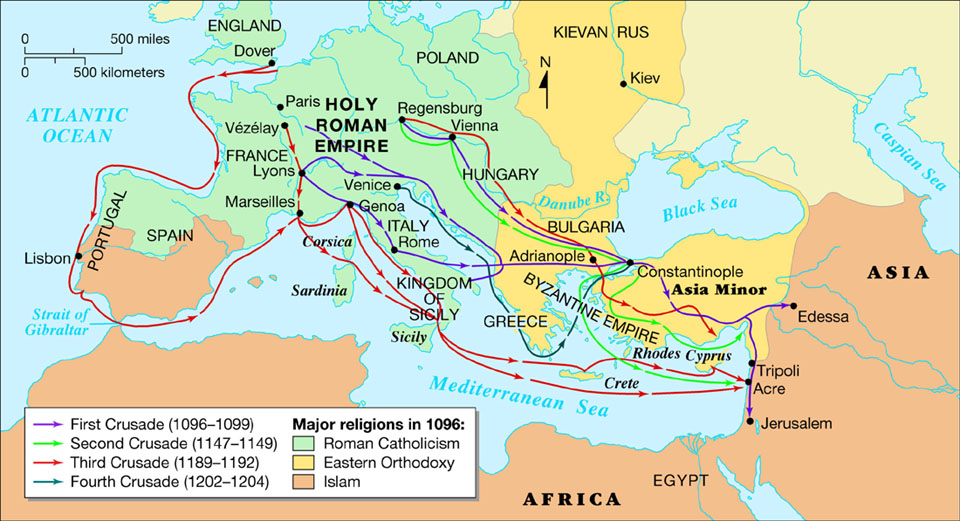
Today’s anti-colonial mindset holds that the Crusaders were foreign intruders. They were, but so were all militarily active parties in the region at the time. For centuries, alien rulers had kept the locally established peoples, Armenians excepted, disarmed and subjugated. It was the policy of Byzantines, Arab conquerors, Egyptians, and the Turkic invaders who arrived shortly before the latest interlopers, the Crusaders.

Everything about the Turks made them the drivers of military and social change in the Crusader era. They were nomadic herders from the steppes of central Asia. Expert mounted archers on small, nimble ponies, they were confident warriors who would swarm their enemies while quickly discharging showers of arrows. Droughts on the steppes spurred them to greener pastures. They met and defeated the Byzantines at Manzikert in 1071. Their subsequent migrations proceeded rapidly. They substituted themselves for nearly all the Arab rulers of statelets in Syria and Palestine. They seized Jerusalem from the Egyptians (who returned to Egypt only to be evicted by the Crusaders). And they encountered the First Crusade soon after it had crossed the Bosporus.

Responding to Turkic weapons and tactics transformed the Crusaders’ Western style of warfare. While armor protected the knights from Turkic arrows, weight considerations precluded the armoring of their horses, which Turkic archers sought to wound or kill before or during battle. The Crusaders responded by reinvigorating an institution much slighted in Western medieval warfare, the infantry.

The idea was to have the knights shielded by an infantry cordon of crossbowmen and pikemen. On a “fighting march” or deployed for battle, the crossbowmen’s arrows would fend off enemy archers whose own arrows had less range and penetrating power. The infantry would open to allow the knights their signature charge. Properly executed with intact warhorses, it could overwhelm any adversary. The system began haltingly during the First Crusade and became standard practice in the Latin Kingdom, the principality of Antioch, and the counties of Edessa and Tripoli.
Infantry requires infantrymen. It was in their recruitment that military change became entwined with social change.

Crusader infantrymen had to be part-timers, in complicated contrast to their knightly comrades. The knights, even with their armed dependents, did not form a permanent army so much as a warrior caste whose status they maintained without intermission. They were born for combat, much as birds are born for flight, and saw it as their calling. Infantrymen were less attuned to war. They were recruited from the resident Christian population, both native and immigrant, urban and rural. Most adult men served in some capacity, if only for garrison duty.

Centuries of Muslim rule had left large, varied Christian populations in place. In the Latin Kingdom, roughly the area comprising modern Israel and Dr. Tibble’s focus, they were perhaps fifty percent of residents. They were more prevalent in Antioch and Edessa where Christian Armenians had, with perseverance, retained a martial culture congruent with the Crusaders’ own. Greek and Syrian Christians of various sects predominated in the Latin Kingdom where they commonly spoke Arabic.

The Crusader rulers bolstered their manpower pool by encouraging farming colonists from the West to settle vacant lands. This magnitude and success of this undertaking have only recently come to light. There are 235 known such colonization sites in the Latin Kingdom alone, with less intense colonization elsewhere.

Newcomers and native Christians generally got along well. They often intermarried, to the dismay of Church officials in Rome who regarded Eastern Christians as schismatics or heretics, but with the complicity of local Catholic churchmen who paid little heed to doctrinal niceties. Strong evidence of Western convergence with the East comes from the military where Armenian and Arabic displaced the Crusaders’ medieval French as the usual languages for training and tactical field commands. Some intrepid men of Eastern-Christian heritage achieved knighthood.

Some indigenous and mixed-heritage Christians became Turcopoles, the Crusaders’ light cavalrymen. Named pursuant to a Byzantine precedent, they specialized in reconnaissance and patrolling. They sometimes had knights and infantry accompany them as they sought to detect and engage hostile infiltrators. Most fighting in the Crusader East occurred in such small-unit actions, not the few great battles. Skirmishers par excellence, and the Turcopoles were in the thick of it.

Completing the Crusaders’ manpower resources were Italian seafarers and the warrior-monks of the military religious orders. Italian sailors and merchants provided crucial assistance to capture the Egyptian-held Palestinian ports. Carpenters and engineers from Italian ships built the Crusaders’ siege engines. The military religious orders, principally the Order of the Hospital of St. John (Hospitallers) and the Knights of the Temple (Templars), augmented the Crusader armies in several ways. As the twelfth century progressed, they promoted tactical “best practices” and placed large contingents of their members in the field armies. They funneled wealth and fresh manpower from Europe to the East. By the 1170s, the orders were responsible for most of the great Crusader castles, Kerak notably excepted.

      Military resources available to the Crusaders lagged their enemies’ growing strength. Political changes exacerbated the disparity. Whereas early Crusaders faced feuding Turkic mini-states and an independent Egypt, their successors confronted a united Turkic/Egyptian  superpower whose consolidation its Kurdish ruler, Saladin, had largely completed by 1186. Egyptian revenues enabled Saladin to fund several armies, each larger than any the Crusaders could muster. Finally in 1187, Saladin crushed the Crusaders at Hattin. A truncated Latin Kingdom, bereft of Jerusalem, survived on a narrow strip of the Palestinian coast. With Edessa having fallen generations before, Antioch and Tripoli also continued as diminished survivors. The Crusaders triumphal years were behind them.

The Crusader Armies offers fine style, rigor without academic jargon, and thorough, unobtrusive documentation. Anecdotes illuminating historical nuances grace Dr. Tibble’s presentation. For example, an account of insubordination attests to how seriously Crusaders, unlike contemporaneous Europeans, stressed military discipline. The culpable fighter won grudging acquittal only because his infraction had harmed the enemy. His excuse, that as a Turk he did not understand the spoken command he had disobeyed, seems not to have mattered.

Some readers will object to Dr. Tibble’s dismissal of religion’s role. He claims that the Crusades can be explained as a clash between nomadic and settled societies without reference to religion. To his credit, he often ignores this dictum. Taken to extremes, it accounts for the Turkic invaders well enough but not their Crusading adversaries.

Dr. Tibble’s treatment of Jews, i.e., his failure even to mention them, is mystifying. He discusses in detail the Crusaders’ relations with everyone else. Why not the Jews? He leaves readers clueless.

His foray into White Crusaders’ attitude toward blacks is welcome but not entirely satisfactory. The Egyptian infantry mostly comprised Black Nubians whom the Crusaders often fought and disdained as men and fighters. Even so, Dr. Tibble writes too loosely of medieval Whites’ “casual racism.” The medieval Song of Roland treats Blacks respectfully. Then again, the author(s) of Roland probably had no experience with Blacks.

The biggest disappointment in The Crusader Armies is the absence of reasoned speculation on the self-identification of the mixed-heritage Crusader families. Many knightly families, for example, including the Latin Kingdom’s royal family, were as much Armenian as European. How did they regard themselves? Perhaps this question presupposes a too modern mentality. Medieval men and women, not indoctrinated with self-identity qualms, could experience personal wholeness within their extended families and their people, where the latter understood is as one’s family’s social milieu, not the modern abstract monstrosity called “the nation.”

Whatever self-identification there had been meant little after Hattin when Saladin launched a sweeping ethnic cleansing of the Crusaders’ hinterlands. All apparently Western Christians, but not Christians identifiable as native, were purged by slaughter, enslavement, or forced exile. It was a draconian program. It also made possible some of the Crusaders’ finest moments.

The scope and speed of ethnic cleansing left Crusader castles isolated in enemy territory without hope of relief. Their defenders, as “men trying to make a point,” Dr. Tibble writes, nonetheless fought heroically. The Hospitallers held Belvoir for eighteen months. At Kerak and Montreal, castles of the secular lord Reynald of Chatillon, whom Saladin personally murdered after Hattin, defenders likewise held out, for nearly two years at Montreal.

It was of these defiant Crusaders that Sir Steven Runciman movingly spoke: “Their lives were precarious and they knew it. … [T]hey faced their doom with pride and resolution.” (Creighton Lecture, Athlone Press, London, 1960, not quoted by Tibble).

The pride of the doomed Crusaders haunts me. It was also the pride of the ancient aristocratic warriors whom Ricardo Duchesne posited as the wellspring of Western civilization and its abiding unique qualities. Modern Christian and Jewish moralists, or, arguably more accurately, the Christian ones goaded by their watchful Jewish mentors, tell us that this pride is a sin or, at best, an abnegation of one’s unceasing obligation to self-criticize and remake oneself and one’s society. Very well, I shall sin and abnegate. I shall not revere Abraham Foxman, Martin Luther King, Pope Francis, Nelson Mandela, Nancy Pelosi, and their ilk as my heroes. For solace, I shall take refuge, if only in my imagination, with the great Christian warlords of the Latin East.
https://www.theoccidentalobserver.net/wp-content/uploads/2018/06/TOO-Full-Logo-660x156-1.png 0 0 Chris Woltermann https://www.theoccidentalobserver.net/wp-content/uploads/2018/06/TOO-Full-Logo-660x156-1.png Chris Woltermann2022-12-22 07:06:422022-12-22 07:07:03The Crusader Armies

Gays, You’re Not Black

December 17, 2022/10 Comments/in General/by Ann Coulter
Gays, You’re Not Black

To make up for slavery and Jim Crow, we abrogated constitutional provisions about freedom of association, freedom of contract and freedom of speech. We tossed out basic rules of fairness to allow (temporarily) affirmative action, set-asides and quotas. Behemoth departments were created in Washington to stamp out the last vestiges of discrimination on the basis of race. …

Unless you’re alleging race discrimination, take your lumps like a cis-gendered white man. You can be fired, not hired, turned away, rejected, called names, disciplined, looked askance at — and no one cares.  

For at least a half-century now, every special pleader in America has made the following argument: Yeah, but what if we were Black?

 This is supposed to be rhetorical kryptonite, capable of anathematizing “discrimination” against any group: atheists, women, gays, immigrants, illegal immigrants, the disabled, Muslims — basically anyone except a fully abled, cis-gendered, White male born in this country.

Oh my gosh! You’re right — we DO have to let girls try out for the Green Bay Packers!

OK, fine, we’ll hire more blind lifeguards.

Of course, Shadi Abdullah is welcome to be president of our campus Hillel group.

Naturally, the “What if they were Black?” argument came up ad nauseum at the Supreme Court last week during oral arguments over Colorado’s “anti-discrimination” law. According to Colorado, making two gay guys who are married to one another feel “unwelcome, objectionable, unacceptable or undesirable” is the equivalent of separate water fountains for black people.

A web designer had petitioned the court, objecting to the law’s requirement that she design a website celebrating a gay marriage, in contravention of her religious beliefs. But if you’d heard only the questions from Justices Sonia Sotomayor and Ketanji Brown Jackson, you’d think the petitioner was refusing to design websites for Black people.

E.g.:

JUSTICE JACKSON: “[C]an I ask you a hypothetical … [What if] they want to have a sign next to the [shopping mall] Santa that says, ‘only white children.’ Why isn’t your argument that they should be able to do that?” [The hypothetical went on for hours, but that was the gist of it.]

These were a few of Justice Sotomayor’s questions:

— “What’s the difference between that and ‘I don’t believe black people and white people should get married’?”

— “Tell me how that’s different, by the way. What you’re basically saying is, in our Ollie’s Barbecue case, the company there said, ‘I’ll serve blacks but only on a takeout window, not inside my restaurant because that sends a message that I endorse integration ….’”

— “Well, when I sit down to eat a meal by a full chef who creates this beautiful picture on a plate, why can’t he say, ‘I make specialized meals for my clients. I will not serve a black person.’”

Here’s a cheat sheet that should help answer the justices’ questions:

Can I refuse to let black kids sit on Santa’s lap? — NO.

Can I refuse to serve black people at my restaurant? — NO.

Can I refuse to bake one of my wedding cakes for black people? — NO.

Can I refuse to write speeches for black people? — NO.

Can I refuse to perform marriage ceremonies for black people — NO.

Can I refuse to let black people into the Marines? — NO.

Can I discriminate against black people for any reason, ever? — NO.

Displaying his own unique approach, Eric Olson, Colorado’s solicitor general, who was defending the law (popular name: “We Won the Right to Gay Marriage and Now We’re Shooting the Wounded”), made this pioneering argument: “What [a business] can’t do is say, ‘I reserve the right to refuse service, which means in practice I will not serve black people.’”

A good rule of thumb is that any claim of discrimination that requires a comparison to black people is sophistry.

No offense — I’m sure the rest of you have really moving tales of woe, full of pathos and suffering. But gays, atheists, disabled people, women (whatever the hell that is), immigrants, illegals, please try to remember: YOU’RE NOT BLACK.

It’s discrimination on the basis of race — and only discrimination on the basis of race — that is forbidden by our Constitution. Other forms of “discrimination” may be stupid (if so, the market will punish you) or blindingly logical (football teams allowing only healthy young men to try out, or religious groups limiting officeholders to practitioners of the religion).

Only one type of discrimination ever stirred up such mass revulsion in this country that we decided to amend our Constitution to prohibit it: race discrimination.

You’d think that at a moment when our entire national dialogue is fixated on the legacy of slavery, it wouldn’t be so difficult for people to grasp that black Americans’ unique history is not amenable to cut-and-paste victimhood.

To make up for slavery and Jim Crow, we abrogated constitutional provisions about freedom of association, freedom of contract and freedom of speech. We tossed out basic rules of fairness to allow (temporarily) affirmative action, set-asides and quotas. Behemoth departments were created in Washington to stamp out the last vestiges of discrimination on the basis of race.

By now, of course, the only discrimination involving black Americans is in their favor. But that doesn’t change the rule: NO DISCRIMINATION ON THE BASIS OF RACE.

As G.K. Chesterton said, “When you break the big laws, you do not get freedom, you do not even get anarchy. You get the small laws.”

That’s what “discrimination” law is today. Instead of one big law: “No Race Discrimination!” we have a million little laws about strict scrutiny, intermediate scrutiny, rational basis test, public accommodations, bona fide occupational qualifications, and on and on and on. At the same time, we have open race discrimination against whites and Asians.

Unless you’re alleging race discrimination, take your lumps like a cis-gendered white man. You can be fired, not hired, turned away, rejected, called names, disciplined, looked askance at — and no one cares.  

This simple rule allows us to live in what we call “freedom.” As the libertarians would say (if they were real libertarians), start your own website business, bakery, Hillel organization, professional football team, holiday, all-women’s eating club, etc. etc. etc.

Gays, you’re not black. (And you’re not Allan Bakke.) Gays’ median household income is about $115,000 — the highest of any group in America. It’s $45,000 for black people. To my gay readers, answer this honestly: When you move into a neighborhood, do home prices go up or down?

Blacks must be looking at gay rights activists in bewilderment, thinking: Why couldn’t we be oppressed like that?

For the rest of you, memorize this, recite it in the shower, write it on your hand: “Unless I’m being discriminated against on the basis of my race, I will stop being a pain in everyone’s ass.”

     COPYRIGHT 2022 ANN COULTER

https://www.theoccidentalobserver.net/wp-content/uploads/2018/06/TOO-Full-Logo-660x156-1.png 0 0 Ann Coulter https://www.theoccidentalobserver.net/wp-content/uploads/2018/06/TOO-Full-Logo-660x156-1.png Ann Coulter2022-12-17 07:26:542022-12-17 07:27:44Gays, You’re Not Black

New Address

December 14, 2022/9 Comments/in General/by Kevin MacDonald

Some people are still mailing to the old address. So once again, here’s the new one:

The Occidental Observer
285 W. Prairie Shopping Center
PMB 115
Hayden, ID 83835

And I’d like to take this opportunity to thank people who are contributing. You make this effort possible!

https://www.theoccidentalobserver.net/wp-content/uploads/2018/06/TOO-Full-Logo-660x156-1.png 0 0 Kevin MacDonald https://www.theoccidentalobserver.net/wp-content/uploads/2018/06/TOO-Full-Logo-660x156-1.png Kevin MacDonald2022-12-14 08:30:472022-12-14 08:30:47New Address

James Edwards at the Counter-Currents Conference, Atlanta 2022

December 12, 2022/2 Comments/in General/by James Edwards

https://www.theoccidentalobserver.net/wp-content/uploads/2018/06/TOO-Full-Logo-660x156-1.png 0 0 James Edwards https://www.theoccidentalobserver.net/wp-content/uploads/2018/06/TOO-Full-Logo-660x156-1.png James Edwards2022-12-12 13:58:302022-12-12 14:00:52James Edwards at the Counter-Currents Conference, Atlanta 2022

What Does Watching the Film “Shadowlands” Bring Up for You?

December 8, 2022/11 Comments/in General/by Robert S. Griffin, Ph.D.

This was posted a week ago for a day with comments put off until this re-posting—the writing gets into what that’s about.   If you missed this post the first time around and want to participate in the comments section, you have time.   This will be on the site a week or so before being archived. 

*   *   *

Much of getting clear about something and figuring out what to do about it involves reactivity.   You stay vigilant to what’s going on in the world and what people are saying and writing about it and what is going on inside you—physical sensations and thoughts and memories and images in your head—and put words to what you make of all of that, and give it articulate meaning, get specific about its significance, what it implies for you, your goals and actions with regard to it and what you think it implies for people collectively.

This contrasts with uncritically taking in what others put in front of you—the media (movies and TV, etc.) and what politicians, journalists, professors, advocates, podcasters, and such insert into the public discourse—and go, “Yes, that sounds good” or “Nah” and leave it at that or offer an off-the-top remark to people around you or on social media or in comments sections in webzines like this one.

Especially if the second paragraph above characterizes you more than the first, I’d like to push up against that a little in this writing.  This post is an invitation to respond in depth to something.

*   *   *

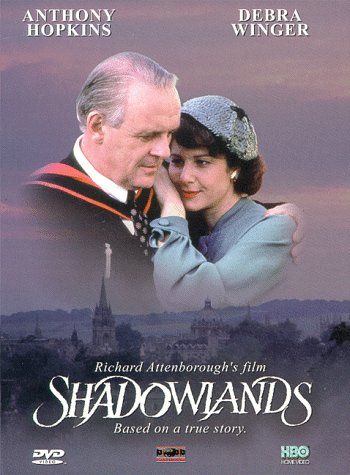
I streamed a movie the other day that prompted responses in me that made a difference in how I see things, including myself, and that have stayed with me, and I think it might do the same for you.  It’s “Shadowlands,” a 1993 British based-on-a-true-story drama about the mid-life relationship between the British Oxford and Cambridge academic and popular Christian theologian and writer C.S. Lewis—he’s best known for his children’s Narnia stories—and the Jewish-American poet Joy Davidson.  The story takes place in Britain in the 1950s.    It’s directed by the Brit David Attenborough and stars Anthony Hopkins as Lewis and Debra Winger as Davidson.

I found “Shadowlands” a superb film.  Hopkins’ and Winger’s performances, wow.   If nothing else comes out of the activity I’m going to suggest, you might see a good movie. But the big thing in this context, I think “Shadowlands’ is nutritious food for thought, so to speak, including about mortality, though I don’t want to go into themes or possible perspectives more than that because I don’t want to channel your engagement with the film.  I’ll leave it that it seems to me that if you’re of the sort drawn to reading a publication like this one, there’s a lot for you to work with here.

You can stream “Shadowlands” on Google Play, Vudu, Amazon Prime, iTunes, Apple TV, and I’m sure other places, and you can buy it inexpensively—you know where to go for that.  You can watch it free as a YouTube, though the resolution isn’t very sharp on that print and I’m concerned that that will keep you distant from the reality of what is being depicted, including the breathtaking landscapes that dot the film; better to pay the $3.95, or whatever it is, rental and get the full measure of the “Shadowland” experience.

Here’s what I’m thinking:  This post is only up for the day and no comments allowed.  This same post will be up a week from now with the comments section open then.  The time between now and next week will give you the chance to pay the dues required to comment—namely, to see the film and work with it so that your comment can go into some depth, offer more than the opinion spurt so prevalent in this text-and-social-media-conditioned age.

I realize you may not be up for either watching the film or giving over time to discerning what it prompted in you and sharing that, and that’s perfectly fine, you may well have better things to do with your time, but that’s the invitation.  What’s behind making it is my hope that, in a small way, for some people, this exercise will move them toward becoming more of a participant in the meaning-making and public-dialogue-and-debate process rather than remaining essentially a recipient and yea-or-nay reactor to the pronouncements of others.

*   *   *

So, if you’re up for it, watch “Shadowlands” over the next week and share the best of your thinking as a comment when it’s back on this site.  Let’s say that what you give the rest of us is within the focus of this webzine, that you believe it will contribute positively to us, that you write at least one crafted paragraph, and that your response(s) to other commenters are of this same sort.  I’ll respond to every comment that meets those criteria.

I hope this turns out to be an enjoyable and productive time for you.  All I know for sure is that I was engaged by “Shadowlands” and respected it as a film and that it prompted thoughts and feelings that matter to me—I’ll get into some of them in the comments section next week—and that the idea of week-delayed, in-depth comments had enough weight for me to put energy today into writing up this post.  But that’s me, you do you.

Perhaps you and I and some others will meet up here next week.  In any case, have the best week you can in the one chance you’ll get to live it.


https://www.theoccidentalobserver.net/wp-content/uploads/2018/06/TOO-Full-Logo-660x156-1.png 0 0 Robert S. Griffin, Ph.D. https://www.theoccidentalobserver.net/wp-content/uploads/2018/06/TOO-Full-Logo-660x156-1.png Robert S. Griffin, Ph.D.2022-12-08 05:32:382022-12-08 07:33:51What Does Watching the Film “Shadowlands” Bring Up for You?

Trump IS Nick Fuentes

December 5, 2022/30 Comments/in General/by Ann Coulter
Trump IS Nick Fuentes

Who’s the happiest guy in America this week?

Nick Fuentes. In a matter of days, he’s gone from total obscurity to the most famous person in the country. Everybody’s talking about him!

Until he had dinner with Trump, literally, no one had ever heard of him (except various “hate watch” groups scamming money out of the perpetually alarmed). That’s not for lack of trying on Fuentes’ part. He was doing anything he could think of to get people to notice him.

You say praising Hitler will get me in the news? Watch this!

[Twenty researchers at People for the American Way earnestly type up reports titled, “The Dangerous Rise of Far-Right Extremism,” then blast them to the Upper West Side.]

Serendipitously, Donald Trump is also desperate for attention. As president of the United States, he used to brag to anyone who would listen about the important people who called him. (You know, the way a lot of serious adults do.) Rupert Murdoch calls me every day!

     He proudly produced the letters he’d exchanged with North Korean leader Kim Jong Un to journalist Bob Woodward, telling him the letters were “soooo top secret,” and asking Woodward (again, a JOURNALIST) (for The Washington Post!), “Don’t say I gave them to you. OK?”

This is a man who faked a Time magazine featuring him on the cover with the headline, “TRUMP IS HITTING ON ALL FRONTS … EVEN TV!” — and hung them on the walls of his golf clubs.

It’s like an episode of “Dynasty.”

So you can well imagine Trump’s state of mind right now. He blew the midterms, everyone knows he blew the midterms, and then held a funereal presidential announcement at Mar-a-Lago, attended by only losers and grifters.

After the grim event, those of us unlucky enough to be on his email list were bombarded with messages announcing the MAJOR ENDORSEMENTS he’d received! (Nearly 10!)

Endorsement of President Donald J. Trump by Texas Agriculture Commissioner Sid Miller

Endorsement of President Donald J. Trump by the New York Young Republican Club

Each of the no-name and/or crazy people endorsing him was proclaimed in a separate email for maximum impact. I don’t know whose endorsement carries any weight these days — definitely not Trump’s — but it’s sure not these guys.

The point is: When you’re the former president and you’re bragging about the Young Republican Club of New York City endorsing you for president, Nick Fuentes is a HUGE “get.”

Trump was dying to have anyone famous come to Mar-a-Lago. Kanye West (Ye) is a big name, right? A strongly strong name. Plus, he’s probably not getting a lot of dinner invitations these days anyway. So Trump invited Ye, and Ye brought Fuentes.

MAJOR SCORE!

For days, Trump’s “Springtime for Hitler” dinner led on every program on MSNBC. Also CNN. Probably ESPN and the Cartoon Network, too.

Fuentes is the biggest news since a white guy shot up a Chesapeake Walmart. Scratch that — he was Black. Since a White guy shot up a Colorado Springs gay nightclub! Oops, let’s move on — he’s nonbinary.

Oh well, never mind. Fuentes is big, big news! Extensive clips of his sad little podcast (six viewers) have been playing around the clock on TV. He’s been featured in 20 separate articles in The New York Times alone, getting billboarded, front-page coverage.

Even with the Times’ flood-the-zone approach toward any vaguely White man who says something stupid, Fuentes never made the paper until Dec. 16, 2020 — in the 26th paragraph of a Thomas Edsall column: “At the pro-Trump rally in Washington on Dec. 12, the day after the Supreme Court decision, the crowd chanted ‘Destroy the G.O.P.’ at the urging of Nick Fuentes, a far-right opponent of immigration.”

Since then, despite his leaping in front of any microphone within 50 miles, Fuentes has appeared only in buried asides in a few dozen articles (about Jan. 6, natch).

But now — now, Fuentes is a star! Just like Trump. Fuentes and Trump: Narcissistic baby morons whose sole driving force in life is being FAMOUS!

Most people are unfamiliar with this emotion. A normal person likes everything about fame — except the fame part. (I tried to turn down the Time magazine cover, as the reporter John Cloud could confirm.)

Another similarity of the narcissistic baby morons: Both briefly gained respectability when, amid their babbling idiocies, they happened to hit upon immigration, and were rewarded by a nation crying out for anyone to give a damn about our country.

We didn’t want the incendiary stuff, but if that’s what it took to get immigration on the table, fine, we’ll take it. At least they weren’t calling illegal immigration an “act of love.” (Jeb!™)

Sadly, it turned out they were just monkeys typing for an infinite amount of time and producing Shakespeare. Recall that Trump first tried running for president in 2012 by pushing birtherism. Crash and burn.

Then by complete chance — the happy accident of Trump seeing me discuss my book Adios, America! and requesting a copy — in 2015, he started talking about immigration. He was pointlessly nasty, utterly ignorant, but at least he was talking about it. No one else would, so he became president.

But now, it’s perfectly clear that Trump’s bluster about a wall and deporting illegals was just random words that he assembled. He didn’t intend to do it, didn’t understand it and didn’t care.

Now, he’s back to his loony-tunes, get this! mode, still perseverating about his “sacred landslide election victory” being “viciously” stolen from him — in an election year when there was a red wave for every Republican but him.

From what I’ve read, Fuentes has roughly the same B.S.-to-sanity ratio, winning fans on those occasions when he talked about immigration, then deciding to spend 99% of his time trying to say things so repellent that he’d make news.

He’s made it now! You can’t turn on the TV without seeing Fuentes talking about imposing a Catholic dictatorship, Hitler is great, women should be forced to marry young and have children, and Trump must be made dictator for life.

Is he humiliated? No! He’s on TEE-VEEEEEEEEEEEEEEEEEEEE!!!!

The irony is: All the cable news hosts making Fuentes a star are driven by the same weird compulsion. No one paid by a television network is any less craven than Trump and Fuentes. Liberals are suddenly reborn as right-wingers at Fox, and the reverse happens at MSNBC and CNN. What do I have to believe? Please. I’m willing to say anything.

Of all the addictions — gambling, drinking, drugs — none leads to more embarrassing behavior than the quest for fame.

Unfortunately for the country, we are now locked in a situation where Trump, Fuentes and the media have identical interests: Keep Trump and Fuentes in the news.

     COPYRIGHT 2022 ANN COULTER

https://www.theoccidentalobserver.net/wp-content/uploads/2018/06/TOO-Full-Logo-660x156-1.png 0 0 Ann Coulter https://www.theoccidentalobserver.net/wp-content/uploads/2018/06/TOO-Full-Logo-660x156-1.png Ann Coulter2022-12-05 05:47:262022-12-05 05:47:26Trump IS Nick Fuentes

Book Review of Culture of Critique with Mark Collett

December 2, 2022/9 Comments/in General/by Kevin MacDonald


https://www.theoccidentalobserver.net/wp-content/uploads/2018/06/TOO-Full-Logo-660x156-1.png 0 0 Kevin MacDonald https://www.theoccidentalobserver.net/wp-content/uploads/2018/06/TOO-Full-Logo-660x156-1.png Kevin MacDonald2022-12-02 10:51:512022-12-02 10:51:51Book Review of Culture of Critique with Mark Collett
Page 199 of 256«‹197198199200201›»
RSS Feed Logo RSS Feed Logo Subscribeto RSS Feed

Kevin MacDonald on Mark Collett’s show reviewing Culture of Critique

James Edwards at the Counter-Currents Conference, Atlanta, 2022

Watch TOO Video Picks

video archives

DONATE

DONATE TO TOO

Follow us on Facebook

Keep Up To Date By Email

Subscribe to get our latest posts in your inbox twice a week.

Name

Email


Topics

Authors

Monthly Archives

RECENT TRANSLATIONS

All | Czech | Finnish | French | German | Greek | Italian | Polish | Portuguese | Russian | Spanish | Swedish

Blogroll

  • American Free Press
  • American Freedom Party
  • American Mercury
  • American Renaissance
  • Arktos Publishing
  • Candour Magazine
  • Center for Immigration Studies
  • Chronicles Magazine
  • Council of European Canadians
  • Counter-Currents
  • Curiales—Dutch nationalist-conservative website
  • Denmark's Freedom Council
  • Diversity Chronicle
  • Folktrove: Digital Library of the Third Way
  • Human Biodiversity Bibliography
  • Institute for Historical Review
  • Mondoweiss
  • Pat Buchanan
  • Paul Craig Roberts
  • Project Nova Europea
  • Red Ice
  • Richard Lynn
  • Rivers of Blood
  • Sobran's
  • The Occidental Quarterly Online
  • The Political Cesspool
  • The Raven's Call: A Reactionary Perspective
  • The Right Stuff
  • The Unz Review
  • VDare
  • XYZ: Australian Nationalist Site
NEW: Individualism and the Western Liberal Tradition

Also available at Barnes & Noble

Culture of Critique

Also available at Barnes & Noble

Separation and Its Discontents
A People That Shall Dwell Alone
© 2025 The Occidental Observer - powered by Enfold WordPress Theme
  • Link to X
  • Link to Dribbble
Scroll to top Scroll to top Scroll to top

By continuing to browse the site, you are legally agreeing to our use of cookies and general site statistics plugins.

CloseLearn more

Cookie and Privacy Settings


How we use cookies

We may request cookies to be set on your device. We use cookies to let us know when you visit our websites, how you interact with us, to enrich your user experience, and to customize your relationship with our website.

Click on the different category headings to find out more. You can also change some of your preferences. Note that blocking some types of cookies may impact your experience on our websites and the services we are able to offer.

Essential Website Cookies

These cookies are strictly necessary to provide you with services available through our website and to use some of its features.

Because these cookies are strictly necessary to deliver the website, refusing them will have impact how our site functions. You always can block or delete cookies by changing your browser settings and force blocking all cookies on this website. But this will always prompt you to accept/refuse cookies when revisiting our site.

We fully respect if you want to refuse cookies but to avoid asking you again and again kindly allow us to store a cookie for that. You are free to opt out any time or opt in for other cookies to get a better experience. If you refuse cookies we will remove all set cookies in our domain.

We provide you with a list of stored cookies on your computer in our domain so you can check what we stored. Due to security reasons we are not able to show or modify cookies from other domains. You can check these in your browser security settings.

Other external services

We also use different external services like Google Webfonts, Google Maps, and external Video providers. Since these providers may collect personal data like your IP address we allow you to block them here. Please be aware that this might heavily reduce the functionality and appearance of our site. Changes will take effect once you reload the page.

Google Webfont Settings:

Google Map Settings:

Google reCaptcha Settings:

Vimeo and Youtube video embeds:

Privacy Policy

You can read about our cookies and privacy settings in detail on our Privacy Policy Page.

Privacy Policy
Accept settingsHide notification only