Western Culture

Decline and Empire in Ancient Rome and the Modern West: A Review of David Engels’ Le Déclin, Part 2

Go to Part 1.

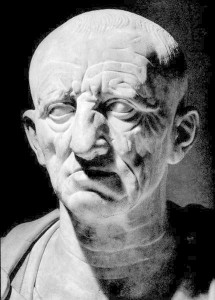
Cato the Elder

Roman Conservative & Imperial Responses

The Roman authorities, whether republican or imperial, did not passively accept these developments. Engels observes that “[f]rom the second century B.C., a large number of conservative politicians opposed with a marked traditionalism the Hellenization of the Roman elite and the Orientalization of the population” (142). This was embodied above all by Cato the Elder, who argued that Greek culture, which had become so rational, skeptical, and cosmopolitan, would mean the end of Rome:

Concerning those Greeks, son Marcus, I will speak to you more at length on the befitting occasion. I will show you the results of my own experience at Athens, and that, while it is a good plan to dip into their literature, it is not worth while to make a thorough acquaintance with it. They are a most iniquitous and intractable race, and you may take my word as the word of a prophet, when I tell you, that whenever that nation shall bestow its literature upon Rome it will mar everything. (Pliny, Natural History, 29.7)

In terms of immigration, as previously mentioned, Gaius Papius had on behalf of the people apparently sought to expel non-Italic foreigners from the city altogether. Augustus later limited the emancipation of slaves, “lest they should fill the city with a promiscuous rabble; also that they should not enroll large numbers as citizens, in order that there should be a marked difference between themselves and the subject nations” (Cassius Dio, 56.33).

The Roman leadership also sought to counter native demographic decline. As early as 131 B.C., the censor Quintus Metellus Macedonicus urged making marriage mandatory. Later, “in order to ensure the biological survival of the Roman elite, Augustus . . . decreed very unpopular laws” (83), including making marriage mandatory for men between 25 and 60 and making divorce more difficult. The emperor is supposed to have justified the measures as follows:

For surely it is not your delight in a solitary existence that leads you to live without wives, nor is there one of you who either eats alone or sleeps alone; no, what you want is to have full liberty for wantonness and licentiousness. … For you see for yourselves how much more numerous you are than the married men, when you ought by this time to have provided us with as many children besides, or rather with several times your number. How otherwise can families continue? How can the State be preserved, if we neither marry nor have children? . . . And yet it is neither right nor creditable that our race should cease, and the name of Romans be blotted out with us, and the city be given over to foreigners — Greeks or even barbarians. Do we not free our slaves chiefly for the express purpose of making out of them as many citizens as possible? And do we not give our allies a share in the government in order that our numbers may increase? And do you, then, who are Romans from the beginning and claim as your ancestors the famous Marcii, the Fabii, the Quintii, the Valerii, and the Julii, do you desire that your families and names alike shall perish with you? (Cassius Dio, 56.7–8)

Tellingly, Augustus himself however was married twice and had a reputation for licentiousness. His only biological child, Julia, was notorious for her licentiousness. Read more

Decline and Empire in Ancient Rome and the Modern West: A Review of David Engels’ Le Déclin, Part 1

David Engels, Le Déclin: La crise de l’Union européenne et la chute de la République romaine—quelques analogies historiques
Paris: Éditions du Toucan, 2016, 3rd ed.

David Engels is a professor of classics at the French-speaking Free University of Brussels (ULB). While most academics and their works languish in relative obscurity, the 38-year-old Engels has already made a name for himself as a conservative cultural critic, known for his op-eds and interviews in the mainstream media, as well as for his best-seller comparing the decadence of ancient Rome and modern Europe: Decline: The Crisis of the European Union and the Fall of the Roman Republic—A Few Historical Analogies.[1]

Hailing from Belgium’s small German-speaking community, Engels writes about Europe from a refreshingly multinational perspective, drawing from English-language, French, and especially German sources, as well as, of course, the vast body of surviving Greek and Roman literature. With over 600 endnotes and numerous graphs and statistics, Engels’ book has been written with Teutonic scrupulousness.

Engels’ thesis is simple and compelling: there are many parallels between the late Roman Republic (the period roughly from the destruction of Carthage in 146 B.C. to Augustus’ founding of the Principate in 27 B.C.) and today’s European Union: There is above all a general ethno-cultural decline, which makes a shift towards autocratic politics inevitable. Engels frames his provocative thesis in just such a way as to still be considered respectable enough by academia and the media, and thus be treated as a responsible but critical interlocutor.

The parallel between the late Roman Republic and today’s European Union is somewhat forced in places, but really serves as a useful framing device for comparing and discussing the social trends in these two very different societies. Specifically, Engels structures the work by comparing European public opinion on various topics (identity, family, democracy…) as expressed in Eurobarometer polls with Roman developments as expressed in the surviving sources. This somewhat strange structure nonetheless works, and I would say Le Déclin is a fine introduction to late Roman republican history. Engels furthermore recognizes that many of Europe’s symptoms of decadence are also evident across the West in general (255).

Engels’ observations on contemporary EU politics—the hollowing out of democratic processes and civil rights, economic reductionism, a growing chasm between the elite and the people, rising ideological intolerance, and so on—are all on point, and have since almost become received opinion. I will then focus especially on Engels’ analysis of Roman decadence. As will become quite apparent, the Roman experience, one of the truly epic achievements of Western political history, offers many lessons for us today. Read more

The Puritan Intellectual Tradition in America, Part 3: Was the 1924 Immigration Law Too Little, Too Late?

Go to Part 1
Go to Part 2

Concluding Thoughts on the Puritan Intellectual Tradition in America

An interesting feature of Puritanism is the tendency to pursue utopian causes framed as moral issues—their susceptibility to utopian appeals to a ‘higher law’ and the belief that the principal purpose of government is moral. New England was the most fertile ground for “the perfectability of man creed,” and the “father of a dozen ‘isms.’”[1] There was a tendency to paint political alternatives as starkly contrasting moral imperatives, with one side portrayed as evil incarnate—inspired by the devil. Puritan moral intensity can also be seen in their “profound personal piety”[2]—their intensity of commitment to live not only a holy life, but also a sober and industrious life. Read more

The Puritan Intellectual Tradition in America, Part 2: The Period of Ethnic Defense, 1890-1965

Go to Part 1.

The early part of the twentieth century was the high-water mark of Darwinism in the social sciences. It was common at that time to think that there were important differences between the races in both intelligence and moral qualities. Not only did races differ, they were in competition with each other for supremacy. For example, William Graham Sumner was a social Darwinist; he thought that social class and racial divisions as well as competition were part of the natural order of things. Writing in 1903, he noted that “the two races live more independently of each other now than they did” during the slave era.[1] Whereas later in the century, Jewish intellectuals led the battle against Darwinism in the social sciences, racialist ideas became part of the furniture of intellectual life—commonplace among intellectuals of all stripes, including a significant number of Jewish racial nationalists concerned about the racial purity and political power of the Jewish people. Many of them were Zionists who believed in the importance of Jewish racial purity (a Jewish homeland in Israel would prevent assimilation and intermarriage) and Jewish racial superiority .[2] Read more

The Puritan Intellectual Tradition in America, Part 1: Nineteenth-Century Optimism and Utopian Idealism

This is about a pernicious strand of European thinking that is an important component of the crisis we face today—the Puritan strand of American thought which dominated America until the 1960s counter-cultural revolution. The synopsis is that in the nineteenth century, Puritan-descended intellectuals engaged in utopian, idealistic fantasies, often with moralistic overtones. Then after the Civil War, this type of thinking went into disfavor, replaced by Darwinian thinking which reached its apex in the battle over immigration, ending with the passage of the 1924 law. However, this intellectual shift was eradicated by the Jewish-dominated intellectual movements I discuss in The Culture of Critique.

The culture of the West is complicated—a blend really between very different cultural influences. A basic idea is that Western societies are individualistic—far more individualistic than any other culture area of the world. But within that general framework of individualism, there are important differences.

One important strand derives from Indo-European culture: From the Pontic Steppes of the Ukraine around 4500 years ago. This culture was completely militarized; it was aristocratic and strongly hierarchical. Read more

Ancient Sparta: The First Self-Conscious Ethnostate? Part 3: The Virtuous Circle of Spartan Power

Go to Part 1.

Go to Part 2.

The Virtuous Circle of Spartan Power: Discipline Through Lordship

The defining fact of Spartan life was the hard-won conquest of neighboring Messenia in the eighth century and the enslavement of its population as Helots. This victory had launched the virtuous circle of Spartan power. The subjugated Helots provided the Spartan citizen-soldiers with both the leisure and the imperative need to dedicate themselves to martial prowess in the face of a constant threat of rebellion at home. The entire social organization of Sparta came to reflect this state of affairs. Thucydides noted: “most Spartan institutions have always been designed with a view to security against the Helots.”[1]

The system instituted by Lycurgus proved remarkably successful for centuries. The organization and training of the—at their height—around 8,000 Spartan citizen-soldiers to suppress the Helots also translated into international military power, which in turn allowed Sparta to secure allies and thus yet more military power in the Peloponnese. Xenophon opens his account of the Spartan regime saying: “Sparta, despite having one of the lowest populations, had nonetheless clearly become the most powerful and most famous state in Greece.”[2] The unsentimental Thucydides says of Sparta: ‟its system of good order is very ancient and it has never been subject to tyrants. Read more

Ancient Sparta: The First Self-Conscious Ethnostate? Part 2: Commitment to Collectivism

Go to Part 1.

There is a sense in which all life for Spartan citizens was communal and hierarchical. Even once one had completed the agoge, Spartiates would eat together in common mess halls, again creating common feeling. The ages were mixed, so that the older could teach the young, and citizens were expected to discuss noble deeds. In the gymnasium, the oldest man would supervise, and citizens were expected to train regularly. Xenophon claims that “it would certainly not be easy for anyone to find men healthier or more physically apt than Spartiates.”[1]

Lycurgus reputedly had accompanied his basic law with a land reform giving each of those in the small citizen class an equal property, although economic inequality gradually accumulated over time. A positive consequence of the Spartans’ systematically communal lifestyle was an extremely high degree of trust among citizens. They shared each other’s hunting dogs and horses, the latter being extremely valuable property in those days. Citizens even trusted others to beat their own children if they had done wrong, for “there was a sense in which everyone regarded himself as father, tutor, and commander of each boy.”[2]

The entire society was oriented towards inculcating martial valor and unity. Cowards were severely stigmatized—so much so that they could be beaten freely—and “the citizens considered an honorable death preferable to a life of disgrace.”[3] Read more