Western Culture

“One Battle After Another” (2025): Radical Politics & Fetishized Miscegenation, Part 1

Max West writes at Logical Meme and on X at @Logicalmeme. He is the author of Normism: The Philosophy of Norm Macdonald (2021).

NOTE: Spoilers ahead.

9023 words

I.             Overview

One Battle After Another opens with a prologue set 16 years prior to the current day, which sets up the decades-long chain of events that are to follow. We see a fictional, far-Left, militant, revolutionary group called the French 75 (based on a fusion of the Weather Underground and the Black Liberation Army) engaged in the violent ‘liberation’ of the equivalent of an ICE detention facility. The establishment shot to this first sequence is the Otay Mesa Detention Center in San Diego (a real federal detention facility), which is denoted in a title card, and the film’s soundtrack provides the requisite swelling-strings stylization, the sort of conveyor-belt “feel sad here” cue we’re accustomed to in Hollywood’s endless production of Holocaust films featuring gaunt prisoners in concentration camps (except in the case of Mexican illegals, the body type is generally the opposite of gauntness).

In the wake of the violent January 2026 anti-ICE protests in Minnesota that further divided the nation, One Battle subsequently received a slew of Academy Award nominations, winning Best Picture, Best Director (Paul Thomas Anderson), Best Adapted Screenplay (Paul Thomas Anderson), and Best Supporting Actor (Sean Penn). These outcomes come as no real surprise, given Hollywood’s penchant for trendy political content and public virtue-signaling.

However, at its core One Battle is a White male liberal’s glorification of radical Black politics and, to an odd and striking degree, Black female hypersexuality. Anderson awkwardly enmeshes his film with a miscegenation fetish and a portrayal of militant Leftwing radicalism as having a racialized sexual dimension, of sexual ‘liberation’ being an essential component of revolutionary politics. Secondarily, the film elevates Mexican illegal immigrants to a near-sacred status. Collectively, these representations of non-White groups amount to a cringe-inducing romanticization of the Other, all of which is further amplified by a one-dimensional and mystifyingly juvenile caricature of the police and military as ‘fascist’ thugs wantonly committing summary executions and getting sexually aroused by Black women pressing loaded guns against them. It’s all so very strange.

Such characterizations are informative, however, in revealing the modern Left’s current morality play. Here lies a paranoid, conspiratorial mindset, and an emotional rendering of Black and Brown groups’ respective ‘persecutions’ in a ‘fascist’ America. In today’s Cultural Marxism, which might be more accurately called Identity Marxism, traditional Marxist conflict theory (of oppressor vs oppressed) is applied to identity groups rather than just economic classes. This post-1960s trend centers on identity politics — focusing on race, gender, and sexuality — to create a matrix of oppression, a blueprint from which one can restructure society.

Beyond its boilerplate agitprop qualities, One Battle is more interesting when looked at as just one more instance of Hollywood’s many liberal revenge fantasies against White America. One Battle does this in much the same way that films such as Jordan Peele’s Get Out (2017) or Ryan Coogler’s Sinners (2025) do.[1]

Liberal film critic Richard Brody describes One Battle as “a work of grand symbolic design” and speaks for many progressive fans of the film when he interprets Anderson’s alternate history narrative in hyperbolic terms. Anderson, he writes, “looks profoundly beyond the immediate terms of his fiction to reach powerful insights regarding the horrors of the moment” (Brody, 2025). The film attempts to juxtapose absurdist political satire (primarily of conservatism, à la Kubrick’s Dr. Strangelove) with earnest Leftist preaching and hand-wringing, but the stark contrasts in style — correlated with the respective political positions — only serves to highlight the film’s didacticism. In short, One Battle captures the contorted, paranoid psyche and moral framework of today’s Left and stands as the most influential liberal moral panic film of the past year.

II.            Age of Anxiety and The Leftist Moral Panic

It is not exactly a new nor controversial thesis to say that our culture feels unmoored. Among the Western nations, the crisis of post-industrial late modernity is real and its causes multifold. We can divide these causes into internalized and externalized factors. The external factors are objectively external (e.g., atomization & social fragmentation; mass third world immigration; feminization of culture; digital information overload; A.I.) while the internalized factors are just that: attitudes and beliefs altered within individuals and, by extension, society as a whole. From a Voegelinian perspective[2], we can see a loosely causative and almost circular relationship to these internal factors, some of which include: alienation => digital anxiety => narcissism => epistemic instability => conspiracy theorizing => gnosticism => radicalization (i.e., activist transformation of the world). The Left and the Right of course react to the external factors in vastly different ways, and so internalize their subsequent anxieties differently. With respect to how the Left reacts to these external factors — that is, how they internalize associated anxieties into their psyches (and their art) — One Battle serves as an archetypal example.

In The End of Ideology (1960), Daniel Bell argued that in prosperous democracies, the grand, transformative political ideologies of the nineteenth and early twentieth centuries — the ideologies which aimed to radically reshape society (e.g., Marxism, Nazism) — no longer inspire mass commitment. Revolutionary appeals to the working class were effectively diffused by Keynesianism and an expanding welfare state. Bell and likeminded thinkers anticipated that, in the West, politics would shift toward pragmatic, incremental, piecemeal problem-solving — technical adjustments, expert-driven reforms, and pluralist negotiation — rather than sweeping ideological visions or eschatological promises of utopia. In the U.S., this has largely been true: the Leftist radical activism of the 1960s–1970s (e.g., Weather Underground, Black Panthers) faded into insignificance, eventually becoming little more than touchpoints of cultural nostalgia, much like the Hippies.

Unlike in the 1960s, among today’s influential Leftists there is no explicit call for revolution per se, at least none with any real traction, no political manifesto akin to Marx’s to rally behind and serve as a foundational organizational text. Leftist propaganda today is delivered in a more personalized and individualized form, commensurate with our social media age of curated information flows. If there is anything resembling a unifying ideology for today’s Left, it is Wokeness. This presents itself as a hazy and inexact form of moral indignation, one that collectively coalesces around Anti-Whiteness. Far more so than class, today’s Left is animated by identity politics surrounding race and gender.

In The Opium of the Intellectuals (1955), Raymond Aron argued that Leftist ideology functions like a secular religion, immune to evidence and hostile to dissent. Marxism became the “opium” of Western intellectuals, offering moral exaltation, historical certainty, and a sense of belonging while obscuring the layers and complexities of political reality. Aron argued that the Left had become a moral identity rather than a coherent political program: intellectuals equated “Left” with justice and “Right” with reactionism, fascism, racism, and the like. While Aron’s book is chiefly a dissection of French left-wing conformism and intellectual life in the 1940s–1950s, it has predictive value when evaluating the modern Left in the U.S., which has in many ways begun to parallel the trajectory of 1960s French Leftism, not so much in revolutionary ambitions (e.g., May 1968) but in the spiritual despair, nihilism and narcissism that underlies it.[3] The influential conservative philosopher Roger Scruton, who witnessed the May ’68 riots while in Paris, has described them as “a kind of adolescent insouciance, a throwing away of all customs, institutions, and achievements, for the sake of a momentary exultation which could have no lasting sense save anarchy” (Scruton, 2003).

So, might we be in the early stages of a resurgent, 1960s-style, radical activism among the Left… a Version 2.0? The Far Left has made serious inroads toward control of the Democratic Party: younger generations adept at social media (AOC, Mamdani, etc.) are shaping the Party’s intrinsic national message, which in turn changes the Party’s platform, actualized policies, and lastly and sometimes reluctantly, the stated positions of the Party’s elders themselves. (As an example, one need only look at the radical leftward change in position on illegal immigration that figures such as Joe Biden, Barack Obama, and Hilary Clinton have displayed from the mid-1990s to the present). Particularly among the young, there is also the Left’s increasing propensity and willingness to use violence to achieve political goals (Antifa rioting; George Floyd rioting, the assassination of Charlie Kirk; two assassination attempts on Donald Trump; the Left’s lionization of Luigi Mangione, who murdered UnitedHealthcare CEO Brian Thompson; numerous attempts to murder ICE agents; etc.), which comports with the political message of One Battle.[4]

III.          Weather Underground + Black Liberation Army = French 75

In One Battle, the fictional, far-Left, militant, revolutionary group called the French 75 is based on a fusion of the Weather Underground and the Black Liberation Army. The title One Battle After Another was itself taken from a Weather Underground missive written by Bernardine Dohrn in 1969. In a February 2026 interview[5], the ever-unrepentant Weather Underground terrorist (and Obama mentor) Bill Ayers effusively praises Paul Thomas Anderson’s film One Battle After Another (2025) and asserts that Anderson “obviously read everything about the Weather Underground. He obviously listened to our son Zade Dohrn’s podcast Mother Country Radicals. He obviously researched Assata Shakur and the Black Liberation Army.” Ayers argues that Anderson, in taking the now-mythic iconography of 1960s radicalism and placing it in a contemporary timeframe, un-freezes this chapter of American history from cultural nostalgia and makes it relevant for our current times, almost as a call to action.

“The title One Battle After Another,” Ayers says in an eye-opening part of the interview, “is taken from a speech Bernardine [Dohrn] gave. … The context of the speech was explaining how we can be defeated but we have to keep going,” i.e., we must fight one battle after another.[6] What Ayers is referring to isn’t a traditional speech but a revolutionary statement written by Dohrn in the October 21, 1969 edition of FIRE!, the Weather Underground’s propaganda-style publication that became associated with the terrorist group after it literally went underground.[7] The statement reads:

On Monday, October 6, a pig statue honoring the murderers of Chicago strikers was blown to bits. On Tuesday, October 7, the head of the Chicago Pig Sergeants Association said that “SDS has declared war on the Chicago Police — from here on in it’s kill or be killed.” On Wednesday, October 8 a white fighting force was born in the streets of pig city. … We came to Chicago to join the other side — to stop talking and start fighting … to destroy the motherfucker from the inside.

There were only 500 of us, but we forced Pig Daley to call in the Guard… We did what we set out to do, and in the process turned a corner. FROM HERE ON IN IT’S ONE BATTLE AFTER ANOTHER — WITH WHITE YOUTH JOINING IN THE FIGHT AND TAKING THE NECESSARY RISKS. PIG AMERIKA — BEWARE: THERE’S AN ARMY GROWING RIGHT IN YOUR GUTS, AND IT’S GOING TO HELP BRING YOU DOWN. DID THAT PIG SAY KILL OR BE KILLED?

What can we infer from this? Well, it would appear that Anderson either named his film One Battle After Another after encountering Dorhn’s rant himself or after someone in his circle of family/friends suggested the title after they had read Dohrn’s rant. In either case, it is implausible that Anderson did not know of Dohrn’s rant when deciding to name his movie. Given Anderson’s auteur status as a writer/director, and the absolute (and rare) creative control he has over his filmmaking process, it would be far too coincidental otherwise. Furthermore, any doubts can be laid to rest when we consider that Anderson’s script has the Perfidia character use a phrase from the above Dohrn rant: In her “declaration of war” to the guards of the migrant detention facility, she characterizes her violent activism as itself a natural reaction. “We’re here to right your wrongs, motherfucker. You got an army growing in your fucking guts, and you put it there.”

This, in turn, leads us to wonder if Anderson’s militant radicalism is far deeper than he publicly reveals. It’s either that or his turning a blind eye to the Weather Underground’s ideological justification for violence signals a stunning naivety. In any event, the film in no uncertain terms depicts domestic terrorism committed by militant Leftists in a sympathetic light.

It is important to remember the extent to which the Jewish-dominated Weather Underground leadership sanctioned genocidal levels of violence, when the time came. Larry Grathwohl, an FBI informant who infiltrated the highest ranks of the Weather Underground, reported how the group’s leadership estimated that, once the Revolution had succeeded in the United States, they would need to kill 25 million people. Grathwohl writes: “I want you to imagine sitting in a room with 25 people, most of whom have graduate degrees from Columbia and other well-known educational centers, and hear them figuring out the logistics for the elimination of 25 million people. … And they were dead serious” (Kengor, 2013).

It is also important to remember how the Weather Underground’s leadership believed it to ultimately be their duty to step aside and allow Blacks and Browns to be the revolutionary vanguard. Some of this sentiment was driven by frustration with the reactionism of the Nixon-era White working class, but the stronger sentiment was that this willful dispossession of leadership was a moral imperative. “We believed that the revolution led by Black and brown people was imminent,” notes one former Weather Underground member, “and it was our job to convince working-class whites to act as foot soldiers” (Reeves, 2026). Lastly, it cannot be overemphasized just how pathologically anti-White the Weather Underground was in their ideology and rhetoric, which in many ways anticipated our own Woke era’s anti-Whiteness.

Of course, none of this is on display in One Battle, just milder, coded allusions within an overall irresponsible liberal revenge fantasy of a film. “This fantasy may coincide with contemporary turmoil,” writs Armond White, “but its mixture of political absurdity, comic bloodshed, and racial farce merely exploits Millennial confusion” (White, 2025). For example, among the coded references is how, throughout the film, saying “Green Acres, Beverly Hillbillies, Hooterville Junction!” serves as a passcode for French 75 members to identify one another. Within the film, that’s as far as the reference goes, but in the 1960s, these sitcoms (with “Hooterville Junction” being a substitute for “Petticoat Junction”) were set in rural White locales, antithetical to Black urban locales, and so became a target of rage by Black militants. This exact phrase (along with other cultural references to Whites) is used in Gil Scott-Heron’s 1971 black liberation song “The Revolution Will Not Be Televised”, which can be heard in One Battle and which, lyrically, drips with resentment against Whites and their culture:

Green Acres, Beverly Hillbillies, and Hooterville Junction
Will no longer be so damn relevant
And women will not care if Dick finally got down with Jane
On Search for Tomorrow
Because black people will be in the street looking for a brighter day
The revolution will not be televised.

With various cultural references like this, Anderson doesn’t come right out and directly broadcast his radicalism, but rather provides the select viewer with a wink and a nod. The closest reveal of Anderson’s true political philosophy is via the minor character of Howard Sommerville (Paul Grimstad) who isn’t in the film very long and serves as an incongruous placeholder for Anderson to briefly articulate his own meta-level political ideology. We see Sommerville sitting alone in a café drafting the speech he’ll eventually deliver over guerrilla radio airwaves (that we hear in voiceover).

Paul Grimstad as Howard Sommerville in One Battle

We also see Sommerville engaging in Will Stancil-styled barrio activism (handing out pamphlets to Mexicans at a bus station, etc.) during this voiceover. Howard’s diatribe is comprised of standard-issue Marxism, blank-slate race denialism, open borders ‘asylum’ rhetoric, and a call for what Voegelin delineates as the activist transformation of the world:

… maybe starting to see how corrupt to the core this whole fucking charade is. This great noble experiment in self-government. Bought and sold by billionaires. The Davos crowd. Openly racist, fucking Bell Curve Nazis.

It’s bedtime for democracy, comrades … good night. So, you’re feeling, like, maybe your mind is starting to erode? Good. This is happening on the ground, through coordinated effort and strategic lines of resistance. Every day, working through dedicated teamwork, to take it directly to the capitalist overlords, who are extracting value from your life this very second.

Go ahead. What, you think this is Facebook? This is gonna happen on your Instagram? It’s gonna happen on a hashtag somewhere? I think not. And don’t forget, while you’re doing it, that this is a nation that gives asylum. Don’t think they’re separate. Don’t break them apart.

IV.         Influences & Pynchon’s Conspiratorial Mindset

Paul Thomas Anderson’s overall body of work contains an impressive array of films packed with immediacy, visual flair, and stylized mise-en-scène: Hard Eight (1996), Boogie Nights (1997), Magnolia (1999), Punch-Drunk Love (2002), There Will Be Blood (2007), The Master (2012), Inherent Vice (2014), Phantom Thread (2017), Licorice Pizza (2021), and now One Battle After Another (2025).[8] Anderson’s films are driven by intense and often damaged individuals whose inner longings collide with grand American mythologies (fame, family, capitalism), and his narratives often unfold in loosely episodic structures taking place within sprawling, operatic arcs. Among his immediate influences, Robert Altman and Martin Scorsese are most apparent. From Altman we get the ensemble storytelling, the overlapping dialogue, and the chaotic feel of fractured families, and from Scorsese we get the streetwise shot-compositions, kinetic camera movement (Anderson is also a fan of Max Ophüls in this regard), and the popular music needle drops that underscore a scene’s desired emotional effect.[9] There is also the noticeable influence of Stanley Kubrick’s precision and emotional austerity in films such as There Will Be Blood and Phantom Thread. With respect to One Battle, Anderson has cited the following as key influences in the making of the film[10]:

  • Days of Rage: America’s Radical Underground, the FBI, and the Forgotten Age of Revolutionary Violence (2015): Bryan Burrough’s seminal book details the radical underground in the 1970s, documenting a largely forgotten era of intense domestic terrorism in the U.S. He details how groups like the Weather Underground, the Black Liberation Army, and the Symbionese Liberation Army conducted thousands of bombings and killings.[11]
  • Les Misérables (1935): Anderson cites Richard Boleslawski’s 1935 film adaptation of Victor Hugo’s novel, particularly its mad, cacophonous first act that serves as the backdrop and setup for the core human conflict in the story: Inspector Javert’s (Charles Laughton) obsession with capturing ex-convict Jean Valjean (Fredric March).
  • Vanishing Point (1971): Anderson cites Richard Sarafian’s underrated mythopoetic road movie, which I have previously written about.[12] In Vanishing Point, the protagonist is determined to drive from Denver to San Francisco in record time, for an unspecified goal, and his urgency in the matter acts as a purpose-in-itself, where the ultimate telos of one’s ‘vanishing point’ – eyes fixed as far as one can see down the road — symbolizes the annihilation of being that comes with death.
  • Midnight Run (1988): Anderson absolutely loves this witty, buddy-action-comedy-road-movie starring Robert De Niro and Charles Grodin, made in the heyday of the 1980s buddy films craze (e.g., 48 Hrs. (1982), Beverly Hills Cop (1984), and Lethal Weapon (1987)). Anderson says it is both his personal favorite film and his family’s favorite film, which they watch at least twice per year.[13]

Relative to Anderson’s earlier films, with One Battle we have a more frenetic pace that reflects the confused, paranoid, and desperate mindset of today’s Left, where ‘fascism’ is everywhere — in every institution of authority, and even hidden underneath the seemingly benign, trimmed lawns of the suburbs. It is here where Anderson’s literary influences come to the forefront. The majority of Anderson’s films are based upon his own original screenplays, but in the case of There Will Be Blood, Anderson adapted his screenplay from Upton Sinclair’s socialist novel Oil! (1927), and in One Battle After Another (as with Inherent Vice) we have Anderson adapting a screenplay loosely based on the novel Vineland (1990) written by his most significant and lasting literary influence: Thomas Pynchon[14].

Pynchon is one of the founders (and giants) of postmodern fiction, a satirical genre that — through devices of irony, self-referentiality, and non-linear narrative — parodies modernist fiction just as modernist fiction parodies realist fiction. Pynchon’s oeuvre is replete with conspiracy theories, usually fanciful and ridiculous, and the conspiracies in his novels are typically layered and, despite remaining largely unseen and in the background, serve as the magnetic center of the novels’ events. Countercultural anti-hero protagonists, often burned-out pot-smoking 60s-era radicals, stumble through the novel’s plot and life in general, but then also stumble onto actual conspiracies they soon find themselves caught up in. The harrowing realities of the conspiracy, the upending of one’s conventional ways of understanding the world, take their toll on characters’ psyches, leading to an ever-worsening paranoia. In many ways, Pynchon’s novels, characterized by hidden connections and multiple interpretive levels, provide interwoven, gnostic systems of meaning to the characters and to the reader. Contours of ‘The System’ are delimited. It is most interesting, then, when Harold Bloom characterizes Pynchon’s novels as Kabbalistic.[15]

The conspiracy-theory-as-plot-device is itself greatly influenced by early American detective fiction (e.g., Hammett, Chandler), a genre that in a more straightforward literary manner involves mystery and unknown forces which the hero does not fully understand. Over the course of typically three acts, a slow and suspenseful unraveling of a conspiracy takes place. Of course, the conspiracy itself may be relatively low-level, and not necessarily part of a particular, more macro-level one, but a conspiracy nonetheless. As with the genre of classic film noir — which inherits all the essential tropes of detective fiction and was often helmed by liberal Jewish émigré directors — there is a darkened moral atmosphere to the world and a growing skepticism toward institutions. Gone is the clean moral universe of classic whodunits. Instead, justice is compromised, authority corrupted, truth rarely restores order, and the protagonist (often a grizzled and jaded private detective) uncovers guilt without being able to meaningfully correct it. The fatalism inherent in this worldview (and the arc of conspiracy theories in general) coincides with the explosive growth in the twentieth century, particularly since World War II, of both the federal government and large corporations, i.e., the prevailing dominance of the bureaucratic-administrative state and its nexus with corporate interests.[16] The institutions that effectively control us have become ever more faceless, unaccountable, and remote from the average citizen, and in One Battle this type of dark and cloaked entity — as it is imagined by the Leftist’s conspiratorial mindset — is the fictional White supremacist secret society called the Christmas Adventurers Club.

V.           Characters+

Bob Ferguson

Leonardo DiCaprio plays Bob Ferguson (aka “Ghetto” Pat Calhoun aka “Rocketman”), a former 60s radical who was an explosives expert for the film’s fictional domestic terrorist group French 75.[17] In the film’s aforementioned opening sequence, we see Bob in his earlier activist/terrorist years as he participates in ‘liberating’ a migrant detention facility. Whether intended by Anderson or not, we witness the pathetic spectacle of this out-of-place, White, ‘60s revolutionary surrounded by Black radicals and Mexican illegals, screaming insults to the DHS soldiers whom the French 75 has just placed inside the very ‘cages’ that minutes ago held illegal aliens:

We are a political organization that is free from the eyes, the ears, and most importantly, the weapons of the imperialist state, and this fascist regime! You are a political prisoner of the French 75, motherfuckers! You’ve been captured by the French 75! Fuck the police! Viva La Revolución!
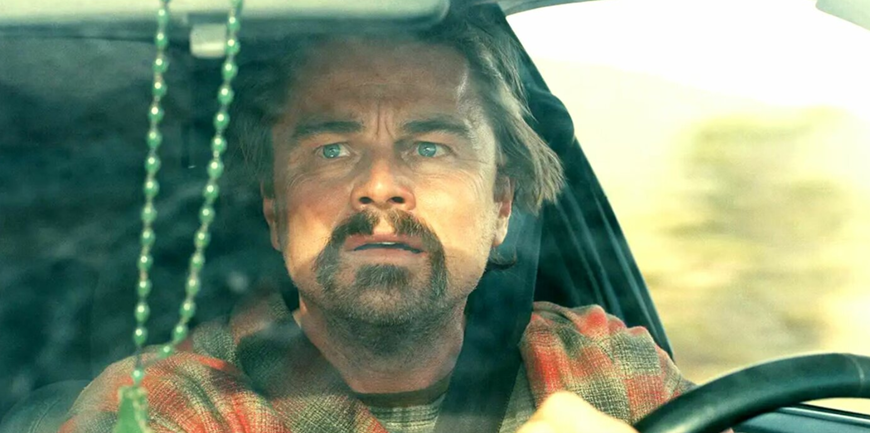
Leonardo DiCaprio as Bob Ferguson (aka “Ghetto” Pat Calhoun aka “Rocketman”)

In the 16 years since the film’s opening sequence timeline, Bob has changed his identity and fled to the fictional town of Baktan Cross in Northern California, but his identity and sense of self are still inextricably linked to his past revolutionary activities and political philosophy. However, he’s now a man-bun-sporting, paranoid burn-out dressed in Jeffrey Lebowski bathrobe attire, who spends his days smoking pot, vaping, and watching Battle of Algiers. His existence now is nothing more than as a vessel of nostalgia, save for him being the (cucked) “father” of his mixed-race daughter Willa. In fact, Bob has been cucked thrice-over. First, he doesn’t realize that he’s not the biological father of Willa (though Perfidia surely does). Second, he’s been cucked by the Revolution, as Perfidia abandons him and Willa to “do the revolution.” Third, he’s been cucked by his own feminism, reflected in his inability to be a stern and responsible father to his daughter.
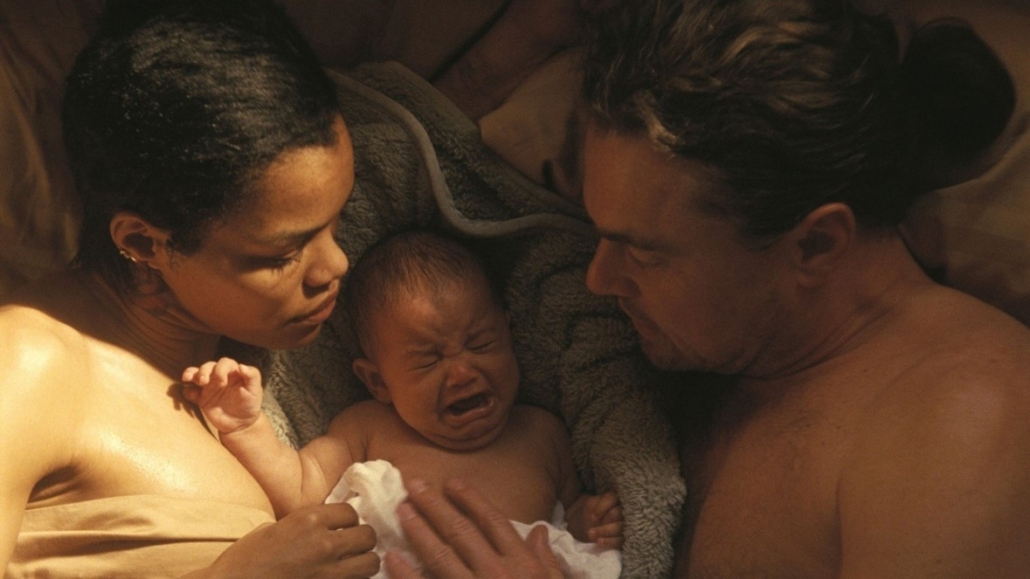
DiCaprio has commented on his character’s old-school hippie/libertarian streak, of the type one finds in certain Northern CA towns such as Eureka:

Bob is what I like to call a don’t tread on me, anti-establishment, hippie revolutionary who is paranoid about anything and everything. He doesn’t want to be taxed. He doesn’t want to be monitored. He’s incredibly skeptical of everyone and everything around him. He hides himself off in the middle of the woods and stays home, watches movies like The Battle of Algiers, smokes pot and drinks, but has one objective, and that’s to protect his daughter (Bowie, 2025).

Through Bob, we see a previous-generation Leftie feeling awkward around the new generation Lefties: namely Generation Pronoun & Generation Snowflake. When his daughter’s friends arrive at their home to take her to a school dance, there is this exchange:

Bob: Now, who’s the one with the lipstick? What’s that one’s name?
Willa: Bobo.
Bob: Bobo … Now, is that a he or a she or a they?
Willa: Dad, come on.
Bob: No, are they transitioning? I wanna know if…
Willa: They’re nonbinary.
Bob: Okay, I just wanna be polite…
Willa: It’s not that hard! … They/them.

Later in the film, when Bob is on the run, we see him on the phone with French 75 headquarters, trying to determine the arranged rendezvous point with his daughter. He’s talking to a whiny guy (“Comrade Josh”), but because he cannot remember the password code to the question “What time is it?,” Josh does not give him this information. Bob pleads with him to make an exception, but Josh repeatedly refuses. After Bob explodes in rage at Josh, cursing at him and threatening him, they have this exchange:

Josh: Okay, this doesn’t feel safe. You’re violating my space right now.
Bob: Violating your space?! Man, come on… What kind of revolutionary are you?! We’re not even in the same room here! We’re talking on the phone, like men!
Josh: Okay, there’s no need to shout. This is a violation of my safety. These are noise triggers.

At an important level, Bob belongs to the pantheon of the Hapless Male trope, namely the endless drumbeat of predictably inept men (almost always White) that Hollywood and Madison Ave churn out in movies, sitcoms, and TV commercials. Invariably, these bumbling and not-all-that-smart males serve as comic relief, but are eventually guided, rescued, or otherwise saved by either a Strong Woman (aka the Mary Sue trope), a non-White, or the intersection of both.[18] Even the New York Times, ever late to noticing cultural trends it did not itself create, has put One Battle into this context. In a piece entitled “Dramas Keep Showing Us Hapless Men—and Hypercompetent Women,” Diego Hadis discusses several recent movies, including One Battle, where the three male protagonists all “fit the archetype of the schlemiel: irredeemably inept, an accident of a person, the butt of some great cosmic joke” (Hadis, 2026). These clueless males are eventually teamed up with ‘hypercompetent women’:

The women they come across, on the other hand, seem ready for anything. They might see several chess moves ahead of both the protagonists and antagonists. They know how to affect the world of the movie, and they do so with ease — exactly what the actual “hero” of the story is completely unable to do. …

They are ever-present — and they are usually so capable, so confidently efficacious, that if they were the story’s focus, the movie would be over in 15 minutes. (Hadis, 2026).

In the case of One Battle:

Perfidia is the film’s driving force, directing the group’s strategy and taking Bob as a lover; her actions push the story forward even after she leaves. All through the film, though, so many of the women Bob encounters have things together in ways that put him to shame — say, the nurse doing intake at a police station after Bob is arrested in a military raid, who hands him off to another nurse, at a hospital, who calmly, unflappably leads him to freedom. Even Bob’s teenage daughter, Willa, is the responsible one, a purple belt in karate who effectively parents her own father. (Hadis, 2026).

Rather than criticizing these tired girlboss tropes for being as formulaic as the Waif-Fu trope (i.e., action movies where a 100 lb. girl handily beats up 250 lb. men), Hadis not surprisingly adopts the New York Times’ “it’s time for women to run the world” approach:

The fact that these figures are so often women may be a way of suggesting that men have had their run, and look where it has gotten us. … We should not be surprised if the coming years bring more films like these — all dreaming that there is somebody out there with whom we might throw in our lot, somebody competent enough to tell us what to do to make the world right (Hadis, 2026).

This last sentiment is very much a feminist call-to-action-for-women in One Battle’s final scene.

Perfidia Beverly Hills

Perfidia Beverly Hills (Teyana Taylor) is the Strong Black Woman trope par excellence and the leader of the French 75. And while one of the world’s most famous movie stars is in One Battle, it is Perfidia who Anderson deems the film’s main character. He notes:

I had a feeling like, Perfidia needs to feel like she’s the protagonist, the hero of the movie. You know, Leo might be in it, Sean might be in it, all these well-known actors are in it, but you see Teyana and it’s like: That’s the star of the movie. I wanted audiences to feel like, this is really a movie about a Black revolutionary (Fear, 2025).

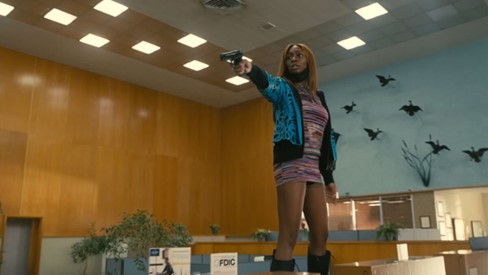
In the film’s opening illegal-immigration-liberation scene, when she first encounters Lockjaw and has a gun pointed at him, she declares her aforementioned political mission, which Anderson has clumsily written to shoehorn in a pro-abortion sentiment:

My name is Perfidia Beverly Hills, and this is a declaration of war. We’re here to right your wrongs, motherfucker. … You didn’t count on me. You didn’t count on my fight. The message is clear: free borders, free bodies, free choices, and free from fuckin’ fear!
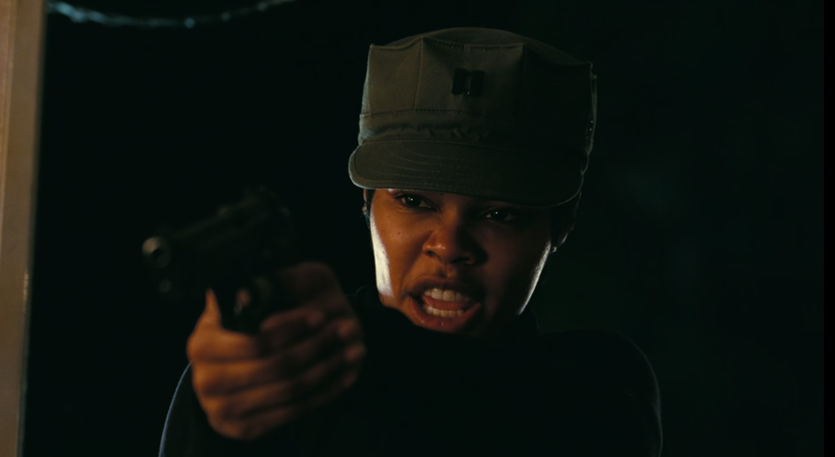
Teyana Taylor as Perfidia Beverly Hills

The very name ‘Perfidia’ literally means betrayal, which is apropos in this case: Ultimately, she betrays Bob by being attracted to, and having sex with, Lockjaw. She betrays the French 75 in a plea deal with authorities that involves her ratting out their names and locations. And she betrays her daughter by abandoning her. (Naturally, despite all of this irresponsibility and dysfunction, her daughter Willa still ‘relates’ to her in the film’s ending). Her middle and last name of “Beverly Hills” should not be overlooked either: this is Anderson situating one front of the revolutionary vanguard (at least nominally) within the manicured lawns of Beverly Hills, and perhaps giving Hollywood liberals a jab for not being sufficiently committed to Leftist causes and the associated ‘direct action’.

Anderson writes Perfidia as experiencing post-partum depression, and she abnegates her maternal role to her newborn infant Willa as a result, with Bob carrying the load. When Bob scolds her, reminding her that they “are a family now,” Perfidia uses her revolutionary politics to justify her abandonment of the mother role: “This is a new consciousness. I’m not your udder buddy. I’m not your mother. You want your power over me, the same reason you want your power over the world. You and your crumbling male ego will never do this revolution like me.”

Anderson no doubt based Perfidia on Assata Shakur, who joined the Black Panther Party in the late 1960s before becoming involved with the Black Liberation Army. She gained notoriety after a 1973 shootout on the New Jersey Turnpike that resulted in the death of a state trooper. She was convicted of murder in 1977 and sentenced to life in prison, but in 1979 escaped with the help of supporters. She then lived in the underground until 1984 when she was granted asylum in Cuba, where she lived until her death in 2025 at age 78. As an example of the standard hagiography heaped on Shakur by the Left, Nikole Hannah-Jones (of the ‘1619 Project’ infamy) was granted a New York Times op-ed slot to celebrate Shakur. The piece is full of gems, including this quote from Angela Davis, the more famously feted Black Female Revolutionary:

Angela Davis, the activist who was wrongly imprisoned during that same tumultuous period, told me women were the backbone of Black radical movements and “the government probably recognized more than even our own people did the power of Black women. (Hannah-Jones, 2025)

In One Battle, after a bank heist goes awry, and which involves Perfidia killing a bank guard, she is apprehended by the police. (Anderson cowardly casts a Black male to play the murdered bank guard, so as to deflect attention from the prevailing Black-on-White nature of violent crime in America). We then see an all-White gaggle of cops cheering and flipping her off while taking selfies.

Lockjaw, thoroughly smitten with her, arranges for her to get a witness protection plea deal, in exchange for beginning an illicit affair. She puts up with this for a certain duration before fleeing (ironically through an official border crossing into Mexico) for a destination that, we learn later in the film, is either Cuba or Algiers, both being locations that actual 1960s Black radicals fled to when U.S. authorities were on their tail.

Willa Ferguson

The progeny of Perfidia and (shockingly) Lockjaw, Willa (Chase Infiniti) is nonetheless raised by Bob alone, given that Perfidia abandoned the family when Willa was an infant. As the film fast-forwards sixteen years later, we see Willa now sixteen herself, receiving karate instruction from Sergio St. Carlos. Steely Dan’s “Dirty Work” is playing on the soundtrack, which lyrically signifies the degradation of Bob and Perfidia’s revolutionary romance into a domestic aftermath where Bob is the sole parent, having ‘cleaned up’ Perfidia’s mess. (Bob once imagined himself as part of History; now he’s an exhausted man left holding the child, the guilt, the secrets, and the consequences).

Chase Infiniti as Willa Ferguson

Willa is now a rather typical American teen female. She has a cell phone that she hides from Bob (who has forbidden them), They/Them friends, and Girl Power attitude. In terms of both cultural attitudes and Leftist political strategies, Willa represents the notable generation gap relative to Bob’s generation. She is described to Bob as a natural ‘leader’ by her high school history teacher, which leads Bob to cry tears of pride.

In terms of plot, Willa is the aforementioned hyper-competent female forced to deal with Bob’s rather inept ‘dumb White guy’ persona. (The father-daughter dynamic between Bob and Willa is a central aspect of One Battle, no doubt partly a function of Anderson’s own relationship with his three biracial daughters).

Signifying where her future will lead after the movie ends, and with Lockjaw and his men searching for her, Willa is offered protection by a group of young, Black, radical, pot-smoking, ghetto-speaking, machine-gun-toting nuns called the “Sisters of the Brave Beaver” (inspired by Sisters of the Valley, an actual hippie convent), the name of which is yet another of Anderson’s bizarre sexualization of radical politics. At this ‘convent’ Willa learns how to shoot. (It’s significant then that Anderson cast both Maya Rudolph and one of his daughters to play members of this Sisterhood).
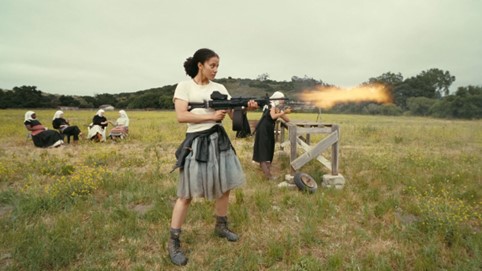
Willa at the Sisters of the Brave Beaver

After narrowly averting death at the hands of both Lockjaw and the Christmas Adventurer Club’s hitman, when Bob finally finds her on a remote California desert highway, Willa (having recently learned who her biological father is) screams “Who are you?!” to Bob, who replies to her plaintively by saying “It’s your dad,” which reconciles the two of them. (There may be an undercurrent here of Anderson’s own biracial daughters possibly questioning aspects of their racial identity as well as their father’s). Of this sequence, Anderson has said: “Coming up with the situation for Willa, where she is finally able to take agency over a situation — to turn the tables, be the aggressor, take the high ground — this became very exciting for us” (Fear, 2025).

In One Battle’s final sequence, Bob and Willa are back home safe and sound. Bob decides to finally give Willa a letter that Perfidia had written to her years ago, but that Bob has kept hidden from her. “I wanted to protect you,” he tells Willa, “From all your mom’s shit, from all my shit. I suppose I wanted to be the one that you came to for help. … The cool dad that you could say anything to, even though I know that’s impossible.” Bob gives her the letter and as Willa reads it in her bedroom, we hear the letter’s content being read in voiceover by Perfidia. The letter contains some verbatim lines from an actual letter a Weather Underground member wrote to their family, as shown in the 2002 documentary The Weather Underground.[19] At the 1:16:19 marker of this documentary, we similarly hear one of these letters being read in voiceover: “Hello from the other side of the shadows. I don’t mean to shock you, but I have been contemplating writing you for a long time. … Often I wake up and find it completely inexplicable how and why I am where I am today and disconnected from my family.”

Sergio St. Carlos

A secondary character to One Battle, Sergio St. Carlos (played by Benicio del Toro) — aka “Sensei” — acts as a calm balance to Bob’s frantic and paranoid nature. “Ocean waves,” he often says as a mantra during tense moments. Sergio is both a karate sensei and a ‘coyote’ of sorts for Mexican illegals in the fictional sanctuary city of Baktan Cross. “I’ve got a little Latino Harriet Tubman situation going on at my place,” he tells Bob.[20] With Lockjaw in pursuit of both him and Willa, Bob has reached out to Sergio for help in rescuing Willa. Sergio agrees and, along the way, introduces Bob to his family as the “Gringo Zapata.”

In one rather creepy moment, as Sergio and Bob and driving through a downtown Baktan Cross that is undergoing a fiery battle between protesters, police, and Lockjaw’s forces, Sergio pauses next to a dozen or so Mexican kids on skateboards. “Bee Gee,” he says to one of them he recognizes, “what’s the word?.” With a gloating smile on his face, the kid tells Sergio “It’s fuckin’ World War III out there, yo!”

One Battle has several digs at contemporary cell phone culture, one of which is when Sergio — almost out of character — takes a selfie with Bob. In another scene, when Sergio has to rush the illegals temporarily hiding above a Mexican-operated corner store to a sanctuary church, he yells several times at a Mexican teen minding the store to get off his phone, after Sergio has told him to watch the front door. Soon after, in Sergio’s ramshackle apartment above the store, he tells one of his daughters to get off her phone. In yet another room, we see two more Mexican teen girls on a couch not talking to each other but both staring at their phones. In all these instances, there is a blank look upon each teen’s face as they are staring at their phone.

Del Toro’s most memorable line in the movie takes place after he’s distracted the police away from Bob. Both had been drinking beers earlier. When the police pull Sergio over, they ask him if he’s been drinking. “I’ve had a few,” he says. “A few what?” asks one of the cops. “Few small beers” Sergio replies.

Benicio del Toro as Sergio St. Carlos

Colonel Steven J. Lockjaw (Sean Penn)

The film’s one-dimensional villain is Colonel Steven J. Lockjaw (Sean Penn). A military man who dutifully follows orders, Lockjaw is nonetheless a corrupt military officer without scruples. He stands as a cartoonish representation of White Christian society, White supremacism, and reactionary politics — all rolled into one. He is depicted as perpetually angry and violent. His surname is, of course, meant to convey a clenched jaw and Penn portrays Lockjaw with a stilted, tight-ass gait, as well as an undercut ‘fash’ hairstyle that — when he meets with the Christmas Adventurers Club, a White supremacist secret society — is combed to be Hitler-like. (There isn’t much in the way of subtleties with One Battle). Sean Penn’s rumored years on steroids serves the role’s physicality well, although he seems to overact here (but in his defense the script probably called for an over-the-top military racist).[21]

Sean Penn as Colonel Steven J. Lockjaw

Reflecting how the Left often sees all uniformed law enforcement entities as one monolithic army of ‘fascism,’ One Battle blurs the lines between police, traditional military, and paramilitary law enforcement roles. Lockjaw is the commanding officer of a fictional paramilitary group called the “MKU” (Mankind United). While his role involves overseeing an immigration detention center on the U.S.-Mexico border, MKU functions as a distinct, specialized government organization rather than a traditional branch of the military.[22]

At one point in the film, we see what appears to be the FBI or some other element of the DOJ awarding Lockjaw with the ‘Bedford Forrest Medal of Honor’ for his work hunting down members of the French 75. (Forrest was a Confederate general during the American Civil War who later served as the first Grand Wizard of the Ku Klux Klan).

Despite his White supremacism bona fides, Lockjaw secretly harbors a largely repressed sexual obsession with Black women, so a miscegenation element also becomes crucial to the motivations of the film’s villain. Early in the film, Lockjaw is sexually humiliated by Perfidia but depicted as enjoying it, as it leads to his sexual arousal and then his “reverse rape” (as he later describes it). This display of a conservative White alpha male enjoying sadomasochistic submission to an angry, armed Black woman (complete with a gun pointed at his crotch) serves as a caricature of Second Amendment gun rights advocates and, more importantly, as a humiliation ritual for White males. If there is one grand metanarrative to One Battle, it is as a liberal revenge fantasy against conservative White men. Lockjaw symbolizes this class, first through his depicted arrogance and coldness, then later through ritual humiliation, disfigurement, and death.

In the film’s only scene between him and Bob, we see Lockjaw use very few words to indirectly articulate his jealousy that Bob has Perfidia and not him. “You like Black girls?” he asks Bob. “I love ‘em. … I LOVE ‘EM!” One X user has aptly memed this exchange as emblematic of how poorly drawn Lockjaw is from the standpoint of character depth:

In yet another tired trope of Leftist ‘explanations’ of conservatism, the film makes implications that Lockjaw is a closeted homosexual.[23] In one exchange — after Lockjaw has abducted Willa and deploys a DNA test to prove (or disprove) that she is, in fact, his biological daughter — it’s implied that Lockjaw is a repressed homosexual:

Willa: Why is your shirt so tight?
Lockjaw: I’m not gay, if that’s what you’re saying.
Willa: I didn’t say that.
Lockjaw: I’m not a homosexual.
Willa: I did not say that … but I see the lifts in your shoes.

Such is the sort of dialogue that wins the Oscar for Best Adapted Screenplay.

In this same scene between Lockjaw and Willa, he says to her at one point, in an over-the-top display of White-against-Black racial hostility: “You shut up! JUST SHUT UP, YOU FUCKING MUTT!!”. In addition to being a racial insult, this dialogue also serves to express the Left’s absurd notion that Blacks are being held in silence by the ‘institutional racism’ of White society. One can only wonder if Anderson is conveying his own daughters’ real (or, more likely, imagined) experiences, his own fears about what his daughters may face in the future, or whether through the character of Lockjaw he’s clumsily articulating his own inner demons on his daughters’ mixed-race status.

Having determined through a DNA test which he’s administered to Willa that she is in fact his biological daughter, and hence a threat to his acceptance into the Christmas Adventurers Club, Lockjaw decides to kill her, but not before mocking and insulting her further:

I am a Christmas Adventurer! Do you know what that is? I have a higher calling. It is a higher honor than having you. I loved her, in case you were wondering. Best goddamn-looking witch I ever saw. Yeah, she was possessed. … She was insane. Like you. You have it in you. I smelled it from within her, and I can smell it from within you.

Lockjaw binds Willa’s hands and drives her out to a remote canyon location where he meets Avanti (Eric Schweig), whom from their exchange we easily infer has done this sort of contract-killing work for Lockjaw numerous times in the past. “I don’t do kids,” Avanti says, even after Lockjaw offers to double his rate. Lockjaw then tells Avanti to instead take Willa to a remote private militia actually called…. drumroll… “1776,” fully confident that they will have no compunction in killing Willa. And, in case the didactic allegory here isn’t yet clear, we have Avanti the American Indian ultimately deciding to sacrifice himself by killing all the 1776 members and saving Willa, before dying himself in the gun exchange. (We know that Avanti is Indian not only from his physiognomy, but because one of the evil 1776 members derisively refers to him as “Wagon-burner”).

In a myriad of ways, and from absolutely every angle, Lockjaw is the bogeyman that a Jewish-dominated Hollywood fear most. Thus, despite Lockjaw being a comically one-dimensional character (and Sean Penn’s performance being almost camp), what Lockjaw represents resonates with Hollywood’s political imagination. It isn’t surprising then that One Battle wins a bunch of Oscars, including Sean Penn winning for Best Supporting Actor.

End of Part 1.


[1] With the 2026 Academy Awards, Sinners laughably received the most Oscar nominations of any film in history. Coogler, who is Black and is best known for the Black Panther movies which inspired the emergent Wakanda mythos, constructs Sinners with a Black-centric orientation and a didactic plot involving White vampires who prey upon Blacks, ‘turning’ these Black victims into vampires themselves. In a racialized variation of From Dusk till Dawn (1996), the social-justice messaging in Sinners is hilariously heavy-handed.

[2] Voegelin’s The New Science of Politics: An Introduction (1952) provides a useful lens for understanding the political implications of widening conspiracy theories and totalizing ideologies. Voegelin views the ideological pathologies of modernity to be gnostic in structure. Such ideologies often claim access to special knowledge (gnōsis) which reveals the hidden truth of history, and promises that salvation can be achieved within the world rather than beyond it.

[3] We can see this despair and self-absorption in such films as the Maoist director Jean-Luc Godard’s La Chinoise (1967) and being satirized by Wes Anderson in The French Dispatch (2021).

[4] For empirical data on the Left’s growing willingness to use violence, see Rufo (2025) and Dulberg & Horder (2025).

[5] Bill Ayers interview, AirGo podcast Episode 386 (“One Battle After Another, Fascism, and Activism During the 60s”), https://youtu.be/XbB40aRz8bg?si=cqUkawiHyESaQbE7, uploaded to YouTube on February 12, 2026 by Respair Production & Media.

[6] Bernardine Dohrn (born Bernardine Rae Ohrnstein) was a leader of the Weather Underground and is the wife of Bill Ayers. Her son Zayd Ayers Dohrn also asserts that the movie title One Battle After Another comes from his mother. See Dohrn (2026).

[7] See Varon (2004), pp. 107–108. Mark Rudd, a prominent SDS leader at Columbia in 1968 who went on to become one of the original leaders of the Weatherman / Weather Underground, and who is himself Jewish, has written about the significant overrepresentation of Jews in the New Left, particularly in leadership positions (Rudd, 2005). Lichter & Rothman (1981) estimate that Jews accounted for approximately 60% of the New Left in the mid-1960s. See also MacDonald (1998, Ch. 3 “Jews and the Left”) and Rudd (2009).

[8] Magnolia (1999) was already on the pulse of where our culture has been drifting for quite some time. The randomness and contingency of life is explored through a series of rather sad and lonely characters, almost all of them male, desperately seeking love and connection. One outlet for this state of affairs is the charismatic and cultish self-help guru Frank T.J. Mackey (Tom Cruise), who preaches a misogynous ethos (ala Andrew Tate) which teaches men how to “Seduce and Destroy” and whose manosphere seminar’s intro music is Strauss’s Thus Spake Zarathustra.

[9] As with Scorsese, music is central for Anderson. In One Battle, this is accomplished through existing songs such as Steely Dan’s “Dirty Work” and Tom Petty and the Heartbreakers’ “American Girl”, as well as through original sountrack compositions. Jon Brion’s anxious, percussive experimentation and Jonny Greenwood’s jarring modernist score (solo piano doing staccato drone patterns and then dissonant passages aurally representing a character’s paranoia) deepen a scene’s psychological tension.

[10] https://www.youtube.com/watch?v=S8Q35vXE9bI.

[11] For a brief summary of Burrough’s book, see Van de Camp (2020).

[12] Max West, Vanishing Point (1971). https://logicalmeme.com/vanishing-point-1971/

[13] https://www.youtube.com/watch?v=E8WW4jJ59d4.

[14] Development of a Vineland adaptation has been a pet project of Anderson’s since the early 90s when he first read and became obsessed with the novel. Anderson’s film Inherent Vice (2014) is a relatively faithful adaptation of Pynchon’s novel of the same name, and The Master (2012) contains elements based on Pynchon’s novel V (1963), such as the protagonist being a discharged sailor who connects with a cult-like group of individuals. (See Arblaster, 2022).

[15] Bloom shares Pynchon’s liberal paranoia that White Christian Fascists lurk behind every tree and every lawn ornament, aligning him with the pronounced history of Jewish antagonism to Christianity and Gentilism. “The not unimpressive polemic of Norman Mailer — that Fascism always lurks where plastic dominates — is in Pynchon not a polemic but a total vision” (Bloom, 2003, p. 2). Jews love Pynchon, not only because of his radical Leftwing idealism but also because of these Kabbalistic-style attempts to placate a lingering paranoia and persecution complex with elaborate gnostic conspiracy theories. See, for example, Mendelson, Edward (ed.). Pynchon: A Collection of Critical Essays (1978). Pynchon is not himself Jewish but was raised both Catholic and Episcopalian.

[16] See, for example, James Burnham on the managerial–bureaucratic class and the writings of Samuel Francis and Curtis Yarvin (aka Mencius Moldbug).

[17] DiCaprio notes that his own father was a 1960s counterculture radical and bombmaker who “hung out with Abbie Hoffman.” In preparation for his role, DiCaprio cites as influences the book Days of Rage, Gillo Pontecorvo’s The Battle of Algiers (1966), Al Pacino’s nervous Sonny Wortzik character in Sidney Lumet’s Dog Day Afternoon (1975), and Lumet’s Running on Empty (1988), about a couple who are continually on the move with assumed identities, after having committed terrorist acts as part of a Weather Underground-like group. (As noted in Tom Wolfe’s fascinating Radical Chic & Mau-Mauing the Flak Catchers (1970), Lumet hosted a high-end party for the Black Panthers before Leonard Bernstein’s soiree for the Black terrorist group, the latter being the focus of Wolfe’s essay). See https://www.youtube.com/watch?v=Q_cV9ciktoQ.

[18] The ‘White Men Are Stupid In Commercials’ account on X (@StupidWhiteAds) catalogs some of the countless TV commercials that adopt this trope.

[19] http://www.theweatherunderground.info/

[20] It was Del Toro’s idea to have Sergio be a ‘protector’ of Mexican illegals. The scenes with Del Toro were shot almost entirely in El Paso, TX, a city that is today a de facto satellite of Mexico. Anderson “adores” this city and its people. “Being in El Paso, at the center of immigration,” Anderson says, “gave us so much material and local talent to work with. It became the centerpiece of the film and certainly the best time I’ve ever had going to work” (Abramovitch, 2026). Del Toro has said that he and Anderson visited a church in El Paso that serves as a sanctuary for illegals until they get their “paperwork processed”.

[21] Like many on the Left, Anderson seems to equate extreme physical fitness with Rightwing politics and, childishly, homoeroticism. In the film’s opening sequence, many of the soldiers under Lockjaw’s command are physically buff and shown with their shirts off.

[22] MKU is likely modeled after the Border Patrol Tactical Unit (BORTAC), an elite, highly trained special operations unit within the U.S. Border Patrol Special Operations Group. Established in 1984, BORTAC provides national/international response to high-risk incidents, including counter-narcotics, hostage rescue, and riot control. One Battle’s closing credits confirm that MKU stands for Mankind United.

[23] Other notable examples of this trope include the repressed homosexual Col. Frank Fitts (Chris Cooper) in American Beauty (1999) (who also collects Nazi memorabilia to boot) and Major Weldon Penderton (Marlon Brando) in the movie Reflections in a Golden Eye (1967). Bertolucci’s The Conformist (1970) has special relevance here as well. Bertolucci was a Marxist and the visually stunning ‘Fascist aesthetics’ of The Conformist frames the protagonist Marcello’s troubled psyche. However, the narrative assumes a facile Marxism-Freudianism: Marcello’s childhood trauma from sexual abuse and consequent sexual dysfunction serve as a Freudian ‘explanation’ of his political extremism and willingness to assassinate an ‘anti-Fascist’ professor on behalf of the state. Repeatedly, we see the Left’s simplistic depictions and explanations of Rightwing political sentiment as psycho-sexual drama within the bourgeoisie.

Paul Thomas Anderson’s overall body of work contains an impressive array of films packed with immediacy, visual flair, and stylized mise-en-scène: Hard Eight (1996), Boogie Nights (1997), Magnolia (1999), Punch-Drunk Love (2002), There Will Be Blood (2007), The Master (2012), Inherent Vice (2014), Phantom Thread (2017), Licorice Pizza (2021), and now One Battle After Another (2025).[8] Anderson’s films are driven by intense and often damaged individuals whose inner longings collide with grand American mythologies (fame, family, capitalism), and his narratives often unfold in loosely episodic structures taking place within sprawling, operatic arcs. Among his immediate influences, Robert Altman and Martin Scorsese are most apparent. From Altman we get the ensemble storytelling, the overlapping dialogue, and the chaotic feel of fractured families, and from Scorsese we get the streetwise shot-compositions, kinetic camera movement (Anderson is also a fan of Max Ophüls in this regard), and the popular music needle drops that underscore a scene’s desired emotional effect.[9] There is also the noticeable influence of Stanley Kubrick’s precision and emotional austerity in films such as There Will Be Blood and Phantom Thread. With respect to One Battle, Anderson has cited the following as key influences in the making of the film[10]:

  • Days of Rage: America’s Radical Underground, the FBI, and the Forgotten Age of Revolutionary Violence (2015): Bryan Burrough’s seminal book details the radical underground in the 1970s, documenting a largely forgotten era of intense domestic terrorism in the U.S. He details how groups like the Weather Underground, the Black Liberation Army, and the Symbionese Liberation Army conducted thousands of bombings and killings.[11]
  • Les Misérables (1935): Anderson cites Richard Boleslawski’s 1935 film adaptation of Victor Hugo’s novel, particularly its mad, cacophonous first act that serves as the backdrop and setup for the core human conflict in the story: Inspector Javert’s (Charles Laughton) obsession with capturing ex-convict Jean Valjean (Fredric March).
  • Vanishing Point (1971): Anderson cites Richard Sarafian’s underrated mythopoetic road movie, which I have previously written about.[12] In Vanishing Point, the protagonist is determined to drive from Denver to San Francisco in record time, for an unspecified goal, and his urgency in the matter acts as a purpose-in-itself, where the ultimate telos of one’s ‘vanishing point’ – eyes fixed as far as one can see down the road — symbolizes the annihilation of being that comes with death.
  • Midnight Run (1988): Anderson absolutely loves this witty, buddy-action-comedy-road-movie starring Robert De Niro and Charles Grodin, made in the heyday of the 1980s buddy films craze (e.g., 48 Hrs. (1982), Beverly Hills Cop (1984), and Lethal Weapon (1987)). Anderson says it is both his personal favorite film and his family’s favorite film, which they watch at least twice per year.[13]

Relative to Anderson’s earlier films, with One Battle we have a more frenetic pace that reflects the confused, paranoid, and desperate mindset of today’s Left, where ‘fascism’ is everywhere — in every institution of authority, and even hidden underneath the seemingly benign, trimmed lawns of the suburbs. It is here where Anderson’s literary influences come to the forefront. The majority of Anderson’s films are based upon his own original screenplays, but in the case of There Will Be Blood, Anderson adapted his screenplay from Upton Sinclair’s socialist novel Oil! (1927), and in One Battle After Another (as with Inherent Vice) we have Anderson adapting a screenplay loosely based on the novel Vineland (1990) written by his most significant and lasting literary influence: Thomas Pynchon[14].

Pynchon is one of the founders (and giants) of postmodern fiction, a satirical genre that — through devices of irony, self-referentiality, and non-linear narrative — parodies modernist fiction just as modernist fiction parodies realist fiction. Pynchon’s oeuvre is replete with conspiracy theories, usually fanciful and ridiculous, and the conspiracies in his novels are typically layered and, despite remaining largely unseen and in the background, serve as the magnetic center of the novels’ events. Countercultural anti-hero protagonists, often burned-out pot-smoking 60s-era radicals, stumble through the novel’s plot and life in general, but then also stumble onto actual conspiracies they soon find themselves caught up in. The harrowing realities of the conspiracy, the upending of one’s conventional ways of understanding the world, take their toll on characters’ psyches, leading to an ever-worsening paranoia. In many ways, Pynchon’s novels, characterized by hidden connections and multiple interpretive levels, provide interwoven, gnostic systems of meaning to the characters and to the reader. Contours of ‘The System’ are delimited. It is most interesting, then, when Harold Bloom characterizes Pynchon’s novels as Kabbalistic.[15]

The conspiracy-theory-as-plot-device is itself greatly influenced by early American detective fiction (e.g., Hammett, Chandler), a genre that in a more straightforward literary manner involves mystery and unknown forces which the hero does not fully understand. Over the course of typically three acts, a slow and suspenseful unraveling of a conspiracy takes place. Of course, the conspiracy itself may be relatively low-level, and not necessarily part of a particular, more macro-level one, but a conspiracy nonetheless. As with the genre of classic film noir — which inherits all the essential tropes of detective fiction and was often helmed by liberal Jewish émigré directors — there is a darkened moral atmosphere to the world and a growing skepticism toward institutions. Gone is the clean moral universe of classic whodunits. Instead, justice is compromised, authority corrupted, truth rarely restores order, and the protagonist (often a grizzled and jaded private detective) uncovers guilt without being able to meaningfully correct it. The fatalism inherent in this worldview (and the arc of conspiracy theories in general) coincides with the explosive growth in the twentieth century, particularly since World War II, of both the federal government and large corporations, i.e., the prevailing dominance of the bureaucratic-administrative state and its nexus with corporate interests.[16] The institutions that effectively control us have become ever more faceless, unaccountable, and remote from the average citizen, and in One Battle this type of dark and cloaked entity — as it is imagined by the Leftist’s conspiratorial mindset — is the fictional White supremacist secret society called the Christmas Adventurers Club.

V.           Characters+

Bob Ferguson

Leonardo DiCaprio plays Bob Ferguson (aka “Ghetto” Pat Calhoun aka “Rocketman”), a former 60s radical who was an explosives expert for the film’s fictional domestic terrorist group French 75.[17] In the film’s aforementioned opening sequence, we see Bob in his earlier activist/terrorist years as he participates in ‘liberating’ a migrant detention facility. Whether intended by Anderson or not, we witness the pathetic spectacle of this out-of-place, White, ‘60s revolutionary surrounded by Black radicals and Mexican illegals, screaming insults to the DHS soldiers whom the French 75 has just placed inside the very ‘cages’ that minutes ago held illegal aliens:

We are a political organization that is free from the eyes, the ears, and most importantly, the weapons of the imperialist state, and this fascist regime! You are a political prisoner of the French 75, motherfuckers! You’ve been captured by the French 75! Fuck the police! Viva La Revolución!

In the 16 years since the film’s opening sequence timeline, Bob has changed his identity and fled to the fictional town of Baktan Cross in Northern California, but his identity and sense of self are still inextricably linked to his past revolutionary activities and political philosophy. However, he’s now a man-bun-sporting, paranoid burn-out dressed in Jeffrey Lebowski bathrobe attire, who spends his days smoking pot, vaping, and watching Battle of Algiers. His existence now is nothing more than as a vessel of nostalgia, save for him being the (cucked) “father” of his mixed-race daughter Willa. In fact, Bob has been cucked thrice-over. First, he doesn’t realize that he’s not the biological father of Willa (though Perfidia surely does). Second, he’s been cucked by the Revolution, as Perfidia abandons him and Willa to “do the revolution.” Third, he’s been cucked by his own feminism, reflected in his inability to be a stern and responsible father to his daughter.

DiCaprio has commented on his character’s old-school hippie/libertarian streak, of the type one finds in certain Northern CA towns such as Eureka:

Bob is what I like to call a don’t tread on me, anti-establishment, hippie revolutionary who is paranoid about anything and everything. He doesn’t want to be taxed. He doesn’t want to be monitored. He’s incredibly skeptical of everyone and everything around him. He hides himself off in the middle of the woods and stays home, watches movies like The Battle of Algiers, smokes pot and drinks, but has one objective, and that’s to protect his daughter (Bowie, 2025).

Through Bob, we see a previous-generation Leftie feeling awkward around the new generation Lefties: namely Generation Pronoun & Generation Snowflake. When his daughter’s friends arrive at their home to take her to a school dance, there is this exchange:

Bob: Now, who’s the one with the lipstick? What’s that one’s name?
Willa: Bobo.
Bob: Bobo … Now, is that a he or a she or a they?
Willa: Dad, come on.
Bob: No, are they transitioning? I wanna know if…
Willa: They’re nonbinary.
Bob: Okay, I just wanna be polite…
Willa: It’s not that hard! … They/them.

Later in the film, when Bob is on the run, we see him on the phone with French 75 headquarters, trying to determine the arranged rendezvous point with his daughter. He’s talking to a whiny guy (“Comrade Josh”), but because he cannot remember the password code to the question “What time is it?,” Josh does not give him this information. Bob pleads with him to make an exception, but Josh repeatedly refuses. After Bob explodes in rage at Josh, cursing at him and threatening him, they have this exchange:

Josh: Okay, this doesn’t feel safe. You’re violating my space right now.

Bob: Violating your space?! Man, come on… What kind of revolutionary are you?! We’re not even in the same room here! We’re talking on the phone, like men!

Josh: Okay, there’s no need to shout. This is a violation of my safety. These are noise triggers.

At an important level, Bob belongs to the pantheon of the Hapless Male trope, namely the endless drumbeat of predictably inept men (almost always White) that Hollywood and Madison Ave churn out in movies, sitcoms, and TV commercials. Invariably, these bumbling and not-all-that-smart males serve as comic relief, but are eventually guided, rescued, or otherwise saved by either a Strong Woman (aka the Mary Sue trope), a non-White, or the intersection of both.[18] Even the New York Times, ever late to noticing cultural trends it did not itself create, has put One Battle into this context. In a piece entitled “Dramas Keep Showing Us Hapless Men—and Hypercompetent Women,” Diego Hadis discusses several recent movies, including One Battle, where the three male protagonists all “fit the archetype of the schlemiel: irredeemably inept, an accident of a person, the butt of some great cosmic joke” (Hadis, 2026). These clueless males are eventually teamed up with ‘hypercompetent women’:

The women they come across, on the other hand, seem ready for anything. They might see several chess moves ahead of both the protagonists and antagonists. They know how to affect the world of the movie, and they do so with ease — exactly what the actual “hero” of the story is completely unable to do. …

They are ever-present — and they are usually so capable, so confidently efficacious, that if they were the story’s focus, the movie would be over in 15 minutes. (Hadis, 2026).

In the case of One Battle:

Perfidia is the film’s driving force, directing the group’s strategy and taking Bob as a lover; her actions push the story forward even after she leaves. All through the film, though, so many of the women Bob encounters have things together in ways that put him to shame — say, the nurse doing intake at a police station after Bob is arrested in a military raid, who hands him off to another nurse, at a hospital, who calmly, unflappably leads him to freedom. Even Bob’s teenage daughter, Willa, is the responsible one, a purple belt in karate who effectively parents her own father. (Hadis, 2026).

Rather than criticizing these tired girlboss tropes for being as formulaic as the Waif-Fu trope (i.e., action movies where a 100 lb. girl handily beats up 250 lb. men), Hadis not surprisingly adopts the New York Times’ “it’s time for women to run the world” approach:

The fact that these figures are so often women may be a way of suggesting that men have had their run, and look where it has gotten us. … We should not be surprised if the coming years bring more films like these — all dreaming that there is somebody out there with whom we might throw in our lot, somebody competent enough to tell us what to do to make the world right (Hadis, 2026).

This last sentiment is very much a feminist call-to-action-for-women in One Battle’s final scene.

Perfidia Beverly Hills

Perfidia Beverly Hills (Teyana Taylor) is the Strong Black Woman trope par excellence and the leader of the French 75. And while one of the world’s most famous movie stars is in One Battle, it is Perfidia who Anderson deems the film’s main character. He notes:

I had a feeling like, Perfidia needs to feel like she’s the protagonist, the hero of the movie. You know, Leo might be in it, Sean might be in it, all these well-known actors are in it, but you see Teyana and it’s like: That’s the star of the movie. I wanted audiences to feel like, this is really a movie about a Black revolutionary (Fear, 2025).

In the film’s opening illegal-immigration-liberation scene, when she first encounters Lockjaw and has a gun pointed at him, she declares her aforementioned political mission, which Anderson has clumsily written to shoehorn in a pro-abortion sentiment:

My name is Perfidia Beverly Hills, and this is a declaration of war. We’re here to right your wrongs, motherfucker. … You didn’t count on me. You didn’t count on my fight. The message is clear: free borders, free bodies, free choices, and free from fuckin’ fear!

Teyana Taylor as Perfidia Beverly Hills

The very name ‘Perfidia’ literally means betrayal, which is apropos in this case: Ultimately, she betrays Bob by being attracted to, and having sex with, Lockjaw. She betrays the French 75 in a plea deal with authorities that involves her ratting out their names and locations. And she betrays her daughter by abandoning her. (Naturally, despite all of this irresponsibility and dysfunction, her daughter Willa still ‘relates’ to her in the film’s ending). Her middle and last name of “Beverly Hills” should not be overlooked either: this is Anderson situating one front of the revolutionary vanguard (at least nominally) within the manicured lawns of Beverly Hills, and perhaps giving Hollywood liberals a jab for not being sufficiently committed to Leftist causes and the associated ‘direct action’.

Anderson writes Perfidia as experiencing post-partum depression, and she abnegates her maternal role to her newborn infant Willa as a result, with Bob carrying the load. When Bob scolds her, reminding her that they “are a family now,” Perfidia uses her revolutionary politics to justify her abandonment of the mother role: “This is a new consciousness. I’m not your udder buddy. I’m not your mother. You want your power over me, the same reason you want your power over the world. You and your crumbling male ego will never do this revolution like me.”

Anderson no doubt based Perfidia on Assata Shakur, who joined the Black Panther Party in the late 1960s before becoming involved with the Black Liberation Army. She gained notoriety after a 1973 shootout on the New Jersey Turnpike that resulted in the death of a state trooper. She was convicted of murder in 1977 and sentenced to life in prison, but in 1979 escaped with the help of supporters. She then lived in the underground until 1984 when she was granted asylum in Cuba, where she lived until her death in 2025 at age 78. As an example of the standard hagiography heaped on Shakur by the Left, Nikole Hannah-Jones (of the ‘1619 Project’ infamy) was granted a New York Times op-ed slot to celebrate Shakur. The piece is full of gems, including this quote from Angela Davis, the more famously feted Black Female Revolutionary:

Angela Davis, the activist who was wrongly imprisoned during that same tumultuous period, told me women were the backbone of Black radical movements and “the government probably recognized more than even our own people did the power of Black women.” (Hannah-Jones, 2025)

In One Battle, after a bank heist goes awry, and which involves Perfidia killing a bank guard, she is apprehended by the police. (Anderson cowardly casts a Black male to play the murdered bank guard, so as to deflect attention from the prevailing Black-on-White nature of violent crime in America). We then see an all-White gaggle of cops cheering and flipping her off while taking selfies.

Lockjaw, thoroughly smitten with her, arranges for her to get a witness protection plea deal, in exchange for beginning an illicit affair. She puts up with this for a certain duration before fleeing (ironically through an official border crossing into Mexico) for a destination that, we learn later in the film, is either Cuba or Algiers, both being locations that actual 1960s Black radicals fled to when U.S. authorities were on their tail.

Willa Ferguson

The progeny of Perfidia and (shockingly) Lockjaw, Willa (Chase Infiniti) is nonetheless raised by Bob alone, given that Perfidia abandoned the family when Willa was an infant. As the film fast-forwards sixteen years later, we see Willa now sixteen herself, receiving karate instruction from Sergio St. Carlos. Steely Dan’s “Dirty Work” is playing on the soundtrack, which lyrically signifies the degradation of Bob and Perfidia’s revolutionary romance into a domestic aftermath where Bob is the sole parent, having ‘cleaned up’ Perfidia’s mess. (Bob once imagined himself as part of History; now he’s an exhausted man left holding the child, the guilt, the secrets, and the consequences).

Chase Infiniti as Willa Ferguson

Willa is now a rather typical American teen female. She has a cell phone that she hides from Bob (who has forbidden them), They/Them friends, and Girl Power attitude. In terms of both cultural attitudes and Leftist political strategies, Willa represents the notable generation gap relative to Bob’s generation. She is described to Bob as a natural ‘leader’ by her high school history teacher, which leads Bob to cry tears of pride.

In terms of plot, Willa is the aforementioned hyper-competent female forced to deal with Bob’s rather inept ‘dumb White guy’ persona. (The father-daughter dynamic between Bob and Willa is a central aspect of One Battle, no doubt partly a function of Anderson’s own relationship with his three biracial daughters).

Signifying where her future will lead after the movie ends, and with Lockjaw and his men searching for her, Willa is offered protection by a group of young, Black, radical, pot-smoking, ghetto-speaking, machine-gun-toting nuns called the “Sisters of the Brave Beaver” (inspired by Sisters of the Valley, an actual hippie convent), the name of which is yet another of Anderson’s bizarre sexualization of radical politics. At this ‘convent’ Willa learns how to shoot. (It’s significant then that Anderson cast both Maya Rudolph and one of his daughters to play members of this Sisterhood).

Willa at the Sisters of the Brave Beaver

After narrowly averting death at the hands of both Lockjaw and the Christmas Adventurer Club’s hitman, when Bob finally finds her on a remote California desert highway, Willa (having recently learned who her biological father is) screams “Who are you?!” to Bob, who replies to her plaintively by saying “It’s your dad,” which reconciles the two of them. (There may be an undercurrent here of Anderson’s own biracial daughters possibly questioning aspects of their racial identity as well as their father’s). Of this sequence, Anderson has said: “Coming up with the situation for Willa, where she is finally able to take agency over a situation — to turn the tables, be the aggressor, take the high ground — this became very exciting for us” (Fear, 2025).

In One Battle’s final sequence, Bob and Willa are back home safe and sound. Bob decides to finally give Willa a letter that Perfidia had written to her years ago, but that Bob has kept hidden from her. “I wanted to protect you,” he tells Willa, “From all your mom’s shit, from all my shit. I suppose I wanted to be the one that you came to for help. … The cool dad that you could say anything to, even though I know that’s impossible.” Bob gives her the letter and as Willa reads it in her bedroom, we hear the letter’s content being read in voiceover by Perfidia. The letter contains some verbatim lines from an actual letter a Weather Underground member wrote to their family, as shown in the 2002 documentary The Weather Underground.[19] At the 1:16:19 marker of this documentary, we similarly hear one of these letters being read in voiceover: “Hello from the other side of the shadows. I don’t mean to shock you, but I have been contemplating writing you for a long time. … Often I wake up and find it completely inexplicable how and why I am where I am today and disconnected from my family.”

Sergio St. Carlos

A secondary character to One Battle, Sergio St. Carlos (played by Benicio del Toro) — aka “Sensei” — acts as a calm balance to Bob’s frantic and paranoid nature. “Ocean waves,” he often says as a mantra during tense moments. Sergio is both a karate sensei and a ‘coyote’ of sorts for Mexican illegals in the fictional sanctuary city of Baktan Cross. “I’ve got a little Latino Harriet Tubman situation going on at my place,” he tells Bob.[20] With Lockjaw in pursuit of both him and Willa, Bob has reached out to Sergio for help in rescuing Willa. Sergio agrees and, along the way, introduces Bob to his family as the “Gringo Zapata.”

In one rather creepy moment, as Sergio and Bob and driving through a downtown Baktan Cross that is undergoing a fiery battle between protesters, police, and Lockjaw’s forces, Sergio pauses next to a dozen or so Mexican kids on skateboards. “Bee Gee,” he says to one of them he recognizes, “what’s the word?.” With a gloating smile on his face, the kid tells Sergio “It’s fuckin’ World War III out there, yo!”

One Battle has several digs at contemporary cell phone culture, one of which is when Sergio — almost out of character — takes a selfie with Bob. In another scene, when Sergio has to rush the illegals temporarily hiding above a Mexican-operated corner store to a sanctuary church, he yells several times at a Mexican teen minding the store to get off his phone, after Sergio has told him to watch the front door. Soon after, in Sergio’s ramshackle apartment above the store, he tells one of his daughters to get off her phone. In yet another room, we see two more Mexican teen girls on a couch not talking to each other but both staring at their phones. In all these instances, there is a blank look upon each teen’s face as they are staring at their phone.

Del Toro’s most memorable line in the movie takes place after he’s distracted the police away from Bob. Both had been drinking beers earlier. When the police pull Sergio over, they ask him if he’s been drinking. “I’ve had a few,” he says. “A few what?” asks one of the cops. “Few small beers” Sergio replies.

Benicio del Toro as Sergio St. Carlos

Colonel Steven J. Lockjaw (Sean Penn)

The film’s one-dimensional villain is Colonel Steven J. Lockjaw (Sean Penn). A military man who dutifully follows orders, Lockjaw is nonetheless a corrupt military officer without scruples. He stands as a cartoonish representation of White Christian society, White supremacism, and reactionary politics — all rolled into one. He is depicted as perpetually angry and violent. His surname is, of course, meant to convey a clenched jaw and Penn portrays Lockjaw with a stilted, tight-ass gait, as well as an undercut ‘fash’ hairstyle that — when he meets with the Christmas Adventurers Club, a White supremacist secret society — is combed to be Hitler-like. (There isn’t much in the way of subtleties with One Battle). Sean Penn’s rumored years on steroids serves the role’s physicality well, although he seems to overact here (but in his defense the script probably called for an over-the-top military racist).[21]

Sean Penn as Colonel Steven J. Lockjaw

Reflecting how the Left often sees all uniformed law enforcement entities as one monolithic army of ‘fascism,’ One Battle blurs the lines between police, traditional military, and paramilitary law enforcement roles. Lockjaw is the commanding officer of a fictional paramilitary group called the “MKU” (Mankind United). While his role involves overseeing an immigration detention center on the U.S.-Mexico border, MKU functions as a distinct, specialized government organization rather than a traditional branch of the military.[22]

At one point in the film, we see what appears to be the FBI or some other element of the DOJ awarding Lockjaw with the ‘Bedford Forrest Medal of Honor’ for his work hunting down members of the French 75. (Forrest was a Confederate general during the American Civil War who later served as the first Grand Wizard of the Ku Klux Klan).

Despite his White supremacism bona fides, Lockjaw secretly harbors a largely repressed sexual obsession with Black women, so a miscegenation element also becomes crucial to the motivations of the film’s villain. Early in the film, Lockjaw is sexually humiliated by Perfidia but depicted as enjoying it, as it leads to his sexual arousal and then his “reverse rape” (as he later describes it). This display of a conservative White alpha male enjoying sadomasochistic submission to an angry, armed Black woman (complete with a gun pointed at his crotch) serves as a caricature of Second Amendment gun rights advocates and, more importantly, as a humiliation ritual for White males. If there is one grand metanarrative to One Battle, it is as a liberal revenge fantasy against conservative White men. Lockjaw symbolizes this class, first through his depicted arrogance and coldness, then later through ritual humiliation, disfigurement, and death.

In the film’s only scene between him and Bob, we see Lockjaw use very few words to indirectly articulate his jealousy that Bob has Perfidia and not him. “You like Black girls?” he asks Bob. “I love ‘em. … I LOVE ‘EM!” One X user has aptly memed this exchange as emblematic of how poorly drawn Lockjaw is from the standpoint of character depth:

In yet another tired trope of Leftist ‘explanations’ of conservatism, the film makes implications that Lockjaw is a closeted homosexual.[23] In one exchange — after Lockjaw has abducted Willa and deploys a DNA test to prove (or disprove) that she is, in fact, his biological daughter — it’s implied that Lockjaw is a repressed homosexual:

Willa: Why is your shirt so tight?
Lockjaw: I’m not gay, if that’s what you’re saying.
Willa: I didn’t say that.
Lockjaw: I’m not a homosexual.
Willa: I did not say that … but I see the lifts in your shoes.

Such is the sort of dialogue that wins the Oscar for Best Adapted Screenplay.

In this same scene between Lockjaw and Willa, he says to her at one point, in an over-the-top display of White-against-Black racial hostility: “You shut up! JUST SHUT UP, YOU FUCKING MUTT!!”. In addition to being a racial insult, this dialogue also serves to express the Left’s absurd notion that Blacks are being held in silence by the ‘institutional racism’ of White society. One can only wonder if Anderson is conveying his own daughters’ real (or, more likely, imagined) experiences, his own fears about what his daughters may face in the future, or whether through the character of Lockjaw he’s clumsily articulating his own inner demons on his daughters’ mixed-race status.

Having determined through a DNA test which he’s administered to Willa that she is in fact his biological daughter, and hence a threat to his acceptance into the Christmas Adventurers Club, Lockjaw decides to kill her, but not before mocking and insulting her further:

I am a Christmas Adventurer! Do you know what that is? I have a higher calling. It is a higher honor than having you. I loved her, in case you were wondering. Best goddamn-looking witch I ever saw. Yeah, she was possessed. … She was insane. Like you. You have it in you. I smelled it from within her, and I can smell it from within you.

Lockjaw binds Willa’s hands and drives her out to a remote canyon location where he meets Avanti (Eric Schweig), whom from their exchange we easily infer has done this sort of contract-killing work for Lockjaw numerous times in the past. “I don’t do kids,” Avanti says, even after Lockjaw offers to double his rate. Lockjaw then tells Avanti to instead take Willa to a remote private militia actually called…. drumroll… “1776,” fully confident that they will have no compunction in killing Willa. And, in case the didactic allegory here isn’t yet clear, we have Avanti the American Indian ultimately deciding to sacrifice himself by killing all the 1776 members and saving Willa, before dying himself in the gun exchange. (We know that Avanti is Indian not only from his physiognomy, but because one of the evil 1776 members derisively refers to him as “Wagon-burner”).

In a myriad of ways, and from absolutely every angle, Lockjaw is the bogeyman that a Jewish-dominated Hollywood fear most. Thus, despite Lockjaw being a comically one-dimensional character (and Sean Penn’s performance being almost camp), what Lockjaw represents resonates with Hollywood’s political imagination. It isn’t surprising then that One Battle wins a bunch of Oscars, including Sean Penn winning for Best Supporting Actor.

Go to Part 2.

[1] With the 2026 Academy Awards, Sinners laughably received the most Oscar nominations of any film in history. Coogler, who is Black and is best known for the Black Panther movies which inspired the emergent Wakanda mythos, constructs Sinners with a Black-centric orientation and a didactic plot involving White vampires who prey upon Blacks, ‘turning’ these Black victims into vampires themselves. In a racialized variation of From Dusk till Dawn (1996), the social-justice messaging in Sinners is hilariously heavy-handed.

[2] Voegelin’s The New Science of Politics: An Introduction (1952) provides a useful lens for understanding the political implications of widening conspiracy theories and totalizing ideologies. Voegelin views the ideological pathologies of modernity to be gnostic in structure. Such ideologies often claim access to special knowledge (gnōsis) which reveals the hidden truth of history, and promises that salvation can be achieved within the world rather than beyond it.

[3] We can see this despair and self-absorption in such films as the Maoist director Jean-Luc Godard’s La Chinoise (1967) and being satirized by Wes Anderson in The French Dispatch (2021).

[4] For empirical data on the Left’s growing willingness to use violence, see Rufo (2025) and Dulberg & Horder (2025).

[5] Bill Ayers interview, AirGo podcast Episode 386 (“One Battle After Another, Fascism, and Activism During the 60s”), https://youtu.be/XbB40aRz8bg?si=cqUkawiHyESaQbE7, uploaded to YouTube on February 12, 2026 by Respair Production & Media.

[6] Bernardine Dohrn (born Bernardine Rae Ohrnstein) was a leader of the Weather Underground and is the wife of Bill Ayers. Her son Zayd Ayers Dohrn also asserts that the movie title One Battle After Another comes from his mother. See Dohrn (2026).

[7] See Varon (2004), pp. 107–108. Mark Rudd, a prominent SDS leader at Columbia in 1968 who went on to become one of the original leaders of the Weatherman / Weather Underground, and who is himself Jewish, has written about the significant overrepresentation of Jews in the New Left, particularly in leadership positions (Rudd, 2005). Lichter & Rothman (1981) estimate that Jews accounted for approximately 60% of the New Left in the mid-1960s. See also MacDonald (1998, Ch. 3 “Jews and the Left”) and Rudd (2009).

[8] Magnolia (1999) was already on the pulse of where our culture has been drifting for quite some time. The randomness and contingency of life is explored through a series of rather sad and lonely characters, almost all of them male, desperately seeking love and connection. One outlet for this state of affairs is the charismatic and cultish self-help guru Frank T.J. Mackey (Tom Cruise), who preaches a misogynous ethos (ala Andrew Tate) which teaches men how to “Seduce and Destroy” and whose manosphere seminar’s intro music is Strauss’s Thus Spake Zarathustra.

[9] As with Scorsese, music is central for Anderson. In One Battle, this is accomplished through existing songs such as Steely Dan’s “Dirty Work” and Tom Petty and the Heartbreakers’ “American Girl”, as well as through original sountrack compositions. Jon Brion’s anxious, percussive experimentation and Jonny Greenwood’s jarring modernist score (solo piano doing staccato drone patterns and then dissonant passages aurally representing a character’s paranoia) deepen a scene’s psychological tension.

[10] https://www.youtube.com/watch?v=S8Q35vXE9bI.

[11] For a brief summary of Burrough’s book, see Van de Camp (2020).

[12] Max West, Vanishing Point (1971). https://logicalmeme.com/vanishing-point-1971/

[13] https://www.youtube.com/watch?v=E8WW4jJ59d4.

[14] Development of a Vineland adaptation has been a pet project of Anderson’s since the early 90s when he first read and became obsessed with the novel. Anderson’s film Inherent Vice (2014) is a relatively faithful adaptation of Pynchon’s novel of the same name, and The Master (2012) contains elements based on Pynchon’s novel V (1963), such as the protagonist being a discharged sailor who connects with a cult-like group of individuals. (See Arblaster, 2022).

[15] Bloom shares Pynchon’s liberal paranoia that White Christian Fascists lurk behind every tree and every lawn ornament, aligning him with the pronounced history of Jewish antagonism to Christianity and Gentilism. “The not unimpressive polemic of Norman Mailer — that Fascism always lurks where plastic dominates — is in Pynchon not a polemic but a total vision” (Bloom, 2003, p. 2). Jews love Pynchon, not only because of his radical Leftwing idealism but also because of these Kabbalistic-style attempts to placate a lingering paranoia and persecution complex with elaborate gnostic conspiracy theories. See, for example, Mendelson, Edward (ed.). Pynchon: A Collection of Critical Essays (1978). Pynchon is not himself Jewish but was raised both Catholic and Episcopalian.

[16] See, for example, James Burnham on the managerial–bureaucratic class and the writings of Samuel Francis and Curtis Yarvin (aka Mencius Moldbug).

[17] DiCaprio notes that his own father was a 1960s counterculture radical and bombmaker who “hung out with Abbie Hoffman.” In preparation for his role, DiCaprio cites as influences the book Days of Rage, Gillo Pontecorvo’s The Battle of Algiers (1966), Al Pacino’s nervous Sonny Wortzik character in Sidney Lumet’s Dog Day Afternoon (1975), and Lumet’s Running on Empty (1988), about a couple who are continually on the move with assumed identities, after having committed terrorist acts as part of a Weather Underground-like group. (As noted in Tom Wolfe’s fascinating Radical Chic & Mau-Mauing the Flak Catchers (1970), Lumet hosted a high-end party for the Black Panthers before Leonard Bernstein’s soiree for the Black terrorist group, the latter being the focus of Wolfe’s essay). See https://www.youtube.com/watch?v=Q_cV9ciktoQ.

[18] The ‘White Men Are Stupid In Commercials’ account on X (@StupidWhiteAds) catalogs some of the countless TV commercials that adopt this trope.

[19] http://www.theweatherunderground.info/

[20] It was Del Toro’s idea to have Sergio be a ‘protector’ of Mexican illegals. The scenes with Del Toro were shot almost entirely in El Paso, TX, a city that is today a de facto satellite of Mexico. Anderson “adores” this city and its people. “Being in El Paso, at the center of immigration,” Anderson says, “gave us so much material and local talent to work with. It became the centerpiece of the film and certainly the best time I’ve ever had going to work” (Abramovitch, 2026). Del Toro has said that he and Anderson visited a church in El Paso that serves as a sanctuary for illegals until they get their “paperwork processed”.

[21] Like many on the Left, Anderson seems to equate extreme physical fitness with Rightwing politics and, childishly, homoeroticism. In the film’s opening sequence, many of the soldiers under Lockjaw’s command are physically buff and shown with their shirts off.

[22] MKU is likely modeled after the Border Patrol Tactical Unit (BORTAC), an elite, highly trained special operations unit within the U.S. Border Patrol Special Operations Group. Established in 1984, BORTAC provides national/international response to high-risk incidents, including counter-narcotics, hostage rescue, and riot control. One Battle’s closing credits confirm that MKU stands for Mankind United.

[23] Other notable examples of this trope include the repressed homosexual Col. Frank Fitts (Chris Cooper) in American Beauty (1999) (who also collects Nazi memorabilia to boot) and Major Weldon Penderton (Marlon Brando) in the movie Reflections in a Golden Eye (1967). Bertolucci’s The Conformist (1970) has special relevance here as well. Bertolucci was a Marxist and the visually stunning ‘Fascist aesthetics’ of The Conformist frames the protagonist Marcello’s troubled psyche. However, the narrative assumes a facile Marxism-Freudianism: Marcello’s childhood trauma from sexual abuse and consequent sexual dysfunction serve as a Freudian ‘explanation’ of his political extremism and willingness to assassinate an ‘anti-Fascist’ professor on behalf of the state. Repeatedly, we see the Left’s simplistic depictions and explanations of Rightwing political sentiment as psycho-sexual drama within the bourgeoisie.
Alex Honnold, Free-Soloing, and a Christian View on Race

Alex Honnold 

Free Solo, instead, is largely about the intensity of knowing a person like [Alex] Honnold, of having someone so unusual in your life, and the ways in which he bewitches, excites, and frightens the people around him simply by doing his job.

Free Solo Is a Staggering Documentary About Extreme Climbing by David Sims, Atlantic Magazine (September 27, 2018)

I hate heights.

*        *        *        *

My fear of heights has increased with age — I do not recall it being an issue when I was younger. While I have no fear of commercial air travel, I have developed an intense fear of heights — even modest ones. It struck me a few years ago when I hiked Crowders Mountain near Charlotte, North Carolina with my family. I took the “easy” path of seemingly hundreds of trail rock steps to the 1,600-foot summit, which offers incredible views of the surrounding area. Upon reaching it, I took one look around and decided that the view itself was too much: I began to have something more than anxiety but less than a full-blown panic attack. I almost immediately (and embarrassedly) tucked tail and made haste to descend the mountain. There are even more embarrassing episodes of my fear of heights that I will not belabor here (like my anxiety on Ferris Wheels) but the nub of my fear appears to be when the place of height lacks adequate (at least to me) safety measures. In any event, I am certainly — and markedly — afraid of heights now.

Understanding my fear of heights is important in understanding my reaction to the 2018 documentary Free Solo. Free Solo is not just a documentary about rock climbing in its most extreme form — it is an incredible journey in the psychological portrait of an obsessive type of Western man. The film follows professional rock climber Alex Honnold as he prepares to free solo El Capitan in Yosemite National Park. Free solo rock climbing is a form of climbing where the climber ascends without the use of ropes or protective gear, relying solely on their climbing shoes and chalk for grip. This style of climbing emphasizes the climber’s skill and mental fortitude, as any fall can result in serious injury or death. While extreme sports have become a fad of sorts in the last forty years — mostly individual sports that simultaneously push adrenaline and limits beyond measure — free solo rock climbing is perhaps the most extreme of them all.

El Capitan — or the El Cap — is a vertical rock formation in Yosemite National Park, on the north side of Yosemite Valley, near its western end. The granite monolith is about 3,000 feet from base to summit along its tallest face and is a world-celebrated location for big wall climbing. To see it — to see its almost flawless granite verticality — it is be stunned that anyone could climb even with the most prophylactic safety equipment let alone climb with none. Just looking at it gave me chills — it is that impressive. Alex Honnold was the first man ever to free solo this mountain — and this first was captured by Free Solo. It is never lost on the viewer (or at least this one) that this was easily a film that could have never seen the theaters had Honnold slipped to his death on camera. Watching him scale the face of El Cap is itself a marvel that he did not.

Three things stand about the work as a documentary. First, it is visually stunning. Any nature footage of Yosemite is bound to impress, and everything there seems almost prehistoric and larger than life. It is creation in its purest and most unadulterated form. The film captures this beauty and grandeur as well as any nature documentary has. The film zeroes in on Honnald’s climbing — and moves in, as it were, to the crevices, cracks, and depressions on the face of the mountain. Instead of the smooth appearance that El Cap has from a thousand feet away, it is a highly textured labyrinth of creases that the film highlights. Second, the film is a study into the mind of an extreme athlete — Honnold is a very unusual psychological specimen. The film does its best, albeit in very brief interludes, to offer some insight into the mind of a free soloist. Third, the documentary is drama-filled with ethical dilemmas and emotional strain. The people who assist and accompany Honnold on this journey — from his film crew to his fellow rock climbers who train with him; from his girlfriend to his mother — are struck by the problem of helping Honnold do something that is so incredibly dangerous on its face. That the filmmakers, who are Honnold’s longtime friends, might be filming contemporaneously his death is never lost on them. That his climbing companions may be training with him for the same is similarly difficult for them to process.

It is a mesmeric film — one that I was late, by seven years, seeing when it was first released. A close friend — someone who shares a similar personality, at least in some ways, to Alex Honnold — recommended the movie to me. Unlike me, this friend is someone who shares an affinity for extreme adventures. In a just a little bit different life, he could have been someone like Alex Honnold.

Alex Hannold at Yosemite

*        *        *        *

Free Solo was a documentary that was acclaimed by virtually everyone who saw it. It won the Academy Award for best documentary in 2018 — and, based upon my research, every major publication — of every conceivable stripe — seemingly had something (universally positive) to say about it. In an age in which heroes are a dead letter and in which religion is a tacky anachronism, Free Solo strikes a chord for a type of man who is alive in doing something extreme. No, really extreme. It is a perfect statement of secular religion, or, at least, a type of secular religion. Embodied within it is a type of secular holiness that bears a relation, albeit for different reasons, for the hard things done by men in ages past. Man, in the age without God, seeks his Zen in highly idiosyncratic ways but it is to be found, or so he thinks, if that way is authentic and radically his own. I cannot recall a character who exemplifies Zen in the secular sense more than Alex Honnold. To demonstrate how powerful this image is, I, as a man who is deeply committed to the most retrograde and traditional form of Catholicism, found myself mesmerized by him. I too am a creature of my age.

But enough has been written — more in fact — about the mind of the extreme athlete in Alex Honnold. While he is, to say the very least, an intriguing and mystifying human being, most of what has been written about his documentary would be, to the extent he cared, agreeable to him. There is something else that fascinated me about him — something I think he would find it much less fascinating but just as compelling to me. That is, Honnold as the archetype of the Western man — the European man. Let me unpack that: Honnold appears to have generic modern liberal sensibilities. He is a vegetarian and an environmentalist. His foundation is based upon environmental micro-investments for impoverished Third World communities. He grew up in California. He ostensibly is irreligious and shacks up with his girlfriend in his home (a van). Other than his habit for undertaking this extreme activity, he strikes me very much as a man with conventional California liberal beliefs and views. While I would not describe him as a “hippie,” he is seemingly comfortable in their midst and aping their worldview (when he is not thinking about rock climbing, which is evidently not very often). To say that he would disdain what I am going to write it is to put it mildly, yet it was what struck me after taking in the whole of who — and what — this man is.

Let me offer politically incorrect assumptions on several counts and digress for a moment from free soloing. To situate my comments and observation, something must be said of race. First, races exist — not as social constructs, but as durable biological categories. Moreover, various races differ on average in myriad ways. The traditional understanding of race, which is just another word for the biological term “sub-species,” historically subdivided people into five categories: Caucasian (White); Mongoloid (Asian); Negroid (Sub-Saharan African); Australoid (Aborigine); and Amerindian. If race were not such a dirty word, I am sure that greater precision in definitional terms would have developed. Obviously, race is not so rigid that its categories are impermeable, and the borders between groups give way to zones of racial and geographical clines but the general proposition holds that racial groups differ from one another in meaningful ways. While “race” is an objectionable word among Western elites, “population groups” is a more anodyne way of saying the same thing among contemporaries. The meaningful differences between groups are something that can be registered internally but rarely spoken of in so-called polite company. So, that East Asians, for example, generally have a higher intelligence (as measured by a range of intellectual assessments) is noticed but seldom mentioned. That Sub-Saharan Africans surpass other groups in a variety of athletic feats (mostly those that rely upon fast twitch muscles) is similarly noticed.

We are not allowed to mention racial differences, in part, because of the implications of these differences — especially in modern, pluralistic societies like those common in the post-Christian Western world. It is not deemed an acceptable thing to say, for example, that the primary reason that African Americans do not obtain proportional admission (without substantial assistance) as a group to America’s elite universities is because they are, on average, less intelligent than the average intelligence of the competitor groups in Whites (which is just shorthand for European) and East Asians. Likewise, it is similarly verboten to say that the reason why African Americans disproportionately populate American prisons (and therefore disproportionately engage in anti-social criminal activity) is that they generally have a greater average tendency towards anti-social behavior, or, put differently, have lesser levels, on average, of self-control. Explanations for social phenomenon such as these are considered outside of acceptable discourse, and, as such, other explanations for different outcomes among racial or population groups must be considered. If one understands this, it makes perfect sense why, in an era in which racial discrimination is heavily penalized socially and legally, that a concept like “systemic racism” is used to capture an alleged mythical explanation for different racial outcomes — one that has no basis — as opposed to the more obvious one that racial or genetic distinctions largely account for different outcomes.

It is understandable to me why some have deemed race beyond acceptable discourse. There is something unseemly about it — something that offends good manners. If we accept that which we see in front of us — that is, racial differences obviously exist — we sense that there is an unfairness to it because race is, after all, an immutable characteristic that seemingly divests people of agency. The determinism of race has an ugly side. It seems plausible to me that many might accept the reality of race but deny its legitimacy of inclusion in public discourse because to do so would allow the public to use race as a shorthand for intelligence, work ethics, or criminality. Exceptions to average outcomes of course exist, of course; perhaps the thinking is that to allow a greater room for race to be included in public discourse is to allow unfair racial discrimination to flourish and create a self-fulfilling cycle of divergent racial outcomes.

The objections to taking race seriously come from more than Western liberal elites: they also come from the minority of committed Christians in Western societies. Christianity, as the great universalizing force in world history, rejects tribal or racial identity as particularly instructive, let alone destiny-making, in determining whether any man can be saved. To admit racial differences is to call into question, at least superficially, whether that maxim is true in the main. If all men are essentially equal in dignity before God and Church, which is what Christianity posits, then can groups of men meaningfully differ in racial attributes that make effecting that dignity real? I have struggled with that question for many years now as a committed Catholic — my mind and soul want the essential dignity of all men to mean that all groups are of equal abilities and attributes. Parenthetically, beyond religion, is not the American ideal of meritocracy predicated on such an assumption? But, upon years of reflection upon it, there is nothing particularly offensive about racial group differences and the Christian premise of essential dignity of all men. To a finer point on it, Christians readily acknowledge that differences of ability, temperament, and intelligence exist among individual men. Indeed, it is obvious as the day is long. I may be smarter, more athletic, and more peaceful than some but there are many who are better than me in every one of those regards. These differences do not call into question the essential dignity of all men — they co-exist. I do not feel inferior when I am around someone who is my better in some or all regards because I am essentially the equal of any man.

That different families, kinship communities, and nations should have similar group-level differences likewise should not call into question the essential dignity of men. That races, as the outer ring of population distinctions, also have differences as a result likewise should not be offensive. But more to the point, a reconciliation must be cognizable because I believe that Christianity is true and the faith as it is will never contradict natural truths. If race — and racial differences — are true as a matter of nature (and the powerful cocktail of geography, genetics, and time that make racial differences plausible), then racial differences and Christianity must be reconcilable.

For my own part, my intellectual and spiritual reconciliation of race and religion comes with certain moral demands: first, Christianity requires for the group as much as the individual that we exercise a profound humility. All have fallen and therefore no man or no collection of men bound by kinship is permitted to glory in themselves — only in God. That means even if we acknowledge differences, the relative hierarchy of men in view of those differences, whatever they may be, is irrelevant to their dignity as men. East Asians, for example, are not better versions of human beings because they are, on average, smarter than the rest of the world. It is difficult for me to claim that denying, for example, this reality (East Asian intelligence) is itself a virtue. Second, Christians are duty-bound to treat both kin and stranger (which is another way to say those from within and without of our racial group) with the same human dignity. The missionary impulse to convert all nations, given to the Apostles by our Lord, carries with an implicit conviction that all nations are worthy to be saved. Race then may be real, but it never warrants, at least for the Christian, a belief in essential superiority or inferiority of one group versus another on the plane of human dignity. But nor does it require, in service of the notion of essential human dignity, that we deny the existence of differences that exist among individual men or groups of men. They exist and make up what we might term the hard landscape of human existence in this world.

Race then is not a social construct — it is a principle derived from biology and nature. Men tend not to use it as a social concept or organizing principle. Race becomes relevant, at least to me, as a proxy for civilization. If civilization is the outer limit of human social organization and race is the outer limit of group differences, it makes sense, and is indeed borne out, that different races make different civilizations. European civilization is different from East Asian civilization and so on. Obviously, religion plays an outsized influence on civilization but so do racial attributes. The West looks like it does — the people within it have the assumptions and customs that they do — because, in large part, it was created by a particular racial group (Whites) who themselves had collective abilities and temperaments that fit the civilization they created. The same is true for every other civilization.

I am a White (read: European) American who is comfortable in Western Civilization. One of the demeaning characteristics of the elitist crusade against race is that Whites like me are — ironically — told that our particular race and our particular civilization (Western) is uniquely depraved (which violates the seeming social canon that race does not exist as a category and, in any event, should never be used as a cudgel against people born into that non-existent category). I became racially-conscious later in life (at about the same time I discovered my fear of heights) because of the official racial bias and bile that poured forth from elitist circles upon me and my own. To distill this further, when I had the full complement of children that God would give me, I found the racial bias and animus against them far more offensive than it had ever been against me. If my racial consciousness is offensive, and I am sure it is, the people to be blamed are the militant “anti-racists” in positions of power that showered upon me and my own that we are somehow qualitatively worse human beings for being born White. I did not believe that was true for other races; I will not believe it about my own either.

If my racial consciousness was initiated through what was essentially a negation of the official elitist hostility towards Whites, my evolution has been a more nuanced view based upon the positives of belonging to this group and civilization. To put it differently, I may have started this path in protest of racism shown towards me, but I have ended it with an affinity towards my own. To be sure, this is not a matter of racial superiority (indeed, my religion will not countenance it), but it is a recognition that my people — that is, Whites — are reasonable in wanting the perpetuation of their civilization, which can only come if Whites perpetuate themselves as a group. Under conventional conversational mores, it is perfectly acceptable for an African-American to indicate his or her preference for a Black spouse or their children’s marriage to a Black man or woman; to swap out, however “White” for Black in that sentiment is to, evidently, ride with the Klan. In that sense, I have a strong preference that my White children marry others from my racial group. While Catholicism trumps race in terms of marriage for my children, race is something too in the way that I think about it. Perhaps nothing more offensive could be said by a White man today — the truth is that I care little for the opinion of the people who it would offend. I see now, in a way that I did not see before, that Whites add something special to the world that is worthy of perpetuation. And if I can indulge the thought a bit more, Whites are, as a group, an unusually empathetic group of people — a caring race — which is why, or so it seems to me, God chose them to be the main missionary engine of His Holy Church. There is a double irony there. Whites are depicted by Western elites and race hustlers as uniquely evil as a group — the truth is something far different. To be clear, Whites are not a “new” chosen people and other races have different gifts too that I do not deny. But my view is that my people — my extended kin in the form of Whites — have co-created a wonderful civilization that is laudable. It is something that I can say that I am proud of without any form of customary “White Guilt”. Indeed, I refuse that now.

So native Europeans — both in Europe and in the vast European diaspora — have much to be proud of in the accomplishments of their people and the civilization that they created. They have been on the forefront of virtually every civilizational advance — and what is more, they exported those advances. The Chinese, in particular, match Europeans in many regards in their civilizational greatness but as is well known, they famously built a wall around their civilization instead of sharing it. In any event, from virtually every field of human accomplishment, Europeans have done incredible things for which is more than acceptable to both take cognizance of — and be proud of — as a member of that group and civilization. The world, as it is, organizes itself in a model given to it by Europeans — in arts, sciences, technology, culture, and economics given to it also by Europeans. And the question remains, why did the world tilt in such a distinctively European way? While that is a complex question, it does strike me that there is something uniquely curious in Europeans — something restless and adventurous among them. In every endeavor of human searching, Europeans have been among the forefront of discovery. Why is that? Prof. Ricardo Duchesne’s Faustian Man.

In his own unique way, Alex Honnold is an exemplar of this intrepid racial type found among a class of Europeans who fueled Western Civilization’s greatness. To look at him is not to see any particular attribute of greatness — he is seemingly an ordinary man. But his inner drive is Herculean — it is positively Faustian. His desire for excellence is otherworldly. And what makes him so unique is there is almost no hint of vanity or gain — he undertakes this incredible effort only to satiate his innate inner need to do it. Europe has produced men like this in seemingly every generation, and they are the great men of their ages. They did it not for fame — not for money — not for acclaim but because their nature made them reach for something beyond them and focus upon it with a monomaniacal obtuseness that is incredible to behold. In Honnold, I saw Alexander the Great. I saw Julius Caeser. I saw Constantine. I saw Saint Augustine. I saw Charlemagne. I saw Richard the Lionhearted. I saw Jean Parisot de Valette. I saw Columbus. I saw Hernan Cortez. I saw Pizzaro. I saw Oliver Cromwell. I saw Jacques Cathelineau. I saw Napolean. I saw Ernest Shackleton. I could go on, but I won’t. There is fearlessness and restlessness in the greatest of my people that manifests itself in magnitude for nothing other than the greatness of the challenge and the iron will to see it through. And to those who would say that Christianity crimps Western man’s greatness, behold how many of our best men were devoted Christians. Christianity, notwithstanding whatever Frederich Nietzsche said, does not create men without chests. We have had many Christian European men much greater than Nietzsche to ever count.

Even though Alex Honnold, in his breezy California liberalism would balk at the comparison and the point, he is nonetheless prisoner to a legacy that runs through his blood. He is a man who would rather die than compromise. He is a man who seeks something impossible because it is impossible. That Christianity lost my people in the main means that it lost people of singular greatness like Alex Honnold. I may see things more clearly, and I think I do, but I will never touch the greatness of a man like him in this life. And it has little to do with rock climbing but everything to do with the spirit of a warrior willing to sacrifice — willing to not count the cost of the battle before fighting. Alex Honnold is great not because he free soloed El Cap, as incredible as that was, but because he both wanted to do it and was willing to suffer the privations that accompanied it until it was accomplished, or he died. And while he would disown me publicly for my racial acclaim, I am proud that he is of my own kind.

Oh, that the Church might gain men like him again and my civilization and people might rise again. That we may once more put that distinctive European proclivity towards greatness once again at the service of Holy Mother Church. When this greatness is married to grace — when this otherworldly resolve is fixed towards God — the world becomes a European project for Christ. Oh, that might it be again.

Saint Boniface, Pray for Us.


Katy Perry’s Horrible Music Cannot Be Turned Off: The Terrible, Degenerate Music Other People Listen to Matters

Author’s note: The caption “Entartete Musik” featured on this and other images means “degenerate music.” This along with greater condemnations of degenerate art were a prominent platform position of a certain political movement in the past. Some readers may recognize the stylized lettering from a certain progpaganda poster as well.

The cultural milieu any individual and society are immersed in is all encompassing and, in many important ways, inescapable. This pertains to so many aspects of modern culture: film, television, streaming, social media, and other forms of media. But it is perhaps no truer than in relation to music, particularly popular music. Just as there are so many facets of American Unkultur I despise with every fiber of my being, such contempt and disdain is exacerbated by how utterly inescapable so many of these elements are. I resent knowing who the Kardashians are, just as I resent knowing who Taylor Swift, Cardi B, and Katy Perry are. And with the announcement that this “artist” will be performing at the half time Super Bowl at the end of the football season, I now resent knowing who “Bad Bunny” is, or at least being familiar with his moronic stage name, and I do so without yet having been afflicted with what horrible “music” he or—more precisely—the studio executives, producers, and other handlers have doubtlessly created. And yet sentiments similar to “I resent knowing who any of these people are” all too often elicit a tiresome and utterly mindless response: namely, “Why would you care what other people listen to?” The reasons are as varied as they are obvious, and yet it is a concept that remains far too elusive to far too many. This essay will set forth some of the reasons why any sensible person should and invariably does care about the music others listen to, and how no one can just turn it off, at least not at an individual level.

As a key, integral component of the cultural milieu that envelops one and all, popular music promoted by advertising and mass media is largely inescapable. This belies the blithe but equally inane assertion that “if you do not like it, just turn it off,” “do not listen to it,” or other ridiculous responses to sensible protestations against modern “music” and American Unkultur more broadly. Obviously, to some degree, an individual does have a choice as to what he listens to, but that choice is far more limited than conventional wisdom supposes. Any number of scenarios in modern life involve situations where a person is a captive audience to music he rightly detests. A person can be shopping at a grocery or drug store and some horrible song comes on. Comedian Jim Florentine has a whole series in his podcast lamenting being exposed to what he regards as “Awful 80s Songs.” Readers with more agreeable taste in music may not agree with each and every song from the era he lambasts and ridicules, as some (but certainly not all or even most) popular music from the 80s is fairly listenable. But the general principle that the public is a captive audience to the music played in establishments open to the public nonetheless rings true.

How many have been shopping for groceries, sitting at a restaurant to enjoy a meal, fetching a modern car ride service, as well as engaged in other day-to-day activities before being suddenly exposed to “California Gurls” by Katy Perry, replete with its infamous, out-of-tune “millennial whoop” refrain that is not only grating but will remain in any person’s brain for hours or even days afterward: note hereinafter the word “girls” will be spelled correctly, as this publication will not abide the further degeneration of language at the behest of such pariahs. One time at a restaurant, that very song came on and I politely excused myself and pretended to take a phone call until the cursed auditory affliction had ended. In a grocery store or other shopping settings, however, such remedies are often not available. A person cannot just abandon a shopping cart or hand-basket and leave the store as quickly as possible, particularly if there are perishables among the items selected. The only choice is to sit (or stand) and take it. An Uber driver can be asked to turn off the music, but not all will comply. Or consider staying at a sprawling Scottish hotel and estate that just happens to have booked a wedding reception and the DJ, among other unfortunate selections, plays “Wannabe” by the Spice Girls at such a volume that it is even heard at a distance during a stroll through the estate gardens.

Other songs that are unpleasant to the ear include “You Got the Look” by Roxette and “Sussudio” by Phil Collins. On account of the finale of the somewhat overrated but still commendable series The Sopranos, the American public in particular has been subjected to a heavy barrage of “Don’t Stop Believing” that only subsided after a decade of it being constantly played in various public settings, although it is still regrettably heard somewhat regularly. Many of these songs although terrible are not nearly as bad as more modern fare.

By the same token, many of these horrible songs are admittedly matters of personal preference.1 A lot of the bad music, particularly music produced and peddled in recent times, transcends beyond mere personal preferences, however. Matters of art, music, and literature are often subjective, but some things go beyond that and are objectively awful. Consider for example how steak is prepared. Different persons may have different preferences for rare, medium rare, or medium, but medium well and above all “well done” steak is a ruined steak, and there are objective criteria that bolster this assertion:2 a “well-done” steak is dry, tough, and without flavor. The same principle applies to music. Children of the 80s, such as myself, will have different proclivities for different genres of music with each having its advantages and disadvantages. Some might prefer heavy metal, whereas others prefer indie-alternative, goth, and industrial as an expression of rebellion against the mainstream. But “Sussudio,” “We Built This City,” and other “earworms” are objectively awful.3 It may be difficult to identify and articulate what such objective criteria with precision, but they do exist.

“California Girls” as a Case Study of Truly, Objectively Awful Music and Harmful Messaging

Unlike some of the awful music described earlier, so much modern popular music crosses certain boundaries that places such degenerate culture beyond matters of taste and even the objectively awful into the category of things that should simply not be tolerated at all. A proper assessment of “California Girls” by Katy Perry in relation to this question requires a critical examination of the lyrics, the music video, and other elements associated with the song. That assessment and critique reveals whether disdain for this horrid song is a matter of personal preference, something objectively awful but more or less harmless, or is in the realm of expression that is not only objectively terrible but is also harmful content that should not be tolerated in consideration of first principles.

At the outset, irrespective of any subversive or disdainful lyrical or imagery conveyed as a message, the song is truly awful. As with the constellation of gynocentric pop singers propped up by the recording industry, inducing acute estrogen poisoning on the public, the song and production is obviously choreographed by recording studio producers and executives, and the “canned sound” production renders this unmistakable to the trained or discerning ear. Indeed, whereas legitimate music artists came about on their own, productions like this are planned, directed, and choreographed by the recording industry. One immediate “tell” of this is that Katy Perry did not write the song, it was “co-written” by committee, consisting not just of Perry and “Snoop Dogg” but Max Martin (real name Karl Martin Sandberg and the actual, real songwriter) and producers “Dr Luke” and “Benny Blanco,” real names Lukasz Gottwald and Benjamin Levin. As should be obvious to more discerning readers, the latter two are Jewish, an important fact that is by no means coincidental.

To further condemn this number as objectively awful, consider further how the refrain is a seemingly unending earache that likely has made some people’s ears bleed not only figuratively but literally as well. It is not only grating but is largely sung out-of-tune. Much worse, that horrible refrain has become known as the “millennial whoop.” Because of a unique propensity in human psychology to favor the familiar (better known as the mere exposure effect), and because this single proved so successful,4 recording studios have essentially mimicked that same refrain countless times over in various pop acts propped up by the industry since the release of this single. Indeed, the real, principal song-writer Max Martin (real name Sandberg) has written a plethora of hits for the league of mostly gynocentric pop stars that have infected what passes as popular “music” and American Unkultur more broadly. This propensity to offer nearly identical iterations of the same basic form of musical content has only worsened with the devastating effects that streaming and piracy have had on the recording industry. In response to these and other seemingly insurmountable challenges, the recording industry sponsors far fewer artists and even genres of music, concentrating its investment in a much smaller pool of artists that are more or less guaranteed to make money. Those artists are almost always the sort choreographed and staged by the industry, and its executives and producers. The lamentable success of this single and Katy Perry more broadly made this bit of induced ear-bleeding a veritable template, which has been closely mimicked if not copied whole cloth in a number of pop stars since. In this way, “California Girls” is not only a horrible song exceeding that of “Sussudio,” “We Built This City,” and other such auditory afflictions, it is the very nexus of modern era “musical” schlock, from which a million clones closely mimicking its progenitor have exploded and burst into the stream of culture and society at large.

Some might contend the song and others like it are nonetheless harmless, in the same way a despicable cretin who eats a well-done steak is (more or less) harmless—that the song is simply a matter of taste, even if objective, universal criteria inform that the song is objectively horrible, in the same way that a “well-done” steak and “Sussudio” are horrible. A critical examination of the lyrics and most especially the music video however implores otherwise. Many phrases in the lyrics reveal how this song normalizes not just promiscuity but hyper-promiscuity. “We’ll melt your popsicle” is an obvious allusion to bringing a man (or men) to climax. Then there is this stanza:

Sex (sex) on the beach
We don’t mind sand in our stilettos
We freak in my Jeep
Snoop Doggy Dogg on the stereo, oh-oh

This is bolstered even further when placed in the greater context of other songs by Perry, including “Last Friday Night (T.G.I.F),” which includes the line “Skinny dipping in the dark then had a ménage à trois.”

These lines speak for themselves, although two things should be stressed. It cannot be argued that either the lines “sex on the beach” or how “we freak in my jeep” is imagined in the context of a loving, long-term relationship, or even a relationship at all.

Far more egregious, however, the song normalizes and condones miscegenation in both subtle and overt ways. The last line is of course an explicit statement that the sorts of hot, highly desirable young women described in the song listen to and like black, negrocentric rap “music,” most especially including that of Calvin Cordozar Broadus, the rapper’s real name. It also serves as a double entendre of sorts, as the verb “freak” in black slang can mean to dance in a particularly suggestive, provocative way, but it can also pertain to lewd sex acts. Even worse than the goofy use of black slang and explicit allusions to listening to rap music, both the lyrics and the imagery in the music video pair Broadus with Katy Perry:

Katy, my lady (yeah?)
Look at here, baby (uh-huh)
I’m all up on ya
‘Cause you representin’ California (ooh, yeah)

Other stanzas allude to miscegenation more broadly, pairing Black men with, if not White women explicitly, the hot, desirable “California girls” more abstractly:

Homeboys bangin’ out
All that ass hangin’ out
Bikinis, zuchinis, martinis, no weenies
Just a king and a queenie

Since when are young White men ever “homeboys?” Indeed, while the video features a number of very attractive women, most of whom are White but with a couple of diversity party favors, Broadus is the only male. He is presented as the archetypal pimp from 70s blackspoitation fare.

The lyrics are also objectionable for advancing Ebonics, black slang, and just bad English, however silly these lines are. In addition to “freak in my jeep,” “Cause you representin’ California (ooh, yeah)” is one prime example. Then there is “West Coast represent”—properly stated as “The West Coast represents,” you illiterate, uncultured pigs. In many ways these corny lines smack of the sort of cringe-inducing efforts by square conservatives to seem cool with laughable attempts at mimicking black culture and rap “music;” the extreme sex appeal and desirability of Katy Perry seems to override this, proving once again that the most desirable women have life on difficulty mode: tutorial.

Those who have read “Living in the 80s” may balk that there is moral inconsistency afoot. How can someone denounce “California Girls” for moral dissolution when that same individual favors classic Duran Duran or other, for lack of a better term, pop new wave artists of the 80s as well as the more artistically serious artists that comprise indie alternative more broadly? Although tame by contemporary standards, it is indisputable that the lyrics of “Hungry Like the Wolf” are indeed salacious, particularly with the sound of a woman moaning, ostensibly in orgasm, at the end.

There are several problems with such objections. First, Duran Duran is actually good music.5 Admittedly, such favor for Duran Duran, as with any artist or genre of music tied to a certain era and generation, is largely predicated on being a child of the 80s, as explained at further length below. On the other hand, with the passage of time, younger generations who did not come of age during their peak also enjoy such music. Much of the music and lyrics of Duran Duran may be wanting of substance, as Robert Smith of The Cure famously lamented, but it more than makes up for that in both style and listenability. Preference (not nearly a strong enough word in this instance) for Duran Duran is not merely a matter of taste and personal preference, in the same way that disgust and disapproval of a well-done steak is not. But aside from the fact that “Hungry Like the Wolf” and other favorites by Duran Duran are so eminently listenable, and accounting for how favor to such music is largely predetermined by being born in a certain time and place as an American Gen Xer, there are several important distinguishing factors. The sexual desire Simon Le Bon sings about is really about desiring one woman: “Woman, you want me, give me a sign.” When he states “I’m on the hunt, I’m after you,” it is in relation to that woman, at least in that particular instance.6 Beyond that, such lasciviousness is described in a more genteel manner. The line “Mouth is alive, with juices like wine / And I’m hungry like the wolf” could not be more different than Katy Perry talking about “melting your popsicle,” particularly with explicit references to “sex on the beach” and how “we freak in my jeep,” to say nothing of her mimicking a blow job in various moments in the video. At around 1:05 into the music video, Katy perry quickly runs her mouth and face along her forearms in an upward vertical motion, and then, after very quick cutaways, is shown again mimicking giving oral sex, with her hands to her face as if holding a phallus while pushing her cheek out with her tongue, all with a quick wink to the viewer: it happens so incredibly fast most viewers might miss it and indeed screenshots can only be captured when played at one quarter to one half playback speed.

Everyone knows that “Hungry Like the Wolf” is about sex and sexual desire, but it does not contain words with an explicit, sexual denotation, whereas “sex on the beach” and “freak in my jeep” do. Nor does it contain clumsy, abrupt allusions with the subtlety of a chainsaw or sledgehammer. And while Robert Smith of The Cure and others have disparaged the lyrical content of many Duran Duran songs, as most of the lyrics are non-sensical or at least leave much to be desired, “Hungry Like the Wolf” is not one of them. The quality of the lyrical content of “Hungry Like the Wolf” is brought in even stronger relief when compared to Perry, particularly with its use of Ebonics and black slang appropriated from so-called rap “culture.” While Perry is yet another avatar for American Unkultur in all its brash vulgarity and ugliness, Duran Duran—with a certain elegance and style—remains quintessentially British, in a proper sense, by its very gestalt.

Some who oppose the moral dissolution and ugliness of the modern world may disagree, but there must be balance between stodgy prudery on one hand and abject profligacy on the other. What Le Bon and Duran Duran describe in “Hungry Like the Wolf” is a healthy and essential part of normal sexual desire, and indeed part of the Life Force. It is imperative for both the individual and society that young White men and women desire one another, with a mind for certain carnal delights, tempered by countervailing social mores stressing the importance of loving, long-term relationships and an emphasis on marriage. That is not to say such fare is not exceedingly decadent, but expressions like this Katy Perry song are far worse and indeed are so utterly egregious that they cross many red lines for all the reasons discussed above. The song embraces hyper promiscuity, and does so not by mere reference or allusion, but in explicit terms denoted in the plain language of the lyrics.

Beyond that, the interracial element condemns the Katy Perry song as something that is truly morally and ideologically anathema. Matters of race, including expressions promoting race-mixing, are not just a matter of preference, or something reasonable minds can disagree on. They are a matter of first principles. To the extent supposed “inalienable rights” exist at all, they certainly pertain to those rights of race, blood, and soil, which includes freedom from racial imposters like Broadus or the recording, advertising, and other well-moneyed “industries” pushing miscegenation, above all pushing miscegenation on gullible, consensus-driven White women and even adolescent girls and children through the hypnotic power of mass media and modern popular music.

It cannot be emphasized enough that the song and music video normalize miscegenation and multiracialism. This is done by pairing Broadus with Perry not just as a musical duo but as a mutual sexual interest, bolstered and reinforced by the lyrical passages cited above, most especially “homeboys.” Multiracialism is further bolstered by the contingent of women dancers in provocative attire accompanying Perry, most of whom are extremely attractive White women, interspersed with a handful of diversity party favors, notably one single, solitary Black woman. These elements notwithstanding, the song is unmistakably geared first and foremost to White women, particularly suburban middle and upper middle class White women, and more particularly White adolescent and even “tween” girls. This is demonstrated in many different elements of the song’s lyrics and the video. Consider the allusion to driving (and arguably having sex in) jeeps, a fairly expensive automobile for young people. Vehicles like a jeep are generally made available to a certain sort of very privileged young White woman, a daddy’s girl, who gets a brand-new jeep or comparable vehicle on her sweet sixteen. That reference, reference to “sand in stilettos” connote an affluent lifestyle that is most applicable to upper middle- and upper-class White women. Consider also the title of the album featuring this single: Teenage Dream.

Even for those who do not bother reading or listening to the lyrics, the video presents Broadus with Perry. She is seen dancing with him in a most suggestive way, while also “looking him over” with a desirous glance. One of the last segments shows Katy Perry along with several other girls buried in the sand along with Broadus, kicking their feet up and down. Such body language is an unmistakable sign of excitement, sexual excitement. These and other visual cues go well beyond subliminal programming, as the video explicitly and overtly links the likes of Broadus with Perry and the entourage of other hot women in her dance ensemble. It is also of note that this very same pairing, linking the likes of Katy Perry with some black rapper, was done yet again in a song called “Dark Horse,” featuring “Juicy J,” real name Jordan Michael Houston; the video depicts Perry as Cleopatra and features some of the same imagery indicating sexual desire between Houston and Perry.

This matters because no matter how awful Perry’s music is and no matter how contemptible she is as both an “artist” and a person, it is indisputable that Perry was incredibly desirable in her heyday, and still is fairly attractive even in her 40s. As has been explained elsewhere by this author, women are consensus driven and are most influenced by whom they (in this and other instances) correctly perceive as the most alluring and desirable women. This phenomenon explains social proof also known as preselection, whereby women are not necessarily attracted to handsome or successful men, but are more precisely attracted to men desired by other attractive, desirable women. In plain terms, the video presents Katy Perry—who is (or was at the time) easily in the very highest echelon of female sexual allure—desiring Broadus and being receptive to his advances. Both the song and the video thus advance the insidious programming and indoctrination informing white women in particular that beautiful women like Katy Perry fuck black men.

A still from the music video to the aforementioned “Dark Horse.” Behold Katy Perry—those eyes, that mouth. Considering where she has been, however, one should think twice about any hypothetical prospect for intimate relations.

From Bad to Worse: A Spiral Forever Downward

In certain respects, musical fare such as “California Girls” is tame in comparison to a lot of “music” that now exists in modern popular “culture,” and that has been offered decades before. Those who have read “American Degeneracy Laid Bare” will recall how fourteen year-old blonde girls recited shockingly profane if not obscene lyrics by a black rapper. Those lyrics include lines like “7 bitches get fucked at the same time” and how he “can talk to a bitch / And get [his] dick sucked.” Readers of “What Consenting Adults Do Is Our Concern” will similarly recall the timeless, poetic lyrics of “Rules” by “Doja Cat:”

Said play with my pussy, but don’t play with my emotions (Emotions)
If you spend some money, then maybe I just might fuck ya (Fuck ya)
When I shake that ass, I’ma do that shit in slow motion (Motion)

Truly a poet laureate of our time.

Other lyrics by this “artist” are similarly profane. Consider “Cyber Sex,” with the line “Pussy all pink with a tan / And I play with it ‘til my middle fingers are cramped up.” Although somewhat less overt, the lyrics to “Juicy” are just as crass, even though profane language per se is avoided: “”He eat my fish like tekka maki, like a side of me with saké / So I put it in my mouth and suck it out like edamame, yeah.” Cardi B, another wonderous, mystery-meat specimen in a demographic that is becoming increasingly mongrelized and Africanized, is similarly infamous for the lines in “WAP:”

Yeah, yeah, yeah, yeah
Yeah, you fuckin’ with some wet-ass pussy
Bring a bucket and a mop for this wet-ass pussy
Give me everything you got for this wet-ass pussy

A further sample of these lyrics reads as follows:

Beat it up, nigga, catch a charge
Extra large and extra hard
Put this pussy right in your face
Swipe your nose like a credit card
Hop on top, I wanna ride
I do a kegel while it’s inside
Spit in my mouth, look in my eyes
This pussy is wet, come take a dive

This song features “Megan Thee Stallion,” who of course campaigned for Kamala Harris. The song “Intercourse” is similarly noteworthy, with a salient passage also encouraging marijuana smoking and excessive drinking as well as hyper promiscuity, all with the lewd crassness and abject vulgarity that is the hallmark of these “musical artists:”

Mixin’ weed with the liquor, creatin’ the chemistry
Takin’ shots back to back of the white Hennessy
I’m about what I say, so please do not tempt me, ayy
I’m so for real, I came no panties when he asked me to chill
I never gave a fuck ‘bout what them other girls sayin’
I just wanna know if the dick really hangin’
You ain’t gotta sugarcoat shit ‘less you’re lickin’ on me
If that’s the case, you need to get the liquor and the honey
Body right, pussy tight, come and put it on me
Sendin’ pics to your phone so you’re never lonely

Most recently, one Sabrina Carpenter—an attractive blue-eyed blonde and former Disney child star—has emerged as the latest female pop abomination, with similarly lewd, profane lyrics. Readers can peruse her lyrical content on their own, but it should be noted she has marketed a line of t-shirts, jerseys, and other apparrel with the name “Sabrina Carpenter” and the number “69.”

The cover art for Sabrina Carpenter’s album Man’s Best Friend, branded appropriately as entartet. The burgeoning pop singer is explicitly linked with race-mixing, like so many before. The producer is Jack Antonoff, of the same tribe as Gottwald and Levin.

These and other examples illustrate how tame “California Girls” is in comparison, but this may be reason to condemn the more subtle, less explicit offerings more vehemently. Several considerations inform this conclusion. First, the Perry single was released fifteen years ago. Despite its overt sexual allusions that are not just salacious but celebrate hyper-promiscuity, there was of course no meaningful response or reaction to these and other offerings because mainstream conservatism has been so incredibly inept and useless on matters of culture. And as is inevitably the case, society quickly became acclimated to such content, and deviancy was quickly defined even further down, as it always is.7 The failure to respond, in any meaningful or effective way, to offerings like “California Girls” or “Side by Side” by Ariane Grande8 paved the way for a new generation of figures in popular music, with content that is even more crass, more lewd, more profane; condemning such fare merely as utterly distasteful does not begin to describe the matter.

Beyond that, to the extent most pay little attention to lyrics at all, songs like “California Girls” are more effective and more dangerous because, in this idiotic society, so many fail to perceive these lyrics for what they are. In warfare, both soldiers and their hardware that are well camouflaged are, quite obviously, harder to detect and thus enjoy a much greater likelihood of the enemy being unable to react until it is too late. The same principle applies, in many ways, to subversive and degenerate cultural expressions in particular but really any written, visual, or multi-media work. That consideration informs why innuendo. double-entendre, allusion, and implication are so incredibly effective, both rhetorically and semantically.

An altered mage of the covert art for the album Teenage Dream. Behold the failed legacy of Tipper Gore and the “parental advisory explict content” warning. Such ineffectual measures have not even dissuaded parents from taking young, prepubescent girls to see Katy Perry concerts.

As confounding as it may be to those both capable and inclined to read and understand song lyrics, this explains, at least to some small degree, why parents are taking young girls to see concerts featuring Katy Perry, Ariana Grande, and the like. As utterly inappropriate and shocking as that may be, parents do take young girls to see these and other artists, and have for quite some time. Indeed, there are even indications parents are taking young girls to see the aforementioned Sabrina Carpenter, even allowing young prepubescent girls to wear “Sabrina Carpeneter 69” apparrel.9

To suggest that “California Girls” is at all subtle or at all comparable to linguistic camouflage might rightly be met with ridicule and derision, but accounting for how passive and stupid much of the American public is, and when compared to the outright pornographic lyrics recounted above, such fare has proven capable of succeeding in mainstream culture with few sounding the alarms. Even today, most people are shocked by that moment in Lost Children of Rockdale County where fourteen-year-old girls recount such lyrics, all while playing with “stuffies” to demonstrate to the interviewer their familiarity with various group sex scenarios. As confounding as it may be, almost no one is shocked by “California Girls” and other portents of American Unkultur. This is true even though that song also promotes hyper promiscuity and race-mixing in ways quite similar to “Luv in Ya Mouth,” the song recounted by those fourteen year old girls in Lost Children of Rockdale County. That makes it and other similar fare all that more dangerous precisely because the masses are so complacent to indecent and profane lyrics and content, provided that such expressions do not venture into truly explicit or obscene language or imagery.

Just Turn it Off? No One Can Turn This Music Off

It should be self-evident that the suggestion to “turn it off” or simply choose not to listen to bad music is no solution at all. Even if such content were not played in public (much of it is in fact played in public settings with ubiquity), it is still in the stream of culture, and has been for some time. This is particularly true of the loathsome Katy Perry single in question. The popularity of that song and comparable offerings are not merely limited to slumber parties of teen and even “tween” girls lip-synching along to the scandalous lyrics with a hairbrush as a prop microphone. As unsavory as that prospect is, this sort of music is wildly popular among adults, particularly adult women. This shit music has lamentably become the soundtrack of our lives. And as modern Unkultur only devolves further, truly profane and obscene music is often played and overheard in public, and is so with increasing frequency. This includes instances where racial minorities, most especially blacks, blast their horrible music on Bluetooth speakers in various public settings as well as the worst music imaginable being played in eating and drinking establishments open to the public. Tolerance for ever increasingly vulgar and degenerate music and lyrical content only serves to normalize it, which then causes the masses to become acclimated to it. And tolerating it only defines deviancy ever downward.

Beyond that, music profoundly affects both temperament and mood as well as social norms and mores. The military traditions of Europe and indeed most civilizations in world history have long understood how music affects mood, which is why these traditions have embraced the power of music to instill fervor and zeal for war or, in times of peace, readiness for war. The composition of soundtracks for films and the way music is implemented in film and television demonstrates this further. Viewers will often interpret the same exact scene in profoundly different ways depending on the tone and temperament of the soundtrack being played along with the video footage.

Similarly, consider the central role “boomer rock” has played not only in shaping and defining the many mad delusions that have typified the baby boomer generation, but culture and society more broadly, across the Western world in the wake of American hegemony and the infusion of its insidious cultural expressions into European culture and civilization. How much of a role has “Imagine” by John Lennon played in convincing tens if not hundreds of millions of people in Europe and the Anglosphere that the mad folly and civilizational ruin of open borders is somehow a good idea? “Sex, Drugs, and Rock N’ Roll” is not only a buzzword slogan, but captures the ethos of much of the popular music of that generation (and succeeding generations to some degree), as that ethos is installed and programmed into the masses by the ubiquity of such music. Sensible persons may rightly detest both “Imagine” and John Lennon and other artists advancing the same contemptible creed, but that will not change what a profound impact that and other cultural expressions have had both on the “culture” and mainstream norms and mores. Simply refusing to listen to “Imagine,” to the extent that is even possible in an absolute sense (it is in fact not possible, as has been shown) changes none of this. Nor does personal aversion to Broadus—aka “Snoop Dogg”—detract from how he has been allowed—planned, even—to become a cultural icon, from sponsorships to Winter Olympics coverage to having his voice featured in ai voice generation services, to so much more besides.

In relation to both bad music that simply offends good taste but ultimately pertains to matters of personal preference as well as music that is truly repugnant for moral and ideological considerations, it is an inescapable axiom that the individual and society will be profoundly affected by the sorts of music embraced by large contingents of that society, and will do so in ways that are difficult to fully and perfectly appreciate or understand. This is particularly true of adolescent and young men in the sexual and dating and marketing place. Those who came of age in the 90s who rightly detest rap were almost invariably hampered in the dating and sex game by the sheer numbers of white women who do like this contemptible, negrocentric, vulgar filth. In current times, the same principle applies in relation to the numbers of white women who are not only fond of Taylor Swift but are zealous—militant even—in their patronage for the cultural and musical pariah. The number of such young women are seemingly legion. These and other such examples demonstrate how popular but undesirable music preferences of the masses will affect young men who balk at this and other garbage. The choice is to either feign amicability to such fare, try one’s luck by cavalierly and defiantly declaring “No, I hate Taylor Swift” or “I hate rap music,” or limiting one’s prospects to the ever diminishing pool of otherwise attractive women who detest such auditory and cultural afflictions. Further consider the ramifications of a society whereby college-educated women not only listen to Taylor Swift but read People magazine and various celebrity gossip rags, a culture, or rather state of Unkultur, where entities like Access Hollywood and TMZ not only exist but enjoy widespread popularity, even among those who are supposedly educated.10

The insistence that those who object should simply “not care what music other people listen to” or that “people who do not like it should just turn it off” is further undermined by the critical discernment that what is perceived as individual choice is far more limited than supposed by conventional wisdom. As explicated in “Thrust into It All: The Individual Defined by Culture and Circumstance,” the time and circumstance any one person is born into plays a much greater role in any person’s predilections and tastes than individual disposition or temperament. This is why young people who came of age in the roaring 20s were generally quite fond of hot jazz music, why teenagers in the silent generation generally liked “doo wap” and other popular music in the 50s, so on and so forth. Practically no one other than a certain segment of “The [NOT The] Greatest Generation” and older segments of the “The Silent Generation”11 can stand Lawrence Welk, let alone enjoy and seek out such sappy goofery with half-ass smiles and so much fra-le-lah-la-la; in fairness, many in that generation partial to more respectable big band and even jazz acts were not fond of such sickly sweet, childish whimsy that is not all that different than the inane children’s tunes sung by Barney the Dinosaur. It is the case however that no one born after about 1935 can stand that horseshit, thus proving again that the single greatest factor predetermining fondness or disdain for any artist or genre is the time, place, and era one is born into.

Further consider that people generally are drawn to what others like and what others do, and this is true perhaps most of all as it pertains to music. This is true of human psychology generally, but is particularly true of women who are consensus driven. The reasons explaining the “Swiftie” phenomenon are indeed confounding and impossible to understand fully, but much of it is explained by consensus driven conformity and the ad populum phenomenon. Indeed, Taylor Swift is a colossal psych-op in various ways. Consider allegations and rumors that her original single was propped up by her very affluent father who bought up 40,000 copies of her album to get her name on the charts. It is of note that these assertions persist despite concerted but unconvincing efforts to “debunk” or “fact check” them, just as it is of note that her father bought shares in the recording label. Whatever one concludes on that matter, the purchase of album and single copies to create the impression of popularity and consensus is a known tactic employed by various recording studios and executives.

Swift’s lamentable popularity has since been bolstered by a continuing and unrelenting advertising and publicity campaign, including the obnoxious manner in which NFL games featuring the Kansas City Chiefs constantly cut away to Swift and her entourage in a luxury booth whenever Travis Kelce, her then boyfriend and now fiancé12, would make even a nominal play. In accordance with the herd mentality, large numbers of people are susceptible to this. If they were not, the many billions expended in advertising campaigns would be a colossal waste of money. These and other considerations reveal that very often such regrettable predilections and taste in music is far less a matter of personal choice and much more about various external factors that envelop both the individual and society at large.

Beyond what one chooses to listen to by way of record or cd collection, streaming, or digital audio “hoarding,” that music which is prevalent in any given cultural milieu in a particular point of time is not only inescapable, but defines both that cultural milieu and that particular era and historical period in which it exists. Just as hot jazz music was an indelible part of the urban fabric in many American cities in the 20s and 30s, so the horrible music of today is an indelible part of the dreadful state of culture today. The manner in which music defines an era and a generation is well understood intuitively, even if only a select few can articulate how this is so. That very principle is exemplified by how the best cinema that uses music from a time period to convey that sense of time and place, from the music heard in 1955 Hill Valley in Back to the Future, to the selections chosen for different years and different eras in Goodfellas and Casino. This principle is also observed in films made in a particular era, such as Fast Times at Ridgemont High.

As with any other component of Kultur and Unkultur, music, as a cultural expression, has a profound impact on our social mores and mannerisms. Music, more so than perhaps any other facet of culture, has a profound, almost hypnotic effect on mood and disposition. A near universal celebration and love for genres and artists defines people and more particularly a generation. Similarly, more cultured and enlightened individuals and factions in a balkanized, fragmented, and dystopic society are only further alienated and estranged by the embrace of music that is rightly alien or repugnant to them. These and other considerations implore that what others listen to—that is what society as a whole listens to—matters, and matters a great deal. It matters in the same way that culture is so very important, all-pervasive even.

In this way, absurd suggestions such as “why do you care what music other people listen to?” or “just turn it off” are part and parcel of the same destructive ethos of indifference and hyper-relativism, imploring that the individual and society should not care about any elements of the cultural milieu in which everyone is intractably immersed in. It is the same, tired, and preposterous suggestion that no one should care about society or culture at all. This inane “argument” applies to so many facets of our daily life that stem from culture. No one should care, the argument goes, that people’s attire devolved from what it was in decades past to much of the abject slobbery so pervasive today. Or that smoking marijuana is not only legal but has become mainstream and thus seen as banal, just as no one should care about the myriad other vices and other destructive behaviors engaged in by individuals and society alike, that what “consenting adults do” is no one’s concern. Nor should they care that music has devolved in disastrous fashion. Instead of classical music and some of the genres enjoyed by both sides of World War II to some of the more respectable exemplars of 80s new wave and indie alternative, society is now defined by music that is not only god awful in terms of musical content but conveys any number of subversive, destructive messages, messages that are transforming and corroding social norms and mores for the worse. And society continues to devolve ever further downward in the absence of any meaningful response. Above all, the absurd suggestion insists that no one should care in the slightest that some of the most desirable and alluring white women have been weaponized against their own civilzation by these elments in the culture, both as figures in the constellation of pop stars producing such schlock and the legions of women who are hypnotized by these elements. As has been demonstrated time and again, nothing matters more than culture. Culture envelops all, and music is a key, integral component of culture’s all-encompassing power and influence.


1 I submit that as much as I hate “Don’t Stop Believin’” it has some modicum of artistic and musical value. Such disdain is therefore a personal preference, an utterly correct personal preference that can be argued with many observations and facts, but still ultimately a matter of personal preference. “Sussudio,” “We Built This City,” and others however are objectively awful, as further outlined in footnote three.
2 The subject is beyond the scope of this essay, but the matter is, or should be, utterly beyond dispute. This is demonstrated by how most reputable steak houses refused to prepare a steak well done, a practice sill embraced by some, but regrettably by fewer and fewer.

3 Once again, the precise particulars bound up in why and how this is so are beyond the scope of the essay, as such matters have defied precise articulation and summary by many of the great thinkers and critics of the ages. Some inditia as they relate to this song are of note however. First and foremost, both songs have not withstood the test of time, and were even disliked by some when they were released. Both are reguarly featured in lists of the worst songs ever. “Sussudio” is regularly chastised and ridiculed by Jim Florentine and other comics. “We Built This City” is regularly featured as the first in such lists of worst songs of all time. This is not entirely dispositive, as many of these critics laud other horrible music.

Both songs have meaningless—and awful—lyrics that have similarly been chastized and ridiculed, but that cannot be all of it as both Duran Duran (lyrics are not awful but often not great either ) and Cocteau Twins (whose music really has no lyrics at all) prove. It is also indicative that “We Built This City” is probably the single greatest exemplar of selling out, remarkable even for the baby boomer set that that ensemble was a part of. The same singer, Grace Slick, was, of course, behind “White Rabbit,” a hippy baby boomer anthem for drug use and 60s culture. Unlike the other modern pop songs afflicting us that are objectively awful, disdain for that song stems from personal preference and ideological and moral reasons as the song; as much as I dislike it personally, the song has musical and artistic value and was written and composed from a legitimate artistic, creative process. “We Built This City” was not written out of such a process, but was written and choreographed simply to make a hit, to make money. Slick even stated she hates it but sings it (or did sing it) because people liked it at the time. Another indicator that that song is objectively awful is that it is almost never heard among the many auditory afflictions that plague public life because it is disliked even by the lemmings among us.

4 Alas, the song achieved massive commercial success. The single topped the Billboard Hot 100 for six consecutive weeks, sold over 5.7 million digital downloads in the U.S. by 2012, and earned a 5x Platinum certification from the RIAA. Globally, it reached number one in multiple countries, including Canada, Australia, and the UK, with over 12 million equivalent units sold worldwide. The video has over 800 million views on Youtube and is featured among spotify’s list of songs streamed one billion times.
5 Of course, many dislike Duran Duran, including artists I regard with much greater favor, especially Robert Smith of The Cure. But dislike or disdain for Duran Duran is merely personal preference, predetermined to a large degree by extertnal facors such as the time and place one is born into. Those who doubt the objective musical value of classic Duran Duran are invited to listen to “New Moon on Monday” and “Union of the Snake,” as just two examples. The lyrics of course leave much to be desired substantively and might as well be regarded in the same way one regards Elizabeth Fraser’s innovative “baby talk” that was a hallmark of that Cocteau Twins sound. The musical structure of these and other Duran Duran songs however is beyond reproach. Layered, almost stillleto keyboarding creates a polyphonic collage of sounds that borders on the symphonic, replete with an infectious melody. The wide range of notes from different instruments but especially keyboarding firmly removes it from the sort of repetitive, canned garbage that recording studios invariably prop up as part of their tried and proven formula for creating successive billboard hits. The masses who like Katy Perry, Taylor Swift, et al. are dumb and classic Duran Duran is sublime.
6 This is not to deny Simon Le Bon was infamous for his womanizing, and rumors persist he was anything but faithful to Yasmine after marriage. Critical analysis should once again invoke the death of the author, or in this instance death of the musician and songwriter. The plain text of the lyrics are completely compatible with a worldview that acknowledges the importance of men and women seeking certain carnal delights, tempered by seeking long-term relationships with an eye for marriage. The fact that Le Bon is shown in the music video pursuing a woman of a mixed Black and Asian ancestry is also addressed in “Living in the 80s.”
7 Readers familiar with this author’s work will also be familiar with this critically important concept that remains little understood by far too many. Defining deviancy down is closely related with the Durkheim Constant, which posits that any society, no matter how virtuous or profligate, will have the same quotient of what that society regards as deviant, even as each society has vastly different moral standards and mores. As a result, if deviant behavior is not properly sanctioned and deterred, society slowly loses its ability to regard such behavior as deviant, and that formerly deviant behavior then becomes mainstream. More outlandish, extreme behavior then moves up on the periphery of social behavior that is deviant, but not inconceivable. A crucial phenomenon associated with this process is that as society defines deviancy ever further downward, eventually what was once mainstream and uncontroversial becomes deviant. This is because any society and civilization must have some behavior it regards as deviant, to fill the quotient of deviant behavior envisaged by the Durkheim Constant. This is seen today insofar as opposition to interracial sex and relationships, even opposition to so-called gay marriage is now deemed as socially and morally unacceptable in much of mainstream society today. In addition to other essays discussing this vital concept, see Slouching Towards Gomorrah by Robert Bork, most particularly the introduction.
8 That song is about a threesome. Right-winger Black Pigeon Speaks has a video about how parents in Britain were taking young girls to see Ariane Grande. The video may have been deleted by youtube.
9 One would also hope they would not allow even teenagers to see the likes of Doja Cat—real name Amala Ratna Zandile Dlamini—and the others mentioned above, but given that people are taking six year olds to see Sabrina Carpenter, there is little reason to believe most even upheld these most minimal of standards, to the extent one can call them standards at all. More importantly, if an adolescent in particular becomes enamored with subversive or degenerate cultural elements such as these, there is very little parents can do. Often times, such measures simply cause them to rebel harder. The solution therefore has to be at a macro, societal level. Cultural problems require solutions geared towards the culture.
10 Readers of this author may remember the discussion in “Against Democracy,” noting that the German word “Bildung” denotes both education and being cultured. To whatever extent such women are educated, they are not cultured.
11 Those generations are generally regarded as born between 1901-1927 and 1928-1945, respectively.
12 More skeptical readers are quite sensible to conclude this is a sham engagement. Whether Kelce is gay or has some other proclivities he wishes to keep from the public and is using Swift as a “beard,” or whether it is choregraphed as a joint venture between Swift’s handlers and the NFL to draw audiences to both Swift and the NFL is open for speculation. But something is almost certainly afoot.

CJ Miller Interviews Prof. Ricardo Duchesne on “Greatness and Ruin”

The Cover Spread of Duchesne’s Latest Book, Greatness and Ruin

12000 words

Q: Hello, Dr. Duchesne.  Thank you for granting this interview.  If it’s all right by you, I would like to start with a few personal questions, to help the reader get to know you a bit.  Can you tell us a little about your personal background? Anything about your life or career before coming to Canada? I know that you are originally from Puerto Rico. How/why did you end up coming to Canada?

A: I was born in Puerto Rico to parents of diverse heritage. Wikipedia’s biographical information is inaccurate.  My father, a medical doctor, was of Afro-Puerto Rican, French, Spanish, and Portuguese descent. My mother, purely British by ancestry, was born in India, not of “Anglo-Indian” descent. They met at the Sorbonne in Paris, where they studied before relocating to Madrid for my father’s medical training.

At 14, following my parents’ divorce, I moved to Canada with my mother and two sisters. I have pleasant memories of my childhood in Puerto Rico. My father often took us (wife and family of six children) on Sunday outings around the island, or to animated gatherings at my grandparents’ home. My father, one of fifteen siblings, came from a musical lineage; his father is recognized as one of the two great classical-jazz composers of Puerto Rico. His mother would spend most of the day cooking great meals. My mother, quintessentially British, lived in a world of eccentricity and imagination. Though not studious, I was drawn to my mother’s large book collection, captivated by their looks, sometimes wondering about their contents, though I rarely read as a child.

Q: I think it would be interesting to learn a little about your intellectual journey. Was there anything noteworthy in your high school and/or undergraduate days? What made you decide to go into academia, and into sociology in particular?

My early years in Canada, interspersed with nearly a year in Spain, were marked by liberality. From ages 14 to 18, I immersed myself in nightlife, indulging in drinking and drugs, barely scraping by academically. By 19, exhausted by this lifestyle, I was captivated by Plato’s Republic and its vision of a perfected mind. In college, two years before McGill University, I embraced Marxism, committing to a minimum of three hours of daily reading to compensate for my lack of academic background. This discipline led to strong college performance, but at McGill, I reverted to old habits, earning a B- average in my first two years while remaining a keen reader of Marx and contemporary Marxist thinkers, including Latin American politics. I revered Lenin as history’s greatest revolutionary.

A Portrait of the Professor as a Young Marxist

At 22 or 23, after dropping out of university, I contemplated an academic career. While working part-time, I devised a rigorous self-study plan, devouring great novels, philosophy, and works on historical materialism, Nietzsche, Natural Law, economic history, and the history of the sciences. Nietzsche’s ideas, though clashing with my Marxism, kept me thinking beyond my leftist inclinations. For three years, I lived a near-solitary life, cycling, reading in parks, and meeting my girlfriend, whom I would later marry.

Q: What were some of your early intellectual interests and influences? When and how did you begin to develop views that diverge from the academic mainstream? Did you always stand out in any ways from your colleagues and the general intellectual climate, or did you only become “out of place” in academia after expressing your views?

A: My intellectual approach diverged from the mainstream as I pursued broad, historical studies over any disciplinary specialization. I enjoyed the study of the histories of a wide range of subjects, whether mathematics, philosophy, or economics. I was building up a library through purchases in second hand books stores. In retrospect, I can see now—I still have many of these books—how the study of the history of these subjects likely implanted in me the sense that most accomplishments had come from Europe, since in those days most books were naturally Eurocentric. I also read overviews about human evolution, agriculture’s origins, civilizations, modern science, and the Industrial Revolution. Returning to complete my BA, I majored in History, focusing on Europe, while taking diverse courses. My Marxist convictions persisted, culminating in an MA thesis defending a Marxist interpretation of the 1789 French Revolution.

I was lucky to find an interdisciplinary program at York University, Toronto, for my PhD studies. I still did not want to become an “expert” in any particular field. This program was called “Social & Political Thought.” I studied a bit of everything: philosophy, economics, history, political science, and sociology, resisting the fascination of the other students with postmodernism, feminism, and postcolonialism. Drawn to Hegel’s historical approach, I saw thought (and debates about the ultimate questions) as comprehensible only through their historical development. My dissertation, a phenomenological analysis of the Marxist “transition from feudalism to capitalism” debate, traced how “classical” Marxist claims evolved toward “post-Marxism” in the degree to which the major contenders in this debate were conceptually compelled (in light of the evidence) to incorporate ideas from Adam Smith, Max Weber, and other non-Marxist thinkers.

When I was hired as a sociologist at the University of New Brunswick in 1995, I identified as a liberal cultural Marxist. Sociology gave me ample room to sustain my interdisciplinary interests, allowing me to teach diverse courses—sociology of law, economic development, historical and political sociology—without specializing. This generalist approach, while fulfilling, relegated my publications to second- and third-tier journals. By 1999, I found a huge but definitive subject I could focus on in the “rise of the West” debate, engaging revisionist scholars online who challenged Eurocentric narratives with multicultural perspectives. My defense of Western achievements, infused with Nietzschean, Weberian, and Hegelian influences, sparked much debate among academics advocating inclusivity and multiculturalism.

Even as a Marxist PhD student, I had been uneasy about increasing third-world immigration to Toronto and Montreal in the early 1990s. My further readings on Western history from a comparative perspective, coupled with the multiculturalist push to downplay Western contributions, eventually pushed me towards conservatism, in a quasi-libertarian way. I came to believe that humanity’s highest achievements were at odds with inclusivity and leftist ideologies.

Q: Can you speak to some of the pressures you faced in your career for your views, and the reception of your work among your colleagues and students?

A: I kept my ideas about race, White identity, and immigration private up until about 2018. Mind you, I did show open support for Trump, walking with a MAGA hat around campus, which infuriated a few professors. I also gave a lecture at my university to a packed audience about Trump in early 2017, where I brought up immigration issues.

All in all, however, they still saw me as a conservative who authored a book, The Uniqueness of Western Civilization (2011), cherishing this civilization for its cultural and intellectual achievements. It was in late 2012 that I began exploring the links between the devaluation of Western achievements, the rise of multicultural world history, and the politics of diversity and immigration. By early 2013, I frequently visited online platforms such as American Renaissance, Occidental Observer, and Counter Currents. Although Uniqueness addressed the political dimensions behind the push for a multicultural historical approach, I now saw with clarity that this push was not solely about “new findings” or “new methodologies” by leftist revisionist historians; it also aimed to reshape curricula, to produce a new world history at the service of the growing racial diversity in the West.

A striking double standard was apparent in this whole debate around race: revisionist historians readily linked Western global expansion to “White supremacy” but reacted with hostility when I associated Western accomplishments with “White Europeans.” I first observed this in online exchanges on H-World, H-Net’s world history forum, as well as in academic conversations, conference discussions, and email correspondence.

As I explored controversial websites and delved into race realism and White nationalism, I withdrew from discussing politics with colleagues at the university, limiting myself to the non-racial themes of Uniqueness. This was no great loss; I recall only one professor there with whom I had meaningful intellectual exchanges. As I had already been promoted to full professor in 2008, I felt no pressure to publicize my research. Thus, I maintained a low profile regarding my involvement in dissident circles, including numerous activities and invitations, barely saying a word, if any, about my subsequent books, Faustian Man in a Multicultural Age and Canada in Decay, when they were published in 2017.

Opposition to my pro-Western views initially came externally through grant rejections and severed ties with former leftist colleagues as I developed the ideas leading to Uniqueness. Later, conservative circles distanced themselves when I began addressing race and immigration. After Uniqueness appeared, I was invited to speak at Princeton University in 2012, and several American conservatives praised its scholarship. However, they disengaged once my critiques of immigrant diversity became clear. Steven Balch, who wrote a long, glowing review of Uniqueness, contacted me about joining Texas Tech University’s Institute for the Study of Western Civilization, which he had just been hired to create. Yet, upon learning of my evolving views, he cut off communication.

Q: Before things came to a head in 2019, did you already have a sense that many of your colleagues and students were against you?

A: Things began to deteriorate with my colleagues during 2018, as they learned about my book Canada in Decay, which was then a best seller, and I told them about it. Opposition to my ideas came earlier from the bigger campus at Fredericton when they learned about a video interview I did on 2014 criticizing academics for their lack of critical thinking about immigration issues. I was on the Saint John campus of the University of New Brunswick. In 2015, members of the sociology department at Fredericton wrote a letter to a major newspaper objecting to my views. They also wrote a formal complaint against me (with many signatures coming from academics from other universities) to the president of the university. University administrations, however, tend to take student complaints far more seriously. There had been no complaints against me from any students.

It was really my effort to push through the dissertation of a student, Clare Ellis, that revived the opposition against me in the Fredericton campus. It is a long, complicated affair. Suffice it to say that they hated the thought that a student had managed to produce a dissertation about immigration replacement in Europe, with very high evaluations from external supervisors, while the Fredericton examiners engaged in petty nitpicking, which I ridiculed in replies. In the end, they were compelled, if reluctantly, to pass the dissertation. They could not deny it was based on extensive research and citations. (Arktos has now published this dissertation, under the title, The Blackening of Europe, in three volumes).

It was a guy named Bernie Farmer, well known in radical leftist activism, and founder of The Canadian Anti-Hate Network, who orchestrated, in 2019, a united opposition against me, first in Fredericton, and then in Saint John. This included an open letter signed by over 100 academics published in the media, a few articles, and some radio discussions.

Q: From my understanding, the university basically pressured you into taking early retirement following complaints from students and staff, and an open letter by your colleagues demanding your dismissal. Were many of the people making these demands people you knew personally? Were there any that surprised you?

A: There were no complaints from students. I was not pressured into early retirement by the administration. I just knew it would not have been possible for me to work in a department where every one of my “colleagues” had signed the open letter, and filed other complaints, including numerous professors in departments below and above the floor where my office was located. This toxic environment compelled me into early retirement. In a way, there were no surprises. I understood the risks I was taking, and expected something to happen at some point. It confirmed my realization around 2013 that the West is absolutely committed to immigration and diversity, and will ostracize anyone who talks about replacement of Whites.

Q: You have written extensively about the plight of White Canadians, and been very outspoken about the downsides of our policies of mass immigration. As an immigrant to Canada yourself, what makes you so passionate about the cause of demographic replacement in this country? Or is it more the case that you are concerned about the demographic collapse of Whites in the West in general, and simply extend that concern to the country you live in now?

A: I am equally concerned about demographic replacement across the West, not just Canada. Native Canadians tend to be concerned about Canada, which is understandable since they have a stronger Canadian identity than I do. While I “feel” for Canada more due to the many years I have spent here since high school, I tend to have a cosmopolitan Western outlook, caring more or less equally for Australia, New Zealand, Germany, Sweden, Spain, or England. Sometimes I wonder why I care so much about immigration replacement considering that I am an immigrant born on a small island in the Caribbean, with some non-White blood. Perhaps it is my “genetic memory,” my majority European ancestry, combined with my admiration and identification with the intellectual and cultural heritage of Western civilization. Civilizations have declined in the past, like China, Japan, and India, but they have managed to rise again. The West will never again be the West in a few decades if trends are not reversed. The argument for endless immigration, Black and brown pride, and White compliance, goes against my sense of fairness, pride, and dignity.

Q: As you mentioned previously, Uniqueness was less controversial upon its publication than your subsequent works, and even received a mixed but overall balanced reception, with positive reviews in relatively mainstream journals. Do you think this was solely due to the emphasis on culture rather than race, or was the intellectual climate in academia generally less restrictive towards such material back then? How did the intellectual climate change and develop between that time and your retirement?

A: Uniqueness would not have been reviewed, certainly not as favorably, if it had equated Western civilization with the “White race.” Its focus on cultural, economic, demographic, and geographical factors—without drawing on race realism—allowed it to be positively received by reputable journals such as The European Legacy, Journal of World History, Cliodynamics, Academic Questions, Canadian Journal of Sociology, The Independent Review, Policy, and The Dorchester Review. Six of these reviews, of which five were very positive, were extended essays. (It received long reviews in alternative right journals as well). For a long time now, the liberal academic establishment has excluded publications that explicitly link Western achievements to racial categories. Certainly, the 2016 U.S. presidential election, and the Black Lives Matter riots of 2020, heightened the hysteria of academics against “systemic racism.” Psychology remains the only social science discipline where journals may tolerate race-realist perspectives on IQ, provided they are presented in a strictly scientific, nonpolitical manner within expert circles. However, even in psychology, the intellectual climate has grown increasingly restrictive. Scholars may still explore race realism, but only by adopting a libertarian stance or confining their work to a purely technical lexicon, avoiding political language or affiliations.

Q: Uniqueness was not an explicitly racialist book, and certainly not antisemitic, but you did set up several thinkers as intellectual antagonists, including Frank, Boas, Adorno, Horkheimer, and Wallerstein, all of whom happen to be Jewish—and many would argue that they do not simply “happen to be,” but that in fact their Jewishness is a major influence on their reasoning and a motivation for their intellectual pursuits. Of course, you address many other thinkers, but Jews feature prominently in the intellectual antagonists you address in Uniqueness. Did this occur to you at the time? You mentioned (and it is clear from your books) that your ideas on race largely crystallised after publishing Uniqueness. Is this also the case with your familiarity with the so-called Jewish question?

A: Before writing Uniqueness, I had read two excellent articles by Kevin MacDonald, and was familiar with IQ race realism. While I did not object to these perspectives, though I felt uncomfortable with their political implications, I deemed it unnecessary to incorporate them into my arguments. I also recognized that some Jewish scholars, such as David Landes, whom I discuss favorably in Uniqueness, were supportive of Western civilization. Mind you, in reply to Brill, the publisher of Uniqueness, I actually listed Kevin MacDonald’s journal, The Occidental Quarterly, as a potential reviewer. They did send a review copy to him, and he wrote a long review. We have kept in communication to this day, after he sent me a copy of the review late in 2011. I met him a few times, and consider him a most esteemed academic colleague.

It was only after publishing Uniqueness, as I elaborated in Faustian Man in a Multicultural Age (2017), that I gained a clearer understanding of the relationship between race and the rise of the West. I realized that Eurocentric scholars in the debate over the West’s rise framed it as a “universal civilization” grounded in liberal values, open to assimilation by any immigrant. Initially, I shared this view of the West as a universal liberal civilization. However, shortly after Uniqueness was published, I began to see that this philosophical stance aligned with policies promoting immigration-driven demographic replacement, a position I could no longer endorse. I was convinced that a Western world with a marginalized White population would cease to be Western.

This induced me to think further about the relationship between liberalism and immigration. The view I took in Faustian Man, and elaborated at length in Canada in Decay, written later but also published in 2017, was the standard one within dissident circles: that the West had come under the domination of a cultural Marxist ideology. Liberalism had long existed with strong immigration restrictions, and White identity affiliations. Only in recent years did I reach the view that liberal capitalism has a universalist progressive logic, and that this logic eventually pushed it towards open borders and racial diversity, after past traditional norms and identities were seriously weakened.

Duchesne Speaking at an American Renaissance Conference


Q: As someone who has been familiar with your work for some time, I could kind of observe that shift in thinking between your earlier work and G&R.  Uniqueness reminded me in some ways of another book that was very much in the same vein, namely Civilisation: The West and the Rest by Niall Ferguson, though of course Uniqueness was much more academic in tone compared to the sleek pop-historiography of Civilisation, nor did it really share Ferguson’s counter-Jihad (i.e., Zionist) focus on a supposed clash of civilisations between the West and the Islamic world.  Nonetheless, there are similarities.  Ferguson posits several “Killer Apps”—namely competition, science, private property, medicine, consumerism, and the Protestant work ethic—as the defining features of Western culture that led to the rise of the West.  This is also somewhat in same vein as Joseph Henrich’s idea of the West as WEIRD (Western, Educated, Industrialised, Rich, and Democratic).  In G&R you are critical of Henrich’s almost monocausal attribution of these traits to what he refers to as the medieval Catholic Church’s “Marriage and Family Program” (especially its repression of polygamy and cousin marriage).  I do tend to agree with your critiques of this overemphasis on the church’s role, but at least Henrich offers a plausible explanation, whereas Ferguson offers no explanation of why or how (or even from exactly whom, racially speaking) these “killer apps” might have arisen.  Can you speak to the similarities and differences between their hypotheses and your own?

A: Uniqueness has certain affinities with Ferguson’s Civilisation: The West and the Rest in its endorsement of the “Eurocentric” argument that individual rights, free markets, Enlightenment values. However, in a review I wrote of Ferguson’s book in early 2012, I am quite critical of his book for two reasons: first, I now realized that many pro-Western historians, including Ferguson, were often right-wing liberals or neoconservatives who framed the West’s values as universally replicable; second, as articulated in Uniqueness, the West’s distinctiveness predates modernity, stretching back to ancient times.

Ferguson’s book implies that Europe was an undeveloped backwater until its economic rise in the 1500s, ignoring a rich legacy of intellectual and artistic achievements. These include the Greek invention of dialectics, philosophy, historical writing, and tragic poetry; the Hellenistic advances in natural sciences, such as Aristarchus’s heliocentric hypothesis and Euclid’s Elements; and Roman innovations like republican governance and legal concepts of personhood. By ignoring this heritage, and that of the Middle Ages, Ferguson reduces the West to a set of modern “apps”—liberal values detachable from their cultural roots.

In my review, I rejected the notion that Western liberal values are universal tools that any culture, regardless of history or ethnicity, can adopt. These values, along with the West’s broader achievements, are uniquely Western, inseparable from its historical and cultural trajectory. I also challenged Ferguson’s view of the United States as a “propositional nation” defined solely by universal ideas rather than ancestry, customs, or ethnicity.

The novelty and interpretative power of Joseph Henrich’s The Weirdest People in the World (2020) lies in his demonstration that Westerners created very different liberal institutions, or civic associations, freed from kinship networks and norms, because they were psychologically different. Liberal institutions did not create liberal individuals; rather, liberal individuals created liberal institutions. By “liberal individuals,” Henrich means individuals with a greater “neurological and psychological” set of capacities, marked by reduced nepotism, greater trust, fairness, and cooperation with strangers. He maintains that these traits emerged in the Middle Ages after the Catholic Church dismantled polygamous kinship networks, imposed monogamy, and encouraged marriages based on voluntary decisions. This shift fostered civic institutions like guilds, universities, and chartered towns, grounded in impartial rules and merit rather than tribal loyalties.

However, Henrich’s claim that this psychological transformation arose incidentally from the Church’s prudish concerns about polygamy or its self-interested land grabs via excommunication is unconvincing. As I argue in Greatness and Ruin, the Greeks, Romans, and early Christians had long recognized monogamy’s civic benefits, such as reducing blood feuds over inheritance. These earlier arguments suggest a deeper, more intentional cultural evolution toward monogamy, challenging Henrich’s view of it as an “unintentional” byproduct of ecclesiastical policy.

Q: It is clear that, whether we’re talking about “killer apps” or WEIRDness, the consensus seems to be that certain Western cultural traits seem almost destined to bring about liberalism.  There is a logical progression from burgeoning individualism to liberalism, just like there is from liberalism to the West’s predicament today, as you mentioned.  Still, you once believed that liberalism, perhaps in a more conservative form, was basically compatible with nativist policies and White identity.  With G&R, you have come to view it more skeptically, seeing ethnic nationalism as fundamentally incompatible in the long-term with the progressive logic of liberalism.  What precipitated this shift in your thinking?

A: Liberalism is inherently a progressive ideology that seeks the full emancipation of individuals from pregiven collective identities, whether traditional or biological. In other words, liberalism did not actualize its ideals the moment the first liberals came to power with the Glorious Revolution of 1688, or the French Revolution of 1789. Liberalism initially coexisted with customs, rituals, religious beliefs, and nativist sentiments, which kept its progressive logic in check, and gave early liberal societies a very traditional character by the standards of today. Over time, however, the emancipatory project of liberalism eroded these “backward prejudices,” fostering a purer liberal order that views racial equality and immigrant diversity as essential to achieving equal liberty for all, regardless of sex, religion, or race.

To understand the West, one must adopt a historicist perspective. Particularly since the early modern era, or the Renaissance, the West has been a dynamic civilization defined by continuous change and innovation. Concepts like feudalism, capitalism, individualism, democracy, representative government, and liberalism lack transhistorical meanings; their nature and significance evolve with their temporal context. Judging these phenomena by a single historical instantiation ignores their variability. This lack of historical awareness may explain why scholars like Paul Gottfried argue that the contemporary West is dominated by “cultural Marxism,” a distinct ideology. Gottfried remains attached to the classical liberal version witnessed in the Anglo world of the nineteenth to early twentieth centuries, though he occasionally equates liberalism with the pre-1960s or pre-1980s West.

This does not imply that all self-identified liberals in our times embrace liberalism’s latest formulation. Today, liberals broadly divide into left- and right-wing camps. Right-wing liberals favor earlier versions of liberalism and view leftist excesses as deviations from the path of liberty. Yet, conservatives have historically accommodated progressive achievements, only recently resisting “wokeness” via a populist rebellion. Most conservatives, nevertheless, still regard ethno-nationalism, immigration restrictionism, and White identitarianism as illiberal ideologies to be excluded from the public sphere.

Consider Eric Kaufmann, a self-described right-wing liberal who critiques woke politics while defending Western civilization for the sake of “truth and freedom above ideology.” Upon closer examination, however, it is clear that Kaufmann opposes only the excesses of wokeness (aggressive censorship, rigid diversity mandates, and open borders) because they provoke populist backlashes that threaten stable, multiracial liberal democracies. He is not alone. Prominent liberal intellectuals like Konstantin Kisin, Steven Pinker, Sam Harris, Jonathan Haidt, Yascha Mounk, and Niall Ferguson share this perspective.

Q: In G&R, you mentioned that Traditionalists “have been the only ones—think of De Benoist, Kerry Bolton, Alexander Dugin—to carry a frontal attack on liberalism as such, holding its inherent individualism responsible for undermining every cultural, racial and sexual identity in the West.”  You also make several critiques of this school of thought, especially of their failure to address the stagnation of non-Western cultures, stating that they “have not been able to grapple consistently with the ways in which the traditionalism of the West has always coexisted with some degree of individualism, monogamous families freed from polygamous kinship networks, equal civic status, and participation in politics for free adult males—what is now known as a ‘civic-republican’ form of liberalism, in complete contrast to the non-Western world.”  Nonetheless, it seems to me that the total rejection of liberalism in this way of thinking had its influence on your thought, or at least was something you had to grapple with.  I remember listening to previous interviews of yours in which you brought up Dugin specifically, and your main critique of his Fourth Political Theory was that he professed to synthesise a new political theory by borrowing only the best elements from the previous theories, but in fact, you asserted, he had borrowed very heavily from communism and fascism, while taking nothing from Western liberalism.  I think your critique was basically accurate, (and I think part of the reason Dugin does this is simply due to Russia’s historical circumstance, including its age-old inferiority complex towards Europe), but nonetheless he is a very interesting thinker, even if one finds much to disagree with.  Did your views on Dugin change between that interview and when you wrote Greatness and Ruin?  What is your overall assessment of his political thought as it relates to liberalism?

A: In a 2014 review of The Fourth Political Theory, written under a pseudonym, I critiqued his blanket condemnation of liberalism, and his heavy reliance on Marxist and post-modern critiques. In a 2020 interview, I noted that his “fourth political theory” absorbed some “positive” contributions of communism (critique of individualism and capitalism) and fascism (concept of ethnos), but rejected everything associated with liberalism (preferring the concept of “social freedom,” or freedom of the group, over individual freedom). By 2022, however, I recognized Dugin’s insight that liberalism is the West’s dominant ideology. This led me to conclude that wokeness is not a new leftist or “cultural Marxist” phenomenon, but the culmination of liberalism’s progressive logic. Many Western dissidents (race realists and White nationalists) criticize Dugin for dismissing race as a construct, rejecting fascism and White nationalism, and advocating a multipolar geopolitics that some view as “third worldist” opposition to Western hegemony. These critics, I believe, overlook the historical and cultural context from which Dugin’s ideas emerged.

As a Russian cultural nationalist, Dugin views the post-Soviet American push to spread liberal hegemony into Eastern Europe and Eurasia as an existential threat, aimed at fragmenting Russia and imposing liberalism. I view Russia as predominantly European, with 80–85% Slavic peoples and significant Western cultural elements. This is why I support his cultural nationalism against American neoconservative values. Russian Slavs retain a natural ethnocentrism, and both Putin and Dugin embrace Slavic identity within the Russian federation, though not White nationalism, which is incoherent to Russia’s historically-based multiculturalism and its experience fighting the Germans during World War II. Unlike Western multiculturalism, which is driven by a progressive ideology, Russia’s diversity is an organic historical reality.

By the same token, while I appreciate Dugin’s Russian perspective, I also recognize that race realism and White identity are valid approaches in the Western context, where Whites are set to become a minority if the West does not make a decisive break with liberal capitalism.

Q: Great insights.  I could not have summed up my own views on Dugin better myself.

You make frequent reference to Hegel in your work, and both Uniqueness and Greatness and Ruin draw heavily from Hegel’s ideas on the genealogy of reason and the development of man’s intellectual faculties throughout history. You argue convincingly in Greatness and Ruin that Hegel’s philosophy of the development of the human mind is specific to the cognitive experience of Europeans. Do you agree that, especially in light of his attempts to reconcile the contradictions of some of the most important developments in European thought—namely classical philosophy, Christianity, the Enlightenment, and Romanticism—Hegel could be considered primarily (if perhaps not self-consciously) a philosopher of the European mind? Would you consider yourself a Hegelian?

A: Uniqueness has a long chapter titled “The Restlessness of the Western Spirit from a Hegelian Perspective” arguing that Hegel’s Phenomenology of Spirit (1806) should be read as an account of the developmental experience of the Western spirit rather than of the human spirit as such. This should be obvious enough. The historical allusions of this book are almost entirely to philosophers, literary works, poems, scientific treatises, political and military figures from Europe. In our age of equality of rational capacities and rights, Hegelian scholars cannot but pretend that the Phenomenology is an exposition of “human experience and cognition.”

Granted, Hegel, like every other European philosopher, wrote in terms of the rational essence of “mankind-in-itself” and of the rational nature of humans to become self-aware of themselves as the agents of their conceptual creations and activities. Europeans have always expressed themselves in universal terms, projecting their intellectual experiences onto humanity, and, indeed, presupposing that Europeans, in their higher state of cognition, should be the standard by which to make judgements about humanity in general.

Once we connect this text with what Hegel says in more explicit terms in his “Lectures on the Philosophy of History,” which presents a comprehensive view of world history through the lens of his philosophical ideas, it is hard to deny that the basic truth contained in the Phenomenology is that the West is the only civilization in which “freedom” and “reason” have progressed over the course of history.

The Phenomenology of the Spirit is a work that seeks to capture, in a comprehensive manner, the developmental experience of the idea of freedom in its intrinsic association with the developmental experience of reason. What I learned from this text, which allowed me to go beyond the narrow reduction of Western uniqueness to economic growth and modern science, is that the intellectual history of the Western spirit cannot be comprehended as a substance, a state of being, but as an “activity.” Non-Western civilizations can be reasonably identified in terms of one or two major philosophical experiences, “the Confucian worldview,” the “Hindu Mind,” the “Talmudic” world of Jews, or the “Islamic experience” of Muslims, in their essence, with subsequent intellectual variations occurring primarily within these currents, or in combination with a few other relatively static currents, such as Buddhism, or Sunnism versus Salafism in Islam.

In contrast, the mental experience of the West can be known only by knowing it as an experience that engendered in the course of time multiple philosophical schools, through a dialectic of theses, anti-theses, and syntheses. At the base of this dynamism, as I came to understand with greater clarity while writing Greatness and Ruin, is the discovery of the mind by the ancient Greeks: the realization that humans have a faculty that is singular to the human species, which consists in the ability of reason to create methods for proper reasoning, concepts and values, over which it can adjudicate as to their validity and morality.

It was really from the first flowerings of reason in ancient Greece that Hegel detected an inner necessity (a “dialectical” logic) in the philosophical development of humans, which he traced to the nature of reason per se to become actually what it was potentially from the beginning. Prior to the Greeks, humans had barely become conscious of their rational consciousness. Human consciousness started to display a restless disposition—its true potentiality and nature—when it came to “discover” itself as a faculty in its own right in ancient times. For it was then that reason apprehended its capacity for self-reflection, to think for-itself, in terms of its own volitional abilities, ceasing to accept passively the existence of norms, gods, and natural things as if they were “things-in-themselves” beyond its own reflective judgments.

This rational spirit would remain in a state of dissatisfaction and alienation, restlessness and unhappiness, continually seeking a new solution, in its effort to overcome and sublimate every contradiction within its thinking, and every non-conceptualized unknown it encountered. The Western self could not feel “at home” in the world until it got rid “of the semblance of being burdened with something alien.” The Phenomenology views every major Western outlook—Roman stoicism, skepticism, Catholic scholasticism, Cartesian rationalism, British empiricism, German idealism, and romanticism—not as isolated or timeless viewpoints, but as evolving “moments” in the effort of human selfhood to become what it is intrinsically: the free author of its own concepts, values, and practices.

The Phenomenology thus exhibits the ways in which diverse but interrelated outlooks held sway and conviction for some time, only to be seen as limited in their inability to provide answers consistent with the demands of beings that are becoming increasingly aware of themselves as the free creators of their own beliefs, laws, and institutions. Europeans, in Hegel’s grand scheme, only became what they are potentially—rationally self-conscious agents—when they came to recognize themselves, in modern times, as free in their institutions and laws, and as the ultimate decision makers as to what is true, rather than relying on “natural laws” mandated from above.

For Hegel, this stage had been reached in his own time, in the post-French Revolution era of Europe. It is not that there would be no more history after him (no further debates about, for example, how widely free speech should be extended). Liberal institutions would continue to develop, improvements and adaptations to different national experiences and events would occur. His point was that Europeans would no longer accept a political order that denied the equal liberty of individuals to express themselves as free rational agents.

Hegel, however, was not a libertarian or a relativist who believed in value pluralism. As I will explain in response to the next question, he was a communitarian liberal who believed that the state should play a key role in creating a sense of cohesion and belonging among citizens, rather than allowing the business world, and freewheeling individuals, to be in charge of the foremost ideals of a society.

I agree with Hegel that only Europeans became conscious of their consciousness. This is the foundation stone from which I try to make sense of the unique historical trajectory of Europeans. In this respect, I am a Hegelian. Of course, as I show in Greatness and Ruin, there are currently many other thinkers, treatises, debates, historical and psychological findings, with keen insights about the “second-order thinking” of Europeans and other unique psychological traits. However, I don’t believe there is a grand purpose in history. We can see meaningful patterns, identifiable stages in Western history, but history is unpredictable. Most humans are barely able to think for themselves; Africans and Indians, non-Western peoples generally, are now a huge majority in the world, and their ways of thinking are very different, even if they have modernized or are modernizing. Apart from Western technology and affluence, the historical experience of the West means very little to other civilizations. Samuel Huntingon was correct that modernization should not be confused with Westernization. AI, globalization, mass immigration, and race mixing inside the West, are creating a world that is unpredictable and very different from the world Hegel experienced.

Q: It is, of course, far beyond the scope of this interview to come up with exactly what it would look like, but do you think Hegelian dialectical methods might be fruitful in reconciling European ethnic self-preservation and cultural coherence with the “liberalising” tendencies of individualism, universalism, et cetera, that seem to be intrinsic to Western culture?

A: In my judgement, Hegel belongs to a group of German thinkers, idealists and historicists, who understood the value of modernity, freedom, the use of reason, and the value of open inquiry, while believing that societies could not be founded solely on the free choices of individuals abstracted from their ethnos and ancestral community ties. They emphasized the “social rights” of the community or ethnos. In chapter 10 of Greatness and Ruin I examine the ideas of German historicists, their critique of liberalism, though not Hegel’s own critique.

Hegel, we can say, is a liberal communitarian who advocated for “social rights” within a political order that would reconcile the individualist aspirations of citizens with the need of humans for community ties, a sense of belonging, ancestral ties and historical rootedness. Today, in the West, liberal communitarians are multiculturalists who identify “social rights” with economic equality, welfare provisions, and the removal of “socially constructed” differences between the sexes and races.

Charles Taylor, one of the major Canadian theorists of multiculturalism, and an admirer of Hegel, has readapted Hegel’s ideas to serve progressive ends, while discarding or suppressing his traditionalism and nationalism. Hegelian scholars generally have put forth a Hegel that views “social rights” as rights for greater equality in a multicultural setting, a Hegel that synthesizes the atomism of free markets and private rights with a state that ensures social rights for diverse peoples and promotes the “collective economic good” of society.

It is true that Hegel argued that being recognized as a citizen while living in abject poverty limited individual self-expression, insomuch as this was a result of the actions of powerful citizens having complete freedom of contract without any social rights protecting workers in the form of state regulations. But there is more to Hegel’s concept of social freedom. When Hegel writes about a shared conception of the good, he does not mean economic goods only; he means as well cultural collective goods, a sense of peoplehood (Volk) that can be guaranteed only by a national state. Hegel appeals to the idea of national identity as the glue that can tie otherwise rational private citizens by virtue of their belonging, through birth and ethnicity, to a single culture.

Current interpreters of Hegel, notwithstanding the merits of their works in organizing and clarifying Hegel’s extremely difficult ideas, rarely mention or willfully misread Hegel’s emphasis on national identity. For example, Frederick Neuhouser, in his book, Actualizing Freedom: The Foundations of Hegel’s Social Theory (2000), argues that Hegel could not have appealed to a sense of national belonging “akin to bonds of brotherhood” since such bonds would be rooted in a “prereflective attachment,” which is supposedly inconsistent with a post-Enlightenment culture in which individuals accept only communitarian identities that are “consciously endorsed through a process of public reflection on the common good.”

I disagree. Neuhouser should know that the “bonds of love” that unite Western families are not purely “free” and “rational,” even as the union of husband and wife are freely decided rather than coerced by unreflective customs. There is a strong natural bond between parents and children and between men and women as sexual beings who can reproduce children, not to mention the multiple customs that regulate the marriage ceremony and child-rearing. There is also a strong natural (but no longer prereflective) bond uniting people with the same historical ancestry, territorial roots, and language within one nation. This bond is consistent with a rationally free subject. The subjection of “pre-reflective bonds” to rational examination does not necessarily entail the creation of a nation based on “propositional values.” Thinking critically about “prereflective bonds” means that these bonds can no longer be seen as unknowable, mysterious forces that control the affairs of men; it means that we now know their nature, that we can explain why we individuals tend to be more attached to people of our own ethnicity and historical lineage. It means that we have rationally explained studies about in-group attachments, biological dispositions, and genetic determinants.

Q: With the proliferation of technology, rising literacy and rates of education, and the global homogenisation of culture due to American media power, to what extent do you think non-Western peoples might be moving towards Western modes of thought, including individualism and higher-order thinking?

If, as you argue in Greatness and Ruin, the development of the Western mind underwent a process of Piagetian development to arrive at higher-order self-conscious thought, do you think it is likely that certain other peoples might undergo a similar development, perhaps even at an accelerated rate, since Western culture has already “paved the way” towards this level of self-consciousness?

You quote Hegel: “In development, nothing emerges but what was there originally in germ or in-itself.” You assert that the telos of consciousness is “to make consciousness explicit to itself, to reach self-consciousness,” and that “the seed of man’s apprehension of himself as the only being that can become aware of his capacity to self-determine [is] already there inside man as such” (p. 147), but that this “implicit capacity only started to become explicit and actual with the ancient Greeks, and never manifested itself anywhere else.”

Would you say, then, that this germ, this potential for self-consciousness, exists in man as such—that is to say, in all peoples? You give a plausible genealogy of the development of European self-consciousness reaching all the way back to the Indo-Europeans. Is the development of higher-order thinking in Europeans, then, purely a result of this cultural Piagetian developmental process—culture and consciousness building upon itself—and unique to Europeans purely because of the cultural processes that we have undergone? Or is the germ, the potential, different across different people groups, such that, for example, African Pygmies never could have undergone a similar development of consciousness, no matter what cultural experiences and processes they underwent? Do you think it is potentially a case of culture influencing genetics, and vice versa?

And, at the risk of asking an impossible question here: what do you think is the relationship between innate cognitive potential (of a people) and cultural development of consciousness?

A: One would think that, if I agree with Hegel that the potential for self-consciousness exists in man as such, I would agree that Western culture has ‘paved the way’ for second order thinking, self-consciousness, and a high level of creativity among non-western peoples with the spread of modernity. Yet, in Greatness and Ruin, I seem to suggest that the introspective consciousness of Europeans—the disposition to examine one’s own thoughts and feelings, and what Joseph Henrich calls the “WEIRD” Western traits for intentionality, trust of strangers, and lack of ingroup identity—are too deeply wired into the psychology of Europeans to be replicated among non-western peoples simply through proper socialization. Henrich is also ambivalent about this. On the whole, his thesis is that, with modernization, creation of liberal institutions open to merit and based on universal rules and equality of rights, humans will exhibit “WEIRD” dispositions. But he also brings up research showing that second- and third-generation immigrants in Europe from Muslim nations (and other cultures with strong kinship networks) have not assimilated. For Henrich, it comes down to the persistence of kinship networks. If they are “demolished,” then we get “weird” humans.

But it looks like things are more complicated. In China, despite the promotion of nuclear families and monogamy through policies like the Marriage Law of 1950, and the one-child policy (1979–2015), which aimed to reduce extended family networks, kinship systems still remain strong and deeply rooted in Confucian principles, emphasizing filial piety, patrilineal descent, and extended family obligations like ancestor worship and bloodline. Kinship norms remain strong across many other non-Western nations.

I still don’t see the same level of individuality among Asians, Africans, Mestizos, and Muslims, despite adoption of monogamy, some liberal institutions, and modernization. I don’t see the same degree of what Charles Taylor called the “inner depths” of the Romantic movement in Europe, in his book Sources of the Self (1989). This refers to a very uniquely European modern understanding of the self as having a profound, inward or “authentic” dimension, feelings and moral sensibilities. The self in Chinese and Japanese cultures remains more tied to social roles and pre-modern philosophies, external rules and expectations.

Genetics matters, of course. Populations with low average IQs can’t attain a profound inwardness, beyond superficial consumerism and narcissistic forms of self-expression. It can’t be denied, however, that nations like China and Japan today exhibit high scientific reasoning and formal operational thinking, with significant achievements particularly in applied science. Japan has won 28 Nobel Prizes in science, making major contributions like the bullet train (Shinkansen, 1964), lithium-ion batteries (1980s), and robotics (ASIMO). China is currently a leader in fields like quantum computing, CRISPR gene editing, and 5G technology.

It can be argued, nevertheless, that China and Japan excel in applied and technical fields like engineering and materials science), but not in more “creative” fields like theoretical physics or biology, where Western scientists still dominate. A 2018 Journal of Creativity Research study found that Japanese students score lower on measures of “creative ideation” compared to American students, which has been attributed to a focus on consensus and rule-following. Japan and China mainly excel in continuous improvement or “iterative refinement” rather than “disruptive innovation,” as witnessed in American tech-driven breakthroughs in Silicon Valley). Similarly, a 2021 study in Frontiers in Psychology found that Chinese students show “high convergent thinking” (problem-solving within rules) but “lower divergent thinking” (generating novel ideas), as compared to Westerners.

The West remains the citadel of political liberalism and pluralism. China is an illiberal culture with a surveillance state. China’s social credit system and extensive digital monitoring create a highly controlled environment, which suppresses individual self-expression. While Japan’s post-World War II constitution guarantees freedoms of expression, association, and thought, making it de jure a liberal democracy, its culture remains deeply collectivist, emphasizing group harmony, deference to authority, and social roles over personal expression.

While I can see a high tech, AI/genetic engineering world taking us in directions never anticipated, with the full participation of East Asians, I don’t anticipate seeing again in history the high level of creativity Europeans exhibited in the invention of all the fields of knowledge, multiple philosophical outlooks, exploration, and mapping of the world. This will remain the singular legacy of Europeans.

Q: Earlier, you mentioned the “uniquely European modern understanding of the self as having a profound, inward or ‘authentic’ dimension.”  This reminded me of something I’ve been mulling over for some time, and I’d like to get your thoughts on it:

Do you think there is a sort of trade-off between self-consciousness and authenticity?  I sense that White people often understand (intuitively, though often not intellectually) that other people-groups have more kinship-based ways of thinking, and to some extent even admire or envy them for the “authenticity” of their cultures, traditions, and kinship bonds.  Is the White liberal yearning for “authenticity” a mere romanticisation of a lower level of consciousness, a sort of “noble savage” ideation?  Is it, in effect, a yearning for a return to the smothering womb of undifferentiated selfhood, a shirking of the responsibility that comes with higher consciousness?

Anecdotally, as a child growing up in an already very multicultural and racially diverse environment, I often looked at the natural, unexamined (and thus totally self-confident) ethnic identity of my non-White peers with a degree of envy.  It seemed like a source not only of pride, but also of strength, reassurance, certainty, something they could always fall back on, so to speak.  They were just so sure of who they were and what people they belonged to, and I didn’t see the same thing among any assimilated White Canadians.

I agree with your assessment in Greatness and Ruin that this sort of unexamined, purely instinctual, kinship-based tribal identity is probably not possible for Whites to ever truly return to; the collective European mind has undergone a developmental process that makes this type of thinking alien to us, which is both to our advantage and our disadvantage, as you have laid out.  However, I feel that the awakening of ethnic nationalism in the Romantic era was, to an extent, a subconscious response to this problem: a yearning for the authenticity of unexamined ethnic tradition and belonging.  Ironically enough, the rise of ideological Nationalism was largely driven by intellectuals romanticising (and often embellishing) the supposed unexamined traditions of peasants to construct ethnic national identities.  (I do not say ‘construct’ in a dismissive way; the identities of modern ethnic nations had organic roots in history, culture, kinship, etc.; they were ‘constructed’ in the sense of being self-consciously ‘synthesised’ to some degree from diverse regional customs for the political expediency of binding together ethnic nation-states.)  I do see the irony here in the self-conscious attempt to construct unconscious ethnic/national identity, but I do not think it is necessarily a contradiction.  Modern ideological Nationalism, while it is based in organic cultural and kinship groups, is also a liberal idea to some extent, or at least could not have come into being without liberalism.

If self-consciousness and a degree of individualism are inherent to the Western mind, then perhaps ideological Nationalism can strike a balance between these elements on the one hand, and the power (and human need) of belonging and identity on the other hand.  Just because the identity is to some degree self-conscious and intentional, does not mean it lacks all authenticity.  Total universalist individualism is ruinous for us; total, unthinking, kinship-based tribalism is impossible for us; it seems to me that some sort of self-conscious Nationalism is the best way forward, whatever form it might take.  What are your thoughts on this?

A: Since about the 1960s, you are correct, a lot of progressive Whites have come to identify “authenticity” with non-Western cultures, holding an idealized image of Native American “environmentalism” or African tribal vibrancy, echoing Rousseau’s noble savage and the Romantics’ nostalgic imaginings of the Middle Ages as an Eden of organic unity. They have identified the West, by contrast, as “artificial” and “soulless” in its corporate-driven consumerism and careerism.

However, when I write about the “uniquely European modern understanding of the self as having a profound, inward or ‘authentic’ dimension,” I have in mind another aspect in the Romantic longing for authenticity as the expression of one’s unique, inner self. Behind Rousseau’s imagining of the “noble savage” and the Romantic longing for the organic unity of the Middle Ages, I find a modern rebellion of the individual against the Enlightenment’s cold rationalism and the stultifying effects of industrial mechanization. The Romantics framed their rebellion as a return to an imagined natural authenticity in pre-modern man, unaware that they were a product of Western modernity, expressing a novel variation of the Western longing to be oneself, to create one’s aesthetics and values, rather than to conform to societal expectations and prescribed social roles.

The idea of living an authentic life is essential to the philosophy of existentialists like Sartre and Camus. With the collapse of monarchy and religion, followed by increasing scepticism about the ability of reason to create universal values to ground human societies and give meaning to one’s life, existentialists, including Nietzsche, radicalized the meaning of authenticity as the complete transvaluation of all prior beliefs and the creation of one’s lifestyle in a world that was otherwise absurd and meaningless. We are condemned to be free. We have a choice to be either free in an authentic way, original and true to one’s chosen purposes, or to follow the average man’s predilection to accept external dogmas and remain unoriginal (“bad faith”).

Liberal pluralism, in its own political way, accepts the meaninglessness of the world, the inability of Western peoples to reach consensus about the “good life” or the “highest” values. The state should simply create a public sphere in which everyone can do their own thing without infringing on the rights of others. The only commitment can be to the plurality of values in a state of tolerance.

The current Western projection of an authentic organic life to non-White cultures is a reflection of the alienation Westerners feel in their hyper individualized societies. Humans, including Westerners with their individualist psychologies, have a longing to be rooted somewhere, to belong in a community. As liberalism eviscerated every tradition which hitherto sustained our liberal societies for many centuries, until recent decades, leaving Western individuals alone in the “absurd” world Camus wrote about, they were drawn to seek communitarian ties in the pre-modern world and in more traditional non-Western lands.

Liberal multiculturalism, which is based on a school of thought identified as “liberal communitarianism,” is a product of this mindset. Charles Taylor and Will Kymlicka effectively told White Canadians that bringing vibrant and authentic cultures from the non-White world would give Canada a communitarian identity that Anglo-capitalist liberalism could not provide. By not demanding assimilation from foreign immigrants and from the nationalistic Quebecois, and allowing them to enjoy certain collective rights to their cultural traditions and folkways, Canada would become a more culturally vibrant nation. Immigrants and Quebecois would in turn be encouraged to join this multicultural liberal order, agreeing to respect the rights of individuals to free expression rooted in Anglo liberalism—that is, to be open to the right of members of their ethnic communities to make their own cultural choices. For a time, most Whites bought into the idea that attending multicultural festivals and the like would give them some collective meaning and authenticity. But with the outright swamping of the nation with endless streams of new immigrants, many are feeling more alienated than ever, as their neighbourhoods and cities have turned into ethnic enclaves and rootless melting pots without substantial ties. This is happening across the West.

Just a few years ago, as one can read in my extended review of Joseph Henrich’s The Weirdest People, published in June 2022, I believed that nationalism, the creation of ethnic-cultural states by Europeans, could strike a balance between their individualism and the inescapable longing humans have to belong to a community of people with strong ethnic and cultural bonds. The nation states of the West, after all, were quite liberal a few decades ago despite their White-only immigration policies. As you point out, nationalism emerged within evolving liberal states; and in its inception after 1789, nationalists did not call for civic liberalism alone, but insisted that the creation of nationalist states should be grounded on the actual historical reality that territorial states in Europe were rooted in common ancestral ties and historical experiences. They were not mere constructs of the imagination. Liberalism was compatible with ethno-nationalism. I defended this view in my book Canada in Decay.

I now think it will be very hard to recreate national ethno-cultural states within the framework of our liberal institutions. It is not accidental that across the West, not in only one or two Western states, liberal governments eventually agreed, after World War II, to delink their states from any ethnic group and even any cultural tradition. We are now in a “post-national” stage, in which calling Canada a “liberal Western nation” is deemed to be exclusionary. In Canada in Decay, I attributed this to the “march through the institutions” of cultural Marxist ideologues. But now I see it as the progressive unfolding of liberalism. A state that prioritizes an ethnic group is simply incompatible with the principle of individual rights.

I can’t see how, in our times, the state of France, for example, would abolish Article 1 of the Constitution, which emphasizes equality before the law for all French citizens “without distinction of origin, race, or religion.” This would entail a restoration of the Vichy fascist regime, which would entail a declaration of war against the existing order. I can’t see either how the United States would reject integration (Brown v. Board of Education, 1954). Integration is rooted in the 14th Amendment (1868), which provides a constitutional basis for laws ensuring equal protection for everyone regardless of race. Rejecting the 14th Amendment and Brown v. Board of Education would entail a huge upheaval.

It would also entail accepting a prolonged breakdown in the capitalist economy, which would require a very strong political movement to stand up to global capitalism, which would require, moreover, a sizable proportion of White men with high levels of “V” and “C”. Australian millionaire Jim Penman writes (in his 2014 book Biohistory) about two temperamental traits, labeled “V” (vitality, high testosterone, aggression, risk-taking) and “C” (sexual restraint, control of children, family orientation, work ethic), which are both essential for the creation and maintenance of civilizations. These two traits have declined considerably in the West. I have a hard time envisioning a rejection of liberalism under low levels of V and C.

However, liberalism is decomposing, tensions are rising, and a climate may be emerging in which V levels will rise among White men, and that may open unanticipated possibilities.

Q: Do you think it will be possible for the West to walk back from the precipice it is on and achieve a better balance between its universalism and individualism, and reverence for its heritage? What do you think this might look like?

A: My hope comes from the expanding failures of liberalism. We were promised—rooted in the moral ideals of liberalism—that Western nations could overcome the divisions and conflicts associated with World War II, racial segregation in the United States, and millennia-old ethnic tensions across Europe, with the implementation of immigrant multiculturalism, the promotion of equal cultural rights to “disadvantaged minorities,” the elimination of White-only immigration policies, and the creation of societies in which everyone, regardless of racial and religious identities, would eventually enjoy equality of liberty and opportunities as individuals. Diversity was inherently a good: the more diversity, the more progressive and liberating Western nations would become.

Well, for some years now many Western leaders have been compelled to admit, if implicitly, that increasing diversity does not necessarily entail increasing harmony. Racial and cultural tensions have grown across the West. Blaming “systemic racism” and “White supremacists” no longer carries the same powers of persuasion among large segments of the population as it has for the last two or three decades. In Greatness and Ruin, I outline many other failures of liberal capitalism. This ideological order, after bringing great dynamism and prosperity for many centuries, has reached a moral dead end, notwithstanding continuing innovations and GDP expansion.

But now that liberal progressivism has eaten up, deconstructed, and trashed the traditions, customs, and rituals that sustained this society for centuries—attachments to family, country and God—things are falling apart. When William Butler Yeats wrote “Things fall apart; the centre cannot hold” in his poem The Second Coming, published in 1920, he could not have imagined a breakdown of liberal societies permeated with foreign immigrants educated to identify native Whites as targets for permanent reparations. We are rapidly reaching civil war-like conflicts. I agree with David Betz, a mainstream academic at King’s College London, that Britain could see civil war within five years.

This is the source of my optimism, which is rooted in my pessimism about the ability of Whites to break away peacefully, through elections and reforms, from this liberal reality. As far as Western elites see it, the die is cast; the West has been racially diversified; liberalism guarantees equality of rights for everyone. Racism is basically illegal. The West is a multicultural civilization based on the separation of culture (not just religion) and the state. Culture is a choice. The state has no right to impose any values other than the value that everyone has a right to choose their values as long as they accept the equal rights of others. In other words, the state has a right to ensure that everyone accepts multicultural liberalism in the public sphere. Those who reject this order can be marginalized.

Even conservatives don’t see it as a problem that the White populations of many Western nations are already set to become a minority within a few decades. They think it is quite insulting to insinuate that non-Whites are “less Canadian” or “less American” or “less British.” As long as non-Whites embrace “German values” or “Swedish values,” it will be the same. That is, as long as immigrants embrace the values of multiculturalism and equality of choice, the West will remain the West.

It is true that White citizens in Western nations never voted to become a minority. Many want immigration to be reduced. Our liberal order allows voters to ask for less immigration. Remigration, however, is not allowable. I think the Trump administration, as it is, understands that deporting 20 million or so illegals is extremely difficult within this order. Expedited mass deportations will require illiberal measures incompatible with legally established American values. Stephen Miller’s “narrow interpretation of liberalism,” which prioritizes rule of law and national sovereignty for deporting criminals, seems to work only for non-working illegal immigrants, but not for working illegals.

So far, as of June 2025, Trump’s deportation numbers are less than 200,000. Most of these deportees had criminal records. These deportations were justified in terms of Miller’s arguments, as a proportionate response to lawbreaking. But deporting 20 million would require authoritarian measures, such as sweeping raids, detention camps, and “legal shortcuts,” which counter liberal principles like due process, pluralism, and individual rights. “Targeting” communities of “Latinos” would “undermine equal protection under the Fourteenth Amendment.” Deporting working “undocumented” immigrants (those integrated into the economy and paying taxes) would clash with free market values. Identifying and detaining millions in workplace raids would be seen as invasive authoritarian surveillance measures. Liberal capitalism cherishes free markets, diversity, and mobility. Deporting 20 million would require invoking something like the Insurrection Act or declaring a national state of emergency to deploy military forces.

We see a similar situation in the actions of the Italian leader Giorgia Meloni. The liberal media identifies her as “far right,” and, accordingly, it set into motion a way of reabsorbing her into the liberal order away from radical measures; indeed, it has managed to use her populist beliefs to strengthen and streamline Italy’s role within this regime. Since taking office in October 2022, only 50,000 illegal migrants were deported. Yet, at the same time, a 2023 decree regularized 450,000 undocumented migrants already in Italy in order to meet “labor shortages.” Legal immigration quotas have been expanded. Some estimate that 280,000 “irregular” migrants, mainly Africans, have landed over the last 32 months. The “Mattei Plan” has bribed African rulers (for example, in Tunisia, Ethiopia, Nigeria) with a payment of 5.5 billion euros to encourage voluntary returns and “address migration’s root causes.” Today, Meloni is being celebrated for her “economic pragmatism,” E.U. alignment, labor policies, tax cuts and “digitalization.” She is “optimizing” Italy’s needs within the global liberal order. In appreciation, she obtained 194.4 billion euros from the E.U.’s Recovery Fund.

To the question “What do you think this (taking on liberal multiculturalism) might look like?”— let me respond by way of what Nayib Bukele, the President of El Salvador, has accomplished. Keep in mind, though, that Bukele has been dealing with criminals, not legal citizens, and that in El Salvador liberalism has not penetrated deep into the psychology of the population, and that many illiberal customs remain strong. What his actions show me is that a Western leader will have to act in even more authoritarian ways if he is to clean up the mess liberals have caused with mass immigration and wokeness. Bukele successfully accomplished his goals (while gaining the support of over 90% of the population) by suspending some constitutional rights and limiting due process. He had no choice, indeed, but to declare a state of emergency multiple times, curtailing the right to legal counsel, freedom of association, and privacy in communications. His administration conducted mass detentions of over 85,000 on the basis of “uncorroborated allegations,” going against the “presumption of innocence and due process.” (I am quoting the words liberals in the West have used condemning his actions.)

He had to restrict judges’ ability to offer alternatives like bail or house arrest; to impose virtual hearings often involving hundreds of defendants at once, with little opportunity for effective defense. Detainees have been frequently unaware of charges, with lack of access to legal representation. Bukele had to limit judicial autonomy, replacing corrupt Supreme Court individuals with loyalists, a policy he extended to lower courts. These actions are “contrary to liberal ideals of an independent judiciary protecting individual rights.” There have been many “human rights violations,” with families often denied information about detainees’ whereabouts, “undermining equal protection under the law.”

Moreover, Bukele’s government had to curtail freedom of expression by criminalizing reporting on gang activities, with journalists facing surveillance. He had to employ the military to “intimidate” political opponents, once threatening the legislature with armed forces to pressure lawmakers. He had to use propaganda to encourage citizens to report suspected criminals, which “fostered a climate of fear and informant culture, undermining liberal values of privacy and community.” His “unconstitutional pursuit of re-election in 2024” further eroded “democratic norms.”

This is what allowed him to be successful: authoritarian control over all branches of government and civil society, controlling key institutions like the Supreme Court and Attorney General’s office, and thus the weakening of the system of “checks and balances.” This is what allowed El Salvador to escape decades of corruption, violence, and fear.

My optimism, then, is based on the failure of liberal multiculturalism, though I don’t see a way out within the order of liberalism, and believe the West must experience the most revolutionary changes witnessed in history to transcend its current reality. History, however, is full of surprises, and we can’t anticipate what AI and genetic engineering will do.

Q: It sounds like what you see as a possible way for the West to correct course, pragmatically speaking, are more authoritarian policies within the framework of liberal democracy to curtail immigration and deport illegal immigrants and criminals on a large scale. This is certainly plausible and desirable to those concerned with the demographic future of the West.

What about in the realm of ideas? What do you think is the likelihood of illiberal ideas gaining mass acceptance? Anecdotally, in both online discourse and casual conversation with everyday people, I see racial awareness and even the beginnings of familiarity with the Jewish issue spreading rapidly, the latter especially among young people. I don’t have any numbers on this, nor do I believe some sort of “great awakening” is right around the corner, but I do believe that every year, more people are becoming open-minded to these ideas; the sacred cows of liberalism are losing relevance; the holocaust begins to be seen not as a unique evil that grants the Jewish people special victim status for eternity, but as a historical anecdote, a tragedy of war like any other, and its narrative and claims are even coming under more scrutiny, closer to the mainstream than ever before. Instead of kumbaya cultural harmony, we see, as a result of mass immigration, ethnic conflicts being imported from the motherland to play out on Canadian soil (see for example the conflict between Sikh and Hindu nationalists over the issue of Khalistani separatism). This also disproves the left-liberal notion that all non-Whites share common interests opposed to those of the “White oppressor.” As Whites become a plurality in their own countries, instead of the mainstream or the “oppressor,” we become just another racial group among many. The youth of both the hard left and right see “liberal” almost as a slur, and put little stock in the promises of democracy or the “rules-based international order.” Do you think that, eventually, illiberal ideas and more group-oriented ways of thinking could begin to supplant liberal individualism among Whites, or is it too deeply rooted in the Western mind for anyone but fringe tendencies to move beyond it?

A: It’s true that an increasing number of prominent X “influencers” and conservatives, like Matt Walsh and Charlie Kirk, are now, in the last month or so, calling for an end to legal immigration, admitting that anti-Whiteness is widespread, and suggesting that the United States must remain majority White. A very noticeable momentum against immigration replacement is palpable on X and among everyday Whites. Saying that I don’t see a way out of this mess “within the framework of liberal democracy” may seem out of step. To be clear, I believe it is possible to “curtail immigration and deport illegal immigrants and criminals,” though not “on a large scale” without a strong re-evaluation of our liberal values and adoption of authoritarian measures.

This effort, to deport 15 or 20 million illegals, will produce a groundswell of opposition in the U.S., creating a civil war-like situation. Now, add to this, a plan to remigrate millions of legal Muslim, Asian, and African immigrants, with families, in all the largest territorial areas of the West. These possibilities are nowhere in the horizon of nations like Canada, Australia, and New Zealand. Never mind efforts to deal with the failure of integration in the U.S.. We can’t avoid widespread societal conflicts. Liberalism is deeply entrenched in all the institutions, the schools, universities, publishing houses, newspapers, law courts, political parties, Google, AI, police departments, and the military. Mere feelings, online posts, and the revitalization of dormant ingroup instincts among Whites are not enough. We need organized movements, political parties, with clearly articulated illiberal ideas, principles, and policies. Liberal populism is not enough. As I indicated in the case of Meloni’s Italy, populism lacks a cohesive ideological alternative; it cannot but operate within the framework of liberalism, easily softened and employed by those in power to meet the larger ends of liberal diversity. Things will unravel and skid out of control. Opposition to deeply held liberal institutions and beliefs will grow. Alternative ideological outlooks may emerge.

Q: Great answers, and a lot to think about.  Dr. Duchesne, thank you for your time.  And to the reader, in addition to Greatness and Ruin, please check out Duchesne’s earlier books, and his website https://www.eurocanadians.ca/ .

Two Styles of Moral Thinking: Reciprocity vs. the Unique Rightness of the In-Group

Philosophers have been debating the nature of justice since antiquity without ever coming to agreement. Formally, justice means “giving every man his due.” In other words, it concerns the distribution of rewards and punishments or (more broadly) of the good and bad things of this world to human beings. The debate really concerns what principle ought to determine the distribution. This is what philosophers are trying to establish when they argue over the nature of justice.

Although no conclusive agreement has ever emerged on the question, some general principles appear to have been thrown up by the debate itself. One such principle is reciprocity. The idea is that one necessary (but probably insufficient) condition for justice is that the same principles a person (or group) applies to himself (or itself) must also be extended to rival claimants.

The issue of reciprocity arises in debates over racial nationalism. White nationalists seek to create White ethnostates, and this may appear prima facie unjust because it requires the exclusion of other possibly quite decent and worthy people from such states. This is, of course, precisely the injustice of which nationalists’ opponents accuse them.

The nationalists’ answer is that they want nothing for their own group that they would not be happy to allow others: every ethnicity should be free to form its own ethnostate. So, while these other groups may indeed be excluded from our countries, this does not deprive them of a homeland of some kind—one from which they are even free to exclude us in their turn.

We can see from this example that the nationalist and his opponent—whom we may call the integrationist, the antiracist, the cosmopolitan, or any of a number of other terms—actually do agree on something: both argue in terms of reciprocity, supporting political arrangements as just only if they apply the same principles to all. The integrationist wants every country opened up to everybody, while the nationalist wants a particular homeland for every group—and thus (indirectly) for every individual. Both agree, in other words, that justice requires reciprocity, and both apply this principle in their thinking, even though they arrive at different and contradictory political programs.

One consequence of this situation is that no appeal to justice-as-reciprocity can decide the point at issue between integrationists and nationalists. Any verdict in favor of one doctrine or the other must be based on some other consideration, such as its relative compatibility with human nature. I would suggest that the tribal nature of man might be especially relevant in this context.

It is likely that the disposition to reason morally in terms of reciprocity is stronger in some people than others, like virtually all human dispositions. And racial realists will easily understand that if this is the case, such a disposition almost certainly differs across genetic groups as well. I would expect to find thinking in terms of reciprocity most common in Europeans and their descendants, although I admit never having made an empirical study of this.

One great European expression of the importance of reciprocity, or applying the same principles to others that we would claim for ourselves, is what the philosopher Immanuel Kant called his categorical imperative: “Act only according to that maxim whereby you can at the same time will that it should become a universal law.” A maxim is a rule of behavior. So what Kant means is that rules of behavior possess moral legitimacy only if they can be applied in the same way to everyone. The essence of morality, in his view, lies in not making exceptions in one’s own favor.

For example, it would be advantageous to me to take anything I wanted from anyone else: in other words, to steal. But if this principle were applied universally, there could be no security of property for anyone, and civilization would quickly collapse back into savagery. So the maxim “steal whatever you desire” fails to conform to the categorical imperative, whereas the maxim “do not take things that do not belong to you” does conform to it. The latter rule can thus be morally legitimate, while the former cannot. A similar argument could be made about lying, which if it became universal would completely destroy social trust and thus also result in the collapse of civilization. The rule that we should tell the truth, on the contrary, can be universalized and is therefore morally legitimate.

In his book Why Race Matters, the Jewish-American philosopher Michael Levin suggests that conformity to the principle of reciprocity is a basic feature of what he calls “Caucasoid morality.” In tribute to Kant’s formulation of this principle in his categorical imperative, Levin calls persons who think morally in terms of reciprocity “kantian:”

A kantian can be expected to see things from a variety of perspectives. He will follow general rules, not constantly seek to make an exception of himself. He knows that other people take their own ends as seriously as he takes his, so he does not treat others as mere resources. Nobody wants his own preferences overridden for the sake of someone else’s, so a kantian will not selfishly override the preferences of others. A kantian who wishes others to serve his own ends attempts to recruit them as he would wish to be recruited, by persuasion or bargaining rather than threat, coercion, or deception. Kantians are aware that they sometimes need help, so they are inclined to help others. Since a kantian like everyone else wants to be able to rely on promises, he is trustworthy. (Why Race Matters, 211–212)

This is, in fact, a reasonably good description of our everyday conception of what a good person is, although it may not include the whole of moral virtue (e.g., heroic self-sacrifice for the group). Levin points out that applying such moral principles requires some intelligence, since it involves an ability to abstract from one’s personal interests. So while there certainly exist bad persons of high intelligence, there may be limits to how good (in the kantian sense) a person can be without some intelligence. This helps to explain why kantian behavior may be more common among races with higher intelligence, e.g., among Whites than Blacks.

My impression, as already stated, is that European descended people are especially prone to moral reasoning in terms of reciprocity. I will not try to prove this thesis conclusively within the confines of an essay, but I can point out how it might explain certain cultural misunderstandings which arise in our age of mass immigration and multiculturalism.

For example, I once came across a story about a Christian pastor who visited a Mosque in an immigrant neighborhood in Europe. During his visit, the resident Imam presented him with a copy of the Koran, which the man politely accepted. The pastor then extended an invitation to the Imam to come visit his church, which the Imam proceeded to do. There, the pastor politely presented him with a copy of the Christian Bible. The Imam drew back in horror, fearing contamination from the infidel’s disgusting and sacrilegious book, in such clear contradiction to everything contained in the Holy Koran.

It would, I think, be safe to observe that this Muslim Imam did not reason morally in terms of reciprocity. But that does not make it impossible for us to understand his behavior. He was a Muslim, after all: he believed in the divine origin and unique rightness of his particular faith tradition. If God really did dictate the Koran and reveal his will to Muhammad in a way he never did to any other human prophet, then the Imam was correct to act as he did. Infidel dogs such as that polite Christian pastor are bound for the flames of hell, and such a fate is no more than what they deserve for their inexplicable failure to recognize the obvious truth of Muhammad’s claim to be God’s final and most perfect prophet!

In other words, rather than reasoning morally in terms of reciprocity, the Muslim reasons in terms of the unique rightness of his in-group, the ummah or worldwide community of Muslim believers. Many writers have noted this aspect of Islam. Frithjof Schuon, e.g., writes of Muslims’

curious tendency to believe that non-Muslims either know that Islam is the truth and reject it out of pure obstinacy, or else are simply ignorant of it and can be converted by elementary explanations; that anyone should be able to oppose Islam with a good conscience quite exceeds the Muslim powers of imagination, precisely because Islam coincides in his mind with the irresistible logic of things. (Quoted in Serge Trifkovic’s The Sword of the Prophet, p. 199)

Their implicit faith in the rightness of the authoritative traditions of their in-group is so powerful that they are unable to place themselves outside of it even in their imaginations, as Schuon notes. This is, of course, directly contrary to the practice of the kantian as described by Prof. Levin, who “can be expected to see things from a variety of perspectives.” Communication between an observant Muslim and a European who thinks in terms of reciprocity is thus inherently difficult and cannot be overcome by mere good will on either side: that European pastor will inevitably see the problem as getting the Imam to reason in terms of reciprocity, while the Imam will see the problem as the pastor’s failure to convert to Islam. The two ways of reasoning are simply incommensurable. This is one reason the presence of any significant number of Muslims within Western societies will always be problematic.

The same failure of communication due to different styles of moral reasoning can be met with in other contexts as well. One example is holocaust commemoration. Many European gentiles are easily recruited to support this cause out of a sincere horror for the killing of the innocent. They see the holocaust as an especially horrifying example of man’s inhumanity to man. It is irrelevant for them that the particular case involved Germans killing Jews; it would have been just as wrong and just as horrifying if it had involved Jews killing Germans instead.

But some European gentiles eventually come to the realization that many Jews do not see matters in this way at all. For Abraham Foxman, e.g., the holocaust “was not simply one example of genocide but a near successful attempt on the life of God’s chosen children and thus on God himself.” It would have been an entirely different matter if Jews had been killing Germans rather than the other way around, for the Germans are not God’s chosen children! In Foxman’s way of looking at things, there can be no reciprocity when one is a Jew, for his in-group is unique and not commensurable with any other human group. It would be positively wrong to apply the same standard to Jews as to the other peoples of the world. He even comes close to identifying his own group with Almighty God.

Elad Barashi is an Israeli television producer with ties to the current governing coalition in Israel. Regarding that country’s ongoing war on Gaza, he recently unbosomed himself as follows:

[W]ho is the man who doesn’t want to see Gaza burned to the ground by the IDF’s fire? Who is the man who defends and has mercy on these Nazis? Who is the fool who says there are ‘innocents’ in Gaza? Who is the despicable scoundrel who wants to let them flee to Arab countries or Europe freely?… The 2.6 million terrorists in Gaza deserve death!! They deserve death!! They deserve death! Men, women, and children—by any means necessary, we must simply carry out a Shoah against them—yes, read that again—H-O-L-O-C-A-U-S-T! In my view—gas chambers. Train cars. And other cruel methods of death for these Nazis. Without fear, without weakness—just crush. Eliminate. Slaughter. Flatten. Dismantle. Smash. Shatter. Without conscience or pity—children and parents, women and girls—all of them are marked for a cruel and harsh death…. Who is the brave man who will decide to bring a total Holocaust to Gaza, so that rivers of blood will flow from it, so that rotting Gazan corpses pile up in mounds…. (X post, since deleted but available here)

He goes on, but this sample of his thinking is perhaps adequate for our purposes.

Mr. Barashi’s reflections might be usefully understood in the context of frequent Jewish warnings against facile holocaust comparisons which trivialize that event’s allegedly unique horror. Here we see someone not simply comparing current events with the holocaust but actually calling for a new one: no “never again” for this Jew!

But, of course, the holocaust Mr. Barashi wishes to see is not really the same as the late unpleasantness in Eastern Europe. In fact, it will be the farthest thing imaginable from the Nazi holocaust, because this time it will involve Jews killing Palestinian “Nazis.” For the essential question in assessing holocausts is not how many deaths they involve but whose ox is getting gored. The case where Jews are being killed is not simply distinct from the case where Jews are doing the killing: they are polar opposites. One is the greatest horror in all of human history, while the other is more than justified and rejected only by the unpardonably weak—such as Jews who want to make peace with their neighbors.

If European gentile thinking turns decisively upon the principle of reciprocity, much Jewish thinking turns upon the principle of Jewish uniqueness. It is easy to see that the two principles are precisely opposed to one another. For Kant, the essence of right behavior lies in not making an exception of oneself, and the principle can apply to groups as well as individuals. For the Jew, the fundamental fact about the world is the Jew-Gentile distinction, along with the entirely exceptional status of his own people.

However, we must not rush to conclude that this un-Kantian way of thinking, so difficult for many European-descended people even to wrap their minds around, is a specifically Jewish trait: the Muslim, as noted above, also sees his religion as universally and uniquely true, something that gives the ummah or community of Muslim believers a status not unlike that which the Jewish nation holds in Jewish thinking. Both are, of course, entirely incompatible with justice-as-reciprocity, and problematic in any group residing among Europeans prone to thinking morally in those terms.

Even if I am correct that such thinking is especially characteristic of Europeans, it is only fair to ask whether the contrary style of thinking—viz., in terms of the unique rightness of an in-group—has not also sometimes characterized us. One can certainly make a case that it has, citing certain teachings of historical Christianity in support. The Gospel of John depicts Christ as saying “No one comes to the Father except through me.” This has traditionally been understood to mean that there is no salvation outside Christianity (although Catholics and Protestants argue over whether this means communion with Rome or personal faith in Christ). That would make Christians the unique depositories of spiritual truth, and thus incomparable with all other people in the world. If this sounds vaguely Jewish, that is no accident. For most of Christian history, most Christians have held to the doctrine of supercessionism, which understands Christians as heirs to the divine promise made to Abraham (Genesis 12: 1-3) and understands the Christian Church as having replaced (or “superceded”) the Jewish nation as God’s chosen people.

Although it embarrasses many contemporary Christians, the traditional understanding of these doctrines was that non-Christians are bound for eternal damnation after death. The early North African Christian writer Tertullian wrote graphically of his fantasies of seeing Christ’s pagan enemies suffering in the flames of hell. This is not so different from what we find in Islam. When I ask Christians about this awkward aspect of their faith tradition, they usually admit that it makes them uncomfortable, but say they have faith in God to do whatever is right. In their minds, this probably does not include roasting all Buddhists in eternal fire.

Europeans did not always view their religious traditions as having a unique claim to truth. First-time readers of Herodotus’s Histories are often surprised to find him writing of foreign peoples worshiping Greek gods: e.g., the Egyptians worshiping Apollo. Of course, the Egyptians did not have any god named “Apollo.” Instead, they had a god named “Horus.” When Greeks heard Egyptians telling stories about Horus, he sounded more like Apollo to them than like any of the other Greek gods. So they concluded that “Horus” was simply the Egyptians’ name for Apollo. This is called an interpretatio Graeca. Herodotus uses the procedure in describing the religious life of all foreign peoples he describes.

What Herodotus never does is claim that only the Greek gods are the true gods, while the Egyptians and everyone else worship false gods, for which blasphemous practice the Greek gods are sure to punish non-Greeks after death. At one point he declares: “I have no desire to relate what I heard about matters concerning the gods . . . since I believe all people understand these things equally.” In other words, no one stands in a privileged relation to the divine. It is a kind of reciprocity concerning religion: your gods are probably as valid as mine. When modern European Christians think in a similarly tolerant and easygoing way about alien religious traditions, they may be succumbing to liberal modernity—but they may also simply be returning to a way of thinking long characteristic of their non-Christian ancestors.

Where did the less tolerant aspects of historical Christianity come from? Many would say they first came into the world with monotheism itself: in other words, with Judaism, the world’s first monotheistic religion. It does not seem to have occurred to Jehovah’s first worshipers that Baal and Ashera might be alternative Canaanitic names for their own God. Why not? One obvious possible explanation is that Jews are not Europeans—and neither were their ancient Israelite ancestors who first formulated monotheism. The same goes for Islam, which shares with Judaism the idea of a special and particular relation to the divine in which outsiders do not participate.

Just as intolerance and the unique rightness of in-group tradition are not absent from European history, the ability to think in terms of reciprocity is not necessarily entirely lacking in non-European peoples. It was, after all, the Jewish academic philosopher Michael Levin whom I cited as formulating justice-as-reciprocity in a useful way. And even Orthodox Jews who recognize the authority of the Talmud and rigorously separate themselves from all gentiles may understand the value of practicing justice-as-reciprocity among themselves. Indeed, such Jews are especially noted for high levels of in-group trust.

Finally, we should ask ourselves whether or not it is acceptable or even advisable for European-descended people to think partly in terms of the inherent claims of our in-group rather in terms of reciprocity. We might point out, e.g., that this is simply how the game of evolution is played: all persons and groups want to get their genes into the future for no other reason that the genes are theirs. Why should Europeans be any different from platypuses in this regard? We all want to survive and reproduce, and if any group does not wish to do so, it will not be long before another, healthier group comes along that will be happy to replace it.

So while we are sincere in acquiescing to the existence of homelands for non-Europeans from which even we ourselves may be excluded, our ultimate political aims have a purpose which transcends a mere willingness to practice reciprocity. Fundamentally we want what all living organisms want: to perpetuate our kind. Justice-as-reciprocity is an important component of European moral thinking, but not its sole and ultimate horizon.

In sum, while all human groups reason to some extent in terms of both reciprocity and the interests of the in-group simply because it is the in-group, Europeans are probably especially prone to the former style of thinking and non-Europeans to the latter. As a practical matter, we must be aware of both styles of moral reasoning. We should be willing to practice reciprocity with all who are willing to practice it with us—in other words, to practice reciprocity reciprocally. But when we encounter outsiders committed to the supposedly unique claims of their in-group, we must counter with an unapologetic commitment to our own.

The Heresiarchs

9095 words

Everybody, deep in their hearts, is waiting for the end of the world to come
Haruki Murakami, ‘1Q84’

‘Don’t Look Now’[1]: Psycho-Historical Antecedents

For Western Europe, this current unhappy year 2025, not only marks the 80th anniversary of its Anglo-Saxon occupation, but also the 50th anniversary of the release of Pasolini’s 120 Days of Sodom (Salò o le 120 giornate di Sodoma). Undoubtedly, ‘Salò’ constitutes the most shocking cinematographic evidence of the cultural ‘reorientation’ of Eurasia’s Atlantic Rim, after the final victory of the Anglo-Saxon ‘Crusade against Europe’ ended its independence in that even unhappier ‘Zero Year’, 1945.[2] Although the film’s utterly depraved pornographic content and its deliberately antinomian director decisively preclude their inclusion in the canons of Western high art (the post-1945 sum total of which is remarkably meagre in any case), they still hold great diagnostic value for those few historians still inclined to study the current putrefaction stage of the ‘Decline of the West’. Even the outer circumstances of the film’s release, which took place some weeks after the death of its director, are heavy with appropriate symbolism: in a remarkable example of ‘life imitating art’, the gruesome details of Pasolini’s murder are seamlessly aligned with the psycho-dramatic program proposed in his final script, radically inverting and, of course, purposefully perverting what is commonly accepted as the West’s greatest literary creation: Dante’s Divine Comedy.[3] With the benefit of two generations of hindsight, its content may now be profitably projected on the course of recent Western psycho-history:

(1) Il girone delle manie ‘the circle of manias’ of 1970-1995, for which the prerequisite cultural tabula rasa of Stunde Null and economic consumer paradise of les trente glorieuses had been created by, respectively, the Greatest and Silent Generations (cohorts born 1890-1915 and 1915-1940). This ‘circle’ is realized by the Boomer Generation (cohort born 1940-1965), whose rise was heralded by the LARP-revolutions of ‘1968’, making Western Europe’s civilizational regression irreversible by the mid-1980s. Elsewhere, the author has suggested that, after the Boomers’ ‘march through the institutions’, the ‘ABBA’ years 1978-1980 mark the actual civilizational ‘point of no return’,[4] but the neoliberal scorched earth policies of the Reagan-Thatcher-Lubbers regime took some time to take full effect. The loss of techno-idealistic drive and basic geopolitical realism in Western civilization as a whole are most dramatically illustrated by two collapses on the Western frontiers: the Challenger disaster of 1986, effectively replacing the ‘Space Age’ exploration with ‘Star Wars’ megalomania, and the assassination of Rabin in 1995, effectively ending the decolonization era outside the West and marking the start of an all-out Anglo-Zionist crusade for global hegemony.

(2) Il girone della merda ‘the circle of excrement’ of 1995-2020, during which the now-maniacal Boomers, having descended into collective narcissism and unbridled consumerism and having abandoned the religious and ethical precepts of the Western Tradition, rule without checks and balances.[5] Beyond a shadow of a doubt, they have proven Kierkegaard’s words: remove the anguished conscience, and you may as well close the churches and turn them into dance halls. Rejecting Western Tradition, the Boomers have adopted a structurally inverted Weltanschauung, hence radically antinomian and overtly nihilistic, with all classical hallmarks of a (self-)destructive cult: behavioral and personality changes, loss of personal identity, cessation of scholastic activities, estrangement from family, disinterest in society and pronounced mental control and enslavement by cult leaders.[6] This internal ‘cultic’ condition has its counterpart in an aggressively proselytizing external ‘mission’ (exporting ‘values’ such as ‘liberal democracy’, ‘DEI’, ‘LGBTQ rights’, the ‘free market’, the ‘Rules Based Order’), resorting to forced conversion wherever necessary (ranging from soft-power ‘colour revolutions’ in the post-Soviet space to the ‘humanitarian interventions’ in the former Yugoslavia and the ‘Arab Spring’ bloodbath in the Middle East).

Under the Boomer regime, the West’s Weltanschauung, which may defined as cultural nihilism applied internally and satano-globalism applied externally, is also characterized by distinctly millenarian overtones: slogans such as Bush’s ‘New World Order’ and Fukuyama’s ‘End of History’ point to the ‘doomsday cult’ aspect of regime now ruling the ‘Collective West’. With the Boomers safely ensconced in privileged safety ‘bubbles’ (‘uniparty cartels’, ‘tenured positions’, ‘trust funds’, ‘gated communities’), the soul-crushing internal manifestations of this cultic regime, including neo-Victorian labour and housing conditions (‘deregulation’, ‘privatization), wholesale ethnic replacement (‘asylum seekers’, ‘labour migrants’) and the perversion of law and order (‘affirmative action’, ‘hate speech legislation’), are primarily borne by the Boomers’ children and grandchildren (Generation X, cohort 1965-1990, and the Millennials, cohort 1990-2015). The even more horrifying external manifestations, including IMF/World Bank-imposed debt slavery across the Global South (‘privatization’, ‘austerity’), mass human trafficking into the West (‘smuggler’ networks, ‘NGO’ facilities) and systematic violence to subdue anti-hegemonic resistance anywhere (engineered ‘extremist terrorism’, tailored ‘forever wars’), are primarily borne by the masses of the ‘s**thole countries’ of the Global South, whose psychological dehumanization precedes their necropolitical decimation. During this quarter of a century, which more or less equals the ‘Unipolar Moment’ in international politics, the internal and external victims of the Boomer elite’s New World Order found themselves caught drowning in this deliberately created ‘circle of excrement’.

(3) Il girone del sangue ‘the circle of blood’, starting in 2020, represents the final ‘Age of Consequences’ in Western psycho-history: with the ‘Covid Scamdemic’ and the follow-up ‘Vaccinocaust’, obviously aimed at tearing down the pillars of Western socio-economic life and culling the Western population, the once Boomer-based and West-centred New World Order project has crossed a historical threshold. Elsewhere, the author has pointed out that the ‘Ten Months That Shook the World’, between the ‘Covid’ lockdown of March 2020, through the ‘BLM’ summer and the ‘Biden’ coup autumn of the same year, and the ‘January 6th’ episode of 2021, effectively mark the final Fall of the West.[7] From that point onwards, the West is effectively defunct as a historically distinct Kulturkreis, leaving its remnant peoples and remnant institutions ‘captured’ (in older words: ‘possessed’) by unmitigated satano-globalism, creating a state of ‘zombification’ in which the name ‘Western’ is reduced to a highly deceptive place-holder term bereft of the cultural and civilization content and continuity that it once covered.[8] With the fading out of its carrier cohort, the Boomer Generation, the satano-globalist New World Order project itself is now undergoing a radical transformation, characterized by demographic metastasis as well as eschatological acceleration. Demographically, its predominantly White, late-stage paternalist and ‘culturally Christian’ demographic carrier is now replaced by a new rabidly anti-White, fiercely (f)emocratic and militantly anti-religious successor generation of hand-picked, ‘Manchurian Candidate’-type Young Global Leaders and a host of DEI minions, preferably proudly incompetent, unabashedly narcissistic and openly hostile to the interests of the ‘mass formation’-shaped slave populations that they are to rule.

Thus, ‘Europe’ is now ruled by the ‘power women’ likes of Finland’s ‘rainbow family’/‘topless office’ Sanna Marin, Estonia’s ‘war at any price’/‘hate Russia but not rubles’ Kaja Kallas and Germany’s ‘trying everything’/‘phizergate’ Ursula von der Leyen. Ideologically, the Boomers’ New World Order project is now rapidly shifting towards its only logically consistent end-state, which combines a techno-totalitarian surveillance state (abolition of civil rights) with a bio-leninist caste system (inversion of meritocracy) and a transhumanist agenda (bio-technical control) and which, given its pursuit of the ‘immanentization of the eschaton’, is perhaps best described by the term ‘satano-globalism’. Its necessary corollary in the domain of domestic and international Realpolitik is the normalization of what Achille Mbembe has aptly termed ‘necropolitics’, i.e. the state-sponsored condemnation to various (physical, psychological, cultural) forms of death and existential liminality of specific, greater or smaller, target populations in the pursuit of biopolitical aims. The most logically consistent application of necropolitics equals the ultimate application of transhumanism, i.e., the (technological) supersession of the whole of humanity, which in turn equals the aim of satanism, completing the ‘circle of blood’.

The sacred scriptures of the world’s great religions record several instances of whole nations caught up in vicious cycles of psycho-historical decay. Thus, on the boundary of recorded history, there is the dismal record of the days of Noah, when few heeded the gathering clouds. But there is no need to look back further than the more recent record of the days of Lot, when the first Sodom and Gomorrah went up in smoke:

Then the Awful Cry overtook them at the sunrise
And We utterly confounded them, and We rained upon them stones of heated clay
Lo! therein verily are portents for those who read the signs
– Quran 15:73-5

Sycorax’ Hour[9]: Necropolitical Preliminaries

Moving into the final phase of the three-circle trajectory, Western Europe now finds itself shorn of its existential essence, effectively bereft of the civilization, the culture and the identity that once defined it as the heartland of the West: it has now entered a post-Western existential state. During the first circle ‘mania’ phase, which corresponds to the Boomers’ 1970-1995 heyday, Western Europe abandoned its culture, inverting its Nomos archetype by adopting anti-ethics and anti-aesthetics. Moving through the second circle ‘excrement’ phase, which corresponds to the Boomers’ 1995-2020 decadence, Western Europe abandoned its civilization, inverting its Evangelion archetype through the coercive and violent pursuit of globalist-nihilist hegemony (geopolitical ‘Unipolarity’). Now entering the third circle ‘blood’ phase, starting with the Annus Horribilis of 2020 (the Covid-BLM-Biden operations resulting in the Fall of the West), Western Europe faces the inversion of its Techne archetype, as evidenced by the redirection of its φαρμακεία from life-saving medicine to transhumanist sorcery and by its redirection of its οἰκονομία from ploughshares to swords. The direct physical violence attendant on the inversion of the Techne archetype, rapidly expanding internally (‘gender surgery’, ‘vaccine damage’) as well as externally (‘Ukraine’, ‘Gaza’) and increasingly depersonalized through new technologies (‘drone warfare’, ‘AI targeting’), is compounded by novel forms of non-physical violence, particular to a new age of ‘hybrid’ and ‘multi-dimensional’ war and to a new reality of a ‘technologically framed’ world in which most of humanity is already (partially) absorbed in a matrix of multiple ‘alternative realities’ (‘virtual workspaces’, ‘digital communities’, ‘online dating’), such as ‘deplatforming’, ‘geofencing’ and ‘algorithmic censorship’. Rapid advances in information technology, nano-technology and bio technology, allowing for an unparallelled degree of real-time surveillance, subconscious manipulation and custom-made intervention in the lives of entire nations by nebulous forces entirely beyond the control of obsolete institutional ‘checks and balances’, are even now giving rise to a techno-totalitarianism of unprecedented scope and depth — the preparation of this ‘System of the Beast’, complete with a Palantir panopticon and a CBDC dungeon, is now approaching its final stage. At a whim, these techno-totalitarian forces can impose pandemics, create wars or disrupt supply-lines, unleashing the Four Horsemen of the Apocalypse of plague, war, hunger and hell on a global scale, by simply choosing some convenient ‘narrative’, ‘locking down’ the economy, imposing ‘mass formation’ conditions, ‘deplatforming’ critical voices and, where necessary, moving dissenters ‘off the grid’. The Covid-BLM-Biden-vaccine narratives of 2020-21 were a successful test of how easily the population of the (ex-)West can be manipulated into self-destructive behaviour by these means and the Ukraine-Gaza narratives of 2022-23 showed how they can also be used to ‘weaponize’ whole nations against any designated external enemy, be it the greatest military power in the world (Russia) or a defenceless refugee population on a strip of desert land (Gaza). As a result, millions have already died without as much as a dent in the infernal mechanisms perpetuating the ‘circle of blood’.

As things stand now, it looks like the West’s psycho-historical trajectory will have to run its full course, with the lazy passivity and shameful apathy of the (ex-)Western masses gradually giving way to enthusiastic support and undisguised sadism, much like the exhaustion of the Roman Republic gave way to the cruelty of the Roman Empire. This psycho-historical devolution, by which the (ex-)West is now descending into a state of neo-atavism, is guided and exploited by those advocating it and profiting from it, but, once set in motion, it also has an autonomous, self-reinforcing dynamic: the systematic projection of collectively held complexes onto convenient scapegoat populations is a basic psychological mechanism that finds its ‘natural’ (viz. non-anagogically corrected) outlet in bloody sacrifice and ritual sadism (damnatio ad bestias, malleus maleficarum). Thus, it is not surprising that the neo-Christian, tradition-respecting, martially minded and nationally cohesive Russian people are maligned and assaulted by the nihilistic, anti-traditional, decadent and identity-less masses of the West. Similarly, it is not surprising that religiously open, ethnically open, history-immersed and spiritually minded Palestinians are despised and massacred by the religiously closed, ethnically closed, history-falsifying and materially oriented Zionist colonists who came to the Holy Land on an ‘inverted crusade’ mission from the West.

The start of the second Trump presidency, in January 2025, likely marks the point at which the last restraints on the rising blood lust of the West are removed in the international arena: the last remnants of the ‘rules based order’ (OSCE, ICC) and the ‘international institutions’ (WHO, UNWRA), already long obsolete, irretrievably biased and deeply corrupted in any case, are being relegated to the dustbin of history and the last pretences at professional diplomacy and balanced journalism are being discarded as superfluous relicts of an irrelevant past. Within the West, these are not, however, being replaced by the known — and safely predictable — modalities of earlier ages, such as hard-headed realism and brazen self-interest. At the inter-state level, neither imperial Realpolitik nor mercantilist calculus have staged a comeback in Western international politics: instead, chaos reigns supreme. A tipping point has been reached: after decades of deliberate miseducation, constant media propaganda, systemic corruption and anti-meritocratic programming, the inner decay of Western societies, thus far hidden by generational delay and institutional prestige, is finally starting to show on the outside, cracking the thus-far shallow but smooth outer façade in the international arena. Shamelessly, Tinder-quality ‘power women’, ‘openly gay’ golden boys, ‘affirmative action’ non-Westerners and ‘double-citizenship’ Zionists now claim to ‘represent’ ex-Western nations — without any thought for the most basic interests, or even survival, of the states that they claim to ‘lead’.

The leaders of the Eurasianist East and the Global South would make a grave mistake in assuming that these Western ‘leaders’ are seeking the peace, prosperity and well-being of the Western nations and states, or even that they are pursuing rational goals and calculated profits. On the contrary, pursuing sub-rational ‘emotions’ and pursuing non-calculable ‘experiences’, both exclusively related to narrowly narcissistic egos and exclusively derived from specific psychopathologies, these malignantly diseased predators, much like the vampires and zombies of literary and cinematographic fiction, should be assessed according to the mortal danger they pose to their prey, the latter category comprising all still authentically human individuals within the (ex-)West as well as all still authentically human societies across the rest of the world. These vampiric and zombified creatures may incidentally serve certain specific political agendas and certain specific economic interests, most transparently those of the ‘big banking’, ‘big business’, ‘big pharma’ and ‘big tech’ sectors which unleashed them on the world in pursuit of certain short-term projects, but they can and do run amuck, much like the monster created by Dr. Frankenstein. The world’s Witching Hour has begun.

Tis now the very witching time of night
When churchyards yawne and hell it selfe breakes out contagion to this world
– Shakespeare, Hamlet

‘15 Minutes’[10]: Demonological Perspectives

Unfortunately, the vampiric and zombified nature of the Western ‘leadership’ does reflects, to varying degrees across various areas of the West (less so in the still-Catholic and Orthodox part of the EU than in its ex-Protestant part and the overseas Anglosphere), the ‘katagogic’ metamorphosis that a significant part of the populace has undergone since the 1960s. These ‘lost soul’ masses, suffering staggering rates of obesity, body dysphoria, drug addiction, mental disease and ‘vaccine’ damage, provide a limited but dependable electoral base for the West’s vampiric and zombified ‘leadership’: thus, the intensely psychopathic[11] and increasingly grotesque characters currently representing the ‘Collective West’ do externally reflect the true inner state of the West. To the extent that other, less affected sections of the Western electorate still vaguely recognize the diseased nature of their society, however, they tend to vote for ‘controlled opposition’ figures that are only marginally less diseased than the fully vampiric and zombified ‘mainstream’ candidates and that have been carefully screened for their ability ‘compromise’ when the time is right.

Thus, all across the West, a whole host of ‘populist’ and ‘civic-nationalist’ false prophets are biding their time in the opposition benches, waiting in the wings of institutional power and standing by to take their turn at ‘leadership’. The moment their turn has come, however, they fall in line with the ‘establishment’, nudged by ample rewards and co-opted by the ‘powers that be’: their essential role is to serve as ‘lightning rods’ for societal discontent and to ‘put on a good show’. Since the early 2000s and all across the West, this mechanism has proven its efficiency, time and again, with ‘populists’ coming to power and nothing ever changing. Obscene income disparities, chronic housing shortages, generational income insecurity, wholesale ethnic replacement, intermittent terror waves, rampant grooming gangs, imploding family structures, collapsing education systems, woke-weaponized judiciaries, maliciously micromanaging bureaucracy, ubiquitous social media pornification, staggering addiction rates, unchecked transgender cultism — all these things are only getting worse. Over time, the accumulating weight of injustice, decadence and ugliness is creating a wave of suffering, disgust and despair that not many can bear. As the social, legal and political order dissolves under the combined aegis of kleptocracy (the banksters’ elite), pornocracy (the women’s rights’ elite), ochlocracy (the consumer mob) and idiocracy (the whore-nalysts of the media class and the mid-wits of the academic class) and as the number of ‘lost souls’ increases, daily life itself becomes surreally perverted until finally a tipping point is reached: the point beyond which reality itself breaks down, giving way to collective madness.

Forglobalists, leftists and run of the mill psychopaths, free will means the ability to choose not to believe in archetypes, or morality or even objective truth. They choose nihilism, but this is only part of the problem. The defiance of truth goes beyond some misguided attempt to be free from societal judgment. Instead, [these] people define freedom without responsibility as the ultimate state of being. In other words, they view the capacity to inflict suffering and destruction without regard as an evolutionary advantage. They think their lack of humanity makes them superhuman. It’s no mistake that leftists and woke activists are obsessed with power dynamics; their new religion ensures that they cannot see the world any other way. For woke ideologues everything revolves around which groups hold power and how they can take that power for themselves. Thus, questions of right and wrong never enter into the equation. Power is the end that justifies all means. They see moral order as an artificial construct that oppresses them, because they want to do evil without consequence. Moral relativism at its core requires the victimization of others as a form of rebellion against order.

Of course, the injustice of this mentality is hard to dismiss but leftists have a way around that. There’s no shortage of woke activists who have displayed a contempt for the law and for morals when they’re being judged, but they will joyfully embrace morals and the law when they think these things can be used against their enemies. Hypocritically, leftists like the idea of rules, but only for other people. Rules are a shield to prevent retribution from the people they victimize. That’s the only purpose rules serve for the woke. To summarize, leftists are total relativists. The rules do not apply to them. The law does not apply to them. Morality does not apply to them. Conscience is non-existent for them or it exists but they have trained their minds to ignore it. Biological reality does not apply to them. They think they are special and that boundaries should only exist for the people they don’t like. This is pure evil. There’s no other rational way to look at it.[12]

Thus, within the West, the second Trump presidency, following the ‘Biden Era’ socio-economic and legal-moral bankruptcy of its system of governance and reflecting the post-‘9/11’, post-‘Covid’, post-‘QAnon’ implosion of its public trust, may be said to mark a perceptual tipping point: this is point at which the boundary between reality and fiction breaks down and at which the audience and the actors merge. The line dividing the carefully choreographed LARPs of the Washington spin-doctors and the Hollywood mind-benders from real-life psychopathy and kinetic violence has been crossed. Ironically but appropriately, this emerging ‘alternative reality’ is ushered in by former reality show and talk radio host Donald Trump, now appointed Entertainer-in-Chief. At the sounding of this second ‘trump’, in the twinkling of an eye, all is changed: nightmarish forces, including demonic entities and ghoulish dispositions long ago cast out into the outer dark by Christian morality, are now pouring back into waking reality through the crumbling ‘walls of the world’. Taking possession of the ‘lost souls’ of the West, they will inflict their ‘15 minutes’ of triumph on an unsuspecting humanity: ab occidente tenebrae.

Hell is empty and all the devils are here
– Shakespeare, The Tempest

Operation Pandemonium: Kakistocratic Mechanisms

Outside the West, it is now widely recognized that the deliberate promotion of degeneracy and the targeted application of terror have been key strategies in imposing globalist-nihilist hegemony over the Eurasian East and the Global South ever since the end of World War II. The twin strategies of ‘hearts and minds’ and ‘shock and awe’ to demoralize and destroy non-compliant populations and enemy states may be nothing new as imperialist tools, but the globalist-nihilist versions of both are characterized by two significant innovations: the scientific mass-application of social engineering and the ‘inverse engineering’ of societal structures and state institutions to achieve an antinomian end-state. Inside the West, these same twin strategies have also been applied, but with greater sophistication and in different dosages: whereas the wholesale slaughter of tens of thousands of civilian enemies was required outside the West (e.g. the Phoenix Program in Indochina and Operation Condor in Latin America), the surgical removal of the occasional high-profile (semi-)dissident sufficed in Europe and North America (e.g., Malcolm X in America in 1965, Veronica Guerin in Ireland in 1996, Pim Fortuyn in the Netherlands in 2002, Udo Ulfkotte in Germany in 2017). The submission to globalist-nihilist-dominion of indigenous Western populations, posing a potential but permanent political threat to the hostile elite within its geographic home-base territory, was primarily achieved through subterfuge – at least till the point that these populations were sufficiently reduced in relative demographic weight vis-à-vis the Third World colonists that they ultimately were to be replaced with (a process formally begun with the Hart-Celler Immigration Act of 1965). Thus, side by side with the policies of anti-natalism (‘women’s rights’, ‘sexual liberation’, ‘birth control’) and mass-immigration (‘guest labour’, ‘asylum seekers’, ‘family unification’), an unprecedented program of miseducation, disinformation and gaslighting was gradually put in place, based on psycho-social deprogramming, socio-economic conditioning and culture distortion. The result is a multi-layered system of institutionalized deception, reaching from collective longue durée culture (foundational mythology, archetypal identity, deep history) to individual day-to-day experience (news cycle, bureaucratic status, financial security).

Arguably, the important mechanism underpinning this full spectrum deception is the manipulation of language because truth has to be spoken to power and the most efficient way to repress the truth is by controlling speech itself: if a man cannot say what he means, he will never mean what he says. The long-term effect of systematic Orwell-type linguistic manipulation, exploiting basic cognitive mechanisms such as psychological bias, confirmation bias, reflexive thinking and apophenia and enhanced by sophisticated marketing strategies such as demographic targeting and subliminal messaging, is to reduce the meaning of words to highly exploitable placeholder variables, resulting in highly manipulable collective states of cognitive dissonance and paranoia.

The deliberate weaponization of various forms of modern art is an important element in this process of language manipulation: art shapes language and perception by creating association shortcuts and artfully crafted propaganda can perform a very efficient ‘thought crime stop’ function. Properly ‘marketed’ and artfully crafted, propaganda can induce collective states of irrationality and infantilization, creating a buffer of ‘protective stupidity’ between the rulers and the ruled, eliminating the individual reasoning and maturity on which collective rationality and civic responsibility depend. Deliberately blurred, the boundary between reality and fiction can thus be ‘artistically’ adjusted in either direction: prime examples of how such adjustments on the sliding scale from ‘historical fact’ to ‘conspiracy theory’ are taking place over time are the many Hollywood-Pentagon co-production ‘files’, ‘disclosures’ and ‘investigations’ covering the ‘controversial’ subjects of JFK, UFOs and 9/11 — all incomplete in terms of information given to the public. But such boundary adjustments do not only take place retroactively, as in ‘rewriting the past’, but also proactively, as in ‘shaping the future’, through a clever combination of artistic precognition and cultic protocol: prime examples of this ‘predictive programming’ are Hollywood-Pentagon co-produced movies such as ‘Contagion’ (2011, ‘pandemic preparedness’), ‘Transcendence’ (2014, ‘transhumanism preparedness’), ‘Finch’ (2021, ‘climate change preparedness’), ‘Leave the World Behind’ (2023, ‘hybrid war preparedness’), ‘Civil War’ (2024, ‘Trump preparedness’) and ‘Zero Day’ (2025, ‘deep state take-over preparedness’). These retroactive and proactive manipulations of language and art, in which virtual and alternative realities are created, must be understood as essential elements of the information warfare, now broadening to cognitive warfare by which the Western hostile elite is seeking to maintain and enhance its power: cognitive warfare degrades the capacity to know, produce or thwart knowledge.[13] As the Western hostile elite shifting into ‘flight forward’ mode both at home and abroad, its use of tricks, pranks and fakes to achieve ‘full spectrum dominance’ is becoming increasingly obvious: the ‘news’ and ‘analyses’ put out by the Western legacy media are now so transparently biased and absurd that the West’s cognitive bubble can now be properly described as an ‘Empire of Lies’. This output is also starting to show remarkable similarity, in reality-bending technique if not anagogic intent, to the propaganda output of the Third Reich, including straight-forward Nazi-era parodies such presenting NATO as fighting the barbaric hordes on a new Eastern Front for Lebensraum (read: raw material and real estate collateral for Black Rock and Vanguard) and European civilization (read: the sacrosanct rights to have gay discos and transgender surgeries), and the EU as promoting media Gleichschaltung for the protection of values. [A] wave of repression [is] sweeping the major Western states.It is a structural movement in government of the worst kind. It can only be compared to the wave of fascism that swept much of Europe in the 1930s.The now-threadbare mantle of public intellectual in the West has passed to lightweight figures like Jordan Peterson and populist Islamophobes like Douglas Murray.[14]

The effect of full spectrum deception is to induce a state of highly manipulable ‘fluidity’ at all levels of human existence, a ‘we will never know the truth’ state at the collective and at the individual level, befitting the ‘Age of Aquarius’ spirit permeating the Western public sphere at the time when the techniques underpinning it were perfected in various ‘MKUltra’-type experimentation programs. This state of fluidity, in which all collective forms of identity (religion, ethnicity, caste, lineage, gender) were first ‘critiqued’ and then ‘deconstructed’ in all experiential domains, gradually caused the atomization of the collective and the alienation of the individual. As the traditional concepts of the church, the nation and the family as collective reference points were demolished and as the natural hierarchies of age, gender and ability were denied, community gave way to ‘society’, culture was replaced by ‘entertainment’, vocation was exchanged for ‘career’, artisanship shifted to ‘production’, aesthetic values were superseded by ‘consumer choices’, knowledge was reduced to ‘opinion’ and private morality abdicated to ‘public opinion’. As this process reached its logical conclusion, a collective state of malignant narcissism came to reflect the individual state of counterfeit identity adopted by the rootless masses of the ‘collective West’, as reflected in the ‘modernized’ public institutions catering to their new need. Thus, ‘modernized’ churches turned anti-transcendental, reflecting the exclusively here-and-now ‘life style choices’ of their ‘liberated’ members (hence their feminist and woke-oriented personnel, their vernacular and sentimentalized services and their politicized and activist messaging), ‘modernized’ academia turned anti-meritocratic, reflecting their new ‘equal opportunity’ clientele (calculating tinder girls preparing for post-age 30 sinecures, ambitious metrosexual soy-boys pursuing laptop-career bubble lives, and resentful BIPOCs bent on ethnic vengeance), and ‘modernized’ state institutions turned anti-justice, reflecting the narrow interests of the West’s bankster elite, which seeks to nullify all political and legal checks and balances on its power to exploit the masses domestically and the non-West internationally. The latter inversion of state power, which meant that state institutions abandoned the Katechon principle (protection of the weak and encouragement of virtue), effectively resulted in politicide and kakistocracy, shielding the predatory and parasitic globalist hostile elite from political repercussions and legal accountability.

By 2020, after four decades of West-led liberal neo-imperialism (the post-WWII bipolar era) and three decades of West-based globalist hegemony (the post-Cold War unipolar moment), the twin strategies to achieve globalist-nihilist hegemony, i.e., the full spectrum promotion of counterfeit values and ideas and the necropolitical application of war and terror, had resulted in the de facto end of effective resistance inside the West as well as the de facto submission of most states outside the West. Domestically, real dissident voices had been silenced and replaced by controlled opposition LARPs. Internationally, sovereign state power outside the West-led ‘rules-based order’ had been significantly reduced: a few minor anomalies (Serbia, Syria, Cuba, Venezuela) aside, only the military molochs the Eurasia (Russia, China, Iran, North Korea) and some of their direct neighbours (Belarus, the -stans, Vietnam, Laos) retained any trace of true sovereignty. At this point, however, the West’s ruling elite fell victim to the great bane of all would-be rulers of the world: hubris. About its the decision to ‘go for broke’, the why question may, up to a point, be argued: perhaps the ruling elite’s ‘flight forward’ was triggered by a ‘Nature Bats Last’-style calculus of looming ecological collapse, or by a ‘Georgia Guidestones’-style calculus at global population billions reaching the magic number 8, or by the approaching biological expiry date of the boomer core of the hostile elite, or simply by the need to conquer the immense resources of Eurasia to provide additional collateral for the banksters to be able to continue the global financial Ponzi Scheme — it does not matter.

The how question, however, is beyond dispute: in March 2020, the globalist elite decided to impose fully fledged techno-feudalism within the West (the ‘Covid’ psyop, enabling socio-economic lockdown and massive wealth transfers to the top, the ‘Biden’ coup, ending residual free speech and residual legal recourse, the ‘vaccine’ roll-out, culling the masses and paving the way to transhumanism) and, in April 2022, it decided to take down Russia, the most powerful remaining sovereign state remaining outside the West, through a combination of military pressure (Project Ukraine), political subversion (terror campaign and black propaganda), economic starvation (sanctions and blockade). Once again, both of these agendas were pursued by the twin strategies of counterfeit concepts and necropolitical violence. The domestic agenda combined an artificial narrative (‘Covid’), a counterfeit crisis (‘lockdown’) and a convenient scapegoat (‘unvaccinated’) with unabridged democide, viz., the Vaccinocaust.

Similarly, the international agenda combined an invented nationality (removing the sub-category ‘Ukrainian’ from the overall category ‘Russian’), an artificial state (claiming rule over the Bolshevik SSR territory for the Majdan regime) and a fictitious narrative (projecting imperialist design and aggressive intent to the Moscow government) with prolonged, large-scale military conflict, viz., the Ukraine War. In the Western masses, both agendas induced a permanent state of ‘mass formation’, achieving a level of collective psychosis and hallucination unprecedented in recorded history but entirely compatible with their preceding decades of scientifically engineered conditioning. In such a society, characterized by institutionalized cognitive dissonance, where sexual perversion substitutes biological gender, administrative citizenship overrides birth nationality and individual grievances prevail over the common good, literally anything is possible — including the unopposed rule of undisguised evil. After the completion of Operation Mockingbird, which achieved the cultic ‘deprogramming’ of the Western masses, and Operation Mindf**k, which achieved their cultic ‘immunity’ to reason, the globalist-nihilist ruling elite is now free to unleash its final offensive to conquer the world: Operation Pandemonium.

Exploiting the NBICs (Nanotechnology, Biotechnology, Information Technology and Cognitive Sciences), the globalist West’s ability to wage cognitive war has been exponentially enhanced, approaching the point at which a shift from artificial intelligence to artificial identity and from trans-humanism to anti-humanism can and will be made. As the cognitive-domain global arms race heats up, the Eurasian East will be forced to speed up its counter-measure response time as well as reinvent its innovation cycle – this is the era of dromocracy.[15] Operation Pandemonium is about to commence.

Now I lay me down to sleep
Pray the Lord my soul to keep
If I die before I wake
Pray the Lord my soul to take
Hush, little baby
Don’t say a word
Never mind that noise you heard
It’s just the beasts under your bed
In your closet, in your head
Exit light, enter night
Take my hand
We’re off to never-never land
– ‘Enter Sandman’, Metallica

The Cainite Strain: Antinomian Continuities

The previous paragraphs sketched the psycho-historical, necropolitical, demonological and kakistocractic trajectories of the Crisis of the Modern West, which is now obviously closing in on its dénouement. At this point, an attempt should be made to address the question as to its probable outcome. After all, even if the West itself is assumed to be irrevocably lost, the Rest still will have to face considerable (geopolitical, macro-economic) fall-out and would have to deal with significant (material, human) debris. As Western civilization approaches its ‘event horizon’, to be either utterly destroyed or fundamentally transformed, its overall historical arc is becoming increasingly clear and an educated guess as to its final destiny becomes feasible. Preliminary to providing ‘guestimate’, this paragraph serves to more precisely sketch out the historical arc to be followed.

If the Christian Tradition that has essentially shaped Western civilization is taken as its ‘factory settings’ reference point and if the Crisis of the Modern West is analysed according to the ‘thesis-antithesis’ dialectic method, then many of the structural inversions characterizing that crisis appear as entirely logical — even predictable. The overall historical trajectory becomes clear: as its original Christian world vision and its Christian mission statement are structurally inverted, the West comes to adopt a diametrically opposed world vision and mission statement. Thus, the West does not merely become post-Christian or non-Christian: it becomes anti-Christian, espousing values and aims that are antithetical to those of the Christian Tradition. The Church’s negative anthropology (‘original sin’) is replaced by a positive anthropology (‘human rights’), its prescription for individual world-overcoming (time-independent transcendence) is replaced by a push towards collective world-absorption (history-bound materialism) and its anagogic socio-cultural structures (disciplined hierarchies promoting good works) are replaced by anti-meritocratic anarcho-tyranny (hedonist atavism inhibiting good works). Essentially, the Christianity-shaped archetypal idea(l) of the Nomos, once guiding the West in the abstract (religious conscience) and the concrete (worldly law), is replaced by its logical counterpart: antinomianism.

Throughout its history, Christianity has always faced antinomian challenges, either embedded within ‘non-own’ (old, external) religious forms or within ‘home-grown’ (new, internal) heresies, but the greatest of these challenges came with the eighteenth-century rise of the ‘Enlightenment’ in the West. Although the founders, thinkers and adherents of the ‘Enlightenment’, which caused and includes all of nineteenth- and twentieth-century historical-materialism (liberalism, anarchism, socialism, communism), claim that they stand aside from religion, their ideas and movements all necessarily take the form of heresies of Christianity: they originate in, are shaped by and relate to an entirely Christian society. This is implicitly and sufficiently shown in their stand for ‘secularity’ (i.e., an antithetical position vis-à-vis religion), ‘science’ (i.e., an antithetical position vis-à-vis revelation) and ‘humanism’ (i.e., an antithetical position prioritizing creation over the Creator). But the discursive power of the ‘Enlightenment’ heresies is precisely located in their (apparent) lack of engagement with Christian doctrine — or any other religious doctrine. Neither the older ‘Gnostic’ heresies besetting early Christianity (e.g., the Nicolaitans, Borborites and Carpocratians) nor the newer ‘doctrinal’ heresies plaguing institutional Christianity (e.g. the Pelasgians, Almaricians and Dulcinians) ever came close to the success of these ‘Enlightenment’ heresies. From a Traditionalist perspective, the success of these ‘Enlightenment’ heresies can be explained by their radical rejection of the most basic foundations of all religious life, which are the quest for transcendence, the experience of the numinous, and the knowledge of the Sacred: this rejection befits the current state of the human world, now entering the Kali Yuga, which is the final phase of the Great Cycle of the Ages. The current physical, intellectual and spiritual state of humanity is so much degraded that now, for the average person, even the simplest requirements of traditional religion are too great a burden, numinous experiences are beyond the range of perception and transcendence is impossible, if not inconceivable.

This is not to say that the many heresies besetting Christianity, past and present, small and great, do not also possess a time- and place-independent common dominator, which can be deduced from their effect, which is antinomianism, i.e., their incompatibility with the wellbeing and continuance of humanity. Because, in the final analysis, antinomian practice, taken to its logical conclusion, does not merely serve ritual ‘deprogramming’ (as in child abuse grooming), ceremonial ‘counter-initiation’ (as in masonic degree transition) and cultic ‘dehumanization’ (as in adenochrome harvesting), but also the realization of a larger, long-term aim: human extinction. The promotion of anti-natalism, trans-sexualism and trans-humanism, which are among the final practical outcomes of ‘Enlightenment’ heresies irrespective of their initial theoretical precepts, is a recurrent feature in all antinomian movements. As an adjunct to trans-humanism, there may also be noticed the promotion of sub-humanism, through the idolization of theriomorphy, in which humans abandon the human state and are transformed, voluntarily or involuntarily, into chimaeras, such as vampires, werewolves and zombies. In 2021, the mere propagandistic promotion of this sub-humanization agenda was augmented by the imposition of coercive laws, prompting large sections of the Western masses to accept mRNA injections and submit to altering their genetic codes. Another, more obvious sign that physical alterations to the human form, preliminary to the eventual elimination of humanity as a whole, are gaining ‘mainstream’ acceptance throughout the West is the exponential rise in the visibility of body-altering tattoos, piercings, plastic surgery and transgender operations.

Consistently, antinomianist movements set out to ‘free’ women from the ‘curses’ of marriage, childbearing and motherhood, and the method of ‘freeing’ them is to flatter them by ‘equality’ (i.e., ignoring female weaknesses), to talk them into ‘emancipation’ (i.e. eliminating male protectors) and to make them aspire to the status of ‘hierodule’ (i.e., separating the sexual and procreative functions). It should be noted that, within such movements, women tend to have very prominent leadership roles: leaving aside the mythological record of female archons, such as Adam and Eve’s forgotten daughter Norea, who tried to set fire to Noah’s ark, there were as many female heresiarchs in pre-modern times (Marcellina, Helena, Philomena, Flora, etc.) as there are in modern times (Fatemeh Baraghani, Helena Blavatsky, Simone de Beauvoir, Germaine Greer, etc.). From this perspective, it is no surprise that, in the increasingly antinomian West, a strikingly high number of women have recently come to occupy the (at least formally) highest positions of political leadership. There is no need to repeat the short list of female political ‘luminaries’ given in the first paragraph: this femocratic role call is part of emo-history rather than psycho-history. In short: modern Western matriarchy in its counter-cultural and neo-atavistic manifestations, including exogamic ‘open borders’ in politics, home impulse-driven ‘conspicuous consumerism’ in the economy, all-pervasive pornocracy in the social media, all-levelling idiocracy in education, ‘virtue-signalling’ taboos in the public square and ‘open relations’ in the private sphere, are predictable side-effects of the victory of antinomian heresy in the West. Thus, the ‘Enlightenment’ has plunged the West into a new Dark Age.

For convenience, the antinomian common denominator of the host of heresies faced by Christianity over the centuries may be referred to as the Cainite Strain, after those — supposedly fictitious — followers of humanity’s first assassin. Such reference has the advantage of allowing the sacred scripture of the Abrahamic religions to shed light upon the obscure origins and the hidden continuities of antinomian heresy. Over the 19th and 20th centuries, the gradual spread of ‘Enlightenment’ heresy across the Christian world, disguised as socialism, communism and liberalism, triggered substantive investigations into canonical and apocryphal scripture to discover the nature of the Mark of Cain and the identity of the Serpent Seed. Undoubtedly, some of these investigations led to over-simplified conclusions and race-determinist distractions (including the ‘update’ from the Calvinist predestination doctrine to the contemporary ‘reptile class’s’ conspiracy theory), but, as a collective endeavour, they had the advantage of raising public awareness that the ancient curse of antinomian heresy had returned to the Christian world and its ultimate origins had to be properly understood before it could be effectively combatted. In this matter, the mythopoeic nature and psychosocial functionality of the specific origin myths and cultic customs adhered to by various antinomian heretical groups should not be allowed to distract from the very real effectiveness of the resulting ‘constructed identities’ in gaining political and economic powers for these groups. Because, hidden in the shades of the secularist and scientific ‘Enlightenment’ heresies of socialism, communism and liberalism, very real political and economic power was being accumulated by a loose conglomerate of cultic groups adhering to non-secular and non-scientific myths and customs, from eighteenth-century Free Masonry and nineeenth-century-century Anglo-Saxon Israelism to twentieth-century Zionism and twentieth-first-century nihilist globalism.[16] Important common features shared between these various iterations of this cultic conglomerate are the recurring themes of unchallenged global hegemony to be ruled by a Chosen People, the re-establishment of an Ancient Covenant, the building of a New World Order and the rebuilding of a Temple. The increasingly open messaging of this of this ethnic-cultic conglomerate, which has recently begun exiting its self-spun shade and is about to take centre-stage in world affairs, now allows for a realistic estimate of its progress along its collective Nigra Peregrinatio — and its final destination:

Wherefore ye be witnesses unto yourselves
That ye are the children of them which killed the prophets
Fill ye up then the measure of your fathers
Ye serpents, ye generation of vipers, how can ye escape the damnation of hell?
– Matthew 23:31-3

Nigra Peregrinatio: Holocaustological Horizons

The Crisis of the Modern West proper may be said to have started at roughly the same time in the geopolitical as well as the numino-political realm: the U.S.-U.S.S.R. military occupation of the European heartland was completed in May 1945 and the discovery of the ancient heretical texts at Nag Hammadi took place in December 1945. In the immediate aftermath of World War II, the fatal weakening of its worldly and spiritual Katechon forces meant that Europe no longer had any defence against the spread of antinomian heresy: gradually, its political, economic and social system became distorted, until a point of no return was reached in all domains of life. At the same time, another, ‘cultic’ war was waged on Europe aimed at the inversion of its religious identity and values, by the rewriting and overwriting of the history and doctrine of its identity-shaping Christian Tradition. Synchronized with the discovery of the Nag Hammadi and Qumran heretical texts (1945, 1947), the New Israel identity of old Christian Europe was eliminated through the establishment of the Zionist ‘State of Israel’ and the Holocaust Claims Conference (1948, 1951). Thus, ex-Christian Europe, which had once sent out mighty crusader armies to conquer the Holy Land and colonize the Near East, found itself militarily and psychologically conquered by the same cabal of the largely Anglosphere-based Cainite heresiarchs that ran the Zionist colony in Palestine.

Claiming to represent the ancient ‘Israelites’, either by ‘Jewish’ birth descent or by ‘Judeo-Christian’ ideological allegiance (both categories representing historical frauds according to authoritative historians), these Cainite heresiarchs then proceeded to claim a ‘blank cheque’ from history based on a holocaustological narrative custom-designed to fit the collective Post-Traumatic Stress Syndrome of the European peoples after World War II. Soon enough, the European peoples found themselves in the role of willing ‘Stockholm Syndrome’ accomplices to all crimes perpetrated by their heresiarchical hostile elite. These include not only the crimes committed overseas against the peoples of the Middle East (Naqba, Arab Spring, Gazacaust)[17] and the Global South (‘austerity program’ neo-colonialism, ‘shock-therapy’ disaster capitalism, ‘humanitarian intervention’ war), but also those committed at home against the peoples of the West themselves (ethnic replacement through mass immigration, family breakdown through social engineering, debt slavery through neo-liberal usury). Within the West, the now decades-old holocaustological narrative, perpetuated by educational dogma, media censorship and lawfare blackmail, has resulted in a mass cult of ‘judeolatry’ impervious to historical fact, rational argument and legal procedure. Its cultic symbols pervade the entire West, from ubiquitous Stolpersteine and Noahide rainbow flags in the street to endlessly repeating holocaust-themed films and talk shows in the mass media.

The very first Stolperstein, set on 16 December 1992 in front of Cologne City Hall, with Heinrich Himmler‘s order for the initiation of deportations

Here it should be explicitly and emphatically stated that, from a Traditionalist perspective, the self-identification of the heresiarchs ruling the West with any authentic Tradition or any authentic religious or ethnic identity, as it attempts vis-à-vis ‘Judaism’ and the ‘Jews’, represents nothing but a shallow counterfeit — an abomination short and simple.[18] The fact that the consistent attempt by the heresiarchs ruling the West to associate themselves (either directly or indirectly) with the Mosaic religion (i.e., Judaism, a remnant form of earlier Abrahamic religions) and the Jewish ethnicity (i.e., the Israelites, a polygenic population formerly defined by Mosaic religious practice but now lacking any such delineation) is a transparent fraud, as shown by the fact that they do not adhere to any religious Tradition and do not practice any citizenship allegiance except to that of the ‘State of Israel’, i.e., their own self-invented and entirely artificial Zionist colony in Palestine. Judaism, a religious Tradition only still authentically adhered to by small remnant groups such as Neturei Karta, is so entirely hostile to any collective project of worldly dominion and any personal indulgence of antinomian freedom as to be entirely incompatible with the heresiarchs’ globalist-nihilist project. To the contrary, it may very well be argued that within authentic Judaism, just as in any other authentic religious Tradition, lies the key to the redemption of the Mark of Cain assumed by the heresiarchs. Specific to Judaism is the concept of the ba’al tshuva, or ‘master of the return’, referring to the personal redemption of sin by the acknowledgement of guilt (‘atonement of shortcoming’), and its pre-emption by conscientious orthopraxy (‘walking in righteousness’). Without a doubt, Judaism is the most Nomos-detailing of all of the Abrahamic religions: as such, it is diametrically opposed to the antinomianism practiced and propagated by the heresiarchs now ruling the West. In that sense, Judaism invites those heresiarchs claiming ‘Jewish’ heritage to repentance — now and here, before it is too late.

It is usually said that Judaism is the standpoint of the law. However, this could also be expressed by saying that Judaism lies in anxiety. But here the nothing of anxiety signifies something other than fate. It is in this sphere that the phraseto be anxious-nothing’ appears most paradoxical, for guilt is indeed something. Nevertheless, it is true that as long as guilt is the object of anxiety, it is nothing. The ambiguity lies in the relation, for as soon as guilt is posited, anxiety is gone, and repentance is there. The relation, as always with the relation of anxiety, is sympathetic and antipathetic. This in turn seems paradoxical, yet such is not the case, because while anxiety fears, it maintains a subtle communication with its object, cannot look away from it, indeed will not, for if the individual wills it, repentance is there.

That someone or other will find this statement difficult is something I cannot help. He who has the required firmness to be, if I dare say so, a divine prosecutor, not in relation to others but in relation to himself, will not find it difficult. Furthermore, life offers sufficient phenomena in which the individual in anxiety gazes almost desirously at guilt and yet fears it. Guilt has for the eye of the spirit the fascinating power of the serpent’s glance. The truth in the view of attaining perfection through sin lies at this point. It has its truth in the moment of decision when the immediate spirit posits itself as spirit by spirit. Contrariwise, it is blasphemy to hold that this view is to be realized in concreto. It is precisely by the anxiety of guilt that Judaism is further advanced than Greek culture, and the sympathetic factor in its anxiety-relation to guilt may be recognized by the fact that it would not at any price forego this relation in order to acquire the more rash expressions of Greek culture: fate, fortune, misfortune. Kierkegaard

As outlined in the first paragraph, the West crossed the psycho-historical threshold of the ‘circle of blood’ in 2020. Their ‘culture distortion’ program having run its course, the antinomian heresiarchs have now effectively made the Western masses complicit in their crimes, including those crimes perpetrated against themselves. The sado-masochistic shift from victim to perpetrator has been completed and the Western masses now identify with their rulers, to the extent that antinomian heresy has become the norm and even open genocide has become accepted practice whenever deemed necessary to uphold the cultic narrative, as in Gaza. As befitting antinomian heresy, that cultic narrative, however, is as flexible in content and form as the heresiarchical elite itself: both the narrative and the elite can and do shape-shift with amazing alacrity, ditching used-up stories and people and absorbing new stories and people to suit the final aim of the movement. The recent ‘radicalization’ of the narrative and leadership throughout the West proves the point: the media shift to the justification of ethnic cleansing and open genocide in the Holy Land and the policy shift to ‘Israel First’ governance in the United States and Germany indicate the rapid Zionization and Israelization[19] of the West.[20] The absence of any substantial resistance to these developments proves that the West, as a whole, has fallen into unapologetic evil, encouraging the ruling heresiarchs to hasten their ‘inverse crusade’ against those still resisting their Griff nach der Weltmacht across the Eurasian East and the Global South. They may very well overreach as they resort to this Flucht nach Vorn, but those opposing it, whether still resisting their rule inside West or fighting it in the Eurasian East and Global South, should never forget that, ultimately, they are merely representatives of a much older and much more dangerous, viz. non-human enemy. They should also remember that the program the West-based heresiarchs are ultimately working for is not at all concerned with human power – or any human purpose. Rather, this program is essential inhuman and anti-human: it is to immanentize the eschaton and realize the rule of the antichrist. In that sense, the heresiarchs should not only be fought by worldly means: they should also be fought by spiritual means. First, they should be called upon to repent and turn away from their pilgrimage to Chorazin. Finally, those still refusing should be exorcised, by all possible means, and cast into the Outer Darkness.

Errare humanum est, perseverare diabolicum

Coda: Occidentalist Epilogue

Because the author hails from the fallen West and because his fate is linked to its fate, it is appropriate that this epilogue should serve the edification of his fellow Westerners. The question, however, arises as to what is still worth saying.

The handful of colleagues and comrades who, over the last years, tried but failed to prevent and remedy the Fall of the West do not need words of solace and support — they ‘know the score’ and have, accordingly, either made themselves scarce or resigned themselves to the approaching final judgement. The rest of the Dissident Right, now effectively defunct but until recently the only movement conceivably capable of altering the political trajectory of the West, has either betrayed or abandoned the cause. Most of its ‘White Nationalists’, now amply subsidized by NATOstan agencies, have aligned themselves with the most psychopathic Russophobe elements of the Kiev regime. Most of its ‘Civnat Conservatives’, now comfortably co-opted by the new ‘right-wing’ governments of the West, have resorted to the richer pickings of militant Zionism and populist islamophobia.[21] Most of its ‘intellectual leaders’, already compromised by their failure to stand up and be counted on the Great Reset issues of ‘Covid’, ‘vaccines’, ‘Ukraine’ and ‘Gaza’, have been deceived and discredited by the trompe-l’œil of the Trump Moment.

On the Western masses, now hopelessly mired in irredeemable decadence and wilful ignorance, no more words should be wasted. Unworthy of their ancestors, they flounder.

Entartet Geschlecht, unwert der Ahnen! Wohin, Mutter, vergabst du die Macht über Meer und Sturm zu gebieten? O zahme Kunst der Zauberin, die nur Balsamtränke noch braut! Erwache mir wieder, kühne Gewalt, herauf aus dem Busen wo du dich bargst! Hört meinen Willen, zagende Winde! Heran zu Kampf und Wettergetös! Zu tobender Stürme, wütendem Wirbel, treibt aus dem Schlaf dies träumende Meer! Weckt aus dem Grund seine grollende Gier! Zeigt ihm die Beute die ich ihm biete! Zerschlag es dies trotzige Schiff, des zerschellten Trümmer verschlings! Und was auf ihm lebt, den wehenden Atem, den lass ich euch Winden zum Lohn!

‘Degenerate race, unworthy of your ancestors! How, o mother, did you dispose of the power of ruling sea and tempest? O feeble art of the sorceress, now only cooking up curative potions! Raise up in me once again, bold power, rise up from my breast where you have lain concealed! Give ear to my will, half-hearted winds! Off to battle and storm! Into the raging tempest and furious vortex, raise from her slumber this somnolent sea! Awaken from her depth her malevolent greed! Show her the prize that I have to offer! Let her smash this insolent ship, let her gorge on her shattered wreckage! And whatever has life on her, that faint breath. I leave as reward for you winds!’ – Wagner, Tristan und Isolde


Notes

[1] Title of an occult-themed thriller film (Nicholas Roeg, 1973), artistically depicting the effects of clairvoyance and precognition – appropriate to the Biblical record of the fate of Lot’s wife Ado, who was turned into a pillar of salt when she turned during her family’s flight from Sodom.

[2] Skewed reference to the wartime memoir Crusade in Europe by Dwight Eisenhower,  former Supreme Commander Allied Expeditionary Force, published in 1948.

[3] For the author’s short-hand ‘top five’ of European high literature, cf. Alexander Wolfheze, Globus Horribilis, Twelve Futuro-Fundamentalist Essays (Arktos: London, 2024) 572-81.

[4] Cf. Wolfheze, Globus Horribilis, 21-7.

[5] The author’s aetiology of the Crisis of the Modern West, cf. Alexander Wolfheze, Alba Rosa. Ten Traditionalist Essays about the Crisis in the Modern West (Arktos: London, 2019).

[6] Florence Kaslow and Marvin Sussman, Cults and the Family (Haworth, 1982).

[7] For the author’s full analysis of the Annus Horribilis events of 2020, cf. Wolfheze, Globus Horribilis, 35-118.

[8] For the author’s sphere impressions of the direct aftermath of the Fall of the West, cf. Wolfheze, Globus Horribilis, 119-45.

[9] Reference to the sea witch Sycorax, the ‘Scythian Raven’, mentioned in Shakespeare’s play The Tempest as the mother of the mooncalf creature Caliban, both inhabitants of some unspecified ‘cannibal isle’ in the Atlantic – appropriate to the black arts-practicing Neo-Atlanticist heresiarchs ruling the West.

[10] Title of a thriller film (John Herzfeld, 2001), artistically depicting the effects of ‘applied antinomianism’ in the context of a collectively narcissist society, set in NYC, the West’s ‘heart of darkness’. The title itself refers to Andy Warhol’s quotation ‘in the future, everybody will be world-famous for 15 minutes’, accurately capturing the narcissist megalomania characteristic of the West’s ‘Century of the Self’.

[11] Bert Oliver, ‘When “Psychopathic” is No Exaggeration’, Brownstone.org 22 January 2024.

[12] Brandon Smith, ‘The NWO Religion: How the Woke Postmodern “Faith” Glorifies Evil’, Alt-Market.us 17 April 2025.

[13] François du Cluzel, ‘Cognitive Warfare’, Innovationhub-actorg 2020, p. 5.

[14] Craig Murray, ‘This Hell’, The Unz Review 9 April 2025.

[15] Aleksandr Dugin, ‘Dromocracy. Speed as Power’, Geopolitika.ru 18 October 2022.

[16] For the author’s cultural-historical analysis of the occult origins of Western Modernity, cf. Alexander Wolfheze, The Sunset of Tradition and the Origin of the Great War (Cambridge Scholars: Newcastle upon Tyne, 2018) 88-126.

[17] For the author’s eschatological analysis of the Gazacaust, cf. Wolfheze, Globus Horribilis, 554-70.

[18] For the author’s take on the ‘Jewish Question’, cf. Alexander Wolfheze, Rupes Nigra. An Archaeo-Futurist Countdown in Twelve Essays (Arktos: London, 2021) 247-78.

[19] Humaira Ahad, ‘Dark Abyss: How Israeli Settler Society Became a Sanctuary for Rapist, Pedophiles’, Presstv.ir 14 April 2025.

[20] For the author’s assessment of these phenomena, cf. podcast ‘Alexander Wolfheze on the Amsterdam Psy-Op’, Truth Jihad / Kevin Barrett, Unz.com 19 November 2024.

[21] For the author’s take on the ‘Islam Question’, cf. Wolfheze, Rupes Nigra, 373-88 and 431-44.

On the Indoctrination of Frau Löwenherz: A Case Study of Culture as Programming

Meet Leonie Plaar, who goes by the moniker Frau Löwenherz as well as Leonie Löwenherz.  Far-left, lesbian, Antifa, she is a most grotesque figure who exemplifies many of our troubles.  Quite regrettably, she has a TikTok account with over 500,000 followers, while other social media accounts, namely her German language TikTok and Instagram accounts, have just under 100,000 and just over 50,000 followers, respectively.[1] She has made various appearances on German television, some of which were made objects of derision and ridicule by a number of detractors. Most amusing of all, she stormed off twitter and migrated towards Bluesky due to Elon Musk’s policies allowing users to express themselves more freely, including those that offend her far-left orthodoxy.


A screenshot of her last tweet announcing her departure from Twitter, migrating to Bluesky.  The German language along with her likeness are weaponized against that very essence.

Pictures from several years ago attest to her natural beauty which she has, to put it mildly, neglected. Facial contortions resulting from a permanent state of outrage manifesting from the wokescold ideology seem to be making her, if not ugly, far less attractive. There is a certain, bitter irony in her moniker of Frau Löwenherz, a name that draws from her Germanic personage even as her message and very being advocate for the abolition of Germany and the German people.  In this way, she and her handlers are using her Germanic phenotype and mannerisms to deconstruct or dismantle that Germanic essence. Given how pedestrian and unoriginal her takes are, a matter discussed at length below, one cannot help but conclude she has been choreographed and boosted by certain nefarious, powerful interests.

In this video from last year, she made a presentation in Cologne talking about her decision to cut off contact from her father. Her stated reasons, like most if not everything this woman has ever uttered, are cut whole cloth from the boilerplate of cliched thoughts of the far-left hive mind that pervade both America and Europe. What grievances compelled her to such a drastic decision? Her father supports Alternativ für Deutschland (AfD) and is generally opposed to how the Bundesrepublik handled the Covid pandemic and vaccination requirements.[2] For these unforgivable sins, for such political heresy of the day, she destroyed her relationship with her father, as it is unclear what effect this has had with other members of her family.  Based on what is divulged in this presentation, by all accounts he was and is a loving father (she describes herself as a Papakind or daddy’s favorite), and a man who, supporting the AfD, loves Germany and wants to protect it from national and racial suicide.

The video is distressing, but there are some silver linings. The YouTube thumbs down extension reveals a ratio of over four to one dislikes and likes, and that is with the disincentive to even bother given how youtube tries to hide such feedback. In addition, a number of German language comments left by Antifa sorts and other such lefty rabble indicate a number of comments denouncing this woman, the decisions she made, and what she stands for have been deleted.

A brief perusal of her TikTok accounts and other content reveals that she only utters tired cliches that could very well be taken for verbatim by millions of others so inclined, both when she is speaking in English and her native German, with some buzzwords including “cishet male,” “toxic relationships” and “all men” being a few that stick out after a very brief perusal of her main TikTok page. Another cliché from her German TikTok account is “Liebe wen Du willst” (love whom you want).  While in college, as she was being indoctrinated in cultural Marxist claptrap, she wrote a poem called “Alter Weißer Mann” (“Old White Man),” proving that pulling all the registers from intersectioanlist feminism and other such wokery is a tried-and-true formula for poetry so bad it does not warrant discussion let alone translation here.  Then there is this presentation on a Ted Talk offshoot— aside from speaking in unoriginal boilerplate, her far-left activism seems to be correlated to putting on some pounds. But just as this reveals that she and so many of her ilk are incapable of an original thought or idea, the ubiquity of these clichés, the maggots of the mind, further demonstrate how they have consumed so many tens of millions, across different nations and languages. It is such unvaried, uniform regurgitation of the very same language that gave rise to the NPC meme.

A screenshot of her Ted Talk. More thumbs down ratings than otherwise, and this despite the disincentive to even bother. One is reluctant to make comments on another’s appearance, but she has packed on some pounds. One can only infer that the dysfunction of her far-left nuttery is giving her the body of a middle-age woman before reaching 30.

Many such cliches are seen in this video. Use of the word “triggered” to describe how Plaar has rightly incurred the ire of her detractors, or “non-binary lesbian” friends as people she was protecting by destroying the relationship with her father. Denouncing the AfD for “at the very least taking an indirect part in deaths of people” sounds very reminiscent of lefty woke jargon about “stochastic terrorism” lodged against various right-of-center influencers.  When discussing her decision to cut off her father, and ostensibly much of her actual family, she talked about how she has her own family of friends and supporters in the LGTBQ community. She has a “magnificent family,” (großartige Familie), a family of queer people her age, by now a tired cliché repeated so many thousands of times over. This by now is a familiar yarn, covered for example in Irreversible Damage by Abigail Shrier, which discusses at length the modus operandi of those indoctrinated in the transgender cult to cut off family as a matter of course (sometimes while still accepting payments for college tuition and living expenses).  It is a growing phenomenon that is coming to characterize millennials and Generation Z.  In most contemptible fashion, at the conclusion of this presentation Plaar encourages others in a similar situation as her to do the same, asserting that no one is obligated to maintain a relationship with people who “are a danger to you,” “take energy from you,” or that “you do not feel comfortable around,” assuring audience members there is a “family out there for you.”

That every utterance is so thoroughly unoriginal—verbatim the same slogans, phrases, and sentences simply translated into German— is proof that she is a product of cultural programming. As explicated in “Thrust Into It All; The Individual Defined by Culture and Circumstance,” we all are a product of cultural programming to a profound, even incalculable degree. A great irony with individuals like Frau Plaar is that she assuredly likens herself to be a very unique individual.  Many of her videos denounce racism, neo-Nazis, and the like, from which it can be inferred that she has lapped up—with a voracious appetite and most ardent fervor—the servings of Kriegschuld offered to her on an unremittent basis since birth as a “good,” modern German.

As explained in “Thrust Into It All,” one could take an exact clone of Plaar, but place her in a different cultural milieu and period of time, and, that clone—by virtue of being born in that different time and circumstance alone–would be a radically different individual than what we now behold. If she were not born in modern Germany with the decades of national self-flagellation, the indoctrination through both education and culture of Kriegschuld talking points, but in Germany in the 1920s or 30s, she would most likely have views that would make her father and other AfD supporters seem radical in a very different way, not because of any accusations of being “far-right,” but because of their classical liberalism and, one, would presume, some measure of aversion to Hitler and the more onerous policies of that regime. If she were born in the 1920s or ’30s, she would have been compelled to join the Bund deutscher Mädel, but most likely would have joined of her own free volition, to the extent one really chooses to do anything at all.  Rather than be indoctrinated with war guilt and later the tenets of intersectionalism and other such cultural Marxist jargon proffered at the University of Osnabrück and elsewhere, she would have a greater awareness as well as righteous resentment and indignation towards the number of hardships afflicted on the German people in the wake of the 1918 armistice and later the Versailles Diktat, including paying not a million but a billion marks for a loaf of bread during the number of inflation crises that Germany experienced, the nigh one million Germans who died during the naval blockade of 1918, among other hardships and indignities suffered by the German people on direct account of the do-goody Western democracies. Doubtless she would also have a more enlightened view on the legitimacy of Germany’s territorial claims on the Sudetenland and Danzig, as well as a more enthusiastic view of marching into the Rhineland Palatinate (Germany marching into her own backyard) and the Anschluss (Austrians overwhelmingly supported it). German newspapers in the 1920s and ’30s covered atrocities and mass murder in Stalin’s Soviet Russia in a way that did not exist in the English-speaking world and in a way that is downplayed to this day in Germany, so her affinity for the historical predecessors to Antifa and the far left, namely the KPD would be most unlikely. It is almost certain she would have supported Germany’s war effort in the Second World War, particularly after the German armed forces avoided a protracted war by making France capitulate in six weeks, and not without good reason, especially without the advantage of hindsight.

The role of cultural milieu as programming of each individual is not merely illustrated by considering what Leonie Plaar would be like 80 to 100 years ago, but is further demonstrated by the realization that, in many ways, the choices she makes and the utterances she makes are not an individual choice at all as properly understood, but are part of a greater rubric of sociological and cultural phenomena that shape and define the individual in any context, but most especially in modern Germany as she stands on the precipice of nationaler und völkischer Abschaffung.  The real terror of Leonie Plaar is that she is not just an individual, not an isolated incident, but is part of a greater hive mind that is leading Germany and all of Europe to ruin—to racial and national suicide. Having chosen to be lesbian[3], she is part and parcel of the antinatalism that has a death grip on Germany, Europe, and White populations across the world.

Since the original date of publication, this image was recently posted on her Instagram account, confirming this author’s contention that she had a boyfriend in college. A precise translation is unncessary, as it is nothing other than cookie-cutter, boilerplate misandry of the lesbian sort.

Proof of this contention—that her cookie cutter far left leanings are not an individual trend but part of an insidious cultural and societal trend in Germany and to a lesser extent Europe—is pervasive and is demonstrated in any number of news stories about modern Germany. See the demonstrations against the AfD, as tepid and restrained as that party is, most recently in Essen, or that “good” Germans have a fleet of ships, as part of an organization called the Sea Eye, to interdict boats and rafts of Africans—not to send them back or. . . other, harsher measures to prevent them from reaching European shores, as ought to be done—but to rescue them and ferry them to European shores for settlement.

When compared with a certain, tragic generation of Germans nearly a century ago, Plaar and “good” Germans like her, as products of a pernicious social programming, are in many ways an inversion of the two excellent Terminator movies worthy of discussion and acknowledgement.[4] Everyone knows the difference between the original terminator in the first movie, sent to kill Sarah Connor, and the second cyborg, once referred to as “Uncle Bob,” sent in Terminator 2: Judgment Day to protect John Connor: programming. Skynet of course programmed the first terminator to assassinate Sarah Connor to prevent John Connor from being born, and after that failed John Connor and the human resistance overtook a Skynet stronghold in 2029 and programmed a captured terminator, sending him back in time to protect him in 1991 from the T-1000 played by Robert Patrick.  In human affairs, the cultural milieu that envelops the individual is the programming, defining the individual in such profound ways that are only slightly less determinative than the programming of a Cyberdine Systems Model 800 cyborg.

Many would of course object to the analogy for comparing the generations of Germans who came of age during the Third Reich to the cyborg terminator sent to protect John Connor and the future of humanity.  Simply stated, Germans of this period have been unfairly maligned, as the vilification of them is always made with the advantage of hindsight, and never accounts for the legitimate reasons everyday Germans followed Hitler without that advantage of hindsight[5], including the myriad injustices of the Versailles Diktat, the deprivations and hardships suffered by the German people at the end of World War I mentioned above, the legitimate threat of communist revolution, the shocking and extreme decadence and sexual degeneracy of the Weimar Republic, especially Weimar Berlin, not to mention legitimate territorial claims on Sudetenland, Danzig, and Austria.  Ernst Nolte and others correctly distinguish between the German people at the time and the political leadership at the top that failed them in such utterly devastating, catastrophic fashion.  In spite of such unfair vilification, Germans of this time period advocated for the family, advocated for natalist policies that would allow the German people to propagate beyond a couple of generations, and they fought for their country against the evils of liberal democracy, Soviet Bolshevism, and International Jewry.  Despite the catastrophic moral and military failures of the top leadership, this generation did have a decency utterly absent in individuals like Plaar who seek the abolition of their own people.  Contrary to conventional wisdom, and contrary to what deluded Germans like Plaar insist as she and those of her ilk march Germany to her very abolition, the hypothetical Plaar born in 20s and 30s—or really the generation of women from that period—is much closer to the benign, savior of humanity “Uncle Bob” variety of terminator cyborg than its predecessor sent to snuff out the future of humanity. And no matter how much Plaar and those like her would deny it, it is a nigh certainty she would have gladly fallen in line as a BDM girl as a clone born in the 20s or 30s. She has after all shown a strong propensity to follow whichever way the winds of power blow.

The Terminator analogy is of course somewhat simplistic in other ways, as few metaphors bear close scrutiny.  The concept of Geworfenheit as formulated by Martin Heidegger is of course in tension with Entwurf¸ or projection, the way the individual interacts with the externalities that envelop him.  Some of us are endowed with some small semblance of autonomy, even if free will is far more limited than the Anglo-American tradition so foolishly supposes. In many ways, free choice is but an extensive drop-down menu, in which the choices available to the individual are prepopulated by the externalities that envelop him, including time and circumstance one is born into and other externalities from cultural milieu to familial and religious upbringing.

There is another imperfection in this analogy, however, namely that many societies present a conflict between receding incumbent cultures and ascending subversive ones, with Germany being arguably a better example than any other in the Occident.  To be sure, Germany, like almost all of Europe, is in serious trouble, beset on all sides by this sort of subversive cultural programming, the intake of junk American Unkultur, replete with English-language advertising and English-language pop songs that imperil the future of not just the German language but many European languages and other languages around the world. This however is in tension with the incumbent culture of Germany, one that has developed over centuries and that rejects the insidious views and lifestyles of persons like Plaar, or those who commit miscegenation or want to flood Germany and other European lands with Third World hordes who have no right to set foot on the sacred continent. In this way, individuals are subject to two competing efforts to program, although the insidious, malignant cultural programming that infected Plaar does seem to be ascending.

The opposition between an incumbent and at the moment receding culture and an ascending subversive new culture might lead some to question whether the constraints on individual autonomy are as severe as argued for. Although the analogy to cyborg programming may be a bit simplistic and overstated in some respects, those who insist on free will overlook things such as the abiding tendency of sorts like Plaar, especially women, to go with the dominant social order, the power of peer pressure, the appeal of authority wielded by whatever professors indoctrinated her with feminist and intersectional jargon at the University of Osnabrück, the irrational compulsion to rebel against one’s parents, among other externalities that most are not even conscious of.

In many ways, simplistic and erroneous notions about individual autonomy, whatever that is supposed to mean, combined with the greater philistinism of mainstream conservatism that holds matters of culture and the arts in open contempt, at least here in the States, have contributed greatly to many of our troubles that have allowed young women like Plaar to be so indoctrinated, to be so programmed.  All of this might have been avoided if there were an established opposition to cultural Marxism that actually cared about culture, and was not merely feigned opposition by paid-to-lose shills who only pretend to serve their constituencies.  Germany, alas, is a special case, being a vanquished country, a nation that did not have legal sovereignty until after reunification, a country that abides by a constitution written at the direction of and with assistance from the victors that conquered her.  Germany is a country in which leftist youth wear t-shirts reading “Germany Must Die So That I May Live,” it is a country in which an insidious philosophy called “anti-Germanism” compels self-hating Germans to brandish signs thanking Bomber Arthus Harris for firebombing Dresden to counter protest sensible Germans who protest the war crime perpetrated by the “do-goody” Allies.

Of course, these elements in the culture and higher education stem from the march through the institutions of power here in the States by cultural Marxism. Intersectionalism, the anti-white rhetoric, everything that comprises Plaar’s malignant programming of the mind was imported from the United States, much of which was imported from German Jews fleeing the Nazi regime in the 1930s.[6] Because these harmful “ideas,” to the extent one can call them ideas, most immediately originate from the United States, those beholden to more mainstream views or who are (somehow) still beholden to quaint and erroneous views about American exceptionalism make a grave error in thinking all of this is peculiar to the Germans or that somehow the Germans collectively deserve this or are responsible for this.         ◊

It is unclear what the best short- and long-term solutions are for those Germans (and other European peoples) not infected by the insidious programming that has infected those like Frau Plaar. As always, no matter how daunting and seemingly intractable a problem may be, any solution requires a correct understanding of the nature of the problem.  Germans, Europeans, and the European Diaspora have no hope of prevailing without the critical, essential understanding that Frau Plaar and those like her are a product of the cultural milieu that envelops them and envelops us all. To save heiliges Deutschland und Mutter Europa, the cultural programming must be changed by any means necessary and available, not unlike how the programming of the Model 800 cyborg determines whether he is a friend or foe of humanity in the two Terminator films. For Germany in particular, changing the cultural programming, and doing so in time, will be difficult, but German nationalists do have an incumbent cultural foundation that has existed for centuries.  That incumbent cultural foundation needs to be protected and touted with much greater vigor than has been seen in recent memory.

The fate of not just Germany but all of Europe may hinge on whether a critical mass of Germans can overcome decades of war guilt. The ridiculous outrage from Sylt, where chants of “Ausländer Raus, Deutschland den Deutschen, Ausländer Raus” to L’Amour Toujours” became a national scandal, including the “cancellation” of persons involved, calls for five year prison sentences, and banning the song from Octoberfest and other festivities. Conversely, different variations of the song shot up on the varous German music charts, one sign of many showing there is still hope for Germany yet.

At some point, Germans and Europeans writ large need to understand that the United States is not their friend and find some way to expel not only the American armed forces from Germany and other European countries, but expel and expunge many horrid auspices of American Unkultur from their midst. This will require a more enlightened, authoritarian ethos, a dark enlightenment, that rejects American platitudes about individual autonomy and especially the absurd notion that what consenting adults do is no one else’s concern. If for example Germany were to ban or oust McDonald’s as ought and must be done, a critical mass of persons must come to understand that persons making the “choice” to patron these portents of Pax Americana affect Germans and Europeans collectively.[7] The same rationale—the same dark enlightenment–applies to embracing intolerance for a certain sort of German woman who desires to copulate with men of different races, holds “refugees welcome” signs at the train station to greet passenger trains full of migrants, and so on. Above all, Germany and other vassal states of the American empire must come to the realization that they are occupied nations and develop the political will demanding they cease to be so.  These are just some of the steps necessary to end the process whereby young Germans and Europeans altogether are programmed by this insidious American creed.  The failure to either discern this fundamental truth about culture as programming or to successfully implement measures to disrupt and end such programming will ensure that persons like Plaar and her handlers will prevail, even as her phenotype and lineage will be assured of extinction through the auspices of antinatalism and the Great Replacement should these elements continue to succeed.

Other articles and essays by Richard Parker are available at his publication, The Raven’s Call: A Reactionary Perspective, found at theravenscall.substack.com. Please consider subscribing on a free or paid basis, and to like and share as warranted. Readers can also find him on twitter, under the handle @astheravencalls.

Notes


[1] To dissuade readers from adding view counts, links to her English and German language TikTok accounts are provided in this footnote. General website is here. Archives: https://archive.is/fQNjmhttps://archive.is/os20a; https://archive.is/5PCBj

[2] She makes a number of outlandish claims in denouncing both the AfD and her father. In addition to accusing the AfD of engaging in “Nazi rhetoric,” and associating the party with the Hitler salute, she further claims her father indulged conspiracy theories about Bill Gates wanting to put microchips in people through these experimental vaccines. In addition, she states the last utterance compelling her to break off contact with her father was when he “unironically compared the vaccine mandate to the Holocaust.” She even accuses AfD supporters of engaging in rhetoric expressing a desire to see “people like me dead,” a sentiment that I cannot condemn entirely but also highly doubt has any basis in fact, particularly as Alice Weidel is lesbian.  Given the number of outlandish statements she has made that have no apparent basis in fact, one would be wise to consider her an unreliable narrator. Shortly before the Holocaust accusation, at approximately 15:25, she challenged her parents regarding the vaccine asking, what would convince you to take the opposite conclusion from your reticence to take the vaccine. Her father replied “nothing.”  This is much more likely to have happened, and, of course, it is no reason to destroy a relationship with a loving father.  Finally, this video likely references her last visit with her father, demonstrating her intentions were not in good faith. She went there looking for a fight.

[3] In the video presentation discussed at length in the second paragraph on, Plaar divulges that she discovered she was bi-sexual at 15 and determined she was lesbian at 17 and came out  at some point in time thereafter, when precisely is unclear.  However, in these two TikTok videos, she identifies as “lesbian and bi.”  Additionally, about a year ago,  I seem to recall discovering a video evidencing she had a boyfriend in college among other materials. Regrettably I now am unable to locate these videos.  Regardless, that she identifies alternately as lesbian or bisexual demonstrates her lesbianism is a choice and socially and culturally conditioned, as female sexuality is generally much more fluid than male sexuality. EDIT March 31, 2025. A recent entry on her instagram confirms she had a boyfriend in college. She the note made on this date to see the image.

[4] One is reluctant to make any reference to American popular culture, but there are outliers for almost everything Terminator and Terminator 2: Judgment Day are great cinema with profound themes and great story-telling that distinguish them from so much dreck.

[5] While the German people of the time and today are undeserving of the unmitigated villainy that has unfairly maligned them, the regime—or more precisely its political leadership at the top—had a number of moral failings, not to mention a number of catastrophic strategic and tactical blunders that doomed Germany, despite the deutsche Wehrmacht being a most lethal instrument and one of the great paragons of military discipline in all history; even the greatest warriors cannot fight three peer powers on three fronts simultaneously and emerge victorious. As stated elsewhere, I am most ambivalent about the Nazi period, as I regard Hitler and those in his inner circle with a strong aversion, although this aversion diverges largely from conventional wisdom.  I am deeply sympathetic to the reasons for which everyday Germans followed Hitler—without the advantage of hindsight—as I regard the Allies as bad or worse. I do condemn Hitler however, for in effect losing the war by involving Germany in a war with three peer powers simultaneously, not to mention the barbarism he perpetrated against Slavic Europeans, the Russians in particular although the German armed forces saw much barbarism perpetrated by the Russians as well from the very onset of Operation Barbarossa.  Hitler also brutalized his own people, and showed callous disregard for the lives of his own men in “stand or die” orders. While in Allied captivity, Field Marshall Ritter von Leeb once stated “The excesses of National Socialism were in the first and final analysis due to the warped personality of the Führer,” to which Heinz Guderian responded, “the fundamental principles were fine.” This is an entirely reasonable position on the matter.

[6] See Culture of Critique by Kevin MacDonald, for starters.

[7] See specifically the subsection captioned “Ubiquity of Fast Food.”