Contra Camera: On Photography, Film and TV as Engines of the Anti-Human, Unenchanted and Immoral

Ich habe meinen Tod gesehen! That’s one of the most plaintive and poignant things I’ve ever read. Ironically enough, it’s also one of the most penetrating. In English it goes: “I’ve seen my death!” That’s what Anna Bertha Röntgen, wife of the German physicist Wilhelm Röntgen, reportedly said in 1895 after she saw an X-ray photograph he had taken of her left hand. The bones were clearly visible, you see, and so she foresaw herself as a soul-less, lifeless skeleton. And you can see her bones, because this is the photograph, still here long after the death it foretold to her:
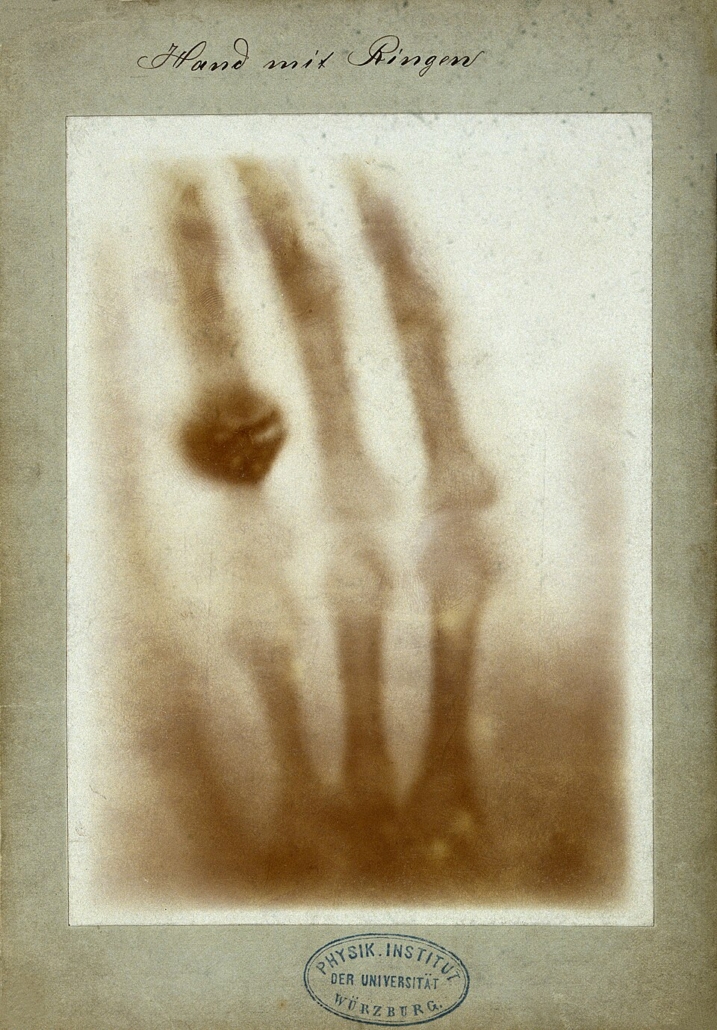
A hand and a horror: the first medical X-ray (image from Wikipedia)

Anna Bertha cried out against technocentric modernity in its early days, when technology was only just beginning to perform marvels like that. For her the marvel of X-rays was also a horror. And she was right in some very important sense, although it’s hard for us to recapture her emotion, when such images have been routine for many decades. Indeed, countless people today would find her reaction amusing. They’d like to be able to photograph or film her distressed face for LOLs or lulz. I call that kind of photographic sadism gelotography (from Greek γέλωτο-, gelōto-, “laughter”).

Gelotography is a much younger cousin of pornography, an anti-human genre that began almost as soon as photography itself did. Where one pursues the dopamine-dump of orgasm at any expense, the other pursues the dopamine-dump of laughter.[1] Accordingly, pornography and gelotography are part of why I’d say the camera is a wonderful evil, one of the two great unenchanting engines of technocentric modernity. The other great engine of unenchantment and evil is the car, which the conservative writer Russell Kirk once described as “the mechanical Jacobin,” as “a revolutionary the more powerful for being insensate. From courting customs to public architecture, the automobile tears the old order apart.”

Language as lightning

“Mechanical Jacobin” is a wise and wonderful phrase, a lightning-like metaphor that links cars with the arrogant, mass-murdering, tradition-trashing, society-smashing Jacobins of the French Revolution. And yes, cars and the infrastructure that serves them have been like Jacobins: transforming and tyrannizing cities and landscapes, assaulting the eye and ear and nose with metal, tarmac and concrete, with engine-noise, tyre-rumble and exhaust-fumes. And ironically enough, Kirk’s phrase illustrates one of the themes of this essay: the superiority of language over imagery, of words over pictures. I say “ironically enough,” because how would you illustrate that phrase? How would you convey Kirk’s meaning in pictures? On the printed or pixelated page, you understand it in an instant: “mechanical Jacobin.” Putting it into pictures would be much more difficult and time-consuming.

But the difficulty of illustrating an idea or capturing a scene has its salutary side when you compare illustration by hand with taking a photo. One of the charges I want to lay against photography is that it has cheapened reality, giving us too much with too little effort. With a camera, you can capture all the detail and depth of an entire landscape in an instant. And thereby you diminish the depth and denigrate the detail. That doesn’t happen when you try to paint or draw a landscape. Or paint or draw something much smaller and simpler, like a cup or a flower or a face. When you learn to paint or draw, the true richness, complexity and depth of the world are brought clearly before you in a way that simply doesn’t happen with a camera.

The Watcher Watched

So I’d echo Kirk’s anathema against cars by saying that cameras are mechanistic Jacobins. They cheapen reality and they corrupt morality. In Nineteen Eighty-Four (1949), George Orwell presented a nightmare society where “You had to live — did live, from habit that became instinct — in the assumption that every sound you made was overheard, and, except in darkness, every movement scrutinized.” But that was the state invading privacy with cameras and microphones. Now the mechanistic invasion of privacy has been privatized:

“We had sex in a Chinese hotel, then found we had been broadcast to thousands”

One night in 2023, Eric was scrolling on a social media channel he regularly browsed for porn. Seconds into a video, he froze. He realised the couple he was watching — entering the room, setting down their bags, and later, having sex — was himself and his girlfriend. Three weeks earlier, they had spent the night in a hotel in Shenzhen, southern China, unaware that they were not alone.

Their most intimate moments had been captured by a camera hidden in their hotel room, and the footage made available to thousands of strangers who had logged in to the channel Eric himself used to access pornography. Eric (not his real name) was no longer just a consumer of China’s spy-cam porn industry, but a victim.

Warning: This story contains some offensive language

So-called spy-cam porn has existed in China for at least a decade, despite the fact that producing and distributing porn is illegal in the country. But in the past couple of years the issue has become a regular talking point on social media, with people — particularly women — swapping tips on how to spot cameras as small as a pencil eraser. Some have even resorted to pitching tents inside hotel rooms to avoid being filmed.

Last April, new government regulations attempted to stem this epidemic — requiring hotel owners to check regularly for hidden cameras. But the threat of being secretly filmed in the privacy of a hotel room has not gone away. The BBC World Service has found thousands of recent spy-cam videos filmed in hotel rooms and sold as porn, on multiple sites. […]

Eric, from Hong Kong, began watching secretly filmed videos as a teenager, attracted by how “raw” the footage was. “What drew me in is the fact that the people don’t know they’re being filmed,” says Eric, now in his 30s. “I think traditional porn feels very staged, very fake.”

But he experienced what it feels like to be at the opposite end of the supply chain when he found the video of himself and his girlfriend “Emily” — and he no longer finds gratification in this content. (“We had sex in a Chinese hotel, then found we had been broadcast to thousands,” BBC News, 6 February 2026)

So the biter was bit, the watcher was watched, the wanker wanked over. And feminists no doubt wish this biter-being-bit could happen more often to voyeuristic males invading the privacy of vulnerable females. Stories like that have been appearing for a long time at leftist outlets like the BBC and Guardian. But some of the leftists who decry the invasion of privacy for pornographic ends do not decry the invasion of privacy for political ends. For example, what about when someone is captured on camera in a private setting being racist or transphobic? “Ah, that’s different!” some leftists would say. As a racist and transphobe myself, I obviously don’t agree. And I can use my opposition to pornographic privacy-invasion to support my transphobia. Why should so-called “transwomen” not be allowed to enter female spaces like dressing-rooms and toilets? Well, one good reason is that the male perverts in question won’t be able to plant spy-cameras there.

No female Mozart

Real women do that sort of thing much less often, which is why I was puzzled by this headline back in March 2025: “Woman jailed for recording hundreds of men using the toilet in Aldi.” In fact, it wasn’t a woman but a “transwoman,” that is, a male pervert called John Leslie Graham. And it isn’t a coincidence that men are both corrupted by cameras and creators of cameras. That is, it’s men who invent the technology that other men use for voyeurism and privacy-invasion. As the provocateur Camille Paglia once put it: “There is no female Mozart because there is no female Jack the Ripper.”

Men break boundaries criminally, creatively and cognitively in ways that women don’t. Recall the story at the beginning of this essay. It’s impossible to imagine the sexes in that story reversed, with a female physicist called Anna Bertha Röntgen creating X-ray photography and her husband Wilhelm crying “Ich habe meinen Tod gesehen!” Women don’t invent like that and men don’t emote like that. That cry was authentically female, the lament of an utterly ordinary and unexceptional woman at the cleverness and skill of her husband, who’s still famous and still celebrated as the discoverer of X-rays. And yes, we can certainly agree that the husband was far more intelligent and inventive than the wife. But we might also agree that he had far less wisdom.

Breaking the white light

And that story of a technophilic man and a technophobic woman reminds me of another story about a clever technophile and a wise technophobe. It’s a story in J.R.R. Tolkien’s The Lord of the Rings, when the wizard Gandalf is describing how he sought the aid of the wizard Saruman against the Dark Lord Sauron. Saruman’s name means “Man of Skill” or “Man of Cunning,” because he is skilled at molding and manipulating matter to his own ends, as Gandalf sees again during their dialog:

“The Nine have come forth again,” I answered [Saruman]. “They have crossed the River. So Radagast said to me.”

“Radagast the Brown!” laughed Saruman, and he no longer concealed his scorn. “Radagast the Bird-tamer! Radagast the Simple! Radagast the Fool! Yet he had just the wit to play the part that I set him. For you have come, and that was all the purpose of my message. And here you will stay, Gandalf the Grey, and rest from journeys. For I am Saruman the Wise, Saruman Ring-maker, Saruman of Many Colours!”

I looked then and saw that his robes, which had seemed white, were not so, but were woven of all colours. and if he moved they shimmered and changed hue so that the eye was bewildered.

“I liked white better,” I said.

“White!” he sneered. “It serves as a beginning. White cloth may be dyed. The white page can be overwritten; and the white light can be broken.”

“In which case it is no longer white,” said I. “And he that breaks a thing to find out what it is has left the path of wisdom.”

“You need not speak to me as to one of the fools that you take for friends,” said he. “I have not brought you hither to be instructed by you, but to give you a choice.” (The Fellowship of the Ring, 1954, Book II, chapter 2, “The Council of Elrond”)

Gandalf refuses the choice, just as he refuses to be impressed by Saruman’s boast that “the white light can be broken.” There I’d say that Tolkien was making an implicit reference to — and rejection of — the mechanistic, mathematicized world-view of the great English physicist Isaac Newton (1643-1727). It was Newton who explained why white light can be “broken” with a prism into the visible portion of the electromagnetic spectrum (where X-rays would later be found by the German physicist Wilhelm Röntgen). If I’m right, then Saruman is a spokes-wizard for the nihilism of Newtonianism, for the foolish cleverness of science and technology. He has what is later described as “a mind of metal and wheels” and “does not care for growing things, except as far as they serve him for the moment.” (The Two Towers, “Treebeard”)

Books are bigger

I haven’t seen that confrontation between Gandalf and Saruman in the very successful film-trilogy of Lord of the Rings. Yes, it would be interesting to see it, but also invasive. Someone else’s images would invade my head and overwhelm the private, personal images I’ve always created when I’ve read and re-read Lord of the Rings. That’s one of my other objections to film and one of my other reasons to elevate literature over film and photography. The potency of the image overwhelms and obliterates the privacy of the imagination. And yet books — those silent, inert rectangular blocks of printed paper — are far bigger than booming, bustling, broad-screen movies, with all their action and activity and energy. Books remind me of the famous saying by the Greek philosopher Heraclitus: Δὶς ἐς τὸν αὐτὸν ποταμὸν οὐκ ἂν ἐμβαίης, Dis es ton auton potamon ouk an embaiēs — “You cannot step twice into the same river.” Readers of Lord of the Rings have never experienced the same book. Viewers of Lord of the Rings have always experienced the same film.[2] In other words, readers cook the book for themselves from the ingredients supplied by Tolkien; viewers consume what was cooked for them by the director Peter Jackson and the many others who created the films.

Film is tyrannical — sense-seizing, attention-appropriating, imagination-obliterating — in a way that literature isn’t. Film is also collectivist where literature is individualist. With Lord of the Rings, what one man created on paper took hundreds or thousands of men and women to put onto film. As the English writer Alan Moore once said: “[T]he written or spoken word is a higher technology than film. I believe it is much more genuinely magical in its effects and much more human. I’m not ignorant or dismissive of cinema. But with the written word, any writer has got exactly 26 characters. Out of the rearrangements of those 26 characters, the writer can create anything.”[3]

Definitely disenchanting

Artificial intelligence has narrowed that gap between the individualism of literature and the collectivism of film. It’s allowing entire films to be created with minimal expense and effort by single individuals. But the tyrannizing, sense-seizing evils of film have remained. And the privacy-stripping, amorality-encouraging evils of film have been encouraged. AI allows any kind of obscenity or extremity that can imagined to be literally turned into images. And so AI becomes part of the disenchantment of technocentric modernity, the Entzauberung der Welt or the stripping of magic and mystery from life named by the German sociologist Max Weber in 1917 from a poem by the German poet Friedrich Schiller. Film and photography disenchant in part because they make definite in a way that language and literature don’t. For example, what did Helen of Troy look like? Language both can and can’t tell us. From the 1590s, the English playwright and poet Christopher Marlowe tells us like this:

Was this the face that launch’d a thousand ships
And burnt the topless towers of Ilium? (Doctor Faustus, Act V, scene 1, lines 161-2)

But Marlowe also doesn’t tell us, because there’s no description of Helen’s face there, nothing about the shape, color, contours and myriad other features of a face which cameras can capture with such ease. And have captured in films about the Trojan War, where real actresses have embodied the literally mythic beauty of Helen of Troy. And where real sets have represented the “topless towers of Ilium.” Or failed to represent them, because how do you represent “topless towers”? The concept works in words, but would be impossible or absurd to convey on film.[4] Marlowe’s words are more wonderful and more powerful than any film or photograph because they are indefinite in a way film and photography can’t be and don’t want to be. Indeed, you could say that Marlowe wrote a kind of meaningful music about Helen’s beauty: all his words have meanings and some refer to material things, but they float in the mind like music, untethered to any particular manifestation of materiality.

Instant over hours

He was writing poetry, of course, but you can say the same of mathematical language. The word “triangle” floats free of materiality too, encompassing all triangles but embodying no particular triangle. Film and photography always want to manifest the particular, so triangles are tethered there. And so are trees and towers. And the face of a mythic beauty like Helen of Troy. Or the face of a historic beauty like Cleopatra. She was embodied by the actress Elizabeth Taylor in the hugely expensive film Cleopatra (1963), with its crew of hundreds and cast of thousands. And let’s suppose that the film had been the masterpiece it aimed to be. Let’s suppose it had been the greatest film ever created. I still think its hours of imagery and action would have been less powerful and less of an art-work than a single second of Cleopatra’s life illustrated by one man with much less advanced technology in the nineteenth century:
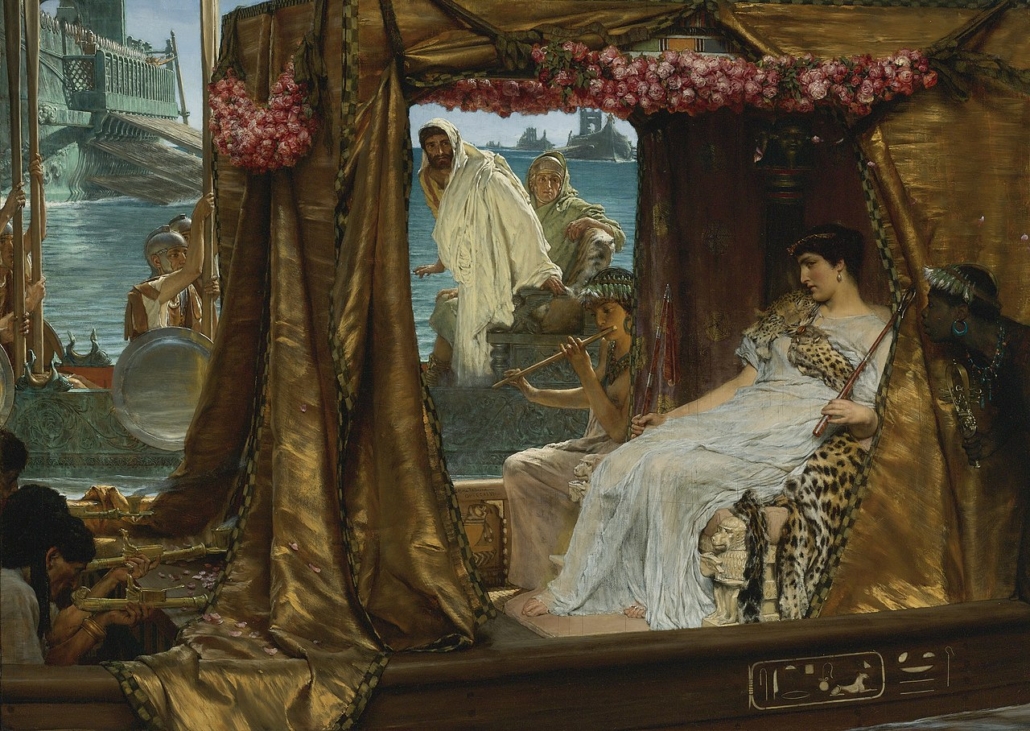
The Meeting of Antony and Cleopatra (1885), by Sir Lawrence Alma-Tadema (image from Wikipedia)

That’s one of the best paintings by Sir Lawrence Alma-Tadema (1836-1912), the Anglo-Dutch master who achieved a kind of full-color photographic realism in paint long before photography itself was routinely and realistically in color. Looking at that painting, one can almost feel the heat of the sun, smell the sea-air and the roses, hear the music of the flute, the creaking of the galleys, the splash of the oars. And in the “almost” is the enchantment. Alma-Tadema had to conjure that scene in the viewer’s mind with nothing but paint on canvas. And with his own long-honed, hard-earned skill, of course. The painting invites the imagination in a way that a film of the same scene wouldn’t and couldn’t. When we see the painting, we imagine what happened before and will happen next. A film would show us what did and will happen. And nowadays there would likely be sex. If all art aspires to the condition of music,[5] then perhaps you could say that all film aspires to the condition of pornography: ever more exciting, ever more explicit, ever more extreme, obscene and evil.

But the evil of film lies less in its pornography than in its pseudography, that is, in its ability to convey lies and falsehoods in a convincing, quasi-realistic way. Film and its retarded younger brother television have been peddling lies about racial and sexual differences for decades, portraying Blacks as wise and noble victims of White oppression, presenting women and homosexuals as superior to straight White males, who are thrust on film where leftism wants them to be in reality: at the bottom of all moral, cultural and cognitive hierarchies. And there lies a great irony: the technology created by White men has been used to overthrow White men and elevate their enemies. Photography, film and TV were all created by the cunning hands and clever brains of White men like the French Louis Daguerre (1787–1851), pioneer of photography, the American Thomas Edison (1837–1941), pioneer of cinema, and the Scot John Logie Baird (1888–1946), pioneer of television. What was invented and perfected by White men was then turned against White men.

Toppling giants, elevating dwarves

But part of the camera-driven undermining of White men wasn’t planned and purposive. Why was the Anglo-Dutch master Lawrence Alma-Tadema an artistic hero in the nineteenth century and the Jewish charlatan Mark Rothko an artistic hero in the twentieth? Because the camera mechanized the representation of reality and thereby corrupted art, driving it away from realism and beauty and towards abstraction and ugliness. Alma-Tadema was hugely skilled; Rothko was hugely hyped. Indeed, Rothko and other charlatans were beneficiaries of what the American journalist Tom Wolfe called The Painted Word (1975), whereby art became centered not on the skill and talent of disproportionately White masters, but on the words and theories of disproportionately Jewish scholars and critics.
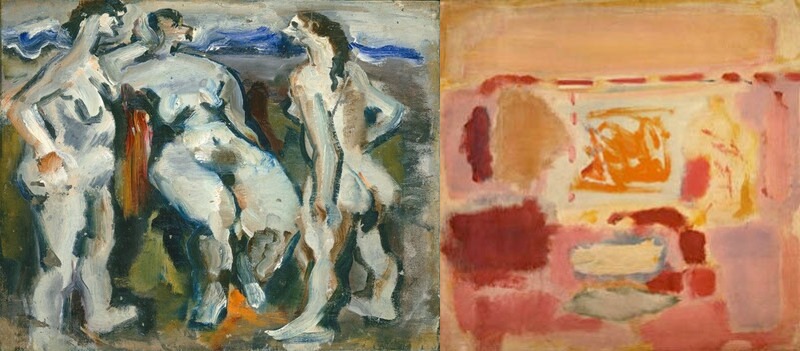
Rothko wrecks reality, then embraces abstraction (see Brenton Sanderson’s “Mark Rothko, Abstract Expressionism, and the Decline of Western Art” at TOO)

The camera indirectly created the Painted Word, toppled artistic giants like Alma-Tadema and elevated artistic dwarves like Rothko. Meanwhile, Jews in Hollywood and New York were turning the White male inventions of film and television against Whites in general and White males in particular. But cameras would have been catastrophic without the K-words. What cars have done to landscapes, cameras have done to mindscapes. And the two inventions collaborated in wreaking havoc on our culture. Cameras and cars have been the two great unenchanting engines of technocentric modernity.


[1]  I dislike the modern fashion for referring to or explaining human motives and behavior in reductive, neurochemical ways: “dopamine rush” and so on. It’s crude, cursory and disenchanting. But reductionism seems entirely appropriate for pornography and gelotography.

[2]  And a single reader has never read the same book twice.

[3]  Alan Moore has also said: “I find film in its modern form to be quite bullying[.] It spoon-feeds us, which has the effect of watering down our collective cultural imagination. It is as if we are freshly hatched birds looking up with our mouths open waiting for Hollywood to feed us more regurgitated worms [..]”

[4]  “Topless” can be interpreted as “having no limit in height” or “unexceeded in height.” Either way, it can’t be easily or unabsurdly represented as an image.

[5] Walter Pater said this in The Renaissance: Studies in Art and Poetry (1877): “All art constantly aspires towards the condition of music. For while in all other works of art it is possible to distinguish the matter from the form, and the understanding can always make this distinction, yet it is the constant effort of art to obliterate it.” See Gutenberg text.

Carrie Prejean Asked Uncomfortable Questions About Israel and Lost Her Job Two Days Later

Carrie Prejean Boller did not arrive at the February 9, 2026 hearing on anti-Semitism in America as a hardened ideologue. She came wearing an American-Palestinian flag pin, armed with questions she believed a Religious Liberty Commission should be willing to hear, and convinced that religious freedom meant the freedom to dissent from the prevailing orthodoxy on Israel.

By February 11, she was gone.

The former Miss California USA, a recent convert to Catholicism appointed by President Trump to his White House Religious Liberty Commission, was removed from the panel after she challenged witnesses at a Museum of the Bible hearing about whether criticizing Israeli policy in Gaza constituted anti-Semitism, whether Catholics were required to embrace Zionism, and whether social media platforms would be pressured to censor biblical passages about the role of Jewish authorities in the crucifixion of Christ.

Her removal came not from President Trump, but from Commission Chair Dan Patrick, the evangelical Christian Lieutenant Governor of Texas. Prejean responded with a public letter rejecting his authority and accusing him of acting “in alignment with a Zionist political framework that hijacked the hearing, rather than in defense of religious liberty.”

The message was unmistakable. In an era when Jewish power over American discourse on Israel has reached unprecedented consolidation, even asking the wrong questions can be detrimental to one’s standing in normie political circles.


Prejean is by no means a fervent anti-Semite. Her career arc, in fact, mirrors that of a typical establishment conservative. She rose to national attention in 2009 when, as Miss California USA competing for the Miss USA title, she answered a question from celebrity blogger Perez Hilton about same-sex marriage by saying she believed marriage was between a man and a woman. The answer cost her the crown and made her a hero to social conservatives. She subsequently authored “Still Standing”, appeared on conservative media circuits, and built a brand as a defender of traditional values and religious conviction in a hostile culture.

Prejean married former NFL quarterback Kyle Boller, had children, and converted to Catholicism in April 2025. When Trump appointed her to the Religious Liberty Commission, it seemed a natural fit for someone whose public persona had been defined by refusing to bend under pressure.

That history makes what happened next even more revealing. If someone with Prejean’s conventional conservative credentials could be expelled for the simple questions she asked, the boundaries of acceptable discourse on Israel have become vanishingly narrow.

The February 9 hearing was convened to address the rising levels of anti-Zionism and anti-Semitism taking place in the United States, particularly on college campuses following Hamas’s October 7, 2023 attack on Israel and the subsequent Israeli genocide in Gaza. Witnesses included Yeshiva University President Ari Berman, Jewish activist Shabbos Kestenbaum, Jewish students, and rabbis who shared accounts of rising anti-Semitism and harassment.

Prejean used her questioning time to challenge the premise of the hearing itself. She asked witnesses whether “speaking out about what many Americans view as a genocide in Gaza should be treated as anti-Semitic.” The Miss California winner pressed them directly with a yes or no question. “If I don’t support the political state of Israel, am I an anti-Semite, yes or no?”

Prejean defended Candace Owens and Tucker Carlson, both of whom had faced accusations of trafficking in anti-Semitic rhetoric, saying she listened to Owens daily and had “never heard anything anti-Semitic from her.” She told the panel that “Catholics do not embrace Zionism” and asked, “So are all Catholics anti-Semites?”

Most controversially, she raised the historical charge that “Jews killed Jesus,” asking whether social media platforms would face pressure to ban biblical passages referencing Jewish authorities’ role in the crucifixion. She also directly challenged Kestenbaum, noting that Israel had been mentioned 17 times during the hearing and asking, “Are you willing to condemn what Israel has done in Gaza?”

Chair Dan Patrick halted her questioning. The backlash online was immediate. Far-right activist Laura Loomer called for her removal. Kestenbaum publicly urged her to resign.

Prejean refused. She tweeted, “I would rather die than bend the knee to Israel,” and accused the commission of pushing a pro-Zionist agenda rather than protecting religious liberty. She posted that she would “continue to stand against Zionist supremacy in America” and described herself as “a pro-life Catholic and a free American who will not surrender religious liberty to political pressure.”

On February 11, Patrick announced her removal, stating, “No member of the Commission has the right to hijack a hearing for their own personal and political agenda on any issue.” Prejean responded with a defiant open letter disputing Patrick’s authority to remove her. She wrote that the commission “was created by Executive Order of President Donald J. Trump. Members were appointed by the President and serve as his appointees. Nothing in the Executive Order grants you the power to remove presidential appointees.”

She accused Patrick of “speaking without authority” and acting on “a Zionist political agenda, not the President’s, not the U.S. Constitution’s, and not the purpose of this Commission.” Her closing lines were unambiguous. “I refuse to bend the knee to Israel. I am no slave to a foreign nation, but to Christ our King.”

The controversy exposed fractures not just on the right, but within Catholicism itself. Prejean claimed to be defending Catholic doctrine. Catholic commissioners at the hearing said she was distorting it. A priest on the panel cited the Second Vatican Council’s Nostra Aetate (1965), which formally repudiated the deicide charge and condemned anti-Semitism “directed against Jews at any time and by anyone.”

What happened to Prejean is not an isolated incident. Her expulsion exemplifies organized Jewry’s commitment to policing all forms of criticism directed against Israel or any other Jewish-dominated entity.

The machinery is well established. Pro-Israel donors flood campaigns, ensuring politicians who stray face primary challenges from groups like AIPAC’s United Democracy Project. Think tanks from the American Enterprise Institute to the Foundation for Defense of Democracies enforce orthodoxy. Media outlets amplify charges of anti-Semitism against anyone questioning the U.S.-Israel relationship. Social media platforms adjust content moderation under pressure from organizations like the Anti-Defamation League and the Combat Antisemitism Movement, which celebrated Prejean’s removal.

Carrie Prejean Boller is no ideologue steeped in anti-Semitic fervor or the arcana of the Jewish question; she is simply one more American recoiling from the Gaza genocide unleashed after October 7. Jewish organizations, however, flush with unchecked authority in the wake of October 7, brook no dissent, branding even the feeblest remonstrance against Israel as heresy. Her expulsion thus lays bare the iron grip on American public life, where religious liberty yields to the caprices of Jewish enforcers.

The Quaker Question

In the UK, there is a group called the Centre for Countering Digital Hate. It is a Transatlantic NGO based in London and Washington, DC, run by an Afghani-British Labour activist called Imran Ahmed. In December 2025, President Donald Trump banned this man from the United States due to being a “key collaborator with the Biden administration’s effort to weaponize the government against U.S. citizens” and because he was involved in a campaign to coerce American social media platforms to punish Americans for expressing certain conservative points of view.

In particular, Trump’s administration objected to the way in which Ahmed, and others, campaigned to force American platforms to restrict freedom of expression within the UK and the European Union. If you’re not already familiar, keep the name in mind, as the Centre for Countering Digital Hate is right up there with Hope Not Hate, Stonewall, Mermaids, and their American counterparts, such as the SPLC in terms of suppressing free speech and attacking those who question Woke dogmas.

Now if you’re an ordinary right-wing type you’re probably thinking, “Oh let me guess, it’s funded by the Jews, right?”  No. Well . . .  yes, but they’re not actually the main social group that funds them. If you look into the first three charities that do so then it is only the “Pears” family (originally Schleicher) that are Jewish. The other two funders, Cadbury and Rowntree, are two of the big three British Quaker families who pioneered the confectionary industry through the Industrial Revolution; the other family being the Frys, also minor confectioners but more associated with prison reform.

There is also the Paul Hamlyn Foundation. Paul Hamlyn (1926–2001), a notorious champagne socialist of his day, had a Jewish father while his mother was a Quaker. Paul was raised in possibly the oldest “pedigree woke” schools in the United Kingdom: St Christopher School, Letchworth Garden City. In a similar story to the Steiner schools, St Christopher was founded for the theosophical movement, a popular “spiritual-Woke” craze of its day that stressed universal brotherhood and attacked traditional power structures and even the notion of scientific truth, it was soon after adopted and run by a Quaker family. If we count the Paul Hamlyn Foundation as half and half, then that’s 1.5 Jews to 2.5 Quakers among those who are funding the Center for Countering Digital Hate. What if this is proportionally generally true of all far-left enterprises? What if it is true across the last three centuries of history? What if it has been more the Quakers than the Jews who’ve been pushing and funding left wing social reform since the onset of the Industrial Revolution and even earlier?

We groan in disbelief as the dissident right to ignore the Quaker Question—an exception is Kevin MacDonald’s Individualism and the Western Liberal Tradition which has a chapter on the critical role the Quakers played in abolishing slavery in the UK (but not in America where Puritan-descended people took the lead). The power of this super-virtue-signalling, pacifist sect that believes that members are imbued with the “inner light,” such that God is somehow “in them” and guides their righteous consciences. How many times has one of your permanently online friends named-dropped one of the eminent early twentieth-century Jewish banking families: the Rothschilds, the Warburgs or the Schiffs? How many times have they brought up George Soros, Jonathan Greenblatt (of the ADL), Larry Fink (of BlackRock fame) or even Michael Bloomberg?     Compare this with how many times your friend has mentioned equally eminent Quaker banking families: the Barclays, the Lloyds or the Gurneys? Excluded from the professions, the Quakers, like the Jews, went into finance. Has he ever mentioned William Penn, the founder of Pennsylvania, whose pacifist policies eventually led to the state nearly being overrun by the French and their Native American allies? Or what about Elizabeth Fry née Gurney, who pioneered making UK prisons as easy as possible?

Your friend probably doesn’t even know who the Pease family or the Rowntree family are, unless he’s partial to fruit pastilles, and that’s a terrible shame, because all of these families form part of a powerful sub-ethnic group within the Anglo-European population. Quakerism has for a long time emphasised marriage within their community. Given enough time and evolution, Quakerism might have formed its own Jewish-like ethnic identity. George Fox, its seventeenth century founder, encouraged Quakers to inter-marry and “marrying out” would lead to disownment if the spouse did not convert. English Quakers abolished this requirement in 1860.

You can draw connections between the famous members of old Jewish families and social progressive reform through the nineteenth, twentieth and twenty-first centuries, but it requires more work and what you will find isn’t really that exciting. Compare that with what the Quakers got up to: proto-Woke social justice spills off the page, but, of course, it is manipulatively dressed up as “caring” and “equality” such that there can be no rational debate: African American rights, Native American rights, women’s rights including suffrage, trade unionist rights, liberal prison and sentencing reform and religious pluralism. You will struggle to find a single eminent Quaker at any point in history who didn’t have a hand in at least one of these things, because proto-Woke liberal social justice has always been an essential part of the Quaker sect.

There are movements started by Quakers that aren’t even about social justice, yet you would intuitively associate them with puritanical virtue signalling. An extremely proto-Woke sect of the Quakers in the late nineteenth century – the Shakers – came up with the idea that all sex, even in marriage, was evil. Another sect was led by a non-binary natal woman who called herself “Universal Friend” and became furious if her original name was employed. The Quakers are known for their historical advocacy of teetotalism, as we explored earlier, and the temperance movement that ultimately inspired the prohibition on alcohol in the United States.

The Quakers have also been long known for their Pacifism, even against their ideological opposites during World War II. So, if Quakers had approached a majority of the population in Britain and America by the mid-twentieth century, then German, Italian and Japanese Fascists and National Socialists would ironically have easily won the War and wiped out Quakerism. Quakers are even known to be some of the earliest advocates of vegetarianism in the modern era, and played a major role in founding the Vegetarian Society of England in 1847 and their own exclusive Friends Vegetarian Society in 1902. Unsurprisingly, in that vegetarianism is a form a virtue-signalling and of reassuring yourself of your own virtue, practicing it is predicted by the kind of mental instability that would be associated with being left-wing.

When it comes to social justice, the Jewish influence has until perhaps recent decades for the most part stayed confined to fighting post-World War II anti-Semitism. The only areas where the Jews have an edge over their Quaker counterparts in the UK are in the far-left’s bloodiest invention, Marxist thought, where they have definitely been historically overrepresented, if not quite to the degree that has always been claimed. Presumably these political areas involve too much testosterone, conflict and general chaos for the timid and submissive Quaker sensibilities, and so they have allowed that void to be filled by other out-groups.

It’s often taken for granted today, because of the present political climate of polarisation, that Revolutionary Marxism, sexual libertinism, and Woke social justice are all part of the same far left tapestry, but actually historically speaking, especially before the 1960s, these were much more politically disparate. Though some have argued convincingly that it was postmodern philosophers of the Frankfurt School that united these things together, the simpler explanation is that since Fascism has historically opposed them all, in being anti-Fascist one necessarily takes on all causes supposed Fascists dislike.

Quakers are a dying breed today. Historically their numbers and influence in Europe and America, especially in the Anglo World, has been substantial, but now their size is insignificant; only about 75,000 people in the United States self-identify as Quaker. We suspect that Quakerism’s passive, soft and strange religious overtones are too out of touch with the far-left’s burning anger and Neuroticism to be popular with young Woke moralists today. As is inevitable with most liberal left-wing religious sects, their own teachings have brought about their demise, by mass apostasy and demographic collapse. In 1980, there were over 17,000 registered Quakers in the UK, by 2020 there were roughly 12,000. You see the same pattern across all the liberal mainstream Protestant groups, which are arguably just watered down versions of Quakerism today anyway. But although the religion is dying, the elite family networks, the money and the organisations still linger on and shall continue to do so for a while yet, as is evident in the funding structure of Centre for Countering Digital Hate outlined earlier.

As Canadian political scientist Eric Kaufmann has shown in Shall the Religious Inherit the Earth?, a similar fate befalls the Jewish elite in the West, as they’re demographically in decline, being replaced by a new stock of competing Chinese, Indian and Arab elites, with their own hegemonic interests, and religion plays a relatively moderate role for the dominance and cohesiveness of those groups, especially the Chinese. The Jewish people will nevertheless remain firmly entrenched, even expansive, in Israel for the foreseeable future however, and Israel most definitely does exercise political influence beyond its borders. When controlling for intelligence, religious conservatism predicts fertility.

Jewish people for whom their Jewish identity is salient have been and will continue to be a politically active presence in Western Europe for some time, although in remarkably different ways that depend largely on whether they are secular universalist liberal Jews or religious or Zionist Jews. However, in the UK, only the highly insular Haredi and Orthodox Jews have above replacement fertility. The other Jewish groups are marrying out and simply dying out due to below replacement fertility. There is evidence that the IQ of Orthodox Jews is lower than that of Whites which predicts the Haredi’s high fertility but also their limited socioeconomic success.

Nevertheless the Jewish peoples’ superiority over the Quakers is very clear. The Jewish contribution to science and invention alone is beyond impressive: Fritz Haber, Albert Einstein, Oppenheimer, to name a few, let alone their contributions to art, literature, film and culture.

What have the Quakers ever done for us? Chocolate snacks . . .  that’s about it, and even these were only developed because coco was seen as a virtuous alternative to alcohol. That’s about it. And what have they ever done to us? It was the Quakers who started the modern hegemonic far-left, they laid the foundations for everything, and even now their legacy continues to dominate the insanity of modern Woke politics. Your permanently online is obsessed with the Jewish Question, and that’s exactly how the Quakers want it to be.

The above is an edited version of part of The Quaker Question: Exposing the Sect that Really Rules the World by Edward Dutton and J.O.A. Rayner-Hilles. Hard copies are available from the publisher at https://wylfings.com/ The e-version is available on Amazon.

The Transgender Menace Is Far from Defeated: Conservative Triumphalism Is Wildly Overstated

There is increasing gloating from certain conservative pundits that the transgender menace has been defeated. These people assert that mainstream conservatism actually won this battle in what is otherwise a decades-long trend of defeat after impending defeat in the-so-called culture war. Matt Walsh has been particularly strident on this matter, confidently declaring that “the fight over “transgenderism” is over and the Left lost.” This is a sentiment he has expressed repeatedly over the past several months. Last October, Matt Walsh made this bold assertion in response to the Eric Kaufman study mentioned below:

Transgenderism is effectively over. We destroyed it. Clearest and most decisive cultural win that conservatives have ever achieved.

Even some of a more radical persuasion have made similar remarks, including Jared Taylor who wrote “Has the White Trans Plague Peaked?” One encouraging development after this essay’s original publication concerns a public statement by The American Society of Plastic Surgeons, declaring it now recommends “that gender-affirming surgeries be delayed until patients turn 19.” The statement specifically cited “‘insufficient evidence’ that the benefits of chest, genital and facial surgeries on minors experiencing gender dysphoria outweigh the risks.

Transgenderism has been repelled to some limited extent. The election of Donald Trump is a key, critical component of this. Executive orders banning federal funding for so-called gender affirming care for minors have been a huge setback for those institutions promoting transgender nuttery, and do so at a handsome profit. Banning transgender “people” from the military is another important policy decision that stigmatizes transgenderism to some degree and distances this mad delusion from mainstream life, at least to some limited degree. These and other policies are a welcome reversal from the peak influence that transgenderism enjoyed during the Biden Administration.

However, a survey of both those institutions promoting and advancing transgender lunacy and a review of American society—particularly in urban, leftist strongholds—reveal that transgenderism remains entrenched in important sectors of American life. These and other considerations demonstrate that the transgender menace has not, in fact, been defeated. It is merely in remission. If—or rather when—democrats are elected back in power, the effort to render transgenderism as a part of mainstream American life will likely be stabilized and then rendered a permanent long-standing component of modern American society, with only modest retreats from some of the more outlandish demands and practices that characterize the utter insanity and delusion that is transgender ideology.

Perhaps the single most significant indication that transgenderism has not, in fact, been defeated is that newspapers and other mainstream media outlets still adhere to the idiocy of customized pronouns as well as the so-called “singular they,” particularly in relation to a known, single individual whose sex is known. Similarly, almost all such media outlets continue to use the made-up names favored by transgender “people.” Few if any publications and media outlets have stopped calling Bruce Jenner “Katelynn” or Richard Levine “Rachel.” Although Ellen Page is no longer a woman as the term is properly understood, neither could such a creature or any biological woman ever be a man. And yet no media outlets refrain from referring to this freak as “Elliot.” Indeed, any search for Ellen Page on various search engines will reveal results for “Elliot Page.”

This trend does not just pertain to left-wing publications such as The New Yorker or The Huffington Post. Consider the manner in which The Daily Mail recently reported outrage on how, under the Trump Administration, a portrait of Levine “misgendered” and “deadnamed” him by captioning his portrait in the capitol building with his real birth name, Richard Levine. Quite significantly, this article referred to the individual as “Rachel,” and used the incorrect pronouns “she” and “her.” Interestingly, an article in Fox News covering this same story studiously avoided referring to Levine by any pronouns at all, while stating his birth name and what he calls himself now.

A strict policy against actual misgendering, as the term is properly understood, requires use of a birth name and use of “he him” pronuns, although perhaps “it” is more justified in such circumstances.

Further consider the altercation between Kelsea “Kaden the Pooner” Rummler and the Department of Homeland Security. Coverage in both The Daily Mail and Fox News refer to Rummler as a man, refer to this individual by the name Kaden, and use he/him pronouns. Neither article denotes that Rummler was transgender, but given all the “tells” attending the littlest pooner who got her eye shot out, it beggars belief that these reporters did not know Rummler is a biological woman.

While periodicals like The Daily Mail do not exactly exemplify the loftiest standards in journalism and writing, they are generally regarded as “right of center” on most matters and quite often present readers with an important survey of the continuing madness that pervades modern society. That mainstream outlets like these willingly adhere to this perverse charade of customized pronouns and refuse to “dead name” transgender “people” is a strong indication that these practices are mainstream and will be extremely difficult to dislodge from everyday life and society. Stated another way, it seems transgender ideology and its adherents have succeeded in their campaign of linguistic capture, both in relation to fantastical and utterly wrong pronouns as well as a marked aversion to if not outright prohibition of so-called dead-naming.

One somewhat encouraging trend that Jared Taylor and others have pointed to is the sharp drop in minors declaring themselves transgender or even non-binary. As Taylor informs his readers, some reports indicate that numbers have fallen from about eight percent to one percent. Another report cited by Taylor is less encouraging; according to “The Kaufmann report. . . the percentage of students calling themselves trans has dropped from 7 percent to 4 percent since 2023. . ..” That eight percent of youngsters—ostensibly both adolescents and children—succumbed to this utter madness is yet another indictment against mainstream conservatism and its intractably tepid nature and constitution. While that number, for now, has fallen to an appreciable degree, one percent is still much higher than the baseline number that should characterize any sane society and indeed even American society a decade ago and in eras past since time immemorial; that baseline number is zero percent. As even one percent is totally unacceptable, four percent is a far more alarming number, rendered even more troubling that it is close to the 3-4 percent margin of error that typifies these sorts of polls and studies.

These trends are further mitigated by the consideration that only about half of the states have banned so-called transgender care for minors. This, quite obviously, means that the other 25 states still allow and thus promote this abomination to continue. This is all the more damning because so-called gender affirming care should never be tolerated or countenanced for anyone, anywhere. A ban of so-called gender affirming care only in relation to minors in effect in just a little over half the states is so far off the mark from the obviously correct objective—banning transgender care categorically, for adults and minors alike.

Nor is it the case that transgender ideology has lost favor in leftist strongholds, from certain social media platforms to coastal elites. A brief examination of reddit and TikTok alike reveals that transgenderism is still quite prevalent in these and other social media platforms. In addition to subreddits that pertain specifically to transgender nuttery, a brief perusal of reddit reveals that posts celebrating or boasting transgender identity as well as transgenderism writ large occur quite often. This is true even, most especially, in subreddits that have nothing whatsoever to do with this pariah afflicting modern society. Indeed, posts celebrating transgenderism appear fairly regularly on otherwise mainstream subreddits, including subreddits pertaining to football and even r/bitchimatrain, the purpose of which is to showcase pictures, videos and other media depicting trains in a variety of sensational contexts, from colliding into cars left stranded at crossing gates to any number of matters.

TikTok similarly remains a hotbed of both transgender nuttery and radical gender ideology as well as far-left lunacy more broadly. The insidious social media platform is riddled with profiles and short videos asserting fantastical, customizable, and—above all—wrong pronouns as well as advancing transgender identity and radical gender ideology. This of course is in addition to the countless videos endorsing violence in response to the ICE raids in Minneapolis and elsewhere.

Readers are of course right to decry both platforms as the veritable cesspools that they are, but it is a mistake to dismiss either of these platforms outright, as many mainstream conservatives are wont to do. Reddit retains significant influence and reach. It retains such reach and influence despite its ridiculous censorship policies and the plague of super moderators such as bardfinn—real name Steven Joel Akins—and merari01—real name believed to be Joost Eggelaar of Eindhoeven, Netherlands. Indeed, Google’s search engine artificially foists reddit at the top of any query. Most AI queries—including Grok—often refer to results in reddit, above and beyond even Quora. TikTok, although nothing less than veritable brain rot that eviscerates ever diminishing attention spans and intelligence of the collective masses, is also similarly influential, if not more so.

Such considerations are further bolstered by the observation that few celebrities and persons of influence who have embraced transgenderism and inflicted such insanity on their offspring have recanted. To this author’s knowledge, there is not a single celebrity or person of influence who has expressed regret in endorsing so-called transition of a son or daughter, whether that son or daughter is an adult or minor. Once again, readers are correct to decry celebrity influence. But such objections notwithstanding, it is nonetheless the case such figures unfortunately wield profound influence over the masses in American society and “culture.”

Similarly, at the time of this writing, no medical institutions or associations have denounced transgenderism in all its abject insanity. So-called gender affirming care and the very foundations of transgender ideology are still endorsed by all major American medical institutions. Neither the American Medical Association (AMA), the American Psychological Association (APA), nor the American Academy of Pediatrics (AAP) have backed down from their advocacy and endorsement of transgenderism. None of these and other incredibly powerful and influential institutions have either recanted these positions or curtailed them in any significant way.1 It is true of course that the Cass Review rebuked the use of puberty blockers in minors and was an important blow to transgender lunacy. However, both the report and Dr. Cass herself still affirmed transgenderism in principle. Indeed, a letter by Dr. Cass herself expressly affirmed transgenderism and gender affirming care, particularly for adults but also, quite critically, even minors. Salient portions from a letter denying association or endorsement of Abigal Shrier’s Irreversible Damages read as follows:

Anyone who has actually read my Report will see that it advocates to provide appropriate support for all gender questioning young people, regardless of whether they choose a medical pathway or not. I have never read Irreversible Damage, and the suggestion that I recommended it to anyone is fabrication. I note that by the time it was published I had already been reviewing the evidence for six months and had spoken to people who had had successful medical transitions, and I continued to do so throughout my Review. I have consistently said, both in my report and in multiple public fora that this is the right pathway for some young people.

Together, these and other considerations reveal that transgenderism remains entrenched in American society and Western culture more broadly, and will likely remain so given the ineffectual nature of mainstream conservatism. As has been asserted before by this author, the critical failure of the conservative response was how tentative and qualified it was. Most mainstream conservative pundits spent more time qualifying their objections, limiting their objections to men in women’s intimate spaces like locker rooms and nude spas as well as women’s athletics. In the same way, their opposition was further limited to advancing and propagating transgender nuttery to minors, instead of denouncing transgenderism categorically for adults and minors alike. The vast bulk of mainstream, “normie” conservatism spent far too much time and effort to assure they do not denounce transgenderism in adults, and would never stoop to mocking, denouncing, or ridiculing transgenderism categorically.

Consider for example the tepid, weak tea offered by Ryan T. Anderson in When Harry Became Sally. As set forth in the review “When the Temperate Is Decried As Extreme: A Review of When Harry Became Sally: Responding to the Transgender Moment,” a substantial portion of the text is expended on pointless disclaimers that transgender people have “rights” and that “discrimination” against transgender “people” is wrong. As examined at length in this critique and review, Anderson expends quite a bit of verbiage placating so-called civil rights concerns. Indeed, he is hopelessly and shamelessly “beholden to the civil rights ethos, as well as its ideological and rhetorical baggage,” as demonstrated in this remarkable passage:

Granted, there has been historic bigotry against those who identify as transgender, and it has not vanished. If people are being turned away from restaurants or denied basic medical care solely on grounds of a transgender identity, that is real discrimination and it should be addressed appropriately so that people are treated with dignity and respect. (197)

This could not be more wrong. Treating such persons with “dignity and respect” is to normalize such behavior. If not hatred than certainly contempt and disdain for transgenderism and thus transgenders themselves is not only acceptable but righteous. Individual proprietors of various establishments should be able to express such contempt and disdain by refusing service just as everyone should refuse any association with such individuals. If done with ridicule and mockery, all the better.

Consider also the likes of Peter Boghossian, who constantly bloviates how grown adults should be—and must be—allowed to do whatever they want with their bodies. This is of course a most spurious assertion in relation to self-harm in other contexts. No sane society allows a person to amputate a limb or leg because of an insane delusion that a person’s intrinsic self is an amputee. Nor does society allow anorexics and bulimics to persist with their own particular fit of self-harm and self-destruction.

Opposing the propagation of transgender nuttery to children and minors is of course laudable, but if transgenderism is not rejected and denounced universally and unequivocally, conservative opponents are unwittingly, or perhaps wittingly, normalizing it and allowing transgender delusions to become part of mainstream life. Just like anything, once this lunacy is allowed to enter the mainstream, once it is allowed to take a foothold in the stream of culture and discourse, such elements inevitably contaminate the minds of adolescents and children alike. By expending so much time and rhetoric granting so much ground to ideological and political enemies, conservative punditry accomplishes very little besides normalizing transgenderism. As with gay marriage and other ills that have afflicted modern society, this demonstrates ignorance or disregard for the fundamental concept of defining deviancy down. By not ostracizing, stigmatizing, and condemning transgenderism forcefully, society and the individual alike eventually become acclimated to it, as it then becomes mainstream. Once formerly deviant behavior becomes mainstream, deviancy is defined further downward, as even worse, more extreme proclivities that were once unthinkable then enter into the periphery of deviant behavior that is nonetheless cognizable and known in society.

Moreover, as Rules for Radicals stipulates, mockery and ridicule is one of the most devastating tools available in any effort in discourse and persuasion. Saul Alinsky asserts there is no defense when something is made an object of ridicule sharply and with competence. Fuddy-duddy conservative types like Anderson, Boghossian and others have utterly forfeited this essential, devastating approach, omitting it entirely in the conservative “tool kit” on the issues of transgenderism and radical gender ideology. This is all the more damning as a brief, cursory survey of various transgender specimens, of both the so-called male-to-female and male-to-female variety, reveals that they are the greatest objects of ridicule of all. And yet most of these fuddy-duddies would never sully their precious respectability by calling such an individual a “troon” or a “pooner:” derogatory epithets and insults for the male-to-female and male-to-female sorts, respectively. Nor would they ever resort to mocking, demeaning, or ridiculing these “people” in any way, even though, as Rules for Radicals stipulates, that is one of the most effective, devastating rhetorical and persuasive tools available. Such cowardice also forfeits the power of shaming and stigmatizing undesirable behavior to deter individuals from entertaining such ideas or conduct.

Readers have doubtlessly noticed the phrase “transgender ‘people’” has been qualified with quotation marks for the word “people.” This connotes dehumanization, now explicitly denoted in this paragraph. Consider the blithe and seemingly outrageous assertion that the notion of transgender “people” is an oxymoron. For once such individuals go beyond the point of no return by permanently mutilating their genitals or destroying bodies with puberty blockers and hormones in ways that can never be repaired, such individuals have abrogated and negated their very humanity. Normal sexuality that humans have been blessed with is not only the quintessential core of humanity, but indeed goes to the very heart of the mammalian essence. Those possessed and deluded by the maddest folly that is transgender insanity and delirium have destroyed and gutted that quintessence of what it means to be human and thus dehumanize themselves beyond all hope of redemption. As set forth in “Less Than Human: An Argument for Prescribing ‘It’ for Certain Transgender ‘People,’” any “man who mutilates his penis through so-called gender-affirming surgery to create a very poor counterfeit of a vagina has negated so much of his humanity as to cease to be human in many important ways.” Similarly, “Women who remove their ovaries, have their breasts lopped off, sterilize themselves and destroy the ability to ovulate, as well as undergo man-made horrors beyond most people’s imagination by way of the neo-penis have destroyed not only so much of what makes them women but their own humanity as well.” As obvious but harsh as such rhetoric is, what mainstream conservative pundit would ever dare to condemn transgenderism in such a firm, cavalier, and uncompromising manner? This lack of vision is why they lose time and time again.

If opposition to liberal orthodoxy more generally and transgender insanity specifically had been more strident and assertive, the transgender menace would likely have been defeated very quickly. Instead, by hemming and hawing, this madness was allowed to establish itself in mainstream society. Some of the more outlandish demands are currently being repelled, but time is running out to oust this pariah from all visible corners of society. This as well as the wishful thinking that transgenderism has been defeated both further inform readers of the structural deficiencies of mainstream conservatism and the need for much more radical, hard-hitting opposition to the left.

Readers, particularly younger ones who have no living memory of the 90s, should consider that such premature gloating is nothing new among mainstream conservatism. After the New Gingrich revolution in 1994, in which The Republican party seized control of both the House and the Senate for the first time in over half a century, there was much confidence that so-called “political correctness” had not only been defeated, but had been defeated decisively, intractably. History has shown how wrong such declarations were. Then, as now, the forces of liberalism and cultural Marxism have not been defeated, they are simply in a temporary state of regression and remission. Precisely because mainstream conservatism always resorts to half measures, because mainstream conservatism wastes so much time with pointless qualifications and reassurances that they would never object to “what consenting adults do,” this is almost certainly a temporary respite. Transgenderism is very much alive and doing fairly well, all things considered. And unless much balder strategies are resorted to in the immediate future, this pariah and menace will soon be permanently entrenched into the fabric of modern American society—and thus European civilization more broadly. There may still be time to prevent this, but those opposed to transgenderism will have to stop limiting objections to and arguments against transgenderism as they relate to propagating minors or infringement against women’s spaces. Opposition to transgender insanity and delusion must embrace that “call for uncompromising intolerance,” correctly discerning that this menace must be eradicated from all areas of mainstream public life.

Other articles and essays by Richard Parker are available at his publication, The Raven’s Call: A Reactionary Perspective, found at theravenscall.substack.com. Please consider subscribing on a free or paid basis, and to like and share as warranted. Readers can also find him on twitter, under the handle @astheravencalls. Those readers particularly concerned with the transgender menace are particularly encouratged to peruse the section “Against Transgenderism.”

The Jewish Power Web Behind Trump’s New Choice for Fed Chair

Kevin Maxwell Warsh did not rise to the chairmanship of the Federal Reserve on the strength of a PhD in economics. He does not have one. Born April 13, 1970, in Albany, New York, Warsh studied public policy at Stanford before earning a law degree from Harvard Law School in 1995, with additional coursework at MIT’s Sloan School and Harvard Business School. Multiple Jewish community publications including Jewish Insider and JWeekly have identified Warsh as Jewish, a background that would turbocharge his ascent to the top of the financial ladder.

Jerome Powell, whom Warsh is set to replace, also lacked an economics doctorate. But Powell spent years building institutional credibility at the Fed. Warsh’s path ran through Jewish networks that put him on the fast-track to success.

After Harvard Law, Warsh went to Morgan Stanley in New York, spending seven years in mergers and acquisitions, rising to vice president and executive director. By 2002, at 31, he joined the Bush administration as Special Assistant to the President for Economic Policy and Executive Secretary of the White House National Economic Council.

In January 2006, Bush nominated Warsh to the Federal Reserve Board of Governors. At 35, he became the youngest governor in the Fed’s history. Former Fed vice chairman Preston Martin, a Reagan appointee, publicly declared the nomination was “not a good idea” and said he would vote against confirmation if he could. Warsh was confirmed anyway.

During the 2008 financial crisis, he became one of Ben Bernanke’s—who is also of Jewish extraction—most indispensable lieutenants. Bernanke wrote that “Don Kohn, my vice chairman, and Kevin Warsh, with his many Wall Street and political contacts and his knowledge of practical finance, were my most frequent companions on the endless conference calls through which we shaped our crisis-fighting strategy.” Warsh resigned from the Fed in March 2011, returned to Stanford’s Hoover Institution, joined Stanley Druckenmiller’s Duquesne Family Office LLC, served on the boards of UPS and Coupang, joined the Group of Thirty, advised the Congressional Budget Office, and sat on the Bilderberg Group’s steering committee.

The x-factor behind Warsh’s rapid ascent in the financial world was his marriage into the Lauder family—one of the most powerful Jewish families in the United States. In 2002, Kevin Warsh married Jane Lauder, granddaughter and heiress of cosmetics empire founder Estée Lauder. Forbes estimated Jane Lauder’s personal net worth at approximately $2.4 billion as of 2017. But more consequential to Warsh’s political trajectory was what the marriage brought in the way of a father-in-law.

Ronald Steven Lauder, born February 26, 1944, is the sole heir to The Estée Lauder Companies with a net worth of approximately $4.7 billion. He attended the Wharton School at the University of Pennsylvania, where he was a classmate and friend of Donald J. Trump. The two have remained close confidants for over 60 years. Lauder served as U.S. Ambassador to Austria under Ronald Reagan from 1986 to 1987, and contributed more than $1.6 million to pro-Trump organizations since 2016, including $5 million to the MAGA Inc. super PAC in 2025.

As Politico reported in 2017, when Warsh was first a contender for Fed chair, Trump biographer Tim O’Brien noted, “Anytime someone has a connection to someone who’s powerful or famous, it matters immensely to Donald Trump.” Fortune described Warsh’s nomination as pairing “an inflation hawk with a deep Trumpworld connection through Ronald Lauder, a friend to the president for 60 years.”

To understand Ronald Lauder is to understand one of the most influential figures in organized Jewish life globally. Since 2007, Lauder has served as President of the World Jewish Congress. His affiliations also include the Conference of Presidents of Major American Jewish Organizations, the Jewish National Fund, the Anti-Defamation League, Yad Vashem, and the American Jewish Joint Distribution Committee. In May 2025, Israeli President Isaac Herzog awarded Lauder Israel’s Presidential Medal of Honor.

His connection to Israeli politics runs deeper still. Lauder is largely credited with helping Benjamin Netanyahu win the 1996 Israeli election, when Netanyahu faced a 30-point deficit against incumbent Shimon Peres. In 1998, Netanyahu asked Lauder personally to conduct Track II negotiations with then-Syrian leader Hafez al-Assad, and Lauder’s draft peace treaty became part of subsequent Israeli-Syrian diplomatic efforts. In 2018, Israeli police questioned Lauder over gifts he had given Netanyahu.

All of that is Kevin Warsh’s father-in-law. And in Washington, that has mattered more than any doctorate, any editorial board criticism, or any accusation of ideological convenience. Curiously, mainstream outlet like The Atlantic have called out Warsh’s career-long pattern of changing monetary policy positions based on which party controls the White House.

During the Obama years, Warsh was a vigorous inflation hawk, opposing low interest rates and quantitative easing even when unemployment hovered near 10%. After Trump’s first election in 2016, he co-authored a 2018 Wall Street Journal op-ed with Druckenmiller arguing against rate hikes. Under Joe Biden, he returned to hawkish criticism. After Trump’s re-election and the prospect of his own nomination, Warsh began advocating for rate reductions, citing an AI-driven productivity boom as a “significant disinflationary force.”

His positions on trade followed a similar arc. In a 2011 Wall Street Journal op-ed, Warsh called on policymakers to “resist the rising tide of economic protectionism.” In a 2010 speech before the Securities Industry and Financial Markets Association, he declared “U.S. companies are made better by global competition” and praised “pro-growth trade policies.” These positions made MAGA hawks nervous when Warsh was considered for Treasury Secretary in November 2024. But by 2024, Warsh had shifted, suggesting that unfriendly nations should no longer enjoy the benefits of American economic partnership, which allayed concerns from the economic nationalist wing of the Trump moment.

The immediate catalyst for Warsh’s nomination was Trump’s conflict with Jerome Powell, who Trump himself had nominated in 2017. In January 2026, the DOJ under DC U.S. Attorney Jeanine Pirro opened a criminal investigation into Powell related to cost overruns on the Fed’s headquarters renovation. Powell released an unprecedented public video calling the probe a pretext for political pressure.

Warsh was a finalist for the Fed chair position in 2017 before Trump selected Powell and was considered for Treasury Secretary in November 2024 before Scott Bessent got the job. With Powell weakened and politically radioactive, the path finally cleared.

Warsh’s coronation at the Fed cements Trump’s lifelong pattern of elevating Jews through elite networks over American economic nationalists or credentialed outsiders, proving once more that in the corridors of power, father-in-law Ronald Lauder’s billions, World Jewish Congress clout, and connections to the Israeli mothership outweigh any hawkish flip-flops or MAGA misgivings. In the commanding heights of the American economy, Jewish privilege endures unchallenged.

The Forgotten Legacy of the Church Militant

5232 words

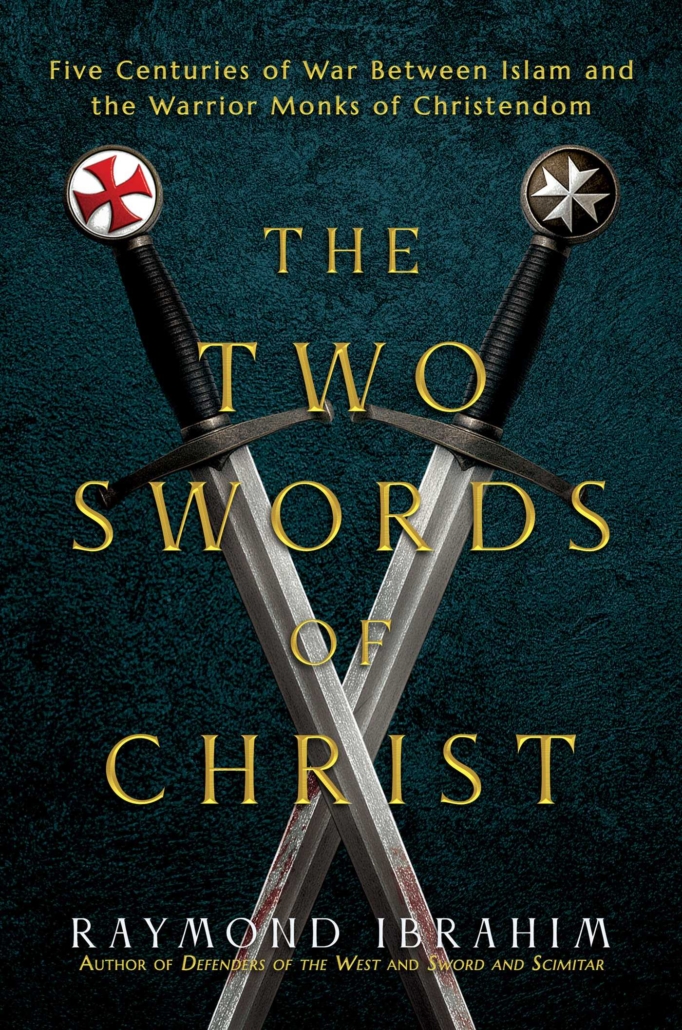
The Two Swords of Christ: Five Centuries of War Between Islam and the Warrior Monks of Christendom


Raymond Ibrahim
Bombardier Books, 2025
512 pages, $32.00 hardcover

The average American knows little about Islam apart from the bare fact that it is a “religion.” From this, certain things follow for that average American. First: Islam is a private matter which the state and all non-Muslims are bound to tolerate. Second: when Muslims fail to practice reciprocal tolerance toward non-Muslims, this cannot be due to their religion per se, but must have its source elsewhere—such as in a mysterious process called “radicalization.”

Americans believe these things because of a revolution in religious thinking carried out within Western Christendom in the seventeenth and eighteenth Centuries. This involved a shift away from understanding religion as a comprehensive set of beliefs and rules meant to inform society as a whole and toward considering it an affair of individual conscience. The practical goal of this “privatization of religion” was the worthy one of bringing an end to the destructive wars of religion which shook Europe in the century following the Protestant Reformation.

But the average American is not familiar with this chapter of intellectual history and hence does not understand that the modern ideal of religious toleration is not natural or universal. It is an historical achievement specific to European Christendom. He therefore assumes that the private character of religious belief and the moral requirement upon all of us to tolerate freedom of individual religious conscience are timeless and perhaps even self-evident. This is a good example of what novelist Gore Vidal meant when he famously said that USA ought to stand for the United States of Amnesia. We suffer from the provincialism of time in a way most of our enemies do not.

In fact, the revolution in religious thinking which accompanied the Enlightenment and the rise of liberalism never occurred within Islam. To this day, it is difficult for Muslims even to get their minds around the modern Western conception of religion as something private. For the Muslim, Islam is a total way of life and thinking which governs every aspect of social reality—law, politics, economics, war, and peace—and not primarily a matter of personal conscience. Muhammad taught that it is a duty incumbent upon every Muslim to support the struggle against all other laws and religions until Islam rules over the entire world. Unending warfare against the non-Muslim world is intrinsic to Islam.

Raymond Ibrahim is an American-born writer of Coptic Egyptian ancestry. As such, he has no illusions about Islam. He knows, e.g., that Muslims had to persecute the Christian native stock of Egypt cruelly for some seven centuries before a Muslim majority could emerge there, and that another seven centuries were required to reduce Christians to the 10 percent of the Egyptian population they constitute today. Before writing the work under review here, he produced Crucified Again (2013), an account of Christian persecution in the contemporary Islamic world, Sword and Scimitar (2018), an overview of Islam’s fourteen-century war against Christendom, and Defenders of the West, (2022) a collection of biographical sketches of eight men who led Europe’s defense against the Islamic enemy, including Richard the Lionheart and Spain’s El Cid.

The present book, The Two Swords of Christ, focuses on the Templars and Hospitallers, military and religious orders that played a central role in the Crusades. The title alludes to Luke 22: 36–38, in which Christ tells his disciples: “He that hath no sword, let him sell his garment, and buy one.  And they said, Lord, behold, here are two swords. And he said unto them, it is enough.” During the Middle Ages, this passage was interpreted allegorically, as Ibrahim explains: “Christians were to fight two sorts of evils with two sorts of swords—a spiritual sword against spiritual enemies, and a physical sword against physical enemies.”

The Knights of the Temple and the Hospital were embodiments of this principle: they were monks subjected to a strict spiritual rule and soldiers ready at a moment’s notice to sacrifice their lives in defense of the faith. They did not believe that turning the other cheek was the whole message of the Gospel, nor did they believe themselves obligated to tolerate a religion that persecuted their own. Their story is especially worth recalling in an age when Christianity has largely been reduced to sentimental humanitarian universalism.

The story of the warrior monks begins in the time of the Crusades, following the capture of Jerusalem in 1099. Here already we must caution the reader against popular distortions of the historical record. Many of our contemporaries imagine the Crusades as a kind of early European imperial aggression against the Muslim world, projecting the nineteenth century back upon the eleventh. But at the time, everyone on both sides understood that the lands in which the Crusaders fought had been Christian for several centuries before being conquered by Islamic imperialists in the seventh century. This conquest subjected the Christian population to “massacres, enslavement, church desecration, and systematic extortion,” as our author puts it.

The extortion was a consequence of the new rulers’ eventual realization that Christians could be more profitable to them alive than dead. Accordingly, they were subject to an onerous tax called the jizya in exchange for being allowed to continue practicing their religion. This was not “tolerance” in our sense of the term, however. Christians remained subject to periodic violence from their Muslim neighbors, and they had no official recourse against it. Ibrahim tells this story in more detail in his earlier book Sword and Scimitar.

Pilgrimages to the Holy Land, especially Jerusalem, were an established practice long before the Muslim conquest, and Muslims allowed them to continue because they could profit from it by charging pilgrims for admission. But such payments did not always protect Christians from violence at the hands of locals. For example:

In the early eighth century, some Arabs—described as “untamed and beastly, illogical in mind and maniacs in their desires”—captured, tortured, and executed seventy Christian pilgrims for refusing to convert to Islam. Shortly after that, another sixty pilgrims were crucified in Jerusalem.

Such outrages continued periodically down through the centuries, but they increased in frequency and savagery following the appearance of the Seljuk Turks on the scene in the late eleventh century. Europe soon got wind of the atrocities through the reports of returning pilgrims, and it was indignation at the abuse of their coreligionists which inspired their war to free the Holy Land.

This war, known to history as the First Crusade (1095–1099), resulted in the establishment of four new states under European Catholic patronage, including a Kingdom of Jerusalem covering the Holy Land proper. Christians regarded these territories as part of Christendom which had temporarily been usurped by Islam but were now restored to their rightful owners. The indigenous Christian population agreed, seeing the Crusaders as liberators.

Pilgrimages became more frequent but were still not free of danger from the many Muslims who continued to live in the area. Indeed, as Ibrahim writes, attacks on pilgrims “not only continued but were marked by a special cruelty by vengeful Muslims still smarting over the Christian victory.” Even the main road from the port of Jaffa to Jerusalem, used by nearly all pilgrims, was not safe.

A veteran of the First Crusade, Hugh of Payns, learned that Christians watering their horses at a cistern not far from Jerusalem were frequently ambushed and killed. A Medieval chronicler writes: “Moved by a strong feeling of justice, he defended them to the best of his ability, often lying in ambush himself and then coming to their aid, killing several of the enemy.” Together with another knight, Godfrey of St. Omer, Hugh decided to form a permanent brotherhood dedicated to escorting and guarding pilgrims along the roads to and from Jerusalem. In 1119, Hugh, Godfrey, and seven other knights took vows of poverty, chastity and obedience before the patriarch of the Church of the Holy Sepulcher in Jerusalem. King Baldwin bestowed upon them the old al-Aqsa Mosque on the Temple Mount as a headquarters. This had been built over a famous church dating back to 543 AD. Long before that, of course, the site had hosted King Soloman’s Temple. Accordingly, the knights always referred to their disused Mosque as the Temple, and they became known as the Knights of the Temple, or Templars.

Life in the Temple was austere. A contemporary chronicler tells us that Hugh of Payns “lived there poorly dressed and ill-fed, spending everything he had on horses and arms, using all means of persuasion and pleading to enlist whatever pilgrim-soldiers he could either for permanent service or at least for temporary duty.” Hugh and Godfrey were for a time reduced to sharing a single horse between them in their sorties to protect pilgrims.

The little band’s fortunes picked up in 1129 when St. Bernard of Clairvaux championed their cause at the Council of Troyes.

They were formally recognized as an order—Christendom’s very first military order—and given a religious rule of seventy-two clauses, the prologue of which exhorts recruits “who up until now have embraced a secular knighthood in favor of humans only, to hasten and associate yourselves in perpetuity with the order of those whom God has chosen from the mass of perdition and assembled for the defense of the Holy Church.”

The Templars’ fame and prestige exploded; new recruits and donations poured in. Within twenty years, the Templars possessed a network of preceptories that covered Europe. At the order’s peak, these preceptories numbered close to one thousand.

The new order had critics who saw fighting as an unchristian occupation inconsistent with the monastic calling. Bernard, however, defended the Templars with a treatise In Praise of the New Knighthood. Ibrahim paraphrases his argument:

Fighting and even killing are not intrinsically evil; rather, it is the intention and motivation of the fighter that decides the matter. The new knights were engaged in malecide, not homicide; their purpose was to exterminate evil, not evildoers (who, in this context, were seen as collateral damage).

This did not amount to any general license to kill. Muslims should not be “slaughtered when there is any other way of preventing them from persecuting the faithful,” wrote Bernard, but centuries of experience had demonstrated that there often was not: “it seems better to destroy them than to allow the rod of sinners to continue to be raised over the lot of the righteous.”

Bernard also contrasted the new order with Europe’s secular knighthood, an institution derived more from old Germanic tradition than from Christianity. The secular knight fights from “irrational anger,” for “empty glory” or “earthly possessions,” adorning himself and his horses with baubles resembling the “trinkets of women.” But the Templars lived and dressed austerely:

When battle is imminent, they protect themselves . . . by iron, not gold, so that, armed and not adorned, they strike fear into the enemy rather than arousing his greed. They seek to have strong and swift horses, not ones decked out in many colors. They are intent on fighting, not pomp; victory, not glory.

It was an age when every noble’s principal business was warfare, but also an age of faith: so the Temple’s combination of the two ideals in a single vocation of “fighting for Christ” was nearly irresistible to many young men. During the ceremony of admission to the order, recruits were admonished that their service had three aspects: “the first is to abandon and leave behind the evils of this world; the second is to serve our Lord; the third is to be poor and to do penance in this life, for the salvation of the soul.” The average recruit was about 27 years old, and was expected to be adept at mounted combat before joining the order.

The Templars followed a monastic rule based on that of the Cistercians, with prayers beginning every morning at 4AM. Even in the field, they prayed and held masses, pitching their tents in a circle around the tent that served as chapel. The habit of discipline and obedience the men acquired by practicing the monastic life served them well in the field, and was one of the main reasons the military orders were more effective than the regular Crusader armies.

The nucleus of the Templar organization was formed by the Knights, of whom there were commonly about three hundred, although at the order’s height in the early thirteenth century the number may have grown as large as a thousand or more. But the Knights were assisted by the “serving brethren,” or sergeants at arms (sergeant means “servant” in Old French). These were freemen who held various important offices and fought side by side with the knights whom they greatly outnumbered. Many were the offspring of marriages between Latins and local women. There also existed a class of nonmilitary servants attached to the order: blacksmiths, carpenters, drapers, and so forth.

The Templars’ mission soon expanded from merely protecting pilgrims to going on the offensive against Islam, as Ibrahim explains:

This evolution appears to have been inevitable. If it was axiomatic that Muslims would always and everywhere prey on Christians, pilgrims and otherwise—and it was—and if the Temple’s entire purpose was to protect Christians, then by default the Temple was at war with surrounding Islam.

For four and a half decades following the capture of Jerusalem, the Crusader states remained relatively safe from outside attack due to the reputation they had gained during the First Crusade as well as to divisions within the Muslim world. This changed in 1144 with the Muslim siege and capture of Edessa, capital of the northernmost of the four Crusader states, followed by the usual rape, slaughter, and enslavement of the Christian inhabitants. In response, the pope called for what became known as the Second Crusade.

The Temple contributed 130 Knights and an unknown but much greater number of sergeants-at-arms from their preceptory in Paris under the command of Everard de Barres. These men accompanied King Louis VII of France into Asia Minor, where the Crusaders suffered a disastrous ambush. The King then put the Templars, whose discipline and frugality he admired, in charge of what remained of his army. An historian of the Crusades writes: “Only when an inept Louis VII allowed the Templar Master to reorganize his column of march were the undisciplined French Crusaders saved from certain annihilation.”

A force amounting to just ten percent of what had first set out arrived penniless in Antioch in March 1148. Once again, the Templars came to the rescue: Commander Everard traveled on to Acre, where he secured the necessary funds, bringing his own order close to bankruptcy in the process.

A council of local Frankish leaders, disregarding Louis’ wish to liberate Edessa (the original purpose of the Crusade), decided to employ the remaining forces in besieging Damascus, then seen as a serious threat to Jerusalem. The siege was brief and unsuccessful. The Second Crusade thus ended in failure, but the Templars had acquitted themselves well and prevented the worst; they alone emerged from the fiasco with an enhanced reputation. The King of Jerusalem subsequently wrote to Louis VII:

Above all, we earnestly entreat your majesty constantly to extend to the utmost your favor and regard to the Brothers of the Temple, who continually render up their lives for God and the faith, and through whom we do the little we are able to effect, for in them, indeed, after God, is placed the entire reliance of all [Christians] in the eastern regions.

The Templars began establishing fortresses across the Holy Land, with one of the first and greatest completed in Gaza in 1150. It served to protect Jerusalem against raids from Fatimid Egypt. But its usefulness was limited by the continued existence less than ten miles to the north of an extremely well-manned Muslim fortress at Ascalon.

In January, 1153, King Baldwin of Jerusalem led his forces, including a sizable contingent of Templars, to besiege Ascalon. The Christians were outnumbered about two-to-one by the fortress’s defenders, who were regularly provisioned by sea from Egypt. A chronicler writes: “Almost daily our people made attacks upon the city; scarcely a day passed without carnage.” Four months into the campaign, King Baldwin prepared to acquiesce to the pleas of his exhausted men to lift the siege—and was only prevented by the insistence of the Templars that the place could still be taken.

In August, Muslims succeeded in setting fire to a wooden tower manned by the Templars close to the city walls. Unfortunately for them, a shift in the wind blew the flames back upon their walls, causing one section to collapse. Forty Templars rushed into the breach and fought to the last man. Three days later, Ascalon surrendered. The historical records available to us prevent an exact reconstruction of these events, but Ibrahim suggests that “a strong desire to avenge the sacrifice of the Temple prompted the rest of the Crusaders to greater feats of arms.” Whatever the exact details, it is certain that the surrender of Ascalon was an important Christian victory, and that the heroic sacrifice of the Templars played an essential role in helping achieve it.

*   *   *

The Knights of the Hospital, or Hospitallers, emerged into prominence as a military order later than the Templars, but their origins go back farther.

Pilgrims to Jerusalem often arrived at their destination exhausted, starved and penniless, and could not expect help from hostile local Muslims. Long before the Crusading era, therefore, charitable establishments were set up in the Holy Land to minister to their needs. These were always subject to extortionate taxation by the local Muslim rulers and occasionally destroyed outright if the rulers were feeling especially pious.

At some point in the 1050s, a group of Italian merchants purchased a plot of ground in Jerusalem near the Church of the Resurrection, where they established a monastery that became a haven of refuge for pilgrims. It was soon found advisable to establish a separate accommodation for female pilgrims under the direction of local nuns, and this become the original “Hospital of St. John of Jerusalem” from which the Hospitallers would take their name. By 1080, an increase in pilgrimages led the same Italian merchants to establish a second “hospital” for men, distinct from the original monastery. A monk named Gerald of Sasso was appointed to run this institution, and he is viewed as the founder of the Order of the Hospital. In the early days, the monks of the hospital concerned themselves with providing a place of rest, food, and basic medical care—primarily to Christian pilgrims, but also to needy Muslims and Jews according to the Biblical principle “love your enemies and do good to those who hate you.” Following the Christian conquest of Jerusalem in 1099, donations increased and the hospital grew and flourished.

Gerald died in 1120 and for the next forty years the Hospital would be governed by a Frenchman named Raymond du Puy. Raymond perceived that “rather than caring for wounded and dying pilgrims after they had been attacked on the road, it seemed much more advantageous to protect them against being attacked in the first place.” He summoned his monks for a consultation.

The brethren accepted with alacrity the proposals. It was agreed that whilst they must in no way relinquish their original vows, or relax their care of the sick and the poor, a part of the monks should always be in readiness to take up arms against the attacks of the infidels. The new proposals were placed before the Patriarch of Jerusalem and received his blessing, and Raymond du Puy at the head of his monks, all armed and mounted, placed their services at the disposal of King Baldwin II.

Formally, the order of the Hospital was organized like that of the Temple, with distinct classes of knights, sergeants and arms, and non-military servants, but among the Hospitallers knights dominated numerically, and not only in terms of prestige. The day-to-day monastic life of the Hospitallers was also similar to that of the Templars, though governed by the Augustinian rather than the Cistercian rule. During its early years as a military order, the Hospitallers fought mainly in a defensive capacity, providing security for Christian pilgrims on the road in a manner similar to the early Templars.

*   *   *

Ibrahim notes that most Europeans naïvely thought of crusading as a matter of capturing Jerusalem, declaring victory, and going home. But the Christian kingdoms established in the Levant faced constant danger from the much larger Muslim principalities which surrounded them. Of these, the most important was Fatimid Egypt. The wisest Christian leaders felt that Jerusalem would never be secure until a Christian prince ruled in Cairo, and this was a much more arduous task than conquering Palestine had been.

Accordingly, beginning in 1163, King Amalric of Jerusalem began a series of campaigns against an Egypt weakened by a succession crisis. It is in connection with the Amalric’s fourth invasion in 1168 that we first read of the Hospitallers fighting offensively alongside the Templars. But these Christian incursions were not what would prove fatal to the Fatimids.

In 1169, the country’s ruler was killed by a thirty-two-year-old Kurdish military officer named Saladin at the instigation of his uncle, a mercenary commander in Damascus. The assassin soon assumed power as the founder of a new dynasty, the Ayyubids. He became Christendom’s most celebrated enemy of the Crusading era, immortalized in many romantic and fanciful European legends.

Arabic chroniclers who observed the man up close describe Saladin as a highly observant Muslim who loved hearing Koran recitals, prayed punctually, and

hated philosophers, heretics, materialists and all opponents of the sharia. . . .  Jihad weighed heavily on his heart; he spoke of nothing else, was interested only in those who had taken up arms, had little sympathy for anyone who spoke of anything else or encouraged any other activity.

Saladin severely persecuted the Coptic Christians of Egypt, crucifying or hanging many thousands of them and desecrating their churches. Not content with the thought of driving the Franks from Palestine, he dreamed of pursuing them to Europe “so as to free the earth of anyone who does not believe in Allah.”

Saladin’s first efforts against the Crusaders were unsuccessful. In 1171 he attacked the Templar fortress of Gaza, but the Knights made a sally and “performed such prodigies of valor that Saladin abandoned the siege and retired into Egypt.” Six years later, in November 1177, eighty Templars contributed to the defeat of his second invasion of the Crusader Kingdom: a nearly naked Saladin is said barely to have escaped the final melee on the back of a racing camel. He sent out criers across Egypt to trumpet his “victory” in order to deceive the Muslim populace.

Two years later, he achieved his first important success over Christian forces, killing or capturing five hundred knights, most of them associated with the Temple or Hospital. But he did not rush to follow up this achievement, knowing that a final reckoning with the Crusader states would require uniting more of the Muslim side under his banner. Over the next few years, he made strategic truces with the Christian princes while bringing the remaining independent Muslim cities to the North under his rule.

In the spring of 1187, the Masters of the Temple and the Hospital were travelling together on a diplomatic mission when they learned that an invading party of Saladin’s men was nearby. They assembled all their available knights, about 140, and gave chase. Coming upon a force of 7000 near Nazareth, the badly outnumbered knights charged gallantly to a certain death. Historians refer to this self-sacrificial action as the Battle of Cresson, and have contrasted the knights’ behavior with the “pragmatic and often devious ploys” used by Muslim commanders who more often prioritized stratagems and missile warfare over bravery and hand-to-hand combat. The Templars and Hospitallers looked upon themselves as having already abandoned their lives to God when taking their vows. A Christian knight, they believed, must never ask how many the enemy are, but only where they are.

Tales of self-sacrifice by the military orders abound in the Christian chronicles of this era, but as one historian has written:

The Templar emphasis on the community of Brothers acting together was probably the reason why no individual Templars were recognized by the Catholic Church as saints. Because the whole Order had to work together in Christ’s service, the Order would have tried to discourage its members from venerating individual Brothers. If individuals were singled out this way it would encourage Brothers to “go it alone” in the search for martyrdom and glory, which would destroy the vital cooperation and discipline on the battlefield.

Two months after Cresson, Saladin led 20,000 men to besiege the castle of a Christian prince who had recently broken a truce with him. The Christian leaders in Acre decided to move against him with nearly all the forces at their disposal, leaving very few to garrison Jerusalem. 300 Templars and 250 Hospitallers participated. The two armies met at a spot called Hattin near the Sea of Galilee. The battle was among the greatest and most consequential of the Crusading era, and Saladin emerged victorious. All captured Templars and Hospitallers were given the choice between conversion and death, and all chose death. A Muslim chronicler wrote:

These two groups were especially selected for execution because they had the greatest valor of all the Franks. [Saladin] wrote to his deputy in Damascus ordering him to kill all of them who fell into his hands, and it was done. … It was Saladin’s custom to execute the Templars and Hospitallers because of their fierce enmity toward the Muslims and their great courage.

Another chronicler reports that Saladin swore a vow regarding the military orders: “I will purify the earth of these two filthy races.”

With Jerusalem now nearly defenseless, Saladin quickly besieged and captured it.

*   *   *

Ibrahim stresses that The Two Swords of Christ is intended as a history of Christendom’s two major military orders, not of the Crusades as such; still less can we cover all the vicissitudes of the crusades in this review.  In general, the fighting monks’ role in the subsequent 104 years until the Franks’ final evacuation of Acre in 1291 resembled that of the Templars in the Second Crusade: they provided the few bright pages in a story otherwise marked by repeated setbacks and failures. Seven more crusades were proclaimed, but met with an ever-diminishing response from Europe. The miracle of the First Crusade was never to be repeated.

The history of the Templars came to a sad and terrible end. In 1307, King Phillip IV of France had them all arrested and thrown into dungeons.

They were charged with heresy, including by denying Christ, spitting and urinating on the cross during their induction ceremony, engaging in homosexual activities and sorcery, worshipping demonic idols—some smeared with the fat of children they had roasted, no less—and even “worshiping a certain cat that appeared amongst them.”

King Phillip had a history of making similar accusations against men with deep pockets, including Italian bankers and Jews. Many of the charges could be traced back to men of ill-repute, such as a disgraced knight and murderer who had been expelled from the order two years before and was out for revenge. The King of England and many others tried to come to the Temple’s defense, but to no effect.

Phillip announced that he would grant clemency to all Templars who “confessed” to their crimes, but show no mercy to the rest, who were subjected to interrogation with torture. Any American who wants to understand the historical basis of our constitutional guarantees against forced self-incrimination and the presumption of guilt could do no better than to read about the trial of the Templars. Many knights died under interrogation. Some confessed under duress only to disavow their confessions later: these roused the King’s special ire, and all were immediately put to death.

The pope seems to have been sympathetic but was himself largely a creature of the French king, who soon moved him to Avignon just to keep a closer eye on him. Realizing that regardless of the men’s innocence, the accusations had created a scandal surrounding the order that would never be forgotten, the pope ordered the dissolution of the Temple in 1311. Only when betrayed by Christians did the order fall; they “accomplished through treachery what Muslims could not through force,” as Ibrahim puts it. Some Spanish knights were so disgusted by the spectacle that they fled to Grenada and turned Muslim.

The Order of the Hospital endured longer. Fleeing the Holy Land in 1291, they established themselves at Rhodes. From that island they carried on a constant struggle against the rising might of the Turks until the most famous Ottoman Sultan, Suleiman the Magnificent, successfully drove them out in 1522. Charles V granted the knights possession of the Island of Malta eight years later, from where they carried on a struggle against the Barbary pirates and slave traders. They were responsible for ransoming countless Christian captives. In 1565, 43 years after their expulsion from Rhodes, the now-elderly Suleiman ordered a vast armada to sail against their Maltese fortresses, but the knights withstood a four-month siege. Suleiman vowed a further attempt but died before he could organize it. The Hospitallers’ career as a military order largely ends at this point, but under the name Knights of Malta, they exist to this day, pursuing humanitarian work similar to their original vocation of relieving suffering pilgrims in the Holy Land.

*   *   *

Europe is home to a uniquely dynamic civilization whose history often gives an impression of continuous transformation and innovation. Many changes in both religious and secular thinking have transpired since the heyday of the Templars and Hospitallers, making a proper appreciation of their vocation and deeds difficult for the modern reader. Islam, by contrast, does not change much. Fervor may diminish at times, but revival movements constantly emerge to return the faith to its original mission of waging war against the infidel until the entire world submits (“submission” being the literal meaning of the word Islam). We live today in an age of widespread and perhaps unprecedented Islamic revival.

Muslims marvel as our leaders—sure that Islam is simply a “religion” analogous to post-enlightenment Christianity—welcome them into the heart of Europe, subsidize them, and punish the locals who object. They can only conclude Allah must have addled the wits of the Christian dogs in order to prepare the way for their final defeat. And that is perhaps as good an understanding of contemporary European pandering to Islam as any our own unworthy rulers could offer.

Raymond Ibrahim knows that a war does not end simply because one side forgets it is being fought; all that happens is that the forgetful side ensures its own defeat. The war waged for so many centuries by Christendom’s military orders continues, but who is prepared to assume the burden once borne by the Knights of the Temple and the Hospital?