Featured Articles

Review of “Unmasking Anne Frank, Her Famous diary Exposed as a Literary Fraud” by Ikuo Suzuki

I am going to assume that most readers of The Occidental Observer are familiar with the official story of Anne Frank, the young Jewish girl (aged 13–15) who kept a diary while hiding in a house from Jew-hunting “Nazis” in the Netherlands during World War II. In searching the TOO site for “Anne Frank,” I found no hits, but the Anne Frank story is almost as prevalent and persistent as the holocaust story itself, and surely TOO readers know the basics.

Publisher Clemens & Blair has just released a new book focused on the fraudulence of The Diary of Anne Frank. A number of other works examining the fraudulent Anne Frank diary have been published over the course of many years, most famously “Is the diary of Anne Frank Genuine?,” an article in English in 1982 by Robert Faurisson. But this new book surpasses the old ones in many ways.

Author of the current work, Ikuo Suzuki, a Japanese researcher, reviews a number of these earlier analyses of the diary in his new book, as does editor Thomas Dalton in his Foreword. As assistant editor, I do the same in my Introduction. (Disclaimer: I have a partial financial interest in this book.)

From there, Mr. Suzuki explores new analyses of the diary, including an illuminating graphic depiction of the many changes among the many various publications of the diary over the span of decades. So numerous and detailed are the diary’s entries over 26 months that logical inconsistencies and physical and logistical impossibilities inevitably occur; Suzuki identifies many new ones. He calls some of this “Anne magic,” and indeed only a magical explanation can reconcile some of the diary’s many internal flaws and self-contradictions.

Suzuki’s book is arranged into five main chapters, each having four to nine sections. As an example of inconsistency among various published versions of the diary, Chapter 1 is titled “Absurdity on the Surface,” and one section is titled “The Translation of ‘Cat’ Into ‘Tarantula’.” This Chapter displays pictures and drawings of the “Annex” in which Anne Frank supposedly hid out with seven other Jews, along with examinations of physical and architectural impossibilities.

Suzuki goes on to explore “Absurdities Lurking in the Depths” in Chapter 2, closing with the section “Was Everything a Figment?.” Here we see pictures of diary pages themselves, and careful comparisons among the bewildering number of different versions of the diary published at different times in different languages. Here we find Suzuki’s unique graphic display of the many changes among the versions. For example, Anne Frank is said to have edited her own diaries at a later point in her time in the “hideout.” Edited is not the proper term when we see that one early entry in her Diary as presented in the English publish version is actually a combination of two entries more than a month apart from the original diaries.

Chapter 3, “Annie Ample: A Soft-Core Porn Romantic Life?,” examines the core drama at the heart of the diary: the love (or lust) affair Anne supposedly had with a Jewish boy from another family also confined in the “hideout.” One of the great revelations that Suzuki presents is just how grotesque and sexually perverse the diary truly is, raising doubts on its own whether a young girl could even think such thoughts, much less write them down.

I’ll say here that, in my Postscript, I present the content of five missing pages of the diary that supposedly were found in 1998, and then two more “uncovered” in 2018. The five pages contain a scathing denunciation of Anne’s mother Edith and an oblique critique of her father Otto, but the two “uncovered” pages contain “perhaps the filthiest pornographic smut of the entire diary.” (I will spare readers the details here, though the book will not.)

Chapter 4 explores Anne’s writing career (or lack of it), the “infamous bookshelf door,” and the story of the beginning and end of the “hideout” (which is the chapter title). More pictures of documents and infrastructure assist the inquiry. This chapter engages in a staple of Diary doubters—handwriting analysis, and clarifies some former confusion.  A letter Anne Frank supposedly sent in 1940—before the “hideout”—to a pen pal in the US was found, and when its handwriting is compared to the handwriting of the Diary, even an amateur analyst can see the two are different. It also debunks the absurd story—or stories—of how the diaries were finally found after the “hideout” inhabitants were hauled away by the Gestapo.

Chapter 5, “The Diary Unmasked,” explores the core issue of The Diary of Anne Frank, one that all revisionists have addressed: who really wrote the diary? Many speculate that Anne’s father Otto Frank was the actual author all along, but Suzuki excludes Otto as lacking the character, ability and motivation to forge the diary. He says: “there was at least one person in Otto’s vicinity who definitely possessed those qualities.” Suzuki’s in-depth profile and examination of this one person—Jewish playwright and journalist Meyer Levin—I found compelling. For instance, Levin’s relationship with Otto Frank included Frank appointing Levin his copyright agent in 1952. Levin’s history involved him working in the “Office of War Information” in the US, producing propaganda movies. Thus Levin had the presence and ability to invent the Diary as on-going war propaganda.

Mr. Suzuki closes with a touching Afterword he calls “Annelies Next to You,” in which the focus of our outrage is inverted from the evil “Nazis” to those who would fabricate lies in Anne’s name. This is a virtue of this book; Suzuki never blames Anne for the fraud, but rather points the finger at other Jews. “Not a single word in (the diary) contains her truth. It is merely a prison for Annelies’ soul, covered by a thick wall of falsehood in the name of a legend.” Our compassion should be for the real Annelies (her full name) Frank who has been so brutally used and misrepresented to promote a Jewish victim/”Nazi” perpetrator agenda.

The book closes with my Postscript, where, as stated, the five “missing” and two “uncovered” pages bring us up to date on diary developments. Unfortunately, Revisionists can also generate myths to their discredit, and one of these is the “ball-point pen” story. Hopefully I put to rest the claim that the diary is a fraud merely because it was written in ball-point pen, which was not invented until 1950. (Only two attached notes were written in pen, but nothing in the diary text itself.) The Postscript is framed as “Re-Rebutting the Anne Frank House,” which is the lavishly funded and well-organized foundation administering the “hideout” building itself as a museum, curating the diaries themselves (though not all are displayed), and issuing the on-going education about the iconic Jewish victim of “Nazi” tyranny, Anne Frank. I believe that just about the only point on which the Anne Frank House is correct regarding the diary is its position on the ball point pen issue. Everything else is tendentious and misleading propaganda, or outright deception.

In the words of main author Suzuki: “All other textual information, even the testimonies of friends and relations, is too biased and too fraudulent to be believed.” As he carefully demonstrates, there is so little truth to the diary itself that one can hardly accept any of it as valid.

This is one of those books that in parts of a couple sections presents such exhaustive detail as to make reading tedious, while at the same time my fascination with the revelations drew me onward. Suzuki could not completely resist the temptation to depart from a strict scholarly tone and lapse into humor—but neither could Dalton or I. I suppose this has to be accepted in such revisionist material, as we see all over certain “free speech” social media platforms. The lapses are rare and brief however, and the depth and scope of scholarship prevail. If I have any final critique of Unmasking Anne Frank, it is that it treated the perpetrators of the hoax too lightly, failing to express the appropriate loathing and contempt and even criminal accusations they deserve. Suzuki’s compassion is for Annelies, who was so cruelly used by these criminal fraudsters, but he expresses not enough outrage at those who exploited her posterity. We are all victims of the fraud as well.

Unmasking Anne Frank by Ikuo Suzuki, including the excellent Foreword by editor Thomas Dalton and Introduction and Postscript by myself, achieves the difficult task of summarizing and updating previous diary revision, while presenting new crucial insights. The end effect is to drive a dagger of certainty into the bleeding heart of Diary pathos. Suzuki’s detailed biographical analysis of the person he concludes actually wrote the diary—Meyer Levin—is  the climax of a book filled with stunning insights. This book has much to consider for those new to Diary doubt, and much more to ponder for those already familiar with Anne Frank revisionism. Unmasking Anne Frank is, without doubt, the best such revisionist text ever produced; it is not only a great contribution to diary revision, it may be a culmination.

Who Are We? Towards an Anglo-Protestant Political Theology Part Two

Statue of Alfred the Great, Winchester, England

Go to Part One.

Preterism, or, Covenant Eschatology

Preterism (from the Latin, præter or “past”) is a biblical hermeneutic or interpretive method consistent with process theism.  A preterist biblical theology denies that the Bible sets out the story of humanity from the creation of planet earth when God breathed life into the first human until the end of the world at the Second Coming (the Parousia) of Jesus Christ.  Rather, the biblical narrative has to do with the rise and fall of Old Covenant Israel.  On a preterist reading, the bible story will not support a futurist eschatology which still awaits the return of Christ at the end of the world.  Preterists hold that the clear text of Scripture shows that all of the biblical prophesies of a new heaven and a new earth, not just those in Revelation, were fulfilled in AD 70.

In that year, Christ returned to oversee the destruction of the Temple in Jerusalem, the physical center of the old heaven and old earth occupied by God’s first people.  In the Book of Revelation, we see the Old Covenant world of Israel sinking into lakes of fire, while the New Covenant world enters into history.  The Jerusalem Temple makes its exit in a spectacular cataclysm; a new creation becomes incarnate in the church, the ecclesiastical Body of Christ.  There the bible story ends.

The preterist hermeneutic is also known as “covenant eschatology”.  That is to say, the biblical narrative is consummated by the fulfillment of the covenant promises to carnal Israel.  This was the end of the old age; it was then, that “the first heaven and first earth” long-symbolized by the Jerusalem Temple, “passed away.”  It was with the end of the Old Covenant that the promised resurrection of the saints was fulfilled.  This consummation was a process of spiritual renewal, begun by the resurrection of Jesus the Christ as “the firstfruits of those who have fallen asleep” (1 Cor. 15:20).  As the “Holy City, the new Jerusalem” came down from God, “a new heaven and a new earth” came into being (Rev. 21:1-2) thus inaugurating the church age.

This preterist vision of the resurrection at “the end of the age” is quite different from O’Donovan’s mainstream futurist eschatology.  On his reading, “it is given to nobody but the risen Christ to raise the dead, the church’s authority does not rest in exercising that power by delegation, but in pointing to its future exercise in an act of testimony.” O’Donovan, like another well-known Anglican theologian, N.T. Wright, looks forward to the parousia of a “global Jesus” at some point in our own future.  Wright portrays Paul as the one who prophesies the still-future transfiguration of the entire cosmos, the moment when all those who belong to the Messiah “are themselves raised bodily from the dead.” Wright very explicitly ties the victory over death promised by Paul and Jesus to a physical resurrection of the dead.  If death is to be defeated, he declares, then “anything other than some kind of bodily resurrection, therefore, is simply unthinkable.”  In stark contrast, preterists contend that “the covenantal eschatology of national Israel offers a much more persuasive hermeneutical framework within which to interpret Paul’s understanding of the resurrection body.”

Samuel G. Dawson, for example, points out that Paul publicly declared that he “was saying none other things but those which the prophets and Moses did say would come” (Acts 26:22).  Dawson contends that “Paul’s concept of the resurrection wasn’t that fleshly (or even transfigured) bodies would come out of holes in ground at all, because that’s not what Moses and the prophets taught.”  Instead, Moses taught “the resurrection of Old Covenant Israel from the death of its fellowship from God”.

Dawson breaks even more dramatically from Wright when he observes that Paul never speaks of resurrected “bodies.”  Instead, Paul refers only to “the resurrection of one body, the Old Covenant faithful who were being transformed into the body of Christ.”  The hermeneutic problem here, Dawson concludes, “comes down to whether the resurrection Paul spoke of was one body in his present time or billions of bodies more than two thousand years in the future.”

If Dawson is right, then the early church effectively replaced Israel as the people of God.  The God of history ordained that old national Israel fulfill its telos through one final, fiery sacrifice on the Temple Mount.  A new age dawned in which the historical process of interaction between God and national Israel, as recounted in the biblical narrative, expanded to incorporate both the Greek and Latin civilizations of the Mediterranean basin.  In effect, Old Covenant Israel was superseded by the development of European Christendom.

O’Donovan explicitly rejects any such supersessionist interpretation.  National Israel, he asserts, can never be replaced.  The Old Covenant remains in force for the Jews.  Because Jesus the Christ represents God the “Kingdom’s representative must suffer the resistance of Israel on God’s behalf; but representing Israel’s cause, too, he must suffer God’s resistance on Israel’s behalf”.  In the end, however, O’Donovan returns to the utterly ahistorical claim that the representation of Israel “opens out to the representation of the human race”.  In this new creation, however, O’Donovan insists that “the continuing Israel…is not to be dismissed as an irrelevant survival from the past”.  The Gentiles have been grafted onto Israel’s root; we only await the moment when carnal Israel comes to see “the possession of the law fulfilled in Christ”.

O’Donovan maintains that “until the last reconciliation the two communities must coexist”.  Gentile Christians “cannot ignore the community into which they have by faith been grafted”.  In effect, therefore, when carnal Israel speaks, Christians must listen.  One might expect, therefore, that even if O’Donovan’s political theology does not require the criminalization of acts which “deny” or “downplay” the Holocaust, he would never condone such blasphemy.

Indeed, O’Donovan explicitly joins with Christian Zionists to accord carnal Israel a theopolitical status unknown to other nations comprising the eschatological society of the human race.  Whether other families, tribes, and nations have an eternal destiny may be open to debate; but there is no doubt in his mind that “Israel has one—is that not enough?”  A positive response to that rhetorical question, turns on the truth or falsity of the futurist eschatology upon which O’Donovan’s political theology rests.  My own view is that Old Covenant Israel is not the only nation through which God has worked in this world.  The English, too, once saw themselves as a “holy nation”.  With the grace of God, other British-descended peoples can and should strive to emulate that godly objective.

Kinism

Process theism, when combined with the historical theology inherent in preterism, leads inexorably to Kinism, or, as some would have it, “the Christian doctrine of nations”.  The Old Covenant bound the holy nation of Israel to God; the New Covenant offered the grace of God to every nation (ethnos) of the known world (oikumene).  The leaves of the tree of life in the New Jerusalem were to serve for “the healing of nations.”  Old Israel was no more.  On Judgement Day, Christ sentenced the stiff-necked synagogue of Satan to spiritual death.  Only a righteous remnant was left to carry the holy seed of Israel unto the nations.  For almost two thousand years, every Christian nation adjured Jews within the realm to recognize their Redeemer, thus ending their age-old rebellion against God.  In sharp contrast to the Jews, Anglo-Saxons eagerly entered into the new covenant world.

Attuned to racial and ethnic differences, kinists understand the powerful biocultural affinity between the early Christian church and the pagan tribes of Anglo-Saxon England as well as the prominent place occupied by covenants in tribal social structures.  Conversely, once their churches downplayed the importance of blood covenants to the spiritual life of both family and nation, the ancestral attachment of Anglo-Saxon Protestants to the Body of Christ was bound to fade away.  The creedal religion of the modern Anglican church denies that either faith or political allegiance is passed on through the blood of the large, partly-inbred extended family that constitutes the Anglo-Saxon ethny.  No modernist “proposition nation” grounded in the universalist ideology of secular humanism, least of all the one abjuring its ethno-religious roots in the sacred blood and faith of the Old English people, can ever again be a holy nation in the eyes of God.

For kinists, the Christian nation rests upon a covenant, under God, between the dead, the living, and the unborn.  The living members of the nation, according to R.J. Rushdoony, “see themselves as the trustees of the family blood, rights, property, name, and position for their lifetime.  They have an inheritance from the past to be developed and preserved for the future.”

Royalism

Royalty plays a central role in the bible story.  Jesus the Christ traced his descent to King David.  As the very model of an English David, Alfred the Great established a Christian kingdom in England.  The hereditary monarch of the British dominions once served as trustee-in-chief for his realm.  The ecclesiastical significance of the monarchy was given formal recognition when Henry VIII, his heirs, and successors were declared to be Supreme Governors of the Church of England.  The Royal Supremacy played a significant role in the rise of the broad-church movement in Victorian England.  It has since become little more than a mere manifestation of the shapeshifting Crown manipulated for its own ends by the (imperial cum globalist) government of the United Kingdom.

Anglican royalists should create an Angelcynn Network of ethno-religious activists to liberate the captive Crown in right of the Royal Supremacy.  The Crown has become little more than a rubber stamp for corrupt politicians with no discernible interest in the spiritual welfare of Anglo-Saxons “at home” or in the diaspora.  Once the Royal Supremacy over the Church of England has been insulated from political control, it should be extended to every reformed Angelcynn Church, not just in the United Kingdom, but throughout the British dominions as well.  In time, it may become possible for the Crown to charter Angelcynn churches even among the Anglo-American remnant population in the failed American republic.

In the eighteenth century, Henry St. John, Viscount Bolingbroke hoped that a Patriot King would re-awaken the English nation from its spiritual slumbers.  The appearance of such a patriot prince would have been a miracle indeed.  In our own time, it is doubly hard to imagine a British prince daring to stand against a government determined to maintain its control over the royal prerogative in ecclesiastical affairs.  But, as Bolingbroke wrote, those who pray for such a deliverance must not neglect such means as are in their power “to keep the cause of reason, of virtue, and of liberty alive.”  The blessing of a patriot prince might indeed “be withheld from us” but to “deserve at least that it be granted to us, let us prepare to receive it, to improve it, and to co-operate with it.”

Bolingbroke knew that were a patriot prince to campaign in defence of the monarchy, he would be subject to a raging torrent of criticism and abuse.  Yet when a good prince is seen “to suffer with the people, and in some measure for them…many advantages would accrue to him.”  For one thing, the cause of the British peoples generally “and his own cause would be made the same by their common enemies.”

What is the nature of that cause?  In short, a patriot prince will call forth a spirit of resistance to both managerial statism and the abstract universalism of globalist plutocracy.  He will do everything in his power to civilize those wild and immoral forces.  But the appearance of a Patriot King is not inevitable.  Indeed, only a people whose lost liberties are restored to memory will recognize his coming as an opportunity to reshape their allegedly preordained future.

The Idea of a Patriot King as Messianic Mythos

A postmodern neo-Angelcynn political theology could resurrect the hope of a nation re-born through the appearance of a genuinely godly Patriot King.  A diasporic network of Angelcynn evangelists should work to ignite the mythos of a patriotic British monarch acting as Supreme Governor of their ancestral church throughout the Anglosphere.

Of course, as a matter of legal formality, the Queen already plays this role in England. Constitutional reality is quite otherwise; her role as head of the church has been usurped in practice by the Prime Minister.  The Crown has been reduced to a rubber stamp.  Pending the constitutional reformation of the ecclesiastical body politic, the Anglecynn Network must develop a political theology which conceives the existentially political friend-enemy distinction as constitutive of the relationships between Angelcynn peoples and other peoples or states (including “our own” states which now employ their power over us, in part, by admitting alien peoples, in huge numbers, to citizenship on equal terms with British-descended host populations).

In other words, an authentic, autochthonous, neo-Angelcynn political theology would understand the church as an ethno-religious institution safeguarding the ethnic interests, spiritual welfare and godly character of the British-descended peoples.  The theological justification for such a church polity is essentially biblical.  That is to say, that the Bible tells the story of a historical process of interaction between the divine, God, or Yahweh, (whichever name you prefer) and a particular people or nation; namely, the Israelites. That nation developed into a medium through which God manifested his real presence in the world.

Significantly, the Angelcynn people in the time of Alfred the Great modelled themselves on ancient Israel.  During the Golden Age of the early church—the Age of Incarnation—the Angelcynn church was seen as the spiritual avatar of the emergent English nation, working in partnership with the king.  That ethno-religious symbiosis of nation, church, and kingship was disrupted radically during the eleventh-century by the Norman Conquest and, shortly thereafter, by the Papal Revolution which created a church-state claiming jurisdiction over the whole of Christendom.

The old symbiosis was not, however, restored by the substitution of a state church for the Papal church-state during the Reformation.  By that time, the Age of Disincarnation driven by the scholastic rationalism and legalistic absolutism of the papal church-state had all but eliminated the explicitly ethno-religious character of the English church.  Anglican Protestantism became just another creedal religion, inevitably spawning countless doctrinal schisms down to the present day.

A genuinely neo-Angelcynn political theology would aim to restore the spirit, if not the letter, of the original symbiosis between British-descended peoples, the church, and a British monarchy.  Such a church might become capable of regenerating a Volksgeist serving as the seed-bed for the advent of an actual Patriot King of the sort envisioned by Viscount Bolingbroke in the eighteenth-century.

Conclusion

Under present circumstances, every once-proudly Anglo-Saxon country throughout the Anglosphere, is now subject to states which have reduced the WASP founding stock to a de facto stateless people.  Both the globalist state and cosmopolitan Anglican churches embrace the multiculturalist program, according no special status or formal recognition to the British-descended peoples.  The informal alliance between British states and Anglican churches has, in effect, transformed WASPs into an invisible race.  That process was well underway by the early twentieth-century.

In retrospect, had an ethno-religious Angelcynn political theology existed as an autonomous force (i.e., one not bound hand and foot to the imperial state) during the first half of the twentieth century, church leaders might have recognized that the British and Dominion governments were acting in opposition to the best interests of the British peoples by twice declaring war on Germany.

Prior to 1914 or 1939, Germany did not conceive itself as an enemy of the British people.   Both the Kaiser and Hitler declared themselves ready, willing, and able to recognize, defend, and co-operate with the governments and peoples of the British Empire.   Indeed, in the late nineteenth century, many leading figures in both Britain and the United States (e.g., Cecil Rhodes, W.T. Stead, H.G. Wells, and Andrew Carnegie) not only promoted greater unity between the Anglo-Saxon nations but also believed that they should ally with their racial cousins in Germany.  Accordingly, Rhodes included students from Germany as well as those from America and the Commonwealth in his famous scholarship program.  Unfortunately, other, more powerful interests within the British state were determined (e.g., Winston Churchill, in both wars) to treat Germany as an enemy that must be destroyed (ideally by re-creating the fragmented statelets that existed prior to 1870).

Clearly, the idea of a Greater Britain withered away during and as a result of the world wars of the twentieth century.  For a time, during the century-and-a-half following the American revolution, the Anglo-Saxon world developed a unique geopolitical personality.  The Anglo-Saxon peoples anchored their collective identity in constitutional exoskeletons, creating a commonwealth of states sharing a common “British” civic identity.  In all of those nations, civic identity has been progressively drained of ethno-religious meaning.

In the nineteenth century, the Church of England and its colonial, dissenting, and American offshoots endorsed a secularized “political theology of cosmopolitan nationalism”.  Anglo-Catholics, evangelical Protestants, and Christian Zionists jointly hailed the ecumenical lordship of global Jesus while awaiting his return in power and glory at the end of history.  What they didn’t expect was the First World War.

With the foundation of the Kaiserreich, however, the German Question reared its ugly head; it was not at all clear how the mercantile, thalassocratic ideal of cosmopolitan nationalism could be reconciled with telluric power of a militarized German Empire.  Unfortunately, the Anglican political theology of cosmopolitan nationalism did not preclude the defeat and destruction of that Empire.  Indeed, it eventually spawned the global hegemony of a godless, increasingly demonic, transnational corporate plutocracy.

Who Are We? Towards an Anglo-Protestant Political Theology Part One

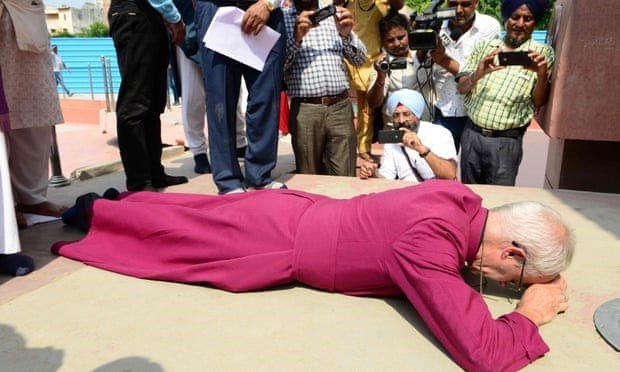
The archbishop of Canterbury, Justin Welby, lies on the ground at the Jallianwala Bagh memorial. Photograph: Narinder Nanu/AFP/Getty Images

The recent move by the Canadian government to criminalize “condoning, denying, or downplaying” the Holocaust is not just an infringement of civil liberties supposedly guaranteed by the Charter of Rights and Freedoms.  More importantly, it endows a distinctively Jewish political theology with legal protections denied to core Christian beliefs.  The fact that this development has not been opposed either by mainline Protestant or Catholic churches is highly significant.  Still, once upon a time, the Catholic Church did possess a distinctive political theology of its own, one identifying the Jewish people as an actual or, at best, a potential foe.  The Second Vatican Council put an end to that “antisemitic” article of faith.  But in principle, at least, Catholics could return their historic political theology on the Jewish Question.  Things are very different among the Anglo-Protestant people of Canada, in particular, and of the Anglosphere, generally.

Anglo-Protestantism has long since been captured by cosmopolitan humanism, a liberal world-view denying the existential distinction made by realist political theology between friend and foe.  Accordingly, Anglo-Protestants shy away from the traditional Christian belief that the Old Covenant with Israel according to the flesh was superseded by a New Covenant between God and the Church.  Having rejected supersessionism, Anglo-Protestants generally recognize the Jews as elder brothers in the faith whose Covenant with God remains in force.  The Holocaust Mythos, therefore, is widely accepted as the story of a monstrous crime committed against a people of God representative of humanity-at-large.  Mainline Anglo-Protestant churches inhabit a moral universe in which a loving God confronts the “perpetrators” of genocides against innocent “victims” who may or may not receive aid, comfort, or justice from “bystanders”.

The Jewish people, on the other hand, have not been slow to recognize that their world is characterized by a sharp division between their “philosemitic” friends and their “antisemitic” enemies.  During the twentieth century and continuing today, Anglo-Protestants have recognized the Jews as their “friends” and have, accordingly, been willing to combat “enemies” of the Jews whenever and however their governments have commanded.  The Second and Third Reichs in Germany were foremost among those designated by our governments as collective “enemies,” not just of the British peoples, but of humanity itself.

Now that the Palestinian President (while sharing a platform with the German Chancellor) has charged Israel with inflicting “50 Holocausts” upon his people, one might wonder whether the Germans copped a bum rap over the Holocaust 1.0.  To reach any firm conclusion, we should reflect upon the historical development of Anglo-Protestantism and the theological presuppositions that have prevented the church from developing an ethno-religious theology capable of reliably distinguishing “friend” from “foe”.

How Anglicans Escaped “Anglo-Saxon Captivity

The Church of England created the original model of Anglo-Protestantism during the sixteenth-century Reformation which separated the Anglican church from Roman Catholicism.  The  word “Anglican” is grounded etymologically in the old Anglo-Saxon term “Angelcynn” which meant literally “kin of the Angles.” This poses the obvious question as to whether Anglican political theology retains the capacity to draw any distinction between “friend” and “enemy” now that the Anglican “brand” has been drained of its ancestral, biblically-based, ethno-religious meaning.  In what follows, I will use Angelcynn to denote the broad, but long disunited, body of Anglo-Protestants who could, and in my view, should re-unite in a broad church acting as a medium for the expression of their particular ethno-religious needs and interests.

Nations are rooted in historical myths, symbols, and ethno-religious traditions which, in the case of England, developed over many centuries during the Middle Ages.  Leading authorities in support of that thesis are: Anthony D. Smith on The Ethnic Origins of Nations and Martin Lichtmesz on Ethnopluralismus.  The concept of ethnopluralism must be distinguished from modern secular policies of multiculturalism as defended, for example, by James Tully.  Official multiculturalism in the Anglosphere refuses to recognize the political character of Anglo-Protestant ethno-religious identity.  But the Israeli historian, Azar Gat, in his book on Nations: The Long History and Deep Roots of Political Ethnicity and Nationalism provides support for the proposition that Anglo-Protestant Christians desperately need to recover a political theology anchored in their own distinctive ethno-religious identity.  As things stand, all Protestant denominations, Anglican and dissenting churches alike, have united with the state to deny the legitimacy, indeed even the reality, of any such need.

Carl Schmitt is generally credited with the invention of the term “political theology”.  What did Schmitt mean by political theology?  German scholar Heinrich Meier suggests that Schmitt was looking for the legitimate foundations of political action.  In European civilization, he found a conflict between political philosophy, ostensibly based in the universal principles of rational discourse, and revelation anchored in particularistic ethno-religions.  To speak of revelation, of course, takes us into the realm of biblical theology.  What is the relationship between biblical revelation and political theology?  Did the historical Jesus preach a political theology?  Did Jesus the Christ and his followers, before and after the Cross, have friends and enemies?  While the historical Jesus seems to have focused on the destiny of his own people, the global Jesus, as worshipped by contemporary Anglo-Protestants, came to save the whole of humanity.

For the ancestors of today’s Anglo-Protestants, political theology, avant la lettre, was a fact of life.  In fact, the theology of the Angelcynn was politicized from the very beginning of their historical ethnogenesis.  The story of the emergence of the English nation, no less than the biblical narrative of ancient Israel, was and remains a process moved by “the lure of God”.  Ethno-religious divisions long defined friends and enemies, thereby shaping the demographic development of the English nation.  Neither the English nor, later, the British state created the English nation.  Instead, the Old English Church nurtured the ethnogenesis of the English people.  An embryonic English ethnos, working in and through the early Angelcynn church and their king, became the prototype of an English “state,” well before the Norman Conquest.

Over the centuries, the identity of those deemed to be enemies of the English changed.  During the reign of Alfred the Great, the Vikings were perceived as the greatest threat.  When William the Conqueror invaded England, the Norman enemy was victorious. The Norman Conquest in combination with the Papal Revolution transformed the ethno-religious culture of England.  One sign of the transformation was the replacement of the Old English used in Angelcynn monasteries by the Latin language employed in the universal Church governed from Rome.  The ecclesiastical regime based on the absolutist papal monarchy survived in England for several centuries.

Following the upheavals of the Reformation and Civil War, the division between Protestants and Catholics largely defined the distinction between friend and enemy for Britons, both domestically and internationally.

With the expansion of England, a Greater Britain emerged in the settler colonies around the world.  From the eighteenth century onwards, the British Empire competed for power and resources with continental rivals such as France and Germany.  Religious differences were no longer central to such conflicts.  Indeed, since then, the process of secularization advanced to the point where historians have pronounced the death of Christian Britain.

In the Empire at large, one might even ask whether Australia, for example, was ever a Christian community on its road to nationhood.  Ever since the Second World War, the declining Anglican confession throughout the Anglosphere has celebrated its escape from “Anglo-Saxon captivity,” to the point where it has been absorbed into a form of global Christianity hostile to any suggestion that the Anglican church should be of, by, and for the white British peoples of the Anglosphere.  “White racism” is now the proclaimed enemy of mainstream Anglican political theology.

Indeed, contemporary Anglican political theology, in the person of the Archbishop of Canterbury, Justin Welby, manifests itself as the kinder, gentler face of post-Christian globalist bioleninism.  In other words, it is difficult to distinguish between the public face of Anglican political theology and the Woke political ideology governing “Our Democracies”.

In the realm of academic theology, however, Oliver O’Donovan’s The Desire of the Nations offers a much more sophisticated model of Anglican political theology, but one no less opposed to an ethno-religious understanding of the Anglican tradition.  O’Donovan contends that the point and purpose of every nation’s existence has been determined once and for all in the “Christ event”.  “Membership in Christ,” he declares, “replaced all other political identities by which communities knew themselves”.  Because the church is “catholic” it “leaps over all existing communal boundaries and forbids any part of the human race…to think of the Kingdom of God as confined within its own limits and to lose interest in what lies beyond them”.  Strictly speaking, according to O’Donovan the church is an “eschatological” rather than a political society: it can be “entered only by leaving other, existing societies”.


For O’Donovan, in the modern world, not even those other, “political” societies constituted by governments are based on shared blood, language, and religion.  Instead, the only form of “nationalism” open to modern “nation-states” such as Australia, Canada, or the United Kingdom is a “civic nationalism’’ defined by a common political will.  Nationalism, therefore, is sometimes said to be in trouble.  But, O’Donovan maintains, this is nothing new.  “The truth is,” he remarks, “it has been in trouble ever since Christ rose from the dead”.  In the eschatological society of the church, “no people’s identity as a people can be assumed; community identity is no longer self-evident.  It is called into question by the existence of a new people, drawn from every nation, which by its catholic identity casts doubt on every other”.

In stark contrast, to that “catholic” vision of Christian identity, my thesis will defend the proposition that the Volksgeist of the English nation (and other British-descended peoples) was once, and could be again, an important medium through which God works in this world.  Accordingly, this project rests on a set of presuppositions that differ in certain fundamental respects from those underlying O’Donovan’s approach to political theology.

Any theological schema of civic action requires one or more orienting concepts if it is to achieve its objectives.  Historically potent examples of such orienting concepts, can be found in the lives and works of men such as Martin Luther, John Calvin, and John Wesley.  Calvin’s theology was oriented around the concept of the “majesty or sovereignty of God.”  Luther oriented his theological theory and practice around “justification by faith” while Wesley’s work revolved around the notion of “responsible grace.”  Each of these concepts oriented new approaches to practical theology, each sparking its own theological revolution.  Unfortunately, those revolutions oriented as they were, each in its own way, to personal salvation has run its course.  Evangelical Protestantism is dying on the vine.

An Angelcynn Reformation seeking the collective redemption of British-descended peoples requires a more comprehensive strategy; it must be oriented around not just one but four concepts.  This multi-pronged approach can be grounded in several existing but, as yet, separate streams of white Anglo-Saxon Protestant theology.  The four key theological concepts are: (1) process theism; (2) preterism; (3) kinism; and (4) royalism.  If and when these already intellectually compelling challenges to theological orthodoxy merge into a single popular current of ethno-religious experience, the next Great Awakening in British religious history will be in the offing.

Process Theism

Process theism builds on the historical theology of the nineteenth-century Anglican broad-church movement in rejecting traditional Christian theism.  The early creeds of the Church established an image of God, outside time and space, the omnipotent, omniscient, and omnipresent source of being itself, who created the world out of nothing.

The doctrine of creatio ex nihilo cannot be found in either the Old or the New Testament.  It appeared suddenly in the latter half of the second century B.C.   Its appearance “can best be explained as a defence of the most controversial part of the Christian kerygma, the resurrection of the dead”.  Only a God who created the world out of nothing could accomplish the bodily resurrection of the dead.  Oliver O’Donovan’s vision of the universal church as an eschatological society preserves that creedal linkage between God’s created order and the bodily resurrection of believers in the new creation.

By contrast, process theism denies that the doctrine of creatio ex nihilo can be grounded in Genesis One.  Instead, creation is conceived as an ongoing process within which God remains actively involved with all forms of conscious life.  Biologist Bruce G. Charlton suggests that process theism can provide his discipline with the metaphysical framework it desperately needs to solve fundamental problems such as group selection.  Natural selection is comparatively easy to explain at the level of individual organisms.  But “true group selection…entails a purposive mechanism that can predict, can ‘look ahead’ several generations, and infer what is likely to be good for the survival and reproduction of the species.”  The theory of natural selection “lacks teleology—a goal, direction or purpose.”

If the idea of purpose demands an organizing entity or deity then “evolution across history is best explained as a directional process of development” at both the individual (ontogeny) and group (phylogeny) level.  The comparative evolutionary success of ethnic groups is probably affected, therefore, by the nature and intensity of their religious connection to the theistic organizing entity.

God is not omnipotent, however.  Hence the evils of the world cannot be charged exclusively to his account; moreover, he is affected by his interactions with us and the wrongs we do unto others and ourselves.  Robert Gnuse demonstrates that the Old Testament provides a revealing account of the processes of communication between the Israelites and the divine.  Perhaps white Anglo-Saxon Protestants, too, could and should create a national bible recording our own communication—or lack thereof—with the divine.

Indeed, process theism provides grounds for doubting that the “Christ-event” (i.e., the Incarnation, Passion, and Resurrection of Jesus) happened, once and for all, in the history of only one nation in the ancient Near East on planet Earth.  Jesus the Christ made a unique appearance in Israel according to the flesh but who knows whether or not other singular incarnations for other unique nations or even other worlds are excluded.  There is only one historical Jesus, but there may be other Christ-events in some other “holy nation.”

In Part Two, we will discuss the contribution that preterism, kinism, and royalism can make to the emergence of an Anglo-Protestant political theology capable of distinguishing friend from foe.

Go to Part Two.

Stabbing Salman Rushdie: How a Leftist Literary Giant Has Worked to Destroy Free Speech, Not Defend it

They yawned and looked the other way. That was how leftists reacted to a report in July 2022 describing how at least 1,000 White working-class girls had been raped, prostituted and sometimes brutally murdered by Muslim sex-criminals in merely one town in the English Midlands. The girls were white-trash nobodies, you see, and not worthy of leftist commentary or concern. But when the bad and pretentious novelist Salman Rushdie was stabbed in New York by a “man from New Jersey,” leftists howled with shock and dismay. Like the cartoonists murdered at Charlie Hebdo in 2016, Rushdie is a leftist and his fellow leftists felt his pain.

Maggie’s mighty intellect

And like his great friend Christopher Hitchens, Rushdie is a dishonest windbag, which made it very appropriate that so many other dishonest windbags rushed to their keyboards to write about the attack. The mighty intellect of Margaret Atwood allowed her to reach these conclusions:

In any future monument to murdered, tortured, imprisoned and persecuted writers, Rushdie will feature large. On 12 August he was stabbed on stage by an assailant at a literary event at Chautauqua, a venerable American institution in upstate New York. Yet again “that sort of thing never happens here” has been proven false: in our present world, anything can happen anywhere. American democracy is under threat as never before: the attempted assassination of a writer is just one more symptom.

Without doubt, this attack was directed at him because his fourth novel, The Satanic Verses, a satiric fantasy that he himself believed was dealing with the disorientation felt by immigrants from (for instance) India to Britain, got used as a tool in a political power struggle in a distant country. (If we don’t defend free speech, we live in tyranny: Salman Rushdie shows us that, The Guardian, 15th August 2022)

No, Maggie: the attack happened because leftists like you have allowed millions of Muslims who hate free speech to flood into the West. The only surprise about the attempted murder of Salman Rushdie is that it took so long. Among much else, Rushdie’s “satiric fantasy” depicted prostitutes play-acting as wives of the Prophet Muhammad and satisfying sexual perversions like necrophilia. Muslims correctly viewed the novel as blasphemous and Rushdie himself as an apostate. That’s why they want to impose on him the traditional Islamic punishment for blasphemy and apostasy, namely, death.

Atwood didn’t discuss any of that or the numerous “assassinations” of blasphemers in Muslim countries like Pakistan. Nor did she discuss the vibrant Lebanese origins of the would-be assassin or indeed mention the words “Muslim” and “Islam” at all. Instead, she tried to suggest that Trump and the Republicans were somehow to blame: “American democracy is under threat as never before [the new mantra of the American left]: the attempted assassination of a writer is just one more symptom.”

Shock News: Import Muslims, Get Islam

No, it was a symptom of Muslim enrichment, like the Charlie Hebdo attacks in France and the murder of Asad Shah in Britain. Atwood’s dishonesty and refusal to state the obvious were universal among other leftist commentators on the “attempted assassination.” The leftist Michael Hill, president of the Chautauqua Institution where Rushdie was speaking, said that it was “an attack on the very foundation of who we are and what we stand for” and represented “the utter antithesis of everything that the institution has stood for since its founding 148 years ago.” Fancy that! White America imports millions of non-Whites from violent, illiberal cultures and suddenly old traditions of American civilization are under attack. Hill didn’t, of course, discuss why a Lebanese Muslim might have been responsible for formulating an “utter antithesis” to free speech.

In Britain, the leftist Lady D’Souza also refused to mention the obvious. She waffled thus: “It seems to me that there’s one important lesson here, which is no one anywhere should ever, ever, ever be threatened with death for writing a novel. Yet we seem to be living in a world, despite Salman’s fight, where that could be well be a possibility.” No, Lady D’Souza: we don’t “seem” to be living in such a world. We are living in such a world. And it’s thanks to leftists like you, who have flooded the West with low-IQ non-Whites from the world’s most violent and illiberal cultures.

Squirming Maps and Pallid Streets

It’s also thanks to Salman Rushdie himself, who has worked all his life to destroy free speech, not defend it. That’s because, like his fellow leftists, he is an ardent anti-racist and passionate supporter of non-White immigration. You could call leftism a Salmanic virus that has infected the West and is now bringing about its dissolution. Way back in 1982, Rushdie was using terms like “white supremacy” to condemn the entirely legitimate resistance of Britain’s native Whites to Third-World immigration. He was also demonstrating that he’s a clumsy and pretentious writer:

Now I don’t suppose many of you think of the British Empire as a subject worth losing sleep over. After all, surely the one thing one can confidently say about that roseate age of England’s precedence, when the map of half the world blushed with pleasure as it squirmed beneath the Pax Britannica, is that it’s over, isn’t it? Give or take a Falkland Island, the imperial sun has set. And how fine was the manner of its setting; in what good order the British withdrew. Union Jacks fluttered down their poles all around the world, to be replaced by other flags, in all manner of outlandish colours. The pink conquerors crept home, the boxwallahs and memsahibs and bwanas, leaving behind them parliaments, schools, Grand Trunk Roads and the rules of cricket. How gracefully they shrank back into their cold island, abandoning their lives as the dashing people of their dreams, diminishing from the endless steaming landscapes of India and Africa into the narrow horizons of their pallid, drizzled streets. The British have got other things to worry about now; no point, you may say, in exhuming this particular dead horse in order to flog the poor, decomposed creature all over again. (“The New Empire within Britain,” Salman Rushdie, 1982)

It’s obvious that English isn’t Rushdie’s mother-tongue and that he has a typical leftist grasp of reality and logic. For example, how does a map “squirm”? What on earth are “pallid … streets”? British streets are paved in black. Rushdie’s hatred and envy of Whites spilt over into his description of inanimate objects. How did the pink conquerors “diminish” from “the endless steaming landscapes of India and Africa”? Rushdie isn’t using the right verb or seeing any clear picture of what he’s trying to say. And look at how clumsily he riffs on the already stale idiom of “flogging a dead horse.” No doubt he fondly imagined that he was demonstrating his mastery of the pink conquerors’ language: “See, sahibs, not only do I know your oh-so-obscure idiom, I can wittily expand on it!”

The Self-evident Savagery of Blacks

Well, no, Rushdie isn’t a witty or clever writer. He’s pretentious and clumsy. His entire career has consisted of posturing for leftist sahibs. And he’s been richly rewarded for it, showered with literary awards and knighted by the supreme representative of British Imperialism in 2007. Part of his shtick has been to attack ordinary Whites on behalf of the hostile leftist elite. For example, he laid out this core leftist principle in his “pallid streets” essay: “Immigration is only a problem if you are worried about blacks; that is, if your whole approach to the question is one of racial prejudice.” Well, Salman: immigration led directly to you being stabbed on stage by a Lebanese Muslim thousands of miles from Lebanon. Was that stabbing a “problem” or something to celebrate? If it was a problem, then obviously there’s more than “racial prejudice” to doubts about non-White immigration. Rushdie also said in his essay that “perhaps the worst thing about the so-called ‘numbers game’ is its assumption that less black immigration is self-evidently desirable.”

A Black with White blood on his hands: the vibrant Lee Byer and his 87-year-old White victim

But it is indeed self-evident that “less black immigration” is desirable. When Blacks arrived in Britain, they began to do what Blacks always do when they arrive in a White nation: to prey on the natives. They’ve been preying on the natives ever since. In the same month as Salman Rushdie was stabbed in New York to universal leftist condemnation, another elderly man was stabbed in London under even worse circumstances. But the second stabbing will not receive universal leftist condemnation. Indeed, leftists will send it down the memory hole as soon as possible. Unlike Salman Rushdie, Thomas O’Halloran did not survive his encounter with a vibrant non-White. Not that vibrancy of any kind was mentioned when news first broke that an “87-year-old grandfather” had been murdered in a “shocking act of unprovoked violence” whilst riding his “mobility scooter in broad daylight.” However, as a committed member of the racist community, I immediately assumed that a non-White was responsible — most probably a Black. Sure enough, a Black called Lee Byer has been charged with the murder.

Rushdie wakes up to Woke

Mr Byer seems to have hit the headlines before, as one of the “masterminds behind a string of jewellery shop robberies.” Like a wildly disproportionate number of Blacks, he excels at theft and violence, not at anything that sustains or strengthens White civilization. Salman Rushdie, of course, is more intelligent than the vast majority of Blacks. But that simply means that he’s able to attack White civilization more effectively and on a wider scale. Leftist intellectuals like Rushdie don’t often commit “shocking acts of unprovoked violence” (except against logic and the English language). But they support and facilitate the mass immigration responsible for the presence of psychopathic Black thugs like Lee Byer in the West. And although Rushdie is an intellectual, he doesn’t have much of an intellect. This is what he recently said about the excesses of woke culture: “If you can only write about a gay character if you’re gay or you can only write about a straight character if you’re straight, very rapidly the form of literature becomes difficult to continue with.”

Rushdie doesn’t understand how Woke works: Black actors can take on any White role

Rushdie’s powers of observation and reason have not improved since 1982. No wokester argues that only straight people can write about or perform as straight characters. That isn’t how Woke works at all. No, Woke insists that minorities can write or perform as they please. It’s the White or heterosexual majority that is censored and circumscribed. For example, Black actors can take on any White role, but White actors are now banned from taking on any Black role. The same applies to gay actors and straight actors. And some Jews, as I described in “Jewface and the Under-Race,” are trying to make it apply to Jewish actors and goy actors.

Rushdie’s Jewish admirers

Rushdie doesn’t appear to have noticed any of that. But he has certainly noticed the importance of not offending Jewish sensitivities in his work. He’s mocked Islam and the Prophet Muhammad, but he’s never mocked the Holocaust or questioned the way it is used to justify censorship and imprisonment right across the West. And Jews greatly appreciate Rushdie and his work on their behalf, which is why he was given a knighthood in 2007. The two most important members of the “Arts and Media Committee” that recommended him for the honor were Jews: the plutocrat Lord Rothschild and the BBC Director Jenny Abramsky. Jews are also at work in the Chautauqua Institution that hosted vibrant Rushdie and his vibrant attacker:

There is a strong Christian and Jewish presence in the community, and a growing emphasis on reaching out to Muslims. The summer season includes a programme on “Islam 101” and there are regular dialogues attempting to unite Jews and Muslims. The calendar for next week includes an interfaith talk billed as “Being the change — a leap of faith”. It features the founders of a network of Muslim and Jewish women, Sisterhood of Salaam Shalom. Against that tradition, Friday’s attack came as a violation. “This was principally an attack on Mr Rushdie, who we continue to hold in prayer,” [Michael] Hill said. “But it was also an attack on the very foundation of who we are and what we stand for. At the core, for us, it was an attempt at silencing.” (Rushdie stabbing was ‘an attack on who we are’, says venue’s president, The Guardian, 14th August 2022)

It’s nonsense to claim that the attack on Rushdie was a “violation” of a “tradition” of outreach to Muslims and cooperation between Jews and Muslims. Both Jews and Muslims believe firmly in silencing their critics. High-IQ Jews play to their strengths and work in politics, media and law to create and enforce laws and propaganda against “hate.” Low-IQ Muslims play to their strengths, stabbing novelists or machine-gunning cartoonists. The Sisterhood of Salaam Shalom embodies a principle set out by many Jews down the decades, namely, that “Muslims and Jews are natural allies.” But what are they natural allies against? That part is left implicit, but the answer is obvious. Muslims and Jews are natural allies against Whites and White civilization.

Burned alive by her Muslim rapist: the White girl Lucy Lowe

To any objective observer, it’s obvious that Jews are the world’s biggest and most effective enemies of free speech. That’s partly because they campaign directly against free speech through organizations like the Anti-Defamation League (ADL) in America, the Community Security Trust (CST) in Britain, and the Ligue Internationale Contre le Racisme et l’Antisémitisme (LICRA) in France. But it’s also because Jews work tirelessly to import the world’s second-biggest and second-most-effective enemies of free speech, namely, Muslims.

The attack on Salman Rushdie was more proof of how bad Muslim immigration is for free speech. The attack was also poetic justice. Rushdie is a rich member of the leftist elite and has now suffered some of the violence imposed on ordinary Whites for decades by non-White immigration. It isn’t supposed to work like that, which is part of why leftists were so upset by the attack on Rushdie. Leftists like Margaret Atwood don’t care about White girls being raped and incinerated by non-White Muslims in Telford or 87-year-old grandfathers being stabbed to death by Blacks in London. And when they say they care about free speech, they mean that they care about free speech for leftists. That’s why leftism is a Salmanic virus that is destroying the West.

Jews and the Australian Dream: Part III—The Un-Australian Dream

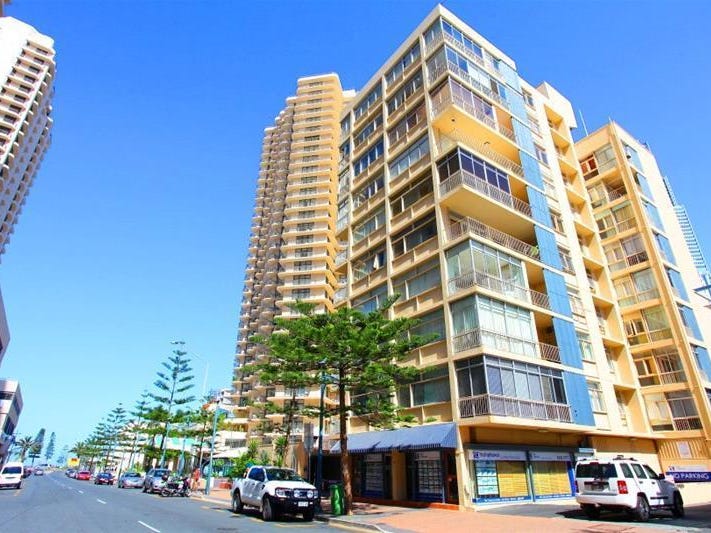
The 10-story Kinkabool tower at 34 Hanlan Street in Gold Coast

Go to Part I.
Go to Part II.

From South Coast to Miami Beach.

Further afield from Sydney and Melbourne where the majority of Jews reside, Jewish property developers are also notable on the Gold Coast, performing a now familiar role. It was here that property developers Stanley Korman (encountered previously in Melbourne) and Eddie Kornhauser made a name for themselves, not just as pioneers of high-rise living, but of the Gold Coast as a city itself. Once little more than a beachside town in an area called South Coast, these early investments laid the groundwork for the 1980s tourist boom, when the city became awash with Japanese money and holiday travelers, and the skyline grew ever taller with a sheer wall of apartment towers now settled along the beachfront. It was Stanley Korman, the “father of the Gold Coast,” who was among the first to see the potential of the area, developing the 10-story Kinkabool tower at 34 Hanlan Street in 1960, the first apartment tower on the Gold Coast, which at the time towered above mere beachside shacks. Korman, inspired by a holiday in the USA,[1] began his pioneering beachside venture in the late 1950s with an American-style holiday resort (the Chevron Hotel) as well as the Chevron and Paradise Islands housing precincts, leading the way in establishing Surfers Paradise as a popular holiday destination:

He [Korman] was soon generating much of the impetus for the phenomenal development of the locality from ‘just another tourist resort’ to an internationally recognised location.[2]

Born in Poland, the Korman brothers Stanley and Paul arrived in Australia in 1932 and set up a hosiery business, migrating into property development after the war; they transferred their focus to the Gold Coast after developing Stanhill and other American-style hotels in Melbourne. Stanley Korman’s brash style and sprawling network of companies would ultimately attract the attention of the government, and he was charged and sentenced to six months prison for issuing a false shareholder prospectus, later leaving Australia for the USA in 1967.

Arriving somewhat later on the scene was another prominent Jewish developer on the Gold Coast, Eddie Kornhauser. Also born in Poland and fleeing to Melbourne in 1939, Kornhauser purchased the historic Surfers Paradise hotel from Korman with an aim to cater to the growing number of Jewish holidaymakers from Melbourne and Sydney. In 1975, under the vehicle of HSP Developments, he developed the site into two early apartment towers, Allungah and Ballah, and built the Paradise Centre shopping mall, now the urban focal point of Surfers Paradise. Kornhauser persisted with Gold Coast high-rise apartments until the early 2000s, the 40-story Pivotal Point tower at 50 Marine Parade in Southport a final contribution. Disrepute also followed Kornhauser, who was implicated in the scandals of the Bjelke-Petersen Government. He was charged and later acquitted on three counts of corruption charges relating to bribery,[3] and he remained a close friend with Abe Saffron from his time developing hotels in Sydney. Kornhauser donated to Yesihva schools throughout his life, established the Bob Hawke Forest in Israel (named for his friend the former Prime Minister) and Israel’s Haifa University made him an honorary Doctor of Philosophy and Governor of the University.

Other developers surveyed elsewhere, notably Meriton and Dainford Holdings, also made their mark on the Gold Coast at a later date. However deeper Jewish influences on development are found far beyond Australia’s borders. To architect Robin Boyd, the Gold Coast amounted to the best example of “Austericanism,” a term he coined to critique the then nascent propensity for Australians to imitate American ideas. Boyd infamously labelled the Gold Coast the capital of this new “Austerica” in his book The Australian Ugliness (1960), describing it as the “fibro-cement paradise under a rainbow of plastic paint.”[4] Similar to Boyd’s analysis of the “American influence” of Hollywood on the Australian mind,[5] this Austericanism on the Gold Coast turns out to be rather more Jewish than Boyd would let his readers know.

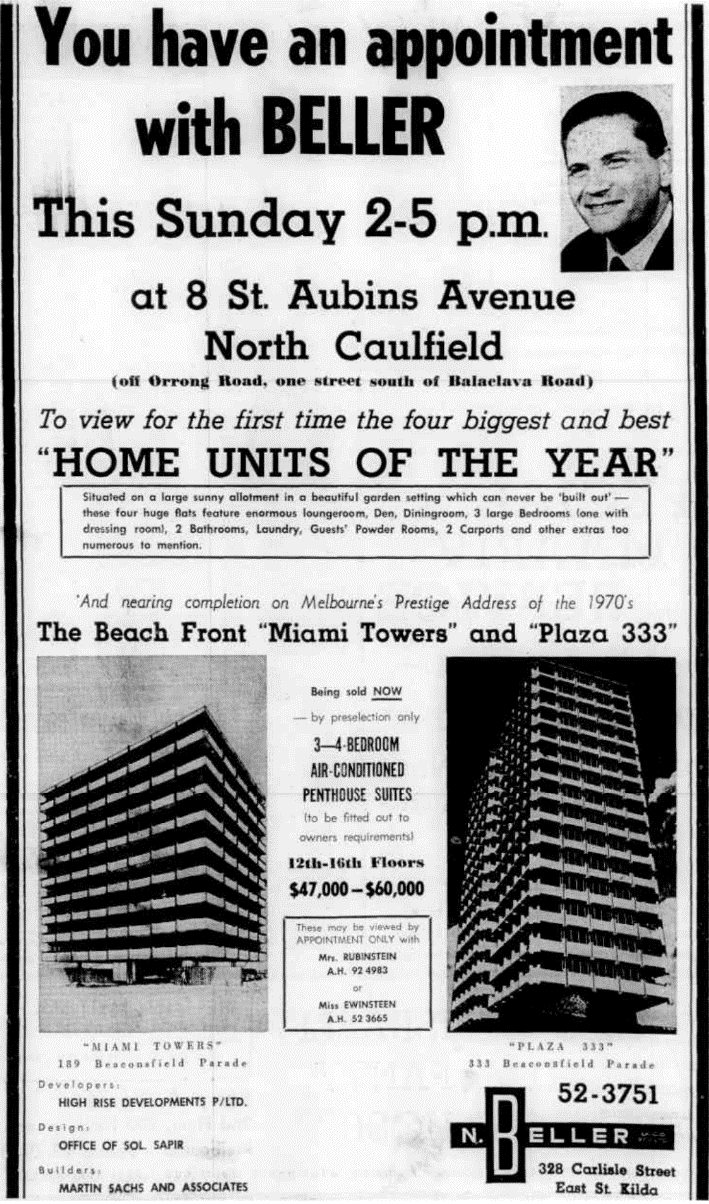
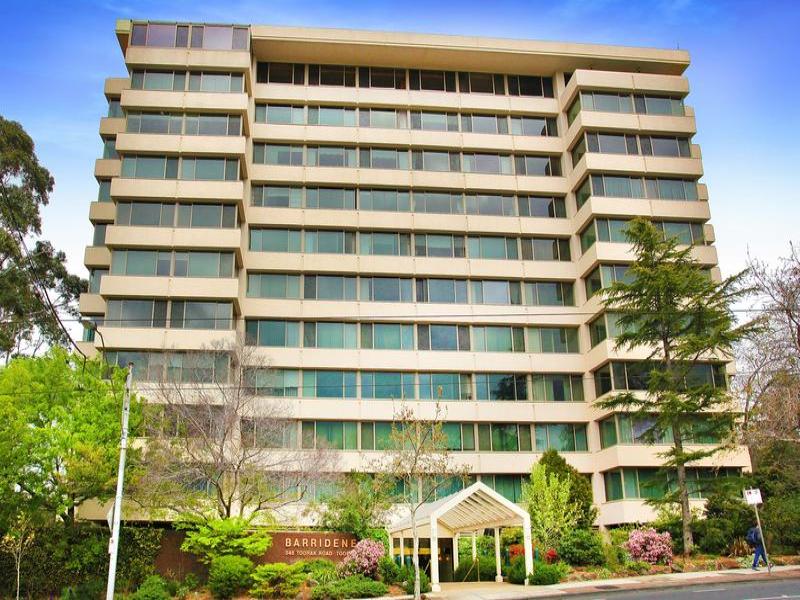
Much of the inspiration for the development for the Gold Coast as a gaudy beachside resort, in the tower-by-the-beach style of development that defines the city (also evident to a lesser degree on the waterfront streets of St Kilda in Melbourne), was in fact Miami Beach in Florida. Both Stanley Korman and Bruce Small visited Miami Beach during the 1950s and were impressed by the scale of development in the hotel and resort precinct. Seizing the chance to replicate this in Australia, Korman and Small soon capitalized with the pioneering Edgewater and Kinkabool towers respectively. Beachside suburbs of the Gold Coast like Palm Beach and Miami bear this Florida heritage, and while it is unclear if he visited the area, the influence of Miami Beach on Nathan Beller is also likely. His 10-story block at 189 Beaconsfield Parade was given the name Miami Towers, and the St Kilda City Council of the 1970s hoped the beachside boulevard could replicate the success of the Gold Coast.[6] The strong Jewish presence in property development in Miami Beach, an area with 15 Jewish Mayors to date, is underscored by the Greater Miami Jewish Federation, who state that:

The skyline of Miami Beach has changed from the day the first skyscraper went up in 1940. It continues to change, as some buildings come down and new higher ones go up. Jews have been involved in every aspect of these developments, as architects, developers, and contractors. Through their contributions to the physical appearance of Miami Beach, their roles in building the Beach are apparent and perpetual.[7]

Described as the “gayest, richest Jewish city in the world” by the early 1950s,[8] Miami Beach has long since been immensely popular with Jewish tourists and retirees from the northern states of the USA. American Jews such as Asher Grossinger, Morris Lapidus, Samuel Jacobs, and Stephen Muss heavily contributed to this post-war development of Miami Beach as a Jewish resort, and the example they set to Korman, Beller and Small reflects yet another degree of Jewish influence on the emergent high-rise property scene in Australia.

The Krantz Legacy.

On the other side of the country, Jews also played an influential role in early flat and apartment development in the city of Perth, Western Australia. Born in Perth to Russian-Jewish parents, architect Abraham Harold Krantz began designing and promoting flats in the 1930s, with his contribution to the city now earning him a legacy as an architect who “almost singlehandedly created the apartment industry in the western capital.”[9] A relative of Isaac Steinberg, promoter of the Kimberley Scheme (a settlement program for Jewish refugees in northwest Australia in the 1930s), Krantz’s firm Krantz & Sheldon is alleged to have been responsible for the design and construction of over 90 percent of flats in Perth between the years 1930 and 1960[10] and again largely supplanted the existing architectural style of Perth’s early flats with modernism. His partner in the firm, Robert Sheldon (born Schlaefrig), was another Jewish refugee from Austria. The Lawson Flats at 2 Sherwood Court were the tallest archetype of the early style of flats built in Perth. Developed in 1937, the building was built in the Spanish Mission style, and the flats were, like counterparts in NSW and Victoria, occupied by Perth’s elite.

Krantz’s success with smaller flat developments in the 1930s led to offers of investment and he soon had a budding reputation as Perth’s know-how man for flats, and set up investor syndicates for his growing clientele that made larger developments financially viable. Krantz and Sheldon were also responsible for most of the taller high-rise towers built immediately after strata title reform in Western Australia—the Strata Title Act 1966—with a string of towers in South Perth. The tallest, the 21-story Windsor Towers—a local behemoth when completed in 1968—evokes the arrogant positioning of Seidler’s Blues Point Tower in Sydney and once dominated views of the Swan River.

An opponent of suburbia, arguably Krantz’s most controversial projects were the Wandana Flats designed for the State Housing Commission. They were not only the first public high-rise flats in Western Australia and predictably aroused mass anger from local residents, but built in 1956, they pioneered the International Style in Australia. In an article for The Western Mail in 1937 entitled “MODERN FLAT DEVELOPMENTS. An Architect Explains His Work,” Krantz defended the flat typology against criticisms of iniquity, depravity and of being destructive of home life, arguing that “it provides a home in the true sense of the word” and was necessary due to affordability crises and changing lifestyle patterns.[11] Krantz’s son David was also employed at the firm and designed the 16-story Mt Eliza Apartments at 71 Mount Street (built in 1964), at the time Perth’s tallest residential building, and arguably the first true high-rise apartment tower in the city. 

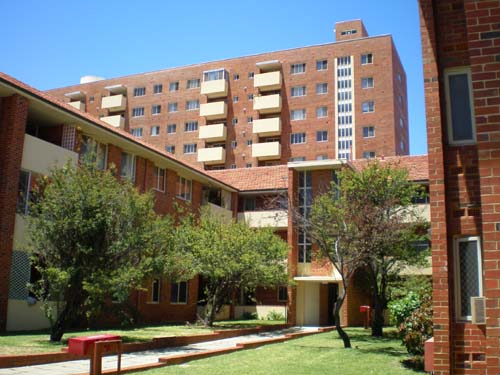
Wandana Apartments, Perth

Conclusion

“In moving to a flat rather than a house, however, … European Jewish families were subtly subverting Australian norms. Rather than conforming to the social and cultural values of the host population, they were in fact helping to transform them.”[12]

The role of the Jewish migrant community, as a vanguard element in leading the mass uptake of flat and apartment living by taking advantage of new property title laws around the country, is crucial in comprehending the changes that came about in Australia’s urban form in the post-war era. Looking for opportunities for financial success in a new society and hostile to the existing political and cultural norms of Australians, preferring instead to replicate the apartment style living of the lives they fled in Europe, Jews ultimately led the process of re-shaping the fabric of Australian cities and breaking down one of the most deeply held norms of their new host society.          This essay has focused on the role of Jewish architects and developers, but their role as residents in the flat trend is also worth broaching, for without the choice being made to pursue flat living over suburban housing, much of the demand for flats—and thus the impetus for developers to build and architects to design—would never have materialised. Emphasising the Jewish and broader migrant role, O’Hanlon contends that

were it not for the arrival of these people it is highly unlikely that flats and flat living, which in many quarters were considered alien to the Australian urban experience, would have become a significant component of city life here.[13]

Fleeing from the cities of Central and Eastern Europe, flats and multi-family buildings were familiar and detached houses were foreign, and as noted by O’Hanlon, the clustering of post-war flats and early high-rise towers in areas of Sydney and Melbourne with high Jewish populations is simply not a coincidence. The popularity of flats as a housing choice within this new Jewish community is evident in the pages of the Australian Jewish Times during the era, where advisements for purchasing or renting flats are noticeably common. Robin Boyd, although misidentifying the Ostjuden culprits as “Central Europeans,” diagnosed the anti-assimilationism at the heart of these flat developments:

Many New Australians, especially those from central Europe, are used to high-density city living, and prefer and seek it here. … The more successful European migrant … created a demand for flat buildings near the city. … Thus cheap walk-up blocks of eavesless flats, made of yellow or orange bricks, according to region, were built in great quantity in areas which tolerate them such as St Kilda. … In block after block they replaced all the old single houses and the trees and created another separate zone of their own, isolated and insulated from the old Australian suburbia.[14]

Sheltered within the flat, with friends and relatives occupying multiple dwellings within the building, Jews designed and developed the perfect mechanism to recoup from their European wartime experiences. In many ways flats operated as a defensive bulwark against the assimilationist mechanism of the suburb, shielding the Jewish community from the potential of losing communal identity and “Jewishness” in the gentile individualism of detached suburban housing. From these experiences would also grow the desire to promote pluralism and multiculturalism, to politically outlaw the assimilation they feared would occur outside the safety of the flat. This was foreshadowed by the successor of flat developer Nathan Beller as president of the Victorian Jewish Board of Deputies, a man by the name of Walter Lippmann.

Changing Demographics.

Looking abroad to America, a country that also experienced a significant intake of European Jewish migrants, though at an earlier date than Australia, we find a similar phenomenon to that uncovered so far in Australia. Lasner’s book High Life—Condo Living in the Suburban Century (2012) explores the history of multi-family buildings in the USA. The American “co-op” or co-operative is roughly equivalent to the Australian flat in the era of company title and the “condo” or condominium to the later strata-titled flats. Lasner regularly identifies a Jewish character to the changing demographics involved in the growing proportion of co-op and condo residents (in particular in New York, Los Angeles, and Miami Beach), and Jewish names are common throughout his vignettes of early and landmark developments that bucked existing housing norms, or in the prominent figures and activists involved with the alternatives to detached dwellings. The shifts in attitude towards multi-family housing evident in Sydney and Melbourne occurred to a similar degree in New York City, where Jews were at a vanguard of new housing tenures that diverged from the existing private and individualistic style of co-ops primarily sought and developed by rich WASPs. Lasner further notes that, in the post-war co-ops, as a counter trend from the push towards suburbanization, “In New York, at least, most of the homeowners were Jewish and most were quite liberal.”[15] Some of these post-war co-ops are also significant for their progressive views on race in housing, supporting racial integration within their developments at a time when racial exclusion in housing, though technically illegal, was still socially and cultural enforced elsewhere. Lasner cites the example of a majority Jewish co-op literally applauding the first Black families to arrive at their complex in 1948.[16]

Through all this, Lasner emphasises demand over other structural changes as the driving component of the growth of co-ops and condos in the USA during the suburban century. “Changing demographics” he writes, was “one of the leading reasons for the condo counter trend…the condo emerged because it appealed to different, in some ways paradoxical, aspects of the human experience[17]  and “finding community was an important by-product of, and often an impetus to, co-ownership [ownership of a unit in a multi-family building].”[18] Other than Jewish or other migrant demand, demand for flats in Australia was also supplemented by the changing demographics that resulted from the breakdown of the traditional family structure. The era of the flat boom coincided with lowering marriage rates, rising divorce rates, increasing female economic independence, a declining fertility rate from an increased number of childless individuals and an overall shift to a more “cosmopolitan” way of life.

In searching for the source behind the rise of these non-traditional choices and lifestyles, one can make the case that many of the causal factors are ultimately grounded in and resulting from changes that can be drawn back to Jewish social and political activism in Feminism and the Sexual Revolution, and their precedents in Freudianism and the Frankfurt School. Similarly, much of the modern demand for high-rise living, which comes primarily from Asian migrants, would simply not exist had not the White Australia Policy been abandoned and multiculturalism been enshrined, both acts being steeped in Jewish activism in Australia and broader Jewish ideological trends from abroad, as outlined by Brenton Sanderson.[19] Regardless of the degree of the Jewish role in the deeper demographic and political currents in the West that spurred the mass introduction of the flat and the apartment into Australian cities, it was nevertheless Jews that took up the vanguard role in bringing these changes to fruition.

The Jewish Vanguard.

Moving on from residents, the overrepresentation of Jewish developers and architects explored in this essay leads to the inevitable question of how and why it was that such a tiny minority came to exercise such an enormous role.  Jews have gone far beyond what would be expected of their involvement in the property development industry based on a simple statistical percentage of the Jewish community. They are enormously overrepresented even when compared to other migrant groups such as the Italians and Greeks, who would also prosper in the flat and high-rise property industry at a later date and had a similar sense of cultural chauvinism and a hostility to assimilation that is endemic amongst Jews. Jews account for 7 of the 23 Inductees into the Australian Property Hall of Fame, distinguished primarily by their high-rise property credentials (or shopping centers).[20] Brothers Bruno and Rino Grollo of Grocon are the only Italians inducted into the list, their representation of eight percent is thus roughly in line with the 4.3 percent of people in Australia with Italian ancestry, compared with the 30 percent representation of a group that makes up scarcely 0.1 percent of Australia’s population.[21]

The answer to this question offered by Jewish scholars is predictably uncritical and myopic, attributing this Jewish success in property development and their over-representation exclusively to such factors as hard work, imagination, and “collaboration” (better identified as ethnic networking).[22] While these undoubtedly contributed, these suggestions miss the most crucial factor that the high-rise apartment industry was quite simply ripe for the taking; it was a new industry with nothing in the way of institutional barriers erected to prevent their entry. Jews entered into a disreputable market segment that was avoided by the majority of local entrepreneurs, landowners and property developers of the time, who saw the typology as subversive, foreign and unpopular for most White Australians and contrary to their ideals; they shunned capitalizing even on the evident migrant demand. This argument is borne out by the fact that the Jewish property developers surveyed in this essay can be directly contrasted with native property development powerhouses of the post-war era such as Albert Victor “AV” Jennings. Considered a champion of the Australian Dream, AV Jennings’ property empire focused on developing detached suburban housing on the rapidly expanding urban fringes, playing little to no role in the flat and high-rise apartment industry. Where smaller gentile developers during the post-war era are identified, their endeavors are consistently characterized as one-off projects, likely resulting from surplus land being offloaded, that did not lead to further developments or a long-term involvement in the industry. Other large Australian property corporations from the era almost exclusively funded and developed commercial buildings instead, and the same circumstance of a strong Jewish and weak native presence among the architects of flats and early apartment towers has also been explored, attributable to much of the same aversion.

This new generation of Jewish migrants, by way of their chauvinism, post-holocaust insecurity and ethnic insularity, cared little for assimilating and fitting in with Australian cultural mores, and saw no reason to continue the suppression of flats in Australian cities if it offered them financial return, cultural protection, or a familiar living style. In turn, they were seemingly unconcerned by local opposition or outright supportive of the socially and culturally subversive nature of their endeavors. Local opposition to flats and apartment living was, according to academics like O’Hanlon, equivalent to proto-fascism and “at best xenophobic, at worst anti-Semitic.[23] This opinion is likely to have been shared by Jews at the time, potentially seeing their early involvement in flat and high-rise development as an opportunity to, quite literally, build a more tolerant and less homogenous Australia and thus counter the xenophobic prejudices they believed to be ingrained in the opposition to flats. That gentile developers involved in the flat and high-rise industry during and after the boom years of the 1960s were also overwhelmingly recent migrants, of non-British and non-European background, reflecting a similar unfamiliarity or hostility to Australian culture, as well as a tendency to resist assimilation, further solidifies this apparent local avoidance of high-rise development. Jewish overrepresentation in flat and apartment development and the promotion of high-rise living thus speaks far more to an aversion to the typology by White Australia than Jewish success in outcompeting gentiles.

State governments, forced to provide quick and financially viable housing solutions for the poor, were the only proponents drawn from traditional Australian society involved in the high-rise dwelling typology in any significant way during this period, building the large housing commission towers, some up to 40 stories, that now pockmark the suburbs of Australian cities. Lacking the wartime destruction of cities that made large plots of land easy for the governments of Europe to acquire, flats held the advantage of economy and space over detached dwellings, but even then only a fifth of the total output of the Housing Commission in NSW was for flats.[24] The scale of these housing projects reached their peak in the late 1960s, driven by a housing crisis, but the fad of housing the poor in towering Le Corbusier-style blocks disappeared almost as quickly as it arrived, forced out by community protest, and now universally considered by governments to be bad policy that only intensified crime, social dislocation and delinquency.

In the absence of a Jewish vanguard driving the flat and apartment living typology to a critical mass, high-rise living may well have arrived on the scene only much later, and on a scale and form far more sympathetic to Australian cultural mores. The cities of Brisbane and Perth, both larger than the Gold Coast, saw only a muted high-rise apartment trend in the 1960s and 1970s compared to the rapid growth elsewhere, and up until recently their central business districts remained almost entirely comprised of office towers. The lack of a significant Jewish element to catalyse a high-rise tower boom in Brisbane, a city that possessed only a minuscule Jewish population, cannot be gainsaid as one of the causes for the different path in urban form the city took until Jews finally arrived on the scene. Few apartment towers showed up after early novelty specimens like Torbrek and Glenfalloch, the latter developed by Stanley Korman. Apartment towers taller than Torbreck (built in 1960) only began to emerge by the 1990s when opposition had withered away and apartment living was becoming a property norm. Soon thereafter Harry Triguboff devoured the city skyline in the late 2000s, as Meriton towers became Brisbane’s tallest buildings. In Perth, the Krantz group’s high-rise role was a relatively solitary one, and Adelaide, another city with a tiny Jewish population, remained almost devoid of residential towers until the explosion of development in the years of what may be identified as the “Asian Property Boom.”

The Asian Property Boom

Once the stigma and resistance to flats and high-rise living had been all but broken down by Jews, the floodgates opened in this new boom period from 2010 to 2019 that corresponded with the highest ever annual migrant intakes in Australian history. More migrants and real-estate investment from Asia flowed into the Australian property market than ever before and ever taller apartment towers arose in all of Australia’s capital cities. Hidden behind these events, ostensibly the work of Asian capital, one discovers the final piece in the puzzle: a financial industry of non-bank lenders dominated by Jews, dedicated to providing funds for apartment developments via loans for land and construction facilities.

Most prominently among these capital flows is Brae Sokolski and Wayne Lasky’s MaxCap group, Australia’s largest real-estate lender, which backed many of the tallest apartment buildings developed since 2010. Other major Jewish lenders to the property industry include the Schwartz family’s investment bank Qualitas; Wingate Group, founded by Farrel Meltzer in 2004, with a clique of prominent Jewish families involved; Monark Property Partners, based in Melbourne and co-founded by Michael Kark and Adam Slade-Jacobsen; and CVS Lane Capital Partners based in Sydney, a venture of the Liberman family. Smaller players such as Adrian Redlich’s Merricks Capital and Joseph Gersh’s Gersh Finance Fund also have apartment towers to their name, and Jews are present in the leading roles of Australia’s traditional banking institutions, namely Ian Narev (Narewczewitz), the former CEO of Australia’s largest bank, the Commonwealth Bank, whose stewardship from 2011 to 2019 paralleled the Asian Property Boom.

Whither White Australia?

 The culmination of this revolution in urban form has had dire consequences for the Australian people. The apartment development industry is now entrenched as a pivotal player in the destruction of White Australia through demographic replacement, via the largest per-capita migrant intake program in the West prior to COVID-19. Far from simply providing investment sources for foreigners and homes for the influx of non-White migrants, who are overwhelmingly the developers, purchasers and occupants of these apartments, the strong GDP growth as well as the associated jobs and tax revenue created by the industry have become a major justification for keeping Australia’s extraordinarily high immigration rate going, valuable in papering over economic deficiencies since de-industrialization and the fall in native-born birth rates below replacement levels. Around 20 and 12 percent of people in Sydney and Melbourne respectively now live as part of a flat building or within apartments,[25] a percentage expected to continue rising with further planned mass immigration and an unwillingness to allow urban sprawl. Current government reports project Australia is set to add 13.1 million people over the next 40 years, the equivalent of adding the population of Melbourne, Sydney, and Brisbane to the country—a figure in fact downgraded from even higher projections prior to 2020 as a result of the COVID-19 pandemic.[26] With no political will for the establishment of entirely new cities and little migrant interest in locating to the rural fringes of the country, the clear expectation is for these migrants to be housed in the existing population centres.

What now of the Australian Dream? While there can be no doubt it still exists among White Australians, it is increasingly becoming a fantasy from a bygone era, as younger generations are priced out of the detached housing market in all but the outer fringes of the city, where cramped lots with tiny garden spaces offer room for little more than a few paltry shrubs. Sentiments around flats and high-rise living in the cultural strongholds of White Australia do remain largely negative, but they are unfocused with no mainstream political outlet, and are too timid to address the underlying demographic issues at play (let along the Jewish roles played in this). Political forces such as the “Save Our Suburbs” campaigns, founded during the revival of high-rise living in the 1990s, now struggle to find traction in opposing the development onslaught. The erosion of what was once considered the Australian way of life is taken as a given by Australia’s political and technocratic leaders and little attempt is made to stem these changes. Opponents who deride apartment living as un-Australian or who call for an end to mass immigration (as a solution to the trifecta of housing unaffordability, urban sprawl and tower overdevelopment) and to cease the relentless growth of the property industry are despised anachronisms whose voices are destined to be silenced as “racists” or drowned out by the money of property developers. The horse has certainly bolted when one looks back to the concerns once raised that flats would foster sexual immorality or cosmopolitan radicalism and lead to a decline in native Australian birth rates—worries that now seem quaint in the face of the non-White influx and attempts to deconstruct Western Civilisation as a whole.

To speak of Australian Jewry today as “controlling” the apartment development industry is an overstatement. The Jewish vanguard has long since passed, and while still playing a vastly overrepresented role in this industry, in particular in financing, it is the “New Australians” and the non-White demographics that have picked up the baton. But without Jews taking up this vanguard role, Australian cities may have embarked on a very different urban as well as cultural and demographic path, one perhaps more consistent with the desires of Australia’s White majority. Lest any reader think the Jewish community is not cognizant of this fact, one must only consider the words of Australia’s most prominent Jewish historian, Susan Rutland, who upon surveying the achievements of the Jewish community in architecture and the property development realm, concludes:

The full acceptance and the freedom which Australia offered them has enabled them [Jews] to make substantial contributions in many different fields, and particularly in the areas of architecture and property development, changing the face of Sydney from a small, isolated, and insular backwater to a vibrant city.[27]

That Australians so often resisted these assaults on their cities, their cultural aspirations, and the Australian way of life, and never particularly consented to the sort of “vibrancy” brought by the post-war Jewish migrants is of no concern to those who celebrate the Jewish role, in yet another area of Australian society, in delivering the country from a “mono-cultural, anglo-backwater.”[28]


1] P. Spearritt & J. Young 2007, ‘Korman, Stanley (1904-1988)’, Australian Dictionary of Biography, retrieved from https://adb.anu.edu.au/biography/korman-stanley-12755

[2] K. Moore 2005, ‘Embracing the Make-believe—The Making of Surfers Paradise’, Australian Studies, 18(1), p.187-210, p.195.

[3] M. Massey, ‘HINZE CORRUPTION CHARGES LINK BUSINESSMEN’ Australian Financial Review, 15 December 1989, retrieved from https://www.afr.com/politics/hinze-corruption-charges-link-businessmen-19891215-k3qez

[4] R. Boyd 1960, The Australian Ugliness, F.W. Cheshire, Melbourne, p.87.

[5] Ibid., p.82

[6] Longmire 1989, op. cit., p.230

[7] M. J. Zerivitz, Miami’s Jewish History – A Brief History of the Jewish Community of Greater Miami, retrieved from: https://jewishmiami.org/about/federation/miami_jewish_history/

[8] M. G. Lasner 2012, High Life—Condo Living in the Suburban Century, Yale University Press, NY USA, p.164

[9] Butler-Bowden & Pickett 2007, op. cit., p.87.

[10] Museum of Perth, The Krantz Legacy—Syndicates, retrieved from https://www.thekrantzlegacy.com/syndicates

[11] Full article on https://www.thekrantzlegacy.com/.

[12] O’Hanlon 2014, op. cit. p.118.

[13] O’Hanlon 2014, op. cit., p.133.

[14] I. McKay, R. Boyd, H Stretton & J. Mant 1971 Living and Partly Living—Housing in Australia, Thomas Nelson, Melbourne, p.37.

[15] M. G. Lasner 2012, High Life—Condo Living in the Suburban Century, Yale University Press, New York USA, p.152

[16] Ibid., p.249

[17] Ibid., p.8

[18]Ibid., p.14

[19] See B Sanderson 2018, ‘The War on White Australia—A Case Study in the Culture of Critique (Parts 1-5)’, The Occidental Observer, retrieved from https://www.theoccidentalobserver.net/2018/10/01/the-war-on-white-australia-a-case-study-in-the-culture-of-critique-part-1-of-5/

[20] The Australian Property Hall of Fame, Inductees 2012-2022, retrieved from https://propertyhalloffame.propertycouncil.com.au/inductees

[21] Data on ancestry sourced from the 2016 Australian Census – https://profile.id.com.au/australia/ancestry

[22] S. Rutland 2008, ‘Postwar Jewish Migration and Sydney’s City-scape’, Literature & Aesthetics, 18(2), p.138-155, p.141-142.

[23] O’Hanlon 2009, op. cit., p.239.

[24] Butler-Bowden & Pickett 2007, op. cit., p.131.

[25] Australian Bureau of Statistics, 2071.0 – Census of Population and Housing: Reflecting Australia – Stories from the Census 2016—Apartment Living, retrieved from https://www.abs.gov.au/ausstats/abs@.nsf/Lookup/by%20Subject/2071.0~2016~Main%20Features~Apartment%20Living~20

[26] Commonwealth of Australia, 2021 Intergenerational Report, retrieved from https://treasury.gov.au/sites/default/files/2021-06/p2021-182464.pdf

[27] Rutland 2008, op. cit., p.153.

[28] Ibid., p.139.

Jews and the Australian Dream, Part II:  Kings of High Rise

Go to Part I.

Due to geographic constraints and restrictive rent controls, Sydney was never quite as suburban and low-density as Melbourne prior to World War II. Early flats were built for the working poor near industrial points of the harbor and luxury towers were constructed along Macquarie Street in the city centre, the first apartment precinct in Australia. The uptake of flats (and the associated stigma) grew during the inter-war years and blocks up to 10-stories high rose in the wealthy and cosmopolitan inner-east suburbs of Elizabeth Bay and surrounds, with no significant Jewish involvement in these events. This growth was in-part spurred by the rent controls of the Fair Rents Act 1915, the law heavily restricting rental returns on land, thus making flats more profitable ventures for wealthy landlords in these built-up areas than a single detached house. The tallest and most exclusive of Sydney’s early flat buildings was The Astor on Macquarie Street, built in 1923, which still possesses uninterrupted views over the Opera House and the harbor. At 13 stories, it was the tallest residential building in Australia for nearly 40 years until overtaken by Blues Point Tower in 1961. Famous occupants included the Jewish feminist Ruby Rich and heiress Dame Eadith Walker, and many of the flats were sold to wealthy pastoralists from rural New South Wales (NSW), who used them as a pied-à-terre.

Tolerated for the rich and used as a last resort to house the poor, these housing outcomes were never considered acceptable solutions for the growing middle-class Sydney population, neither from local residents, local councils, slum reformers or the New South Wales (NSW) state government of both the Liberal and Labor persuasion, all of whom preferred to promote the home ownership ideals of the Australian Dream while doing their best to mitigate flat uptake.[1]  Anti-flat advocates focused their ire on the growth of flats around Kings Cross, which they argued contributed to the area becoming a morally disreputable centre, full of transient residents and rapacious landlords. The suburbs of Elizabeth Bay and Potts Point accounted for 92 percent of all flats in Sydney by the year 1928[2], the same year that the state government passed the Local Government (Amendment) Bill 1928, which allowed councils to prohibit residential flats. Popular opposition failed to make an impact in the post-war era when immigration increased the pressure for development, and the property industry secured the passing of the landmark Conveyancing (Strata Titles) Act in 1961. The law ended the era of flat developments being primarily a rental venture for investors and fully legalized owner-occupier arrangements, allowing flats and towers to flourish, as developers no longer needed to front the full capital costs of the building and could expect only rental returns for their efforts. The intent of strata titles, at least for the governing NSW Labor Party, was to correct a decline in affordability and rental stock that occurred during the 1950s, which landlords argued came as a result of the failure to remove rent control laws. The scale of development that followed over the next two decades was beyond even the wildest expectations of those who drafted the Act.

After strata titles were introduced, the number of occupied flats and apartments skyrocketed, from just under 60,000 in 1954, to 252,000 by the end of the boom in 1981.[3] In Melbourne, fewer than 60 apartment blocks over 8 stories appeared between 1960 and 1980; in Sydney the figure was over 450, concentrated on the eastern waterfront suburbs of Port Jackson.[4] As in Melbourne, these developments were hostile to the cultural aspirations of Australians and aroused fierce opposition in the form of local anti-development groups and the powerful union-based “Green Bans” movement. Attempts by local governments to stem the tide of towers, responding to the howls of protest from ratepayers, achieved little. The boom ran out of steam with the economic downturn of the mid-1970s, when property prices fell and developers offloaded the last of their new flats, finally allowing breathing space for councils to reassess their planning codes and put in place blanket-bans on new towers.

More than any other ethnic group, Jewish property developers and architects would play a leading role in this change in the post-war period and into the twenty-first century, enormously overrepresented in re-shaping Sydney into a sprawling apartment metropolis with the densest population of any city in Australia. Modern property development powerhouses founded in this era—Meriton, Stockland and Mirvac—all have Jewish roots, as do prominent developers of the past such as Paul Strasser and Frank Theeman. Other Jewish property developers not covered in detail in this essay also consistently crop up in the annals of Sydney property history. Sidney Londish of Comrealty and Regional Land Holdings (also notable as an early exponent of shopping centers) and Frank Lowy and Robert Saunders (originally Jeno Schwarcz), founders of the Westfield shopping center empire, also had interests in apartment development. The strong spatial patterns of flat and apartment development in the eastern suburbs of Sydney during this period once again strongly correlate to the traditional Jewish suburbs of Bondi, Woollahra and Paddington (the equivalents of St Kilda in Melbourne), and the growth of the Jewish community from post-war migration into the areas around Kings Cross and Edgecliff. The same over-representative Jewish presence noted in the high-rise trend in Melbourne is evident in Sydney on an even larger scale. Between strata reform in 1961 and the year 1980, more than 50 percent of high-rise apartment developments above 15 stories involved some combination of a Jewish developer or architect.

As the following review will reveal, these Jewish developers varied in the quality of their output and in their moral scruples, but were all consistent in their character as early movers, innovators, and popularizers of the high-density alternatives to the Australian Dream. Gentile developers are counted among the minor players in the burgeoning flat and high-rise industry after 1961;[5] nevertheless to discuss the history of flat and high-rise property development in Sydney without reference to these Jews, would be to ignore the most important as well as enduring protagonists of this post-war revolution in Sydney’s urban form.

Parkes Developments

Starting off the review of the key Jewish players in the post-war era is a migrant from Hungary who fled from communist rule in 1948—Paul (Paulus) Strasser. Born to a wealthy Budapest family, Strasser emerged from small financial beginnings in Australia to build Parkes Developments—and its sprawling network of associated and subsidiary companies—into a flat-building empire throughout suburban Sydney, believed to be the largest landholder in Sydney at the time.[6] Co-founded with fellow Hungarian émigré Robert Ryko in 1956, Parkes’ development style piled building upon building, squeezing as many flats as possible onto the land, overwhelming the low-density landscape of the areas they chose to develop. The most egregious example of this may be found in the Sydney suburb of Eastlakes, where in 1961 Parkes Developments built an army of over fifty 3-story flat buildings on land that was once a disused racecourse now surrounding the Eastlakes Shopping Centre. The NSW housing commission rounded out the development with twin 9-story blocks overlooking the nearby single-story houses—designed by Harry Seidler. Other overbearing Parkes flat developments that aroused aggressive local opposition in Sydney include the waterfront redevelopments of the industrial foreshore around Leichhardt Street and Bortfield Drive in Chiswick, the Grace Campbell Crescent flat complex in Hillsdale. Parkes Developments also made many forays into 10-story plus blocks along the waterfront of eastern Sydney and in Kings Cross.
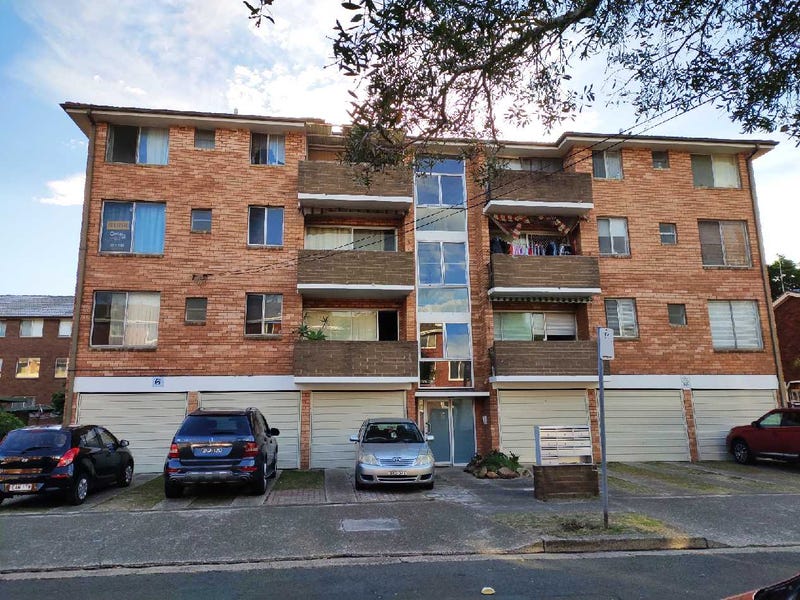
Part of the Grace Campbell Crescent flat complex

Strasser’s involvement with the closely associated banking and property company Development Underwriting Ltd (with Charles J. Berg and Robert Strauss) also produced a number of flat and retail developments throughout Australia, and his business empire spanned an estimated 70 companies, with interests as diverse as cattle breeding and oil and mining ventures. By the 1970s, an exact account of the ownership structure of Parkes and its intertwined companies became difficult to ascertain (structured primarily to avoid paying high tax rates on privately owned companies[7]) and allegations of corrupt dealings with NSW Premier Robert Askin, who knighted Strasser in 1973 for “services to building industry and charity,” dogged Strasser’s career. Parkes Development ultimately collapsed in 1977, tens of millions of dollars in debt and Strasser spent his latter years on the managing committee of Mirvac before his death in 1989. A benefactor of Jewish causes, Strasser led the creation of, and was President of Shalom College from 1972–1976, a college for Jewish students at the University of New South Wales.

Stockland

In 1952, Ervin Graf, an architect who arrived in Australia from Hungary in 1950, borrowed £3000 from Albert Scheinberg. From this loan, Graf built the retail and property behemoth Stockland, originally called Stocks & Holdings. Now for all intents and purposes a gentile-run company, Stockland is Australia’s largest property group, with diverse developments of apartments, offices, and shopping center complexes around Australia. Early principal directors Albert and John Scheinberg departed to form their own flat development company in 1974, taking up the suitably “goyisch” name McDonald Industries, but Graf remained at the head of Stockland until his retirement in 2000, the function attended by Prime Minister John Howard.[8] An advocate for high migrant intake and a pioneer in bringing high-rise living to Sydney, Graf was among the first to take full advantage of the changes to strata titles in 1961. Stockland began its venture in high-rise apartments in 1952 with a 20-story block at 8–14 Fullerton Street, Woollahra, adjacent to a Jewish hospital. Stockland’s crowning achievement in high-rise living came in 1964 when Graf completed the Park Regis Tower at 27 Park Street in the center of the city. Dwarfing the surrounding buildings, at 45 stories it was the tallest residential tower in Australia upon completion. Designed by in-house architect Frank Hoffer (also from Hungary), the tower soon became a popular residence for Sydney’s cosmopolitan elite and an icon for the changing cultural mores in Australia during the period.[9] Park Regis was unmatched in scale for an apartment tower in Australia for more than 15 years, retaining the title of tallest residential building in Sydney until as late as 1996 when it was eclipsed by Meriton towers. Another benefactor and President of Shalom College (from 1990–1993), the yearly Ervin Graf Memorial Oration was named in his honour and has hosted speeches by Jewish luminaries such as Deborah Lipstadt and Amos Oz; Graf donated to Jewish educational and other causes throughout his life.
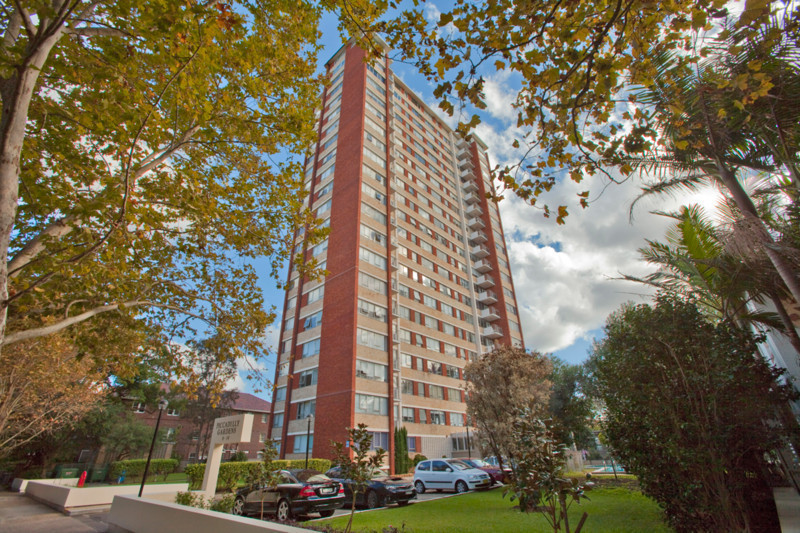
8–14 Fullerton Street, Woollahra
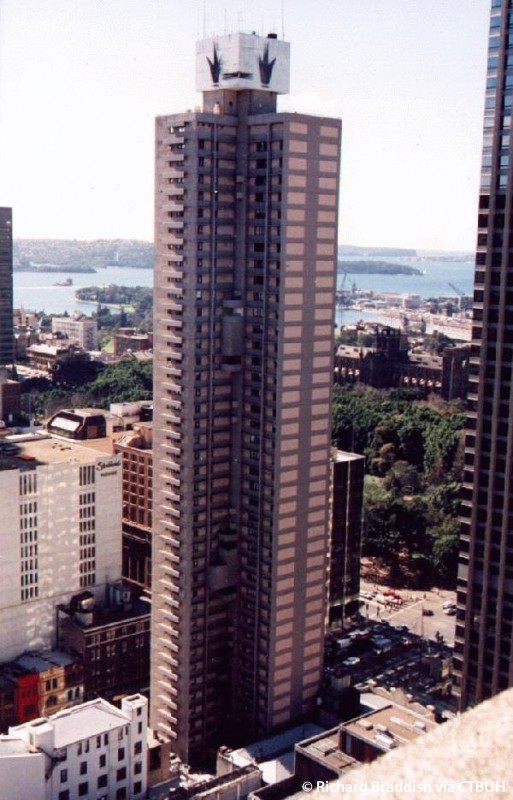
Park Regis Tower

Progress and Properties

Founded in 1955 by Tibor Balog and Michael Hershon (Hirschhorn), who both arrived from Hungary after World War II, Progress and Properties was, along with Graf’s Stocks and Holdings, among the earliest property development companies to enter the Sydney high-rise apartment scene. Going public in 1965 after earlier ventures in smaller scale flat development, Progress and Properties was responsible for a cluster of apartment towers in Darling Point, primarily along Thornton Street, ranging from 18–30 stories. The historic Retford Hall mansion was demolished to make way for these towers, and their 30-story Ranelagh Flat at 3 Darling Point Road (built in 1969) became Australia’s second tallest residential building upon completion. In North Sydney, their 23-story block at 50 Whaling Road still projects into the sky with little regard for the single-story houses adjacent, and numerous other flats and sizeable apartment blocks attributable to Progress and Properties are dotted throughout the eastern and inner western suburbs of Sydney. By the mid-1970s Progress and Properties had morphed into Dainford Holdings, which also found success on the Gold Coast, with 15 apartment towers throughout the 1980s. The tallest, the 47-story BreakFree Peninsula at 3 Clifford Street, took the title of the tallest apartment tower in Australia from Stockland’s Park Regis.
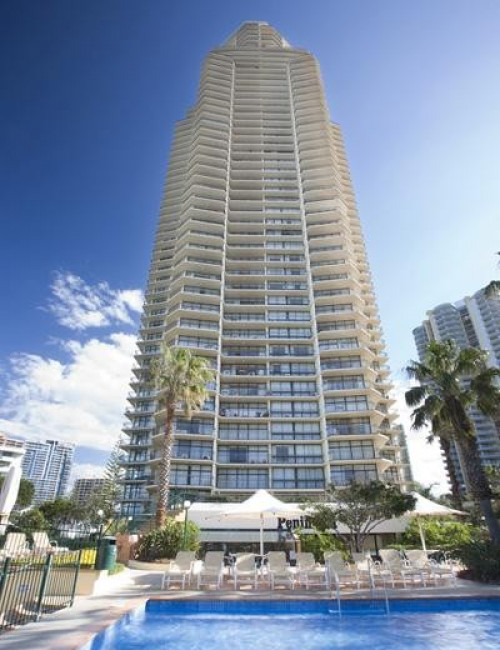
BreakFree Peninsula

Like Strasser and Frank Theeman, Hershon and his partners were among the seedier players of the Sydney property development industry. An investigation by the Sydney Tribune uncovered a number of associations between Progress and Properties and Jewish crime boss Abe Saffron,[10] and Dainford Holdings collapsed in 1991, shortly after Balog was charged with corruption relating to property dealings with the Waverly Council.[11] Further scandal surrounded Hershon, also notable as the head of a lingerie manufacturer, and he was a board member of a number of Zionist organizations and Jewish schools throughout his life.

Meriton

“I looked around and I saw cottages everywhere… I thought it was time they lived in apartments.”- Harry Triguboff[12]

Still privately owned by Harry Triguboff, the success of Meriton embodies the revolution that Australian urban form has undergone. The company has grown to become the largest apartment developer in Australia, a builder of copious quantities of low-cost units and towers in New South Wales and Queensland. The company estimates it has provided more than 75,000 apartments in Australia since its inception.[13] A mainstay of rich lists, at one point the wealthiest person in Australia, in 2020 Triguboff was the third richest person in Australia with an estimated wealth of $15.5 billion, behind only mining magnate Gina Reinhart and Jewish recycling king Anthony Pratt.[14] His Russian-Jewish family arrived in Australia via China after the war, and Triguboff founded Meriton in the late 1960s after dabbling in construction work for new flats. As rates of migration surged, Triguboff set about expanding Sydney upwards and early flats gave way to soaring apartment towers when the company hit its stride in the 1990s. By the twenty-first century, Meriton’s towers held the titles for the tallest residential buildings in Sydney and Brisbane.

The first large developer to expand high-rise towers westwards beyond Sydney’s harborside suburbs, Meriton’s commanding presence in the Sydney property market has not endeared it to critics who see Meriton’s “low-cost, high density” formula for apartments as a blight on Sydney’s urban landscape. Meriton’s tower developments were responsible for much of the tightening of Sydney’s planning laws during the Carr state government. The resulting SEPP 65 law, passed in 2002, introduced mandatory design standards for apartment developments, and allowed only registered architects to design towers.
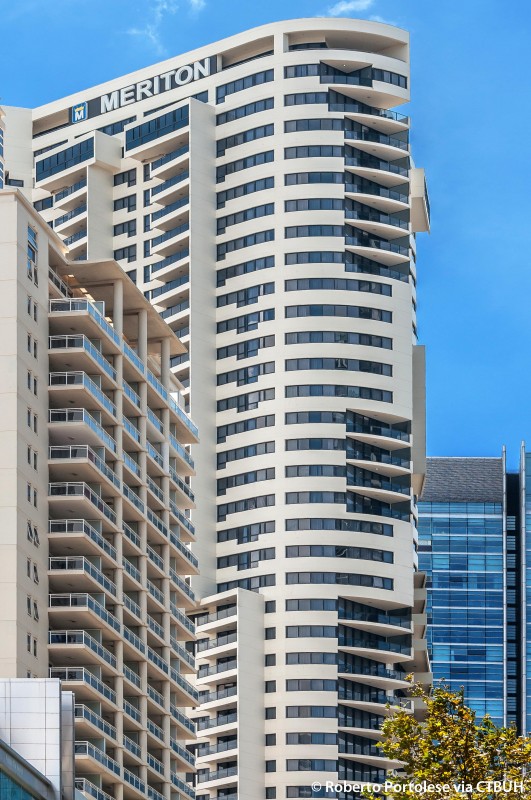
Over the years, Triguboff has allocated vast sums of his personal fortune to Jewish causes in Israel, where his parents relocated to. From funding schools to promote Bedouin assimilation, to the Shorashim project, a Rabbinical initiative dedicated to assisting Jews in proving their Jewish heritage when migrating to Israel, Triguboff’s Zionist credentials are impeccable. In 2012, the Harry Triguboff Gardens at the Rabin Centre, a library and research center in Tel Aviv, was dedicated to him for his long-term support for the Jewish National Fund,[15] an organization founded to settle and irrigate former Palestinian land. Not limited to Israeli causes, Triguboff is also a major donor to the Chabad education movement in Australia, worrying that Jewry might disappear without Jewish schooling. Triguboff’s comments on the future of the Jewish people to the newspaper The Jerusalem Post in 2013, highlight his concerns about the demographic future of the diaspora:

Diaspora Jewry would disappear, that’s why I was always very much involved with school. I wanted Jewish children to go to Jewish schools. I realized that we have to do everything we can to preserve the Jewish race. I’m very proud of it and I think it’s wonderful.[16]

Triguboff’s feelings on the people and composition of Australia are arguably less devoted. Commenting on a government proposal in 2006 for a values and language test for new migrants to Australia, Triguboff put it bluntly: What’s more important for me—a guy who can fix my tap or a guy who can speak English?[17]

Not surprisingly given the large migrant source of new apartment purchasers, Triguboff is a staunch supporter of “Big Australia,” having the ear of many NSW governments, and he hopes that not only are current population targets well exceeded, but that Australia’s population will quadruple to reach 100 million[18]—a proposal that, given the current source of most migrants to Australia and declining White birth rates, would lead to the effective eradication of Australia as a predominantly White country. What Triguboff, the preservationist of the Jewish race, would think of a proposal by a gentile property developer to quadruple the population of Israel, primarily through mass immigration of non-Jews and purely for his own economic gain, need not even be asked.

Mirvac

Formed later than Meriton and Stockland, Mirvac emerged from the economic crash of the 1970’s and remains one of the largest property developers in Australia. Publicly listed since 1987, Mirvac’s apartment tower projects are prominent in all major cities of the country. Founded by Jewish architect and developer Henry Pollack (born Polak), Pollack remained chairman and a major shareholder of the company until his retirement in 1996 and continued his architectural practice with Mirvac’s in-house architectural team. Born in 1922 in Lodz to Russian-Jewish parents, Pollack fled to Lithuania ahead of the advance of the German Army into Poland. Arriving in Sydney in December 1941 via China, Pollack married a local Jewish girl and jumped from career to career, holding jobs as a watchmaker, farmer, and owner of a women’s fashion store. Pollack finally found his calling in architecture after a visit to the Brussels World Exhibition in 1958; he became attracted to modernism and was bristling with a desire to break with the past:

Seeing the Brussels Exhibition … made me realise that I could join a revolutionary movement and build the future, disregarding the phlegmatic, plodding past which started with Greek columns in the sixth century BC and was still using them in twentieth AD.[19]

Predictably, the reasons invoked for this rejection of traditional western architecture are to be laid at the foot of Hitler and the Holocaust:

Watching the light and airy structures of the Brussels Exhibition, totally different from the buildings I knew, I wondered whether it was a coincidence that Hitler banished the Bauhaus and proscribed modern architecture and art. Could his murderous decisions be taken in full daylight behind clear glass walls? Modern architecture had cut all ties with the past, made the previous architectural styles irrelevant and seldom referred to them. I felt the same way; I wanted to start afresh and not be associated with continuity. I did not want a profession that had grown out of the unbearable past.[20]

Pollak began his career in the office of architect Henry Kurzer and opened his own practice in 1964. Early commissions for houses ensued, but Pollack, now in his 40s and worried about the viability of his late-chosen profession, began to seek out his own development sites to become self-reliant. His first projects as an architect/developer—blocks of flats in Lakemba in Western Sydney and Roscoe Street, Bondi—sold well and Pollack soon had numerous flat projects throughout Sydney. Among the larger projects of Pollack’s pre-Mirvac days was a 14-story block of flats, High Tor at 20–24 Rangers Road, Neutral Bay and a sprawling lot of low-rise flats at 102 St Georges Cres, Drummoyne, projects by now financed through venture partnerships, often with other Jews.[21]

Pollack’s success attracted the attention of others, and an offer of financial partnership came from the Australian Guarantee Corporation, a finance group owned by the Westpac Bank. The partnership was christened with the company name “Mirvac” in 1972. Mirvac transitioned from flat renovations during the economic downturn to high-rise towers—a 21-story tower at 80 Berry Street, North Sydney an early project—and other high-rise apartment towers in the then emerging Bondi Junction, Chatswood and North Sydney precincts soon followed. Driven by a more holistic development style than competitors like Meriton, from its inception Mirvac has distinguished itself with an up-market focus to its apartments, a luxury tower at 5 York Street in central Sydney (built in 1981) being an early example. Seemingly a focal point of Sydney’s Jewish property developers, Pollack also took part in the development of Shalom College, appointed by primary donor Frank Theeman as the architect of the complex,[22] and Jews have remained at the helm of Mirvac into the present, with current CEO and managing director Susan Lloyd-Hurwitz being appointed in 2012. In 2020, she was ranked number 2 in the Australian Financial Reviews property power players, ahead of Darren Steinberg, the CEO of investment property trust Dexus.[23]
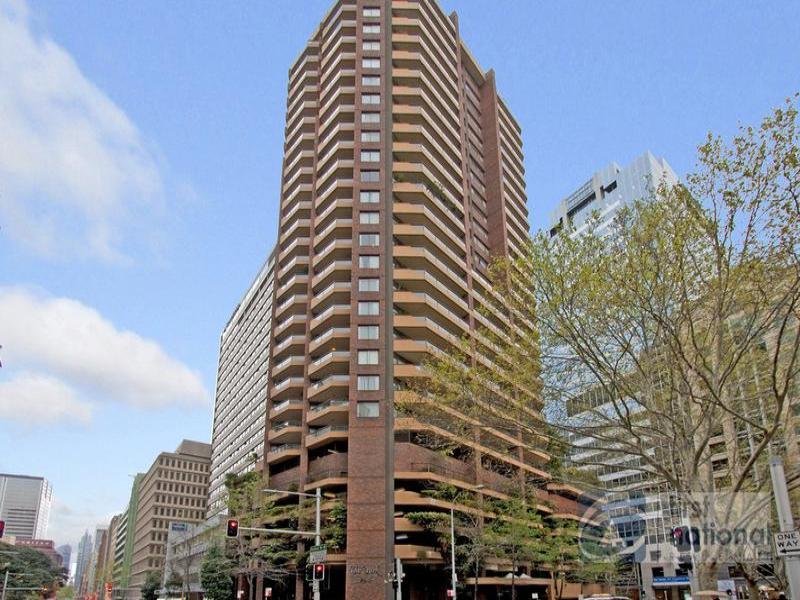
5 York Street, Sydney

Frank Theeman and the Green Bans

Born Franz Thiemann in Vienna in 1913, Theeman left Austria with his wife and arrived in Sydney in 1939 where he started a successful hosiery business, Osti Pty Ltd.[24] Theeman saw the opportunities in property under the development-friendly Askin government and began purchasing vast swathes of terraced houses along Victoria Street near Kings Cross. The properties on Victoria Street formed part of the Woolloomooloo Redevelopment Central Plan (1969), intended by the NSW state government as a new high-density precinct to replace a working-class suburb. Other Jewish developers also followed suit; Frank Lowy’s Westfield Towers on William Street was an early start, and Parkes Developments had plans for a tower over King Cross Station, while Sid Londish snatched up 9.5 acres of property in Woolloomooloo, with plans for towers to be erected over the next 30 years.[25] Theeman’s project at 55–115 Victoria Street, comprising three 45-story residential behemoths and a 15-story office tower, would have razed the historic streetscape to the ground and have dwarfed the surrounding buildings. His project instantly aroused local and much more powerful opposition, sparking one of the most controversial incidents in Australian property and criminal history.

The “Green Bans” as they came to be known, were union strike actions imposed on developments by the Builders Laborers Federation (BLF), led by Jack Mundey. Mundey, a Communist Party member, allied his union base with the middle class in a campaign to save historic Sydney sites of architectural and environmental value from redevelopment. Responding to calls from local residents aggrieved by development plans in their nneighborhood, the BLF placed Green Bans over projects, barring any union worker from participating and effectively halting construction work. The 42 Green Bans imposed in Sydney by the mid-1970s ranged from parks to expressways and high-rise towers,[26] and in July 1973 a Green Ban was placed over Theeman’s sites on Victoria Street after local opposition, including from Victoria Street resident Juanita Nielsen, who prominently railed against Theeman’s development in the pages of her local newspaper. As a newcomer to the property development industry, the Green Ban over his project cost Theeman substantially, since he was paying an estimated $16,800 a week on interest payments for the loan by 1975.[27] The stalemate drew on, and residents of Victoria Street opposing the development found themselves confronted by Sydney’s criminal underbelly. Inhabitants and squatters of the now Theeman-owned houses were intimidated by thugs alleged to have been in the pay of Theeman and violently evicted, and the head of the local anti-development group was kidnapped and terrorised into abandoning the protest. The fate of Theeman’s leading opponent, Juanita Nielsen, was the least pleasant:

On the morning of July 4, 1975, Nielsen opened the door of the Carousel Club in Kings Cross—owned by Abraham Gilbert Saffron, a man often referred to by Sydney’s racy afternoon papers as “Mr Sin.” She was supposed to be meeting a man at the club to discuss placing some ads in her paper but was never seen again.[28]

An inquest and successive attempts to uncover the story behind Nielsen’s disappearance and presumed murder have come up empty. The case is now infamous in Sydney crime history; newspaper articles and books speculating on her disappearance continue to be published to this day. Abe Saffron is alleged to have loaned money to Theeman to fund his project, but Theeman denied having any role in Nielsen’s disappearance and little more than allegations were ever laid at his feet during his later life. Eventually the Green Ban was lifted and a smaller 15-story development was completed instead, one that left the Victoria Street streetscape largely intact, punctuated now only by minor apartment blocks like 145 Victoria, designed by Jewish architects Henry Kurzer and Henry Haber. The efforts of the BLF saved the Woolloomooloo precinct and countless other areas throughout Sydney from high-rise redevelopment, and it has persisted as a low-density historic suburb of Sydney to this day.

The Reign of Seidler

The contribution of Jewish architects to the new era of flats and apartments in Sydney bring forth the names of Hugo Stossel of H. Stossel and Associates from Hungary, another leading designer of flats and towers, the firm Lipson and Kaad, and other names, such as Stephen Javor, Alexander Kann, Hans Peter Oser, Ervin Mahrer, Aaron Bolot and Henry Epstein—all again overshadowing gentiles in the growing flat and high-rise industry. Highlights from Aaron Bolot from Russia include the Wylde Street Cooperative Apartments built in Potts Point in 1950, a striking early modernist design that has attained a similar place in architectural annals to Stanhill in Melbourne, and the 12-story Quarterdeck Apartments in Carabella Street, Kirribilli, another early tower by Lend Lease (built in 1960) which demolished the historic home of Australia’s first prime minister Edmund Barton. With these Jewish architects, the earlier Art Deco and Spanish Mission Style used for the design of inter-war flats was driven out in favor of Modernism and the International Style. None of these names however come close in fame and recognition awarded to Australia’s most famous Modernist architect, if not the most famous Australian architect since 1945, Harry Seidler, a major proponent of high-density living whose concrete towers would come to define the skyline of Australian cities.

Born to a Jewish family in Vienna in 1923, Seidler spent time as an enemy alien in a British internment camp, leaving Austria in 1938. Seidler studied under Marcel Breuer and Walter Gropius in New York at the Harvard Design School and, after forays in New York and South America, he was persuaded by his parents to design their new Sydney home, whereupon he decided to stay. Finding early work designing controversial modernist houses, more often than not for migrant Jewish clients, Seidler designed countless blocks of flats, iconic examples including Ithaca Gardens and Vaucluse Waters, and transitioned into larger and larger projects, utilising new prefabricated concrete techniques. Seidler was conscious of the existing prejudice against flats, which he attributed to the low-quality architectural styles of existing flats built by developers like Parkes, and he set out with a desire to shift Sydney away from suburbia to high-rise “Wohnmaschinen”[29] consistent with his Bauhaus training.

Seidler teamed up with Meriton and other developers later in life, but he is most notable for his partnership with Lend Lease founder, Gerardus “Dick” Dusseldorp, with whom he collaborated on Sydney’s soaring new towers, designed true to the Modernist ideal: concrete boxes to work in and glass and concrete boxes to live in. A gentile migrant from the Netherlands, Dusseldorp’s background in many ways mirrors the story of the post-war Jewish migrants. Born in Utrecht in 1918, Dusseldorp was conscripted into forced labor by Germany during World War II, spending time in labor camps in occupied Poland, and arrived in Australia in 1951, directed by the Dutch building company he worked for to find new development opportunities away from war-torn Europe. Like Seidler and other Jewish developers and architects, his foreign upbringing similarly lent him an unfamiliarity with the cultural mores of Australia and a worldly mindset that manifested itself as a dislike of the parochial nature of 1950s Sydney. His construction company Civic and Civic, later growing into the multinational developer Lend Lease, would become yet another pioneer of high-rise residential and office towers in Sydney, and it was Dusseldorp and his company who drafted the bill and spearheaded the effort to introduce Strata Title reform in New South Wales, via the Conveyancing (Strata Titles) Act of 1961.[30]

The consistent lobbying effort of both Seidler and Dusseldorp was also successful in removing the old 12-story height limit in the central city,[31] replacing it with a generous floor space ratio (FSR) that allowed much taller towers to proliferate, ultimately transforming the traditional form of Sydney’s central business district. Together they produced Sydney’s landmark modernist towers—Australia Square, MLC Centre, Capita Centre, and Blues Point Tower. Perhaps Australia’s ugliest apartment tower, Blues Point occupies prime Sydney real-estate, situated on the edge of a peninsula opposite the harbour bridge, a blight on the landscape for all to see. Blues Point was the only tower built in the failed McMahons Point redevelopment, which proposed 29 towers across the peninsula. Seidler defended his work in classic Seidler style, berating Blues Points critics as “illiterate, insensitive, and uneducated.”
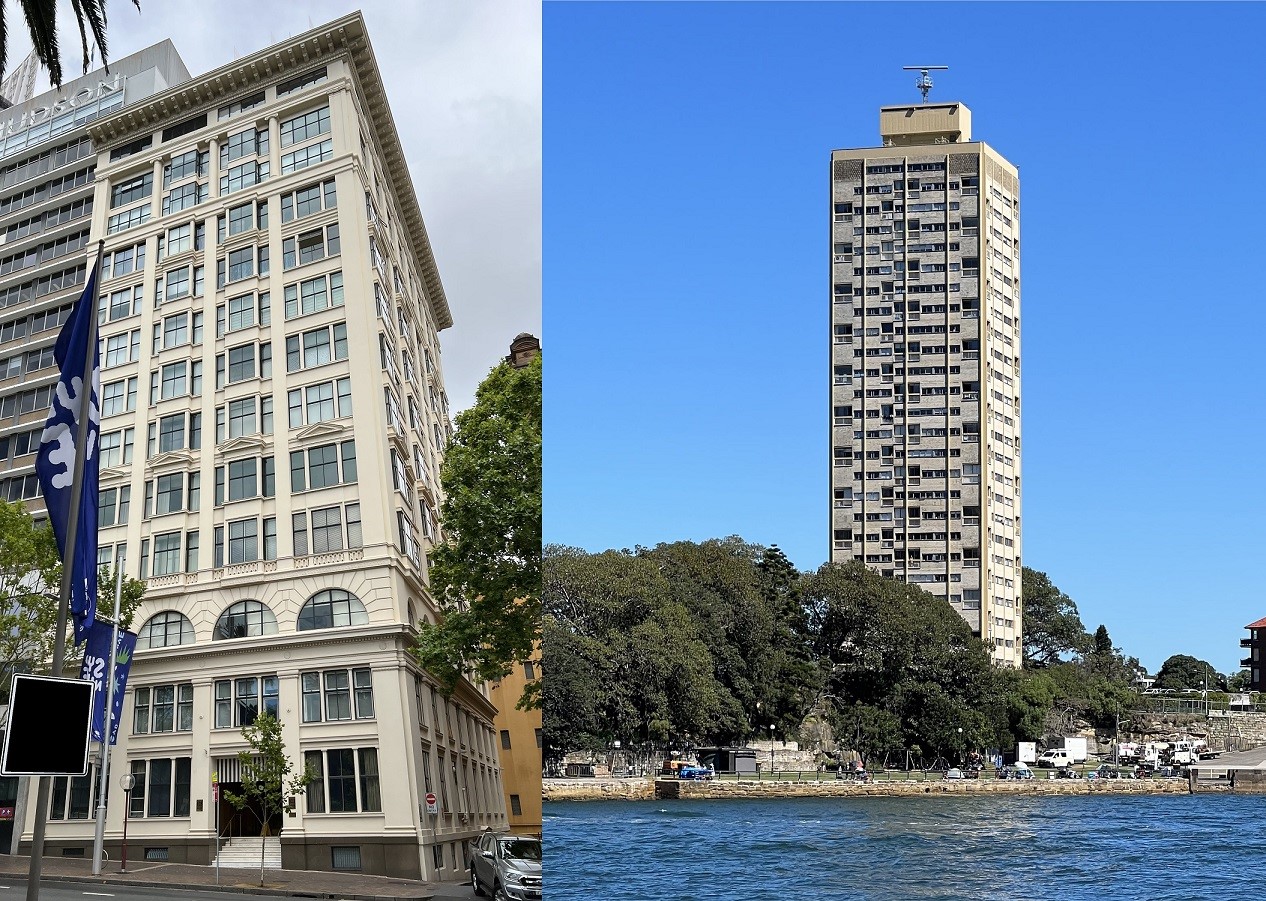
The Astor and Blues Point

Seidler’s disparaging views about the Australia he arrived in, the harsh rhetoric against his critics, and his battles with local councils over his outlandish modernist designs have become almost architectural folklore:

Each new project resulted in a fight with councils filled with people Seidler disparaged, variously, as ‘butchers and grocers’ who made ‘idiotic judgments’ on aesthetics and couldn’t read sophisticated plans.[33]

Once describing the Australian architectural scene as a “backwater, a provincial dump,”[34] Seidler’s snobbery and disdain for anything traditionally Australian extended to believing that nothing ever built in Australia was worth a heritage listing.[35] To make way for the MLC centre, the century-and-a-half old Theatre Royal and the Australia Hotel were razed to the ground in one of Sydney’s worst heritage crimes, and Seidler once called for the demolition of Sydney’s iconic Queen Victoria Building, calling it “an architectural monstrosity, a wasteful, stupid building.”[36] Siedler, like Graf and Pollack, was critical of walk-up flats, seeing the trend as a poor urban outcome and more often than not devoid of architectural quality. But this opposition ran counter to the direction of mainstream Australian sentiment, seeing the solution to the walk-up problem as promoting even higher densities, rather than restricting flats.

Conclusion

Parkes Developments and Progress and Properties may have disappeared, but Harry Triguboff’s Meriton still rules the roost in Sydney apartment developments, a role supplemented by a property development elite who leverage a large influence on the NSW political scene through lobbying groups such as the prominent Urban Taskforce or the Property Council of Australia. With a high proportion of Lebanese and Chinese, as well as Jewish players, this developer elite is marked by a meagre presence of individuals descended from Australia’s founding stock. Not much has changed in the reputation of property developers in Sydney since the years of the alleged collusion of Paul Strasser and the Askin government in the 1970s, as they continue to be plagued with regular occurrences of corruption and scandal. Land transactions are a common target for official investigation into corrupt dealings with local councils or the state government. Property developers have been banned from donating to NSW political parties since 2009 but have found plenty of other measures for the plundering of Australia’s cities and livelihood. Chief among these is the promotion of mass immigration, a policy consistently advocated for by the Urban Taskforce in the face of all evidence of its crippling effect on Australia’s GDP per capita, let alone on its culture and demographic makeup. The Taskforce continues to push for a “rapid return” of Australia’s extraordinarily high migrant intake program in the aftermath of the COVID-19 pandemic.[37] Comprising 10 members, Lebanese and Jewish members easily outnumber the White Australians on the Executive Committee of the Urban Taskforce[38], leaving little wonder why this group, so unrepresentative of Australia’s demographics, is so hostile to the continuation of the Australian people as a cohesive entity.

Go to Part III.


[1]  For a detailed account of the New South Wales’s government efforts against flats pre-1939, see Thompson 1986, op. cit., p.25-67.

[2] Ibid., p.45.

[3] Ibid., p.285.

[4] Ibid., p.180.

[5] Mainline and Home Units of Australia, neither of which survived the 1970s downturn; and HUA was far from a local, founded by itinerant Englishman Syd King.

[6] C. Butler-Bowden & C. Pickett 2012, ‘Strasser, Sir Paul (1911—1989)’, Australian Dictionary of Biography, retrieved from https://adb.anu.edu.au/biography/strasser-sir-paul-15741.

[7]M, Wilson, ‘How Parkes eased a burden’, Sydney Morning Herald, 19 March 1977, p.49.

[8] C. Cummins, ‘Architect whose faith in property’s potential paid off’, Sydney Morning Herald, 29 July 2002, retrieved from https://www.smh.com.au/national/architect-whose-faith-in-propertys-potential-paid-off-20020729-gdfhqk.html.

[9] D. Jellie, ‘A 60’s Icon Turns 40’, Sydney Morning Herald, 22 November 2007, retrieved from https://www.smh.com.au/lifestyle/a-60s-icon-turns-40-20071122-gdrnkp.html

[10] Sydney Tribune, “A Tribune Investigation,” 28 March 1984, p.16

[11] R. Harley, ‘DEVELOPER, PLANNER SENT FOR CORRUPTION TRIAL’, Australian Financial Review, 29 August 1992, retrieved from https://www.afr.com/property/developer-planner-sent-for-corruption-trial-19920819-k52a5

[12]Sydney Morning Herald, ‘Triguboff and the new Great Australian Dream’, 24 November 2010, retrieved from https://www.smh.com.au/business/triguboff-and-the-new-great-australian-dream-20101124-1868h.html

[13] ‘About Meriton’, Meriton, retrieved from https://www.meriton.com.au/about-us/

[14]Rich List 2020, Australian Financial Review. Retrieved from https://www.afr.com/rich-list

[15] ‘Triguboff Gardens Dedicated at Yitzhak Rabin Center in Tel Aviv’, KKL-JNF, 9 September 2012, retrieved from https://www.kkl-jnf.org/about-kkl-jnf/green-israel-news/september-2012/rabin-center-triguboff/.

[16] I. Evyatar, ‘Spotlight: Building Jewish Identities’, Jerusalem Post, 4 July 2013, retrieved from https://www.jpost.com/features/front-lines/spotlight-building-jewish-identities-318797

[17] A. Cennell, ‘Triguboff: Let’s Trade Trees for Homes’, Sydney Morning Herald, 11 October 2006, retrieved from https://www.smh.com.au/national/triguboff-lets-trade-trees-for-homes-20061011-gdokmv.html

[18] ‘Population to hit 50 Million by 2050: Triguboff’, Sydney Morning Herald, 25 January 2020, retrieved from https://www.smh.com.au/national/population-to-hit-55m-by-2050-triguboff-20100125-mt45.html

[19] H. Pollack 2001, The Accidental Developer, The Fascinating Rise to the Top of Mirvac Founder Henry Pollack, ABC Books, Sydney, p.193.

[20] Ibid., p.195.

[21] Ibid., p.241.

[22] According to Pollack, Theeman abandoned his involvement in the project upon being told it would not earn him a knighthood, Ibid., p. 234.

[23] N. Lenaghan, ‘New kids on the block join 2020’s property power players’, Australian Financial Review, 1 October 2020, retrieved from https://www.afr.com/property/commercial/new-kids-on-the-block-join-2020-s-property-power-players-20200819-p55n6f.

[24] G. N. Hawker 2012, ‘Theeman, Frank William (1913—1989)’, Australian Dictionary of Biography, Retrieved from https://adb.anu.edu.au/biography/theeman-frank-william–15666

[25] Shirley Fitzgerald 2008, ‘Woolloomooloo’, Dictionary of Sydney, retrieved from https://dictionaryofsydney.org/entry/woolloomooloo

[26]  See Green Bans 1971-1974, retrieved from https://www.greenbans.net.au/green-bans-1971-74

[27] G. N. Hawker, op. cit.

[28] A. Clark, ‘The man who reshaped Australia’, Australian Financial Review, 16 May 2020, retrieved from https://www.afr.com/life-and-luxury/arts-and-culture/the-man-who-reshaped-australia-20200514-p54sxt.

[29] “Living-machines.”

[30] Thompson 1986, op. cit., p.123-137.

[31] E. Farrelly 2021, Killing Sydney – The Fight for a City’s Soul, Pan Macmillan Australia, p.36.

[32] ‘Towering Ambition’ Sydney Morning Herald, 28 September 2002, retrieved from https://www.smh.com.au/entertainment/art-and-design/towering-ambition-20020928-gdfoao.html.

[33] J. Power, ‘Harry Seidler, the ‘great disruptor’ of modern Australian architecture’, Sydney Morning Herald, 11 January 2021, retrieved from https://www.smh.com.au/national/nsw/harry-seidler-the-great-disruptor-of-modern-australian-architecture-20201215-p56nim.html

[34] ‘When Harry met Sydney’, Sydney Morning Herald, 10 March 2006, retrieved from https://www.smh.com.au/national/when-harry-met-sydney-20060310-gdn4g9.html

[35] Farrelly, op. cit., p.220.

[36] ‘Tear down this City Horror’, The Daily Mirror, 26 September 1961, retrieved from https://fabsydneyflashbacks.blogspot.com/2021/09/1961-harry-seidler-calls-for-demolition.html

[37] ‘Developer Lobby demands “rapid return” of mass immigration, Macrobusiness, 21 September 2021, retrieved from https://www.macrobusiness.com.au/2021/09/developers-lobby-demands-rapid-return-of-mass-immigration/

[38] See Urban Taskforce Executive Committee, retrieved from https://www.urbantaskforce.com.au/about-us/urban-taskforce-executive-committee/

Jews and the Australian Dream, Part I: A White, Suburban City

“While the detached suburban home was seen as quintessentially Australian, the urban flat or apartment was European—French, German or more likely middle European, which like cosmopolitan was a derogatory term in this period and a euphemism for Jewish.”[1]

During the post-war era, a radical change swept across the urban landscape of the city of Melbourne, marking a turning point in its built form. A city comprised overwhelmingly of detached suburban houses began to see the large-scale emergence of a new, very foreign living typology seeking to challenge this hegemony—the flat.

Flats, also known as units, were the clustered forms of accommodation located within a single building that began cropping up en masse on allotments in the beachside neighborhoods of St. Kilda, Middle Park and Elwood. This growth started slowly at first, but caught speed in the mid-1960s, and flats were soon sprouting in suburbia at an alarming rate, an alien incursion entirely distinct from the existing dwelling and streetscape patterns. Often built in the style that became colloquially known as “six-packs,” referring to the number of flats inside, these modern multi-story buildings generally contained between 6–18 dwellings across the floorplan, thereby multiplying rents and occupants of land tenfold. Where flats appeared, private gardens and greenery withered, and what little area the building didn’t occupy was paved over for car parking and driveways to service the multiple occupants where there was previously only one. From the years 1954 until 1977, the number of occupied dwellings located within a flat complex quintupled from around 26,000 (accommodating less than 3% of Melbourne’s total population) to over 125,000.[2]

Vast swathes of streets and neighborhoods came to be dominated by these overbearing buildings, and construction of detached houses on the other hand practically disappeared during the apex of the flat boom in some suburbs. In the two years from 1962 to 1964 in the suburb of Prahran, 33 houses were built to 1,337 buildings containing flats, and in the same period in St Kilda, no houses were constructed compared to more than 1600 flats.[3] These beachside suburbs were the worst hit and the trend swept further eastwards into places like Caulfield and Hawthorn. In others suburbs, flats were kept at bay along major arterial roads, their intrusion into the depths of suburbia vehemently resisted by local councils and residents. The success of the flat typology in Melbourne and elsewhere in Australia soon encouraged developers to build higher, and Australians watched in dismay at the encroachment into their neighborhoods and their city of a high-density living style once so foreign to them, craning their heads up towards new high-rise apartment towers.

Early Flats

Prior to this boom in flats and the subsequent entry of apartments[4] and high-rise living onto the scene, Melbourne’s urban form overwhelmingly reflected the mores of its culturally and racially homogeneous white population. With plenty of land to spare, housing throughout the city was typified by detached dwellings on quarter-acre suburban blocks or double-story Victorian terraced houses within the oldest inner-city suburbs. Containing healthy backyards with space for gardening and backyard sports, these single-family dwellings were representative of the predominant desire for an overall green, low-density, private, and individualistic living style. By contrast, flats pre-World War II were a rarity all but avoided by the middle and working-class majority in nuclear family arrangements, and were confined far from the growth of suburbia.

The earliest of multi-family buildings in Australia would seem to modern observers as more akin to a hotel than a home, where instead of self-contained kitchens, they possessed a central kitchen and a staff of servants to attend to the residents in common dining rooms. These early buildings, many renovated from defunct mansions due to shortages of domestic staff (the servant problem as it was known), gave way to the first true self-contained flats during the inter-war period. Limited to the affluent suburbs, flats functioned primarily as investment vehicles and haunts for the wealthy that were never intended to displace the detached house as the main residence. They were often a convenient secondary or tertiary home for country dwellers visiting the city, rented out to the elderly and the widowed, or supplied to bachelor offspring. These flats were heavily restricted by planning codes at the time and came in the era before liberalising inventions such as strata titles and off-the-plan sales contracts. Lacking support from traditional financial institutions, which largely avoided funding them, flats were also expensive to develop. They were primarily rented out, which limited investment returns to rental returns, and where flats were sold, this had to be financed and arranged under complex Company Title laws, whereby ownership of a dwelling in a building was allocated by shareholding in a company, rather than by being subdivided into individual ownership titles. These shares could not be mortgaged and any sale or transfer of ownership had to be approved by the board of the company. Melbourne’s predominate flat architects and developers prior to World War II, the likes of Howard Lawson, and Walter Butler, operated for this small and uniformly affluent clientele in the streets of South Yarra and along St Kilda Boulevard, and the tallest residential building at the time, the 8-story Alcaston House on Collins Street, was built only a stone’s throw away from Victoria’s seat of power, Parliament House, expectedly housing the wealthy and the elite.

The Australian Dream

Subversive to established lifestyle norms and the Australian Dream, and fuelling the rise of cosmopolitanism and multiculturalism, this mass proliferation of flats and apartments in the post-war era aroused widespread and consistent angst and opposition from Australians, who were concerned about the social and cultural effect of the uptake of this new living typology on their cities. To understand the source of popular opposition to flats, as well as how radical these changes truly were, one must delve into the Australian psyche at the turn of the twentieth century, a time when a detached house was intimately linked with the emergent Australian Dream, whereas flats and apartments were linked with squalor and moral impropriety, as well as a subversive and foreign living style considered unnecessary and unsuited to the Australian way of life.

The Australian Dream, a derivation of the similar but not identical American term, grew out of the egalitarian ideals of the late 1800s and held broadly to a vision of a universally propertied nation, with the old class divides between the property haves and have-nots abolished in the New Britannia, signifying greater opportunities for social mobility and freedom. As well as its egalitarian thrust, it was believed that ownership of one’s own block of land and home, the essence of the Australian Dream, would lead to prosperity and political stability, as well as produce a healthy population living in clean air away from industrial pollution, political radicalism, and other immoral influences. At this point, the ideas of Ebeneezer Howard and the Garden City/City Beautiful movements were reaching their crescendo, and most tracts of land were subdivided in mind of a detached dwelling with plenty of space for a garden. As early as the 1930s, Australia likely held the crown for the most suburban country of all nations, as well as possessing an extraordinarily high homeownership rate, an achievement almost unmatched by other countries in the West. In the face of this distinctly Australian achievement, living in a flat represented almost a complete negation of the Australian Dream as a cultural aspiration and was in fact seen as a danger to the Australian way of life.

Butler-Bowden & Pickett argue that the prospect of mass flat living oscillated between two unwelcome extremes in the Australian mind, evoking images of Continental European hedonism and radicalism, as well as of tenement blocks and slum living.[5] Seen as crowded, unhealthy, and fostering undesirable social outcomes, the latter was in many ways a leftover of imagery from the worst days of the industrial revolution, where the influx of people into cities was followed by overcrowding, pollution and disease, and other social and political ills abounded. Socialist agitation in Europe drew much of its strength from these crowded urban masses, and the fear of falling birth rates from flat living were two political liabilities that Australia’s liberal elite were always keen to avoid. Despite this apparent contradiction in rhetoric between flats as the domain for the bohemian upper-class as well as for impoverished criminals, what was constant to all these elements was the danger to family life and the physical health of the nation, as well as an overall lack of patriotism. Whether it was the malnourished child growing up in the crime-ridden squalor of the slum flat, the bachelor-radical eschewing the bourgeois ideas of family life whilst living in the Bauhaus living-unit, or the un-married, childless heiress living in luxury in the The Astor, the threat to Australia’s future demographic vitality remained the same. Historians the likes of Charles Bean exemplified the patriotic opposition to flat living in Australia as a national danger, fearing that if flats replaced the classic Australian cottage, the ANZAC national spirit would disappear.[6]

Consequently, the first emergence of flats after World War I was a worrying portent for politicians, residents, and moral arbiters of the time, keen to see the trend limited if not outright restricted, and a variety of laws were passed throughout the states of Australia to ban them or otherwise contain them in suburbs for the wealthy, who were considered less susceptible to the detrimental impacts of flat living. The aggravated tone of the debate on flats during the interwar period is highlighted by Anne Longmire in The Show Must Go On, her history of the City of St Kilda (where the flat boom in Melbourne would soon become most apparent), quoting the vice-president of the Elwood Progress Association—an organization formed to combat flats in their neighborhood:

Flats were destructive of the best citizenship, and home builders should have the protection of the council against the intrusion of them into streets of family residences.” Supporting his case, the St. Kilda Press of 25 May 1935 argued that the city was becoming “pock-pitted” by undesirable buildings, and the one-family home would cease to exist unless zoning was introduced so that St. Kilda would not be “blighted” any further. A year later Cr. Robinson said at the annual meeting of the Progress Association that although the increase of flats had increased rate revenue, “they were attracting a type of people that were not desirable in the best interests of St. Kilda.[7]

Attitudes such as these continued to hold among the native post-war population. However, by the late 1950s the defences began to buckle as rates of migration from Europe gathered speed. Demand also came from the new generation of young adults, the nascent baby boomers, who saw flats as a “launching pad for freedom.”[8] Renting a flat or “flatting” became synonymous with unmarried youth seeking to lead transient sex lives away from the prying eyes of parents and close neighbours,[9] and flats were a cheap housing choice for young women attempting to remove themselves from the social expectations of family life. A popular example of the association of flats with sexual liberation was the subversive television soap opera Number 96, which first broadcast many of the ideas of the sexual revolution to mainstream Australian audiences. Set in the eponymous fictional flat building in the Sydney suburb of Paddington, Number 96 ran from 1972 to 1977 and featured the first homosexual and transgender characters on Australian television. Politically, flats also found currency with the forces of the New Left, whose writings rejected Australian suburban housing as a cultural malaise and who recognized the liberal and assimilationist function of the suburb as a structural and ideological barrier to their desired political changes.

The assault on Australia’s social and housing norms and traditional urban structure that began in earnest after World War II was no mean feat, coming up against deep and entrenched political and cultural opposition to these changes. The force of argument from the New Left, a handful of modernist architects, and the few extant flat developers would never be enough to convince a majority of Australians to support or even take up high-density living themselves. Instead, the task of reshaping the urban form of Australia’s cities and driving the rise of flats and high-rise living, taking advantage of the legal changes to property titles and the migrant influx, was ultimately carried out by an unyielding and determined ethnic group who were at the vanguard of these changes in almost every state in Australia. Fought primarily in the two largest cities, Sydney and Melbourne, this battle was not simply over Australia’s urban form, but over what Australia’s very future identity was to be, a fight that became a defining feature of Australia’s changing culture and demographic makeup from the 1960s onwards.

Re-shaping Melbourne

Upon investigating further, one discovers that this small, statistically insignificant group of people, primarily recently arrived migrants from Europe, made up the most prominent involvement in the post-war proliferation of flats and high-density living into what was once a solidly detached-suburban landscape. As developers, financiers, and architects, but also as residents going against the grain of the Australian Dream and the prevailing suburban living norm, it is Jews that emerge as playing the leading role in breaking through the existing stigma and cultural opposition to bring the flat and high-rise typology en masse to the city of Melbourne.

The first sign of a major break in urban form would come in 1950 with the construction of the 9-story Stanhill flats along Queens Road. Taking the title of the tallest residential building from Alcaston House, Stanhill was something altogether new for the city and challenged not only Melbourne’s height limits but its conservative architectural style. When compared to earlier flats, Stanhill, notes Sawyer:

has no suburban counterparts. Its modernity, height, high site coverage and integration of shops within the block (as opposed to flats over shops) set it apart from any other suburban [flat] block. … [It] anticipates the changing nature of inner-city suburban development, and shares design philosophies with that of luxury flat towers now being erected in St. Kilda Road, some thirty years after Stanhill’s completion.[10]

Funded and developed by Jewish brothers Stanley and Hilel Korman from Poland and designed by German architect Frederik Romberg, Stanhill’s glassy, steel-frame design exemplified a major broach of the modernist revolution in Melbourne. Romberg learnt from the Bauhaus master himself, briefly studying directly under Gropius at the ETH in Zurich; he was appalled by the architectural styles he saw upon arrival in Australia as a refugee from Europe.[11] He was committed to the social radicalism of modernist architecture, a goal ultimately facilitated by the Korman brothers, but Stanhill would end up being his largest and most famous work. A number of smaller flat buildings designed by Romberg are dotted throughout Melbourne and a 13-story bachelor flat complex in the city centre was unrealised.

If Stanhill was the early warning sign, then the rest of the army was soon to arrive. When the post-war influx of Ostjuden from Central and Eastern Europe began moving into the traditional Anglo-Jewish precinct of St Kilda and spreading into the surrounding neighbourhoods, flat developments soon followed in their wake. As O’Hanlon notes, “it is no accident that the distribution of the flats built in Melbourne in those years correlates strongly to the residential patterns of this growing Jewish community.”[12]

Aided by legal reforms to property titles (the Transfer of Land [Stratum Estates] Act 1960) and supported by the more laissez-faire local governments who saw the viability of flats as a quick solution to deal with the large migrant influx, Jewish developers led the flat development trend throughout the boom years, most prominently in the worst hit municipality—the City of St Kilda. A sample of records reveals that all five applications to build flats lodged in the month of September of 1964 in the City of St Kilda were by Jewish developers; in September of 1966 five of seven applications and in September 1968, all but one of eleven new applications for new flats that month were by Jewish developers,[13] with these figures likely replicated in other nearby councils.

Rather than operating through dedicated property development companies as is the norm today, these flats were primarily built through a collaborative approach between a mixture of builders, accountants, lawyers, architects, and real-estate agents who formed project teams (often creating a corporation solely for the building), organized investor syndicates for funds and pooled resources within the Jewish community over procuring loans from banks, which at the time were hesitant to fund flats. This hodgepodge of funding is reflected in the cheap and unintuitive designs of many of these flats, being little more than rectangular blocks with a skin of bricks. They were in stark contrast to the intricately designed Victorian terraces or Federation-era houses that sat on adjacent lots, there being neither financial means nor desire for architectural effort to assimilate the building into the local character. Dedicated Jewish developer/builders such as Martin Sachs, Adam Martin Adams of Martin Adams Developments, Jack Szwarcbord, Schlomo Itzan and Issac Hatz of Henley Constructions, and Leon Chandler left their mark on the city with countless flat developments to their name. In addition, Jewish real-estate firms Talbot & Co. and Birner Morley supplemented real-estate dealings with their own development ventures, and Jewish law firm Arnold Bloch Leibler (ABL, the law firm of Jewish activist Mark Leibler) found much of its early success in brokering for these property developments. To this day ABL continues to act as a legal advisor for Asian property developers and their apartment towers. Many flats of the era are attributable only to amateur consortiums of Jews, often family-based, who developed flats as investment projects parallel to other businesses and did not specialise in the property industry. These were primarily of the walk-up style so evident in St. Kilda, but a larger example is found in “Orrong Towers,” completed in the early stages of the boom in 1961 at 723 Orrong Road, Toorak. Designed by Herbert Tischer, the 8-story tower was built by the Tischer family-owned business Stuard Industries, which specialised in importing pianos and other musical instruments from Europe.

The Beller Boom

I see nothing wrong with a high-rise block in a shady suburb street, provided it is designed in good taste.”—Nathan Beller[14]

As the 1960s drew to a close, the trend did not end with 2-3-story walk-up flats. Further strata title reform came with the Stata Titles Act 1967—based upon the NSW strata law and intended to fix the deficiencies of the earlier 1960 law—which allowed the creation of a Body Corporate to control and manage common property within the building, removing responsibility for the more cumbersome upkeep of a high-rise building from individual owners. This reform opened the way for the intensification of high-rise apartment development, a market soon dominated by an enterprising Jewish developer by the name of Nathan Beller, president of the Victorian Jewish Board of Deputies from 1966–1969. The portfolio of Nathan Beller demonstrates that, emboldened by financial success and strata reform, walk-up flats gave way to taller buildings that began to tower over Melbourne’s low-density landscape. Beller, a real-estate agent by trade turned property developer, fled Austria in 1938 and was responsible for countless flats throughout the inner south and east suburbs, but he arose immediately after the strata reform of 1967 as Melbourne’s main high-rise living exponent, in a partnership with builder Martin Sachs and the architect Sol Sapir.

With Beller’s development company High Rise Developments Pty Ltd (alongside his real-estate agency to sell the flats), multiple examples of their work along the waterfront streets of St Kilda and Elwood are still the tallest structures in the area, towering over the surrounding houses. The Jewish trio collaborated on around a dozen large apartment blocks throughout the inner south-east in the short period between 1967 and 1973, and Sapir claims to have worked on the design of over 100 blocks of flats himself by the year 1971, with many more following afterwards.[15] Beller’s advertisements for high-rise flats in local newspapers promoted the cosmopolitan and progressive image of high-rise living, while denigrating those that settled into a “suburban brick-veneer rut,” the detached dwelling belittled as a “rambling workhouse that gobbled up leisure time.[16]

Data assembled by this writer of the approximately 60 apartment buildings over 8 stories built in Melbourne between the years 1950 and 1985, indicates that more than 70 percent of these developments involved some combination of a Jewish architect or a Jewish builder/development consortium. Of this, Beller’s team was Melbourne’s undisputed leader of the high-rise trend, building more apartments towers than any other developer until the mid-1970s economic downturn hit.

Émigré Architects

In the years before the flat boom, the scanty examples of flats in Melbourne rarely exceeded 2–3 stories in height and architects would make a conscious effort to blend the built form into the low-rise streetscape, often massed to appear from the street as an English mansion or a single-family dwelling—an architectural genuflection to the desired detached-suburban form. The typical English concern for privacy was incorporated, rejecting common entrances in favour of multiple access points that led to only portions of the building or to a single dwelling. Such outcomes soon became forgotten, because even in the architectural composition of flats built during the post-war boom, the preponderance of new forms of urban thinking hostile to mainstream sentiment is evident, mostly imported from abroad by “émigré architects,” a popular euphemism for Jewish architects found in literature on the topic. The few Australian architecture firms who designed flats and high-rise buildings in Melbourne during this period (notably Moore & Hammond, who designed two larger towers along Toorak Road for suspected Jewish clients) are outnumbered by the likes of Mordechai Benshemesh, Sol Sapir (Sapirshtein), Herbet Tischer (Tichauer), Michael Feldhagen, Bernard Slawik, Theodore Berman, Anthony Hayden (Hershman), Ernest Fooks (Fuchs), Anatol Kagan and Kurt Popper, who feature among the roster of Jewish architects whose portfolios overflow with flats and towers in Melbourne. Often applying modernist styles learned in universities in Europe[17], this group of Jews has only recently seen recognition in architectural history journals, despite their overrepresentation in the trend. Earlier publications preferred to highlight the well-formed design of Robin Boyd’s sole tower output, “Domain Park” (developed by Lend Lease), rather than a dozen cheap and less palatable designs by Sol Sapir. Born in Melbourne to Jewish parents who migrated from Poland, Sapir was the most prolific flat and high-rise architect in Melbourne of this group; at least 15 high-rise blocks built during the early high-rise era, most of them developed by Beller, are attributable to him.

Of the other productive architects of this group, we find in Kurt Popper the quintessential story of a Jewish émigré architect subverting the Australian Dream. Arriving from Vienna, Popper was responsible for over 80 blocks throughout Melbourne,[18] and later became a lecturer on high-rise apartments in the School of Architecture at the University of Melbourne based off of his expertise in flat and high-rise design. These included four of the earliest apartment buildings in the central business district—city-living pioneers when Melbourne’s centre was practically deserted after business hours and was comprised almost entirely of office and retail buildings well into the 1990s. These were: Crossley House at 51 Little Bourke Street (completed in 1966 by Jewish builders Notkin Constructions), Park Tower at 199–207 Spring Street (completed in 1969, also by Notkin Constructions), 13–15 Collins Street (completed in 1970 by a Jewish development consortium), and Lonsdale Heights at 131 Lonsdale Street respectively. The at-the-time towering Collins and Spring Street buildings (22 and 20 stories each) struggled to attract local purchasers still adverse to apartment living. The Collins Street tower was partially converted into office and retail spaces and only 25 percent of units were sold in the Spring Street tower two years after completion.[19] The 20-story Lonsdale Heights tower was developed by Hotelier Les Erdi, a Jewish-Hungarian refugee, and included 135 flats alongside the Chateau Commodore Hotel. The hotel dining room became a regular venue for Zionist and other Jewish organisation meetings and Popper was a popular choice for the design of Jewish community buildings throughout Melbourne, with several synagogues, schools, and kindergartens on his resume.

Mordechai Benshemesh, who arrived in Australia in 1939 from what was then still Palestine, also dabbled in property development with his own company Lakeview Investments, alongside his flat design output. He is notable for designing the 13-story Edgewater Towers on the waterfront in Elwood for developer Bruce Small. Edgewater was Melbourne’s first residential building to exceed the 10-story mark and was arguably the first true “residential skyscraper,” taking the title of the tallest residential building from Stanhill. In 1961, his reputation as a leader in the high-rise trend became evident when he was invited to participate in a forum in Sydney alongside fellow Jewish architects, Harry Seidler and Neville Gruzman to speak on the topic of apartment buildings.[20]

Finally, Ernest Leslie Fooks’ influence is apparent not simply in his architectural output but also as an early town planner, allegedly the first lecturer on the subject at Melbourne’s Royal Institute of Technology. As a student in Vienna, Fooks was employed at the architectural firm Theiss & Jaksch and worked on the “Hochhaus Herrengasse” (built in 1930), at the time Vienna’s tallest residential building and the first non-religious building to protrude above the rooftops of the historic Viennese Old City. Proud of his involvement in the project, Fooks took his photos of the building with him when he fled Austria in 1938.[21] In 1946, whilst working as a planner at the Victorian Housing Commission, Fooks published X-Ray the City!: The Density Diagram, a novel work in Australia with an introduction by H.C. Coombs, the then federal director of Australia’s post-war reconstruction department. In it, Fooks advocated for density as a planning solution to Australia’s growing cities and the inequality of social and cultural infrastructure, and critiqued the popular sentiments that equated density with social delinquency—arguments that may have seeded some of the initiative within the state Housing Commission to build the now-hated housing commission towers. Fooks also put his ideas into practice in his private architectural output, being responsible for the design of another 40 blocks of flats in the boom suburbs during the era,[22] as well as a number of Jewish community buildings and schools, notably Mount Scopus College.

A New Generation

The financial crisis of the mid-1970s followed the suburban backlash, and, as the boom in construction ultimately dried up, the flow of new flats dwindled to a trickle. The flat boom peaked in the years of 1967–1968 where around 13,600 dwellings were added, crashing to 2,400 by 1979–1980.[23] That the high-water mark for flat development exactly coincided with the year of the arrival of the cultural and sexual revolution reflects the connection between the two phenomena.   While not as fierce as in Sydney, Melbourne-based Green Bans stifled their fair share of developments, local councils tightened up planning laws, and resident actions groups began forming throughout the suburbs in response to Housing Commission towers and the flat and apartment boom. The encroachment of Jewish-built high-rise towers, in particular Nathan Beller’s, into the WASP heartlands of eastern Toorak and Hawthorn enraged locals, leading to the establishment of local anti-high-rise groups. An 8-story proposal by Beller at 480 Glenferrie Road opposite the elite Scotch College saw objectors come out in droves, his 9-story block at 3–5 Rockley Road, South Yarra (designed by Sol Sapir) was the final insult to residents on a street overdeveloped with flats, but a tower proposed in the depths of Toorak at 546 Toorak Road (built in 1971 and also designed by Sol Sapir), named Barridene after the mansion that previously occupied the site, garnered the most attention. Local residents submitted over 800 objections to the proposal and the building was eventually cut down from 19 to 13-stories, the outcry becoming the impetus for a blanket ban on more towers in the area. To this day Barridene still looms over surrounding mansions of Toorak and the Presbyterian Church across the road, the church steeple no longer being the tallest structure in the area – an apt example, in urban and built form terms, of Jewish disregard for Christian cultural mores.

Berridene

After the flat boom ended, a calm set on the Melbourne housing market, as detached dwellings re-asserted themselves, migration slowed, and the Baby Boomers, now with children to raise, shifted to traditional detached housing. This calm would not last long however, as apartment developments re-appeared in the mid-1990s, following initiatives to revitalise the central business district and bring city-living to the heart of Melbourne. Jewish property developers came to the fore once again, former Melbourne Lord Mayor Irving Rockman’s Northrock Investments leading the way with a 58-story apartment tower proposal at 368 St Kilda Road (later reduced to 40 stories) and a 33-story tower at 265 Exhibition Street. Central Equity followed suit in the newly zoned suburb of Southbank with apartment towers at 28 Southgate Avenue and 83 Queensbridge Street, the first in the precinct; Max Beck’s Becton attempted to outdo Nathan Beller with a 38-story tower at the Espy Hotel at St. Kilda beach and Mirvac made steadily erected early towers in the re-zoned Docklands and Southbank precincts. Central Equity, co-founded and now chaired by Eddie Kutner, has become Melbourne’s most consistent high-rise property developer. Largely taking its inspiration from Meriton in Sydney, it has been churning out low-cost apartment towers in the city on average once every year since the early 2000s. The suburb of Southbank, now the tallest in Australia, is almost synonymous with the Central Equity brand—nearly 30 apartment towers south of the river now bear Central Equity’s name. A Zionist like most of his Jewish property developer kin, Kutner’s credentials have seen him involved in the Australia-Israel Chamber of Commerce, Jewish schooling and Keren Hayesod-UIA.

By the twenty-first century, other European migrant communities were also taking the limelight in roles that the Jewish community had paved the way for in the post-war era.  Smaller conglomerations of flats had also sprouted in the neighborhoods of Footscray and Northcote, areas popular with Italian and Greek migrants. Italian families such as the Grollo’s, Schiavello’s and Giuliano’s grew their small construction firms into high-rise tower developers in Melbourne from the 1980s onwards, following in the wake of the Jewish community and also seeing the opportunities in flat and high-rise property development as a means of financial success. The development team of the 90-story Eureka Tower (built in 2006), up until recently the tallest building in the city and star of the rise of apartment towers in central Melbourne, symbolised the new state of affairs in property development. It was constructed by Italians (Daniel Grollo of Grocon), designed by a Greek architect (Nonda Katsalidis) and funded by Jews (Tab Fried and his brother-in-law Benni Aroni).

Although overshadowed in scale by the latest generations of property developers—now from China, Singapore and Malaysia—Jewish developers in Melbourne continue to find financial success in providing apartments for the influx of immigrants and profiting off the displacement of the Australian way of life. After 20 years, Central Equity is still going strong, and Jewish developers Meydan Group, Lustig and Moar, R. Corporation, H&F Property, Vicinity, Dealcorp, Debuilt Property, Pan Urban, and LK Property fill the spaces amongst the Asian megatowers. In an interview with a local property website, David Kobriz, the founder of Dealcorp, neatly encapsulated the hostile feeling to earlier Australian society that is now endemic throughout the industry:

Melbourne today is such a cosmopolitan place and you have to look back to the ’50s and ’60s to see where that’s come from… the third and fourth-generation migrants have made the city what it is today. Dynamic, full of variety and catering for a wide range of people.[24]

Go to Part II.


[1] S. O’Hanlon 2008, ‘Dwelling together, apart: The Jewish presence in Melbourne’s first apartment boom’, Australian Jewish Historical Society Journal 19(2), p.237-247, p.239.

[2]S. O’Hanlon 2014, ‘A Little Bit of Europe in Australia: Jews, Immigrants, Flats and Urban and Cultural Change in Melbourne, c.1935—1975’, History Australia, 11(3), p.116-133, p.120.

[3] R. Rivett, ‘Flats are Taking Over’, The Canberra Times, 14 September 1965, p.2

[4] A note on usage: In modern Australian parlance, a flat or unit generally refers to a dwelling in a smaller building, mostly the older two-story walk-up types. Once the building becomes large and tall enough for an elevator, the reference to the dwelling and the building usually changes to an apartment and apartment tower, the word apartment being a later neologism in Australia.

[5] See Chapter 1 ‘Slums of the Future?: A century of controversy’ in  C. Butler-Bowden & C. Pickett, 2007, Homes in the Sky: Apartment Living in Australia, Miegunyah Press, NSW, Australia.

[6] Ibid., p.2.

[7] A. Longmire 1989, St Kilda – The Show Goes On: The History of St Kilda Vol. III, 1930 to July 1983, Hudson Publishing, Australia, p.65.

[8] R. Thompson 1986, Sydney’s flats: a social and political history, Macquarie University, p.171, retrieved from: http://hdl.handle.net/1959.14/90117

[9] S. O’Hanlon 2012, ‘The reign of the six-pack: Flats and flat-life in Australia in the 1960s.’, In S. Robinson, & J. Ustinoff (Eds.), The 1960s in Australia: People, Power and Politics, Cambridge Scholars Publishing, p.42.

[10] T. Sawyer 1982, ‘Residential flats in Melbourne: the development of a building type to 1950, Honours Thesis, Faculty of Architecture, Building and Planning, The University of Melbourne. p.46.

[11] O’Hanlon and others list Friedrich Romberg among the names of Jewish architects. Whilst also a migrant from Europe, Romberg appears not to be Jewish, rather descended from a Prussian family. The oversight potentially due to his presence in a Jewish milieu with a German surname and refugee past. Romberg fled Germany due to his left-wing views and a desire to avoid conscription into the German Wehrmacht.

[12] O’Hanlon 2014, op. cit., p.120.

[13] O’Hanlon 2014, op. cit., p.126. O’Hanlon sources this from the Building and Construction and Cazaly’s Contract Reporter, July-September 1964, 1966 and 1968, noting the preponderance of Jewish names.

[14] Nathan Beller quoted in The Age; ‘New Style of Life in Towers’, The Age, 19 June 1970, p.21.

[15] Built Heritage Pty Ltd, Dictionary of Unsung Architects SOL SAPIR, Retrieved from https://builtheritage.com.au/dua_sapir.html

[16] Advertisement, The Age, 3 October 1970, p.5

[17] See entries at: Built Heritage Pty Ltd, Dictionary of Unsung Architects, Retrieved from https://www.builtheritage.com.au/dictionary.html. The relative dearth of flats mentioned in the portfolios of non-Jewish architects is notable, their portfolios instead predominantly highlighting detached dwellings and commercial buildings, and flats are otherwise absent from the portfolios of Melbourne’s most prominent firms of the day such as Bates Smart and McCutcheon or Oakley & Parkes.

[18] O’Hanlon 2014, op. cit., p.122.

[19] D. Atyeo, ‘Few takers for O-Y-O Flats in the City’, The Age, 17 February 1971, p.3.

[20] Built Heritage Pty Ltd, Dictionary of Unsung Architects MORDECHAI BENSHEMESH, https://www.builtheritage.com.au/dua_benshemesh.html

[21] RMIT Design Archives 2019, Special Edition – Vienna Abroad, Volume 9, p.41.

[22] O’Hanlon 2014, op. cit., p.122.

[23] M. Lewis 1999, Suburban Backlash—The Battle for the World’s Most Liveable City, Bloomings Books, Australia, p.91

[24] L. Sweeney, ‘Building our city: Dealcorp’s David Kobritz on the need for higher density living in Melbourne, Domain, 30 September 2019, retrieved from https://www.domain.com.au/news/building-our-city-dealcorps-david-kobritz-on-the-need-for-higher-density-living-in-melbourne-886251/