Featured Articles

Review of Josh Neal’s American Extremist

American Extremist: The Psychology of Political Extremism
Josh Neal
Imperium Press, 2020.

About a year after Charlottesville, I noticed the emergence of a new breed of young alternative thinkers in our circles. I’m more of a reader than a listener and, because these individuals were overwhelmingly engaged in podcasts and YouTube videos, my familiarity with them and their ideas was only developed gradually. At the inevitable risk of omitting someone of importance, I don’t think I’m terribly mistaken in listing them as including, for the most part, the staff of the Euro Bureau of Literaturo podcast—Tyler Hamilton, Josh Neal, Joel Davis, “Fashy Žižek,” and Jefferson Lee—as well as Keith Woods, and a handful of Twitter personalities and other podcasters roughly in the 25-35 age range.[1] Although each brings their own perspective and expertise to a broad range of subjects, these thinkers share a number of characteristics which make a form of common association logical. One of the most obvious is their departure from prior, more reactionary, perceptions of Marxism, Cultural Marxism, and Americanism. As the “Far Right” has evolved, it has inevitably and eventually come to include a younger generation educated in the jaws of the beast, by which I mean a generation educated long after the “long march” through the institutions had taken place.

This younger generation, which, having representatives from Canada, Australia, Central Europe, and Ireland, is less wholly American in staffing if not in following, is more distant from “Red Scare” politics, yet has also been confronted with some of the most radical social changes in a century. The result is that these figures have arguably developed a very nuanced perspective of our contemporary problems and their origins when compared with what might have been offered previously. Other commonalities include the fact these thinkers emerge predominantly from the fields of philosophy and psychology, often with graduate degrees, and combine a renewed and focused criticism of capitalist neoliberalism with a qualified repurposing of some of the arguments of the Frankfurt School, especially the work of Adorno and, to a lesser extent, Marcuse.

One need not agree in toto with the approach or theoretical grounding of these young thinkers to understand that they are performing very important work. One of the consequences of the alienation of our ideas from practical politics in the Anglosphere is the resort to a war of ideas rather than a practical electoral politics based on immediate material interests (e.g., the direct community engagement of the British National Party at its peak). The rise of the social media “movement,” the podcast scene, and the rise of online “personalities,” sometimes disparagingly termed “e-celebs,” has largely followed in the wake of the death of that politics, and it seems to be a received wisdom that cultural metapolitics is necessary to pave the way back to practical engagement.

Be that as it may, the question remains as to which metapolitical path, or battle, is the surest route to success. Here we have a quandary. It’s in the nature of each person to believe that his particular expertise holds the key to unlocking the puzzle of the age. The historian steps forth with a revision of the received narratives of the past in the belief that it will help bring about an awakening. The philosopher sees instead a philosophical revolution as the means to renewal. The geneticist or the anthropologist dissects the dysgenic fall of man and calls for a eugenic program to reverse decline. The psychiatrist diagnoses the pathologies of the masses in the hopes of lifting the veil and ushering in a transformation. The truth, of course, is that all hands are required on deck, and that all keys are required for a Great Unlocking. In this spirit, so long as certain basic principles remain unviolated, I’ve always been relatively open-minded towards novel approaches to the terrible times in which we happen to live. And the revisiting and repurposing of the work of Adorno, Marcuse, Freud, and Žižek is certainly novel.

If I had any problem with these podcasters at all, it was that they didn’t write enough, because putting opinions systematically to paper, where one’s sources can be scrutinized and one’s logical progression of thought more clearly laid bare, certainly makes such opinions more personal, vulnerable, and accountable. Being something of a Luddite, I also harbor a personal antipathy to what I see as the transience of the podcast as opposed to the permanence of the essay or the book (it being much easier in my view to turn to a page for a quote than to click through a succession of time-stamps).

It was a great personal pleasure, then, to see Josh Neal emerge late last year as the first of his emergent cohort to systematically set down a worldview in book form. In fact, in American Extremist, Neal offers one of the most interesting, thoughtful, and challenging (in several respects) works I’ve read in about a decade. This is a sizeable text, coming in at just under 300 densely-packed pages, divided into four “books,” all of which are aimed at reshaping our understanding about how political extremism begins, and what it really is.

Yet, in my reading of this exceptionally written text, it was also much more than that. First, although it is painstakingly objective throughout, this is an intensely personal work and, intentionally or not, it bears the stamp of Josh Neal’s personal journey throughout. This isn’t a bad thing, and it adds considerably to its significance and gravitas in my opinion. Second, American Extremist is one of the most, if not the single most, thorough elucidations of the nature of contemporary society that I’ve ever read. Such was the startling clarity of some of Neal’s dissections that at times I felt as though I wasn’t so much reading the book as being beaten about the head with it. Third, the book is a timely call for self-reflection on the part of all of us who, having spent so much time working against our opponents, should take care not to sacrifice who we are in the process. This is therefore a work of profound political conscience.

Beginnings

The book opens appropriately with an introduction titled “From There to Here,” in which Neal outlines his journey into thought criminality. I think I first saw Josh sometime in 2018, when he recorded an episode of the McSpencer Group with Richard Spencer. He was very well-spoken, authoritative, and seemed a natural in front of the camera. Although some of the media scaremongering around Richard has now dissipated somewhat, especially in the discovery of new bogeymen following the Capital “invasion,” I remember thinking it was very brave for someone who appeared to be a successful young scholar to publicly show his face in a podcast with a figure then regarded as Public Enemy Number 1. In the introduction to American Extremist, we find out just how Neal came to be in this position. A psychology graduate with ambitions to become a licensed clinical psychologist, he spent the period 2015/2016 knee-deep in doctoral applications but also reconsidering his life path and the world around him. Academic psychology was dominated by “academics of a certain persuasion,” and as Neal began to re-evaluate what he understood about the world, “I couldn’t shake the nagging feeling that there would be significant compatibility issues. I wanted to practice my craft, but the cost seemed too high. Cautiously, I began searching for potential off-ramps to liberate me from the highway of stagnation and conformity I saw unfolding before me.”

The Trump campaign, and more specifically the response of Neal’s colleagues to it, accelerated his journey into the kind of wrong-think that places a man in professional jeopardy. But Neal’s journey had begun a little earlier, precipitated by, among other things, the removal of Muammar Gaddafi, the Trayvon Martin affair, the shooting of Michael Brown and subsequent assassination of five Dallas law officers by Micah Xavier Johnson, the migrant crisis in Europe, and the rash of domestic terror attacks in California, Florida, and New York during the second term of the Obama administration. Faced with a challenging political and cultural climate, Neal and a friend entered the world of podcasting. He abandoned most of his earlier media consumption habits, and sought out new perspectives—a journey that would eventually lead him to content produced by the then “Alt-Right.” In relation to his growing distance from his older worldview, his transformation was quite sudden. In Neal’s words, “the depth of my ignorance was dispelled in spectacular fashion. … I was introduced to alternative ways of thinking, texts I never knew existed, and whole ideological movements I was utterly and completely unaware of.” Together with this was another realization:

Intellectual journeys are often more perilous than the kind your average adrenaline junkie might pursue. People won’t disown you for scaling a mountain, but perhaps they will should they catch you reading the wrong book.

Undeterred, Neal pushed ahead with his own broadcast, hoping to make a contribution through his interests in psychology, philosophy, and art. He began an interview series, during which he recorded conversations with figures like Kevin MacDonald, and found it thrilling to work with genuinely heterodox intellectuals as opposed to the kind of fake rebels offered up by the mass media. Neal was soon enjoying a viewership in the tens of thousands, and eventually entered into a broadcasting partnership with Richard Spencer—the McSpencer Group. Although I am unfamiliar with the precise details of what next occurred—and they are only really hinted at in the book—I think Neal was then caught in the crossfire of lingering hostility from some factions of the American movement over Charlottesville. Neal explains that his new broadcast association with Spencer was “not exclusively” the cause of a subsequent clash with “the wrong kinds of people,” but that it was a significant element in it. In any case, it was disgruntled members of the American movement, and not Leftists, journalists, or Antifa, who started the ball rolling in terms of revealing the full details about Neal’s life—a doxxing in other words. What followed was the predictable sequence of media hit-pieces, and Leftist activism designed to ruin Neal’s employment and career prospects and his life in general.

I’ve related this section of the book at length for a number of reasons, the most important being that I think the episode was crucial not only to the production of the book, but to its approach as well. Neal’s entry into our circles was nothing less than a rollercoaster, involving first a sequence of revelations about issues from the Left, followed by a stunning dropping of the veil in relation to some on “our own side.” In Neal’s words,

Just because you think you share beliefs with someone doesn’t mean that you actually do. The alt-right was (and to some degree remains) the place to find some of the most courageous, intelligent, and talented people you’ll ever meet—but it is also a den of thieves and scoundrels. Foolishly, I had gotten into bed with a bunch of snakes and paid the price for it. A tiny but vocal group had gathered all of the information they could find, and hand delivered it to their supposed mortal enemies—antifascist activists and their sympathetic friends working as journalists.

In the aftermath, Newsweek and the New York Post both attempted hit-pieces on Neal, while his Graduate School professors declared that his political affiliations suggested he had succumbed to a “dangerous insanity.” Meanwhile, in the midst of allegations of his own extremism, and confronted with escalations of extreme and often irrational behavior from both the Left and Right, Neal was presented with an important question: What is extremism, and where does it really come from?

In American Extremist, Neal attempts to answer this question while taking clinical aim at extremists of both the Left and Right. The central thesis of the book is that extremism is built into American neoliberalism, and that it is essentially an inescapable top-down phenomenon that draws almost all citizens into its vortex in one fashion or another. While one can take the Left path or the Right, the result in most cases is a suffocating inertia interrupted occasionally only when certain alienated or disturbed individuals spiral off into chaotic and nihilistic violence. While “extremism” has become a talking point, as a societal problem it has become unsolvable thanks to the failure of psychology to even approach the issue objectively. Neal argues that, beginning with Freud, psychology has dedicated itself only to the “erasure of limits, an aggrandizement of the self, and the overthrow of authority and ritual. Eager to depose the Gods of old, deicide became an end in and of itself.” In the postwar period, psychology became a “scientific attack dog” which “legitimized the sociopolitical developments that weakened the family, weakened the community, and weakened the country.” The Frankfurt School and its links to the OSS (an early incarnation of the CIA) prefigured an intensifying relationship between the State and the University, with the result that experiments in depersonalization techniques, and attempts at mind control, paved the way for later co-operation in the development of advanced interrogation techniques following 9/11. Since academic mainstream academic psychology is thoroughly entrenched in the neoliberal system that incentivizes and directs it, a radical redefinition of extremism can only come from outside the paradigm. This is the fundamental goal of American Extremist.

Systemic Alienation

The first “book” of American Extremist is an attempt to explain the ways in which extremism is created and perpetuated by neoliberal elites. Decades of propaganda have steadily eroded mental and cultural links to the past, with devastating consequences. Neal points out that “if a people can be ripped from their inherited narratives, or merely have their narratives re-written in a way that is disempowering, then they necessarily become psychologically vulnerable to the slings and arrows of malevolent storytellers and cognitive colonizers.” What we see today, in average citizens, are “victims of this mythological theft” becoming “alienated from their own identities, thus producing a kind of false consciousness and the development of an othered self-concept.” In attempting to locate the fons et origo of extremism, we would be mistaken to look among individual people alienated from themselves and should instead place the responsibility on “those members of society who possess the power to influence entire civilizations,” and who have greatly benefited from the fact “the subversion of religious, national, and ethnic mythos grants a tremendous capacity for political and social control.”

As an example of myth-robbing subversion, Neal points to Donna Zuckerberg’s Not All Dead White Men (2008), a text dedicated to “de-fanging classic texts (such as those of the Stoics) who, in her view, served as a legitimating force that aided far-right misogyny.” Other subversive figures pointed to by Neal include Hugh William Montefiore, a British Jewish convert to Anglicanism, and later Bishop of Birmingham, whose primary “contribution” to Christianity appears to have been his claim that Jesus Christ was a homosexual. With millions of dedicated and motivated activists chipping away at collective memory like this, a quiet revolution has taken place. Neal stresses that,

The revised slavery mythos sets Black Americans in the role of ‘true’ Americans and Whites in the role of oppressive coattail riders. The narcissism of modern sexual identity allows religious figures to be desacralised and reconfigured as counter-culture heroes for sexual minorities. Novel psychological and sociological paradigms are cast retroactively upon classic texts, thus removing their genius and necessitating their decontextualisation so as to accord with contemporary sensibilities. In all such cases only one group truly benefits: the powerful.

In the widespread absence of the development of secure identity, resentment has become the prevailing feeling of our time and a general atmosphere of falsehood is rampant. Although we’ve heard a lot about “fake news” over the last four years, Neal points out that false collective fictions have long been rampant in American society thanks to the malicious activity of the mass media. Neal uses the cases of Trayvon Martin and Michael Brown to demonstrate the way in which the press is far from “free and independent” in relation to neoliberal hegemony. Media misrepresentation of these cases, and later that of George Floyd, led to nationwide riots, racial strife, and the deaths or protestors and police officers alike. In other words, press action was extremist, and in turn led to extremism. The book then offers a remarkable and damning psychological profile of the average journalist, revealed to be overwhelmingly left-wing with “a high need for power, sensation seeking, and binge drinking.” As the foot soldiers for neoliberal ideology, journalists and other media figures saturate the general population with a malevolent framing of reality that excludes real dissent, with the result that America has witnessed instead a “total convergence between leftism (neoliberalism) and rightism (neoconservatism)—two ideologies birthed by the same mother, differentiated only by aesthetic and temperamental particularities.” Neal continues,

Points of disagreement between the two ideologies rarely scratch the surface of political discourse, instead opting to pedantically bicker over matters both optical and practical, thus limiting the scope of what can possibly be achieved. The theatrical nature of their dispute gives the impression of opposition, whereas on matters of political significance the two invariably march in lockstep.

Journalists keep this theatre in motion because they are “easily controlled people; their hunger for power makes them ideal minions.” The left-journalist is notable for his/her “arrogance and gluttony, narcissism and pedantry,” as well as their habit of being “passive-aggressively confrontational, and possessing a uniquely religious quality of pettiness and vengeance-seeking.” Journalists are often of the “lowest quality and character,” and represent biological types as well as certain perspectives. Neal remarks that, “while their employment does not offer them much in the way of meaningful compensation, they out-earn others when it comes to catharsis, self-righteousness, and visibility.” Equally important, however, is Neal’s assertion that mainstream right-wing journalism is equally sociopathic, and both hysterical and self-serving, with only the object of hystericism differing in each case. Neal explains that “both the American right and left believe they hold a monopoly on truth and moral self-righteousness.” Locked in powerlessness, the media of the Right has descended into “neurotic escapism and counter-narrative creation.”

All media, of course, is essentially monopolized. Neal points to the fact “most of the media any American will ever consume, be it digital, print, or otherwise, is effectively owned by six corporations.” Press centralization means genuine dissent can be dealt with very efficiently either by directly attacking ideas or groups dangerous to the status quo or by maintaining a policy of silence in order to starve these ideas or groups of social oxygen. The media monopoly, in both its mainstream Left and Right arms, is united against genuine opposition, as well as a series of other presuppositions. Neal argues that the idea that progressive neoliberalism and reactionary neoconservatism are wholly distinct and antagonistic is a myth.

Both are system ideologies with a great deal of epistemic agreement, and as such uniformly share the same goals though they may achieve them through different methods. Axiomatically, both accept the primacy of the individual and share the belief that he can be improved or realised through the application of economic techniques. Both tend to view contemporary moral debates in terms of America’s history with slavery and its participation in the Second World War. Both accept a linear, progressive view of history (that is to say, humanity always moves forward, improving along the way). Neither side fundamentally takes issue with America’s imperial practices, especially if the military is used as a force for “spreading democracy.”

The American Ideology

Perhaps most important of all is the fact both Left and Right insist that Americanism itself “is not bound in anything real, but rather is simply a result of the choice to live in America.” Because of this deeply problematic, but ubiquitous, understanding of what it means to be American, we are forced into the realization that “the problem of political extremism is to understand that the problem is America.” Here I was reminded strongly of Sam Dickson’s remarkable NPI 2013 speech on “America: The God That Failed.” When I mentioned this speech to Dickson several years ago, he told me that he had been criticized for it at the time. Now, however, it seems prophetic, at least in the sense that a growing segment of the younger American, and indeed international, movement is rejecting what it perceives as an American imperialism and internationalism that enriches elites and individualistic traitors while destroying the ethnic and cultural fabric of the nation. In fact, Neal, echoing Dickson, insists that “the country can only be regarded as a dismal failure.” One can only add that any nation that reduces its self-concept to merely “a choice to live in ‘X’” is a failure, and this goes for every country in the Anglosphere, and, increasingly, most of the nations of Europe, that have redefined themselves in the image of the ideology of Americanism.

Beginning with a discussion of the myth of democracy, Neal then moves to a discussion of American mental paralysis. Although much ink has been spilled on authoritarianism and anti-authoritarianism, Neal argues that most Americans in fact “struggle to find an actionable equilibrium between the two positions.” Rather than being clearly Fascist-leaning, or anti-Fascist, Americans endlessly fumble in the middle, as demonstrated by the Right’s screeching about fascist overreach under Obama, and the Left’s identical refrain under Trump. Neal asks, “What does this tell us? Are Americans hopelessly confused? Is every political actor a fascist or a fascist-in-democratic clothing? I believe that we can confidently say yes to the former, but no to the latter.” Americans are hopelessly confused because of the way in which democracy obscures the true nature of authority. The result of this confusion is a fear of all authority, as well as a breakdown in authority itself and of its accountability. Neal mentions that,

Parents fail to exercise the rightful authority over their children; teachers do not discipline their students; hedge fund managers, investment firms, and executive boards routinely engage in unethical and illegal conduct but frequently go unpunished; and to the degree that Americans engage in the political process, we find that they support the same policies and the same actors time and time again.

A fundamental feature of American society is that of disunity. “Supposedly unified by our shared American values, our freedoms, and our love of democracy (though not in actuality), the line between friend and enemy grows murkier with each passing year.” Americans are now united only by an increased feeling of unease and uncertainty. Everywhere Americans look they see failures of authority, “thus producing a conceptual collapse whereby failures of authority anywhere become failures of authority everywhere. Without anyone to show us how to act, we struggle to devise constructive courses of action for ourselves. Absent a rightful authority, agency and ethical conduct collapses.” Neal thus implies that the remedy to our current situation is not less authority, but an increase in ‘rightful’ authority. He contrasts this with the inertia of conservatism, stressing that authority is “a wilful and vital stance which seeks assertion, dominance, security—yes—but more importantly a securing of desire, or some thing, be it an object or a goal.” Locked in a holding pattern in which he/she perpetually loses, the conservative is little more than a right-liberal.

Another myth attacked by Neal is that of the individual. Neal insists that extreme individualism is indistinguishable from sociopathy. A key problem of our time is that extreme individualism is now systemic, encouraging endless “narcissistic line-pushing,” and endlessly shaping individuals in this image:

America’s culture of transaction and domination, of immediacy and short-sightedness, of ruthless pragmatism, could produce little else in its population. The speed with which recently migrated peoples conform to this system surely indicates the verity of this fact.

A society filled with individualistic sociopaths will inevitably reproduce both extremists and novel forms of extremism. Combined with alienation from one’s identity, what emerges is a kind of oikophobia, a fear of one’s own house, or the commonplace items one might find inside it, now transposed to the cultural sphere, where the oikophobic individualistic sociopath develops a disdain for all that is familiar in his homeland and home life. From this emerges a fashionable disdain for rural or “hometown” America, for one’s ethnic group, and even for oneself. Such, argues Neal, is the one of the major problems of our time.

What is Extremism? Who is an Extremist?

The first hurdle faced when dealing with extremism is the issue of definition. Our conception of extremism is, for the most part, set in stone by organizations like the ADL and the SPLC who use it as shorthand for White, rightwing dissent from the multicultural neoliberal status quo. This tunnel vision isn’t just an issue of partisanship, but of wholly malicious intent, as evidenced in the documentary Alt-Right: Age of Rage when a chart illustrating White demographic decline was captured ‘in shot’ during an interview with the SPLC’s Mark Potok. Of the SPLC and the ADL Neal remarks:

We may say it is a metaphysical principle of certainty that whenever an individual or group undertakes a world-transformative mission of moral excellence that their true intention probably has more to do with the opposite of goodness and nobility. This is particularly true when that mission is aided by State and Capital.[2]

The mission of the ADL and the SPLC has been boosted in recent years by increasing cooperation from the press, with Neal noting that “the language of the top press outlets radically shifted in favour of extreme intersectional neoliberal ideology.” Thus, while the mantra is that White nationalist extremism is on the rise, “one can only conclude that, institutionally, the ideology of the intersectional left rose to prominence, not White supremacy. Ideological White supremacists, nationalists, immigration skeptics, racists, and patriots (who are all regarded as indistinguishable from one another and thus equally evil) hold no sway in the media, the government, and are hard pressed to locally organize.” Neal argues that the real nature of extremism takes the form of a “high and low versus the middle” pincer strategy, in which elites cooperate with the lowest (rank and file anarchists, antifa, etc.) in order to mobilize against the middle (working classes and members of the recently dubbed precariat). The result is that the pincer “squeezes the center out of political existence,” thus breeding extremism systemically. But the only definition of extremism elites are happy with is one that condemns “critics of global finance, open borders, multiculturalism, radical individuality (feminism, identity politics, etc.), scientism, institutionalised arts and media, and the sexual revolution.” Whether individuals  protest against these things with a laptop, or with a semi-automatic rifle, is ultimately of no consequence to elites, who insist that “lawful and peaceable radicals are no different from the violent school shooter, the rioter, the unhinged lunatic—they are extremists one and all.”

Neal, on the other hand, asks why definitions of societal harm, and extremism, are not much broader. He insists that

The university professor who betrays his role as shepherd of his academic flock, the journalist who uses his platform to spread maladaptive ideas or destroy the lives of those he views as contemptible, the media personality who engages in dishonest and destructive speculation and reckless cheerleading, the tech guru who indulges in post-human fantasies, the capitalist who sacrifices his workers’ livelihood for greater earnings, the physician who trades his role as healer for that of political activist—they are all, no more and no less, every bit the extremist that the school shooter and the online anti-fascist/racist are. … Pathological and antisocial extremism from on high breathes life into the lungs of those down below. Their relationship is symbiotic.

The ubiquity of the “high-low” definition of extremism is, however, severely limiting to the average individual, who invariably fears social ostracism. The self-policing of thoughts is therefore rampant. Neal remarks that “average people do not fear being wrong, or philosophically and intellectually inconsistent. The average person fears social censure; he fears a disruption of employment. He fears, deeply fears, an inability to find romance and friendship.”

How A Society Becomes Extreme

Again, Neal’s fundamental premise is that extremism is “a top-down phenomenon, originating among the powerful and then floating downstream through the various institutions of power and influence.” Like all revolutions, the advent of neoliberal extremism has not occurred “without the patronage of the upper classes.” Neal borrows from the work of Polish psychiatrist Andrzej Łobaczewski (1921–2008) to argue that our elites are staffed predominantly by characteropaths, individuals who, through biological condition or genetic predisposition, are given to a psychological disposition to evil. Beneath the elites are pathocrats—maladapts and political actors given to the psychology of evil who are also skilled in the infiltration of institutions. Since characteropaths cannot thrive under normal conditions, they “must destroy what is good and healthy in order to live.” The foot soldiers of both groups are schizoids; a lumpen population of the hypersensitive, the distrustful, and the eccentric. Also of assistance in this scheme are skirtoids (the uncritical, the egotistical, and those drawn to the primitive), and “jackals”—violent mercenaries. Neal illustrates these categories with some interesting examples, most notably that of legal scholar Cass Sunstein, who is presented as a quintessential pathocrat skilled in subversion and the manipulation of language. Neal points to the manner in which Sunstein, a “spellbinder,” “has a long-standing preoccupation with the control of information flow and human behavior. … [He] seeks to nudge people away from their deeply evolved instincts toward attitudes that favor the governing classes.”

Spellbinders like Sunstein, who “cannot function in a healthy society, and feel wronged by it,” help suspend cognition in the masses through changes in the meaning of terms like ‘racism’, ‘anti-Semitism’, etc. Since many reactions to the decline of society and civilization (disgust, anger, etc.) are based in evolved and natural responses to negative stimuli, changes in language and the interruption of cognition results in the fact that “a whole range of emotional responses (disgust, confusion, ambivalence, reticence, self-preservation etc.) are no longer legitimated for anyone outside of the spellbinding class.” In fact, through speech laws and other legislation this narrowing is enshrined in law. The project of delegitimizing identity is thus so total that it acts as a catalyst to extremism among those deprived of natural emotional responses.

In some pathological responses, the result is, of course, an inversion of the suffocated emotions, and Neal remarks that “it is possible to critique oneself out of existence”—something that is clearly ongoing throughout the West. There is a very real incentive, therefore, for hostile elites and spellbinders to continue with the status quo. Neal points out that

once the central pillars of the individuation process are toppled, we are all but helpless to make up the difference, particularly when they are replaced with toxic simulacra—psychological facsimiles—that are transient and wholly inferior to the real thing. We become ripe for exploitation.

White left-liberals are described by Neal as some of the most prominent victims of elite extremism, since, through concept creep, they have come to regard most of their own heritage as either non-existent or uniquely evil. As explained in American Extremist, these individuals, for a range of reasons, are capable of great “sensitivity towards injustice directed towards others but not the self.” Many, of course, also become ambitious for advancement within the status quo, and are only all too aware of the price for admission—one they are in many cases quite willing to pay:

Without the ability to creatively construct his identity, to conceptualise his experience in terms that he uniquely understands for himself, contextualised by his community, man becomes something easily molded and controlled. Modern American identities are passively accepted by the transformed consumer classes; developed by academic spellbinders and reified by figures of cultural influence, so chosen not because they actually represent anything of significance or because they are trusted members of some community, but rather precisely because they are willing to compromise themselves—to purge their consciousness and accept another in its place—is what earns them the role of high priest or priestess of the American empire.

In the second book of American Extremist, Neal profiles the psychology of extremists of both the left and right while maintaining the basic principle that “the extremist is a cultural creation through and through.” The section begins with a thorough denunciation of centrists and fence-sitters who view themselves as somehow apart from the poles of the system. For Neal, the static centrist is characterized by a numbing inertia that renders one particularly vulnerable to the nudges of the pathocrats. In short, the centrist believes he’s standing still while the changing of definitions all around him means he is in fact a pawn constantly moving in a direction dictated by the spellbinders. “Time and again, he cedes territory because of his habit of narcissistic ignorance and apathy.” From here, Neal moves to a discussion of the antisocial extremist of the left (AEL) and of the right (AER). Neal borrows somewhat heavily from psychoanalysis in this section and, depending on their opinion and knowledge of that subject, readers may or may not enjoy this style of profiling, heavy as it is in references to the ego, the id, and, in one case, even to the retention of feces. Freud is employed with qualifications, but again, I think some readers will find this approach difficult. For my own part, the use of this approach caused some hesitancy, but wasn’t so overbearing that I became dismissive. I was also aware of the fact that I’m simply not well-read enough in psychoanalysis to be able to offer a meaningful critique of this kind of discourse. My really rather limited reading is skewed overwhelming to the writings of Jung, and I haven’t read more than a couple of essays by Freud. I nevertheless found the section very interesting, with much that I couldn’t help but agree with. Neal’s description of the left extremist as psychologically underdeveloped and addicted to politics as part of a deranged pursuit of pathological pleasure certainly has a ring of truth.

The Internet

Book III, “The Digital Demiurge,” was one of my favorite sections of the volume, and offers some piercing insight into the way in which the internet, and social media in particular, has accelerated extremism. Being an instinctive Luddite, I’ve long regarded social media as an unmitigated disaster, and have several times in the past advised people to remove themselves altogether from the most data-intensive platforms. The internet has swamped us with information, with the result that we know more but act less. At the same time, the dynamic of Internet news media is such that sensationalism is a built-in and inescapable feature. For Neal, “the techno-informational age has made hermits of us all.” We buy online, we date online, and more and more of our social and political life is taking place exclusively online. The result is a proliferation of online lives that allow, to an increasing extent, ordinary people (especially those opposed to the system) to be targeted as if they were responsible for all the ills of the world. One need only look at the glee that accompanied attempts to dox attendees at the torch-lit rally the night before Unite the Right in Charlottesville. As Neal puts it, “the will to transgress is being directed at people with no influence whatsoever. … More and more, the average person is invited to participate in this new social ritual—to vilify, degrade, and shame the apostate of neoliberalism.” Neal continues:

The prevailing psychologies of our time (hopelessness and loss, moral self-righteousness, narcissism, and rage) combined with free and easy access to total strangers creates the perfect storm of opportunity for irrational (and consequence-free) retaliation. The retaliatory object is symbolic, for it is almost never the case that the transgressor was personally slighted by them. Rather they are the image of the oppressor.

Social media in particular has resulted only in the formation of herd mentalities, and has “permitted the control of global crowd consciousness in a way that has never before been achieved in human history.” Neal adds:

Corporate control of these social media platforms simultaneously allows for the cordoning off of wrong think, which keeps the larger crowd docile and removed, while also permitting wrong thinkers and their ideologies to fester in isolation, thus more susceptible to self-cannibalisation and irrelevance.

Neal spends a fascinating few pages on the nature of censorship that I found extremely enlightening, not least his characterization of it as an “evolving technique of removal,” and as a survival technique developed and implemented in a sick society by “the disease-makers.”

Solving the Problem

The final book of American Extremist is devoted to discussions around solving the problem of extremism. The section opens with a very good critique of false, but heavily publicized, “attempts” to address the issue, with special emphasis on Robin DiAngelo’s White Fragility. Having reviewed White Fragility myself, I agree with much that Neal has to say on the subject, especially his discussion of DiAngelo’s “malicious” use of language to describe Whites and the “curiosity of an ethnically Italian-Jewish woman championing the cause of Blackness.”[3] Neal situates DiAngelo’s work, and her style of Capital-sponsored “Whiteness education” as falling into the same category as “corporate gym memberships, sports leagues, psychological services, and hot yoga classes,” since “anti-racism training promises to make the workplace a better environment for everyone. In the mind of the neoliberal, raising political consciousness has the same holistic value as any diet or fitness regimen.” DiAngelo claims to be fighting against the overwhelming strength of Whiteness, but, Neal asks, if this is the case then we must ask how she got her book published, and how she can command speaking fees in the tens of thousands of dollars. Her message is promoted in every company, school, and university. The answer, remarks Neal, is that extremism, or elite-created perceptions of it, is profitable. There will therefore be no genuine attempts to resolve it from within the system.

Neal then turns to his own proposals for a genuine transformation of society, and these involve attacking extremism at its root. He first suggests an attack on the pathocratic vision of the future. He then stresses that Man must be provided something meaningful from within to steer him from despair. The entire moral framework of the elites must be rejected. A more philosophical mode of thinking should be introduced to the minds of troubled individuals. There should be a concerted effort to promote the building of faith, family, love, and honor. Finally, Neal calls for free and uncomplicated speech.

Final Remarks

Josh Neal’s American Extremist is a vast, wide-ranging, nuanced, and incredibly thoughtful treatise on the decline of American society and the rise of political extremism. The book is a product of a tremendous amount of study and effort, and it will require a similar level of study and effort from the reader if the fullest extent of its wisdom is to be extracted. It’s a book to be read and re-read, and I believe that, since we unfortunately may be shackled to neoliberalism and its ideological poisons for some time, it will continue to be of the utmost relevance. Its author is to be congratulated and thanked in equal measure.


[1] Eric Striker and the TRS team share some of the thinking of this group, but have a longer history of movement prominence, and differ enough in approach, to be considered distinct from this new grouping.

[2] One is also reminded of that famous line from Bukowski that “the best at hate are those who preach love, and the best at war finally are those who preach peace.”

[3] I myself was unable to confirm that DiAngelo had a Jewish ethnic background.
The Axeman of Tacoma: Revisiting a Forgotten Black Serial Killer

 The mainstream media and the neoliberal bioleninist state that they empower operates from an outdated script. This is part stupidity and part laziness, but at its core, it is about maintaining the narrative. See, for instance, publicized hate crimes in the United States. Whenever the supposed victim is non-White, the media and politicos jump to the conclusion of pasty-faced perpetrators as if we still live under Reconstruction. The most famous recent example of Jussie Smollett, who fabricated a hate crime in 2019 in order to further his flagging career, was bought hook-line-and-sinker by Democrats like Kamala Harris, who used her Twitter account to call the faux crime a “modern day lynching.” When it came to light that the noose and bleach attack on Smollett was carried out by his paid (and Black) accomplices rather than rednecks in MAGA hats, the moment became fodder for jokes rather than a serious condemnation of the elite class’s implicit anti-White bias. Instead of demanding hate crime charges against Smollett and his ilk (after all, their false accusations amount to blood libel), people made memes and mocked Smollett as a weird aberration.

Fake hate crimes became something of an industry after the 2016 presidential election, with Daily Caller reporting over twenty well-publicized fake hate events, most of which involved Blacks blaming Whites for their own devious behavior [1]. Black academic Wilfred Reilly wrote an entire book on the hate hoax phenomena, blaming its visibility post-2016 on a multiplicity of factors, from increased reporting from federal and state agencies to the serial corruption of “fake news” [2]. Reilly writes in his book Hate Crime Hoax that the combination of fake allegations and “the real, but anti-White, wave of backlash crimes” carried out by non-Whites get used by the left-wing media to print article after article about the worsening racial situation in the United States [3]. Again, the media wants racial conflict front and center because the neoliberal state (the combination of Wall Street, academia, and the permanent bureaucracy) uses the false idea of rampant and violent White racism to justify further oppression via high taxes, historical erasure, and anarcho-tyranny against the Historic American Nation. It is also true that the current regime is full of people who sincerely believe that White people are always bad and need to be punished.

Arguably, no outdated script used by the media is more blindly accepted than the notion that serial killers are always White men. The idea of White male murderers is embedded in popular comedy, movies, and mass culture generally. True crime aficionados gobble up documentaries, podcasts, and books about such “golden age” monstrosities as Ted Bundy, John Wayne Gacy, and Jeffrey Dahmer. These are the men who helped inspire the FBI to coin the term “serial killer” in the first place, and since the 1970s they have provided the archetype of serial killers in the popular imagination.

The truth is that most serial killers in the United States are Black. White people, who are 76.6-percent of the U.S. population, represent about 58-percent of all serial murderers [4]. As with violent crime in general, White males are underrepresented when it comes to serial killers. Blacks, on the other hand, are overrepresented. This trend began in the 1980s, which “was the first decade in which White serial killers only just had more than half of the share” of crimes. In the 1990s, the U.S. saw more Black serial killers than Whites, and in the 2000s, “just 32% of US serial killers were White, while 54% were Black and 11% were Hispanic” [5]. In plain language, Blacks “have been the outright majority of serial killers since the 1990s” [6]. Despite this fact, and despite some well-known Black serial killers like Lonnie David Franklin, Jr., alias the Grim Sleeper, and Samuel Little, the Black serial killer who may have killed 93 victims, the general public still persists in the delusion that White men should be feared more than Black men.

The Black serial killer is not a new phenomenon, nor is it confined to just Black Americans. South Africa has one of the “highest numbers of serial killers in the world” [7], and as a Black majority state, one cannot blame such actions on racism or institutional injustice against Blacks. As for motivations, Black serial killers tend to have the same motivations as their White counterparts—deviant sexual desires, an overactive fantasy life, mental disturbances, etc. However, Black serial killers are unique in that they are more likely to target non-Black victims than White serial killers. John Douglas, one of the most famous members of the FBI’s Investigative Support Unit, noted in his book Mindhunter the higher rates of interracial violence carried out by Black offenders as compared to White offenders [8]. Douglas himself worked on two such cases: George Russell Jr., who strangled three White women to death in Seattle between 1990 and 1991, and William Henry Hance, aka the Stocking Strangler who murdered and sexually assaulted six elderly White women in Georgia in 1978. Prior to Douglas’s career and even the term “serial killer” itself, there were Black serial killers who targeted White women. Jarvis Theodore Roosevelt Catoe, whom the Washington, D.C. newspaper called the Dupont Circle Killer, raped and strangled several White and Black women between 1929 and 1941 [9]. The infamous Servant Girl Annihilator of Austin, Texas, who butchered at least eight White and Black women between December 1884 and December 1885, was most likely a Black drunkard and local ruffian named Nathan Elgin [10].

But of all the Black serial killers to prey on White women, the worst of the bunch was the Axeman of Tacoma, Jake Bird. These days, Tacoma is an outpost of the Black Lives Matter hegemony. The city’s police chief, Don Ramsdell, has voiced total support for the movement. Such placating has done nothing to deter several BLM and Antifa riots in the city since last summer [11]. Back during the Great Depression, the city lacked both masked anarchists and Afro-Marxists, but it was still a violent place populated by rough loggers and weather-beaten railroad workers. Jake Bird was one of these men.

Bird did not come from Tacoma originally. Born in Louisiana in 1901, Bird grew up in a violent and unstable home (which is all too common in Black families even to this day). At age nineteen, he left home and began riding the rails. Bird “fit the bill as a stereotypical hobo, sneaking into train cars only to hop off once the train reached town” [12]. Eventually, Bird found his way to Tacoma, the city then known as the City of Destiny.

Little is known about Bird’s activities between 1930 and 1947. He lived an indigent lifestyle of seasonal work. However, it is highly likely that Bird murdered White women in the states of Florida, Illinois, Iowa, Kansas, Kentucky, Michigan, Nebraska, Ohio, Oklahoma, South Dakota, and Wisconsin over a span of several years [13].  Little is known about these individual crimes, although suppositions can be made based upon the double murder that we know Bird committed for sure—the October 30, 1947 slaying of Bertha Kludt and her daughter Beverly June. Bird entered the Kludt household at 1007 South 21st Street in Tacoma and attacked both women with an axe. Although he surprised both women, they managed to scream and scream loud enough to alert their neighbors. Tacoma police officers arrived quick enough to find Bird still at the scene and covered in blood. Bird attempted to escape by slashing one officer’s hand with a knife and stabbing another in the shoulder. The wounded officers took these blows before ultimately tackling Bird and arresting him [14]. While imprisoned in Tacoma’s Old City Jail, the loquacious Bird confessed to forty murders across the United States. A Washington jury later convicted him of eleven murders, although most suspected him of at least forty-four murders in total [15].

Prior to his execution in 1949, the story of Jake Bird, the Axeman of Tacoma, took a bizarre turn. At his trial, Bird yelled out, “I’m putting the hex of Jake Bird on all of you who had anything to do with my being punished. Mark my words. You will die before I do.” It turned out that this “hex” had legs, as six men involved in the case died of natural causes between the trial and Bird’s execution. Judge Hodge, the presiding judge in the case, died of a heart attack one month after Bird’s sentencing. Next came Joe Karpach, a police officer involved in the case, who also died of a heart attack. Chief court clerk Ray Scott, Lieutenant Sherman Lyons of the Tacoma Police Department, Bird’s defense attorney J.W. Selden, and corrections officer Arthur A. Seward all died of heart failure, thus becoming the final four victims of the Axeman of Tacoma’s curse.

Bird may or may not have had Black magic powers, but he was certainly demonic. Little is known about the particulars of Bird’s crimes, which is in keeping with most Black serial killers. It seems the general public, true crime addicts, and the FBI are just not that into Black serial killers, although their reasons likely differ. That said, given Bird’s choice of weapon (the axe) and given his choice of victims (White women), it can be theorized that Bird was motivated by lust. Like the so-called Man from the Train, whom authors Bill James and Rachel McCarthy James believe murdered somewhere around one hundred people between 1898 and 1912, Bird used the railroads to move from town to town and leave just as quickly. And like the Man from the Train, whom James and James theorize murdered out of a deep-seated attraction to prepubescent females, it appears that Bird murdered White women because that was who he fancied the most. It is not impossible that Bird might have been motivated by racial animosity. Such murders are not unheard of. The Zebra Killers of 1973-1974 shot, stabbed, and mutilated White San Franciscans as an act of racial revenge spurred on by the anti-White vitriol of the Nation of Islam. In June 2019, 23-year-old Black criminal Temar Bishop beat and raped a White woman on the roof of his Bronx apartment. One eyewitness later testified that Bishop justified his actions by saying, “‘She was a White girl. She deserved it because us minorities have been through slavery.’” Vanderbilt football player Cory Batey said much the same thing after he raped a White woman in 2013. Specifically, Batey was heard to yell, “That’s for 400 years of slavery.” In Europe, Black Africans and Muslims from North Africa and the Middle East routinely sexually assault native women and blame their crimes on “racism,” “colonialism,” and “Islamophobia” [16]. Bird may have had these same thoughts, but we will never know as he was sent straight to hell almost seventy-two years ago.

While the Axeman of Tacoma’s motivations can only be guessed, what is not unknown is the fact that Black males in the United States not only commit violent crime at higher rates than other races, but they have been the majority of serial murderers since at least the 1990s. Jake Bird was merely one of the earliest and most prolific of these Black serial killers, and his signature of attacking White woman is sadly not uncommon among Black offenders. These days, in the age of “White privilege” and the proliferation and support of Critical Race Theory, unhinged Black criminals have an overabundance of justification for their anti-social behavior. There may be multiple Jake Birds waiting in the wings, just sharpening their axes and preparing public defenses full of CRT loanwords as we speak.


[1]: Peter Hasson, “Here’s A List of Hoax ‘Hate Crimes’ In The Trump Era,” Daily Caller, Feb. 18, 2019, https://dailycaller.com/2019/02/18/hoax-hate-crimes-list/.

[2]: Larry Elder, “The Fake News ‘Surge’ in Hate Crimes,” Real Clear Politics, Apr. 11, 2019, https://www.realclearpolitics.com/articles/2019/04/11/the_fake_news_surge_in_hate_crimes__140019.html#!.

[3]: Wilfred Reilly, Hate Crime Hoax: How the Left is Selling a Fake Race War (Washington, D.C.: Regnery Publishing, 2019): Kindle edition.

[4]: Mackenzie Samet and Jackie Salo, “New profile of serial killers debunks long-held myths,” New York Post, Aug. 14, 2018, https://nypost.com/2018/08/14/serial-killers-a-terrifying-look-at-their-ordinary-lives/.

[5]: “Black Serial Killers vs White Serial Killers: Stats, Figures (Shocking Truth),” Ways to Die, https://ways-to-die.com/Black-serial-killers/.

[6]: Robert Hampton, “Most Serial Killers Are Black,” American Renaissance, May 30, 2019, https://www.amren.com/commentary/2019/05/most-serial-killers-are-Black/.

[7]: “Black Serial Killers vs White Serial Killers”

[8]: John Douglas and Mark Olshaker, Mindhunter: Inside the FBI’s Elite Serial Crime Unit (New York: Gallery Books, 2017): 214.

[9]: Peter Vronsky, American Serial Killers: The Epidemic Years, 1950-2000 (New York: Berkley, 2020): 49-51.

[10]: Skip Hollandsworth, Midnight Assassin: The Hunt for America’s First Serial Killer (New York: Picador, 2015): 216.

[11]: Jason Rants, “Jason Rantz: I was inside Antifa riots in Tacoma—this is what I saw,” Fox News.com, Jan. 26, 2021, https://www.foxnews.com/opinion/antifa-riots-tacoma-jason-rantz.

[12]: Steve Dunkelberger, “Jake Bird: The Strange Story of a Tacoma Serial Killer and the Hex that Made Him Famous,” SouthSound Talk, http://www.southsoundtalk.com/2016/03/31/jake-bird-tacoma/.

[13]: Vronsky, American Serial Killers, 36.

[14]: Dunkelberger, “Jake Bird.”

[15]: Martin Gilman Wolcott, The Evil 100: Fascinating True-Life Tales of Terror, Mayhem, and Savagery (New York: Citadel Press, 2002): 129.

[16]: Raymond Ibrahim, “Europe: Rape Victims Accused of Racism,” Gatestone Institute, July 11, 2020, https://www.gatestoneinstitute.org/16179/rape-victims-racism.


Mike Lindell’s Absolute Proof: China Joe as the Real Manchurian Candidate

Update, Feb. 22, from The Epoch Times: In an interview with the Wall Street Journal on Monday, Lindell said he was “very, very happy” about the lawsuit.
“I have all the evidence on them,” he told the paper. “Now this will get disclosed faster, all the machine fraud and the attack on our country.”
Last week, Lindell told the Daily Beast that he wants Dominion to file a lawsuit against him because he could obtain evidence via discovery. “That would so make my day because then they would have to go into discovery, and that would make my job a lot easier,” he also said.

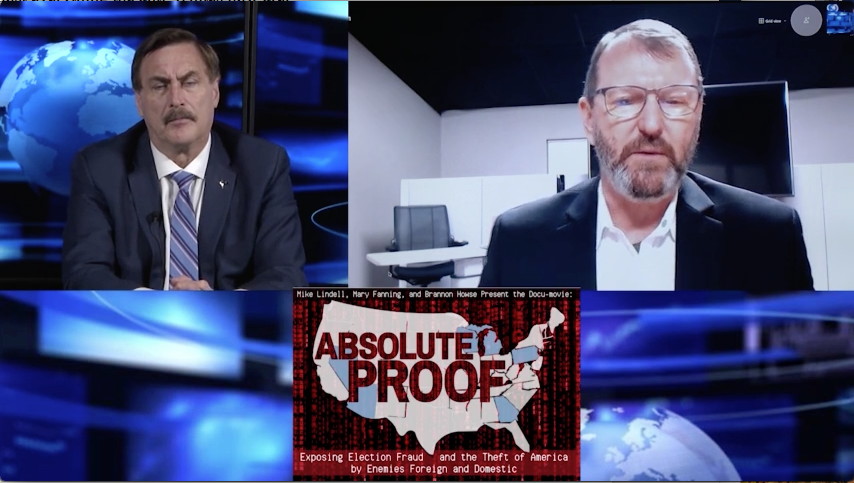
Those with any concerns about the recent election, or the future of the U.S. electoral system, and even the constitutional order, should watch Absolute Proof, a video about computer election fraud that’s hosted, and probably financed, by Mike Lindell. Its source is the World View Weekend (WVW) Network, with which I wasn’t previously familiar. It was posted on Rumble on February 5, and by the time I saw it a few days later already had three million views. It seemed like a keeper so I downloaded it using the “Rumble video downloader” website.

Until seeing this video I tended to dismiss the computer aspects of the voter fraud allegations as something of a distraction. After all, it sounded quite fantastic and therefore required a great deal of substantiation for credibility, which seemed to be missing, unlike the evidence for manual forms of skullduggery — such as Trump voters showing up to vote in person and learning that their ballot had already been cast by mail for Biden, double- and triple-counting of Biden ballots, votes by non-citizens, intimidation of observers, voters and election officials, hundreds of thousands of ballots being counted without Republican observation, etc. All this was as plain as day, and indicated levels of fraud on a scale more than sufficient to change the outcome in the five states that flipped from red to blue — Wisconsin, Michigan, Pennsylvania, Georgia and Arizona. Sidney Powell was the main promoter of the computer fraud claims and repeatedly stated that she would soon “unleash the Kraken,” (i.e., the evidence) but never delivered (as of yet) on her promise/threat.

It appears that in this video Mike Lindell, the “My Pillow” CEO who’s worth ~$300 million, has released the Kraken. It’s two hours long so it requires some commitment. It gets better the deeper you get into it and the last 23 minutes deliver the goods in such detail that it seems almost too conveniently complete and convincing to be real. If it’s as credible as it seems, then “China Joe” Biden really is the literal Manchurian candidate.

Lindell is a bit too unpolished and emotional for this sort of thing, and his efforts clearly have some religious motivation, but his amateurish manner is sincere and authentic, as in his commercials for his products. He has made his fortune through marketing (not inventing) so he must have some talent for it, and especially in connecting with a less sophisticated audience. Also, his products are made in the USA, which he stresses in almost all his ads, making him one of the few marketeers not beholden to China. His business has suffered from the cancel culture, with many retailers dropping his product line because of his efforts to expose the election fraud, which reveals how thoroughly in control of almost everything the anti-Whites now are.

Lindell’s guests provide the sophistication and credibility, but he flies solo in the first twelve-minute segment where he reviews the well-known evidence of non-computer election fraud.

Lindell and Col. Waldron

His first guest is retired army Col. Phil Waldron, an expert on “information warfare” who was called by Rudy Giuliani to provide expert testimony on the Dominion voting machines and Smartmatic software before state legislatures. In a powerful segment (12:37-23:45) he describes Chinese control of Dominion and how the machines were used to cause a 26% shift in the Georgia vote, taking 13% of the vote away from Trump and giving it to Biden. He summarizes the election as “definitely a coup that was aided and abetted by a foreign threat nation state, China” with assistance from within the U.S. government. Since Waldron testified before legislative hearings on election fraud, his information is not new to those who watched the hearings, but since they were watched by so few, what he provides is effectively new even to the great majority of those who have otherwise been following the matter closely.

The second guest, Texas cybersecurity analyst Russ Ramsland (23:55-48:50), gives an overview of the security problems with the Dominion and similar voting machines, his firm’s efforts before the election to raise security concerns with the authorities, and their post-election forensic audit of the results in Antrim county in Michigan (where it has been shown that 5000 votes were switched from Trump to Biden and indicating that this could have happened elsewhere), as well as other counties where the fraud was even worse, but they have not yet revealed their findings. He makes the important point that the proportion of ballots that went to adjudication in Fulton and other prime suspect counties increased from the normal rate of less than 1% to over 60%, meaning the adjudicators were deciding the election, as in Stalin’s maxim that “It’s not who votes that counts, but who counts the votes.” Ramsland reveals there was also significant computer vote-scamming in Texas, but not enough to flip the state because the scammers’ concerns about the heightened level of scrutiny there deterred them from pushing their activities too far from fear of discovery. He also stresses that there was a complete lack of interest and investigation by the responsible authorities, from Attorney General William Barr to multiple agencies and judges, with no serious look at the evidence but only a general dismissal of the charges as supposedly already debunked.

Lindell’s third guest (48:50-1:01:57) is Dr. Shiva Ayyaduri, a smooth-talking Indian immigrant scientist and engineer who sounds more like a self-promoting salesman turned Massachusetts Republican politician. He claims to be the inventor of email, but this is true only in a highly qualified sense. He recounts his experience as a supposed victim of computer election fraud in his own GOP primary in September, with the apparent participation or connivance of the power structure, seemingly as a trial run for what happened nationwide in the general election. I see this segment as something of a distraction from the central narrative, with no connection to it unless we surmise that the Republican establishment is itself in on, and a participant in, the computer election fraud, as part of the establishment in general. In terms of the “uniparty” theory this could be considered plausible, but it seems a bit of a reach that they would risk exposing what could be called their “nuclear option” on such an insignificant election rather than carefully reserving it for the main event a few weeks later.

The fourth guest (1:01:59-1:04:51), former Michigan state senator and gubernatorial candidate Patrick Colbeck, was a Wayne county (Detroit) poll challenger who offers eyewitness evidence that the Dominion voting machines were connected to the internet, and therefore part of a network, despite official assertions to the contrary.

The fifth guest (1:04:52-1:08:07), Melissa Carone, who like first guest Col. Waldron has also previously given her testimony in legislative hearings, was hired by Dominion Voting Systems in Detroit to assist with I.T. (Information Technology) work for two days during the election. This guest is unique in this video in that she was a witness to blatant large-scale manual election fraud rather than computer fraud. Her job involved walking up and down the rows of tabulating machines where she was close enough to see thousands of ballots that were all — without exception — for Biden, never seeing a single one marked for Trump. She also witnessed many packs of these Biden ballots being run through the tabulation machines, and therefore counted, multiple times. When she informed her supervisor, a part-owner of Dominion, that there was a problem, he simply said they didn’t want any problems. She has since been threatened by Dominion with a suit for defamation and widely mocked by SNL and other MSM programming, with the clear message that if you dispute the integrity of the election you are a legitimate object for ridicule.

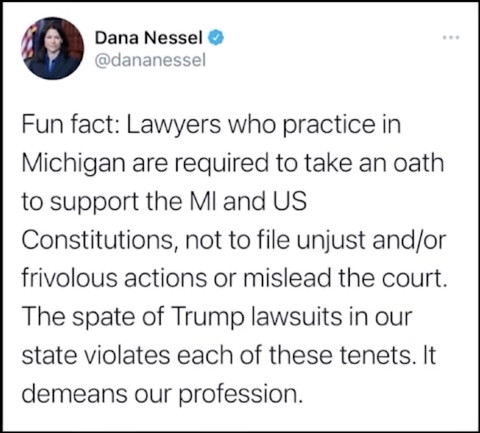
It gets better (or rather worse for the fraud-allegation-is-only-for-nutcases group). Lindell’s sixth guest (1:08:20-1:36:02) is Matt DePerno, a Michigan lawyer who got involved with the anomaly in Antrim county, a small northern county which consistently votes about 65% Republican and 35% Democrat but in this election voted exactly the reverse. This result was so anomalous, such a huge deviation from the norm, that it was obvious there was a problem and it was challenged. In a hand recount it was discovered that of 17,320 total actual votes the Dominion voting machines had changed 7,060 votes from Trump to Biden and also totally eliminated 3,200 votes. A forensic study (presumably the audit done by the firm of the second guest, Russ Ramsland) found that files with voting information were deleted from the Dominion system the day after the election. If 7,060 votes had been flipped in a large county it probably wouldn’t have attracted scrutiny. There is a great deal of additional worthwhile information provided by DePerno in this segment, including pages from the Dominion manual with instructions how to connect the machines to the internet and a video of Eric Coomer, Dominion’s director of product security, discussing their internet connectivity that supports all networks, even in Mongolia. Most chilling is the warning sent by Dana Nessel, Michigan’s Jewish lesbian SJW attorney general, to Michigan lawyers that their oath to support the U.S. and Michigan constitutions means they should “not file unjust and/or frivolous actions or mislead the court. The spate of Trump lawsuits in our state violates each of these tenets.”

Michigan attorney general Nessel’s threat

Per DePerno, Nessel has publicly stated this means “she’s calling for attorneys in Michigan to be disbarred who file lawsuits in Michigan challenging the election.” Furthermore, in a November 20 interview with The Washington Post, Nessel threatened to investigate and criminally charge Michigan state legislators who challenged the legitimacy of the election results, see here, here, here, and here. With this hanging over their heads there is little reason to wonder at the legislators’ unwillingness to acknowledge or consider the evidence, and why poor Giuliani found himself in the hearings butting his head against a wall.

The seventh segment (1:36:06-1:49:44) is, says Lindell, the moment we’ve all been waiting for, where he delivers the goods and releases the Kraken, and he doesn’t disappoint us. The star guest of this segment is “national intelligence researcher and author” Mary Fanning, who is listed as the executive producer of the video and is associated with The American Report and Worldview Weekend Broadcasting Network, see here, here, and here. Fanning is the only guest we do not see but only hear, suggesting she has reasons to avoid facial identification.

Lindell listening to Mary Fanning

Fanning provides exhaustive detail of foreign interference in the election by computer hacking, with over 66% of the intrusions originating in China. Per her account, this hacking alone took 4.8 million votes from Trump and added 13.3 million votes for Biden (i.e., not counting the voter fraud by old-fashioned skullduggery that was so blatant in the Black inner city precincts in Milwaukee, Detroit, Philadelphia and Atlanta), with the true popular vote total being 79 million for Trump instead of 74.2 million, and 68 million for Biden instead of 81.3 million. This would be a total of 147 million popular votes for the two major candidates instead of 155.5 million. This difference indicates 8.5 million votes weren’t switched but simply created, which would help explain why the vote totals are so huge, although even 147 million still exceeded all expectations, being far beyond the 129 million of 2016.

Where does Fanning’s data come from? Supposedly, cyber-security experts, who work for the U.S. government (?!?!), proactively “put all this in place before the election to make sure they caught all this information to make sure foreign adversaries were not deciding our election” and began collecting petabytes (quadrillions of bytes) of information in real time on November 1 in 2,995 U.S. counties. The detailed data, all listed neatly in columns on a chart consisting of “thousands of pages,” is overwhelming, including a time log of every transmission, the IP (Internet Protocol) address, unique computer ID code and geographic location (e.g., county and state) of every transmitting (source) computer and receiving (target) computer, the method of the intrusion (e.g., false credentials, breaking the firewall, etc.), whether or not the intrusion succeeded, and the votes changed, which are all “Trump down” by various amounts, meaning the number of votes subtracted from Trump and added to Biden.

 An excerpt from Fanning’s chart showing all 12 columns. Could these be the numbers that launch a thousand Krakens and topple the topless towers of Illegitium?

Close-up of the first 7 columns of Fanning’s chart for improved legibility

After this chart we see the display on the experts’ real time surveillance system showing the internet transmission lines, the time stamp on every transmission, and the actual files being sent and received as they travel along the transmission lines, with the most severe cyber attacks coming out of China.

Figure 6: Two views of the surveillance system display

It certainly seems that an undertaking on this scale, and the kind and quantity of data it has collected, could only have been possible for someone with a very high level of access and resources, suggesting government actors. Were they rogue actors, or were their actions sanctioned by the Trump administration? Did they fail? If their data is correct, then clearly in spite of their efforts foreign adversaries did have a decisive effect on our election, contributing far more to the total level of fraud than all the manual skullduggery combined. But perhaps their purpose was not to prevent the cyber-fraud but to document it, and Mike Lindell is the only one willing to promote their findings.

One thing strange about this is that even the old-fashioned skullduggery, such as double and triple counted votes, illegal and fraudulent votes, and hundreds of thousands of ballots counted without GOP observation, seemed to be sufficient in itself to move Michigan, Pennsylvania, Georgia and perhaps a few others into Biden’s column by margins in the tens of thousands. Was Trump’s lead so great that it couldn’t be credibly overcome by the hacking and they needed the manual skullduggery to supplement the hacking campaign? Did they need the hacking in seemingly most of the other states as well not for electoral vote purposes but to prevent Trump from actually winning the popular vote, apparently by numbers way beyond their expectations, which would have discredited the results from their manual skullduggery in the targeted swing states? The clumsiness of the large deviation caused by the Antrim county hack indicates that the campaign was not as carefully planned as it should have been, and seems to be the type of mistake a Chinese nerd hacker with little knowledge of small town America might be expected to make.

The guest in the eighth segment (1:49:50-1:53:50) is 83-year old retired Lt. Gen. Thomas McInerney (USAF) who gives his imprimatur to the video and states we “are now seeing the largest domestic enemy in our history” in addition to the most massive foreign cyber-warfare attack in world history.

The ninth and final, and shortest, segment features Terry Turchie, former assistant deputy director of the counter-terrorism division of the FBI, who addresses the failure of the FBI to investigate the election coup. In short, they were, and are, “compromised,” which suggests they are not free actors.

In closing, Lindell expresses his belief and hope that if seen by enough people this video will overcome the divisions in our country and unite us in a great revival of patriotism. He seems to think that proof of China’s reversal of our election will unify the entire country against this common enemy, with even the Left having an epiphany that transforms them into loyal America Firsters. Actually, of course, a Leftist seeing this video would more likely cheer China as an ally that came to their rescue and saved the day. Lindell’s belief reveals not just incredible naivete, but more dishearteningly, an amazing level of ignorance and dysfunctional sense of situational awareness. He doesn’t understand that everything now happening is ultimately about race, centered on race and driven by racial group interests. He totally misses the role of race and racial interests in the power struggle that underlies the increasing intolerance, division and polarization in the country, all part of the process of racial transformation as the founding White population loses power to, and is increasingly replaced by, the diverse non-Whites who are unified against them in this purpose. All the old verities and norms created and sustained by Whites do not matter to them, except as reminders of a history and people they see as hateful and an obstacle to their goals.

Nor should we want it otherwise. We should not want the unity Lindell wants and believes he is helping to realize. We should want increasing division and polarization, to sever our unnatural and racially destructive union with non-Whites and divorce ourselves from them with complete territorial and political separation. And despite what Lindell believes, this is actually what this video will do. It is an awakener, a red-pill, attesting to the fact that the racial status quo is unsustainable, and terminal for the White population and its country.

The standard, expected and seemingly scripted establishment (i.e., Anti-White Coalition) response to this video can be seen here.

Neither Fox nor Newmax or any other platform of significant reach have addressed this video or the possibility of massive foreign election rigging by computer hacking, nor are they likely to. Since the events of January 6 Fox has clamped down hard on all aspects of the electoral fraud story. Even back in November they didn’t air a Janine Pirro (Judge Janine) episode because of its coverage of election fraud. Maria Bartiromo covered the story heavily into late December then stopped. Fox news anchor emeritus Britt Hume put in an appearance to denounce the fraud allegations as clearly false and totally without substance. Lou Dobbs, who probably couldn’t be controlled if he was allowed to speak, was simply taken off the air, although not fired, and so is still under contract with Fox where they can control him and keep him from appearing on any other outlet.

Clearly we live in conspiratorial times, where there seem to be more conspiracies afoot then we can keep track of, but all of them are part of the much larger central conspiracy, which is all against our race.

Which brings us to the matter of the ignored elephant in the room. Where were the Jews in all this? Of course they were at the center of it all. But there is no mention of them and their role in this video. Nor is there much mention of the other usual suspects and bad actors in general. The focus is on the Chinese role, which is proper considering its scale and the fact no one else has mentioned it, not even Trump when he alluded to true election results very similar to those alleged in this video. Obviously, it is greatly in China’s interest to replace Trump with Biden and return to the relationship they had with the U.S. before 2017, when they enjoyed great influence over those in America’s “core circle of power,” as Chinese academic Di Dongsheng, Vice Director and Secretary of the Center for Foreign Strategic Studies of China, explained to a Shanghai audience on November 28 , with the video of his address going viral in early December and discussed on several Fox Network shows.

Figure 7: Di Dongsheng during his address, and Tucker Carlson discussing it with China expert Gordon Chang

But the Chinese couldn’t get away with something on this scale unless the Jews were on board with them, protecting their back and providing cover from the media, academia, politicians, Wall Street, etc. as only they can. Nothing like this can succeed unless the Jews are part of it, or at least agree to cover for it, and for that it has to further Jewish interests and be “good for the Jews.”

Let’s hope this video flies far and wide. As previously noted, it already had three million views when I watched it. If Lindell is willing to make the commitment, it could go a good distance. Its story that our domestic racial enemies have now formed something of an alliance of common interests with our most powerful foreign adversary, if essentially correct, is certainly a very important one, and would greatly discredit the establishment and red-pill a lot of normies, which can only help us. Also, it should inform us that although our primary enemies are unfortunately already within the gate and the odds of us overcoming them often seem overwhelming, the enemy outside the gate also commands our attention, and our deliberations should consider how to resolve our domestic racial problem in such a way that we will still emerge strong enough to confront foreign foes on favorable terms.


The Pale Male Paradox: How White Men Achieve Most And Are Vilified Worst

It’s one of the most interesting, enlightening and eye-opening books I’ve ever read: Simon Winchester’s Exactly: How Precision Engineers Created the Modern World (2018). Winchester tells a story of astonishing ingenuity, intelligence and effort from the steam-engine (44) to the “extreme ultraviolet” laser (296). And it’s almost exclusively a story of stale pale males—of White men from northwestern Europe. They’re the ones who have created the modern world, whether living on ancestral soil, like the English ironmaster John Wilkinson (1728–1808) and the Swedish machinist Carl Edvard Johansson (1864–1943), or transplanted to the United States, like the manufacturer Henry Ford (1863–1947) and the space scientist Roger Easton (1921–2014).

Pale precision: the front cover of Simon Winchester’s Exactly (2018)

 Logocentric lawyers vs exotropic engineers

If only one of those names is familiar to you, then you’re not alone. Before I began this book, I had heard of James Watt, John Harrison, Henry Ford, Sir Frank Whittle and “Rolls-Royce.” And that was pretty much it. Although precision engineering has shaped the lives of every human being on the planet (with the rare exception of stone-age tribes like the Andamese Islanders), precision engineers have not usually become household names. That’s partly because engineers in general aren’t interested in becoming household names. Instead, they’re interested in engineering, in solving technical problems, in overcoming the challenges posed by gravity or heat or cold or drag or pressure or vibration or chemical attack or any combination thereof.

The joys of Jewish ideology: a satirical diet-ad about the famines caused by communism

But the anonymity of engineers is also partly due to what you might call the logocentric snobbery of Western culture. As Ron Unz has pointed out, the typical training for a Western leader is that of lawyer, while the typical training for a Chinese leader is that of engineer. This may give China a decisive advantage over the West in the century ahead. Or rather, it may give China another decisive advantage, because China’s racial majority, the Han Chinese, is not under ideological and demographic assault by a hostile elite of Jews and by non-Chinese immigrants eagerly applying the Jewish culture of critique. There would be plenty of material in China for a hostile elite to work with — the brutal subjugation of the Tibetans and Uighurs, for example — but the Chinese don’t intend to surrender control of their homeland to anti-Chinese outsiders. They’ve suffered the calamities of Jewish ideology all the same. Marxism has afflicted them with famines, concentration camps and a high-tech surveillance state, but they remain unrepentant in their ethnocentrism and probably unstoppable in their eugenics.

“The west was built on racism”

Things are very different in the West. Shortly after completing my latest re-read of Simon Winchester’s book, I came across two articles in the Guardian celebrating the work of Kehinde Andrews, the “first UK professor of Black studies.” Professor Andrews claims that he’s “probably done permanent damage to [his] mental and physical health establishing this Black studies course [at Birmingham City University].” But fear not: the sacrifice of his Black body and Black brain has not been in vain. Professor Andrews has spoken harsh truth to hegemonic power and established that “the west” (no capital letter, naturally) “was built on racism” — “that the US was created ‘in the founding fathers’ image of white supremacy’ and Britain’s wealth accumulated through centuries of African enslavement.”

Speaking harsh truth to hegemonic power: Black Studies Professor Kehinde Andrews (who is part-White)

Well, you can be sure that there are no anti-Chinese or anti-Jewish equivalents of Kehinde Andrews in Chinese or Israeli universities. And you can also be sure that Professor Andrews is even more ignorant about engineering than I am. Yes, Britain did indeed accumulate some wealth “through centuries of African enslavement.” But so did the Muslim world and African slave-kingdoms. And slavery was neither necessary nor sufficient for the rise of Britain as an industrial and technological giant. Black slaves effectively played the role of horses and oxen: their muscles powered mechanisms and economic systems created by White ingenuity and foresight, but Blacks had no intellectual or creative role in what they powered.

White men aren’t obsessed with themselves

And “racism” does not explain why White men were necessary (and would have been entirely sufficient) for the creation of precision engineering. But evolution and genetics do, as Kevin MacDonald has described in books like Individualism and the Western Liberal Tradition: Evolutionary Origins, History, and Prospects for the Future. Nevertheless, Kehinde Andrews exposes one half of what I call the pale male paradox. White men have achieved most in all manner of fields, from engineering and mathematics to exploration and mountaineering. But they are also the most vilified group on earth and are held responsible for all manner of evils, from slavery and pollution to systemic racism and police brutality. Why does the highest-achieving group also receive the greatest opprobrium? That seems like a paradox, but I’d suggest it’s easy to resolve. The same factors behind the achievements of White men also explain the vilification of White men.

High amongst those factors is the fact that White men aren’t obsessed with themselves and their own interests. Simon Winchester himself is a good example. I could detect no trace of racial or national pride in Exactly. He didn’t write the book as a White man to celebrate the greatness of White men: he wrote it because he delights in engineering and ingenuity. More generally, you could say that he delights in external reality and humanity’s efforts to understand and control it — he’s written books about everything from maps and skulls to earthquakes and the Pacific Ocean. But he isn’t an autistic technophile and although he describes the astonishing achievements of Henry Ford in Exactly, he also begins the book with a series of quotations from the technocritic Lewis Mumford (1895–1990), including the line: “Forget the damned motor car and build cities for lovers and friends.”

Not interested in truth or reality

And he ends the book celebrating both the precise technology and the imprecise artistry of another group of pale human beings: the Japanese. He describes how, in Japan, meticulous electronic engineers co-exist with craftsmen devoted to “wabi-sabi, an aesthetic sensibility wherein asymmetry and roughness and impermanence are accorded every bit as much weight as the exact, the immaculate, and the precise.” (p. 314) In other words, Winchester is objective and able to understand opposing ideas and points of view, quite unlike the rabidly ego- and negro-centric Kehinde Andrews. And Winchester is highly intelligent and scientifically knowledgeable, again unlike Kehinde Andrews.

Winchester and Andrews are therefore excellent representatives of their respective races: over-achieving, gift-bestowing Whites and under-achieving, grievance-bearing Blacks. Furthermore, Winchester trained as a geologist and has worked with advanced engineering. He’s a writer who’s rooted in reality. Kehinde Andrews isn’t rooted in reality, which you might suppose a fatal disadvantage for a historian and cultural commentator. But Andrews’ career flourishes regardless, because the culture of critique is not interested in truth or reality. Instead, it is interested in political and social power. It’s effectively an ideological parasite that has, so far, done an excellent job of subverting the nervous system of the West and taking control of its economic, technological and cultural muscles. That’s why the Black drug-abuser and criminal George Floyd is vastly better known than, for example, the White engineer Henry Maudslay (1771–1831).

Screw you, BLM!

Again, I hadn’t heard of Maudslay and his “formidable skill in delicate engineering” (p. 54) before I read Exactly. Unlike George Floyd, Maudslay exerted himself to defeat crime, not to commit it. He helped perfect the effectively unbeatable locks of his mentor Joseph Bramah (1748–1814). He then went on, in Simon Winchester’s words, “to become the founding father of precision toolmaking, mass production, and the key engineering concept of perfect flatness.” (p. 62) Among much else, he invented a lathe that could “efficiently, precisely and [quickly]” make something that contributed far more to Britain’s wealth than “centuries of African enslavement.”

The humble but hyper-important screw

What was the something? It was “that most essential component of the industrialized world, the screw.” (p. 63) Henry Maudslay, unlike George Floyd, helped hold Western civilization together — and literally so. In a sane world, his story would embolden Whites to say “Screw you!” to inane and self-righteous anti-White groups like Black Lives Matter. But we don’t currently live in a sane world. Maudslay was an undoubted achiever, Floyd was an alleged victim. And the culture of critique “valorizes” Black victims while anathematizing White achievers. That’s why most of us heard endlessly about Floyd in 2020 and not at all about Maudslay.

Horrific hate-crimes against the Jewish community

Nor did we hear about a Swedish engineer who contributed immensely to perhaps the most important part of precision: measurement. But Winchester points out that the Swedish engineer has been unjustly forgotten for a long time: “Carl Edvard Johansson died in 1943, respected and beloved in Sweden, and forgotten elsewhere.” Johansson (1864–1943) invented measuring instruments known as gauge blocks or Jo blocks, which come in varying sizes and can be fitted together to measure, for example, “any of the 1000 lengths from 3.000 to 3.999 mm in 0.001 mm steps.” Winchester writes that Jo blocks are “machined with such precision that there [are] no asperities whatsoever on their surfaces that might allow air to get between and form a point of weakness. They [are] so perfectly flat that the molecules of their faces [bond] with one another when they [are] joined [and it becomes] impossible to break them apart. … They can only be slid apart.” (p. 3)

Winchester adds that scientists still don’t fully understand the physical mechanism behind the bonding of Jo blocks. In a sense, White ingenuity is still defeating White ingenuity: Johansson’s measuring blocks created a mystery. But another mystery was vigorously probed by the man who employed Johansson after he moved to America. That man, Henry Ford, is perhaps the most interesting and important figure in Exactly. Winchester cleverly contrasts Ford’s success in mass-manufacturing and popularizing the motor car with the elitist engineering and marketing of the Rolls-Royce partnership in England. But he doesn’t say anything about one horrific aspect of Ford’s story: his prolonged hate-crimes against the Jewish community.

Cohesive, in-bred and hyper-ethnocentric

As Kevin MacDonald has described in “Henry Ford and the Jewish Question,” Ford devoted substantial time and money to the mystery of how the tiny Jewish minority has been so influential in — and pernicious for — the Western world. He backed a newspaper, The Dearborn Independent, that tried to alert gentile Americans to what Ford saw as Jewish conspiracies against the West. And he published an infamous book called The International Jew: The World’s Foremost Problem (1920), which MacDonald describes as “an amalgam of dark speculations on Jewish conspiracy combined with some interesting and, on the whole, accurate information on Jews and perceptions of Jews during the period.”

It’s plain today that Ford succeeded mightily at mechanical engineering and failed miserably at social engineering. His attempts to expose Jewish conspiracy and defeat Jewish power were fruitless, but that’s hardly surprising. Like the other engineers and inventors in Exactly, Ford was a remarkable White male individual, not part of a cohesive, in-bred Jewish community bound by hyper-ethnocentrism and the ruthless pursuit of collective interests. White men are certainly remarkable for their ability to cooperate, but not in pursuit of their own ethnic and genetic interests. Instead, they direct themselves outwards, creating ingenious and awesome machines, scaling the earth’s heights, plumbing the ocean’s depths, and landing in person or by proxy on the Moon, Mars and Venus.

All Blacks Who Ever Lived

If the minds of White men weren’t directed outwards like that, they wouldn’t be so vulnerable to parasitic ideologies like the culture of critique and Critical Race Theory. But White men also wouldn’t have achieved astonishing things like those described in Simon Winchester’s book. So is it ironic that Kehinde Andrews and countless other anti-White ideologues go through life relying absolutely on White male invention and ingenuity without acknowledging the debt they owe, let alone expressing any gratitude? No, I don’t think it is. I think it’s entirely predictable. One could hardly expect Kehinde Andrews to admit that merely one tiny White group like the Swedes have contributed more to science and technology than all Blacks who ever lived.

Indeed, the single Swedish male Carl Edvard Johansson contributed more to science and technology than all Blacks who ever lived. As did each of the other stale pale males described in Simon Winchester’s Exactly: How Precision Engineers Created the Modern World. Winchester didn’t write this book to refute the culture of critique and the inanities of “anti-racism,” but I think it provides a highly effective refutation all the same. It wasn’t written as a celebration of White male achievement and in fact I didn’t impose that interpretation on it as I read. After all, I’m a White male myself and like Winchester I can rejoice in engineering and ingenuity for their own sake.

“A work of staggering genius”

And Winchester also speculates whether the Industrial Revolution could have happened more than two thousand years ago. He begins the first chapter of this book writing about the Antikythera mechanism, a “lump of calcified bronze and wood” (p. 24) recovered from a shipwreck in the Mediterranean in 1901. It turned out to be “a mysterious computing device of unimagined mechanical complexity … that had evidently been made in the second century B.C. and was clearly a work of staggering genius.” (p. 25) It was White genius, but not in northwestern Europe: rather, the mechanism was made by another incredibly talented European group, the ancient Greeks. And why did their genius not bear greater fruit? At the moment we can only speculate, but cliodynamics and historical genetics may soon be able to tell us why Exactly was published in 2018 and in English, rather than two millennia ago in Greek or Latin.

A work of staggering genius: the 2100-year-old Antikythera mechanism, an ancient Greek analogue computer and orrery used to predict astronomical positions and eclipses for calendar and astrological purposes (modern reconstruction)

If the Industrial Revolution had indeed started in the Ancient World, White men might have reached the stars by now. It didn’t and it’s the Chinese who seem best-placed to carry on the legacy of the White engineers described in Winchester’s book. Unless White men start devoting some of their genius to the problem of self-defence, they won’t have a future. Or even perhaps a past. The culture of critique is already proclaiming that Black women “played a crucial part” in the Moon Landings and the creation of GPS, the global positioning system whose genuine White male creators are described in Winchester’s book.

Proud Black wimminz in, hate-filled honkies out

As Black women are written into the history of STEM (Science, Technology, Engineering and Mathematics), White men will be written out. Our hostile elite aren’t really following the script of Orwell’s Nineteen Eighty-Four (1949), but they might as well be: “In his own schooldays, Winston remembered, in the late fifties, it was only the helicopter that the Party claimed to have invented; a dozen years later, when Julia was at school, it was already claiming the aeroplane; one generation more, and it would be claiming the steam engine.”

The steam engine, the aeroplane and the helicopter are all products of White male genius. The parasitic Party had already claimed two of them for its own in Orwell’s novel. In our reality, the parasitic culture of critique is beginning to assign the products of White male genius to Black women. That’s false history, but lies power leftism and it’s precisely because White men have flown so high that the culture of critique intends to bring them so low. Simon Winchester’s Exactly: How Precision Engineers Created the Modern World describes the heights of White male achievement and serves as an excellent, if implicit, refutation of the anti-White ideologies now infesting and undermining the West.

Three Heroic White Films

I’ve put aside two hard-hitting essays regarding the ongoing assault on Whites in the United States because I suspect readers need a break from the relentless negative news we’ve all been exposed to. I confess I’m more than guilty of pointing out how rapidly the situation of Whites has become exceedingly bleak, I suffer from that situation in real life, and like readers, I need a break, too. So perhaps the current relative lull in The System’s assault on us will allow readers a chance to watch one, two or all three of the uplifting Hollywood films I’m going to recommend.

Thus, in this essay I will celebrate these three implicitly pro-White films that since 2016 have somehow survived the gauntlet of our modern commissars to emerge as honest, realistic stories of White men doing heroic deeds. No Numinous Negroes, no Wakanda, no “Jews to the Rescue.” Just White men like we really have been since time immemorial, placed now in modern technological settings that we White men have ourselves created. The three films are Deepwater Horizon, Sully (both 2016) and Only the Brave (2017).

*   *   *

Deepwater Horizon

Deepwater Horizon (2016) trailer

The disaster film Deepwater Horizon stars three A-List actors: Mark Wahlberg, Kurt Russell and John Malkovich. It tells the true story of a huge oil rig in the Gulf of Mexico that suffered a series of fatal explosions, resulting in a massive oil spill that made world headlines for weeks. Deepwater deals with hard men who work with their hands. They are the kind of men who keep America humming, putting gas in the tanks of the cars and trucks we drive, providing the backbone to the globe-girdling U.S. military, and keep toasty warm the homes of Americans in subzero locales such as Minnesota, Wisconsin and Michigan.

Mark Wahlberg plays the lead with grit and seriousness. He has a man’s job to do — and he does it.

Ditto for “Mr. Jimmy,” the rig manager played by an aging Kurt Russell. No cute jokes for either man or knowing winks at the audience. Instead, they are gruff, no-nonsense employees in the high-stakes world of oil drilling, where mammoth machines can chew up a man in an instant and hellish infernos can erupt from liquid gold far under the ocean. Deepwater Horizon captures these dangers in spades and blasts them out at you without mercy.

Kurt Russel as Mr. Jimmy

Not only is there non-stop suspense and action in this flick, there is also a depiction of the unyielding business pressures to get the job done no matter the cost or risks. Here we are treated to masterful dialog by the trio of engineer Wahlberg, rig manager Mr. Jimmy, and John Malkovich as Donald Vidrine, a senior British Petroleum supervisor.

I know little about the South, but it sounds as if Malkovich is using a Louisiana Creole accent, which I found fascinating. As Mr. Vidrine, he cloaks his no-nonsense demands in folksy sayings and metaphors, which Wahlberg and Russell take in stride. I’ve already listened to this dialog half a dozen times but could stand to listen to it a dozen more times. Experience the best part here.

John Malkovic as Mr. Vidrine

Once you’ve enjoyed the theater skills of the voices and dialog, watch it all again for the attempt to give an inside view into the workings of one of the biggest corporations on earth. I don’t think any knowledgeable film buff could watch this scene without thinking of Ned Beatty’s amazing soliloquy about the world of money in the 1976 classic Network. Both speeches are pure magic.

The business considerations as cause of the disaster out of the way, we next enter into the fires, explosions, deaths & injuries, and heroics of the men on the doomed oil rig. Truly it is a glimpse of hell.

Some crewmen survive, some die, some are gravely injured. One man selflessly sacrifices his life to save fellow crewmen, the vast majority of whom are White — and male. An exception comes in the form of a subcontractor position played by Gina Rodriguez, a Puerto Rican American actress. She has one line where she clearly makes a better decision than her male boss, but when the fires rage hot, she breaks into an uncontrolled panic and is saved by a daring and level-headed White male (Wahlberg’s character).

As we will see later with Only the Brave, Deepwater honors the eleven men who lost their lives by showing their photos at the end of the film. The postscript reads: “The blowout lasted for 87 days, spilling an estimated 210 million gallons of oil into the Gulf of Mexico. It was the worst oil disaster in U.S. history.” The men lost in that disaster were not “deplorables,” “insurrectionists,” “right-wing terrorists” or “White supremacists.” They were White men like our fathers, brothers, classmates and neighbors. They equal the Real America. It is proper that they are honored in this film.

*  *  *

Sully


Sully (2016 – watch trailer)

The second film of my trio is the Clint Eastwood-directed Sully, the true story of Captain Chesley “Sully” Sullenberger, who glided a crippled airliner away from the towers of New York City and safely landed on the frigid waters of the Hudson River. What is so wonderful about the film is the fact that it is so true to real life, something Hollywood is not always known for.

Let me explain with this little experiment. Think about the last time you walked through an American airport, particularly one that is heavily domestic. Who were the pilots in uniform you saw strolling down the corridors pulling their leather flight bags?

A Nice White Flight Crew  —  Airport (1970)

Admit it — you saw White males in uniform. That would make sense, since unlike most other professions today, piloting airplanes in America has remained in the vicinity of 95% White and male. This must gall liberals and social engineers, for these groups dream of a world of “equality,” that is, one in which White males are purged, punished, eliminated, or at least relegated to humiliating positions of impotence.

Sully came out in 2016 in the face of endless promotion of non-white diversity and “vibrancy,” going against all that Hillary Clinton and her vast entourage represented, and supported the reality that it is White males who built the public manifestations of Western civilization and to a large degree still keep it going.

Oh, how delicious it was to watch Tom Hanks as a competent, seasoned pilot, making the best decisions in only seconds.

Next to Hanks sits the first officer, played by Aaron Eckhart, who is tall, square jawed and tough. Dare I say he’s almost Aryan?

Hats off to Eastwood for casting Hanks and Eckhart as the cockpit crew of Sully. Further, most of the supporting cast is White as well. Real life, real celluloid representation. Sometimes, that’s all I can ask of Hollywood, a wish I don’t often have granted.

Actual Pilots “Sully” Sullenberger and Jeffrey B. Skiles

Because of its unvarnished heroism, I’m going to give a somewhat detailed description of the action in Sully. It was frigid in New York on January 15, 2009. “Sully” Sullenberger sat in the left-side seat, while first officer Jeffrey B. Skiles sat to his right. Skiles was slated to fly this leg of the journey, and the plane lifted off uneventfully, turning northwest. As it neared 3,000 feet, the A320 struck a flock of large Canada geese, some of which were ingested into the two engines. The collision resulted in a full loss of power. Coming at such a low altitude over a major city filled with skyscrapers, the situation was critical.

To provide backup power, Sullenberger switched on the tail-mounted APU, a generator which provides auxiliary power. The pilots had only seconds to decide whether to return to LaGuardia, try to reach Teterboro Airport on the New Jersey side of the Hudson River, or find some alternative. Drawing on his vast experience, Sullenberger determined that trying to reach either airport was a poor choice, so he opted to land on the calm winter waters of the Hudson. Passing less than 900 feet over the George Washington Bridge, the plane landed safely in the middle of the Hudson, where all passengers and crew were rescued by nearby boats.

Eckhart, Capt. Sullenberger, Eastwood and Hanks

Enjoy looking at the faces of White men like this while you still can. Unlike so, so many other “reenactment” and “based on” films and documentaries, Eastwood’s Sully panders not at all to liberal pieties, not even in minor roles such as air traffic controller or captain of a ferry boat. We don’t have the cheesy cabin ensemble of multiracial passengers, something ushered in by the likes of Airport 75 and other such dreck from the seventies. Sully is like the cast of The Waltons, imagined as if John-Boy had grown up and become a pilot like Sullenberger. No drinking, no drugs, no wild sex. Just traditional White Americans living their lives and dealing with the challenges life inevitably throws their way.

Surprisingly, despite its debut during the run-up to the Hillary-for-President season, the same press that so blatantly supported Hillary and savaged Trump as “literally the next Hitler” gave Sully overwhelmingly positive reviews. For instance, reviewer Simon Thompson awarded the film nine out of ten points, writing: “Sully is a beautifully balanced, classily nuanced and hugely engaging film that avoids all the clichéd pitfalls it could have slipped into. Tom Hanks gives one of the best performances of his career and Clint Eastwood’s direction is beautiful and rich. It’s not just a great movie, Sully is one of the best pieces of cinema that a major Hollywood studio has released this year.”

A reviewer at ebert.com wrote:

As Capt. Chesley “Sully” Sullenberger, the plain-spoken, cool-headed veteran pilot who pulled off the impossible under immense pressure, Tom Hanks once again reminds us why he continues to be Hollywood’s best personification of the all-American Everyman since James Stewart’s “Mr. Smith Goes to Washington.” Who else is so good at encapsulating such red-white-and-blue values as never-say-die commitment, pride in a job well done, doing your duty no matter the cost and selfless courage in the face of disaster without being a goody-goody bore?

Even the Village Voice said kind things about the film: “This is a talky, mild-mannered drama about stoic, middle-aged white men exhibiting poise amid chaos and illustrating the sanctity of simply doing one’s job.”

If you’d like more background on Sully, see my original 2017 review here.

*   *   *

Only the Brave


Only the Brave (2017) trailer

Only the Brave is another story about the lives of White men who get their hands dirty. Early on, we see a scene where a moderate forest fire is being handled by a hot and sweaty crew. Miraculously, there are no affirmative action minority hires in this scene, no tough Puerto Rican chick, no sensitive black guy. Just garden-variety White men — tough men. And the entire movie remains that way without exception. Even the men’s families are nice White people:

Like Deepwater Horizon and Sully, Only the Brave is based on a true story, the incredibly tragic demise of 19 out of 20 members of an elite firefighting crew called “Hot Shots.” On June 28, 2013, dry lightning ignited a fire near the hamlet of Yarnell, Arizona, just northwest of Phoenix. While the situations in the first two movies discussed above involved sudden accidents that unexpectedly overtook the White heroes, in Only the Brave, these firefighters knew they were always living on the cusp of danger, thus making these men the truest of heroes because they knowingly risked their lives to protect their fellow Americans.

The film is centered around crew chief Eric Marsh, played by a man’s man, Josh Brolin. At every turn, the film succeeds in portraying Marsh as a thoroughly admirable character who is a natural leader of men.

The film includes a number of softer scenes of Marsh with his wife, likely inserted to drawn some women to the film, but it is clear that Marsh’s life is out in the mountains facing fires that aim to kill him. I suppose that conflict with his wife provides some of the tension in the film, but the wife is grossly outclassed by Marsh’s masculinity and intense focus on his job. At one point, for instance, while the couple is sharing a candle-lit bath, the wife asks a taciturn Marsh, “Do ya wanna talk about it? Or do you wanna do your John Wayne thing?” Marsh remains silent.

Of course she already knew the answer. Immediately, the movie cuts back to the male action. How appropriate, though, that the wife referenced John Wayne, for this 2017 film and its characters belong back in the Wayne era when men were men and women were women. Right and wrong are clearly understood, and there is no hint whatsoever that these men’s world will soon be overtaken by foreign immigration, Black Lives Matter degenerates, or feminists running amok on the streets. America is still a White man’s country.

To be sure, these men are not cardboard characters lacking flaws. Indeed, they are human. Second to Marsh is Brendan, a young man who in the beginning of the movie is shown smoking meth, committing petty larceny, and getting one of his throw-away girlfriends pregnant. His struggle to grow into a mature man is a central theme of the movie, along with Marsh’s decision to take Brendan under his wing and keep him from reverting to an aimless drug addict. (Careful listeners will catch a fleeting conversation revealing that Marsh himself had addiction problems, so his decision to mentor Brendan is rooted in that sense of identification.)

Brendan indeed grows, slowly taking responsibility for his girlfriend and baby daughter. Like Marsh, however, his life is largely focused on the wild land, where all plant material is nothing more than “fuel” to a firefighter. None of the men here put their women or their wives above their duty and bonding with their firefighting brothers. Nineteen of them pay for this focus, too.

In short, one day the men are caught by unpredictable winds and overtaken by torch-like flames. Here it is not “toxic masculinity” that is pilloried but the very best traits in real men that are celebrated and duly honored. Death through sacrifice is the highest calling of the Granite Mountain Hot Shots.

Again out of character, Hollywood critics lavished praise on this traditional film, with the critics of Rotten Tomatoes praising in unison with average viewers the merits of the film. “Only the Brave’s impressive veteran cast and affecting fact-based story add up to a no-frills drama that’s just as stolidly powerful as the real-life heroes it honors.” Another wrote that, “Only the Brave is a visually splendid, spellbinding, and surreal movie that also happens to be an emotionally shattering, over-the-top ugly-cry for the ages.”

*   *   *

Viewing these films is easy with Amazon streaming rentals, but for the same price you can buy new DVDs if you still have such archaic equipment lying around. Move fast, however, for our post-insurrection respite will likely not last long. In a thousand ways, The System has announced that characters like all the White men in the films just reviewed are now Enemies of the People. In self defense, will real White American men now show the bravery and determination seen in the noble acts of participants in these movies, as well as the real men they were based on? Time will tell.


A Few Great, Often Forgotten White Moments

Since this is Black History month (how can we forget?), it is important (since there is no White History month) to pay tribute to the humble contributions that White folks have made to our culture and to Western Civilization.

I don’t want to risk bragging by enumerating the obvious and blaring it out like some digital-lit billboard on the Interstate, but there are a whole lot of accomplishments that any White person over the age of (hmm) thirty is faintly familiar with. Such as the Magna Carta, the US Constitution, the wisdom of  ancient Greece, Christian morality, the Enlightenment, the King James Bible, the common law, property rights, religious tolerance, habeas corpus, universal suffrage, equality under the law, the Golden Rule, free-market economics, the abolition of slavery, respect for women. . . okay, you get the picture.

And the names, my gosh, where do I begin? Let us take note of Joan of Arc, Bach, Beethoven, Mozart, Leonardo Da Vinci, the mathematician Hypatia (d. 420AD), Michelangelo, Vermeer, Shakespeare, Florence Nightingale, Goethe, Moliere, Jane Austen, Isaac Newton, Christopher Wren, Charles Darwin, Watson & Crick, Olinto De Pretto, Samuel Johnson, Emmeline Pankhurst. . . the list is virtually endless.

My goal is to entertain as well as enlighten the reader with a few not-as-well known, or so-well-known but taken-for-granted inventions, happenings, and ideas, and a modicum of names of White people who deserve to be listed in the pantheon of The Great Whites. Let us begin.

Arthur Scherbius

Arthur Scherbius was a German electrical engineer who patented an invention for a mechanical cipher machine, later called the EnigmaC:\Users\kmacd\Desktop machine. He was born in Frankfurt, Germany and studied electricity at the Technical College in Munich, and then went on to study at the Technical College in Hanover, finishing in March 1903. The next year, he completed a dissertation titled, “Proposal for the Construction of an Indirect Water Turbine Governor” and was awarded a Doctorate in engineering.

He subsequently worked for a number of electrical firms in Germany and Switzerland. In 1918, he founded the firm of Scherbius & Ritter. He made a number of inventions, for example, asynchronous motors, electric pillows and ceramic heating parts; his research contributions led to his name being associated with the Scherbius principle for asynchrous motors. He applied for a patent in February 1918 for a cipher machine based on rotating wired wheels, what is now known as a rotor machine. (Thomas Jefferson invented a cipher wheel also.) His company also purchased the rights to another patent for a rotor machine from Hugo Koch—patented in 1919.

His firm’s cipher machine, marketed under the name “Enigma,” was initially pitched to the commercial market. There were several commercial models, and one of them was adopted by the German Navy (in a modified version) in 1926. The German Army adopted the same machine (also in a modified version somewhat different from the Navy’s) a few years later.

Just like all the other rotor machines, this apparatus had both electrical and mechanical systems. The mechanical part of the system consisted of rotors which were arranged along its spindle, a keyboard, and a stepping component which turned one of the rotors when a key was pressed and a sequence of lamps for all the letters.

The machine was used to encrypt any plaintext message and for every letter typed by the operator the lamp showed a different letter as per the pseudo-random substitution. The letters displayed by the lights were recorded as the enciphered substitute. When the key is pressed, it moves one of the rotors, so that the next key uses a different electric pathway, therefore, producing a different substitute alphabet for all the letters. The cyphertext is then transmitted to another operator who deciphers the message. As long as the settings of the deciphering equipment resembled that of the enciphering machine, the message could be deciphered.

Scherbius’ Enigma provided the German Army with the strongest cryptographic cipher in the world at the time, until the code was broken by Polish mathematicians in the 1930s, as discussed in the following section.

Marian Rejewski, Henryk Zygalski and Jerzy Rozycki

While Alan Turing gets all the credit for breaking the code of the Enigma machine, probably due to his cult-like celebration for being a brilliant homosexual and due to the hit movie The Imitation Game, it was actually three Poles who cracked the code. Their story is virtually non-existent to the public.

The earlier Enigma machines were adopted by the government and military services of numerous nations like Germany who used it to send and receive messages before and during the Second World War. The British and their allies understood the problem posed by this equipment in 1931 when a German spy known as Hans Thilo allowed his French spymaster to take a photograph of a stolen operating manual for the Enigma machine. The manual included all the keys and plugboard settings which the Germans used in September and October 1932.

The British and their allies could not decipher the message; therefore, they handed them over to a Polish mathematician named Marian Rejewski. Rejewski together with Henryk Zygalski and Jerzy Rozycki managed to build an Enigma double. They developed numerous techniques for defeating the plugboard and get all the components of the keys, thus making it possible for them to read all the German enciphered messages from 1933 to 1939. With the 1939 German invasion imminent, the Polish government decided to share their secrets with the British.

Less than six weeks before World War II began, on September 3, 1939, Lieutenant Gwido Langer, head of the Polish Central Staff’s cipher bureau invited British and French intelligence chiefs to a meeting at his secret cryptology centre at Pyry in the Kabaty woods near Warsaw.

There he revealed to them that his team, Rejewski, Zygalski, and Rozycki, had cracked the Enigma code seven years before and had been reading German messages ever since. This was five years before Alan Turing had even started studying cryptology – he was still working on a degree in mathematical logic at Princeton University in the United States.

The GC&CS (Government Code and Cipher School) in Buckinghamshire became the Allies’ center for dealing with the war-induced changes in the enciphered messages.

Since the Germans were convinced that their technology could not be deciphered, they continued using the machine for different types of communications with their secret services, in the sky, and on the battlefield. The decoded messages were given to a few commanders who used it cautiously making sure that the Germans did not find out that their cipher was broken.

Alan Turing, gay icon, will be the face on Britain’s next £50 note, which we’ll see in 2021 and is acknowledged as the father of computers. Turing’s legacy is carried on by the annual Turing Award that is the highest recognition in computer science since 1966.

The three young Polish mathematicians who were the first to crack the new German military Enigma code got their faces on a Polish postage stamp in 1983.

Claude Shannon

Have you heard the term “Information Theory?” No? Then perhaps you’ve been watching too many faux movies, like Red Tails (on the Tuskegee Airmen), or reading factvels (novels passing themselves off as non-fiction) like Hidden Figures (on African-American women involved in NASA).

Claude Elwood Shannon wrote the most important master’s thesis in history in which he, at twenty-one years old, applied Boolean algebra to switching circuitry titled “A Symbolic Analysis of Relay and Switching Circuits.” In this paper Shannon invented new mathematics to describe the laws of communication. It was a transformative work, turning circuit design from an art into a science, and is now considered to have been the starting point of digital circuit design.

In a 1939 letter to his mentor at Bell Laboratories, Vannevar Bush, Shannon outlined some of his initial ideas on “fundamental properties of general systems for the transmission of intelligence.” After working on the problem for a decade, Shannon finally published his masterpiece in 1948: “A Mathematical Theory of Communication.”  He introduced new ideas, like the entropy rate of a probabilistic model, which have been applied in far-ranging branches of mathematics such as ergodic theory, the study of long-term behavior of dynamical systems. Shannon’s theories have now become the standard framework underlying all modern-day communication systems: optical, underwater, even interplanetary.

His theories laid the groundwork for the electronic communications networks that now lace the earth. As noted by Ioan James, Shannon biographer for the Royal Society, “So wide were its repercussions that the theory was described as one of humanity’s proudest and rarest creations, a general scientific theory that could profoundly and rapidly alter humanity’s view of the world.”

While Shannon worked in a field for which no Nobel prize is offered, his work was richly rewarded by honors including the National Medal of Science (1966) and honorary degrees from Yale (1954), Michigan (1961), Princeton (1962), Edinburgh (1964), Pittsburgh (1964), Northwestern (1970), Oxford (1978), East Anglia (1982), Carnegie-Mellon (1984), Tufts (1987), and the University of Pennsylvania (1991). He was also the first recipient of the Harvey Prize (1972), the Kyoto Prize (1985), and the Shannon Award (1973). The last of these awards, named in his honor, is given by the Information Theory Society of the Institute of Electrical and Electronics Engineers (IEEE) and remains the highest possible honor in the community of researchers dedicated to the field that he invented.

But Shannon was also a fun-loving joker; he invented something called the “Ultimate Machine,” a machine—a box really—containing a replica of a human hand whose sole purpose was to turn off a switch that had been turned on by its user. Shannon approached research with a sense of curiosity, humor, and fun. An accomplished unicyclist, he was famous for cycling the halls of Bell Labs at night, juggling as he went. His later work on chess-playing machines and an electronic mouse that could run a maze helped create the field of artificial intelligence, the effort to make machines that think. Yeah, we call them computers.

As Stanford University Professor David Tse says, Shannon “invented the future.”

You can watch a recent documentary on Shannon’s life at Amazon Prime.

Oscar H. Banker

If you had never heard of Claude Shannon, then I can guarantee that you’ve never heard this man’s name. You should know it. . . you probably drove or were driven somewhere recently using two of his historic inventions — the automatic transmission and power steering.

Oscar H. Banker (b. Asatour Sarafian, May 31, 1895) was an Armenian-American inventor who patented a number of works, including an automatic transmission and power steering for automobiles. He is considered the “father of the automatic transmission.”

General Motors incorporated the semi-automatic transmission system into some of its vehicles in 1934, oddly enough the same year that Banker filed for a patent on the automatic transmission. The GM design had many flaws, leading Banker to propose his system to the company, asserting that it would be safer and more durable. After battling for eight years, Banker’s design was adopted and GM finally offered the American driver automatic transmissions using Banker’s design in 1940 in Oldsmobiles and Cadillacs, the first mass-produced automatic transmission vehicles. It was a marvel of engineering complexity that simplified driving so much that today, 97 per cent of all cars have just two pedals.

1940 Oldsmobile

In Banker’s memoirs titled Dreams and Wars of an American Inventor: An Immigrant’s Romance published in 1983 he writes: “America is yet the greatest country existing for opportunity, for achievement and if a person can endure the hardships, ridicule, rebuffs, whatever and keep on going! That is what counts. And absolutely nothing else.”

The Drinking Bird

It would seem that brilliant people have a penchant for designing useless toys if you follow the examples of Claude Shannon and Miles Sullivan both of whom worked for Bell Labs in the 1940s. Sullivan filed for a patent on his toy in 1946.

The drinking bird is an iconic desk toy, but can you explain how it works? The principle is unintuitive at first glance, but beautifully simple in hindsight, like only the most brilliant inventions are.

At its core, the drinking bird is a heat engine, not unlike a steam turbine or diesel engine. When the bird’s head dips in the water, it gets wet. When the water evaporates, the bird’s head cools. This temperature change in-turn changes the internal pressure of the bird’s vacuum sealed body, and the movement of the gases and liquids inside propel the bird’s motion.

The bird’s underlying principle is unintuitive at first glance, beautifully simple and a mesmerizing feat of engineering. The drinking bird illustrates many principles in chemistry and physics: boiling and condensation; combined gas law; torque; the center of mass; capillary action (wicking of water into the felt); wet-bulb temperature (temperature difference between head and body bulbs depends on the relative humidity of the air); the Maxwell-Boltzmann distribution; heat of vaporization/heat of condensation; and the functioning of a heat engine.

It’s best just to watch it in action and listen to the engineer guy explain it.

The Columbian Exposition of 1893

The World’s Columbian Exposition celebrated the 400th anniversary of Christopher Columbus’s discovery of America. (Or as Wikipedia says, Columbus’s arrival in the new world.)

There hasn’t been a World’s Fair in North America since 1986 in Vancouver, B.C., and the last one in the US was in New Orleans in 1984. During the Fairs’ heydays, wealthy and middleclass families would make pilgrimages across the seas to meccas of modernization to see the wonders firsthand.

Rather than trumpeting how great each nation was or could be, the Fairs became pitiful reminders of how desperate we had become. World’s Fairs don’t even try to capture the imagination like they used to. The 1939 World’s Fair’s Dawn of a New Day slogan exuded aspirational wonder as nations shamelessly hawked their latest kitchen appliances or technological innovation.

The 1964 Fair held in New York focused on Peace Through Understanding—how many foreign wars has the US engaged in since then? The last Fair in 2015 in Milan, Italy had as its theme — Feeding the planet, energy for life — it focused on ending hunger and developing food sustainability for impoverished nations. . . what a downer!

Dubai, a sheikhdom in the United Arab Emirates, bet billions of dollars on an Expo to rejuvenate its struggling economy. That Expo is now postponed to Oct. 1, 2021, due to the coronavirus pandemic.

But the Columbian Expo held in Chicago was probably the pinnacle of global mankind’s demonstration of striving for excellence.

Fredrick Law Olmsted, possibly the world’s foremost landscape architect, laid out the plan to build on a swamp requiring wood pilings driven into the ground to support the buildings. He also created a system of lagoons and lakes in which full size replicas of Columbus’ ships, the Niña, the Pinta, and the Santa Maria floated. 40,000 skilled and unskilled laborers (making ten cents a day) constructed the fair’s buildings.

There were over 65,000 exhibits at the fair covering 630 acres. The Chicago skyline was dominated by a 250-foot-high Ferris wheel, designed for the fair by inventor George Ferris. It was 100 feet taller than today’s Ferris wheel at Chicago’s Navy Pier and had 36 cars capable of holding 60 people each. Fully loaded, it could carry 2,160 people and took a full twenty minutes to make one rotation. The commission responsible for the Fair believed it couldn’t be done. But Ferris, embodying the spirit of American ingenuity and doggedness, built it anyway.

The color of the material generally used to cover the buildings’ façades, white staff, which was a type of plaster of Paris, gave the fairgrounds its nickname—the White City. Its scale and grandeur far exceeded all prior world’s fairs including the one held in Paris in 1889 symbolized by the Eiffel Tower. The Columbian Expo became a symbol of emerging American Exceptionalism.

The main entryway was a peristyle of forty-eight massive fluted columns on either side of an arch in the style of the Arc de Triompe.

Every US state built an exhibition house or building to show its products. California had, among other things, a full-size medieval knight on a horse made of prunes. Missouri showcased a replica of the Statue of Liberty made of sugar. Philadelphia sent the Liberty Bell to grace Pennsylvania’s building.

This was the first Fair to solicit exhibits from foreign countries and forty-six heeded the call. It seemed that each nation was in a fierce competition to excel the others. France built a nearly full-size wing of the Palace of Versailles.

On October 9, 1893, nearly a million people paid 50 cents to attend the opening where President Grover Cleveland pushed a solid gold button to switch on George Westinghouse’s electric lights that illuminated in a bath of brilliant whiteness the staff-laden buildings of the Fair. Nearly half of the total population of the US attended the Fair.

It is impossible to describe the awesome accomplishment of the White men and women who came together to create one of the wonders of the modern world. Everything about it was the biggest, the best, the greatest. It had the longest telescope in the world, the largest building in the world, and a choir of 2,500 singers.

A good book to read on the subject is Erik Larson’s The Devil in the White City. Another place that I really recommend is the documentary narrated by Gene Wilder titled “Magic of the World’s Fair.” Trust me, the documentary will amaze you.

If you watch the documentary, and I hope you do, you will be left with a sense of appreciation for what white people have achieved. Like George Ferris who was not content to allow the erector-set appearing Eifel Tower to stand as the crowning glory of civilization, there were others who motivated by money, fame, or ego, would scale mountains of obstacles, and leave their indelible record in the history books and in their genes for future generations.

You might also feel a bit wistful if not melancholy as you contemplate that White people descended to the deepest part of the oceans, climbed the highest land masses, and flew to the moon to go for a walk.

Can we ever attain the impossible tasks again? Or have we lost that intangible component, that antecedent of accomplishment, that precursor of victory, and that faculty of deliberative striving?

Have we lost it — our will?

The Working-Class Future of the GOP

AXIOS article by Mike Allen, Jim VandeHei:

Republicans, long reliant on big business and the rich, see a post-Trump future centered on working class white, Hispanic and Black voters, top GOP officials tell Axios.

Why it matters: This is a substantial shift, born of necessity and the post-Trump reality. It would push Republicans further away from the interests of corporate America and traditional conservative ideas like entitlement reform.

Top Republican officials tell Axios that if the party is going to survive, it needs to copy Donald Trump’s fixation on blue-collar voters in 2016 and working-class and minority voters in 2020 — and ditch, or at least downplay, allegiance to big business.

  • So instead of Republican leaders talking about reforming Medicare or Social Security, you’ll hear them talking about protecting entitlements.
  • Instead of corporate tax cuts, job “stability” will be a campaign theme for House Republicans as they try to win the majority in next year’s midterms.

What’s happening: Numerous corporations are cutting off money to a big chunk of Republicans who refused to certify the Joe Biden victory.

  • At the same time, Trump showed Republicans how to invigorate not just working-class whites, but also some Hispanic and Black voters, especially men.

The big picture: Recent polling shows Republican voters no longer coalesce around tax cuts and entitlement reforms.

  • Instead, there’s a substantial divide — and many signs their future might rest in protecting traditional workers and traditional values.

  • In a YouGov poll of 1,000 Trump 2020 voters for AEI, 42% described themselves as working class — about the same share as evangelical Christians. …

Basically, this is what had to happen when the rich become disproportionately Jewish and educated middle- and upper-middle-class Whites became infected with leftist, anti-White ideology and became convinced that wokeness was a moral imperative. Jews — including the many former neocons who jumped ship because of Trump hate — are on the left and the financial and intellectual backbone of the Democratic Party. The Dems are now the party of the billionaires, the media, and the academic establishment. They have no emotional ties to traditional America or even the Chamber-of-Commerce, Kiwanis-Club, small-business folks who used to made up most GOP voters. They do not resonate to the White working class whom they see as retrograde, outsourceable rubes. I seriously believe that they are aiming for an American police state in which dissident voices are silenced — even mainstream conservative outlets like Fox News — and the oligarchs have complete control.

Such an America would continue to have the trappings of democracy, and the flag won’t change (except there will be two more stars for DC and Puerto Rico). But it would be a one-party system like California and New York — already on the horizon when Texas turns blue. The 2016 election proved to them that the uniparty concept of Jeb Bushes or Mitt Romney versus Hillary Clinton or Joe Biden was vulnerable to populist, implicitly White messages. It cannot happen again. Hence their complete meltdown at the prospect that Trump could possibly run again. And hence the need to bury him with another bullshit impeachment whose only purpose at this point is to throw yet more mud on him in the hopes that his name is so tarnished that he couldn’t possibly win.

For White identitarians, a multiracial working class party is far from ideal, but at this point, an ethnically diverse working-class coalition is likely the only way for the GOP to realistically gain power in national elections. And apart from a serious secession movement from a coalition of red states — which could happen as the political climate continues to deteriorate — it would seem to be the best option for White identitarians. The fact is that wokeism has made educated middle- and upper-middle-class Whites willing agents in their own destruction. They are hopelessly caught up in the media-induced frenzy of White guilt and I don’t see most of them waking up until it’s far too late. And a very substantial percentage of them will be happy to see their own prospects and the prospects of their children and grandchildren compromised if only they can feel morally and intellectually superior, and in tune with the editorial page of the New York Times—the phenomenon of altruistic punishment that is so characteristic of Western (and only Western) societies.

And who knows? Maybe something good can come of this. It’s certainly in the interests of the entire working class to end immigration and deport illegals. Trump did quite well among non-Whites, and one of his big talking points was to trumpeting how non-White and female employment were at all-time highs (ignoring White males, of course). So it’s a realistic scenario to think it could happen. Class politics replacing identity politics for non-Whites. Of course, that would be an uphill struggle because the vast majority of political leaders and their funding comes from the identity-politics left.

In the long run, forcing wokeism to lose political power along with a reassertion of traditional values would have huge payoffs even without dislodging the left from cultural power in the media and universities — a much more difficult task. It could certainly use federal power to tone down Critical Race Theory in the federal government (Biden immediately rescinded Trump’s executive order prohibiting teaching it to federal employees) and the K-12 educational system. If a populist-platform GOP won the 2022 and 2024, wokedom would be apoplectic and likely intensify the guilt-tripping of Whites. Anti-White hatred would be more obvious than it already is, and propaganda in the media and the schools would be intensified. This is already turning off a great many Whites. Driving around the  other day I heard a woman caller on Rush saying that White people were now being discriminated against because of the color of their skin and that she was being asked by her school to agree to the idea that there is White privilege and that there is systemic White racism. Imagine the uproar if she refused. But such a situation will certainly lead to White people identifying more strongly as White and realizing that the prospects for them and their children are increasingly diminished.

Of course, a working-class coalition would be intensely opposed by cultural elites and their billionaire backers. Their prospects depend entirely on their imported electorate and they would view substantial defections as a disaster. Which is why the anti-White propaganda is accompanied by messages of identity politics for non-Whites. And a big part of the message is that the Democrats are the party of non-Whites and the Republicans are the party of White supremacists.

As noted repeatedly here, our post-1965 elite is a Hostile Elite — hostile to the traditional White, Christian people and culture of America. A working class movement centered around traditional values and opposition to immigration would almost certainly have overtones of anti-Semitism. At this point, calling someone a globalist or mentioning the influence of George Soros is often considered coded anti-Semitism, even though the politicians who lead it would never come out and be explicit about the ethnic identifications and ethnic attitudes of the people who oppose them.

Such a coalition would be a “baby steps” way of achieving White interests. I am certainly not ruling out cataclysmic possibilities like large-scale secession or even civil war, but I’m not at all sure enough Americans have an appetite for such scenarios. Once a working-class coalition dominated by Whites got in power much good could happen in addition to ending immigration: purging the federal bureaucracy, forcing social media companies to allow dissident opinions, carving out and legitimating secession scenarios, and even contemplate enacting some of the police-state measures being pursued by the left to achieve permanent power.

What’s obvious is that the present situation is extremely volatile. Trump was the most disruptive force encountered by the uniparty establishment in its history. The left realizes that they can’t let it happen again and their answer is to inaugurate a police state. Any way forward that disrupts this must be seriously considered.