Featured Articles

Dragged Across Concrete (2019) and the Art of Cinematic Trolling

 

The author writes at Logical Meme and @Logicalmeme.
9125 words

Since the 1960s, there have been sporadic reactions in film against emergent liberal hegemonies in culture. In the early 1970s, when the social changes borne of the countercultural 1960s were, in very short order, becoming the mainstream culture and translating into the disastrous social policies of that era, there were occasional sympathetic depictions from Hollywood which channeled White discontent and a growing White male anxiety — for example, Dirty Harry (1971), The French Connection (1971), Death Wish (1974), and Taxi Driver (1976) — but by the 1990s, articulation of this anxiety (which, as a sociological phenomenon became hardened, not softened, through decades of collective experience) was largely expressed, ironically, through unsympathetically depicted characters — for example, Falling Down (1993) and American History X (1998)[1].

Since this time, the Hollywood filmmaking pipeline has become thematically constricted by a radical surge of political correctness and leftwing, agenda-driven depictions of race and racial conflict. Unspoken rules ensure that any film dealing with race ultimately settles on the side of predictable, leftwing, social justice platitudes. (Various Oscar-winning films of recent years attest to this.) As such, when it comes to subjects such as racial conflict, the effects of mass immigration, or the plight of Whites in America, there is simply no diversity of opinion coming out of Tinseltown. Creatively, this has led to a metastasizing sameness, a bland and boring creative funk, to mainstream films that touch upon such subjects.

In terms of the sociology of filmmaking, the significance of Mel Gibson’s The Passion of the Christ (2004) was to demonstrate — in stark, jaw-dropping, financial terms — the profound imbalance between the demand for ‘conservative’ films and the sparse supply of such films coming out of a leftwing, Jewish-dominated Hollywood system. Passion was independently produced and distributed by Gibson’s Icon Productions, going on to earn over $600 million worldwide, and currently stands as the highest-grossing R-rated movie in history. (The film also confronted strong rebuke and charges of anti-Semitism from prominent Jewish individuals and organizations.) Gibson’s next film Apocalypto (2006), also produced by Icon Productions, depicted violent, genocidal, tribal conflict in sixteenth century Mexico, and alluded to the eclipse and decline of Mayan civilization, emphasized in the film’s penultimate scene of Spanish Christian conquistadors arriving by ship to the jungle’s coast, with the indigenous locals looking on in awe. (Not surprisingly, Apocalypto was castigated in some quarters for harboring racist and colonialist apologetics.) Read more

When is the final decadence coming? from Sallust and Juvenal to the present (Part 2)


Juvenal (55 – 138 AD)  

Interpretations of any text, on any social subject and at any time, including the interpretation of the verses by the Roman poet Juvenal, are also the mirror image of the dominant political ideas — the dominant zeitgeist. But who will control the interpreter if many Western dissident thinkers today are forced to follow the pedagogical ukases set up by politicians after the end of World War II? In this respect one could cite Juvenal and his famous verse in the Sixth satire: “Quis custodet ipsos custodes.” Who will guard the guardians?, or better yet who will control the architects of today’s newspeak which is raging in the Western universities and in the mass media?

More or less the same principle of intellectual censorship and self-censorship reigns today in the study and research on different races. Given the liberal-communist dogma of progress and the belief that races are solely a social construct and not a biological fact, and in view of the climate of self-censorship running rampant in high education and in the media, it must not come as a surprise that scholars who analyze differences between human races are often accused of using “ethnic stereotypes.”

Now, the term “stereotype” has become yet another buzzword today among scores of speech sanitizers in Europe. The same procedure of lexical hygienics is taking

place when a biologist tries to explain the role of genetic differences in affecting the trait distributions of races. A geneticist, should he venture into the demystification of egalitarian dogmas about race and heredity is certain to be demonized as racist, fascist, xenophobe or a proverbial  White supremacist. The newspeak used by the media against the evil-thinking intellectuals  has spread by now in all chancelleries and in all European and American universities.

Admittedly, ideas, in this case false ideas, dominate intellectual discourse in the West and not the other way around. In the same vein, the dominant ideas which lie at the System’s foundations, will be a decisive factor in the interpretation of some new genetic discovery, and not the other way around. Recently we saw a witch hunt of the Nobel Prize winner James Watson, a co-discoverer of the structure of DNA. He was attacked in the mainstream media for his allegedly racist remarks made about ten years ago about Africans, stating that “our social policies are based on the fact that their [Black Africans’] intelligence is the same as ours — where all the testing says not really”[1]. What Watson said is shared by thousands of biologists and geneticists, but for reasons already mentioned, they remain silent. Read more

When is the final decadence coming? From Sallust and Juvenal to the present (Part 1)

What follows below is the translation of my speech/paper delivered in the French language at the conference organized by Résistance Helvétique, Geneva, March 9, 2019.

*   *  *

The Ancients, that is, our Greco-German-Gallo-Slavo-Illyro-Roman ancestors, were well aware of hereditary causes of decadence, although they attributed to this notion different names. The idea of decadence, let alone its reality, has always been present, although its current denomination came first into the French language by the eighteenth century in the writings of Montesquieu.[1] Later on, toward the end of the nineteenth century, the so-called “decadent” poets in France were a favorite and highly praised genre in traditionalist literary circles, labelled today in a somewhat derogatory way as “far-right circles.” Subsequently, these so-called decadent poets and writers started to exert a considerable influence on many right-wing rebels despite their own often unbridled, transracial, alcoholic and narcotized manners, or simply put, despite their decadent lifestyles.[2]

Although less common than in France, the term “Dekadenz” was also common in the prose of reactionary and revolutionary conservative writers in Germany by the end of the nineteenth century and at the beginning of the twentieth century. Like their counterparts in France, these writers had become terrified over the climate of moral decay and capitalist anomie in the cultural and political life of their country. It should be pointed out, however, that the German word “Dekadenz,” which is of French origin, has a different meaning in the German language, a language which prefers tapping into its own lexical treasure trove and where signifiers often yield different meanings. A good German conceptual equivalent of the French word “décadence” would be a very unique German term “Entartung”, a term translated into French and English by a heavy-handed term “degeneracy,” which, because of its biological connotations, does not always match with the original meaning of the German word “Entartung.”

The German word “Entartung,” whose etymology and meaning were originally politically neutral, refers to a process of “de-naturalization,” a process not exclusively linked to biological degeneration. This unique German word, due to its frequent use during the period of the National Socialist rule in Germany, underwent a negative semantic shift in the wake of World War II and following the Allied anti-German propaganda, to the point that it is no longer in use in the realm of culture and politics in contemporary Germany.[3]

In ex-Communist Eastern Europe, during the Cold War, the term decadence was almost non-existent. Instead, the communist commissars blasted Western capitalist mores with a revolutionary and all-purpose term that soon became a derogatory buzzword in the communist vernacular: “bourgeois.” In summary, one can conclude that the most avid users of the term “decadence,” as well as its most ardent critics, have been writers classified as right-wingers or authors on the far right.

Three essential questions need to be raised. When does decadence start to manifest itself, what are its origins, and how does it end? A host of premodern and postmodern writers, from JB Bossuet to Emile Cioran, each in his own way and each resorting to his own mode of literary expression, have provided us with apocalyptic accounts of decadence seen as steering us now toward the end-times of the European world.

Despite this, it seems that Europe is still alive and kicking despite a series of decadences it has encountered over its history, starting with the decadence in ancient Rome all the way to serial decadences in modern times. With one big exception. In view of the large-scale racial replacement of European peoples by the masses of non-European peoples, the old European world seems to be now preordained not to a transient decadence, but rather to a terminal decadence. Read more

On the Liberal/Leftist Mantra:”Our Common Humanity”

There is an overabundance of the use of the words “we,” “us,” and “our” in the following polemic. Whites in America have been discouraged from describing themselves with these terms in discussions about race, because we have been discouraged from having a collective identity. In defiance of that convention, I have used the terms often in this essay.

I will begin by stating that America’s Europeans — Europeans everywhere — are experiencing massive displacement by swelling non-White populations, a shift that threatens to make our political and cultural landscapes unrecognizable in the near future. As this happens, public discourse has been reinvented to accommodate the visible changes in our societies. Let us start by examining just a few examples:

  • Demands for redistributions of wealth are now increasingly presented as being reasonable and inevitable; the imported poor must be fed and subsidized.
  • The historical narratives of Western nations are increasingly rewritten to include non-Whites, even if the rewrites are historically inaccurate.
  • The rare acts of violence committed by Whites against non-Whites are extensively examined for any hints that they are “hate crimes,” while vastly more numerous incidences of violence by non-Whites against Whites are generally dismissed being merely criminal in intent.
  • Institutional discrimination against non-Whites is intensely denounced as being unthinkable, while the legalized discrimination routinely directed at Whites in job hires, promotions, and college placements is either ignored or applauded as necessary.

Ironically, all of these things, and similar convolutions of logic and justice, now occur while great to-do is made about a need for “colorblindness,” or the need for “equality under the law,” or “understanding.” As our societies are enthusiastically deconstructed and reinvented, one of the most perpetual refrains that we now hear is the insistence that Whites search within themselves for tolerance by tapping into their sense of the common humanity that they share with all other human beings, and especially human beings of color.

As appealing as this sounds, if we are to examine humankind’s “common humanity,” it may be important that we include in our examination a thorough appraisal of the vast destruction that we humans have repeatedly inflicted on our own species, other species, and the natural environment. We should perhaps intellectually embrace the reality that placing multiple and very different groups in previously homogeneous areas — like the U.S., Canada, Germany, or Australia — greatly increases the potential for intergroup conflict, overpopulation, political upheaval, resource depletion, environmental devastation, and a host of other problems. And let us least of all forego an examination of the potential for this kind of demographic change to rapidly submerge the original populations of those countries. Are the odds of perpetual conflict and collateral devastation not exceedingly high? If they are, is it not exceedingly foolhardy to take these risks?

Fundamentally, it’s because the people who are engineering this transformation and a great many of their followers hate White people far more than they worry about the downsides of multiculturalism. Most of us, whatever our political persuasion, do not look into another man’s face without seeing therein a fellow human being. But seeing a shared humanity in another person’s face requires reciprocity. We are not receiving reciprocity when other individuals and groups condemn us for wanting the historical and cultural and racial continuity of our own lineages and societies to endure into the future. We are not guilty of any sin merely by virtue of having a racial or cultural or religious identity that we desire to perpetuate — just as no other group is guilty for having these things and wanting to perpetuate them. We also are not receiving reciprocity when we are forced to demand the same rights of association or freedom from discrimination that other groups around us consider to be their entitlement. And it again follows that we are guilty of no moral misdeed when we make appeals that the same standards of morality and civic engagement apply to our group — especially when we can see very clearly that they do not. Read more

Kosher Komedy: The Semi-Woke Jokes of Titania McGrath

If you’re interested in the wacky world of far-left politics in Britain, you might enjoy “As Soon As This Pub Closes,” a survey of Leninist and Trotskyist parties written from the inside by the late John Sullivan (1932–2003). He was a veteran of revolutionary socialism who somehow kept his sense of humour and absurdity amid the leftist lunacy. This is how he summed up the later career of Tony Cliff, né Yigael Gluckstein (1917–2000), the Israeli-Jewish head of the Socialist Workers Party (SWP): “Once [Cliff] despaired of changing the world he saw little point in trying to understand it.”

Cheap shots and unfunny sneers

That’s a good Marxist in-joke and “As Soon as this Pub Closes,” originally issued as a pamphlet in 1988, is a highly enjoyable read. But an old friend of Sullivan’s made an interesting point in Sullivan’s obituary: “This pamphlet in particular has a unique quality, in that all who read it laugh heartily at what he says about the other organizations, only to become deeply indignant when they come to his descriptions of their own.”

Good satire works like that: the more effective it is, the less amusing it is to its targets. For example, if you’re satirizing SJWs and their absurdities, you don’t want good reviews from the Guardian and New Statesman. Fortunately for the parody poet Titania McGrath, scourge of the modern left, her book Woke: A Guide to Social Justice didn’t get good reviews from those publications. The Guardian said: “Lampooning the language of social justice is a cheap shot.” The New Statesman said: “Titania McGrath’s tired and unfunny ‘joke’ is just the old sneering at the young.”

Titania McGrath, radical intersectionalist poet

Read more

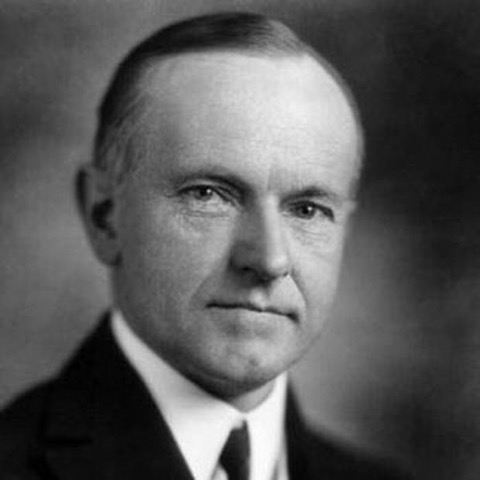
Where is Calvin Coolidge When We Need Him?

In the 1952 American presidential election, Republican Dwight Eisenhower ran against Democrat Adlai Stevenson.  Eisenhower was a five-star general in the army and Stevenson was the governor of Illinois.   I’m so old I was in grade school back then and my teacher Miss Kelly, who was big for Stevenson—as I think about it, this may not have been altogether appropriate—put me up to standing on a corner in downtown St. Paul, Minnesota handing out Stevenson campaign literature to anybody who would take it.

My dad was a barber in the basement of the Saint Francis Hotel a block away, and I took a break from my political duties to pay him a visit.  After saying hello to Dad in his satiny smock and watching a haircut, I gathered up my pile of Stevenson flyers and went up the stairs to the lobby of the hotel and the front door with the idea of getting back to work.

When I got to the top of the stairs, I saw a banner saying there was a meeting of the Minnesota Republican Party going on in the Saint Francis.  There were a few cardboard posters propped up with sticks with pictures of what must have been party luminaries.  About twenty men—all men in those years—stood talking to one another; I supposed they were party members between meetings.   Making my way head-down through them on my way to the front door and the street, I stumbled and out spewed, it seemed like ten feet, all my Stevenson flyers with his picture on them.  I was mortified and a bit scared—the barber’s kid, a collage of Stevenson faces on the lobby floor, and the Republicans in their suits looking eight feet tall to me who had stopped what they were doing to take in what had just happened.  As it turned out, they couldn’t have been nicer.  They all smiled and helped me gather up the flyers and wished me well and I went on my way.   I’ve never forgotten that moment.

Maybe I’ve taken too long to get to what I want to say here, but the purpose of recounting this memory was to establish the context for the general observation that I think I’ve lived through a marked downturn in American politics: from Dwight David Eisenhower and Adlai E. Stevenson—grown-ups, serious men, men of real substance, both of them—to Donald Trump and Beto O’Rourke.   Eisenhower and Stevenson had discrete comb overs, but neither of them had what looked like a lemon meringue dessert sitting on his head, and neither of them talked about the size of his member on the campaign trail.  And Beto?  Is he the one with REO Speedwagon on his mixtape?  President Beto?  Really?  Eisenhower had been the Supreme Commander of the Allied forces in Europe during World War II and president of Columbia University.   What exactly has Beto done that’s so great?

To get to the specific topic of this writing: a story, or I guess it’s a joke, my dad told me perhaps a few too many times when I was growing up.  It had to do with a president from the 1920s, Calvin Coolidge.  Coolidge wasn’t the most outgoing person in the world and he wasn’t known for his loquaciousness.  The way the story/joke Dad told me went, a little boy, nine or so, went up to President Coolidge and said, “My dad bet me a nickel that you wouldn’t say three words to me.”  After a pause, Coolidge looked at the tyke and said, “You lose.”

Calvin Coolidge.  Born in 1872, died in 1933.   Republican.   Elected vice-president in 1920.   Became president in 1923 upon the death of president Warren G. Harding.  Elected president in 1924.  Declined to run for a second full term as president in 1928.1

Calvin Coolidge

Read more

Interview with Edward Dutton, the Jolly Heretic

I thoroughly enjoyed this interview and thought it allowed me to get at some important questions in my research. Edward Dutton is an evolutionary psychologist whose book on Finland was reviewed on TOO by F. Roger Devlin. We discuss controversial issues related to The Culture of Critique, Dutton’s book on Finland, and my forthcoming Individualism and the Western Liberal Tradition: Evolutionary Origins, History, and Prospects for the Future.

https://youtu.be/euBn1eSUbKM?t=166