Featured Articles

Brexit and the Jews

Orthodox“Britain’s anti-EU ‘Leave’ campaign has helped create a public discourse of prejudice and fear, couched in a parochial nationalism, that Jews in Britain must challenge.”
Dr. Ilan Zvi Baron, Durham University, England

Although delighted by the advent of Brexit, I’ve forfeited participation in the celebrations and wistful speculations indulged in by many in our movement. I don’t deny that we’ve achieved a helpful success in the war to save our people. Nor do I deny that many of our enemies have been given a long-overdue dose of nationalist ‘shock and awe.’ Of more pressing interest to me, however, is the observation and anticipation of enemy counter-measures, as well as the assessment of just how much of a victory we have actually achieved. The following analysis of Jewish responses to Brexit will further illustrate not only the priorities of organized Jewry, but also the limitations of our achievement. It is hoped that this will result in a deeper understanding of the true significance of recent events in the context of the greater battle to reduce Jewish influence in our nations, and assist in the forward march to racial-national renewal.

It’s tempting at first glance to imagine that all Jews are against Brexit. This instinctive prediction arises in the nationalist mind due to the conflation of Jewish identity with liberalism and its modern globalist and ‘social justice’ corollaries. In many respects, of course, this is a helpful conflation that assists with accurate predictions. However, what the instinct neglects is a vast historical context in which the relationship of Jews with liberalism is very complex indeed, and in which such easy predictions lead to a facile and naive understanding of Jewish strategies. In brief, history indicates that Jews have fluctuated in their attachment to liberal and even globalist causes.
Read more

Liberal Media Bias and How to Counteract it: Examples from Brexit and Benghazi

Liberal bias is well known to exist within the mainstream media, including network news shows of CBS, ABC, and NBC, cable channels CNN, MSNBC, major newspapers, news-wires, especially CBS News, Newsweek, and the New York Times. In support of the notion of liberal bias of the major networks is the finding that the Democratic Party received a total donation of $1,020,816, given by 1,160 employees of the three major broadcast television networks (NBC, CBS, ABC), while the Republican Party received only $142,863 via 193 donations. Both of these figures represent donations made in 2008. I suspect that numbers for the 2016 election will dwarf these figures that already are weighted over 10:1 in favor of Democratic support.

Another more direct, but equally convincing means of assessing media bias is by canvasing media outlets immediately after an important politically charged event like the Leave-Remain vote for Brexit. The morning after the vote, I spent most of the day canvasing several liberal media depictions on TV (BBC, PBS, CBS) and via  the internet (NYT) and just one counterpoint on FOX resulting in unbelievable contrasts!

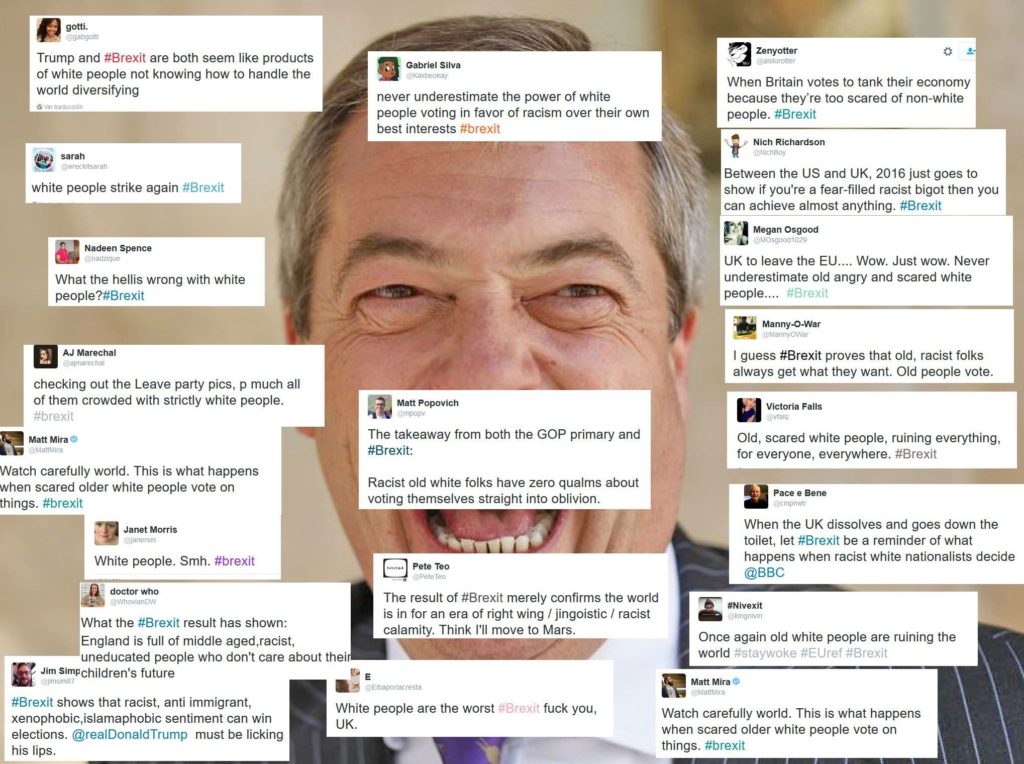
I was particularly struck with the rather extreme media bias of PBS which today appears to be the mouthpiece of the Democratic Party. Their staff interviewed lots of traumatized professional journalists. What impressed me was 1) the fact that every single commentator was completely negative; 2) only one view was represented, with no opposing commentary; and 3) the negative viewpoint expressed was somewhat hysterical and absurdly extreme. Like Chicken Little, these journalists were clearly upset by the democratic referendum in Britain and conjured up catastrophic cascades likely to follow it using terms like “dire, dark and disturbing,” with years of steep economic decline. The British majority were characterized unabashedly as old, angry, stupid and white — out to build walls instead of allowing free borders, a backlash against the more enlightened policy of globalization. There was literally no commentator who mentioned any other possible motive for the majority other than racism. Nobody expressed any notion that voters simply want back their freedom to elect their own officials and determine their own future. Read more

Brexit — the shockwaves continue: UKIP rising as Labour heads toward oblivion, Israel Lobby emerges triumphant

Has Britain’s referendum victory been stolen?  The forces of darkness have quickly reasserted themselves and the portents are now very grave.  Both the outgoing prime minister David Cameron and his possible successor Boris Johnson are both now saying trade must come before immigration curbs.  Nigel Farage, the face of Brexit, has accused them of backsliding but may himself have been already “frozen out” out of the European exit negotiations by more establishment figures in the broad Brexit alliance.

This would only confirmed the growing suspicions about the real motives behind the Conservatives who had so belatedly joined the Leave camp. Boris Johnson was worryingly vague about any change of European freedom of movement rules saying “It is said that those who voted Leave were mainly driven by anxieties about immigration. I do not believe that is so.” If there is a stab in the back then it is an inside job.

But it is the statements made by two prominent UKIP members, two prominent Leave members, one UKIP one Conservative, that have really caused alarm.  Both Douglas Carswell and Dan Hannan are still committed to freedom of movement across Europe which essentially negates the entire point of the referendum in the minds of most voters.

Both Carswell, who is an MP, and Hannan, who is an MEP,  are prominent conservative writers with strong free market affiliations and City of London connections.

But in fact both men have been sniping at Farage and questioning his leadership long before the referendum. At the height of the campaign Carswell was pouring abuse on his party leader, not least for a gritty refugee poster, and he then went to opine that Farage was “not a serious person.”

The Offensive Ad

The offensive poster

But while both men are disloyal to Nigel Farage and worryingly “flexible” on the core issue of immigration, there are some causes to which they do display unquestioned loyalty. Both are staunch friends of Israel and have gone out of their way to reassure the Jewish community that, whatever happens, they do not need to worry.

Read more

The Orlando Shootings: Talk, Reality, and the New York Times

To put this writing in its context, it needs to be kept in mind that a thing is whatever it is, and it’s not any other thing.  In Orlando, Florida in the early morning hours of June 12th, 2016, 49 people were killed and 53 injured in Pulse, a gay nightclub, by, it appears at this writing, a lone gunman of Afghan ancestry by the name of Omar Mateen, who, three hours after the onset of his mass killing spree, was shot dead by police as he exited Pulse, bringing the death total to 50.  That event, that reality, is one thing.  What people say about that thing, that concrete reality, is another thing.  Reality and the words that depict it and give it meaning are two different things.

This distinction sounds obvious, but we sometimes lose sight of it, and sometimes we are encouraged to lose sight of it.   We come to believe that the words we use to made sense of, in this case, Orlando, are the reality, when in fact they never can be that.   We can try to get the words to align well with the reality, that would be good, but still, they aren’t the reality.

This is important to underscore because now, after the event, essentially, and most importantly, Orlando is what people say about it in the public realm.  Other than to the people immediately affected by this tragedy, Orlando is now about language, words, and verbal exchange. To make sense of what happened in Orlando, it is important to look at it from a linguistic angle, and that’s what I’m doing here.  This writing is about language and its implications. Read more

The Future of British Nationalism After Brexit

Brexit-Grexit-EU-Cartoon

Brexit has come and gone, and like Wellington said of the Battle of Waterloo it was a “damn close run thing.” Indeed, that was one of the reasons I supported Scottish independence two years ago — to stop Scotland dragging England to the left on important issues like this. (My other reason was so that Scotland could discover on its own — and rather painfully I suspect — the limits of leftism when not buttressed by a larger non-socialist entity).

But what about the fallout from Brexit and its effect on British nationalism? Yes, it gets us out of the EU and shakes the foundations of the still incomplete Tower of Babel. But what lessons can we learn from it, and what directions should nationalists take?

Perhaps the most interesting point about the Brexit Referendum is the political vacuum it revealed. All the main parties, except UKIP, officially backed the defeated cause. That’s right — the Conservative Party, Labour Party, and Lib Dems, as well as the SNP and Plaid Cymru, supported REMAIN. But, even with a higher turnout than in a general election, they failed to get their way.

What does this mean? It means that practically the entire British political establishment was not aligned with the wishes of the majority of the British voting public. Read more

Britain says no

brexit

Cucked reactions to the Brexit vote

“Bliss was it to be alive.,.” the words of poet William Wordsworth seem appropriate on a morning when Britain woke up to find the world had turned upside down — and our ruling elite had been given a decisive bloody nose. The British people’s narrow but definite rejection of the European Union is the biggest upset since Churchill was rejected by the voters in 1945.

The country seems in shock this morning. Red-eyed female presenters on the BBC look as if they have suffered a close family bereavement and the commentators are scrambling around trying to make sense of it all but there is no doubt who they are blaming: David Cameron, the “heir to Blair” himself and a man who had sworn to make Britain safe for the financial and bureaucratic elites.

In a system in which the defining characteristic of politicians must always be the ability to successfully sell lies to the voters, Cameron finally failed to deliver. He had come to power on a promise to reduce annual net immigration to under 100,000 and instead it had soared to an official 310,000 (unofficially it much higher than 500,000). While ordinary people were aghast, Cameron had merely shrugged his shoulders and said his hands were tied by Europe.  For generations, British politicians had got away with this. Then he allowed himself to be talked into a referendum. You can see the rationale. The voters had fallen for it repeatedly and there seemed no reason to think they would not do so again. Read more

Jacques Delors on the Failure of the European Union

This article is aimed at the many Europeans who are emotionally invested in the European Union (you might be surprised at the number, especially among the young and educated). Whereas I emphatically support European cooperation and even a degree of European political unity, I want in good faith to argue here that this political construct is at best woefully insufficient and often outright destructive for the challenges we Europeans will face.

The current governments and cultural establishments in Europe put a lot of stock in the EU as the means for Europeans to retain power and security in the twenty-first century. For example, European Commission President Jean-Claude Juncker has explicitly claimed that the EU is a valid response to our catastrophic demographic decline. The late French President François Mitterrand, a major founder of the EU, was in part motivated by the idea that Europeans could reclaim their agency after half a century of Soviet and American domination of the Old Continent. The current president, François Hollande, similarly claimed during the recent commemoration of the Battle of Verdun:

You [the audience] are French and German, German and French, by birth or by adoption, but you are Europeans by convictions, not because you would simply fear the return of the tragedies of the past, but because you want to be global actors in the world of tomorrow, with our values, with our principles.

Other European governments make similar claims that the EU is central to our power, peace, and prosperity. British Prime Minister David Cameron made his case to stay in EU in the upcoming referendum on membership, saying: “The reason that I want Britain to stay in a reformed EU is in part because of my experience over the last six years is that it does help make our country better off, safer and stronger.” Conversely, EU-philes like immigration apologist Philippe Legrain (tweet him here) predict economic and political disaster if the EU is disbanded.

Personally, I tend to think both the pro-EU and anti-EU cases tend to be overstated. The EU is notorious for its paralysis and political gridlock. The word most associated with the EU in the news is no doubt “crisis”: The financial crisis, the euro crisis, and now, worst of all, the migrant crisis. The EU, far from being a respected world power, seems more than anything else a non-entity wracked by indecision.

The question then arises: Do European leaders really believe their own claims about the incredible power and prosperity enabled by the EU? Read more