Featured Articles

Kooky Qatar — More dough than you can sheikh a stick at, Part 1 of 2
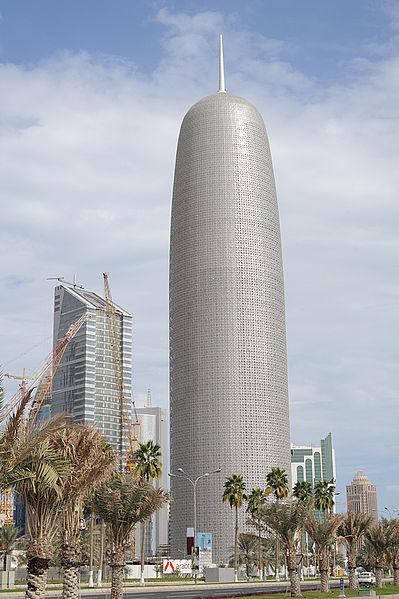
Qatari architecture - Burj Doha

Midway down the Persian Gulf, a small peninsula the size of Connecticut rudely juts out opposite the world’s largest gas field. This fateful geomorphic kiss has made the state of Qatar the Gulf’s own version of The Provisions State, amassing vast wealth since its amicable independence from the British in 1971. An overnight cornucopia of new opportunities and problems alike have tumbleweeded in, but the regime shows little in the way of restraint. Much like its topography, Qatar is protruding sharply into regional politics and shaping up as an influential player whose political wake is being felt many seas away.

Qatar is an underestimated high-flier because it is often pigeonholed with the other spoiled Gulf States whose wealth is inversely proportional to their humility. Rather than be a wealthy, neutral and independent state, Qatar is a politically promiscuous country that attempts to buy everyone’s affection, some more than others, in a strategy termed “hedging.”[i] Qatar manages to maintain close relations with America, Israel, Iran and Palestine. Qatar is not nearly as much a nation state as it is a family estate, but the ruling al-Thani family does manage an approval rating that would make most Western democracies envious.

Qatar’s wealth cannot be overstated since the consequent social effects and political leverage are perhaps without precedent. Qataris pay no income tax or sales tax, and utilities like electricity and healthcare are provided free of charge. Citizens have come to expect the state’s general allowances, which can be as high as $7000 per month, along with free land, guaranteed civil employment and interest-free loans.[ii] In order to grasp just how brimming the Qatari coffers are, one has to turn to the state’s $250 billion sovereign wealth. Read more
Guillaume Faye: Seven Mistakes That Explain The Failure Of The European New Right

The weakness and shallowness of the mainstream Right has been noticed a thousand times. In 1896, Robert L. Dabney described the GOP as “a party that never conserves anything,” that always growls against the Left’s innovations but ultimately rallies to them, to the point of being “a mere shadow that follows Radicalism as it moves forward.” This emptiness allowed for the GOP to be taken over by crypto-Trotskyite neoconservatives once they had purged the old guard.

The very repetition of the critique, though, shows that making the point — and re-discovering it again and again — is not enough. Those who made the point were right but could not change the “Mighty Left And Spineless Right” system. Dogs bark at cars, but dogs can’t drive, and the astute critiques of Conservatism Inc. have never yet achieved power in the US.

The non-mainstream Right must find an alternative beyond this simple critique. But before today, before the Internet became public, others already tried. Though barely mentioned in the mainstream today, these dissenters were able to coalesce into an intellectual big tent associated with the French magazine Le Figaro. They became intellectually fashionable, sparked debate among a wide range of political issues, and sought genuinely new grounds in order to replace the Left in its role of cultural authority able to shape the mainstream norms, narrative and core concepts. These thinkers were known under the name of Nouvelle Droite (“New Right”).

It may come as a surprise to many, but the biological roots of IQ, sex differences, the soundness of eugenics, the Indo-European-Aryan roots of Euro-American civilization — such were the topics raised by fierce, fearless “New Righters.” Indeed, Nouvelle École (New School), one of the main journals of the New Right, listed names such as Raymond B. Cattell, Hans Eysenck, Henry E. Garrett, Arthur Jensen, and R. Travis Osborne on its masthead. Many of their positions overlapped with today’s neo-masculine points. Of course, they were targeted by cultural Marxists, labelled “fascists” and “racists,” but for some time they seemed rather stimulated than weakened by the Leftists’ attacks. Read more

A Review of “The Mighty Dead” by Adam Nicolson — Part 2

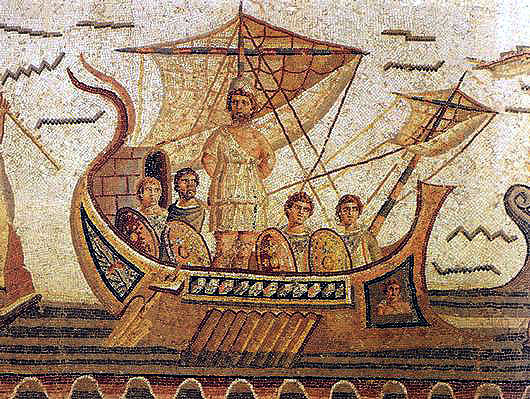
A scene from the Odyssey from a Roman mosaic

A scene from the Odyssey from a Roman mosaic

Part 1

Homer was central to the Ancient Greeks’ conception of themselves and their origins. At their most holy and self-conscious moment, the quadrennial festival of the Panathenaia, the Athenians  “gathered for total immersion in the Homeric stories, drinking up the tales from which most of their great tragedies drew their plots and characters, thinking of Homer as the source of what they were.”[i] According to Nicolson, these origins are fundamentally northern. He observes how, particularly in the Odyssey, the Greeks are depicted as outsiders to the Mediterranean world, with Odysseus portrayed as an impoverished northern wanderer not entirely at home in the Mediterranean world, who, after many trials and tribulations, returns home a broken king, an outsider with few allies. While Odysseus and the other Greek chieftains conceive of themselves as noble kings, the civilized states of the Mediterranean see them as barbarians.

When Odysseus and his crew find themselves facing Polyphemus the Cyclops, the notion of the Greeks as outsiders is manifest. “Strangers, who are you?” the man-eating Cyclops asks them. “Where do you come from, sailing over the sea-ways? Are you trading? Or are you roaming wherever luck takes you over the sea? Like pirates?”[ii]  Nicolson notes that, “he may be the king of Ithaca, the son of Laertes, a man whose fame has reached the sky, but that is not how the world of the Odyssey treats him. Everywhere he arrives anonymous, not somebody but ‘nobody.’”[iii] This epithet features prominently in the same episode from the Odyssey when Polyphemus asks Odysseus his name. Odysseus replies that his name is “Nobody.” When Polyphemus is later blinded and cries out for help, the other Cyclops ask who has hurt and blinded him. “Nobody!” he answers to our amusement. Read more

A Review of “The Mighty Dead: Why Homer Matters” by Adam Nicolson, Part 1

The Mighty Dead: Why Homer Matters is an example of that non-fiction genre so reviled by the anti-White establishment: books that celebrate the European past and the rich and world-transforming culture that emerged from it. Foundational to this culture are the Homeric epics, the Iliad and the Odyssey, which have long been pillars of the Western literary canon. While their place in intellectual life of the West has waned over the last century (casualties of the generalized decline of a now Jewish-dominated culture), they remain as alive as ever for many readers. For author Adam Nicolson, in addition to their imperishable literary value, the Homeric epics should matter to all Europeans because through them “Homer tells us how we became who we are.”[i]

Nicolson is an English writer and journalist known for his scholarly but passionately expressed works on history, landscape and literature. The grandson of noted (and controversial) writers Harold Nicolson and Vita Sackville-West, he recalls being taught Homer at school, where his fumbling knowledge of Greek meant “it was as if the poems were written in maths.” Today most schoolchildren are unlikely to get even that far — with the majority doubtless associating Homer with The Simpsons and its derisive Jewish caricature of the White American father. Nicolson “rediscovered” Homer in middle age when he found himself electrified by the American poet Robert Fagles’ acclaimed verse translation of the Odyssey.

In The Mighty Dead Nicolson argues that the mainstream historical account of Homer is wrong. The current orthodoxy has the Iliad and the Odyssey as products of the early Iron Age Greece of the eighth century BC, or thereabouts. This was a time, often labelled the Greek Renaissance, when Greek civilization, after five centuries of decline and stagnation, saw a revival that culminated in the golden age of classical Athens in the fifth century BC. This rebirth, yet to be fully explained, coincided with a population boom and the rediscovery of bronze-making, a skill that had fallen into disuse in the preceding four centuries. This was a time in Greek history that saw the growth of

colonies, trade, improved ships, gymnasiums, coinage, temples, cities, pan-Hellenic competitions at Olympia (the first, traditionally, in 776 BC), the art of writing, of depicting the human figure on pottery and in the round, the first written law codes, the dating of history. The first tentative moves towards the formation of city-states: every one of these aspects of a renewed civilization quite suddenly appeared all over the eighth-century Aegean. Homer, in this view, was the product of a new, dynamic, politically inventive and culturally burgeoning moment in Greek history. Homer was the poet of a boom.[ii]

Read more

Donald Trump in Eugene, OR

A Trump speech has to be experienced in person to really begin to grasp the incredible appeal this man has generated. The atmosphere inside the convention center in Eugene was electric. There were around ~5000 supporters —close to capacity, with many more outside who were, according to Trump, prevented from getting in because of fire regulations (Trump: “What are they worried about? It’s a cement floor. It’s not going to burn. Let ’em in,” to great cheers. )

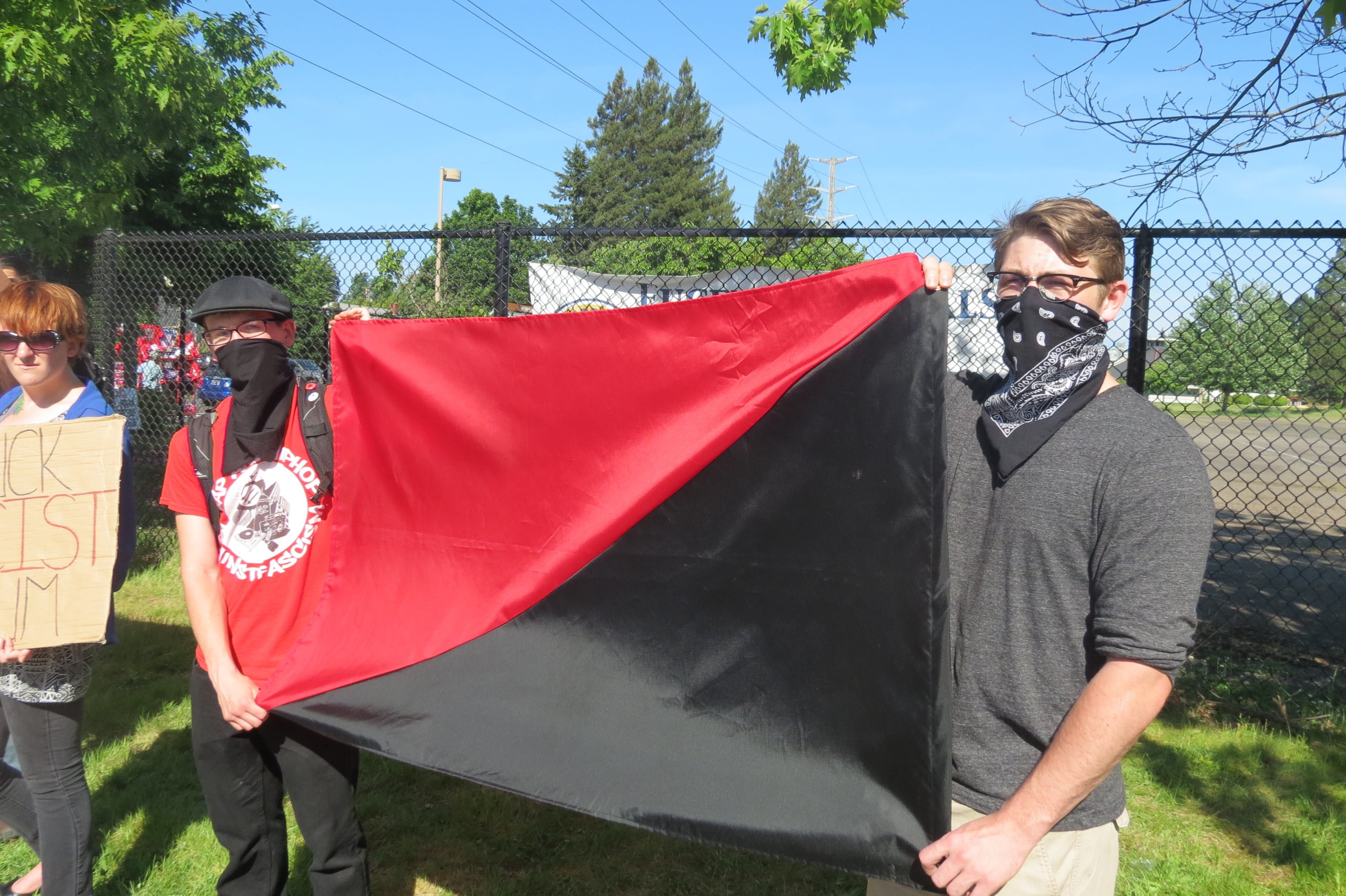
I got there so 2-1/2 hours early, hoping to get a good place to stand (no seating), so many of the more obnoxious protesters hadn’t arrived yet. This is a very good video from InfoWars showing the types of people, the hatred, the Mexican flags, etc. that eventually showed up. The InfoWars reporter talks to a flag-holding anarchist/syndicalist duo who refused to talk to me. I guess it’s because I told them that they are pillars of the establishment. They just stared straight ahead.

IMG_2823

Read more

The Hurt Feelings Scale

hurt

This is Canada and you have no right to hurt my feelings

Psychology professor Mark Leary of Duke University achieved notoriety for his construction of various “scales” for the purpose personality assessment. There is the “Interaction Anxiousness Scale”, the “Brief Fear of Negative Evaluation Scale”, the “Need to Belong Scale”, the “Blushing Propensity Scale”, the “Imposterism Scale”, the “Social Physique Anxiety Scale”, and something that appears to be custom-made for Canadian political culture. The “Hurt Feelings Scale.”

I believe that the “Hurt Feelings Scale” has the potential to become a mainstay of sound government emotional management. Think of the possibilities. A Hurt Feelings Form (HFF) could be handed out to every immigrant the moment he has been sworn in at the Citizenship ceremony. In fact, the government could send out this form to every member of a visible minority or identity group to monitor their feelings so as to determine if other Canadians are as racist, sexist, homophobic, trans-phobic, Islamophobic and micro-aggressive as they say we are.
Read more

Philip Green, Jewish Criminality, and the Cost of Economic Parasitism, Part 2

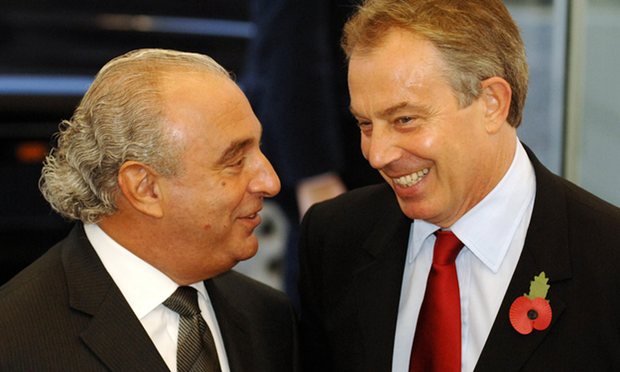
green&BLair

Green and Tony Blair

Part 1

Philip Green possesses an appearance so darkly befitting a caricature that one might see it, like the stripes of a wasp, as a warning from Nature itself. But even had this son of the Talmud emerged from the womb looking like a Swedish prince his life trajectory would have still borne the stamp of his racial origins. Green was born on 1952 in Croydon, in south London, the son of a retailer and property speculator. At the age of nine he was sent to the Jewish boarding school Carmel College in Oxfordshire, the most expensive school in all of England until it closed in 1995. As his biographer Stewart Lansley points out, Green is no ‘self-made” man. Few Jews ever are — the entire concept of the ‘self-made man” is rooted in individualistic rather than close-knit societies. When his father died, Green inherited the family business at the age of twelve and had access to a substantial estate. More importantly, Green was born into a close-knit community of Jewish businessmen and speculators, all of whom had access to credit networks and financial knowledge beyond the means of non-Jews. Assured of the support of these networks, Green left Carmel College at 15 to work for a co-ethnic shoe importer. By his late teens he was travelling to the US, Europe and the Far East. On his return, at age 21, he set up his first business with a £20,000 loan backed by more communally pooled funds, importing jeans from the Far East to sell on to London retailers. Read more