• MISSION STATEMENT
  • TERMS
  • PRIVACY
The Occidental Observer
  • HOME
  • BLOG
  • SUBSCRIBE TOQ
  • CONTACT USPlease send all letters to the editor, manuscripts, promotional materials, and subscription questions to Editors@TheOccidentalObserver.net.
  • DONATE
  • Search
  • Menu Menu

Featured Articles

Some basic principles for the national struggle

May 4, 2024/13 Comments/in Featured Articles, White Racial Consciousness and Advocacy/by Povl H. Riis-Knudsen

With permission from: Danmarks Frihedsraad, a Danish Nationalist site.

Looking across the political landscape today, there is little reason not to be dismayed. Quite simply, Denmark has no national opposition to the prevailing political system. And by opposition, we don’t just mean a political opposition, but also a cultural and ideological opposition.

Many will now mention the Danish People’s Party as well as the Danish Association, the Danish Culture Association and possibly other small groups that may have some good will, but are all very far from meeting the criteria for being a national opposition.

In order to deal with any political or cultural issues that go beyond today’s arguments about tax rates, it is necessary to be clear about the nature of the task facing such an opposition. Every political leader must be able to expect absolute clarity on the following points. If they lack this clarity, they indulge in illusions, wishful thinking and easy shortcuts that only lead to nothingness. If he has clarity but still indulges in illusions that there is an easier way, he is dishonest and will achieve nothing. Only those who let every action be guided by these principles can accomplish anything positive – no matter in what way they choose to advance the Danish cause.

The following points are not a political program. Such a program is in itself meaningless. They are guidelines. They are hardly suitable as a basis for party politics, but should anyone harbor the vain hope that something can be achieved through party politics, it must be borne in mind that these points must necessarily be your invariable guideline – in the sense that you cannot take positions in your political work that contradict these points. You don’t have to post them on the church door!

1. The highest task of any Danish cultural or political movement is the preservation of the fatherland, its independence, its language and culture, its customs and traditions, its territorial integrity and the uniqueness and continued biological existence of its population. This is a task that cannot be discussed and there can be no compromises of any kind. Anyone who does not follow this clear principle is a traitor and deserves punishment as such. At no point can one cooperate with anyone who does not recognize this task. Any participation in or support of efforts that alienate the Danish people from their culture and history and biological origins actively participates in undermining the nation.

2. In this context, it is necessary to realize that the survival of the people is a biological question. You cannot change the people through the integration of foreigners and pretend that you are preserving Denmark. Anyone who treats immigration solely as a question of economics, religion or culture is missing the point. Those who do so act either out of stupidity, inexcusable ignorance or because they act against their better judgment in an attempt to avoid being labeled racist, Nazi or otherwise disliked. These are often alibi points, such as wanting more adoption of foreign children or wanting Muslim immigration to be replaced by Christian negroes.

Denmark must remain the land of the Danes, and being Danish is not something you can become by passing a law in the Danish Parliament. Any integration of foreigners will inevitably lead to biological integration, which in the long term will destroy the basis for talking about a Danish people. Anyone who does not want to recognize racial and biological differences within and outside the people must be relegated to playing in the political sandbox at Christiansborg. Such forces are of no real relevance to a national opposition.

3. It is necessary to realize that the democratic form of government, so highly valued today, has become the most powerful weapon against the survival of our people. It is no longer a form of government, but an ideology, based on nebulous and unscientific ideas of universal human rights, which denies all the principles that it would be necessary to defend to ensure the preservation of the people. As an ideology, democratism is as totalitarian as communism or Nazism — there is complete freedom to discuss where the deck chairs on the deck of the Titanic should be placed, but there is no freedom to change course. Believing that this system can save us is naïve. To believe that it can be changed through elections is hopelessly naive. If elections changed anything, they would not be allowed. The current monolith of politicians, civil servants, bishops, priests, teachers and press have nothing to fear. Against it, Goebbels was a true dilettante! Together with the EU, it controls what people are allowed to think — and any party that does not think this way will be crushed if it contains even the slightest germ of success. Even an election victory of over 50% of the vote (which for any party is utopian) would not make the current elite hand over the keys to power.

4. It is necessary to realize that all the ideologies that today dominate the natural sciences as well as culture, education, politics, law and social sciences were conceived and propagated by ethnically self-conscious Jews who, together with their minions, effectively control society through a central role in the economy, entertainment industry and media, with the stated purpose of weakening the power, self-esteem and population health of White peoples in return for strengthening their own position. Anyone who, in his efforts to be a respectable nationalist, emphasizes his support for Israel against the Palestinians is choosing the greater evil over the lesser. When Denmark today is flooded not only by Palestinians, but by all sorts of foreign peoples, the responsibility can largely be placed with Jews. Islam is undoubtedly an evil, but its threat to Denmark and Europe will disappear with the disappearance of the foreign masses. Effective work to realize this vision is consistently opposed by Jews and Jewish organizations.

5. It is necessary to leave every form of Christianity behind, for it has prepared the ground for the destruction of the European peoples by robbing them of their own original religion and filling them with guilt, original sin and spiritual Judaism to such an extent that Christians have a Jew as their god and “savior.” Christianity has always opposed science and progress and today is further subverted by subversive forces to support everything that destroys the existence of our people. The Danish National Church could have been a bulwark against the Islamization of Denmark, but practice shows the exact opposite. The People’s Church is leading the effort to dismantle the nation. Having said this, however, it must be added that Christianity has left such an indelible mark on our history and culture that it has gained a degree of civil rights that cannot be overlooked. In a cultural battle between Islam and Christianity, there is no doubt where the national opposition stands. However, if Christianity is to have any chance of being part of the future, the Church must necessarily arrive at a form of Christianity and a church structure that actively supports the preservation of the nation. Otherwise, it will remain part of the problem.

6. It is necessary to realize that all the evils that nationalist Danes today complain about and seek to combat are the result of Hitler losing the Second World War. Had Hitler won the Second World War — or even better: Had World War II not happened — these evils would not exist today. Copenhagen would not have had 20% foreign inhabitants, billions of kroner and euros would not have been spent on foreign aid and refugees, Danes would still have had children (there would have been no pensioner hump), Africa would still have been under European control, and the people of this amazing continent would not have had to fear constant civil wars, violence and famine. Had the Germans won the war, there would certainly have been many things to complain about, but the biological existence of our people would not have been threatened and everything else can be restored.

7. It is necessary to realize that the Holocaust of the Jews is the means used today to suppress any national revival in Europe. By participating in the now completely overblown death cult of this new religion of the 21st century, the power of the Jews and the powerlessness of the White race is cemented. The right is held accountable for Hitler’s actions, while the left never has to discuss the 200,000,000 people murdered in the name of communism and equality, the memory of which rarely finds its way into the media.

8. It is necessary to realize that America and America’s intervention in Europe’s internal affairs has been to Europe’s misfortune – and that America’s continued power will lead to the destruction of the White race. America has not saved us twice in the last century, as a foolish, history-less politician who likes to act as a representative of national Denmark has claimed – it has twice prevented an internal settlement of European affairs. Without America’s intervention in the First World War, the warring parties would have had to recognize that neither was capable of defeating the other and would have had to make a peace that would have preserved the status quo in Western Europe. Germany would not have been humiliated, there would have been no war reparations, no economic collapse, no Hitler (!), no World War II, no “holocaust”, 50 million Europeans would not have been killed, there would have been no bombed cities, no destruction of European cultural values, no communism in half of Europe, no Berlin Wall, no Middle East conflict, no immigration of the 3rd world masses into Europe, no Third World masses in Europe, no developing countries in Europe. world masses in Europe, no development aid, no terrorism, no September 11 …… in short, none of everything that makes our existence poorer and threatens our future.

9. The European Union is an effective tool for the deliberate destruction of the Europe of peoples. Every effort emanating from the EU is aimed, directly or indirectly, at removing national borders, wiping out cultural, linguistic and biological differences between the many peoples of Europe, opening up Europe to immigration from the Third World and giving big business unimpeded access to plunder the peoples of Europe while sending jobs abroad. The EU has absolutely no popular legitimacy and must be fought in every conceivable way. It is today’s occupying power and the greatest evil facing national forces.

***

Many will arbitrarily exclaim to these points that this is “pure Nazism”. Well, if Nazism embraced the principles underlying the above points, then maybe it wasn’t so bad after all. Maybe it was worth thinking about? “Nazism” is one of the key words used to scare people away from the values that would ensure a proper foundation for their lives and future. “That’s what Hitler said,” roar Krasnik, Notkin and all their ilk whenever a national movement appears, and immediately it scatters again in all directions in terror. The word “Nazism” automatically conjures up mountains of corpses, rolling tanks, marching columns, smoking chimneys, bombed cities and the like, all of which can easily be attributed to Nazism. However, all of this belongs to history, which does not prevent Nazism from being based on eternal, natural principles that are obviously true and which no society can afford to ignore.

“Nazism” – or National Socialism, as it should rightly be called – only makes sense today as a historical phenomenon, strongly tied to the country and time in which it emerged. National Socialism is inextricably linked to Hitler, German tradition and German social conditions, which today are quite foreign to us. Anyone who wants to revive the fallen ideology should do themselves the favor of reading Hitler’s Mein Kampf, which strongly warns against giving artificial respiration to the past. Instead, it emphasizes the need to create a new movement born of the needs of the time and place, which can grow organically in the given society. All in all, today’s admirers of Adolf Hitler should be the first to read his book, which, even in the clumsy translation available in Danish, has much to offer. The inevitable consequence of a sensible reading must necessarily lead to the immediate dismantling of today’s undergrowth of ridiculous and in many cases abominable small groups who claim to be Adolf Hitler’s heirs without ever having familiarized themselves with what this might entail. These have done nothing to save the existence of the people – quite the opposite.

Today, we don’t want to go back to the 30s – we want to be part of the future. The past will never and must never return – the external conditions are far too different for that. Today’s problems are far more serious than anything Hitler faced. His task was mainly economic – today it is existential, and the popular foundation on which Hitler built his movement no longer exists. Patriotism and nationalism are no longer self-evident, but something to be argued for. However, none of this means throwing the baby out with the bathwater. A truth is a truth, no matter who says it. There were serious inherent flaws in the Third Reich that must never be repeated, but the values that must underpin the renewal of society if it is to survive in a form that ordinary people want to be part of are ancient. They can be found in the ancient cultures of India, Ancient Greece, Cicero’s Rome and classical conservatism, and today they can be scientifically substantiated in a way that only 50 years ago could only be dreamed of. The virtues and qualities that have been the foundation of European civilization for millennia (and there are no other civilizations in our sense!) are completely independent of who started from them and what the outcome has been. It is the task of future leaders to avoid the mistakes of the past and build a better and more lasting edifice on the foundations. This requires a good, thorough and unbiased study of history.

Today, the task seems hopeless. The terror against dissidents has developed in such a way that they can no longer lead a normal life with work, family and social interaction. This is why so few have the strength to defend Denmark – and why so many seek pseudo-alternatives that seem easier than the consistent resistance struggle. This cannot be changed immediately, and those who seek a political way out within the framework of the ruling system naturally deserve at least tacit support, while remembering the above 9 points. But the fact that a political enterprise requires compromise is already in the cards. Most Danes want the Denmark they know back – and it’s not Helle Thorning Schmidt’s Denmark – but they just want it to happen by itself, so that one morning they wake up and everything is back to normal. They don’t think too much about causes and culprits – and above all, they just want everything to be solved the nice way. We would all much prefer that, but it is not a likely outcome to the problems. As already mentioned, the current decision-makers and their lackeys will not voluntarily relinquish their position of power and magically transform themselves into useful and nationally-minded citizens working for the good of the people. This fairytale ending is naive. There will be a struggle for power, and a far-reaching showdown with the current “elite” will be necessary – and it will not be pretty or harmonious. But the alternative to the Danish people rising up and demanding Denmark back is far worse. If the Danes just stand by, we will slide towards a full-scale war in the streets between Danes and foreigners – and it will be very bloody, as many of our intruders are born with a Kalashnikov in their hands and have excellent military training, while Danes are generally alien to combat and the use of weapons. In addition, respect for human life is far lower among our guests than among us. They have grown up in or been influenced by societies where a human life is not worth much. They will therefore be in a very strong position in such a war. The only alternative is to dismantle Denmark without a fight, adopt Islam, destroy the pigs, close the liquor factories and breweries, burn the paintings in our museums, melt the statues, tear down the churches, raze our ancient monuments to the ground, burn our books and sheet music, let our girls be forced to marry immigrant types from the third world, so that we can finally be biologically exterminated. Sharia will be introduced, women will be stoned and men beheaded for religious offenses, and any concept of law will disappear. The natural sciences will die out, creativity will disappear. Intellectual activity will be centered on interpretations of the Koran, such as issuing new fatwas, for example, banning snowmen, and this will only be done in Arabic. If anyone wants to know what society will be like, we would recommend a trip to the Islamic State – a one-way ticket should suffice. Of course, there are still gentler versions of Islamic states to which a return ticket may be worthwhile – but their days are numbered too, see the developments in Turkey. It is not recommended to postpone your trip for too long.

All ideas of human rights, multiculturalism, humanism, tolerance etc. are – ironically – products of Western culture and are unfamiliar concepts as soon as we get to other peoples. The ideas are partly fine when practiced within a homogeneous society where people have the same set of values, but when extended to other peoples with a completely different agenda, they are suicide!

What can we do to prevent this sad fate for our homeland? There are, of course, the political parties – but as mentioned, such work has no chance of achieving the goal if it stands alone, but it can be a good platform for spreading the national message and recruiting qualified people. We are very much in the same situation as in 1940. Back then, a party whose goal was to kick the Germans out of the country would have had no place on earth. So they eventually resisted in a more tangible way – but not very successfully. At the time, however, they had powerful foreign supporters and a different kind of manpower – and success was eventually brought in from outside. Under no circumstances would armed action against today’s occupying troops have any significance in the sense that it would cause the foreigners to flee from the wide-open Danish treasury. In many cases, they come from countries where they are exposed to an immediate risk of death and mutilation on a daily basis – mass shootings in mosques or targeted assassinations would not make much of an impression, nor would they significantly affect the percentage of foreigners. They would only serve for self-gratification – and probably for the hidden joy of more people than you might think, but this joy would have no overall impact either. Today, it is also difficult to imagine that an armed uprising against the police and military with the aim of overthrowing the system would lead to any result. Such an attempt would be doomed from the start. One could rather imagine that liquidation actions against the worst traitors would make an impression, but they would largely serve to make those in power drop the mask and implement the absolute police state. Nor would such actions save Denmark in the current situation.

There is absolutely no way around the Danish people. Change is only possible if a significant proportion of the people want it. If the people don’t wake up and want the change and everything that goes with it, it will die and disappear from the world map within the next 50 years. It will be infinitely sad, but in that case it is inevitable. It is therefore important, first and foremost, to influence the part of the population that is still deeply loyal to the homeland. You don’t do this by shielding yourself in parties that separate you from the Danish people, but by participating in the life of the people and cultivating their culture. One of the things you can blame the Danish Association, the Danish People’s Party and other well-meaning organizations for is that there has only been a very modest cultural involvement, and the “Association for the Promotion of Danish Culture, Democracy, Language, History, Architecture and the Danish Song” has never been very successful in its endeavors, perhaps because it was strongly influenced by the church from the beginning, perhaps because it has been too intellectual and too little popular. Culture is not something that is just written in books, it is something that must be lived in daily life. Today, we need singing and folk dancing – the latter not as a sport with Danish championships, but as a natural part of our traditional culture. We need to maintain our language in the face of the increasing use of English in our daily lives, and we need to read our literature. We need a cultural manifestation. There is a need to raise awareness of the people at all levels.

The first place to start is with ourselves. You can only save the people if you love them. To love them, you must know them. To know them, you must understand their history, their culture, literature, music, dance and other expressions of their life. Any desire for change that is not based on a heartfelt desire to save the Danish people from certain doom is doomed from the start. This is about the collective – not about the enlarged ego of the individual.

Actually, the right wing is in the same situation as the dog that barks at passing cars every day. What would it actually do if one day it caught a car? What would the right wing in the broadest sense do if Helle Thorning Schmidt one day walked past Morten Uhrskov Jensen or Daniel Carlsen with the keys to the Prime Minister’s Office and said: “I give up. Now it’s your turn. Have fun!” The fact is that the right wing today has too little to offer – not just in terms of manpower, but also in terms of ideas and education. There are simply far, far too few qualified people to even dream of replacing the traitors who sit everywhere in the glands of society. It’s not enough to have political ambition – it takes much more. This is where the right needs to step in. Educating a real elite that can take the place of the traitors and that is aware of the principles listed here. However, this elite cannot allow itself to be exposed and subjected to the usual press hype.

The communist ’68ers did not win their influence by standing for election, but by marching through the institutions. National Danes must not end up on welfare, but must follow the same path. If you have the skills, you should study, settle down in a good job and quietly influence the world as much as you can. If you are a lawyer, you should apply to the courts and take them on. If you are an educator, you must constantly promote reason in your teaching and fight any politicization of something that should not be political. If you are a craftsman, you must acquire a position in society from which you have as much influence as possible on your local area. In any case, you should educate yourself to be able to take over key functions in society if the opportunity arises. Applying for positions in the police, military and national defense is a given. These institutions will be key to any change – however it comes about. Participate in your children’s school life and try with all your might to counteract the stultification of the state. Avoid childcare centers – nothing good comes from them. You should participate in the life of associations and everywhere firmly defend your ideals without engaging in political activity. In general, you should not participate in the political game for the sake of power, because you won’t get it, but to create respect and familiarity in the local community – and you don’t necessarily have to found new parties to do that. Above all, you don’t have to compromise on basic principles. Support the grumbling and discontent that exists in the people. Never miss an opportunity to speak your honest opinion about politicians and the state of society. If you have the opportunity, you should choose the occupation that gives you the most influence and the greatest independence and untouchability. When choosing employees and suppliers, always think of your peers and, as far as possible, boycott companies that employ non-nationals or foreigners. The latter is the most difficult as they enjoy special protected status, but as a customer this is not primarily your problem. Preferably put your money where it benefits Danes.

Finally, it is important to keep an eye on the traitors and their henchmen so that they are not forgotten the day national Denmark (might) rise. Just as the resistance movement during the previous occupation kept meticulous arrest lists of their opponents, national Danes should remember the non-national forces so that they do not escape accountability for their actions. The big fish are already known to everyone. It goes without saying that politicians and media personalities have a lot to answer for – they will not be forgotten under any circumstances. However, all the small fish who diligently contribute to the execution of the genocide of the Danes in their daily lives, in letters and associations and under the guise of their public positions in education, the judiciary, the church, etc. certainly deserve to be remembered and held accountable for their actions when the time is ripe.

None of these measures will change anything on their own – but together they will create a possible basis for the rescue of Denmark. We must always remember the upheavals in Eastern Europe in 1989-91. Not many people predicted them. Most people thought they were just ripples on the surface, but it was the people who rose up against the tyranny the Western powers had handed them over to in 1945. We all thought that after this upheaval there would be new and better times, but we were wrong. There was no national elite capable of taking the reins so that the previous rulers and their henchmen could easily continue under new auspices, with the result that the state of the world from a national perspective has deteriorated considerably.

The people can rise up in many ways and for many reasons, and the EU’s fragile fantasy economy could collapse in a matter of months once the ball starts rolling. A political situation could arise that suddenly changes the rules of the game completely. All things that are difficult to predict, but which may offer the chance for a change. However, in such a situation, the national wing must be ready to take up the challenge and bring about this change. It is therefore to be hoped that the collapse will not be immediate.

Freedom is never won cheaply, and it is never won through stupidity.

Povl H. Riis-Knudsen


https://www.theoccidentalobserver.net/wp-content/uploads/2018/06/TOO-Full-Logo-660x156-1.png 0 0 Povl H. Riis-Knudsen https://www.theoccidentalobserver.net/wp-content/uploads/2018/06/TOO-Full-Logo-660x156-1.png Povl H. Riis-Knudsen2024-05-04 07:19:072024-05-04 08:48:28Some basic principles for the national struggle

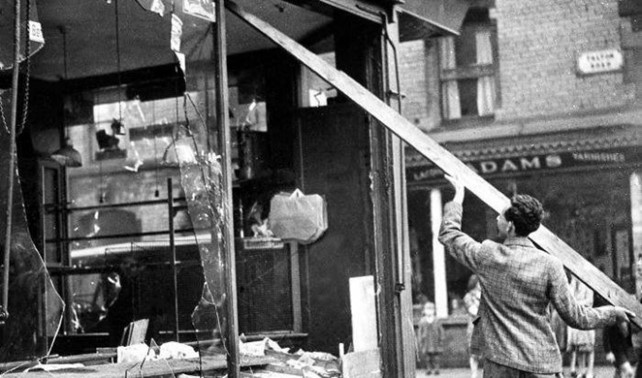
August 1947—Kristallnacht in the UK in response to Jewish anti-British terrorism in Palestine to the sergeants hanged in Palestine affair

May 3, 2024/2 Comments/in Featured Articles/by Francis Goumain

This photo does not show a shop window in Berlin, Leipzig or Treuchtlingen after the night of November 9, 1938, but was taken in Liverpool in August 1947.

Few people remember it, but in the summer of 1947, a terrible heat wave swept across Europe, not quite as intense as that of 2003, but spread over a substantially longer period.

But it’s not the only event that’s been almost completely forgotten about this summer, or, when it’s mentioned again, we are presented with a rather suspicious introduction, already heard elsewhere, every time it comes to excuse or exonerate the same old “international community”, in this case, that’s what we get:

In 1947 a washed-out summer had followed a harsh winter, and Britain was in the grip of recession as it struggled to restart its economy after the Second World War. On the August bank holiday weekend, the weather in Manchester had turned hot and stuffy. Trade in the shops was poor, rationing was in full swing and many workers had opted to stay in the city for the long weekend.

The only original aspect of this introduction is to add a meteorological touch to explain anti-Semitism. Only then, having skewed our reading, do we begin to broach the subject:

In cinema queues and on street corners, one topic dominated the conversation: the murder of two British army sergeants by Irgun paramilitaries in Mandate Palestine. The Irgun was one of several Zionist groups fighting a guerrilla war to force British troops out of the territory and establish the state of Israel. It had kidnapped the two sergeants in retaliation for death sentences passed on three of its own fighters. The three men were executed by British forces on 29 July, and two days later the bodies of the soldiers were discovered amid the trees of a eucalyptus grove near Netanya. They had been hanged and the ground beneath them booby-trapped with a landmine.


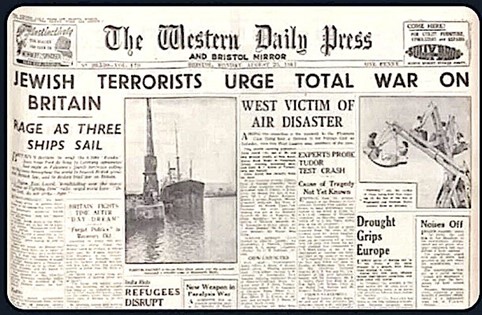
As the front page of this newspaper shows, it’s not the far right that’s turning up the heat against a backdrop of economic crisis and rationing. Also noteworthy on the right is the reference to the heatwave and drought in Europe.

It was just one incident of many in a vicious conflict. Militants had bombed the King David Hotel in Jerusalem a year previously, and even set off small bombs in London. But the “sergeants affair”, as it came to be known, caused public outrage in mainland Britain.

On 1 August, a Friday, the Daily Express reported the story on its front page, prominently displaying a photograph of the bodies which, it promised its readers, would be a “picture that will shock the world”. British Jewish leaders condemned the killings, but more lurid details followed in the next day’s papers. That weekend, as Walter Lever, a working-class Jewish resident of Manchester recalled, “There was nothing to do but walk the streets . . . discussing the newspaper,” the story of the hanged sergeants “taking precedence over the week’s murders and rapes”.

There were already signs that a backlash was imminent. In Birkenhead, near Liverpool, slaughterhouse workers had refused to process any more meat for Jewish consumption until the attacks on British soldiers in Palestine stopped. Around Merseyside, the anger was starting to spill on to the streets as crowds of angry young men gathered in Jewish areas.

On Sunday afternoon the trouble reached Manchester. Small groups of men began breaking the windows of shops in Cheetham Hill, an area just north of the city centre which had been home to a Jewish community since the early 19th century. The pubs closed early that day because there was a shortage of beer, and by the evening the mob’s numbers had swelled to several hundred. Most were on foot but others drove through the area, throwing bricks from moving cars.

Soon the streets were covered in broken glass and stones and the crowd moved on to bigger targets, tearing down the canopy of the Great Synagogue on Cheetham Hill Road and surrounding a Jewish wedding party at the Assembly Hall. They shouted abuse at the terrified guests until one in the morning.

The next day, Lever said, “Cheetham Hill Road looked much as it had looked seven years before, when the German bombers had pounded the city for 12 hours. All premises belonging to Jews for the length of a mile down the street had gaping windows and the pavements were littered with glass.”

By the end of the bank holiday weekend, anti-Jewish riots had also taken place in Glasgow and Liverpool. There were minor disturbances, too, in Bristol, Hull, London and Warrington, as well as scores of attacks on Jewish property across the country. A solicitor in Liverpool and a Glasgow shopkeeper were beaten up. Nobody was killed, but this was the most widespread anti-Jewish violence the UK had ever seen. In Salford, the day after a crowd of several thousand had thrown stones at shop windows, signs appeared that read: “Hold your fire. These premises are British.”

Arsonists in West Derby set fire to a wooden synagogue; workers at Canada Dock in Liverpool returned from the holidays to find “Death to all Jews” painted above the entrance. And in Eccles, a former sergeant major named John Regan was fined £15 for telling a crowd of 700: “Hitler was right. Exterminate every Jew – every man, woman and child. What are you afraid of? There’s only a handful of police.”

As for the events in Palestine in 1947, some might argue that a people oppressed on a land from which it has been robbed has a legitimate right to resort to armed struggle, including terrorism, to oust the colonial power, but more likely, nothing will be uttered, I guess it would be deemed more suitable to forget this period altogether and avoid unfortunate parallels with the present situation in the region. (Yet, the startling Bristol Mirror headline Jewish terrorists urge total war on Britain could be seen as still relevant today – only, adding the US).

To conclude, the outbreak of simultaneous unrest in several British cities in 1947 shows that it’s not necessary for the political regime in power to organize, instigate or condone it. Clearly, Clement Attlee’s government had nothing to do with it, but on the contrary, it also shows that the direct responsibility of the National Socialist hierarchy at the highest level is not automatically evident in the Kristallnacht of 1938 either. It has to be proven.


Editor’s note: The 1947 riots are well known among British nationalists. This is a 2015 article by Francis Carr Begbie:

Commemorating British Casualties of Jewish Terrorism, 1944–1948

August 6, 2015; by Francis Carr Begbie

Normally, a gathering of British nationalists in central London, proudly bearing English banners and Union Flags, would be met with a horde of screaming demonstrators bussed in from far and wide. But no disturbance took place last weekend when such a group of patriots assembled near Trafalgar Square and the reason is not hard to discern. For such interference would have meant drawing attention to a historic episode the British government and the Jewish community leaders would most likely wish forgotten — the killing of 784 British police officers, servicemen, Crown servants and civilian staff by Jewish terrorists in the Palestine Mandate crisis between 1944–48.

So that is why, although every broadcast and print outlet and every political party was circulated with a press release, there was a total media blackout.  It was a far cry from the anti-Shomrim demonstration against the establishment of a sectarian Jewish police force a month ago.

All par for the course. The British government’s attempt to “forget” the sacrifice of these servicemen and dump them down the memory hole is very reminiscent of another similarly embarrassing episode, the murderous Israeli attack on the USS Liberty in 1967.

The British servicemen and police were a peacekeeping force serving in what was known as the British Palestine Mandate enclave just after the war. This Mandate was agreed as part of the Balfour Declaration and it was due to elapse in May, 1948.

It was a time of great tension. The Arabs were beginning to realize that the promises and assurances they had been given at Balfour counted for nothing and their homeland was being given away. The Jewish settlers were being reinforced by the illegal immigration of thousands of Jews from war-devastated Europe and reinforced by armaments from the Soviet Union and financial support from the USA.

Holding the line between them were young British servicemen and police, many of whom had come straight from the war in Europe and had taken part in the liberation of such camps as Bergen-Belsen, only to find themselves shot at and blown up by Jewish terrorists. Their deaths left a lasting bitterness among the veterans and their families.

The deaths included the hanging by piano wire of two 20-year-old British Army sergeants, Mervyn Paice and Clifford Martin, who in 1947 were kidnapped by Irgun and held hostage for three weeks. Their bodies were left hanging in a eucalyptus grove and were booby trapped with land mines.

Also the 100 British Army personnel, Crown servants and civilians who were murdered by means of a huge bomb planted by the Irgun in the basement of the King David Hotel, Jerusalem in July 1946.  Another 28 British soldiers died in the bombing of the Haifa Cairo train.

It is not widely known that the terrorism spread to Britain. Last weekend’s  wreath-laying ceremony near Trafalgar Square took place at the site of the British Colonies Club, which was bombed by members of the Irgun terrorist group on 7th March 1947 when numerous people were injured and maimed.

In Britain, another victim was Rex Farran, brother of the intended target, Captain Roy Farran DSO, MC — an SAS anti-terrorism specialist. Rex opened a parcel bomb addressed to “R. Farran” at the Farran family home in Staffordshire. A total of 20 letter bombs were sent in mainland  Britain.

Many attacks took place while the war was still going.  These include the murder of Lord Moyne, Secretary of State for the Colonies, and his British Army driver, Corporal Fuller, on 6th November 1944 while British forces were still fighting in France. The hand-gun assassinations were carried out in Cairo by the Stern Gang.

It was the same terrorists, from the Irgun and Stern Gang, who collaborated on a  massacre of at least 100 Arab civilian villagers at the village of Deir Yassin, on 10th April 1948.

As with the murder of the two young sergeants, the Deir Yassin operation was organised by Menachem Begin, later a prime minister of Israel. He also received a Nobel Peace Prize.

On May 19, 1947 the British government protested to the United States against American fund-raising drives for Palestine terrorist groups. The complaint referred to a “Letter to the Terrorists of Palestine” by playwright and screenwriter Ben Hecht, American League for a Free Palestine co-chairman, first published in the New York Post on May 15. The ad said, “We are out to raise millions for you.” This letter included the infamous phrase that every time British soldiers were shot or blown up “the Jews of America make a little holiday in their hearts.” During that period Hecht wrote under a pseudonym to avoid the British boycott of his work in effect until the early 1950s.
Hecht also wrote a Broadway play to raise money. In  A Flag is Born, the role of a Holocaust survivor was played by Marlon Brando. The London Evening Standard called it “the most virulent anti-British play ever staged in the United States.” However, Jewish syndicated columnist Walter Winchell, whose column appeared in over 2000 newspapers worldwide, said it was “worth seeing, worth hearing, and worth remembering. … It will wring your heart and eyes dry. … Bring at least 11 handkerchiefs.”
The deaths of British servicemen and the murderous ingratitude of the Jewish community caused a huge shock in post-war Britain. It is not widely known that the two young sergeants affair led to the last widespread anti-Jewish riots in Britain. Shop windows were smashed across Britain but especially in Glasgow, Liverpool and Manchester.

Despite the anger among the British, up until 2001 there was no memorial and it was only after 60 years that the Ministry of Defence agreed that the conflict merited its own campaign medal.

The Forgotten British Heroes meeting at Trafalgar Square heard a demand from Peter Rushton of Heritage & Destiny Magazine that one of the men responsible for the London bombing be brought to justice.

Today Robert Misrahi is one of those peculiarly French creations — the popular TV philosopher. The Sorbonne-trained academic enjoys a

reputation as a media figure and a professor of ethical philosophy.  But back in 1947 he was part of the Irgun gang which planted the bomb in the Colonies Club. He has never even been questioned over his part in the bombing.

Another of the culprits responsible for the King David Hotel went onto to enjoy a long life in Britain and boasted freely about her exploits without fear of any legal impediment.

Miriam Abramoff lived openly in the London suburbs and was giving interviews about her infamous past as recently as 2012. She died last year at the age of 88. She frequently returned to Israel and always took tea at the King David Hotel “It is so beautiful there now” she said.

Veteran nationalist Martin Webster was one of the organisers of the Forgotten British Heroes campaign. He was scathing about how they are not even allowed to take their place among all the other units of the British armed services to lay their wreaths at The Cenotaph in Whitehall on Remembrance Sunday:

No explanation for this exceptional ban on brave men and women at the national ceremony of remembrance has ever been given by official sources — but all know the ban has been imposed at the behest of the Jewish community’s sundry lobby organisations and their billionaire backers who donated millions of pounds every year to the main political parties.

The Establishment and the Jews can’t wait until the remnant of these brave men who served in Palestine (and their Old Comrades Associations) have died-off and no longer represent an ‘embarrassment’!

After the commemoration, the Israeli Ambassador in London, Daniel Taub, received a letter from the Campaign recollecting the details of the above Zionist atrocities. It makes several rather pointed demands given the highly successful history of Jewish post-WWII activism: that Israel pay compensation to the victims of Zionist terrorism and their families, build a ‘Museum of Zionist Terrorism’ in Jerusalem and institute courses about Zionist terrorism in Israel’s schools as a warning to future generations.

The letter is signed by Martin Webster, Richard Edmonds, Jeremy Turner, Lady Michèle Renouf, and Peter Rushton.

https://www.theoccidentalobserver.net/wp-content/uploads/2018/06/TOO-Full-Logo-660x156-1.png 0 0 Francis Goumain https://www.theoccidentalobserver.net/wp-content/uploads/2018/06/TOO-Full-Logo-660x156-1.png Francis Goumain2024-05-03 08:07:052024-05-03 08:07:05August 1947—Kristallnacht in the UK in response to Jewish anti-British terrorism in Palestine to the sergeants hanged in Palestine affair

Hate Watchdogs Need Glasses

May 2, 2024/7 Comments/in Featured Articles/by Ann Coulter
HATE WATCHDOGS NEED GLASSES

Too bad the Jewish students being harassed on campuses don’t have the Proud Boys around to protect them. They can thank the Anti-Defamation League’s Jonathan Greenblatt for making that impossible.

Greenblatt could see right through the Proud Boys’ stated mission of supporting Western Civilization. Ha! Mere camouflage for “a right-wing extremist group with a violent agenda.”

Similarly, the Southern Poverty Law Center alerted liberals that the Proud Boys were “extremist” and “white nationalist.”

Wikipedia’s entry on the group is a 20,000-word libel. (Apparently, the group “us[ed] ‘Western chauvinism’ as euphemism for the white genocide conspiracy theory” — just like Wikipedia uses “The Free Encyclopedia” as a euphemism for “left-wing bile.”)

There is literally nothing about “white nationalism” or “white genocide” in anything the Proud Boys said about themselves. Or “right-wing,” for that matter, unless prizing Western culture is now the exclusive province of the right wing.

How about these statements: “Zionists don’t deserve to live,” “Go back to Poland!” “Burn Tel Aviv” — all said recently by protesters at Columbia University. Or how about a Palestinian flag and the words “FINAL SOLUTION” at George Washington University?

I guess the ADL and SPLC didn’t see that coming, despite their exquisitely sensitive antennae for “hate.”

Arguably, these hate watchdogs took their eye off the ball by labeling conservatives “white nationalists” merely for admiring the West, opposing mass immigration, defending the police, writing books about IQ, attacking feminism, hating identity politics or warning of Islamic terrorism.

It sure seems like conservatives weren’t the biggest threat after all, eh, Jonathan?

In fact, now that the Biden administration is proposing to import Palestinians living in Gaza as “refugees,” could The New York Times, SPLC and ADL ease up on calling Peter Brimelow a “white nationalist” and “racist” solely because his website, VDare.com, opposes mass Third World immigration?

While I’m thrilled that more than 10 people are finally expressing disgust at left-wing psychotics, where were they when much, much, much, much, much worse was being done to conservative speakers on college campuses?

Say, where’s Mitt Romney? Shouldn’t he be explaining that the anti-Israel agitators simply oppose genocide? That’s what they say, anyway, just as “antifa” said it was “anti-fascist.” Thus, on Aug. 15, 2017, in the middle of years-long violent antifa attacks on conservatives, Romney proclaimed: “[Antifa] opposes racism and bigotry. Morally different universes.”

How conservatives expressly define themselves is always a fake-out, whereas what antifa says about itself may not be questioned.

In February 2017, antifa nearly burned the University of California, Berkeley, to the ground to protest a Milo Yiannopoulos speech. You might say Milo was asking for it by being funny. (Leftists are cool with boring conservatives.)

Well, then how about Charles Murray, Heather Mac Donald, David Horowitz and Ben Shapiro? They are among the country’s smartest and most influential conservatives.

A month after the Milo conflagration, Murray was hounded off the stage by protesters at Middlebury College in Vermont. As Murray and his faculty interlocutor were trying to leave, the mob physically attacked them, then jumped on their car and tried to flip it. The professor had to be hospitalized, having sustained whiplash and a concussion.

No students were suspended or expelled. To the contrary, Middlebury promised to cancel any future speakers who might provoke leftist ire.

SPLC on Murray: “White nationalist.”

The following month, Mac Donald was forced to give her speech at California’s Claremont McKenna College livestreamed to an empty room after 250 protesters blocked students from entering the building. The protesters called Mac Donald an “anti-black fascist” who promoted “blatant anti-Blackness and white supremacy.”

In a preview of what was to come for anyone paying attention, the protesters not only chanted anti-police slogans, but also “From the river to the sea, Palestine will be free.” Mac Donald’s book “The War on Cops” has absolutely nothing to do with Palestine.

That, too, didn’t set off any alarm bells at the ADL or SPLC — much less with donors, Wall Streeters or the media.

The Hamas cheerleading squads on campus today are despicable, but CNN spent a full segment last week interviewing a Jewish student because the protesters had splashed his brother with water. Conservative speakers would be thrilled if the worst they had to fear was water-splashing, ugly words and unauthorized camping.

Shapiro saw his scheduled speeches canceled by one college administration after another — California State University Los Angeles, Gonzaga University, Grand Canyon University, DePaul University.

Horowitz was shouted down at the University of Houston by pro-Palestinian activists shouting “Free, free, free Palestine” and “Racists off our campus.” (Everybody’s a “racist” to liberals. It’s like calling conservatives “poopy-heads.”)

ADL on Horowitz: “extremist,” “Islamophobe.” SPLC on Horowitz: “anti-Muslim, anti-immigrant and anti-black.”

In November 2019, thousands of antifa tried to prevent me from speaking at UC Berkeley. They failed for only one reason: The Proud Boys were there. Ditto with speeches I gave in Philadelphia and Los Angeles. Antifa came, but so did the Proud Boys. Order was maintained.

This is why the Proud Boys had to be made Public Enemy No. 1: They protected conservatives from violent leftists.

If the only thing you know about the Proud Boys is that they were at the Jan. 6 riot, you’ve been lied to. Yes, absolutely, a few dozen Proud Boys were there. This was an organization with 30,000 members. More Methodists attacked the Capitol, but they weren’t forced to disband. They weren’t a threat, you see, to the left’s shock troops.

It is now perfectly obvious that journalists, donors, Wall Street and ordinary liberals have been scammed by the ADL and the SPLC, spinning fantasies of evil conservatives, all while college leftists were marinating in pure evil, coddled and petted by college administrators, only to erupt into genocide-supporting lunatics after Oct. 7.

Polite liberals and head-in-the-sand conservatives never imagined these civilization destroyers would come for them. Is it too late to bring the Proud Boys back?

     COPYRIGHT 2024 ANN COULTER

https://www.theoccidentalobserver.net/wp-content/uploads/2018/06/TOO-Full-Logo-660x156-1.png 0 0 Ann Coulter https://www.theoccidentalobserver.net/wp-content/uploads/2018/06/TOO-Full-Logo-660x156-1.png Ann Coulter2024-05-02 07:20:532024-05-02 07:20:53Hate Watchdogs Need Glasses

The Meaning of “Knife”: Salman Rushdie Pumps His Ego and Helps the Islamic War on Free Speech

April 30, 2024/14 Comments/in Featured Articles, Islamization/by Tobias Langdon

Barack Obama was the affirmative-action president. Salman Rushdie is the affirmative-action literary giant. Like Obama, Rushdie didn’t get to the top of his profession thanks to the depth of his talent and power of his intellect. No, he got there thanks to the color of his skin and the leftism of his politics.

Separated by an ocean, united by Islam

And just as Obama harmed Blacks and worsened race relations in America, so Rushdie has harmed the cause he claims to hold most dear: freedom of speech and of the artistic imagination. Still, look on the bright side. Rushdie is now one of the most famous writers in the world, feted by his fellow leftists everywhere from America to the Antipodes. He’s just published a new book with a simple title and pretentious subtitle: Knife: Meditations on an Attempted Murder. It was written in response to the knife attack launched on him in 2022 by one of the countless Third-World savages whom leftists like Rushdie have imported into the West since the Second World War.

Simplicity and pretension: The cover of Salman Rushdie’s Knife

He was lucky to survive. But the odds were always far better for him than they were for the Glaswegian shopkeeper Asad Shah, who was attacked by another Third-World savage in 2016. Like Rushdie, Shah was accused of blaspheming against Islam. Unlike Rushdie, Shah wasn’t immediately helped by a friendly crowd when the savage began stabbing. That’s why Rushdie is alive and Shah is dead. But the living Rushdie has never acknowledged the dead Shah or explored the disturbing parallels between those two knife-attacks separated by the Atlantic and united by Islam. Part of the reason for Rushdie’s silence on Shah may be that Rushdie has no desire to share the limelight. I’ve never been impressed by the depth of Rushdie’s literary talent, but I have always been impressed by the size of his ego.

Asad Shah and his heroic murderer Tanveer Ahmed (image from BBC)

Knife is another vehicle for Rushdie’s ego and another opportunity for White and Jewish leftists to shower him with praise. And yes, I agree with some of the praise. Rushdie has responded with courage and humor to a near-fatal assault and months of painful treatment in hospital. But his writing hasn’t gotten any better and his analysis of art and Islamic pathologies hasn’t got any less pretentious or any more honest. The literary critic Erica Wagner said that “Knife is a tour-de-force, in which the great novelist takes his brutal near-murder and spins it into a majestic essay on art, pain and love.” She also described how Rushdie tries to understand his would-be assassin, a Lebanese migrant called Hadi Matar:

About two-thirds of the way through Knife, Rushdie conducts his own imaginary interview with this assailant, “my would-be Assassin, the Asinine man who made Assumptions about me, and with whom I had a near-lethal Assignation” – Rushdie’s wordplay never fails him — and attempts to conceive of the young man’s motives. (“Review: Salman Rushdie’s memoir is horrific, upsetting – and a masterpiece,” The Daily Telegraph, 15th April 2024)

In fact, Rushdie’s wordplay never fails to be adolescent. And Matar’s “motives” really aren’t as complex or mysterious as Rushdie tries to pretend. In The Satanic Verses, the character based on the Prophet Muhammad bears another piece of Rushdie’s adolescent wordplay. He’s called Mahound. Get it? Rushdie resurrected a medieval European version of Muhammad’s name to associate Muhammad with dogs, which are of course unclean animals in Muslim eyes (Mahound has also been regularly used by Christians to vilify Muhammad as the founder of a false religion). Elsewhere in The Satanic Verses, there are prostitutes named after Mahound’s wives. One of those wives is dead and the prostitute named after her incites “necrophilia” in her clients, “who forbade her to make any movements.” Rushdie was mocking and subverting Islam. Orthodox Muslims have responded to the mockery and subversion in entirely healthy and predictable fashion: by trying to kill him.

The evils of Islam

It’s entirely healthy from the point of view of Islam, that is. Orthodox Muslims believe in being feared, not in being loved or admired for their tolerance. Whereas Christianity in the West tolerates abominations like Piss Christ (1987) and continues to decay and dwindle, Islam in the West responds with violence to abominations like The Satanic Verses and continues to grow in size, power, and influence. There was a very simple way of avoiding this problem, but for obvious reasons Rushdie and his supporters refuse to mention it. Non-White Muslims should never have been allowed to colonize the West. As it is, not only have Muslims been allowed to colonize the West: they’re being heavily subsidized to breed and to deepen the roots of their evil religion.

And I think “evil” is a fair description of Islam. Take this horrible story from fourteen years ago:

My mum has always had a special place in her family because she was the first girl to live beyond childhood. Five of her sisters died as babies or toddlers. It was not until many years later that anyone worked out why so many children died and three boys were born deaf. Today there is no doubt among us that this tragedy occurred because my grandparents were first cousins. …

My family is not unique. In the UK more than 50 per cent of British Pakistanis marry their cousins – in Bradford that figure is 75 per cent – and across the country the practice is on the rise and also common among East African, Middle-Eastern and Bangladeshi communities.

Back when my grandparents were having children, the medical facts were not established. But today in Britain alone there are more than 70 scientific studies on the subject. We know the children of first cousins are ten times more likely to be born with recessive genetic disorders which can include infant mortality, deafness and blindness.

We know British Pakistanis constitute 1.5 per cent of the population, yet a third of all children born in this country with rare recessive genetic diseases come from this community. Despite overwhelming evidence, in the time I spent filming Dispatches: When Cousins Marry, I felt as if I was breaking a taboo rather than addressing a reality. Pakistanis have been marrying cousins for generations. …

Throughout I had to remind myself that this is a health story – nothing more. It is not about religion or cultural identity. It is about avoidable suffering such at that experienced by Saeeda and Jalil Akhtar, whom I met in Bradford. They are first cousins and have six children, three with the genetic disease mucolipidosis type IV. This stops the body getting rid of waste properly and affects brain functions controlling vision and movement.

Mohsin, their second eldest, is 17 and blind. He wanders aimless and helpless, often crying in frustration. His sisters Hina, 13, and Zainab, 11, have the same condition. They live in almost complete darkness. Saeeda is worn down from years of round-the-clock care. She spoon-feeds them, dresses them and fears for them. Neither she nor her husband can quite accept that their familial link is the cause of this pain.

This is a major public health issue that has huge implications for other services. The cost to the NHS is many millions of pounds. On average, a children’s hospital will see 20 to 30 recessive gene disorders a decade, but one hospital in Bradford has seen 165, while British Pakistani children are three times more likely to have learning difficulties, with care costing about £75,000 a year per child. However during this investigation we found no efforts to introduce any national awareness-raising campaign. Why? (“The greatest taboo: One woman lifts the lid on on the tragic genetic consequences of when first cousins marry,” The Daily Mail, 23rd August 2010)

The answer to the question is simple. Why? Because leftists would much rather allow children to suffer horrifically than criticize a doubly sacred minority: brown-skinned Muslims. Leftism collaborates with the evil of Islam. For further examples, take Asad Shah again. If Rushdie had, per impossibile, tamed his egomania in Knife and written about Shah’s murder, he would have had to begin the story with the death-sentence imposed in Pakistan on a Christian woman called Asia Bibi. Her conviction for blasphemy against Islam was grossly and blatantly unfair, but it was enthusiastically supported by mainstream Muslim groups in Pakistan.

A mainstream mosque in Maryland honors the hero-martyr Mumtaz Qadri

When a Muslim politician called Salmaan Taseer began to campaign on Asia Bibi’s behalf, one of Taseer’s bodyguards expressed his disapproval by machine-gunning Taseer to death. The bodyguard, Mumtaz Qadri, then peacefully surrendered to the authorities and calmly accepted his subsequent execution for murder. His photo later appeared on a poster issued by a mainstream mosque in Maryland, USA. Pakistani colonists in America were celebrating the anniversary of his death and hailing him as a ghazi-shahid, a hero-martyr.

Headchopping for Muhammad

Are Salman Rushdie and his leftist admirers disturbed that Muslims in America are celebrating Mumtaz Qadri, a murderer for Muhammad and dedicated enemy of free speech? They should be. After all, it’s certain that Qadri would just as happily have machine-gunned Salman Rushdie as he machine-gunned Salmaan Taseer. But Rushdie and his fellow leftists have ignored the mosque in Maryland. They don’t want to face the true scale of the disaster they’ve inflicted on the West. That’s also why Rushdie and his fellow leftists have ignored the murder of Asad Shah in Glasgow, which was carried out in direct imitation of Mumtaz Qadri by a Pakistani migrant called Tanveer Ahmed. That murder earnt Ahmed the title of ghazi, “hero,” but Britain no longer has the death-penalty, so he didn’t go on to become a shahid, “martyr,” too.

Many other Muslims in Britain would be very happy to earn the title of ghazi. That’s why a schoolteacher who worked in the Yorkshire town of Batley is still in hiding. He showed his religious-studies class some satirical cartoons of Muhammad in 2021 and roused the wrath of local “Islamists,” as conservatives and libertarians dishonestly call them. They’re not Islamists: they’re mainstream Muslims. And the death-threats they issued to the teacher were entirely believable. After all, a teacher called Samuel Patey had recently been beheaded by an “Islamist” in France after he was falsely accused of showing blasphemous cartoons of Muhammad to one of his classes. Libertarians and conservatives blame such murders not on Muslim migration but on “liberal cowardice.” We’ve got to act robustly in defense of free speech and stop treating Muslims like children. But a decadent Western state that allows mass migration by Third-World savages is never going to act robustly against them.

To ask is to answer

And what if, per impossibile, Britain did begin to “act robustly”? Suppose the state had responded to the death-threats in Batley by hunting down and jailing those who had issued or inspired them. Would that have pacified or inflamed the situation? Would the “Islamists” have been cowed or emboldened by this infidel persecution? Would those sent to jail have seen the error of their ways and ended their sentences as staunch supporters of free speech? Merely to ask the questions is to answer them. There are only two kinds of “robust action” that will solve the worsening Third-World pathologies in the West, including the Muslim war on free speech. The first is an immediate and permanent end to Third-World migration into the West. The second is the deportation of all non-Whites now resident on Western soil back to their homelands.

But leftists and their libertarian allies can’t admit the truth. That’s why they’ll turn Knife into a best-seller. It offers them comforting fantasy rather than uncomfortable reality. And note that Rushdie can’t even be realistic about the central fact of the book: the vicious attempt on his own life. He indulges in adolescent wordplay about “my would-be Assassin, the Asinine man who made Assumptions about me, and with whom I had a near-lethal Assignation.” But an “assignation” is agreed by both parties. Rushdie didn’t agree to that meeting with a Third-World savage. It was imposed on him against his will. Just as Third-World migration has been imposed on ordinary Whites against their will by the hostile elites of Western nations. Unlike Salman Rushdie, countless ordinary Whites have not survived their one-sided “assignations” with Third-World savages. I wrote about one of those ordinary Whites in an earlier article about Rushdie and his “asinine assassin.” In the same month as the attempted murder of Rushdie, an 87-year-old grandfather called Thomas O’Halloran was murdered in a “shocking act of unprovoked violence” whilst riding his “mobility scooter in broad daylight.” A Black career criminal called Lee Byer is due to go on trial for the murder.

A choice between truth and lies

Leftists ignored the actual murder of Thomas O’Halloran, but wailed in shock and horror about the attempted murder of Salman Rushdie. And now, in April 2024, they’re heaping praise on Rushdie’s Knife and ignoring the murder of another White grandfather by another Third-World savage. A so-called asylum-seeker called Ahmed Alid has just been found guilty of murdering 70-year-old Terence Carney in October 2023. Like Hadi Matar, Salman Rushdie’s would-be assassin, Alid used a knife. Unlike Matar, he was successful in slaying an infidel for Islam.

Two Third-World savages imported by leftists: Hadi Matar and Ahmed Alid

But there will be no close analysis of Terence Carney’s murder by leftists like Salman Rushdie. That’s why I can reach a simple conclusion. I don’t know the meaning of life but I do know the meaning of Knife. Rushdie’s tour-de-force is yet more proof of how leftists never hesitate when given a choice between truth and lies, between reality and fantasy, between facing facts and feeding their own egos. It’s lies, fantasy and ego every time.

https://www.theoccidentalobserver.net/wp-content/uploads/2018/06/TOO-Full-Logo-660x156-1.png 0 0 Tobias Langdon https://www.theoccidentalobserver.net/wp-content/uploads/2018/06/TOO-Full-Logo-660x156-1.png Tobias Langdon2024-04-30 09:34:182024-05-02 03:24:20The Meaning of “Knife”: Salman Rushdie Pumps His Ego and Helps the Islamic War on Free Speech

Who Watches the Watchers?

April 29, 2024/2 Comments/in Featured Articles, Free Speech/by Mark Gullick

When the Roman poet Juvenal first used the phrase Quis custodiet ipsos custodes in the sixth of his second-century Satires, he was referring playfully to critics of his relationship with his wife. The phrase’s passage to its current status as a political lock-and-guard mechanism came via its misattribution to Plato’s Republic. But the observation of those whose role it is to observe, whether or not they are sanctioned by the state, is itself worthy of observation. Watching needs watching.

The idea is a simple one but it is a central supporting wall in the edifice of any entity that wishes to call itself a democracy; that those who are tasked with regulating the behavior of the citizenry must also be subject to the same level of scrutiny. This safeguard has been exponentially expanded and therefore complicated by the global success of the internet, and the rise of and ease of access to online information has led to the replacement of a culture in which political news and views were accessed solely via reading the newspaper and watching TV. Today, your telephone, even your child’s telephone, can allow you to watch world events unfolding in real time, and this small unit is a portal into a vast labyrinth of opposing political views and opinions. Juvenal’s conundrum (which leads, of course, to an infinite regress) has never been more pertinent than in our cyber-environment. This is an arena in which the watchers are able to do a lot more watching, but are becoming increasingly alarmed that this political voyeurism is reciprocal, and that they are being watched right back.

Watching, and being watched, is rapidly becoming the instinctive human activity which should concern us most. In our cyber world, the ability to watch increases steadily, and it is perfectly suited to the technocratic organization of control in which no one goes unobserved. In Martin Scorsese’s movie Casino, the boss – Sam “Ace” Rothstein, played by Robert de Niro – explains the surveillance system in his Las Vegas casino:

“In Las Vegas everybody’s got to watch everybody else. The players are looking to beat the casino. The dealers are watching the players. The box-men are watching the dealers. The floor-men are watching the box-men. The pit bosses are watching the floor-men. The shift bosses are watching the pit bosses. The casino manager is watching the shift bosses, I’m watching the casino manager, and the eye in the sky is watching us all”.

Rothstein is referring to a central, revolving bank of cameras watching everything that takes place in the casino and monitored from a control room. This is a modern version of English philosopher Jeremy Bentham’s panopticon, intended to control and secure prisons using the centralized ability to observe all the inmates and guards all the time. Bentham summarizes his design:

“The essence of it consists then, in the centrality of the inspector’s situation, combined with the well-known and most effectual contrivances for seeing without being seen.”

But now this centrality and invisibility are under threat as everyone gets to join in. Modern online observation evokes the “sphere of nature” suggested by French mathematician and physicist Blaise Pascal, in which “the center is everywhere, the circumference nowhere”. Anyone can be a watcher now, even of the other watchers.

Watching is a response to the need for security, beginning with physical security. The need to watch and thereby ensure one’s own safety and that of others is what links the soldier on guard duty with the visual entry-phone. Security, however, the making secure of something, is no longer concerned simply with the safety of the person. We hear much about national security, cyber-security, data security. The more security is required, in whatever different forms, the more watching will get done, and there will be more watchers to be watched.

The increasing invasiveness of Western states in the lives of its citizens is undeniable, and Big Brother is watching closely. The surveillance of citizens’ hitherto private lives, much of which now takes place online, seems to be a globalist objective in the West, and this is increasingly reflected in its legislation. Observation is moving away from being a physical transaction and becoming a virtual operation. Policing is shifting from the observation of what is usually accepted as criminality and towards the monitoring of statement and opinion, particularly online. The British police are increasingly criticized for, to use a contemporary phrase, “policing Tweets and not streets”. Definitive figures are hard to come by, but it seems clear that more people are currently being arrested in the UK for comments made on social media than in Russia. And it is not just the written word that is being monitored, but also the spoken.

As any hunter will tell you, hearing is as important as seeing, and so listening is as important as watching, and this certainly applies to the new Scottish Hate Crimes Bill, which was passed by the Scottish Parliament but is having a very hard time of it with those irritating people, the electorate. Scottish First Minister Humza Yousaf’s pet project passed into law on April Fool’s Day and means that a household conversation can now be reported by a family member (or anyone else) if they find it to be actually, or even potentially, offensive to themselves or others. A vast network of police patrol points was set up whereby ordinary people could make a complaint about comments either online or at the dinner-table, if families still dine together.

There were 8,000 complaints in the first week, just 0.6% of which have been shown as legitimate, and Police Scotland have admitted this is straining already failing police resources. Scotland has the highest rate of drug deaths in Europe, for example, and a rising crime rate in line with the rest of the UK, and so many feel that watching drug dealers and burglars may be a more worthwhile occupation for the police. Be careful what you watch for.

To allay slightly our Orwellian fears, there are organizations who are watching the state. With some, the clue is in the name, as with London-based Big Brother Watch, who have been monitoring state surveillance in the UK for 15 years. Another meticulous observer is Biased BBC, who have much to observe. These are single-issue watchers, set up precisely to monitor and with watching as their mission statements. It is not quite as obvious, however, that the Financial Conduct Authority (FCA), the UK’s largest regulator of the finance industry, should be monitoring the employment quotas of private companies in the interests of financial probity, which is supposed to be their remit. A press release outlines their new policy:

The FCA has finalised rules requiring listed companies to report information and disclose against targets on the representation of women and ethnic minorities on their boards and executive management, making it easier for investors to see the diversity of their senior leadership teams.

We might want to challenge the suggestion that investors make their decisions on how much a company’s board of directors resembles a 1980s Benetton ad, but with DEI (Diversity, Equity, and Equality) just as intrusive in the UK as the US, the FCA is just one example of monitored affirmative action among many.

So, sometimes the watchers are themselves watched, and are not reveling in the spotlight. HOPE Not Hate (HnH) is an organization dedicated to exposing Britain’s “far Right”, a movement they invent in its absence, as I wrote about for Occidental Observer here two years ago. This year, HnH have had a gain of function, moving from a wagging finger in the background to a political fist. Within three hours of the publication of their 2024 annual report, British political party Reform UK had de-selected three of their candidates for the upcoming General Election. Once HnH got a taste for this political power at one remove, they kept going.

The watchers, however, are being watched by someone becoming increasingly adept at the art. Tommy Robinson is a leading hate figure on the Left, and divides those on the Right. He has produced a video which makes several allegations about HnH for which they would surely sue if Robinson has got his facts wrong. They started the cycle by devoting a huge slice of their report to denouncing Robinson, as well as gloating about his legal and financial struggles. Now he is watching them right back. So much for the “watchdogs”, as observational and regulatory bodies are often referred to in the UK. How far can they see?

The ability to watch improves as quickly as technology, and the current European drive towards digital identity is panoptical. The entire financial infrastructure of an individual’s life can now be monitored, and implications drawn from it which may not be to the advantage of that person. I saw an early example in Sweden 30 years ago. In Gothenburg, there were two systembolagets, or large government-run liquor stores. Identity must be shown and recorded when purchasing alcohol and, if the amount bought is considered too high for the household in question, social workers are sent to the home address to discuss issues around alcohol with the family or individual concerned. Under “digital identity” measures, there is nothing to stop the great panopticon of state from watching which books you buy, which organizations’ newsletters you receive, or whose lectures you attend. The European Union is building its own Chinese-style social credit system, and the de-banking of individuals and businesses for holding the “wrong” political opinions proceeds apace, at least in the UK.

The arrival of IT also means that American philosopher John Dewey’s classical observation is far more relevant than in the era of paper. Litera scripta manet translates as “That which is written down, remains”. But that was then. Now, paper documentation, shredders and waste-paper bin (or trashcan) fires are antique. Paper can be destroyed, as Scottish essayist Thomas Carlyle found out to his cost in 1834 when his servant accidentally burned the first draft of Carlyle’s great work, The French Revolution. There was no backing it up then, but online documentation is not so easy to dispose of.

The state is increasingly out-sourcing its ability to watch its citizens to big-tech companies, and their level of monitoring can be retrospective as well as current. So-called “forensic” examination of a person’s past on social media can be used to bring someone down. When an account is banned by Twitter/X, you can’t start another, but they don’t expunge your Tweets. The account – including my own – is described as “permanently suspended”, but it is more like suspended animation. They keep all your Tweets in case they ever come in useful, in case you become one of those people who, as school-teachers once said of errant pupils, needs watching.

As for supposedly private communications, how can you know whether someone is reading your emails other than the intended recipient? I was advised to change to an encrypted service after being warned by an editor that one well-known email platform was allegedly partly staffed by diligent SJWs who see it as their duty to regulate their company’s service in an unofficial capacity by flagging up what they deem to be “problematic” correspondence, and subsequently closing accounts.

Then there is the natural defense of the reluctantly observed, a prohibition against watching, from the banning of a speaker or film to more subtly technocratic means. Freedom of Information requests (FOIs) made to the UK Government may by their name seem straightforward, but they are fitted with locks and guards to protect certain ethnic minorities from unwanted scrutiny. In June 2023, the reply to FOI reference number 2023 1066 was published on the website of the Office for National Statistics, The query was as follows:

“I would like to request data on violent crime in England and Wales broken down by the ethnicity of the perpetrator from 2016 to the most recent available year”.

The British police are already hobbled by the ludicrously exhaustive amount of documented information that must accompany each arrest, which means that the information requested will almost certainly be available. The response is interesting, and summed up in the first paragraph:

Our publications and data concern crime as it is experienced by the victim, or as it is recorded by police. Unfortunately, we do not, generally, produce statistics or details on the offender.

So, we have a victim-based report focusing on the experience of the person suffering the criminal act. This is not much use to a murder victim, but it is at least an attempt at a procedural approach. But collected data exists “as it is experienced by the victim or as it is recorded by police” [italics added]. As football fans say of referees who they feel have treated their team unfairly, he must be watching a different game to the rest of us.

In the UK, as in many other Western countries, illegal immigrants are watched far less than tax-paying indigenous citizens, and Migration Watch is another self-explanatory name for an organization that does just that. In 2022, their research showed that just 2% of immigrants arriving in the UK held passports. It is estimated that up to 90% of illegal migrants throw their passports into the English Channel, thereby rendering useless a globally recognized method by which people can be monitored. No English person returning from abroad would be allowed into the country without a passport. Do you ever get the feeling you are not being watched?

So, if you are online in any way, you are watching and being watched. For the data-harvesters, the swing of the scythe never stops. A variety of colloquialisms are appropriate for those just logging in: “Watch out”, “watch it”, “watch your step”, “watch what you say”. If you wish to assist someone who requires such a warning, you “watch their back”. And we should heed all of those warnings.

Finally, we should not get too carried away with our newly acquired super power of being able to watch the watchers. Don’t underestimate exactly who it is watching you. The ruling elites don’t have binoculars and your license number jotted down somewhere, they command the most technologically advanced panopticon in history. Don’t be over-confident when it comes to your locks and guards. Those comforted by the security blanket of their VPNs and unregistered phones may be exhibiting the same psychology as very small children who think that by covering their eyes, no one else can see them. So, watch yourselves.

https://www.theoccidentalobserver.net/wp-content/uploads/2018/06/TOO-Full-Logo-660x156-1.png 0 0 Mark Gullick https://www.theoccidentalobserver.net/wp-content/uploads/2018/06/TOO-Full-Logo-660x156-1.png Mark Gullick2024-04-29 08:10:402024-04-29 08:10:40Who Watches the Watchers?

Champions of Judea: On the supplanting of British foreign policy

April 28, 2024/12 Comments/in Featured Articles, Jewish Influence/by Horus

From Horus on Substack. Please subscribe. Excellent research.

Our last article discussed the pursuit of Jewish interests by Winston Churchill and the British ruling class. Recall that Churchill considered Jews (at least as compared to Arabs) to be racially superior and strove energetically to enable Jewish colonisation of Manchester and London as well as of Palestine. He was born in the ambit of Rothschild, de Hirsch and Cassel, and was unfailingly loyal to Zionists throughout his life, serving them with outstanding fervour. He helped bring about the Balfour Declaration. He repeated Disraeli’s dictum “The Lord deals with the nations as the nations deal with the Jews”, claiming the sanction of the Christian deity for Jewish supremacism. Churchill described his devotion to Zionism bluntly as “a question of which civilisation you prefer.”

Churchill’s anti-German beliefs were as old as his adoration of what he called the “higher grade race”. He helped cause the Great War and was thrilled by it. After Versailles, he traduced Weimar governments less frequently than he had those of the German Empire, but on occasions in the 1920s still spoke of Germany as a threat.1 On March 23rd 1933, two months after Adolf Hitler became chancellor, Churchill castigated the new Germany in Parliament for its “ferocity and war spirit, the pitiless ill-treatment of minorities [and] the denial of the normal protections of civilised society to large numbers of individuals solely on the ground of race”.2 He asserted that “The Nazis inculcate a form of blood lust in their children … without parallel … since barbarian and pagan times.”3

Portraying Germany as a military threat was, at that time, partly just a way for an unprincipled politician to attack Ramsay MacDonald, the prime minister who, though sympathetic to the Soviets, was for disarmament to facilitate peace.4 Churchill, though, was unprincipled in a consistently anti-German direction. Had he ‘warned’ about Stalin the way he did about Hitler, Churchill’s post-war reputation as the politician who ‘saw the danger’ could have been twice as great. He had been staunchly anti-communist since 1917, and until 1930 or later, “His posture toward the Soviet Union was one of consistent abhorrence.”5 Yet as the Soviet Union proceeded to amass the largest armed forces in history, Churchill does not appear to have investigated the red threat at all.6 By 1935 he was scheming with the Soviet ambassador against the British government. By the summer of 1940 he had condoned the Soviet annexation of several countries. The Soviet regime, without war as extenuation, had by 1935 already caused civilian ruin and death on a scale Hitler’s regime would never match, with immense horrors still to be inflicted. Evidently neither Churchill nor anyone else lauded for their prescience in regard to Germany had any sincere objection to dictatorships that callously maltreated civilians and used vast forces to menace their neighbours, and any historical work implying that they did must be false and exculpatory.

Jewish foreign policy

As though at the same prompting, Churchill began to campaign against Germany simultaneously with an international alliance of Jewish interests organised and led publicly by Samuel Untermyer, a wealthy Jewish lawyer from the U.S. who has also instrumental in  developing and promoting Christian Zionism, a strongly pro-Israel movement. Untermyer launched a boycott which the Daily Express referred to on March 24th 1933 as a ‘Judean declaration of war against Germany’.7 ‘War’ was scarcely an exaggeration, as Zbyněk Vydra describes: “The main goal was terminating Jewish persecution by overthrowing Hitler and the boycott was meant to be one of the means of bringing Germany down on its knees.”8 In Untermyer’s words, the aim of his “purely defensive economic boycott” was to “undermine the Hitler regime and bring the German people to their senses by destroying their export trade on which their very existence depends.”9 Tolerance of their “very existence” might be resumed once they clearly signalled their compliance. At least as early as May 1933, while Soviet collectivisation killed millions, Untermyer declared that Hitler’s government was carrying out a “cruel campaign of extermination”. His accusations were repeated in private correspondence as well as in speeches, newspaper articles and open letters. He specified in 1934 that not mere expulsion from Germany but the death of all Jews “by murder, suicide or starvation” was Hitler’s “openly avowed official policy and boasted purpose”. To the suggestion of verifying whereof he spoke, Untermyer replied “I have no intention of going to see Hitler, although asked by his friends to do so.”10 Churchill similarly spoke only about Hitler, never to him. Untermyer happily visited the Soviet Union during the Great Terror; Churchill did so in secret during the war.

In Britain, a boycott of trade with German firms was begun in the East End of London by Jews descended of immigrants from the Russian Empire. Though intimidation was employed to some effect, this effort alone could not force the hand of the whole British population. Regime change could more likely be achieved by compelling nation-states to act against Germany regardless of popular wishes—the typical top-down strategy of Jewish activism aimed at recruiting non-Jewish elites—and of that aim Untermyer’s international campaign stood a better chance. He first launched the American League for the Defense of Jewish Rights, but was persuaded later in 1933 to change the name to the Non-Sectarian Anti-Nazi League to Champion Human Rights in order to attract non-Jewish support. According to Richard Hawkins, “In early November 1934, the NALCHR announced that a world conference would begin on November 25 in London. Its aim was to intensify and coordinate the boycott of Germany.” As Hawkins describes, the World Non-Sectarian Anti-Nazi Council to Champion Human Rights (WNSANCHR) was established as a result.

“The conference also resulted in the establishment of a British Non-Sectarian Anti-Nazi Council (BNSANC) with Sir Walter Citrine, the general secretary of the British Trades Union Congress, as president. … The activities of the BNSANC appear to have gone largely unreported apart from a successful demonstration of as many as twenty thousand and a meeting in London’s Hyde Park joined by many thousands more on October 27, 1935. It was addressed by prominent British politicians and academics from across the political spectrum including Eleanor Rathbone MP, Clement Attlee MP … Citrine, Professor JBS Haldane and Sylvia Pankhurst.”

Hawkins must imagine the political spectrum to run only from socialists to communists, but regardless, the Council would soon become remarkably non-sectarian in that regard. Though he says they went largely unreported, Hawkins himself mentions that the state-controlled BBC broadcast the Council’s addresses.11

The burgeoning influence, assisted by the BBC, of socialists like Attlee and Haldane caused dread to British conservatives including Harold Harmsworth, the first Viscount Rothermere, who owned newspapers including the popular Daily Mail and who had opposed universal suffrage and the growth of the Labour Party.12 Rothermere supported revision of the treaties imposed on Germany and the other defeated states after the Great War. He was also sympathetic to Benito Mussolini’s fascists and Hitler’s National Socialists for their fierce opposition to the many attempts at communist revolution in Italy and Germany. In January 1934, he began supporting the British Union of Fascists (BUF) in Mail editorials. Rothermere was particularly alarmed at Stafford Cripps’ communist-friendly Socialist League, which campaigned for Labour’s next government to grant itself the power to rule by decree and prohibit all opposition.13 With the Socialist League intact and growing, Rothermere nevertheless ceased to support the BUF in July 1934. According to Paul Briscoe, “Jewish directors of Unilever … decided to present … Lord Rothermere, with an ultimatum: if he did not stop backing Mosley, they and their friends would stop placing advertisements in his papers. Rothermere gave in.”14 In November 1933, Untermyer had written that “A properly carried out boycott will cause Germany´s economic collapse within a year.” Shortly after, Pinchas Horowitz, a prominent member of the Board of Deputies of British Jews, wrote that “Once the sixteen million Jews inhabiting the world stop buying German goods, they will represent a power which no country will be able to ignore.”15 Presumably, as Jews were relatively small in number and spread across many countries, neither Untermyer nor Horowitz seriously estimated their power as consumers so highly; the power which no country would be able to ignore more likely referred to the ability to coerce pezzonovantes like Rothermere to help ensure that Britain and other powerful states would prioritise international Jewish interests over those of their own people. Mosley, who strove to prevent war, would never have been anything other than a hindrance to “causing Germany’s economic collapse”.

Pinchas Horowitz was also a leading member of the Jewish Representative Council for the Boycott of German Goods and Services (JRC), founded in November 1933. The JRC was separate from the BoD though they had much commonality in membership. Neville Laski, the Board’s president, refused the JRC’s demands to involve his organisation officially in the Jewish boycott, arguing that such a move would likely provoke Hitler’s government to take repressive measures against Jews in Germany.16 This was consistent with the cautious stance taken by the German equivalent of the Board, the Central Association of German Citizens of Jewish Faith.17 Whatever Untermyer said about “terminating Jewish persecution”, he and associates like Rabbi Stephen Wise led the faction prepared to aggravate such persecution in pursuit of “overthrowing Hitler”. As Zionists, they likely found provocations of Hitler desirable. Certainly Untermyer seemed to regard his Jewish opponents in America with contempt, saying in December 1937:

“The wave of world-wide anti-Semitism, led and encouraged by Germany, that is inundating our country should serve only to make us more race conscious, tie us closer together and confirm us in our determination to combat and overcome by every means in our power the vast propaganda of this world-bully and braggart and the forces of evil that inspire it. There are still too many turn-coats, hyphenated Jews and apostates in our ranks. The sooner we expose them and rout them out, the better it will be for our welfare and self-respect. They are an undiluted liability.”18

Neville Laski’s reticence toward the overt participation of the Board of Deputies in Untermyer’s boycott also derived from the value he placed on the Board’s close relations with the British government and civil service. The historians who have written on the boycott mostly treat as a failure or a mistake the Board’s declining to join officially (though individual members were free to participate), but good relations with the likes of Robert Vansittart, the acutely anti-German head of the Foreign Office, were arguably more valuable. According to Laski, at a meeting in October 1934, Vansittart, referring to Untermyer and the American Jewish Congress (AJC), said that

“the aggressively Jewish, flamboyant and narrow character of the anti-German propaganda carried on by certain Jewish quarters in America was having results which were very nearly provocation of anti-semitism on a large scale. … He said that he approved of the use of an economic weapon against Germany, but he did not approve of a flamboyant user of such a weapon.”19

Vansittart thus advised his allies on public relations, the better to achieve their shared aims. In 1936, as the World Jewish Congress was being founded (mainly by AJC members at first) with aims including “to coordinate the global economic boycott of Germany”, Laski, “who had originally been just cautious, changed his opinion within a single month towards a complete refusal and did his best to prevent participation in the WJC.” According to Vydra, the prevailing view among the Board of Deputies was that “the Congress would strengthen the boycott movement, but the BoD´s participation would lead to the loss of influence on the British government.”20 Most historians are militantly incurious about how the Board, representing less than half a percent of the British population, came to have such influence.

Jewish domestic policy

Vydra remarks that “[t]he Jewish boycott of Germany was an international activity and can be understood as a type of Jewish foreign policy.”21 Gentile foreign policy was found wanting. Intercession (stadlanut) had been enacted by the Russo-Jewish Committee and Lord Rothschild since the 1880s. The Jewish elite in Britain had also founded the Conjoint Committee for such work. While men like Vansittart and Churchill worked to align British foreign policy with “Jewish foreign policy”, their colleagues did likewise in domestic matters, virtually without resistance. The British Union of Fascists, however unsuited to the role, appears to have been the only vehicle of any size for opposing the usurpation, and thus was targeted for violent suppression. On 4th October 1936, the BUF staged a lawful, police-escorted demonstration through several sites in East London, an area in which Jewish immigrants from Eastern Europe had concentrated, in which the unofficial, militant boycott of Germany had begun and in which British people were confronted by immigrant hostility exemplified by the violent crime operation led by Jacob Comacho (alias Jack Comer or Spot). As the police escort attempted to clear illegal blockades in Aldgate, they were assaulted by masses of armed Jews, Irish and communists. Comacho and his associates were leading figures in the assault. Jews organised under the Jewish People’s Council Against Fascism and Anti-Semitism. The communists were mainly from the Communist Party of Great Britain (CPGB), which took orders from the Soviet Union via the Comintern. The ‘Battle of Cable Street’ was the largest of many such assaults on the BUF in the 1930s. The aggressors were rewarded with legislation within two months: a new Public Order Act which impaired the BUF’s ability to demonstrate.22

The Board of Deputies did not at first openly encourage anti-fascist aggression. As Daniel Tilles says, “much of the Board’s anti-fascist activity, for … good reason, took place privately and remained unpublicised.”23 In July 1936, a deputation from the Board, including Neville Laski and vice-president Robert Waley Cohen, expressed sympathy for Jewish violence against the BUF and prevailed on Simon to punish “those preaching hatred”.24 John Simon’s Act, passed in December that year, was “influenced by the personal intervention of Harold Laski” (Neville’s pro-Soviet brother) and “made the police act with even greater intensity” against the BUF.25 Let us assume that the hatred preached was so abominable as to justify bricks flung at British bobbies by gangsters, else we risk the conclusion that the deputies sought special treatment and power for the higher grade race.

The Board had begun to co-opt anti-fascist militancy before the assault in Aldgate, “establishing a body to direct defence policy in mid-1936, the Co-ordinating Committee (CoC—known from late 1938 as the Jewish Defence Committee).”26 Late in that year, “Sidney Salomon, the secretary of the CoC, in an interview with the Evening Standard, absolved his thugs of blame for their aggression, arguing that it was ‘not human nature … to stand calmly by while Blackshirts shout insults.’”27 Herbert Morrison, leader of the London County Council and a senior figure in the Labour Party, which affected to exist for the benefit of British workers, met in secret with Neville Laski and Harry Pollitt, leader of the CPGB, in October 1936 to co-ordinate the terrorism they mutually supported.28 By March 1937, Neville Laski was satisfied that condoning violence would not lose him politicians’ support: “in contact with the Home Office to discuss anti-Jewish meetings, [Laski warned] that ‘any self-respecting Jew in the crowd would have the greatest difficulty in restraining himself, not only vocally, but even physically.’” He also urged police to collaborate with Jewish and communist infiltrators or invaders starting fights at BUF meetings.29 Newsreel producers already routinely used misleadingly-edited footage of such fights to portray the BUF to the nation as the instigators.

Spreading dread

With the most avid opponents of hostility to Germany corralled by state suppression and terrorism, successive British governments, notwithstanding their Home Secretaries, remained an obstacle to the full adoption of “Jewish foreign policy”. Under MacDonald and Stanley Baldwin, peace with Germany continued, and Neville Chamberlain intended the same. Winston Churchill followed his aspersions about “war spirit” and “blood lust” with a fear campaign about Germany’s military strength. “As 1934 progressed Churchill developed an important subsidiary theme to disarmament: the growth of German air power”, according to David Irving, who continues:

“‘I dread the day,’ he told the House on March 8, ‘when the means of threatening the heart of the British empire should pass into the hands of the present rulers of Germany.’ Such melodramatic statements were typical of the debating stance that Churchill would adopt over the next five years. Sir John Simon predicted in cabinet on March 19 that Hitler would move east or into territories of German affinity like Austria, Danzig and Memel. His colleagues were unconvinced that Hitler harboured evil designs on the empire, and rightly so. We now know from the German archives that even his most secret plans were laid solely against the east. In August 1936 he would formulate his Four Year Plan to gird Germany for war against Bolshevist Russia; and not until early 1938 did he order that Germany must consider after all the contingency of war with Britain—a contingency which, it must be said, Mr Churchill had himself largely created by his speeches.”30

Churchill “found that Britain’s weakness in the air was a popular theme, particularly among leading London businessmen. Their doyen Sir Stanley Machin invited him to address the City Carlton Club on it. He developed his campaign on the floor of the House, in newspaper and magazine articles, and in BBC broadcasts too.”31

Churchill used Parliamentary privilege and his high security clearance to publicise statistics, and alarming interpretations of them, on behalf of a network of anti-German civil servants and intelligence agents led by Robert Vansittart, head of the Foreign Office. On 9th November 1933, the Committee of Imperial Defence had “decided that a body should be set up to determine Britain’s worst defence deficiencies. That body, which became the DRC, was approved by the Cabinet on 15 November” but “held its first meeting on 14 November, the day before it was formally constituted by the Cabinet.”32 The Defence Requirements Committee was “the body whose decisions largely determined the path that British strategic defence policy took in the years until 1939.”33 It was a vehicle for Vansittart and Warren Fisher, his equivalent at the Treasury, to wage institutional war against the Air Ministry which was “[i]n theory… the sole body responsible for the co-ordination and analysis of information on the German air force” and which insisted on reporting what it found.34 As Wesley Wark describes,

“Despite the fact that no concrete intelligence had reached the air ministry during the DRC’s term, the committee nevertheless found itself preoccupied by the question of the future rearmament of Germany, especially in the air. Pushed by Vansittart, the DRC accepted, without conviction, the estimate of five years as the time it would take Germany to rearm, and adopted this as their deadline for British defence planning. Germany was fixed, using Warren Fisher’s terminology, as the ‘ultimate potential enemy’. When the chief of the air staff presented a very modest programme for the RAF to the committee, both Vansittart and Fisher threatened that they would not sign the report.”35

The moderation of the air staff provoked Vansittart to bypass them. “The clash of political and military intelligence in the DRC had encouraged the central department of the Foreign Office to begin drawing up their own appreciations of the German air force.”36 Ralph Wigram, the head of that department, supplied Churchill figures until his death in 1936.37 Another supplier was Desmond Morton, formerly of the Secret Intelligence Service and in 1934 the head of the Industrial Intelligence Centre of the Committee of Imperial Defence. Morton brought to Churchill’s home “secret files which the Prof. [Frederick Lindemann] illicitly photocopied for Churchill.” Morton’s figures only spoke of numbers of planes and “omitted any consideration of quality or range”.38 Churchill’s rhetoric aimed at maximising alarm: “‘Germany has already, in violation of the Treaty, created a military airforce which is now nearly two-thirds as strong as our present home defence airforce.’ By the end of 1935, he warned, Hitler would match Britain’s airforce; by 1936 he would overtake it—such was Churchill’s claim.” Irving paraphrases Churchill: “[I]f both countries continued to rearm at their present rate, in 1937 Germany would have twice the airforce Britain had.” He continues:

“It is plain from the record of November 25th that the cabinet was concerned about the effect of Mr Churchill’s brash campaign on their delicate relations with Germany. Hoare felt they must make clear to the world that his ‘charges were exaggerated.’ Chamberlain expressed puzzlement that they themselves had no information backing Churchill’s claims. … [T]he captured files of the German air ministry reveal both his statistics and his strategic predictions to have been wild, irresponsible, exaggerated scaremongering, delivered without regard for the possible consequences on international relations.”39

Vansittart was aided by Reginald Leeper who became head of the Foreign Office news department in 1935. According to Richard Cockett, “Leeper shared the views of Sir Robert Vansittart on foreign policy and in particular his attitude to Germany.”40 Leeper sought “willing collaborator[s]” among journalists

“to further the aims and policies of the Foreign Office. He realized that with a certain degree of openness and flattery diplomatic correspondents could be welded into a cohesive body who could be relied upon always to put the Foreign Office point of view in the press. [He] built up a set of diplomatic correspondents … loyal to him.”41

The main enticement for correspondents was being shown confidential Foreign Office documents. “[T]he more correspondents were let into the News Department’s confidence, the more willing they would be to adopt the Foreign Office view.” Leeper’s “tame pets” repeated the Foreign Office’s views under their own names.42 At least one of the “most privileged diplomatic correspondents”, Norman Ewer of the Daily Herald, was a spy for the Soviet Union.43

In March 1935, Vansittart leaked the fact that Hitler had privately claimed to John Simon that his Luftwaffe, forbidden under Versailles, had already reached parity with the Royal Air Force.44 Leeper then fed out a more alarming story in April, and Churchill spoke of it as “official” in Parliament.45

Leeper’s team overlapped with Vansittart’s. According to Cockett,

“they used the News Department to give out news of conditions in Germany, statistics of German rearmament, reports of German concentration camps to enhance this pessimistic view of Germany—the leak to the Daily Telegraph in 1935 was supposed to contribute to this general picture. Vansittart was particularly free with his confidences and encouraged Leeper to take the same attitude in the pursuance of their campaign against appeasement. Ian Colvin relates how ‘Rex Leeper sometimes came upon Vansittart in his room at the FO in full conversation with Winston Churchill.’ The excuse Vansittart gave to Leeper for communicating confidential information to a mere MP was that ‘it is so important that a man of Churchill’s influence should be properly informed’ and so he was quite content to ‘tell him whatever I know’.”46

Intelligence sources

As Wark says, “The best intelligence which the [Secret Intelligence Service] gained on German air force developments was obtained through contacts with foreign secret services and through the exploitation of dissident German sources.”47 On the basis of such sources, some of whom approached him directly, from February 1936, Vansittart formed his own intelligence network, “separate from the SIS and the Foreign Office”.48 According to Cockett,

“Vansittart was… particularly open in his communications with FA Voigt of the Manchester Guardian. Indeed, Voigt was a key member of Vansittart’s shadowy ‘Z Organization’, an intelligence service run principally for his own benefit to keep him informed of developments inside Nazi Germany. It was run with the co-operation of the head of the Secret Intelligence Service (SIS), but otherwise was run clandestinely – unknown to the rest of the staff at SIS headquarters in London.”49

According to Gill Bennett, the Z Organisation was set up by Hugh Sinclair, head of SIS, and assigned to Claude Dansey, who “ran his own small staff, including Jewish émigrés and other exiles, and supposedly communicated with SIS only through [Hugh] Sinclair, although the evidence suggests that Morton too received information directly from Dansey.”50

Churchill’s intelligence network also included Jewish émigrés like Jurgen Kuczynski, a spy for the Soviet GRU, and Leopold Schwarzschild, a journalist and publisher, whom Churchill called “two German refugees of high ability and inflexible purpose”.51 Using information from Kuczynski was especially absurd:

“After publishing an anonymous article in Brendan Bracken’s The Banker in February 1937 with tongue-in-cheek ‘calculations’ of Hitler’s annual arms budget, he had been contacted by ‘certain circles, and these he had ruthlessly milked of both funds for the party coffers and secret information for the Soviet Union. These circles, he said by way of identification, were those that came to power in 1940 ‘with the overthrow of Chamberlain.’

… Kuczynski also drafted a blimpish brochure on Hitler and the Empire, to which an R.A.F. air commodore wrote the foreword. ‘I chose the pen name James Turner,’ he wrote. ‘The whole thing was a rather improbable romp.’ Turner’s line was, he chuckled, to deny any personal dislike of fascism—that was a matter for the Germans alone — ‘If only it were not such a danger for the British empire.’”52

Kuczynski and Swarzschild may have already been sources for the Z Organisation or Morton’s Industrial Intelligence Centre at the CID (or both). As Wark describes,

“The IIC was created as a secret unit in 1931 to collect and evaluate information on industrial war planning in foreign countries. … Their sources included material from industrial publications, statistics from the board of trade and department of overseas trade, Foreign Office reports, information volunteered by British industrialists and whatever covert material was supplied by the Secret Service.”

For reasons unexplained, “At first the IIC concentrated on Russia but soon turned its attention to the German aircraft industry.”53

One “British industrialist” who volunteered information was Sir Henry Strakosch, a Jewish financier from Austria who, according to David Lough, was another of “the small group of experts who had been feeding Churchill confidential information about Germany’s armaments expenditure.” Of Strakosch’s expertise, Lough says that “As chairman of Union Corporation, the South African mining business, Strakosch passed on confidential details of the raw materials which his company was supplying to the German armaments industry.”54 The German armaments industry must have been awful enough to alarm Strakosh but not quite so terrible that he stopped contributing to it. As Irving describes,

“When the air staff issued a secret memorandum on November 5, 1935 — based, we now know, on its authentic codebreaking sources — stating firmly that the German front line consisted of only 594 planes, Churchill sent an exasperated letter to the Committee of Imperial Defence: ‘It is to be hoped,’ he wrote, ‘that this figure will not be made public, as it would certainly give rise to misunderstanding and challenge.’”55

Friendship with Strakosch became highly beneficial to Churchill and the anti-German front. In severe financial difficulty in 1938, Churchill told friends he would leave politics and put his mansion Chartwell up for sale. Strakosch agreed to pay off the debts (about £18,000 according to Irving and Lough). “Chartwell was withdrawn from the market, and Churchill campaigned on.”56 Lough stresses that there was no quid pro quo with Strakosch (other than membership of Churchill’s dining club). I find no evidence contradicting Lough here. Strakosch’s motive appears to have been to keep Churchill, perhaps the most well-placed activist for the cause, in politics to “campaign on” against “misunderstanding and challenge”. As Lough says of their collaboration, “Sir Henry … regarded Churchill as the one politician in Europe with the vision, energy and courage required to resist the Nazi threat.”57 Strakosch loaned another £5,000 to Churchill in 1940 and left Churchill £20,000 when he died in 1943.58

The Focus

Cockett describes how “Leeper and Vansittart enlisted [Churchill] in their campaign against Germany” as he “could be thoroughly relied upon to use their information in the way that they wanted”. Leeper

“visited Churchill at his home at Chartwell on 24 April 1936 to encourage him to try and bring together all the various groups who were already concerned about the German danger. This meeting was the genesis of the anti-Nazi council which became known as the Focus Group. This duly tried to rectify what Vansittart had identified as the crucial flaw in Britain’s state of readiness: ‘the people of this country are receiving no adequate education — indeed practically no concerted education at all — against the impending tests’ … ”59

Other than this “genesis” at Chartwell, the Anti-Nazi Council was already the British branch of Untermyer’s World Non-Sectarian Anti-Nazi Council for Human Rights. As Richard Hawkins describes,

“In April 1936, Winston Churchill joined the WNSANCHR. … In July, the Board of Deputies of British Jews created a secret fund to support anti-Nazi groups including the WNSANCHR. At a meeting on October 15, the WNSANCHR, at the suggestion of Churchill, decided to establish a Focus in Defence of Freedom and Peace movement. The Focus helped revive Churchill’s political career. As Eugen Spier later observed, ‘Later on it was easy to forget the part [the Focus] played in creating a platform for Winston Churchill at a time he was in the political wilderness.’”60 

The Focus served as an information exchange, a network of support and a fountain of money for the anti-German campaign of which Churchill was the most valuable figure. Yet despite including prominent politicians, civil servants, businessmen and journalists, few of whom were abashed about their stance on Germany, Churchill was no more keen for the Focus to be a matter of public discussion than he was the real size of the German air force. To enable individuals with contrasting affiliations to join discreetly, the group had a loose structure, avoided formal membership and only staged events under other names.61 Eugen Spier, a Jewish immigrant from Germany and one of the founders and main funders, wrote a book on the career of the organisation, but did not have it published until 1963. Irving says that “Churchill pleaded with him not to publish it during his lifetime.”62 Court historians still frown at our disrespect for the great man’s privacy.

Churchill “wryly recognised who was behind this body. ‘The basis of the Anti-Nazi League,’ he would write later in 1936 to [his son] Randolph, misquoting its proper title, ‘is of course Jewish resentment at their abominable persecution.”63 Jewish resentment may have been a motivation, but the wealthy, well-connected Jews in the “League” were not under persecution and, as noted, the international effort of which they were part intruded upon the cautious practices of the Jewish organisations in Germany. The Focus’s aims were the same as those of Untermyer and the World Jewish Congress: Germany must overthrow Hitler or be destroyed. In Spier’s words, “we had to prove to Britain and the world that for us there could be no peace with the Nazi regime.”64 Whether the struggle was really for survival or supremacy, no cost was too great.

Bribery

Another “basis of the League” was Czech bribery. The recipients tended to be unapologetic. As Irving says,

“Europe was awash with secret embassy funds. … The Czechs were most prolific. … When Robert Boothby, once Churchill’s private secretary and now a member of his Focus, was later obliged to resign ministerial office over irregularities involving Czech funds and a certain Mr [Richard] Weininger, he advised the House, as an MP of sixteen years’ standing, not to set impossible standards ‘in view of what we all know does go on and has gone on for years.’”65

Weininger, a wealthy Jewish immigrant, was working mainly for his own benefit.66 Jan Masaryk was the main conduit for Czech government bribery and a friend of Churchill. Reginald Leeper and Henry Wickham Steed, the Focus’s most committed journalist, were two payees.67 Sir Louis Spears MP was given regular cash and a lucrative directorship of a major Rothschild-controlled Czech industrial firm at the behest of Edvard Benes.68

Communist sympathisers

The Czech government was headed by Benes and had formed an alliance with the Soviet Union in 1935. The Soviets were permitted to use Czech airbases against Germany and Benes wholly trusted that they would provide sizeable forces in case of war; the Soviet Commissar for Foreign Affairs, Maxim Litvinov, encouraged his trust.69 The Focus’s aims dovetailed with Litvinov’s foreign policy and the aims of the Comintern. The above-mentioned Robert Boothby was a co-founder of the Popular Front which lobbied for pro-Soviet policies from 1936 until being assumed into Churchill’s wartime government. The Focus also included former Labour minister Hugh Dalton MP, an apologist for the Soviet dictatorship since its founding.70 Focus members Clement Attlee, leader of the Labour Party, leftist Tory MP Harold Macmillan, ‘peace’ activist Norman Angell and Liberal Party politician Violet Bonham-Carter, an old friend of Churchill, wrote for The Future, a magazine published by Willi Münzenberg, a German communist who specialised in creating pseudo-independent organisations to enable celebrity intellectuals like Angell to deniably support the Soviet Union.71 The launch of The Future was funded by Munzenberg’s comrade Olof Aschberg, a Jewish banker from Sweden who had helped launder money for the Bolshevik regime after its repudiation of foreign loans and seizure of private assets. The editor was Arthur Koestler, also of Jewish ancestry, who had recently resigned as a Comintern agent when The Future launched.72 

Zionists

Alongside servants of the Comintern, the Focus was populated by Zionists, Jewish or otherwise. A leader of Anglo-Jewry and member of the Focus along with his brother Robert was Henry Mond, the 2nd Baron Melchett, who had helped finance Pinhas Rutenberg’s plan for irrigation and electricity generation in Palestine (Rutenberg’s company was granted a monopoly on generation over most of Palestine in 1921).73 In this effort Mond joined Edmond de Rothschild, the primary financier of Jewish settlement in Palestine (and Rutenberg’s scheme), and Edmond’s son James de Rothschild, a family friend of Churchill and a member of the Focus with his cousin and wife Dorothy. Churchill supported Rutenberg’s project while he was Colonial Secretary from 1921-22 just as he consistently supported the greatest possible Jewish immigration into Palestine throughout the 1920s and 30s (expressly to make Jews the majority there). Rutenberg was a leading Zionist activist closely associated with Churchill’s friend Chaim Weizmann as well as David Ben-Gurion and Vladimir Jabotinsky. Weizmann and Ben-Gurion became Israel’s first president and prime minister in 1948. Jabotinsky was a Zionist militant and anti-British agitator who founded Irgun, members of which murdered British officials and servicemen in Palestine after the war.

Secret funding

Copious funding was available to the Focus. The “secret fund” Hawkins mentions was administered by Robert Waley Cohen, vice-president of the Board of Deputies of British Jews. As Robert Henriques describes, “Bob” was one of the leaders of Anglo-Jewry, for whom there was a need “to find a platform which would enlist the whole-hearted support of the greatest possible number of Gentile friends.” He continues:

“Every week Bob and a few other leaders of Anglo-Jewry met at New Court to plan a form of defence against anti-Semitic propaganda. In June, Bob, and several others had an interview with the Home Secretary and returned with the assurance that the Government would do everything in its power to arrest what it acknowledged to be “a growing evil”.74

The other leaders go unnamed. Henriques continues:

Churchill “enlisted many eminent men in his ‘Defence of Freedom and Peace’ movement, and this formed a nucleus of sympathetic, liberal, non-Jewish opinion with which the Anglo-Jewish leaders could co-operate. While Jewish Defence was continued by the Board of Deputies with direct propaganda which probably did more to reassure British Jews than to combat the infiltration of Nazi doctrine, it was decided at New Court to raise a secret fund, initially of £50,000, which would work with the sympathetic non-Jewish organisations as well as with the Jewish Telegraph Agency, the latter providing the hard facts of Nazi atrocities which were so seldom reported in the press. Bob agreed to raise, control and administer this fund. It was started with a dinner party at Caen Wood Towers on 22nd July, from which over £25,000 was immediately subscribed, and the balance promised. Bob insisted from the start that the Jewish defence movement must concentrate on attacking Nazi philosophy and its denial of human rights, rather than on the direct refutation of anti-Semitic propaganda. … [H]e insisted that propaganda should be directed against ‘pursuing peace without caring for freedom and justice’ — a summary of the British policy of appeasement.”75

Cohen, like Spier, took as read that “Jewish defence” entailed using one gentile nation-state to impose Jewish values and interests on another.

As David Irving says, £50,000 “was a colossal sum for such an organisation to butter around in 1936 — five times the annual budget of the British Council”, and it was only “initially” £50,000.76 Cohen, thanks in part to his means, took charge of the Focus, as Henriques describes:

“[T]he ‘Defence of Freedom and Peace’ movement was publishing a series of pamphlets explaining what Nazi-ism meant and refuting the belief in the country that it had its legitimate aspects. Each pamphlet was read in manuscript by Bob and usually edited and amended profusely. Even Winston Churchill was not exempt; and one of his articles entitled ‘The Better Way’, which he sent to Bob in draft, was returned to its author with copious alterations, all of which were accepted. Soon the ‘Defence of Freedom and Peace’ movement, whose secretary was AH Richards, began publication of a journal known as Focus on which Wickham Steed and Bob — the latter described as ‘the veritable dynamic force of Focus’ — were Churchill’s main lieutenants.”77

News media

Under the pretext of securing “human rights” and combatting “anti-Semitic propaganda”, the Focus strove to pressure the news media into a belligerent stance toward Germany:

“To administer the ‘secret’ defence fund, Bob employed HT Montague Bell, recently retired from the editorial chair of The Near East, who was very largely engaged in drafting letters to the press and providing the necessary facts, for eminent people to compose their own letters in refutation of the very considerable correspondence published by most of the national newspapers excusing Fascism and even advocating it, including sometimes its anti-Semitic aspects.”78

The Focus also worked to co-ordinate ostensibly separate media organisations toward a single aim:

“While Montague Bell was arranging the publication of a series of so-called ‘Vigilance’ pamphlets, written by Colin R Coote, then a leader-writer of The Times, and other well-known journalists, Bob was personally interviewing various Tory Members of Parliament, including Harold Macmillan, Douglas Hacking, and Sir Waldron Smithers. Negotiations which had begun in 1937 between Bob, Professor Gilbert Murray and Sir Norman Angell led to the formation in 1938 of the Focus Publishing Company which took over Headway, the publication of the League of Nations Union. Meanwhile, Bob’s fund was being used to sponsor a large number of small, independent enterprises whose operations were co-ordinated by Montague Bell, now reinforced with an assistant and a secretariat.”79

With Churchill, Macmillan, Boothby and others being sitting Conservative MPs, the Focus’s secretiveness was prudent as, according to Eugen Spier, “the policy of the new Headway would be to turn out the Conservative government.”80

Both the Focus and the Board of Deputies appear to have been subsidiary, at least financially, to the unnamed leaders of Anglo-Jewry who met at New Court and initiated the “secret fund”:

“By tremendous efforts … Bob raised further gifts to the Fund to keep pace with its expenditure. It was found that the work of the Fund inevitably overlapped the official defence work of the Board of Deputies. Accordingly a very substantial annual sum was paid by the Fund to the President of the Board (Neville Laski, KC) so that he could temporarily sacrifice his legal practice and devote himself wholly to the co-ordination of Jewish defence.”81

Under the threat of an advertising boycott, potential adversaries of the Focus like Lord Rothermere, owner of the Daily Mail, had already been rendered compliant. Lord Beaverbrook, main owner of the Daily Express (in which Rothermere had a large stake too) was susceptible to the same menaces, and, though at times privately sympathetic to Germany, he printed what he thought good for business. His Express headline from March 1933, ‘Judea Declares War On Germany’, preceded an article lauding Judea for doing so. Beaverbrook was also a friend of Churchill, Vansittart and Ivan Maisky, the Soviet ambassador.

Perhaps the most consequential of the Focus’s activities was described by Eugen Spier to Churchill privately in June 1937:

“It is one of the objects of the Focus to provide its members, and you most of all, with just those facilities which a party machine provides, publicity by public meetings, through the press and our publications. The Focus is steadily growing; its audiences daily become larger, its backing ever more forceful, with the support of some of the most important people in the country.”82

With its forceful backing, the Focus did attract the support of important people. It could also make mediocre people seem important. By late 1936, “The editors of the influential weekly journals The Spectator, New Statesman, The Economist and Time & Tide were wooed and won: Wilson Harris, Basil Kingsley Martin, Lady Rhonda, Harcourt Johnstone.” They were joined by “Sir Walter Layton and AJ Cummings, chairman and chief commentator of the News Chronicle, as well as Lady Violet [Bonham-Carter] and two BBC executives.”83 The BBC, as noted, had already helped publicise the Focus’ precursory demonstrations. They also gave Churchill respectable amplification for his ‘warnings’ about Germany as early as 1934.84 Henry Strakosch and Churchill’s friend Brendan Bracken jointly owned half of The Economist anyway.85 Walter Citrine was already a director of the Labour-aligned Daily Herald. The Daily Mirror was vehemently anti-Hitler without prompting from the Focus. There were others whom the Focus left alone as they were already model citizens: the Express’ cartoonist David Low, who specialised in ridiculing his enemies, or his counterpart at the Mirror, Philip Zec, who specialised in dehumanising them. Low was a supporter of the Soviets (except when they allied with Germany) and Zec was a director of the Jewish Chronicle, the grandson of a rabbi and son of an immigrant from Odessa.

According to Irving,

“At Waley-Cohen’s request Brendan Bracken released German-born Werner Knop, who had been foreign news editor of his Financial News and Banker since 1935. The Focus set him up in an office in the fountain yard of one of the ancient Inns of Court near Fleet-street. Knop’s ‘front,’ Union Time Ltd, disguised as a press agency, was funded ‘by a group of British businessmen and newspaper editors’.”86

Marcus Bennett describes Union Time as “a front for various German emigres working across various professional fields to encourage anti-Nazi opinion in Britain and combat Nazi propaganda in general.” He continues: “It was Union Time Ltd which had camouflaged, among many others, the activities of [Hilde] Meisel, who approached … [Labour MP George] Strauss asking for money to murder Hitler. Strauss sent her to the City of London to meet Werner Knop. … Knop granted her the necessary financial support.”87

The Focus also benefited from partnership with a real press agency, Cooperation Press Service. According to Lough, Cooperation Press Service, “founded by Dr Imre Revesz, a Hungarian Jew … specialized in distributing articles written by European politicians across a network of 400 newspapers in seventy countries on the Continent. Cooperation had started in Berlin before Hitler’s rise to power, then moved to Paris just before a raid on its offices by the Gestapo.”88 Revesz (alias Emery Reves) offered Churchill a much wider readership and larger fees for his newspaper articles by syndication. He did the same for Clement Attlee, Tory ministers Anthony Eden and Alfred Duff Cooper, and anti-German politicians across Europe including Leon Blum, a central figure in the Popular Front.89

Vansittart-Litvinov

The Focus bound several forces into one fascio: journalists, Foreign Office men, the Popular Front, industrialists, Czech hirelings, Disraelite Tories, Zionists and mainstream Anglo-Jewry, all drawing upon Cohen’s secret fund and serving the same purposes as the international alliance headed by Samuel Untermyer and his colleagues at the World Jewish Congress. It also complemented the work of leading civil servants. The Foreign Office, as we have seen, had been committed to anti-German policies long before Hitler became Chancellor, and before Germany had done anything more threatening than condemn the Treaty of Versailles, Vansittart collaborated with the Soviet government against his own. The diaries of Ivan Maisky, the Soviet ambassador, were edited by Gabriel Gorodetsky, who says that

“In going about his ambassadorial duties in London, Maisky studiously followed the lead of [Maxim] Litvinov, who had spotted the Nazi threat as early as 1931. However, it took Litvinov almost a year to convince Stalin that Hitler’s rise to power meant that ‘ultimately war in Europe was inevitable’. The formal shift in Soviet foreign policy … towards a system of collective security in Europe and the Far East … occurred in December 1933…

Vansittart, the permanent undersecretary of state, was the advocate of such ideas in Britain. … Britain could preserve a local balance of power in both Europe and the Far East by allying with the Soviet Union, which could place a check on both Japanese and German expansion. … He … gravitated towards European security based on the pre-1914 entente of Britain, France and Russia.”90

The balance of power policy was established as Foreign Office doctrine by Eyre Crowe, Arthur Nicolson, Charles Hardinge and other favourites of King Edward VII.91 Maurice Cowling says that Vansittart “advocated a Russian alliance with France, British co-operation with Litvinoff and tripartite firmness towards Germany.”92 He “treated the Franco-Soviet alliance as non-negotiable.”93

Russia had ceased to be a state in 1917. The Russian monarchy had been usurped, the monarch murdered, the alliance with Britain repudiated in bello [in war] and the empire refounded as a Union of Soviet Socialist Republics, but these were, apparently, not too much of an interruption for the entente of 1907 to be considered obsolete. Nor were the Bolsheviks’ brazen hostility toward and attempts to undermine the British Empire, which continued under the Comintern until 1943 (and in other forms afterward), nor that the crimes of Stalin’s regime exceeded even those of Lenin’s. Stalin himself was leader the Soviet attempt to impose “collective security” on Poland in 1920. Regardless, the school of Eyre Crowe merged happily into that of Meir Henoch Wallach-Finkelstein (‘Litvinov’ was an alias). Gorodetsky says plainly (and approvingly) that Vansittart was an “ally” of Maisky.94

Thus the Focus did not recruit men like Vansittart but rather teamed with them. As mentioned, Rex Leeper introduced Churchill to the Anti-Nazi Council in April 1936. In the previous year, as Gabriel Gorodetsky describes,

“Vansittart assisted Maisky in setting up a powerful lobby within Conservative circles. … Maisky was further invited to a dinner en famille at Vansittart’s home [in June 1935], where he met Churchill. ‘I send you a very strong recommendation of that gentleman,’ wrote Beaverbrook to Maisky. … Churchill indeed told Maisky that, in view of the rise of Nazism, which threatened to reduce England to ‘a toy in the hands of German imperialism’, he was abandoning his protracted struggle against the Soviet Union, which he no longer believed posed any threat to England for at least the next ten years. He fully subscribed to the idea of collective security as the sole strategy able to thwart Nazi Germany.”95

Churchill frequently referred to his desire to ‘encircle’ Germany again. At a royal reception in November 1937, he had made a show of spurning Joachim von Ribbentrop, the German ambassador, and telling Maisky “I’m wholly for Stalin.”96 In March 1938 he told Maisky that “I am definitely in favour of Stalin’s policy. Stalin is creating a strong Russia. We need a strong Russia and I wish Stalin every success.”97 By May 1938, during the first Czech crisis, he had sunk as far as apologising to Maisky for including in a recent speech some perfunctory mentions of Soviet maltreatment of civilians. He regretfully explained that his constituents would not yet accept unconditional support for the Soviet regime.98 Vansittart told Maisky in August 1937 that Britain approved of the pact the Czechs made with the Soviets in 1935.99 Had the pact been activated by war with Germany, the question of whether Soviet forces could have been evicted after being granted passage and bases was a grave concern for the Poles and Romanians at the time. When, in April 1939, Churchill asked Maisky on behalf of the Poles whether they need worry, Maisky avoided answering to avoid lying; Churchill was undeterred.100

War party

The Focus helped ensure that Chamberlain was assailed persistently from many angles. Irving mentioned that the initial secret fund was five times greater than the annual budget of the British Council, but in any case the Council was overseen by Reginald Leeper before Lord Lloyd became its chairman in July 1937; both men were supporters of the Focus.101 The Council began as a propaganda body under Leeper’s Foreign Office news department. Philip Taylor says that it was “created as a response to the malignant propaganda of the totalitarian regimes which had come into being following the Treaty of Versailles.”102 Taylor’s wording tidily excludes the most malignant “totalitarian regime” of all, but whatever the Council’s purview, Lloyd acted beyond it. John Charmley describes him as “an unofficial ambassador with the entrée to chancelleries from Paris to Ankara” and “a useful sounding-board whose words could, should it prove convenient, be denied.” He was intended as “an element of steel” in Chamberlain’s policy.103 However, Lloyd, like Churchill, had been of the Crowe school since long before the Great War, and demanded nothing but steel vis-a-vis Germany.104

Baldwin and Chamberlain allowed diplomatic sabotage to continue under them. Had they only been as merciless to warmongering subordinates as the latter demanded of them toward Germany, civilisation might still stand. Cohen, the Board of Deputies, the Foreign Office and the Soviet Embassy had already co-created a secret war party cutting across existing alignments and through departments of state. It was complacent of Chamberlain to merely remove Vansittart from his post in 1938 and narrow Leeper’s remit and not extirpate their practices. He inflicted a loss Lloyd and others could negate.

Chamberlain would have been remiss not to have Churchill surveilled, but he went no further.105 Churchill was free to conduct “his own foreign policy” and established “his own direct links with foreign governments… [H]e called upon foreign statesmen, sent out personal envoys… and encouraged the diplomatic corps to look upon Morpeth Mansions as a second Court of St. James.”106 His “own” foreign policy was that of Litvinov: aggravating Anglo-German relations to the greatest possible extent. “For us, there could be no peace with the Nazi regime,” as Spier said. Opportunities to subvert the peace arose in 1938 and the Focus became more a force than a presence.


Horus is a reader-supported publication. To receive new posts and support my work, consider becoming a free or paid subscriber.


1

Churchill’s War, David Irving, 2003, p18, 23

2

Irving, p36

3

Irving, p37

4

According to David Irving, Churchill’s opponents “regarded the relentless assault on Ramsay MacDonald and his quest for disarmament as prompted by selfish political motives. But it was easy to contrast Macdonald’s tireless efforts with Hitler’s stealthy rearmament. It made good copy.” Irving, p37.

5

Irving, p23

6

Stalin’s War of Extermination, Joachim Hoffman, 2001, p30, 32

7

Daily Express, March 24th 1933, reproduced at https://www.nationalists.org/library/hitler/daily-express/judea-declares-war-on-germany.html. The Daily Express was the largest-circulation newspaper in the world at the time. Max Aitken (Lord Beaverbrook), the proprietor and an old friend of Churchill, became a minister in Churchill’s wartime government.

8

British Jewry and the Attempted Boycott of Nazi Germany, 1933–1939, Zbyněk Vydra, Theatrum historiae 21 (2017), p206

9

“Hitler’s Bitterest Foe”: Samuel Untermyer and the Boycott of Nazi Germany, 1933–1938, Richard Hawkins, American Jewish History, Volume 93, Number 1, March 2007, p31

10

Hawkins, p25, 26, 29, 30. Given Untermyer’s wild accusations, it is rational to wonder how often similar statements from others are uttered regardless of evidence.

11

Hawkins, p45. Irving says that “Citrine was angered by Hitler’s brutal closure of the trade unions.” Irving, p59. Stalin must have closed his unions less brutally.

12

See Labour and the Gulag – Russia and the Seduction of the British Left by Giles Udy, 2017. Much of the Labour Party, including Ramsey MacDonald, was pro-Soviet from 1917 to 1945. During the Cold War this became a fringe position in the party.

13

The Impact of Hitler, Maurice Cowling, 1975, p46

14

My Friend the Enemy : an English Boy in Nazi Germany, Paul Briscoe, 2008, p28. According to James Pool, Rothermere confirmed this to Mosley and Hitler. See Who Financed Hitler: The Secret Funding of Hitler’s Rise to Power, 1919-1933, James Pool, 1997, p315-6

15

Vydra, p206

16

Vydra, p200

17

Final Solution: The Fate of the Jews 1933–1949, David Cesarani, 2016, part one, section ‘Protest and Boycott’. Cesarani notes that the American Jewish Committee originally took the same position as Laski’s Board of Deputies while the American Jewish Congress sided with Untermyer and helped form the World Jewish Congress.

18

Hawkins, p49. Vilification was used in support of the boycott from the start.

19

Anglo-Jewish Responses to Nazi Germany 1933-39: The Anti-Nazi Boycott and the Board of Deputies of British Jews, Sharon Gewirtz, Journal of Contemporary History, Volume 26, Number 2, April 1991, p267

20

Vydra, p211

21

Vydra, p212

22

https://blog.nationalarchives.gov.uk/no-pasaran-battle-cable-street/ – note the approval of the authors. The Act was the creation of John Simon, who as Home Secretary had ultimate authority over all British police, including those wounded trying to uphold the law in Aldgate.

23

“Some lesser known aspects” – The Anti-Fascist Campaign of the Board of Deputies of British Jews, 1936-40, Daniel Tilles, p138

24

Tilles, p139

25

Vydra, p212

26

Tilles, p136. “Over 1937 the CoC established the London Area Council (LAC), a subsidiary body in the East End that took over the anti-fascist campaigning of the Association of Jewish Friendly Societies (AJFS), which had already been working in harmony with the Board.” Tilles, p143

27

Tilles, p140

28

Tilles, p151. Morrison and the Board of Deputies were already linked by their collaboration on the Anti-Nazi Council, of which Pinchas Horowitz was a member and Morrison was a vice-president. Irving, Churchill’s War, volume 1, chapter 6, note 4

29

Tilles, p140

30

Irving, p40

31

Irving, p40

32

The Defence Requirements Sub-Committee, British Strategic Foreign Policy, Neville Chamberlain and the Path to Appeasement, Keith Neilson, The English Historical Review, Volume 118, Number 477, June 2003, p662, 665

33

Neilson, p653

34

British Intelligence on the German Air Force and Aircraft Industry, 1933–1939, Wesley Wark, The Historical Journal, Volume 25, Issue 03, September 1982, p628

35

Wark, p630. The reasons for fixing Germany as the enemy are unmentioned; Wark simply calls it “obvious”.

36

Wark, p631

37

Irving, p48

38

Irving, p40-1. “There is no evidence to support the latter’s postwar claim that Morton did so with prime ministerial approval; other papers were just filched by Morton and never returned.”

39

Irving, p41-2. Simon, Hoare and Chamberlain were among those termed the Guilty Men in 1940 in a book published by the Jewish communist Victor Gollancz.

40

Twilight of Truth – Chamberlain, Appeasement and the Manipulation of the Press, Richard Cockett, 1989, p21

41

Cockett, p16-7

42

Cockett, p21

43

Cockett, p17-8

44

Cockett, p20

45

Cockett, p21

46

Cockett, p22

47

Wark, p629

48

Wark, p636

49

Cockett, p22

50

Churchill’s Man of Mystery – Desmond Morton and the World of Intelligence, Gill Bennett, 2007, chapter 9. Dansey was of some assistance to Leon Trotsky (born Lev Bronstein) in 1917 – https://www.theguardian.com/uk/2001/jul/05/humanities.highereducation

51

Irving, p81. Jurgen Kuczyinski later recruited Klaus Fuchs as a spy for the Soviet Union. Fuchs was handled by Jurgen’s sister Ursula (alias Ruth Werner) while he betrayed the British and American nuclear weapons research programmes.

52

Irving, p82. The origins of ‘bulldog and Spitfire’ nationalism become clearer.

53

Wark, p635

54

No More Champagne – Churchill and his Money, David Lough, 2015,ch18. Also see Irving, p52

55

Irving, p52

56

Irving, p111-2, 116, and Lough, notes for chapter 18

57

Lough, chapter 18

58

Lough, chapters 18, 20 and 21

59

Cockett, p24

60

Hawkins, p46. According to Irving, “The reason for the ANC approach to Churchill in April 1936 was this: in London, authoritative Jewish bodies including the powerful Board of Deputies had come out against the more strident boycott activities, lest these provoke the Nazis to more extreme measures; in New York, the firebrand Zionist leader Rabbi Stephen S. Wise, an associate of Untermeyer’s, disagreed and founded a militant World Jewish Congress based in Geneva. As the Board of Deputies was the principle source of its British finance, the A.N.C. shifted to a political approach in 1936, and began hiring helpers on the political scene.” Irving, p59

61

Focus – a Footnote to the History of the Thirties, Eugen Spier, 1963, p13. See also Irving, p67

62

Irving, p58

63

Irving, p58, 67

64

Spier, p99

65

Irving, P99-100

66

Irving, p170-1. Richard Weininger was brother of the famous Otto – see Robert Boothby – a Portrait of Churchill’s Ally, Robert Rhodes James, 1991, p198

67

Irving, p59-60

68

Irving, p100, 117. The Wittkowitz Mines and Iron Works “manufactured armourplate, partly for British navy contracts. The Austrian Rothschilds held a 53 per cent controlling share. In 1938 the well-informed Rothschilds transferred the company to the Alliance Assurance Company, a London Rothschild firm. Blackmailing the family to sell off their controlling interest to Germany, the Nazis imprisoned Louis Rothschild in Vienna. Even after they physically seized Vitkovice in March 1939, the haggling went on until the bargain was struck for £3.5Million. Irving, p118

69

Czechoslovakia between Stalin and Hitler – The Diplomacy of Edvard Benes in the 1930s, Igor Lukes, 1996, p192-3

70

See Labour and the Gulag by Giles Udy, 2017

71

The Red Millionaire – A Political Biography of Willy Münzenberg, Moscow`s Secret Propaganda Tsar in the West, Sean McMeekin, 2003, p194. Angell wrote in the Daily Herald that ‘patriotism was a menace to civilisation’. See Cowling, p242-3. “Münzenberg had not forgotten the visceral appeal the antifascist campaign [in Germany in 1923] had had for celebrity intellectuals…” McMeekin, p194. “Thomas Mann did contribute a short article, as promised, in late November, and his piece was flanked by another impressive celebrity coup, an essay by Sigmund Freud on anti-Semitism.” McMeekin, p298

72

Red Millionaire, McMeekin, p296-7. Münzenberg, when expelled from the German Communist Party in 1936, denounced Stalin as a traitor to anti-fascism. Koestler previously used his job with the Focus-aligned News Chronicle as cover for his Comintern work.

73

“In so far as possible the engineering staff is kept 100% Hebrew, but Arabs are used for pick and shovel work.” The Seventh Dominion? – Time Magazine

74

Sir Robert Waley Cohen, 1877-1952: A Biography, Robert Henriques, 1966, p361. Cohen was a director of Royal Dutch Shell, a company created with Rothschild finance; New Court was the business premises of N M Rothschild. Natty Cohen, Robert’s father, was on the Russo-Jewish Committee. See Henriques, p42-3. In the tradition of the Anglo-Jewish Cousinhood, Cohen’s and his wife Alice were first cousins.

75

Henriques, p362-3. The Focus’s longer name was the Focus in Defence of Freedom and Peace. See also Hawkins, p46 and Spier, p9

76

Irving, p64. About the British Council’s budget, see Cultural Diplomacy and the British Council: 1934-1939, Philip Taylor, British Journal of International Studies, Volume 4, Number 3, October 1978, p244-265

77

Henriques, p363

78

Henriques, p363

79

Henriques, p364

80

Spier, p141

81

Henriques, p364

82

Spier, p108

83

Irving, p73

84

https://www.parliament.uk/globalassets/documents/parliamentary-archives/Churchill-for-web-Mar-2014.pdf

85

Lough, notes for chapter 11

86

Irving, p119

87

The Tribunite Who Tried to Kill Hitler, Marcus Bennett, 2021 – https://tribunemag.co.uk/2021/12/the-tribunite-who-tried-to-kill-hitler. Knop is the source for his own role. Meisel, also known as Hilda Monte, appears to have been part of a terrorist network: “Monte had given notice to Knop that on 18 July her group would conduct a ‘demonstration attack’ – on that day, nine people on the Nazi-chartered Strength Through Joy were killed in a boiler room explosion.”

88

Lough, chapter 18

89

Irving, p87. “Soon every major Hitler speech was countered by a well-paid Churchill riposte published in most of Europe’s capitals. – ‘The new encirclement of Germany!’ he quipped to the Standard’s editor.”

90

The Maisky Diaries: Red Ambassador to the Court of St James’s, 1932-1943, edited by Gabriel Gorodetsky, 2015, chapter on 1934

91

ibid.

92

Cowling, p156

93

Cowling, p157. Cowling is speaking of 1936, but Gorodetsky shows it was already the case by 1934 or earlier

94

Gorodetsky chapters on 1934 and 1940. Advocates of alliance with the Soviet Union find it expedient to call it ‘Russia’, falsely connoting continuity.

95

Gorodetsky, chapter on 1935

96

Gorodetsky, chapter on 1937

97

Gorodetsky, chapter on 1938

98

Irving, p121

99

Gorodetsky, chapter on 1937

100

Irving, p173

101

Lord Lloyd and the decline of the British Empire, John Charmley, 1987, p208, p211. See also Taylor

102

Taylor, p264

103

Charmley, p222

104

Charmley, p14

105

Irving, p100. See also Cockett p9

106

Irving, P99

 

https://www.theoccidentalobserver.net/wp-content/uploads/2018/06/TOO-Full-Logo-660x156-1.png 0 0 Horus https://www.theoccidentalobserver.net/wp-content/uploads/2018/06/TOO-Full-Logo-660x156-1.png Horus2024-04-28 12:13:322024-04-28 12:13:32Champions of Judea: On the supplanting of British foreign policy

Beaconsfield Revisited: A question of which civilisation you prefer

April 27, 2024/in British Politics, Featured Articles/by Horus

HORUS
The last article described the ascendancy of the Rothschilds and the Anglo-Jewish elite, their intercession efforts for Jews worldwide, their support for the Ottoman Empire and condemnation of Russia, and the profligacy of their friend Edward VII. Here we will examine the relationship between debt, warmongering and Judeophilia exhibited by three politicians of consequence, Disraeli, Randolph Churchill and Winston Churchill, whose collective legacy was to establish ‘one nation’ thinking as the default mode of the Conservative Party.

‘One nation’ was Disraeli’s phrase. ‘Tory democracy’ was Lord Randolph’s, and it referred to the co-optation of social democracy into the Tory scheme: maintaining formal property rights but implementing regulations and welfare measures, to win the support of the ‘low’ for the ‘high’ against the ‘middle’ to maintain the hierarchy. The free market, which largely obtained in Britain in the 19th century, is fertile for driven upcomers and threatening to those of hereditary wealth and status, and the latter react by enticing a section of the poor to support them, usually by claiming to alleviate their destitution while casting a mirage of patriotism. The cost is seen as worthwhile, as power is more important than money; the producing of money can anyway be assigned mostly to the unborn. Noblesse oblige has always served as a pretext for the conservation of power.

The introduction of any degree of socialism into democracies (and even dictatorships) virtually guarantees the beginning of an era of permanent and growing state debt. We are living in one now. Those who promise the earth tend to be most electable, the more so if they lie about or pass off the cost, and there are sufficient scoundrels to overfill Parliament. Socialists tend to welcome debt, as it enables their programmes while causing the ‘crises of capitalism’ they affect to predict, although some are sincere in their universalist principles, and they laudably oppose war. Free of compunctions against both debt and needless killing, ‘Tory democrats’ are typically warmongers, or at least as uninhibited about bellicosity as they are about incurring liabilities on behalf of others. As Henry Campbell-Bannerman said on becoming Prime Minister in 1905, “Militarism, extravagance [and] protection are weeds which grow in the same field, and if you want to clear the field for honest cultivation you must root them all out.”1
Margaret Thatcher was the first Tory leader since Neville Chamberlain to attempt anything like “honest cultivation”, yet even after her eleven years as Prime Minister, Britain was far more socialist than it had been under Ramsay MacDonald, the Tories having been in government for the majority of the intervening years. This owed much to Thatcher’s idol Winston Churchill who, in March 1908, wrote to the Prime Minister, Herbert Asquith, that the government should impose “a sort of Germanised network of State intervention and regulation”2 to suppress and displace the market; Asquith appointed him as President of the Board of Trade to fulfil this plan. Churchill worked under Chancellor David Lloyd George, his fellow in statism and belligerence.3 The aftermath of the First World War provided new opportunities for ‘progressive’ advances, and the severe recessions of the 1930s and the devastation of the Second World War were useful problems; Churchill let William Beveridge take credit for the solution. Clement Attlee’s government imposed a comprehensive welfare state and nationalisation of most industries. When the Conservatives returned to government with Churchill as Prime Minister in 1951, they consolidated and deepened Labour’s advances, and when he retired in 1955, ‘one nation’ men were in total control.4

It is illuminating to contrast Disraeli and the Churchills with their opposites in these matters: Gladstone, the 15th Earl of Derby, and Neville Chamberlain. Disraeli, made Earl of Beaconsfield in 1876, tried to have Britain enter the Russo-Turkish War of 1877 on the Turkish side. Lord Derby, the Foreign Secretary, steadfastly objected on grounds that included the effect on British state finances, which Disraeli appears to have disregarded. As John Charmley says, “Derby thought that Disraeli’s acuteness in seeing ‘what is most convenient for the moment’ was combined with ‘apparent indifference to what is to come of it in the long run.’ … The idea that he might compromise the ‘future of the country by reckless finance’ was, like ‘distant results of any kind’, foreign to Disraeli’s way of thinking.”5 Disraeli, like Edward VII and the Churchills, was a beneficiary of Rothschild favours from a young age, the point being not that that family swayed him, but that a habitual borrower is unsuitable to be an executive of anything that has a budget.

Allying against the middle classes applied in foreign policy, not only ‘social’ matters. “From the days of his early political novels through to the Reform Act triumph of 1867, Disraeli had liked to make rhetorical play with the notion of an alliance between the upper classes and the lower orders, and he did so now in late June [1877], pointing out to his colleagues that they ‘were united against Russia’. Derby’s contending view, that the ‘middle classes would always be against a war’, was dismissed by Disraeli with the comment that ‘fortunately the middle classes did not now govern’. … Derby recalled ‘many instances in which the majority of our class wished to interfere in European quarrels but no instance in which the nation agreed with them’. He did not ‘believe the majority of the public wants war with Russia, so long as it is honourably possible to keep out of one’. Here, side by side, were the old Tory tradition and the lineaments of what would supplant it. Disraeli was a ‘social imperialist’ long before anyone had invented the phrase.”6 Charmley adds that “As one contemporary commentator noted, ‘Disraeli-Toryism’… represented an ‘alliance between “society”, the music-halls and Lord Beaconsfield’.”7 ‘Jingoism’ comes from a song promoted in music halls in support of Disraeli and the Ottomans.

Disraeli was excited at the prospect of war. After he gained the upper hand in the Cabinet, “Derby found Disraeli ‘excited and inclined to swagger’, when he saw him on 11 February [1878]; he was ‘saying war was unavoidable’ and that although it would last ‘three years it would be a glorious and successful war for England’. Derby was ‘disgusted with his reckless way of talking, and evident enjoyment of an exciting episode in history, with which his name was to be joined’; this was the antithesis of Conservative statesmanship.”8 This is strikingly reminiscent of Winston Churchill. When war with Germany nearly came in the summer of 1911, Edward Grey, the Foreign Secretary, was impressed that while most ministers were away from Westminster, Churchill, “…not tied to London by official work, kept me company for love of the crisis. … his high-mettled spirit was exhilarated by the air of crisis and high events.”9 According to Roy Jenkins, in 1914, “Amid the gathering storm, Churchill was a consistent force for intervention and ultimately for war.”10 So was Lloyd George. “At 11 pm, August 4, as the ultimatum expired and the moment came when Britain was at war, a tearful Margot Asquith left her husband to go to bed, and as she began to ascend the stairs, ‘I saw Winston Churchill with a happy face striding towards the double doors of the Cabinet room.’”11 Churchill dreaded the thought of any end to the fighting. “On September 14, [Herbert] Asquith wrote to Venetia Stanley, ‘I am almost inclined to shiver, when I hear Winston say that the last thing he would pray for is Peace.’”12 His exultation did not abate after the first battle of Ypres, when he told Asquith’s daughter Violet “I think a curse should rest on me because I am so happy. I know this war is smashing and shattering the lives of thousands every moment and yet — I cannot help it — I enjoy every second.”13 In January 1915: “Churchill, according to Margot Asquith’s diary account, waxed ecstatic about the war and his historic role in it: ‘My God! This is living History. Everything we are doing and saying is thrilling — it will be read by a thousand generations, think of that! Why I would not be out of this glorious delicious war for anything the world could give me (eyes glowing but with a slight anxiety lest the word “delicious” should jar on me).’”14

Winston was a continuation of his father in this and other ways. Lord Randolph had, according to Edward Hamilton, “excessive intimacy” with the Rothschilds, especially Nathaniel. Reginald Brett, a friend of both, said that “Churchill and Natty Rothschild seem to conduct the business of the Empire in great measure together, in consultation with [Joseph] Chamberlain.” Niall Ferguson says that the wife of the Prime Minister, Lady Salisbury, spoke out “against Randolph who communicated everything to Natty Rothschild” and “hint[ed] that people did not give great financial houses political news for nothing”. He continues, “The evidence of an excessively close relationship seems compelling, especially in view of the precariousness of Churchill’s personal finances. As is now well known — though his earlier biographers suppressed the fact — he died owing the London house ‘the astonishing sum of £66,902’”.15 Ferguson minimises the accusation that Randolph’s annexation of Burma to India, with attendant financing opportunities, was a reward for Rothschild favours, but whoever gained, the taxpayers of India incurred the cost of the British forces sent to repel guerillas for the subsequent decade. According to R.F. Foster, the public were led to believe the cost would be one tenth of the actual amount.16 Ferguson is generous in saying that

“…it seems right to regard Natty’s bankrolling of Churchill after 1886 as primarily an act of friendship as syphilis inexorably took its toll; for politically and financially he was now more a liability than an asset. … It was less calculation than kindness to the increasingly pathetic Churchill which prompted the Rothschilds to take an interest in the career of his ambitious son, though no doubt they were gratified when young Winston opposed the Aliens Bill in 1904 as Liberal MP for Manchester.”17

No doubt they were, as,

“…when the idea of restrictions on immigration surfaced for the first time in the 1880s, the Rothschilds and their circle were disconcerted. As N. S. Joseph, the architect of Rothschild Buildings put it, ‘The letters which spell exclusion are not very different from those which compose expulsion.’ … When… the immigration question was referred to a Royal Commission… Natty made no secret of his opposition to ‘exclusion.’ … Natty dissented from the majority on the Commission, whose report called for ‘undesirable’ immigrants — including criminals, the mentally handicapped, people with contagious diseases and anyone ‘of notoriously bad character’ — to be barred from entry or expelled. In his minority report, Natty argued forcibly that such legislation ‘would certainly affect deserving and hard-working men, whose impecunious position on their arrival would be no criterion of their incapacity to attain independence.’” Implicitly the argument was that every criminal, beggar and invalid (and everyone else) should be free to move to Britain else the richest family in the world feared being expelled (by a government composed of their dinner guests). Nathaniel’s son Walter informed Britain that it “should be the refuge for the oppressed and unjustly ill-treated people of other nations so long as they were decent and hard-working.” A similar bill was passed in 1905, and Nathaniel cursed it as “‘a loathsome system of police interference and espionage, of passports and arbitrary power.’ … Nevertheless, he opposed petitioning for its repeal … on the ground that a renewed debate might lead to a tightening of the rules; instead he pinned his hopes on persuading governments to apply it leniently.”

Ferguson gratuitously adds that “if nothing else, the passage of the Aliens Act in 1905 gave the lie to Arnold White’s claim that ‘the Prime Minister and the Cabinet of England alter their policy … at the frown of the Rothschilds.’”18 Perhaps so, but the Rothschilds appear to have had their way regardless of the Act.

Ferguson attributes the Rothschilds’ support for the Churchills “less [to] kindness than calculation”, but it is both kind and provident for rich people to cultivate young politicians, with or without particular requests in mind. Disraeli, Randolph and Winston were all supported by and lived in the ambit of the Rothschilds and Jewish magnates in general, the same set who were so benevolent to the extravagant Edward VII. As Martin Gilbert says, “After Lord Randolph Churchill’s death in 1895, shortly after [Winston] Churchill’s twentieth birthday, his father’s Jewish friends continued their friendship with the son. Lord Rothschild, Sir Ernest Cassel and Baron de Hirsch frequently invited him to their houses.”19 He also became friends with (the younger) Lionel de Rothschild and Philip Sassoon, both closer to his age. Even considering the older men’s acts of real charity, including large donations to medical causes and Cassel’s support for the British Red Cross in the First World War, their generosity to particular individuals is remarkable. Lord Randolph looked on Cassel as a man to ask for favours, and after Randolph’s death Cassel employed Winston’s brother Jack. He paid huge sums for furnishings in at least two of Winston’s residences and often gave him smaller sums for other purposes.20 Just as Rothschild, Hirsch and Cassel helped manage Edward’s finances, Cassel did the same for Churchill. Nous was perhaps more valuable than munificence. “Cassel’s help to Churchill was continuous,” according to Gilbert, and was crucial at several vulnerable moments, as in late 1915 when Churchill, already heavily in debt, lost his main source of income. Cassel immediately provided enough money for Churchill’s crisis to pass and promised him, in Churchill’s words, “unlimited credit”.21

We find evidence of continuous assistance but no quid pro quo as such.22 On grand matters, at least earlier in his life, Churchill and the Jewish elite could be at variance. In contrast with his enthusiasm, the Rothschilds do not appear to have welcomed war with Germany (especially in alliance with Russia) or benefited from it overall. Instead of a transactional relationship, I surmise that warmongering politicians, who tend to be reckless about state finances, often treat their own finances the same way, and rich men like Cassel appear to them as an answer to prayer. In that way, war, debt and Judeophilia go together. I suspect that not being asked for anything in return was deeply impressive to men like the Churchills and fostered a gratitude which the beneficiaries sought opportunities to show in their actions. Borrowing can engender obsequiousness. There is also tradition: Churchill’s ancestor’s famous campaigns in the War of the Spanish Succession were financed very profitably by Solomon de Medina; thus did the family gain its high status.23 For them and other aristocrats, and for monarchs in many times and places, borrowing from ‘the Jews’ was a habitual resort in funding war or luxury. Winston Churchill, no matter how many times he became dangerously indebted, appears to have treated the employment of valets and chauffeurs as indispensable, and his household, typically paying dozens of staff at once, consumed enormous amounts of wine, spirits and cigars even when he was insecure.24 It would be a surprise if such a man was unpliant to those who enabled him to live on his high plateau of indulgence. Churchill was aware that he reciprocated by being a friend to them in politics, and wrote to Cassel’s granddaughter Edwina after his friend’s death: “The last talk we had — about six weeks ago — he told me that he hoped he would live to see me at the head of affairs. I could see how great his interest was in my doings and fortunes.”25

To Jews who feared hostility from native populations, such relationships could bring security. Likewise, those who encounter exclusivity can identify gateways through it by observing who tends to fail to support themselves. These were probably the main attraction of Edward for Cassel, who according to Davenport-Hines “sought royal favour as compensation for prevalent anti-Semitism”.26 The same measures that grant security tend also to grant power.

Churchill was a friend to Jewry more broadly, not only rich men like Cassel. By Churchill’s stance on the Aliens Bill of 1904, Jewish immigrants from Eastern Europe were making their presence known in politics; Britain began to experience the impact of refugees. Churchill started as a Tory MP in Oldham but rebelled in favour of the Liberals in Parliament, and his constituency party withdrew support from him in December 1903. Liberals in Manchester North-West invited him in early 1904 to stand there at the next election. As Martin Gilbert describes,

“One of Churchill’s principal supporters in the Manchester Liberal Party was Nathan Laski, a forty-one-year-old Manchester merchant, President of the Old Hebrew Congregation of Manchester, and Chairman of the Manchester Jewish Hospital, who enlisted Churchill’s support, as a matter of urgency for the Jews, in seeking to prevent the passage of the Aliens Bill through Parliament.”27

Alas, Gilbert does not give details of how Churchill was enlisted, but he was clearly devoted to the cause. Gilbert continues: “In May 1904, Nathan Laski sent Churchill a dossier of papers relating to the Aliens Bill, which included official government immigration statistics. Churchill prepared a detailed criticism of the Bill, which he sent both to Laski and as an open letter to the newspapers.”

The Guardian and Times published it, among others. Churchill referred to Laski’s figures in his letter: “What has surprised me most… is how few aliens there are in Great Britain. To judge by the talk there has been, one would have imagined we were being overrun by the swarming invasion and ‘ousted’ from our island”. Churchill remarked that the official rate was “only 7,000” immigrants per year and that “Germany has twice as large and France four times as large a proportion of foreigners as we have.” Therefore, “It does not appear… that there can be urgent or sufficient reasons, racial or social, for departing from the old tolerant and generous practice of free entry and asylum to which this country has so long adhered and from which it has so often greatly gained.”28

Churchill also raised the prospect of “an intolerant or anti-Semitic Home Secretary” and criticised the fact that the bill would require police and customs officials to be “the judges of characters and credentials.” He was concerned with the effect on the “simple immigrant, the political refugee, the helpless and the poor” who would not have “the smallest right of appeal to the broad justice of the English courts”.29 He said that the bill served “to gratify a small but noisy section of [the government’s] own supporters and to purchase a little popularity in the constituencies by dealing harshly with a number of unfortunate aliens who have no votes… It is expected to appeal to insular prejudice against foreigners, to racial prejudice against Jews, and to labour prejudice against competition.” Churchill then referred to the bill as “a measure which, without any proved necessity, smirches those ancient traditions of freedom and hospitality for which Britain has been so long renowned.’”30 Put in newer terms, Britain was a nation of immigrants, built by diversity and defined by tolerance, and should #standtogether against those who would whip up fears of being swamped and spread anti-Semitic replacement theories.

Churchill, in his own words, “ratted” from the Tories to the Liberals on the same day his letter to Laski was published.31 A week later, he spoke against the Bill in the Commons, but it passed its first stage, and went to committee for review, wherein Churchill and his comrades effectively filibustered, challenging every word. As Gilbert says, “by the seventh day of the committee’s deliberations, only three lines of a single clause had been discussed. A further ten clauses and 233 lines remained to be examined. Anxious to avoid the continuation of such thorough scrutiny, the government abandoned the Bill. Churchill had supported the Jews, and prevailed.”32

The Liberals formed a minority government in December 1905 and passed their own, less restrictive bill into law; Churchill was unable to stop it. While Lord Rothschild argued for “persuading governments to apply it leniently”, other Jewish activists were squarely for repeal. An editorial in the Jewish Chronicle proclaimed criminal intent: “On our part the Act should be fought … as the laws against free speech were eluded. … Let not anyone be afraid of the epithet ‘evading the law’.”33 Churchill showed a modicum of independence from Rothschild by siding with the repealers in a letter to the Home Secretary, Herbert Gladstone. Though he had already publicly attacked the idea of restriction on principle anyway, he found every possible fault in the detail too, and summarised the Act as “useless and vexatious”.34 Nathan Laski’s gratitude notwithstanding, his constituents voted him out in 1908; as a rising star of the party, he was offered a safe seat in Dundee.

Five days after his party formed the new government in 1905, Churchill spoke at a rally in Manchester prompted by the Kishinev riots that had occurred six weeks before (and in April 1903). The Chronicle approvingly reported his extensive use of pathos and said that he spoke of these ‘pogroms’ as “not spontaneous but rather in the nature of a deliberate plan”, a canard levelled at the Russian administration since the 1881 riots in the Pale of Settlement and contradicted by all archival evidence.35 His father had spoken at a similar event in 1881. There appears to be no record of either man saying a word about the thousands of Bulgarian civilians killed by Ottoman forces in 1876 or the same regime’s sequence of enormous massacres of Armenians in the decade preceding the rally in Manchester; this was not only because those nations had not colonised Cheetham. Disraeli had mocked the true reports of the crimes in Bulgaria. As Michael Makovsky says, “Lord Randolph Churchill … considered himself a protégé of Disraeli. … Young Winston imbibed Lord Randolph’s devotion to Disraeli and philo-Semitism.” The father and the son both imitated Disraeli in piously intoning, through their lives, a blasphemous threat dressed as a proverb: “The Lord deals with the nations as the nations deal with the Jews.”36 Under the Ottomans, Jews had prospered with little disturbance; perhaps the Christians could bear subjugation more demurely. At the Manchester rally, condemning the Ottomans’ arch-enemy, Churchill spoke alongside his friend Chaim Weizmann, who came from the Russian Empire and was a leader of the world Zionist movement. Churchill sent a message to the annual conference of the English Zionist Federation in January 1908, based on a draft by Moses Gaster, a friend of Nathan Laski. Churchill declared “I am in full sympathy with the historical traditional aspirations of the Jews. The restoration to them of a centre of true racial and political integrity would be a tremendous event in the history of the world.”37

Churchill wore openly his intent to deny to Britons what he was determined to provide for “the Jews”. Jews must have their own homeland, and anywhere else they chose to live should be treated as their land too. As David Cesarani relates, “During 1902 and 1903, there were disturbances in South Wales at Dowlais and Pontypridd during which Jews were physically assaulted. At Limerick, in Southern Ireland, a local priest incited his congregation to mount a crippling boycott of Jewish traders.”38 [but see here for Andrew Joyce’s take.]Later, “During the years before the First World War, anti-Jewish feeling in Britain intensified appreciably. The most dramatic eruption occurred in August 1911, in the valleys of South Wales. For three days the small, isolated Jewish communities suffered intermittent rioting and vandalism.”39 According to Gilbert,

“In the days after the attacks, Churchill ensured that as many as possible of the participants in the riots were arrested, brought before the courts, and sentenced to up to three months’ hard labour. After the passing of the sentences, local populations called mass meetings and decided to collect signatures for a petition protesting against them. A deputation presented this petition to the Home Secretary, but Churchill replied, as the record of the meeting noted, that after having given the evidence ‘his careful and serious consideration, he cannot interfere with the decision of the local justices.’”

As with the riots in the Russian Empire, most historians seem to neglect attempting to explain the violence. Gilbert shows no curiosity, only satisfaction: “From his position of authority, Churchill had acted without hesitation to stamp on violence in Britain.”40

Given the example set by Churchill, it is small wonder that the party of which he is the icon is now importing thousands of people per day from all over the world. The Chronicle’s call for immigrants and their helpers to evade the law is now fulfilled by organised criminal networks operating brazenly. Everyone who objects is likened to a fascist and an anti-Semite, upon which their targeting by state surveillance and repression is deemed legitimate. ‘Tory democrats’ only ever regarded working class support as a means of preventing a new ruling class supplanting their own, and in that endeavour they find social democrats congenial; their shared fear is of genuine conservatives and patriots. For Churchill, there was only ever ‘one nation’ that mattered: Israel, first as a global ‘nation’ working across many countries, and after 1948 as a nation-state. He committed his life to his own pleasure and to Jewish power, hence his exaltation by its champions. Martin Gilbert, as a Zionist Jew, was a fitting choice as his official biographer.

Gilbert relates Churchill’s advocacy for replacing Arabs with Jews as the majority in Palestine at the Peel Commission in 1936:

“Returning to the British conquest of Palestine in the First World War, [Horace] Rumbold remarked: ‘You conquer a nation and you have given certain pledges the result of which has been that the indigenous population is subject to the invasion of a foreign race.’ Churchill did not accept that the Jews were a ‘foreign race’. ‘Not at all,’ he said. It was the Arabs who had been the outsiders, the conquerors. ‘In the time of Christ,’ Churchill pointed out, ‘the population of Palestine was much greater, when it was a Roman province.’ That was when Palestine was a Jewish province of Rome. ‘When the Mohammedan upset occurred in world history,’ Churchill continued, ‘and the great hordes of Islam swept over these places they broke it all up, smashed it all up. You have seen the terraces on the hills which used to be cultivated, which under Arab rule have remained a desert. … It is a lower manifestation, the Arab.’”

Professor Reginald Coupland “complained that the Jewish Agency … had its representatives in London ‘and they can speak to the Colonial Office and the Arabs feel on their side they are rather left in the cold. They have not the great engine the Jews have.’ Churchill replied brusquely, not hiding his preference: ‘It is a question of which civilisation you prefer.’”

Referring to the Balfour Declaration, “Sir Horace Rumbold then asked Churchill, ‘When do you consider the Jewish Home to be established? You have no ideas of numbers? When would you say we have implemented our undertaking and the Jewish National Home is established? At what point?’ Churchill’s answer was unequivocal. Britain’s undertaking would be implemented ‘when it was quite clear the Jewish preponderance in Palestine was very marked, decisive, and when we were satisfied that we had no further duties to discharge to the Arab population, the Arab minority.’”

Churchill rejected the idea that Palestinian Arabs had good reason to complain about the rapid Jewish immigration into Palestine, and “allowed himself to be drawn into a more contentious discussion. ‘I do not admit that the dog in the manger has the final right to the manger,’ he told the commissioners, ‘even though he may have lain there for a very long time. I do not admit that right. I do not admit, for instance, that a great wrong has been done to the Red Indians of America, or the black people of Australia. I do not admit that a wrong has been done to those people by the fact that a stronger race, a higher grade race, or, at any rate, a more worldly-wise race, to put it that way, has come in and taken their place.’”41

Britain is undergoing a disaster comparable to that endured by the “lower manifestation” in Palestine. The Christians there are spat upon in their own land by some of the “higher grade race”, and, just as the Palestinians have found, the ascent of that “race” in our land is coeval with our decline. A glance at a few of those close to Churchill at the time of the Aliens Act is illustrative: Jacob Gaster, son of the senior Zionist Moses Gaster, was a lifelong communist. His sister Phina married Neville Laski, a judge, a senior figure in the Board of Deputies and the Anglo-Jewish Association, and the son of Nathan. Neville’s brother Harold was a Marxist, a Zionist, a BBC broadcaster, and a supporter of Stalin and the Frankfurt School before he became Chairman of the Labour Party, which then completed the welfare state Churchill and Lloyd George had begun.

We have spoken here only of the earlier part of Winston Churchill’s career. Our theme of the confluence of war, debt, socialism and Judeophilia will be continued in the next article.


1

Speaking at the Royal Albert Hall on 21st December 1905, quoted in The Times the following day.

2

Churchill: a Life, Martin Gilbert, p193-4

3

Churchill and Lloyd George appear to have imitated much of the ‘Progressive Era’ in the USA. See The Progressive Era by Murray Rothbard.

4

Socialist advances usually accompany wars; ‘one nation’ Tories prevent the more Derbyish types reversing those advances.

5

Splendid Isolation? Britain, the Balance of Power and the Origins of the First World War, John Charmley, chapter 6.

6

Splendid Isolation, Charmley, chapter 3. In chapter 11 Charmley defines ‘social imperialism’ as “an attempt to distract the electorate from trouble at home by a bold imperial policy”.

7

ibid., chapter 9

8

ibid., chapter 8

9

Asquith – Portrait of a Man and an Era, Roy Jenkins, chapter 16

10

Churchill, Jenkins, p239

11

Churchill, Hitler and the Unnecessary War, Patrick Buchanan, chapter 2, quoting Asquith, Jenkins, chapter entitled “The Plunge to War – 1914”

12

Unnecessary War, Buchanan, chapter 2

13

ibid., chapter 2

14

ibid. chapter 2

15

The House of Rothschild – The World’s Banker – 1849-1998 (volume 2), Niall Ferguson, p332

16

Lord Randolph Churchill : a Political Life, R. F. Foster, p209

17

House of Rothschild, volume 2, Ferguson, p333

18

House of Rothschild, volume 2, Ferguson, p277-8.

19

Churchill and the Jews, Martin Gilbert, chapter 1. Gilbert also mentions that “The Baron’s adopted son, Maurice, known as ‘Tootie’, later Baron de Forest” was also a friend of Churchill. de Forest later employed William Ewer as a secretary. Ewer became a communist in the 1910s and an agent of the Soviet Union after the Bolshevik coup.

20

Great Contemporaries: Sir Ernest Cassel: “A Few More Years of Sunshine”, Fred Glueckstein – https://winstonchurchill.hillsdale.edu/great-contemporaries-sir-ernest-cassel-a-few-more-years-of-sunshine/

21

No More Champagne – Churchill and his Money, David Lough, chapter 8

22

This is the subject of much of No More Champagne.

23

Entry in the Jewish Encyclopedia – http://www.jewishencyclopedia.com/articles/10547-medina-sir-solomon-de. De Medina was also employed for his information network, just as the Rothschilds would be later.

24

No More Champagne, Lough. Paying bills (late) for wine, spirits and cigars is a continuous theme.

25

Great Contemporaries, Glueckstein

26

Edward VII – The Cosmopolitan King, Richard Davenport-Hines, chapter 3

27

Churchill and the Jews, Gilbert, chapter 2

28

Churchill and the Jews, Gilbert, chapter 2

29

Churchill – a Life, Gilbert, p165

30

Churchill and the Jews, Gilbert, chapter 2

31

https://winstonchurchill.org/resources/quotes/re-rat/ Churchill’s secretary, John Colville, quoted Churchill as saying “Anyone can rat, but it takes a certain amount of ingenuity to re-rat”, referring to his having started as a Tory, “ratted” to the Liberals in 1904 and then “re-ratted” to the Tories in 1924.

32

Churchill and the Jews, Gilbert, chapter 2. Gilbert also says that “Nathan Laski wrote to thank Churchill ‘for the splendid victory you have won for freedom & religious tolerance’.” Churchill – A Life, Martin Gilbert, p167

33

The Jewish Chronicle and Anglo-Jewry, 1841-1991, David Cesarani, p100

34

Churchill and the Jews, Gilbert, chapter 2

35

Jewish Chronicle, 15 December 1905, quoted in Churchill and the Jews, Gilbert, chapter 2. Regarding archival evidence, see my article Great Variance

36

The Road to Zion, Michael Makovsky – https://winstonchurchill.org/publications/finest-hour/finest-hour-191/the-road-to-zion/

37

Churchill and the Jews, Gilbert, chapter 2. Churchill, as Home Secretary, made him a British citizen in 1910. Weizmann also worked under him during the First World War when Churchill was Minister of Munitions. Weizmann relinquished his blue passport when he became the first President of Israel in 1948.

38

Jewish Chronicle, Cesarani, p98

39

Jewish Chronicle, Cesarani, p110

40

Churchill and the Jews, Gilbert, chapter 2

41

Churchill and the Jews, Gilbert, chapter 10

https://www.theoccidentalobserver.net/wp-content/uploads/2018/06/TOO-Full-Logo-660x156-1.png 0 0 Horus https://www.theoccidentalobserver.net/wp-content/uploads/2018/06/TOO-Full-Logo-660x156-1.png Horus2024-04-27 10:56:202024-04-27 10:56:20Beaconsfield Revisited: A question of which civilisation you prefer
Page 91 of 496«‹8990919293›»
Subscribeto RSS Feed

Kevin MacDonald on Mark Collett’s show reviewing Culture of Critique

James Edwards at the Counter-Currents Conference, Atlanta, 2022

Watch TOO Video Picks

video archives

DONATE

DONATE TO TOO

Follow us on Facebook

Keep Up To Date By Email

Subscribe to get our latest posts in your inbox twice a week.

Name

Email


Topics

Authors

Monthly Archives

RECENT TRANSLATIONS

All | Czech | Finnish | French | German | Greek | Italian | Polish | Portuguese | Russian | Spanish | Swedish

Blogroll

  • A2Z Publications
  • American Freedom Party
  • American Mercury
  • American Renaissance
  • Arktos Publishing
  • Candour Magazine
  • Center for Immigration Studies
  • Chronicles
  • Council of European Canadians
  • Counter-Currents
  • Curiales—Dutch nationalist-conservative website
  • Denmark's Freedom Council
  • Diversity Chronicle
  • Folktrove: Digital Library of the Third Way
  • Human Biodiversity Bibliography
  • Instauration Online
  • Institute for Historical Review
  • Mondoweiss
  • National Justice Party
  • Occidental Dissent
  • Pat Buchanan
  • Paul Craig Roberts
  • PRIVACY POLICY
  • Project Nova Europea
  • Radix Journal
  • RAMZPAUL
  • Red Ice
  • Richard Lynn
  • Rivers of Blood
  • Sobran's
  • The European Union Times
  • The Occidental Quarterly Online
  • The Political Cesspool
  • The Raven's Call: A Reactionary Perspective
  • The Right Stuff
  • The Unz Review
  • Third Position Directory
  • VDare
  • Washington Summit Publishers
  • William McKinley Institute
  • XYZ: Australian Nationalist Site
NEW: Individualism and the Western Liberal Tradition

Also available at Barnes & Noble

Culture of Critique

Also available at Barnes & Noble

Separation and Its Discontents
A People That Shall Dwell Alone
© 2025 The Occidental Observer - powered by Enfold WordPress Theme
  • X
  • Dribbble
Scroll to top

By continuing to browse the site, you are legally agreeing to our use of cookies and general site statistics plugins.

CloseLearn more

Cookie and Privacy Settings


How we use cookies

We may request cookies to be set on your device. We use cookies to let us know when you visit our websites, how you interact with us, to enrich your user experience, and to customize your relationship with our website.

Click on the different category headings to find out more. You can also change some of your preferences. Note that blocking some types of cookies may impact your experience on our websites and the services we are able to offer.

Essential Website Cookies

These cookies are strictly necessary to provide you with services available through our website and to use some of its features.

Because these cookies are strictly necessary to deliver the website, refusing them will have impact how our site functions. You always can block or delete cookies by changing your browser settings and force blocking all cookies on this website. But this will always prompt you to accept/refuse cookies when revisiting our site.

We fully respect if you want to refuse cookies but to avoid asking you again and again kindly allow us to store a cookie for that. You are free to opt out any time or opt in for other cookies to get a better experience. If you refuse cookies we will remove all set cookies in our domain.

We provide you with a list of stored cookies on your computer in our domain so you can check what we stored. Due to security reasons we are not able to show or modify cookies from other domains. You can check these in your browser security settings.

Other external services

We also use different external services like Google Webfonts, Google Maps, and external Video providers. Since these providers may collect personal data like your IP address we allow you to block them here. Please be aware that this might heavily reduce the functionality and appearance of our site. Changes will take effect once you reload the page.

Google Webfont Settings:

Google Map Settings:

Google reCaptcha Settings:

Vimeo and Youtube video embeds:

Privacy Policy

You can read about our cookies and privacy settings in detail on our Privacy Policy Page.

Privacy Policy
Accept settingsHide notification only