Western Culture

The Wisdom of the Ancients, Part 1: Greek City-States as Ethnostates
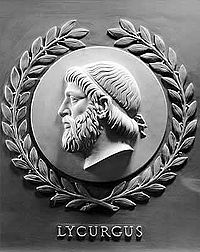
Lycurgus bas relief from the chamber of the U.S. House of Representatives

Like too many of our generation, I was raised and “educated” without acquiring any real knowledge of European identity or our Western tradition. The Classics lay unopened. Though I may have tried once or twice to read them, they always left me baffled. I was too ignorant to even attempt to lessen my ignorance through them. I then did not know where we, our great civilization and family of nations, came from, and I took them for granted. “The West” meant little more to me than a set of very recent and highly questionable values largely imposed in the last century or so.

Having become conscious of my ignorance, I sought to rectify this, and I began reading some of the Classics — especially those of the Ancient Greeks — and, to my joy, I found that this time I could read them and that they often had very relevant insights for our times. I believe the difference is that I am a bit older, a bit wiser, and that I have been able to emancipate myself from the very impoverished view that postwar consumer democracy represents the highest possible form of human life. Having removed my liberal blinders, I could finally appreciate these works.

For the most part, I have not reviewed these works, for they are too subtle and my lights are too feeble to do them full justice. (I have, however, because the relevance and insight were too great, written for The Occidental Observer on the ethnocentric and eugenic themes in Plato’s Republic.) I fear my inferior paraphrases are not much use and I instead encourage the curious to read the Classics themselves.[1]

Nonetheless, I do wish here to highlight a few major insights and themes which I have drawn from my (by no means comprehensive) readings. In so doing, I hope to provide a useful introduction and whet the appetite of my readers to discover our peerless Western tradition. This should not be done in an antiquarian spirit. The Greeks, a brilliant people living in the harsh world of the ancient Mediterranean, discovered truths and techniques of timeless value, things to not memorize, but to live by. If one has understood anything, one begins to see life in a different way, and one begins, however modestly, to change one’s life, day by day. Read more
Plato’s Racial Republic

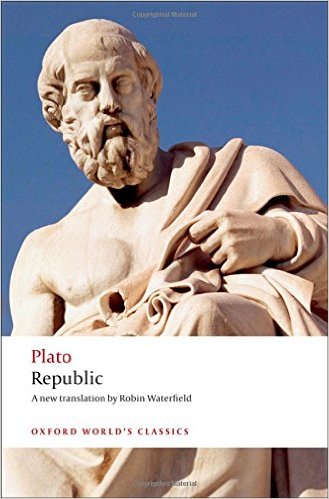
Plato

Plato
Republic (Robin Waterfield Trans.)
New York: Oxford University Press, 1994

Egalitarians have argued that notions of nation and race are largely modern constructs. Marxists in particular have typically claimed that Western ruling classes invented these ideas to consolidate the power of bourgeois states or as a mere pretext to divide the working class along (supposedly imaginary) racial lines and to oppress their colonial subjects.

It is then important to look at the actual record of discussion of tribe, nation, and race in our European tradition. In fact, hereditarian and ethnocentric themes have been present in Western thought from the beginning. An example of this would be Herodotus, the very first historian, who 2,500 years ago already defined being part of the Greek nation through four criteria: common religion, common blood, common language, and common custom.

In this article, I will give an account of racial and ethnic thought in Plato’s monumental philosophical treatise, The Republic, which is widely recognized as the founding text of the entire tradition of Western thought. I will demonstrate the following points:

  • Inequality: the idea that men are created unequal is absolutely pervasive throughout The Republic and is foundational to its ethics. Plato asserts that individuals have inborn differences in physique, personality, and intelligence, in addition to differences due to upbringing.
  • Heredity and eugenics: Plato notes that human differences are significantly heritable and so often refers to eugenic solutions to improve both society and elites, with explicit comparisons to animal breeding.
  • Patriotism: Plato argues that patriotism is a good and compares it with love for one’s family.
  • Greek racial/ethnic identity: Plato argues that “ties of blood and kinship” meant Greeks should not wage war on one another or enslave each other, reserving this for non-Greeks, and that their common identity should be cultivated through joint religious practices.

Plato’s Republic presents a powerful vision of an aristocratic racially-conscious state.[1] The ruling elite, known as the “guardians,” and to a lesser extent the wider citizenry would steadily improve themselves both culturally through education and biologically through eugenics. The elite would reach for the truth through constant reflection and dialectic, while both elite and masses would be conditioned through (civil-)religious education, being taught to consider the pursuit of these cultural and biological goods as a sacred moral imperative.[2] Read more

Time to Subscribe to The Occidental Quarterly

The Summer issue was loaded into subscribers’ area on TOQonline 6/16.
Print journals were mailed 6/15 and will take somewhat longer to arrive than they have in the past.

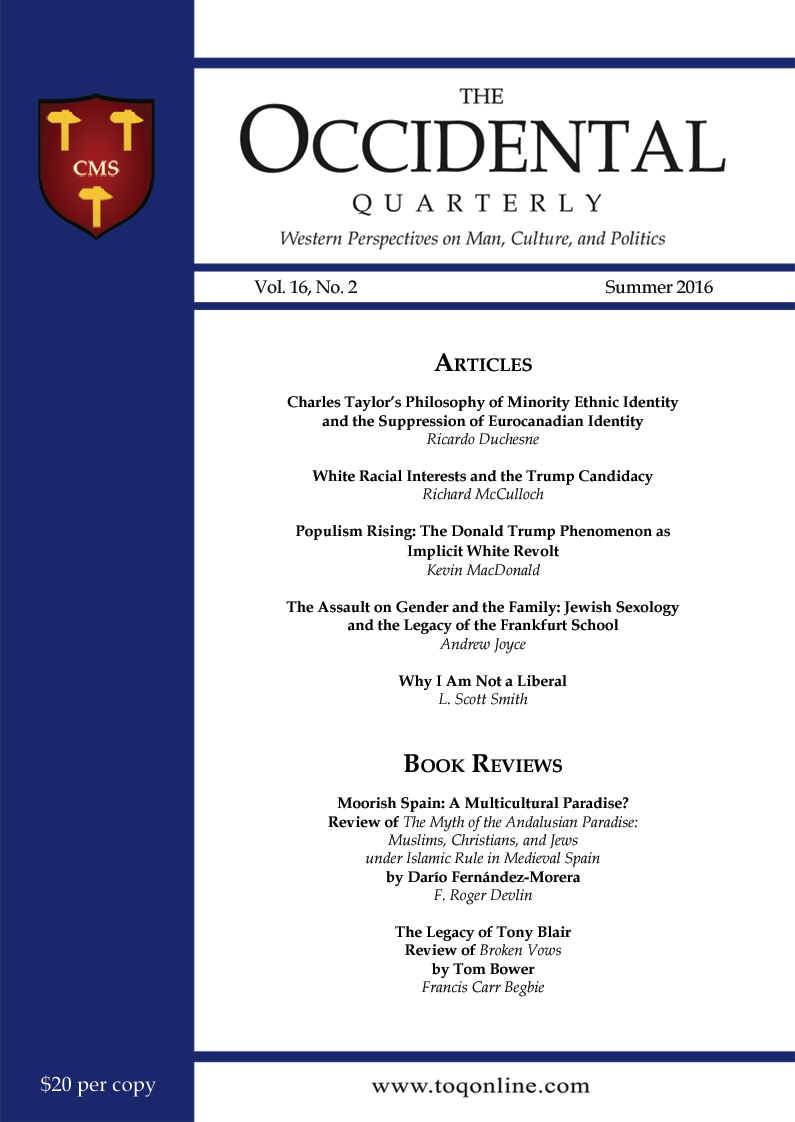
The Occidental Quarterly
6/16: Summer 2016–Vol. 16, No. 2

The Occidental Quarterly - Summer 2016
(Click image to enlarge it.)

The Occidental Quarterly fills a unique niche  in bringing together scholarly articles on a wide range of topics that are mired in political correctness elsewhere.

There are quite a few reasons for the precarious state of our civilization and our people. But one of the main ones is that we have lost the intellectual and moral high ground to a cultural elite that is hostile to our people and our culture.

A main purpose of TOQ is to change the attitudes of White people so that they will feel confident identifying as White and explicitly asserting their interests as Whites. Politically aware Whites must understand that the elites that dominate culture and the political process in the West are intellectually and morally bankrupt.

The domination of the mass media and the academic world by elites that are hostile to White identity and interests is a major barrier for educated Whites to act on behalf of their interests. White people cower in fear of being called a racist for believing and acting in ways that are absolutely normal and natural for all the other peoples of the world. While other peoples defend themselves, their culture and their borders, societies in Europe, North America, Australia, and New Zealand that have been controlled by Whites for hundreds of years are the only ones to accept their demise as a moral imperative. We view this outcome as the result of competition over the construction of culture in which the legitimate interests of Whites have been compromised.

All of the scientific data are on our side. Increased ethnic diversity is associated with a host of societal ills, including decreased support for social welfare programs and lack of public trust. Those who argue that Western societies have a unique moral obligation to cede cultural and political control to non-Whites completely ignore the legitimate interests of Whites. No one argues that countries like Korea or Uganda have a moral obligation to allow other peoples to swamp the native population.

Digital download subscriptions are only $30/year for four issues; subscriptions by mail are only $60/year. Go to www.theoccidentalobserver.net and click on ‘SUBSCRIBE TO TOQ’.

You will not only find the articles fascinating and informative, you will also be supporting the work of scholars who are part of a community defending our people and our culture with the highest level of integrity and intellectual sophistication.

The (very handsome) cover for the Spring 2016 issue can be accessed by clicking here. This issue will be mailed out around March 21.

A Review of “The Mighty Dead” by Adam Nicolson — Part 2

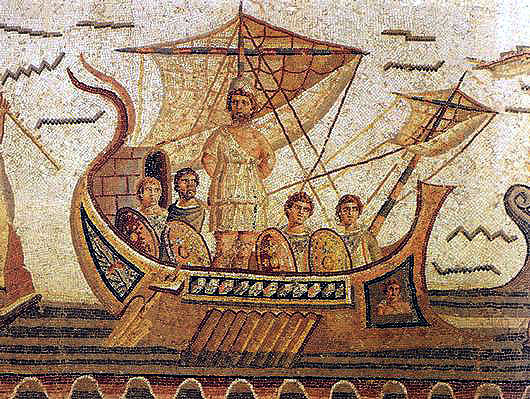
A scene from the Odyssey from a Roman mosaic

A scene from the Odyssey from a Roman mosaic

Part 1

Homer was central to the Ancient Greeks’ conception of themselves and their origins. At their most holy and self-conscious moment, the quadrennial festival of the Panathenaia, the Athenians  “gathered for total immersion in the Homeric stories, drinking up the tales from which most of their great tragedies drew their plots and characters, thinking of Homer as the source of what they were.”[i] According to Nicolson, these origins are fundamentally northern. He observes how, particularly in the Odyssey, the Greeks are depicted as outsiders to the Mediterranean world, with Odysseus portrayed as an impoverished northern wanderer not entirely at home in the Mediterranean world, who, after many trials and tribulations, returns home a broken king, an outsider with few allies. While Odysseus and the other Greek chieftains conceive of themselves as noble kings, the civilized states of the Mediterranean see them as barbarians.

When Odysseus and his crew find themselves facing Polyphemus the Cyclops, the notion of the Greeks as outsiders is manifest. “Strangers, who are you?” the man-eating Cyclops asks them. “Where do you come from, sailing over the sea-ways? Are you trading? Or are you roaming wherever luck takes you over the sea? Like pirates?”[ii]  Nicolson notes that, “he may be the king of Ithaca, the son of Laertes, a man whose fame has reached the sky, but that is not how the world of the Odyssey treats him. Everywhere he arrives anonymous, not somebody but ‘nobody.’”[iii] This epithet features prominently in the same episode from the Odyssey when Polyphemus asks Odysseus his name. Odysseus replies that his name is “Nobody.” When Polyphemus is later blinded and cries out for help, the other Cyclops ask who has hurt and blinded him. “Nobody!” he answers to our amusement. Read more

A Review of “The Mighty Dead: Why Homer Matters” by Adam Nicolson, Part 1

The Mighty Dead: Why Homer Matters is an example of that non-fiction genre so reviled by the anti-White establishment: books that celebrate the European past and the rich and world-transforming culture that emerged from it. Foundational to this culture are the Homeric epics, the Iliad and the Odyssey, which have long been pillars of the Western literary canon. While their place in intellectual life of the West has waned over the last century (casualties of the generalized decline of a now Jewish-dominated culture), they remain as alive as ever for many readers. For author Adam Nicolson, in addition to their imperishable literary value, the Homeric epics should matter to all Europeans because through them “Homer tells us how we became who we are.”[i]

Nicolson is an English writer and journalist known for his scholarly but passionately expressed works on history, landscape and literature. The grandson of noted (and controversial) writers Harold Nicolson and Vita Sackville-West, he recalls being taught Homer at school, where his fumbling knowledge of Greek meant “it was as if the poems were written in maths.” Today most schoolchildren are unlikely to get even that far — with the majority doubtless associating Homer with The Simpsons and its derisive Jewish caricature of the White American father. Nicolson “rediscovered” Homer in middle age when he found himself electrified by the American poet Robert Fagles’ acclaimed verse translation of the Odyssey.

In The Mighty Dead Nicolson argues that the mainstream historical account of Homer is wrong. The current orthodoxy has the Iliad and the Odyssey as products of the early Iron Age Greece of the eighth century BC, or thereabouts. This was a time, often labelled the Greek Renaissance, when Greek civilization, after five centuries of decline and stagnation, saw a revival that culminated in the golden age of classical Athens in the fifth century BC. This rebirth, yet to be fully explained, coincided with a population boom and the rediscovery of bronze-making, a skill that had fallen into disuse in the preceding four centuries. This was a time in Greek history that saw the growth of

colonies, trade, improved ships, gymnasiums, coinage, temples, cities, pan-Hellenic competitions at Olympia (the first, traditionally, in 776 BC), the art of writing, of depicting the human figure on pottery and in the round, the first written law codes, the dating of history. The first tentative moves towards the formation of city-states: every one of these aspects of a renewed civilization quite suddenly appeared all over the eighth-century Aegean. Homer, in this view, was the product of a new, dynamic, politically inventive and culturally burgeoning moment in Greek history. Homer was the poet of a boom.[ii]

Read more

Northern Europeans less prone to “blaming the other”

A recent paper by Sebastian Pothoff et al. published in Personality and Individual Differences finds that Northern Europeans (Germany, Netherlands) are less likely to “blame the other” than Southern Europeans: “Self-blame includes thoughts that relate to blaming yourself for a traumatic or stressful event. Other-blame is the process of blaming others for what happened to yourself.”

They also discuss evidence that northern Europeans score lower on power distance, where power distance refers to the degree to which less powerful people in a culture accept power inequalities; in other words, Northern Europeans are more egalitarian.

These findings fit well with the theory that there is a north-south cline in individualism and egalitarianism (see here toward the end), with the north being higher on both. Re egalitarianism, Scandinavian society in general has a history of relatively small income and social class differences. An anthropological study of hunter-gatherers found that the economic inequality approximated that of modern Denmark (Eric A. Smith, et al.,  Current Anthropology.51(1),19–34, 2010).

The difference in other-blame is particularly interesting in that it is consistent with the idea that Northern Europeans more readily take the point of view of the other when assigning blame. I think this is part of the deep structure of individualism. When Michael Polignano wrote a book titled Taking Our Own Side, he put his finger on a major problem for Western individualists: We tend to take a neutral point of view in moral issues — not biased in our own favor or what’s good for our group. We tend to take the point of view of the emotionally disinterested, rational observer, not swayed by personal interest. So we are less likely to blame others for problems and try our best to see the situation from the other person’s point of view. Read more

The Testament of a European Patriot: A Review of Dominique Venner’s “Breviary of the Unvanquished” (Part 2)

Dominique Venner in his youth

Part 1

We Heretics: A Thankless Struggle

Venner has no doubt that, if we are to live amidst the existential threats against us, we must struggle. Again illustrating his attraction to the heroic Western tradition noted in Part 1, struggle is integral to life. In a particularly inspiring passage for those of us at war with the present system, Venner writes:

To exist is to struggle against that which is denying me. To be unbowed does not consist in collecting heretical books, dreaming of fantastical conspiracies, or taking to the maquis in the Carpathians. It means holding oneself up to one’s own standard in the name of a higher standard. To be loyal to oneself in the face of the void. To ensure one is never cured of one’s youthfulness. To prefer alienating people to living on one’s knees. Amidst the setbacks, to never ask oneself the question of the uselessness of the struggle. We act because it is disgraceful to give up, and it is better to go down fighting than to surrender. (28)

Venner often notes that history is filled with surprises and unexpected reversals. As a result, the demobilization caused by hopelessness is somewhat irrational and in any case unhelpful: You never know in what circumstances our labors could prove salutary. Read more