
Western Culture

Babel and the Capitalist Babelization

Review of Babel Inc.: Multiculturalism, Globalisation, and the New World Order
by Dr. Kerry Bolton
Black House Publishing Ltd, 2013

The tower of Babel is rightly used as a metaphor for contemporary rootless and mongrelized masses stashed together in the towering inferno of end times. As an allegory, however, the process of “babelization” signifies a distorted reality and an inhumane political process in which standard forms of cognition and speech are subject to entirely new denominations, requiring a completely different method of conceptualization. Attempting, therefore, to draw some parallels between George Orwell’s 1984 and Bolton’s Babel Inc., cannot be valid; Orwell’s vision of the static future has become outdated.  Bolton’s Babel Inc. offers, instead, a dynamic description of the process of capitalist entropy in which Babel Inc. and its ruling class continue to grind human beings, including themselves, to dust.

Which are these ruling classes in this Babel Inc.? This is where the author masterfully steps in and rejects the wide-spread right-wing babble about the Babel Inc. being allegedly run by a conspiratorial and homogenous group of wicked people, or some extra-terrestrial golems allegedly bent on ruling the White world. Rather, the Babel Inc., or simply put,  the System, resembles a nameless, albeit grotesque polity that can in no way be reduced to just one single free-lance Orwellian big brother or some big postmenopausal feminist mama. The Babel Inc., as Bolton sees it, is a logical postmodern transposition of the myth of economism and egalitarianism, two doctrines whose genealogy can be traced from well before the period of Enlightenment in Europe. Read more

Two White Guys, Caldwell and Jorgeson, Conquer El Capitan

Extreme sports is a context for implicit Whiteness:

Extreme athletes exist in an implicitly White world where they associate only with other White men—“a racially and gender exclusive place” where White men “can un-apologetically perform an ideal masculinity which they cover by taking death-defying risks, enduring the pain of participation and displaying an unwavering confidence and coolness in the face of apparent danger.” …

White men jumping off buildings and sky surfing are reenacting a fundamental script of Western culture—the same script that underlies Western energy, inventiveness, exploration and creativity. “Extreme Sports as a Context of Implicit Whiteness

As Domitius Corbulo notes in his comment on the vast overrepresentation of Europeans as explorers:

Exploration is not only a popular subject, but one filled with fascinating stories of human greatness, heroic will, and stamina against immense odds and hardship—exactly the sorts of traits that, according to cultural Marxists, should not be found to be unusually common among Europeans. …

Roughly speaking I counted about 75 great European explorers in the period from about 1800 to the present, men (and a few women) who dedicated themselves to the discovery of the unknown, reconnoitering every place of the planet, climbing the highest mountains, penetrating into the deepest crevices of the oceans and high above in space. This history is rarely taught in our schools and universities; it has been virtually banned, or slandered by charges of imperialism.

Tommy Caldwell and Kevin Jorgeson exemplify these traits, with a strong dose of perseverance and incredible bravery. They have succeeded in a free climb of El Capitan, in Yosemite National Park. “Free climbing” is climbing from ledge to ledge using only the natural features in the rock, using ropes only for protection in case of a fall, and not relying on gear for upward progress. The photos below give some idea of the challenges involved.

Read more

The Rotherham Pathology

The horrifying scandal in Rotherham (previous versions covered copiously for TOO by Tobias Langdon) continues to unfold. A report commissioned by the city council stated that at least 1400 children were sexually abused over 16 years.

It is hard to describe the appalling nature of the abuse that child victims suffered. They were raped by multiple perpetrators, trafficked to other towns and cities in the north of England, abducted, beaten, and intimidated. There were examples of children who had been doused in petrol and threatened with being set alight, threatened with guns, made to witness brutally violent rapes and threatened they would be next if they told anyone. Girls as young as 11 were raped by large numbers of male perpetrators. This abuse is not confined to the past but continues to this day. … One young person told us that ‘gang rape’ was a usual part of growing up in the area of Rotherham in which she lived. …

Within social care, the scale and seriousness of the problem was underplayed by senior managers. At an operational level, the Police gave no priority to CSE, regarding many child victims with contempt and failing to act on their abuse as a crime. Further stark evidence came in 2002, 2003 and 2006 with three reports known to the Police and the Council, which could not have been clearer in their description of the situation in Rotherham. The first of these reports was effectively suppressed because some senior officers disbelieved the data it contained. This had led to suggestions of cover- up. The other two reports set out the links between child sexual exploitation and drugs, guns and criminality in the Borough. These reports were ignored and no action was taken to deal with the issues that were identified in them.

Read more

Žižek, Group Selection, and the Western Culture of Guilt

I am not going to try to figure out why academic left superstar Slavoj Žižek would want to review The Culture of Critique but he did (Steve Sailer: “Slavoj Žižek on Kevin MacDonald’s Culture of Critique“). Perhaps it’s part of his persona where he writes things that are jarring and paradoxical — which is what I get from this review of one of his books. Anyway, as everyone knows, he plagiarized his review from Stanley Hornbeck’s review in American Renaissance. (He now says that a friend sent him the review and said he could use it under his name.)

The horrors! The giveaway, as Sailer notes, was that his review was far more lucid than his usual writing, prompting an alert blogger to actually make a side-by-side comparison, on the basis of which it is only reasonable to say that he stands convicted.

All that is amusing but of no real consequence, although one could hope for a bump in book sales. But Sailer’s blog has attracted ~250 comments at this writing, mainly expressing opinions on my work in general. After reading quite a few, it seemed to me that there were quite a few very articulate defenders of the basic ideas expressed in Culture of Critique, etc.

This is a link to all the reviews of Culture of Critique I am aware of (excluding Žižek , but who needs Žižek  when you have the original?). This includes John Derbyshire’s review in The American Conservative as well as my reply. The only review to appear in an academic publication is Frank Salter’s which is excellent; Paul Gottfried also reviewed it in Chronicles Read more

Tales of Blood and Gods: Some Thoughts on Religion and Race

asatru

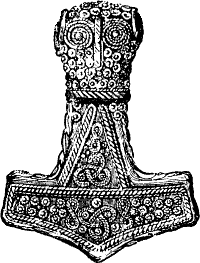
Mjolnir, the hammer of Thor; one of the major symbols of Ásatrú.

“How strangely things grow, and die, and do not die! There are twigs of that great world-tree of Norse belief still curiously traceable.”
Thomas Carlyle, Lectures on Heroes, 1841. 

I come from a long line of atheists, heretics, and breakers of convention. I’m sceptical about anything related to what’s considered the paranormal or supernatural. I don’t think I’ve ever held an honest religious belief. I consider myself, above all, to be an ardent rationalist. I look for facts, I weigh evidence, and I attempt to come to measured conclusions.

Despite this, I’ve never had a problem with religion qua religion. I like the idea that there is more to our existence than what can be seen, and I am happy for any collection of sky-searchers to worry about my soul so long as those who believe in their chosen deity or deities refrain from interfering in my “real” interests. A Muslim in Riyadh can dictate to the females around him as he pleases; it doesn’t concern me. It does concern me, however, when that Muslim wishes to import his beliefs and attending actions (not to mention about one hundred equally ‘pious’ relatives) into my locality.

Closer to home, I can’t say I’ve had much of a problem with Christianity among my fellow Whites. In fact, I have a number of Christian friends; as a group they’re a polite bunch, and normally seem quite cheerful. A few of them had struggled with depression and myriad social difficulties until they “found Jesus,” so perhaps there is something to be said for the palliative benefits of that faith; and perhaps this explains, more than any other fact, its endurance and appeal in all ages.

However, controversial though it may be to say it, it occurs to me that Christianity is coming more and more into conflict with what I perceive to be my interests and those of my ethnic group. Curiously, for a religion which grew like a weed from the rabidly ethno-centric soil of Judaism, Christianity has been anything but a friend to the ethnic group which breathed life into it, energized it for centuries, and took it to the four corners of the earth. The source of almost unceasing fratricidal conflict for centuries, the Church now reveals itself a party to the abolition of the European peoples. In the past, when Europe, North America and other White nations were ethnically homogenous (and confidently so) some of the fundamental conflicts between ideas of the “universal man under God,” and an acknowledgement that one was part of a specific ethnic community with concrete interests, could be masked. Not so in this brave new world. Only since the 1950s can we assess the utility of the Christian faith in acting as a boon to the folk who for centuries granted it lordship over them. And in the assessment of this writer, it has been found wanting. Read more

Alexander Dugin’s “The Fourth Political Theory” is for the Russian Empire, not for European Ethno-Nationalists

Only a rare few in the alternative right knew Alexander Dugin before the publication and translation of his book, The Fourth Political Theory, in 2012. Suddenly, the contents of this book became the subject of lively discussion and he was hailed as “arguably the most prominent New Right thinker in the world.”  With the exception of Michael O’Meara at Counter Currents, most of the reviews were very positive or at least sympathetic.  After reading reviews, interviews, blogs, articles, and listening to some video lectures by Dugin, I decided to read The Fourth Political Theory (FPT).

Through the first pages, I was fairly impressed by Dugin’s laconic treatment of the way liberalism had created the normative conditions for a humanity predisposed toward a world government in its “glorification of total freedom and the independence of the individual from any kind of limits, including reason, identity (social, ethnic, or even gender), discipline, and so on” (18). With the “liberation” of man from any necessary, pre-ordained membership in any community or identity, and the universal morality of human rights widely accepted, few obstacles now stood in the way of a totalitarian global market.

Dugin is a patriot and I agree that Russia must act as a counter-hegemonic power against the spread of American Hollywood values and the continuing expansion of the EU inside former Soviet territories. Read more

Review of Mjolnir: Magazine for the Creative Arts

MJOLNIR

Mjolnir: Magazine for the Creative Artss
Issue 1: Blast Off
David Yorkshire, Editor

“Leftism is the lie writ large. In any case, the right knows that equality itself is a fabrication and can only be achieved and maintained by holding back those who strive for excellence. The opposite of equality is quality. So it is with art. Quality is known instinctively: go into any art gallery and answer honestly which you prefer, Ian Davenport or J M W Turner. Mjolnir stands for quality; Mjolnir is therefore elitist and promotes spiritual elitism in all its forms.”

Mjolnir Magazine

Reading like a Searchlight international list of traditionalist writers, reviewers, and artists, Mjolnir’s table of contents includes David Yorkshire (editor of Mjolnir, writer for Western Spring), Jez Turner (the founder and chairman of the IONA London Forum) reviewing A K Chesterton’s Leopard Valley, Gina Hunt reviewing David Hamilton’s Culture Wars, Boris Nad (Serbian author, artist and revolutionary thinker.), Dragoš Kalajić (“one of the most significant artists, visionaries and Traditionalists of our European culture in the last quarter of the 20th century”Open Revolt.info), southern traditionalist writer Patrick McClary, Yorkshire romantic-realist landscape artist J W Foster, a pseudonymous Australian poet going by the handle Clarence Cadel , and H P Lovecraft. Oh, and me*. Read more



