Aristotle: The Biopolitics of the Citizen-State, Part 2
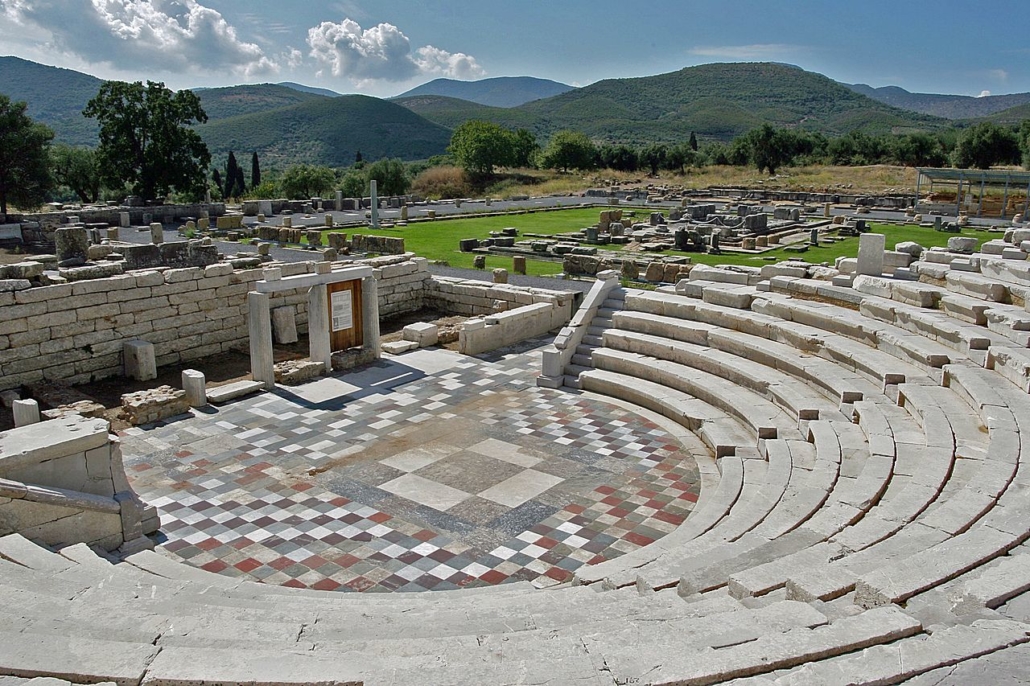
The ekklesiasterion, or assembly meeting place, of Messene, where civic debates were held
Aristotle’s Republic of Virtue
From these biopolitical premises, Aristotle wholeheartedly agreed with the communitarian ethos which the Greeks took for granted. As the philosopher explains: “the goodness of every part must be considered with reference to the goodness of the whole” (1260b8) and “a whole is never intended by nature to be inferior to a part” (1288a15). Indeed, Aristotle’s definition of a community-centered notion of justice may well be incomprehensible to many moderns: “The good in the sphere of politics is justice; and justice consists in what tends to promote the common interest” (1282b14). How many political discussions today — whether about abortion, gay marriage, immigration, economic policy, or whatever — refer to the common good rather than to solipsistic arguments about individual or sectoral ‘rights’ and ‘fairness’?
Aristotle is decidedly more ‘bourgeois’ and less spiritual than Plato. He has far less to say about the role of religion in the good society, this being practically an afterthought. He seems to hope for, at best, a stable and moderate regime, one respecting the interests of both rich and poor, founded upon an enlightened citizenry composed of independent landowners and responsible citizen-soldiers. But Aristotle also had an elevated notion of what politics should be about. In his own time, he contradicted those who believed that the state exists only as a kind of contract between individuals, meant only to guarantee their security or to enable them to chase after coin.
For Aristotle, man fulfills his nature as a rational being through philosophical contemplation and active citizenship. But only a minority have the intellectual gifts necessary to do this, and furthermore, as a practical matter, the work of servile subalterns is necessary to secure the necessary leisure to pursue philosophy and politics. Hence, Aristotle notoriously endorses a doctrine of natural slavery: barbarians and the morally defective are incapable of freedom and hence are only fit to be slaves of better men, thus enabling the latter to fulfill our human potential. Natural slaves are those who, either as individuals or as entire peoples, are so poorly endowed in reason that they may only participate in it as the servants of superior men. Aristotle observes: “what difference, one may ask, is there between some men and the beasts?” (1281b15). The recognition of inequality, enabling the creation of a just community and hierarchy, is no less central to Aristotle’s ethics and politics than those of Plato. Read more