• MISSION STATEMENT
  • TERMS
  • PRIVACY
The Occidental Observer
  • HOME
  • BLOG
  • SUBSCRIBE TOQ
  • CONTACT USPlease send all letters to the editor, manuscripts, promotional materials, and subscription questions to Editors@TheOccidentalObserver.net.
  • DONATE
  • Search
  • Menu Menu

Paul de Lagarde on Jews and Indo-Europeans, Part 1 of 3: German Opposition to Judaism and Its Relation to Christianity

August 12, 2022/13 Comments/in Anti-Jewish Writing, Featured Articles/by Alexander Jacob PhD

Paul de Lagarde on Jews and Indo-Europeans; [extract from Ch. 13: “Juden und Indogermanen” (“Jews and Indo-Europeans”) of Mittheilungen (Cummunications), II (1887).]

Translated by Alexander Jacob

Paul de Lagarde (1827–1891) was a distinguished Orientalist and Biblical scholar who was appointed Professor of Oriental Languages at the University of Göttingen in 1869. He was a prolific author, and many of his books remain in print. Lagarde (who was born Paul Bötticher but adopted Lagarde from his great-aunt’s surname) also contributed to the development of the ideology of the Conservative Party of Prussia, especially in the essays collected in his Deutsche Schriften (1878).[1] As a theologian, he was in favour of a return to an original Christianity that predated the established Church, whether Roman Catholic or Protestant, and he encouraged the development of a new religion that would be fully nationalist in form and feeling. His anti-Semitism, displayed in many of his essays, was based on the fact that the Jews always constituted a nation within a nation and one that was deleterious to the host nation. The arguments he presents in this last section of Chapter 13 of his 1887 work, Mittheilungen II, are consequently pivoted on the primary mistake of Jewish emancipation and on the rapid social depredations that Jewry was enabled to undertake as a result of this unfortunate event.

*   *   *

I find that the term ‘anti-Semitism’ requires explanation.

Europe suffers from some peoples who belong to an earlier human epoch and remain from the latter, incapable of development as nations—the gypsies, the Basques, the Irish, the Jews.

Of these, the gypsies can remain outside consideration. They are acknowledged to be a burden on Europe but a burden that can be borne.

The Basques make life difficult for the Spanish: for the Carlists[2] would be impossible if they did not repeatedly find in the Basques the point from which they could plunge the Iberian Peninsula into a civil war.

What the Irish are for Great Britain and—through their influence on the politics of Great Britain incapacitated by them—directly for all of Europe is known to everybody.

That the Jews groan under the hatred, the contempt, the aversion of the people of Europe is a fact so obvious that the Jews themselves will not deny it quite easily; that, however, the people of Europe have more than sufficient reason for those feelings follows naturally from the fact admitted by the Jews.

I speak here of the Basques, the Irish, the Jews as nations, for individual Basques, Irishmen and Jews have at all times been accepted in their midst happily and cordially by the Europeans.

These four nations raise the claim to live in the Europe of the nineteenth century under conditions which this Europe is not in a position to grant. They wish to be foreigners and citizens at the same time, nourish views of long-lost centuries and nevertheless be allowed the full possession of all the rights of modern men.

As a consequence, they are not only foreign to us but also abhorrent. They act on us like antipathetic guests with whom one cannot come to any understanding because one wishes always that they would go away.

We Germans know that we are of Indo-Germanic, Aryan origin. But we do not feel as Indo-Germans or Aryans but as Germans separate from the Romans and Slavs—who likewise belong to the Indo-Germanic family—and separate from even the non-German Teutons.

If we all together, with the exception of the strictly progressive people, reject the Jews not as Jews but as Semites or, in rarer cases, as Phoenicians, there is in this expression at the same time the reason why we do it: the instinct of the people has, without knowing what is happening to it, stamped the term, and the view underlying the term is therefore also right: it has emerged from the psyche of the nation. I recall an expression of similar import: ‘reptile’.[3] We are anti-Semites because Jewry living among us in the nineteenth century and in Germany represent views, customs, and claims that date back to the times after the division of the races close to the time of the Flood and, because they do, seem as strange to us as flint knives and nephrite arrowheads. We are anti-Semites, not anti-Jewish, because in the middle of a Christian world the Jews are Asiatic heathens. Circumcision and the dietary laws of the Jews are atavisms. The monotheism of the Jews stands on the same level as the report of a petty officer commanded to the commissariat who announces the existence of only one copy of any object: one God, two tables, three fathers, four mothers, and the 2307 Passover foods to be found in nature. The belief in the chosenness or, as it is now called, the “world-historical mission” of Israel then crowns the absurdity: a people who through the centuries have not produced anything for history—name one if it really does exist—are able to shout in the face of the Indo-Germans—who have indeed developed everything on which we live—that they are the favourite people of God.

Thousands of Israelites were accepted into the German nation—I limit my observation to it—before 1830, have amalgamated into it and the descendants of those who were first converted have already no inkling any more that they originate from Israelites. This amalgamation, however, proceeded so felicitously only because the people accepting made no bones about the fact that they were the ones giving, the ones drawing others up. Even the Jews leaving the old racial community without clear knowledge knew fully, at that time, that they were improved by the conversion, that they had escaped a fully unsustainable condition, a “heathen religion,” as Goethe had told them in Wilhelm Meisters Wanderjahren 2,1, that they had been permitted into a nation that could not be mentioned in the same breath as the Jewish nation, one of the earliest in history, that they were able to become men first through the conversion to us. We Germans were, and are, obliged to give individual Jews our best; but it is a betrayal of our best, it is a gross ignorance of our property and our life, if we call this Asiatic famed for intellectual gifts that are not existent equal to ours. We enjoy now the fruits of the tree planted by our liberal and humane grandfathers and fathers. The first condition of achieving peace with the Jews, of benefiting the Jews as well as ourselves, is that of returning—even after the unfortunately declared emancipation—to the standpoint of the time before the emancipation. The Jews will become Germans only if they always hear from us that they are not yet that, and that they, as Jews, present to us nothing but a burden that is for us odious and useless for history by continuing to carry that upon which we squander strength that can be better employed.

But, after the emancipation, the Jews are rather worse than what they were before. We told them that they are equal to us, had the same rights as us: in thanks the Jews tell us that they are better than us and we have to learn from them.

Anyone who matters knows that the modern education of Germany, insofar as there is one, is based on the Germanic character of the people, of which also their monarchical sensibility is a part, next, on the Church, and third on the effect of the spirit of the Greeks. Anybody who matters knows that we Germans are a historic people.

Since they were emancipated, the Jews have done more than just begin to deny all of that, to speak to us about their Asiatic rubbish as our salvation; they are also so insolent as to expect a rejection of our history. In political life they always stand on the side of the progressives standing in the way of all progress who demand that we build a house without foundation, who call it freedom not to become free and tolerance to act like apes.

Mr. Kaufmann explains on p. 45: “I shall not be silent for the sake of Zion.” He speaks in the manner of Deutero-Isaiah 62.1.7,[4] That had been done before him already by K. Lippe, M.D., and Mr. Lippe appears as a protector of our sacred sites, of our immortal ancestral heritage, of the humane law-giving of Zion and the pure civilisation of Jerusalem.

What do Zion and Jerusalem have to do with the fellow countrymen of Siegfried and Hermann? Mr. Delitzsch,[5] as a Protestant and Jew, Mr. Kaufmann and Mr. Lippe, as Jews, are not at all in a position to understand what the circumstance means that Luther has changed—and how!—the ancient Church forms of the names of the Old Testament in his contrary wisdom. HEBREW and HEBREW= Zion and Jerusalem are suitable only for the Jews, and for the Jews as Jews; the Church became acquainted with, and named, those places not through the Jews but through the mediation of the Greek-speaking synagogue and with the sense that these Hellenistic synagogues imparted to the place names translated into Greek; the Church then further placed its interpretation in the tradition dating therefrom, and that is why the Church speaks of Zion and Jerusalem and considers the people speaking of Zion and Jerusalem as ἐθvιxoí [ethnikoi], as heathens. The Church sings the best Psalms, those expressing most fully the regular religious service of the ancient synagogue, the cantica graduum (119–133=120–134),[6] according to the synagogue, but it sings these in its own sense. Zion and Jerusalem are, for Germans who have not sunk into Liberalism and Protestantism, nothing at all, for the Jews as important as the Forum in Rome for the Italians, the Kaaba for the Mohammedans. But even the German born after the heartless and mindless Reformation, still full of the ancient faith, sighs

Jerusalem, thou lofty city,
God will that I were there.

And the theologian who has studied his subject knows very well how he has to deal with the passages in the Letters to the Hebrews, which my readers may wish to consult 12,22,13,14. Zion (rather, Çiyyón), Jerusalem, Ezekiel=Kaskel=Yeḥezqeél, Yirmeyohu or the Jeremiah of Ewald[7] and his five-penny pupils are, for sensitive men all over Europe, not at all existent. One who praises them to us—quickly over the border with them! Our “Lord” arose from the Adonai of the ancient synagogue read as Yahweh; the new synagogue, which has become Jewry, that is, ἔθνος [ethnos], understands neither Adonai nor Yahweh; it must throw aside the significance of these names—which became apparent first to me—for Yahweh and Adonai lead to the Lord of the Church, whom the Protestants do not recognise and the Jews ridicule and malign.

Related to the explanations of Mr. Kaufmann and Mr. Lippe is the answer that Goethe gave in Wilhelm Meister’s Wanderjahre 3, 11:

We tolerate no Jew among us; for, how can we grant him a share in the highest culture, whose origin and convention he denies?

Here nobody objects that Goethe was in his old age a man of a past age who had become childish—one hears now many things. I cite from the Vossische Zeitung, certainly a paper that is not suspicious, from 19 April 1884, the approval of the “golden sentence that should be pondered on” that Alfred Christian Kalischer, a baptised Jew, ventured in a volume on Spinoza published by Franz von Holtzendorff:

It cannot be in the long run acceptable to want to constantly sustain a nationality at the cost of the eternal eradication of that spirit of this nationality that all epochs of creative cultured peoples praise and respect as their most excellent divine spirit.

Much is to be objected to in Kalischer’s sentence: One must acknowledge that the merely reactionary aspect of Jewry, these cinders of an age that has long been burnt out, is judged by him clearly enough.

The view expressed here would long ago have been the universal one if Protestantism had not stood in its way, itself a cinder like Judaism. Mr. Moritz Lazarus[8] has, in his writings to the German Jews, 10,11, cited the statement of a man of “famed Christian piety,” the Privy Church Counsellor, Franz Delitzsch:

On the part of the Christians there enters into the anti-Semitic movement an un-Christian racial hatred that cries out to the heavens and, since the roots of Christianity are the same as those of the Old Testament religion, represents the disgusting conduct of a bird that dirties its own nest

Mr. Delitzsch would perhaps have come out better from this affair since he himself is of Jewish origin, thus an interested party. If that which is propounded in the sentence just quoted, which is ill-considered beyond pardon, should be taken as Protestant theology this theology no longer deserves to be considered as a subdivision of Christian theology.[9]

The Church does not recognise any Judaism and any Christianity but the Old Testament and the New Testament: the form of the latter is the Church. The Church teaches that Christ was conceived by the Holy Spirit, born of the Virgin Mary, and rejects through these formulae every connection of the head of the Church, and therewith of the Church, with Judaism. The Church calls Jesus the Christ, that is, it sees in him the fulfiller not of the old expectations of Judaism but of the old promises of God. The Church calls Jesus Christ the Lord, that is, it finds in him the Yahweh of the Old Testament, not the one belonging to the Semites or one of their race, but to the theologians of Israel, the ones who called forth the promises of God into being. It is not true that the Jews living today adhere to the “religion” of the Old Testament, for one who speaks of the Old Testament recognises therewith a New Testament. It is not true that the canon of the synagogue has been the central point of the life of any Jew after Christ for, although it modelled its expressions after this canon, the synagogue further matured through the Mishna and the Gemara to the Neoplatonism and Aristotelianism of the Middle Ages transmitted by the Arabs to the Jews and, thereafter, through the Deism of the English to Mendelssohn,[10] Geiger,[11] Holdheim,[12] Graetz,[13] Lazarus, Lasker,[14] Sonnemann,[15] Sabor[16] and Singer.[17] In the course of this development, whose direction will not be unclear to anybody, the race remained identical, only the clothes with which the race covered—and covers—its shameful nakedness have changed. But the fourth Gospel [according to John], the most anti-Jewish book of the New Testament, maintains in 1:13 against the Jews that the children of God are not produced by the blood (of Jewish patriarchs) and not out of the flesh and the will of man but by God; this Gospel  recognises, in 4:22,23, that salvation derives from the Jews but it sets the genuine worship of God in spirit and truth in opposition to the Jewish worship; this Gospel announces straightforwardly, in 3:5, that one who is not born from above cannot see the kingdom of God; it therefore denies that which the Bible-believing Royal Saxon Privy Church Counsellor teaches, that a Christian dirties his own nest when he sets forth against the unashamed claims of a nation that once, through its prophets and pious men, stood closer to the Church than the other heathens, through their sibyls and prophets, from which however the light and warmth has disappeared because they were foolish enough to consider the revealed and gifted wealth as the fruit of their own natural development.

Go to Part 2.


[1] For my translation of part of this work, see Alexander Jacob, Europa: German Conservative Foreign Policy 1870–1940 (University Press of America, 2002).

[2] Carlism is a legitimist movement that began in Spain around 1830 and sought to establish the dynasty of Don Carlos (1788–1855) on the Spanish throne. It lasted until the Spanish Civil War, when the Carlists allied with General Franco. The movement found regular support in the Basque territories and among the Basque nationalists.

[3] Lagarde: See my Deutsche Schriften, in Vollständige Werke (Complete Works), 448ff.

[4] “For Zion’s sake will I not hold my peace, and for Jerusalem’s sake I will not rest, until the righteousness thereof go forth as brightness, and the salvation thereof as a lamp that burneth.”

[5] Franz Delitzsch (1813–1890) was a Protestant Hebraist who was assumed by many to be of Jewish descent. He attacked both the anti-Semitic movement in Germany and the attacks on Christianity in the Jewish press.

[6] Bartolomeo Botta’s edition of Psalms, the Cantica graduum was published in Milan in 1563.

[7] Heinrich Ewald (1803–1875) was a German orientalist and Protestant theologian.

[8] Moritz Lazarus (1824–1923) was a German-Jewish philosopher who established “Völkerpsychologie” (national psychology) as a branch of philosophical studies.

[9] LaGarde: Cf. the Complete Edition of my [Lagarde’s]  Deutsche Schriften, 292, 293.

[10] Moses Mendelssohn (1729–1786) was a philosopher and theologian of the “Haskalah” or Jewish Enlightenment.

[11] Lazarus Geiger (1829–1870) was a philologist and philosopher.

[12] Samuel Holdheim (1806–1860) was a rabbi and a leader of early Reform Judaism.

[13] Heinrich Graetz (1817–1891) was a Jewish historian and apologist who wrote a 11-volume Geschichte der Juden (History of the Jews) (1853–1875).

[14] Eduard Lasker (1829–1884) was a Liberal politician.

[15] Leopold Sonnemann (1831–1909) was editor of the Frankfurter Zeitung and a founding member of the Liberal “Deutsche Volkspartei.”

[16] Adolf Sabor (1841–1907) was a Social Democratic member of the Reichstag.

[17] Paul Singer (1844–1911) was a founding member of the Sozialdemokratische Partei Deutschlands (SPD).


https://www.theoccidentalobserver.net/wp-content/uploads/2018/06/TOO-Full-Logo-660x156-1.png 0 0 Alexander Jacob PhD https://www.theoccidentalobserver.net/wp-content/uploads/2018/06/TOO-Full-Logo-660x156-1.png Alexander Jacob PhD2022-08-12 08:25:022022-08-13 07:41:05Paul de Lagarde on Jews and Indo-Europeans, Part 1 of 3: German Opposition to Judaism and Its Relation to Christianity

Canada Outlaws “Condoning, Denying or Downplaying” the Holocaust Mythos: Jewish Political Theology Enshrined in the Criminal Code

August 11, 2022/54 Comments/in Featured Articles, Free Speech/by Prof. Andrew Fraser

According to the OED, a “mythos” is a “traditional or recurrent narrative theme or pattern; a standard plot in literature.”  For many, the Holocaust Mythos conjures up the hope of universal redemption from the absolute evils of racism, anti-Semitism, and militant White nationalism.  Arising out of the allegedly planned extermination of the Jewish people by “Nazi” Germany and its collaborators, the story has acquired canonical status in officially-constructed “memory cultures” throughout the West.  In Canada, where the politically correct Trudeau regime clearly craves recognition as a humanitarian superpower, the government has followed in the footsteps of Germany and several other European states by enshrining the official narrative in the Criminal Code, s. 319.  Henceforth

(2.1) Everyone who, by communicating statements, other than in private conversation, wilfully promotes antisemitism by condoning, denying or downplaying the Holocaust

  • (a) is guilty of an indictable offence and liable to imprisonment for a term not exceeding two years; or
  • (b) is guilty of an offence punishable on summary conviction.

Even before the criminal law was amended to outlaw the “[w]ilful promotion of antisemitism,” schools, universities, churches, and the media in Canada routinely stigmatize anyone who publicly dares to doubt the truth of the Holocaust Mythos.  The Canadian parliament, therefore, meekly echoed Jewish historian Alon Confino who describes the Holocaust as “a foundational event that tests the limits of our humanity.”  Another Jewish historian, Matthew Feldman, acknowledges that the received interpretation of “the Holocaust” as “history’s greatest crime” emanates a quintessentially religious aura.  No Member of Parliament wanted to be seen “profaning” the memory of Jewish victims of “the supreme example of human inhumanity” by voting against the proposed amendments.  For its part, the Trudeau government can be confident that enforcement of its postmodern anti-blasphemy law will not be impeded by the much-hyped Charter of Rights and Freedoms.  For a long-time Charter sceptic such as myself, this is no surprise.

After the massive violations of a host of fundamental rights and civil liberties supposedly “guaranteed” by the Charter during the recent Covid pandemic, suppression of presumptive rights to form and publicly express controversial opinions on the history of the Third Reich is about par for the course.  Is it merely coincidence that this restriction of free speech reflects the power and serves the interests of one particular, highly-visible, economically well-endowed, socially privileged, and politically powerful ethnic group?  Curiously enough, at least one prominent Jewish spokesman fears that to make “condoning, denying, or downplaying the Holocaust” a criminal offence will not be good for the Jews.  Nevertheless, Carolyn Yeager, an American blogger of German ancestry, has documented the widespread support for such legislation within the organized Jewish community in Canada.

When it was announced, the text of the Trudeau regime’s proposed amendment to the Criminal Code was buried in Annex 3 of the federal budget papers presented to Parliament in the spring of 2022.  By the end of June, the government’s amendments had sailed through Parliament as part of a long and complex budget bill, receiving royal assent without debate on their merits (much to the relief of MPs, one suspects).  The current legislation adopts the definition of the Holocaust originally proposed in a private member’s bill blatantly mirrored by the government measure; namely:

Holocaust means the planned and deliberate state-sponsored persecution and annihilation of European Jewry by the Nazis and their collaborators from 1933 to 1945

As it happens, such a definition has been repeatedly “denied” or “downplayed” by the so-called “functionalist” school of mainstream historians who portray the Holocaust as an evolving reaction by bureaucrats, military personnel, and collaborators to events during the war years rather than the product of an “intentional,” “planned” or “deliberate” scheme directed from the top down.  It remains to be seen whether s. 319(3)(1)(c) will provide an adequate defence for someone publicly promoting a “functionalist” interpretation of the Holocaust.  According to this provision, no-one shall be convicted if “the statements were relevant to any subject of public interest, the discussion of which was for the public benefit, and if on reasonable grounds they believed them to be true.”  This defence does not, of course, prevent prosecutions in which the process is itself intended to serve as the punishment.  Outside the respectable realm of decorous academic debate, however, renegade “revisionists” risk the full measure of legal retribution.

Why, then, is the foundational event of Christianity, the paschal mythos surrounding the death and resurrection of Jesus Christ, less deserving of protected legal status than an officially prescribed, crypto-theocratic single-sentence story arising out of the Second World War?  Is it merely coincidental that the Holocaust Mythos features a narrative arc remarkably similar to the Easter story?  Although set in the twentieth-century, the Shoah is a story of undeserved Jewish suffering in the “death camps” of Eastern Europe followed by their triumphant, ethno-religious resurrection in the promised land of Israel.

In Canada from now on, anyone publicly “condoning,” “denying,” or even “downplaying” the Jewish Holocaust narrative faces the threat of two years imprisonment.  This repressive measure was announced shortly after Christian pastors were charged merely for holding Easter Sunday church services in contravention of public health orders during the contrived Covid “emergency.”  When contrasted with the obsequious reverence accorded to contemporary Jewish sensibilities, such blatant disrespect for age-old Christian rituals represents a remarkable challenge to the political theology of every Anglo-Protestant church.

Are the truth claims of the official Holocaust Mythos any more or less contestable than the biblical and ecclesiastical narratives concerning the historical Jesus?  One often hears the claim that “the Holocaust” is the best documented “event” in human history.  But when, where, and by whom have the relevant and reliable documents been subjected to free, fair, and public forensic cross-examination and opened to continuing debate between all interested parties?

How did we reach the present sorry state of affairs? The answer to that question requires a fundamental critique of contemporary Anglo-Protestant political theology and, in particular, that of the Anglican church.  After all, given a literal definition of “political” as meaning “affairs of state,” any aspect of the theology professed by the Church of England is political in the sense that it is an established, state church.  True, in the first half of the twentieth century, the Anglican churches in the old White dominions were not state churches, but their overwhelmingly Anglo-Saxon membership by and large trusted their governments and, following their lead, accepted the declarations of war against Germany in 1914 and 1939 without significant demur.

Moreover, in Great Britain, the bishops of the Church of England were members of the House of Lords.  De facto, the government of the day decided who were to be identified as enemies of the British people and punished as such.  Assigning guilt for the state of war between Germany and the British Empire was a matter of state policy.  In both the Versailles treaty (aka, the Diktat) imposed on Germany in 1919 and the Nuremburg trials following Germany’s defeat in WWII, the imperial and dominion governments upheld the charge that Germany alone was guilty of waging a war of aggression.

But political theology denotes more than the everyday activities of an established church complying with state policies.  According to the German jurist Carl Schmitt, politics, in the deepest sense, has to do with the existential distinction between friend and enemy.  Because the Church was not an autonomous ecclesiastical polity of, by, and for the English people, friends and enemies of the British state were, ipso facto, friends or enemies of the Church.

Unfortunately, neither the WASP laity nor the ecclesiastical leadership of the Church of England, either “at home” or in the dominions, have done much to defend and preserve the ethno-religious dimensions of Anglican identity.  This stands in stark contrast to the well-known ethnocentrism of the Jewish people.  By enshrining the Holocaust Mythos in the Criminal Code, the Canadian government has embraced a quintessentially Jewish political theology.

Dirk Moses, the Frank Porter Graham Distinguished Professor of Global Human Rights History at the University of North Carolina-Chapel Hill, in his well-received book on The Problems of Genocide, identifies the narrative structure of the Holocaust Mythos as “the archetypical genocide” in international law. He observes that both law and popular culture present “the image of the largely agentless and innocent—that is unpolitical—Jewish victim [as] the ‘ideal’ or ‘exemplary’ victim.” Orthodox Jews typically “emphasize…the traditional religiosity of Jewish victims” and “[t]his theological interpretation has permeated general commemoration, which thereby constitutes a political theology.”  The officially-prescribed, global “memory culture” adopts that particularistic political theology whenever it associates Jews with “the archetypical and universal form of victimhood”.

There is no denying the particularistic, ethno-religious significance of the Holocaust Mythos.  This was evident, for example, when a cross-party trio of Jewish MPs rose in the House of Commons to offer their fulsome support during the second-reading of Tory M.P. Kevin Waugh’s now redundant private member’s bill to criminalize “Holocaust denial” in Canada.  The Trudeau regime, of course, has a broader agenda, aiming to burnish its self-proclaimed credentials as the first post-national state.  The government, therefore, will probably “deny” or “downplay” the ethno-religious favouritism inherent in its decision to sanctify Jewish political theology by force of law.

Whatever the consequences of that decision in Canada however, Anglo-Protestants throughout the Anglosphere now have a rare opportunity to consider how their ethno-religious interests might be adversely affected by the criminalization of public dissent from the officially-prescribed Holocaust narrative.  We should pray that the opportunity to reflect upon who “we” are, where “we” came from, and perhaps even where “we” are going will not be missed.  Sadly, however, Anglo-Protestants, especially Anglicans, have embraced a liberal humanitarianism that now makes it all but impossible to distinguish between “us” and “them.”

https://www.theoccidentalobserver.net/wp-content/uploads/2018/06/TOO-Full-Logo-660x156-1.png 0 0 Prof. Andrew Fraser https://www.theoccidentalobserver.net/wp-content/uploads/2018/06/TOO-Full-Logo-660x156-1.png Prof. Andrew Fraser2022-08-11 10:29:422022-08-11 10:29:42Canada Outlaws “Condoning, Denying or Downplaying” the Holocaust Mythos: Jewish Political Theology Enshrined in the Criminal Code

Racial Narratology in Law and Policy

August 9, 2022/28 Comments/in Featured Articles/by V.S. Solovyev

CALLED THE MOST CITED LEGAL SCHOLAR OF ALL TIME, former federal appellate judge Richard A. Posner calls himself a “pragmatist” in the dimensions of legal interpretation and in the judgment of many contentious social issues, including forms of personal identity and race.

His bona fides are impressive, and the references made by other judges, scholars and writers to his many judicial opinions, books, law review articles and legal journal essays, do indeed verify his ranking in citations.

The concept of pragmatism, or more specifically, American pragmatism, which is generally identified by early twentieth-century thinkers including William James, John Dewey, and Charles Sanders Peirce, goes by many variations, but perhaps most simply it is a school of philosophy that seeks to direct its attention to facts (often inconvenient), and to the consideration of effects stemming from policy and politics; that is, on the reasonably probable impact of decisions on groups, institutions and even larger society. These effects can be unintended, which in more abstract versions of philosophical inquiry, are frequently overlooked.  In academia especially, the use of “narrative” or story-telling (which can also go by the term of rhetoric, or the use of language in order to persuade, often regardless of factual inconsistency), has replaced investigation and solid social science methods of research, verification, and testing of hypotheses.

Mr. Posner is generally known among his former law school colleagues at the University of Chicago, as an iconoclast; as even a critical troublemaker in his willingness to call out bias and illogical positions taken by numerous legal scholars.  This bias and emotionalism can become especially pitched when the topic turns to personal identity; but more, when it can be formulated as a more generalized phenomenon.  One subject that lends itself especially well to such rhetorical manipulation is race.

In one of Posner’s books is an assemblage of several of his essays, titled Overcoming Law (where by “overcoming” he generally refers to those aspects of our Western legal system that rest on false assumptions, weak factual awareness, denial of facts, or even the logic of the law as an independent or “autonomous” construction). Posner asserts that law should be “more empirical and less conceptual” and that “the judicial game” should be “a little closer to the science game.”

This is good advice in my view, and he unpacks several examples of law school peer literature that exhibit difficulties in clear thinking, and are cases of non-pragmatic arguments that are advanced by feeling, emotional hyperbole, exaggerated claims, and perhaps especially, a hostility to criticism.  But more than mere hostility, many of his law school colleagues who write on political issues are almost hysterical (in a clinical sense) and even violent in how they will attack their ideological opponents (or their imaginary enemies).

This problem may be most pronounced in theories of race, both in the way race “hustlers” or race promoters see themselves as victims, and in how they describe their asserted tormentors and adversaries as “colonizers,” or even “terrorists.”  It is a dangerous practice that survives—despite its basis in hate speech—through the ideological accommodation of modern law school culture.

Posner does a good job of putting his finger on the excesses of many law professors who have taken up a cause of extremism or vengeance for perceived historical wrongs.  He cites their “loose grip on facts” and their consistent failure to see (or even consider) how their speech and policies can have many unintended consequences in creating the very racial division they putatively seek to cure.

But Posner has a major blind spot of his own: he finds racial and other forms of modern identitarian causes to be largely misguided (while defending otherwise the liberty to be free of formal prejudice), and while he will describe critical race theories, for example, to be distorted in the ways they seek to carve out their own special forms of suffering and justifications for compensation. However, he sees no such distortions to American society by the entrenched interests that have codified the concept of “anti-Semitism.”

What Posner calls “empathetic jurisprudence” is further classified as “narratology” and imaginative literary writing, drawing into the discussion Aristotle’s distinction between history and literature (or fact-seeking versus storytelling). All of this Posner filters through his pragmatic preferences for rational thought, while nevertheless drawing a hard line around anyone who would dare criticize the holocaust narrative (not merely so-called holocaust denial but the stable mass media version of its features).  He even praises Canada’s punitive criminal law on “holocaust denial.”  This law assumes that “denial” or even questioning official narratives creates harm, and that this harm incurs a social cost that requires government intervention.

This kind of special-interest blindness, even by a scholar who prides himself on rational empiricism, and practical or “pragmatic” criticism of such protected special categories, is likely not surprising to most readers here.  But the particular implication I would like to raise is that in the context of today’s increasing hysteria, violence and “re-education” initiatives organized around classes on White racism, the law itself is moving in a steady manner toward criminalization of the White race itself—and, ipso facto, in its supposed historical culpability of Whites, especially toward two particular racial or ethnic categories: Blacks and Jews.

In the former, Posner asks if Blacks can ever locate and accept a group identity that is not affiliated or linked to Black slavery.  But he fails to interrogate what may be an even more dangerous and entrenched narrative that continues to destabilize American society through its highly organized political interests: Can modern Jews locate and accept an identity that is not linked to the Holocaust?

Posner ends one of his essays with a seeming fair-minded consideration: “If Whites must acquire a stereoscopic biracial perspective in order to cope effectively with our society’s racial problems, blacks must too.”  This may indeed signify a path toward a more enlightened perspective on American racial division (a “tit for tat” or good for the goose and gander simplification of course), but what he leaves out is that his personal identity is anchored in modern Zionism and is therefore excepted from any such consideration.  But worse, the anti-Semitic construct continues to be growing more legs and arms in how it is defined, protected as a program (a profitable one), and as codified in international criminal law. The current “disinformation” agenda of the political Left lends itself to the interests enmeshed with the official narrative on anti-Semitism, and it achieves its success not by pragmatic refutation or rational dialogue, but, like Black racial extremism, through an organized effort to diminish White status (and White demographic representation), and to simply erase its culture and history. The parallels to Bolshevik hostility and violence toward White Russians are telling; e.g., writer Douglas A. Smith characterizes the White Russians as “former people.”  This is precisely the political nature of a growing Black racial extremism that is combined with a highly organized Jewish institutional agenda that together seek a partnership in a systematic program (pogrom?) to make the American White race not only diminished but effectively extinguished culturally, economically, and electorally.  This may ultimately fail, but not without a pragmatic preemptive response by Whites. As John Stuart Mill advised in Considerations on Representative Government, change is accomplished by the activation of the twin pillars of a functional democracy: political participation and competence.

V.S. Solovyev is a graduate of the University of Chicago

https://www.theoccidentalobserver.net/wp-content/uploads/2018/06/TOO-Full-Logo-660x156-1.png 0 0 V.S. Solovyev https://www.theoccidentalobserver.net/wp-content/uploads/2018/06/TOO-Full-Logo-660x156-1.png V.S. Solovyev2022-08-09 08:02:012022-08-09 08:02:01Racial Narratology in Law and Policy

Actually, Our Culture Is Better

August 8, 2022/11 Comments/in Western Culture/by Ann Coulter

Actually, Our Culture Is Better

I see the pro-abortion crowd is still bragging about their “10-year-old rape victim,” lamenting that the poor kid had to travel all the way from Ohio to Indiana to get the abortion. They make it sound like a trek from Iran to Iraq in the 13th century.

I don’t expect coastal liberals to know this, but Ohio is next to Indiana. The drive from the child’s home in Columbus, Ohio, to the abortionist in Indianapolis takes 2.5 hours. The cost of the gas was probably a greater trauma for the family than the trip.

But as long as they’re going to keep talking about how hard it is to get an abortion in Ohio, I’m going to keep talking about how hard it is to assimilate the Third World to First-World norms about women and children.

Child rape, gang rape, incest — it’s been a long time since we’ve seen much of that in the United States. Of course, there are lots of things we thought had been abolished a hundred years ago that our immigration policies are bringing back.

Indeed, the precise reasons people doubted “10-year-old rape victim” (until we found out the rapist was an illegal immigrant from Guatemala) were:

1) We grew up in America, where such crimes were freakishly rare;

2) We are being systematically lied to about the new cultures being brought in by mass Third-World immigration.

In its treatment of women, America is rare even among Western nations.

Toward the end of Democracy in America, Alexis de Tocqueville attributes “the unusual prosperity and growing strength” of America to “the superiority of their women.”

This admirable creature, he said, was the product of Protestantism combined with self-government and the spirit of freedom. “Amongst almost all Protestant nations young women are far more the mistresses of their own actions than they are in Catholic countries. … [S]he has scarcely ceased to be a child when she already thinks for herself, speaks with freedom, and acts on her own impulse.”

Cut to: The mother of the 10-year-old rape victim in Ohio adamantly defending her child’s rapist.
Women rallying around the menfolk — who are rapists — is something else that’s new to Americans.

But such behavior is disturbingly well-known to police and prosecutors who deal with large immigrant populations.

“Hispanic rape victims are unlikely to report victimization to the police because in their families the male is the head of the household, and women are subordinate to men,” criminal justice professor Shana L. Maier writes in her book Rape, Victims and Investigations: Experiences and Perceptions of Law Enforcement Officers Responding to Reported Rapes.

She continues: “Because maintaining the honor of the family is important, Hispanics and Latinos are more likely than other racial/ethnic groups to blame the victim. The victim, not the perpetrator, is blamed for bringing dishonor to the family.”

With the media actively covering up the crimes of immigrants, it may take a while to notice, ladies, but American men were the best you ever had it.

Let’s check in with de Tocqueville again. “[A]lthough a European frequently affects to be the slave of woman,” he wrote, “it may be seen that he never sincerely thinks her his equal. In the United States men seldom compliment women, but they daily show how much they esteem them.”
And he was comparing America to Europe — forget primitive tribesmen.

After your government undertook a massive program to relocate the Hmong people from Laos to Minnesota and Wisconsin (and elsewhere in the U.S.), local law enforcement and medical authorities began to notice a striking upsurge in gang rape and forced prostitution. At one St. Paul clinic, a pediatric nurse calculated that Hmong girls were about six times more likely than other victims to have been raped by five or more people.

But their families blame the child rape victims. “In Hmong culture,” the Associated Press matter-of-factly explained, “a girl who loses her virginity before marriage may be looked down upon by her own relatives, even if she is forcibly raped.”

Thus, one Hmong mother’s response to her 12-year-old daughter being gang-raped by at least 10 men (also Hmong, of course) was not to call the police. To the contrary, when the girl limped home after an especially brutal episode, her mother said to her: “You’re just a little slut.”
This is their CULTURE.

Our culture sparkles and gleams, even compared to advanced European democracies, as noted by de Tocqueville. Among the interesting facts about America he cited was this: “In America a young unmarried woman may, alone and without fear, undertake a long journey.”

Not anymore, ladies! Sorry, but the rich needed cheap labor and the Democrats needed voters.

COPYRIGHT 2022 ANN COULTER
DISTRIBUTED BY ANDREWS MCMEEL SYNDICATION
1130 Walnut St., Kansas City, MO 64106; 816-581-7500

https://www.theoccidentalobserver.net/wp-content/uploads/2018/06/TOO-Full-Logo-660x156-1.png 0 0 Ann Coulter https://www.theoccidentalobserver.net/wp-content/uploads/2018/06/TOO-Full-Logo-660x156-1.png Ann Coulter2022-08-08 11:29:502022-08-08 11:29:50Actually, Our Culture Is Better

From the Sublime to the Repulsive: Thoughts on Gentile Beauty and Jewish Uglification in Architecture

August 7, 2022/70 Comments/in Featured Articles/by Tobias Langdon

If you want to feel your head swim, consider this awe-inspiring fact. When Christ was born two thousand years ago, the Great Pyramid at Giza was already more than two thousand years old. In fact, the Great Pyramid is about 4500 years old. But reproducing it would challenge — and perhaps defeat — the technology and organization of modern America or Britain. It’s the worthy structure that begins a fascinating and enjoyable book called Great Buildings (2012), whose subtitle promises The World’s Architectural Masterpieces Explored and Explained.

Great Buildings, a fascinating book that says much more than it intends to

The book was written by an English architectural historian called Philip Wilkinson and belongs to the often excellent Dorling Kindersley series of large-format surveys of history, technology and science. But the book does much more than its author and publisher intended, because it implicitly supports some heterodox and even heretical ideas about politics, culture and human biological difference. When he’s presenting dates of construction, Wilkinson uses “BCE” and “CE,” the supposedly inclusive but actually anti-Christian and anti-Western abbreviations that stand for “Before Common Era” and “Common Era.” Those abbreviations were invented by Jewish academics to replace “BC” and “AD,” meaning “Before Christ” and “Anno Domini” (in the year of Our Lord). In other words, these Jews wanted to push Christ and Christianity out of history. They have succeeded getting their terminology adopted by mainstream publishers, and it has been eagerly adopted by the left generally. It’s one apparently small but in fact very significant expression of leftists’ hatred of Western civilization and their longing to dominate it, destroy it, and rule the ruins.

Man-made mountain — the Great Pyramid at Giza, c. 2500 BC (image from Infogalactic)

By adopting that anti-Western chronology, Wilkinson and his publisher reveal their own leftism. But the book they created is an implicit repudiation of leftist dogma on the oneness of humanity. Large buildings have always been the clearest and most obvious examples of what German might call Kulturgeist, that is, culture-spirit or the expression of the unique traits and abilities of a particular culture. But a culture-spirit is ultimately a race-spirit, an expression of the genetically influenced abilities and preferences of a particular racial group. And once it is complete, a pyramid or a cathedral or a temple becomes a central part of culture-gene interaction: it creates an environment in which members of a particular race can feel happy, energized, positive about themselves and their future, prepared to invest in and work for posterity. Great Buildings is, in effect, a tour of different race-spirits and the different ways in which genetically distinct groups of human being have constructed buildings to suit themselves, strengthen their culture, and attempt to secure the survival of their civilization.

Angkor Wat and Chartres Cathedral (images from Infogalactic)

And what has suited human beings in their architecture throughout almost all of history has been the combining of beauty and grandeur. In their racially distinct ways, the temple-complex (c. 1150 AD) at Angkor Wat in Cambodia and Chartres Cathedral (1194–1223 AD) in France both pursue that goal. But you could say that Angkor Wat is chthonic and Chartres is astral. Angkor Wat seems to grow out of the earth and seems to remain deeply rooted there. Chartres aspires to escape the earth, to draw the mind and spirit heavenward to dwell among the stars.

But there are also distinctive architectural traditions within the West. The Palatine Chapel in Aachen, Germany, and the Borgund Stave Church at Lærdal, Norway, are brother-buildings, but are different in more than simply their choices of building-material. The Palatine Chapel, built in stone, is part of Roman tradition; the Borgund Stave Church, built in wood, is Scandinavian. Both are Christian, both are beautiful, both are rooted in paganism. But they’re distinct and affect the eye and mind in different ways.

The Palatine Chapel and the Borgund Stave Church (images from Infogalactic)

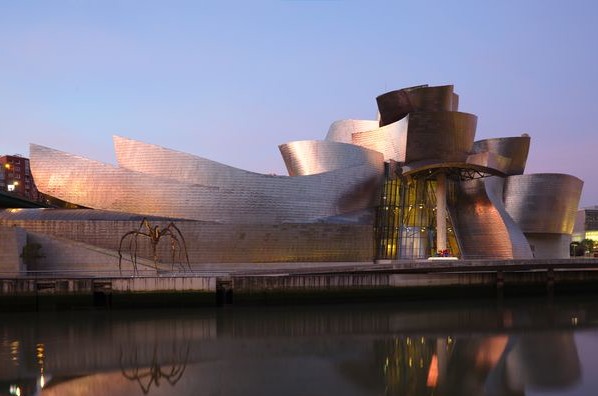
That is, after all, the central role of architecture: to celebrate and affirm the spirit of a particular culture, its gods and its history. Or at least, that was the central role of architecture. Great Buildings does something else that its author and publisher did not intend: by presenting so many centuries of great architecture so well, it underlies the radical — and repulsive — nature of a grand discontinuity that struck the Western world in the twentieth century. You could say that the book begins with a man-made mountain and ends with merde maximale — maximal shit from the present day. The Great Pyramid at Giza is a man-made mountain and the merde maximale is the work of modernist architects like Frank Gehry (born 1929) and Zaha Hadid (1950-2016). Gehry is Jewish and designed the appallingly ugly, obtrusive and eye-assaulting Guggenheim Museum in Bilbao, which displays ugly modernist art under the auspices of the Solomon R. Guggenheim Foundation, as set up by the Jewish plutocrat Solomon R. Guggenheim (1861-1949).

Gehry’s grotesque Guggenheim Museum in Bilbao (image from Infogalactic)

I think the Jewishness and the ugliness of the building and its contents are related. Until it reaches the section entitled “1900 to Present,” Great Buildings displays and discusses glorious architecture inspired by major world religions like Hinduism, Buddhism, Christianity and Islam. One religion is conspicuous by its absence: there was no glorious architecture inspired by Judaism. But you could say that modern architecture is inspired by Judaism — Jewish values, Jewish ideas, Jewish money. And that’s why architecture has descended from the sublime to the repulsive.

The invention of Jewish genius

You can see the same descent and same discontinuity in books about the history of art. Before the twentieth century, art was sublime; during the twentieth century it turned repulsive. Modernist art-movements like Dadaism assailed traditional standards of beauty and meaning, and abandoned traditional requirements for artistic competence and realism. Brenton Sanderson has exposed the Jewishness of Dada in his article “Tristan Tzara and the Jewish Roots of Dada.” He’s also discussed — and demolished — the work of the Jewish “genius” Mark Rothko (1903-70), one of the supreme exemplars of the abandonment of artistic competence. When goy philistines say “My six-year-old could have painted that” of a Rothko painting, they’re usually quite right. But one of the great advantages of abandoning artistic competence and realism, from the Jewish point of view, was that it enabled power to pass from gentile artists to Jewish art-critics and art-dealers, who were then able to promote (and profit from) Jewish “geniuses” like Rothko and Marc Chagall.

“Mensch” Richard Rogers and his architectural evisceration, the Centre Georges Pompidou in Paris (images from Wikipedia)

Alas, unlike art, architecture isn’t suited for the stripping away of all competence and technical ability. Even Jewish architects have to be able to design buildings that stand up, resist the elements, and refuse to collapse in all but the most extreme circumstances. But modern architects don’t have to be able to design buildings that delight the eye and elevate the spirit. Indeed, they’re now trained to design buildings that do the opposite: dismay the eye and depress the spirit. According to Great Buildings, the “prestigious Pritzker Prize” is “architecture’s highest honour.” It was established by the Jewish plutocrat Jay Pritzker (1922-99) in 1979 and has been awarded to atrocity-mongers and uglifiers like the Jewish Richard Rogers (1933-2021). Rogers was saluted as “a mensch of an architect, full of whimsy, genius and morality” by the Jewish Forward magazine on his death in 2021. Well, I would describe his acclaimed Pompidou Centre not simply as an architectural abortion but as an architectural evisceration. The viscera of the building — its pipes and ducts and elevators — have been strewn over its exterior. It’s a supremely ugly and uninspiring spectacle. Naturally enough, it’s hailed as a masterpiece of modernism.

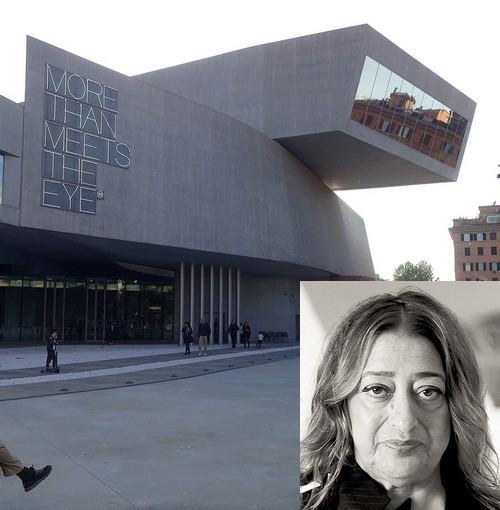
Merde MAXXImale: Zaha Hadid and her MAXXI Museum in Rome (images from Wikipedia)

The “prestigious Pritzker Prize” was also awarded to Zaha Hadid (1950-2016), a lavishly praised female architect who embodied the ugliness of modernism and the catastrophic decline of architecture in more ways than one. She was personally ugly and Great Buildings describes her as “Iraqi-British.” That is, she was an Iraqi Muslim who first took a mathematics degree in Beirut before studying architecture in London. She then went on create horrors like the MAXXI, a museum of modern art in Italy. Perhaps Hadid learnt French during her studies in Beirut and would have understood me when I call the museum merde MAXXImale — “MAXXImal shit.” If so, she would also have understood the ominous words of the French modernist Le Corbusier (1887-1965): “Une maison est une machine à habiter.” Great Buildings translates those words into English: “A house is a machine for living in.” Le Corbusier was a gentile but was one of the greatest proponents of uglification in architecture. Hadid certainly made his principle central to her work. Like those of so many modernists, her architectural abortions look like kitchen utensils or household appliances reproduced on a gigantic scale in concrete and steel.

Taj Mahal - a symbol of eternal love - FlyKLIA

Miracle in marble: the Taj Mahal in India

In giving so many archi-abortions to the world, the Muslim-born Hadid broke with a glorious Islamic tradition of beautiful architecture. For me, the greatest building of Great Buildings is the Taj Mahal, the “vision of shimmering white marble” erected by the Mughal emperor Shah Jahan (1592?-1666) near the river Yamuna in northern India. Like Christianity but unlike Judaism, Islam has given great beauty to the world in its art and buildings. Chartres Cathedral, a Christian masterpiece included in Great Buildings, rivals the Taj Mahal for beauty but does not match it, in my opinion. One reason for that is that the Taj Mahal incorporates an element of beauty that was far less developed in the Christian world: calligraphy. Indeed, as Great Buildings points out, only one identity is certain among the myriad craftsmen who worked on the Taj Mahal, that of the Iranian calligrapher Amanat Khan, who embellished the Taj Mahal with quotations from the Qur’an in an alternately sinuous and sword-like script.

A giant open-air urinal

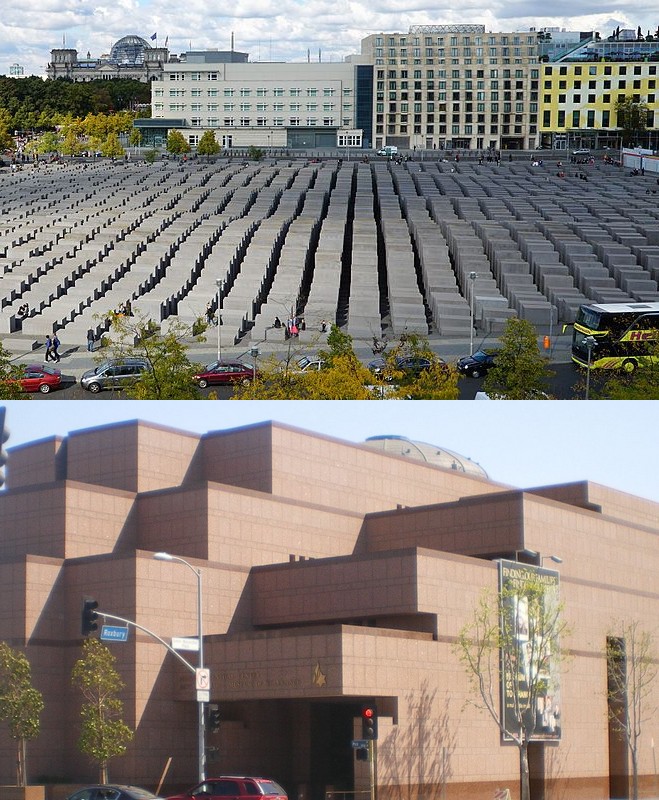
Khan’s calligraphy is, perhaps, the final touch that brings the Taj Mahal as close to perfection as any building has reached. Islam does not belong in the West, but has given the world some truly beautiful architecture. Judaism is many centuries older than Islam and has given the world no beautiful architecture. Indeed, Jews have responded to the ethical atrocity of the Holocaust by inflicting aesthetic atrocities of their own on the world, like the Memorial to the Murdered Jews of Europe in Berlin and the so-called Museum of Tolerance in Los Angeles.

Aesthetic atrocities: the Memorial to the Murdered Jews of Europe in Berlin and the Museum of Tolerance in Los Angeles (images from Wikipedia)

Fortunately enough, neither of these horrors appears in Great Buildings. The author and publisher may have been anxious to placate Jews by including the dreck of Rogers and Gehry, but they didn’t want to take sycophancy too far. The Memorial in Berlin looks like a giant open-air urinal and the Museum of Tolerance like a post-modern public lavatory in fetching fecal shades. Perhaps the appearance of the Memorial and the Museum is a private Jewish joke about “taking the piss” and “peddling shit.” What’s certain is that Jews don’t mind commemorating the Holocaust with very ugly architecture that is completely lacking beauty and grandeur.

Temple of Inscriptions | Inside is the tomb of the Mayan rul… | Flickr

Replication of the Parthenon in Nashville Greece (top) and the Temple of the Inscriptions in Mexico

And what is that something? It’s intelligence. Building big demands brain-power. Great Buildings doesn’t discuss this stark biocultural fact, but it’s the one thing that unites the very distinct traditions of East and West, of the Old and New Worlds, of Greece and China and Mexico. Tall structures that stand for hundreds or thousands of years aren’t only expressions of race-spirit but also assertions of IQ. You have to be bright to build big. Architecture is also an example of the non-linear powers that high intelligence gives the groups that possess it. For example, European Whites or East Asian Chinese are not hundreds of times more intelligent than sub-Saharan Blacks or New Guinea tribesmen. Yet the structures created by the former races have been hundreds or thousands of times larger and taller and longer-lasting than the structures created by the latter. In a related way, the subversive and anti-Western Jewish billionaire George Soros is not thousands of times more intelligent than Kevin MacDonald or Steve Sailer or Vox Day. But he is, alas, thousands of times richer and more influential.

Unfettering intelligence from aesthetics

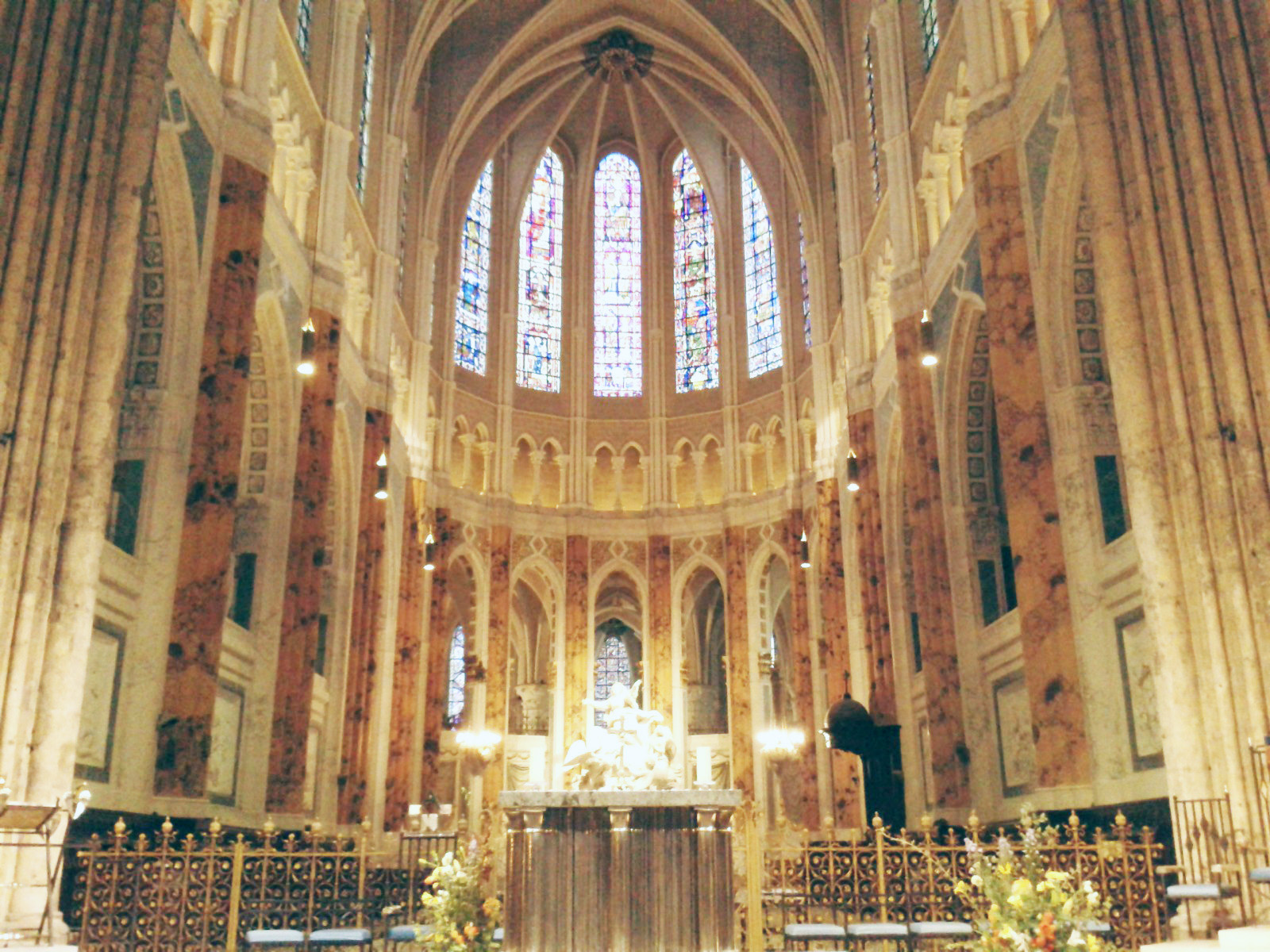
The subversive and anti-Western Jewish plutocrat Jay Pritzker was also thousands of times richer and more influential. And his influence, like that of George Soros, has been pernicious. As I pointed out above, Great Buildings describes the “prestigious Pritzker Prize” as “architecture’s highest honour.” But it’s an honor that goes to those who have smashed the millennial-long tradition of beauty and grandeur in architecture. When you reach the final section of Great Buildings, you enter an era of repulsive ugliness and absorb the central lesson of modernism. The lesson is this: When intelligence is unfettered from aesthetics, you get atrocity. Modernism unfettered intelligence from aesthetics in architecture, whereupon the Western world was assailed with the architectural abortions of the twentieth century. You can see that radical and repulsive discontinuity in the single nation of France. Unlike beautiful Chartres Cathedral from the Middle Ages, which has elevated the spirit and enriched the life of France, the ugly Pompidou Centre has assaulted the spirit and undermined the life of France. Once again, it’s not a coincidence that Chartres was created by goyim and the Pompidou Centre by a Jew.

The Choir of Chartres Cathedral

Chartres is also a reminder that Mencius Moldbug, aka Curtis Yarvin, was both utterly wrong and highly dishonest to give the name “The Cathedral” to the vast, interlocking system of anti-White and anti-Western activism, subversion, and propaganda that currently controls politics and the media. The beauty and grandeur of cathedrals like Chartres are integral to the West. But Yarvin’s so-called “Cathedral” hates cathedrals and the Christianity that inspired them. He should have of course have called that system “the Synagogue,” because Jews are central to its subversion and its hatred of the West. Why didn’t he give the hate an honest and accurate name? You won’t be surprised to learn that Yarvin himself is Jewish.

Experience Australia from your home with virtual events at Sydney Opera House and Arts Centre MelbouThe Sydney Opera house (image from Infogalactic)

There are no synagogues in Great Buildings. And I don’t think Philip Wilkinson, the author of the book, is Jewish. He doesn’t have a Jewish name and most of his book is a celebration of genuinely great buildings that embody the beauty and grandeur of true architecture. Furthermore, two of the modern buildings he describes — the Chrysler Building in New York and the Sydney Opera House — aren’t architectural abortions. They don’t match the best of the past, but they too are great buildings. Perhaps they’re also glimpses of what the twentieth century’s architecture could have been like without the dominance of Jews.

https://www.theoccidentalobserver.net/wp-content/uploads/2018/06/TOO-Full-Logo-660x156-1.png 0 0 Tobias Langdon https://www.theoccidentalobserver.net/wp-content/uploads/2018/06/TOO-Full-Logo-660x156-1.png Tobias Langdon2022-08-07 06:31:572022-08-08 10:48:14From the Sublime to the Repulsive: Thoughts on Gentile Beauty and Jewish Uglification in Architecture

The Plot Against Australia, Part II: Censorship and the White Australia Policy

August 5, 2022/18 Comments/in Featured Articles/by Jason Cannon

Go to Part I. 

Censorship and the White Australia Policy

Broader ideological connections between the anti-censorship cause in the post-war era and the crusade against White Australia are also apparent, and the contribution of Jews, as well as their literature at the cultural vanguard, was in part responsible for a major ideological shift in the character of the anti-censorship cause. Prior to the 1960s, it was the overtly political nature of censorship in Australia that aroused the most indignant opposition. Censorship of the press occurred during both World Wars, and the banning of communist and other socialist works—as well as books like Huxley’s Brave New World and Orwell’s Down and Out in Paris and London—was a point of contention for the intellectual class, who argued such censorship restricted political freedoms. There was also a strong strand of “anti-wowserism” among the intellectual class that sought to improve the poor cultural standing of Australia and combat what was perceived to be excessive puritanism. ‘Wowser’, an outdated Australian term, was defined as an overly zealous or puritanical person, in particular those who campaigned for temperance. Moralistic attempts to ban even things like comic strips or cheap “paperback junk” arguably backfired and gave far more credibility to the later anti-censorship cause than it otherwise would have had. Instead of Reich-reading revolutionaries who hated the racial status quo, prominent anti-censorship advocates prior to 1939 included the likes of artist/author Norman Lindsay and his close associate P.R. Stephensen, a now forgotten nationalist intellectual who was imprisoned during the war for his Axis sympathies. In the wake of a politically embarrassing banning of J. D. Salinger’s Catcher in the Rye, reforms in 1954 by Liberal Prime Minister Robert Menzies largely rectified the heavy-handed nature of earlier prohibitions. As such, in the run up to Portnoy’s Complaint, just about the only publications that were still being banned were those of a particularly sexually obscene nature, works such as The Painted Bird, or the explicit pornography that was beginning to appear.

It was the banning of James Baldwin’s Another Country in 1963 that for the first time brought the White Australia Policy directly into the picture when it came to censorship debates. Censorship opponents were by now fully under the sway of Boasian ideas of racial equality, and they argued that the ban on Another Country would be interpreted as an act of racial prejudice.[20] At a time when Australia’s racially restrictive immigration policy was coming under international pressure, it was this new breed of anti-censorship activists explored in this essay that were taking up leadership roles and shifting the nature of the cause into a revolutionary endeavour to upend every aspect of Australian society in sexual as well as racial terms. Obscenity laws were increasingly seen as a crucial bulwark against the creation of a new sexually liberated and racially diverse Australian society. To free Australia from racialism and rid itself of the White Australia Policy, it was seen as necessary to first rid the country of the fear of sex and foreign contamination argued to be implicit in the establishment of obscenity laws and importation restrictions. Critics such as Geoffrey Dutton, who was one of Graham C. Greene’s local contacts, lambasted censorship as being merely a small part of the broader moral and racial protectionism of Australia, seeking to isolate itself in a “pure all-white paradise” protected from corrosive foreign influences.[21] Seizing upon the ideological similarities between the impetus behind immigration restriction (i.e., protection of Australia from Chinese migrants and cheap coloured workers) and censorship in protecting Australia from foreign moral influences, Dutton clearly enunciated the case for the discarding of censorship laws not simply on the grounds of literary merit or the ability for an adult to decide for themselves what works they should be allowed to read, but on the removal of racial and moral protectionism. The Jewish newspaper editor and columnist Cyril Pearl, another veteran of the anti-censorship campaign who made an appearance for the defence at the first NSW Portnoy trial, mockingly referred to censorship as “a part of the White Australia Policy”[22] and the radicals of OZ and the student press also saw their participation in strong racial terms.

The editorial line of OZ consistently agitated against the White Australia Policy in unison with their case against obscenity laws. A perfect example of this is found in Edition 18 of the magazine from April 1965. As a cover story, OZ reviewed the statement of policy of a new conservative magazine set to be published, the “Australian International News Review,” which eventually ran for only 17 issues and ceased operation two years later. Published in-full by OZ, this statement of policy included the following points:

News Review supports severely restricted immigration to prevent the development of a colour problem and its consequent danger to Australia. News Review is utterly opposed to the present mass exploitation of the sex theme and the impetus it gives to increasing moral delinquency throughout the commonwealth.[23]

The editors of OZ were hysterical in response, and revealed the connection they saw between the two causes:

And now, when there is some stirring of the forces proposing such basic civil liberties as less severe censorship and racial equality, we are about to have the “National Review.” … The excerpts reproduced here … indicate clearly what these policies are. The words “Fascist” and “Nazi” are smear-words more often abused than correctly directed these days; but if any policy deserved such a description, this is it, with its careful blend of national jingoism and Anglo-Saxon racialism.

The publisher Graham C. Greene would later become involved with the global anti-apartheid movement that was attempting to overthrow the white minority government in South Africa. Under his leadership, Jonathan Cape published the works of Jewish author Nadine Gordimer, a member of Nelson Mandela’s African National Congress whose novels Burger’s Daughter and July’s People fantasied the violent political overthrow of the South African government—works for which she won the 1991 Nobel Prize for Literature.

The Pornographic Era Begins

The immediate winner of the collapse of Australia’s obscenity laws was of course not literature, but pornography. Within two years, the country was already becoming awash with smut, and authorities around the country attempted to stem the tide:

By 1974, the New South Wales Government was complaining that Sydney had been “flooded” with pornography. … The Queensland Literature Board of review sought to step in where the federal government had retreated and set about prohibiting an increasing amount of material. It banned ninety-three publications in 1972–1973, sixty-seven in 1973–1974, eighty-two in 1974–1975, and eighty-eight in 1975–1976.[24]

Locally produced sex comedies with R18+ ratings like Alvin Purple were reaching cinemas in late 1973, but the majority of pornographic material was (and still is) coming from the United States. The consequences of this collapse and the shift to the supposed “control” and classification of publications is plain for everyone to see. Hardcore pornography now brims from our screens and laptops, freely accessible by any child with an internet connection and inattentive or lax parents; every sexual perversion imaginable is openly discussed and displayed on television and in films; streaming networks Netflix and HBO commission shows about teenagers that graphically depict sex, drug use, miscegenation, and the celebration of sexual immorality[25]; sexual lyrics are practically mandatory in the pop songs that emanate from Spotify playlists and the radio; and smutty literature sits in the bestseller sections in bookshops.      The broader influence of internet pornography and the prominent Jewish role in this, as well their role in the birth of the pornographic industry itself, is beyond the scope of this essay. Nevertheless, by the 1990s internet pornography was the coup de grâce of a global Jewish effort of moral subversion and social engineering that successfully disintegrated the final remnants of obscenity law that remained in the West. With the arrival of internet porn, the Australian government had lost any effective ability to dictate the reach and accessibility of obscene pornographic material in society.

Obscenity controls have now vanished from Western countries, but the underlying propensity to ban and restrict that which is believed to be harmful or destructive to your culture and religion (this being the essence of the intent behind obscenity laws) has not. Over the course of the last 60 years, the political and cultural power to enact censorship laws and to enforce these restrictions over society has rather shifted to Jews who subsequently inverted the political mechanisms previously used by obscenity laws to suit their own purposes.  Instead of the idea of obscenity (that which is harmful to Christianity and Western people), we now have the idea of “hate speech”—that which is harmful to the Jews. Accordingly, our culture no longer bans pornography or works like Portnoy’s Complaint, and instead bans only ”anti-Semitic” material and “racist” and “hate” publications. Similarly, depictions of homosexual behaviour used to be considered obscene; now to be against homosexuality is to engage in “hate speech,” which, as we are always told, inevitably leads to another holocaust. These new hate speech controls, which are in every sense a substitution of obscenity controls, have been enshrined into law across the West and hate speech policies operate on all major social media platforms. In Australia, hate speech laws have been in force since 1995, under Section 18c of the Racial Discrimination Act. The law came into existence as a result of Jewish ethno-political activism and Jews continue to defend the law with the utmost ferocity against any gentile who dares to attempt to weaken it.[26] Dennis Altman argued in 1970 that censorship acts “not only to preserve good taste, but also to exclude radical critiques.”[27] By the same token, hate speech laws act to exclude radical critiques of Jews and their actions. In all, the Customs Official with his government list of prohibited books has not disappeared, he has simply been replaced by the Amazon Employee and his digital register of books deemed by Jewish groups like the ADL to be hate speech.

A Depraved Youth

As was constantly (and mockingly) pointed out by opponents of censorship, being exposed to one single obscene book on its own won’t necessarily deprave a reader, but being exposed to a lifetime of pornography and sexual content, to such an extent that it is considered a normal state of affairs, certainly can. Presently our youngest generation of men and women are practically raised on the sort of hyper-sexual content uploaded to all their favourite social media sites like TikTok, Reddit, Instagram and YouTube, and are a demographic consistently identified by researchers as having strong porn-viewing habits. A government survey from 2017 found that 44 percent of Australian children between the ages of 9–16 experience regular exposure to sexual images,[28] and another study of exposure to explicit pornography found that the median age an Australian child first views pornography is 13 in boys and 16 for girls. The study also found that “LGBTI children” watch pornography more frequently and from a younger age.[29] One can confidently assume these figures have only gotten worse in the intervening years, but as anyone who attended high school in the last two decades can tell you, online pornography viewing is rampant amongst teenagers. In the distant days of porn videotapes/magazines, or when an internet connection meant a fixed computer monitor sitting in middle of a living room, viewing pornography was a more complicated affair. Nowadays it is discreetly and effortlessly accessed on portable laptops and phones, and the proliferation of personal mobiles and other such handheld devices amongst children has removed almost any last control that parents had on pornographic or other hyper-sexual exposure. Far from ushering in a period of sexual decency and health as was predicted by some of the anti-censorship activists, Australia in the aftermath of Portnoy’s Complaint now grapples with a crisis of abnormal sexuality, pornified culture, and a seeming epidemic of sexual harassment and other sex crimes. A slew of sex scandals, sexual harassment claims and rape allegations have hit the Australian political scene over the last four years, prompting all kinds of exposés about a culture of sexual misconduct that exists in even the highest offices in the land. The worst incidents include a case of rape that occurred inside the Australian parliament building, and a political staffer who outdid Portnoy himself by being caught masturbating onto the desk of a female Member of Parliament and sharing pictures of the act to his colleagues.[30]

Moreover, the obvious link between the hyper-sexualisation of society that was unleashed with the defeat of obscenity laws and the modern outrage over such incidents and things like “rape culture” and the misogynistic impact of pornography on the male mind continue to be ignored by progressives. At no point in his book can Patrick Mullins bring himself to make these connections (nor the Jewish connections for that matter), as to do so would be to undermine the moral and political “victory” that Portnoy’s Complaint delivered for the left. The best he can muster is a few bland sentences about the “increase in availability of and demand for pornography”[31] absent from any extrapolation of the impact this has had. Also ignored are the former comrades-in-arms against obscenity who later renounced their work when the consequences of liberation became apparent. Peter Coleman’s 1962 book Obscenity Blasphemy Sedition is still a standard work on the history of censorship in Australia, written when Coleman was under the spell of Jewish academic Henry Mayer, but he has since turned against it:

It is also the one book that I later renounced. I began it with the idea of striking a blow for the total abolition of censorship. By the time I delivered it to the publisher, I was beginning to have doubts about the abolitionist cause, libertarianism in general, and even Henry [Mayer] as “guide, philosopher and friend”. (He remained a friend.) It was too late to rewrite it, although in later editions I added some “second thoughts”. Critics welcomed the new editions but not my second thoughts.[32]

As for sexually healthy relations, increases in STD rates are prevalent across the West, and our society now must deal with the abhorrent spectacle of young men, inspired by hardcore pornography, strangling women to death during sex, or ordinary young women making money by selling naked images of themselves on the internet via websites like Onlyfans. Originally a non-sexual content subscription service, Onlyfans was purchased in 2018 by Ukrainian-born businessman Leonid Radvinsky, the latest in a long line of Jewish porn-tycoons, who promptly turned the site into a hub for selling pornography and sexually explicit content, utilized by prostitutes and underage girls alike.

The Australian Reich

The spectre of Wilhelm Reich looms large in the conflicts over obscenity encapsulated in this essay—a figure whose ideas, as briefly alluded to, provided much of the basis for the anti-censorship critique from the 1960s onwards. Years after his death, Reich was hitting new heights of popularity with the student revolt and the ’68 generation at the same time that Portnoy’s Complaint landed on Bennet Cerf’s desk. Identifying Australian political and cultural figures over the course of the 1960s who directly read and comprehended his works is difficult to uncover, but what is clear is that by the turn of the century the ideas of Reich had fully permeated the culture. The erstwhile defender of Australian obscenity laws during the Portnoy battle, former Customs Minister Don Chipp, could be found in 2003 practically repeating the lines of Reich’s The Mass Psychology of Fascism:

Tomorrow, in a speech for the Eros Association, he [Don Chipp] will issue a warning: censorship of sexual content opens the door for political censorship, deprivation of civil liberties and totalitarianism.[33]

Reich, writing during the ascension to power of German National Socialism, saw the revolutionary value in promoting the sexualization of children—something which his most devoted disciples during the sexual revolution sought to accomplish. He understood that a society of gentiles befuddled and distracted by sex and pornography—one where political energy and moral outrage has been redirected or blinded by sexual passions—is a society where an anti-Jewish reaction can never take deep root:

If we could once succeed in engaging the sexual interests of children and adolescents on a mass scale, then reactionary contamination [fascism] would be faced with a tremendous counterforce—and political reaction would be powerless.[34]

As long as the masses are too busy masturbating, having casual sex and letting their children watch porn, then the West lacks the moral clarity, let alone the political ability, to attempt to curb Jewish influence on our culture. So as it turns out, Gershom Scholem and the Australian Rabbis were wrong. In bringing down Australia’s obscenity laws and leading the way for the pornographic era and the mass sexualization of children and broader society, Portnoy’s Complaint was in fact good for the Jews of Australia—but don’t expect that admission to come from them any time soon.


[1] P. Mullins 2019, The Trials of Portnoy, Scribe Publications, Australia.

[2] For a while seditious works were also prohibited in Australia.

[3] Mullins, op. cit., p.30.

[4] The defendant Wald was Jewish abortionist Louis Wald, a practitioner at the Heatherbrae Clinic in the suburb of Bondi, at the time the largest illegal abortion clinic in Australia.

[5] Mullins, op. cit., p.40.

[6] Mullins, op. cit., p.45.

[7] High Court of Australia, Crowe v Graham Judgement, retrieved from: https://staging.hcourt.gov.au/assets/publications/judgments/1968/078–CROWE_v._GRAHAM–(1968)_121_CLR_375.html

[8] Mullins, op. cit., p.147.

[9] Mullins, op. cit., p.32.

[10] Mullins, op. cit., p.62.

[11] Australian Jewish News, Portnoy—A Series of Complaints, 30 September 1970, p.11.

[12] Mullins, op. cit., p.64.

[13] E. Michael Jones, 2008, Chapter 30 The Messiah Arrives Again. In: The Jewish Revolutionary Spirit, Fidelity Press, USA, p.974.

[14] Mullins, op. cit., p.69

[15] Mullins, op. cit., p.261.

[16] Commonwealth of Australia, 2011 Review of the National Classification Scheme: achieving the right balance, Legal and Constitutional Affairs References Committee, p.30.

[17] Mullins, op. cit., p.197.

[18] Ibid., p.62.

[19] E. Connelly, 2018 ‘Harvey Weinstein: On Jews and the Shiksa’, The Occidental Observer, retrieved from: https://www.theoccidentalobserver.net/2017/10/18/harvey-weinstein-on-jews-and-the-shiksa/

[20] Mullins, op. cit., p.25.

[21] G. Dutton 1970, Moral Protectionism, In: Australia’s Censorship Crisis, (eds) G. Dutton and M. Harris, Sun Books, Australia, p.96-104

[22] S. Murray-Smith 1970, Censorship and Literary Studies, In: Australia’s Censorship Crisis, (eds) G. Dutton and M. Harris, Sun Books, Australia, p.79

[23] OZ Magazine, Edition 18, April 1965, University of Wollongong Archives, Call no. 052/47. Retrieved from: https://archivesonline.uow.edu.au/nodes/view/3498/

[24] Mullins, op. cit., p.257.

[25] Examples include Sex Education on Netflix or Euphoria on HBO, the latter created by Jew Sam Levinson and based upon an Israeli TV show.

[26]See B. Sanderson 2014, ‘Australian PM Caves in to Jewish Lobby on Free Speech Laws’, The Occidental Observer, retrieved from https://www.theoccidentalobserver.net/2014/08/08/australian-pm-caves-in-to-jewish-lobby-on-free-speech-laws/

[27] Mullins, op. cit., p.47-48.

[28] A. Quadara, A. El-Murr, & J. Latham 2017 The effects of pornography on children and young people: An evidence scan (Research Report), Australian Institute of Family Studies, Melbourne, retrieved from: https://aifs.gov.au/sites/default/files/publication-documents/rr_the_effects_of_pornography_on_children_and_young_people_1_0.pdf

[29]M.  Lim, M, et. al. 2017 ‘Young Australians use of pornography and associations with sexual risk behaviours’, Australian and New Zealand Journal of Public Health, retrieved from: https://www.burnet.edu.au/system/asset/file/2649/Pornography_ANZJPH_paper.pdf

[30] K. Curtis & A. Livingston 2021 ‘‘Sex act on female MP’s desk’: Liberal staffer sacked over lewd video’, Sydney Morning Herald, March 22nd, retrieved from: https://www.smh.com.au/politics/federal/sex-act-on-female-mp-s-desk-images-shared-among-liberal-staffers-20210322-p57d0v.html

[31] Mullins, op. cit., p.257-259.

[32] P. Coleman, ‘Australian Notes’, Spectator Australia, 9 May 2015, retrieved from: https://www.spectator.com.au/2015/05/australian-notes-248/

[33] The Age, Chipp off an Old Block, 26 November 2003, retrieved from https://www.theage.com.au/national/chipp-off-an-old-block-20031126-gdwt6o.html.

[34] W. Reich 1933, The Mass Psychology of Fascism, English Translation 1946, Orgone Institute Press, New York, p.169.

https://www.theoccidentalobserver.net/wp-content/uploads/2018/06/TOO-Full-Logo-660x156-1.png 0 0 Jason Cannon https://www.theoccidentalobserver.net/wp-content/uploads/2018/06/TOO-Full-Logo-660x156-1.png Jason Cannon2022-08-05 07:06:282022-09-04 05:59:27The Plot Against Australia, Part II: Censorship and the White Australia Policy

The Plot against Australia, Part I: How Portnoy Took Down Australia’s Obscenity Laws

August 4, 2022/28 Comments/in Featured Articles/by Jason Cannon

I suppose, after me, all the shits came in? — Phillip Roth

Australia was one of the last holdouts in the West in policing and restricting the publication, importation, and distribution of pornography and other forms of obscenity. Where censorship regimes in the USA and UK had already collapsed by the mid-1960s, as late as the year 1971 vice squads in police forces around Australia still ran raids of bookstores believed to be selling obscene literature. Political leaders of the era such as the formidable Vice-Premier of the state of Victoria, Sir Arthur Rylah, and his counterpart in the state of New South Wales, Sir Eric Willis, still possessed the vocabulary and conviction to resist the mass sexualisation of society and provide a defence to the Christian morals of the Australian people. The prohibition of obscene publications is now a politically dead issue, but opposition to it, the anti-censorship cause as it was known, once occupied an incredibly important front in the wider cultural and sexual revolution of the 1960s and 70s that set countries like Australia onto a path of cultural and demographic ruination. Every country in the West has an infamous piece of literature or film that either put a foot in the door for the entrance of pornography or otherwise resulted in the breakdown of obscenity laws and controls in their respective countries, often as a result of a much-publicised legal trial. In the United Kingdom, this was works such as Lady Chatterley’s Lover (first unexpurgated version in the UK in 1960) and Last Exit to Brooklyn (1964). In the United States, the film The Pawnbroker (1964) saw the end of the power of the Motion Picture Production Code, a set of industry guidelines on content that was imposed on the film studios of Hollywood. But in Australia, this ignominious title is given to Philip Roth’s most famous work, a now iconic Jewish book by the name of Portnoy’s Complaint (1969).

As this essay will uncover, the story of the end of obscenity law and censorship controls in Australia—events that subsequently caused the flowering of the sexual revolution—is one of a cultural and political push teeming with Jews. Although not intended to do so, the recently released book The Trials of Portnoy[1] by Australian journalist Patrick Mullins exposes the key Jewish role in this undertaking, showing the deeply involved nature of Jewish ideas, activism, and money, and how crucial Jewish literature was in breaking down the laws that served as a bulwark against the advance of the sexual revolution and the permissive society. Throughout the book, Mullins identifies the major pre-Portnoy victories for anti-censorship that led up to the decisive final battle over Portnoy’s Complaint. Each subsequent victory served to embolden the anti-censorship cause and its supporters, who were convinced the march of progress was on their side, and conversely weaken, embarrass, and enrage the defenders of sexual mores and the moral virtues of Australian society. At the conclusion of this came Portnoy’s Complaint, which was prosecuted for obscenity in courtrooms around the country in the most widely publicized and debated censorship trials since World War II. After Portnoy, it was no longer possible for an obscene publication to be banned in Australia.

Legal Framework

These events will be explored in turn, but a brief digression is necessary to understand the structural basis of the obscenity laws and other legal restrictions that operated throughout the country. In the pre-internet era, the Australian legal framework for the restriction and prohibition of publications deemed to be obscene was contained in federal law jointly under the Customs Act and the Post & Telegraph Act, which took their inspiration from the UK Obscene Publications Act of 1857. Together these Acts gave broad powers to the Federal Customs Minister and customs officials to proscribe “blasphemous, indecent or obscene works” onto a banned publications list and restrict the importation and local distribution of such banned works. This included the power to search through the luggage of arriving travellers from overseas. Further state laws existed, with some variations on a state-by-state basis, to police obscenity on a local level. These were the laws utilised to, for example, fine a bookstore caught selling obscene literature or people caught in possession of a federally prohibited import.

The legal definition of obscenity used in Australia was established under common law precedent by English case law in Regina v. Hicklin 1868, which entrenched what came to be known as the Hicklin Test of obscenity. Central to the Hicklin Test was the question of whether the publication under consideration had “the tendency to deprave and corrupt those whose minds are open to such immoral influences and into whose hands a publication of this sort may fall.” As such, the focus of the Hicklin Test of obscenity rested not upon the impact of the publication on mature and law-abiding adults, who were considered morally upstanding enough to recognise the obscene work and handle it appropriately, but on those such as children, a group seen as particularly susceptible to the corruption of obscene literature due to their still-developing minds and therefore far more in need of strong laws to restrict its dispersal throughout society. The Hicklin Test did not require obscenity to be established in the context of the publication as a whole. Instead, a publication could be prohibited even if only a few passages in the entire text were found to be obscene. In the era before the sexual revolution, it was exceptionally rare for the law to confront the types of obvious pornography that are commonplace now. Instead, works deemed obscene were those of a sexually explicit or indecent nature, those exhibiting particularly graphic violence, or works that contained egregious attacks on religious beliefs.[2]

The Hicklin Test also implicitly acknowledged a fact that is ignored by pornographers and other liberal opponents of obscenity laws, namely that once an adult can legally and freely access something, it is then not difficult for it to fall into the hands of a child. Even if an age-restricted product can only be purchased in a store by an adult, from that point onwards, any control over its future readership or viewership is entirely down to the prerogative of the purchaser, or simply a matter of chance. No amount of age-restrictive laws on purchase or distribution could, nor can, stop a pornographic magazine/videotape or a violent video game from being discovered hidden under a bed by a child, or from being given by a careless 18-year-old to a younger sibling. Put simply, one cannot effectively protect children from pornography without also restricting it for adults.

The Hicklin Test was also introduced as the definition for obscenity in America in Rosen v. United States (1896), where a New York Jew by the name of Lew Rosen was found guilty of using the postal service to send an obscene publication. Hicklin was later overturned in the US in favour of a ‘community standards’ test (also known as the Roth test) in the landmark Supreme Court case Roth v. United States 1956, where yet another Jew, publisher Samuel Roth, was convicted for selling erotic literature.

OZ Magazine

Early rumblings of change came in 1963 with the founding of the magazine OZ, the premier satirical publication of the 1960s counterculture in Sydney. Established by three students at the University of Sydney, all of whom later went on to prominent positions in Australian cultural life, OZ grew out of the libertarian subculture of the “Sydney Push” and took its cue from Jewish satirists Lenny Bruce and Mort Sahl, the British magazine Private Eye, and the satirical BBC television program That Was the Week That Was. OZ sought to expand published counterculture in Sydney beyond the limited confines of the student press, prominently Honi Soit at the University of Sydney and Tharunka at the University of New South Wales, and established itself as a literary focal point for the growing forces of the New Left. Alongside its opposition to censorship, OZ was a trailblazer in Australia for a number of other political causes that would soon become major left-wing policies, from the anti-Vietnam War effort, to the dismantling of the White Australia Policy. The founders of OZ magazine, as well as the other leading members of this subculture (Wendy Bacon, the former editor of Tharunka, was another prominent anti-censorship activist) were deeply influenced and indebted to Jewish psychoanalysts Sigmund Freud and Wilhelm Reich. Reich’s works in particular formed the basis of much of their anti-censorship critique attributing sexual “repression”—including the proscription of sexually obscene literature—as a root cause of social, economic and political ills in society, as well as providing a seemingly scholarly basis for their belief in the abnormality of Christian morality.

Publication of the first issue of OZ in April 1963 met with immediate outcry. The magazine featured a series of interviews with an abortionist and young women who had procured abortions, as well as a tongue-in-cheek article about the history of chastity belts—intended as a metaphor for Australian sexual norms being “locked in the past.” The founders pled guilty to charges of obscenity levelled against them by the NSW government and were fined 20 Australian Pounds. Unrepentant, the founders of OZ were again charged and found guilty of obscenity for Edition 6 of the magazine in February 1964, and even harsher penalties were imposed, including a prison sentence. Wanting to take a stand against censorship, outraged by the severity of the charges and realizing that the magazine would not survive its infancy much further with repeated convictions, they lodged an appeal against the decision. The case was heard by the Jewish Appeals Court Justice Aaron Levine, a known progressive justice, who bucked public outrage by overturing the obscenity charges, ruling that OZ was satire and that the prosecution had failed to identify any real examples of people that would be corrupted or depraved by the publication, and had to point to more than “a theoretical group of unidentified persons”[3]—a stark redefinition of the Hicklin Test.

Levine’s progressive credentials would solidify in 1971 when he adjudicated in R. v. Wald[4], a case which effectively legalised abortion in the state of New South Wales. Justice Levine provided a defence to abortion on economic and mental health grounds so broad, that legislation to de-criminalize abortion was not taken up in NSW until nearly 50 years later in 2019. The founders of OZ later relocated to the UK, starting London OZ in 1967, and the cover pages of the magazine became progressively more pornographic and LSD-influenced, owing to use of that drug by the editors. The May 1970 edition, Schoolkids OZ, written by and aimed at high school teenagers, was the subject of one of the last major obscenity trials in the UK.

The Trial of Lady Chatterley

Infamous in the history of UK literary obscenity, the unexpurgated publication of Lady Chatterley’s Lover had been banned in Australia since 1929 due to its erotic passages. The issue had lain dormant in the country until 1964, following the UK publication of The Trial of Lady Chatterley, an account of the famous court case four years earlier (R v. Penguin Books Pty Ltd) that broke UK obscenity laws. For including the offending passages, The Trial of Lady Chatterley was also subsequently banned in Australia. A rescue mission for The Trial would come in the form of a trio of liberators, who formulated a daring approach to flout Australia’s obscenity controls. This trio was led by Jewish entrepreneur and property developer Leon Fink, conspiring with Alex Sheppard, the Secretary of the NSW Council for Civil Liberties (CCL), and a local bookshop owner and tenant of one of Fink’s properties, to secretly publish a local edition of the book. With Fink bankrolling the illegal enterprise, a copyright was obtained from UK publisher Allen Lane, and Fink had torn up sections of the book sent to Australia through the post by friends overseas. Using the smuggled pages, 10,000 copies of the book were printed in secret, and distributed to select bookstores around the country in April of 1965.[5] Once the books were in place, Fink and Co. notified the Australian government of their act in an attempt to pressure them to rescind the ban. Prosecution of bookstores selling the book was attempted by Arthur Rylah in Victoria, but the stunt was an embarrassment to the federal government, who promptly gave in and removed Lady Chatterley’s Lover, the Trial of Lady Chatterley and a number of other works from the prohibited list.

The incident exposed the need for a uniform approach to obscenity across all states, as the anti-censorship activists were now getting bolder with their approach. Amendments were made to the Customs Act to tighten up procedure, to close the loophole for local editions of banned works, and a new Board of Review was established to act as a higher review authority than customs officials, which was given the ability to exempt from restriction works that were of “literary, artistic or scientific merit.”[6] This flimsy strengthening of obscenity law was utterly undone however with the landmark High Court of Australia case Crowe v. Graham (1968), an appeal against a conviction of obscenity in relation to two self-published magazines. Despite upholding the obscenity convictions, Justice Windeyer overturned the Hicklin Test in Australia, specifically citing Roth v United States in his decision, and formulated a new Australian test for obscenity based on the Roth Test: whether the publication would “offend the modesty of the average man or woman in sexual matters.”[7] The shift was subtle at the time, but it had far-reaching implications for the Portnoy’s Complaint battle that was soon to come. Thereafter, a publication declared obscene only had to answer for an offence against broad “community standards” (a community acknowledged to have a “new frankness regarding matters of sex”[8]) not against the category of “those whose minds are open to such immoral influences”—that is, primarily young people whose minds were still being formed. The two magazines in question, Censor and Obscenity, were amateurish publications, designed to do little more than thumb disapproval at obscenity laws, and contained a hodgepodge of pornographic images and selections from banned literature. Existing sources are unclear on the identity of the culprits, but they are likely to be more members of the same Reich-influenced university milieu as OZ and the university press; OZ advertised for both magazines within its own pages.

American Hurrah

A performance of the play American Hurrah at a Sydney theater became the scene of another victory for the anti-censorship cause, where a complaint from a local grandmother, who mistakenly attended the performance with her grandchild, led to threats of legal action from deputy leader of the State Government, Eric Willis. Her complaint was directed at a series of obscenities scrawled on the walls of the set during the third act of the play, a set piece intended by the playwright to shock the audience. Written by Jewish playwright Jean-Claude van Itallie, American Hurrah premiered in New York in 1966, directed by Jews Jacques Levy and Joseph Chaikin and critically explored the themes of consumerism and American involvement in the war in Vietnam. The play had gone largely unnoticed until the complaint, but the theater company agreed to remove the offending portions of the set from all performances henceforth. In response, a group of outraged intellectuals conspired to stage a free performance of the play with the offending set pieces included. Willis placed police into the audience, in order to shut down the free performance should they discover that the offending parts were included. The organizers, the “Friends of America Hurrah” which included Jews Cyril Pearl and Harry Seidler, watched on as the free performance degenerated into a pornographic spectacle:

Two actors dressed as dolls simulated sex, wrecked the set, and drew on the walls the words fuck shit, and, a big cock up my juicy cunt. As police all over their theatre leapt to their feet, the actors jumped into the audience and made for the side doors.[9]

Later performances of the play were restricted but the perceived heavy-handedness of Eric Willis’s approach was taking its toll. The anti-censorship cause won more converts, who felt that the mere presentation of “four-letter words” was no longer sufficient grounds for legal action.

Dennis Altman’s Suitcase

Justice Aaron Levine made another appearance in a legal case bought by Dennis Altman and the CCL in 1969, appealing the act of a customs official who seized two copies of banned literature from Altman’s luggage on a return trip from the USA—Sanford Friedman’s Totempole and Gore Vidal’s Myra Breckenridge. Altman saw the opportunity to try the strength of the revised Customs Act in the aftermath of the backdown on Lady Chatterley’s Lover, and another prominent censorship case made its way before Justice Levine. Like the Jewish homosexual protagonist in the novel Totempole, Altman was also a Jewish homosexual, and would later become Australia’s foremost gay rights activist, soon to publish his iconic but now forgotten work Homosexual: Oppression and Liberation in 1971. Levine ruled that Totempole was not obscene and should be returned to Altman and upheld the ban on Vidal’s Myra Breckenridge, but as Levine was delivering his judgement, greater efforts to bring down Australian censorship laws were fermenting in Australia and abroad.

Portnoy’s Complaint

What I’m saying, Doctor, is that I don’t seem to stick my dick up these girls, as much as I stick it up their backgrounds—as though through fucking I will discover America. Conquer America—maybe that’s more like it. — Alexander Portnoy

Portnoy’s Complaint was first published in New York in February 1969 and was an immediate sensation. Before it even hit the bookshelves, the film rights had already been sold to Warner Bros. for $250,000 USD.[10] The novel, by Jewish author Phillip Roth, is written in the form of a monologue delivered by the titular character Alexander Portnoy, who exorcizes the lurid details of his sexual life and guilty conscience to a Jewish psychoanalyst and ruminates on the frustrations of being a modern Jewish man. Much of the themes of the book likely went over the heads of non-Jewish readers who have not studied the peculiarities of this group of people—the overbearing Jewish mother and timid Jewish father, the lusting after non-Jewish women (“shiksas”), the pangs of Jewish assimilation, and the unique complications of being a Jewish minority in a Christian society. But the significance of the book as an honest presentation of the Jewish psyche (many consider Portnoy to be an author insert for Roth himself) was not lost on the more conservative Jewish leaders. Roth’s earlier works had caused a stir with the American Jewish community, who labelled him a self-hating Jew for failing to follow the dictum that Jews must never be portrayed negatively, only positively. Negative reviews of Portnoy’s Complaint appeared in Commentary magazine, the mouthpiece of the America Jewish Committee, and the religious leaders in the Australian Jewish community were similarly perturbed. Local Rabbis worried that the book was “very dangerous from a Jewish point of view” and “not good for the Jews.”[11]

Of Portnoy’s Complaint, Israeli philosopher and kabbalist Gershom Scholem declared that the book was more disastrous to Jews than The Protocols of the Elders of Zion and was “the book for which all anti-semites have been praying.”[12] With this critique, Scholem likely had in mind the numerous passages where Portnoy ridicules the “stupid goyim” or Portnoy’s cognizance that his lust for sleeping with gentile women (schtupping the shiksas) was almost a political act; by defiling their daughters, Portnoy was getting revenge on the WASP anti-semites who mistreated his father at work. Portnoy is, as E. Michael Jones writes, “a Jew right out of Mein Kampf,”[13] another Messiah who has come to liberate the gentiles, in particular the shiksas, from the binds of their Christian morality:

To save the stupid shiksa; to rid her of her race’s ignorance; to make the daughter of the heartless oppressor a student of suffering and oppression; to teach her to be compassionate, to bleed a little for the world’s sorrows.

Portnoy’s shiksas, each given a disparaging nickname (The Monkey, The Pilgrim and The Pumpkin), become the vehicle for his revenge-saturated sexual fantasies, but all three are eventually discarded when they fail to meet his expectations as sex objects. The archetype of the Jewish man indulging his fantasies—often revenge motivated—by having sex with the Christian girl, would become a common theme in the so called “golden age” of pornography, the pairing of Harry Reems and Linda Lovelace in the film Deepthroat being a famous example. It also played out in real life throughout the history of Hollywood, the #MeToo scandal being the latest iteration, where Harvey Weinstein and a cast of other famous Jews were caught out taking liberties with the shiksa on the casting couch. Aside from the screeds against gentiles, the most offending passages, and the ones read aloud the most in the obscenity trials, were undoubtedly the frequent descriptions of masturbation and the objects that accompanied Portnoy’s lewd ritual, from chopped liver to a sister’s item of underwear. Whereas Lady Chatterley’s Lover is embarrassingly written Pagan eroticism that is now quaint to read, Portnoy’s Complaint is fully fledged Jewish obscenity that has not lost its shock value. Even to a modern reader such as this writer, having been fully exposed to the depravities of sexual modernity, the masturbation passages are still viscerally repulsive and generally unpleasant to dwell upon.

In March 1969, an advance copy of Portnoy’s Complaint was sent to the Australian customs office by Tom Maschler, the Jewish literary editor of Jonathon Cape (Roth’s UK publisher), for approval to export the book to Australia. The book was identified for the prohibited list but conscious of the stir it caused in America, it was sent to the National Literature Board of Review for a final decision. Despite conceding literary merit, the board agreed that the presentation of obscene sexual themes outweighed any such merit and Portnoy’s Complaint was duly prohibited. Declaring the book to be “one of the most important literary works we have published in the last 10 years,”[14] Tom Maschler was outraged and vowed to fight the ban, turning to his colleague Graham C. Greene, the managing director of Jonathon Cape who had connections in Australia, to deal a death blow to Australian obscenity laws.       Anti-censorship and sexual liberation ran in the blood of the Greene Family. Graham Greene was the son of none other than Hugh Carleton Greene, Director-General of the British Broadcasting Corporation from 1960 to 1969. With Hugh Greene’s support, his tenure at the BBC oversaw the arrival of the sexual and cultural revolution onto British television screens, decisions which led to his arch nemesis Mary Whitehouse’s campaign against the BBC. Greene was the BBC’s Berlin correspondent throughout the 1930s and it was here in 1936 that Graham was born, to the first of Hugh Greene’s four wives. Hugh Greene’s time under the National Socialist regime left him with a dislike of any form of censorship, equating Mary Whitehouse’s crusade against sex and obscenity on British television with the events of National Socialist Germany—comments for which Whitehouse won a successful defamation suit against Greene.

In Graham Greene and Tom Maschler, the Australian anti-censorship cause now had two heavyweights of the English publishing industry on their side and Greene began corralling the forces of the anti-censorship vanguard, seeking their advice on the specifics of the Australian situation. Greene voiced his criticism of Australia’s obscenity laws during his visit to Australia in October 1969, publicly threatening that Jonathon Cape would publish an illegal edition to flout the law. Various local publishers offered to run expurgated editions of Portnoy’s Complaint, but Maschler and Greene held to their aims (Maschler explicitly refused to allow an expurgated “Australian edition”), and saw an opening in a censorship system that was on increasingly shaky grounds. They found a willing publisher in Penguin Books Australia, who agreed to illegally publish the unexpurgated edition and struck a deal with Jonathon Cape for the publishing rights, agreeing to pay progressive royalties, depending on how many copies were sold. Following the model set by Fink and Co., 75,000 copies were printed in secret, reproduced via photo offset of smuggled copies, and by late August 1971, copies had been surreptitiously distributed to willing bookstores around the country. Word got out on August 30 and crowds of customers lined up to purchase a copy. Amongst them were the detectives of police vice squads.

In the ensuing chaos, the Australian government held firm in its support of the ban and legal action was taken against bookstores around the country, but defenders of Australian morals watched in dismay as the supposedly iron-tight response broke down around them in a mess of contradictory and disparate outcomes. Almost immediately the anti-censorship forces found a victory in the state of South Australia, where Don Dunstan, the then still closeted homosexual Premier (at the time still with his Jewish wife), announced that there would be no prosecution of the book in his state and that Portnoy’s Complaint would be free and legal to purchase for all adults. In Tasmania, the ban was upheld but no court cases ensued; in the state of Victoria, the book was declared obscene by a judge and the ban upheld; and in Western Australia, a trial centred around a bookstore in Perth owned by the Communist Party of Australia. The book was declared legal for sale on literary merit due to more liberal legislation in the state.

In Queensland, a court case saw a token fine imposed on another Communist bookstore, but the key battle came in New South Wales, Australia’s most populous state, and the location of the most important Portnoy trials. An impressive prosecution against bookstore chain Angus and Roberston was led by Jack Kenny QC, who outlined the impact a not- guilty verdict on the book would have not only on obscenity law but on wider moral virtues in the country, and attacked the concept of literary merit. Nevertheless, the defenders of Australian sexual mores found no respite, as two back-to-back court cases in NSW ended in a mistrial. Both juries were unable to come to a verdict.

Portnoy’s Aftermath

Following the second mistrial in NSW, Australia’s censorship system was in tatters. A third trial against Portnoy’s Complaint was out of the question. The country-wide mechanisms to police obscenity had been thoroughly broken. A different legal situation existed for Portnoy’s Complaint in every Australian state; in some it was still banned, and in others it was completely legal for purchase and possession. Or it was subjected to otherwise ambiguous legal outcomes that resulted in the book’s effective legalisation. As Mullins notes:

Where the publication of Portnoy’s Complaint figures most in the history of the end of book censorship is in its scale and scope. It was an unprecedented undertaking. In all the opposition to censorship in Australia, no other act of defiance was as bold. It was the first occasion where one book was used to test every channel of the Australian Censorship system.[15]

The Australian government, weary of the continual losses on this front, finally gave in on June 15, 1972, and Customs Minister Don Chipp rescinded the importation ban on Portnoy’s Complaint and a number of other previously proscribed books. Two final scuffles over obscenity ensued during the latter half of 1972, one over The Little Red Schoolbook and another over Leonard Cohen’s Beautiful Losers, banned since 1966, where a local publisher threatened to redo the tactics of The Trial and Portnoy’s Complaint with an illegal local edition. However, by this stage it was not only the censorship system that was in tatters, but also the governing Liberal Party of Australia. The election held in December 1972 swept the Liberal government out of office for the first time in 23 years, replaced by the Labor Party and Gough Whitlam as Prime Minister. A kindred soul to the anti-censorship cause and the political embodiment of the coming to power of the New Left in Australia, Whitlam promptly dismantled the censorship infrastructure under the Customs Act, removing all books from the importation ban list and removing powers from the Department of Customs to search for banned publications. The legal apparatus for dealing with obscene works shifted to the function of “classification” of publications based on age limits, and in 1974 the Whitlam government oversaw the introduction of a new federal classification scheme, which for the first time allowed pornography for sale and outright prohibited only publications which advocated for, or incited, crime, violence or the use of illegal drugs.[16] At the conclusion of the short-lived Whitlam Era in 1975, the concept of obscenity and the words “tendency to deprave and corrupt” had all but disappeared from the Australian legal system.

All told, Tom Maschler correctly identified the book as the ideal battering ram to bring down Australia’s obscenity laws. Just as Sidney Lumet’s The Pawnbroker was the perfect mix of nudity and a “culturally important” holocaust tale that broke down the Catholic-based Production Code in Hollywood, Portnoy’s Complaint was the perfect mix of obscenity and celebrated Jewish literature that gave it all the leeway to exploit the fractures in the Australian legal system. 

A Question of Literary Merit

Moving back to the Portnoy trials, the concept of literary merit was the common point of contention throughout all the criminal cases brought to trial in the Australian states. It all came down to whether or not Portnoy’s Complaint had literary merit, and if this merit overruled—where it had been successfully established—the obscene nature of the book.    As Jack Kenny QC, counsel for the Crown during the NSW Portnoy trials outlined to the jury, the term literary merit has no accepted definition, being inherently vague resulting in it being utterly up to the interpretation of the numerous individuals professing to be literary experts who were called as witnesses for the defense.[17] In practice, literary merit is established as soon a book is published by a reputable publishing firm and given positive reviews by book critics in papers of record. In other words, Portnoy’s Complaint is literature for the same reason “Piss Christ” and Duchamp’s “The Fountain” are considered art—because it is in a museum, or in this case, because it was published. Once a piece of writing has passed these gatekeepers in the publishing firms and newspapers, any number of witnesses can be dredged up (as they were in all the Portnoy trials, and similar obscenity trials in the UK and USA) to declare a work as having literary merit. There were as many different interpretations of the term offered during the trials as there were people declaring to be literary experts. When it comes to Portnoy’s Complaint then, who were these gatekeepers?

By now the answer should come as no surprise to readers. It was published by Random House, Jewish Chairman and co-founder Bennet Cerf personally presenting Roth with a contract and an advance payment,[18] and the book received early positive reviews from Jewish critics Josh Greenberg at the New York Times, Albert Goldman at Life magazine and Alfred Kazin of the New York Review of Books. Portnoy’s Complaint struck a deep chord with second- and third-generation Jewish immigrants in America, who at the time were becoming entrenched in the publishing houses and in the wider literary culture of America. It was a time when the older concerns about how Jews were to assimilate into America were subsiding to the realization that American culture itself was becoming Jewish. As underscored by Edmund Connelly:

Roth began writing in the midst of what we can think of as the “Jewish American literary onslaught,” as Jews practically took over publishing fiction in America, and Jewish authors shouldered aside non-Jewish writers. Any English student at an American university from 1970–2000 or so would be familiar with the names: Abraham Cahan, Isaac Bashevis Singer, Joseph Brodsky, Henry Roth, Bernard Malamud, Chaim Potok, Saul Bellow, E.L. Doctorow, J.D. Salinger (half), Norman Mailer, Susan Sontag, … Erika Jong, Cynthia Ozick and so many others.[19]

The idea of literary merit, if it ever had a concrete definition, comes from a time before Jews took over the reins of the major publishing houses and the direction of American (and therefore Western) culture; a time when it could be expected that the people at the helm of publishing houses would hold the fort against obscenity and not allow blatantly obscene works to be published.

Go to Part II.


[1] P. Mullins 2019, The Trials of Portnoy, Scribe Publications, Australia.

[2] For a while seditious works were also prohibited in Australia.

[3] Mullins, op. cit., p.30.

[4] The defendant Wald was Jewish abortionist Louis Wald, a practitioner at the Heatherbrae Clinic in the suburb of Bondi, at the time the largest illegal abortion clinic in Australia.

[5] Mullins, op. cit., p.40.

[6] Mullins, op. cit., p.45.

[7] High Court of Australia, Crowe v Graham Judgement, retrieved from: https://staging.hcourt.gov.au/assets/publications/judgments/1968/078–CROWE_v._GRAHAM–(1968)_121_CLR_375.html

[8] Mullins, op. cit., p.147.

[9] Mullins, op. cit., p.32.

[10] Mullins, op. cit., p.62.

[11] Australian Jewish News, Portnoy—A Series of Complaints, 30 September 1970, p.11.

[12] Mullins, op. cit., p.64.

[13] E. Michael Jones, 2008, Chapter 30 The Messiah Arrives Again. In: The Jewish Revolutionary Spirit, Fidelity Press, USA, p.974.

[14] Mullins, op. cit., p.69

[15] Mullins, op. cit., p.261.

[16] Commonwealth of Australia, 2011 Review of the National Classification Scheme: achieving the right balance, Legal and Constitutional Affairs References Committee, p.30.

[17] Mullins, op. cit., p.197.

[18] Ibid., p.62.

[19] E. Connelly, 2018 ‘Harvey Weinstein: On Jews and the Shiksa’, The Occidental Observer, retrieved from: https://www.theoccidentalobserver.net/2017/10/18/harvey-weinstein-on-jews-and-the-shiksa/

https://www.theoccidentalobserver.net/wp-content/uploads/2018/06/TOO-Full-Logo-660x156-1.png 0 0 Jason Cannon https://www.theoccidentalobserver.net/wp-content/uploads/2018/06/TOO-Full-Logo-660x156-1.png Jason Cannon2022-08-04 00:01:302022-08-06 08:17:50The Plot against Australia, Part I: How Portnoy Took Down Australia’s Obscenity Laws
Page 157 of 639«‹155156157158159›»
Subscribeto RSS Feed

Kevin MacDonald on Mark Collett’s show reviewing Culture of Critique

James Edwards at the Counter-Currents Conference, Atlanta, 2022

Watch TOO Video Picks

video archives

DONATE

DONATE TO TOO

Follow us on Facebook

Keep Up To Date By Email

Subscribe to get our latest posts in your inbox twice a week.

Name

Email


Topics

Authors

Monthly Archives

RECENT TRANSLATIONS

All | Czech | Finnish | French | German | Greek | Italian | Polish | Portuguese | Russian | Spanish | Swedish

Blogroll

  • American Free Press
  • American Freedom Party
  • American Mercury
  • American Renaissance
  • Arktos Publishing
  • Candour Magazine
  • Center for Immigration Studies
  • Chronicles Magazine
  • Council of European Canadians
  • Counter-Currents
  • Curiales—Dutch nationalist-conservative website
  • Denmark's Freedom Council
  • Diversity Chronicle
  • Folktrove: Digital Library of the Third Way
  • Human Biodiversity Bibliography
  • Institute for Historical Review
  • Mondoweiss
  • Pat Buchanan
  • Paul Craig Roberts
  • Project Nova Europea
  • Red Ice
  • Richard Lynn
  • Rivers of Blood
  • Sobran's
  • The Occidental Quarterly Online
  • The Political Cesspool
  • The Raven's Call: A Reactionary Perspective
  • The Right Stuff
  • The Unz Review
  • VDare
  • XYZ: Australian Nationalist Site
NEW: Individualism and the Western Liberal Tradition

Also available at Barnes & Noble

Culture of Critique

Also available at Barnes & Noble

Separation and Its Discontents
A People That Shall Dwell Alone
© 2025 The Occidental Observer - powered by Enfold WordPress Theme
  • X
  • Dribbble
Scroll to top

By continuing to browse the site, you are legally agreeing to our use of cookies and general site statistics plugins.

CloseLearn more

Cookie and Privacy Settings


How we use cookies

We may request cookies to be set on your device. We use cookies to let us know when you visit our websites, how you interact with us, to enrich your user experience, and to customize your relationship with our website.

Click on the different category headings to find out more. You can also change some of your preferences. Note that blocking some types of cookies may impact your experience on our websites and the services we are able to offer.

Essential Website Cookies

These cookies are strictly necessary to provide you with services available through our website and to use some of its features.

Because these cookies are strictly necessary to deliver the website, refusing them will have impact how our site functions. You always can block or delete cookies by changing your browser settings and force blocking all cookies on this website. But this will always prompt you to accept/refuse cookies when revisiting our site.

We fully respect if you want to refuse cookies but to avoid asking you again and again kindly allow us to store a cookie for that. You are free to opt out any time or opt in for other cookies to get a better experience. If you refuse cookies we will remove all set cookies in our domain.

We provide you with a list of stored cookies on your computer in our domain so you can check what we stored. Due to security reasons we are not able to show or modify cookies from other domains. You can check these in your browser security settings.

Other external services

We also use different external services like Google Webfonts, Google Maps, and external Video providers. Since these providers may collect personal data like your IP address we allow you to block them here. Please be aware that this might heavily reduce the functionality and appearance of our site. Changes will take effect once you reload the page.

Google Webfont Settings:

Google Map Settings:

Google reCaptcha Settings:

Vimeo and Youtube video embeds:

Privacy Policy

You can read about our cookies and privacy settings in detail on our Privacy Policy Page.

Privacy Policy
Accept settingsHide notification only