

How’s that for gratitude? In 2006 the Conservative MP Daniel Kawczynski was one of the grovelling goys who staffed an All-Party Parliamentary Inquiry into Antisemitism and who listened with entirely straight faces as Britain’s richest and most powerful racial minority pretended to be powerless and persecuted victims. When the Inquiry was complete, those goys urged that even more censorship and surveillance be imposed on Britain to defend Jewish power.
Consorting with racists
And who was the chairman of the Inquiry? Why, it was the Labour MP Denis MacShane, who was working hard for Jewish interests in London even as he ignored the White working-class girls being raped, tortured and prostituted by Pakistani Muslims in his Yorkshire constituency of Rotherham. In other words, the Inquiry into Anti-Semitism supported by Daniel Kawczynski was both deeply fatuous and tragically ironic. But Kawczynski’s goy-grovel and dutiful service for Jewish interests in 2006 counted for nothing in 2020, when Marie van der Zyl, President of the Jewish Board of Deputies, loudly condemned his “decision … to speak at a conference [in Rome] featuring far-right European politicians” and demanded that he be disciplined by his own party for appearing with the “anti-semitic” Hungarian prime minister Viktor Orbán and other racist opponents of Muslim immigration.

Jewish leader Marie van der Zyl pledges to be “a committed ally” of Muslims at an Interfaith Iftar
The Jewish Chronicle backed the Board with a pungent editorial, which said that “by consorting with racists, Daniel Kawczynski sends a clear message that he believes their ideas are legitimate and respectable.” Kawczynski was duly forced into a humiliating “apology” by an “official warning” from the Conservatives, but his critics were not satisfied. As one headline put it: “Jewish and Muslim groups condemn Tory ‘slap on wrist’ for MP who attended ‘festival with fascists’.”
What’s best for Jews?
You can see there how Jews and Muslims act as “natural allies” (the exact words of Jewish anti-racists like Dr Richard Stone) against the interests of Whites and Christians. The Board of Deputies and the Jewish Chronicle still plainly believe in that Jewish-Muslim alliance, but a minority of other Jews now think that Muslim immigration into the West is not in the best interests of Jews. And in fact Kawczynski’s “festival with fascists” was addressed by a famous Israeli academic, the yarmulke-wearing Yoram Hazony (called a “gatekeeper” by VDare), and was partly sponsored by an Israeli think-tank called the Herzl Institute, whose Star-of-David-bearing logo was on prominent display throughout.
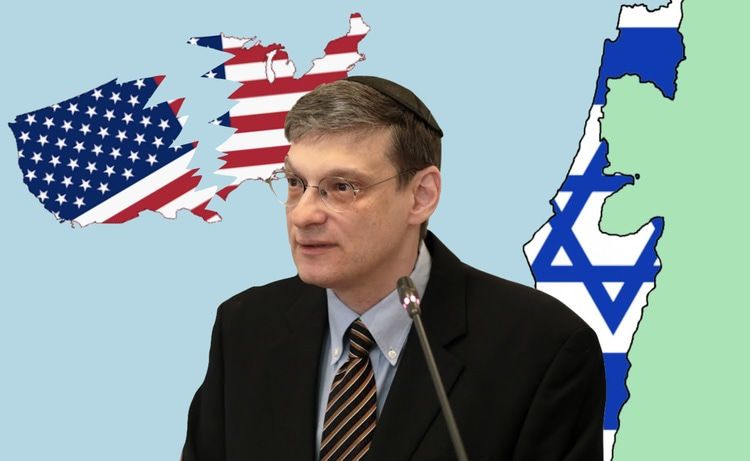
Yarmulke-wearing Yoram Hazony
In other words, it wasn’t a “festival with fascists” at all. Of course, the Board of Deputies and Jewish Chronicle didn’t mention any of that Jewish involvement in their condemnation of Kawczynski. They were being dishonest, but Yoram Hazony returned the favour when he defended Kawczynski in an article at Quillette entitled “The British Conservative Party Should Stop Cancelling Conservatives.” Hazony and his co-author didn’t mention the prominent Jewish criticism of Kawczynski, because they didn’t want to draw attention to the central Jewish role in censorship and “cancel culture.” But another Jewish academic, the sociologist Frank Furedi, wasn’t dishonest like Hazony. He openly named and condemned the Board of Deputies in an article entitled “The witch hunting of Daniel Kawczynski”:
Almost overnight, Kawczynski, a respected MP, was transformed by his media and political detractors into the incarnation of xenophobic evil. Very few mainstream commentators and politicians were prepared to stand up to the powerful campaign of vilification directed against him. Very few even asked the question, ‘What did he actually do?’. Instead, the very fact that some media outlets branded him ‘far right’ was enough to condemn him.
Kawczynski’s alleged crime was that he attended a meeting of fascistic European politicians who apparently are in the business of promoting anti-Semitic conspiracy theories. In the words of former Tory Party chairman Lord Pickles, who serves as the government’s ‘special envoy on post-Holocaust issues’, Kawczynski brought ‘comfort’ to ‘racists and extremism’. Pickles claimed Kawczynski had ‘let fellow Conservatives down’.
It is worth noting that Kawczynski himself is not accused of saying anything remotely racist, xenophobic or anti-Semitic. In the eyes of his persecutors, his crime was that he attended a conference with questionable people. In other words, he is guilty by association.
But who is he guilty of associating with, precisely? Some of his persecutors have alleged that he mixed with well-known anti-Semites and therefore he helped to legitimise anti-Semitism and racism. Marie van der Zyl, president of the Board of Deputies of British Jews, carelessly waded into the discussion, asserting that the Tories ran the ‘serious risk of the public assuming that they share [Kawczynski’s] views’, unless, that is, they made an example of him. The Guardian and the Independent echoed this sentiment, implying that Kawczynski’s guilt was beyond debate. …
It is a shame that Marie van der Zyl and her colleagues at the Board of Deputies have such a shallow grasp of what anti-Semitism actually means. Even worse, at a time when anti-Semitism is on the rise in many parts of Western Europe, crying wolf about it trivialises the seriousness of the threat faced by Jewish people today. If anyone should apologise as part of this sordid, concocted controversy, it should be Eric Pickles and Marie van der Zyl. (The witch hunting of Daniel Kawczynski, Spiked Online, 10th February 2020)
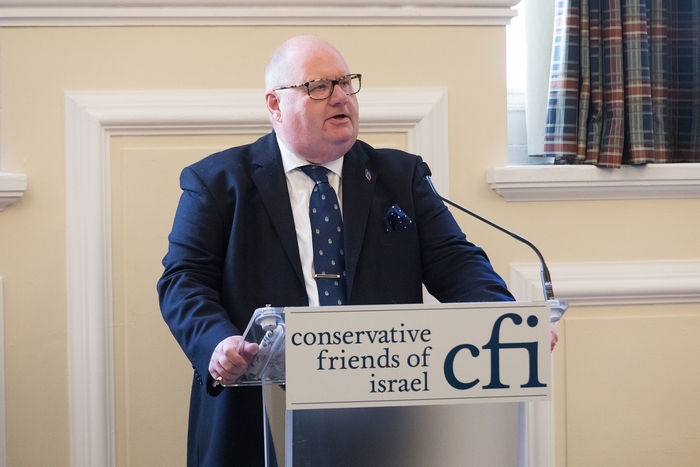
Dedicated shabbos-goy and pie-eater Eric Pickles
Myself, I would trust Frank Furedi as far as I could throw the famously rotund Eric Pickles, but I have to give him credit for naming and attempting to shame the Board of Deputies and for noting that Pickles is “the government’s ‘special envoy on post-Holocaust issues’.” Furedi didn’t explicitly conclude that Jewish organizations play a central role in censorship and “cancel culture,” but he certainly supplied evidence for others to reach that conclusion.
It’s also interesting that Furedi himself seems to have attended the anti-immigration conference in Rome, because it would surely have horrified him during his days as leader of the Revolutionary Communist Party (RCP), a Trotskyist groupuscule that argued for the “rejection of all controls on immigration.” Furedi’s former underlings in the RCP have continued to argue for open borders at venues like Spiked Online, but it appears as though Furedi may no longer believe that open borders are a good way to combat the anti-Semitism that so obviously and deeply concerns him (see his words above).
Viva Italia! Viva Israel!
Anti-Semitism also deeply concerns the Italian politician Matteo Salvini, who had been scheduled to appear at the conference with Viktor Orbán and Yoram Hazony. Salvini didn’t appear in the end, but his views were fully represented there. After all, Salvini strongly opposes Muslim immigration and just as strongly supports Israel. Here’s a translation of part of a speech he made at the Italian Senate proclaiming his love of Israel and blaming anti-Semitism in Italy on Muslim immigrants:
The anti-Semitism of the right, neo-Nazi, neo-Fascist, or of the American/European white supremacist, is our enemy. Similarly our enemy is the anti-Semitism of the left, like the Islamists, like this definition of the modern anti-Semitism, like the red-green alliance. … we are also more concerned with the anti-Semitism that is accepted in some institutions … [like] a European Union that denies its Judeo-Christian roots. A European Union that labels Israeli products produced in disputed territories. A UN which in 2018 dedicated 27 condemnations of Israel in security resolutions, and one against Iran, and not even one on human rights in China and Turkey …
The enemies of Israel are the enemies of civilization and peace. The friends of Israel are the friends of liberty, rights, progress, and peaceful co-existence among peoples, and I remember as one of my greatest satisfactions when, after the meeting I had with Bibi Netanyahu, in a press conference, the Israeli prime minister said, “I have met a friend of Israel.” I am honored, I am honored to be that. And I will fight with all my strength, in all forums inside and outside of the institutions, so that our children and your children never re-live the errors and horrors of the past. Whatever [unintelligible] source or political justification they might have. Long live Italy. Long live Israel. (Matteo Salvini’s Complete Speech on Israel and Jew-Hatred, Gates of Vienna, 22nd January 2020)
I dislike Salvini’s use of the historically baseless term “Judeo-Christian” (giudeo-cristiano in Italian), which was devised in the United States in the 1940s to serve Jewish interests (in another sense, “Judeo-Christian” is a legitimate term in the study of early Christianity). But I don’t think Salvini is a shabbos-goy like Daniel Kawczynski. After all, Salvini said “Long live Italy” before he said “Long live Israel.” I think that a true shabbos-goy would have put Israel before Italy.
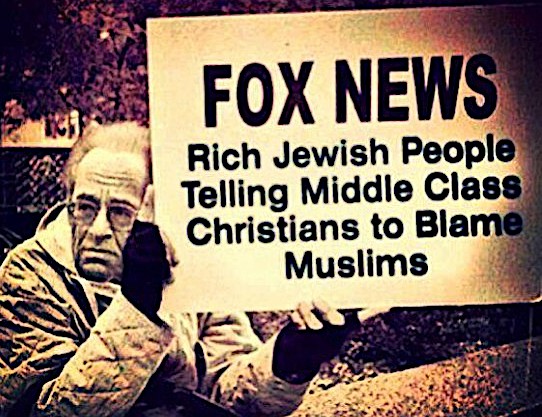
Pretending that Jews had no role in Muslim immigration
Nevertheless, Salvini’s praise of Benjamin Netanyahu is a useful warning, just like Daniel Kawczynski’s attendance at the supposed “far right” conference in Rome. We should keep a careful eye on Jewish and Israeli involvement in pro-White, pro-Christian political movements, because those movements might turn out to be not so pro-White and pro-Christian as they appear. Jews like Yoram Hazony and Marie van der Zyl are not really on opposing sides, because Yoram and Marie are merely supplying different answers to a single all-important question: What’s best for Jews?
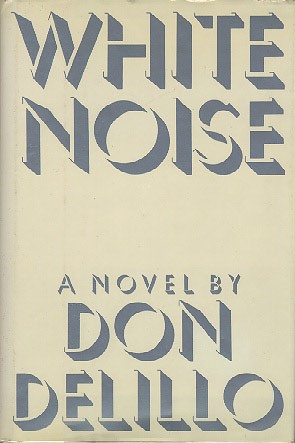
“They were all Hitler majors, members of the only class I still taught, Advanced Nazism.”
Don DeLillo, White Noise
Along with Thomas Pynchon and Cormac McCarthy, Don DeLillo is commonly regarded as one of the finest living writers in American fiction. As well as winning the National Book Award for White Noise in 1985, DeLillo has twice been a finalist for the Pulitzer Prize for Fiction (1992 and 1998), and he was also awarded the Library of Congress Prize for Fiction in 2013. DeLillo’s work is, in the author’s own description, concerned with “power, corporations, the state, and the whole system of consumption and of debilitating entertainments.” As such, his work is relevant to most sections of the political spectrum, including our own, and no work is more bitterly appropriate, prophetic, and caustic than White Noise, his 1985 postmodernist satirical masterpiece. Pathological consumerism, insanity in academia, pandemic panics, social decay and fragmented families, the nihilism and anonymity of urban living, obesity, alienated youth, Western modernity’s terror of death, and the manifold abuses of Big Pharma are all foretold and satirized. Added ingredients include a sneaky and oversexed Jewish character, and a protagonist who is founder and director of the discipline of Hitler Studies. What results from this combination is a novel at once terrifying and hilarious, prescient and unforgettable.
The book begins with the start of a new semester at College-on-the-Hill, the work place of the novel’s protagonist, Jack Gladney. Gladney and his wife Babette both suffer from a pathological phobia of death, something that’s exacerbated when a chemical spill from a rail car releases a black toxic cloud over the town. Following a mass evacuation, Gladney discovers that Babette has been secretly taking a new experimental drug named Dylar, which is supposedly capable of treating intense fear of death. He also finds out that Babette has been obtaining her supply of Dylar from a man she’s been having an affair with. Consumed with his own fears, Gladney sets out to obtain his own illicit supply but the drug not only fails to achieve its stated purpose, at least in Babette’s case, but leads to addiction and a number of psychosis-like side-effects. Gladney spirals deeper into his fear of, and obsession with, death. He eventually decides to murder Willie Mink, the man with whom Babette has been having an affair. Gladney then shoots Mink, but the immediacy of another man’s death brings his own obsession with mortality into realignment. He decides to save Mink’s life, and takes him to a nearby hospital where Mink survives.
The baseline plot of White Noise is quite offbeat and simple, but the novel is intensively interwoven with a thorough social critique almost unheard of in contemporary fiction. I have to admit to some negative first reactions to the text, simply because I’m not particularly fond of novels that are “weird” or rely on certain cartoonish exaggerations to make their point. My first reaction to White Noise, based on the plot alone, was therefore much like my first reaction to Bret Easton Ellis’s American Psycho (1991), another work of postmodernist satire with which it has much in common in a stylistic and thematic sense. White Noise is, however, worth pursuing through its various literary devices, because at its heart is one of the most profound and cutting indictments of modern culture. It’s a text with much to say to the Dissident Right, despite the moderate leftism of its author, and the social critique within the book is best discussed thematically rather than from the perspective of the chronological plot.
Academia
In White Noise, DeLillo satirizes the decline of academic standards, and the degradation of universities into a plurality of microscopic pseudo-disciplines taught by hubristic charlatans. DeLillo’s literary device in this regard involves a protagonist, Jack Gladney, who acts as founder and director of “Hitler studies.” This is an interesting choice to say the least. Of all areas of ideology, only two are totally unable to be commodified, absorbed, and assimilated by the current system — National Socialism and radical Islam. As such, the idea of universities operating courses of study involving the objective analysis of the life and career of Adolf Hitler is obviously inconceivable. One gets the impression, however, that DeLillo knows this, and that he chose “Hitler studies” precisely because of its extreme nature, as well as its darkly comic potential. DeLillo is also concerned with the impact of “celebrity culture” on modern society and intellectual standards, and while Hitler is anathema in the contemporary West, he at least remains ever-present — a kind of notorious anti-celebrity. In DeLillo’s words, “Some people are larger than life. Hitler is larger than death.” As such, for DeLillo, Hitler is the perfect candidate for a micro-discipline within his satire of academia, and Hitler studies takes its place among such real-life disciplines as women’s studies, chicano studies, comic book studies, and celebrity studies.
Most of the novel’s early laughs come from the jarring effect on the reader of the celebration of Hitler studies. Jack Gladney, for example, introduces himself with gusto:
I am chairman of the department of Hitler studies at the College-on-the-Hill. I invented Hitler studies in North America in March of 1968. It was a cold bright day with intermittent winds out of the east. When I suggested to the chancellor that we might build a whole department around Hitler’s life and work, he was quick to see the possibilities. It was an immediate and electrifying success.
Gladney is never far from his dog-eared and heavily annotated copy of Mein Kampf, and he informs us that it’s his custom on Fridays, “after an evening in front of the TV set, to read deeply in Hitler well into the night.” Gladney is told by a colleague that he’s done “a wonderful thing here with Hitler,” and when asked later “How’s Hitler?,” he responds enthusiastically: “Fine, solid, dependable.” When Babette informs Jack that “[Hitler] was on [TV] again last night,” Jack replies, “He’s always on. We couldn’t have television without him.” DeLillo presents Gladney as an intellectual opportunist who merely capitalized on, and in a sense commodified, Hitler. This image is complicated only twice in the novel. In the first instance, we learn that Gladney named his son Heinrich, an act that he later explains is because “I thought it had an authority that might cling to him. I thought it was forceful and impressive and I still do.” The second point where Gladney’s ideological foundations might be regarded as deeper than surface level come when Babette asks him why Hitler is on TV so much. Gladney responds ambiguously that “It’s not a question of good and evil. I don’t know what it is.”
Overall, however, Gladney is depicted as a quintessential example of academic hubris and fraud. He is obsessed with the pretentious aspects of academic posturing, wearing black academic robes and rejoicing in “clearing my arm from the folds of the garment to look at my watch. The simple act of checking the time is transformed by this flourish.” He invents a middle initial so that he can style himself “J.A.K. Gladney.” Although secure in his position as the celebrated founder of Hitler studies, Gladney’s department is “composed almost solely of New York émigrés, smart, thuggish, movie-mad” and the overall academic atmosphere is “one of pervasive bitterness, suspicion and intrigue.” Ultimately, Gladney is self-conscious as an academic fraud, remarking that he had
long tried to conceal the fact that I did not know German. I could not speak or read it, could not understand the spoken word or begin to put the simplest sentence on paper. The least of my Hitler colleagues knew some German; others were either fluent in the language or reasonably conversant. No one could major in Hitler studies at the College-on-the-Hill without a minimum of one year of German. I was living, in short, on the edge of a landscape of vast shame.
DeLillo thus satirizes the creation of academic disciplines by figures who are themselves intellectually average or lacking in suitable insights or skills, something reinforced when Gladney admits early in the book that in regards to the illustrious posturing of J.A.K. Gladney, he is merely “the false character that follows the name around.” Gladney’s success with Hitler studies, despite the fact he’s something of an imposter, is obvious to other academics. One tells Gladney he wants “to do the same thing with Elvis,” and later explains he’s been asked to “teach a course in the cinema of car crashes.” DeLillo probably never appreciated just how much his speculative jesting would become reality.

Just Your Average Academics: Faculty from the Center for Interdisciplinary Gender Studies, University of Leeds
Jews
White Noise is an unusual example of modern fiction in that it presents, as one of its main characters, a rather negative portrayal of a Jew. One of Gladney’s colleagues at College-on-the-Hill is Murray Jay Siskind, an ex-sportswriter. Siskind, who is described as “a stoop-shouldered man with little round glasses and an Amish beard,” is a sex-obsessed urbanite who is totally out of place in small town America. He is also acutely aware of his Jewishness. Siskind informs Gladney that he’s staying in a rooming house, and proceeds to describe the other inhabitants in abstract ways like “A woman who harbors a terrible secret. A man with a haunted look. A man who never comes out of his room.” When Gladney asks him, “Which one are you?”, Siskind responds, “I’m the Jew. What else would I be?” Siskind obsesses with awe over the mundane behaviors of regular townspeople, taking notes about them almost as if he is observing a different species. He is also irrationally suspicious of rural people and manual laborers—reflecting the normative fear and loathing of Jewish intellectuals toward populism and the White working class. When discussing a dripping faucet in his bathroom, Siskind tells Gladney his landlord will fix it before adding “Too bad he’s such a bigot.” The exchange continues:
“How do you know he’s such a bigot?”
“People who can fix things are usually bigots.”
“What do you mean?”
“Think of all the people who’ve ever come to your house to fix things. They were all bigots weren’t they?
“I don’t know.”
“They drove panel trucks, didn’t they, with an extension ladder on the roof and some kind of plastic charm dangling from the rearview mirror?”
“I don’t know, Murray.”
“It’s obvious,” he said.
The humor of the exchange resides in the fact it isn’t at all obvious that manual workers are inevitably bigots. The link between the two exists only in Murray Siskind’s mind, which in fact evidences its own form of bigotry. Even aside from this incident, DeLillo leaves us in no doubt that his Jewish character is altogether unpleasant. Siskind is a lecherous pervert, described several times as having a “sneaky” smile, who reads a magazine called American Transvestite, solicits unusual acts from prostitutes, and leers constantly at Babette, his colleague’s wife, smelling her hair as well as things she’s touched. In fact, elsewhere in the novel he is described in quite animalistic terms, sniffing utensils in the canteen before eating with them. Most ominously, he is also the Mephistophelian influence who persuades Jack Gladney that committing a murder will relieve Gladney’s fear of death.
DeLillo grew up in the Bronx in the 1940s, a time when Jews were accelerating their move into the professions and other areas of economic, social, and political influence. It’s worth pondering whether Siskind was based on real characters encountered by the author, or whether Siskind emerges instead from the unstated, and in many cases unconscious, cultural knowledge that most White people still possess about Jews, despite all politically correct conditioning. Siskind, the quick-talking, psychologically-intense, leering, and predatory bigot, who in turn accuses others of bigotry, is all-too-reminiscent of so many Jewish cultural figures who go on to enter the popular consciousness. Harvey Weinstein, donor to the Simon Wiesenthal Center and the ADL’s campaigns against “bigotry,” is a prime example. And there is little the ADL can do to stop such figures causing speculation, to use their terminology, on “Jewish sexual degeneracy and perversion.” For this reason alone, I found DeLillo’s portrayal of Siskind, the urban Jew in small-town America, to be less grounded in satire than in a rather uncomfortable social reality.
Fear of Death
At time of this writing, much media attention remains focused on the outbreak of novel coronavirus in Wuhan, as well as new outbreaks in Iran and Italy. This panic follows on from previous feverish (pardon the pun) media coverage of Ebola, swine flu (H1N1), and SARS, as well as increasingly vocal and violent protests about putative ecological and environmental disasters such as climate change and the mass extinction of species. In short, we live in a civilization that is in terror of death, and pathologically so. I say pathologically, because our civilization is in fact dying, but not from the causes currently distracting and fixating the masses. Our civilization is not dying from a disease epidemic, global tsunamis, or an asteroid strike, but from its willful and ignorant abdication (via self-hate and industrialized abortion) of a future in favor of mass immigration, consumerism, and instant gratification. We panic about old people dying from flu, but barely blink when millions of Muslims migrate to our countries, utterly transforming the nation and its future. Indeed, we might say that just as one has to confront death in order to truly live (or to become “authentic” in Heidegger’s philosophy), our society is in constant flight from death and thus inevitably collapses into inauthentic decay.
This is the paradox of our age. Fear of death everywhere coexists with a cult of death. Social media and celebrity culture, especially among women, is fixated on fighting ageing and extending youth perpetually. Trying to look younger for longer has long been a human preoccupation in eras of decadence, but our current age would appear to have taken matters to new lows. We live in the period of FOMO, Fear of Missing Out, where individuals collapse into pathological social anxiety if they can’t keep up with events in other people’s lives. Death, once seen as an inevitable part of life itself, and perhaps, for the religious, even of something greater than life, is now reduced for many to a terrifying obstacle to what “might have been.” Death becomes an awful, and extremely personal thing. In their classic essay, “Modernity, Self-Identity, and the Sequestration of Death,” Philip Mellor and Chris Shilling contrast the role of death in modern and pre-modern societies:
[In the past] when death occurred, its significance denoted a disruption to the social body more than it did the passing of an individual body. When identity is rooted more in the group than it is in the individual, death does not threaten the individual as it does in the modern world. Death meant that society had lost part of itself, not that an individual had lost society.
The collapse of group identity in the West has led to a radical change in approaches to death. Death in modernity is lonely, is utterly individualized and lacks deep meaning beyond personal loss. As such, many lives lack meaning also. The elusive search for meaning has translated into an $800 million dollar industry in “self-help” literature, and a series of diet and fitness crazes apparently designed in desperation to ensure one’s body conforms to youthful and sexual standards. The elderly, uncomfortable reminders of an unavoidable future fate, are increasingly segregated from the young. The result is a society, to use the words of Mellor and Shilling, consumed by “intense confusion, anxiety, and even terror,” in the face of mortality. Paradoxically, it does this while condoning abortion on an industrial scale, and the celebration of non-reproductive sexual behaviors that are known to produce their own forms of contagious and fatal illness. In short, the West’s fear of death is as selfish as it is pathological.
To my mind, there are no rivals to DeLillo’s White Noise in terms of the way it tackles fear of death in modernity. Death is a constant topic of discussion for Jack and Babette Gladney. They obsess over who will die first. Jack wakes “in the grip of a death sweat,” while Babette “thinks nothing can happen to us while there are dependent children in the house. The kids are a guarantee of our relative longevity. We’re safe as long as they’re around.” As well as fixations on personal mortality, and much like the postmodern West as a whole, the Gladneys and their children have a nihilistic fascination with natural catastrophes, which provide a kind of entertainment—a mediated version of death too large-scale and “cinematic” to be a genuine disturbance to the real death phobia. Jack describes a night with his family:
That night, a Friday, we gathered in front of the set, as was the custom and the rule, with take-out Chinese. There were floods, earthquakes, mud slides, erupting volcanoes. We’d never before been more attentive to our duty, our Friday assembly. Heinrich was not sullen, I was not bored. Steffie … appeared totally absorbed in these documentary clips of calamity and death. Babette tried to switch to a comedy series about a group of racially mixed kids who build their own communications satellite. She was startled by the force of our objection. We were otherwise silent, watching houses slide into the ocean, whole villages crackle and ignite in the mass of advancing lava. Every disaster made us wish for more, for something bigger, grander, more sweeping.
Consumerism
In White Noise, death and consumerism are intimately bound up together. Faced with death and disaster, everyone in the book responds by shopping. In fact, every negative feeling is assuaged by consumption. In Gladney’s narration, this is reinforced by periodic unexplained insertions into the text (and therefore of Gladney’s consciousness) of marketing data, or phrases from TV ads. While discussing his fear of death, for example, Gladney suddenly spouts “Visa, Mastercard, American Express,” before returning to the topic at hand. His wife mutters the various models of Toyota cars in her sleep. After an altercation with a colleague, Jack Gladney explains that it “put me in the mood to shop.” Ventriloquizing via Gladney, DeLillo’s meandering reflection on irrational postmodern therapeutic consumption is masterful:
I shopped with reckless abandon. I shopped for immediate needs and distant contingencies. I shopped for its own sake, looking and touching, inspecting merchandise I had no intention of buying, then buying it. I sent clerks into their fabric books and pattern books to search for elusive designs. I began to grow in value and self-regard. I filled myself out, found new aspects of myself, located a person I’d forgotten existed. Brightness settled around me. We crossed from furniture to men’s wear, walking through cosmetics. Our images appeared on mirrored columns, in glassware and chrome, on TV monitors in security rooms. I traded money for goods. The more I spent, the less important it seemed. I was bigger than these sums. These sums poured off my skin like so much rain. These sums in fact came back to me in the form of existential credit.
A similar process is enacted in Gladney’s experience of withdrawing cash from an ATM:
I inserted my card, entered my secret code, tapped out my request. The figure on the screen roughly corresponded to my independent estimate, feebly arrived at after long searches through documents, tormented arithmetic. Waves of relief and gratitude flowed over me. The system had blessed my life. I felt its support and approval … What a pleasing interaction. I sense that something of deep personal value, but not money, not that at all, had been authenticated and confirmed.
When news reports suggest a coming snowstorm, Gladney observes swarms of old people engaged in media induced panic-buying:
The old people shopped in a panic. When TV didn’t fill them with rage, it scared them half to death. They whispered to each other in the checkout lines. Traveler’s advisory, zero visibility. When does it hit? How many inches? How many days? They became secretive, appeared to withhold the latest and worst news from others, appeared to blend a cunning with their haste, tried to hurry out before someone questioned the extent of their purchases. Hoarders in a war. Greedy, guilty.
DeLillo also links the broader social malaise to that other form of postmodern mass consumption — eating:
When times are bad, people feel compelled to overeat. Blacksmith is full of obese adults and children, baggy-pantsed, short-legged, waddling. They struggle to emerge from compact cars; they don sweatsuits and run in families across the landscape; they walk down the street with food in their faces; they eat in stores, cars, parkinglots, on bus lines and movie lines, under the stately trees.

For DeLillo, postmodernity is typified by an economy built on induced, quasi-therapeutic panic-buying and eating where the majority consumers are reduced to the status of greedy and guilty hoarders. Fear is thus a commodity of sorts, since it is a stimulant to sales, and, to use DeLillo’s words, “Terrifying data is now an industry in itself. Different firms compete to see how badly they can scare us.” This reality can be observed not only in the media, which exaggerates and commodifies bad news in order to sell otherwise superfluous products to concerned buyers, but also in all aspects of marketing. Here a guiding principle is that people should be convinced of an ever-increasing number of artificial “needs” so they can be sold a proffered, and profit-making, “solution.”
Society
DeLillo’s scathing treatment of consumerism is part of a broader critique of society. Most obviously, DeLillo satirizes the decline of stable, married families. While our contemporary education and cultural systems increasingly laud the various types of “new families” (single-parent, homosexual, etc.), DeLillo bases his novel around the fact the Gladneys are a “blended family” that results from two divorces, two sets of children from prior marriages, and all of the emotional baggage and childhood dysfunction resulting from that. Heinrich, in particular, is a 14-year-old metaphor for the confused, alienated, and emotionally-abandoned children that result from such environments, and it really is remarkable that DeLillo appeared to predict both the pattern and notoriety of mass school shooters like those involved in the Columbine massacre. The boy has morbid obsessions, plays chess via mail with an incarcerated mass killer, often wears camouflage, and Babette worries “he will end up in a barricaded room, spraying hundreds of rounds of automatic fire across an empty mall before the SWAT teams come for him with their heavy-barreled weapons, their bull-horns, and body armor.”
Another of DeLillo’s substantial social predictions is his anticipation of vacuous Instagram culture. In the novel, this takes the form of heavy satire on things that are “famous for being famous” and focuses on a trip undertaken by Siskind and Gladney to “the most photographed barn in America.” The barn is entirely nondescript, and its fame is artificial—the result of signs that merely proclaim it to be famous. Siskind and Gladney arrive to find more than forty cars and a tour bus in the makeshift lot beside the barn, and become aware that people are more interested in taking photos of the accumulation of people, cameras, and tripods than they are in the barn itself. They come to the realization that, in postmodernity, fame itself has become famous; that celebrity itself has become the focus of celebrity. Or, in DeLillo’s words:
“They are taking pictures of taking pictures,” he said.
He did not speak for a while. We listened to the incessant clicking of shutter release buttons, the rustling crank of levers that advanced the film.
“What was the barn like before it was photographed?” he said.
“What did it look like, how was it different from other barns, how was it similar to other barns? We can’t answer these questions because we’ve read the signs, seen the people snapping the pictures. We can’t get outside the aura. We’re part of the
aura. We’re here. We’re now.”

Like the throngs taking photographs of DeLillo’s barn, the cultural life of the West has descended into a celebrity cult where the objects of adoration are largely non-entities whose individual qualities are of lesser importance to the simple fact that they are famous. In this sense, the Kardashians and other focuses of mass media attention are little more than our “barns,” inanimate and unimportant objects that attract attention because we’ve been convinced that they attract attention. We photograph them being photographed, and in doing so “become part of the aura.”
Conclusion
Don DeLillo’s White Noise is one of the best and most intelligent socio-political satires of the last 50 years, and deserves a careful “reading from the Right.” There are certainly themes in the book that will resonate with dissidents, and this review is intended only to cover some of them within a thematic structure. The plot and style of the novel won’t be to everyone’s taste. White Noise is itself, after all, an example of postmodernist literature. It is quirky, sometimes unbearably so, and is occasionally needlessly abstruse. DeLillo is also much better at descriptive writing than he is at writing dialogue. However, I believe the novel is worth the effort of a slow reading and re-reading, and White Noise is perhaps both the kind of art that the present age needs and deserves. It’s an awful mirror in which our contemporary society is morbidly, strangely, and yet accurately reflected. If you’ve felt like we’ve been living out some kind of dystopian novel, maybe it’s because we have.
In the last decade, 40,000 Jews packed their bags and left France. It is a mass exodus of one tenth of the total Jewish population. According to a report, of the half-million Jews currently living in France, 40 percent or 200,000 Jews are also considering the possibility of moving to Israel. … Many historic French Jewish areas have been emptied of their Jews. The number of Jewish families in Aulnay-sous-Bois fell from 600 to 100, in Le Blanc-Mesnil from 300 to 100, in Clichy-Sous-Bois from 400 to 80, and in La Courneuve from 300 to 80. … In Pierrefitte, the community has recorded a 50 percent decline in the number of faithful.
─ Arutz Sheva (2018)[i]
The Jews have been driven from every country they have settled in, forced to wander the globe for centuries as a nation without a nation. This situation has not changed since the establishment of a Jewish homeland in Israel. In western Europe, we are again witnessing a mass exodus of Jews, but this time, it’s not occurring because of White anti-Semitism. The Jews are apparently being driven from their homes because they have become the victims of their own ethnically subversive strategizing.
To understand why diaspora Jews are currently under attack, we have to understand modern Jewish ethnic subversion. The Jewish historical experience has taught Jews they can only thrive in individualistic White majority societies.[ii] This is why liberal diaspora Jews are ideologically committed to ever increasing racial diversity in Western societies. Diversity allows Jews to diminish White political power—the specter of a homogeneous White society turning against them as happened in the 1930s in Germany, while maximizing their own chances of survival by out-competing Whites for available resources. Despite the problems caused by mass non-White immigration for Jew and non-Jew alike, diaspora Jews continue to lobby Jewish-dominated globalist elites for larger and larger numbers of non-White immigrants.[iii] [iv] [v] [vi] [vii]
Unfortunately for Jews, a disproportionately large number of immigrants to western Europe are Muslims with various anti-Jewish grievances. Muslims were initially not perceived as a threat to Jews because of their low IQ, low socio-economic status and penchant for criminal behavior. Jewish anti-White hatred provided more than enough justification for the Left’s recruitment of Muslims in their crusade against Whites and White societies.
Prominent Jewish activists believed that by importing Muslims en masse, Muslims would be ready allies in the struggle against “White privilege.” As far as Jews were concerned, as long as Muslims remained a subservient underclass easily manipulated by Jewish state propaganda, they would turn a blind eye to Muslim anti-Semitism and Judeophobia. And even despite Muslim anti-Jewish violence, the organized Jewish community continues to promote ties between Muslims and Jews. Their solution is not to try to stop promoting Muslim migration but to promote the creation of police-state controls where thought crimes are punished, censorship flourishes, and to ramp up “anti-racist” propaganda the media and the educational system. As Tobias Langdon noted,
Which rich and powerful lobby-group mentors and advises [Muslim activist group] Tell MAMA and has seen its former chief executive become co-chair of Tell MAMA? Why, it’s the Community Security Trust, the Jewish group that also hates free speech and wants to crush native White resistance. Dr Richard Stone, Jewish high priest in the Stephen Lawrence cult, has written that “British Jews and Muslims are natural allies.” Against whom? Against the White and historically Christian majority, of course. While Jews supply the verbal intelligence and legal expertise, Muslims are supposed to play the role of non-White victims in a campaign to undermine and dispossess the White majority.

Runnymede is essentially a secular Jewish organization (analogous to the SPLC in the U.S.) that functions partly promote ties between Jews and Muslims in the U.K.
Promoting Jewish ethnic interests through racial diversification of White societies hasn’t worked out as well as the liberal diaspora Jews once thought. In western Europe, which has been substantially transformed by mass non-White immigration, Jews are finding themselves increasingly under attack. According to Jewish journalist Jeffrey Goldberg of The Atlantic:
France’s 475,000 Jews represent less than 1 percent of the country’s population. Yet last year, according to the French Interior Ministry, 51 percent of all racist attacks targeted Jews. The statistics in other countries, including Great Britain, are similarly dismal. In 2014, Jews in Europe were murdered, raped, beaten, stalked, chased, harassed, spat on, and insulted for being Jewish. Sale Juif—“dirty Jew”—rang in the streets, as did “Death to the Jews,” and “Jews to the gas.”[viii]
Just who could possibly be behind these attacks? Could it be right-wing “neo-Nazis”? Assorted fascist sympathizers? Goldberg has this to say:
But what makes this new era of anti-Semitic violence in Europe different from previous ones is that traditional Western patterns of anti-Semitic thought have now merged with a potent strain of Muslim Judeophobia. Violence against Jews in Western Europe today, according to those who track it, appears to come mainly from Muslims, who in France, the epicenter of Europe’s Jewish crisis, outnumber Jews 10 to 1.[ix]
Unlike the older anti-Semitism, the violence against Jews is pro-Palestinian and overwhelmingly perpetrated by militant Islamists.
According to a survey of Jews in 12 EU member states[x]: “Close to 40 per cent of European Jews have considered leaving their home countries over the past five years because of rising anti-Semitism.”[xi]
Significant numbers of Jews in France and Germany acknowledge that anti-Semitism has worsened over the last few years:
The Jewish community in France — which has suffered a number of high-profile deadly attacks in recent years — appears to have been especially shaken: almost 80 per cent of French Jews told pollsters that anti-Semitism in the country had “increased a lot”, the highest proportion in Europe. But there was also a marked deterioration in Germany, where 44 per cent of Jews said they had thought about emigrating, up from 25 per cent five years ago.[xii]
In France, which has western Europe’s largest Jewish population, the Jews find themselves fleeing worsening anti-Semitism. The National Geographic reports:
Facing record levels of anti-Semitism, many French Jews are joining an exodus to Israel. A third of all the French Jews who’ve emigrated to Israel since its establishment in 1948 have done so in the last 10 years, according to data from the Jewish Agency, which facilitates Jewish immigration to Israel. The 1950 Law of Return enables any Jew from around the world to become an Israeli citizen entitled to numerous government benefits, including financial aid, tax breaks, free Hebrew courses, and a free flight to Israel. In 2015 alone, nearly 8,000 French Jews made what is known as Aliyah—ascent to the Holy Land—the largest number from any Western nation in a single year.[xiii]
The exodus of French Jews is being driven by acts of radical Islamist anti-Semitic violence:
The current wave of immigration began in earnest after the 2012 Toulouse massacre, in which a French-born Islamic extremist opened fire at a Jewish day school, killing a young rabbi who was shielding his three- and six-year-old sons, then shooting to death both boys and an 8-year-old girl. Three years later, a gunman pledging allegiance to ISIS killed four customers at a kosher supermarket in Paris. “In the days after that, we received thousands of calls from people saying they wanted to leave,” says Ouriel Gottlieb, the Jewish Agency’s director in Paris. “Of the four people murdered at Hyper Casher, three of the families moved to Israel.”[xiv]
Ironically, although diaspora Jews are the biggest supporters of mass non-White immigration, they have no problem fleeing the so-called “benefits” of diversity for the safety of Israel, an ethnically and racially homogeneous society. This indicates the Jewish liberal diaspora’s support for mass non-White immigration is cynical at best.
France isn’t the only western European country where Jews have been on the receiving end of Islamist violence. A NY Times Op-Ed documents rising levels of violence against Jews in Scandinavia:
Historically, anti-Semitism in Sweden could mainly be attributed to right-wing extremists. While this problem persists, a study from 2013 showed that 51 percent of anti-Semitic incidents in Sweden were attributed to Muslim extremists. Only 5 percent were carried out by right-wing extremists; 25 percent were perpetrated by left-wing extremists.[xv]
Increasing Muslim-on-Jew violence has forced many Jews to flee the country. Beside the rising anti-Semitic violence, Jews face an additional problem:
There is, however, tremendous hesitation to speak out against hate crimes committed by members of another minority group in a country that prides itself on welcoming minorities and immigrants. In 2015, Sweden was second only to Germany in the number of Syrian refugees it welcomed. Yet the three men arrested in the [Gothenburg synagogue] Molotov cocktail attack were newly arrived immigrants, two Syrians and a Palestinian.[xvi]
The political correctness upheld by liberal diaspora Jews for decades has backfired. Although Jews promoted and even facilitated Muslim immigration to western Europe, they are now among its victims. The diaspora Jews behind cultural Marxism and other politically correct belief-systems were totally oblivious to the possibility these ideological weapons could be used against them. For example, Muslims are typically non-White and Third World; Ashkenazim, on the other hand, are phenotypically indistinguishable from other Europeans, having long ago assimilated Western cultural standards (at least externally). This means Muslims are the oppressed and Jews the oppressors. According to the logic of cultural Marxism, Muslims are members of an even more specially protected class than Jews. In Animal Farm, George Orwell wrote: “All animals are equal, but some animals are more equal than others.” Leftism hasn’t abolished traditional hierarchies, but inverted them. They now serve non-White interests under the guise of liberal egalitarianism; for leftists, the more non-White, the better, which is why Jews always lose when it comes to Third World immigration.
In the wake of the mass Jewish exodus, the German government has promised to increase the penalties for anti-Semitic acts and ensure the criminalization of Holocaust denial in more EU countries.[xvii] The German government, like the rest of the Jewish-dominated globalist elite, believes the solution to rising anti-Semitism is stricter totalitarian controls on freedom of speech and thought. Although the Jews and their allies have sought to protect Jews through passage of illiberal legislation, these tactics have been remarkably ineffective. The reasons for this should be obvious: nearly all of the anti-Semitic violence committed so far has been perpetrated, not by “neo-Nazi” sympathizers, but by Muslim immigrants. If the Jews thought Muslims were their natural allies, they couldn’t have been more wrong.
The expectation among diaspora Jews was that Muslims would put aside their ethnic rivalries to focus on their shared hatred of White society. The underlying Jewish rationale for this arrangement was, in the words of the old cliché, “the enemy of my enemy is my friend.” This attempt at building a bridge between the world of Jewry and the World of Islam has not prevented Jews from being driven from their homes by Muslim anti-Semitic violence.
In the case of European Jewry, sometimes “the enemy of your enemy” really is your enemy.
[i] http://www.israelnationalnews.com/Articles/Article.aspx/21936
[ii] “Throughout history Jews have tended to prosper in individualistic European societies and have suffered in non-Western societies, most notably in Muslim cultures where there are strong ingroup-outgroup sensibilities (e.g., MacDonald 1998a, Ch. 2; the only exceptions to this generalization have been when Jews have constituted an intermediary group between an alien elite and oppressed native populations in Muslim societies.)” See MacDonald, Kevin. “Culture of Critique: Preface (2002).” www.kevinmacdonald.net/books-preface.html.
[iii] https://forward.com/news/breaking-news/325883/over-1-000-us-rabbis-petition-lawmakers-to-welcome-refugees/
[iv] https://forward.com/news/breaking-news/321320/jewish-groups-slam-White-house-for-baby-step-on-syrian-refugees/
[v] https://www.haaretz.com/jewish/british-rabbis-urge-cameron-to-admit-more-syrian-refugees-1.5401290
[vi] https://www.jta.org/2015/09/08/global/european-jews-mindful-of-risks-urge-aid-to-refugees
[vii] https://www.timesofisrael.com/british-jews-prepare-groundwork-for-influx-of-syrian-refugees/
[viii] https://www.theatlantic.com/magazine/archive/2015/04/is-it-time-for-the-jews-to-leave-europe/386279/
[ix] Ibid.
[x] Austria, Belgium, Denmark, France, Germany, Hungary, Italy, the Netherlands, Poland, Spain, Sweden and the United Kingdom.
[xi] https://www.ft.com/content/a8f26a56-fc62-11e8-aebf-99e208d3e521
[xii] Ibid.
[xiii] https://www.nationalgeographic.com/history/2019/11/french-jews-fleeing-country/
[xiv] Ibid.
[xv] https://www.nytimes.com/2017/12/14/opinion/sweden-antisemitism-jews.html
[xvi] Ibid.
[xvii] https://www.timesofisrael.com/germany-warns-of-mass-exit-of-jews-if-anti-semitism-persists/
In “Ted Gold and the Jews of Weatherman” (September 2017 in TOO), I wrote, in describing a envisioned takeover of the United States by the Jewish radical group Weatherman, “Cue the return of leather-jacketed coke-snorting Jewish secret police rounding up the gentiles for rape, torture and murder in dank abattoirs. It happened, look it up.” This somewhat jarring historical reference left one commenter, “Jim,” nonplussed. He wrote, whether ironically or seriously (but amusingly), “Where can I find info on coke snorting Jews raping people.” Somewhat belatedly, I thought I would review some of the evidence for the separate elements of my statement: leather jackets, cocaine, and torture, rape and murder in “dank abattoirs.” And, of course, Jewish Cheka agents.
The Cheka
When the Bolsheviks seized the power that was so famously “lying in the streets” in early November 1917, they didn’t disguise the fact that they meant to rule by force and terror. Within weeks they established the coercive arm of their permanent revolution, the “Extraordinary Commission for Combating Counterrevolution and Sabotage,” Ve-Cheka for short or Cheka for shorter. Lenin placed the fanatical Pole Felix Dzerzhinsky in charge of it, and he in turn recruited a cohort of Latvians, Jews, and renegade Russians to help him devastate the Russian nation. The Cheka almost immediately launched into one of the most horrifying orgies of mass murder ever recorded, and men of Jewish blood, who like other Jewish leftists, retained their Jewish identity, played a very prominent role in it.
It is very well-attested that Jews were, for the first twenty years of its history, vastly over-represented in the ranks of the Cheka in proportion to their numbers in the population of the Soviet Union. A few citations will suffice. The historian Richard Pipes quotes a member of the early Kiev Cheka to the effect that three-quarters of its personnel were Jewish.[1] Another source shows that 37 of the top 96 NKVD (later nomenclature for the Cheka) officials in 1934 were Jews, an astounding number considering they made up only 1.7 percent of the population.[2] The Jews actually outnumbered ethnic Russians in these top positions all the way up to early 1937, when Stalin began purging them. The Soviet-born Israeli journalist Sever Plocker writes, “Many Jews sold their soul to the devil of the Communist revolution and have blood on their hands for eternity”—at a time, incidentally, when celebrating the Bolshevik Revolution was entirely mainstream in the Jewish diaspora community in the West. At the same time, Jews were underrepresented in the population of the Gulag, by roughly twenty-five percent.[3]
Within months of the institution of the Cheka, provincial Chekas were sprouting up throughout the territory controlled by the beleaguered Bolshevik dictatorship. Because the central Cheka was essentially an extra-legal body, and had for some time little bureaucratic control over the provincial Chekas, the latter often amounted to little more than local strong-arm groups, composed of criminals and Jews, whose motives were plunder and revenge. Central authorities did eventually succeed in bringing their Cheka franchises under discipline, but the murder, torture, and plunder continued, the only change being central direction and a better paper trail.
The prestige and élan that surrounded the early Cheka and its personnel is strange to evoke at this point in time, but it was significant, at least among some circles. The organization had no problem recruiting. They affected a hard-edged style that featured leather jackets or trench coats. Yakov Sverdlov, an important early Jewish Bolshevik commissar—Chairman of the Central Executive Committee and thus de jure head of state—apparently spread the vogue for leather jackets and even leather trousers.[4] Here he is, to the right of Lenin:
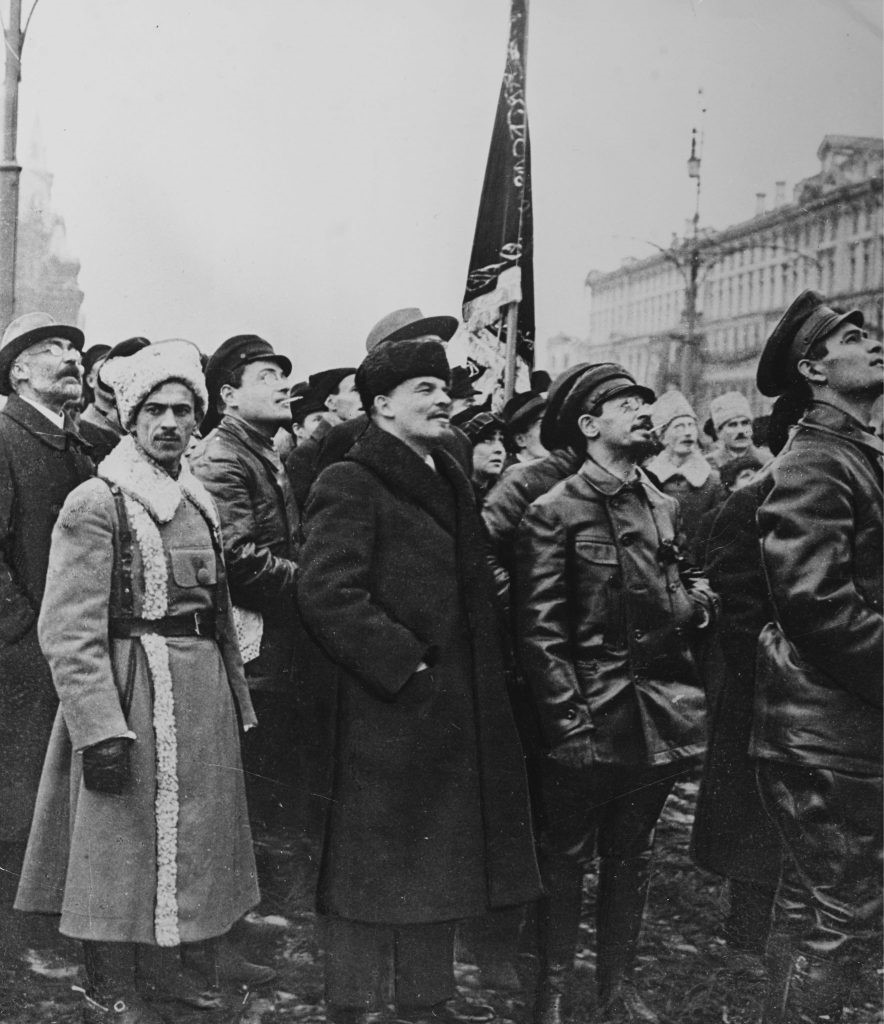
The Jewish functionary and terrorist Rozalia Zemliachka, best known for butchering 50,000 people in the Crimea after the Civil War, was also well-known for her fondness for leather jackets and a hardline persona: “In her forties when the Civil War began, Zemliachka dressed in the stereotypical garb of a Bolshevik commissar and killed with a vengeance.”[5] Another source relates that Dzerzhinsky commandeered a shipment of leather coats meant for air force pilots, and outfitted his men in them.[6] In the early days, every self-respecting Bolshevik commissar and Cheka officer sported leather jackets.
The Jews who flocked into the ranks of the secret police were burning for revenge on their Christian neighbors, and nobody nurses a grievance quite like the Jews—the pogroms, despite their exaggeration by Jewish activists at the time and since, were certainly a component of Jewish hatred toward the Russian Empire. A variety of sources confirm a sense of revenge as a motive. Yuri Slezkine reviews some of the works of early Soviet Jewish writers that illustrate the revenge theme. For example, the amorous advances of the Jewish protagonist of Eduard Bagritsky’s poem “February” are rebuffed by a Russian girl, but their positions are changed after the Revolution when he becomes a deputy commissar. Seeing the girl in a brothel, he has sex with her without taking off his boots, his gun, or his trench coat—an act of aggression and revenge:
I am taking you because so timid
Have I always been, and to take vengeance
For the shame of my exiled forefathers
And the twitter of an unknown fledgling!
I am taking you to wreak my vengeance
On the world I could not get away from!
Igor Shafarevich, a mathematician and member of the prestigious U. S. National Academy of Sciences reviewed Jewish literary works during the Soviet and post-Soviet period, finding a prominent theme of Jewish hatred mixed with a powerful desire for revenge toward pre-revolutionary Russia and its culture. But Shafarevich also suggests that the Jewish “Russophobia” that prompted the mass murder is not a unique phenomenon, but results from traditional Jewish hostility toward the non-Jewish world, considered tref (unclean), and toward non-Jews themselves, considered sub-human and as worthy of destruction—a very reasonable interpretation given traditional Jewish ethics in which non-Jews have no moral standing. People with such beliefs have no moral compunctions about the torture, rape, and murder of their perceived enemies. Hatred toward the peoples and cultures of non-Jews and the image of enslaved ancestors as victims of anti-Semitism have been the Jewish norm throughout history—much commented on, from Tacitus to the present.
Finally, the Jewish hatred and desire for revenge was not confined to the USSR. Jewish members of the internal security force in post-World War Poland often appear to have been motivated by personal rage and a desire for revenge related to their Jewish identity:
Their families had been murdered and the anti-Communist underground was, in their perception, a continuation of essentially the same anti-Semitic and anti-Communist tradition. They hated those who had collaborated with the Nazis and those who opposed the new order with almost the same intensity and knew that as Communists, or as both Communists and Jews, they were hated at least in the same way. In their eyes, the enemy was essentially the same. The old evil deeds had to be punished and new ones prevented and a merciless struggle was necessary before a better world could be built. (Schatz, J. (1991). The Generation: The Rise and Fall of the Jewish Communists of Poland, 226)
The Cheka official quoted by Pipes above said the early days in Kiev (1918–1919) amounted to a “continuous spree” of rape and robbery, though they were “careful to spare fellow Jews.”[7] For some reason, Pipes left out mention of horrific torture and murder, but I’ll fill in those details.[8] A major element of revenge has always been humiliation of the target group and rape of its women, and the Red Terror had plenty of both. The acme of vengeance, for the truly dedicated, is torture and murder: the infliction of terrible suffering directly on the object of hatred, flaunting one’s dominance, then the total destruction of the victim. The frenzied nature of the excesses of the Red Terror resulted from a combination of factors, including an atmosphere of brutalization brought on by revolution and civil war and a perverse ideology, but an ethnic factor was also clearly present.
A recent historian of Stalin’s executioners affirms the Jews “ruthlessly avenged the victims of a century’s pogroms.”[9] Another states that “the “ranks of the Cheka were filled with social elements anxious for revenge.”[10] A historian of the Russian Civil War states, “Always anxious to use national and racial hatreds to advantage, Dzerzhinskii placed Jews in seven of the Cheka’s top ten positions. . . . The victims of centuries of anti-Semitic abuse, the Jews of the Ukraine now had a chance to take revenge.”[11]
The Cheka officers, with literally nothing hindering their action, assaulted women on a mass scale. There is plenty of evidence for this.
“Convicted criminals and certified psychopaths appointed themselves officers of the Cheka and terrorized, raped, and murdered whom they liked.”[12] “Rapes of female prisoners by Cheka guards and interrogators were so commonplace that they occasioned comment from superiors only if performed in some particularly brutal or perverted fashion.”[13] Rape of Russian women by Cheka men “took on gigantic proportions, particularly in the second reconquest of Ukraine and the Cossack regions of the Crimea in 1920.”[14]
Sergey Melgounov wrote the classic account of early Bolshevik rule, The Red Terror. On page 136 he describes Cheka “food detachments” that plundered the food in the countryside to feed the cities, the base of Bolshevik power: “Whenever an expedition that was collecting the grain tax in the Khvalinsky district reached a village the peasants were commanded to surrender their best-looking girls to the officials.”[15]
A story from Ekaterinodar in the Caucasus, c. 1919:
Madame Dombrovskaya, an ex-school teacher, was tortured in her solitary confinement cell . . . . The Che-Ka had been informed that she had . . . jewelery . . . in her keeping: wherefore . . . she was ordered to be tortured until she should reveal where the jewelery might be. For a beginning she was raped and outraged generally—the raping taking place in order of seniority of torturers, with a man called Friedmann raping her first, and the others in regular sequence. And, that done, she was questioned further as to the whereabouts of the jewelery, and further tortured by having incisions made into her body, and her finger tips nipped with pliers and pincers. Until at last, in her agony, with the blood pouring from her wounds, she confessed that the jewels were hidden in an outbuilding of her house. The same evening (the date being November 6) she was shot.[16]
From southern Ukraine: “a witness testified before the Denikin Commission [an investigative body set up by the White Armies] that licentious orgies had been carried out systematically by the Che-Ka and tribunal of Nikolaev, and included even women who had come to beg for relatives’ release, with that inclusion as the price of their relatives’ freedom.”[17]
Some local Chekas were so atrocious that even Bolsheviks were outraged. One—a Serafina Gopner—complained to Lenin about the Cheka in Ekaterinoslav in Ukraine:
This organization is rotten to the core: the canker of criminality, violence, and totally arbitrary decisions abounds, and it is filled with . . . the dregs of society, men armed to the teeth who simply execute anyone they don’t like. They steal, loot, rape, and throw anyone into prison, forge documents, practice extortion and blackmail, and will let anyone go in exchange for huge sums of money.[18]
Virtually all of these poor women were Christian Russians; a great many of the rapists were revenge-minded Jews. I imagine that Jews, with their strong sense of respect for their martyred ancestors, would wish us, too, to “never forget” these victims.
As for cocaine, it was used very widely in the decades before and after 1900. The coca plant grows only in South America, but its properties became known in Europe by the early 1800s. The chemical was isolated from the leaf by a German chemist in 1860, and its use as a stimulant and local anesthetic quickly spread. An early booster of the drug was Sigmund Freud, who wrote a glowing report of its effects and pushed it on his friends and patients. (His addiction lasted twelve years.) By the 1880s, pharmaceutical companies were producing hundreds of thousands of pounds yearly, and Parke-Davis in the U.S. was actually marketing a little kit with cocaine and a syringe and needle for convenient use, although it could also be snorted as a powder. The drug was one ingredient of early Coca-Cola, at least until 1903, when there began a reaction against it because of its addictive and harmful properties. There were an estimated 200,000 addicts in the U.S. at the turn of the century. In addition, Americans became alarmed at the prospect of Blacks committing violent crimes under its influence. One authority maintained that “most of the attacks upon the white women of the South are the direct result of a cocaine-crazed Negro brain.” In 1914 the government placed it under federal control, which did not, of course, eradicate its availability.
Cocaine was also readily available in Russia. The following passages show that Cheka men used it commonly, even maniacally. Some of them claimed that the constant bloodshed and strain necessitated a resort to drugs, but it probably fueled some of the atrocities as well. Whatever the case may be, it was clear that many Cheka men were out of their minds with drugs and sadism. The combination led to mental breakdowns among Cheka agents. A number of them were committed to psychiatric wards.[19]
From a 1919 report on the Cheka in Yaroslavl: “The Cheka are looting and arresting everyone indiscriminately. . . . They have transformed the Cheka headquarters into a huge brothel where they take all the bourgeois women. Drunkenness is rife. Cocaine is being used quite widely among the supervisors.”[20]
The White Armies freed Kiev from Cheka rule for a brief period in 1919. One of the resulting reports stated, “In almost every cupboard and, for that matter, in almost every drawer, we found empty cocaine bottles in piles.”[21]
The Cheka placed their men in all Red Army units. Here is a report from a supervisor on certain of these units: “No administrative norm is being respected by these people. . . . Orgies and drunkenness are daily occurrences. Almost all the personnel of the Cheka are heavy cocaine users. They say that this helps them deal with the sight of so much blood on a daily basis.” The man who composed this report, Rozental, concluded that although these units needed tighter control and were “drunk with blood and violence,” they nevertheless “are doing their duty.”[22] Well, that’s a relief.
Maks Deich, a Jew, was the head of the Odessa Cheka in 1920–1922. There “he earned [a] reputation for extreme cruelty, and suffered a neurosis and addiction to cocaine.”[23] What harrowing atrocities could have earned him notoriety for “extreme cruelty” in this milieu? A Cheka officer in Georgia named Schulmann, very likely a Jew, also earned notice. A prisoner witnessed “brutal executions . . . especially at the hands of a certain Schulmann, who was addicted to morphine and cocaine.”[24]
As for “dank abattoirs,” here is what the White Armies found in Kiev in late August 1919, after they drove out the Bolsheviks:
The place had formerly been a garage, and then the provincial Che-Ka’s main slaughter-house. And the whole of it was coated with blood—blood ankle deep, coagulated with the heat of the atmosphere, and horribly mixed with human brains, chips of skullbone, wisps of hair, and the like. Even the walls were bespattered with blood and similar fragments of brain and scalp, as well as riddled with thousands of bullet holes. In the centre was a drain about a quarter of a metre deep and wide, and about ten metres long. This led to the sanitary system of the neighbouring house, but was choked to the brim with blood. The horrible den contained 127 corpses, but the victims of the previous massacre had been hurriedly buried in the adjacent garden. What struck us most about the corpses was the shattering of their skulls, or the complete flattening out of those skulls, as though the victims had been brained with some such instrument as a heavy block. … And in every case the corpses were naked … [a grave in the courtyard] contained eighty bodies which in every instance bore almost unimaginably horrible wounds and mutilations. In this grave we found corpses with, variously, entrails ripped out, no limbs remaining (as though the bodies had literally been chopped up), eyes gouged out, and heads and necks and faces and trunks all studded with stab wounds. Again, we found a body which had had a pointed stake driven through its chest, whilst in several cases the tongue was missing.[25]
This happened in Kiev, where, you remember, three-quarters of the Cheka staff were Jews.
The Cheka rampage continued for decades. The Terror would reach crescendos, such as “The Great Terror” of 1937–1938, but it never died down until after the death of Stalin in 1953. Robert Conquest, speaking of early 1937, used this chilling description: “Russians who had thought that the country was already in the grip of terrorists were now to see what terror really meant.”[26] When I first read that sentence twenty-five years ago, I had a palpable sensation of horror, and profound sadness for the Russian people.
The German invasion of Russia in June 1941 lifted the curtain on later Bolshevik atrocities.[27] Nearly a quarter century of bloody vengeance had not quenched the Bolshevik/Jewish bloodthirst. The retreating Bolsheviks massacred their prisoners in the frontier prisons rather than transport them to the east, and the incoming Germans carefully preserved the evidence. They didn’t simply kill them, however. One witness, a German doctor, gives the following testimony concerning the scene in Lvov:
I ordered that the cellars [of Brygidky prison] should be immediately cleared, and in the course of the next three days 423 corpses were brought out . . . Among the bodies there were young boys aged 10, 12, and 14 and young women aged 18, 20, and 22, besides old women. . . . [At] the military prison in the northern part of the town . . . the stench of decomposition was so strong and there was so much blood under the mountain of corpses that we had to wear a Polish gas mask in order to enter the cellar. . . . Young women, men, and older women were piled up layer upon layer all the way to the ceiling. . . . The third and fourth cellars were only about three-quarters full. Over 460 corpses were taken out of these cellars. Many of the bodies showed evidence of serious torture, mutilations of arms and legs, and shackling.[28]
Another witness saw
a large space, filled from top to bottom with corpses. . . . The bottom ones were still warm. The victims . . . laid in various poses, with open eyes and masks of terror on their faces. Among them were many women. On the left wall, three men were crucified, barely covered by clothing from their shoulders, with severed male organs. Underneath them on the floor in half-sitting, leaning positions – two nuns with those organs in their mouths. The victims of the NKVD’s sadism were killed with a shot in the mouth or the back of the head. But most were stabbed in the stomach with a bayonet. Some were naked or almost naked . . .
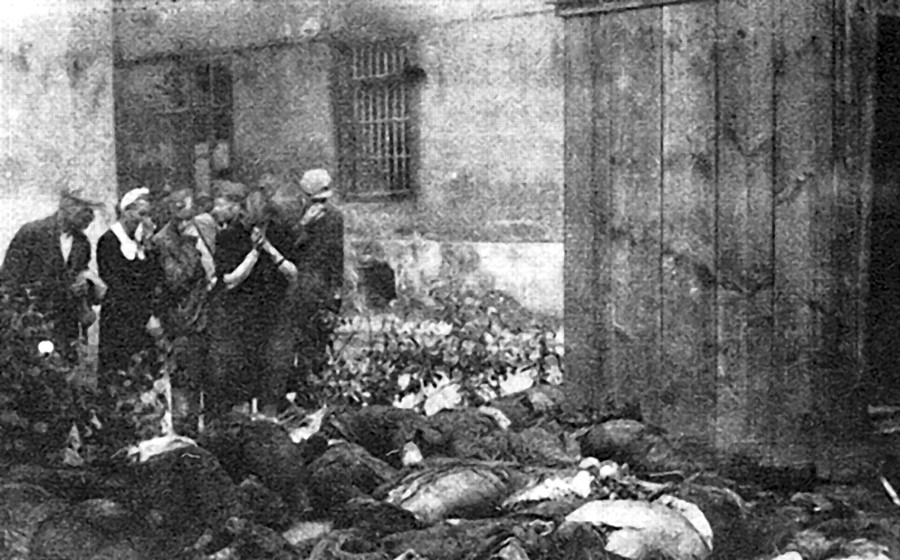
Citizens of Lvov searching for relatives among the victims of the NKVD
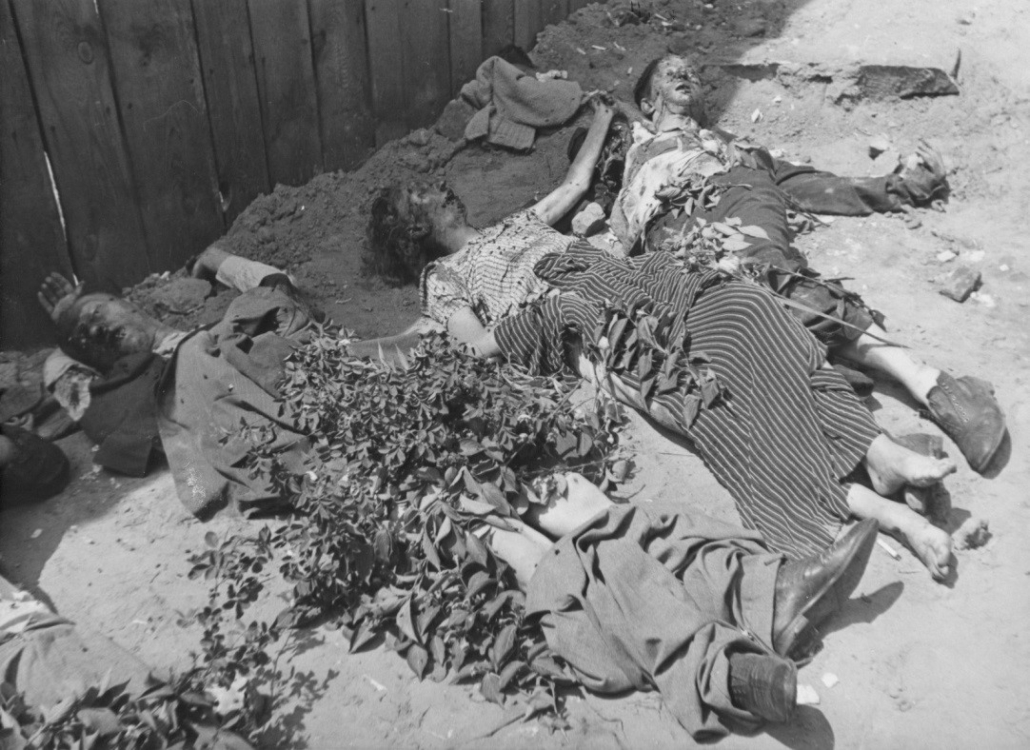
More victims. It looks like they endured severe beatings, and the man in the foreground is partially undressed. Both of the above photos are from https://collections.ushmm.org/search/catalog/pa1153801.
Other witnesses also stated that many of the dead were naked, which naturally leads to the question whether they were raped.[29] The Ukrainian Red Cross estimated that 4,000 people had perished in Lvov alone.[30] Another source says the victims numbered 10,000.[31]
When the local Ukrainian and Polish population saw the terrible scenes, they “immediately started to drag the Jews out of their homes and to abuse them in the streets.”[32] Thousands were killed. The locals pinned the atrocities upon the Jews, so deep-set was the impression that Bolsheviks = Jews. I have not found information on Cheka agents in Lvov for this period, but Jews composed thirty percent of the population of the city.[33] The top-ranks of NKVD officials by this time had a much-reduced Jewish contingent, but that doesn’t mean the middle and lower ranks were reduced in the same proportion. Arkady Vaksberg writes, “But the NKVD was not free of Jews, despite the . . . purges. Among the sadists who came to fill the emptied slots, including very high ones, were “more of the same.”[34] One source states that there were almost 600 Jewish officers in the Ukrainian NKVD in January 1945.[35] Certainly there would have been many more in June 1941.
When I wrote the sentence that introduced this short essay, I was predicting what a Weatherman takeover in America would look like. The communists in Weatherman had important similarities with the Bolsheviks: a smug and fanatical superiority complex, a messianic ideology, slavering hatred of Whites/Christians, and plans for “re-education” camps. The Weathermen have mostly passed away, but the spirit that produced them is far stronger than it was in the 1960s; it is the same ancient and murderous hatred that propelled the Bolsheviks. powerful desire to avenge the evils of the old social order.
The Weathermen were not alone on the Jewish left in the 1960s with fantasies of hatred and revenge. For many Jewish New Leftists “the revolution promises to avenge the sufferings and to right the wrongs which have, for so long, been inflicted on Jews with the permission or encouragement, or even at the command of, the authorities in prerevolutionary societies” (Cohen, P. S. (1980). Jewish Radicals and Radical Jews. London: Academic Press., 208; here, p. 85). Interviews with New Left Jewish radicals revealed that many had destructive fantasies in which the revolution would result in “humiliation, dispossession, imprisonment or execution of the oppressors” combined with the belief in their own omnipotence and their ability to create a non-oppressive social order (Ibid.). These findings are also entirely consistent with Kevin MacDonald’s personal experience among Jewish New Left activists at the University of Wisconsin in the 1960s (here, p. 103, note 13).
The body of this essay is a glimpse at a state of affairs that hovers over the horizon like a vast terrifying storm. No revolutionary overthrow will be needed at this point, for the levers of power are already in the hands of our enemies, awaiting only a situation where they can seize absolute power comparable to their power in the post-revolutionary USSR. Time is short; the great question of this generation is this: does the spirit of our ancestors, the warriors of the steppe, merely slumber in our countrymen? Or is it in fact dead? I’m not sure I want to know the answer to that question.
Notes
[1] Richard Pipes, The Russian Revolution (Vintage Books, 1991), p. 824.
[2] Paul Gregory, Terror by Quota: State Security from Lenin to Stalin (An Archival Study) (Yale University Press, 2009), p. 63.
[3] Terry Martin, The Affirmative Action Empire: Nations and Nationalism in the Soviet Union, 1923-1939 (Cornell University Press, 2001), p. 425. See also here, p. 1028.
[4] Yuri Slezkine, The House of Government: A Saga of the Russian Revolution (Princeton University Press, 2017), p. 152
[5] W. Bruce Lincoln, Red Victory: A History of the Russian Civil War (Simon and Schuster, 1989), p. 386.
[6] Donald Rayfield, Stalin and His Hangmen: The Tyrant and Those Who Killed for Him (Random House, 2004), p. 69.
[7] Pipes, p. 824.
[8] I am aware that Pipes is Jewish.
[9] Rayfield, p. 75.
[10] S. Courtois, N. Werth, J.-L. Panne, Andrzej Paczkowski, K. Bartosek and J.-L. Margolin (eds), The Black Book of Communism: Crimes, Terror, Repression (Harvard University Press, 1999), p. 102.
[11] W. Bruce Lincoln, p. 314
[12] Rayfield, p. 83.
[13] W. Bruce Lincoln, p. 383.
[14] S. Courtois et. al., p. 105.
[15] Sergey Melgounov, The Red Terror in Russia (Hyperion Press, 1976), p. 136.
[16] Melgounov, p. 163.
[17] Melgounov, p. 218.
[18] Courtois et. al., p. 103.
[19] George Leggett, The Cheka: Lenin’s Political Police (Oxford University Press, 1981), p. 271. Donald Rayfield tells of a Hungarian female Chekist who had to be confined to a psych ward after she began shooting witnesses of crimes. Rayfield, p. 83.
[20] Courtois et. al., p. 103.
[21] Melgounov, p. 201.
[22] Courtois et. al., p. 103-04.
[23] Leggett, p. 447.
[24] Amy Knight, Beria: Stalin’s First Lieutenant (Princeton University Press, 1996), p. 236 note 12.
[25] Megounov, p. 176
[26] Robert Conquest, The Great Terror: A Reassessment (Oxford University Press, 1990), p. 181.
[27] An even later account, and more directly tied to Jewish perpetrators, appears in An Eye For An Eye: The Untold Story of Jewish Revenge Against Germans in 1945 (Basic Books, 1993) by John Sack. It is the story of Jewish secret police in the Polish Communist regime after World War Two rounding up Germans in concentration camps for even more rape, torture, and murder.
[28] Alfred M. de Zayas, The Wehrmacht War Crimes Bureau, 1939-1945 (University of Nebraska Press, 1995), p. 216.
[29] De Zayas, p. 220.
[30] De Zayas, p. 221.
[31] Courtois, et. al., p. 225.
[32] De Zayas, p. 223.
[33] Dov Levin, The Lesser of Two Evils: Eastern European Jewry Under Soviet Rule, 1939-1941 (The Jewish Publication Society, 1995), p. 54
[34] Arkady Vaksberg, Stalin Against the Jews (Alfred Knopf, 1994), p. 101. The reaction of the local population is also telling; they had no doubt that Jews were to blame.
[35] Amir Weiner, Making Sense of War: The Second World War and the Fate of the Bolshevik Revolution (Princeton University Press, 2002), p. 269.
Jews, Oligarchs, and Russia
Of course white collar crime is one of the standard stereotypes about Jews and money, a description that seems to follow them wherever they go. Apologists for Jews claim that such crime occurs among non-Jews as well. The difference, however, is not only in their greater likelihood among Jews (see here for an academic treatment that addresses the issue — How do I find such obscure sources!), but, more importantly, that Jewish white collar criminals do not face censure within their own communities. Quite the contrary, it seems.
The following story regarding Russia is essential unknown in the Western world. I believe the first I ever heard of it was in a long 2006 blog by Steve Sailer where he wrote about the connection between Jewish networks, Jewish oligarchs, and the massive defrauding of the Russian people. This involved none other than the former president of Harvard, Lawrence Summers. It’s a long story, but Harvard paid $26.5 million to settle a suit stemming from various improprieties associated with Harvard professors. As Sailer illustrates, however, it is the Jewish aspect of the entire scandal that stands out. The principals of this scandal were Jews, and they were allegedly protected by fellow Jew, Harvard President Larry Summers. The upshot of the scandal was that the “reform” of the Russian economy “turned out to be one of the great larceny sprees in all history, and the Harvard boys weren’t all merely naive theoreticians.” Indeed, they ended up wealthy and managed to go on to other lucrative and important positions.
And guess what: The New York Times, Washington Post and Financial Times decided that this was not a worthy story. Gosh, why not? In the article, Sailer surmises that it was because of Jewish power, a not unreasonable assumption.
Sailer claims that he had not known about the Jewish identity of the “oligarchs” until he read Yale law professor Amy Chua’s book World on Fire. (When Chua correctly noted that six out of the seven of Russia’s wealthiest oligarchs were Jews, her Jewish husband quipped to her, “Just six? So who’s the seventh guy?”) These oligarchs had “paid for Boris Yeltsin’s 1996 re-election in return for the privilege of buying ex-Soviet properties at absurdly low prices (e.g., Mikhail B. Khodorkovsky was put in charge of auctioning off Yukos Oil, which owns about 2% of the world’s oil reserves — he sold it for $159 million to … himself).” Meanwhile, Jews in Russia represented about one percent of the population.
Sailer’s further observations only cast more light on the extent and value of these ethnic connections:
As I’ve said before in the context of exploring how Scooter Libby could serve as a mob lawyer for international gangster Marc Rich on and off for 15 years and then move immediately into the job of chief of staff to the Vice President of the United States, the problem is not that Jews are inherently worse behaved (or better behaved) than any other human group, but that they have achieved for themselves in America in recent years a collective immunity from anything resembling criticism [emphasis added].
Sailer goes on to discuss a number of Jewish reactions to Summers’ removal as Harvard president, ostensibly because of his views on sex differences, that square with what MacDonald has written on Jewish deception and self-deception, including the ability to frame all criticism, no matter how valid, in terms of an anti-Semitic animus. Thus, Harvard professors Alan Dershowitz and Ruth Wisse defended Summers, with Wisse asking, “Was anti-Semitism the driving engine of the coup [against Summers]?” Former lecturer Martin Peretz joined them in the suspicion that Summers’s strong support for Israel played a role in the attack.
Michael Jones adds to the narrative by introducing yet another (((Harvard Professor))), one Jeffrey Sachs, who was tasked with helping nations in economic trouble transition to a modern capitalist economy. In this instance, according to Jones, it unfolded this way:
After orchestrating a coup d’état which deposed Mikhail Gorbachev, Boris Yeltsin dissolved the Soviet Union and invited Sachs to work his Friedmanite magic in Russia. Sachs was put in charge of Yeltsin’s band of Chicago Boys and together they orchestrated a looting expedition the likes of which the world had not seen since the Reformation. By the time it was over, 225,000 state owned companies would be auctioned off at pennies on the dollar of their real value. After Yeltsin opened the Russian economy to their predations, Chicago Boys like Stanley Fisher [it is actually Fischer], who was managing director at the IMF at the time, and Lawrence Summers … rushed in and sank their teeth deeply into the carcass of rich state owned companies…. The oligarchs then teamed up with the Chicago Boys and “stripped the economy of nearly everything of value, moving enormous profits offshore at a rate of $2 billion a month.”
Connecting the obvious dots, Jones concludes that “the looting of Russia was a Jewish operation from start to finish.”
This Russia story blends into an American story because of the Jewish nexus, and one of the best accounts of Jewish financial power — and its relationship to other forms of Jewish power — comes in the writing of retired professor James Petras. He has penned a series of books starkly exposing “the Zionist Power Configuration” that includes Jewish dominance in Western finance. In particular, his book, Rulers and Ruled in the US Empire: Bankers, Zionists and Militants, focuses on this, but he also addresses it in The Power of Israel in the United States, Zionism, Militarism and the Decline of US Power, and Global Depression and Regional Wars: The United States, Latin America and the Middle East.
Here are some of the observations Petras makes: “Jewish families are among the wealthiest families in the United States” and nearly a third of millionaires and billionaires are Jewish. He also points to similar wealth in Canada, where “over 30 percent of the Canadian Stock Market” is in Jewish hands. Alan Greenspan’s tenure as the Chairman of the Federal Reserve is also linked to Zionist power, since Greenspan was “a long-time crony of Wall Street financial interests and promoter of major pro-Israeli investment houses.” (Greenspan was succeeded by coreligionist Ben Shalom Bernanke.)
Debunking the “high school textbook version of American politics,” Petras argues that “the people in key positions in financial, corporate and other business institutions establish the parameters within which the politicians, parties and media discuss ideas. These people constitute a ruling class.” Of the two groups cited by Petras — those in control of financial capital and Zioncons — both are so heavily Jewish as to constitute a single “cabal,” a word Petras uses liberally throughout his books.
Also, Wall Street supplies many of the “tried and experienced top leaders” who rotate in and out of Washington. At the top of the hierarchy, Petras finds the big private equity banks and hedge funds. Thus, political leadership descends from Goldman Sachs, Blackstone, the Carlyle Group and others. Goldman Sachs is a historically Jewish firm, Stephen A. Schwarzman is co-founder and current head of the Blackstone Group, while David Rubenstein is co-founder of the Carlyle Group and served in the Carter administration as a domestic policy adviser.
To get just a minor sense of the interconnectedness of Wall Street and Washington Petras is discussing — and to see its heavily Jewish ethnic nexus — note that during the second Clinton Administration, Robert Rubin served as Secretary of the Treasury and was succeeded by a familiar player — Larry Summers. Rubin worked his way to Vice Chairman and Co-Chief Operating Officer of Goldman Sachs prior to becoming the Secretary of the Treasury, and later became the Chairman of Citigroup and co-chairman of the board of directors on the Council on Foreign Relations.
With respect to the Russia angle, Petras also claims that former President Clinton and his economic advisers backed the regimes that allowed the plunder of Russian wealth. Though relegated to an endnote, he names Andrei Shleifer and Jeffrey Sachs as those involved. What is relevant here is the ethnic connections going to the top of American society that validate Petras’s emphasis on the combined power of Zionism, media and financial control.
The next link to this story was entirely fortuitous. I was working on a project entirely unrelated to Jewish influence, but lo and behold, there it was again. For reasons too boring to describe, I was doing research on trade expert Clyde Prestowitz, who came to the world’s attention with his 1988 book Trading Places: How We Allowed Japan to Take the Lead. This was followed by other big books such as Rogue Nation: American Unilateralism and the Failure of Good Intentions (2003), Three Billion New Capitalists: The Great Shift of Wealth and Power to the East (2005), and The Betrayal of American Prosperity: Free Market Delusions, America’s Decline, and How We Must Compete in the Post-Dollar Era (2010). In particular, the three books written after 2000 concern us.
Prestowitz describes himself as “The product of a middle class, conservative, rock-ribbed Republican, superpatriotic, born again Christian family,” so I’ll take his word for it that he’s not Jewish. A former high-level businessman turned trade official in the Reagan Administration, Prestowitz succeeded in carving out a niche for himself as one of the most insightful commentators on America business and trade. In 1989 he established a think tank, the Economic Strategy Institute (ESI), so I have to assume he’s worldly enough to understand the strictures surrounding talk about Jews, especially when it’s negative.
In one of his books, Prestowitz writes of America that “the vast bulk of working people (who, of course, are also consumers) lost ground. Between 1980 and 2005, U.S. productivity rose 71 percent. Yet real compensation (including benefits of nonsupervisory workers (80 percent of all workers) rose only 4 percent. In the tradable manufacturing sector, productivity rose 131 percent while compensation climbed only 7 percent. This was in stark contrast to the period from 1950 to 1975 when worker compensation rose 88 percent while productivity doubled.”
He locates the reason for this in the fact that the one industry America has promoted over the past thirty years is finance. “It is so striking that I fear we must call it for what it has been — a clear industrial policy to target development of the financial services industry.” He then cites figures for why. In the ten years ending in 2008, “the finance industry spent $1.78 billion on political campaign contributions and another $3.4 billion on lobbying.”
Here Prestowitz, perhaps unwittingly, enters into controversial territory when he begins to construct the outlines of a theory that sound suspiciously like the old “anti-Semitic canards” that blame Jews for the ills laid onto “real” Americans (or Germans or whatever). As he writes, “We need to understand that the interests of Wall Street, and therefore much of Washington, have not been and will not be those of Main Street.” (Cue now Tucker Carlson’s recent segment called “Hedge Funds Are Destroying Rural America.”)
The bulk of this argument is made in chapter four of Three Billion New Capitalists, “Goldilocks and Bubbles: The Faith of Efficient Markets.” A staunch critic of free-trade theory as [allegedly] practiced by modern America, Prestowitz lays the blame for America’s loss of prosperity at the feet of “The Three Apostles: Greenspan, Rubin, and Summers.” He notes how in 1989 and 1993, financial instruments that would play a major role in the meltdown of 2008–09 were exempted from government oversight. Greenspan in particular was passionate about getting the government out of the way. “In fact, Greenspan largely halted the Fed’s active oversight of the banking industry.” Joined by Treasury Secretary Robert Rubin and subsequent Treasury Secretary Lawrence Summers, “the three mounted an aggressive campaign to halt any efforts to regulate trading of new derivative instruments.”
Further crises erupted, all of which involved “The Three Apostles.” Long-Term Capital Management (LTCM), a hedge fund, faced the prospect of losing a staggering $1 trillion dollars that it had borrowed from the largest American banks. “It threatened to freeze world money markets and precipitate a 1929-style crash and perhaps another depression.” Awkwardly, Greenspan, Rubin, and Summers “were in the process of halting a measure that would have put some constraints on the very kind of risky derivatives trading that was bringing LTCM to its knees.” Meanwhile, they continued to discourage the oversight of Brooksley Born, Chairwoman of the Commodity Futures Trading Commission (CFTC). Summers had even phoned her and sharply criticized her actions. This was followed by Greenspan, Rubin and Arthur Levitt of the Securities and Exchange Commission pressuring Congress to straightjacket Born.
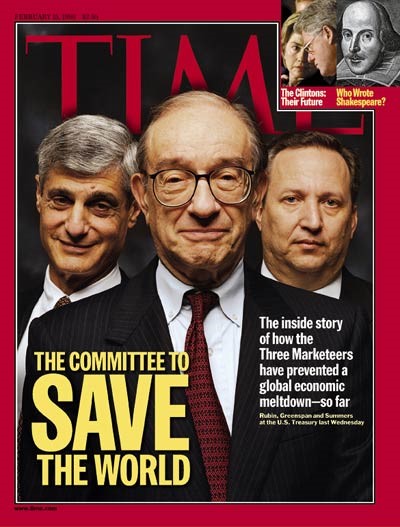
More Reason to Trust the Media
This persisted into 2000, as Greenspan continued to insist that Wall Street should be trusted and left to its own devices. “With those assurances, Congress went ahed and stripped the CFTC of responsibility for derivatives, and President Clinton signed the bill into law in December 2000.” Meanwhile, Ms. Born quietly left government service.
A more explicit account of the pressure brought to bear on Born can be found in Kevin MacDonald’s blog Self-Deception and Guruism among Jews, where he writes how psychoanalysis was
perhaps the greatest intellectual fraud of the 20th century — a set of beliefs that explained everything but had only the most tenuous connection to reality and an ideology that empirical research was for bean counters. The same thought crossed my mind while reading Thirteen Bankers, by Simon Johnson and James Kwak. Near the heart of the financial meltdown was the towering self-confidence of Larry Summers, Robert Rubin and Alan Greenspan in opposing any regulation on the derivatives market. Summers seems to be pivotal. When Brooksley Born, head of the Commodities Futures Trading Commission, proposed that some thought should be given to regulation, Summers reportedly said “I have thirteen bankers in my office, and they say if you go forward with this you will cause the worst financial crisis since World War II.” As Johnson and Kwak note (p. 9), we don’t actually know if there were any bankers in Summers’ office; “more likely he came to his own conclusion.” The point is that Summers had an unshakable faith that what he was saying was correct — a faith that was ominously unrelated to empirical reality. Nevertheless, Ms. Born was successfully pushed aside and ultimately a law was enacted preventing any regulation of the derivatives market.
Prestowitz shows how both Rubin and Summers, upon leaving the government, continued to push reckless paradigms. As vice chairman of CitiGroup, Rubin “emphasized to the bank’s leaders that if they wanted to make more money, they needed to take on more risk by dealing more heavily in derivatives.” For his part, Summers worked for the D. E. Shaw hedge fund, while also teaching at Harvard. More broadly, Prestowitz finds The Three Apostles were joined by others in making what he views as alarmingly poor decisions. One such was the decision to bring China into the World Trade Organization and granting China “permanent most favored nation status in the U.S. market. This will surely come to rank as one of America’s dumbest deals.” For this, he blames President Clinton, but also trade representatives Mickey Kantor and Charlene Barshefsky (both Jewish).
Despite Prestowitz’s disclaimers to the contrary, I’m suspicious when he writes in the space of a few paragraphs about a group of people making what he feels are bad decisions. In the one paragraph that contains Barshefsky’s name, Prestowitz writes of the following other Jews, in this order: Mickey Kantor, Barshefsky, National Security Adviser Sandy Berger, NSC China expert Ken Lieberthal, finishing up with Rubin and Summers (Betrayal p.141). A coincidence?
In reading Prestowitz, you’ll see that he writes nothing explicit about ethnicity or undue intrigue when it comes to these Jews. Indeed, he finishes the chapter I just mentioned by writing of the above individuals, “I know all these people. . . I don’t think any of them would do or say something they did not believe was in the best interests of the United States. But they all recommended and made a bad deal that has reduced American influence and power and constrained its future wealth-creating ability.” Could Prestowitz simply be naive? I simply can’t answer that.
Conclusion
Where does this leave us in the winter of 2020? Thus far, we seem to have emerged intact from the chaos of the 2008 mortgage meltdown, though we live in a bizarre world where credit is created through computer key strokes, interest rates can be negative, and old certainties have evaporated.
One thing that is certain, however, is that the men [and a few women] at the top of the American economic pyramid are heavily Jewish. An erudite American citizen writing under the nom de guerre Andrew Hamilton showed us four years ago what real hedge fund managers were doing and who they were:
More often than not the privileged Jews turn around and use the vast wealth they’ve skimmed from the productive sector of the economy to advance anti-White, pro-Jewish, and Left-wing causes, thereby harming America and the world in two ways — economically through callous and shortsighted market operations, and politically through their “philanthropy” and lavish political donations.
Hamilton specifically notes the shocking wealth concentrated in such hands, referring to Forbes Magazine’s recent ranking of the richest hedge fund managers in the United States by estimated personal net worth: “Twenty-four of the 32 names on the list (75%) are Jewish. Of the 10 wealthiest, 8 (80%) are Jewish.” He further adds that “Despite their social and economic power and privilege the names of hedge fund managers are virtually unknown even to educated and informed people, never mind the general public.” To some degree, we can thank Hollywood for this ignorance.
In its archives, TOO has an embarrassment of riches when it comes to detailed stories documenting Jewish financial power and misbehavior. See, for instance
John Q. Publius, Hedging their Bets (Who Really Decides Elections)
Andrew Joyce, Philip Green, Jewish Criminality, and the Cost of Economic Parasitism, Part 1: The Wider Context of Jewish White Collar Crime and Part 2
James Wald, Putting Shylock to Shame: The Moneylender Portrayed as Hero and Lenin’s Willing Industrialist: The Saga of Armand Hammer Part 1, Part 2, Part 3, Part 4 & Part 5
John Graham and Kevin MacDonald, Is the Madoff Scandal Paradigmatic?
Yes, there is an embarrassment of riches on this topic, so there is no excuse for so few gentile Westerners to know the score. It’s not a pretty story, but burying one’s head in the sand (and watching nothing but sportsball all year long) is inexcusable. This is a war, so we must know our adversary and his tactics. As Bain Dewitt wrote in Counter-Currents, “Jews … have been openly making memewar on Whites since before the birth of Christ and so have a good understanding of what is going on.” Time for us to catch up, lads.
Wrapping things up here, I refuse to attempt to make any predictions about what economic turns we may see in the short or the long term, for even insiders have repeatedly embarrassed themselves in this pursuit. I would just say that we should continue to focus on what Jewish players in the arenas discussed in this and other TOO articles are doing; keep your eyes on the ball. After all, in his great work on money, E. Michael Jones concludes that “Banking is magic that works,” and, as we have seen, Jews continue to be highly active in the upper echelons of banking and money management.
“Banking is magic that works.” I think that’s a fascinating insight phrased in a sublime way. It really speaks to where we are today in the world.
Thinking about the future is daunting, so I’ll defer to a Jewish writer I’ve long admired — James Howard Kunstler. In my experience, he has long played the fascinating role of revealing what some of his fellow Jews are up to but he will never name them as Jews. No worries, since we Jew-wise gentiles can easily read between his lines.
Every New Year, Kunstler pontificates on the state of the world, and for 2017 he referenced much of what I just wrote about above. Here’s what he gave us in “Forecast 2017: The Wheels Finally Come Off.” Going back to the late 70s, he asserts that Fed was guilty of manipulating the money supply, which has “proven to be fatally mischievous.” Fed officials had become “magicians using occult mathematical models and formulas — to cast spells capable of controlling the macro economy the way wizards are thought to control external reality.”
Around the year 2000
the system wobbled again and the viziers of the Fed ramped up their magical operations, led by the Grand Vizier (or “Maestro”) Alan Greenspan, who worked the control rods of interest rates as though the financial system were a great nuclear powered pipe organ that could be revved up and tamped down by a wondrous Fed control panel. This period of Fed spell-casting was characterized by ever more systemically complex finance, growing systemic fragility, pervasive institutionalized accounting fraud, and ever-greater bubbles and busts. Deregulation, especially the 1998 repeal of the Glass-Steagall Act of 1932, sealed America’s financial fate.
Debt was the meat-and-potatoes of the Fed’s wizardry, but the “secret sauce” of Fed magic was fraud [my emphasis], in the form of market interventions, manipulations, regulatory negligence, and just plain systematic lying about the numbers that defined the economy. It amounted to nationalized financial racketeering. Under the consecutive Grand Vizierships of Greenspan and Ben Bernanke, control fraud (using official authority to cover up misconduct) was perfected by banking executives, eventuating in the mortgage securities fiasco of 2008, which took down the housing market and the economy. … The regulators looked the other way, on orders from their bosses. Unlike the earlier Savings and Loan bank crisis of the late 1980s, none of the leading bank officer perps went to jail. The damage of the 2008 crash was epic and never repaired, only papered over with more debt, more deceit, and more racketeering.
The supposed remedy, the Dodd-Frank Act of 2010, was a cover for continued pervasive fraud and the institutional “capture” of government by the banking industry and its handmaidens, really a fascist melding of banking and government, a swindle machine in which anything goes and nothing matters. The frauds have only been rechanneled since 2008 into college loans, car loans, corporate stock buyback monkey business, currency arbitrage shenanigans, private equity asset-stripping, and the gigantic black box of derivatives trading.
Am I the only one fascinated by Kunstler’s choice of words here: “a fascist melding of banking and government, a swindle machine in which anything goes and nothing matters”? Fascist? Really?
At every point, isn’t Kunstler really talking about his fellow Jews, particularly his E. Michael Jones-esque conclusion that “the secret sauce” of Fed magic was fraud?” That’s quite a claim, but is there a better description of what the Fed has been doing for the last dozen years and more? If he is right, where does that leave us — and the world? I have no idea, but I’ve got a pretty good idea how the tunes goes — and the lyrics have much to tell us about Jewish behavior. How soon again will we all be humming that tune?
Karl Marx: o patriarca da esquerda judia ?
O livro de Kevin MacDonald intitulado The Culture of Critique (CofC) deveria ser revisado para focalizar Karl Marx, o fundador do primeiro movimento intelectual e político dos judeus de âmbito mundial? Sendo o criador judeu do socialismo “científico”, ele deu início à crítica radical da sociedade europeia que se estende ao século XXI. Embora o CofC aborde especificamente os movimentos intelectuais e políticos judaicos do século XX, ele certamente poderia ter ampliada sua compreensão da esquerda judaica, se Marx pudesse ser incluído no seu quadro teórico como o fundador dos movimentos intelectuais e políticos que tanto orientaram a esquerda judia no século XX.
A primeira questão a ser levantada é se Marx se reconhecia como dirigente judeu de um movimento intelectual e político de judeus. O CofC de Kevin MacDonald indica os passos a seguir para a solução do problema. Examinemos detidamente as indicações de Kevin MacDonald.
A metodologia de Kevin MacDonald é bastante objetiva. O primeiro passo consiste em “identificar movimentos influentes sob direção judaica, quaisquer sejam, não importando se todos ou a maioria dos judeus participassem deles”. O segundo passo consiste em “determinar se os participantes judeus se assumiam como judeus e se, por tal participação, buscassem atender a interesses judeus”. [i] Depois, então, discutiremos a influência e o impacto desses movimentos na Europa e nos Estados Unidos.
Em vista desses critérios de Kevin MacDonald, acreditamos em que o socialismo científico de Marx atenda aos dois quesitos.
Em primeiro lugar, Marx teve participação direta na criação das principais organizações de esquerda no século XIX. A maioria das primeiras organizações socialistas sofreram influência direta de Marx, quais sejam: a Liga Comunista, cofundada por Marx e Engels em 1847; o Partido Social-Democrático da Alemanha, fundado em 1863; o Partido Socialista Trabalhista da América, fundado em 1876; o Partido dos Trabalhadores Franceses, cofundado pelo genro de Marx, Paul Lafargue, em 1880; e a Federação Social-Democrática Britânica, fundada em 1881. A maioria dessas organizações moldaria a vida política da Europa e dos Estados Unidos no século XX.
Aquele que foi o sabatigói [N.T.: no original: Shabbos Goy] de Marx por longo tempo, Engels, reconheceu a preponderância dos judeus nos movimentos esquerdistas do século XIX:
Ademais, temos para com os judeus uma dívida de gratidão. Sem falar de Heine e Böme, Marx era de pura origem judia; Lassalle era judeu. Muitos entre os melhores da nossa gente são judeus. Meu amigo Victor Adler, que agora está cumprindo pena numa prisão em Viena por sua devoção à causa do proletariado; Eduard Bernstein, o editor da publicação londrina Sozialdemokrat, Paul Singer, um dos melhores homens no Reichstag —essas pessoas deixam-me orgulhoso por sua amizade, e todos eles são judeus! Eu mesmo fui considerado judeu pelo [semanário conservador] Gartenlaube. Na verdade, se eu tivesse de escolher, preferiria ser um judeu a ser um “Herr von” ! [ii]
Em 1911, o sociólogo Robert Michels chamou atenção para a “abundância de judeus na direção dos partidos socialistas e revolucionários”:
Sobretudo na Alemanha, a influência dos judeus tem sido evidente no movimento dos trabalhadores. Os dois primeiros grandes capitães, Ferdinand Lassalle e Karl Marx, eram judeus, bem assim como o contemporâneo deles Moses Hess. O primeiro eminente político da velha escola a abraçar o socialismo, Johann Jacoby, era judeu. Também Karl Höchberg, um idealista, seu pai era rico comerciante de Francoforte, fundador da primeira revista socialista publicada em língua alemã. Paul Singer, que quase sempre presidia os congressos socialistas alemães, era judeu. Entre os 81 deputados socialistas mandados ao Reichstag na penúltima eleição geral, havia nove judeus. Este número é extremamente alto, comparado com a percentagem de judeus na população da Alemanha, com o total de trabalhadores judeus e com o número de judeus no Partido Socialista. [iii]
Em segundo lugar, longe de ser um etnomasoquista antissemita, Karl Marx identificava-se fortemente como judeu e estava muito envolvido com a comunidade judaica:
Com os judeus e a judaicidade, Marx sempre manteve laços positivos. Entre seus amigos mais próximos estavam os judeus Heinrich Heine and Ludwig Kugelmann; por certo tempo privou com Moses Hess e ajudou o ex-comunista de Colônia Abraham Jacoby a emigrar para os Estados Unidos (onde ele se tornou um médico influente). [iv]
Fato indicando forte identificação judaica é que, quando Jacoby militava pela revolução na Europa, sua agenda era a “emancipação” judaica, — a naturalização e eleitoralização dos judeus. Como no caso de Marx, seus associados mais próximos também tinham forte senso de identidade grupal judaica. Eles compartilhavam objetivos, crenças e compromissos em pró da emancipação dos judeus.
A persistente crítica de Marx contra as sociedades europeias resultava dos sentimentos de sua marginalização. Ele era etnicamente judeu, fora criado numa família liberal judia conforme os valores do Iluminismo. Seu pai abraçou o universalismo iluminista por causa da marginalidade dos judeus na sociedade europeia. Em consequência de sua marginalidade social, Marx tornou-se hostil à cultura e aos valores europeus. Reagindo a isso, ele construiu uma identidade social judia positiva, retratando o comportamento judeu balizado pelo ganho financeiro como motivo de orgulho étnico, não como conduta a ser demonizada. Conforme Marx, a emancipação dos judeus não implicaria a dissolução de sua identidade étnica, antes seria resultado da futura condição proletário-comunista ou, mais precisamente, secular, das sociedades europeias, com plena aceitação dos judeus. Ele chegou a acreditar que o judaísmo secular cumpriria papel positivo nas sociedades cristãs europeias. O triunfo mundial do comunismo corresponderia à vitória mundial do judaísmo secular, deixando livres os judeus para a defesa de seus interesses coletivos em sociedades formalmente europeias ainda, mas judaizadas. Nesse particular, Marx não era diferente dos profetas hebreus — que pregavam o domínio israelita do mundo sob a realeza messiânica, a não ser pelo fato de que Marx disfarçava seu particularismo étnico judeu sob a roupagem universalista do Iluminismo liberal.
Em A questão judaica, ele não apenas clamou pela emancipação judaica, como também desafiou o “antissemitismo”. Ele faria a mesma coisa novamente em A sagrada família, publicado em 1844. Esses ensaios foram escritos para refutar Bruno Bauer, para quem a raça judia era “horrorosa” e não teria contribuído com nada para a “construção da modernidade”. [v] Marx acreditava que o preconceito antissemita europeu poderia ser eliminado pela transformação da Europa nas utopias proletário-comunistas, por cuja tolerância poderia o judaísmo continuar a existir. Aparentemente Marx não se iludia ao combater pela emancipação dos judeus, pois ele tinha plena consciência de ser judeu e queria proteger os judeus da perseguição branca por meio do universalismo, em detrimento das maiorias europeias na própria Europa.
Os mais importantes discípulos de Marx ou eram judeus ou eram descendentes de judeus, a exemplo de Adler, Bauer, Bernstein, Luxemburg, Lenin, Trotsky e os membros da Escola de Francforte. Apesar disso, os marxistas judeus aparentemente não ligavam importância à identidade judia de seus membros, pretendendo apresentar a luta pela emancipação judaica como parte da luta contra a sociedade burguesa. Como observou Kevin MacDonald no CofC, os ativistas étnicos judeus escamoteavam sua etnicidade judaica, recrutando não judeus para servir de manequins, que vestiam de linda roupagem para disfarçar o que na realidade era um movimento judeu. Dissimulando sua judaicidade, os dirigentes marxistas puderam promover os interesses judaicos quase sem nenhuma oposição, o que lhes permitiu recrutar mais inocentes úteis entre os góis. Embora o socialismo moderno deva suas origens a um judeu e tenha sido dominado pelos judeus, o movimento atraiu muitos góis, alguns deles se destacaram, como Bebel e Liebknecht. Aliás, quando foi da morte de Marx em 1883, seu maior porta-voz era Engels, um sabatigói.
Marx dizia-se amigo do proletariado, mas suas relações com a comunidade judaica eram estreitas. Como todos os ativistas étnicos judeus, Marx tinha a obsessão de combater o antissemitismo onde quer que se lhe deparasse, mas para não alarmar os góis, esse combate apresentava-se de mistura com a luta contra a sociedade burguesa. O artifício prestava-se a propósito vital, já que assim Marx acobertava sua atitude adversa à sociedade europeia e ainda atraía os não judeus para a nova fé secular judaica — não judeus que também iriam ajudá-lo na luta contra o antissemitismo, como se apenas militassem pela revolução proletária mundial. Enquanto ínfima minoria nas sociedades europeias, os judeus sempre se serviram de não judeus para a consecução de seus objetivos, assim fizeram os marxistas que se valeram do proletariado, assim fazem os neoconservadores que se valem dos conservadores do estabilismo para favorecer Israel.
A análise e a apologética marxistas sempre tiveram por base o “cepticismo e esoterismo científicos”.[vi] Como indica Kevin MacDonald no seu CofC, os ativistas étnicos judeus do século XX comumente lançavam mão dessas táticas mistificatórias. O capitalismo deve atender a requisitos de alto padrão para ser considerado um sistema econômico viável, apesar de sua longa história de sucesso na geração de crescimento econômico, enquanto o comunismo é sempre considerado profícuo, apesar de seus embaraçosos precedentes de estado policial autoritário, pauperização massiva, totalitarismo extremo e catástrofes ambientais. Temos aí dois pesos e duas medidas quanto ao ônus da prova que servem para apresentar o marxismo como um sistema de crenças viável. De igual modo, os apoiantes judeus de Marx argumentam, maliciosamente, que “O socialismo não fracassou, o que fracassou foi o estalinismo, isto é, a ditadura burocrática do partido”. [vii]
A análise econômica de Marx era tão hegelianizante que seus críticos e adeptos não lhe puderam compreender a exata significação. Livros dele como A ideologia alemã e O capital geram ainda controvertidas interpretações. Ele vazava seu discurso em linguagem científica para cobrir suas profecias como o verniz da credibilidade. Por exemplo, o socialismo de Marx era chamado de socialismo “científico”, para que se distinguisse de suas variantes “utópicas”. O fato de apresentar sua versão do socialismo como “científica” indica que o esoterismo da linguagem de Marx era proposital, no que foi imitado pelos epígonos. Na realidade, o socialismo marxiano consistia numa espécie de culto secular da religião judia, cujos princípios dogmáticos não permitiam revisão, mesmo quando confrontados com irrefutáveis evidências em contrário. Até os nossos dias, nenhuma das leis marxistas do desenvolvimento capitalista tornou possível experiências empíricas de falsificação, nem qualquer de suas profecias foi confirmada.
É interessante notar que Franz Boas não foi o primeiro intelectual judeu a submeter a aplicação social do darwinismo a virulenta crítica intelectual; essa honraria cabe a Marx e a seu sabatigói pessoal, Engels. A princípio, eles eram adeptos entusiastas da obra de Darwin A origem das espécies. Acreditavam que a seleção natural corroborava a análise dialético-materialista do desenvolvimento histórico. Entretanto, Marx e Engels chegaram à conclusão de que a teoria de Darwin era “metafisicamente inaceitável”:
Dado que Darwin via a luta na natureza, em grande parte, como luta entre indivíduos, sua teoria pareceu-lhes solapar a própria possibilidade da solidariedade de classe e a eliminação final do conflito humano. […] Na opinião de Marx, a deficiência mais grave da teoria de Darwin residia na ênfase posta sobre o caráter indeterminado e aleatório das mutações, implicando que no mundo para além do reino animal o progresso fosse “puramente acidental e não necessário”, ao contrário do que desejava Marx e exigia a sua teoria (Marx apud Feuer, 1975, p. 121). O Darwinismo ameaçou a fé de Marx e Engels num processo histórico mais propício. [viii]
Em virtude de a biologia darwiniana haver limitado o poder explanatório de sua dialética histórica, Marx and Engels recorreram a causalidades ambientais e subjetivísticas:
Em razão de que outras teorias da evolução, como as de Trémaux e Lamarck, tivessem enfatizado como causas das mutações adaptativas nas espécies ou nas raças a ação direta do meio ambiente ou a resposta automática às necessidades do organismo, tais teorias pareceram mais atraentes para Marx e Engels (como também para Stálin e Lysenko), por darem sanção “científica” para a mundivisão deles. [ix]
A exemplo dos ativistas étnicos judeus que Kevin MacDonald citou no CofC — Boas, Lewontin, Gould etc. — Marx e Engels combateram a aplicação social do darwinismo, porque comprometia sua capacidade de impor a perspectiva ambientalista às sociedades europeias, a partir da qual projetavam a construção de nova raça humana pela manipulação do ambiente conforme as ideias marxistas. Na consecução desse objetivo, os comunistas mataram milhões de dissidentes, sem nenhum escrúpulo, abrindo caminho para o novo homem que fosse criado pelo sistema educacional comunista.
Marx era conhecido por suas tendências ditatoriais, característica que ele compartia com os ativistas étnicos judeus do CofC. No seu pugnaz empenho para conquistar o poder, os judeus foram acusados de autoritarismo pelos seus oponentes. Em 1850, Eduard Müller-Tellering publicou Vorgeschmack in die kuenftige deutsche Diktatur von Marx und Engels, ou A foretaste of the future German dictatorship of Marx and Engels [A pré-estreia da futura ditadura alemã de Marx e Engels], atacando Marx por sua mania de dominação. Os dois tiveram um bate-boca, que Müller-Tellering atribuiu à sede de vingança do “futuro ditador alemão” Karl Marx, motivada pelo fato de ele, Müller-Tellering, haver publicado artigo contra os judeus no próprio jornal de Marx, o Neue Rheinische Zeitung [Nova Gazeta Renana]. Segundo Müller-Tellering, o implacável e vingativo comportamento de Marx resultava da natureza dos judeus, da perversidade deles.
A personalidade autoritária de Marx alienou dele o anarquista Mikhail Bakunin (1814–1876), que escreveu o seguinte:
Todo esse mundo judeu constitui uma só seita exploradora, um tipo de povo-vampiro, um parasito coletivo, voraz, auto-organizado não apenas por sobre as fronteiras dos Estados, mas também por sobre as diferenças de opinião política — esse mundo está, pelo menos em grande parte, à disposição de Marx e dos Rothschilds. Eu sei que os Rothschilds, reacionários como são e continuarão sendo, admiram profundamente os predicados do comunista Marx; e por sua vez o comunista Marx sente-se atraído, por interesse instintivo e respeitosa admiração, pelo gênio financeiro dos Rothschilds. A solidariedade judaica, aquela poderosa solidariedade que se manteve ao longo dos séculos, ligou Marx aos Rothschilds. [x]
Percebe-se aí que Bakunin tinha consciência do grande número de seguidores judeus de Marx — ele sabia que o mundo judaico repartia-se entre Marx e Rothschild. Bakunin rejeitou a ditadura do proletariado de Marx, porque implicava a centralização do poder do Estado, o que levaria ao seu controle por pequena elite. Marx e Bakunin andavam sempre às turras. Bakunin lutava por uma “confederação descentralizada de comunas autônomas”, sendo atacado por Marx, para quem o melhor seria a ditadura do proletariado. Depois do embate entre os comunistas de Marx e os anarquistas de Bakunin, no Congresso de Haia de 1872, Bakunin acabou sendo expulso da Primeira Internacional, por determinação pessoal de Marx.
Assim como os ativistas judeus citados no CofC, Marx combatia na guerra étnica contra as sociedades europeias. O seu socialismo científico ameaçava solapar a moral e as fundações intelectuais da Europa, de sorte que se transformasse numa sociedade secular para suportar indefinidamente a continuação da existência do judaísmo. Por exemplo, em O capital, a sua obra magna, Marx tentou desvelar o funcionamento dos mecanismos internos do modo de produção capitalista na Europa Ocidental, explicando por que ele entraria em colapso sob o peso de suas próprias contradições, preparando o caminho para a revolução proletária. A ditadura do proletariado era visionada como ferramenta de forte dominação, centralizada e autoritária. Quando ela foi imposta aos russos pela elite hostil que assumiu o poder a partir de 1917, teria como consequência a morte de muitos milhões e a opressão política de todos, sendo plausível supor que Marx teria ficado muito feliz se houvesse sido capaz de impor semelhante regime sobre todos os europeus. Embora a defesa que fazem os judeus do universalismo nas sociedades brancas signifique a autodestruição cultural e racial dos próprios brancos, ela enseja as condições ideais para a prosperidade judaica, ao maximizar o controle judaico sobre a população europeia inclusiva e ao minimizar o temor judaico da perseguição antissemítica.
Foi Marx quem assentou as bases ideológicas da principal corrente do ativismo étnico judeu no século XX. No quadro teórico do CofC, a importância de Marx é depreendida de sua condição de fundador judeu de um movimento intelectual e político judeu em meado do século XIX, cuja influência estende-se até o presente. Por exemplo, o mais influente movimento intelectual judeu contemporâneo, a Escola de Francforte, era seita marxista ortodoxa a princípio, mas revisou o marxismo, desviando-o da luta de classes para uma teoria enfatizando o etnocentrismo branco como o problema fundamental e inaugurando o que agora é frequentemente denominado de marxismo cultural.
A conclusão é que o engajamento judeu na esquerda remonta a meado do século XIX e continua exercendo influência no mundo contemporâneo, mostrando-se diante dos europeus como força opositora.
BIBLIOGRAFIA
BLUMENBERG, Werner. Eduard Von Müller-Tellering: Verfasser Des Ersten Antisemitischen Pamphlets Gegen Marx. Bulletin of the International Institute of Social History, v. 6, n. 3, 1951, p. 178-197. Disponível em: <www.jstor.org/stable/44629595>.
COFNAS, Nathan. Judaism as a Group Evolutionary Strategy. Human Nature, v. 29, n. 2, 10 MAR 2018, p. 134-156, 10.1007/s12110-018-9310-x. Acesso em: 13 DEZ 2019.
DRAPER, Hal. State and Bureaucracy. New York; London: Monthly Review Press, 1977. (Karl Marx’s theory of revolution, v. 1).
________. Critique of other socialisms. New York; London: Monthly Review Press, 1990. (Karl Marx’s theory of revolution, v. 4).
FINE, Robert, PHILIP, Spencer. Antisemitism and the Left : On the Return of the Jewish Question. Manchester, UK, Manchester University Press, 2018. Disponível em: <www.manchesteropenhive.com/view/9781526104960/9781526104960.00007.xml>. Acesso em: 13 DEZ 2019.
KAYE, Howard. Social meaning of modern biology: from social darwinism to sociobiology. Routledge, 2017.
MACDONALD, Kevin. The culture of critique: an evolutionary analysis of jewish involvement in twentieth-century intellectual and political movements. Westport: Praeger, 1998.
MARX, Karl. On The Jewish Question by Karl Marx. Marxists.org, 2019. Disponível em: <www.marxists.org/archive/marx/works/1844/jewish-question/>. Acesso em: 13 DEZ 2019.
________ The Holy Family by Marx and Engels. Marxists.org, 2019. Disponível em: www.marxists.org/archive/marx/works/1845/holy-family/ch04.htm. Acesso em: 13 DEZ 2019.
________. Early Texts. Translated and Edited by David McLellan. Oxford: Basil Blackwell, 1971.
MARX, Karl, ENGELS, Friedrich. Marx and Engels, 1860-64. New York: International Publishers, 1985. (Collected works, v. 41).
MICHEL, Robert. Political Parties : a sociological study of the oligarchical tendencies of modern democracy. New York, Free Press ; London, 1962.
SEIGEL, Jerrold E. Marx’s fate : the shape of a life. University Park, Pa., Pennsylvania State University Press, 1993.
WARTENBERG, Thomas E. “Species-Being” and “Human Nature” in Marx. Human Studies, v. 5, n. 1, Dec. 1982, p. 77-95, 10.1007/bf02127669. Acesso em: 26 NOV 2019.
WISTRICH, Robert S. Karl Marx and the Jewish Question Soviet Jewish Affairs, v. 4, n. 1, jan. 1974, p. 53-60, 10.1080/13501677408577180. Acesso em: 21 NOV 2019.
REFERÊNCIAS
[i] MACDONALD, Kevin. Culture of critique. p. 11-2.
[ii] ENGELS, Frederick. “On anti-semitism”. Arbeiter-Zeitung, n. 19, 9 MAIO 1890. Disponível em: https://www.marxists.org/archive/marx/works/1890/04/19.htm
[iii] MICHELS, Robert. Political Parties. p. 246.
[iv] SEIGEL, Jerrold. Marx’s Fate. p.114.
[v] MARX, Karl; ENGELS, Frederick. “The Holy Family.” Marxists.org, 2019. Disponível em: www.marxists.org/archive/marx/works/1845/holy-family/ch04.htm.
[vi] MACDONALD, Kevin. Culture of Critique. p. 122.
[vii] MANDEL, Ernest. The Roots of the Present Crisis in the Soviet Economy (1991). Disponível em: <https://www.marxists.org/archive/mandel/1991/xx/sovecon.html>.
[viii] KAYE, Howard. Social Meaning of Modern Biology. p. 25.
[ix] KAYE, loc. cit. .
[x] DRAPER, Hal. Karl Marx’s Theory of Revolution, v. 4, p. 596.
Fonte: The Occidental Observer. Autor: Ferdinand Bardamu. Título original: Karl Marx: founding father of the jewish left ? Data de publicação: 4 de janeiro de 2020. Versão brasilesa: Chauke Stephan Filho.



