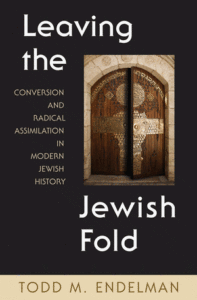
Review: Leaving the Jewish Fold: Conversion and Radical Assimilation in Modern Jewish History by Todd M. Endelman
Leaving the Jewish Fold: Conversion and Radical Assimilation in Modern Jewish History
Todd M. Endelman
Princeton University Press, 2015
“A Jewish question would still exist, even if every Jew were to turn his back on his religion and join one of our major churches.”
Karl Eugen Duehring, 1881
 At the heart of the Jewish Question lies an extraordinary level of ethnocentrism. The tremendous capacity of Jews for mutual co-operation and the reinforcement of group identity is one of the behavioral markers that set them apart from most other human populations. This is the case even in comparisons with other populations that, like the Jews, have historically performed roles as ‘middle man minorities.’ Jewish ethnocentrism has thus deservedly been the major focus of attention when scholars or activists have decided to investigate Jewish group behavior. In general these investigations have rested on the obvious expressions of ethnocentrism — clannishness in business, Jewish endogamy, group political strategies, and the manifestation of Jewish group allegiance even in secular cultural contexts (‘Jews without Judaism’).
By contrast, the story of those Jews who ostensibly left both Judaism and their community, apparently cutting all ties with their ethnic group, has been little explored or discussed in explorations of Jewish ethnocentrism. This story is, however, an important one, and it becomes even more important in a contemporary context in which Jewish intermarriage, particularly in the United States, is reaching unprecedented levels.
Key to understanding Jewish ethnocentrism should be an assessment of its strength, not just in terms of its obvious successes and manifestations, but in terms of its failures — when did it fail, how often did it fail, and why? I chose to read Todd Endelman’s Leaving the Jewish Fold as part of my own deeper investigation into this issue — to probe the weaknesses of Judaism as a group evolutionary strategy for a future book project on that theme. However, rather than being surprised, I found that it largely confirmed my pre-existing theoretical framework. Endelman merely confirms that Jewish conversions to religions other than Judaism have historically been extremely rare and, despite the title of the book, the author provides very little evidence to suggest that the ‘assimilation’ undertaken by those Jews who ‘left the fold’ was radical, or even genuine. To use Endelman’s terminology, ‘drift and defection’ has always been a small, though passionately resisted phenomenon on the periphery of Jewish populations, serving paradoxically at times, like anti-Semitism, to reinforce group cohesion at the core. But in the overwhelmingly majority of cases an extremely high level of ethnocentrism is a constant feature of Jewish history.
The book is neither entertaining nor intellectually stimulating. Leaving the Jewish Fold is the third book by Endelman that I’ve read, following his Radical Assimilation in English Jewish History, 1656–1945 (1990) and The Jews of Britain, 1656 to 2000 (2002). His histories tend towards the type of overview perspective that can be useful when trying to get to grips with major events and personalities, but which lack insight or real interest even on a potentially oppositional level — his stances and arguments are often so weak (or non-existent) that they are difficult to detect. This makes his work slightly more factually correct than, for example, the work of the late ethnic activist Robert Wistrich, but ultimately less ‘fun’ to engage with or argue against. The fact that Endelman continues to be published by elite academic publishing houses like Princeton University Press should be regarded as a symptom of ongoing Jewish influence in Western academia [discussed further here] rather than being suggestive of the quality of his work. Like earlier examples of his work, Leaving the Jewish Fold is for the most part a collection of anecdotes and statistics, derived almost exclusively from published secondary sources, and often involving very little or no original research. The structure and narrative cohesion in this instance, where the material concerns Jews who ostensibly abandoned Jewish life, is haphazard and often confusing. As just one example, during his weak first chapter on the medieval period Endelman inexplicably plucks anecdotes from the eighteenth century. Read more
 Jim Penman,