
Agobard of Lyon and The Origins of the Hostile Elite

As part of the introduction to my forthcoming volume of essays, Talmud and Taboo, I’ve included an overview of key developments in the historical relationship between Jews and Europeans. During the course of this overview I emphasize the historical suppression of European responses to Jewish group behavior, an important and perennial aspect of Jewish-European interactions. This suppression/taboo, as a thing in itself, tends to be less explored and understood when compared to the attention devoted to more obvious manifestations of Jewish influence (e.g. assertive action in influencing immigration control), but consideration of it is crucial to a complete understanding of Jews as a hostile elite. A working theoretical definition of what is meant by “Jews as a hostile elite” is of course also necessary, and is taken here as the implication not only that Jews have historically been opposed/hostile to the interests of the European masses, but also that Jews have had direct access to political power, or significant levels of influence over European elites in possession of it. While writing the introduction to Talmud and Taboo I was primarily concerned with the origins of the Jewish acquisition of this power or influence in Europe, the mode of its expression, and its evolution over the course of centuries. Due to restrictions of space in the introduction to Talmud and Taboo, I want to take the opportunity here to expand on one such example.
To date, our best understanding of modern Jewish political strategies in the context of the “taboo” can be found in Chapter 6 of Kevin MacDonald’s Separation and Its Discontent: Toward an Evolutionary Theory of Anti-Semitism, titled “Jewish Strategies for Combatting Anti-Semitism.” One section deals with “Political Strategies for Minimizing Anti-Semitism.” MacDonald notes that Jews have been flexible strategizers in the political arena, buttressed by an IQ substantially above the Caucasian mean, and argues that the foundations for Jewish influence are wealth, education, and social status.[1] Today, Jews apply this influence in order to stifle negative discussion of their group, and at times to stifle any discussion of Jews at all. MacDonald points out that this is normally done via extensive communal support for “self-defense committees,” which are a feature of every Diaspora population. These committees invariably lobby governments, utilize and influence legal systems, produce pro-Jewish and pro-multicultural propaganda, and fund pro-Jewish candidates or initiatives. Another of their vital functions has been to monitor and expose “anti-Semites,” and to use legal systems in order to exact individual punishments, thereby making an example of individuals and thereby imposing a deterrent atmosphere on the rest of the population. Read more
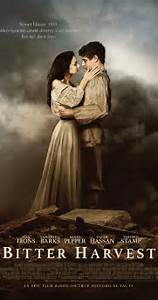 Bitter Harvest (2017) is a film inspired by the love and rediscovery of the writer Richard Bachynsky Hoover’s ethnic heritage. On a trip to the homeland of his Slavic ancestors he began to ruminate on how to capture the story of the Holodomor on film. With small acting parts in a variety of television series Bachynsky Hoover was learning the ropes of the film and entertainment industry. He went again to Kiev, investigating his family history. It was 2004 and the Orange Revolution was in full swing — he saw firsthand a Ukraine in the midst of upheaval. He learned that Western audiences had never seen the Holodomor dramatized on film — a dramatically different situation compared to that other genocide that has become a touchstone of Western Civilization and both a sword and a shield for Jewish and Israeli interests through endless promotion in the media. In 2008 he would return with a script, seeking financing for an English language period piece set during the Holodomor. He met with officials from the Ukrainian Government as well as various oligarchs. All of them turned him down. It was not until 2011 that the dream to make his movie finally caught a glimmer of hope when fellow Ukrainian Canadian investor Ian Ihnatowycz committed $21 million to the film.


