Metanarrative Collapse: Has the Christian Cosmology Invented by St. Augustine of Hippo Stood the Test of Time? Part Two
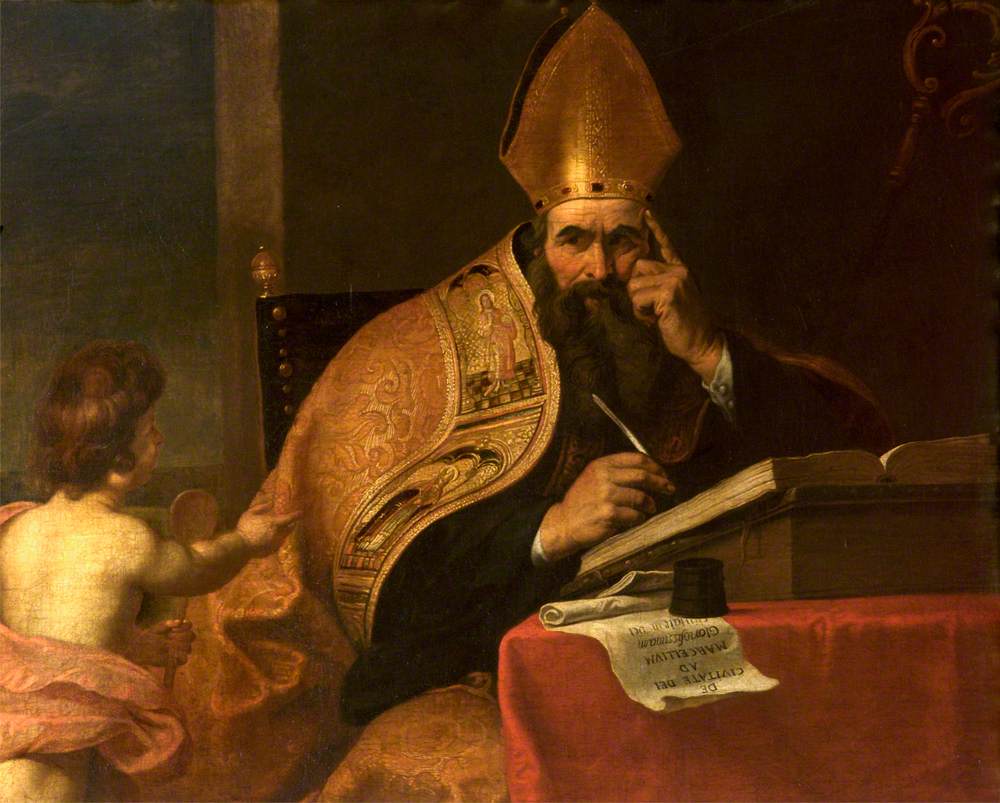
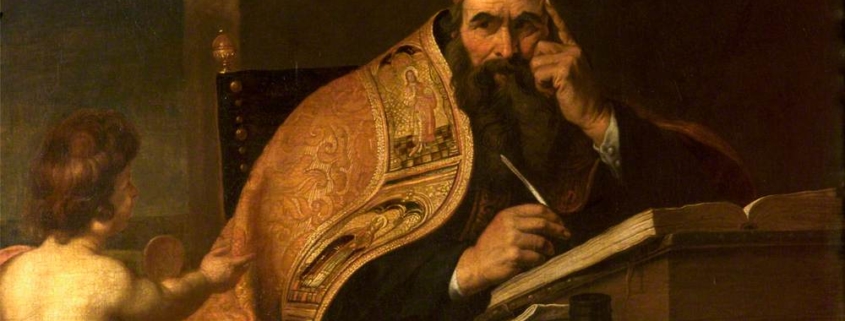
St. Augustine [1]of Hippo (354–430)

Augustine’s Hellenistic Hermeneutic

Augustine’s interpretation of the biblical metanarrative portrays both the creation and the end of the world as the appearance and disappearance of corruptible material existence.  He had no doubt that the New Testament writers were predicting the literal end of the earthly world when, as “[t]he whole Church” expected, Christ would “come down from heaven to judge the living and the dead.”[1]  Augustine was clear that the Day of Judgement applied not just to the people of Israel but to “the rest of the nations as well.”[2]  Faithful Christians, those who live according to the spirit, would exchange the perishable goods of mortal existence for the “Supreme Good” of an imperishable “eternal life” in the City of God.  Other mortals, those who live according to the flesh, would suffer the “Supreme Evil” of “eternal death,” the nothingness inherent in the absolute privation of the Good.[3]  It was out of just such nothingness that the world was created on Augustine’s understanding of Genesis One.  Furthermore, Augustine’s understanding of Genesis 2–3 identifies Adam, not as proto-Israel, but as the first human being.  Accordingly, it not just Old Covenant Israel but mankind as a whole which faces judgement at the end of the world.

Augustine’s neo-Platonic cosmology presupposed the absolute dependence of both mankind and the material world itself on an omnipotent, omniscient, and omnipresent God.  Seduced by the delights of our mortal life “we have wandered far from God,” losing sight of “the invisible things of God.”[4]  The inherent difficulty mortal beings experience in apprehending such invisible divine “objects” must make us eternally thankful for the revealed Word of God.  But a proper understanding of sacred scripture depends upon two things, according to Augustine: “the mode of ascertaining the proper meaning, and the mode of making known the meaning when it is ascertained.”  Understanding the world generally requires that we distinguish between things and signs.  “All instruction is about things or about signs; but things are learned by means of signs.”  There are spiritual as well as material things and signs.  Higher spiritual things are the true objects of enjoyment and use.  A man should view his whole life as “a journey towards the unchangeable life, and his affections [should be] entirely fixed upon that.”[5]

The Bible is both a material and a spiritual thing which can be used or enjoyed in order to understand and participate in the imperishable City of God.  Augustine reminds his readers, however, that not every spiritual or material thing can be judged by its outer form.  On the surface, biblical prophecies of the Day of the Lord may appear to be addressed only to Old Covenant Israel, warning of the impending destruction of Jerusalem.  The inner form of such scriptural signs of things to come can sometimes only be understood “by comparing all the similar passages on the subject which occur in the three evangelists Matthew, Mark, and Luke.”  Augustine points as well to John “who tells us most clearly that the judgement should take place at the resurrection of the dead.”[6]  Clearly, Augustine conceives the resurrection of the dead as a material and bodily, not a solely spiritual, phenomenon.  No such event has taken place; therefore, he expects the fulfillment of that prophecy to occur at some still future time.

Augustine knew, of course, that many “wise men of this world” scoffed at any suggestion “that the earthly bodies of men” can “be carried over into a heavenly habitation.”  To ward off such scepticism, he drew upon an idea that appeared quite suddenly in the late second century AD to defend the idea of a bodily resurrection.  Augustine deployed the doctrine of creation ex nihilo to demonstrate that “He Who in making this world…has already accomplished something far more wondrous than the transformation in which our adversaries refuse to believe.”  If God has already bound “incorporeal souls” to earthly bodies, why should we doubt “that bodies, though earthly, should be raised up to abodes which, though heavenly, are nonetheless corporeal.”[7]

During Augustine’s lifetime, such metaphysical speculation on the origins of matter had already become commonplace among neo-Platonic philosophers such as Plotinus.  Augustine followed Plotinus in contending that “creatio ex nihilo was the expression of God’s omnipotent ability to create without need of supporting causes.”  Such a doctrine was nowhere to be found in the New Testament.[8]  Neither the New Testament writers nor Plotinus were responsible for the connection made by Augustine between the creation story and the eschatological hope of a still future resurrection of the body.

Augustine taught “that because every created intelligence had its origin ex nihilo, it also had to look beyond itself for its end.  Every creature lacked God’s perfection and was therefore mutable.  Because it was mutable it could fall away from that end and become evil.”[9]  At the same time “the resurrection of our Lord from the dead” added “a great buttress of hope” to our faith.  Our bodies, too, after the death we suffer because of sin “shall at the resurrection be changed into a better form…this corruptible shall put on incorruption, and this mortal shall put on immortality.”  He urged the faithful to believe “that neither the human soul nor the human body suffers complete extinction but that the wicked rise again to endure inconceivable punishment, and the good to receive eternal life.”[10] Read more
TOQLive with Prof. Drew Fraser at 8:00 PM EDT on Sunday, July 28


Subscribe to TOQ – and Mail in payment. Here is the link for subscriptions and back issues and Cultural Insurrections!:
https://www.toqonline.com/journal/signup/

TOQ Live featuring Andrew Fraser will air on Sunday evening, July 28 at 8:00 PM EDT with Prof. Andrew Fraser (whose article is now the current featured article on TOO). Should be a great discussion. All of the details are at this link:

https://www.toqlive.com/

Metanarrative Collapse: Has the Christian Cosmology Invented by St. Augustine of Hippo Stood the Test of Time? Part One

Introduction

From its beginnings in the first century A.D. Christianity anchored its cosmology in the Bible.  But what is the Bible?  As a book in hand, of course, it is a collection of ancient texts, the product of the religious history of a remarkably durable and professedly holy ethno-nation in the ancient Near East.  One might well ask, therefore, just what spiritual truths or religious guidance could, or should such a book convey to people like me, specifically, White Anglo-Saxon Protestants living in the twenty-first century?  Is the Holy Bible just another “social construct,” a mere cultural artefact, or is it instead the literal Word of God?

Intellectual heavyweights among mainline Anglo-European Protestants such as Karl Barth concede that the Bible is indeed a “humanly composed and selected” collection of “human words” while professing a neo-orthodox faith that scripture remains “the witness of divine revelation”.[1]  But how should faithful Christians interpret the testimony of that witness?  Or, should we say “witnesses”?  After all, Protestants differ with Catholics as to whether this or that ancient Hebrew or Jewish text should be included in the biblical canon.  At the end of the day, however, even if all churches somehow settle upon on a single, canonical corpus of antique texts, the theological significance of the biblical metanarrative, from Genesis to Revelation, will remain open to competing interpretations—as it always has been.

The difficulty of distinguishing heresy from orthodoxy forced the early church to master the art of theological hermeneutics.  The church fathers expounded the Word of God using a bewildering variety of literal, allegorical, moral, and anagogical (mystical) methods of biblical interpretation.  In quick succession, rival camps staked out their respective claims to the true or most useful understanding of the Bible story.  First in were the mostly Hebrew and Jewish authors and participant observers responsible for the original texts of both the Old and New Testaments.  Marinated in Scripture, the Mosaic law, and the prophetic tradition, they read and told their stories of the creation, fall, and redemption of Old Covenant Israel through an ethnocentrically thickened, Hebraic hermeneutic lens.  Their insider’s view of the Hebrew religious culture revolving around the Jerusalem Temple was far removed from the cosmopolitan, Hellenic, or Greco-Roman presuppositions underlying the Christian tale of two cities told several centuries later by Augustine (354–430 AD), the bishop of Hippo in North Africa. Read more

The Stars at Stake: How the Fight for “Equality” Could Mean the Death of Humanity

In January 2019, a happy, healthy 51-year-old White man called Lee Pomeroy boarded a train for London with his 14-year-old son. He never reached his destination, because en route he got into an argument with a 36-year-old Black man called Darren Pencille. This was a very unwise thing to do, because Pencille won the argument by murdering Pomeroy in a “frenzied attack,” stabbing him “18 times in 25 seconds.”

Lee Pomeroy never reached his destination

This was what I call a “meteor murder.” It flashed through the headlines once when it happened in January and once again when Pencille was convicted in July. Now it’s very likely gone for ever, like many other horrific crimes committed by non-Whites against Whites. There is no mainstream analysis of these crimes and no public lessons are ever drawn from them. Unlike the “racist murder” of the Black teenager Stephen Lawrence, which everlastingly tells us how evil and oppressive Whites are towards non-Whites, the murder of Lee Pomeroy tells us nothing about “race relations.” Absolutely nothing! Lee Pomeroy was a random victim of a misguided fellow human, like the academic Dr Jeroen Ensink, who was stabbed to death by a Black in 2015, or the beautiful White teenager Christina Edkins, who was stabbed to death by a Black in 2013, or the naïve White teenager Mary-Ann Leneghan, who was raped, tortured and murdered by a Black gang in 2006, or the scores or even hundreds of elderly White women raped by a Black gerontophile from 1992 to 2006.

Non-Whites don’t belong in White societies

“There’s nothing to see there, folks! Just move on!” That’s the message of the mainstream media. Of course, the message reverses the truth. There’s an enormous amount to see in such crimes. They form a detailed and extended proof that Blacks and other non-Whites do not belong in White societies and should never have been allowed to enter them. The murder of Stephen Lawrence has been endlessly re-visited in order to promote a giant lie: that wilful White racism explains all non-White failure and dysfunction. The murder of Lee Pomeroy will be forgotten in order to conceal a giant truth: that non-White pathologies arise from non-White genetics and culture, not from White malevolence.

For example, Pencille has been described as a “paranoid schizophrenic,” just like the Black murderers of Dr Jeroen Ensink and Christina Edkins. Rates of paranoid schizophrenia are higher among Blacks, inflicting huge expense on White society even when the Blacks in question don’t take illegal drugs and act violently. But I can see more in Lee Pomeroy’s murder than yet another lesson about non-White genetics and culture. Lee Pomeroy was travelling somewhere on that train. He had a destination and never reached it, thanks to a dysfunctional Black with a history of criminal violence. And so Lee Pomeroy and Darren Pencille may offer us an allegory of the entire human race. A giant task lies before the most intelligent and technologically competent groups of human being. We cannot leave all our eggs in the basket of the planet Earth. We need to get off the planet and establish permanent, self-sustaining bases elsewhere in the solar system and even the galaxy. Read more

The Global Nation


The modern era, beginning with Christopher Columbus’ discovery of the Americas, has been characterized by more and more interconnection and blurring between the world’s societies. This phenomenon has only grown in intensity over time with the rise of technologies such as mass transport and telecommunications, but also intellectual developments such as the rise of internationalist and anti-national ideologies. We may define globalism as the tendency, both conscious and unconscious, towards the destruction of distinct and autonomous nations and states in favor, allegedly, of a harmonious global society and polity. Globalism ignores the reality of racial differences and powerful nature of ethnic identity, two factors which are at the root of the inevitable tensions and conflicts to be found in all multiracial and multiethnic societies.

There are powerful material factors favoring the breakdown of national borders. There are efficiency gains in people being able to work and trade across borders. There is furthermore an understandable push by the billions of humans living in the miserable conditions of the Third World to enter our countries so as to enjoy a more comfortable and secure life. A nostalgic conservatism or reflexive inertia is then not enough to stop these pressures. Even Japan, still largely homogeneous, is starting to see significant numbers of phenotypically-distinct immigrants (especially Indians and Filipinos). An Indian man even recently won a local election in Tokyo. Rather, immigration must be opposed with a conscious and principled counter-force in the name of the economic and social well-being of the native— the preservation of their cultural and genetic identity and their sovereignty.

In the wake of the World War II, internationalists quite reasonably sought to limit conflict between states by embedding them in a web of international institutions (such as the United Nations, the World Trade Organization, and the European Union) and trade relations, as well as a common hegemonic liberal-democratic ideology. This, it was hoped, would create a community of interests making war between great nations unthinkable. Read more

State-Supported Extreme Individualism in Sweden

The following are excerpts from my forthcoming book (now in the final stages), Western Individualism and the Liberal Tradition: Evolutionary Origins, History, and Prospects for the Future.

Extreme egalitarianism is especially apparent in northwest Europe. The “Jante Laws” of Scandinavia are paradigmatic: 1. Don’t think you are anything; 2. Don’t think you are as good as us. 3. Don’t think you are smarter than us. 4. Don’t fancy yourself better than us. 5. Don’t think you know more than us. 6. Don’t think you are greater than us. 7. Don’t think you are good for anything. 8. Don’t laugh at us. 9. Don’t think that anyone cares about you. 10. Don’t think you can teach us anything.[1] In short, no one must rise above the rest. Such egalitarianism is typical of h-g groups around the world,[2] and are antithetical to the aristocratic ideal of the I-Es.

Extreme egalitarianism results in high levels of conformism and social anxiety. Individuals fear social ostracism for violating egalitarian norms and standing out from the crowd—a phenomenon that has played a major role in creating a public consensus in favor of mass migration and multiculturalism. In Sweden especially there is no public debate on the costs and benefits of immigration; sceptics remain silent for fear of shunning and disapproval. Discussing the cancellation of a talk because it was sponsored by a politically incorrect newspaper, journalist Ingrid Carlqvist comments that “everyone with a different opinion in Sweden really is a Nazi! That’s the way it works in the New Sweden, the country I call Absurdistan. The country of silence.”[3]

Similarly, in his Fairness and Freedom, David Hackett Fischer describes the “Tall Poppy Syndrome” (envy and resentment of people who are “conspicuously successful, exceptionally gifted, or unusually creative”) that is characteristic of New Zealand.[4] “It sometimes became a more general attitude of outright hostility to any sort of excellence, distinction, or high achievement—especially achievement that requires mental effort, sustained industry, or applied intelligence. … The possession of extraordinary gifts is perceived as unfair by others who lack them.”[5]

The expression ‘Tall Poppy Syndrome’ originated in Australia but seems more characteristic of New Zealand. Successful people are called ‘poppies.’ This tendency is perhaps not as strong as it used to be, but, although some successful New Zealanders are accepted, “other bright and creative New Zealanders have been treated with cruelty by compatriots who appear to feel that there is something fundamentally unfair about better brains or creative gifts, and still more about a determination to use them.”[6] Doubtless because of the same egalitarian tendencies, the New Zealand system encourages laziness and lack of achievement—workers insist that others slow down and not work hard. “Done by lunchtime” is the motto of a great many New Zealand workers.

Such egalitarian social practices are common in h-g groups around the world[7] and support the general view that this important strand of European culture, especially apparent after it came to power beginning in the seventeenth century (see Chapter 6), reflects the culture of northern h-gs.[8] Reflecting this pattern, Scandinavian society in general has a history of relatively small income and social class differences, including the absence of serfdom during the Middle Ages. A recent anthropological study of h-gs found that economic inequality approximated that of modern Denmark.[9] Chapter 4 discusses the individualism of Scandinavian family patterns, including relatively egalitarian relationships between spouses—extreme even within the Western European context.

Read more

Study Shows Babies Naturally Distinguish Races and Easily Link Them to Languages

Little Timmy can already identify foreigners.

There is an interesting new study from the University of British Columbia on infant babies’ ability to distinguish, and link, different races and languages. According to UBC (my emphasis):

Eleven-month-old infants can learn to associate the language they hear with ethnicity, recent research from the University of British Columbia suggests.

The study, conducted in Vancouver and published in April in Developmental Psychobiology, found that 11-month-old infants looked more at the faces of people of Asian descent versus those of Caucasian descent when hearing Cantonese versus English—but not when hearing Spanish. . . .

We wanted to determine whether the association between Cantonese language and Asian faces we observed was due to a specific pairing infants learn from their environment, or whether infants may just have a bias to pair together any unfamiliar language with any unfamiliar ethnicity. We conducted a second study where we played English-learning, Caucasian infants sentences of English and Spanish and showed them the same pictures of Caucasian and Asian faces. Here, we found that infants looked similarly to faces of both ethnicities with both languages. Taken together, this would suggest that infants are indeed picking up on specific language-ethnicity pairings, likely based upon those faces and languages they encounter. . . .

The link between speaker characteristics and language is something no one has to teach babies. They learn it all on their own.

One of the study’s authors rightly remarks: “Babies are really discerning.” She goes on to add the results “should comfort parents in letting them know that babies who grow up in a multicultural, multilingual society such as Vancouver learn about that diversity and use it to help—rather than hinder—their language acquisition.”

Certainly, there is no doubt a diverse multilingual environment is good for children’s language acquisition. However, I was more struck by another one of the study’s possible implications: that human beings are hard-wired, virtually from birth, to distinguish between races (visible physical differences reflecting different genetic populations) and languages. Read more