The blessed life of a Moral Crusader

Originally posted October 3, 2016

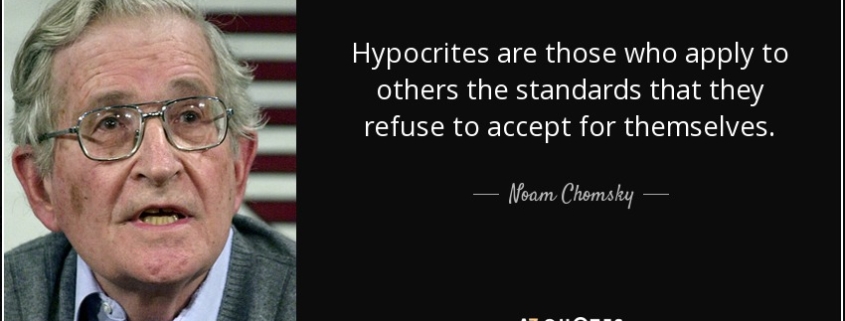
Being a Moral Crusader is a great gig in that you get the best of all worlds, public acclaim and a luxurious lifestyle just for self-righteously calling on others to meet the moral standards that you define. Enter Noam Chomsky who according to Wikipedia “in his youth developed a dislike of capitalism (a grotesque catastrophe”) and the selfish pursuit of material advancement”. He laments the increasing inequality resulting from the gutting of finance industry regulation and warns of an “unaccountable and deadly rule by corporations.”  But amazingly he’s managed to become a highly successful capitalist himself, making millions of dollars through adroit management of Brand Chomsky.
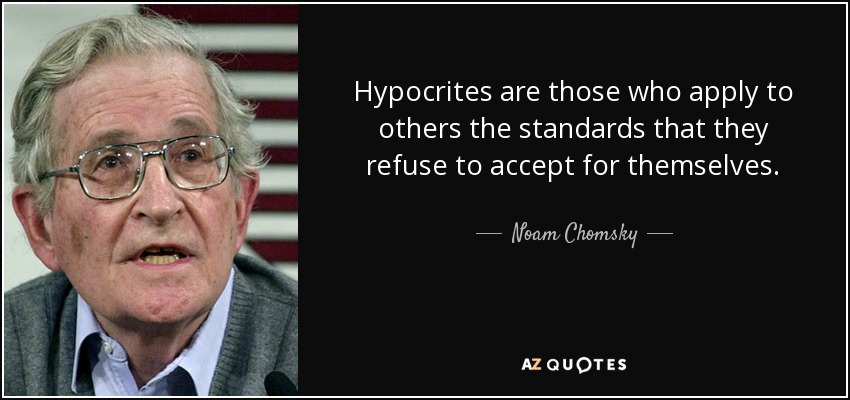
Books represent his biggest earner by far. He churns them out on an industrial scale (they’re largely rehashes of earlier speeches and articles) and charges a hefty capitalist price for them.  As he does for his speeches.  If you want him  to deliver The  Selfish Pursuit Of Material Advancement – one of his favourite lectures – your university will first have to fork out for the $15,000 fee plus the cost of First Class travel and a five star hotel that this horny-handed son of the soil insists on.  And should you want to download material from his web site you’ll be met with this stern warning: “Material on this site is copyrighted by Noam Chomsky and/or Noam Chomsky and his collaborators. No material on this site may be reprinted or posted on other web sites without written permission.” Such permission being granted on payment of a hefty fee.
And what about this: Following the 9/11 attacks he discovered that the demand for his learned opinion had, well, exploded. Despite his intense dislike of the “grotesque catastrophe of capitalism” he immediately jacked up his speaking fees by 30%.  Don’t you just love that?  And within weeks he’d churned out another book to exploit the disaster, this one purporting to explain its causes and significance. However on closer inspection (after you’d forked out your $40) you’d have learned that it was – yet again – made up of already published material spliced together with some hastily-written linkage text.
At a speech in Philadelphia entitled “Noam Chomsky: Media and Democracy” he told the audience that “a democracy requires a free, independent, and inquiring media.” After the speech left-wing ‘journalist’ Deborah Bolling tried to get an interview with him. No problem…if the “free, independent, and inquiring” reporter first forked out $35 for the privilege!  Clearly he didn’t have the likes of her in mind when he wrote “The responsibility of the writer as a moral agent is to bring the truth about matters of human significance to an audience that can do something about them.”

And wouldn’t you expect him to invest the resultant fortune in a blind trust or better again in green eco-friendly stocks? Maybe, but unfortunately such companies offer poor returns and high risk. Unlike those for example in the military-industrial complex, Big Pharma or the oil companies. But that’s not an option given that he sees them as exemplifying the “grotesque catastrophe” of predatory capitalism. Oh wait – one quick intellectual somersault later and he’s plunged headlong into their stocks, greatly enriching himself in the process.

And now he strides the intellectual firmament like a colossus, wealthy, feted, admired, a sought-after guest while remaining a champion of the poor and a defender of the environment. The long and happy life of a Moral Crusader.

(More good stuff on Noam here).
When White Liberal Prophecy Fails: Cognitive Dissonance and the Liberal Mind

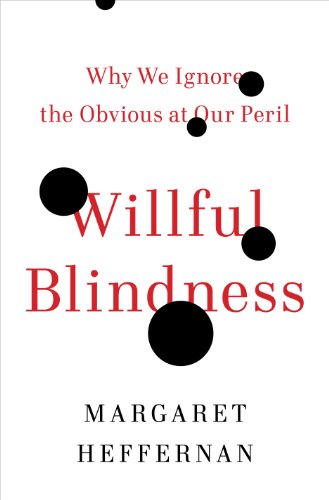
Cognitive Dissonance theory might be more important in explaining the Left’s mindset than we appreciate. Although frequently invoked by mainstream conservatives to superficially skewer liberals’ incoherence and hypocrisy, cognitive dissonance should be applied more broadly and explored more deeply. According to psychologists, the dissonance produced in the mind when holding mutually exclusive beliefs is actually nothing short of a form of mental trauma. Facts and opinions which challenge, for instance, one’s self-identity or long-held conventional wisdom can, say experts, result in agony for the afflicted, producing a feeling of desperation akin to starvation or intense thirst. Unsurprisingly then, the resulting discomfort can push the sufferer to great lengths of irrational and extreme behavior in order to obtain relief[1] (Margaret Heffernan, Willful Blindness, pdf here).Understanding cognitive dissonance, therefore, may go far in explaining our opponents’ aggressiveness and, given the growing unreality of today’s society, their increasingly toxic and desperate behavior.
A basic theme in cognitive dissonance literature is that the brain cannot stand conflict. So hard does the brain work towards resolving it, it’s neural circuitry will actually employ faulty reasoning in order to shut down distress.[2] When presented with contradictory positions, it will, in effect, blind itself to them, for instance, by eliminating the new conflicting belief and clinging to the challenged one. Referring to this characteristic of the mind as our “totalitarian ego”, Psychologist Anthony Greenwald says, much like the thought-control and propaganda devices depicted in George Orwell’s 1984, the mind’s biases are firmly enslaved to the ego’s greater central design (for instance, one’s self-image as a humanitarian and morally righteous person, etc.).[3] This would explain much of liberals’ hyper-defensive reaction to evidence regarding racial differences, for instance, and their aggression toward purveyors of such evidence.

Political psychology professor Drew Weston has found that the brain circuits activating biased reasoning are actually the same ones activated in drug-addicts when getting a fix. Like drug-addicts, the cognitively conflicted will do anything to return to a state of comfort and euphoria.[4] The minds of the conflicted can employ numerous stress responses when, for instance, one’s long-held belief or self-image is challenged, such as avoiding the conflicting evidence in question (and any possible sources of such evidence); resorting to self-denial and magical-thinking[5]; even intentionally misremembering or suppressing past experiences i.e. previous episodes of ethnic tension, etc.[6] And when confronted by ideological opponents, the afflicted can resort to convoluted, fantastical arguments as well as hostile or nakedly diversionary ones, such as making dismissive, personal attacks on the opponent’s motives.[7] No doubt many readers have experienced such episodes from liberals before, even to the point of visible neurosis, hysterical anger, or even threatened or actual violence.[8] As Cognitive Dissonance expert Margaret Heffernan says, “we are prepared to pay a very high price to preserve our most cherished ideas.”[9] Read more

On Liam Neeson and the Philosophy of the White Vigilante

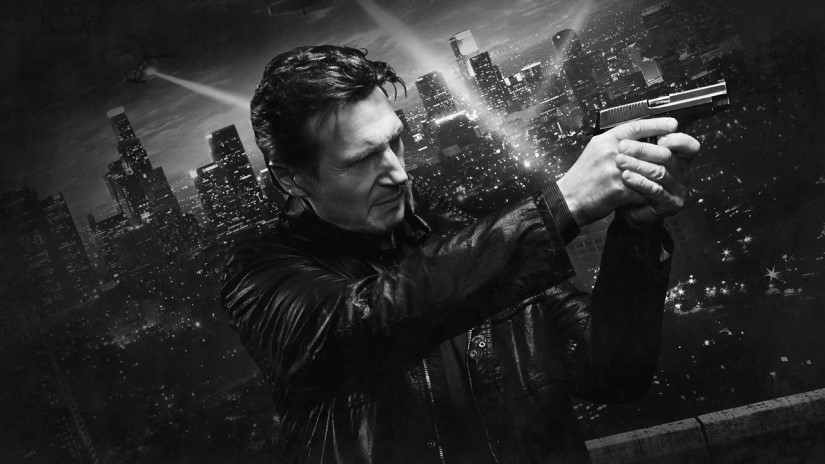
Jonathan Bowden once memorably argued that right wing ideas can be exiled from the political and social mainstream but never totally destroyed, being merely abstracted and displaced into other areas of culture. One such area, he argued, was film, and in certain filmic representations we can still see the semi-self-conscious acting out of the often violent, often suppressed tendencies and latent potentialities of Western man. Bowden cited as examples the number of movie posters depicting a lone White male, gun in hand, gazing into the distance. The movies these posters advertise invariably call upon the themes of a now much-maligned White masculinity. They feature males with singular and non-dialectical mentalities, possessing moral worldviews unclouded by compromise. In a blurring of stark individualism and concern for the group as a whole, these characters often live (and behave) at the margins of the society they go on to protect. They possess an open disdain for social permissiveness, bureaucracy, and procedure, and, finally, they are the spartan, right wing existentialist practitioners of a violent urban vigilantism. They are part of a genre described by one Marxist critic as “repugnantly fascist.” Read more

The Value of Victimhood: Liverpool, Labour and Lucky Luciana Berger

The English port of Liverpool is famous for three things: soccer, music and violence. Historically it falls within the boundaries of Lancashire, but culturally it has never fitted there. It’s always been too self-assertive and idiosyncratic, so much its own place that its inhabitants go by two names. Formally, they’re Liverpudlians; informally, they’re Scousers.

Militant parasites

As the media clichés have it, Scousers are fiercely proud of their city and fiercely tribal in their politics. And their politics have always been left-wing — sometimes very left-wing. When George Orwell talked about “Irish dock-labourer[s] in the slums of Liverpool” in The Road to Wigan Pier (1937), he said that you can “see the crucifix on the wall and the Daily Worker on the table.” The Daily Worker was the official newspaper of the Communist Party of Great Britain (now the paper is called The Morning Star). In the 1980s, Liverpool was the home of a Trotskyist group called the Militant Tendency, or Militant for short, which tried to infiltrate the Labour party and use Labour’s far greater power and prestige for revolutionary ends.

In biological terms, as I suggested in “Verbal Venom,” Militant were a tiny parasite trying to subvert the nervous system of Labour and divert Labour’s resources to their own use. If Militant activists had stood openly as Trotskyists, they had no chance of winning elections and entering local councils or parliament. Wearing a Labour mask, they could win elections and enter power. And that’s exactly what they did in Liverpool, where they won control of the city council. But their parasitic infiltration of the wider party failed: Labour woke to the threat and fought off Militant’s entryism, as this Trotskyist tactic is called. Read more

The Rise and Decline of the West: Review “At Our Wit’s End” by Edward Dutton and Michael A. Woodley of Menie

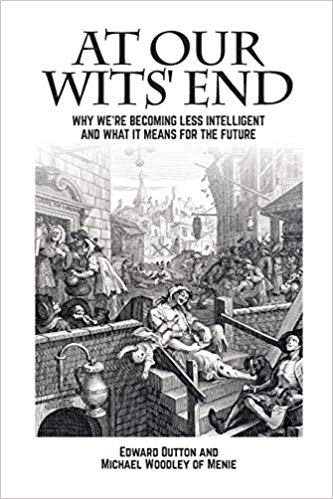
 At Our Wit’s End: Why We’re Becoming Less Intelligent and What It Means for Our Future
Edward Dutton and Michael A. Woodley of Menie
Exeter, UK: Imprint Academic, 2018

We in the West have long become accustomed to the idea that scientific and technological progress is the normal state of things, although decline—technological deterioration and loss of knowledge—is by no means uncommon across world history. The contemporary West may be declining in many ways, but what stage in our history could we point to as the summit of our scientific knowledge and technological capability if not the present? And wouldn’t it be absurd to suppose this progress has reached its completion?

Authors Dutton and Woodley, however, would note that a civilization may pass its peak long before the sum of its achievements is complete. We may look for our greatest era not when our knowledge and capabilities were most extensive, but when they were growing most rapidly. And that point, they believe, is already well behind us.

They begin their study by drawing our attention to two technological breakthroughs of the year 1969: the first flight of the Concorde supersonic passenger jet, cutting transatlantic travel time from eight to three and a half hours, and the first manned moon landing. At the time, most people assumed more such aeronautical wonders lay in store. This writer can remember the ubiquitous “artist’s impressions” of future manned flights to Mars and beyond; every little boy of that generation wanted to become an astronaut.

But a Concorde crashed due to human error in 2000, and all flights were discontinued three years later. We have not returned to the moon since 1972. The authors do not mention this, but by 2010 a NASA administrator was saying that “perhaps [the] foremost” of the space agency’s missions was to “reach out to the Muslim world … to help them feel good about their historic contribution to science, math and engineering.” We are not exactly aiming for the stars any more.

In the authors’ view, the best explanation for such regression is extremely simple: we are becoming less intelligent. Other explanations have some validity: the end of the cold war, e.g., partly accounts for the lowered ambitions of NASA, although not the end of the Concorde. But on Ockhamist principles, as the authors write, “if we can plausibly explain two separate events with one theory, that is superior to having a different theory for each event.” Read more

Guilty of Working While White, Redux: One Year Later

Exactly one year ago from the date we started this interview on January 19, Tom Kawczynski was attacked by the national media for daring to work while White. Because the town’s board of selectman was unable to stand-up to the media’s intense bullying of Mr. Kawczynski for simply stating the obvious — that Whites should have the same right as all other groups to work together to protect, and even advance, their collective interests — he was forced to resign from his position as the town manager of Jackman, a small rural community in western Maine.



The Occidental Observer published an interview with Mr. Kawczynski during that media firestorm. This is a follow-up to that interview to learn how Tom and his wife have contended with the changes in their lives since that attack.

Russell James: You ended the last interview with the words “We have more support than
we know, and we are changing the narrative.” Do you still feel that’s true?

Tom Kawczynski: According to the Census, over 60% of Americans are Whites without Hispanic ethnicity. One party, the Democrats, actively works to subjugate any sense of positive identity for the majority. The opposition, the Republicans, hides in shame from defending the accomplishments of that same group.

Under such circumstances, it can feel like we are unwanted, but what is happening is we stand perched on the verge of a nationalist awakening in this country where Whites will finally speak up for our interests with pride, without shame, and in recognition that as the people who both built and maintain this great country, our voices must be heard.

A lie has long persisted that for us to have pride in our accomplishments is diminution of others. This makes no sense. Rather, it is the rising civil rights issue of our time, to recognize that in a nation which respects popular sovereignty, that the majority can escape silence and be heard once more.

I am confident a new day is far closer than anyone realizes and look forward optimistically to its arrival.

RJ: How do you think it came about that explicit assertions White interests are now completely unrepresented in the institutions of power of a country our forefathers founded and built?

TK: We live in a country where most of our schools, our media, and increasingly, our corporations participate in an ongoing effort to suppress any positive expression of White identity. This is the result of a hundred-year plot of radical egalitarians of all stripes; socialists, communists, and Marxists to undo the republic that honored our heritage and replace it with social democracy, the easiest government to control and purchase.

What is particularly frightening is just how vicious these people have become in suppressing voices, seeking now not to just censor dissent, but to we see people suffering social and financial penalties, as well as a justice system where thought itself is now becoming criminalized.

But the biggest problem for all we can talk about how this happened is that we stopped speaking up for ourselves, both in terms of our own people, and for the moral cause of defending our liberty and legitimate authority that derives from our civilization and its timeless ideals. Read more

Alexander Gauland’ AfD speech deploring the attempt to denigrate German culture