Featured Articles

Léo Taxil: Is Anti-Semitism worse than pornography and Talmudic blasphemy?
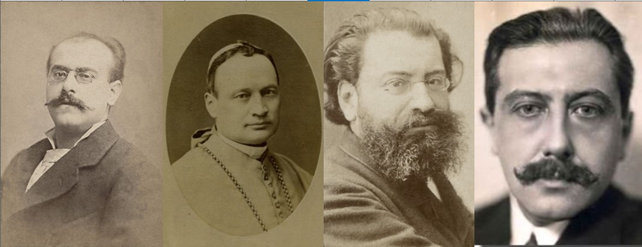
The Villain, the Dummy, the Good, the Suss, from left to right, Léo Taxil (1854–1907) whose real name is Gabriel Jogand-Pagès , Luigi Rotelli (1833 – 1891) the archbishop of Pharsale and apostolic nuncio, Édouard Drumont, author of La France juive (1844–1917), Georges Bernanos (1888–1948)

In 1931, Georges Bernanos published a pamphlet entitled La Grande Peur des Bien-Pensants (The Great Fear of the Righteous), which retraced the life, work and times of Édouard Drumont (see here for a list of TOO articles that deal with Drumont). In it, he painted an apocalyptic picture of the conquest of France by the Jews and the concomitant eviction of the Christians, with, on the one hand, the Crémieux decree, which in 1870 automatically granted French citizenship to the “indigenous Israelites” of Algeria (Adolphe Crémieux was himself Jewish), the Dreyfus affair, which began in 1894, and the subsequent creation in 1898 of the LDH (Ligue des Droits de l’Homme — Human Rights League), these human rights being opposed to the rights –of the French — and even to God, and with, on the other hand, the anti-Catholic Expulsion of the Congregations in 1880, the law of 7 July 1904, relating to the suppression of congregational teaching, known as the “Combes law“, and in the middle of all this, a poor little journalist, Édouard Drumont, who rowed against the tide by publishing in 1886 a monumental La France Juive (Jewish France), 1,200 pages in two volumes, which sought to awaken Catholic France, but which was caught out by the betrayal of the Ralliement (the rallying of the Church in favor of  the nascent republican regime in France), pronounced in 1892 by Pope Leo XIII.

It was in this context that the Léo Taxil episode became emblematic of the Roman clergy fool’s game with the Jews and the Republic in France. The Ralliement as a whole was a downright suicide for the Church, and the Count of Chambord replied to Leo XIII’s policy, “I thought the Church forbade suicide”, but with Léo Taxil, we’ll see just how far this Church will compromise itself.

Drumont was to force a clarification of positions, and the publication of La France Juive was a resounding success, a blow that reverberated deep into the heart of French society and provoked an immediate reaction from the chief rabbi of the Consistoire central des Israélites de France, Zadoc-Kahn, who sent his famous letter to Le Temps, whose deceptively moderate tone oozed anguish:

It is already too much that, a hundred years after the Revolution of 89, there can occur in our public meetings such excitements against a whole category of citizens who are as good Frenchmen as anyone else.” — “As a Jew, I grieve, as a Frenchman, I blush.” —  “France would no longer be France, that is to say the country of liberal traditions…” [American readers can of course replace «France» by «United States» and «Frenchman» by «American» if that helps them understand the sentence]. And immediately afterwards, the perfidious conclusion, the trap set, where cowards are already longing to fall: “It is my absolute conviction that not one member of the Catholic or Protestant clergy, whose virtues I admire, whose elevation of heart and mind, whose enlightened patriotism, would want to subscribe to language that is neither French, nor Christian, nor human”.

One wonders how a clergyman who inherited the tradition of Saint Thomas Aquinas could be taken in by such a display of Oriental displays of politeness, but at least this Zadoc-Kahn is a kind of high priest, whereas Léo Taxil is not. He was a pornographer, a blasphemer and a hoaxer who, in 1887, “in the name of the high clergy”, gave a lecture denouncing the “war of religion” waged by the nationalists (and in particular Édouard Drumont) against the Jewish financiers of the time. And it was to this unscrupulous adventurer that the Apostolic Nuncio, Monsignor Rotelli, gave his visiting card at the end of the conference, without giving it a second thought, and arranged for him to have a private meeting with Pope Leo XIII.
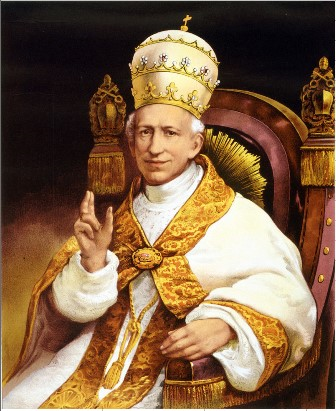
Pope Léon XIII 1810 – 1903

In broad outline, when everything is said and done and we understand the question posed in the title, we understand the Church’s response: anti-Semitism is worse than pornography and Talmudic blasphemy, Catholics must rally round and submit, not only to the Republic, but to the Jewish Republic.

Forgiving readers could get a glimpse of the thought of Bernanos and Drumont in these translated extracts from La Grande Peur des Bien-Pensant, the chapter devoted to Léo Taxil, an anti-clerical Frenchman who concocted a hoax in which he claimed to have returned to Catholicism in an effort to expose the Church’s opposition to Freemasonry. Bear in mind that what we are aiming for here is not so much a good translation into English as making two essential authors known on the other side of the Atlantic: Édouard Drumont and Georges Bernanos, who can be very useful to Americans in understanding what happened in their own country at the same time.

Why so? Because the point of Bernanos and Drumont is beyond the classic war between an anticlerical French Republic and the Church. The context has evolved between 1789 and 1871: the Jews are now in the game, within the Republic and within the Church, just as neoconservatives have managed to dominate both sides of the political divide in the U.S. (see  “Neoconservatism as a Jewish Movement).” It could be said that  Drumont and Bernanos saw the “Ralliement as a Jewish Movement” and Pope Léon XIII as the first Neoconservative who will choose to meet with Léo Taxil, despite his being a pornographer and a blasphemer, rather than Édouard Drumont, Catholic but anti-Semite (and it should be noted that the “but” is completely new, before, it would have rather been a “and therefore”).
§§§

Georges Bernanos, translated from The Great Fear of the Righteous (1931), inner quotes from Drumont

At this time they [the clergy] hurled at the disrespectful Catholic [Drumont], with unheard-of naivety, the most hideous of penmen, rejected by all, a sort of black mass sacristan, claiming to be converted, and whose stench only bigots were probably still able to bear: Léo Taxil.

A magnificent story! A certain number of good people who never tire of anything, so terribly well-intentioned that, like Juvenal’s courtesan — and to rewrite this savage phrase — no cheese will ever make them vomit, still take seriously, after forty years, one or two episodes of an imposture that is as simple, as a summary as any famous swindle. A former seminarian, half pornographer, half blackmailer, supplier to specialty bookshops, then a bookseller himself, founder of an ‘Anticlerical Bookshop’ where he published so-called popular pamphlets, the delight of obsessives and maniacs, he had suddenly announced his return to God, promising at the same time, thanks to imminent revelations about the secrets of the Freemasonry to which he had belonged, a plentiful ration of muddy water to devout frogs. Thousands of simpletons were eager to learn the famous secret rites from the mouth of the prodigal son, no doubt sniffing out details of a wondrous obscenity, the terror and torment of their anxious chastity. Overnight, the anti-clerical Librairie became the anti-Masonic Librairie, tripling or quadrupling its clientele. What’s more, this bizarre forty-something altar boy had secured, it was said, the even more bizarre collaboration of a mysterious Masonic sister [Diana Vaughn] who had once reached the last degree of initiation, was familiar with the demonic cult, and was responsible for an incalculable number of political assassinations, executor of the pitiless decrees of the sect, and who, having miraculously escaped the possession of her master Satan and the vengeance of his accomplices, was condemned to death, wandered under a false name from monastery to monastery, watched over by the daggers of assassins. Using the pseudonym Diana Vaughan, she made revelations even more sensational than those of Taxil, avidly commented on by the most serious Catholic journals, and which filled all the presbyteries of France with visions and nightmares.

This prodigious detective story ended as abruptly as it had begun: with a pirouette. To the terror of the good canons, threatened with apoplexy, the neophyte [Taxil] flooded with blessings [neophyte in the literal sense = newly baptized], stuffed with pious sweets like the parrot of the ladies of Nevers, quietly stuck his tongue out at his new audience, and declared that he had paid off the mitered heads; moreover, more a Freemason than ever, having only revealed Polichinelle’s secrets to right-thinking curiosity. Diana Vaughan had never existed except in his soap opera imagination: the supposed revelations, the confessions, the pages that had shed so many tears, were the crude imposture of this vicious pimp, written on the marble of a café table, greasy with gum syrup and absinthe. What’s more, even at the height of his fervor — an unheard-of trait! — the favourite of the pious public had not even renounced the profits of the Librairie anticléricale. To the bewilderment of his dupes, he had left the management of the bookshop to Mme Léo Taxil, who faithfully brought in, each month, the countless free-thinking pennies, fraternally mixed with the clerical pennies from elsewhere. However disgusting this story may be, it is worth courageously swallowing its ignominy and humiliation: it gives the measure of a certain baseness of heart that explains, without justifying, alas! the corruptions of intelligence.

But at the same time as the author of La France juive [Drumont] was modestly standing for election to the town council, Léo Taxil was still the parish favourite, publishing articles every day in Le Petit Catholique and La France Chrétienne. Although he had already given a few tokens to the nascent anti-Semitism, he suddenly changed his front and in a resounding lecture stigmatized for the first time, in the “name of the high clergy”, what he impudently called the new religious war, declaring moreover that “the names of the Rothschilds, the Pereires, the Cahens of Anvers, the Hirsches, the Ephrussi and the Commondos were universally esteemed”.

The “high clergy” did not let the adventurer’s brutal formal notice go unanswered for long: at the very end of the conference — incredibly — the apostolic nuncio [Cardinal Rotelli] had his card deposited with Mr Léo Taxil. A token of even greater favors! A little later, he was received in private audience by Leo XIII, and in addition to the customary blessings, he brought back a more or less faithful but skillfully balanced interview.

It will be said that the episode is thin. However, it is worth repeating. In its comedy, alas! a little trivial — of such low quality, as it stands at last — it uncovers a whole part of Drumont’s life, gives the measure of the heroic bitterness that twenty years later was to sink into a kind of despair, otherwise incomprehensible.

At this moment at least, in full strength, the incomparable fighter stood his ground. It obviously did not depend on him to destroy in a single day the mediocrity — the incurable mediocrity of the clerical party, a mediocrity whose causes are profound, probably beyond the judgement of the moralist or the historian, and require a supernatural explanation. Let us at least take, after so many years, from this old fraternal voice, an admirable lesson in contempt! The over-scholastic portraits of [anti-Semites, monarchists, and/or pro-Catholics like] Veuillot, the heart-rending cries of Léon Bloy, the lyrical fury of Léon Daudet, the ancient eloquence, the sacred anger of Maurras, cannot give the idea of this good-natured and familiar ferocity, in its somewhat monotonous unfolding, where suddenly a tragic shudder passes, the whole breath of the powerful chest, like a lion’s snort.

All this, he writes, is of secondary interest. What confounds the mind is to see the archbishop of Paris suffer such an individual to dare to speak in the name of the high clergy, to hear the author of Les Amours secrètes de Pie IX [i.e., Taxill] assert that he has a mandate from the Church to attack a writer [Drumont] whose past is clean and who, even when he was not a Christian, never wrote, against what Christians respect, a line of which he would be ashamed of today.

There is more surprise than anger in these lines; you think you see the tired look behind the glasses, the resigned gesture of the hand closing a book. … But he is already marching on his adversary, with his heavy step:

I was curious to go through the filthy work of this man who is so dear to the ecclesiastical authorities today. It is understandable that the first publishers of these books were Jewish: Strauss in Paris, Milhaud in Marseille. It is truly a descent into Jewish hell, into the excremental hell described by Swendenborg in this “tainted Jerusalem which exhales the stench of rats, and through which Jews scabbed to the back run in the mud after a few gold coins”. This is not a mockery of Voltaire, nor the eloquent blasphemy of Proudhon, nor the disturbing protests of so many great rebels: this is pure abjection, the literature of La Lanterne that launched these publications and made them a success; this is the Talmud that announces that it is a good omen to dream of fecal matter.

Taxil’s protective nuncio begins to blush and asks for mercy. The vigilante continues, impassive:

You can’t imagine what it’s like to go through (even in haste, even if you avoid touching them for a long time) these books of stercorals [an omitted passage, a list of books with  gravelly-sounding titles that are difficult to translate]

Another minute’s silence, another step forward.

A few months ago, when M. Quentin-Bauchard’s curious volume La Caricature pendant le siège et la Commune [Caricature during the siege and the Commune] appeared, I was curious enough to look at my collection: it is not complete, and contains barely five hundred items. For a whole day, I saw Paris of the siege pass before me, that strange Paris, which, dying of hunger and still under arms, still found the means to hang nearly a thousand charges, caricatures and drawings on the nails of every shop. … Nothing is spared. … No, I am wrong, and it is an observation that has been made before me: a figure never appears in the midst of these saturnalia which begin on the Fourth of September and end in the days of May. During this time of absolute freedom, in the midst of all the outbursts of anger, no Frenchman was vile enough to insult the white cornette of the Sisters of Charity….

It was as if the Paris that had risen up resembled the Forum of Rome… Sedition was rumbling under the fiery voice of the Gracches, the henchmen of Clodius were at loggerheads with the friends of Milon; people were shouting, threatening and slitting each other’s throats. Suddenly the clamor died down and the daggers were lowered. At the entrance to the square, which resounded with the cries of civil war, the lictors had just appeared, preceding the white procession of the Vestals…

The implacable writer takes his time, swaying his slingshot for a moment:

The first person to insult the daughters of Saint-Vincent-de-Paul, the first to shamelessly lift the sacred gown, was the current favorite of the archbishopric and the nunciature.

He shrugs:

It’s a date, a degree in the sewer. If we had a hydrometer to indicate the low-water mark of the muddy river that has flowed over France, we would find this, indicated with a name.

Here she is, the sister of charity, in the Album anticlérical [comic drawings by Pépin based on text by Léo Taxil] she has her real name: la petite sœur qui quête… [the little sister who’s questing = pun on words, «qui quête» stand for «quéquette» i.e. «wee willy winkle» – sorry]

It was Lent, and the convent chaplain preached a very pathetic sermon on the tears shed by Christ for human sins.

The tears of Christ weeping over the faults of men, you can imagine how this lends itself to villainous comments… Sister Mary of the Angels drinks lacryma christi, she’s drunk as a skunk, she’s hung up by a rapin [apprentice painter] and after nine months we find her in the final drawing with a huge belly that she’s spreading.

He grabbed the drowsy nonce with his strong hand and put him on his feet, limp and pale, facing the burst sewer:

We still have to go on, overcoming a disgust that expresses itself in a very physical way. As you walk through this path that reeks of piss [French word = sentine], you think you’ve reached the last hiccups, but you’re wrong. There is yet another mound of excrement, another puddle of faeces.

Courage, Excellency!

The life of Jesus Christ messing about [along the Seine banks] is perhaps the most ignoble thing imaginable in this work, where ignominy is everywhere.

The Virgin is covered in filth. In fact, everything about her is a development of an abject slander in the Talmud that I have already debunked, which shows the Virgin mating women and being impregnated by a soldier called Panther.

“While Joseph was talking, Marion had regained her composure: she tried to coax her fiancé, made a cuddly pout to make him swallow the pill..

  • Joseph, my big bunny…
  • Ta ta ta, don’t try to fool me… Who, if not a man, put you in this bloody position?
  • It’s the pigeon, Joseph…”

The pen trembles in my hand, but this filth must be transcribed, so that it will be known that the wretch who spewed out this filth was able to rise up against me and say that he was blaming me in the name of the high clergy without an authorised voice being heard to protest.

But Léo Taxil perhaps had another claim to the indulgence of the high clergy, to the favours of the Nuncio Rotelli…. A former student at the seminary, he was introduced to certain special treatises, veritable clinical manuals for the use of future confessors, and one day became a voluntary publisher, translating them from Latin into French and launching the famous Livres secrets des confesseurs dévoilés aux pères de famille (Secret Books of Confessors Revealed to Fathers of Families), thanks to the publicity of La Lanterne. — “the only complete edition published by Léo Taxil and containing Mgr Bouvier’s Diaconales, the Compendium and the Mœchialogie or Treatise on sins against the sixth and ninth commandments of the decalogue and on all matrimonial matters by reverend father Deybryne,Trappist monk”.

In this work of villainy, Taxil was truly infernal. At five francs, the volume still seemed too expensive: to reach the little ones and reveal to them all the secrets of debauchery, he published a volume for one and a half francs, and flooded France with it: “Les Pornographes sacrés: La Confession et les Confesseurs, by Léo Taxil, on sale from the author and all booksellers”.

But here the great voice of the old master is going to swell, to pass imperceptibly from a tone of quiet contempt to that kind of accent which is the very quiver of genius, ingenium, the immortal vibration that nothing stops, neither space nor time — the word of justice where even anger has fallen silent. Words like these do not come out of a man’s heart without tearing it apart: woe betide anyone who receives in the face, to be marked forever, the jet of ruddy blood!

Do you want to know what the Pope’s representative, the Apostolic Nuncio, Archbishop Rotelli of Pharsalus, thinks of the man who has corrupted so many? Read La France chrétienne of 12 June 1890, which reports on the conference against anti-Semitism at the Salle des Capucines.

“The day after the conference, His Excellency the Apostolic Nuncio had his card delivered to Mr Léo Taxil!”

It’s a very fin de siècle trait, and confirms what we’ve said about the frivolous, extravagant, caricatured and buffoonish allure of dying societies.

When we think of the countless little girls in the workshop or in the countryside soiled by this filthy reading, and we see Rotelli fraternising with the author of all this filth, we must not despair of anything. Some day we can expect to see the Apostolic Nuncio, in his fine lace and purple camail, walking arm in arm with the imitators of Ménesclou [infamous murderer, kind of Jack the ripper].

But the comparison is only half fair. The unfortunates who commit these crimes that frighten Paris belong, for the most part, more to the doctor than to the executioner; they are irresponsible brutes; their brains are mush; they bear the burden of all fatal heredities. Here, it’s the intellectual crime — the seminary pupil who coldly says to himself: “I’m going to make money by defiling the souls of little girls and boys”.

So the Nuncio sent him his card.

At this point, what was left of the smile in the tangled beard disappears, the gaze fixes itself without hardening; attentive, as the gaze of the adversary has met it so many times, on pale mornings, and the long, admirably articulated sentences, powerful and supple, follow one another, in the same cadence, as at the end of a duel to the death:

If he sees these pages, Rotelli will not even understand why his conduct is shameful: he has a complete obscuring of the moral sense. For him, virtue consisted in faithfully paying his rent to Calmann-Lévy, with whom he had taken up residence while waiting for the Marquise de Plessis-Bellière to disinherit his parents and leave him a hotel. Such is the morality of this nonce.

He is not a politiian, this Frenchman,” he may murmur as he reads me; “he has not understood the combinazione. Léo Taxil has a good relationship with His Excellency Baron de Rothschild, and Baron de Rothschild is a good man; he got me to do a little business.”

They’re all like that in this country, and the Archbishop of Pharsalus has no more scruples about courting Jews than Nigra had about making the Empress’s rizotto in a silver pan.

Rotelli would even have been a cardinal a year ago had it not been for a trial that took place at the Perugia assize court in March 1890. It concerned a pharmacist, well known to Rotelli, who had murdered his brother with a knife; the brother was a canon, also well known to Rotelli.

It was feared that, in the modern Sacred College, the representative of a race of fratricides might seem a little too 16th-century; it was also feared that the new Eminence might feel some embarrassment in preaching to the godless the virtues of the family.

You know, Excellency, that I’m not like your friend Taxil, and that when I assert a fact, it’s because it’s absolutely true.

§§§

A final word on Bernanos: in the caption to his photo above, we described him as dubious, for two reasons:

1 – The Drumont portrayed by Bernanos bears a striking resemblance to his Curée de Campagne, which can be found in the pages of his next, most famous novel, so it is not clear whether La Grande Peur is sincere or is a kind of rehearsal for his masterpiece.

2 – He was uncompromisingly opposed to National Socialism from the outset, even though NS posed exactly the same problems as concerned Drumont.

So, did Bernanos consider antisemitism to be one of those old Christian virtues that have gone off mad?

That in no way detracts from his talent, of course.

 

Occupying the Universities

For those on the political Right, the university is now occupied territory, but not so long ago the universities were an enemy from a Leftist perspective. Terry Eagleton, one of Britain’s most famous Marxist academics, bemoaned in 2010 in Left-wing newspaper The Guardian that we had ‘witnessed in our own time … the death of universities as centers of critique’. Eagleton’s remedy for this authoritarian co-opting of higher education by the hated Tories is worth quoting in full;

Since Margaret Thatcher, the role of academia has been to service the status quo, not challenge it in the name of justice, tradition, imagination, human welfare, the free play of the mind or alternative visions of the future. We will not change that simply by increasing state funding of the humanities as opposed to slashing it to nothing. We will change it by insisting that a critical reflection on human values and principles should be central to everything that goes on in universities, not just to the study of Rembrandt or Rimbaud.

In passing, do we imagine that White men like Rembrandt or Rimbaud are afforded much study time on today’s campuses? But Eagleton certainly got what he wanted, just not in the way he expected. The ‘free play of the mind’ is now tightly controlled ideologically, and any ‘critical reflection on human values and principles’ is only permissible within strictly policed guidelines. A very modern cliché has it that universities now tell the student what to think, not how to think, and so their original purpose and spirit have been completely inverted.

Centers of learning existed long before universities began to resemble our familiar if fading institutions. Plato’s Academy, Islamic schools such as Baghdad’s House of Wisdom, and English Cathedral schools were all proto-universities. In Latin, universitas was a general term not specific to organized pedagogical structures, and the universitas scholarium was the forerunner of the university in that it was independent and defined by its relative academic freedom.

At the earliest European universities of the 12th century — French in northern Europe, Italian in the south — students would study philosophy as a matter of course, an introductory discipline to prepare them for their core studies, usually theology in France, medicine and law in Italy. Aristotle was the core curriculum and, by the 13th century, students at Paris or Bologna would familiarize themselves with the Stagirite’s Organon (meaning, roughly, the ‘tool’), the central text which would enable them to construct rational arguments, understand and perfect rules and techniques of clear thinking, and follow the laws of excluded middle, demonstration, induction, deduction and the rest of the Western intellectual apparatus which would follow its course to the Enlightenment. This notion of the university as a nursery of thought stayed broadly in place (the dominance of the Medieval church notwithstanding) until the late 20th century. Then something happened.

A key marker of the decline of the American university — a decline which can be extrapolated in the usual way and with the usual transatlantic time lag to Britain and Europe — is Allan Bloom’s 1987 book The Closing of the American Mind. Universities are vital, Bloom writes, for reasons which would be sure to enrage the new ‘woke’ academics;

A great university… made a distinction between what is important and what is not important. It protected the tradition, not because tradition is tradition but because tradition provides models of discussion on a uniquely high level.

Here we see why the classical university kicks the hornets’ nest of a new generation raised on equality and its offspring, equity. Importance/non-importance implies a natural hierarchy of value, anathema to the new Left. Tradition was seen as vital, and tradition is always White and therefore oppressive. Finally, ‘models of discussion on a higher level’ are not inclusive, and inclusivity is a central pillar of the new academic order. The White canon is no longer seen as the fons et origo of wisdom, but as occupied territory to be won back or, failing that, subject to scorched earth policies. And so the university is a key battleground if education in any meaningful sense is to be destroyed, and this is being achieved by reducing intellectual activity to a pre-fabricated kit which need not — indeed, must not — be thought through, merely learnt by rote, as children once learnt their times-tables.

The guiding stratagem of this woke scaling of the ivory towers is to radically modify the received model of truth, and then to impose conformity to the revised model. This involves re-ordering the natural relationship between subjectivity and objectivity.

John R. Searle, in a 1993 paper entitled Rationality and Realism, What is at Stake?, noted that there were serious and deleterious changes being made in universities, ‘not just to the content of the curriculum but to the very conception of rationality, truth, objectivity, and reality that have been taken for granted in higher education, as they may have been taken for granted in our civilization at large’.

Once you start removing the foundation stones of post-Enlightenment thought and reason — the difference between subjectivity and objectivity and the ratiocinative superiority of ratio over emotio among them — then truth is in freefall and epistemology becomes a yard sale of random ideas randomly priced.

In order to genetically modify truth, the curriculum must be altered first in order to remove any of the pre-existent tools, to echo Aristotle, that might enable the student to think independently. A seminal document in this decommissioning of truth is “Occupy the Syllabus” (which can be read here), produced in 2015 by Rodrigo Kazuo and Meg Perrett, then students at UC Berkeley, ironically the home of the Freedom of Speech movement in the mid-1960s. The opening line is a mission statement for the whole document: ‘We have major concerns about social theory courses in which white men are the only authors assigned’.

The co-authors lament that a course on ‘classical social theory … did not include a single woman or person of colour.’ Sometimes, they continue, ‘we were so uncomfortable we had to leave the classroom in the middle of lecture [sic]’.

That 2015 was year zero for the ‘occupation of the syllabus’ is further evidenced by Professor Edward Schlosser, writing in Vox in June of the same year — six months after Occupy the Syllabus — in a piece called “I’m a liberal professor, and my liberal students terrify me”:

I once saw an adjunct not get his contract renewed after students complained that he exposed them to “offensive” texts… That was enough to get me to comb through my syllabi and cut out anything I could see upsetting a coddled undergrad.

Plato’s Republic discusses education at length, and one aside echoes down the centuries: ‘A teacher… is afraid of his students and flatters them, while the students despise their teachers.

And teachers have every reason to fear their students, as the next stage of occupation after subverting the syllabus is to make the faculty conform, and expunge those who don’t. Once you have your scripture, you need heretics. An example comes from my own alma mater in 2021, when a professor of philosophy at the University of Sussex was hounded from her post for comments concerning transgenderism made in lectures and a book. Professor Kathleen Stock is a mild-mannered analytic philosopher, and despite being a lesbian and quite happy to use ‘preferred pronouns’, this was not enough to save her from the student mob. I wrote about this case at the time here.

The case of Professor Stock caught my attention as it also concerned my own subject, philosophy, which brings us to the next stage of occupation. The curriculum has been severely culled, and now increasingly lacks the work of white men. To paraphrase a line from Jaws, we’re going to need a smaller library. Next, the heretics are, if not burned at the stake, then at least made unemployed and perhaps unemployable. These are all subtractions; what is to be added?

We are now all too familiar with the academic presence of CRT, gender-queer theory, African studies and the rest of the grievance portfolio. Philosophy seemed more of a challenge for the occupying hordes. It is difficult to dumb it down, but it can be done. Dr. Ian M. Sullivan is an assistant professor of philosophy at The University of Arcadia in the USA. His work is symptomatic of what has happened to the Humanities. ‘Through queer philosophy,’ we are told, ‘Dr. Sullivan gains an alternative framework to explore classical philosophical writings’. The classical (meaning White) approach to philosophy is erased and replaced with exciting new challenges.

And there are also challenges for the university administrators. The universities are in a bind. They must do well on their DEI (Diversity, Equity and Inclusion) score in order to guarantee government funding and keep their jobs which, at least in the American university system, are by appointment or election. On the other hand, well-off Asian, Arabic and African families do not send their children to Oxbridge, at great expense, to learn queer theory. So there are two conflicting revenue streams to protect.

And so the academic occupation is well advanced. What of the physical university? For the post-modern, progressive student of the Humanities, occupying the refectory is somewhat passé, as students already own today’s campuses. That’s not to say that some undergraduate collective has gone about the place buying up head leases and freeholds at auction, but rather that students now dictate even the topography of Western universities, with their safe zones, racially segregated events, free-speech gazebos, controlled speaking venues, and various other means of protection against the micro-aggressions and White privilege which lurk in every seminar and common room.

How did the universities of 12th-century Western Europe become the malevolent kindergartens of today? Bloom implicitly explains why it is that the old model of the university has been decommissioned:

‘The successful university is the proof that a society can be devoted to the well-being of all, without stunting human potential or imprisoning the minds to the goals of the regime’.

‘Imprisoning the minds to the goals of the regime’ should be the new university motto beneath the crest of every university.

The toxification of the universities, the poisoned wells of academia, will have a wide effect very quickly. Once a ‘woke’ generation or two have passed through higher education, replete with all the new and accelerated, grievance-based prescriptions and proscriptions they have learned in lieu of a real education, they will pass into the workforce, most of them working for the Western public sector, in other words, for the government, the state. Very soon, throughout the West malevolent and uneducated graduates in worthless non-subjects will assume full control of public administration and finances, the arts, media —  both mainstream and alternative — and the law. They have already won the battle, essentially, but are about to bayonet the wounded.

While recognizing that students now run universities, it is also worth noting that the university at Bologna in the 12th century was also run entirely by the student body. They decided on the faculty, they set the curriculum, theirs was the ultimate voice of arbitration. How extraordinary that today everything has stayed the same and yet everything has changed. Today’s Western university — or ‘uni’ as students in Britain call them, the word ‘university’ having become as archaic as ‘manufactory’ — has become an ideological boot camp in which everyone is taught and required to march in lockstep, and this means removing the possibility of independent thought.

‘We shall proceed to a standardization of the intellectuals’, wrote Nikolai Bukharin in The ABC of Communism. ‘We shall manufacture them as in a factory’.

Beauty and the Barbarous: From Glorious Gold to Anatoly’s Anglo

What was the greatest artwork of the twentieth century? Some would choose a painting by Picasso or Rothko, a sculpture by Brancusi or Epstein, an installation by Kapoor or Weiwei. Not me. I don’t like any of those artists and I don’t like the ugly art that is so characteristic of the twentieth century. No, I would choose something by General Dynamics. For me, the greatest artwork of the twentieth century was an aircraft called the F-16 Fighting Falcon.

070720-F-5502S-003 .. An F-16 Fighting Falcon aircraft from the 18th Fighter Squadron positions itself behind a KC-135 Stratotanker aircraft during exercise Red Flag in Alaska on July 20, 2007. More than 80 aircraft and 1,500 service members from six different countries are flying together to sharpen their combat skills in simulated combat sorties. DoD photo by Capt. Tana R.H. Stevenson, U.S. Air Force. (Released)

The greatest artwork of the 20th century: a General Dynamics F-16 Flying Falcon (Wikipedia)

The defense company General Dynamics didn’t intend the F-16 to be a work of art, but that’s what it turned out to be. It literally embodies something that was driven out of officially approved art during the twentieth century by circles of critics, academics, and art dealers dominated by Jews. What was that something? Simple: it was beauty. The F-16 is an extraordinarily beautiful aircraft. You can see that even when it’s sitting stationary on a runway. But its beauty comes fully alive only when it leaps aloft and flies. The F-16 is very good at flying. Flight is itself a beautiful thing, allowing a privileged few to “slip the surly bonds of earth” and enter a new realm full of new possibilities. Humans must have dreamt of flying since far into prehistory. “Birds do it, bees do it, bats and butterflies do it — why can’t we do it?” That question must have been asked many times in many languages down the millennia. The answer, of course, is that flight is very difficult. Birds, bees, bats, and butterflies all evolved to do. Humans got there indirectly, using their extraordinary brains.

Knights of the air

But it wasn’t all humans who could have done that. You can marvel at the F-16 not just for its mechanical and acrobatic beauty, but also for reasons that must remain unspoken in the modern world. The F-16 is a glorious embodiment of White male genius, a kind of metallic and mechanical flower on the tree of Western civilization. Flowers are beautiful, but they can’t exist in isolation. Nor could the F-16. If you were writing a full history of its creation, you’d have to include not just the team of White men at General Dynamics that designed it and built it and got it into the air, but also the teams of White men and the individual White male geniuses who invented or mastered all the things that went into its creation: metals, fuels, electricity, the mechanics and mathematics of flight, the jet engine, computing, and so on.

And a fighter-plane like the F-16 doesn’t just preserve the beauty that has been driven out of modern art: it also preserves the chivalry that has been driven out of modern warfare. “Chivalry” is related to the French cheval, “horse,” because the code of chivalry was forged by White horsemen acting as individuals, not as a horde. A single knight rode a single horse and relied on his individual skill and courage to triumph in battle. An F-16 pilot is a knight of the air riding a mechanical steed. But what would happen if any mainstream figure today tried to celebrate the F-16 in those terms? “This beautiful aircraft is a glorious embodiment of White male genius and gallantry!” The shrieks of outrage would be deafening and the mainstream figure would immediately cease to be mainstream. Such a person would be driven out of decent society for espousing “white supremacism.”

Slaughtering goyim by the multi-million

In other words, they would be punished for speaking the truth. White men have indeed been supreme in achievement and endeavour during the modern age. Indeed, they created the modern age. Without them, humans would not have perfected flight and there would be no F-16. But I think that White men have achieved so much partly because they’re not obsessed with themselves and with advancing their own interests. Instead, they’re obsessed with what’s out there in reality: everything from sub-atomic particles to protozoa to blue whales to the Universe as a whole. But the exotropism of White men — their orientation outward and away from themselves — is what renders them vulnerable to the endotropism, or inward orientation, of other groups.

That’s why I find it so ironic and appropriate that the F-16, that glorious embodiment of White male genius, is scheduled to enter the Ukraine war, that ugly embodiment of Jewish malevolence and meddling (not to mention a major component of the Israeli Air Force as a result of American largesse). White male genius and the beauty it creates have been co-opted to serve the interests of a group that’s isn’t merely selfish but also actively hostile to White men. Jews are highly endotropic: they’re obsessed with themselves and with advancing their own interests. And with punishing their enemies.

Israeli F-16s

The Ukraine war is part of a much bigger and longer war that Jews have waged against the great White Christian civilization of Russia, which they envy and resent both for its achievements and for its resistance to their predation and parasitism. When Jews came to power in that part of the world after the Bolshevik Revolution, they slaughtered goyim by the multi-million. One not-so-notorious episode of Jewish revenge was the Holodomor, the deliberate slaughter-by-starvation of millions of Ukrainians in the 1930s.

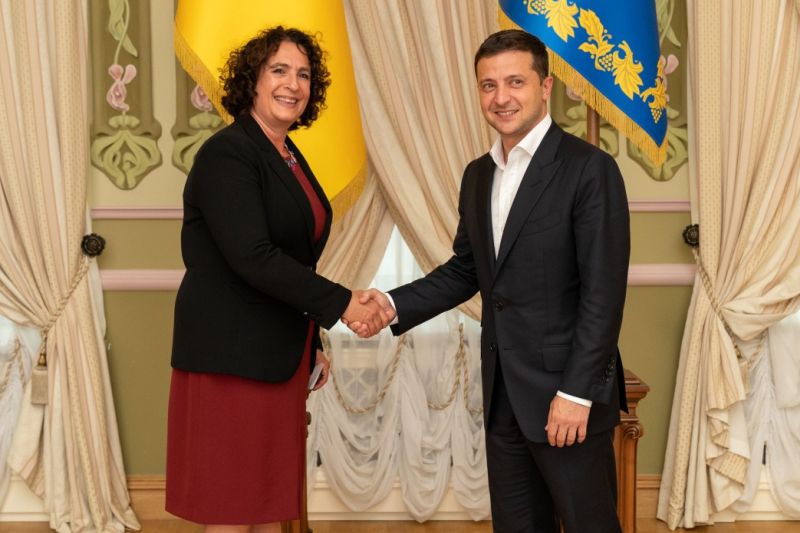
Anatoly’s Anglo: the obviously Jewish Melinda Simmons, British ambassador to Ukraine

I feared that another tragedy was about to be inflicted on Ukraine by Jewish malevolence when I saw a photo in 2021 of Melinda Simmons, the new British ambassador to Ukraine. Sadly, I was right. The great Judeo-Christian transhumanist Anatoly Karlin identified Ms Simmons at the Unz Review as an “Anglo,” but that’s because truth and transhumanism don’t always mix. The photo revealed Melinda Simmons to be ugly, ill-dressed, and unshapely in a characteristically Jewish way. And yes, she’s definitely Jewish: the Jewish Chronicle sardonically called her “Our woman in Kyiv” (a British ambassador is traditionally called “our man in X,” but it’s reasonable to think that the Chronicle meant that Simmons was working for Jewish interests).

Ugly faces in high places

Ukraine is famous for the beauty of its women, so it’s again appropriate and ironic that Clown World chose an ogress like Simmons as one of its ambassadors there. Indeed, Jewish News boasted of how her appointment “completes a unique triumvirate, with Ukraine now having a Jewish ambassador from the UK, Prime Minister and President.” With Jews in such high places, it’s not surprising that Ukraine was about to be brought very low. Russia was finally pushed too far by the repeated provocations of Clown World, as the Jew-dominated West is so well-named, and invaded Ukraine in February 2022.

Ugly faces in high places: British ambassador Melinda Simmons greets Ukraine president Volodymyr Zelensky

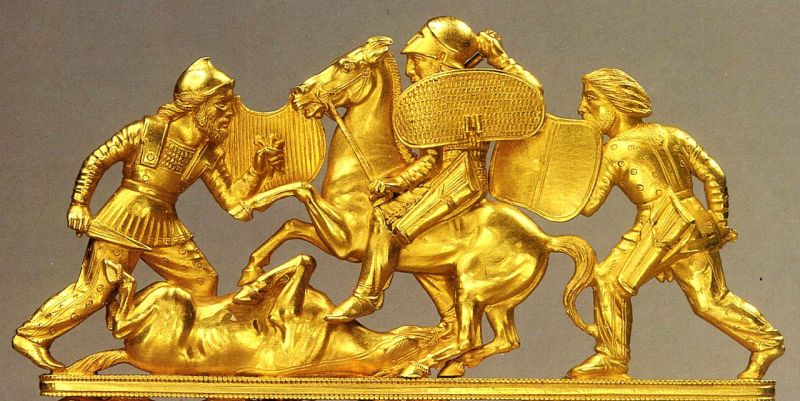
I would call this a triumph of Jewish barbarism in a region that was once proverbial as a land of barbarians. In the classical world, the Scythians were known as savages who lived outside civilization. Modern Ukraine was part of the Scythian homeland. But although the Scythians were barbarians, they weren’t barbarous. They could appreciate and create beauty, as we can see in the gorgeous Scythian jewelry that been dug up by archaeologists. Their craftsmen worked in gold because gold is beautiful, durable, and malleable, taking fine details that would never tarnish or corrode. That’s why we can marvel at the beauty of Scythian art millennia later, when beauty has been driven out of art by the same Jewish tribe that has dragged part of the ancient Scythian homeland into bloody and barbarous war.

Barbarians but not barbarous: some Scythian artwork in glorious gold
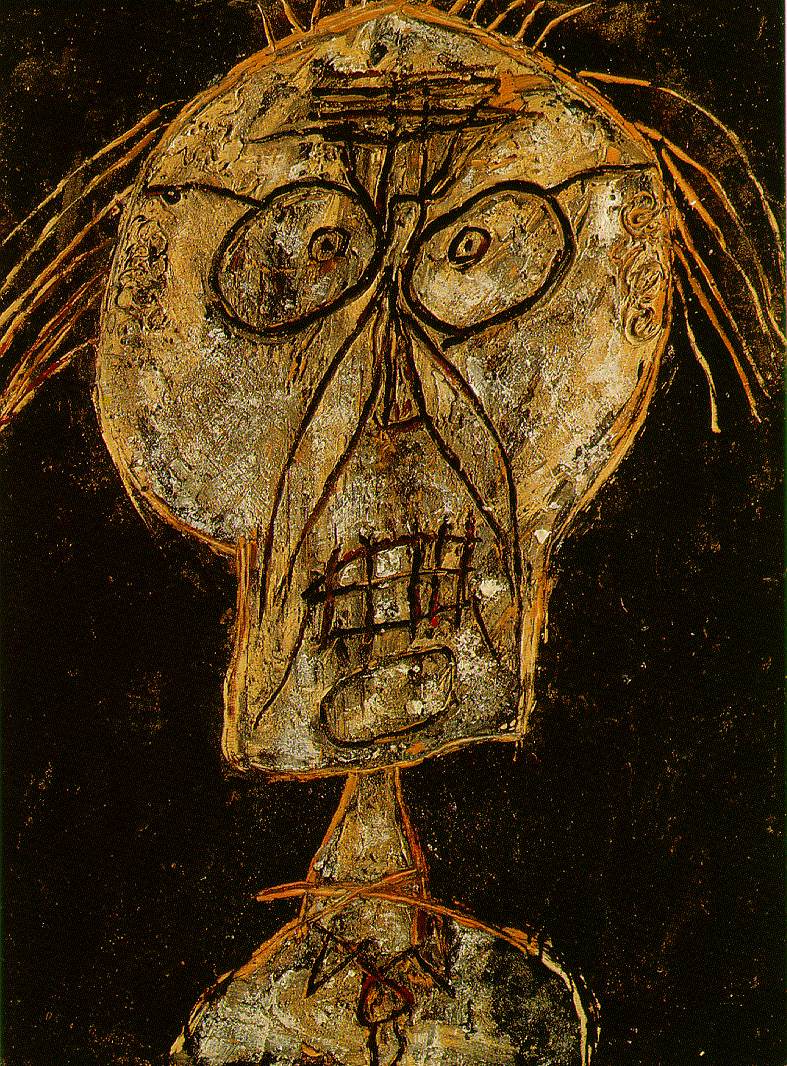

 Some repulsive modern art by Jean Dubuffet, Dhotel nuance d’abricot (1947)

But the war in Ukraine has not gone the way that Jewish neo-cons wanted it to and expected it would. Despite the highly expensive war-tech supplied by Clown World to Ukraine and the repeated predictions of Russian exhaustion or collapse, the evil Christian tyrant Vladimir Putin seems to be in a much better position than the heroic Jewish freedom-fighter Volodymyr Zelensky. Having put his playing-piano-with-his-penis comedy behind him, Zelensky began calling long ago for the West to supply Ukraine with aircraft. Back then, even Joe Biden didn’t think this would be a good idea. Now Clown World changed its minds and F-16s are reported to be on their way (along with other advanced American military technology such as HIMARS artillery and the Patriot missile defense system). If so, some very beautiful White aircraft will be put to some very ugly Jewish ends.

Bond of blood, not mishmash of migrants

It’s a classic case of co-option and coercion. Jews could never have created the F-16 on their own. After all, they could never have created Western civilization and the Industrial Revolution on their own. But who needs to create when you can co-opt and coerce? As Kevin MacDonald has exhaustively documented, the Jews who emigrated to the great White nation of America in the nineteenth and early twentieth centuries had everything they needed to subvert and subdue their White gentile hosts: ethnocentrism, intelligence, psychological intensity, and aggression. One major triumph of Jewish subversion was the recasting of America as a “nation of immigrants.”

This is a complete contradiction in terms. As its etymology suggests, a nation — from nasci, Latin for “to be born” — is a bond of blood, not a mishmash of migrants. America is no longer a true nation and no longer serves the interests of the Whites who created it. Instead, America serves the interests of Jews. That’s why beautiful F-16s will be sent to Ukraine at the behest of ugly Jews like Melinda Simmons. It’s yet another example of how Clown World can co-opt, coerce, and corrupt, but can’t create. That’s presently its strength. Sooner or later, it will become a fatal weakness.

Appendix: Some Winged Words

I quoted above a little of a famous poem by the American aviator and poet John Gillespie Magee (1922–41). Here’s the rest of the poem, which Magee wrote in the year of his death after flying to 33,000 feet in another beautiful aircraft called the Spitfire:

“High Flight”

Oh! I have slipped the surly bonds of Earth
And danced the skies on laughter-silvered wings;
Sunward I’ve climbed, and joined the tumbling mirth
Of sun-split clouds, — and done a hundred things
You have not dreamed of — wheeled and soared and swung
High in the sunlit silence. Hov’ring there,
I’ve chased the shouting wind along, and flung
My eager craft through footless halls of air…
Up, up the long, delirious burning blue
I’ve topped the wind-swept heights with easy grace
Where never lark, or ever eagle flew —
And, while with silent, lifting mind I’ve trod
The high untrespassed sanctity of space,
Put out my hand, and touched the face of God.

Jewish Scientist Who Developed New Vaccine “Saved the World”

Dr. Drew Weissman (along with colleague Katalin Kariko) at the University of Pennsylvania’s Perelman School of Medicine has been lauded as “Penn Professor (who) ‘Saves the World’ with COVID Vaccine Research.” (Kariko is excluded from the headline in this Jewish Exponent article.)  Weissman and Kariko have been lavishly celebrated for their “breakthrough” with mRNA technology. “Earlier this year, Brandeis University and the Rosenstiel Foundation honored the scientists with the Lewis S. Rosenstiel Award for Distinguished Work in Basic Medical Research.”

What I am about to relate is an interlocking nexus of Jewish wealth, big pharma, and connections to the academic community. This goes back a long way.

Brandeis University “was named for Louis Dembitz Brandeis (1856–1941), the first Jewish justice of the U.S. Supreme Court.” We saw Brandeis in the essay “Jewish Control of U.S. Presidents #1: Woodrow Wilson.” Brandeis was installed as the first Jewish justice of the Supreme Court as part of a deal Wilson made with Samuel Untermeyer, Jewish attorney and Wilson handler through blackmail and bribery. Under “Our Jewish Roots,” Brandeis U states: “At its core, Brandeis is animated by a set of values that are rooted in Jewish history and experience.” It espouses “the Jewish ideal of making the world a better place through one’s actions and talents.” This is reminiscent of the “Science Tikkun” of aggressive Jewish vaccine promoter Peter Hotez.

Lewis S. Rosenstiel was a Jewish organized crime boss who made his first fortune bootlegging illegal liquor during Prohibition. He went on to run child-raping blackmail operations prior to those of Roy Cohn, Jewish mob attorney in New York, and Jeffrey Epstein’s infamous child-rape operations most recently.

Weissman and Kariko also won a Breakthrough Prize in Life Sciences from the Breakthrough Prize Foundation. “In July 2012, Yuri and Julia Milner established the Breakthrough Prize, joined the following year by Sergey Brin, Priscilla Chan, Anne Wojcicki and Mark Zuckerberg.” Apart from Chan who is Chinese, all are Jews including Milner, a “Soviet-born Israeli entrepreneur“ whose investment firm DST Global (“The Quiet Conqueror”) invests in Facebook, and who personally invested in 23andMe, whose CEO is Anne Wojcicki. Wojcicki was married to Brin, co-founder of Google and president of parent company Alphabet. Anne’s sister Susan Wojcicki was CEO of Youtube, and Zuckerberg is of course co-founder of the Facebook internet social media platform.

The Perelman Family’s-Funded Medical School—and Much Else

While the interrelationships among so many Jews overseeing the most powerful internet and data companies in the world are noteworthy, here our focus is on Jewish interrelationships in the medical industry. For an analysis of the Jewish role in creating today’s modern pharmaceutical-based medical system, see “The Jewish Origins of the For-Profit Medical Industry.”

Other high-level Jewish crime lords besides Brandeis and Rosenstiel are also funding medical research and development, as discussed in Covert Covid Culprits (review here):

Jewish organized crime oligarch and child-raping blackmail ringleader Leslie Wexner [Epstein’s boss] founded and is funding the Wexner School of Medicine. By November 2020, the Wexner School conducted AstraZeneca covid vaccine trials, on up to 500 victims, with follow-up evaluations for two years.[1]

Jewish organized crime oligarch and child-raping blackmail ringleader Leslie Wexner [Jeffrey Epstein’s boss] founded and is funding the Wexner School of Medicine. By November 2020, the Wexner School conducted AstraZeneca covid vaccine trials, on up to 500 victims, with follow-up evaluations for two years.[1]

More relevant to Weissman, Jewish billionaire oligarch and financial schemer Ronald Perelman (“once touted as America’s richest man.”) is the son of the couple who in 2011 provided the immense grant that gives the Perelman School, where Weissman works, its name. In “Raymond and Ruth Perelman Donate $225 Million to the University of Pennsylvania’s School of Medicine,” the subtitle reads, “Largest Single Naming Gift To A School Of Medicine In U.S. History.” Raymond Perleman’s  (deceased) Wikipedia entry says “He was Jewish.”

Perelman’s entry states: “He was raised in a Jewish family… and is the grandson of Litvak (Jewish Lithuanian) immigrants.” In a Forbes (not to be confused with Perelman’s holding company MacAndrews and Forbes) article titled “Don’t Mess With Me,” we learn that “he is an observant Jew who doesn’t work from sundown Friday to Sunday morning and who, as the Talmud demands, on Saturdays always prays in a group of ten Jewish men, no matter where he is in the world.”

The Forbes article calls Perelman “one of America’s most feared corporate raiders” and a “giddily competitive, 5-foot-7 corporate barbarian.” Also, “Ronald Perelman is a multi-billionaire Jew with a trail of corruption and dirty dealing—what his Wikipedia entry calls ‘controversy.’”[2] Perelman’s name is found in Epstein’s notorious black book on page 43: “…many of these ‘raiders,’ specifically Ron Perelman… dined with Epstein at Epstein’s home throughout the 2000s and whose political fundraiser for Bill Clinton’s re-election campaign was attended by Epstein in the mid-90s…”[3] “Perelman would later be listed as a frequent dinner guest of Epstein’s.”[4]

Ron Perelman… is a veteran of the infamous corporate raiders of Drexel Burnham Lambert during the 1980s. … Perelman’s business tactics were known to be informed by his volcanic temper and his ruthlessness, with former Salomon Brothers CEO John Gutfruend once having remarked that “believing Mr. Perelman has no hostile intentions is like believing the tooth fairy exists.”[5]

The Perelman School of Medicine has over 2,600 full-time faculty members, 781 medical students, more than 1,400 residents and fellows, 967 PhD students, 218 MD-PhD students, 782 post-doctoral fellows, and over 6,800 Perelman School of Medicine employees.

U Penn’s Jewish President

President of the University of Pennsylvania, within which is the Perelman School, was Amy Gutmann, serving from 2004 to 2020 when she resigned to accept the appointment as U.S. Ambassador to Germany. This made her “the longest-serving president in the history of the University of Pennsylvania.” In a Princeton Magazine profile (she was formerly the first Laurance S. Rockefeller University Professor at Princeton, founding director of its University Center for Human Values, and  provost), Gutmann stated:

My father, Kurt, was the youngest of five children in an Orthodox Jewish family living near Nuremberg when Hitler came to power. At a remarkably early age, under incredibly trying conditions, he had the wisdom, foresight and courage to act on the deeply troubling developments and decided to escape. His brave decision profoundly shaped my life and that of my family. I would not be here today had he acted differently.

We are to understand that Amy is another holocaust survivor, because her father was. It is both apropos and an insult that our U.S. Ambassador to Germany today is the Jewish daughter of an alleged holocaust survivor.

Gutmann is co-author of Color Conscious: The Political Morality of Race, and is described as an  “eminent moral and political philosopher.” The publisher’s description states:

Gutmann examines alternative political responses to racial injustice. She argues that American politics cannot be fair to all citizens by being color blind because American society is not color blind. Fairness, not color blindness, is a fundamental principle of justice. Whether policies should be color-conscious, class conscious, or both in particular situations, depends on an open-minded assessment of their fairness. Exploring timely issues of university admissions, corporate hiring, and political representation, Gutmann develops a moral perspective that supports a commitment to constitutional democracy.

Hers is a distinctly Jewish perception of racial justice and “fairness” (i.e., equity whereby all groups achieve the same regardless of talents and abilities in an attempt to raise up Black and Latino socioeconomic profiles). Co-author K. Anthony Appiah “draws on the scholarly consensus that ‘race’ has no legitimate biological basis.”

Immediately as U Penn president, Gutmann launched the Penn Compact, which went on “to integrate knowledge across academic disciplines with a strong emphasis on innovation: Penn was named No. 4 in Reuters’ Top 100 World Innovative Universities in 2017.” This entry lists as “Notable Alumni” Ronald Perelman and Donald Trump. It also shows the number of patents which U Penn has been granted (170), with a commercial impact over 50% above the average. This brings us to the profit motive of Dr. Weissman’s current research.

The New Vaccines: Follow the Money

Weissman

studied biochemistry and enzymology at Brandeis University and earned an MD/PhD in immunology and microbiology from Boston University in 1987. After a residency in Boston, he pursued a fellowship at the National Institutes of Health, where he worked closely with Anthony Fauci (Hon.’18), now director of the NIH’s National Institute of Allergy and Infectious Diseases, whom (Weissman) describes as “one of the great drivers of my research interest.” [Fauci retired at the end of 2022 — KH]

The above quote is from “How Scientists Drew Weissman… and Katalin Karikó Developed the Revolutionary mRNA Technology inside COVID Vaccines.”

Anthony Fauci as director of NIAID became notorious throughout the promotion of the covid-19 pandemic for his advocacy of the new mRNA vaccines—and no other possible natural health measure or intervention, except masks. We must consider that Fauci may also have directed Weissman in his “research interest,” leading to the immensely profitable covid vaccines.

In February Pfizer announced its 2022 sales of covid vaccines plus its new oral paxlovid covid drug totaled $56 billion, with total profits at $31.4 billion. Moderna’s only commercial product was its covid vaccine, and its gross sales in 2022 were $18.2 billion.

News had emerged announcing that Weissman is pursuing the next fabulously lucrative vaccine product, a “universal vaccine.” ABC’s “Philadelphia scientists on quest to develop universal coronavirus vaccine” which was published in February 2022, quotes Weissman:

There have been three epidemics with coronavirus in the past 20 years. The problem with chasing variants is by the time you’ve made a vaccine the variant is gone and a new variant appears. …

We have two vaccines that work well. We’re making more because, in the end, we might have to mix vaccines together to get the protection possible.

We see how the theory of constantly emerging “variants” (they used to be called “mutations”) provides job security for Weissman, and guarantees ongoing profits for pharmaceutical vaccine makers.

Covid Vaccine Damage

Even without mixing mRNA vaccines, the damage from a single mRNA vaccine (as a result of the many doses needed) has been staggering. The U.S. government’s own Vaccine Adverse Reporting System (VAERS) provides the numbers as of May 5:

  • 35,324 COVID Vaccine Reported Deaths
  • 199,790 Total COVID Vaccine Reported Hospitalizations
  • 1,556,050 COVID Vaccine Adverse Event Reports

 Here the blue bars represent deaths from non-COVID vaccines, leaving the red bars for COVID vaccine deaths. Note that “occasional” reports come from outside the U.S.

Recall that “the Lazarus study… showed that less than 1% of events are reported to VAERS”[6] This study was concluded in 2010, and government health agencies have done nothing since to improve vaccine adverse event reporting, while doing much to improve vaccine promotion. 

Pfizer’s own vaccine damage data was released through a Freedom of Information Act request. It covers the three-month period from 1/12/2020 – 2/28/2021, the very beginning of its covid vaccine deployment. Almost 159,000 events were reported world-wide, the largest number being from the U.S. (almost 35,000). Among these were over 1,200 deaths. In pregnant mothers, 29 out of 270 pregnancies resulted in spontaneous abortion or neo-natal death (p. 12). That is almost 11%. Russian roulette is 17%. For pregnant mothers to accept the covid vaccine would be like playing Russian roulette with their babies’ lives with a 9-chamber revolver. Pfizer was expecting to continue this “pharmacovigilance” program for two years (but don’t expect any of the data to become public), but these reports of death and damage accrued in only the first three months.  

New Vaccines at ‘Breathtaking Speed’

Weissman is not deterred by huge spikes in death and damage from the first mRNA vaccines. The Bostonia (Boston University’s Alumni Magazine) article continues:

[Weissman and Kariko] pioneered the mRNA technology that is fundamentally reshaping the landscape of vaccine development and the future of gene therapies. Not only have the new mRNA vaccines proven to be more effective and safer [!] than traditional vaccines, they can be developed and reengineered to take on emerging pathogens and new variants with breathtaking speed [i.e., Warp Speed-KH]. Using mRNA technology, Pfizer-BioNTech designed its coronavirus vaccine in a matter of hours.

Operation Warp Speed was President Trump’s program to fast-track covid vaccines. It was a public-private partnership including the Department of Health and Human Services and the U.S. military. It had a budget of $10 billion and granted $6 billion of that to pharmaceutical companies and other vaccine development firms. OWS used a private company, Advanced Technology International, to award the grants, in order to “bypass the regulatory oversight and transparency of traditional federal contracting mechanisms.”

Weissman’s technology is all about speed, something highly dangerous when applied to vaccine testing and safety.

There were “enormous possibilities,” Weissman says. The scientists believed their technology had the potential to transform medicine, opening the door to countless new vaccines, therapeutic proteins, and gene therapies.

And money, as we have seen.

[Weissman and Kariko’s] discovery caught the attention of two biotech newcomers, Moderna of Cambridge, Mass., and Germany’s BioNTech. Both companies eventually licensed Weissman and Karikó’s patents. (Karikó was hired by BioNTech in 2013, and the company would later partner with US pharmaceutical giant Pfizer on vaccine development. The two companies also now support Weissman’s lab.)

His frustration with how the United States is managing the pandemic has led him to focus on vaccine access for the rest of the world. Weissman is currently working with the governments of Thailand, Malaysia, South Africa, and Rwanda, among others, to develop and test lower-cost COVID vaccines.

‘Immunize the World’

The Bostonia article provides the same Weissman quote as the ABC article, but goes further:

There have been three coronavirus epidemics in the past 20 years,” he explains. “You have to assume there are going to be more. We’re now working on a vaccine that will protect against every variant that will likely appear. Our thinking is that we’ll use it as a way to immunize the world—and prevent the next pandemic from happening in the future.

MERS-CoV, another supposed coronavirus, was said to be spreading from camels to humans primarily in the Middle East. The case fatality rate was said to have been 30-35%, although as with SARV-Cov-2, “Most patients who have died had underlying comorbidities and developed pneumonia or renal failure.” Again, it was health care settings that most caused the symptoms. “45% were healthcare-associated infection.” Some “infections’ were recognized as “asymptomatic.” Though the disease was predicted to possibly spread to the U.S., “no sustained transmission had been reported by late 2014,” and the CDC reported only 2 possible cases. Though no vaccine has been developed, as of 2019 development prospects continue using six different technologies, including DNA and nano-particle vaccines. Profit prospects look promising.

When Weissman says we have had three coronavirus epidemics, and we have to assume we are going to have more, we should believe him. The past three have proven their effectiveness at controlling population behavior and generating pharmaceutical company profits, as well as research funding for Weissman’s efforts to “immunize the world.” .

‘Charging Forward on a Mind-bending Spectrum of Applications’ – “It’s Limitless”

But Weissman is hardly stopping with coronaviruses. He’s working on about 20 other vaccines for diseases from malaria to HIV, with several moving into clinical trials. His lab is also exploring new gene therapies to treat immune deficiencies like cystic fibrosis and genetic liver diseases.

Meanwhile, biotech companies like Moderna and BioNTech are charging forward on a mind-bending spectrum of mRNA applications, including personalized cancer vaccines and autoimmune therapies: “as he looks to the future, he sounds genuinely awed by the staggering potential of the technology he and Karikó invented: ‘It really is exciting. It’s limitless.’”

It appears Weissman’s personal fortunes were only relatively improved by his twenty years of research and development of modified mRNA technology. The patenting of the technology was a complex matter. Basically the patents belong to U Penn and licensing sold to private firms and individuals. Kariko became an executive at BioNTech, and received $2 million two separate times in licensing deals. 

As for Dr. Drew Weissman, MIT Technology Review reported in early 2021:

There are fantastic fortunes to be made in mRNA technology. At least five people connected to Moderna and BioNTech are now billionaires… Weissman is not one of them, though he stands to get patent royalties. He says he prefers academia, where people are less likely to tell him what to research—or, just as important, what not to. He’s always looking for the next great scientific challenge: “It’s not that the vaccine is old news, but it was obvious they were going to work.” Messenger RNA, he says, “has an incredible future.”

In-credible is the word. As we’ve seen, Dr. Anthony Fauci as director of NIAID told Weissman what to research, and his research has reaped enormous profits and stands to reap much more. This financial abundance has come at the cost of more lives than any previous vaccine by far. The death and damage signals in the  VAERS and Pfizer’s own “pharmacovigilance” data are being ignored. By no means was it “obvious” the vaccines “were going to work.” No previous attempt at marketing a coronavirus vaccine had succeeded; the modified mRNA technology Weissman offered had been tried but never been used in any vaccine before, and an objective view of the covid vaccine clinical trials showed it was a failure.

Weissman is moving forward boldly with more modified mRNA medical technology, and no doubt more patent royalties. His Jewish nature and his Jewish network compel him.


[1]Haemers, Karl, Covert Covid Culprits: An Inquest Chronicle, USA, p. 245

[2]Ibid, p. 98

[3]Webb, Whitney, One Nation Under Blackmail, Vol. 2, Trine Day, Walterville OR, 2022, p. 8

[4]Ibid, p. 216

[5]Ibid, p. 215

[6]Haemers, p. 184

Consciousness Raising for White Students

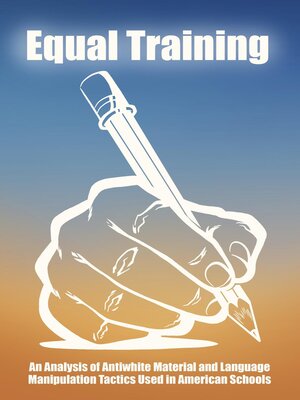
Equal Training: An Analysis of Antiwhite Material and Language Manipulation Tactics Used in American Schools
Student X
Michael Michau, 2023

The simplest definition of education is the transmission of culture, so it is not surprising that schools are on the front lines of the present kulturkampf.  As usual, the Right is reacting to the dynamic cultural changes initiated by the Left whose goal is to replace Western civilization with a globalist multi-ethnic, multi-cultural “civilization.”

A very brief autobiography places author Student X in the belly of the beast. He is a young White man from a working-class family living in a predominately non-White community in Los Angeles County. While attending a local community college X became aware of the anti-White curriculum at his school where “some classes seemed to have more of a prosecutorial atmosphere, instead of an educational one” (8). Not one to suffer in silence while hoping others would challenge this anti-White bias, the author filed an official grievance citing a lack of objectivity and professional manner on the part of some of his instructors.

X received some schooling outside the classroom in his quest for redress. He got the bureaucratic runaround. He met with the president of the department of academic affairs who sent him to the dean of curriculum who referred him to the curriculum committee which met behind closed doors with no input from students or the public. The author also contacted the state’s curriculum committee and the Chancellor’s Office of the California Community College system. The latter entity claimed the issue was outside their authority because “they only have legal requirements to meet on behalf of minorities, not White students” (12).  Incidentally, the author does not like the use of colors White, Black, or Brown as designations for ethnic groups. More on that later.

Not easily discouraged, X realized that the educational bureaucracy was not the vehicle for change, at least not at present. Remedies would have to come at the student/classroom level. White students need to be taught to recognize anti-White bias in curriculum and learn how to counter it. Unfortunately, being aware of the likely consequences in terms of ostracism or worse, few students will have the pluck and determination displayed by the author. And while change may begin with a single person, for a cause to succeed there must be organized collective action. In any case awareness of the problem is a start.

A major message of Equal Training is the power of words and narrative. The Left is skilled in using language for ideological purposes. They know that “the wording of educational literature determines how students are trained to talk and structure their thoughts” (25). When it comes to terminology the Right remains largely tone deaf. For example: much of the Left identifies as progressive and liberal, and the Right obliges them by using their preferred terms. Yet there is very little classical liberalism or progressivism within the contemporary Left. In addition, both these terms have positive connotations outside of ideology. “Yes, we’re making progress on that issue.” “He was liberal with his largesse.” Leftists are globalists, cultural Marxists, maybe anarcho-communists or nihilists. If you need euphemisms: Jacobins or iconoclasts. Using ‘gay’ as a term for homosexuality should also be avoided.

The author believes that the goal of modern education is to subvert White cultural identity by rendering it invalid, eventually replacing it in favor of a globalist, multicultural identity. To resist this indoctrination, it is important for young Whites to establish a strong ethnic, cultural, and sexual identity. It is difficult even for sophisticated adults to navigate the minefield of American identity politics, so knowing who you are is paramount for White youth dealing with a hostile social environment.

A component of a positive ethnic identity is a knowledge of group history. This is why the Left is so keen on erasing and revising American history. One important topic today in American historiography is slavery. X points out that slavery is often taught within what he calls a “cropped narrative.” The institution is given no historical, social, or economic context – simply evil Whites oppressing hapless Blacks. Some students even come away with the impression that slavery was a uniquely American phenomenon. The Holocaust is another topic that lends itself to a cropped narrative.

For X there appears to be a two-step process involved in what might be described as scholastic social engineering. First, efface a positive White identity, then blame, shame, and guilt-trip White students for past transgressions as constructed by the left. War, slavery, oppression: “There’s not one thing you can blame White people for that Brown, Black, and Yellow peoples haven’t also done” (80).

The author points out that if the establishment really wanted to make a multiethnic society work, they would seek a racial reconciliation rather than a racial reckoning. Instead of stoking the flames of resentment they would emphasize a common past. But they will not take this course because much of the Left is more interested in debasing Western peoples and culture than in helping other peoples and cultures. In any case, suppression is the only effective method to govern a multiethnic, multicultural empire. A colorblind meritocracy will not work. Perhaps a strict racial quota system would be the fairest, most transparent way to handle things. X suggests this when he advocates for “proportionate access to all schools, staff positions, government agencies, social services, scholarships, grants, and other opportunities” (184). Of course, it is not our job to make this perverse system work. At the end of the day, race is such an essential human characteristic, both individually and collectively, that a multiracial society will always be problematic.

As mentioned above the author does not like the ethnic designation “White,” though he often uses the term himself. One problem is the way the US government, especially the census bureau, uses the term: “A person having origins in any of the original peoples of Europe, the Middle East or North Africa, including Hispanic and Latino populations” (47).[1] X proposes using the term “White-Ethnics.” For many people this term would bring to mind so called hyphenated ethnics: Polish-Americans, Irish-Americans, etc. “Ethnic White” might be better, but the most useful and accurate designation would be European American.

If European Americans had sufficient racial consciousness, they would insist that Congress change the government’s definition of White. In the author’s words: “We need to demand formal subgroup recognition by the federal government” (60). For one thing having such recognition would “accurately measure our access to scholarships, jobs, and other opportunities” (64). A proper designation would exclude what X refers to as “part-time Whites.” He never explicitly identifies who this group includes, but they are characterized by identifying as White when it is to their advantage, but otherwise adopting a separate, often antagonistic identity, such as is common in Australia since Aboriginals were given benefits like government scholarships and affirmative action  based on their identity. If one stylistic criticism could be made for Equal Training, it is the tendency of the author to make general statements without offering specific examples.

There is a tremendous amount of alienation in our society, especially among White youth, leading to drug use, sexual confusion, and nihilism. This is largely a product of a weak sense of familial, ethnic, and cultural identity. When society’s highest values are diversity and inclusion, the ironic results are that no one feels included, there is little sense of belonging, little sense of ownership. The author believes that Whites have a birthright to their own society with their own institutions designed to serve their needs. In the past this was assumed—a near universal expectation. Today this view is condemned as racist. X notes that “the term racist [is used] to refer to anyone who resists any of the tactics used to dissolve their race” (165). Under this definition having a White family is racist.

X touches upon several other interesting topics including selective law enforcement which is most likely to impact young, heterosexual White men. He points out the need for “our own legal representation and dedicated legal network” (181), such as TOO contributor Glen Allen’s Free Expression Foundation.[2] The author notes the strange and toxic congruence between globalist billionaires and neo-Marxist street thugs—without mentioning the vast overrepresentation of Jews in the former. And X suggests White students major in STEM (science, technology, engineering, math) subjects where curricula are more objective.

I have a couple minor qualms about this work. First, why the title Equal Training. Something catchier and more descriptive might help to promote the book.  Second, while I salute X for having the brass to stand up and confront the educational establishment, that could be a difficult strategy for many students to follow. Even if a student is informed and articulate, instructors usually have arguments to obfuscate a classroom discussion. X concedes that verbally clever academics can deliberately deceive or mislead with a clear consciousness because “they believe their ends justify their means” (59). Then there is the issue of possible grade retaliation. Also, no matter how confident a student might be, a single person representing a position can appear weak and vulnerable. Much more effective in such situations is to have two or more students representing an organization. Of course, organizing is hard and explicitly White groups are prohibited on campuses. Plus, as the author warns, there are sketchy pro-White organizations out there led by people with a propensity for self-destruction. Proxy or surrogate organizations for White students could claim to be groups dedicated to traditional Western culture, either fine arts or folk culture, or they could shield themselves by claiming to be a politically conservative activist group.

I imagine Student X is a member of Gen Z, and Equal Training is aimed at increasing the racial consciousness among his cohort of White high school and college students. Most readers of this journal will be familiar with the issues the author raises. The value of this book for those older readers is that X cuts to the chase emphasizing the basics. For decades a psychological war of unsurpassed sophistication and pervasiveness has been waged against White youth. From pre-school television shows, through the K-12 public education, to academe, they have been subjected to intense propaganda.  To mount a defense in preparation for a counter offensive, students must develop a strong positive ethnic and cultural identity. And a prerequisite for such an identity is a firm grounding in history that will enable students to put past and present events into a historical context. If parents, grandparents, and youth mentors want to know where to begin, it is here.


[1] Actually the US Census Bureau states that Hispanics can be of any race making the term useless as a racial category.

[2] A contributor to The Occidental Observer website, Baltimore attorney Glen Allen, heads an organization, The Free Expression Foundation, which may be able to provide legal assistance to White dissidents.

Marx, Moses and the Pagans in the Secular City, Parts 1 & 2

Intro: Below is my essay published first in 1995 in quarterly CLIO (A Journal of Literature, History, and the Philosophy of History). In view of century-long and still ongoing scholarly disputes about the genesis of totalitarian temptations, intellectual repressions, as well as modern “wokeism” in the EU and US – it may be worthwhile to reexamine the  debate between proponents  of monotheism and polytheism (“mono-poly”!) from a new vantage point. Which is the genuine religious and intellectual homeland of Whites in America and Europe?  Athens or Jerusalem? The Bible or Homer?

* * *

With the conversion of the Roman Emperor Constantine to Christianity, the period of pagan Europe began to approach its end. During the next millennium the entire European continent came under the sway of the Gospel — sometimes by peaceful persuasion, frequently by forceful conversion. Those who were yesterday the persecuted of the ancient Rome became, in turn, the persecutors of the Christian Rome. Those who were previously bemoaning their fate at the hands of Nero, Diocletian, or Caligula did not hesitate to apply “creative” violence against infidel pagans. Although violence was nominally prohibited by the Christian texts, it was fully used against those who did not fit into the category of God’s “chosen children.” During the reign of Constantine, the persecution against the pagans took the proportions “in a fashion analogous to that whereby the old faiths had formerly persecuted the new, but in an even fiercer spirit.” By the edict of A.D. 346, followed ten years later by the edict of Milan, pagan temples and the worship of pagan deities came to be stigmatized as magnum crimen. The death penalty was inflicted upon all those found guilty of participating in ancient sacrifices or worshipping pagan idols. “With Theodosius, the administration embarked upon a systematic effort to abolish the various surviving forms of paganism through the disestablishment, disendowment, and proscription of surviving cults.”(1) The period of the dark ages began.

Christian and inter-Christian violence, ad majorem dei gloriam, did not let up until the beginning of the eighteenth century. Along with Gothic spires of breathtaking beauty, the Christian authorities built pyres that swallowed nameless thousands. Seen in hindsight, Christian intolerance against heretics, Jews, and pagans may be compared to the twentieth-century Bolshevik intolerance against class opponents in Russia and Eastern Europe-with one exception: it lasted longer. During the twilight of imperial Rome, Christian fanaticism prompted the pagan philosopher Celsus to write: “They [Christians] will not argue about what they believe-they always bring in their, `Do not examine, but believe’. . .” Obedience, prayer, and the avoidance of critical thinking were held by Christians as the most expedient tools to eternal bliss. Celsus described Christians as individuals prone to factionalism and a primitive way of thinking, who, in addition, demonstrate a remarkable disdain for life.(2) A similar tone against Christians was used in the nineteenth century by Friedrich Nietzsche who, in his virulent style, depicted Christians as individuals capable of displaying both self-hatred and hatred towards others, i.e., “hatred against those who think differently, and the will to persecute.”(3) Undoubtedly, early Christians must have genuinely believed that the end of history loomed large on the horizon and, with their historical optimism, as well as their violence against the “infidels,” they probably deserved the name of the Bolsheviks of antiquity. As suggested by many authors, the break-up of the Roman Empire did not result only from the onslaught of barbarians, but because Rome was already “ruined from within by Christian sects, conscientious objectors, enemies of the official cult, the persecuted, persecutors, criminal elements of all sorts, and total chaos.” Paradoxically, even the Jewish God Yahve was to experience a sinister fate: “he would be converted, he would become Roman, cosmopolitan, ecumenical, gentile, goyim, globalist, and finally anti-Semite. “(!)(4) It is no wonder that, in the following centuries, Christian churches in Europe had difficulties in trying to reconcile their universalist vocation with the rise of nationalist extremism.

Pagan Residues in the Secular City

Although Christianity gradually removed the last vestiges of Roman polytheism, it also substituted itself as the legitimate heir of Rome. Indeed, Christianity did not cancel out paganism in its entirety; it inherited from Rome many features that it had previously scorned as anti-Christian. The official pagan cults were dead but pagan spirit remained indomitable, and for centuries it kept resurfacing in astounding forms and in multiple fashions: during the period of Renaissance, during Romanticism, before the Second World War, and today, when Christian Churches increasingly recognize that their secular sheep are straying away from their lone shepherds. Finally, ethnic folklore seems to be a prime example of the survival of paganism, although in the secular city folklore has been largely reduced to a perishable commodity of culinary or tourist attraction. (5) Over the centuries, ethnic folklore has been subject to transformations, adaptations, and the demands and constraint of its own epoch; yet it has continued to carry its original archetype of a tribal founding myth. Just as paganism has always remained stronger in the villages, so has folklore traditionally been best protected among the peasant classes in Europe. In the early nineteenth century, folklore began to play a decisive role in shaping national consciousness of European peoples, i.e., “in a community anxious to have its own origins and based on a history that is more often reconstructed than real. “(6)

The pagan content was removed, but the pagan structure remained pretty much the same. Under the mantle and aura of Christian saints, Christianity soon created its own pantheon of deities. Moreover, even the message of Christ adopted its special meaning according to place, historical epoch, and genius loci of each European people. In Portugal, Catholicism manifests itself differently than in Mozambique; and rural Poles continue to worship many of the same ancient Slavic deities that are carefully interwoven into the Roman Catholic liturgy. All over contemporary Europe, the erasable imprint of polytheist beliefs continues to surface. The Yule celebration represents one of the most glaring examples of the tenacity of pagan residues. (7) Furthermore, many former pagan temples and sites of worship have been turned into sacred places of the Catholic Church. Lourdes in France, Medjugorje in Croatia, sacred rivers, or mountains, do they not all point to the imprint of pre-Christian pagan Europe? The cult of mother goddess, once upon a time intensely practiced by Celts, particularly near rivers, can be still observed today in France where many small chapels are built near fountains and sources of water. (8) And finally, who could dispute the fact that we are all brain children of pagan Greeks and Latins? Thinkers, such as Virgil, Tacitus, Heraclitus are as modern today as they were during the dawn of European civilization.

Notes

1. Charles Norris Cochrane, Christianity and Classical Culture (New York: Oxford UP, 1957), 254-55, 329.

2. T. R. Glover, The Conflict of Religion in the Early Roman Empire (1909; Boston: Beacon, 1960), 242, 254, passim.

3. Friedrich Nietzsche, Der Antichrist, in Nietzsches Werke (Salzburg/Stuttgart: Verlag “Das Berlgand-Buch,” 1952), 983, para. 21.

4. Pierre Gripari, L’histoire du méchant dieu (Lausanne: L’Age d’Homme, 1987), 101-2.

5. Michel Marmin, “Les Piegès du folklore’,” in La Cause des peuples (Paris: édition Le Labyrinthe, 1982), 39-44.

6. Nicole Belmont, Paroles paiennes (Paris: édition Imago, 1986), 160-61.

7. Alain de Benoist, Noël, Les Cahiers européens (Paris: Institut de documentations et d’études européens, 1988).

8. Jean Markale, et al., “Mythes et lieux christianisés,” L’Europe paienne (Paris: Seghers, 1980), 133.

……………………………………………………………………………………………

Marx, Moses and the Pagans in the Secular City (part 2)

Modern Pagan Conservatives

There is ample evidence that pagan sensibility can flourish in the social sciences, literature, and arts, not just as a form of exotic narrative but also as a mental framework and a tool of conceptual analysis. Numerous names come to mind when we discuss the revival of Indo-European polytheism. In the first half of the twentieth century, pagan thinkers usually appeared under the mask of those who styled themselves as “revolutionary conservatives,” “aristocratic nihilist,” “elitists”-in short all those who did not wish to substitute Marx for Jesus, but who rejected both Marx and Jesus.(9) Friedrich Nietzsche and Martin Heidegger in philosophy, Carl Gustav Jung in psychology, Georges Dumézil and Mircea Eliade in anthropology, Vilfredo Pareto and Oswald Spengler in political science, let alone dozens of poets such as Ezra Pound or Charles Baudelaire-these are just some of the names that can be associated with the legacy of pagan conservatism. All these individuals had in common the will to surpass the legacy of Christian Europe, and all of them yearned to include in their spiritual baggage the world of pre-Christian Celts, Slavs, and Germans.

In the age that is heavily laced with the Biblical message, many modern pagan thinkers, for their criticism of Biblical monotheism, have been attacked and stigmatized either as unrepentant atheists or as spiritual standard-bearers of fascism. Particularly Nietzsche, Heidegger, and more recently Alain de Benoist came under attack for allegedly espousing the philosophy which, for their contemporary detractors, recalled the earlier national socialist attempts to “de-christianize” and “repaganize” Germany. (10) These appear as unwarranted attacks. Jean Markale observes that “Naziism and Stalinism were, in a sense, also religions because of the acts that they triggered. They were also religions insofar as they implied a certain Gospel, in an etymological sense of the word . . . Real paganism, by contrast, is always oriented towards the realm of sublimation. Paganism cannot be in the service of temporal power.”(11) Paganism appears more a form of sensibility than a given political credo, and with the exhaustion of Christianity, one should not rule out its renewed flourishing in Europe.

Paganism Against the Monotheist Desert

Two thousand years of Judeo-Christian monotheism has left its mark on the Western civilization. In view of this, it should not come as a surprise that glorification of paganism, as well as the criticism of the Bible and Judeo-Christian ethics-especially when they come from the right-wing spectrum of society-are unlikely to gain popularity in the secular city. It suffices to look at American society where attacks against Judeo-Christian principles are

frequently looked at with suspicion, and where the Bible and the Biblical myth of god’s “chosen people” still play a significant role in the American constitutional dogma. (12) Although the secular city has by now become indifferent to the Judeo-Christian theology, principles that derive from Judeo-Christian ethics, such as “peace,” “love,” and “universal brotherhood,” are still showing healthy signs of life. In the secular city many liberal and socialist thinkers, while abandoning the belief in Judeo-Christian theology, have not deemed it wise to abandon the ethics taught by the Bible.

Whatever one may think about the seemingly obsolete, dangerous, or even derogatory connotation of the term “European paganism,” it is important to note that this connotation is largely due to the historical and political influence of Christianity. Etymologically, paganism is related to the beliefs and rituals that were in usage in European villages and countryside. But paganism, in its modern version, may connote also a certain sensibility and a “way of life” that remains irreconcilable with Judeo-Christian monotheism. To some extent European peoples continue to be “pagans” because their national memory, their geographic roots, and, above all, their ethnic allegiances-which often contain allusions to ancient myths, fairy tales, and forms of folklore bear peculiar marks of pre-Christian themes. Even the modern resurgence of separatism and regionalism in Europe appears as an offshoot of pagan residues. As Markale observes, “the dictatorship of Christian ideology has not silenced those ancient customs; it has only suppressed them into the shadow of the unconscious” (16). The fact that all of Europe is today swept by growing nationalism bears witness to the permanency of the pagan sense of tribal historical memory.

In European culture, polytheistic beliefs began to dwindle with the consolidation of Christianity. In the centuries to come, the European system of explanation, whether in theology or, later on, in sociology, politics, or history gradually came under the sway of Judeo-Christian outlook of the world. David Miller observes that Judeo-Christian monotheism considerably altered the Europeans’ approach to the social sciences as well as to the overall perception of the world. In view of these changes, who can reassure us about our own objectivity, especially when we try to understand the pagan world with the goggles of the postmodern Judeo-Christian man? It is no wonder that when paganism was removed from Europe the perceptual and epistemological disruptions in sciences also followed suit. Consequently, with the consolidation of the Judeo-Christian belief, the world and the world phenomena came under the sway of the fixed concepts and categories governed by the logic of “either-or,” “true or false,” and “good or evil,” with seldom any shadings in between. The question, however, arises whether in the secular city-a city replete with intricate choices and complex social differences that stubbornly refuse all categorizations-this approach remains desirable. (13) It is doubtful that Judeo-Christian monotheism can continue to offer a valid solution for the understanding of the increasingly complex social reality that modern man faces in the secular city. Moreover, the subsequent export of Judeo-Christian values to the antipodes of the world caused similar disruptions, yielding results opposite from those originally espoused by the Westerners, and triggering virulent hatred among non-Western populations. Some authors have quite persuasively written that Christian ecumenism, often championed as the “white man’s Christian burden,” has been one of the main purveyors of imperialism, colonialism, and racism in the Third World. (14)

In the modern secular city, the century-long and pervasive influence of Christianity has significantly contributed to the view that each glorification of paganism, or, for that matter, the nostalgia of the Greco-Roman order, is outright strange or at best irreconcilable with contemporary society. Recently, however, Thomas Molnar, a Catholic philosopher who seems to be sympathetic to the cultural revival of paganism, noted that modern adherents of neo-paganism are more ambitious than their predecessors. Molnar writes that the aim of pagan revival does not have to mean the return to the worship of ancient European deities; rather, it expresses a need to forge another civilization or, better yet, a modernized version of the “scientific and cultural Hellenism” that was once a common reference for all European peoples. And with visible sympathy for the polytheistic endeavors of some modern pagan conservatives, Molnar adds:

The issue is not how to conquer the planet but rather how to promote an oikumena of the peoples and civilizations that have rediscovered their origins. The assumption goes that the domination of stateless ideologies, notably the ideology of American liberalism and Soviet socialism, would come to an end. One believes in rehabilitated paganism in order to restore to peoples their genuine identity that existed before monotheist corruption. (15)

Such a candid view by a Catholic may also shed some light on the extent of disillusionment among Christians in their secular cities. The secularized world full of affluence and richness does not seem to have stifled the spiritual needs of man. How else to explain that throngs of European and American youngsters prefer to trek to pagan Indian ashrams rather than to their own sacred sites obscured by Judeo-Christian monotheism? Anxious to dispel the myth of pagan “backwardness,” and in an effort to redefine European paganism in the spirit of modern times, the contemporary protagonists of paganism have gone to great lengths to present its meaning in a more attractive and scholarly fashion. One of their most outspoken figures, Alain de Benoist, summarizes the modern meaning of paganism in the following words:

Neo-paganism, if there is such a thing as neo-paganism, is not a phenomenon of a sect, as some of its adversaries, but also some of the groups and chapels, sometimes well-intentioned, sometimes awkward, frequently funny and completely marginal, imagine … [What worries us today, at least according to the idea which we have about it, is less the disappearance of paganism but rather its resurgence under primitive and puerile form, affiliated to that “second religion,” which Spengler justifiably depicted as characteristic of cultures in decline, and of which Julius Evola writes that they “correspond generally to a phenomenon of evasion, alienation, confused compensation, without any serious repercussion on reality. (16)

Paganism, as a profusion of bizarre cults and sects, is not something modern pagan thinkers have in mind. A century ago, pagan philosopher Friedrich Nietzsche had already observed in Der Antichrist that, when a nation becomes too degenerate or too uprooted, it must place its energy into various forms of Oriental cults, and simultaneously “it must change its own God” (979). Today, Nietzsche’s words sound more prophetic than ever. Gripped by decadence and rampant hedonism, the masses from the secular city are looking for the vicarious evasion in the presence of Indian gurus or amidst a host of Oriental prophets. But beyond this Western semblance of transcendence, and behind the Westerners’ self-hatred accompanied by puerile infatuation with Oriental mascots, there is more than just a transitory weariness with Christian monotheism. When modern cults indulge in the discovery of perverted paganism, they also may be in search of the sacred that was driven underground by the dominating Judeo-Christian discourse.

From Monotheist Desert to Communist Anthropology

Has monotheism introduced into Europe an alien “anthropology” responsible for the spread of egalitarian mass society and the rise of totalitarianism, as some pagan thinkers seem to suggest? Some authors appear to support this thesis, arguing that the roots of tyranny do not lie in Athens or Sparta, but are traceable, instead, to Jerusalem. In a dialogue with Molnar, de Benoist suggests that monotheism upholds the idea of only one absolute truth; it is a system where the notion of the enemy is associated with the evil, and where the enemy must be physically exterminated (cf. Deut. 13). In short, observes de Benoist, Judeo-Christian universalism, two thousand years ago, set the stage for the rise of modern egalitarian aberrations and their modern secular offshoots, including communism.

That there are totalitarian regimes “without God,” is quite obvious, the Soviet Union for example. These regimes, nonetheless, are the “inheritors” of the Christian thought in the sense as Carl Schmitt demonstrated that the majority of modern political principles are secularized theological principles. They bring down to earth a structure of exclusion; the police of the soul yield its place to the police of the state; the ideological wars follow up to the religious wars. (17)

Similar observations were echoed earlier by the philosopher Louis Rougier as well as by the political scientist Vilfredo Pareto, both of whom represented the “old guard” of pagan thinkers and whose philosophical researches were directed toward the rehabilitation of European political polytheism. Both Rougier and Pareto are in agreement that Judaism and its perverted form, Christianity, introduced into the European conceptual framework an alien type of reasoning that leads to wishful thinking, utopianism, and the ravings about the static future.(18) Similar to Latter-day Marxists, early Christian belief in egalitarianism must have had a tremendous impact on the deprived masses of northern Africa and Rome, insofar as it promised equality for the “wretched of the earth,” for odium generis humani, and all the proles of the world. Commenting on Christian proto-communists, Rougier recalls that Christianity came very early under the influence of both the Iranian dualism and the eschatological visions of the Jewish apocalypses. Accordingly, Jews and, later on, Christians adopted the belief that the good who presently suffer would be rewarded in the future. In the secular city, the same theme was later interwoven into modern socialist doctrines that promised secular paradise. “There are two empires juxtaposed in the space,” writes Rougier, “one governed by God and his angels, the other by Satan and Belial.” The consequences of this largely dualistic vision of the world resulted, over a period of time, in Christian-Marxist projection of their political enemies as always wrong, as opposed to Christian-Marxist attitude considered right. For Rougier, the Greco-Roman intolerance could never assume such total and absolute proportions of religious exclusion; the intolerance towards Christians, Jews, and other sects was sporadic, aiming at certain religious customs deemed contrary to Roman customary law (such as circumcision, human sacrifices, sexual and religious orgies). (19)

By cutting themselves from European polytheistic roots, and by accepting Christianity, Europeans gradually began to adhere to the vision of the world that emphasized the equality of souls, and the importance of spreading God’s gospel to all peoples, regardless of creed, race, or language (Paul, Galatians 3:28). In the centuries to come, these egalitarian cycles, in secularized forms, entered first the consciousness of Western man and, after that, entire humankind. Alain de Benoist writes:

According to the classical process of the development and degra-dation of cycles, the egalitarian theme has entered our culture from the stage of the myth (equality before God), to the stage of ideology (equality before people); after that, it has passed to the stage of “scientific pretension” (affirmation of the egalitarian fact). In short, from Christianity to democracy, and after that to socialism and Marxism. The most serious reproach which one can formulate against Christianity is that it has inaugurated this egalitarian cycle by introducing into European thought a revolutionary anthropology, with universalist and totalitarian character. (20) One could probably argue that Judeo-Christian monotheism, as much as it implies universalism and egalitarianism, also suggests religious exclusiveness that directly emanates from the belief in one undisputed truth. The consequence of the Christian belief in theological oneness-e.g., that there is only one God, and therefore only one truth-has naturally led, over the centuries, to Christian temptation to obliterate or downplay all other truths and values. One can argue that when one sect proclaims its religion as the key to the riddle of the universe and if, in addition, this sect claims to have universal aspirations, the belief in equality and the suppression of all human differences will follow suit. Accordingly, Christian intolerance toward “infidels” could always be justified as a legitimate response against those who departed from the belief in Yahve’s truth. Hence, the concept of Christian “false humility” toward other confessions, a concept that is particularly obvious in regard to Christian attitude toward Jews. Although almost identical in their worship of one god, Christians could never quite reconcile themselves to the fact that they also had to worship the deity of those whom they abhorred in the first place as a deicide people. Moreover, whereas Christianity always has been a universalist religion, accessible to everybody in all corners of the world, Judaism has remained an ethnic religion of only the Jewish people. (21) As de Benoist writes, Judaism sanctions its own nationalism, as opposed to nationalism of the Christians which is constantly belied by the Christian universalist principles. In view of this, “Christian anti-Semitism,” writes de Benoist, “can justifiably be described as a neurosis.” Might it be that the definite disappearance of anti-Semitism, as well as virulent inter-ethnic hatred, presupposes first the recantation of the Christian belief in universalism?

Notes :

9. About European revolutionary conservatives, see the seminal work by Armin Mohler, Die Konservative Revolution in Deutschland, 1919-1933 (Darmstadt: Wissenschaftliche Buchgesellschaft, 1972). See also Tomislav Sunic, Against Democracy and Equality: The European New Right, prefaced by Alain de Benoist(Arktos: 2011).

10. See notably the works by Alfred Rosenberg, Der Mythus des 20. Jahrhunderts (München: Hoheneichen Verlag, 1933). Also worth noting is the name of Wilhelm Hauer, Deutscher Gottschau (Stuttgart: Karl Gutbrod, 1934), who significantly popularized Indo-European mythology among National Socialists; on pages 240-54 Hauer discusses the difference between Judeo-Christian Semitic beliefs and European paganism.

11. Jean Markale, “Aujourd’hui, l’esprit païen?” in L’Europe paienne (Paris: Seghers, 1980), 15. The book contains pieces on Slavic, Celtic, Latin, and Greco-Roman paganism.

12. Milton Konvitz, Judaism and the American Idea (Ithaca: Cornell UP, 1978), 71. Jerol S. Auerbach, “Liberalism and the Hebrew Prophets,” in Commentary 84:2 (1987):58. Compare with Ben Zion Bokser in “Democratic Aspirations in Talmudic Judaism,” in Judaism and Human Rights, ed. Milton Konvitz (New York: Norton, 1972): “The Talmud ordained with great emphasis that every person charged with the violation of some law be given a fair trial and before the law all were to be scrupulously equal, whether a king or a pauper” (146). Ernst Troeltsch, Die Soziallehren der christlichen Kirchen and Gruppen (1922; Aalen: Scientia Verlag, 1965), 768; also the passage “Naturrechtlicher and liberaler Character des freikirchlichen Neucalvinismus,” (762-72). Compare with Georg Jellinek, Die Erklärung der Menschen-und Bürgerrechte (Leipzig: Duncker and Humblot, 1904): “(t)he idea to establish legally the unalienable, inherent and sacred rights of individuals, is not of political, but religious origins” (46). Also Werner Sombart, Die Juden and das Wirtschaftsleben (Leipzig: Verlag Duncker and Humblot, 1911): “Americanism is to a great extent distilled Judaism (“geronnenes Judentum”)” (44).

13. David Miller, The New Polytheism (New York: Harper and Row, 1974), 7, passim.

14. Serge Latouche, L’occidentalisation du monde (Paris: La Découverte, 1988).

15. Thomas Molnar, “La tentation paienne,” Contrepoint, 38 (1981):53.

16. Alain de Benoist, Comment peut-on etre païen? (Paris: Albin Michel, 1981), 25.

17. Alain de Benoist, L’éclipse du sacré (Paris: La Table ronde, 1986), 233; see also the chapter, “De la sécularisation,” 198-207. Also Carl Schmitt, Die politische Theologie (München and Leipzig: Duncker und Humblot, 1922), 35-46: “(a)ll salient concepts in modern political science are secularized theological concepts” (36).

18. Gerard Walter, Les origines du communisme (Paris: Payot, 1931): “Les sources judaiques de la doctrine communiste chrétienne” (13-65). Compare with Vilfredo Pareto, Les systèmes socialistes (Paris: Marcel Girard, 1926): “Les systèmes métaphy-siques-communistes” (2:2-45). Louis Rougier, La mystique démocratique, ses origines ses illusions (Paris: éd. Albatros, 1983), 184. See in its entirety the passage, “Le judaisme et la révolution sociale,” 184-187.

19. Louis Rougier, Celse contre les chrétiens (Paris: Copernic, 1977), 67, 89. Also, Sanford Lakoff, “Christianity and Equality,” in Equality, ed. J. Roland Pennock and John W. Chapaman (New York: Atherton, 1967), 128-30.

20. Alain de Benoist, “L’Eglise, L’Europe et le Sacré,” in Pour une renaissance culturelle (Paris: Copernic, 1979), 202.

21. Louis Rougier, Celse, 88.

Gender, “identifying as” and identity

According to Helen Joyce, her bestseller Trans is about gender self-identification: the idea that “people should count as men or women according to how they feel and what they declare, instead of their biology”. But she doesn’t say what gender is.[1] When people have these feelings or make these declarations, what are they feeling and declaring? And what does it mean to identify as something? She points out that national laws, company policies, school curricula, medical protocols, academic research and media style guides are all being “rewritten to privilege self-declared gender identity over biological sex”, but she doesn’t say what a gender identity is, or, come to that, what an identity is.[2]

Let us look at these questions to see if we can gain some clarity. In a previous article I argued that the basic term of transgender ideology, namely “gender”, is only an obfuscating euphemism for sex. If it doesn’t mean sex itself but is taken to refer to clusters of features that tend to go with one sex or the other, these are simply clusters of features that tend to go with one sex or the other. To think of them as amounting to separate things called genders that we “have” in the way that we have a sex is mistaken.

A better way of looking at this is in terms of Carl Jung’s archetypes of the animus and anima, each of which, as I understand it, he thought were present in different degrees in both sexes. Moreover, they might co-exist in different degrees in two members of the same sex. So I imagine that he would have said that in a woman like Margaret Thatcher, who was a leader and a firm one, the animus was stronger than in most women while the anima was weaker, whereas someone like Theresa May, a subsequent British prime minister, was more womanish. What he would not have said is anything so trite as that Mrs. Thatcher had the “gender” of a man.

In my own case, as a boy I was never very interested in soccer or military history; I preferred art and cooking. I drew incessantly on the blackboard my father had fitted over an unused fireplace and baked my first loaf of bread at the age of about nine. No one suggested that I had the “gender” of a girl or saw my art or cooking as a problem. As it happened, I also enjoyed going on adventures with a home-made spear and coming back looking as if I had been dragged through a hedge backwards. The idea that people have a gender, unless by this is meant their sex, is a silly oversimplification of a reality that, although variegated, anyone can grasp, nor does the fact that one boy likes one thing while another likes another raise any question about their sex.

When we ask what it means to say that someone identifies as something, we confront a difference between American and British English, for in British English, properly spoken, one cannot say that someone identifies as something but must say that they identify themselves as something. In other words, in British English the verb “identify” is transitive. Since it is a little easier to explain the answer to our question in British English, I will use this to start with and switch to American English later.

What it means to say that someone identifies themselves as something is that they call themselves that thing or describe themselves that way. Thus a man approaching the scene of an accident might identify himself as a doctor. But it is not only oneself that one might identify as something; it could be anything. One might identify that woman over there as French, a bird as belonging to a certain species or a precious stone as an emerald. So we can say that in the sex context, a man who identifies himself as a woman calls himself one. Now, clearly identifications are not necessarily correct. The man who identifies himself as a doctor might not be one; the woman might not be French, and so on. A man who identifies himself as a woman mis-identifies himself.

Whereas what one identifies oneself as is what one calls oneself, one’s identity is what one is. It is an attribute one has. Everyone has many attributes, therefore everyone has many identities, three in the case of an actress with two children, for example, being those of actress, woman and mother. But in today’s political usage the word “identity” has a narrower meaning. Only a few political identities are available, which are defined by reference to a person’s politically salient features, such as their race or sex. Thus one might have the political identity of being Black or White or of being a man or a woman.

Any political identity contrasts with one or more other political identities, and in certain pairs people with one political identity are conventionally described as being oppressed by people with the other. Thus Black people are conventionally described as being oppressed by Whites, and women are conventionally described as being oppressed by men. This comes straight from cultural Marxism and has nothing to do with whether anyone is actually oppressed. It is just theory. But the theory is applied so that “oppressed” groups are favoured over their “oppressors”, making them feel entitled to social goods such as pity, power and preferential treatment. The struggle of favoured “identify groups” to obtain such goods at the expense of their opposite groups is known as identity politics.

Switching to American English now, the sort of people who say that they identify as something also tend to talk about their “identities”, and they generally conflate the two. Thus a man who says that he identifies as a woman will say that being a woman is his identity. It is “who he is”. But in saying this he adds one mistake to another. Not only does he call himself a woman when he is not one; he insists that he really is one. It is as though someone who calls himself Napoleon were to insist that he actually is Napoleon. Both mistakes must be undone before we can see that he is really just Fred Bloggs.

After gender, transgender ideology’s most important concept is that of gender identity, which it defines as a person’s deep, inner sense of their gender, meaning their deep, inner sense of their sex. A transgender person’s “gender identity” is not, however, their identity but a contradiction of it.[3] A man who calls himself a woman still has the identity of a man because he is still a man. Thus the term “gender identity” refers neither to a gender nor to an identity; it refers to a person’s idea of what sex they are. Thus when we hear that someone is “questioning their gender identity”, this is only someone who is wondering whether they are male or female.

As Helen Joyce points out, transgender ideology asserts that we all have a “gender identity”, which in most cases lines up with our sex but in the case of transgenders happens not to. But is it true to say that we all have a deep, inner sense of our sex? I suspect that most people no more have such a thing than they have a deep, inner sense of how many arms they have. For most people, their sex is such an obvious and familiar part of them that they never think about it, still less do they see it as the sort of thing about which they might have opinions. If this is correct, the only people who have “gender identities” are transgenders, whose deep, inner sense of their sex deceives them.

These people’s “gender identities” may be deep and inner, but if they identify as members of the opposite sex, this is something outer, for to call oneself something is an act that requires an audience. If they go so far as to present themselves as members of the opposite sex, in what transgender ideology calls their gender expression, this is a decidedly public act.

People who present themselves as members of the opposite sex run into trouble if they expect others to identify them as they identify themselves. Just as Fred Bloggs, presenting himself as Napoleon, is more likely to be seen as the deluded Fred Bloggs than as Napoleon, so a man presenting himself as a woman is more likely to be seen as a man presenting himself as a woman than as a woman, nor is he much more likely to be treated as a woman than is Fred Bloggs to be treated as an emperor. But whereas Fred Bloggs knows that he must put up with other people failing to endorse his idea of himself, this is more than transgenders can do. At least, it is more than they can do if they follow the example of their activists, who cannot tolerate anyone failing to endorse their self-descriptions.

Years ago, when transgender activists asked themselves what could be done about these unco-operative people, an idea came to them. Why not force them to endorse their self-descriptions? So they set about gaining influence over policy-makers and getting them to bring in rules banning references to anything they didn’t want mentioned. This would mean that when people saw a man presenting himself as a woman, they would have to call him a woman, or at least a “trans woman”. Note that they could not call him a “trans man”. As a term for a transgender man, the term would have been too descriptive. The idea was to conceal the fact that these were men, not disclose it. “Trans men” were therefore women, namely ones who presented themselves as men.

People would also have to refer to transgender men as “she”. If they wanted to refer specifically to such people’s sex, as when talking about their participation in women’s sports, they could not call them men but would have to come up with locutions such as Piers Morgan’s “people born to male biological bodies”. Why not require people to make fools of themselves and waste everyone’s time by using twelve syllables instead of one?

Come to that, why not get policy makers to stop people using the words “mum” and “dad” and “husband” and “wife” as well, as Qantas told its cabin crew to stop doing in 2018?[4] Why not ban the term “expectant mother”, as the British Medical Association did the year before, requiring such women to be called pregnant people?[5] Why not ban the term “breast feeding” into the bargain? Why not get all references to sex, sex roles and family relationships expunged from the language on the grounds that they might “make groups of people invisible” (Qantas), or “offend transgender people” (BMA)? With no reference to basic natural facts permitted, people might eventually forget that they were basic natural facts.

Policy-makers thought that this was such an excellent idea that they couldn’t understand why they hadn’t thought of it themselves, and so it came about that in 2015 two Texan day-care workers could be fired for refusing to call a six-year-old girl “John” after her “two male parents” complained.[6] The fact that the women, as one of them explained, had been “concerned about confusing the little girl” was neither here nor there. In 2016 a British man was convicted of a hate crime for greeting a man he knew by sight with the words “All right, geezer?” after the latter, a veteran of Afghanistan, turned out to identify as a woman.[7] During the appeal hearing the following year the complainant reportedly sobbed as he told the court that he had found the greeting “very upsetting”. It had “denied his humanity”.[8]

In 2018 an American teacher lost his job when he called out to his class of seven-year-olds: “Don’t let her walk into the wall!”,[9] forgetting that the girl in question now called herself a boy. A woman representing the school district illustrated the mental calibre of those applying the rules when she stated: “That was in fact discriminatory because all the other students were being used pronouns and this student was not being used pronouns”.

We have all heard the stories. In 2018 a teacher in Indiana was forced to resign after refusing to go along with his school’s policy of addressing transgender children by their self-chosen first names.[10] At first the school let him use their surnames, then changed its mind without explanation. At the meeting where the new decision was conveyed to him, he found the school administration “very threatening and bullying”. The character of transgender activists seems to have a way of transmitting itself to their proxies. In 2021 a Canadian man was sent to prison for calling his fourteen-year-old daughter his daughter and referring to her as “her”.[11] He was in contempt of court, having already been told to stop doing this.

Just the other day, in Britain a teacher was banned from the profession for “misgendering” a pupil by saying “Well done girls!” His class contained a girl who identified as a boy. He was also alleged to have shown the class a video that referred to men taking responsibility. He denied that he had done this, but the allegation was enough.[12]

Showing that it is now unacceptable to refer to the sexes themselves and not merely to the qualities generally associated with them, on the same day it was reported that an American student was given zero marks for an assignment in which she had used the term “biological women”.[13] Her professor described her work as “solid” but deemed the “exclusionary” expression so offensive that her assignment could not be recognised as having any merit.

And so we see the logical continuation of bans on words like “chairman” and “fireman”, brought in at the behest of feminists decades ago. These were followed by such things as Cardiff Metropolitan University’s 2017 ban on expressions like “man-made”, “right-hand man” and “gentleman’s agreement”.[14] The words “forefathers” and “sportsmanship” were also ruled out. “Manpower” was not to be used, suggested alternatives being “staff” or “human resources”, meaning that students writing about the battle of Agincourt would have to say that the English won when the French ran out of staff or human resources. Many other universities have introduced similar rules.[15]

All this applies the theory behind George Orwell’s Newspeak, that if we lack the word we will lack the concept, and without the concept we will act as if the thing does not exist. The concept mainly slated for deletion is that of men, as in all the examples in the previous paragraph, but as we have seen, our linguistic engineers have it in for the concept of women too. What is really under attack is any awareness of the fact that there are two sexes. As in Newspeak, our vocabulary is constantly reduced so as to “diminish the range of thought”, and it is this most basic fact of life that we must not think about or, ideally, be able to think about.[16]

This takes us some way from the questions we started with, of what genders are, what identities are and what it means to identify as something, but to repeat the answers: gender as a property of a human being does not exist unless by this is just meant their sex; a person’s identity is something about them; and when someone identifies as something, they call themselves that thing, which they might very well not be.

We got from this to the unhappy situation of today by way of the megalomaniac urge of transgender activists, given in to we know not why by policy makers, to control the speech of others so that their delusions would be supported and never questioned. But it turned out that their agenda extended far beyond stopping anyone upsetting them to include reshaping the language so as to rule out any reference to the sexes or their roles in society or reproduction. Thus what Shulamith Firestone specified in 1970 as the end goal of feminist revolution, namely the elimination of the sex distinction itself, approaches fulfilment.[17]

[1] Helen Joyce, 2022 (2021), Trans: When Ideology Meets Reality, London: Oneworld, p. 1.

[2] Ibid., p. 2.

[3] The present article uses the terms “transgender person” and “transgender” (as a noun) to denote someone who calls themselves a member of the opposite sex. To keep things simple, it does not consider people with other “gender identities”, such as those who call themselves members of both sexes or of neither.

[4] New Daily, March 5th 2018, “Qantas bans staff from using ‘gender-inappropriate’ words”, https://thenewdaily.com.au/life/travel/2018/03/05/qantas-ban-gender-inappropriate-words/.

[5] Telegraph, Jan. 29th 2017, “Don’t call pregnant women ‘expectant mothers’ as it might offend transgender people, BMA says”, https://www.telegraph.co.uk/news/2017/01/29/dont-call-pregnant-women-expectant-mothers-might-offend-transgender/.

[6] WND, Nov. 6th 2015, “Daycare workers fired for refusing transgender demands”, http://www.wnd.com/2015/11/daycare-workers-fired-for-refusing-transgender-demands/.

[7] MailOnline, Feb. 4th 2017, “Entrepreneur hauled into court for hate crimes after saying ‘all right geezer’ to a transgender war veteran”, http://www.dailymail.co.uk/news/article-4190064/Entrepreneur-hauled-court-hate-crimes.html.

[8] The conviction was overturned.

[9] Kevin’s Corner, Dec. 15th 2018, “Teacher fired 4 using wrong pronoun”, https://www.youtube.com/watch?v=xQbjNPjizY0&t=0s.

[10] Conservative Daily Post, unknown date in 2018, “Teacher forced to resign after transgender demands ordered by school”, https://conservativedailypost.com/teacher-forced-to-resign-after-transgender-demands-ordered-by-school/ (page no longer there).

[11] Breitbart, March 18th 2021, “Canadian Man Jailed After ‘Misgendering’ His Daughter”, https://www.breitbart.com/tech/2021/03/18/canadian-man-jailed-after-misgendering-his-daughter/.

[12] Christian Concern, May 23rd 2023, “Heartbroken teacher banned from profession for ‘misgendering’ pupil”, https://www.youtube.com/watch?v=Tm3dKtjN6SQ. The teacher was Joshua Sutcliffe, who said: “Well done girls!” in 2017. A bible study club he had started had already been closed down. The Teaching Regulation Agency backed the punishment (Christian Concern, May 26th 2023, “Teacher banned for ‘misgendering’ | Round The Table”, https://www.youtube.com/watch?v=q-53JYC1Pgg&t=130s). See also Telegraph, May 23rd 2023, “Joshua Sutcliffe interview: I was told ‘call her a him’. I couldn’t go along with it”, https://www.telegraph.co.uk/news/2023/05/23/teacher-sacked-misgendering-pupil/?utmsource=email.

[13] Anthony Brian Logan, May 23rd 2023, “College Student Gets ZERO On Project Over The Term Biological Women!”, https://www.youtube.com/watch?v=9I57tp_9JWQ.

[14] Independent, March 3rd 2017, “University bans phrases such as ‘mankind’ and ‘gentleman’s agreement’ in favour of gender-neutral terms”, https://www.independent.co.uk/student/news/university-cardiff-metropolitan-bans-phrases-mankind-gentleman-s-agreement-genderneutral-terms-free-speech-a7609521.html.

[15] For other examples see BirminghamLive, July 7th 2022, “University bans terms ‘mankind’ and ‘manpower’ over fears of offending”, https://www.birminghammail.co.uk/news/midlands-news/university-bans-terms-mankind-manpower-24421851.

[16] George Orwell, 1989 (1949), Nineteen Eighty-Four, London: Penguin, p. 313 (from the Appendix: “The principles of Newspeak).

[17] Shulamith Firestone’s The Dialectic of Sex: The Case for Feminist Revolution is quoted by Ryan T. Anderson, 2019 (2018), When Harry Became Sally, New York: Encounter Books, p. 151.