Featured Articles

White Politics and Secession in South Africa

It seemed like an act of desperation. Twenty-five years after the fall of apartheid, South Africa’s Whites were counting on a Black man to save them from the corruption and malignancy of Black-majority rule. Its failure should have surprised no one.

By all appearances, Mmusi Maimane was a South African Barrack Obama. Smooth and polished, he seemed like the ideal candidate to win just enough Black votes from the tottering ANC to fulfill the promise of a multi-racial democracy.

The Democratic Alliance (DA) had long been viewed as the party of White people, but that was a handicap when Whites were just eight percent of the population. The party traced its roots back to the Progressive Party, the liberal opposition during the apartheid era, but few Black voters cared about that. Instead, the party drew most of its non-White support from the nation’s “coloured” population, a mixed-race group that shared just one thing in common with the nation’s Whites: a mutual fear of Black domination in the allegedly harmonious “Rainbow Nation.”

Maimane was supposed to be the DA’s ticket out of this electoral dead end.  The “Obama of Soweto” would lead them in the 2019 elections to a promised land where everyone would be treated equally and race no longer mattered.

It blew up in their faces.

The Afrikaners

It all could have worked out very differently. Nearly 30 years ago, in November 1993, President F.W. de Klerk convened his cabinet to inform them that he had accepted Nelson Mandela’s demands for majority rule in the new government.  Upon hearing the news, Tertius Delport, one of his negotiators, was stunned. They had given in on virtually everything. Resolved to resign, he walked down the hall to confront the president directly.

When de Klerk opened the door Delport grabbed him by his jacket lapels and cried out, “What have you done?  You have given the country away!  You allowed children to negotiate!”

“What are you going to do?” de Klerk asked coolly.

“I intend to rally enough colleagues,” Delport answered. “Together with the Conservative Party caucus, you will no longer have a majority.”

“Then there will be civil war,” de Klerk responded.

It was not out of the question. De Klerk had always viewed the military with a mixture of suspicion and disdain. Many of them viewed him as a traitor. He had already removed Magnus Malan, his widely respected defense minister. In late 1992, he resolved to clean out the rest of the dissidents in the military ranks.

“We are not playing with children,” one of his ministers warned him. “We are governing because the Defense Force allows us to do so. … The top command could decide to get rid of us and seize power. And where are we then?”

That did not dissuade de Klerk. The following day, he suspended or forcibly retired 23 senior army officers in what later came to be known as the “Night of the Generals.”
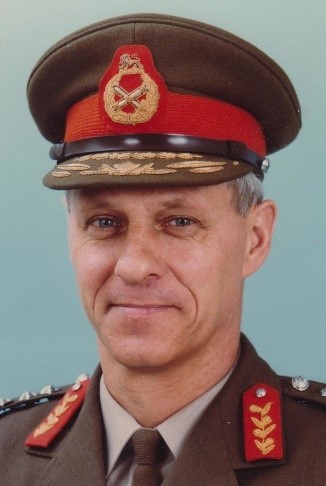
When retired General Constand Viljoen entered politics in 1994 to launch the Freedom Front, some viewed him as the country’s last chance. Many thought him capable of raising an army of up to 50,000 men from various defense forces and civilian paramilitary units that were loyal to him. Anticipating this, General Georg Meiring warned de Klerk and then met with Viljoen to sound him out.

“You and I and our men can take this country in an afternoon,” Viljoen reportedly told him. “Yes,” Meiring replied, “but what do we do in the morning after the coup? The internal resistance and foreign pressures and the stagnant economy will still be there.”

For Viljoen, the lack of support from the armed forces was decisive. “I could have stirred things up in 1994—but for what purpose?” he later said. “I don’t think any action from my side would have resulted in a major part of the Defense Force siding with me.”

Viljoen’s decision was controversial among some Afrikaners, many of whom were more than willing to fight and die to save their country. Instead, Viljoen decided to use the threat of war to win an Afrikaner homeland — a volkstaat — by peaceful means.  To placate him and his supporters, de Klerk and the ANC readily agreed to create a council to review the options. But it was just a ploy. Neither de Klerk nor the ANC ever took the idea seriously.

In the 1994 elections, the first held after the end of apartheid, Viljoen’s Freedom Front earned a little over two percent of the vote. The party was, and remains, an important voice for Afrikaners, as are advocacy organizations like AfriForum and Suidlanders, a civil defense group. But their power is limited by numbers. Whites are a small minority in South Africa. Conservative Afrikaners are just a minority within the minority.

Viljoen never had any illusions about this. His primary focus had always been the creation of an Afrikaner homeland. Consistent with the accord he signed with the ANC, a council was soon created to consider the creation of a such a volkstaat. But then, as now, the council soon faced a major obstacle: Afrikaners were spread too thinly across too many areas of the country for any single region to stand out as the obvious location.

The council considered several options, including one based primarily in the Northern Cape that eventually drew the endorsement of the Freedom Front (shown in the map below). Other proposals included carve-outs in and around Pretoria, where the largest numbers of Afrikaners live.
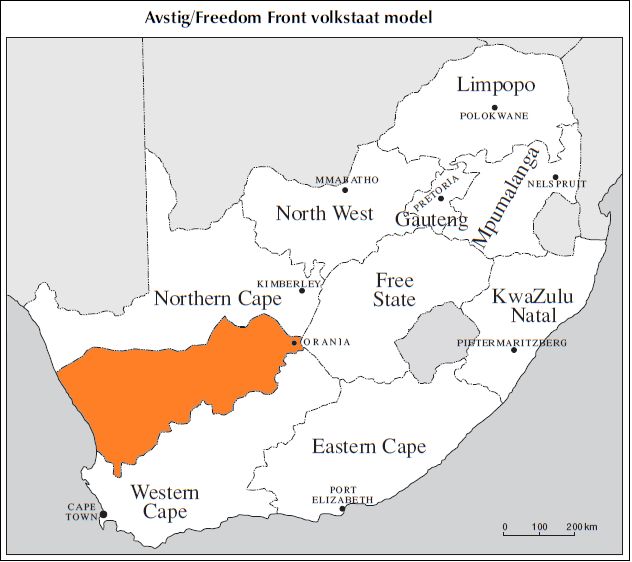
But each of these proposals would have required large numbers of Afrikaners to uproot and move to the new state for it to be viable. Instead, a 1993 poll indicated that just 29 percent of White South Africans backed the creation of such a homeland. Just 18 percent said they would consider moving there if one were created.

“Afrikaners do not want their own homeland,” Johann Wingard, chair of the council, eventually concluded. “They want to live anywhere in their beautiful country where they can make a decent living.” Interest in the idea soon dissipated and the council was dissolved. For many, the dream of a volkstaat seemed dead and buried.

Carel Boshoff, son-in-law of former South African Prime Minister Hendrik Verwoerd, had different ideas. In 1990 he bought a patch of land on the banks of the Orange River at the far eastern edge of the volkstaat proposed by the Freedom Front. The first few residents of the new Afrikaner town, called Orania, arrived the following year. The population has since grown to over 1,700, over a third of whom are children.

“They initially drew support from idealists,” said Dan Roodt, an Afrikaner activist. “They struggled financially in the beginning. In the early 2000s, you could buy a plot of land for a couple a hundred dollars. Now the price is 50 times that much.”

The town’s growth was powered by a strong desire for shared community and growing disenchantment with the rest of South Africa. It would have grown even faster if not for its commitment to using Afrikaner labor. “Orania does not use black labor,” Roodt said, “so it can’t build fast enough to build all the new housing they need.”

Orania had shown that the idea could work. And before long, public opinion would change.

Democratic Alliance

The Freedom Front — later renamed the Freedom Front Plus after it merged with the Conservative Party — was never the primary party of South Africa’s Whites. In the 1994 election, that distinction fell to the Nationalists under F.W. de Klerk. But there was also a third party contending for the White vote that year. The Democratic Party was barely a footnote, receiving fewer votes than the Freedom Front.  But in time — and with the backing of most of the White establishment, the media, and a healthy dose of luck — it soon propelled itself forward to become the nation’s primary party for Whites, second in size only to the ANC.

In 1994, however, it was caught in a bind. Its traditional base of support had always been urban, politically liberal Whites. That became a problem when de Klerk lifted the ban on the ANC. Suddenly the party found itself being squeezed on both sides — by the ANC on the left, which drew away some of its White liberal support, and by the Nationalists on the right, who were viewed by most Whites as the only viable check against the ANC’s growing power.

Instead of capitalizing on this advantage, however, de Klerk fumbled it away. Thinking he could retain power and influence by working with the ANC, he allied with them in a post-election “unity government.” But this only alienated the Nationalists from their base of White voters. Worse, they were blamed for failing to stop the Truth and Reconciliation Commission, which persecuted numerous White officials and military officers for their role in apartheid.

The Democratic Party took full advantage of the situation, challenging the Nationalists from the right in the 1999 elections. With the rallying cry “Fight Back!,” the party gained ground among White voters. After the election, the Nationalists continued to hemorrhage White support until 2005, when the party finally disbanded.

With its principal competition for White voters now gone, the newly renamed Democratic Alliance was free to expand its outreach to other racial groups, first to the “coloured” vote and later to the Black middle class. Like White establishment parties just about everywhere, it downplayed race and emphasized colorblind individualism and classical liberalism to maximize its cross-racial appeal. Using this strategy, it gained support in every subsequent election until 2014, when it peaked at 22 percent of the overall vote.

After that election, Helen Zille, the party’s leader, began looking for a successor. Her ideal candidate would be someone like Barrack Obama, who was then closing out his second term. Mmusi Maimane seemed to fit the bill. With Zille’s backing, he drew overwhelming support from the party in 2015.  The party then marketed him in ways that amounted to virtual plagiarism — including blatantly copying Obama’s “Hope” poster and substituting Maimane’s image instead.
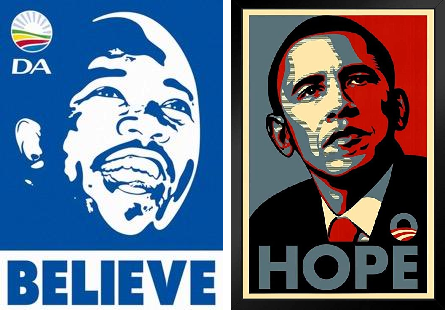
But Maimane did not play along. He was not interested in being the Black face of a White party. If the DA wanted his leadership to reach Black voters, then he would force it to swallow his message — and that message was one of Black nationalism.

In his acceptance speech, he warned the party that colorblindness was not enough. “These experiences shaped me, just like they shaped so many young Black people of my generation,” he said, echoing the criticisms of South Africa’s woke left. “I don’t agree with those who say they don’t see color. Because, if you don’t see that I’m Black, then you don’t see me.”

It was not long before Maimane was locked in a power struggle with senior members of his own party, advocating for affirmative action and straying from its emphasis on non-discrimination. Under his command, the party soon came to be seen as ‘ANC-lite,’ and the DA’s White leadership was not happy.

Neither were some of its other Black leaders, but for different reasons. ”I feel powerless when my activists come to me and say they are victims of racism from senior people in the party, who say they should be grateful that the DA keeps them busy because otherwise they would probably be out stealing and killing people somewhere,” one grumbled. “I mean, what is that?”

The DA paid the price for these divisions at the ballot box. In the 2019 elections, the party lost ground for first time since 1994, failing to gain any traction against the ANC and losing White voters on the right to the Freedom Front Plus. The ANC also lost ground, but not to the “colorblind” DA. Instead, it lost votes to the explicitly Black nationalist Economic Freedom Fighters (EFF) under Julius Malema, who had pledged to “cut the throat of Whiteness.”

The lesson from the election was clear. In an increasingly chaotic nation, Black nationalism was the future. White voters and their parties had gone as far as they were going to go.

After the election, the knives came out. Helen Zille, the DA’s previous leader, was elected to a powerful party position by the old guard and she quickly challenged Maimane from within. Her predecessor, Tony Leon, chaired an internal party review that laid the blame squarely at Maimane’s feet. The Institute for Race Relations, an establishment-backed think tank, said he had abandoned the party’s cherished principles.

Maimane saw the writing on the wall, but he did not go quietly. At his resignation speech he called out the DA’s White leadership in explicit terms. “Over the past few months it has become more and more clear to me that there exists those in the DA who do not see eye-to-eye with me, who do not share the vision for the party and the direction it was taking,” he said. “There have been several months of consistent and coordinated attacks on me and my leadership, to ensure that this project failed, or I failed.”

Other Black party leaders followed him out the door. “I cannot reconcile myself with a group of people who believe that race is irrelevant in the discussion of inequality and poverty in South Africa,” said Herman Mashaba as he resigned from the party and as mayor of Johannesburg, the nation’s largest city.

Malema’s EFF released a gloating statement calling the DA a “White political party in which Whites and their interests as Whites must always dominate and come first.” Maimane was later seen hobnobbing with Julius Malema in what some called an emerging ‘bromance.’

Last November, the party overwhelmingly elected a new White leader, John Steenhuisen. He trounced his primary Black challenger, Mbali Ntuli, with 80 percent of the vote. The party, it seemed, was no longer pretending. Some are now questioning how it could possibly avoid a backlash by non-White voters in the next election.

Secession

Two decades ago, the idea of a White homeland in South Africa seemed dead in the water. Any area reserved for Whites that was too far away from the cities or from employment opportunities seemed impractical. Many Whites at the time also believed, or at least hoped, that South Africa would soon become the harmonious and prosperous multiracial nation that had been promised.

That hope is now gone. A worsening economy, ever-present crime, and rising corruption have all left their mark (detailed in my previous article, South Africa’s Protection Racket). According to public opinion polls, South Africans have grown increasingly pessimistic. The situation briefly stabilized when Cyril Ramaphosa replaced Jacob Zuma as president in 2018, but his promised reforms never materialized. Now public sentiment seems to be worsening again. The DA’s failed “colorblind” political strategy has only further darkened the mood among those who had hoped for more.

These negative views are most prevalent among Whites in general and in the Western Cape in particular, one of the few regions in the nation where Blacks are not a majority. In 2009, Whites in the province allied with the local coloured population and ousted the ANC in local elections. It has been ruled by the DA since then.
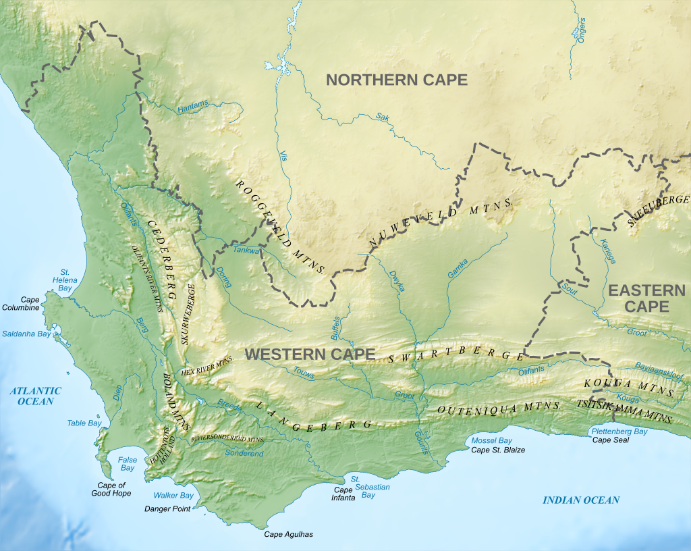
“Ever since the DA came to power in Cape Town and in the Western Cape one has heard a growing chorus from visitors that ‘It feels like a different (and better) country down here!’” wrote one local observer. “The public hospitals and schools work far better here than anywhere else in South Africa, the traffic lights work better, the city center is safer, there is less litter and generally there is better governance.”

Local rule was a step in the right direction, but some activists wanted more. In 2007, they formed the Cape Party to fight for genuine independence. The party never gained traction in the few elections it contested — partly because the timing was wrong and partly because voters inclined to support separatism already had a political home in the Freedom Front Plus.

Nine years of Jacob Zuma’s presidency changed that, however, and several new organizations have emerged. Following the success of the Brexit vote in Britain, CapeXit was founded in 2018 to seek independence through international law. Another organization, the Cape Independence Advocacy Group (CIAG), was launched in 2020.

It seemed like public opinion had changed, but independence advocates decided to sponsor a poll to be sure. Unsurprisingly, the poll found overwhelming opposition among Black voters. But it also showed that Whites now strongly supported the idea, especially those who were supporters of the Freedom Front Plus.

Coloured voters — who constitute a majority of the Western Cape’s population — were more divided. While most were not yet ready to endorse full independence, the majority (68%) agreed that the Western Cape should be given more power to choose its own policies. Advocates now believe that this bloc of voters can be won over, particularly if the nation’s economy continues to deteriorate.
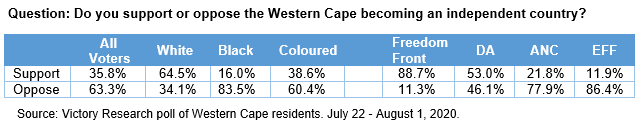
These poll results, which drew wide attention, have put the DA in a box. Much of its White leadership privately supports independence, but it has remained publicly silent to avoid alienating voters both inside and outside the province who do not support the effort. The Freedom Front Plus, which has endorsed independence, sees this as an opportunity. They plan to challenge the DA on this issue in the upcoming 2021 municipal elections.

Despite this growing support, however, some have condemned the independence movement as unrealistic. “Fringe groups have long advocated for the secession of the Western Cape from the rest of South Africa,” wrote Pierre De Vos, a constitutional law professor at the University of Cape Town. “Obviously, the Western Cape is not going to secede and there is no chance of the creation of an independent state.”

“Even if the Western Cape Premier calls a referendum (he won’t), and even if a majority of voters vote for secession (they won’t either), the referendum will have absolutely no impact as the president and his party will have no legal or ethical obligation to adhere to the results,” he wrote. Critics argued that the ruling ANC would inevitably reject Cape independence, not least because the Western Cape and Gauteng, the two provinces with the bulk of South Africa’s White population, provide most of the tax dollars that line the ANC’s pockets.

Supporters counter that international law, not the South African constitution, is the final word on the matter. “Countries secede on a regular basis, and the constitutional law of the parent state is almost never an insurmountable object if the other conditions required by international law are in place,” wrote Phil Craig, CIAG’s co-founder. Political will, not constitutional law, would decide this issue, as it has in nearly every other case of secession.

Bangladesh seceded from Pakistan despite the latter’s objections. Kosovo seceded from Serbia despite Serbia’s objections, and with the International Court of Justice advising that there is no prohibition of the (unilateral) declaration of independence under international law. Estonia, Latvia, Lithuania, Croatia, Slovenia, East Timor, South Sudan. The list goes on.
Closer to home, did the previous South African constitution prevent the end of apartheid, or Namibian independence? Countries secede on a regular basis, and the constitutional law of the parent state is almost never an insurmountable object if the other conditions required by international law are in place.

Whatever the objections, the politics of the issue are clearly trending in the supporters’ direction.  Numerous economic experts and political analysts now see South Africa entering a death spiral. Last year, the nation lost its last investment-grade credit rating when Moody’s downgraded it to “junk” status. Investors have been fleeing the country for years. According to IMF estimates, unemployment is fast approaching 40 percent. The Covid crisis has only made matters worse, contributing to widespread protests. At least one analyst estimates that if its existing economic policies are not reversed, the country faces economic and political collapse by 2030.

Despite such warnings, President Cyril Ramaphosa seems powerless to implement needed reforms. According to analysts at the establishment-backed Institute of Race Relations, power in the ANC has now shifted decisively to leftist Black nationalists. If Ramaphosa were to challenge the party’s top leadership in any meaningful way, they would remove him from office.

This worsening economic and political outlook will only heighten public support for secession over time. The final trigger could be an independence referendum in the Cape, an IMF bailout that imposes cuts on ANC-favored spending priorities, a forced removal of Ramaphosa by the ANC leadership, or a national election that forced the ANC into a governing coalition with the far-left EFF to maintain Black majority rule.

Regardless of the cause, if the Western Cape seceded, it would probably trigger similar efforts in other parts of the country. This might include some or all of the Northern Cape, which has similar demographics and is home to Orania. Another possibility is the Whiter regions in and around Pretoria and Johannesburg, which might also demand increased local autonomy. Absent that, many of these Whites might flee to a newly independent Western Cape, just as Whites fled Zimbabwe to South Africa during Robert Mugabe’s reign.

The Rainbow Nation’s days may be numbered, but now there is something new to hope for. An independent Western Cape would not be the volkstaat — nor indeed an ethnostate of any kind. But it would at least free the nation’s White population from the worst excesses of majority Black rule and reestablish the right of self-determination.

When reporters travel to Orania, they sometimes ask the residents why they chose to move there. “We want to build a better place for our children and ourselves,” one recently said.

It is a simple answer, one that anyone could have given, but now more people are beginning to realize that it is something that cannot be taken for granted. Self-rule has long been an aspiration for many White South Africans. Now, after all these years, it may finally be within reach.

Patrick McDermott is a political analyst in Washington, DC.
Three Fine Films

The past couple of weeks, I watched three films that, tied together, I found artistically superb, personally moving, and very thought-provoking.  I streamed them on the Criterion Channel—a subscription service I recommend if you are a film buff—and Amazon Prime, but between Vudu and Google Play, you’ll be able to rent them.

In the order I saw them:

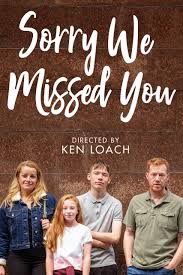
  • “Sorry We Missed You.” British, 2019.
  • “Measure of a Man.” French, 2015. There is a 2018 film with this same title.  The one I’m referring to is with the actor Vincent Lindon, who won the Best Actor award at the Cannes Film Festival for his performance in this film.
  • “I, Daniel Blake.” British, 2016.

“Sorry We Missed You” and “I, Daniel Blake” were directed by the great British filmmaker Ken Loach, who, incidentally, was 83 when he made “Sorry We Missed You.”  Loach co-wrote the film with his long-time collaborator, Paul Laverty.  “Measure of a Man” was directed by Stéphane Brizé, French, who also wrote the screenplay.

What tied these three films together for me is that they were all compelling dramas about the lives of the White working poor, people rarely the protagonists in contemporary cinema.  If this is a topic that interests you, you could also look into the films of the outstanding Belgian directors Luc and Jean-Pierre Dardenne (“The Promise,” “Rosetta,” “The Son,” “The Child”).

The meaning of art is the outcome of an exchange between the work of art and a particular person—you, me, anyone—at a particular point in his or her life.  What I took from these films will be different from what you do.  But perhaps reading a bit about my experience with them will encourage you to do the same sort of thing for yourself.

The first thing that comes to mind for me is that these three films are top quality.   They have superior artistic merit, and they are true, they touch down on the reality of life.  I ended the last writing I did—an essay/review of the 1999 Stanley Kubrick film “Eyes Wide Shut,” a film I disdained—with this:

Really, the only thing that’s come out of this consideration for me is a commitment to do my best to stay clear of creations as base as “Eyes Wide Shut.” 

Since writing that, I’ve been attending to using high quality as a guide.  Is this book, film, top rank, worth encountering?   Does it enrich me, is it truly rewarding, or is it just a pleasant diversion that kills time I’ll never get back and leaves an aftertaste akin to that of a second Snickers bar.  I’ve had enough Snickers bars in my life, and not just in the arts.   So far, so good with that commitment, and I’m better off for it.

The time spent with these three films reminded me that film is a literal medium, in contrast to print—books, articles, opinion pieces.  In film, you can see and hear what’s going on right in front of you; there it is, it isn’t a lifeless abstraction.  In fictional film, as opposed to documentaries, you know there’s a script and that those are actors and it’s a feigned reality, but still, you can see it happening.  And fictional or real life, it’s happening to particular people.   It’s not words on a page, it’s these people—see them, hear them, feel for them.  It reminds us that whatever we are talking about, advocating, declaring to be true and just, ultimately comes down to individual human beings getting their lives done for better or worse in their immediate circumstances, and that human beings and circumstances differ from one another.  In this example, they differ by social class and social advantage.  At its best, film can show us the reality—or better, multiple realities—beneath the words and ideas employed to depict it.

In these three films, we are shown what it is like to be uneducated and poor and struggling to survive in a world that is at best indifferent to your existence.    The people working checkout counters and delivering packages being talked down to and demeaned when they aren’t invisible.  The young mother with her two children in the food bank who frantically tears open a can of food and begins engulfing it right there and then.  “I’m sorry, I’m sorry . . . I’m . . . so hungry . . . I’m sorry.”  The small, deferring older man caught shoplifting meat at a super market looking terribly alone.  “Pay for it and we’ll let this pass.”   “I can’t . . . I’ve just got this [he puts a few coins on the table in front of him].”  “Is there someone in your family who can pay for you?”  “No.”  “A friend?”   “No.”  “Anyone at all?”  “No, there’s no one.”

I grew up poor.   I know what it’s like to live in rented rooms on the second floor of Mister Jensen’s house and have him tell Mother, Dad, and me that we’d have to move because his daughter Mary Jean was getting married and wanted to live temporarily where we were.  But then Mary Jean changed her mind and we could stay.   To live frightened that they will tell you to leave.  To this day, I’m frightened they’ll tell me to leave.

I read a lot of theorizing and prescribing, including in magazines like this one, by people who have lived middle-class lives and have college educations who don’t seem to get what it’s like to be the kind of people depicted in these three remarkable films and what it takes for them to get by in their worlds and to make it out of the fix they are in, or to personalize it, to have been six-years-old living behind a plywood partition in the back of a downtown barber shop with a bed and a radio and the toilet down the hall and keeping quiet so no one knows you are there.

I suggest you watch these three films and see what comes out of it for you:

What was their worth as an artistic, aesthetic experience?

What feelings, memories, insights into your life, did they prompt?   What’s happened to you over the course of your life, what have you become, who you are to yourself and the world?

Did these films make any difference in how you perceive reality and think about things?   About politics, race, social conditions, ideology, your currently favored analyses and solutions to problems, whatever you care about.

Did these films speak to what you are doing with your life and ought to be doing with it?

I hope you have as rich an experience with these three films as I did.

Triggered by Beethoven: The Cultural Politics of Racial Resentment

2020 was meant to be a year of celebration for Beethoven who was baptized 250 years ago (his exact date of birth is unknown) in Bonn on December 17, 1770. COVID-19 prompted the cancelation of commemorative concerts of Beethoven’s music, but the pandemic didn’t quell efforts by anti-White activists to attack the composer’s reputation and dominant place in the cultural pantheon of the West. Rather than a year full of performances of the great composer’s sonatas, string quartets, concertos and symphonies, 2020 saw repeated attacks on Beethoven for the crime of being a White male genius and for embodying the European musical tradition.

Beethoven is the most-performed composer in the repertoire, and his anniversary year was planned to be no exception. Before the widespread cancellation of concerts, 15 to 20 per cent of the repertoire programmed by leading orchestras was music by Beethoven. Widely regarded as the greatest composer of all time, Beethoven is inescapable because he remade almost every genre of concert music that matters. The concerto and symphony in his hands became driving musical narratives of heroic struggle. His late string quartets open a profound window on to the soul. Unlike his predecessors who were craftsmen who supplied a commodity to a paymaster, Beethoven ushered in the age of Romanticism by insisting on his creative independence and the absolute importance of self-expression: “What is in my heart must come out so I write it down.” This was manifested in his refusal to take a secure, salaried position like his one-time tutor Joseph Haydn who was the master of music for a feudal landowner in what is now Hungary.

Beethoven’s heroism in overcoming the worst thing that can happen to a composer — worsening deafness from young adulthood — to compose some of the greatest music ever has awed generations and become emblematic of triumph over adversity. All the stories of Beethoven’s misanthropy, his eccentricity and wildness, date from the decline in his hearing, which often caused him acute physical pain. Only his art prevented him from taking his own life: “It seemed to me impossible to leave the world until I had brought forth all that I felt was within me.” While Beethoven’s confidence as a pianist and conductor gradually diminished with his creeping deafness, his imaginative powers as a composer grew stronger and stronger, and he cast a daunting shadow over his successors: Brahms did not feel confident tackling a symphony until he was in his forties.

Beethoven excelled at his trade because he was born with a gift and worked at it as hard as it is possible to work. Swafford notes how his sketches and manuscripts reveal that:

Nothing came easily to him, least of all composing. Where Mozart could dream up a whole piece in his head while playing billiards, Beethoven had to worry and whip every note into place in his sketches. The sketchbooks are amazing documents: gold being refined from raw ore, pedestrian ideas becoming revolutionary concepts, incoherence being forged into clarity and purposefulness. Even the final manuscripts are a morass of scrawls and blots and revisions on top of revisions.[1]

Beethoven’s Faustian spirit made him into the kind of figure that dominated the imagination of nineteenth century Europeans: the superhuman genius, the revolutionary hero, the master of his own fate and transformer of the world. This reputation carried over into the twentieth century with the influential French writer Romain Rolland holding the composer up as a role model for a less heroic age, epitomizing personal sincerity and self-denial — in a word, authenticity.[2]

Attacks on Beethoven

Laudatory references to White male geniuses like Beethoven inevitably trigger rage from anti-White commentators who huff that it has “long been an argument of white supremacists, Nazis, Neo-Nazis, and racial separatists that ‘classical music,’ the music of ‘white people,’ is inherently more sophisticated, complicated, and valuable than the musical traditions of Africa, Asia, South America, or the Middle East, thus proving the innate superiority of the ‘white race.’” Seen through the Cultural Marxist lens of critical race and gender theory, Beethoven’s music dominates the concert repertoire not because of its exceptional quality, but because White-male privilege and assumptions about White-male genius keep it there. Linda Shaver-Gleason insisted Beethoven’s dominant place in the canon was the result of a White supremacist conspiracy which “intentionally suppressed” the music of non-White composers “in the service of a narrative of white — specifically German — cultural supremacy (because, alas, that too is part of Western culture).”

Slate online recently rebuked Beethoven for his mononym: the fact he is known by a single name, like Michelangelo or Shakespeare. This practice supposedly gives the pedestal of nomenclature to “straight white men at the expense of everyone else.” White male composers, it is claimed, “became so ensconced in elite musical society’s collective consciousness that only one word was need to evoke their awesome specter. Mouthfuls of full names became truncated to terse sets of universally recognized syllables: Mozart. Beethoven. Bach.” The works of composers with mononyms are therefore assumed to be “on a different plane,” whereas this assumption is, we are told, actually the product of “centuries of systematic prejudice, exclusion, sexism and racism.”

In a recent Vox podcast and article, musicologist Nate Sloan and songwriter Charlie Harding claim the opening bars of Beethoven’s Fifth Symphony (the famous da-da-da-DUM motif) should not be given their traditional interpretation — the sound of fate knocking on the door and Beethoven’s resilience in the face of encroaching deafness — but should be construed as the sound of the gate slamming shut on minorities, such as “women, LGBTQ+ people, people of color.” They assert (without evidence) that “wealthy white men” embraced the Fifth Symphony as a “symbol of their superiority and importance.” Black clarinetist Anthony McGill agrees, likening the inescapability of the Fifth Symphony to a “wall” between classical music and new, racially-diverse audiences.

Jewish music writer Norman Lebrecht defended Beethoven against Sloan and Harding’s polemic by citing Beethoven’s “liberal” credentials, claiming, for example, that they “fail to explore how Beethoven’s Fifth served for millions as a symbol of freedom in the war against Nazism.” Unmentioned by Lebrecht is the fact that, despite Beethoven’s politics — which were liberal for their time (he had republican sympathies) — the composer made repeated comments critical of Lebrecht’s own ethnic group. On one occasion, he rejected the idea of selling his Missa Solemnis to the Jewish music publisher Adolf Schlesinger in favor of the German publisher C.F. Peters, informing the latter that: “In no circumstances will Schlesinger ever get anything more from me, because he too has played me a Jewish trick.” Beethoven’s disgust with Schlesinger was prompted by repeated experiences of being short-changed with “such insulting niggardliness, the like of which I have never experienced.”[3] In a letter of 1823, Beethoven called Schlesinger “a beach peddler and rag-and-bone Jew.” In his negotiations with another publisher, Beethoven noted the publisher was “neither Jew nor Italian” and that as he himself was also neither of these, “perhaps we shall come to some agreement.”[4]

Sloan and Harding are on stronger ground in arguing the thematic complexity of the Fifth Symphony necessitated unprecedentedly close listening to fully grasp, and this, in turn, led to the establishment of new norms of concert behavior. These norms — sitting still, staying quiet and not clapping mid-piece — led to the strict culture of classical music that persists to this day, and which allegedly oppresses non-Whites who cannot reasonably be expected to conform to such standards of behavior. Sloan and Harding lament that classical concerts are the sole remaining American institution that typically insists on starting on time. Rather than a sign of respect for all parties involved, these behavioral and procedural norms are, they insist, symbols of White supremacy which alienate “diverse audiences,” and their origins can be traced to Beethoven.

Jewish music writer for The New Yorker, Alex Ross, labelled the planned 2020 Beethoven celebrations “a gratuitously excessive celebration of the two-hundred-and-fiftieth birthday of a composer who hardly needs any extra publicity.” He insists that, in the wake of the Black Lives Matter riots, an examination of the relationship between classical music, which he labels “blindingly white, both in its history and present,” and racism is “sorely needed” because of the genre’s “extreme dependence on a problematic past.” Ross claims that when the classical music tradition was transplanted to the United States, the “white majority tended to adopt European music as a badge of its supremacy. The classical-music institutions that emerged in the mid- and late nineteenth century — the New York Philharmonic, the Boston Symphony, the Metropolitan Opera, and the like — became temples to European gods. … Little effort was made to cultivate American composers; it seemed more important to manufacture a fantasy of Beethovenian grandeur.”

For Ross, classical music can only “overcome the shadows of its past” if it commits itself to a “much more radical confrontation with the white European inheritance,” and by programing more non-White composers like Julius Eastman — a Black composer whose “improvisatory structures, his subversive political themes, and his openness about his homosexuality give him a revolutionary aspect, yet he also had a nostalgic flair for the grand romantic manner.’”

In the frontline of attacks on Beethoven in 2020 was Black music writer and Hunter College academic Philip Ewell, who penned an article titled “Beethoven was an Above-Average Composer — Let’s Leave it at That.” Ewell begrudges the laudatory epithets routinely applied to White composers like Beethoven and their works. For Ewell, adjectives like “genius” and “masterwork,” evoke slavery (master-slave) and sexism (master-mistress), and the classical music lexicon is, in his assessment, overflowing with euphemisms that disguise and reinforce the “white-male frame.”

In addition to “master’ and its derivatives, here are some of the other common euphemisms for white and whiteness in music theory’s white racial frame: authentic, canonic, civilized, classic(s), conventional, core (“core” requirement), European, function (“functional” tonality), fundamental, genius, German (“German” language requirement), great (“great” works), maestro, opus (magnum “opus”), piano (“piano” proficiency, skills), seminal, sophisticated, titan(ic), towering, traditional, and western. Even terms such as “the long nineteenth century” and “fin de siècle” can be considered euphemisms for whiteness and white framing for their close associations with dates and events (and languages) significant to Europe and Europeanism. Such euphemisms are intended to sublimate whiteness into less objectionable forms, thus mitigating the effect of whiteness on music theory and hiding its existence.

Rather than enjoying a merited reputation for the brilliance and originality of his oeuvre, Ewell insists Beethoven’s fame has been upheld by such lexical scaffolding, claiming Beethoven, “along with countless other white males, has been propped up by the white-male frame, both consciously and subconsciously, with descriptors such as genius, master and masterwork.” In Ewell’s jaundiced assessment, Beethoven’s Ninth Symphony is “no more a masterpiece” than Esperanza Spalding’s 12 Little Spells (click the links and judge for yourself). The status of Beethoven’s Ninth is purely, he argues, a product of music theory’s “white-male frame” which “obfuscates race and gender.”

Ewell’s attack on Beethoven is an adjunct of this broader hostility to classical music’s “white racial frame” which, he insists, reinforces the hierarchy of White male composers, and “works in concert with patriarchal structures to advantage whiteness and maleness while disadvantaging POC and non-males.” This frame purportedly encompasses Western tonality itself (with its major-minor harmony and its equal-tempered scale) which is assumed to be the “master” language. Ewell even regards the Gregorian calendar as “white racial framing writ large,” insisting “no one can deny the racial element behind how the world now understands the linear and cyclic nature of time.”

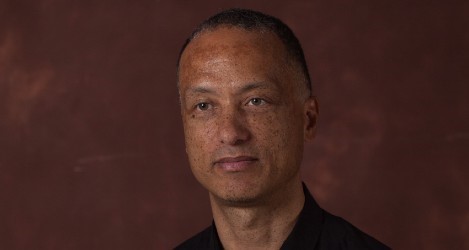
Phillip Ewell

In an article for the journal Music Theory Online entitled “Music Theory and the White Racial Frame,” Ewell argues that “music theory is white [it is]” and the discipline is undergirded by a deep-seated ideology of White supremacy calculated to thwart Black and Brown (but strangely not East Asian) achievement in classical music. The main target of Ewell’s critique is the early twentieth-century music theorist Heinrich Schenker (1868–1935) who initiated the parsing of musical structures into foreground, middle-ground and background to tease out the tonal formulas that underpin large-scale movements. Drawing on poststructuralist critiques of Western civilization, Ewell claims this kind of score-driven analysis of musical works as part of Western musicology (what he dubs the “drive to scientificize music analysis”) represents an effort to “shore up whiteness in music theory’s white frame” and to insulate “whiteness from potential criticism.” In attacking Schenker (who was an Austrian Jew), Ewell inadvertently strayed into forbidden fields of inquiry and faced unexpectedly fierce blowback and accusations of “Black anti-Semitism.”

Ewell’s “white racial frame” purportedly extends to musical education where, in the most commonly used theory textbooks in the United States, only 1.63% of musical examples come from non-White composers. This is also problematic for Linda Shaver-Gleason because studying a particular piece “reaffirms its canonical status; enshrining it in a textbook is deeming it worthy of study.” Constantly referencing White composers “reinforces the idea that they’re the ones who deserve the most respect, as if to say, ‘Marvel at the many techniques Mozart used so perfectly!’” Ethan Hein, a (presumably Jewish) doctoral fellow in music education at NYU, likewise decries the stubbornness of music teachers in teaching “European-descended” classical music over that of “music descending from the vernacular traditions of the African diaspora.” Orienting music education towards the European classical tradition, an “implicit racial ideology,” is, he declares, “insidious” in its “affirmations of Whiteness.”

In 2020, college-level music pedagogy responded to Black Lives Matter by “dramatically reconsidering which composers and musical traditions we do and don’t discuss in the classroom.” Similar dynamics were at work within other musical institutions. The Metropolitan Opera, upon cancelling its 2020–21 season, announced that it would begin its next season with Black composer Terence Blanchard’s Fire Shut Up in My Bones, the first opera by a Black composer to appear on the Met’s stage. Despite such gestures, for Slate journalist Chris White, musicians, academics, and teachers still “have a lot of work ahead to confront the racist and sexist history of classical music.”

Music theory’s white racial frame is also sustained, according to Ewell, by the “citational chain” of white men citing other white men in the musicological literature. He wants to break this chain “in which whiteness begets whiteness and maleness begets maleness.” Meanwhile, Ewell’s own utterly conventional and establishment beliefs are the unreflective product of his engagement with a group of predominantly Jewish critical race and gender theorists: he borrowed the term “white racial frame” from Harvard sociology professor Joe Feagin. Arguing that the entire Western art music tradition is inherently White supremacist, Ewell advocates “overthrowing the existing structure and building a new one that would accommodate non-white music a priori [prior to listening to it??] no reaching for ‘inclusion’ necessary because non-white composers would already be there.”

Beethoven and the “New Musicology”

Ewell postures as an outsider bravely challenging sinister norms entrenched in Western musicology when, in reality, his perspective has been utterly conventional since the advent of the “New Musicology” in late 1980s — when Cultural Marxists to a significant extent overran the discipline. Musicology was one of the last frontiers for poststructuralism and critical theory which had already infested most of the humanities and social sciences by the early 1980s. The New Musicology was founded by the Jewish-American critic and musicologist Joseph Kerman (born Zukerman) whose journalist father William Zukerman (1885–1961) was a prominent figure in the Jewish media and author of the 1937 book The Jew in Revolt: The Modern Jew in the World Crisis.

A key figure in the ascent of the “New Musicology” was Susan McClary whose 1991 book Feminine Endings: Music, Gender and Sexuality is considered a trailblazing text for the movement. McClary gained fame and notoriety for her feminist “analysis” of the first movement of Beethoven’s Ninth Symphony, where she claimed: “The point of recapitulation in the first movement of the Ninth is one of the most horrifying in music, as the carefully prepared cadence is frustrated, damming up energy which finally explodes in the throttling murderous rage of a rapist incapable of attaining release.” This risible statement was an elaboration of her belief the Western musical convention of sonata form is inherently sexist, misogynistic and imperialistic: that “tonality itself — with its process of instilling expectations and subsequently withholding promised fulfilment until climax — is the principle musical means during the period from 1600 to 1900 for arousing and channeling desire.” The primary “masculine” key (or first subject group) is said to represent the male self, and the secondary “feminine” key (or second subject group) represents the “other,” a territory to be explored and conquered, assimilated into the self and stated in the tonic home key.

Virtually all Cultural Marxist critiques of Western classical music fall back on these kind of entirely speculative metaphors. While purporting to offer additional insight into music, the New Musicology systematically imposes an anti-White male ideology on its subject, and, in this endeavor, happily discards all standards of proof and evidence. The conceit that, before the advent of the New Musicology, the discipline was limited to the rigid boundaries of empiricism and positivism is false; awareness of the context and reception of music has always been a core topic of musicology. There was, however, also a belief in purely musical elements and in the value of studying them. The problem with such “objective” technical analysis, for the likes of McClary and Ewell, is that it invariably leads to “White supremacist” conclusions about the relative quality of different musical traditions. The “problematic dimension” of analyzing “music as simply music,” McClary notes, is that people inevitably point to Western classical music “as evidence of the superiority of European and European-descended people, which marginalizes the rest of the world and, also, minority groups in the U.S.”

Constructing Beethoven as Black

The main alternative to the Cultural Marxist deconstruction (and proposed anti-White reconstruction) of the Western musical canon, has been attempts by Blacks to appropriate Beethoven for themselves. Given Beethoven’s status as the archetypical musical genius, it is unsurprising that aggrieved Blacks have, since the early twentieth century, attempted to propagate the myth that Beethoven had some African ancestry. The basis for this entirely spurious claim was the composer’s slightly swarthy complexion, and the fact part of his family traced its roots to Flanders, which was, for a period, under Spanish monarchical rule. Because Spain had a longstanding historical connection to North Africa through the Moors, a degree of blackness supposedly trickled down to the great composer — this despite the fact the Moors as an ethnic group weren’t even Black.

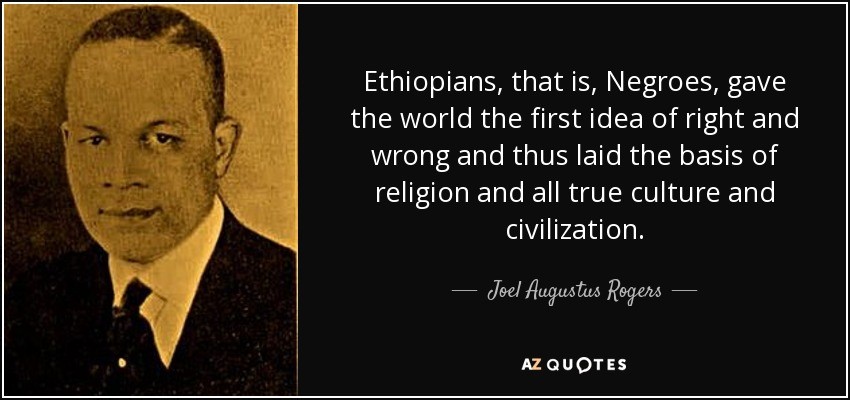
The myth was eagerly disseminated by Jamaican “historian” Joel Augustus Rogers (1880–1966) in works like Sex and Race (1941—44), the two-volume World’s Great Men of Color (1946–47), 100 Amazing Facts About the Negro (1934), Five Negro Presidents (1965), and Nature Knows No Color Line (1952). Rogers, whose intellectual rigor was basically non-existent, claimed that Beethoven — in addition to Thomas Jefferson, Johann Wolfgang von Goethe, Robert Browning, and several popes, among others — was genealogically African and thus Black. Despite being thoroughly debunked, the myth still lingers in contemporary culture: in 2007 Nadine Gordimer published a short story collection called Beethoven Was One-Sixteenth Black: And Other Stories. The determination, contrary to all available evidence, to make Beethoven Black is, of course, a desperate attempt to make the composer and his oeuvre a glorious symbol of Black accomplishment.

A pearl of wisdom from Jamaican historian Joel Augustus Rogers (1880–1966)

Otherwise sympathetic commentators have cautioned that such efforts are self-defeating, merely serving to treat the Western canon as fundamental and all other styles as deviations from this norm, thus reinforcing “the notion that of classical music as a universal standard and something that everyone should aspire to appreciate.” Trying to make Beethoven Black and desperately scouring the historical records for examples of non-Whites who wrote symphonies is to accept “a white-centric perspective that presents symphonies as the ultimate human achievement in the arts.”

Among those routinely cited by those desperate to prove the racial diversity of the Western art music tradition are the mixed-race composers Chevalier de Saint George, Samuel Coleridge-Taylor and George Bridgetower. These figures are remembered solely because they were non-White, not because of the excellence of their compositions. Beethoven personally knew Bridgetower, a talented violinist whose father was from the West Indies. Indeed, Bridgetower was the original dedicatee of one of Beethoven’s most celebrated violin sonatas. Beethoven called it the “mulatto sonata” after Bridgetower (before the word took on a more pejorative sense) and the pair gave the first performance but fell out soon afterwards, whereupon Beethoven renamed the piece for another violinist, Rudolphe Kreutzer.

Conclusion

Classical music, like other aspects of Western culture, has been a casualty of the anti-White diversity mania that now infests Western intellectual life. The Cultural Marxist critique of classical music (and of Beethoven) wallows in bad faith arguments and cognitive dissonance: Western classical music is nothing exceptional, yet cannot be invoked to praise White people because this necessarily implies the inferiority of other races; a White supremacist conspiracy thwarts Black and Brown achievement in the genre, but utterly fails to prevent East Asian interest and success; Black composers have written symphonies (and, indeed, Beethoven himself was Black), yet the Western classical music tradition is inherently White supremacist and needs radical deconstruction.

Ultimately, the reason the classical music canon (and Beethoven’s status as a titan of European civilization) is so keenly resented by anti-White activists, is because the gap in civilizational attainment it underscores is an embarrassing affront to regnant egalitarian assumptions. Western art music (with Beethoven as its leading exponent) stands as a glaring testament to the pre-eminence of European high culture, and implicitly of the race responsible for it. The attacks on Beethoven in 2020 are yet another example of warfare waged against White people through the construction of culture.

Brenton Sanderson is the author of Battle Lines: Essays on Western Culture, Jewish Influence and Anti-Semitism, available here and here.


[1] Jan Swafford, The Vintage Guide to Classical Music: An Indispensable Guide for Understanding and Enjoying Classical Music (Knopf, 1993), 184-85.

[2] Romain Rolland, Beethoven the Creator (Rolland Press, 2008)

[3] Jan Swafford, Beethoven: Anguish and Triumph (Faber, 2015), 760.

[4] Lewis Lockwood, Beethoven: The music and the Life (Norton, 2005), 533.

Julien Langella’s Catholic and Identitarian


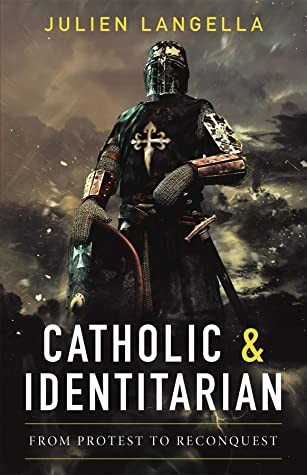
Catholic & Identitarian: From Protest to Reconquest
Julien Langella
Arktos, 2020.

“The absence of anger is a sign of the absence of reason.”
Saint Thomas Aquinas

For better or worse, I’m fairly certain there hasn’t been a Catholic in my family tree since the Reformation, and I remain unsure about a strict definition of “Identitarianism.” It was with an ambivalent but open mind, then, that I recently read Julien Langella’s Catholic & Identitarian, a furious lament on the present condition of France and a firm apologetic for ethnic activism among Christians. Such a text is surely needed. In May 2016 I wrote a scathing essay on Christian attitudes to, and activism on behalf of, mass migration, prompted by the foot-kissing antics of Pope Francis, described in the essay as “the personification of a sick glorification of humility and weakness.” Although I focused for the most part on the Catholic Church, I took aim at all denominations with the demand that “Those who describe themselves as Christian White advocates need to become more vocal in articulating a more ethnocentric or culture-based theology that their co-religionists will find convincing. It is simply not enough to hope that Nationalists can achieve something politically and then come to the rescue of the churches.” Julien Langella, one of the co-founders of Génération Identitaire and whose text first appeared in French in 2017, has provided an admirable response to this problem that will appeal to, and educate, readers of all religious backgrounds and none.

Is this a Catholic book? Yes and no. Religious elements of the text are, thankfully in my opinion, framed as a backdrop to the primary concern: the French are facing the gradual but imminent replacement of their ethnic group in their own homeland. Langella’s central ambition in the book is therefore to explain and condemn this Great Replacement while stressing how Catholicism (and other important facets of the traditional and ancestral life of the French) could and should be used as an underpinning for a resurgent French “Identitarianism.” Langella helpfully avoids some of the clichés of the “TradCath” social media scene by demonstrating an impressive grasp of historical Catholic literature as well as a mature and wide-ranging understanding of many of the contemporary political, ideological, and economic currents that have combined against the European peoples. Most important of all, he is honest in his criticisms of the prevailing attitudes of the Catholic Church on mass migration and ethnicity, devoting one section of the book to a dissection of Pope Francis himself. Unashamedly local in concern, yet avoiding a parochialism that ignores the need for Europeans to unite on some level, Catholic & Identitarian is the most impassioned warning and call to action that I’ve read since Guillaume Faye’s blistering Ethnic Apocalypse (2019).

The book is divided into five chapters, each of which is subdivided into lesser sections. Some of the latter are just a few paragraphs long, which gives the book a sense of fast pacing despite the heavy subject matter often under discussion. The writing style is punchy and straightforward, and mercifully devoid of jargon. The text opens with an interesting Preface from Abbot Guillaume de Tanoüarn, who has previously made headlines in France for resisting the police-enforced demolition of churches. Abbot Guillaume uses his Preface to make the moral and spiritual case for ethnocentrism among Europeans, commenting that “the crisis we face is a moral crisis, and because of its rootedness, because what is at stake is the identity of each of us, one can even say that, deep down, it is also a spiritual crisis.” Individualism is regarded as a cancer, because the common good, or communicatio, of a nation is “not founded on individuals who are magically stuck together, but on families who, in the Christian model of society which prevailed in the West, represent a union of two sexes in “one flesh,” according to the law of love.” Against the organic community, “it has become fashionable in the media to question identity, to stigmatise attachment to soil and traditions. It is almost as if any prior spiritual wealth, anything greater than the Individual, has become suspicious, or has transformed into some new bizarre metaphysical paradigm.” Abbot Guillaume laments the arrival of a perception that individual “freedom encounters no other limit, no other boundary than the liberty of others in a world where neither good nor evil has the slightest meaning.”

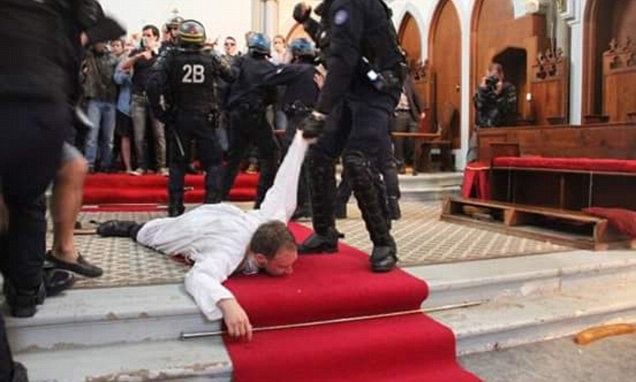
Abbot Guillaume dragged from St Rita church, Paris by riot police in 2016

For Abbot Guillaume, “identity is inherited,” and “among the facts that condition individuals, ethnic origin has its place. … There obviously exist different ethnic origins.” He pours scorn on “the ideology of mandatory miscegenation, which includes an infatuation with quotas and the compulsive glorification of diversity on the “American model,” for which one carefully fails to set limits and ignores in particular the violence it often entails,” and endorses the message of Langella that “miscegenation does not enrich; it impoverishes.” The Abbot closes his Preface with the wish that “the ideology of globalism, as all ideologies, will one day explode like a bubble in response to the urgency of natural politics.”

Julien Langella’s brief introductory chapter sets the scene. Catholicism is on the decline in France, and rather than being incremental, “the collapse is brutal.” More than just a lack of faith and adherence, French society has turned radically to open effronteries to the historical faith: “working on Sundays, homosexual parody of marriage, legalisation of euthanasia, consecration of abortion as a fundamental right, trafficking of women’s bodies through surrogate mothers etc.” The religious decline has occurred alongside massive demographic change, with 20% of the French population now of foreign origin. Langella makes the argument that “De-Christianisation and the Great Replacement go hand in hand,” with Western spirituality, if it exists at all, now being replaced by “an obsession with ‘well-being,’ a kind of Westernized Buddhism” (which I have demonstrated elsewhere is heavily Jewish) and “the cult of the god Consumerism.” Against this spiritual and moral decline, Langella proposes a militant Catholicism typified by the statements of Dom Gérard Calvet, founder of the Sainte Madeleine du Barroux abbey in Le Barroux, who declared his violent antipathy to “the globalist heresy” that wants to “simultaneously eradicate the faith and dissolve the people into a consumerist blob.” Langella asserts that “multicultural societies, sinking ever more each into violence, are doomed to perish,” and celebrates the fact that Catholic voters in France are increasingly turning to ethnocentrism, voting for the Front National in higher percentages than the national average. Langella argues that these voters and activists should gather under the banner of “Identitarianism.”

Why Identitarianism? Langella explains that “nationalist” is a tainted word in France that has “never won general support.” While there is “no academic definition” of Identitarianism because “it does not correspond to any specific school of thought or specific doctrine,” it amounts to an “awareness”: “multicultural societies are multi-conflictual societies, and the homogeneity of a nation determines its survival.” He adds, “to be Identitarian is to reject the commercial standardisation of way of life at the global level, immigration through non-European settlement, and the increasing Islamisation of our streets.” All of which can be summed up in Langella’s stark statement: “If the French disappear, then France dies. … Globalism is a culture of death, and the Identitarian struggle is a march for life.” The introduction closes by making the claim that Christian charity and the struggle for identity are not contradictory:

To claim to accommodate all the misery of the world is not charity. At best, it is weakness and laxity. At worst, it is a calculation in favour of the interest of those who profit from servile labour and a cheap market. The foreigner also has a homeland and a right to live well there, a right to rootedness. Therefore, to accept an uncontrolled flow of immigrants into our country is not the solution to the miseries of Africa and the Middle East. On the contrary, it gives a moral guarantee to those who would transform these unfortunate people into urban slaves. Between the false generosity of pro-immigration lobbies and the cynical “compassion” of certain shady employers, there lies a world of hypocrisy.

The book’s first, and most Catholic, chapter, “Catholic and Indentitarian, Universal and Rooted,” is a prolonged argument against those who have asserted that “total open borders is the only possible Christian position on the subject.” Langella describes the “twisting” of scriptures to defend such an agenda as an act of “moral terrorism,” “perverse ideological manipulation,” and “an idolatry of humanity, a new golden calf, rather than faith in the incarnate God.” For Langella, and the many Catholic thinkers he cites, unity in the Church is not equivalent to the “absurd relativism which prides itself in loving everyone, while it despises everything by placing them on the same level under the pretext of equality.” For Dom Gérard Calvet, such an idea is an example of “ancient Christian virtues twisted into foolishness,” while Cardinal Joseph Ratzinger, the future Pope Benedict XVI, once wrote that “Man absolutely cannot by himself bring about world unity, for division is imposed upon him by the sovereign will of God.” Both were echoing the sentiments of Pope Pius XII, who declared that it was not the position of the Church “to attack or underestimate the particular characteristics that each people, with a jealous piety and an understandable pride, retains and considers as a precious heritage. Her purpose is the supernatural unity in universal love felt and practiced, and not in an exclusively exterior, superficial, and thus debilitating, uniformity.”

Identitarian activist and father-of-three: Julien Langella

While Langella proves himself very capable of selecting some choice Traditionalist quotes, he is equally at pains to admit that “certain clergy — priests, bishops, and even cardinals — are among the first to uphold an unnatural Manicheism that opposes the Gospel to patriotism.” These clerics, spouting “nonsense” and endlessly agitating against the Front National, empty France “of much of her substance, reducing her to a collection of principles, at best “Christian values,” which is to say welcoming migrants, while “remaining more indulgent with the politics supportive of the legalisation of divorce, contraception, and abortion.” Citing Pius XII, Augustine, and Thomas Aquinas, Langella makes the argument that Christian charity must always begin at home, in “an order established by God.” In fact, Langella posits that “National preference is a fundamental Christian virtue.” What follows is a brief but interesting historical tour of Catholic mystics and clergy who undertook war against Islamic incursions, with Langella concluding that “defense of the homeland and defense of the Faith are a single entity in the face of the invading Muslim.”

The chapter closes with a survey of the facts demonstrating the reality of race, and the assertion that Catholicism cannot, and should not, deny it. Incorporating everything from Edmund Burke to Pope Pius XI and the findings of modern genetic studies, it’s a powerful apologetic for prejudice, with Langella asserting that “refusing prejudice is a moral blackmail, a weapon of intimidation against Europeans who are disgusted with invasion-migration. … In forbidding us from exercising the virtue of prejudice, the globalists want to force us to consent to our own disappearance under the wave of the Great Replacement.” He closes with a statement from Benedict XVI: “Nations should never accept to witness the disappearance of what made their own identity.”

The text’s second chapter, “The Religion of Miscegenation,” largely departs from spiritual discussion and context, and provides a very interesting exploration of multiculturalism that will provide food for thought for Whites of all religious persuasions —or none. For Langella, “Gender theory and multiculturalism have the same philosophical origin: liberal narcissism. … To fight gender theory and to ignore multiculturalism is totally contradictory.” The chapter moves on to a lengthy exploration of the nature and extent of miscegenation propaganda in France, which includes a national campaign poster promoting breastfeeding featuring blonde women with Black infants pressed to their chests. Langella describes this phenomenon as a “cult of miscegenation” embraced at all levels of society but promoted especially by hostile elites who have ensured that “what was formerly a purely private choice has become a virtue in and of itself.” Langella cites as one example the Jew Bernard-Henri Levy who once wrote: “Everything that’s local, berets, butter, bagpipes, in short anything French, is foreign to us, even repugnant. … I like race-mixing and I hate nationalism.” Langella is blunt in his response: “Miscegenation is a war. By its obsessive nature, it’s even a jihad.” He then describes the links between globalism and the military-industrial complex, arguing that “military imperialism is the enforcement arm for the globalist project, that of a world where the United States and its lackeys can behave like ghetto rats on an international level.” These elites comprise a “nomadic oligarchy” that treats Europeans like sub-humans “and the rest of the world like replacement livestock.”

One of the book’s great strengths is its focus on the role of international finance in advancing globalism and multiculturalism. International money power demands that the peoples of the earth become “an inexhaustible reserve of servile workers and compulsive buyers.” Multiculturalism, “a weapon of mass subversion,” is “indispensable to the good order of a consumer society: without identity, without fixed landmarks, men are empty inside, so they try to fill this void with material goods.” Nations composed of interlinked and rooted families are inferior, in marketing logic, to nations of transient homosexual couples with two incomes and no children. Against the rise of consumerism, Langella calls for a resurgence in activism in areas that are now seen as old-fashioned — like protest against work on Sundays. Pointing to the number of days off work during the Middle Ages (around 190 a year) due to feast days and religious events, Langella argues that reclaiming even one day of the week from consumerism would be a foothold in the struggle that would at least make Catholic activists appear “more credible.” As things stand, Western youth are in chaotic rebellion against all forms of Tradition since “Capitalism encourages young people to rebel against all authority except one: money.” He closes the chapter by remarking:

The arrival of this liquid society, composed of human beings with barely any willpower, is the anthropological sine qua non for the development of the liberal economy. … This is why, everywhere they can, with the complicity of their Left-wing proxies in education and culture, the hyper-nomads propagate the ideology of multiculturalism. And when people like the Serbs try to resist, “humanitarian” bombs rain down upon them. For as a last resort, there always remains armed force to impose through fire and tears what they could not achieve with advertising and moral lessons.

The book’s powerful third chapter, “The Migration Hurricane and the Church,” offers an unflinching look at the Catholic response to the waves of mass migration into Europe that has accelerated since 2015. Langella stresses that we are witnessing an ongoing colonisation of Europe, “for this is indeed an immigration of settlement.” The author posits three main causes of the migration wave: “globalist ideology as a consequence of the Enlightenment and Jacobin Republicanism; the need for a servile labour force, encouraged by the liberal desire to abolish borders; and the dependency promoted by the welfare state.” Faced with this trifecta, and in a pattern witnessed throughout the West, the French “Right” “has always been the first to betray the French people. Large corporate interest in cheap labour and international Marxism go hand in hand to promote a world without borders where the rule of money can extend without limit.” This combined power has been catastrophic, with one ancient village in the Loire region consisting of 188 inhabitants subjected to a dumping of 100 immigrants (in effect, a total destruction of the life of the village) in the name of “population distribution” to areas “without housing shortages.” In “disgusting displays of cynicism,” Big Capital has been propagandizing such new values while crushing native employment, with Uber running campaigns to collect clothing and toys for illegal immigrants while ruining local cab drivers, and Starbucks announcing their intention to employ 10,000 refugees. For Langella,

This is the typical liberal double-game: on one hand, fracture the workers by exacerbating competition among them, and on the other, acquire a brand image in supporting the current humanitarian cause. It’s a win-win for them in terms of profitability and moral reputation.

Following this discussion is a very disturbing exploration of anti-White activity in France, culminating in an exploration of the rape of French women by migrants. Some of the stories are among the most horrific that I’ve encountered, and there’s no benefit in my repeating them here. The predictable result of this endless ethnic crime has been a form of White flight, and the rise of ethnic segregation in France. As Langella puts it, “You can eliminate land borders all you want; ethnic borders will remain. … We are witnessing genuine ethnic division on French territory.” Langella, to his great credit, always retains a grander vision, and is always at pains to avoid degenerating into a Counter-Jihad caricature, which to be honest is something that I, in my ignorance of Langella and his activism, expected prior to actually reading his text. This broader vision is exemplified when the author finally reaches the subject of Islamic terrorism toward the middle of the chapter, where he concludes: “Islamism is the tree that hides the forest: the true cause of the attack in Paris was immigration.” I couldn’t agree more.

From here Langella moves to a discussion of Church attitudes to mass migration. Setting out his case, Langella argues that the Church “does not have a political program, but she offers a moral framework.” The Church’s record in activism on behalf of refugees and migrants is, however, very mixed. In 1914, Pope Benedict XV instituted the World Day of Migrants and Refugees, but this was primarily in response to the Armenian genocide, and was not “a justification of immigration in itself.” A “migrant” in the ecclesiastical language of the time, was always assumed to be fleeing genuine persecution, rather than being an immigrant in a general sense. Over time, argues Abbot Guillaume, the Church has passed from a teaching of duty of charity to the oppressed to the “ideological value of immigration as an absolute.” For Abbot Guillaume and Langella, this is a heresy that essentially posits immigration as “a trampoline for the Second Coming,” and is “profoundly anti-Christian.” Both point to the “universal destination of goods” as “the foundation of the Catholic critique of capitalism.” This idea always posits that social actions must always take place within the context of uplifting the common good. This “Common Good,” argues Langella, should be the compass of political action and is infinitely more important than “diversity.” He cites Pope John Paul II as saying the right to emigrate “should be regulated because applying this right in an uncontrolled way can be dangerous and harmful to the common good of the communities welcoming the migrants.” Pope Benedict XVI, meanwhile, asserted that “States have the right to regulate migratory flows and to defend their borders.”

Langella then moves to a discussion of “the elusive Pope Francis.” Langella is probably correct in stressing that due to media distortions, especially the media’s desire to portray Francis as a Leftist Pope with relaxed attitudes on gays and open arms for migrants, a full picture of the current Pope’s ideological positions is more difficult than usual to discern. That being said, Langella critiques Francis for being intentionally ambiguous, and for “offering to journalists on a platter” an ambiguity that has led to him becoming “the darling of the intellectual Left.” Langella further criticizes the Pope for “improperly appealing to emotion, and more often in favour of illegal immigrants rather than those who pay the price of accepting the migrants, though no one ever asked if the latter wanted to do so.” The author also sees validity in claims that Francis has shown “indifference towards the victims of crimes committed by illegal immigrants” and “a certain disdain for Europeans as well as a kind of preference for the migrant.” Langella is clear:

Pope Francis is more than ever a pope of images and gestures. He knows the media impact of a good phrase, a good word. The Pope likes to disarm his interlocutors. Not to detract from his refreshing spontaneity, but we have to recognise that he is a “good customer,” as they say in the trade.

Faced with such a situation, Langella offers common sense to his fellow Catholics: “The Pope is not infallible when he discusses social questions. … We can — with prudence — criticise the political speech of the Pope if it hurts the common good.” Closing the chapter, Langella appeals to the writings of a host of cardinals that support the right to strong borders and oppose the globalist project of mass migration. In the meantime, Langella suggests waiting for a shift in leadership rather than encouraging division in the Church, opining that “the best way to save the position of the Pope is to refrain from commenting on it.” I don’t agree, but then I’m not Catholic and I will concede that Langella may have a better appreciation of the situation.

The fourth, and in my view most interesting, chapter of the book is titled “What To Do?” As you might expect, it’s a program of action. The first step is to attempt to change terminology, or the interpretation of it. Langella stresses that “migrant/refugee” is a piece of terminology designed to inculcate sympathy where it is not deserved. What most of these foreigners want is not safety but “comfort and modernity. What they wanted was superfluous shiny objects.” Europeans must strip themselves of sentimentalism, of a love devoid of truth. For Langella, most Black and Middle Eastern migrants are mere cowards seeking luxury, and this is the vision of these foreigners that he believes must become endemic among Europeans if a genuine sea-change in attitudes is to take place.

The next step is the return to fundamental notions of homeland as “a bridge between God and men, a gateway between Heaven and earth.” This ecological outlook locates Man firmly inside his habitat, in opposition to liberal anthropocentrism which places Man above all, and in opposition also to “Deep Ecology” (see the work of Pentti Linkola) that posits Man as an animal no higher than any other. In Langella’s view of a Christian ecology, Man’s culture and traditions and his age-old links to the soil are as worthy of preservation as the habitat itself, reversing the trend of deranged leftists to campaign on behalf of endangered squirrels while entire villages are handed over to foreign peoples.

The third step is the fostering of genuine European unity based on common ethnic and cultural feeling rather than on strictly economic and military interests. What Langella proposes is a “European policy of rootedness” resembling the Visigrad Group (Poland, the Czech Republic, Slovakia, and Hungary) which together has been described as “the most secure region on the continent.”

The fourth step is a reversal of the endless quest for increased GDP which has contributed to an “evident form of moral underdevelopment.” Langella is opposed to international finance and posits a return to forms of corporate social financial order resembling the medieval guilds based on local self-sufficiency and accountability. Explaining this turn to Localism, Langella explains:

It is not the extreme Left-wing globalists who are inciting migratory flows, it’s not even the No Border types who help illegal immigrants to cross the borders. It’s global industrial capitalism. The sole alternative to global uprooting is localism. We don’t need to make everyone in the world a farmer, but we do need to allow people to have food sovereignty, which is also economic and political sovereignty. In other words, we must give them back their dignity. This is the best antidote to uprooting.

Finally, Langella moves to the ethnically foreign population residing in France. He asserts that assimilation is an unachievable myth, and that France is not merely an “idea” but a biological reality that is under threat. The only real response, he argues, is forceful repatriation. Here there is no room for sentimentality: “Mass immigration is a cancer. … It is a profound injustice. … It’s a collective kidnapping. It’s murder. They’re killing us.” Repatriation should begin with a return to the law of blood and the end of birthright citizenship, along with a moratorium on labor migration and a ban on family reunification. This would be swiftly followed by the non-renewal of residence permits with automatic deportation at the end of their period of validity. All construction of non-Christian places of worship would cease. All Islamists would then be targeted for systematic expulsion “to the country of their family history.” After this, specialist units of the police and army should be employed in the rapid and massive forceful removal of foreign populations: “Without a show of force on our part, a general explosion will be imposed on us at any rate, because multiculturalism carries within it the seeds for war like clouds carry the storm.”

Prior to this sequence of events, Langella advocates the building of networks of the ethnically aware in rural France, where localism can be seeded and where defense zones can be efficiently constructed. This will be necessary because “France has learned well that from now on, the state is its enemy and that, despite our calls for unity, the police will never side with us.” He therefore advocates the attitude of the partisan, described by Carl Schmitt as someone who “defends a piece of land for which he has a native attachment,” and whose primary strength is “his bond with the land, with the native population, and with the geographic configuration of the country, mountains, forests, jungle, or desert.” Langella expects no sudden collapse of the System, and is prepared to play the long game.

I have to admit that the book’s fifth chapter, “Fall and Reconquest,” struck a bum note with me, and it would have been my preference, had I been editor, to have omitted it entirely. The entire chapter is a re-run of the Book of Maccabees, which Langella offers as a blueprint of reconquest for us to follow. It didn’t resonate with me at all, or indeed with the approach of the rest of the book, and its inclusion continues to baffle me. The book closes with a somewhat poetic two-page conclusion, the central message of which is that we must “kill the bourgeois inside us” and engage in a “crusade of an integral and permanent love. An eternal fire in our heart, a feast of every moment and of every day.”

Julien Langella is to be commended for producing an impassioned, and often furious, message from a dying France. Some bum notes and petty criticisms aside, there is much here to enthuse and enrage the committed Catholic, and to educate and inspire the non-Catholic. Of course, I could critique the lack of engagement with Jewish matters, but I think it’s already a minor miracle, given France’s array of harsh speech laws, that he ever managed to publish this remarkable work. I think Julien Langella is a very intelligent and capable activist who needs no reminding of the influence of certain elements in the tragedy unfolding for his nation. My demand for total honesty, in this instance, therefore wavers somewhat at the prison gates that inevitably loom in France for anyone daring to question that which lies behind so many of the labels (globalists, nomadic oligarchs, etc.) employed in this very mature text.

I’d be dishonest if I didn’t mention that the total collapse of Catholic Church credibility, much of it mired in seemingly endless sex abuse scandals, hasn’t contributed in some part to the massive swing to the Left in nations like Ireland. I don’t think it’s the sole cause, of course, and I believe at least some of these scandals have become a kind of media meme for a reason, but I do believe that the Catholic Church has a credibility issue to address before it can in any way become a focal point for the ethnic revival of its faithful. But, to Langella’s credit, he appears to be planning for a Catholic revival somewhat outside the Church. This strikes me as eminently sensible. For the record, my own experiences in France are limited to a couple of trips to Paris, some seven years apart. The first was disappointing, the second utterly heartbreaking, as I witnessed some of the world’s most beautiful sites and streets sunk in the degradation and filth of mass migration. I sincerely wish Julien Langella the very best of luck in his quest to redeem his homeland for his people and indeed his God.

Lest We Forget: Codename Zebra, the Anti-White Murders of the “Death Angels”

170 days of racial terrorism struck the White residents of San Francisco from October 20, 1973 until April 16, 1974. Known as the Zebra murders or Zebra killings, four Black men—Jessie Lee Cooks, Larry Craig Green, Manuel Moore, and J.C.X. Simon murdered 15 Whites. 13 victims were shot to death, while the killers hacked the other two to death with machetes. Other victims suffered paralyzing bullet wounds, rape, and robbery, plus one survivor managed to cling to life despite being repeatedly hit in the head and left for dead after suffering several deep slashes to his face. The killers sometimes took trophies, including Polaroid pictures of their victims. The motivation for these murders was the same in every case: the killers viewed their White victims as “devils” to be eradicated to make up for the history of African slavery and oppression.

Mystery writer Clark Howard’s history of the case, The Zebra Killings (1979) , exposes some unsettling facts about the Zebra killers. Larry Green, nicknamed Yellow in Howard’s account, “came from a decent home and was a high-school basketball star” [1]. While Jessie Lee Cooks fit the archetypal mold of the career criminal, Simon, called Skullcap, rose above an impoverished background in Texas (where he developed pinworms because of his habit of spreading fecal matter on his face) and became a married father with a good job in a grocery supply warehouse. However, despite never experiencing racial oppression himself, Simon joined the Nation of Islam in 1970 as a devoted believer in Black supremacy [2]. Another member of the killer gang, Anthony Harris, aka Judo, became a member of Nation of Islam despite having a White wife.
True to his first calling of fiction writing, Howard’s The Zebra Killings is full of dramatic recreations, made-up dialogue, and supposition. For instance, one of the characters, Vandyke, is a composite character based on anti-White street preachers and Black Muslims in the National of Islam. Howard portrays Vandyke as the man most responsible for the radicalization of the Zebra killers. Again, no such man existed. On top of that, Vandyke’s relationship with the Nation of Islam, and therefore the relationship between the Zebra killers and the NOI, is uncertain [3]. Despite these flaws, The Zebra Killings is a well-written work. You just have to take it with a massive dollop of salt.

Religion, specifically the Nation of Islam, radicalized these men, both in prison and on the streets. NOI leaders pumped their heads full of nonsense about how slave masters cut Black babies out of wombs to use them as hog feed. NOI “ministers” also told their flocks that the religions of Christianity and Judaism were created by Whites in order to destroy “superior” Black men and their culture. Cooks, Green, Moore, Simon, and Harris proved to be enthusiastic students of the teachings of the NOI. Vandyke dazzled the men with stories about the so-called “Death Angels.” NOI called men Death Angels if they killed nine White men, five White women, and four White children [4]. The Death Angels scattered throughout California killed as many as 135 White men, 75 White women, and 60 White children [5].

The first known murder carried out by the Zebra killers occurred on October 20, 1973. On that day, Cooks, Green, and Harris kidnapped Richard and Quita Hague while the married couple enjoyed an evening walk along Telegraph Hill in San Francisco. The group sexually assaulted Quita in the back of their van. They forced Richard to watch. Then, after reaching some train tracks outside of the city, the group beat and slashed Richard with a wrench and hacked him with a machete. He somehow managed to survive. As for Quita, detectives later struggled to determine which of her “countless wounds might have been fatal.” All told, she suffered stab wounds to her head and neck. She also suffered cuts to her throat that came close to decapitation, plus a series of hacking-like wounds to her spine [6].

A week later, Cooks shot and killed college student Frances Rose, 28, as she tried to get to class on the University of California’s Extension School campus on Laguna Street. 53-year-old Jordanian immigrant Sammy Erakat, the owner of Erakat’s Grocery near the Civic Center, greeted shooter Simon as a fellow Muslim before Simon shot him to death in the store’s bathroom. Artist Paul Dancik, 26, took three bullets to the chest as he used a payphone. Two days after this murder, Art Agnos, the man who would later serve San Francisco as mayor from 1988 until 1992, walked out of a meeting in the majority Black neighborhood of Portrero Hill only to be shot in the back. That same night (December 13, 1973), 31-year-old Marietta DiGirolamo walked three blocks from her apartment at 651 Scott Street to Divisadero. Simon got out of a Black Cadillac and shot DiGirolamo to death. The fact that the victim had a Black boyfriend did not save her [7]. The last to die in 1973 included 81-year-old Ilario Bertuccio (shot to death while walking home from his shift at the 7-Up bottling plant), 19-year-old Neal Moynihan (shot to death while shopping at the Civic Center), 50-year-old Mildred Holser (shot to death while waiting for a bus), and an unidentified homeless man whose remains were not found until February 10, 1974.

This final victim, called John Doe No. 169 by the San Francisco Police Department, experienced the full savagery of the Black Muslim murderers. The unidentified White man suffered prolonged torture. The killers then decapitated him. His hands and feet were removed postmortem, plus the killers cut his torso from hipbone to hipbone [8].

In response to the rash of murders, the SFPD created a special task force codenamed “Zebra” after their use of the “Z” radio frequency (in the phonetic alphabet used by the SFPD in 1973, “zebra” denoted the letter Z). Detectives Gus Coreris and John Fotinos led the task force. Howard’s account presents Coreris as gruff and Fotinos as more humane. Both proved to be dogged investigators who saw the racial implications of the murders early on. Mayor Joseph Alioto, a San Francisco native and a representative of the city’s blue-collar Democrats, took an active role in the investigation. Alioto’s tenure as mayor coincided with some of the worst crimes in the Bay Area’s history. The Zodiac Killer and the Symbionese Liberation Army occurred under his watch. Mayor Alioto tried to crack down on the Zebra killers by instituting a stop-and-frisk policy that targeted young Black men between the ages of 20 and 30 for random questionings by police. The policy proved controversial. Black Panthers leader Bobby Seale called the policy “a vicious and racist action” that threatened the lives of all Black men in the Bay Area [9]. Liberals in the city protested. Reverend Cecil Williams of the Glide Church, a Black pastor, pointed out publicly that White men had not been stopped at random during the hunt for the Zodiac Killer. Ultimately, Judge Alphonso Zirpoli struck the policy down a week after its implementation.

More Zebra murders appeared in the winter of 1974. Black reporter Chauncey Bailey of the San Francisco Sun Reporter would later tie the second round of Zebra murders to the police shooting of Larry “3X” Crosby on January 25, 1974. Crosby and other members of the NOI were stopped by Berkeley, California police officers as they sold fish door-to-door. Crosby fought the officers and even disarmed one before pistol-whipping him. The other officers opened fire on Crosby, striking him in the back and thereby paralyzing him for life [10]. (Crosby still denounces the shooting to this day.) The shooting of Crosby led to a protest at the city’s Mosque No. 26, which Zebra killers Simon, Cooks, Moore, Green and Harris attended. Bailey was the first to connect the Crosby shooting with the string of murders carried out by the Zebras on January 28, 1974. On that day, 32-year-old Tana Smith, 69-year-old Vincent Wollin, 84-year-old John Bambic, and 45-year-old were all shot to death. 23-year-old Roxanne McMillan survived her shooting on the 100 block of Edinburg Street, but was left paralyzed.

In a sick twist of fate, Bailey, who did much to uncover the full extent of the Zebra crimes, would himself fall victim to Zebra wannabes in 2007. On July 12th of that year, Devaundre (some sources spell it Devaughndre) Broussard admitted to Bailey that he and other members of the Your Black Muslim Bakery murdered White restaurant worker Michael Wills in Oakland after the group’s leader, 25-year-old Yusuf Bey IV, hyped his men up with tales about the Zebra murders [11]. 19-year-old Broussard would later shoot Bailey to death with a Mossberg shotgun as the reporter left a McDonald’s. The execution came because of Bailey’s investigation into the Your Black Muslim Bakery’s welfare fraud, as well as its 2006 bankruptcy and allegations of sexual abuse [12].

As for the Zebra murders, they came to an end in April 1974. In that month alone, the murderers gunned down 19-year-old Thomas Rainwater, a Salvation Army cadet, and 23-year-old Nelson T. Shields IV, the son of a DuPont executive. Harris, after seeing a composite sketch of himself, decided to turn his fellow “Death Angels” in. The city’s $30,000 reward money also helped to sway Harris’s mind [13]. The trial of Zebra killers Cooks, Green, Moore, and Simon would be one of the longest and most expensive in California’s history. All four were convicted in 1976 for multiple murder and conspiracy to commit murder. Simon died at age 69 at San Quentin Prison in 2015. The 75-year-old Moore died in 2017 while serving time at the California Health Care Facility in Stockton. As for Cooks, he has admitted his role in the murders (Moore maintained his innocence until his death). Simon told a parole board in 2007 that his conviction constituted a “legal lynching” [14] and died unrepentant. Green, on the other hand, admitted to a parole board last year that he indeed hated Whites as “devils” in the 1970s, but now believes in the equality of all races [15].

The horrific story of San Francisco’s Zebra killers is far from over. The murderous group were not alone in their hatred of Whites during the 1970s. Mark Essex used a Rugger .44-caliber carbine and .38-caliber pistol to murder nine White people in New Orleans between December 31, 1972 and January 7, 1973. Later monsters include the Beltway Snipers John Allen Muhammad and Lee Boyd Malvo, Frederick Demond of Kansas City, and Micah X. Johnson, the former Army Reservist who used a Saiga AK-74 rifle to ambush Dallas police officers and kill five of them during a Black Lives Matter march in that city. Indeed, BLM can be considered the heirs of the Zebras. They have a similar thirst for blood, as BLM-adjacent terrorists like Johnson and Gavin Eugene Long coexist alongside the criminal underclass of rioters who have been destroying America’s cities since May.

Like the Zebras and the NOI, BLM believes in Black supremacy and keeps its members agitated by spewing hatred towards Whites, including harebrained ideas about how Whites have always hated and mistreated blacks. Such rhetoric has already inspired or likely inspired several murders of White innocents this year: the murder of 5-year-old Cannon Hinnant by 25-year-old neighbor Darius Sessoms; the murder of young mother Jessica Doty Whitaker in Indianapolis on July 5th for the crime of saying “all lives matter”; the August 25th stabbing of an AutoZone employee by 19-year-old Jayvon Hatchett, who was inspired to kill a White man by watching hours of police brutality videos (Hatchett subsequently murdered his White cellmate Eddie Nelson, Jr.); and last month’s shooting at Louisville’s Bungalow Joe’s restaurant that killed 26-year-old Toreon Jermaine Hudson, 48-year-old William Scott Smallwood, and 24-year-old Steven Matthew Head. The killer, 33-year-old Michael E. Rhynes Jr., was apprehended by police wearing a “Justice for Breonna” t-shirt, thus indicating that the murders were done in the name of Breonna Taylor, a Black woman with direct ties to illegal guns and drugs who was shot by Louisville police officers on March 13, 2020 following a firefight possibly involving both Taylor and her boyfriend, Kenneth Walker.

The NOI, the Zebras, and BLM all exist because of anti-White hatred engineered by consistent lying. Black supremacists lie about Whites—their history, their accomplishments, etc. Black supremacists are also allowed to lie because the media covers for them while chasing after White supremacist phantoms. The infernal marriage between the liberal media and Black supremacists is built upon one lie after the other. Because of this, innocent Whites and other non-Black Americans will continue to be sacrificed to appease liberal White guilt and the Black desire for endless revenge. This is no hyperbole; as researcher Anthony Walsh uncovered in 2005, 90 of the 413 serial killers who were active between 1945 and 2004 were Black, indicating that Blacks were overrepresented in the ranks of serial killers by a factor of about 2. As far back as the 1980s, the FBI has known that Black killers are more likely to target non-Black victims than vice versa. Add to this mixture the high Black criminality in general, and you have truly toxic mix.


It is surprising that there have not been more Zebra-like murders in American history.


[1]: Clark Howard, The Zebra Killings (London: New English, 1981): 77.

[2]: Howard, Zebra Killings, 84-85.

[3]: C.F. Robinson, “The San Francisco Zebra Killings,” Counter-Currents, Oct. 27, 2016.

[4]: Peter Vronsky, Serial Killers: The Method and Madness of Monsters (New York: Berkley Books, 2004): 157.

[5]: Vrosnky, Serial Killers, 158.

[6]: Prentice Earl Sanders and Ben Cohen, The Zebra Murders: A Season of Killing, Racial Madness and Civil Rights (New York: Arcade Publishing, 2006): Kindle edition.

[7]: Howard, Zebra Killings, 127.

[9]: Howard, Zebra Killings, 185.

[10]: Nate Gartrell, “Last two living ‘Zebra’ killers denied parole; tied to massive California murder spree targeting Whites at random,” Mercury News, Jan. 28, 2020.  <https://www.mercurynews.com/2020/01/28/last-two-living-zebra-killers-denied-parole-tied-to-massive-california-murder-spree-targeting-Whites-at-random/>

[11]: Ibid.

[12]: Ibid.

[13]: Lee Romney, “Two convicted of murder in shooting of Oakland journalist,” Los Angeles Times, Jun. 10, 2011.

[14]: “Zebra Murders: Remembering Fear That Gripped San Francisco 40 Years Later,” KPIX CBS, Nov. 6, 2014. <https://sanfrancisco.cbslocal.com/2014/11/06/remembering-the-zebra-killings-40-years-later-racially-motivated/>.

[15]: Gartrell, “Last two living ‘Zebra’ killers denied parole.”

European Magazine Interviews James Edwards

I granted an interview to a magazine last week that will available in European newsstands when it goes to press in a few days. Below is a transcript of the Q and A. – James

Magazine: Mr. Edwards, these days America is an exciting field of political observation, but first of all, let’s talk about you and your radio program The Political Cesspool. For years you have been highly political, for example, you campaigned for the presidential candidate Pat Buchanan and also hosted him on your show. So, please, introduce yourself and The Political Cesspool – can you sketch for our readers the history of it and the concept behind?

James Edwards: I am an advocate for European Americans.

On a personal level I am a husband. I have a wife. I have three children.

The radio program was founded in 2004 to express ideas and facts suppressed in the main stream (“System”) media and to give an audience to those who are excluded, who because of their views are effectively silenced.

It is important that someone – even in a small way – tells the truth in contradiction of the System narrative. I am known for discussing matters of faith, heritage and racial reality.

Over the course of the past decade, my work on the radio has been the subject of interest in hundreds of newspaper and magazine publications, as well as television and other radio broadcasts around the world.

In 2016, I was listed alongside Bill O’Reilly, Sean Hannity and Ann Coulter as one of the “Top 20 Right Wing media fixtures” responsible for Donald Trump. I was later specifically named by Hillary Clinton as one of the “extremists” who would shape our country in a Trump administration.

My first book, Racism Schmacism: How Liberals Use the “R” World to Push the Obama Agenda, was published in 2010.

Magazine: How would you describe the media landscape in the USA? What idea should we have of the situation, especially regarding the process of opinion-forming?

JE: The System media displays an unanimity that Goebbels and Stalin could only have dreamed of.

American mainstream media apes and mimics a handful of media giants – The New York Times, The Washington Post, CNN. In this way the same line is repeated in the “American” media from top to bottom. Each journalist is his own censor.

Dissent does not exist. It is not tolerated. Opinions are the same. The same stories are put center stage and repeated over and over again. The same stories are excluded and not reported. All reporting and commentary are the same. The American media speaks with a single voice.

Magazine: One could, for example, witness a concerted Trump-bashing by the establishment and how the mainstream media promoted a cancel culture and even instigated polarisation up to public unrest. Are conservatives in the USA capable or even willing to fight left totalitarianism?

JE: So-called “Conservatives” are psychologically unable to fight “left totalitarianism” (as you call it).

“Conservatives” pose no threat to the dominance of the Left.

R.L. Dabney, a great theologian from the American South, said the following about “conservatism” in the 1800s:

Its history has been that it demurs to each aggression of the progressive party, and aims to save its credit by a respectable amount of growling, but always acquiesces at last in the innovation. What was the resisted novelty of yesterday is today one of the accepted principles of conservatism; it is now conservative only in affecting to resist the next innovation, which will tomorrow be forced upon its timidity and will be succeeded by some third revolution; to be denounced and then adopted in its turn. American conservatism is merely the shadow that follows Radicalism as it moves forward towards perdition. It remains behind it, but never retards it, and always advances near its leader.

Its impotency is not hard, indeed, to explain. It is worthless because it is the conservatism of expediency only, and not of sturdy principle. It intends to risk nothing serious for the sake of the truth, and has no idea of being guilty of the folly of martyrdom. It always when about to enter a protest very blandly informs the wild beast whose path it essays to stop, that its “bark is worse than its bite,” and that it only means to save its manners by enacting its decent role of resistance: The only practical purpose which it now serves in American politics is to give enough exercise to Radicalism to keep it “in wind,” and to prevent its becoming pursy and lazy, from having nothing to whip.

That was true in Dabney’s day and is twice as true now.

Magazine: What is your analysis of the election result and can you give a forecast of what the Biden presidency will bring to the USA?

JE: The surprising thing about the election is the large number of votes – almost 50% – Trump won.

Trump was subjected to Systematic media vilification of the vilest, most unscrupulous and shrill kind for 4 years. Did a single newspaper, radio or television station in America endorse him?

He was outspent by Biden by a factor of 4 to 1.

His supporters were censored and silenced on social media. Even the President himself was eventually censored by Twitter.

The capitalists and the labor unions were against him.

He was opposed by the clergy of most of the churches.

Despite all of this Trump got about 48% of the counted vote and a little higher percentage of the cast vote.

Trump’s showing in the face of these head winds is a very encouraging sign that Whites are increasingly thinking for themselves.

Here’s what I expect from Biden:

Substantial increase in immigration – both legal and illegal. Amnesty and family reunification for illegal aliens. Bemused tolerance of illegal immigration.

Government violation of civil liberties in an effort to suppress dissident speech. FBI harassment of Whites who oppose the System agenda. Crony capitalism.

Corruption as seen in the history of influence peddling by Biden’s son, Hunter Biden.

Higher taxes on small businessmen and professionals. Transfers of wealth from White Americans to other groups, possibly including “reparations” to Blacks whose ancestors were slaves 6 generations ago.

In foreign policy a reversal of Trump’s efforts to withdraw from failed interference in the Middle East.

Revival of the civil war in Syria with American support. Possible intervention in Syria. Confrontation with and provocation of Russia.

All this and more.

Magazine: It seems that America is becoming quite balkanised and increasingly a criminal ghetto (autonomous zones) in the metropolitan areas of blue states. Could secession for Republican states of still White majority be an option? Can the GOP be expected to help in this regard?

JE: America is irreversibly balkanized. The United States is occupied by several competing and hostile nations. A White European nation, an African-American nation, a Jewish nation, an Hispanic nation, an Asian nation, and so on.

We must break up and the sooner the better. The optimum outcome would be a peaceful separation such as that presided over by Gorbachev when the Soviet Union disintegrated with very minor loss of human life.

The GOP is hopeless as a remedy. The GOP will not support secession. Now that Trump is gone expect to see a stampede of Republican leaders to support immigration and other anti-White polices.

Fortunately, demographics will soon cause the GOP to fade away and cease to distract people’s attention.

Magazine: The slogan “Make America Great Again” brings about the question of how to interpret “greatness” with regard to America’s international reputation. That, in turn, depends essentially on the geopolitical ambitions in which the USA is often seen as an imperialist hegemon. Do you think a strategical shift towards an attitude of more non-interventionism would improve America´s international relations?

JE: In foreign relations we need to return to a policy of non-intervention in other nations’ affairs. We need to mind our own business for a change.

Imperialistic interventions need to stop.

And, yes, this would be conducive to better relations and good for the world and good for us.

Magazine: In the recent times, the issue of trade conflicts frequently dominate the news. Did an overstrained zeal of globalisation reveal its damages regarding regio-economical substance and what does that mean for economic nationalism – is this term becoming a synonym for de-globalisation?

JE: The “American” government has facilitated and supported the “de-industrialization” of the country. Biden has been a strong advocate of globalism.

When the Coronavirus hit earlier this year, Americans did not have the ventilators or the masks the government claimed were needed to treat virus victims or to curb its spread because production of medical supplies had been outsourced to China. China decided to keep such things for itself.

No nation can long exist without producing within inside its borders all critical products necessary to its independent existence.

The Case for Secession

“Perhaps law-abiding states should bond together and form a Union of states that will abide by the constitution.”
Allen West, Chair, Texas GOP

Now that the Joe Biden-Kamala Harris regime and their Jewish entourage are measuring the curtains at the White House, it’s time to consider next steps.  As bad as things are for White America today, they are about to get a lot worse.  Physical, psychological, moral, and political threats hang over all our heads.  We are being dispossessed in our own nation.  The situation is grim but not hopeless.  We have options.

In the continental US, 24 states voted majority for Trump, including some of our most populous ones:  Texas, Florida, Ohio, and North Carolina, among them.  The 10 largest Trump states comprise over 100 million people, and all 24 combined are pushing 150 million.  This is a considerable block of people, with a considerable amount of power—political and otherwise.  If these people wish to retain a modicum of self-determination—not to mention self-respect—they will have to consider the strongest possible actions.  These actions include the possibility of literal secession from the United States.  It’s time to examine that option with all seriousness.

Biden’s Jewish-Diversity Retinue

First, let’s be clear about the threat posed by the incoming administration.  Even at this early point, it is clear that they hold an antipathy toward Whites, especially White males, and that they intend to either do as little as possible to support and represent White interests, or worse, to actively impede and harm those interests.  Of course, we don’t yet know what the actual policies will be, but we can make reasonable inferences based on who Biden has appointed to his Cabinet thus far.

Of his “top 16” picks to date, we find the following:  four White males (Brian Deese, Denis McDonough, Tom Vilsack, and Jake Sullivan); five Blacks, of whom four are women (Lloyd Austin, Marcia Fudge, Susan Rice, Cecilia Rouse, and Linda Thomas-Greenfield); one Indian woman (Neera Tander); one Hispanic man (Xavier Becerra)—and five Jews (Tony Blinken, Avril Haines, Ron Klain, Alejandro Mayorkas, and Janet Yellen).

Here we see a few points of interest.  First, there are no White women at all—given that Jews are not White, at least not in the relevant sense of identifying as part of the traditional White population of America.[1]  Second, Blacks and Jews each have more representation than Whites among the top 16, which is amazing in itself, given that Blacks (12.8%) and Jews (circa 2%) are distinct minorities in this country.  Third, at least one of the White men, Jake Sullivan, has proven himself to be remarkably philo-Semitic; his appointment “drew broad praise from Jewish leaders,” and his wife, Maggie Goodlander, worked extensively with influential Jews like Joe Lieberman, Stephen Breyer, and Merrick Garland (see here).  Fourth, we have an interesting “double-banger” in Mayorkas, who manages to be both Cuban and Jewish, thus checking two important boxes.  Fifth, by placing Yellen in charge of the US Treasury, Biden continues a long, nearly-unbroken line of Jews in charge of the top US financial institution.[2]

Furthermore, Biden has placed yet more Jews in important positions among his second tier.  These include the half-Jewish John Kerry (environmental advisor), Jared Bernstein (council of economic advisors), Rochelle Walensky (head of CDC), and Jeff Zients (Covid czar and “counsellor to the president”).

And then, of course, we have the infamous “family ties” among both Biden and Harris.  Biden’s three adult children all managed to acquire Jewish spouses:  Hunter married “filmmaker” Melissa Cohen in 2019, daughter Ashley married Howard Krein in 2012, and (the now-deceased) Beau married the Jewish dry-cleaning scion Hallie Olivere in 2002.  For her part, Kamala Harris married the Jewish lawyer Doug Emhoff in 2014, so we can be sure where her sympathies lie—as if there was any doubt.  Bottom line:  Look for lots of policies favoring Jews and Israelis, and little in the way of support for the 61% of Americans who are White.  Look for so-called open borders (i.e. very generous immigration and amnesty policies), for promotion of all kinds of ‘racial sensitivity’ awareness and training, and for increased attacks on “hate speech,” that is, on anything that the minority-laden Judeocracy decides that it doesn’t like.

What to do:  Independence!

Given all this, it is difficult to find a path forward for concerned Whites.  Their quality of life, their financial security, and their physical and mental health are all more or less guaranteed to decline over the coming four years.  As more Democratic-leaning minorities enter the country or are granted amnesty, and thus acquire voting rights, liberal-left anti-White policies will become more entrenched and more extreme.  This process will then accelerate over the next 25 years, as Whites become a numerical minority in the US—currently projected for around the year 2042.  Jewish influence will increase proportionately, given that they are by far the leading donors, and thus the leading wire-pullers, among the Democrats.

It is clear, then, that ordinary political means—the ballot box—will no longer suffice to promote White interests.  The political system is irrevocably slanted against Whites, and it will not change in our lifetimes; at least, not in the nation as it now exists.  Unless we consider radical structural change, anything like a present-day America is virtually certain to increasingly pander to Jewish and non-White interests, and therefore to suffer irrecoverable decline—socially, economically, culturally, intellectually, and morally. And it will become a very dangerous place for Whites as the coalition of the aggrieved wreaks vengeance.  Anything like the America that we knew in the 1950s and 1960s is done, over, finished.  The three seeds of its demise were planted many years ago:  in the African slave trade that made Blacks an astonishing 20% minority already in the 1770s; in the “all men are created equal” clause of the Declaration; and most of all, in the flood of Jewish immigrants circa 1900.  At that point, our fate was sealed.  It was only a matter of time.  Our end is now clearer than ever.  And it will not be a happy one for Whites.

As the South recognized long ago, the only hope for long-term salvation lies in political separation.  Had the Confederacy prevailed in the 1860s, the status of Southerners (and Northerners!) would be vastly higher than it is today.  It is one of the great tragedies of history that a power-mad Abraham Lincoln—a man who disliked Blacks and who actually, and correctly, sought to ship them back home to Africa[3]—decided to sacrifice thousands of his fellow countrymen simply to save “the nation.”  In the end, some 650,000 American soldiers on both sides died; this is more than the death toll from WWI, WWII, and the Vietnam War combined.  And this is not counting thousands of innocent civilians and slaves who also died, nor the many thousands left with crippling and debilitating injuries.  Lincoln was, without doubt, the biggest war criminal in American history.  We continue to pay the price to this day.

GOP-Texas leader Allen West, a Black American, was correct, then, in his recent pronouncement that the anti-Biden (I hesitate to call them pro-Trump) states ought to separate from the corrupt morass of Washington DC’s America and form a new, better union.  West considers them to be the Constitution-loving states, which is perhaps correct—although he should be careful there.  In the following I will depict an ideal Constitution for a new White republic — a Constitution that is, to be sure, far beyond the political sensibilities of the great majority of White Americans at the present time.

The core U.S. Constitution is a fairly useful document, but it is notably vague on who can vote and it is infinitely malleable via leftist machinations.  But at that time, in the 1780s, the vast majority of voters were White male landholders—which, tragically, allowed Jewish men to vote.  This problem must be fixed in the new nation that West envisions.  Also at first, as we know, women and Blacks could not vote.  As a new, White-friendly, anti-minority nation, this “new America” must certainly allow White women to vote, but it has no obligation to any minorities of any kind.  In fact, any clear-thinking and brave-hearted new nation would deny citizenship to all non-Whites: all Blacks, all Hispanics, all Asians, and all Jews.  It would end, and revoke existing, birthright citizenship.  All this is essential, if we want to get down to fundamental issues and to address the root causes of our present decay.  A properly-conceived and executed secession movement can address all these issues in a single stroke.

Some Open Questions

But there are many logistical problems here, obviously.  One is the matter of which states, precisely, would compose this new America.  As I mentioned at the outset, there were 24 Trump-voting states, comprising some 150 million people.  Further, with the exception of Alaska, they happen to be geographically contiguous, meaning that, in theory, they could unify and create a connected, single nation—one that would chop the remaining US into three or four separate blocks; but that’s their problem.  Additionally, we can well imagine that portions—perhaps the rural areas—of several nearby states would also like to join this newly-emergent nation.  Eastern and northern California, eastern Oregon and Washington, southern Illinois, Virginia south of the DC metro area, and parts of Colorado, New Mexico, Michigan, Pennsylvania, and Georgia, among others, may well choose to secede from their own state and join the “constitution-lovers.”  We can easily imagine the combined numbers approaching 200 million people in all.

Then there are further issues.  Given that Jews of all types will be violently opposed to this idea, we have to take into consideration the size of the Jewish population in each of these states.  Among the 24, Florida is the outlier; it has a large Jewish population, comprising around 4% of the total.  Of the remaining 23, only two (Ohio and Missouri) are over 1%, and of the rest, many are under 0.5%.  Consequently, Florida is unlikely to go along with a new, constitution-loving, pro-White nation.  Perhaps they will have to go it alone.

Along the same lines, large Hispanic populations, especially in Texas and Florida, will pose problems for a pro-White nation. But with significantly less clout than Jews, and without a Jewish lobby actively defending them, Hispanics will be out of luck.  Perhaps they will find it in their own best interests to return to Mexico or Latin America—places that would welcome their relatively advanced education, skills, and comparative wealth.

There is a third problematic group, and that is Christian Zionists.  If it’s true that up to 25% of American adults consider themselves “evangelical Christians” and that up to 80% of these are some version of Zionist—meaning broadly that they support Jews and Israel for Biblical reasons—then this poses a potentially large issue, especially in the southern states.  But this is a regional issue, one requiring regional solutions.  Secessionists will have to play up the benefits of religion, freedom, and independence, and argue that this outweighs any sanctions against local Jews.

All these issues come to a head in a larger concern:  the problem of size.  It has long been recognized, since ancient times, that overly-large states are in for trouble.  Biologically-speaking, this makes sense.  Humans evolved over 2 million years in small hunter-gatherer bands of perhaps 50 to 100 people; for millennia, this was the size of our ‘state.’  Our emotional and rational psyches evolved to deal with groups of this size, and no more.  Larger groups are both unnatural and unhealthy; in larger societies, systemic corruption inevitably creeps in.

The ancient Greeks understood this intrinsically.  Plato said that the maximum, ideal society would consist of 5,040 households, or around 25,000 people—for the entire city-state.[4]  Hippodamus argued for an even smaller state of 10,000 citizens.[5]  Aristotle broadly concurred, saying that the ideal state must be “one and self-sufficing.”  In Book 7 of Politics, he elaborates:

[A] great polis is not to be confounded with a populous one.  Moreover, experience shows that a very populous state can rarely, if ever, be well-governed; since all states that have a reputation for good government have a limit of population. …  To the size of states there is a limit, as there is to other things, plants, animals, implements.  For none of these retain their natural power when they are too large or too small, but they either wholly lose their nature, or are spoiled. …  In like manner, a state when composed of too few is not, as a state ought to be, self-sufficing; when of too many, though self-sufficing in all mere necessaries, as a nation may be, it is not a state, being almost incapable of constitutional government.  For who can be the general of such a vast multitude, or who the herald, unless he has the booming voice of a Stentor? 

               A state, then, only begins to exist when it has attained a population sufficient for a good life in the political community: it may indeed, if it somewhat exceeds this number, be a greater state.  But, as I was saying, there must be a limit.  What should be the limit will be easily ascertained by experience.  For both governors and governed have duties to perform; the special functions of a governor to command and to judge.  But if the citizens of a state are to judge and to distribute offices according to merit, then they must know each other’s characters; where they do not possess this knowledge, both the election to offices and the decision of lawsuits will go wrong.  When the population is very large, they are manifestly settled at haphazard, which clearly ought not to be.  Besides, in an over-populous state, foreigners and aliens will readily acquire the rights of citizens, for who will find them out?  Clearly then the best limit of the population of a state is the largest number which suffices for the purposes of life, and can be taken in at a single view.  (Book 7.4; italics added)

Remarkable insight, and utterly appropriate for the present day.

More recently, social theorists like Leopold Kohr, Ivan Illich, and E. F. Schumacher have also persuasively argued for smaller states.  Kohr suggests that, under modern, technological conditions, the maximum size for a well-governed and rational state is perhaps 10 million people.[6]  Say what you will about the small European nations today, but if nothing else, they are, for the most part, rationally governed; generally speaking, they “work”.[7]  And their smallness and ethnic homogeneity play a large part in their success.

This all helps to explain, first, the insanity of trying to manage a present-day America of 330 million people.  Three hundred million Gandhis would be ungovernable, let alone the present American mish-mash.  Second, it suggests that Allen West’s “new America” of perhaps 150 million is likewise far too big.  Texas alone is 30 million people; it really ought to become its own nation-state.  Florida, Ohio, and North Carolina, all over 10 million, could easily be their own nation-states.  The smaller US states might fruitfully band together.  Ultimately, the 24 “Trump states” could form five or ten independent nations, which might then organize a local American confederation of some sort, to advance their collective interests—but without surrendering local sovereignty.  Five or ten small, independent, pro-White nations would further allow for a fair amount of social and political experimentation, yielding successes that could be transferred to the others.  And diverse states would be harder to undermine by any potentially-resurgent Jewish Lobby—just as a unified European Union is much easier to corrupt than 27 independent nations.

So This Means War!

“Yes,” says the critic, “all fine and good.  But the mighty US military will come in and crush any budding secession movement.  You haven’t a prayer against them.”  Yes and no.  A single movement by a single state might be squelched, but simultaneous movements across the nation would be much harder to address.  We have to understand that our federal government is actually much weaker than it appears, at least when it comes to internal disruption.  We can bomb the hell out of Afghanistan, but a “CHAZ” microstate in downtown Portland carries on for months, run by nothing more than a handful of degenerate anarchists.  Black Lives Matter lunatics managed weeks of looting and burning because they were a diversified, incorrigible, lawless band, working in several locations simultaneously.  “Oh, but BLM and CHAZ had the implicit support of the Democratic power elite.”  Fine—but a multi-state secession effort would have the implicit support of many in the Republican power elite.  For them, there is much to be gained.  Lots of new states mean lots of new presidents, new governments, and new institutions (imagine: new universities not dominated by a Jewish intellectual class!).  Plenty of new opportunities for business, charities, religious groups, academia—the possibilities are immense.

Still, we have to be honest.  It could come down to war, at least in some form, and many in the military would doubtless support the secession.  We need not worry about cruise missiles raining down on Dallas or Columbus, or tanks rolling through the Indiana plains, but we can imagine federal troops being compelled to take some sort of action.  Well, then—defend yourself.  Thus it has always been.  As I’ve argued in the past, if a few thousand low-IQ Afghans can hold the US military at bay for 20 years, then a few million motivated Whites can do much more.  After all, those unwilling to fight are those undeserving to win anything.  We would do well to recall what Nietzsche said about liberalism and the struggle for freedom; I quote him at length:

My conception of freedom.  The value of a thing sometimes does not lie in that which one attains by it, but in what one pays for it—what it costs us.  I shall give an example.  Liberal institutions cease to be liberal as soon as they are attained: later on, there are no worse and no more thorough injurers of freedom than liberal institutions.  Their effects are known well enough: they undermine the will to power; they level mountain and valley, and call that morality; they make men small, cowardly, and hedonistic—every time it is the herd animal that triumphs with them.  Liberalism: in other words, herd-animalization. …

               For what is freedom?  That one has the will to assume responsibility for oneself.  That one maintains the distance which separates us.  That one becomes more indifferent to difficulties, hardships, privation, even to life itself.  That one is prepared to sacrifice human beings for one’s cause, not excluding oneself.  Freedom means that the manly instincts that delight in war and victory dominate over other instincts, for example, over those of “pleasure.”  The human being who has become free—and how much more the spirit who has become free—spits on the contemptible type of well-being, that dreamt of by shopkeepers, Christians, cows, Englishmen, and other democrats.  The free man is a warrior.

How is freedom measured in individuals and peoples?  According to the resistance which must be overcome, according to the exertion required, to remain on top.  The highest type of free men should be sought where the highest resistance is constantly overcome: five steps from tyranny, close to the threshold of the danger of servitude.  This is true psychologically if, by “tyrants,” are meant inexorable and fearful instincts that provoke the maximum of authority and discipline against themselves; the most beautiful type: Julius Caesar.  This is true politically too; one need only go through history.  The peoples who had some value, attained some value, never attained it under liberal institutions: it was great danger that made something of them that merits respect.  Danger alone acquaints us with our own resources, our virtues, our armor and weapons, our spirit, and forces us to be strong.  First principle: one must need to be strong—otherwise one will never become strong.

Those large hothouses for the strong—for the strongest kind of human being that has so far been known, the aristocratic commonwealths of the type of Rome or Venice—understood freedom exactly in the sense in which I understand it: as something one has or does not have, something one wants, something one conquers.[8]

Do we really want to be free?  Do we want to be strong?  Do we have the courage to be strong?  I believe we do.  I believe that White Americans—at least, some core segment of this group—will find it in themselves to take the reins, to fight, and consequently “to force the will of millennia upon new tracks” (to quote Nietzsche once again).  Now is the time to act.  We need to hit them where it hurts.  And I can promise you, the American Judeocracy fears nothing more than a widespread, pro-White secession movement; it is their greatest nightmare.  Let’s work to make it come true.

Thomas Dalton, PhD, has authored or edited several books and articles on politics, history, and religion, with a special focus on National Socialism in Germany.  His works include a new translation series of Mein Kampf, and the books Eternal Strangers (2020), The Jewish Hand in the World Wars (2019), and Debating the Holocaust (4th ed, 2020).  For all his works, see his personal website www.thomasdaltonphd.com


[1] As I wrote recently:  “Let me make this as clear as possible:  Jews are not White—not in any relevant sense.  Jews are White like Jessica Krug and Rachel Dolezal are Black; that is, only to the extent that it serves their interests to deceive.  Yes, Jews’ skin tone matches ours, but that is merely an unfortunate and superficial fact of biology.  To further obscure the issue, they use plastic surgery to hide the nose and to minimize the uniquely repulsive effects of Jewish aging.  This allows them to circulate in White society unnoticed.  But they are not White.  Neither are Lebanese, Syrians, Iranians, nor any other light-skinned Arabs or Middle Easterners.  ‘White’ refers only to the indigenous people of Europe, Ukraine, and Western Russia.  Jews are not White.”

[2] The current officeholder is the Jew Steven Mnuchin.  For a brief further discussion, see my book Jewish Hand in the World Wars (2019: 140-142).

[3] See “The Great Emancipator and the Issue of Race” (here).  Also, CNN recently reported that the nation of Ghana issued a call to Black Americans to “come home” to Africa—a great idea for all concerned.

[4] See Laws, Book 5 (737c-744e).

[5] As mentioned by Aristotle, in Politics II.8 (1267b).

[6] See his fascinating book The Breakdown of Nations (1957/2012).

[7] Yes, we all know that Greece is a basket case.  There are always exceptions.  But most small European nations provide exceptionally high qualities of life, and in this sense, they work for their people.

[8] Twilight of the Idols, chap. 11, sec. 38.