Featured Articles

Trump’s ‘Thatcher Effect’: Obstacle to White Nationalism?
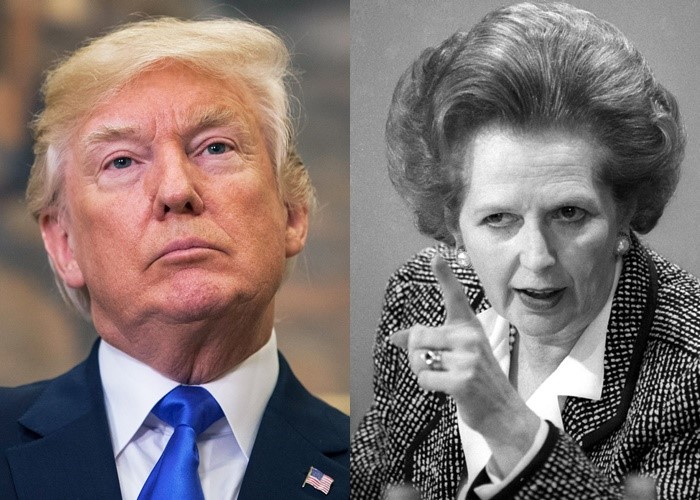
“While anti-fascists had eroded the organisational capacity of the National Front in the late 1970s, Margaret Thatcher had stolen their ideological clothing. As prime minister, she had successfully held together a coalition of support with her blend of jingoism and watered-down Powellism.
Daniel Trilling, Bloody Nasty People: The Rise of Britain’s Far Right (2012)

A rising White Nationalist movement that is somehow stunted in what should be its greatest moment of opportunity. A politically incorrect candidate for office, seemingly unafraid to discuss immigration, and who uses controversial rhetoric touching on race to attract mass support and move victoriously into government. An anti-fascist and left-liberal coalition driven to apoplexy by the repeated intrusion of “racist” arguments and ideas into the national discourse. And a mass influx of coloured migration that somehow continues unabated, perhaps even getting worse. This would be a useful and accurate summary of Donald Trump’s first term in office, which continues to frustrate and confuse those looking for tangible results. As discussions continue on Trump’s putative utility for the anti-immigration cause and on the alternative possibilities of “accelerationism” under a radical left-wing Democrat government, the following essay attempts to offer some advice and lessons from history — a relatively recent history, and one in which all of the important aspects of the Trump phenomenon listed above can be clearly seen. As will be demonstrated from the example of Margaret Thatcher and Britain’s National Front, it is argued here that Trump is an obstacle, and not the way, to the advancement of the Dissident Right.

A Movement on the Rise

The years 2014–16 may in some sense be regarded as a watershed in the recent history of Dissident Right ideas in the United States, and yet they were truly dwarfed by the progress of the Dissident Right in 1970s Britain. Founded in 1967 from a union of the British National Party and the League of Empire Loyalists (and later, the Greater Britain Movement), the National Front was a vehicle for racial thinking and anti-immigration viewpoints at a time when Britain was being swamped by successive floods of coloured migrants from former British colonies. Much like today’s political context, there was a relative neglect of immigration and race-related issues by the mainstream political parties. In yet another important similarity, British industry was beginning to undergo dramatic changes, with the emergence of increasingly troubled and alienated classes of Whites forced to live alongside growing Black and Pakistani enclaves. Simmering inter-racial tensions were being managed, barely, via the gagging of Whites under an increasing number of “race relations” laws, devised almost exclusively by a body of Jewish lawyers. The National Front was able to exploit this context and force its way into the political arena, taking voters from both the Conservative Party and the Labour Party throughout the 1970s.[1] During the period 1972 to 1974, the Front boasted an active and paying membership somewhere between 14,000 and 20,000, and achieved advancement during local elections in 1973, 1976, and 1977. Its electoral influence has been described by scholars as “significant,”[2] and its cultural impact was such that every voter in Britain knew exactly what the movement was, as well as the basic thrust of its ideological trajectory. It was a movement on the rise, and confidence was high. Read more


A Government of Grovelling Goys: Boris Johnson, Friends of Israel and the Second Coming of Cummings

Why aren’t the British Left celebrating? The “one-man melting-pot” Boris Johnson has become the new prime minister. He has Turkish, Jewish, French and English ancestry. Johnson has appointed two politicians of colour to the most important posts in his cabinet: the Pakistani Muslim Sajid Javid is now chancellor and the Indian Hindu Priti Patel is now home secretary. And there are other politicians of colour in other posts, making this cabinet the most “ethnically diverse” in British history.

Boris Johnson gets his priorities right

However, the Left aren’t celebrating. Instead, they’re once again condemning Johnson and his party for racism. They’ve got the so-called Conservatives exactly where they want them: endlessly and fruitlessly chasing the approval of non-Whites. Although the Tories are, like the Republicans in America, completely dependent on White votes to win elections, they never try to advance the interests of Whites or to defend Whites against incessant accusations of racism, bigotry and selfishness. Instead, they embrace the profoundly unconservative and deeply stupid concept of the “proposition nation.” According to the Tories and the Republicans, anyone on Earth can become British or American if they embrace the right “values” and believe in the right ideas.

Serving the Tribe

Meanwhile, the Left harness the primal and potent forces of tribalism as they pursue the only thing that really matters to them: power. But tribalism is actually on plain display in the new Johnson government too. Or rather, it’s Tribalism, with a capital “T.” Johnson, Javid, Patel and Company are all dedicated servants of the world’s oldest, most selfish and most successful tribe: the Jews. However, no mainstream commentator will dare to label this a kosher cabinet. Nevertheless, that is exactly what it is. The dominant lobby-group Conservative Friends of Israel has praised Boris Johnson for his “long history of standing shoulder to shoulder with Israel and the Jewish community.” That’s rather like a puppeteer praising his own puppet for its devotion to duty. As I’ve pointed out in articles like “A Shameless Shabbos-Shiksa” and “How to Win Power and Riches by Betraying Your Own,” Boris Johnson, Sajid Javid and Priti Patel are expert practitioners of the goy-grovel, having endlessly ladled sycophancy on Britain’s tiny but very rich and powerful Jewish minority, and worked non-stop to advance Israeli and Jewish interests.

The Goy-Grovel: Sajid Javid, Priti Patel and Boris Johnson perform at Conservative Friends of Israel (CFI)

Read more

A Rejoinder on White Genocide — and its Cure

Of late, much has been made in the alt-right press of the idea of “White genocide” as an existential threat posed by mainstream society, aimed at the obliteration of Whites in their formerly dominant homelands in Europe and North America.  This movement—conceived and implemented by Jews and their leftist lackeys—is said to portend the virtual or literal end of the White race.  It has no standard definition, and goes by various labels; a recent TOO piece by Richard McCulloch refers, for example, to the “White replacement and destruction movement” (WRDM).  It has been expressed concisely (if ambiguously) by one writer who stated that, on this thesis, “the White race will have no future, and the future will be without the White race.”  It sounds grim.

While it is true that White rule in many nations is under threat, I think it is premature—at least in the coming decades—to decry the physical elimination of Whites anywhere.  Exaggeration and hyperbole do not serve White interests.  We need to think a bit more carefully about ‘White genocide’, and indeed about the concept of genocide itself, lest we get lost in a storm of hype.  Real threats to White interests risk getting subsumed by bogus—or at least exaggerated—dangers.

Let’s start with a look at the word ‘genocide’—a term with thoroughly Jewish origins.  We can begin with standard dictionary definitions, but even here, there is a studied ambiguity.  My Merriam-Webster has a single definition:  “the deliberate and systematic destruction of a racial, political, or cultural group”.  Dictionary.com is very similar, adding only “or national” group.  The construction of the word is straightforward:  geno+cide, from the Greek genos- (birth, origin, or race), and Latin –cide (from cidere:  death, killing).  The word was coined in 1944 by a Polish-Jewish lawyer, Raphael Lemkin, in light of the on-going Nazi attack on Jews.  Etymologically, then, the meaning is, or should be, clear:  the physical death of an entire race of people—that is, the physical elimination of a genotype.

But upon further examination, we immediately run into problems.  First, as anyone knows who studies the issue, the Germans did not seek, nor did they implement, the physical annihilation of the Jews; rather, they wanted something much less ominous:  a German Reich cleansed of Jews, by a process of deportation and removal.  The deaths (and there were many thousands) were an incidental byproduct, not the objective.[1] Read more

Reflections on the West’s Non-White Demographic Revolution: Edmund Burke and the Totalitarian Future of the West

In May of 1789, an armed Parisian mob stormed the Bastille, a potent symbol of the ancien regime’s autocratic power. Their eventual aim was to forge a new social and political order based on the utopian theories of the French Enlightenment. This was historically unprecedented. The cry of the revolutionaries, “Liberté, fraternité, égalité, ou la mort,” reverberated across the Atlantic; it served as the inspiration for revolutions in the Caribbean and Latin America in the years between 1791 and 1826. The Declaration of the Rights of Man and of the Citizen, drafted with the help of Thomas Jefferson, was adopted by France’s National Constituent Assembly in August of 1789. This document is the primary ideological basis of modern-day human rights. Over a century after the French Revolution, Bolsheviks and other radicals were still drawing inspiration from the original revolt against Gallican church and aristocracy. The preponderance of liberal, secular democracies among the world’s sovereign political entities is lasting testimony to the widespread influence of Jacobin thought.

Across the channel, the Whigs, one of the two political parties of the old British parliamentary system–the other being the Tories–openly sympathized with the aims of the French Revolution. Charles James Fox, a noted Whig leader, believed that it was a continuation of the Glorious Revolution, which had ended the threat of Roman Catholic absolutism in Britain by establishing a constitutional monarchy. Months after the storming of the Bastille, a prominent Whig, the dissenting clergyman Richard Price, delivered a sermon in the Old Jewry, a Presbyterian meeting-house. He enthusiastically praised the French Revolution, drawing a favorable comparison between the recent turmoil in France and the events of 1688. Price’s discourse was on the fundamental “principles” of the Glorious Revolution, which he identified as liberty of conscience, resistance to tyranny and the right to “chuse our own governors; to cashier them for misconduct; and to frame a government for ourselves.”

Edmund Burke, an Anglo-Irish Whig with strong Tory leanings, vehemently objected to the idea of cashiering errant rulers for misconduct. Fearing that an unchecked Jacobinism would fan the flames of revolution across Britain, he responded with an impassioned defense of the old order, Reflections on the Revolution in France, written in 1790.  Price’s interpretation of the Glorious Revolution and its significance was mistaken, Burke argued. King James II, through his actions, was considered to have abdicated the crown; William of Orange was then invited to depose James and rule in his stead. By invading Britain, he would save it from the prospect of a Catholic dynasty and a resurgent Catholic faith. Far from being an instance of cashiering and electing “our own governors,” what happened was “a small and a temporary deviation from the strict order of a regular hereditary succession.” The vacant throne would be filled by Mary, the eldest daughter of James; William, her husband, would rule alongside her as co-regent. Read more

The Brutal Reality of Black on White Crime


Putting together a comprehensive list of black-on-white crime is a difficult task for two, superficially contradictory, reasons: 1) There is so much of it. 2) There is so little reporting on it. I doubt there is a day that goes by in the United States without at least dozens of instances of blacks assaulting, robbing, and/or defacing the property of whites. Yet, if all you’re reading is the New York Times, you might guess that crime of that sort takes place half a dozen times a year at most. But, if you start to dig through local news sources, and discover the code words used to discuss black crime (e.g. “youths”), the ocean of write-ups becomes overwhelming. Indeed, American Renaissance has nearly one thousand news items tagged “Black on White Crime,” while Paul Kersey has well over 3,000 blog posts about the matter.

In creating the below list, I sought out to do two things: 1) Cover crimes that were committed and reported on before internet news took over America’s media landscape. That is to say, to feature news stories not already found in several different places online. The most recent year I covered was 2005, which was the first year American Renaissance’s online news feed started publishing stories regularly. 2) Highlight especially brutal crimes. There is so much black-on-white crime, that even “standard” murders and rapes are far too many to count. So instead I focused on those stories that most demonstrate black psychopathy, black hatred for whites, and the schadenfreude so many blacks seem to derive from harming whites in most any way imaginable.

As such, this list should in no way be considered exhaustive—the aforementioned sources, Paul Kersey’s blog and the “Black on White Crime” tag on AmRen, are both more thorough. I have also left unlisted a few of the more well-known cases of black-on-white murder, precisely because there has already been plenty of coverage about them—namely Colin Ferguson’s shooting spree, the killing of Missy McLauchlin and the Wichita Massacre. This list serves instead to show that not only has black on white crime been a standing problem in America for over three decades, but that that crime is made up of some of the most brutal and disgusting acts imaginable. In a world where whites are regularly made to grovel over “micro-aggressions,” jokes, and even simple slips of the tongue, we would do well to remind our liberal fellow-whites what real hate looks like.

——————————————————————————————————————– Read more

Metanarrative Collapse: Has the Christian Cosmology Invented by St. Augustine of Hippo Stood the Test of Time? Part Two

St. Augustine [1]of Hippo (354–430)

Augustine’s Hellenistic Hermeneutic

Augustine’s interpretation of the biblical metanarrative portrays both the creation and the end of the world as the appearance and disappearance of corruptible material existence.  He had no doubt that the New Testament writers were predicting the literal end of the earthly world when, as “[t]he whole Church” expected, Christ would “come down from heaven to judge the living and the dead.”[1]  Augustine was clear that the Day of Judgement applied not just to the people of Israel but to “the rest of the nations as well.”[2]  Faithful Christians, those who live according to the spirit, would exchange the perishable goods of mortal existence for the “Supreme Good” of an imperishable “eternal life” in the City of God.  Other mortals, those who live according to the flesh, would suffer the “Supreme Evil” of “eternal death,” the nothingness inherent in the absolute privation of the Good.[3]  It was out of just such nothingness that the world was created on Augustine’s understanding of Genesis One.  Furthermore, Augustine’s understanding of Genesis 2–3 identifies Adam, not as proto-Israel, but as the first human being.  Accordingly, it not just Old Covenant Israel but mankind as a whole which faces judgement at the end of the world.

Augustine’s neo-Platonic cosmology presupposed the absolute dependence of both mankind and the material world itself on an omnipotent, omniscient, and omnipresent God.  Seduced by the delights of our mortal life “we have wandered far from God,” losing sight of “the invisible things of God.”[4]  The inherent difficulty mortal beings experience in apprehending such invisible divine “objects” must make us eternally thankful for the revealed Word of God.  But a proper understanding of sacred scripture depends upon two things, according to Augustine: “the mode of ascertaining the proper meaning, and the mode of making known the meaning when it is ascertained.”  Understanding the world generally requires that we distinguish between things and signs.  “All instruction is about things or about signs; but things are learned by means of signs.”  There are spiritual as well as material things and signs.  Higher spiritual things are the true objects of enjoyment and use.  A man should view his whole life as “a journey towards the unchangeable life, and his affections [should be] entirely fixed upon that.”[5]

The Bible is both a material and a spiritual thing which can be used or enjoyed in order to understand and participate in the imperishable City of God.  Augustine reminds his readers, however, that not every spiritual or material thing can be judged by its outer form.  On the surface, biblical prophecies of the Day of the Lord may appear to be addressed only to Old Covenant Israel, warning of the impending destruction of Jerusalem.  The inner form of such scriptural signs of things to come can sometimes only be understood “by comparing all the similar passages on the subject which occur in the three evangelists Matthew, Mark, and Luke.”  Augustine points as well to John “who tells us most clearly that the judgement should take place at the resurrection of the dead.”[6]  Clearly, Augustine conceives the resurrection of the dead as a material and bodily, not a solely spiritual, phenomenon.  No such event has taken place; therefore, he expects the fulfillment of that prophecy to occur at some still future time.

Augustine knew, of course, that many “wise men of this world” scoffed at any suggestion “that the earthly bodies of men” can “be carried over into a heavenly habitation.”  To ward off such scepticism, he drew upon an idea that appeared quite suddenly in the late second century AD to defend the idea of a bodily resurrection.  Augustine deployed the doctrine of creation ex nihilo to demonstrate that “He Who in making this world…has already accomplished something far more wondrous than the transformation in which our adversaries refuse to believe.”  If God has already bound “incorporeal souls” to earthly bodies, why should we doubt “that bodies, though earthly, should be raised up to abodes which, though heavenly, are nonetheless corporeal.”[7]

During Augustine’s lifetime, such metaphysical speculation on the origins of matter had already become commonplace among neo-Platonic philosophers such as Plotinus.  Augustine followed Plotinus in contending that “creatio ex nihilo was the expression of God’s omnipotent ability to create without need of supporting causes.”  Such a doctrine was nowhere to be found in the New Testament.[8]  Neither the New Testament writers nor Plotinus were responsible for the connection made by Augustine between the creation story and the eschatological hope of a still future resurrection of the body.

Augustine taught “that because every created intelligence had its origin ex nihilo, it also had to look beyond itself for its end.  Every creature lacked God’s perfection and was therefore mutable.  Because it was mutable it could fall away from that end and become evil.”[9]  At the same time “the resurrection of our Lord from the dead” added “a great buttress of hope” to our faith.  Our bodies, too, after the death we suffer because of sin “shall at the resurrection be changed into a better form…this corruptible shall put on incorruption, and this mortal shall put on immortality.”  He urged the faithful to believe “that neither the human soul nor the human body suffers complete extinction but that the wicked rise again to endure inconceivable punishment, and the good to receive eternal life.”[10] Read more

The Stars at Stake: How the Fight for “Equality” Could Mean the Death of Humanity

In January 2019, a happy, healthy 51-year-old White man called Lee Pomeroy boarded a train for London with his 14-year-old son. He never reached his destination, because en route he got into an argument with a 36-year-old Black man called Darren Pencille. This was a very unwise thing to do, because Pencille won the argument by murdering Pomeroy in a “frenzied attack,” stabbing him “18 times in 25 seconds.”

Lee Pomeroy never reached his destination

This was what I call a “meteor murder.” It flashed through the headlines once when it happened in January and once again when Pencille was convicted in July. Now it’s very likely gone for ever, like many other horrific crimes committed by non-Whites against Whites. There is no mainstream analysis of these crimes and no public lessons are ever drawn from them. Unlike the “racist murder” of the Black teenager Stephen Lawrence, which everlastingly tells us how evil and oppressive Whites are towards non-Whites, the murder of Lee Pomeroy tells us nothing about “race relations.” Absolutely nothing! Lee Pomeroy was a random victim of a misguided fellow human, like the academic Dr Jeroen Ensink, who was stabbed to death by a Black in 2015, or the beautiful White teenager Christina Edkins, who was stabbed to death by a Black in 2013, or the naïve White teenager Mary-Ann Leneghan, who was raped, tortured and murdered by a Black gang in 2006, or the scores or even hundreds of elderly White women raped by a Black gerontophile from 1992 to 2006.

Non-Whites don’t belong in White societies

“There’s nothing to see there, folks! Just move on!” That’s the message of the mainstream media. Of course, the message reverses the truth. There’s an enormous amount to see in such crimes. They form a detailed and extended proof that Blacks and other non-Whites do not belong in White societies and should never have been allowed to enter them. The murder of Stephen Lawrence has been endlessly re-visited in order to promote a giant lie: that wilful White racism explains all non-White failure and dysfunction. The murder of Lee Pomeroy will be forgotten in order to conceal a giant truth: that non-White pathologies arise from non-White genetics and culture, not from White malevolence.

For example, Pencille has been described as a “paranoid schizophrenic,” just like the Black murderers of Dr Jeroen Ensink and Christina Edkins. Rates of paranoid schizophrenia are higher among Blacks, inflicting huge expense on White society even when the Blacks in question don’t take illegal drugs and act violently. But I can see more in Lee Pomeroy’s murder than yet another lesson about non-White genetics and culture. Lee Pomeroy was travelling somewhere on that train. He had a destination and never reached it, thanks to a dysfunctional Black with a history of criminal violence. And so Lee Pomeroy and Darren Pencille may offer us an allegory of the entire human race. A giant task lies before the most intelligent and technologically competent groups of human being. We cannot leave all our eggs in the basket of the planet Earth. We need to get off the planet and establish permanent, self-sustaining bases elsewhere in the solar system and even the galaxy. Read more