Featured Articles

A conversation with Kevin B. MacDonald

Kevin B. MacDonald is an American psychologist. A retired professor of psychology at California State University, Long Beach (CSULB), he is best known for writings that characterize Jewish behavior as a “group evolutionary strategy.”

 Grégoire Canlorbe: It is not uncommon to employ the locution “Judeo-Bolsheviks” to designate the 1917’s revolutionaries in Russia. Yet one seldom speaks of “Judeo-Libertarians,” even though the main intellectual leaders of libertarianism (or free-marketism) in the twentieth century were Jews: let one think of Milton Friedman, Israel Kirzner, Ayn Rand, Murray Rothbard, or Ludwig von Mises. How do you explain it?

Kevin B. MacDonald: CofC stands or falls depending on whether I have adequately described certain specific intellectual and political movements as Jewish. In doing so, I focused on movements that were or are influential and provide evidence of their influence. In describing these movements, I focus on the main figures, discuss their Jewish identities and their concern with specific Jewish issues, such as combatting anti-Semitism. I discuss the dynamics of these movements—the authoritarian atmosphere, the guru phenomenon, ethnic networking, and non-Jews who participate in the movement. I am not attempting to discuss all well-known Jewish intellectuals if they are not part of these movements. Thus, I never claim that Marx was part of a specifically Jewish intellectual/political movement, since he died long before the rise of the Jewish left in the twentieth century which is the focus of CofC. Milton Friedman was a well-known Jewish intellectual, but he may not fit into any of the movements I discuss, and I have never investigated the nature of his Jewish identity (or lack of it) or how he sees Jewish interests. He may well be a neoconservative, a Jewish movement whose members were quite critical of communism for entirely Jewish reasons (e.g., anti-Jewish attitudes of the USSR government ; Soviet and now Russian positions on foreign policy regarding the Middle East (see “Neoconservatism as a  Jewish Movement”). Or one could point to a Jewish supporter of the populist positions of President Trump, but the existence of such a person does not make populism a Jewish movement or erase the effective opposition of the New York Intellectuals to American populism in prior decades as discussed in Chapters 5 and 6 of CofC.

  1. Individual influential Jews or a separate influential Jewish intellectual movement may be critical of a specific Jewish intellectual movement that I discuss, as Friedman was critical of communism — a movement that attracted many Jews, especially after the success of the Bolshevik Revolution, as discussed in Chapter 3 of CofC and in my reviews of Slezkine and Weingarten. Another example is the split beginning in the 1930s between the Stalinist left, which is the topic of Chapter 3, and the Trotskyist left which is a topic of Chapter 6 and “Neoconservatism as a Jewish Movement,” comes to mind. It is possible that opposition to the Israel Lobby may also be reasonably analyzed as a Jewish movement. I have not attempted this, although I have noted in several places that criticism of Israel is increasing among Jews and non-Jews. But in order to establish that critics of Israel constitute a Jewish movement, one would have to pursue the program presented in CofC: discuss whether participants have a Jewish identity and whether they see their activities as furthering Jewish interests as well as explore the dynamics of these movements—whether there is any evidence for an authoritarian atmosphere, the guru phenomenon, ethnic networking, and the status of non-Jews who participate in the movement.

This project would thus go well beyond the “default hypothesis” of Jewish IQ as explaining Jewish involvement in intellectual movements. Such situations may be analogized to arguments between different factions in the Knesset—both dominated by Jews but with different perceptions of Jewish interests.

  1. I am therefore not attempting to develop a general theory of Jewish viewpoint diversity. I am studying certain specific intellectual and political movements that I attempt to establish as influential. I am not trying to develop a theory of why each Jew or most Jews believe what they do—a much more ambitious project. Thus, for example, I have no interest in describing or explaining the diversity of Jewish attitudes on affirmative action— an interesting question, but not relevant to the thesis of CofC which is that certain specific Jewish movements have the features I describe and that they have been influential. Nevertheless, as discussed below, at particular times and places, there is often substantial consensus within the Jewish community on particular issues, e.g., immigration and refugee policy, Israel, and church-state relations.
  2. My writing in CofC is restricted to the movements discussed therein— movements that I have argued have been influential in the twentieth century and whose influence often extends into the present. In addition to these movements, it may well be the case that I have left out individual influential Jews, such as Milton Friedman whose attitudes would seem to be typical of Jewish neoconservatives.

This response is based on my Second Reply to Nathan Cofnas, posted in 2018. Read more
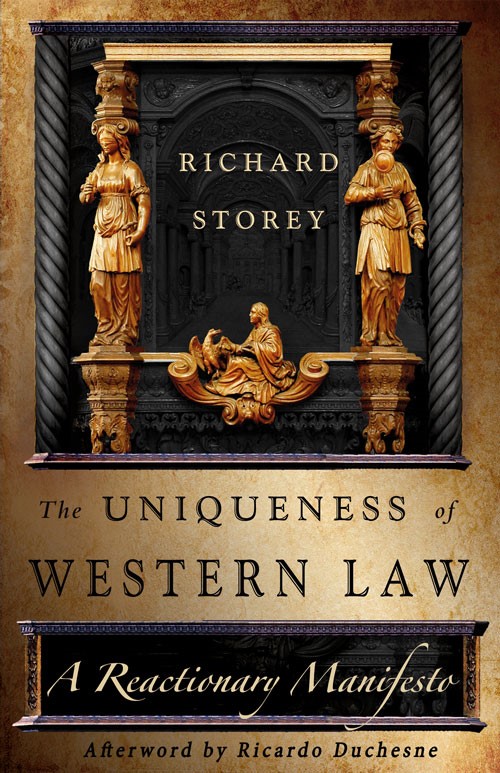
Review: of Richard Storey’s The Uniqueness of Western Law

The Uniqueness of Western Law: A Reactionary Manifesto
Richard Storey
Arktos, 2019

With Washington Summit taking a hiatus and Counter-Currents more or less capitulating in the face of a rapid sequence of Amazon bans, Arktos has emerged as one of the most prolific and stable of the Alt-Right’s publishing brands. Some of this success and stability may be due to the brand’s ability to secure translations of works by familiar names like Alain de Benoist and Julius Evola, as well as bring forward work from new, innovative, and fresh young thinkers like Richard Houck. But I think another, and possibly more important, element contributing to the brand’s ongoing growth and development is consistency — consistency in leadership, editorial standards, production values, and manuscript selection. Over the last couple of years, as a voracious reader of content on numerous topics from multiple sources, I’ve come to appreciate the consistency offered by Arktos in all of these areas. I recently acquired a number of their new titles covering a range of subjects, some of which I expected to agree with wholeheartedly, and others that I thought might challenge me or broaden my understanding in certain areas. Of these, Richard Storey’s self-described “Reactionary Manifesto” fell somewhere in the middle of these expectations. Marketed as “an original interpretation of libertarian theory,” the book was guaranteed to pique my curiosity.

I am not a libertarian, nor have I ever embraced any such political identity or affiliation. My thinking regarding the broader trajectory of libertarian thinking is absolutely in line with that laid out by my TOO/TOQ colleague Brenton Sanderson in his landmark essay “Free to Lose: Jews, Whites & Libertarianism” (TOQ, vol. 11, no., 3; Fall, 2011) For Sanderson, the Jewish intellectual origins of economic libertarianism are explained by the fact that

free markets advance the interests of Jews through imposing an impersonal economic discipline on non-Jews through which their ethnocentricity and anti-Semitic prejudice can be circumvented. … Jews have indeed prospered under the conditions of free market capitalism among often hostile majority European-derived populations. … Jews, even in the freest of markets, are notorious for developing and using ethnic monopolies. … Accordingly, the free-market libertarian agenda, when promoted in the context of a society that is multi-racial, and where some racial groups exceed Whites in the degree of their ethnocentricity, may not promote the group evolutionary interests of Whites in enhancing their access to resources and reproductive success.

Sanderson continues:

It seems evident from the foregoing that the only time that Whites will be acting in their own evolutionary self-interest in embracing the free-market libertarian agenda will be when they either live in a racially homogeneous society where their group interests are not imperiled by the utility-maximizing behavior of individuals; or in a multi-racial society where competing racial groups do not exceed Whites in their ethnocentrism, or exceed Whites in their ethnocentrism but lack the native endowment of intellect to capitalize on this by effectively employing altruistic group strategies in competition with individualistic Whites. … It would seem that libertarian ideas are particularly hazardous to the collective interests of White people because we are naturally attracted to them. As MacDonald notes, our evolutionary history makes us prone to individualism in the first place. You then get a negative feedback loop where libertarian ideology intensifies this innate individualism to encourage ever greater individualism among Whites, and an ever greater aversion to manifestations of White ethnocentrism. Thus, where the spirit of free market libertarian individualism reigns, Whites willingly maximize their individual self-interest at the expense of the group evolutionary interests of the White community — with disastrous long-term consequences.

In terms of analysis, this simply can’t be improved upon. Sanderson’s essay serves as a devastating critique of libertarianism from the standpoint of White ethnic interests, and it has been, and remains, very influential on my thinking about the topic. Thus, even before I opened Richard Storey’s text, I thought that its success would be determined to a large extent by the manner in which it addressed the core issues of ethnic interests and how it grappled with the fact Whites seem uniquely susceptible to individualistic and atomizing ideologies. The fact that Storey is known to frame his thinking in an outwardly Catholic fashion also raised possible doubts as to its potential for wider appeal. Fortunately, this short but remarkably efficient volume rose to the challenge. Read more

Love Islam, Hate Freedom: Leftists Are Eager to Exploit the Christchurch Massacre

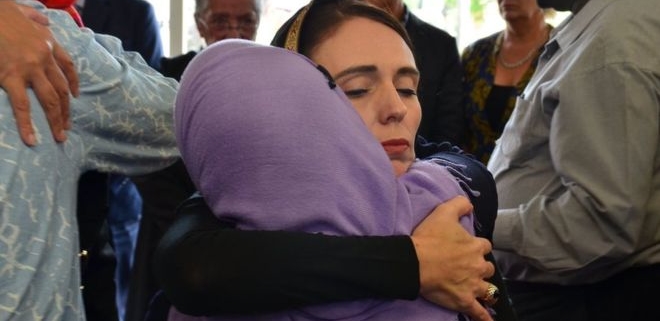
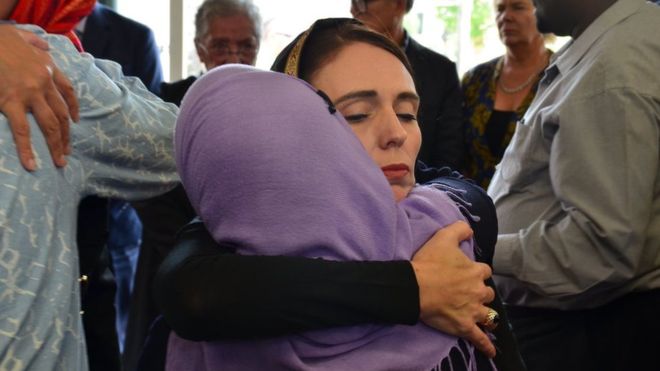
Hugs Against Hate: Jacinda Ardern Postures for the Camera

Like chutzpah, narcissism comes in different forms for different people. Some are narcissistic about their faces or their physiques. But it would be difficult for the New Zealand prime minister Jacinda Ardern to be narcissistic in that way, because she’s a typically effete left-wing politician. Instead, as the Christchurch massacre confirmed, she’s a psychological narcissist. Like countless other SJWs, she postures and preens before a moral mirror, convinced of her own virtue and goodness.

You must trust the virtuous leftist elite

That’s why Ardern will now impose strict gun-controls on dangerous Whites in New Zealand, so they can’t rebel against the Islamically-enriched multi-racial Utopia being created for them by their moral superiors. I prefer the cynicism and common sense of that old reprobate William S. Burroughs (1914—97), who said: “After a shooting spree, they always want to take the guns away from the people who didn’t do it. I sure as hell wouldn’t want to live in a society where the only people allowed guns are the police and the military.”

Burroughs wasn’t a narcissist and didn’t believe in the benevolence or wisdom of any elite. He wanted ordinary people to be able to defend themselves and protect their freedoms.

I blame Orbán, Salvini and Trump: Judeo-Journo Jonathan Freedland

Burroughs was a stale pale male, of course, but not everyone in the stale pale male community agrees with him. Someone who certainly doesn’t is the propagandist Jonathan Freedland, a Jewish activist with a prominent position in the mainstream media in Britain. He sides with the virtuous Jacinda Ardern, not with the reprobate Burroughs. And when an Australian murders Muslims from the Third World in New Zealand, Freedland knows exactly who is to blame: the prime minister of Hungary, the interior minister of Italy and the president of America. After the Christchurch massacre, he plugged the standard Jewish line on mass immigration and Islamic enrichment. All criticism of these things is evil and has to end:

Consider the message of Viktor Orbán, prime minister of Hungary, who repeatedly casts himself as the defender of a Christian European civilisation under mortal threat from Muslim immigration. Or Matteo Salvini in Italy, who presses the same buttons, winning power last year by arguing, among other things, that: “I don’t want to end up like Great Britain, which has Islamic courts instead of British courts.”

If these men give legitimacy to the narrative of “replacement”, then their ideas are, in turn, legitimated by the populist-in-chief in the White House. White nationalists in Europe and beyond were hugely encouraged by the 2017 speech Donald Trump delivered in Warsaw, depicting a Christendom under siege. “Do we have the desire and the courage to preserve our civilisation in the face of those who would subvert and destroy it?” he asked. (To prevent another Christchurch we must confront the right’s hate preachers, The Guardian, 15th March 2019)

Freedland wants this “ecosystem of hate” cleansed by censorship and tough internet controls. Labour councils in Rotherham, Huddersfield and Telford had — and have — the same attitude to the “narrative” of White girls being raped by Muslim men. It’s a nasty narrative, so they censored it and refused to listen. Read more

Ed Dutton with an Evolutionary Perspective on the Rape of Finland

The Silent Rape Epidemic: How the Finns Were Groomed to Love Their Abusers
Edward Dutton
Oulu, Finland: Thomas Edward Press, 2019

Finns enjoy an unusually high-trust society. Longtime British resident Ed Dutton describes unmanned roadside vegetable stands that operate on the honor system, with customers reliably leaving the correct price for what they take. Travelers need not purchase a ticket before boarding a train; everyone happily pays the conductor as he comes through. At least until recently, girls in outlying villages could safely hitchhike into larger towns on Saturday nights.

Oulu (pronounced Oh-loo) is the largest city in northern Finland. It tends to be a dull place, and residents like it that way:

Very little crime, very little conflict; very little to report: Everyone eating the same kind of food, wearing the same kind of clothes, following the same cultural traditions: trusting, safe, predictable. The perfect place to raise a child.

By 2005, however, the city had begun accepting small numbers of Muslim ‘refugees.’ That summer,

a 30-year-old worker for the Finnish Lutheran Church had been naïve enough to get talking to a group of Muslim men in a bar and, worse still, go back to their flat. She was rewarded for her friendliness towards these guests by having her clitoris cut off with a pair of scissors which were then inserted into her vagina.

During the next couple of years, several local women were raped by Muslim men in city parks. By 2008, the trend was being reported in a national tabloid—which, however, failed to mention that all of the assaults had been carried out by Middle Eastern men. Oulu’s local daily, Kaleva, stopped reporting perpetrators’ names. As in other Western countries, Finnish journalists tend to be aggressively cosmopolitan leftists who despise the folks back home, ordinary Finns with “their simple desire for a picturesque wooden house close to a lake; their contentment living in a society where people mostly think in the same way.” If such narrow-minded yokels were to learn what was really going on, the multicultural project might be threatened!

Soon, the names of Muslim criminals were being redacted from police and court press releases as well. Official reports spoke only of men “of foreign background,” as if Finnish women were being attacked by German tourists or Japanese guest lecturers from the local university. But the authorities knew the truth: a 2018 a study by the Finnish Police Academy found that 93% of rapes of foreigners in Finland in 2016 had been committed by men from Islamic countries. Read more

The Role of Empathy in Moral Communities: Altruism—and Pathological Altruism

Editor’s note: This is an excerpt from a book to be titled Western Individualism and the Liberal Tradition: Evolutionary Origins, History, and Prospects for the Future. It is completed apart from proof-reading and deciding how to publish it now that Amazon has become part of the thought police. 

In a later section of this chapter on race differences in personality, I describe the personality system of Nurturance/Love personality system and note that this system is stronger in European culture than other human cultures (see also Chapter 3). Briefly, Nurturance/Love is an evolved system linked to specific brain regions coding for positive feelings in response to being loved and nurturing others; empathy—which results in personal distress at seeing the suffering of others, especially loved ones—is a central emotion of the Nurturance/Love system. The extreme ends of individual differences in the Nurturance/Love system are linked to sociopathy at the low end (callous unconcern regarding the feelings of others, lack of remorse, cruelty) to dependency disorder (overly prone to needing social approval and love) and pathological altruism (overly prone to empathy to the point of self-sacrificing, self-harming behavior) at the high end.[1] Because of its role in cementing family relationships and nurturing children, women are higher on the Nurturance/Love system than men.

For individualists (i.e., people who are less prone to negative attitudes toward outgroups and strangers), being on the high end of empathy can easily lead to a pathological form of altruism where high costs can be incurred with no corresponding benefit. Pathological altruism is generally defined as focusing on others’ needs to the detriment of one’s own needs.[2] Such altruism, motivated by what one might label “hyperempathy,” is more common among females­—which fits with females’ generally being higher on the Nurturance/Love system.[3] It can lead to pathological consequences for both the altruist and the intended beneficiary, as in the phenomenon of co-dependence where one person’s altruism facilitates maladaptive behaviors in another person, such as drug addiction by being overly solicitous and tolerant of other’s self-destructive behavior. Pathological altruism often involves a sense of self-righteousness, which can be translated as a sense of moral superiority that advertises one’s good reputation within a community defined, as prototypical European groups are, not by kinship but by conforming or exceeding the moral standards of the community. As noted above, such expressions of moralistic self-righteousness have a long history in Western societies and are very salient in contemporary political rhetoric.

An example of how self-righteous virtue signaling works at the highest levels of government (also illustrating the gap between elites and the rest of society on critical issues like migration), can be seen in the comments of David Goodhart, a liberal journalist based in the UK, on the migration into the UK:

There has been a huge gap between our ruling elite’s views and those of ordinary people on the street. This was brought home to me when dining at an Oxford college and the eminent person next to me, a very senior civil servant, said: ‘When I was at the Treasury, I argued for the most open door possible to immigration [because] I saw it as my job to maximise global welfare not national welfare.’ I was even more surprised when the notion was endorsed by another guest, one of the most powerful television executives in the country. He, too, felt global welfare was paramount and that he had a greater obligation to someone in Burundi than to someone in Birmingham. … [The political class] failed to control the inflow more overtly in the interests of existing citizens.[4]

An evolutionist can only marvel at the completely unhinged—pathological—altruism on display here, given that the speakers are themselves native White British. Countries whose policies ignore the good of their own people are surely headed for disaster. Such altruism is nothing but a recipe for evolutionary extinction. Read more

Warring on Whiteness: Stale Pale Males vs Vibrant Varicolored Vixens

Chutzpah is a Yiddish word meaning brazen effrontery or impudence. You could say that someone who displays chutzpah is spitting in the face of morality and logic. Appropriately enough, the very word sounds like an expectoration: the ch is pronounced as in German “Bach,” or Scottish “loch,” and the u as in English “sugar.”

“Pity the Poor Jews”

Chutzpah comes in many forms and has many practitioners. In “Power to the Perverts,” I described Jonathan Yaniv, a “trans-identified” Canadian who sued sixteen women for refusing “to wax his balls.” Now that’s chutzpah. The journalist Mark Steyn is another Canadian and another practitioner of chutzpah. He has just got his violin out for a heart-rending rendition of his old favourite song “Pity the Poor Jews.” According to him, there are “Two-Mile Tailbacks at Jew-Hate Junction”:

As Laura Rosen Cohen likes to say, everyone meets at Jew-Hate Junction: excitable young Mohammedans, secular polytechnic Euro-lefties, anti-globalist conspiracy theorists. … Young Muslims do not like Jews: that is a simple fact, and it’s a waste of everybody’s time denying it. Where Muslims predominate, Jews vanish — as in Molenbeek, across the canal from downtown Brussels. …

Ethnic Continentals, on the other hand, do not like Muslims, and they see where this is headed, and it’s easy to blame Jews. The logic is not difficult: ’Tween-wars Europeans would never have entertained for a moment the construction of mosques in every corner of their countries. But then the Holocaust happened, and “nationalism” got blamed, and mass immigration was instituted as a form of penance, and in one of history’s blacker jests the principal beneficiary of Holocaust guilt was Islam. So, in the newest variant of the oldest hatred, Jews get hated for the Islamization of Europe. (Two-Mile Tailbacks at Jew-Hate Junction, SteynOnline, 6th March 2019)

Steyn goes on to discuss the “Jew hate” of Ilhan Omar, the “savvy Somali” Congresswoman who is a rising star of the Democratic party in America. He condemns the Democratic “House Leadership” for failing to put Omar in her place and defend America’s beleaguered Jews: “Like Corbyn in London, it [the House Leadership] can no longer even insist on its anti-Semitic bona fides without weaseling and equivocating.”

Innocent victims of Islamization

When Mark Steyn condemns someone for “weaseling and equivocating,” you should pay attention. He knows what he’s talking about, because he himself is an expert practitioner of those essential political arts. His article about “Jew hate” is replete with them. Take his assertion that “mass immigration was instituted [in Europe] as a form of penance [for the Holocaust]” — exactly the sort of off-the-cuff explanation that has a certain surface plausibility that will pass scrutiny in the mainstream media but completely fail any serious attempt at getting to the roots of what actually happened. Why did Steyn say “was instituted,” using the passive voice? Well, Steyn himself is “weaseling,” because he wants to avoid the questions of precisely who “instituted” mass immigration as penance for the Holocaust and precisely how Jews reacted to this penance.

The answers to those questions are not at all helpful for Steyn’s portrayal of Jews as innocent victims of the “Islamization of Europe.” For example, why does Britain have so many of Ilhan Omar’s fellow Somalis? It’s thanks to the Jewish Islamophile Barbara Roche, the Labour immigration minister who “entered politics … to combat anti-semitism and xenophobia in general.” (See also Andrew Joyce’s “The SS Empire Windrush: The Jewish Origins of Multicultural Britain.”) As part of Roche’s combat, she granted “more than 200,000” Somalis “exceptional leave to remain” in Britain despite the fact that “most were untrained and would be dependent on welfare.”

“Jews and Muslims are natural allies”

Roche wasn’t doing “penance” for the Holocaust but working to atomize Britain for the benefit of Jews. After all, Dr Richard Stone, Jewish high priest in the martyr-cult of Stephen Lawrence, says that “British Jews and Muslims are natural allies.” This is not a “fringe” or minority view among European and American Jews, but absolutely mainstream. In the New York Times, the Jewish journalist Bari Weiss has shaken her head in disappointment over Ilhan Omar’s missteps:

The particular challenge in the case of Ms. Omar is that she is exactly the kind of politician a vast majority of American Jews, who overwhelmingly vote Democratic and who have long aligned themselves with liberal causes, want to celebrate: Here is a refugee, a mother, a Muslim and a woman of color — the first woman of color to represent Minnesota in Congress. It’s no wonder she has already landed on the cover of Time magazine and in front of Annie Leibovitz’s camera. Who wouldn’t want to cheer her on? … It may be more difficult to call out those who ought to be our friends and political allies, but alas for the Jews, not all anti-Semites carry tiki torches. (Ilhan Omar and the Myth of Jewish Hypnosis, The New York Times, 21st January 2019)

As you can see, Jews in America don’t see mass immigration by Muslims as “penance” for the Holocaust, but as a way of recruiting “friends and political allies.” Jews “want to celebrate” Ilhan Omar because she is the antithesis of the stale pale males who founded and shaped America. She is Black, not White; Muslim, not Christian; female, not male.

In short, mass immigration isn’t “penance” by European Whites, but revenge on European Whites. Barbara Roche and Bari Weiss are goyophobes, or haters of White gentiles, in the same way as Sabrina Rubin Erdely, the Jewish journalist who created the hate-hoax about “gang-rape on broken glass” among “the toned, tanned and overwhelmingly blond students” of the University of Virginia.

Snarling in triumph

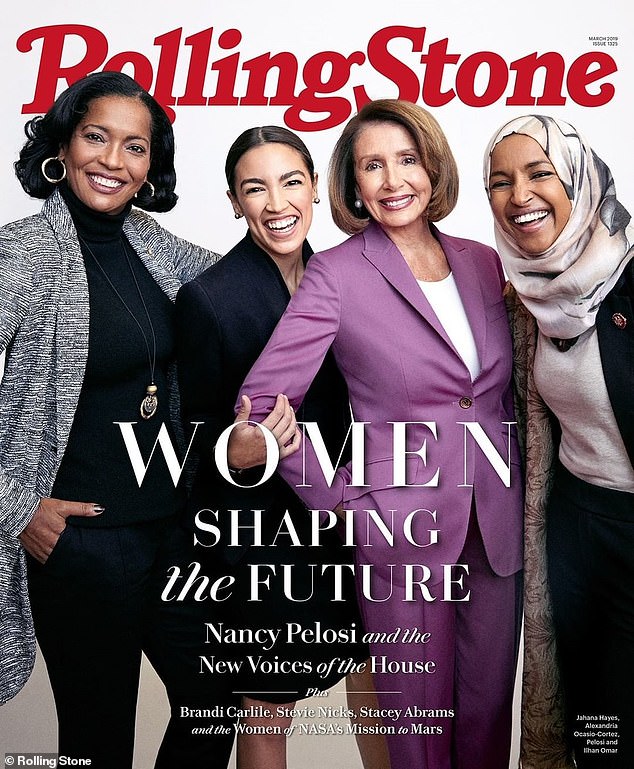
That gang-rape hate-hoax ran in Rolling Stone, the hipster magazine published and co-founded by the Jewish homosexual Jann Wenner (born 1946). The magazine paid millions in damages to some of those it defamed in the hoax, but its goyophobia is as strong as ever. Rolling Stone didn’t simply “want to celebrate” Ilhan Omar, but actually and unequivocally did so by placing her on its cover for March 2019:

Vibrant varicolored vixens: Ilhan Omar and Alexandria Ocasio-Cortez, Rolling Stone #1323

Omar appeared on the cover with the senior Congresswomen Nancy Pelosi and Jahana Hayes, and with another new and vibrant Congresswoman, Alexandria Ocasio-Cortez, who has claimed “Jewish roots that span back 500 years to the Spanish Inquisition.” It’s interesting to compare the facial expressions of the older and newer generations of female Democrat. Pelosi and Hayes are smiling moderately, but Omar and Ocasio-Cortez are almost snarling in triumph. Their canine teeth are fully exposed and their nostrils are raised. Their message for their older colleagues seems to be: “We’re the future, you’re the past!” Read more

The Glories of Gandhara: Lessons for Identitarians

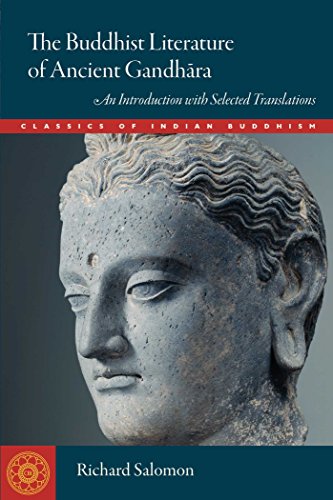
The Buddhist Literature of Ancient Gandhāra: An Introduction with Selected Translations
Richard Salomon
Somerville, Massachusetts: Wisdom, 2018

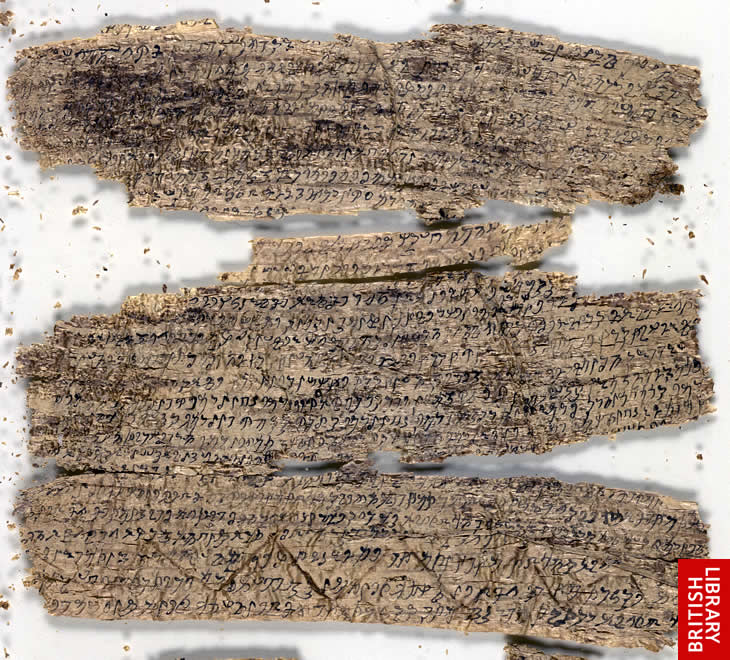
This is a fine book of translations of mysterious Gandharan Buddhist manuscripts. The context provided by Richard Salomon is excellent, providing a comprehensive overview of the little we know of ancient Buddhism and of the various sources: (enormous or fragmentary) Buddhist canons (Pali, Chinese, Tibetan, Sanskrit), archaeological sources (artifacts, inscriptions), and later legends and tales. Salomon emphasizes how little we know about ancient Buddhism from Gautama to Ashoka and indeed about ancient India in general.

Salomon’s long introductory chapters alone are worth the price of the book. I love it when a historian is able to draw a coherent picture from a great mass of wildly heterogeneous material (e.g. W. M. Sale on the Iliad, Brigitte Hamann on young Hitler, Fustel de Coulanges on the Indo-Europeans, David Engels on Roman decline).

Between the second century B.C. and the fourth century A.D., Gandhara, in what is today the rather hellish countries of Pakistan and Afghanistan, was a thriving Indic kingdom ruled by successive waves of Indo-European conquerors (Greeks, Scythians, Kushans . . .). As so often in multicultural empires, a period of syncretic flourishing was followed by total dissolution, with the disintegration of the state and of the ethnic elite with a stake in the commonwealth — quite comparable to what occurred in ancient Rome.

The typical appalling state of surviving Gandharan manuscripts

Read more