• MISSION STATEMENT
  • TERMS
  • PRIVACY
The Occidental Observer
  • HOME
  • BLOG
  • SUBSCRIBE TOQ
  • CONTACT USPlease send all letters to the editor, manuscripts, promotional materials, and subscription questions to Editors@TheOccidentalObserver.net.
  • DONATE
  • Search
  • Menu Menu

Free Speech

A Jewish Mayor’s Mission to Turn Miami Beach into a Haven for Jewish Supremacy

January 30, 2026/8 Comments/in Featured Articles, Free Speech/by Jose Nino

​​Steven Meiner’s tenure as Miami Beach’s Orthodox Jewish mayor reveals his mission to make South Florida a secure redoubt for organized Jewry, leveraging police visits on dissenters and public outrage over Nazi anthems to consolidate ethno-religious power. In January 2026, Miami Beach Mayor Steven Meiner faced two incidents that showcased his commitment to upholding Jewish interests no matter the context.

At Vendôme nightclub, right-wing influencers such as Andrew Tate, Nick Fuentes, and Sneako celebrated while Kanye West’s song “Heil Hitler” blared through speakers during a VIP bottle parade. Meiner, whose grandparents’ families died during World War II, sharply criticized the incident. A few days before, Miami Beach police detectives appeared at veteran Raquel Pacheco’s home, questioning her about a Facebook comment criticizing the mayor’s support for Israel.


What connected these incidents was the application of Jewish power at the municipal level. The woman visited by police had accused Meiner of calling for Palestinian deaths and censoring a documentary about Israeli occupation. For the Orthodox Jewish mayor who has transformed Miami Beach governance into an expression of his religious identity and Zionist convictions, these moments revealed his willingness to use state power and informal pressure mechanisms to intimidate individuals critical of Jewish endeavors.

Steven Meiner’s story begins in Brooklyn, where he was born around 1970 to Sheldon Meiner, a career IRS agent, and Dorothy Weiss Meiner, a public school teacher and guidance counselor. Raised in an Orthodox Jewish home in Brooklyn and later Staten Island, he attended the Yeshiva of Flatbush, a flagship Modern Orthodox day school that would shape his religious identity for life.

Meiner excelled academically. He graduated summa cum laude from Brooklyn College, was elected to Phi Beta Kappa, and majored in political science. On top of that, he earned his J.D. cum laude from Brooklyn Law School.

After law school, Meiner joined the upper echelons of New York corporate law. Between 1998 and 2002, he worked at Dewey Ballantine, focusing on complex financial litigation. From 2002 to 2007, he continued at Mayer Brown, handling large scale financial and securities disputes.

In 2007, Meiner made a pivotal move in relocating to Miami Beach and joining the U.S. Securities and Exchange Commission as a civil enforcement attorney in its Miami office. Over roughly 17 years, he remained at the SEC while simultaneously building a profile in Miami Beach civic life.

Before holding elected office, Meiner served on Miami Beach advisory panels and was active in local charitable organizations. In 2012, he was recognized as Man of the Year by a local civic group, placing him within the city’s professional Orthodox Jewish and civic networks well before his first campaign.

In November 2019, Meiner ran for Miami Beach City Commission Group IV and won a runoff against former commissioner Kristen Rosen Gonzalez in what local press described as an upset. Orthodox outlets highlighted that he was, by their account, the first Orthodox Jew ever to sit on the Miami Beach commission.

As commissioner from 2019 to 2023, Meiner’s brand coalesced around public safety, pushing to expand the city’s misdemeanor prosecution program and increase successful prosecutions for quality of life offenses.

When term limits forced out Mayor Dan Gelber—also of Jewish confession—in 2023, Meiner ran for mayor as a No Party Affiliation candidate, though he had been a registered Republican until switching to NPA in 2018. In a four-way race including Michael Góngora, Mike Grieco and Bill Roedy, Meiner advanced to a runoff with Góngora and won with roughly 54% of about 10,000 votes, becoming the 39th Mayor of Miami Beach.

He branded himself as tough on crime by vowing to clamp down on Spring Break chaos, jail homeless people who refused shelter, expand city prosecutor powers, and restrain overdevelopment. In 2023, he eschewed political committees, and raised $86,600 through his campaign committee, with the vast majority coming from personal checks.

Beyond tackling local issues, Meiner used his mayoral position to assert the Jewish community’s racial will to power. In early 2024, after pro-Palestinian demonstrations took place near Art Basel and at Jewish sites, Meiner sponsored and secured passage of an ordinance making it a crime to obstruct streets or sidewalks after being ordered to clear them, while requiring that an adequate and available alternative forum be offered for protests.

Meiner justified the ordinance by citing an incident in which he said pro-Palestinian protesters harassed elderly Jewish residents leaving their synagogue, drawing parallels to National Socialist Germany. At the city commission hearing, he repeatedly cut off and yelled at speakers, who criticized Israel’s conduct in Gaza or mentioned Gaza in relation to the ordinance.

He told one speaker he would not allow her to “debase and lie about the Israeli government” and cut her microphone. Civil liberties advocates argued that despite formal First Amendment carve outs, the law and Meiner’s conduct signaled that pro-Palestinian speech would be policed much more harshly in Miami Beach than pro-Israel speech. For his steadfast defense of the Jewish community in the immediate aftermath of the October 7 attack by Hamas, the Greater Miami Jewish Federation sent a formal letter to Meiner and the city commission praising the Miami Beach Police Department for its unwavering commitment to protecting synagogues, Jewish schools, the Holocaust Memorial, and the Jewish Community Center.

One of Meiner’s most nationally visible conflicts emerged in early 2025 over O Cinema, a non-profit art house theater leasing space in a city-owned historic building. After O Cinema scheduled screenings of No Other Land, an Oscar-winning documentary about Palestinian dispossession in the West Bank, Meiner sent the theater a letter demanding cancellation of the showings.

He characterized the film as a “one-sided propaganda” attack on the Jewish people that is inconsistent with the values of the city and its residents. He introduced a resolution to terminate O Cinema’s lease, revoke at least $40,000 in previously approved city grant funding, and cut off future subsidies, explicitly tying this to the decision to show No Other Land.

O Cinema initially considered canceling but reversed course within hours, asserting that compliance would betray their mission and the First Amendment. Civil liberties groups including PEN America and Artists at Risk Connection condemned Meiner’s move as “beyond the pale,” warning that terminating a lease in retaliation for film content would constitute unconstitutional viewpoint discrimination.

At a March 2025 commission meeting, it became clear Meiner lacked support from his colleagues. Under pressure, he withdrew the lease termination resolution and tabled a related measure urging O Cinema to screen films reflecting the perspective of the Jewish people and the State of Israel. Nonetheless, he continued publicly describing No Other Land as a false attack on the Jewish people and a public safety threat.

By his 2025 re-election bid, Meiner had moved from his earlier anti-PAC posture to soliciting funds for Miami Beach First, a political committee backing his campaign. According to an investigation by The Real Deal, while Meiner touts a tough line against overdevelopment, Miami Beach First had been heavily funded by major real estate and hospitality figures of Jewish extraction.

Stuart Miller, the Jewish co-CEO of home construction company Lennar, contributed $50,000. Michael Simkins and Marc Roberts, co-owners of E11even nightclub, gave $35,000 combined. David Grutman of Groot Hospitality contributed $20,000. In addition, New York’s Naftali Group pitched in $10,000.

Backed by Jewish donors and the local Jewish community, Meiner pressed forward with his campaign to turn Miami Beach into a safe space for organized Jewry. In January 2026, Meiner’s approach to dissent drew intense national scrutiny when Miami Beach police visited Raquel Pacheco’s home over a Facebook comment she posted criticizing him. Pacheco had replied to an official mayoral Facebook post in which Meiner described Miami Beach as a sanctuary for everyone and one of the most tolerant cities in the country.

Her response accused him of consistently calling for the death of all Palestinians and trying to shut down a theater for showing a movie that hurt his feelings. About six days later, two detectives from the Miami Beach Police Intelligence Unit arrived at her home, showed her the comment, and questioned whether she had written it.

On video, they stated they were concerned her words could spur somebody to commit an extreme act and advised her to refrain from posting similar content. Pacheco refused to answer questions without a lawyer present.

Axios and local reports initially cited police sources saying Meiner’s office had flagged the Facebook post. The Miami Beach Police Chief later issued a statement claiming he alone ordered the visit, while affirming that the mayor had no role in directing enforcement.

The Foundation for Individual Rights and Expression called the visit an “egregious abuse of power” that suppresses protected political speech, observing that Pacheco’s post neither endorsed violence nor met the legal bar for incitement. The subsequent Vendôme nightclub further highlighted the uncomfortable nexus between Meiner’s public postures and his private financing. Videos circulating online showed right-wing influencers including media personality Nick Fuentes, Andrew and Tristan Tate, and social media provocateurs Sneako, Clavicular, and Myron Gaines, celebrating at the South Beach nightclub while Kanye West’s song “Heil Hitler” played during a VIP bottle parade.

The track, which includes repeated chants of the National Socialist salute, has been banned in Germany and restricted on major U.S. music platforms. In the song, West raps about becoming a National Socialist and includes audio of a 1935 speech by Adolf Hitler.

Meiner issued a forceful public statement condemning the incident. He declared on Twitter, “I am deeply disturbed and disgusted by these videos of twisted individuals glorifying Hitler and the murder of millions.” He added that “these ‘influencers’ who spread hate should never have been welcomed into this club or allowed to play a song with Heil Hitler lyrics.”

Vendôme issued its own apology, calling the song’s playing at the club “hate speech.” According to multiple reports, David Grutman, who owns Vendôme through his Groot Hospitality empire and has previously bankrolled Meiner’s mayoral efforts, immediately banned the influencers from all his properties.

Looking at his track record, Meiner is on a mission to make Miami Beach safe for Jewish supremacy. Meiner’s mayoralty thus stands as a stark case study in Jewish political overreach, successfully molding South Florida’s premier beachfront city into a bespoke safe space for his people, insulated from the critiques and provocations that unsettle them elsewhere.

https://www.theoccidentalobserver.net/wp-content/uploads/2018/06/TOO-Full-Logo-660x156-1.png 0 0 Jose Nino https://www.theoccidentalobserver.net/wp-content/uploads/2018/06/TOO-Full-Logo-660x156-1.png Jose Nino2026-01-30 05:43:412026-01-30 05:45:47A Jewish Mayor’s Mission to Turn Miami Beach into a Haven for Jewish Supremacy

Lists

January 6, 2026/1 Comment/in Featured Articles, Free Speech/by Povl H. Riis-Knudsen

In our wild youth, we used to say that people were “on the list” if we had a bone to pick with them. Unfortunately, we didn’t have such a list, as it would have been far too long and unwieldy. Today, I would probably keep positive lists instead. Unfortunately, that would be more manageable!

Jaques Baud – Jaques Baud LinkedIn

However, there are other lists that are far more dangerous – and which rarely attract the attention of the general public. One such list is the EU sanctions list. It recently attracted new attention when sanctions were imposed on the Swiss author, analyst, and commentator Colonel Jaques Baud. Mr. Baud is a retired colonel in the Swiss intelligence service specializing in the Warsaw Pact countries. He has also been affiliated with the UN and, as an expert on Africa, has been sent to several of the continent’s hot spots as a mediator, etc. His entire impressive career is documented on English Wikipedia. Now he has been added to the EU’s sanctions list because his analyses of the war in Ukraine do not correspond with the EU’s established policy. He is accused of allegedly spreading misinformation and conspiracy theories. Have we heard these terms before? Yes, they are meaningless words in themselves, because they presuppose that there is a recognized authority that can determine exactly what is true and what is false. And, of course, no such authority exists. In the exact sciences, there are of course things that cannot be debated – for example, that there are only two sexes – but when it comes to political analysis, it is not quite so simple. That is why we have analysts – and they do not always agree, of course, and they naturally form their own opinions based on their general knowledge of the issues. Most Western politicians, including EU and NATO leaders, lie – deliberately – every time they open their mouths and talk about the conflict between Russia and Ukraine. They always begin with the phrase “Putin’s unprovoked aggression,” and they always forget to mention the real root causes of the conflict. If they claim that they are not deliberately lying, it only proves that their intelligence and general knowledge leave a lot to be desired. In any case, they spread misinformation and conspiracy theories about Putin, Russia, and Ukraine. But they are not on any sanctions list for that reason. Jacques Baud’s analyses are inconvenient, however, because they expose politicians’ web of lies – or at least cast doubt on their self-assured opinions. And that is what democracy and freedom of expression are all about…

Among Baud’s crimes is that in 2016 he stated that there was no evidence that Osama bin Laden had played any role in the attacks of September 11, 2001. He did not say that bin Laden had played no role – he simply saw no evidence. And then he is blamed for quoting Oleksiy Arestovych, who was an adviser to the Ukrainian president, as saying that Ukraine provoked the Russian attack in an attempt to involve NATO. He has said that Putin is not out to conquer all of Ukraine, but to demilitarize it, which is true, but it is classified as “misinformation” because that is what the Kremlin claims, and by definition that is just propaganda. And so on. The list is long.

The bottom line is that there is only one “truth,” and that is the one put forward by the relevant authorities. I have always believed that it was the job of the press and independent analysts to verify such official truths – because if not, we are back in the Soviet Union, where “the truth” could be read every day in Pravda. We must therefore forget all about a free and independent press; we can make do with the Orwellian Ministry of Truth, whose motto is “Ignorance is Strength.” Baud is accused of being paid by the Kremlin, but unlike many other commentators, Baud has deliberately refrained from appearing in the Russian press and on Russian television – but of course he cannot prevent people from quoting him.

The Wikipedia page has a long list of his “crimes.” But even if some of what he says may later turn out to be wrong, that is precisely the right you have in a democratic society. The right to be wrong. Yes, you even have the right to deliberately lie in political debate – at least, people do it diligently. But what should we do about politicians when history shows that they were wrong—or perhaps more accurately, that they deliberately lied? Their incorrect analyses have had consequences—they have impoverished us and destroyed Europe even more than it already was—and they are responsible for the deaths of a few million Ukrainians. In the worst case, they will lead us into a nuclear war. As we know, “conspiracies against peace” were a crime at the Nuremberg Trials. When the current Section 266b of the Criminal Code was introduced, there was also a proposal to make it a criminal offense to agitate for war, but the then Minister of Justice, Knud Thestrup, believed that agitating for Denmark to go to war was hardly a punishable offense… When I listen to the current war rhetoric, I am disgusted, and I beg to differ with Thestrup: They should be punished. But in 1970, it was unimaginable that politicians could be as insane as they are today, but over 50 years of dumbing down and democracy in union have left their mark.

We can summarize it by saying that today you have no freedom of speech if you don’t believe “the right thing” – because ultimately, the core of this is precisely freedom of speech. That is what this is primarily about.

But what does it mean to be on the EU’s sanctions list? Well, it’s worse than going to prison. Your assets are frozen, your bank accounts are closed, you can’t have a credit card, you can’t fly, you can’t travel across borders – in short: you can’t live! The restrictions also apply to your family (what was called Sippenhaft in Hitler’s Germany!), and third parties are prohibited from giving you money.

And Jaques Baud is not the first, he is just the most prominent. The same has previously happened to a large number of German journalists who have written the truth about Russia.

The economic death sentence is handed down by unelected bureaucrats on behalf of unelected politicians. You have no opportunity to defend yourself, there are no avenues of appeal, no opportunities to complain – nothing. Is this what we are to understand by the rule of law? Not in my view! And this is yet another reason why we must not only leave the EU – we must abolish this entire parasitic organization, which is now also shamelessly taking out loans on our behalf. And there must necessarily be a legal reckoning following the same guidelines and with the same penalties and the same legal certainty as in Nuremberg. Perhaps one should invest one’s savings in Daka shares…

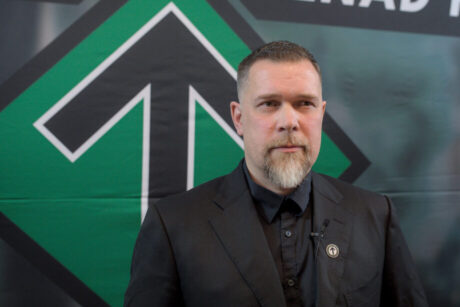
However, there are also other lists, such as the US terror list, which includes all the real or non-existent terrorist organizations created by the CIA. Before writing about any organization, one should check whether it is on that list, because if so, one must be careful what one writes, so as not to inadvertently become guilty of supporting or glorifying terrorism in Denmark as well. However, this list also includes individuals, e.g., Syria’s current president, al-Julani, was on the list (reward of USD 10 million). He was accused of single-handedly beheading his opponents. This can probably be classified as terrorism. However, the list also includes Fredrik Vejdeland, the leader of Nordfront, and he is therefore also on the Swedish list. What terrorism has Vejdeland committed? Absolutely none. He has been convicted of violating the section on “incitement against ethnic groups,” which corresponds to the Danish § 266b, but this can hardly be described as terrorism, cf. al-Julani, Osama bin Laden, and other people of that caliber.

But again, there is no possibility of defense, no possibility of appeal, nothing. It is a purely bureaucratic measure. Rule of law? Forget it, it no longer exists! The consequences are largely the same as for Jacques Baud, but Vejdeland cannot have an official job either, because then you need a salary account. And even if he can get a job where he is paid with real money (i.e., under the table), you can’t use cash for much in Sweden—only in grocery stores. They haven’t been abolished, but most businesses refuse to accept them. Sweden is always ahead when it comes to the road to ruin—but we always follow. Be on your guard!

Fredrik Vejdeland (Photo: Motståndsrörelsen.se)

Vejdeland believes that the Swedish government put him on the US terror list in connection with giving the US bases in Sweden. After all, Vejdeland has had nothing whatsoever to do with the US. Something for something! Al-Julani was removed from the terror list just as easily as he was added to it. For Vejdeland, the situation is different…

Fredrik Vejdeland has a sick wife and eight (8) minor children!

It is also wrong in England. George Galloway, a long-standing member of the British Parliament and leader of the Workers Party of Britain, was detained at the airport with his wife – without being arrested, because that would have given him rights. He was subjected to cross-examination about his political views. When he was released, he left the country, knowing that he was “on the list.” Today, he lives in freedom in Moscow. Listen to him on Mother of All Talkshows (MOATS) on YouTube. If I were younger, I would not hesitate for a moment to join him.

George Galloway (Photo: Jessica Taylor, CC BY 3.0)

If you are a dissident, you might as well prepare yourself for total war with the system.

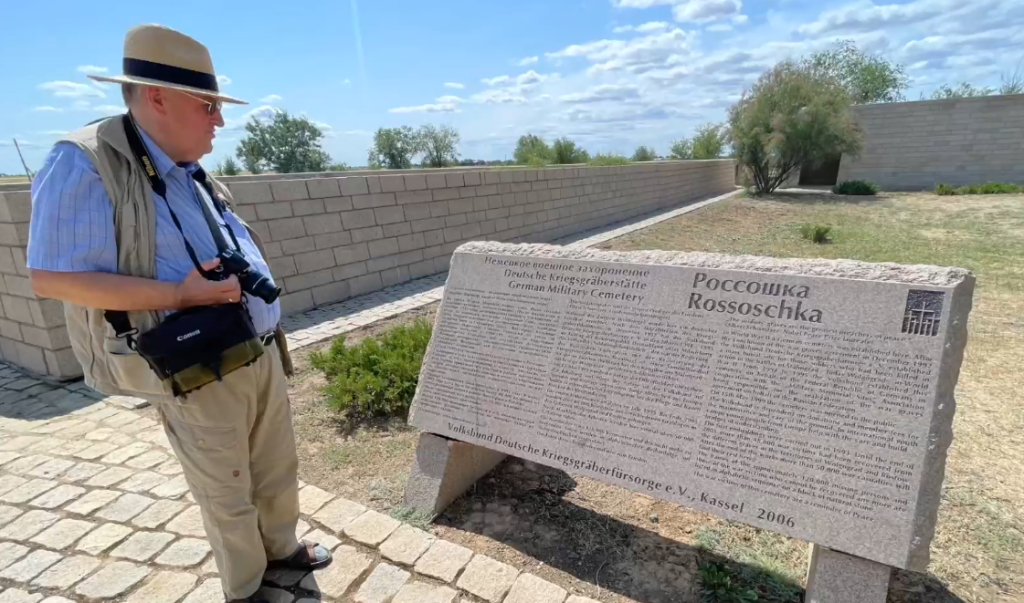
To all those who want war. Rossoschka – German section. The graves of Stalingrad. German politicians should take a trip to Stalingrad.
Travel video: https://cloud.mail.ru/stock/8mbJ99u6uB1zhcWAVxAsKQhm

Related articles:


https://www.theoccidentalobserver.net/wp-content/uploads/2018/06/TOO-Full-Logo-660x156-1.png 0 0 Povl H. Riis-Knudsen https://www.theoccidentalobserver.net/wp-content/uploads/2018/06/TOO-Full-Logo-660x156-1.png Povl H. Riis-Knudsen2026-01-06 06:17:402026-01-06 06:17:40Lists

Legal Witchcraft and Victimhood Inversion

December 6, 2025/11 Comments/in Featured Articles, Free Speech/by Tom Sunic, Ph.D.

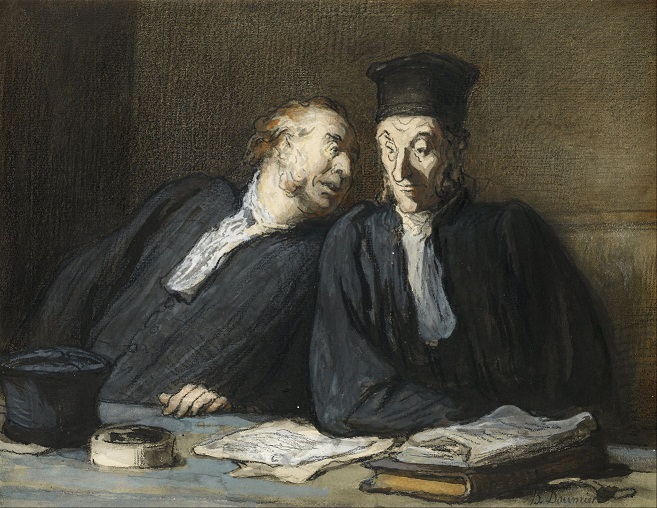
Honoré Daumier (1808–1879), Two Lawyers Conversing


Despite the commendable efforts of President Donald Trump and Secretary Marco Rubio to alert the American public to the rising tide of free-speech suppression in the EU, Soviet-style legal practices in certain segments of the EU judiciary remain very much alive and kicking. Let us be clear: The Second World War has never really ended; it has merely entered a prolonged verbal conflict, potentially on track to assume again violent and war-like dimensions.

The latest case is that of Martin Pfeiffer, former Austrian editor of the now defunct literary magazine Die Aula, who was sentenced on December 3 of this year to four years in prison for “re-engagement in National Socialist activities” under Paragraph 3g of the Prohibition Act (Verbotsgesetz).

The prosecution had listed approximately 300 articles from the now-defunct magazine, which allegedly propagated, among other things, racial ideology and antisemitism. These articles were discussed individually with the jury during sometimes lengthy trial days. Pfeiffer, who was editor-in-chief at the time, was also a district politician for the Freedom Party (FPÖ) in Graz and has consistently denied all charges. The prosecution alleges that he provided a platform in “Aula” for racism, master race and ethnic nationalism, a biologically racist concept of “the people,” and National Socialist racial theories.

The magazine  rarely dealt with ideological subjects, focusing instead on cultural themes and the idea of empire—topics closely associated with the conservative party in Austria, the FPÖ.

What is striking is that the laws under which Pfeiffer was indicted—particularly Paragraph 3g of the Prohibition Act (Verbotsgesetz), enacted in 1947—date from the period when Austria was still under the joint occupation of the four Allied powers: the Soviet Union, United States, United Kingdom, and France. Moreover, Pfeiffer was prosecuted retroactively for articles he had published between 2005 and 2018—in some cases more than fifteen years earlier. The judiciary in the city  of Graz  simply brushed aside both the statute of limitations and the principle of nullum crimen, nulla poena sine lege (“no crime, no punishment without prior law”). The highly abstract, almost untranslatable compound nouns of German/Austrian legal jargon—Wiederbetätigung (“re-engagement”), Volksverhetzung (“incitement to hatred of the people”), etc., defy precise rendering into English, which only adds to their opacity when viewed through the lens of an American lawyer.

Pfeiffer’s case demonstrates that any dissident author—regardless of his political persuasion or nationality—can be subjected to ex post facto prosecution if the ruling class deems him a nuisance. This tactic of selectively targeting “enemies of the people” was a standard tool of the judiciary throughout former communist Eastern Europe.

In passing, it is worth noting that Pfeiffer’s trial bears a striking resemblance to the many show trials of communist Yugoslavia. In 1984, my late father, a Catholic conservative and former attorney, was sentenced to four years in prison for “hostile propaganda” under Article 133 of the Yugoslav Criminal Code (neprijateljska propaganda, YU-KZ). He had written anonymous critical articles for the London-based Croatian émigré bi-weekly Nova Hrvatska, exposing the communist regime’s harsh repression of the Croatian Catholic Church and culture. He was subsequently adopted as a prisoner of conscience by Amnesty International and championed by U.S. Congressman Tom Lantos, Senator Bob Dole, and several other conservative politicians and journalists, among them Pat Buchanan.

There is a far more scarry dimension to the Pfeiffer’s story. After 1945, both the United States and the nations of Europe were compelled to adopt the model of the “proposition nation”—an abstract political community defined not by historical continuity, race or shared culture, but by universalist, immigrant-welcoming, open-entry-for-all principles. The mass influx of non-European migrants into the EU over the past decade was therefore entirely predictable: it was the logical, even deliberate, outcome of the post-war Allied strategy to suppress Europe’s historic interethnic tensions by diluting the cultural and racial homogeneity of its peoples. Likewise, the introduction of the Schengen open-border regime in 1985 (fully implemented in the 1990s) was perfectly in accordance  with the liberal-capitalist dogma of the “free movement of people and capital.”

Germany was particularly affected by these capitalist open-border policies. As the late German legal scholar Günther Maschke observed, “The German people had to adapt to the constitution, instead of the constitution being adapted to the German people.” German constitutionalism, he continued, has become a kind of “civil religion” in which multiculturalism has replaced traditional national identity with a purely legal construct—what Maschke called an imaginary “Basic Law country.” When this is combined with the quasi-sacralized, unquestionable historical narrative of the Holocaust, the result is a birth of a political entity that should be seen as a “secular theocracy.” Within this framework, the only form of patriotism still tolerated in Germany and Austria is Verfassungspatriotismus—constitutional patriotism.(1)

Victimhood Inversion

Today, core elements of the German and Austrian Criminal Code function in some ways reminiscent of former Soviet criminal law. Germany and Austria must demonstrate, daily, that they can meet their “self-re-education tasks” even more rigorously than its post-WWII mentors. Comparable dynamics exist in other EU member states, where semantic drifts have turned the charges of fascism into an all-purpose label of the ultimate cosmic evil.

Despite the phenomenal rise of right-wing parties across the EU, many judicial institutions—both in Europe and in the United States—remain largely staffed by judges and prosecutors from the post-1968 Marxist-inspired “boomer” generation, along with various former left-wing Antifa activists, modern SJWs and virtue-signalers (2). These judges and prosecutors make little effort to conceal their hatred (and fear) of Trump, while also displaying open hostility toward right-wing populist movements and parties such as the growing AfD in Germany or the FPÖ in Austria. In addition, a network of influential and wealthy non-governmental organizations across Europe, such as the CRIF and LICRA in France, the Amadeu Antonio Stiftung in Germany, and the hard-left DÖW in Austria—operate in a manner comparable to U.S. advocacy groups such as the  ADL or the SPLC. Their primary function, very similar to that of the old Soviet people’s commissariats, is to monitor academics, journalists, and public figures suspected of non-liberal ideological transgressions. German nationalists derisively label such snitching NGO outfits Gutmenschen (“do-gooders”); their French counterparts are called bien-pensants. In plain English, these so-called NGOs represent the academic thought police.

Most worrisome, however, is the climate of fear-induced self-censorship among European academics. Many believe that by remaining apolitical, silent and not rocking the boat they will best safeguard their careers and perks—a grave illusion long disproven by dissidents in the former communist countries of East Europe.  Sooner or later the thought police will show up on their doorstep regardless of how mute they were in their former political activities.

In the contemporary West, there is no need for gulags or firing squads given that more sophisticated methods of repression have become far more effective: deplatforming, debanking, or even worse, what the French call l’inversion accusatoire—the “reversal of the accusation.” Broadly speaking, this means “victimhood inversion”, a technique once common in the communist judiciary of East Europe: to cover up one’s own mega crimes, one accuses the opposing side of even greater crimes. The dynamic of mutual victimhood inversion is visible today in the conflict between the Hamas and IDF with many more to come shortly.

Many of the legal and rhetorical tactics recently deployed against President Trump were pioneered decades ago in the multi-ethnic Soviet Union and throughout the formerly communist Eastern Europe. Consequently, European prosecutors and media outlets eagerly reach for the same communist shut-up nouns—“Nazi,” “Ustasha,” “antisemite,” “white supremacist,” “racist”—in order to dehumanize political dissenters, while almost never mentioning the millions who perished under communist regimes between 1945 and 1950. President Trump is surely well aware of these legal and semantic shifts having himself endured similar “lawfare” waged and  staged by his domestic enemies. The long-term outcome of this judicial parody in both the EU and the United States is entirely predictable: growing mutual distrust, escalating interracial and interethnic conflict, institutional breakdown, and, ultimately, the collapse of the System.


Notes:

  1. Günther Maschke, Das bewaffnete Wort (Wien und Leipzig: Karolinger Verlag, 1997), p.74.
  2. Alain de Benoist, “Die Methoden der Neuen Inquisition,” in Schöne vernetzte Welt (Tübingen: Hohenrain Verlag, 2001), p. 190–205.
https://www.theoccidentalobserver.net/wp-content/uploads/2018/06/TOO-Full-Logo-660x156-1.png 0 0 Tom Sunic, Ph.D. https://www.theoccidentalobserver.net/wp-content/uploads/2018/06/TOO-Full-Logo-660x156-1.png Tom Sunic, Ph.D.2025-12-06 08:07:312025-12-06 08:16:35Legal Witchcraft and Victimhood Inversion

Mark Collett is back in the UK after his ordeal in Sweden — plus his interview with me from July 16

August 4, 2025/10 Comments/in Featured Articles, Free Speech/by Kevin MacDonald

As I posted recently, Mark Collett was detained in Sweden because of being “a threat to public order, the fabric of society, and the values on which Sweden and Europe are built.” For these sins, he has been banned from the Schengen Zone for 15(!!) years. He must be a very dangerous guy.

I am happy to report that he is back home and in fine spirits. Here’s his report, followed by his interview of me from July 16:

The interview on July 16:


https://www.theoccidentalobserver.net/wp-content/uploads/2018/06/TOO-Full-Logo-660x156-1.png 0 0 Kevin MacDonald https://www.theoccidentalobserver.net/wp-content/uploads/2018/06/TOO-Full-Logo-660x156-1.png Kevin MacDonald2025-08-04 10:54:412025-08-04 10:54:41Mark Collett is back in the UK after his ordeal in Sweden — plus his interview with me from July 16

Update on Pending Free Expression Foundation Litigation

July 29, 2025/1 Comment/in Featured Articles, Free Speech/by Glen Allen, Esq.
By FEF Staff
One of the services the Free Expression Foundation provides to those whose First Amendment rights have been violated is to obtain and in many instances compensate attorneys for such victims.  In most of these cases, Glen Allen or other members of the FEF board are the attorneys who are selected, although they, unlike non-FEF counsel, are generally not compensated.  Against this background, the following is an update of pending litigation in which FEF is involved through its provision of attorneys to victims of First Amendment violations. FEF has in fact been extremely busy with important litigation in the last three months.

Sines v. Damigo, Eastern District of California Bankruptcy Court, Adversary Proceeding.

In the Sines v. Kessler case  – i.e., the lawfare case devised by Roberta Kaplan based on the chaotic Charlottesville Unite the Right events in 2017 – Nathan Damigo was among many defendants who, after trial and an appeal to the Fourth Circuit, were ultimately held jointly and severally liable for damages in excess of $3 million.  A host of legal flaws, both at the trial and appellate level, led to this unfortunate and undeserved result.  An impartial observer could easily conclude Mr. Damigo should not have been held liable for any amount.  Regrettably, that litigation is now res judicata, i.e., subject to no further appeals.

Mr. Damigo, however, in 2019 filed in the Bankruptcy Court for the Eastern District of California a petition for a bankruptcy discharge as to this liability in 2019.  If he is granted that discharge, as he deserves, Mr. Damigo, a military veteran of limited means, would not have this huge damages award hanging over his head indefinitely as he tries to make a fresh start in life.

In January 2020, Roberta Kaplan, the attorney who was the mastermind for the Sines v Kessler lawfare, stated as follows: “We absolutely can and will bankrupt these groups. And then we will chase these people around for the rest of their lives. So if they try to buy a new home, we will put a lien on the home. If they get a new job, we will garnish their wages. The reason to do that is because we want to create a deterrence impact. So we send a message to other people that if you try to do something like this, the same thing will happen to you. And it already has been a deterrence. We’re seeing lone shooters now; we’re not seeing the kind of massively organized conspiracy we saw in Charlottesville. And I think that’s in large part due to our case.” Allen Wexler, “Roberta Kaplan Takes White Supremacy to Court,” Moment Magazine, January 6, 2020,

True to this vengeful vow, the Sines v. Kessler plaintiffs have filed an adversary proceeding in Mr. Damigo’s bankruptcy case seeking to prevent his discharge of the Sines v. Kessler damages award on the ground that his conduct was “willful and malicious” and therefore not subject to bankruptcy discharge. Through Mr. Allen, Mr. Damigo has vigorously opposed this attempt.  So far Mr. Allen has filed three complex and lengthy legal memoranda on this issue. A  hearing is scheduled for late July 2025.

Jacobs, et al.  v. Catlin, et al. U.S. District Court for the Northern District of Georgia.

The distribution of flyers, pamphlets, and similar literature has long been protected by the First Amendment. These protections apply even if the distribution is anonymous and even if the contents of the flyers or pamphlets would be regarded as offensive by many. The sheriff’s office and related state authorities in Douglas County, Georgia, however, have flagrantly ignored these protections, arresting Philip Matthew Jacobs and his wife Hilary on bogus “littering” charges for distributing flyers critical of Jewish power and influence and threatening Michael Weaver with a similar arrest.  Adding to this outrageous and unconstitutional conduct, Mr. Jacobs was physically assaulted while in jail and both of the Jacobs were required to post $30,000 bond — $60,000 total for “littering.”

Such imperious governmental lawlessness must not be ignored or tolerated.  It must be defied, and Glen Allen, Randy Sheppard (FEF board member), and Fred Kelly are doing just that.  In March 2025, they filed a 42 U.S.C. § 1983 (Civil Rights) First Amendment claim and other claims on behalf of Mr. and Mrs. Jacobs and Mr. Weaver against 13 Douglas County law enforcement and related persons.  In late May 2025, the government defendants responded with a lengthy motion to dismiss. The FEF lawyers responded to that motion with an amended complaint and a motion for preliminary injunctions. The case involves many complicated legal issues and will certainly be expensive and hard-fought, but it is an important case and deserves the support of everyone who cherishes the rule of law and our First Amendment freedoms. Ignoring governmental abuse only invites further governmental abuse.

Metropolitan African Methodist Episcopal Church v. Proud Boys International, David Kuriakose, and Others, District of Columbia Superior Court, Now on Appeal to the District of Columbia Court of Appeals.

Conspiracy allegations are a primary weapon used in lawfare cases to entangle political adversaries in lengthy, complex, and expensive litigation. Unfortunately, all too often such allegations are effective. The lawsuit filed in the District of Columbia Superior Court on behalf of the Metropolitan African Methodist Church by the Washington Lawyers’ Committee for Civil Rights against numerous members of the Proud Boys, International is an example of abusive, lawfare use of conspiracy allegations.

The basic facts were as follows.  In December 2020, after Donald Trump’s loss in the 2020 elections, a huge rally was held in the District of Columbia to show support for Trump. Many groups attended;  members from the Proud Boys International were among them. Unfortunately violence and rowdy behavior broke out and at some point certain Proud Boys jumped over a fence around the Metropolitan AME Church and destroyed a Black Lives Matter sign. Almost immediately the Lawyers’ Committee for Civil Rights brought suit on behalf of the church against dozens of Proud Boys they identified from the voluminous videos, photographs, and media articles that were available of the Pro-Trump rally. They did not, however, sue David Kuriakose at this time.  Kuriakose was a Proud Boy who happened to be walking in the general vicinity of the church when the other Proud Boys jumped over the fence and destroyed the BLM sign. No evidence linked Mr. Kuriakose to the vandalism except that he was nearby and was a Proud Boy. He adamantly denies knowing about or approving the vandalism.

This did not keep the Lawyers’ Committee from adding him as a defendant over three years later. At this point Kuriakose appealed to FEF for help (no other attorneys would help him) and Glen Allen agreed to represent him. Allen immediately took the offensive, filing an Anti-SLAPP motion (i.e., Anti-Strategic Litigation Against Public Participation; a streamlined procedure for dismissing lawfare suits aimed at foreclosing the exercise of First Amendment rights) based on Kuriakose’s Statute of Limitations defense. Allen’s anti-SLAPP motion was denied by the trial court but Allen has now appealed to the District of Columbia Court of Appeals. Briefing begins in Mid-August 2025.

Gancarz, et al. v. Capito, U.S. District Court for Western District of Washington.

In 2021 an  Antifa / anarchist named David Capito, a.k.a. Vyacheslav Arkangelsky, a.k.a.  Richard Smith, using a false identity, infiltrated a Patriot Front group in Washington State. Deceptively gaining the confidence of the Patriot Front members by pretending to share their outlook, Capito was able after several months to illegally gain unauthorized access to confidential information regarding many Patriot Front members. He then sent this fraudulently and illegally obtained information to a leftist organization that published it. It was then used to doxx many Patriot Front members. The consequences of the doxxing in many cases were quite severe,  including loss of employment and  physical and social harassment.

In July 2023, Glen Allen, together with local counsel, filed a complaint against Capito in the U.S. District Court for the Western District of Washington on behalf of four of the Patriot Front members who were harmed by the doxxing plus one of their spouses, alleging claims of fraud, invasion of privacy, and violations of the federal Computer Fraud and Abuse Act.  Effecting service on Capito proved a major challenge, as he changed his name yet again, changed his residence repeatedly and used false addresses, and basically went into hiding. Eventually the Court permitted publication by service, i.e.,  by notices in a local newspaper. In June 2025 a group of lawyers calling themselves the Civil Liberties Defense Center filed a motion to dismiss and a separate motion under Washington’s version of the anti-SLAPP law. Essentially Capito is contending  through his attorneys that he had a First Amendment  right to infiltrate Patriot Front because, he claims, Patriot Front espouses odious views.  Mr. Allen,  together with local counsel, is preparing a response to this preposterous contention plus a response Capito’s  separate motion to dismiss.

Just as proponents of the rule of law and robust freedom of expression should not tolerate  malicious and arrogant violations of their rights by the government,  so too must they defy thugs such as Mr. Capito. We must raise their cost of inflicting their unlawful and malicious activities on others.

IN CONCLUSION, as these cases – and there are others waiting in the wings —  hopefully illustrate, FEF has a full plate of important pending First Amendment cases as it continues to make progress to becoming a force to be reckoned with in the legal arena. In addition, FEF continues to perform many other functions, including mentoring law students and young lawyers, responding to email and telephone inquiries, developing a network of sympathetic lawyers around the country, and fundraising to keep FEF solvent. As always, FEF greatly appreciates the moral encouragement and financial sustenance it receives from its donors and supporters.

Donate Today!
https://www.theoccidentalobserver.net/wp-content/uploads/2018/06/TOO-Full-Logo-660x156-1.png 0 0 Glen Allen, Esq. https://www.theoccidentalobserver.net/wp-content/uploads/2018/06/TOO-Full-Logo-660x156-1.png Glen Allen, Esq.2025-07-29 07:31:522025-07-29 07:31:52Update on Pending Free Expression Foundation Litigation

British Free Speech and J.S. Mill

July 16, 2025/5 Comments/in Featured Articles, Free Speech/by Mark Gullick

Article 19 is an organization which monitors global free speech, and it issues an annual report which grades countries into five categories of freedom of expression: Open, Less Restricted, Restricted, Highly Restricted, and In Crisis. In its most recent report, the United Kingdom has been demoted from the highest category to the second for the first time since records began. From 2000, the UK’s grading had held steady at 88/100 before dropping to 87 in 2014. The decline accelerated, and Article 19’s latest report rates it at 79. Of the 161 nations for which data are available, Denmark ranks first with 94, and North Korea last with 0. The US, with its famous First Amendment, is in 21st place with 85.

Disparities are not necessarily regional. Nicaragua is at 160, just above North Korea, with a rating of 1, whereas neighboring Costa Rica — in which I am writing this –— comes in level with the US on 85. This means I have more freedom of expression in a Central American country than I would in my native UK. Although Article 19 notes that a downward slide is apparent across Europe, there is something particularly unnerving about the UK’s declining freedom of speech. To attempt to discover why this is so, perhaps it may help us to go back 170 years, from the heart of one declining empire to the center of one long vanished, and revisit a philosopher who has much to say about freedom in general and freedom of expression in particular.

In January of 1855, John Stuart Mill, the English radical philosopher and Member of Parliament, was in Rome. One beautiful morning, he climbed the Capitoline Hill and had an epiphany he noted in his Autobiographical Study. Mill had, the previous year, written a short essay on the subject of liberty. Now, he knew he had not said enough, and that he had to grow this fledgling into a book. He says of the revelation: “[O]pinion tends to encroach more and more on liberty, and almost all the projects of social reformers in these days are really liberticide”.

Friedrich Nietzsche was 15 years old when Mill published On Liberty, but the German would have appreciated both Mill’s epiphany — won by walking, as Nietzsche said his own best ideas were — but also that the line with which liberty bisects free will and determinism is as fine as Penelope’s thread. Indeed, the opening line of Mill’s treatise takes up that very thread: “The subject of this essay is not the so-called Liberty of the Will, so unfortunately opposed to the misnamed doctrine of Philosophical Necessity…”

Free will and determinism, that age–old philosophical agon, are present in today’s conflicts over free speech, with Western governments determined to erase the former and replace it with the latter. But this is determinism in what we might call a genetically modified form. Free will — whether it exists or not — is now what it always has been throughout the history of philosophy, that of the individual. Determinism has a mixed provenance. It could be scientistic, religious, or philosophical. Now, the source of the deterministic matrix has changed into something else, something highly temporal and hidden in plain sight; the State. On Liberty is not so much about “freedom to” as it is “freedom from”.

Mill is what we would call a “free speech absolutist”: “If the teachers of mankind are to be cognizant of all that they ought to know, everything must be free to be written and published without restraint”.

I don’t want to give an overall review of On Liberty, but rather a forensic audit of its second chapter, “Of the Liberty of Thought and Discussion”. This is the key in terms of the modern debate among Mill’s countrymen concerning free speech, and “Of the Liberty of Thought and Discussion” calls directly to the British state as it stands, although possibly doesn’t shout loud enough. But before noting any congruencies between Mill’s account of liberty and our present predicament, a note on the important difference between Mill’s age and our own.

Where Mill, in Chapter 2 and thus talking about freedom of expression, writes “the press”, we must read “everyone online” today. Thus, the American Constitution’s famous protection of freedom of assembly must be similarly extended into the virtual community. Freedom of assembly today does not mean a mob of ranchers gathering at the Union Hall to make their feelings known to the Governor, it means billions of people who don’t even have to leave their homes to assemble freely. On Liberty was written a century and a half before the internet would amplify expression and make information more readily available to both the rulers and the ruled than it could ever have been in his time. This discrepancy is analogous to the argument that America’s Second Amendment is seriously outmoded because it was written in the age of musket and flintlock, not our present era of the AK47.

But, at its core, On Liberty has much to say to us, and has taken on a particular resonance all these years after Mill’s death. Once merely a humdrum, course-work, stock-issue, university–curriculum regular, On Liberty has suddenly come to life. Mill’s country is today under scrutiny because its rulers are blatantly curtailing the freedom of its citizenry, and in particular their freedom of expression. Keir Starmer, who looks permanently startled to begin with, was not expecting Donald Trump and Elon Musk (before he went rogue) to upbraid him over free speech in the Oval Office. “Two men will not be together for half an hour”, writes Dr. Johnson, “but one will try to get the better of the other”. It took Trump around half a minute with Starmer, which is the behavior of a ruler. But what of Mill’s ruler?

Mill presents the ruler and the ruled already imbued with a mutual tension. His simple analysis of societal dichotomy is anatomically precise:

“It was now perceived that such phrases as ‘self-government’ and ‘the power of the people over themselves’, do not express the true state of the case. The ‘people’ who exercise the power are not always the same people with those over whom it is exercised”.

If you are outside the political class in Britain, you will be becoming increasingly aware that they are no longer your peer group. They neither serve the state nor pay it undue respect, because they are the state, supposedly there to protect its citizenry, but increasingly that from which the citizens feel they need protection, as they did for Mill.

But it is not merely the apparatus of the state that citizens need to be shielded from: “Protection… against the tyranny of the magistrate is not enough; there needs protection also against the tyranny of the prevailing opinion and feeling…”

We’ll return to opinion and feeling, but for now the tyranny of the magistrate may be precisely what the British public do need protection from. Legislation is being proposed to abolish jury trials for rape cases in the UK and, if it goes through, there is no reason to think this government will stop at rape. In a jury trial, the judge represents the state, the jury the citizenry. Remove the jury, and a defendant’s guilt or innocence will no longer be decided by a jury of his peers, but directly by the state. How long before “hate speech” cases are tried by a judge alone, with the state deeming “12 good men and true” superfluous to requirements?

Mill’s argument in Chapter 2 revolves around the encroachment of tyranny through the suppression of dissident opinion. But in Mill’s time this suppression was of opinion, often religious, the authorities fervently believed to be false. Now, the tyrant knows perfectly the opinions it suppresses to be true, and the citizenry can go hang, or at least go to jail: “[I]t is not, in constitutional countries, to be apprehended that the government … will often attempt to control the expression of opinion, except when in doing so it makes itself the organ of the general intolerance of the public”.

Today, the intolerance of the public means nothing. They have no tolerance to spare, in any case, as it has all been requisitioned by the government and expended on foreigners. But governmental control of the expression of opinion has two facets, the actual performative, the expression of opinion by an individual agent, and the meaning and significance of the opinion itself: “First: the opinion which it is attempted to suppress by authority may possibly be true. Those who desire to suppress it, of course deny its truth; but they are not infallible. They have no authority to decide the question for all mankind, and exclude every other person from the means of judging”.

The question of authority has today come to the fore. Authority is implicitly bound up with the social contract, which the government honors if authority is used in a representative fashion, and disabuses if it uses its authority merely to instantiate that very mode of domination and keep itself in power. The beginning of tyranny. And authority can even tinker with epistemology, despite Mill’s rather Nietzschean dismissal of this: “There is no such thing as absolute certainty, but there is assurance sufficient for the purposes of human life”.

Mill is, of course, the great utilitarian. He is not selling his utlilitarianism here, however, merely offering up the idea of utility as a deciding factor in deciding what is true and what isn’t: “This mode of thinking makes the justification of restraints on discussion not a question of the truth of doctrines, but of their usefulness”.

“The truth of an opinion is part of its utility”, he writes. Truth under the auspices of utility does have something of the casino about it. And what happens in a casino is not merely down to the behavior of the gamblers, but also depends on the policy of the management.

This section on truth and certainty is relevant to us moderns, seeing as we do have a ruling class which is attempting to conflate the truth of what it says with mathematical truth: “The peculiarity of the evidence of mathematical truths is, that all the argument is on one side. There are no objections”.

This was exemplified by the command to “follow the science” during Covid.

But Mill is aware of the tyrannical turn, and its roots in the nature of the true. Thus, the ruler may “assume that their certainty is the same thing as absolute certainty”. If not, they can manipulate it until it is certain. I believe President Obama was the first to talk of the necessity for “curating the truth”. Such a religious term for such an irreligious act.

Truth should also be communal, Mill believed, and the necessity of sharing it is a social contract broken by interfering with freedom of expression: “But the particular evil of silencing the expression of an opinion is, that it is robbing the human race; posterity as well as the existing generation; those who dissent from the opinion, still more than those who hold it”.

Mill finds a sense of duty in the transmission of improving information, an office each individual owes to a wider humanity: “To discover to the world something which deeply concerns it, and of which it was previously ignorant; to prove to it that it has been mistaken … is as important a service as a human being can render to his fellow-creatures”.

In fact, it is the intellectual wellbeing of his fellow–creatures which completes the objections to the censorship of freedom of expression for Mill: “But it is not the minds of heretics that are deteriorated most, by the ban placed on all inquiry which does not end in the orthodox conclusions. The greatest harm done is to those who are not heretics, and whose whole mental development is cramped, and their reason cowed, by the fear of heresy”.

And social relations are the salve for erroneous beliefs: “He is capable of rectifying his mistakes, by discussion and experience. Not by experience alone”.

This is Socratic, and Mill devotes a page or so of On Liberty to Socrates rather than Plato. And the transmission of opinion is also one of the checks and balances democracy requires: “If any opinion is compelled to silence, that opinion may, for aught we can certainly know, be true. To deny this is to assume our own infallibility”.

What of those most affected by the suppression of free expression, those ultimately imprisoned for it? And what is the nature of their crime? “To calumny of this sort, those who hold any unpopular opinion are peculiarly exposed, because they are in general few and uninfluential, and nobody but themselves feel much interest in seeing justice done them”.

This is increasingly becoming the case in the UK, where the appellation “far Right” has been mobilized to segregate the patriotic who are prepared to voice their opinions. Thus, truth is molded via social engineering creating an ideologically atomized populace: “[T]here is never any fair and thorough discussion of heretical opinions... [and this leads to] the dread of heterodox speculation.”

This leads, in turn, to “The deep slumber of a decided opinion”. Public opinion, acceptable public opinion, has now been formed by social coercion.

But Mill also discusses the giving of offence, perhaps the element today which has taken on supreme importance. “Our merely social intolerance kills no one,” Mill writes, and the litmus test of opinion versus offence is made clear: “[I]f the test be offence to those whose opinion is attacked, I think experience testifies that this offence is given whenever the attack is telling and powerful…”

It is worth noting that when “freedom of speech” is discussed, what is generally meant today is freedom of writing. Unless speech is recorded, each speech act is discrete and non-scriptive. Litera scripta manet, as John Dewey noted. “That which is written down remains”. That which is spoken and unrecorded is not. Recording it turns it into a type of writing, a type of inscription. Without straying too far into Jacques Derrida territory, speech and writing are intertwined, but freedom of speech itself appears to remain untouchable in the absence, for example, of witnesses. Now, the British government is seeking to change that with its Employment Rights Bill.

This is one of those legislative instruments which hides behind an apparently beneficent title. Who could argue against the rights of employees, particularly the right not to be harassed in the workplace? But in practice the bill has no interest in physical or sexual harassment, but rather that of overhearing speech which may offend the hearer and thus count as harassment. And the punishment for heresy is not just reactive, but also proscriptive.

An English YouTuber by the name of Andre Walker told a very indicative story in a recent episode. Talking to his friend’s teenage boy and his friends about their experience in school, the boy told him of a lesson they had on slavery. The teacher sternly informed them that if anyone even mentioned the fact that Britain was instrumental in dismantling the slave trade, they would be dismissed from the class.

For Mill, the price society must pay for the suppression of opinion is high: “But the price paid for this sort of intellectual pacification, is the sacrifice of the entire moral courage of the human mind”.

And if what is required seemed unattainable to Mill then, what prospect does it have now? We would have to reach “a stage of intellectual advancement which at present seems at an incalculable distance”.

We have the intellectual advancement, but the political class are concerned that it is being shared around and democratized. A technocratic elite operating the machinery of state has no need of a populace keen and able to use its collective intellect.

Some politicians are not even attempting to hide the suppression of free expression. The new Mayor of New South Wales in Australia informed his citizens that they did not have the same freedom of speech as America. That was it; that’s how policy gets made in the area of freedom of expression.

Mill was areligious, if anything. But On Liberty often displays a Biblical framework. There is a lot of “Do unto others” in there. Civic Christianity can set good laws, so there is nothing wrong with that, but for a man so seemingly uninterested in the religious impulse, his own is analogous: Doing unto others certainly adequately describes the current British government, just not in the traditional, Biblical sense.

But there was enough cynicism in Mill to span the ages: “But, indeed, the dictum that truth always triumphs over persecution is one of those pleasant falsehoods which men repeat after one another till they pass into commonplaces, but which all experience refutes”.

On Liberty is a work of limits and boundaries, transgressed and untransgressed, and, although it speaks again from the past to the UK’s present predicament, Mill perhaps did not go far enough, and could not see, could not have seen, what might happen with the return of tyranny to the country of his birth. He did not see just how far power was prepared to go: “In England, from the peculiar circumstances of our political history, though the yoke of opinion is perhaps heavier, that of law is lighter, than in most other countries of Europe; and there is considerable jealousy of direct interference, by the legislative or executive power, with private conduct”.

The yoke of law is not so light now, 170 years after Mill walked the Capitoline Hill. And it is weighing heavier on the shoulders of the British people week by week, month by month, as more of them are arrested for social media posts than in Russia. There is still a long way down from Mill’s country’s position in Article 19’s league table, but that just means there is further to fall.

https://www.theoccidentalobserver.net/wp-content/uploads/2018/06/TOO-Full-Logo-660x156-1.png 0 0 Mark Gullick https://www.theoccidentalobserver.net/wp-content/uploads/2018/06/TOO-Full-Logo-660x156-1.png Mark Gullick2025-07-16 07:43:032025-07-16 13:34:53British Free Speech and J.S. Mill

The Supreme Court Denies Balogh Certiorari Petition

May 23, 2025/6 Comments/in Featured Articles, Free Speech/by Glen Allen, Esq.
…But the Fight for Free Speech and Assembly Goes On

By Glen Allen, Esq.

As I mentioned in my February 20, 2025 article on the Free Expression Foundation website, in February 2025 Fred Kelly and I filed a certiorari petition with the U.S. Supreme Court on behalf of Warren Balogh in the Balogh v. City of Charlottesville, et al. case.  Warren and Gregory Conte, as you will recall, had filed a pro se complaint in the federal court for the Western District of Virginia seeking redress for injuries the City of Charlottesville and its police department inflicted on them during the Unite the Right rally in August 2017.   Fred, Warren, and I filed the petition because we believed – and still believe – not only that the defendants’ conduct had been unconstitutionally partisan but that the case raised critically important issues regarding the proper role of the police to protect unpopular speech.  We knew the odds the Supreme Court would grant the petition were against us (the Court grants only about 1% of petitions) but we believed our odds were better than most petitions because of the important issues our case presented.  Above all, seeking Supreme Court review was the right and honorable step to take.

On April 7,  2025, the Supreme Court denied our petition.  The Court’s decision, although not surprising, is regrettable. The Court missed an opportunity to advance the cause of First Amendment protection for unpopular speech and to admonish the City of Charlottesville for taking sides against Warren and the other pro-monument protestors. The Court’s denial of our petition, however, has not altered FEF’s determination to uphold First Amendment principles even in the face of daunting challenges .

Warren Balogh wrote an eloquent substack article (Warren’s Substack, April 27, 2025) about his case.  He has given me permission to quote from it, and I do so below:

Mainstream media reporting on my lawsuit has mischaracterized it as me charging that the police failed to protect us from counter-demonstrators on August the 12th. This is not true. Everyone who attended the UTR rally knows we could have, and did, protect ourselves from violent anti-White extremists. In spite of the fact that the ranks of the counter-demonstrators included professional agitators, violent career criminals, armed thugs and activists with detailed plans to commit criminal mayhem and violence against UTR attendees, the fact is that even with police “standing down” to let them attack us, the vast majority of our people made it into the permitted rally area unharmed.

If police hadn’t intervened, we would’ve been able to hear the speakers and carry out our demonstration during the time permitted, and we likely all would’ve been able to leave the park in an orderly fashion and make it back to our vehicles without anyone getting killed or seriously injured. The problem with Charlottesville, and the reason for my lawsuit, was not principally that police failed to protect our side from the other side, but that police attacked our side and drove us into the other side. They dispersed our rally while failing to disperse the Antifa and BLM counter-demonstrators. In fact, the only place the dispersal order was enforced was inside the tiny confines of the park where we held the permit. Leftist counter-demonstrators were given the run of the streets by city authorities!

As I pointed out to [District Court] Judge Moon in one hearing, if the dispersal order had been enforced as “content and viewpoint neutral” (which is a very serious constitutional legal requirement), then why were hundreds of Antifa still marching around the streets in triumph nearly two hours later, when a frightened young man named James Fields—after plugging in GPS directions to take him back home to his mother in Ohio—accidentally turned down a street and found his vehicle under attack by an armed mob?

Moon’s dismissal of our suit, which was later upheld by the Fourth Circuit Court and reaffirmed by SCOTUS’s declining to review my petition, was based on some very specious interpretation and legal reasoning: that police and officials could not be held liable for acts while carrying out their duties (which doesn’t apply in constitutional matters), that we didn’t include enough particulars about certain defendants (more evidence would’ve come out in discovery, or became known after the complaint was filed). Normally, at the dismissal phase, plaintiffs are to be assumed to have the facts on their side, and this is doubly true in a case of such constitutional import and public interest.

Incredibly, Moon’s court even asserted that peaceful, permitted rally-goers have no right to police protection from violent counter-demonstrators. In my appeal to the Fourth Circuit, one federal judge even asked defendants’ attorneys to clarify their argument that I would’ve had no right to expect police protection even if there was no violence from our side, and all the violence came from the other side. And yes, defendants’ attorneys affirmed it, that was their argument!

During my hearing with Judge Moon, I asked that if their position was that peaceful, non-violent, legal permit-holding demonstrators have no right to police protection from violent thugs who come to shut them down, then how are we supposed to exercise our First Amendment right to free speech and freedom of assembly? Neither Judge Moon, nor defendants’ attorneys, nor the three judges of the Fourth Circuit court, nor the SCOTUS were able to answer that question.

All I wanted is a blueprint on how we can exercise our rights.

If the burden is on us to defend ourselves, then so be it, but let the courts affirm we have the right to defend ourselves. This right was explicitly denied to us by the aftermath of UTR, however. As with James Fields, or the half-dozen or so men who went to prison for defending themselves in the anarchic clashes after the police broke up our rally, we are told we have no right to police protection—but also that we have no right to protect ourselves.

That this makes certain types of protest de facto illegal in the United States should be obvious to everyone. . . .

I am very proud to have waged this legal battle for as long as I could. I’m proud that all my filings and the permanent legal record will stand for all time as documents setting out a factual account of what happened. I’m proud that my children and hopefully my grandchildren and great-grandchildren will one day be able to see how I took the right side in the most important fight of our lives. I’m proud that I was able to wage this battle with a minimum of resources and that I was able to tie up countless enemy attorneys and many, many times the resources I spent in making these corrupt, rotten people defend themselves and their actions. I’m proud my name will be forever associated with this fight.

We should always fight for our rights. As I’ve often said, we need to either force this democracy to work, or make them shut democracy down so hard, it will be obvious to all that it’s an illegitimate sham. . . .

I want to thank Glen Allen and Fred Kelly of the Free Expression Foundation. The original complaint was filed pro se, but I never could’ve appealed it to the Fourth Circuit or petitioned the Supreme Court without their help. They are some of the last honest attorneys in America, and some of the only ones who have any courage. I also want to thank Greg Conte, my original co-plaintiff, and Augustus Invictus, who helped prepare the original draft of the complaint . . . .

I want to thank all those who donated and privately chipped in with legal costs. I never wanted this lawsuit to take away funds from those who were waging their own very critical defensive battles against the Sines v. Kessler suits, or trying to stay out of prison, but thanks to the volunteer work of many men we were able to keep going for a tiny fraction of what a suit like this would normally cost. In this country founded “by lawyers, for lawyers,” the process is often the punishment, the rich and powerful have a decisive advantage and openly brag about using so-called lawfare against their political enemies. But this lawsuit shows how a committed and honest group of men can crowdsource a legal battle that is truly David vs Goliath in proportions.

Lastly I would like to thank every last man and woman who attended the Unite the Right rally on August 11-12th, 2017. This lawsuit was a symbolic fight for all the young men who sacrificed more at Charlottesville than I did: all those who spent years in prison, who had their careers or reputations destroyed, who ended their own lives, who still have the threat of imprisonment hanging over their heads. For all their sakes, it was worth it.

https://www.theoccidentalobserver.net/wp-content/uploads/2018/06/TOO-Full-Logo-660x156-1.png 0 0 Glen Allen, Esq. https://www.theoccidentalobserver.net/wp-content/uploads/2018/06/TOO-Full-Logo-660x156-1.png Glen Allen, Esq.2025-05-23 06:38:572025-05-23 06:38:57The Supreme Court Denies Balogh Certiorari Petition
Page 2 of 6‹1234›»
Subscribeto RSS Feed

Kevin MacDonald on Mark Collett’s show reviewing Culture of Critique

James Edwards at the Counter-Currents Conference, Atlanta, 2022

Watch TOO Video Picks

video archives

DONATE

DONATE TO TOO

Follow us on Facebook

Keep Up To Date By Email

Subscribe to get our latest posts in your inbox twice a week.

Name

Email


Topics

Authors

Monthly Archives

RECENT TRANSLATIONS

All | Czech | Finnish | French | German | Greek | Italian | Polish | Portuguese | Russian | Spanish | Swedish

Blogroll

  • American Free Press
  • American Freedom Party
  • American Mercury
  • American Renaissance
  • Arktos Publishing
  • Candour Magazine
  • Center for Immigration Studies
  • Chronicles Magazine
  • Council of European Canadians
  • Counter-Currents
  • Curiales—Dutch nationalist-conservative website
  • Denmark's Freedom Council
  • Diversity Chronicle
  • Folktrove: Digital Library of the Third Way
  • Human Biodiversity Bibliography
  • Institute for Historical Review
  • Mondoweiss
  • Pat Buchanan
  • Paul Craig Roberts
  • Project Nova Europea
  • Red Ice
  • Richard Lynn
  • Rivers of Blood
  • Sobran's
  • The Occidental Quarterly Online
  • The Political Cesspool
  • The Raven's Call: A Reactionary Perspective
  • The Right Stuff
  • The Unz Review
  • VDare
  • XYZ: Australian Nationalist Site
NEW: Individualism and the Western Liberal Tradition

Also available at Barnes & Noble

Culture of Critique

Also available at Barnes & Noble

Separation and Its Discontents
A People That Shall Dwell Alone
© 2025 The Occidental Observer - powered by Enfold WordPress Theme
  • X
  • Dribbble
Scroll to top

By continuing to browse the site, you are legally agreeing to our use of cookies and general site statistics plugins.

CloseLearn more

Cookie and Privacy Settings


How we use cookies

We may request cookies to be set on your device. We use cookies to let us know when you visit our websites, how you interact with us, to enrich your user experience, and to customize your relationship with our website.

Click on the different category headings to find out more. You can also change some of your preferences. Note that blocking some types of cookies may impact your experience on our websites and the services we are able to offer.

Essential Website Cookies

These cookies are strictly necessary to provide you with services available through our website and to use some of its features.

Because these cookies are strictly necessary to deliver the website, refusing them will have impact how our site functions. You always can block or delete cookies by changing your browser settings and force blocking all cookies on this website. But this will always prompt you to accept/refuse cookies when revisiting our site.

We fully respect if you want to refuse cookies but to avoid asking you again and again kindly allow us to store a cookie for that. You are free to opt out any time or opt in for other cookies to get a better experience. If you refuse cookies we will remove all set cookies in our domain.

We provide you with a list of stored cookies on your computer in our domain so you can check what we stored. Due to security reasons we are not able to show or modify cookies from other domains. You can check these in your browser security settings.

Other external services

We also use different external services like Google Webfonts, Google Maps, and external Video providers. Since these providers may collect personal data like your IP address we allow you to block them here. Please be aware that this might heavily reduce the functionality and appearance of our site. Changes will take effect once you reload the page.

Google Webfont Settings:

Google Map Settings:

Google reCaptcha Settings:

Vimeo and Youtube video embeds:

Privacy Policy

You can read about our cookies and privacy settings in detail on our Privacy Policy Page.

Privacy Policy
Accept settingsHide notification only