The Conservative Revolution Then and Now: Ernst Jünger
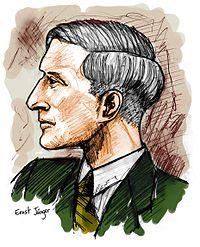
Ernst Jünger, 1895-1998
Early in 1927 the Austrian poet Hugo von Hofmannsthal made a famous address to students at the University of Munich. He alluded to and deplored the historical separation in German society between the intellectual and political sphere, between “life” and “mind”. He deplored that German writing in the past had functioned in a vacuum and was “not truly representative nor did it establish a tradition” and was symptomatic of a crisis in civilization which had lost contact with life. In response, he referred to the “legions of seekers” throughout the country who were striving for the reestablishment of faith and tradition and whose aim was not freedom but “allegiance”. He concluded: “The process of which I am speaking is nothing less than a conservative revolution on such a scale as the history of Europe has never known.
Comparing this with the present day situation, when paleoconservative leaders like Paul Gottfried feel lucky to sell a thousand copies of a book, German conservatism was experiencing a period of unparalleled cultural, intellectual, and spiritual vitality as measured by literary engagement. Large numbers of conservative revolutionary political philosophers formed political clubs and organizations and swamped the periodical market with their pamphlets full of semi-political, semi-philosophical jargon. They found access to the “respectable” public, and became the heralds of conservative revolution. They represented an intelligentsia that had the ear of the people, in contrast to the leftist intelligentsia which was considered “Western” and “alien” by most. Read more