Featured Articles

The Psychology of Moral Communities, Part 2 of 5: Ethnocentrism and Its Control

Go to Part 1.

Controlling Ethnocentrism: Implicit and Explicit Processing

As noted in Chapter 5, psychological research indicates two different types of psychological processing: implicit and explicit processing. These modes of processing may be contrasted on a number of dimensions.[1] Implicit processing is automatic, effortless, relatively fast, and involves parallel processing (i.e., processing going on independently in different parts of the brain) of large amounts of information; it characterizes the modules described by evolutionary psychologists. Explicit processing is the opposite of implicit processing: conscious, controllable, effortful, relatively slow, and involves serial processing of relatively small amounts of information in a sequential manner (e.g., performing the steps of solving a math problem). Explicit processing is involved in the operation of the mechanisms of general intelligence[2] as well as controlling emotional states and action tendencies (such as anger or frustration tending lead to aggression).[3]

As noted in Chapter 5, religious beliefs are able to motivate behavior because of the ability of explicit representations of religious thoughts (e.g., the traditional Catholic teaching of eternal punishment in Hell as a result of mortal sin) to control sub-cortical modular mechanisms (e.g., sexual desire). In other words, the affective states and action tendencies mediated by evolved implicit processing are controllable by higher brain centers located in the cortex.[4] The same goes for ethnocentrism.

Being able to control impulses of any kind taps into the personality system of Conscientiousness, often labelled “effortful control” because it involves explicit, conscious effort to control impulses (see discussion below). Simply put, conscientious people are relatively better able to regulate the more evolutionarily ancient parts of our brain responsible for many of our passions and desires.

Why is this important for thinking about psychology and White ethnocentrism? Just as conscientious people can inhibit their natural tendencies toward aggression and sexual arousal, they are able to inhibit their natural ethnocentrism. The critical point in the following is that cultural information is of vital importance for enabling people to inhibit their ethnocentric tendencies. This cultural information relies on explicit processing and provides the basis for prefrontal inhibitory control of ethnocentrism.

The conclusion is that the control of ethnocentrism is a direct consequence of the control of cultural information. My book The Culture of Critique is an attempt to understand what happened after the highwater mark of the period of ethnic defense (~1870–1930) discussed in Chapter 6.[5] The rise of the new elite meant that explicit messages about race (e.g., “there’s no such thing as race”) and ethnocentrism (e.g., “White ethnocentrism is a sure sign of psychopathology and disturbed parent-child relationships) were being disseminated by the media and throughout the educational system. Especially since World War II, these messages have been consistently hostile to White ethnocentrism. And that in turn has meant that Whites have been encouraged to inhibit their natural ethnocentrism.

Moreover, as emphasized throughout this book, White people tend to be more individualistic than other peoples, implying that they are less likely than other peoples to make invidious distinctions between ingroups and outgroups and are more likely to be open to strangers and people who don’t look like them. Because Whites are low in ethnocentrism and high in Conscientiousness, controlling ethnocentrism is easier for them on average. Their subcortical mechanisms responsible for ethnocentrism are weaker to start with and hence easier to control.

There is considerable research on the roles of implicit and explicit processing in ethnocentrism and its control. Implicit attitudes on race can be measured, e.g., by performing brain scans when the subjects are looking at faces of people of different races.[6] On the other hand, explicit attitudes on race are typically assessed by filling out questionnaires which tap explicit processing. College student populations of Whites in the West typically exhibit pro-Black attitudes on tests of explicit attitudes. For example, one study found that Whites scored 1.89 on a six-point scale, with 1 meaning strongly pro-Black and 6 being strongly anti-Black.[7]

Another way to measure explicit attitudes is by interview. A recent representative sample of 2000 households found that a surprising 74 percent of Whites thought that racial identity was very important (37 percent) or somewhat important (37 percent).[8] In general, people become more racially conscious as they get older—only 53 percent claimed that racial identity was important while growing up. (I have noticed this also as a feature of Jewish identity.[9]) Even more surprising is the finding that 77 percent of Whites thought that Whites had a culture that should be preserved. However, despite asserting the legitimacy of White ethnic identity, only 4 percent of Whites claimed to be a member of an organization based on racial or ethnic identity. (This presumably includes organizations for, say, Scottish or Polish identity which are politically irrelevant in the American political context.) And 75 percent of Whites state that prejudice and discrimination are important or very important to African-American disadvantage.

In general, Blacks and other minorities have much stronger explicit ethnic identities than Whites do. For example, this same survey found that 90 percent of Blacks thought that racial identity was very important (72 percent) or somewhat important (18 percent), and 91 percent felt that Black culture was worth preserving. Blacks also demonstrate a substantially larger explicit ingroup preference than Whites.[10]

The gap between explicit attitudes and implicit attitudes is made possible by the inhibitory mechanisms of the prefrontal cortex. In one study, subjects were shown photos of Blacks and Whites while hooked up to a Functional Magnetic Resonance Imaging (fMRI) machine that takes pictures of the brain in action.[11] When the photos were shown for very brief periods—too short to be consciously processed, the fMRIs showed that Whites had a negative response to the photos of Blacks. This procedure therefore measures implicit negative attitudes toward Blacks.

However, when the photos of Blacks were presented for a much longer period, so that they were consciously experienced, then the difference in reaction to Black and White faces decreased. This happened because the prefrontal region was activated. In other words, people who are consciously aware that they are seeing photos of Blacks are able to inhibit the automatic negative responses from the sub-cortex. Subjects who showed the most prefrontal activation showed the lowest subcortical response. This implies that they were better able to inhibit their negative attitudes toward Blacks.

This study (and there are other studies with similar findings) shows the importance of prefrontal inhibitory control over automatic negative attitudes of Whites toward Blacks. White ethnocentrism exists, but for most Whites, it exists only in a sort of underground world of unconscious, automatic processing: it is an ethnocentrism that dares not speak its name: As soon as the explicit, conscious processor swings into action, it acts to suppress the negative implicit attitudes coming from below so that the subject’s responses align better with the cultural norms of the social environment.[12]

Young children tend to have unabashedly explicit bias in favor of their own race. Explicit race bias emerges early, as young as age three or four, peaks in middle childhood, and then undergoes a gradual decline through adolescence, typically disappearing in adulthood.[13] However, there is no such decline in implicit racial preferences, which remain strong into adulthood.[14] There is also a decline in cross-racial friends and companions as children get older. White schoolchildren are much more likely to have White friends than chance would account for, and this trend increases as they get older.[15]

This means that even as explicit racial preference in White children is declining, they become less likely to actually interact with and form friendships with children from other races. In effect, schools undergo a process of self-segregation. And among adults, Whites are significantly less likely than other racial groups to report interracial friendships and contacts.[16]

The bottom line, then, is that as children get older, they become increasingly aware of the official explicit racial ideology, and they conform to it. Their prefrontal centers of inhibitory control are becoming stronger, so that they are better able to inhibit their implicitly generated negative thoughts about racial outgroups. At the explicit level, they are free from any negative attitudes toward non-White groups and may even be politically liberal or radical. At the same time, however, they are “voting with their feet” by choosing friends and companions of the same race.

And their parents are doing the same thing. Liberals show a greater gap between explicit attitudes and implicit attitudes and behavior than do conservatives. Moreover, while highly educated White parents tend to have liberal explicit attitudes on racial issues, including the desirability of school integration, these same highly educated Whites seek out schools that are racially segregated and are more likely to live in racially segregated neighborhoods. A 2018 article noted that for progressive parents, “more often than not, [their progressive] values lost out” when choosing a school.[17] Indeed, there is a positive correlation between the average education of White parents and the likelihood that they will remove their children from public schools as the percentage of Black students increases.[18] Michael Emerson, an author of the study, is quite aware of the gap between explicit attitudes and behavior: “I do believe that White people are being sincere when they claim that racial inequality is not a good thing and that they’d like to see it eliminated. However, … their liberal attitudes about race aren’t reflected in their behavior.”

The flip side of this is that less affluent Whites are more likely to have explicitly illiberal attitudes on racial issues that are condemned by elites. Yet they are also more likely to actually live in racially integrated areas and send their children to racially integrated schools, presumably due to financial constraints.

Implicit White Communities

Children’s choice of friends and parents’ choice of schools and neighborhoods reflect the raw reality of racial hypocrisy in the United States. These children and their parents are acting on their implicit attitudes, and there is a profound gap between their implicit attitudes and their behavior (which show ingroup racial preference) versus their explicit attitudes (which express the official ideology of racial egalitarianism). In effect, they are creating implicit White communities—implicit because even though these communities are an expression of (implicit) racial preferences, they cannot speak their name: Whites behaving in an implicitly White manner do not explicitly state that their friendship choices or their choice in neighbourhood or school derives from racial preference, because that conflicts with their explicit racial attitudes and with the official racial ideology of the wider culture.

White Americans are gradually coalescing into political and cultural affiliation as Whites, and this trend will continue to strengthen in the future as America ethnic diversity is more of a reality even away from the immigration centers on the East and West coasts and the southern border. But at present, this political and cultural affiliation is not yet consciously and explicitly White, at least partly because conscious White affiliation is a cultural taboo.

In the face of overwhelming sanctions on explicit assertions of White racial identity in the post-World War II world, Whites have adopted a variety of implicit identities which serve as the basis of White association and community. All of these identities exist under the radar of the political correctness enforced by elites in academia, politics, and the media: Republican political affiliation, NASCAR racing enthusiast, evangelical Christian, and country music fan. Each of these identities allow White people to associate with other Whites and even to form a White political base without any explicit acknowledgement that race plays a role.

Implicit White communities have become an increasingly important part of the American landscape as racial polarization increases due to the rise of identity politics—first among non-Whites (and encouraged by the left) but now clearly also among Whites as a reaction. The most important of these implicit White communities results from residential segregation due to White flight. As Kevin Kruse notes, “at the dawn of the twenty-first century, America found itself dominated by suburbs and those suburbs dominated by the politics of White flight and urban secession.”[19] “In the past, the hostility to the federal government, the welfare state, and taxation had been driven by racial resentment, whether in the form of segregationists inside Atlanta or secessionist suburbanites outside it. In the 1990s the new generation of suburban Republicans simply took the politics of White flight to the national stage.”[20]

As Kruse notes, race is never part of the explicit rhetoric of White flight, which tends to be expressed as opposition to the federal government, the welfare state, taxation, and perceived moral issues like abortion and homosexuality. But at the implicit level, the desire for White communities and the aversion to contributing to public goods disproportionately benefiting non-Whites are the overriding motivations.

White flight is part of the fragmented future that lies in store for the U.S. and other Western countries with high levels of non-European immigration. It is a well-established finding that the more ethnically mixed a population becomes, the greater is its resistance to redistributive policies.[21] For example, a study of donations to the United Way of America charity found that White Americans give less when their communities are more than 10 percent non-White. Robert D. Putnam recently showed that greater racial diversity of a community is associated with a loss of trust.[22] Putnam’s result is confirmed by studies conducted at the local community level[23] and, given the recent surge in ethnic diversity, by recent survey data according to which 71 percent of Americans believe that trust in fellow citizens has declined in the last 20 years.[24] Moreover, people are found to be happier living among fellow ethnics than as an ethnic minority.[25] White people living in relatively homogeneous areas like New Hampshire or Montana are more involved with friends, the community, and politics than people in more diverse areas.[26]

At the political level, implicit Whiteness is also reflected in Howard Dean’s famous comment that the Republican Party is the party of White Christians.[27] Non-White ethnic groups tend to vote Democrat even when they have relatively high socioeconomic status, while working class Whites tend to vote Republican—a good indication that this pattern results from identity politics rather than economics. The long-term trend is that since 1992, the Republican share of the White vote has been increasing 1½ percent every four years. Moreover,

it seems a bit touchy to assume that Republicans will max out at around 60 percent of the White vote. This might be the case, but … it’s entirely possible that as our nation becomes more diverse, our political coalitions will increasingly fracture along racial/ethnic lines rather than ideological ones.[28]

Another implicit White community is NASCAR racing, which strongly overlaps with evangelical Christianity, country music, and small-town American culture, particularly that of the South. A famous Mike Luckovich cartoon that appeared in the Atlanta Journal-Constitution shows a Black man and a White man talking with a Confederate flag flying in the background. “We need a flag that isn’t racist … but preserves White southern culture…” The next panel shows a NASCAR checkered flag. The implicit/explicit distinction could not be more obvious. Ninety-four percent of the NASCAR fan base is White, compared to 92 percent for another implicitly White sport, professional hockey.[29]

A large part of the attraction of NASCAR is a desire for traditional American culture. NASCAR events are permeated with sentimental patriotism, prayers, military flyovers, and postrace fireworks. As sociologist Jim Wright notes, “just about everything … you encounter in a day at the track drips with traditional Americana.”[30]

However, “race is the skeleton in the NASCAR Family closet. On the tracks and in the stands, stock-car racing remains a White-person’s sport.” The Whiteness of NASCAR races can be seen from a comment that, after surveying the crowd at the 1999 Daytona 500, “there were probably about as many Confederate flags here as Black people”—i.e., fewer than forty out of a crowd of approximately 200,000.[31] “The near-universal discrediting of the Stars and Bars as a politically incorrect, if not racist, symbol has obviously not yet reached every Winston Cup fan. Either that, or they just don’t care. And, as you might imagine, there was no pussyfooting or self-flagellation about the point among fans at the Southern 500, which was adorned by a profusion of Confederate flags the likes of which I had not witnessed at any other track.”[32]

Wright stresses the link of NASCAR to traditional small town and rural American culture and its links to outdoor pursuits like hunting, fishing, camping, and guns.[33] There is a large overlap between NASCAR fans and gun ownership. There is also a strong Christian religious atmosphere: Races begin with a benediction and a prayer. There is “a visible Christian fellowship” in NASCAR, including entire teams that identify themselves publicly as Christian teams; many of the drivers actively participate in Christian ministry.[34] Other values in evidence are courage in the face of danger—another throwback to traditional American culture, deriving ultimately from the Scots-Irish culture of the English-Scottish border: “As we enter the third decade of women’s liberation and the second decade of the post-communist era, we’ve come to expect, even demand more sensitivity and empathy in our men than bravado or grit, and the traditional manly virtues of courage, bravery, and ‘guts’ strike many as anachronistic at best, even dangerous and moronic.”[35],[36]

While NASCAR is a White sport, the NBA is widely perceived to be a Black sport. Whites, especially nonurban Whites, are a decreasing audience for the NBA, and in general Whites spend the least percentage of time watching NBA games of all U.S. racial/ethnic groups.[37] Moreover, NBA culture is seen as African-American, and the response of the NBA has been to attempt to make the NBA look more like White America in order to restore its fan base. Sports writer Gary Peterson notes that

for decades there has been a racial divide between NBA players (mostly Black) and the paying customers (largely White). That divide has become a flashpoint over the past 15 years. … Never before have the players seemed so unlike the fans. This divide is the top concern at the league office—even ahead of declining free throw shooting and baggy shorts. For proof you need look no further than the league-wide dress code NBA commissioner David Stern imposed last season. It was an extraordinary step—he might as well have told the players, “Quit dressing like typical young, urban African-Americans. You’re scaring the fans.”[38]

Besides banning ostentatious gold chains and mandating business casual attire, the NBA has also handed out draconian penalties for fighting among players. This is because fighting fits into the image of urban, African-American culture. Fines are $50,000 for throwing a punch plus possible suspension (implying loss of pay).[39] It’s interesting therefore that Major League Baseball does not have similar penalties for fighting and indeed, MLB tweeted about a brawl between the Yankees and the Red Sox—in effect, advertising it. The obvious explanation is that the NBA is anxious to avoid the stereotype of Black urban thugs because of its image as a Black sport (80 percent of the players are Black), while MLB has no need to do that because it is not seen as a Black sport.[40]

The point is not that the NBA is more violent than, say, professional hockey—a largely White sport that is notorious for fighting. Rather, the NBA is conscious of racial stereotyping processes among Whites. Part of NASCAR’s attraction for Whites is that it is an implicit White community. By regulating dress and conduct, the NBA seems to be trying to make the NBA more attractive to Whites despite the racial composition of its players.

Managing White Ethnocentrism: The Problem with Non-Explicit White Identity

White people are clearly coalescing into implicit White communities that reflect their ethnocentrism but “dare not speak its name.” They are often doing so because of the operation of various mechanisms that operate implicitly, below the level of conscious awareness. These White communities cannot assert explicit White identities because the explicit cultural space is deeply committed to an ideology in which any explicit assertion of White identity is anathema. Explicit culture operates in the conscious prefrontal centers able to control the subcortical regions of the brain.

This implies that the control of culture is of critical importance. The story of how this explicit cultural space came to be and whose interests it serves is the topic of my book, The Culture of Critique, combined with the material in this volume on European individualism: these cultural transformations are the result of a complex interaction between pre-existing deep-rooted tendencies of Europeans (individualism, moral universalism, and science) and the rise of a new elite hostile to the traditional peoples and culture of Europe.[41] The result has been a “culture of critique” that represents the triumph of the leftist movements that have dominated twentieth-century intellectual and political discourse in the West, especially since the 1960s. The fundamental assumptions of these leftist movements, particularly as they relate to race and ethnicity, permeate intellectual and political discourse among both liberals and mainstream conservatives and define a consensus among elites in academia, the media, business, and government.

Because implicit ethnocentrism is alive and well among Whites and affects their behavior in subtle ways (implicit Whiteness), one might suppose that Whites are in fact able to pursue their interests even against the prevailing wind of the explicit culture of powerful anti-White social controls and ideologies. The problem, however, is that White ethnic identity and interests can be managed as long as they remain only at the implicit level. In general, implicit White communities conform, outwardly at least, to the official multicultural ideology and adopt conventional attitudes and rhetoric on racial and ethnic issues. This allows them to escape the scrutiny of cultural elites that enforce conventional attitudes on racial and ethnic issues. However, it renders them powerless to promote issues that vitally affect their ethnic interests actively and explicitly.

A good example is non-White immigration. During the 2016 presidential campaign and since Donald Trump’s election, there has been much discussion of immigration stemming from Trump’s proposed policies aimed at preventing illegal immigration. His rhetoric tapped into a very large reservoir of public anger about the lack of control of our borders and, I think, the transformations that immigration in general—legal and illegal—is unleashing. Indeed, his rhetoric on immigration may well have been responsible for his election. Although it is common for proponents of illegal immigration to label their opponents “racists,” the fact that illegal immigration is, after all, illegal has made it easy for mainstream conservatives to oppose it without mentioning their racial interests.

This contrasts with the tendency within the establishment media—from far left to neoconservative, libertarian right—of presenting little or no discussion of the over one million legal immigrants who come to the U.S. every year—no discussion of their effect on the economy, social services, crime, or competition at elite universities; no discussion of their effect on the long-term ethnic composition of the U.S. and how this will affect the political interests of Whites as they head toward minority status; no discussion of the displacement of native populations in various sectors of the economy; and no discussion of whether most Americans really want all of this. Indeed, it has been quite common for high-profile conservative opponents of illegal immigration to assert their support for legal immigration as a means of dodging the charge of “racism,” although many are also in thrall to business interests wanting cheap labor. While assertions of ethnic interests by non-Whites are a commonplace aspect of the American political and intellectual scene, mainstream explicit assertions of ethnic interests by Whites have been missing since the 1920s (see Chapter 6).

The result is that leftist ideologies of race and ethnicity have become part of conventional morality and intellectual discourse even within implicitly White communities. As a result, such communities are unable to oppose the forces changing the country in ways that oppose their long-term interest. Because there is no mainstream attempt by Whites to shape the explicit culture in ways that would legitimize White identity and the pursuit of White ethnic interests, implicit White communities become enclaves of retreating, resentful Whites rather than communities able to consciously pursue White interests.

Bottom line: The creation of an explicit culture legitimizing White identity and interests is a prerequisite to the successful pursuit of the interests of Whites as a group.

End of Part 2.


[1] See, e.g.: David C. Geary, The Origin of Mind: Evolution of Brain, Cognition, and General Intelligence (Washington, DC: American Psychological Association, 2005); Kevin MacDonald, “Effortful Control, Explicit Processing and the Regulation of Human Evolved Predispositions,” Psychological Review 115, no. 4 (2008): 1012–1031; Keith Stanovich, Who is Rational? Studies of Individual Differences in Reasoning (Hillsdale, NJ: Erlbaum, 1999); Keith Stanovich The Robot’s Rebellion: Finding Meaning in the Age of Darwin (Chicago: The University of Chicago Press, 2004).

[2] Dan Chiappe and Kevin B. MacDonald, “The Evolution of Domain-General Mechanisms in Intelligence and Learning.” Journal of General Psychology 132, no. 1 (2005): 5–40.

[3] MacDonald, “Effortful Control, Explicit Processing, and the Regulation of Human Evolved Predispositions.”

[4] Kevin MacDonald, “Evolution and a Dual Processing Theory of Culture: Applications to Moral Idealism and Political Philosophy,” Politics and Culture (Issue, #1, April, 2010; unpaginated); see also Kevin MacDonald, “Evolution, Psychology, and a Conflict Theory of Culture,” Evolutionary Psychology 7, no. 2 (2009): 208–233.

[5] MacDonald, The Culture of Critique.

[6] Another method of assessing implicit attitudes is use of the Implicit Attitudes Test (IAT) in which subjects are presented with photos of Blacks and Whites in succession and asked to pair positive or negative words (e.g., “intelligent,” “law-abiding,” “poor,” “success”) with the photos. Eighty percent of Whites take longer to associate positive words with Blacks than with Whites. This is interpreted as indicating that Whites have implicit negative stereotypes of Blacks.

Recently, the results of the IAT showing that people higher on the IAT are more likely to engage in discrimination have been called into question. However, these findings do not reflect on studies that do not focus on discrimination; nor do they affect studies based on brain scans.

For a good summary of the controversies surrounding the IAT, see Jesse Singal, “Psychology’s Racism-Measuring Tool Isn’t Up to the Job,” The Cut (January, 2017).

https://www.thecut.com/2017/01/psychologys-racism-measuring-tool-isnt-up-to-the-job.html

[7] Elizabeth A. Phelps, et al., “Performance on Indirect Measures of Race Evaluation Predicts Amygdala Activation,” Journal of Cognitive Neuroscience 12 (2000): 729–738.

[8] Paul C. Croll, Douglas Hartmann, and Joseph Gerteis, “Putting Whiteness Theory to the Test: An Empirical Assessment of Core Theoretical Propositions,” unpublished manuscript, Department. of Sociology, University of Minnesota American Mosaic Project (2006).

[9] I describe several cases in my trilogy on Judaism, such as Heinrich Heine; see Kevin MacDonald, Separation and Its Discontents, Ch. 2, n. 9.

[10] Brian A. Nosek, Mahzarin R. Banaji, and Anthony G. Greenwald, “Harvesting Implicit Group Attitudes and Beliefs from a Demonstration Web Site,” Group Dynamics 6 (2002): 101–115.

[11] William A. Cunningham, et al., “Separable Neural Components in the Processing of Black and White Faces,” Psychological Science 15 (2004): 806–813.

[12] A similar study explains what happens when people confront controversial issues related to race and ethnicity. White subjects were shown pictures of a smiling interracial couple and then told that their response to the photo indicated that they were prejudiced. After being told this, subjects took much longer to respond to later photos. This is interpreted as being due to subjects trying to consciously control their responses to the photos. The photo serves as a “cue for control”—a warning that “the situation is one in which prejudiced responses may occur and that the brakes need to be applied to ongoing behavior.”

Margo J. Monteith, Leslie Ashburn-Nardo, Corrine. I. Voils, and Alexander M. Czopp. “Putting the Brakes on Prejudice: On the Development and Operation of Cues for Control,” Journal of Personality and Social Psychology 83 (2002): 1029–1050, 1046.

[13] Frances Aboud, Children and Prejudice (New York: Blackwell, 1988); Martha Augoustinos and Dana Louise Rosewarne, “Stereotype Knowledge and Prejudice in Children,” British Journal of Developmental Psychology 19 (2001): 143–156.

[14] Yarrow Dunham, Andrew S. Baron, and Mahzarin R. Banaji, “From American City to Japanese Village: A Cross-Cultural Study of Implicit Racial Attitudes,” Child Development 77 (2006): 1268–1281.

[15] James Moody, “Race, school integration and friendship segregation in America,” American Journal of Sociology 107 (2002): 679–716.

[16] Michael O. Emerson, Rachel Talbert Kimbro, and George. Yancey, “Contact Theory Extended: The Effects of Prior Racial Contact on Current Social Ties,” Social Science Quarterly 83 (2002): 745–761.

[17] Margaret A. Hagerman, “White Progressive Parents and the Conundrum of Privilege,” Los Angeles Times (September 30, 2018).

http://www.latimes.com/opinion/op-ed/la-oe-hagerman-White-parents-20180930-story.html

[18] David Sikkunk and Michael O. Emerson, “School Choice and Racial Segregation in U.S. Schools: The Role of Parents’ Education,” Racial and Ethnic Studies 31 (2008): 267–293.

[19] Kevin M. Kruse, White Flight: Atlanta and the Making of Modern Conservatism (Princeton, NJ: Princeton University Press), 259.

[20] Ibid., 263.

[21] Frank Salter (ed.), Welfare, Ethnicity, and Altruism: New Data and Evolutionary Theory (London: Taylor & Francis, 2005).

[22] Putnam, “E Pluribus Unum: Diversity and Community in the Twenty-first Century”; recent literature: Salter, “The Biosocial Study of Ethnicity”; Peter Thisted Dinesen, Merlin Schaefer, and Kim Mannemar Sønderskov, “Social Trust: A Narrative and Meta-analytical Review,” Annual Review of Political Science 23 (2020), in press. Preprint:

https://www.researchgate.net/publication/335924797_Ethnic_Diversity_and_Social_Trust_A_Narrative_and_Meta-Analytical_Review

[23] See Salter, “The Biosocial Study of Ethnicity.”

[24] “The State of Personal Trust,” Pew Research Center (July 22, 2019).

https://www.people-press.org/2019/07/22/the-state-of-personal-trust/

[25] Salter, “The Biosocial Study of Ethnicity.”

[26] Steve Sailer, “Fragmented Future: Multiculturalism Doesn’t Make Vibrant Communities but Defensive Ones,” The American Conservative (January 1, 2007).

[27] Shailagh Murray, “Dean’s Words Draw Democratic Rebukes,” The Washington Post (June 9, 2005).

http://www.washingtonpost.com/wp-dyn/content/article/2005/06/08/AR2005060800650_pf.html

[28] Sean Trende, “Does the GOP Have to Pass Immigration Reform?,” Real Clear Politics (June 25, 2013).

[29] “Demographics of Sports Fans,” Demographic Partitions.org (July 10, 2017).

http://demographicpartitions.org/demographics-of-sports-fans-u-s/

[30] Jim Wright, Fixin’ to Git: One Fan’s Love Affair with NASCAR’s Winston Cup (Durham, NC: Duke University Press, 2002), 35.

[31] Ibid., 83.

[32] Ibid., 141.

Wright’s book was published in 2002. Since then, the Confederate flag has been less in evidence and there have been efforts to minimize its presence. In 2015 Brian France, Chairman of NASCAR, called the flag an “offensive symbol,” and asked, but did not require, that it not be shown. Some well-known drivers have discouraged it. In 2019 NASCAR rejected an ad for a semiautomatic rifle. Nevertheless, it is doubtful that NASCAR is any less an implicit White community.

Mike Hembree, “NASCAR Fans: Confederate Flag Still Important Symbol,” USA Today (August 8, 2017).

Awr Hawkins, “NASCAR Shifts on Guns, Rejects Ad Showing Semiautomatic Rifle” Breitbart (September 09, 2019).

[33] Ibid., 156.

[34] Ibid., 37.

[35] Ibid., 156.

[36] Country music is also an implicit White community: The vast majority of people [over 90 percent] who listen to country music on a regular basis are White, while only 3 percent of Hispanics and 5 percent of African-Americans say that they prefer country music to other genres of music.

Brandon Gaille, “49 Curious Country Music Demographics” (May 9, 2016).

https://brandongaille.com/46-curious-country-music-demographics/

[37] “Hoop Dreams: Multicultural Diversity in NBA Viewership” (February 26, 2915).

http://www.nielsen.com/us/en/insights/news/2015/hoop-dreams-multicultural-diversity-in-nba-viewership.html

[38] Gary Peterson, “Brawl puts glaring spotlight on NBA,” Contra Costa Times (Dec. 22, 2007).

[39] Gabe Fernandez, “Baseball Fights Highlight a Double Standard in Sports Perception,” The Sporting News (April 12, 2018).

http://www.sportingnews.com/us/mlb/news/baseball-fights-yankees-red-sox-nba-brawls-players-double-standard/15e4ngugjbiv217ebzyvhzeia8

[40] Ibid.

[41] MacDonald, The Culture of Critique.
The Psychology of Moral Communities, Part 1 of 5

Editor’s note: I am moving (gruesome, as always) and will likely be away from my computer for a few days, so I thought I would post Chapter 8 of my 2019 book Individualism and the Western Liberal Tradition: Evolutionary Origins, History, and Prospects for the Future, in five parts. This is the longest chapter in a long book and is basic to the entire project.


Human rationality consists largely of separating intellectual argument from personality attributions about moral character. Our difficulty in making this separation suggests that political, religious, and pseudo-scientific ideologies have been part of moralistic self-display for a very long time.
Geoffrey Miller, The Mating Mind[1]

This book has emphasized that the liberal strain of Western culture stems ultimately from European individualism which in turn can be found at the very origins of the European peoples. As noted in several places, a fundamental aspect of individualism is that group cohesion is based not on kinship but on reputation—most importantly in recent centuries, a moral reputation as capable, honest, trustworthy and fair. Reputation as a military leader was central to Indo-European warrior societies where leaders’ reputations were critical to being able to recruit followers (Chapter 2). And the northern hunter-gatherer groups discussed in Chapter 3 developed egalitarian, exogamous customs and a high level of social complexity in which interaction with non-relatives and strangers was the norm; again, reputation was critical to remaining in the group.

The reputation-based moral communities of the West thus have deep historical roots both in Indo-European culture and in hunter-gatherer culture. In Chapter 5 I noted that Christian Europe had become a moral community based on Christian religious beliefs rather than ethnic or national identity. Moreover, the abbots and prelates of the medieval Church, the Puritan and Quaker religious leaders of the seventeenth and eighteenth centuries, and the liberal intellectuals of the nineteenth centuries discussed in later chapters carried on the primeval tendency to create moral communities as a source of identity. Finally, as discussed below and in Chapter 9, such moral communities have come to define the contemporary culture of the West.

These moral communities are indigenous products of the culture of the West—products of Western culture in the same way that kinship-based clans, cousin marriage, sequestering women, and the harems of elite males are products of the people of the Middle East.

My view is that the moral communities observed at the origins of Western history and surfacing recurrently in later centuries tapped into a pre-existing tendency among individualists to create such communities as a force for cohesion that does not rely on kinship relations. Particularly important since the seventeenth century have been the egalitarian moral communities based on a hunter-gatherer ethic whose evolutionary origins are discussed in Chapter 3. Beginning after World War II and accelerating greatly in the 1960s and thereafter, these moral communities have been defined by the intellectual left which is bent on dispossessing European-derived peoples from territories they have dominated for hundreds, or in the case of Europe, many thousands of years.

Moral communities are pervasive throughout the institutional structures of the West; however, because of their widespread influence, moral communities are particularly noteworthy in the media and the academic world. For example, whereas mainstream social science had been relatively free of morally based ingroup-outgroup thinking prior to World War II, such thinking has had dramatic effects on the social sciences and humanities in later decades, to the point that academic departments and scholarly associations in these areas can be accurately characterized as “tribal moral communities” in the sense of Jonathan Haidt.[2] This is most obviously the case in areas such as social psychology, sociology, and ethnic and gender studies.

The result has been that academic research communities and the media rigorously police research and commentary that conflict with racial egalitarianism or promote the interests of European-derived peoples, and these attitudes have been internalized by a great many White people. Researchers such as Arthur Jensen, Richard Lynn, J. Philippe Rushton, and Ralph Scott who attempt to publish findings on race differences or on public policies related to race find themselves socially ostracized, and they quickly learn that there are steep barriers to publication in mainstream academic journals and no mainstream grant support for their research.

For example, when scholarly articles contravening the sacred values of the tribe are submitted to academic journals, reviewers and editors suddenly become extremely “rigorous”— demanding more experimental controls and other changes in methodology. Such “scientific skepticism” regarding research that one dislikes for deeper reasons was a major theme of The Culture of Critique in discussions of the work of Franz Boas, Richard C. Lewontin, Stephen Jay Gould, and the Frankfurt School, to name a few.[3]

One result of this academic reign of terror has been that conservatives often self-select to go into other areas that are not so compromised, such as the hard sciences or computing; there is also active discrimination against conservative job candidates and Ph.D. applicants.[4] The system is therefore self-replicating.

Social Identity Processes as an Adaptation for Moral Communities

In previous work I have argued for an evolved basis for social identity processes.[5] People are prone to creating positively valued ingroups in which the outgroup is negatively valued—a human universal. The negatively evaluated outgroup need not be defined by kinship—cultural categories, such as “likes modern art” vs. “hates modern art” or if groups have different-colored uniforms (as at sporting events) are able to produce positive attitudes towards ingroup members and negative attitudes toward outgroup members. Because social identity processes are not necessarily defined by kinship, Western peoples are particularly prone to these processes.

William Graham Sumner was a Darwinian anthropologist whose work was mentioned in Chapter 6 as typical of the intellectual elite of the late nineteenth–early twentieth century that fed into the movement for ethnic defense leading to the 1924 immigration restriction law. He expressed the essentials of social identity processes as they play out in tribal societies as follows:

Loyalty to the group, sacrifice for it, hatred and contempt for outsiders, brotherhood within, warlikeness without—all grow together, common products of the same situation. It is sanctified by connection with religion. Men of an others-group are outsiders with whose ancestors the ancestors of the we-group waged war. … Each group nourishes its own pride and vanity, boasts itself superior, exalts its own divinities, and looks with contempt on outsiders. Each group thinks its own folkways the only right ones, and if it observes that other groups have other folkways, these excite its scorn.[6]

The only difference from contemporary research into social identity is that the references to ancestors of the ingroup and the outgroup need not apply. Sumner’s quote would thus not apply to the West where the important historical groups discussed here are not based on ancestry but on being a member of a moral community.

Social identity research conducted in Western societies shows that ancestry of ingroup and outgroup is not important for people having positive attitudes about their ingroup and negative attitudes about outgroups.[7] Within the group there are higher levels of cohesiveness, positive emotional regard, and camaraderie, while relationships outside the group can be hostile and distrustful. The tendency for humans to place themselves in social categories often has powerful emotional consequences, including guilt from violating group norms, empathy for ingroup members, hatred and discrimination against the outgroup, and increased self-esteem because ingroup members see themselves as a member of a superior group. For moral communities, this implies that ingroup members see themselves as morally superior and as acting from ethically pure motives while seeing outgroup members as evil, morally depraved, lacking all human decency, etc.

Attesting to the lack of importance of kinship for creating group conflict, ingroup favoritism and discrimination against outgroups occur even in so-called “minimal group experiments”—i.e., experiments where groups are constructed using random labels for ingroup and outgroup. Ingroup favoritism and discrimination against outgroups thus occur even if there are no conflicts of interest between the groups or indeed any social interaction at all. Even when the experimental subjects are aware that the groups are composed randomly, subjects attempt to maximize the difference between the ingroup and the outgroup, and they do this even when such a strategy means they would not maximize their own group’s rewards. The important goal seems to be to outcompete the other group. These studies attest to the power of “groupness” in the human mind—the tendency for even the most randomly constructed groups to elicit discrimination against outgroups.

My literature review concluded that social identity processes are a psychological adaptation (i.e., they are an evolved result of natural selection) designed for between-group competition.[8] For example, social identity processes have been found in a very wide range of societies, whether or not these societies are based on extended kinship. And they can be found very early in life—even before there is any specific knowledge about the outgroup. Moreover, cognitive processing of ingroups and outgroups is automatic—not the result of conscious reflection, but more like an innate psychological reflex akin to blinking in response to a sudden burst of intense light.

Another indication of the evolutionary origin of social identity processes is that these tendencies toward positive evaluation of the ingroup and devaluation of the outgroup are exacerbated by real conflicts of interest between groups.[9] In other words, even though relatively mild versions of these phenomena occur in minimal groups, they are much stronger where there are real conflicts of interests. This is important because psychological adaptations typically show graded responses to environmental context. For example, most people tend to have natural, reflexive fears of things that were dangerous over evolutionary time—things such as snakes, spiders, and heights—whereas this does not tend to occur with lethal modern inventions like guns or nuclear radiation. However, reflexive fear is likely to be less extreme if the feared object is caged in a zoo or if one is a safe distance from the threat. Responses are thus graded according to the intensity of the provoking event.

Recall in Chapter 6 that millenarian attitudes, while very characteristic of American politics, tend to go into dormancy, only to be resurrected in times of presumed peril or crisis—“the expansionist period, the Civil War, the First World War.”[10]

Like a recessive gene, in the right situation [messianic moral crusading based on constructing a morally defined ingroup] could become dominant. In the years preceding American entry into each of the great wars, there was first a period of passionate non-involvement. This reaction no doubt was perfectly natural, but there was a special moral tone to the expressions of political leaders; the wars, it seemed, were destined to catch the righteous nation in the old web. Eventually, however, the trumpets of Zion began to be heard, and a millennialist kind of enthusiasm was generated. The great wars of our history have all to a considerable extent been regarded as Armageddon—which surely was near. After the war had been won, and evil conquered, a permanent era of peace and prosperity would begin.[11]

In contemporary times, one thinks of the wars in Iraq and Libya, advertised in part as moral crusades to remove evil dictators, Saddam Hussein and Muammar Gaddafi respectively, and to install a democratic regime that would ensure a bright future for these countries. (In both cases, the wars have not quelled previously existing ethnic and religious conflict.) In the quote from Tuveson, notice that the political rhetoric of both the isolationist period prior to the war and the war itself is couched in moral terms and relies on creating morally defined ingroups and outgroups, as in the period prior to World War II when isolationists dominated public discussion (but not Roosevelt Administration policy) prior to Pearl Harbor.

Moreover, our contemporary political rhetoric is saturated with attributions of moral superiority, and increasingly we are seeing this rhetoric being linked to physical harassment and even violence. Because the left has attained the moral high ground in the media and in education (from elementary school through university), moral communities of the left are particularly powerful. It is not at all uncommon to see attributions of moral depravity hurled at conservatives and particularly at members of the racialist right.

Despite the current regime of relatively low-level harassment and violence, if history is any guide, we are still mainly in the phase of non-violent conflict. Condemnations of harassment and physical violence are still common among establishment figures of both left and right. However, this phase will likely be followed by assertions that any and all means may be undertaken to destroy the morally depraved enemy, including violence, with the stated goal of establishing a permanent reign of peace, love, and ethnic harmony. Indeed, there have already been numerous instances of violence by self-styled antifa groups.[12] This utopian future will be advertised in defiance of everything we know about human nature and the costs of multiculturalism, particularly the effects of multiculturalism on increasing between-group conflict.[13] 

The Role of Empathy in Moral Communities: Altruism—and Pathological Altruism

In a later section of this chapter on race differences in personality, I describe the personality system of Love/Nurturance and note that it is stronger in European culture than other human cultures (see also Chapter 3). Briefly, Love/Nurturance is an evolved system linked to specific brain regions coding for positive feelings in response to being loved and nurturing others; empathy—which results in personal distress at seeing the suffering of others, especially loved ones—is a central emotion of the Love/Nurturance system. The extreme ends of individual differences in the Love/Nurturance system are linked to sociopathy at the low end (callous unconcern regarding the feelings of others, lack of remorse or guilt, cruelty) to dependency disorder (overly prone to needing social approval and love) and pathological altruism (overly prone to guilt and empathy to the point of self-sacrificing, self-harming behavior) at the high end.[14] Because of its role in cementing family relationships and nurturing children, women are higher on the Love/Nurturance system and thus more prone to empathy than men.

Whereas sociopaths are unconcerned with receiving affection or being liked by others, people who are at least moderately high on the Love/Nurturance system value being liked by others. This tendency to want to be liked can interfere with rational judgments. The default mode of human reasoning is socially embedded in social interactions,[15] and social predilections, such as wanting to be liked, may prevent rational assessments of costs and benefits of actions. Thus people may make rational judgments based on data or past experience that enabling more refugees to come into their city will lessen social homogeneity as well as strain social services and the school system. But they may still publicly approve a refugee program because they would be more likely to get social approval from friends and neighbors in their face-to-face world. Indeed, they may go out of their way to advertise their attitude—what is now termed “virtue signaling.”

For individualists (i.e., people who are less prone to negative attitudes toward outgroups and strangers), being on the high end of empathy can easily lead to a pathological form of altruism where high costs can be incurred with no corresponding benefit. Pathological altruism is generally defined as focusing on others’ needs to the detriment of one’s own needs.[16] Such altruism, motivated by what one might label “hyper-empathy,” is more common among females­—which fits with females generally being higher on the Love/Nurturance system.[17] It can lead to pathological consequences for both the altruist and the intended beneficiary, as in the phenomenon of co-dependence where one person’s altruism facilitates maladaptive behaviors in another person, such as drug addiction by being overly solicitous and tolerant of another’s self-destructive behavior.

Normal levels of wanting to be liked as well as pathological altruism often involve a sense of self-righteousness, which can be translated as a sense of moral superiority that advertises one’s good reputation within a community defined, as prototypical European groups are, not by kinship but by conforming or exceeding the moral standards of the community. As noted above, such expressions of moralistic self-righteousness have a long history in Western societies and are very salient in contemporary political rhetoric.

It’s interesting that moral outrage, especially by males, acts as a cue to mate value in monogamous marriage that is a fundamental marker of Western social structure.[18] Since women want mates who fit into their moral community, men who signal moral outrage compatible with the values of that community are seen as good marriage prospects.

An example of how self-righteous virtue signaling works at the highest levels of government can be seen in the comments of David Goodhart, a liberal journalist on migration:

There has been a huge gap between our ruling elite’s views and those of ordinary people on the street. This was brought home to me when dining at an Oxford college and the eminent person next to me, a very senior civil servant, said: ‘When I was at the Treasury, I argued for the most open door possible to immigration [because] I saw it as my job to maximise global welfare, not national welfare.’ I was even more surprised when the notion was endorsed by another guest, one of the most powerful television executives in the country. He, too, felt global welfare was paramount and that he had a greater obligation to someone in Burundi than to someone in Birmingham. … [The political class] failed to control the inflow … in the interests of existing citizens.[19]

An evolutionist can only marvel at the completely unhinged—pathological—altruism on display here, given that the people making these policies are presumably native White British themselves.

As noted in Chapter 7, this overweening concern with people of different races living in far off lands at the expense of one’s own people was characteristic of many nineteenth-century English intellectuals, particularly those associated with Exeter Hall, who exhibited what Charles Dickens described as “platform sympathy for the Black and … platform indifference to our own countrymen.”[20] In his novel Bleak House, serialized in 1852–53, Dickens portrayed such sentiments in the character of Mrs. Jellyby, whose “handsome eyes had a curious habit of seeming to look a long way off. As if … they could see nothing nearer than Africa.”[21] Mrs. Jellyby neglected those around her, including her daughter, her thoughts directed instead towards the fictitious African possession of Borrioboola-Gha and her idealistic plans for its development.

It is well-known that massive non-White immigration has had negative effects most of all on the traditional, White working class of Western societies, while wealthier Whites can escape the problems brought about by immigration by moving to other neighborhoods—the phenomenon of White flight.  They also tend to have jobs, such as in journalism, that have not been impacted by immigration, although visas for workers in technical areas are increasingly common. However, contemporary liberal-minded elites throughout the West are indifferent or even dismissive of the negative effects of immigration on the White working class in terms of lowered wages,[22] lessened community cohesion and involvement,[23] and deteriorating public schools. As noted, in Mrs. Jellyby’s case, this included neglecting her own children—also characteristic of contemporary liberals who typically fail to think seriously about the effects of mass non-White migration on the long-term prospects of their own children as a minority in a majority non-White society.

Such expressions of high-mindedness are attempts to fit into a moral community as defined by the media and accepted by their peers. Because the left dominates the moral high ground, expressing empathy for the native Whites, especially the White working class, makes anyone with such ideas into a moral pariah, as would advocating for their interests, with likely negative effects on career prospects. Indeed, expressions of White identity and especially having a sense of White interests have been condemned by establishment media and academic figures as illustrating the lowest form of moral depravity.

Of course, the motives involved in such cases may involve more than empathy for suffering others. While these elite Whites may feel genuine empathy for suffering others in foreign lands to the point of wanting to inundate the West with them, they are also in effect buttressing their status in the morally defined ingroup. They may even be attempting to be “more moral than thou”—competitive virtue signaling—by out-empathizing others in the group. And whether consciously or unconsciously, they may be aware of severe costs if they fail to conform to the norms of their moral community—as well as the benefits of conforming.

As expected given the above-noted sex differences in empathy, women are more prone to pathological altruism than men—the prototype being the long-suffering wife who continues to nurture an abusive, alcoholic husband. Pathologically altruistic people respond very strongly to images of suffering refugees, immigrants, and other non-Whites. And as noted regarding empathy, there are specific brain regions that are activated when a subject feels sympathy for others. Indeed, Williams Syndrome, a genetic disorder, is characterized by being overly trusting and sympathetic.

The conviction of self-righteousness characteristic of pathologically altruistic people need not be rational:

What feels like a conscious life-affirming moral choice—my life will have meaning if I help others—will be greatly influenced by the strength of an unconscious and involuntary mental sensation that tells me that this decision is “correct.” It will be this same feeling that will tell you the “rightness” of giving food to starving children in Somalia, doing every medical test imaginable on a clearly terminal patient … . It helps to see this feeling of knowing as analogous to other bodily sensations over which we have no direct control.[24]

In other words, the sensations of rightness and nobility act as psychological reflexes, and they are so pleasurable that people are inclined to seek them in their own right and without regard to facts or the long-run consequences to themselves.

Talk to an insistent know-it-all who refuses to consider contrary opinions and you get a palpable sense of how the feeling of knowing can create a mental state akin to addiction. … Imagine the profound effect of feeling certain that you have ultimate answers. … Relinquishing such strongly felt personal beliefs would require undoing or lessening major connections with the overwhelmingly seductive pleasure-reward circuitry. Think of such a shift of opinion as producing the same type of physiological changes as withdrawing from drugs, alcohol, or cigarettes.[25]

Feelings of moral righteousness may thus be pleasurable and lead to addiction. “Sanctimony, or a sense of righteous outrage, can feel so intense and delicious that many people actively seek to return to it, again and again.”[26]

The pleasure of knowing, with subjective certainty, that you are right and your opponents are deeply, despicably wrong. Or, that your method of helping others is so purely motivated and correct that all criticism can be dismissed with a shrug, along with any contradicting evidence.[27]

This type of sanctimoniousness is, of course, particularly common among the people labeled “Social Justice Warriors.” These are the people screaming “racist,” “misogynist,” “white supremacist,” etc. at any seeming violation of the norms of the moral communities of the left. And, because of the cultural hegemony of the left, such people can often be seen on social media (and in op-eds in the mainstream media) expressing their moral righteousness—a moral righteousness that fits with or extends the boundaries of the cultural left.

Another aspect of this is competitive altruism or competitive virtue signaling. Given that expressions of moral righteousness are typically communicated in a social setting and are aimed at solidifying or enhancing one’s reputation within a group, there may be competition for ever more extreme expressions of self-righteousness—even among people who are not biologically inclined to be high on the Love/Nurturance system. Extreme expressions of moral righteousness are not only addicting, they may also raise one’s status in a social group, just as it’s common for religious people to express “holier than thou” sentiments. Strongly religious people compete to be most virtuous in their local church. On the left, we see vegan fanatics shunning vegans who even talk to people who eat meat or eat in restaurants where meat is served—even family members. I imagine there is a dynamic within antifa groups—the shock troops of the establishment’s views on race and migration—where people who do not condone violence or are unwilling to crack heads themselves are ostracized or at least have much less status.

The result is a “feed forward” process in which the poles of political discourse move ever farther apart. For example, well-publicized attacks on Confederate statues have quickly morphed into attacks on Thomas Jefferson, George Washington, and Christopher Columbus. Sympathy among liberals for granting amnesty to illegal immigrants has morphed into calls by prominent Democrats to abolish the Immigration and Customs Enforcement Agency (ICE), make border crossing legal, and give them health care, driver’s licenses, voting rights, and ultimately citizenship. Inviting anyone remotely associated with conservative ideas—much less the racialist Right—to give a talk at a college campus has morphed from a tolerated rarity to a context for angry protests, rioting, injuries to conservatives, and damage to property.

Indeed, I suggest that this competitive virtue signaling is a major cause of the increasing polarization that we see in the United States and throughout the West in the age of social media. A Pew Research Center survey on changes in U.S. political culture from 1994–2017 found that the increasing divide between Republicans and Democrats, especially on immigration and race, was much more due to the median views of Democrats shifting left.[28]

Nevertheless, a theoretically similar phenomenon exists on the right as, for example, when individuals condemn others for being insufficiently militant or ideologically pure. However, because the left dominates the cultural landscape, such competitive virtue signaling has had most of its effects on the left. Such competitive virtue signaling from both the left and the right is highly characteristic of the social dynamics of social media sites and journalism.

People on the right face the danger of “doxxing,” having their identity and personal information made public. Hosts of shows in the mainstream media may have to cope with losing sponsors and hence their livelihood; e.g., as of March, 2019, Fox News host Tucker Carlson had lost around 30 sponsors, mainly because of his comments on immigration.[29] Or people may fear losing their job as a result of a phone call to their place of employment by a self-described “civil rights” organization such as the Southern Poverty Law Center or the Anti-Defamation League. This may well be why it is the left that has become more extreme in recent decades, whereas far too many on the right attempt to mollify their leftist critics by knuckling under to their moral righteousness.

The cultural domination of the left has meant that certain views are off-limits for all but the most daring. Thus, media sites like Breitbart and The Daily Caller, while definitely to the right of the mainstream media, avoid explicit advocacy of White identity and interests. Such constraints are much less apparent on the left, with the result that the left continues to get more and more extreme in their views. As I write, views on immigration noted above and on abortion (making abortion legal up until or even shortly after birth) that used to be virtually non-existent among Democrats are increasingly being espoused by mainstream Democrat politicians and pundits.

A critical consequence of this is racial polarization. White Americans have been shifting toward the Republican Party—the last Democrat president to get a majority of White votes was Lyndon Johnson in 1964. In general, this is an expression of implicit Whiteness (discussed below), as non-White groups coalesce in the Democratic Party. The point here is that such trends are likely to increase and polarization become more severe.

Go to Part 2. 


[1] Geoffrey Miller, The Mating Mind: How Sexual Choice Shaped the Evolution of Huan Nature (New York: Anchor Books, reprint, 2001), 332.

[2] Jonathan Haidt, “Post-partisan Social Psychology.” Presentation at the meetings of the Society for Personality and Social Psychology, San Antonio, TX, January 27, 2011.

https://vimeo.com/19822295

http://people.stern.nyu.edu/jhaidt/postpartisan.html

[3] Kevin MacDonald, The Culture of Critique: An Evolutionary Analysis of Jewish Involvement in Twentieth-Century Intellectual and Political Movements (Westport, CT: Praeger, 1998; 2nd edition: Bloomington, IN: AuthorHouse, 2002), especially Chs. 2 and 6.

[4] Kevin MacDonald, “Why are Professors Liberals?,” The Occidental Quarterly 10, no. 2 (Summer, 2010): 57–79.

http://www.kevinmacdonald.net/Professors.pdf

[5] Kevin MacDonald, “An Integrative Evolutionary Perspective on Ethnicity,” Politics and the Life Sciences 20 (2001): 67–79; see also Ch. 1 of Separation and Its Discontents: Toward an Evolutionary Theory of Anti-Semitism (Westport, CT: Praeger; 2nd edition: Bloomington, IN: AuthorHouse, 2002).

[6] William Graham Sumner, Folkways (New York: Ginn, 1906), 13.

[7] Kevin MacDonald, “An Integrative Evolutionary Perspective on Ethnicity.”

[8] Ibid.

[9] Miles Hewstone, Mark Rubin, and Hazel Willis, “Intergroup Bias.” Annual Review of Psychology 53 (2002): 575–604; Michael A. Hogg and Dominic Abrams, Social Identifications (New York: Routledge, 1987);

[10] Ernest Lee Tuveson, Redeemer Nation: The Idea of America’s Millennial Role (Chicago, University of Chicago Press, 1968), 199.

[11] Ibid., 214.

[12] Natalie Richardson, “Two More Oregon Men Left Bloody after Violent Antifa Attack at Portland Protest,” Washington Times (July 1, 2019).

https://www.washingtontimes.com/news/2019/jul/1/two-more-oregon-men-left-bloody-antifa-attack-port/

[13] Frank K. Salter, “The Biosocial Study of Ethnicity,” in Rosemary Hopcroft (ed), The Oxford Handbook of Evolution, Biology and Society (Oxford: Oxford University Press, 2018): 543–568.

[14] Kevin MacDonald, “Personality, Development, and Evolution,” in Robert Burgess and Kevin MacDonald (Eds.), Evolutionary Perspectives on Human Development, 2nd edition (Thousand Oaks, CA: Sage, 2005): 207–242; MacDonald, “Cutting Nature at Its Joints.”

[15] Keith Stanovich, Who is rational? Studies of Individual Differences in Reasoning (Hillsdale, NJ: Erlbaum, 1999); Keith Stanovich The Robot’s Rebellion: Finding Meaning in the Age of Darwin (Chicago: The University of Chicago Press, 2004).

[16] Barbara Oakley, Ariel Knafo, and Michael McGrath, “Pathological Altruism—An Introduction,” in Barbara Oakley, Ariel Knafo, Guruprasad Madhavan, and David Sloan Wilson (eds.), Pathological Altruism (New York: Oxford University Press, 2012): 3–9, 3.

[17] Ibid., 5.

[18] Mitch Brown et al., “Demonstrate Values: Behavioral Displays of Moral Outrage as a Cue to Long-Term Mate Potential,” unpublished ms, Fairleigh Dickinson University (2020).

[19] David Goodhart, “Why We on the Left Made an Epic Mistake on Immigration,” Daily Mail (March 22, 2013).

http://www.dailymail.co.uk/news/article-2297776/SATURDAY-ESSAY-Why-Left-epic-mistake-immigration.html

[20] Arthur A. Adrian, “Dickens on American Slavery: A Carlylean Slant,” PMLA: Journal of the Modern Languages Association of America 67, no. 4 (June 1952): 315–29, 329.

[21] Charles Dickens, Bleak House, Vol. 3 (London: Bradbury & Evans, 1853), 26.

https://books.google.com/books?id=KlsJAAAAQAAJ

[22] George J. Borjas, “The Analytics of the Wage Effect of Immigration,” Working Paper 14796 (March, 2009), National Bureau of Economic Research.

https://www.nber.org/papers/w14796.pdf

[23] Robert D. Putnam, “E Pluribus Unum: Diversity and Community in the Twenty-first Century,” Scandinavian Political Studies 3 (2007): 137–174; Salter, “The Biosocial Study of Ethnicity”; see also Frank Salter, “Germany’s Jeopardy,” You Tube (January 5, 2016).

[24] Robert A. Burton, “Pathological Certitude,” in Barbara Oakley, Ariel Knafo, Guruprasad Madhavan, and David Sloan Wilson (eds.), Pathological Altruism (New York: Oxford University Press, 2012): 131–37, 135.

[25] Ibid., 136.

[26] David Brin, “Self-addiction and Self-righteousness,” in Barbara Oakley, Ariel Knafo, Guruprasad Madhavan, and David Sloan Wilson (eds.), Pathological Altruism (New York: Oxford University Press, 2012): 77–84, 80.

[27] Ibid., 80.

[28] Pew Research Center, “The Partisan Divide on Political Values Grows Even Wider” (October 5, 2017).

https://www.people-press.org/2017/10/05/the-partisan-divide-on-political-values-grows-even-wider/

[29] Jeremy Barr, “Without Major Sponsors, Tucker Carlson’s Show Leans on Ads for Fox Programming,” The Hollywood Reporter (March 22, 2019).

https://www.hollywoodreporter.com/news/major-sponsors-tucker-carlsons-show-leans-fox-news-house-ads-1196257

If I Had Made the Closing Argument in Defense of Derek Chauvin . . .

At this writing, in mid-May, 2021, former Minneapolis police officer Derek Chauvin has been convicted by a jury of second-degree murder, third-degree murder, and second-degree manslaughter in the death of George Floyd during Floyd’s arrest.  Chauvin hasn’t been sentenced yet.  The first charge carries a maximum of forty years in prison.

Chauvin was one of four officers involved in the arrest of Floyd on May 25th 2020 for passing a counterfeit $20 bill.   They handcuffed him but were unable to get him to go into the back seat of a police car.  While Floyd was lying face down in the street, Chauvin had his knee on Floyd’s neck and shin on his back for over nine minutes and he died.  Mobile phone video taken by a bystander recorded the episode.  The autopsy revealed that Floyd had COVID, heart disease, and high amounts of fentanyl and methamphetamine in his system at the time of his death.  The medical examiner’s opinion was that Floyd died of cardiac arrest and that his health condition contributed to his death, which he ruled a homicide.  The case received extensive attention because of its racial angle: Chauvin is White, Floyd was Black.  It fit the current widely-believed narrative of an epidemic of racism-motivated killings of blameless Blacks by White cops.

I didn’t follow the Chauvin case all that closely.  I sampled front-page news accounts in the paper and read daily summaries of the trial on the internet.  I watched the defense closing argument on television, which brought up questions for me and prompted this writing.  Later, I read a transcript of it.1

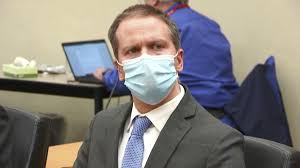
Defense Attorney Eric Nelson

In his closing argument, Chauvin’s defense attorney, Eric Nelson, didn’t exactly hit the ground running.  It’s fifteen minutes into his presentation and he’s still defining reasonable doubt and the presumption of innocence and I’m going, I got it, I got it, move it!   When Nelson finally got into the substance of what he had to offer, it seemed as if the word “reasonable” was in every other sentence: what was reasonable for a police officer to do in this circumstance; reasonable, reasonable, reasonable.  This from the transcript characterizes the thrust of Nelson’s closing argument:

And then you look at the direct knowledge that a reasonable police officer would have at the precise moment force was used. That includes information that they gather from dispatch, their direct observations of the scene, the subjects, and the current surroundings. They have to take into consideration whether the suspect was under the influence of a controlled substance. They can take that into consideration, because again, this is a dynamic and ever-changing. Just like life, things change.  It’s a dynamic situation. It’s fluid. They take into account their experience with the subject at the beginning, the middle, the end. A reasonable police officer tries to, or is at least cognizant and concerned, about future behavior, and that factors into the reasonable police officer’s analysis too, because sometimes officers take someone into custody with no problem and suddenly they become a problem. It can change in an instant.2

This went on for about forty-five minutes and I’m thinking, what’s he doing this for, reasonableness is the last thing you want to try to tack on to Chauvin.  What Chauvin did was, it seems to me, obviously unreasonable.  The reasonable thing to have done when all four officers couldn’t get Floyd into the police car—he was a really big muscular guy—was to call for a police van, or better, an ambulance and emergency medical personnel (Floyd was saying he couldn’t breathe), and let Floyd sit or lie somewhere handcuffed until they got there.   At least Chauvin could have taken his knee off Floyd’s neck as soon at Floyd stopped thrashing around.

And anyway, I thought to myself, Chauvin isn’t accused of being unreasonable. You don’t go to jail for being unreasonable.  You go to jail for breaking a law.  It struck me that, really, I didn’t know what law or laws Chauvin was accused of violating.   As did everyone, I had seen the video and assumed that it was to be taken as Chauvin out-and-out murdering Floyd, but I wasn’t up on the particulars—first degree, second degree, and so on–and Nelson going on about reasonableness wasn’t helping me out in this regard.

I quickly checked online while Nelson was making his presentation and learned that Chauvin was accused of second degree murder and two lesser charges, manslaughter being one of them.  I didn’t get into any details of the laws, wanting to get back to Nelson—or sort of; in truth, he was boring the hell out of me.  I kept waiting for him to deal directly with the charges against Chauvin and how the prosecution hadn’t proved them, but it never happened.  He jumped around, this, that, and the other thing—all the trouble they had getting Floyd to cooperate, what force is authorized, how long Chauvin’s knee was on his neck (or was the knee on his upper back?), Floyd’s cause of death, and the hostile bystanders, and what was reasonable in all of that.

It was clear Nelson was conscientious and had put in a lot of preparation time, but I’m reacting, “How exactly does all of this relate to what Chauvin’s accused of doing?”  The trial must be more than just whether Chauvin is a racist White cop like all the rest of them and oppresses Blacks for no reason at all and looked very bad on a video, and that if you agree that what was going on was evil personified, and who wouldn’t, put the creep in prison and throw away the key.  The law is more precise, nuanced, than that, or so I assumed anyway.  (Later: Yes, the law is more precise than that, but I’ve concluded from writing this up that Chauvin was indeed convicted of looking on the video like your typical racist White cop who tortures and executes poor, helpless Blacks, case closed, cart him off.)

I’m not an attorney, but I’ve taught school and written for publication, and I know that to convince people of something—which was the challenge for the defense here—you need to organize your presentation so that things tie together in an easy-to-understand, accessible, convincing way.  People ought to feel good about themselves for getting on board with you.  From watching his presentation and later reading a transcript of it, my call is that defense attorney Nelson didn’t bring that off.

 *   *   *

Take this for what it’s worth, I’m no expert on the details of the case and have zero legal expertise, but I’m going to be so presumptuous as to sketch out how I would have come at the closing defense argument in the Chauvin trial for your consideration.
I’d have grounded my presentation in the specifics of the laws Chauvin was accused of violating and argued that the prosecution hadn’t established beyond a reasonable doubt that he had violated them.  I’m not contending this would make any difference in the verdict, just that it would have been better than what Eric Nelson did.  This was a rigged proceeding from the get-go, right out of Stalin’s time or East Germany before the fall of the Berlin Wall.  It was a show trial.   Here’s an enemy of people, nail him good (and, in this instance, if you don’t, it’s an apocalypse, and we know where you live).  Clarence Darrow couldn’t have won this case.  But even if a cause is futile, we still are obligated to do the right thing the best we can.  We can push the rock up the mountain even if it is sure to roll back down on us.  Here’s how I would have pushed the rock.

In the closing argument, I would have put the Minnesota legal statutes Chauvin was accused of violating on big pieces of cardboard and set them on easels.   I looked it up, there were three of them, three counts.   With a pointer that had a rubber tip on it, I would have directed my presentation at what was on the three pieces of cardboard.   If it wasn’t on the cardboard, I wouldn’t deal with it (with one exception, which I’ll get to right at the end of this writing).

As it was, in no time at all, the jury found Chauvin guilty on all three counts.  One juror after the trial said that eleven of the twelve were ready to convict twenty minutes into the deliberation, but one juror held them up a bit on some technicalities.  Count I was second degree murder.  Count II was third degree murder.  Count III was second degree manslaughter. Wielding my pointer, I’d have said to the jury, “These are the three laws that Derek Chauvin is accused of violating.  Let’s go through them one at a time.  The question for you is whether the prosecution has proven beyond a reasonable doubt that Chauvin did these things.  Men and women of the jury, much less a reasonable doubt, there is no doubt that Derek Chauvin didn’t violate any of these laws.”

I’ll go through the three counts here and briefly say how I’d come at them.  You can add your own thinking to mine.   The counts are taken from the formal charges against Chauvin.3

COUNT I

Charge: Second Degree Murder – Unintentional – While Committing a Felony

Minnesota Statute 609.19 (1)

Maximum Sentence: Imprisonment for not more than 40 years.

Offense Level: Felony

Charge Description: That on or about May 25, 2020, in Hennepin County, Minnesota, Derek Michael Chauvin caused the death of a human being, George Floyd, without the intent to effect the death of any person, while committing a felony offense other than criminal sexual conduct in the first or second degree with force or violence or a drive-by shooting, namely assault in the third degree.

This is the big one, forty years.   What jumps out here is that in order to be guilty of violating this law, it isn’t enough that Chauvin caused the death of Floyd, he had to do it while committing a particular felony, third degree assault (which usually isn’t a felony, but sometimes is if the offense is bad enough).  Subdivision 1 of the Minnesota statute for third degree assault applies in this case:

609.223 ASSAULT IN THE THIRD DEGREE

Subdivision 1.   Substantial bodily harm.

Whoever assaults another and inflicts substantial bodily harm may be sentenced to imprisonment for not more than five years or to payment of a fine of not more than $10,000, or both.

The issue with this count is whether the prosecution has shown beyond a reasonable doubt that Chauvin was assaulting Floyd rather than restraining him.

To the jury:

“Are you certain enough that Chauvin was assaulting Floyd to put him in prison for forty years?   The video has this exchange:

Chauvin:  Relax.
Floyd: I can’t breathe!
Chauvin: You’re fine. You’re talking fine.

And this:

Officer: I just worry about the excited or delirium or whatever.
Chauvin: That’s why we have EMS coming.

“Does that sound to you like assault with the intent to inflict substantial bodily harm, no reasonable doubt about it?   Could it be that Chauvin thought he was restraining Floyd until the medical people got there?  He may have been unreasonable, or unwise, in doing what he was doing, but that is not the issue in this count.  It is whether he was committing the felony offense of assault against Floyd.   Ask yourself, ‘How has the prosecution demonstrated to me beyond a reasonable doubt that Chauvin was assaulting rather than restraining Floyd?’  They haven’t, and there is no doubt about that.”

The second count, third degree murder. 

COUNT II

Charge: Third Degree Murder – Perpetrating an Eminently Dangerous Act and Evincing a Depraved Mind

Minnesota Statute 609.195 (a)

Maximum Sentence: Imprisonment for not more than 25 years

Offense Level: Felony

Charge Description: That on or about May 25, 2020, in Hennepin County, Derek Michael Chauvin caused the death of another, George Floyd, by perpetrating an act eminently dangerous to others and evincing a depraved mind, without regard for human life.

The key elements here are perpetuating an eminently dangerous act and evincing (revealing) a depraved mind, without regard for human life.

“Has the prosecution demonstrated to you beyond a reasonable doubt that the neck restraint Chauvin applied is eminently—exceedingly, extremely—dangerous?  No, it hasn’t. This restraint is authorized by the Minneapolis police department, is widely used by law enforcement throughout the world, and is not known for causing death; it certainly hadn’t in Minneapolis before the Floyd incident.  Are you sure beyond a reasonable doubt that Chauvin thinks to himself, ‘Here’s my chance to perpetrate an eminently dangerous act right here in front of all these people and with this young woman taking a video on her cellphone.’  Conjecture isn’t evidence. Presumption isn’t evidence.  What hard evidence has the prosecution given you that supports you being so certain that this human being—Chauvin is a human being, just like George Floyd, just like you—was perpetrating an eminently dangerous act rather than trying to do his job that you are willing to put him in prison for 25 years?  Twenty-five years from now is 2146.  And how have you been shown that Derek Chauvin is no less than depraved?  Not just performing an ill-advised act, but depraved.  And that he is without regard for human life?  The prosecution has established this?   When?  How?  This count takes the cake.  It’s absurd.”

And the third charge, second degree manslaughter.

COUNT III

Charge: Second Degree Manslaughter – Culpable Negligence Creating an Unreasonable Risk

Minnesota Statute: 609.205 (1)

Maximum Sentence: Imprisonment for not more than 10 years, or payment of a fine of not more than $20,000, or both.

Offense Level:  Felony

Charge Description:  That on or about May 25, 2020, in Hennepin County, Minnesota, Derek Michael Chauvin caused the death of another, George Floyd, by his culpable negligence, creating an unreasonable risk and consciously took the chance of causing death or great bodily harm to another, George Floyd.

The angle here is the part about consciously took the chance of causing death or great bodily harm.

“It’s fair to say that what Derek Chauvin did contributed to George Floyd’s death, though even that isn’t a dead certainty given Floyd’s dire health condition.   But did Chauvin consciously take the chance of killing Floyd?  Was that on his mind?   The prosecution has established that?  Absolutely, it hasn’t.  Chauvin had no way of knowing about Floyd’s COVID and heart disease.  We’re talking about a police officer here, not a medical expert.  It’s commonly believed that if you can speak you can breathe.  Should Chauvin have just let Floyd lie there until medical help got there, where Floyd said he wanted to be (‘I want to lay on the ground, I want to lay on the ground.  I’m going down, I’m going down.  I’m going down’).   Arguably, yes.   Given that Mr. Floyd died, we can assume that with 20/20 hindsight Derek Chauvin would do things differently.  But that doesn’t justify putting him in prison for ten years.  He didn’t consciously—consciously, with intent—take the chance of causing Floyd’s death. There is no evidence that supports that speculation.”

More to be said, but you get the idea of how I would have come at the closing argument.  If nothing else, it provides an alternative to the approach taken by Chauvin’s defense attorney, Eric Nelson.   A New York Times article squared with what I saw Nelson doing, that is to say, pushing the reasonable-police-officer theme.

For nearly three hours, Mr. Nelson focused on Mr. Chauvin’s decision-making and on what factors may have caused Mr. Floyd’s death.  He emphasized that the jury instructions say that no crime has been committed if a police officer was justified in using reasonable force and that jurors should determine what is justified by considering what “a reasonable police officer in the same situation would believe to be necessary.”4

As far as I can see, in going this route, Nelson didn’t speak to what the charges against Chauvin actually were, and it was deadly bad for Chauvin.  I certainly wouldn’t have wanted to be making the case that what Chauvin did was reasonable.

I keep thinking I have to be missing the point in all of this somehow.  I’ve recently begun reading the Powerline site online and finding it very informative.  It’s a group of attorneys commenting on the news.  One of them, Scott Johnson, wrote this with reference to federal charges against the four police officers involved in the Floyd case:

State convictions and stiff sentences against the former police officers in this case would easily satisfy federal concerns. The theory of the state prosecutions is that, even though George Floyd was lawfully arrested and detained, police exploited their detention authority, abusing his rights to (a) be subjected to only reasonable (not excessive) force, and (b) have police protect his right to life. Chauvin was found guilty of those abuses, and it is highly likely that the other three former officers will be, too.5

Exploited detention authority?  Used unreasonable force?  Didn’t protect Floyd’s right to life?  Chauvin was found guilty of those abuses?  I thought the charges were violating Minnesota statutes prohibiting assault, committing an eminently dangerous act, behaving from a depraved mind and having no regard for human life, and knowingly taking a chance on causing death or great bodily injury.  Scott Johnson is a Minneapolis attorney who for 25 years has written for major publications, including National Review and The New York Times, and he is a fellow at the prestigious Claremont Institute.  He’s got really strong legal credentials, and I’m following the NFL draft (Wilson has a history of shoulder surgery).   I don’t know.  I’ll leave it to you to sort this out.

*   *   *

I’ll close with three things I would have done if I had been defending Chauvin.

First, I would have done my best to get that mask off him.   Personalize him, make him an individual.  With the mask on, Chauvin comes off as a type, a symbol for racist cops everywhere.  If you throw the book at him, you are making a statement about police and their practices in general, not punishing a mortal, fallible-like-we-all-are, individual person, with parents and a sister and former stepchildren whom he may still be in contact with and a job that happens to be that of a police officer.   I’d try to humanize Chauvin, make the jury aware that whatever they do, for whatever reason, they are doing to him.

I would have had him testify.  Attorneys are really skittish about having defendants testify, something about them getting worked over by prosecution grilling.  I don’t get it.  I don’t care what instructions judges give juries—don’t read anything into the defendant’s choice not to testify, etc.  If I’m on a jury, I’m thinking he has something to hide or he’d be bursting at the seams eager to tell his side of the story.  Plus, I want to hear from him.  We’ve heard from everybody else.  Tell us, what were you doing and why?   Give us your side.

I don’t see how Chauvin would be vulnerable on the stand.  All he has to do is hang in there with a simple story.  “We’ve got a guy who we can’t wrestle into a car and he’s ranting and thrashing around and kicking his legs.  I thought I was staying calm and restraining him until the ambulance got there, which turned out to be longer than I expected.   People were yelling at me and threatening me and I thought I might have to use mace to protect myself when in my mind I was doing the proper thing.  It was a dangerous situation, so bad that the emergency medical people wouldn’t attend to Floyd until they got him out of there.  Absolutely, I wasn’t assaulting Floyd.   I thought the knee restraint was safe and that since he was talking he could breathe.   I feel terrible that he died.   I’ll live with it for the rest of my life.  I wish I could have done better by George Floyd, but I know in my heart that I did the best I could to safely make the arrest within the intense pressure of that moment.”

And last, I would have ended my closing argument by referring to the elephant in the room: people were threatening to tear apart the city of Minneapolis, and other cities as well, if the jury didn’t convict Chauvin, and there were threats against the jurors themselves if they didn’t do the mob’s bidding.  The jurors weren’t sequestered, they knew this.  I don’t know how directly I could have addressed the threat that was looming over the trial.  Perhaps something like this: “There are times in our lives, not more than a few, when we are called upon to do the truly honorable thing and there is a very strong temptation not to.  Doing the honorable thing in that circumstance tests our character: our honesty, our integrity, our autonomy, our toughness, our courage.  This is a highly charged case, you knew that before you took your oath as a juror.  You’ll very likely never be tested like this again in your life.  You have the responsibility to assess thoroughly and impartially whether or not the prosecution has established beyond a reasonable doubt that Derek Chauvin violated three Minnesota laws.  You pledged to do that, and only that.  Now is your time to stand up and be counted, as a citizen and as a human being.  Thank you.”


Endnotes

  1. Both the transcript and a video of the defense closing argument are online.

https://minnesota.cbslocal.com/video/5503824-full-video-defense-presents-closing-arguments-in-derek-chauvin-trial-part-1/

  1. From the transcript of the defense closing argument. Op. cit.
  2. The formal charges against Chauvin.

https://assets.documentcloud.org/documents/6935897/Derek-Chauvin-Second-degree-murder-charge.pdf

  1. “In His Closing Argument, Derek Chauvin’s Lawyer Urges Jurors to ‘Not Let Yourselves Be Misled.’” Nicholas Bogel-Burroughs, The New York Times, April 19, 2021. https://www.nytimes.com/2021/04/19/us/derek-chauvin-defense-closing-argument.html
  2. “A Redundant Prosecution, Star Tribune Edition,” posted on Powerline by Scott Johnson on May 8 th, 2021. https://www.powerlineblog.com/archives/2021/05/a-redundant-prosecution-star-tribune-edition.php


Is Jewish Leftism a ‘Reform Problem’?

“What Reform did not do, any more than the ‘Science of Judaism,’ was to solve the Jewish problem.” Paul Johnson, A History of the Jews, 1987.

Sparked by Tucker Carlson’s remarkable move towards the Jewish Question, the recent condemnation of the ADL issued by 1,500 rabbis associated with the Coalition for Jewish Values (CJV) has once more raised the question as to whether destructive activity perpetrated by Jewish activists in America is a matter of denomination rather than ethnicity. For several years now, but increasing during the early Trump years, there’s been a quiet but growing argument from self-styled ‘right-wing Jews’ that Jewish leftist activists are anathema to Judaism, or that as adherents of the Reform movement or Liberal Judaism they are a variety of heretical neo-Frankists unrepresentative of “true Jews.” Underlying these arguments is the implication that anti-Semitic theories involving Jews as an ethnic group, perceived as uniform, rely on weak generalizations that do not take into account the political and cultural nuances of American Jews, and therefore that such theories are illogical and irrational. In the course of almost a decade of writing about anti-Semitism and historical and contemporary Jewish behavior among Europeans, I’ve addressed this issue of political nuance more or less directly in a number of essays, especially my discussion of Jewish attitudes to Brexit and Jewish Leftist activism in children’s fiction. Given the quite dramatic nature of this most recent intervention from a signification number of rabbis against one of the world’s most prominent Jewish organizations, however, I think it’s an appropriate time to tackle the subject directly.

Before beginning, it’s worth reflecting on the context of the initial contention made by self-styled right-wing Jews. These Jews, one of the most prominent being Nathan Cofnas, make the argument that Jewish involvement in the advancement of Leftism in the West is both limited (in the sense that the advancement of Leftism also involves massive numbers of Whites and other ethnic groups), and is a predominantly Reform affair, whereas Orthodox and Ultra-Orthodox Jews have a different socio-political direction entirely. In regards to the first element, the ‘limits’ of Jewish involvement, there are few, if any, anti-Jewish theories in circulation which ascribe to Jews sole responsibility for the entirety of contemporary leftist activism. What does exist, however, is a substantial volume of evidence demonstrating that individuals who self-identify as Jews have been over-represented as innovators, leaders, and funders of the modern Left, and this evidence has led to the logical and tactical adoption of an anti-Jewish political position by many conservative Europeans and those of European ancestry. To put it simply, Jews don’t need to be orchestrating a kind of solo conspiracy against the West for an anti-Semitic political position to make theoretical sense and be supported by the data, or for Jewish influence to be a reasonable and rational topic of public discussion.

In regards to the second element of the ‘right-wing Jewish’ contention, it should be understood that the trajectory of the argument is essentially diversionary. When I first read the “not all Jews” argument being employed by Cofnas against Kevin MacDonald, for example, I was immediately reminded of the historical framework of prior debates in which minor concessions on the Jewish Question appear to be made, but are then narrowed and finally diverted. Relevant examples can be found in the public debates between Christian Wilhelm Von Dohm and Moses Mendelssohn[1], and between Karl Marx and Bruno Bauer.[2] In both cases, which concerned the question of Jewish political emancipation, and the undesirability of such an event in the context of negative Jewish group behavior, the Jewish participants attempted to rhetorically carve off elements of the Jewish population, scapegoating them temporarily in order that broader Jewish goals (social, political, or economic) might be achieved. Both Mendelssohn and Marx conceded that harms were being wrought by Jews, but added that this was the result of historical mistreatment that produced a class of renegade Jews (crooks and usurers for Mendelssohn; arch-capitalists for Marx). The fundamental goal of these rhetorical strategies was to defuse and weaken the anti-Semitic reaction, with both Mendelssohn and Marx keen to ease the Jewish path to full civic equality in Europe.

The modern version of these strategies appears to be the insistence that historical treatment (exclusion from the Right[3]) and contemporary circumstances (tendencies in Western liberalism) have created a Frankenstein’s monster in the form of a radical left Reform Judaism. While right-wing Jews are comfortable, to an extent, in condemning these radical Reform Jews, they insist that the host population should remain tolerant of the Jewish ethnic group as a whole and to continue to support Israel. The crucial point here is that, because of its diversionary nature, and its quite obvious side-stepping of the cost-benefit implications of philo-Semitic tolerance (as if European problems with Jews and Judaism have ever been limited to postmodern Leftism), it is inherently political to ask if Jewish Leftism is a Reform problem. It is nevertheless interesting to ask, given that it interrogates the framing of anti-Semitism and opens up valid questions about the Jewish relationship to the Left, and about the nature of the Jewish-European conflict more generally. Most pertinently we should ask, even if Jewish Leftism is a Reform problem, does it ultimately matter?

Gaining conclusive and detailed insight into the socio-political leanings of contemporary American Jews is difficult. Part of this difficulty lies in historical Jewish evasiveness when it comes to, for example, being counted in national censuses, and more general suspicions that data collected on Jews will inevitably be used against them by the host population.[4] When Jewish organizations conduct their own surveys of political, social, or cultural attitudes, the direction of analysis is overwhelmingly against the host population. In fact, surveys of alleged anti-Semitism in the host population are extremely common, if not the most common type of social survey conducted by Jewish groups.[5] Scholars have pointed out that in those instances where Jewish groups engage in surveys among their own people, these surveys are overwhelmingly concerned with population size and Jewish identity, and are often loaded with agendas, biases, and goals such as the boosting of Jewish fertility and the reduction of intermarriage rates.[6] Furthermore, in those instances when Jews have conducted social research on themselves as a means of ‘explaining’ themselves to host peoples, this has also been warped by ulterior and often apologetic motives. Hebrew University’s Sergio Della Pergola, for example, has argued that “Jewish social research was never the mere exercise of human curiosity or analytical skill. Rather it was a means of advancing specific theses regarding the nature of the Jews vis-a-vis world society.”[7] All of which is to say that survey data and social research concerning Jews should be treated with an appropriate level of caution.

It’s nevertheless clear that gaining some kind of reliable insight into the political positions and divisions of American and Western Jewry is important, if not crucial, for host nations. Since their earliest arrival in Europe, Jews have been noted as influential political actors in Western nations, and in recent decades this influence has extended even to the manipulation of the demography of those countries. Della Pergola, for example, has argued that Jewish populations “may significantly influence national population trends in order to advance their own corporate interests — for example, by advocating particular policy interventions.”[8] Della Pergola notes that Jewish populations can often be divided into at least two categories: the core Jewish population of strongly-identified, full-blooded, and often religious, Jews; and the ‘enlarged Jewish population’ which embraces all those with at least some Jewish ethnic heritage that they have consciously embraced, as well as those full-blooded Jews of a less religious inclination but who see themselves as part of a Jewish peoplehood. It’s important to stress at this stage that both divisions are fully capable of formulating and pursuing ideas of what constitutes “corporate interests,” even differing ideas, since the ultimate corporate body in both divisions is not Judaism as such but the Jewish people or even merely the idea of the Jewish people and its putative destiny.

One of the weaknesses of Della Pergola’s division of contemporary Jewry is its lack of utility in the religious sense. Orthodox and Reform Jews can only be roughly mapped onto “core” and “enlarged” categories because, in an American context in which Reform Jews are certainly an influential demographic majority, it makes little sense to argue that they are not in fact the “core” of the American Jewish community. This is where the argument of the self-styled right-wing Jews encounters its first major stumbling block, because the attempt to defend Jews in toto by scapegoating Reform Jews misses the point that Reform, for all intents and purposes, is American Jewry and will remain so demographically far into the future.[9]

The “core” and “enlarged” categories are, however, of some interest and utility when discussing survey data on Jewish political attitudes. It’s been noted that most exit polls will collect reasonably accurate data on “core” Jews because they capture “Jews by Religion” (JBR) when asking if voters are Protestant, Catholic, Jewish, etc. The “core” Jewish population is more likely to include the more religiously identified Orthodox Jews, but it’s interesting that most recent exit polls (conducted by Pew Research) continue to show that even in the JBR category the party split was 68 percent Democratic, 7 percent Independent, and 25 percent Republican. Figures for “Jews of No Religion” (JNR) were 78 percent, 10 percent, and 12 percent. More than 40 percent of JBRs described themselves as liberal, while only 22 percent described themselves as conservative. The rest indicated only that they were moderate, which is open to any number of interpretations. Herbert Weisberg, writing in The Annual Jewish Year Book 2019 explained the figures as indicating that “Jews should be considered to be more Democratic and more liberal than media surveys and exit polls typically show.”[10] This would seem to be indicated also by a number of J Street exit polls which showed that Orthodox Jews are more liberal than ‘right-wing’ Jewish diversionists would have us believe. More than half of Orthodox Jews (59 percent), for example, voted for Obama in 2012, and a similar proportion (56 percent) voted for Clinton in 2016.[11] Even among the Ultra-Orthodox, normally viewed as overwhelmingly hawkish and likely to vote along with the flamboyant Zionism of the GOP, more than a third of respondents (35 percent) to one poll described themselves as Democrats.[12]

It’s important to note that the Jewish political profile is unique. While attempts have been made, by diversionists like Cofnas, to explain Jewish liberalism as an aspect of their higher educational attainment or their likelihood to be more urban-dwelling, serious scholars of Jewish demography and politics have long noted that “studies consistently find that Jews are significantly more Democratic than non-Jews with similar socio-demographic characteristics … Indeed, Wald’s calculations show they are more Democratic than the non-Jew who is their closest match on demographics and economic status.”[13] Wald and Weisberg instead argue that all Jews, whether Orthodox or Reform, “core” or “enlarged,” will vote or engage politically as part of a reaction to “the greatest perceived threat to their interests.”[14] In other words, Jewish political behavior is best explained by Jewish agency and perceptions of Jewish interests rather than cultural context.

It’s arguable that two of the most important Jewish interests are in the form of socio-economic dominance and multiculturalism, and here the unique pattern of Jewish political activity continues and amplifies. It’s extremely interesting that Jews very heavily support non-economic forms of Leftism, and are very much in favor of the expansion of government power, but are much more reluctant to back purely economic forms of socialism. In this regard they differ significantly from non-Jewish Leftists who embrace and emphasize economic socialism within their worldview. A 2012 survey found that a majority of Jews were not willing to pay more taxes in order to help the poor, were not likely to support a government health scheme, and were generally not supportive of government economic guarantees.[15] Jews have also been noted in the past as strong opponents of affirmative action, with even the ADL and the American Jewish Committee filing briefs against it.[16] This can be easily interpreted not as a method of opposing race politics, but as a means of preventing incursion into, or a breaking up of, established Jewish dominance within the professions. This would indicate that Jerry Muller’s theory that Jews have long had a “special relationship” with capitalism,[17] continues to have resonance despite the leadership of Jews in the onward march of purely cultural and political forms of Leftism—now championed by large swaths of other elite sectors of America, including large corporations.[18] The general image that emerges is one in which Jews act politically to create socially and culturally fluid societies where a façade of social justice and equality is promoted and celebrated, and in which a pseudo-elite (Whites) is attacked, but in which no real threat to Jewish privileges and socio-economic dominance is present.

Jews also quite obviously have a special relationship with multiculturalism, being Europe’s first significant minority and the passive or active cause of most of the continent’s earliest legislation on tolerance and migration. It’s an unfortunate commonplace that many of those who have criticized Kevin MacDonald for suggesting that Jews promote multiculturalism in order to feel more secure, are completely ignorant of the fact that several of his ideas are in some form or another slowly becoming fairly mainstream in the sociological study of contemporary Jews. Historian Diana Pinto, a Jewish Harvard graduate, Fulbright Fellow, and board member for the Institute for Jewish Policy Research, has argued that, within a multicultural context, “Jews are no longer perceived as the only ‘diasporic’ people, or as the most significant ‘other’ in the society,” and that this “relieves Jews of burden.”[19] Any scenario in which the pluralistic principles of the host nation are fundamentally challenged, or in which demographic change could return Jews to a position of ‘burden,’ would therefore quite obviously represent a perceived threat to Jewish interests along the lines discussed by Wald and Weisberg, and the question of immigration and associated laws would be an area of political activity that one would expect to see high levels of Jewish participation. Jewish opinions on threat level can of course vary, with some Jews feeling content and secure with moderate levels of pluralism while others would feel secure only when the demographic dominance of the host population is completely undermined. If a proportion of the immigrating demographic is itself a perceived threat to Jews, for example in the case of Muslim migration to France and other parts of Europe, further division and divergence would be expected. The most important aspect of the topic, however, remains that Jews have a fundamental interest in preserving the pluralistic principles of the host nation and avoiding a return of the Jews to a position of being a salient ‘other,’ and therefore a ‘burden.’ In this respect, much as with the nature of Jewish Leftism in relation to economic and social questions, the Jewish relationship to multiculturalism is unique, and involves a blurring of the standard Left-Rright political categories that can be more crudely applied to non-Jewish political activity.

The apparent clash between the Anti-Defamation League (ADL) and the Coalition for Jewish Values (CJV) over Tucker Carlson presents an interesting case in which fundamental agreement on Jewish interests can be overlaid with disagreement between fringe cliques of Jews and the great majority of the Jewish population on how to best achieve those interests. The first point worth stressing is that the incident is not a straightforward case of Orthodox versus Reform. The Coalition for Jewish Values is, as far as I am aware, exclusively staffed by Orthodox and Ultra-Orthodox Jews who can be usefully described as “core” Jews. The ADL, however, cannot be neatly categorized as a Reform organization, because its most recent Directors have been Orthodox (Abe Foxman, Director 1987–2015) and Conservative (Jonathan Greenblatt, Director 2015–present), and because its behavior since its founding can be most accurately described as an expression of the “enlarged” Jewish population rather than any specific denomination within that. Further, the motivations and past actions of the CJV map comfortably within a reasonable conception of Jewish interests rather than being a novel break from them. And finally, in all such cases of division within the Jewish community, it’s important to assess where the power lies if one is attempting to discern relative influence on the wider society. The ADL, representing the interests of the “enlarged” Jewish population, is far more powerful and influential than CJV.

Even aside from the fact that they emerged from the momentum of Trumpist Zionism, it’s interesting that the CJV has rationalized its more socially conservative positions via the lens of Jewish interests. When the group filed an amicus brief in support of Christian groups fighting to keep a large cross placed on public grounds in Pensacola, Florida, for example, the CJV claimed that ruling against the right to place a cross would also “encourage the erasure of minority religions from public life.” In other words, they viewed their actions primarily as protecting Judaism and pluralistic principles in the host society, even if this commitment to pluralistic principles has not extended, as in the case of the “enlarged Jewish community,” to gays and transsexuals. The CJV may also be a response of sorts to increasing awareness among conservative Whites (like Tucker Carlson) that Jews occupy a very unique and prominent role in American Leftism. This increasing visibility would obviously be perceived as a threat by Jews. Yaakov Menken, the CJV’s managing director, has recalled a conversation with a Christian pro-Israel leader who told him: “I can’t tell you how often people ask me “‘why are you devoting so much time to supporting the Jews and Israel when Jews oppose us on our core issues?’” The potential collapse of Christian Zionism and philo-Semitism in America would obviously have significant consequences for Jewish influence globally, and it should therefore come as no surprise that an effort to heighten the visibility of a “right-wing Judaism” would be made, no matter how superficial or self-interested.

Concluding Remarks

Is Jewish leftism a Reform problem? No. The Orthodox and Ultra-Orthodox have their own history of endorsing and supporting Leftism if it suited Jewish interests, motivated by their attempting to avoid or lessen perceived threats. Moreover, even if Jewish Leftism was a Reform problem, the broader causes of anti-Semitism wouldn’t evaporate with the disappearance of that denomination. The Reform movement, we should recall, began in the nineteenth century — around 2,000 years after the earliest writings against the Jewish people. Many of the major historical provocations of anti-Semitic attitudes such as high levels of Jewish ethnocentrism, Jewish economic domination and exploitation, and the special political relationship between Jews and elites, cross denominational lines and precede by centuries the emergence of the modern Left. Some aspects of problematic contemporary Jewish behavior such as slumlordism, fraud, and white-collar crime are actually found in higher numbers among the Orthodox and Ultra-Orthodox than among Reform Jews.[20]

In short, the case for an ethnic interpretation of Jewish behavior far outweighs that for a denominational perspective. In the end, the diversionary argument of the self-styled Right-wing Jews can only gain traction among those whose worldview is simplistic and without nuance, and who perceive all of contemporary politics under the basic rubric of Left versus Right. Among such people, it’s perfectly possible to look at the handful of anti-transsexual or anti-ADL statements of the CJV and conclude that one has an ideological brother. Among the more sophisticated, however, in which a definite sense of ethnic interests is foremost, a more nuanced approach emerges, along with a new question altogether: For how long will the politics of my nation turn on the axis of Jewish interests?


[1] Crouter, Richard. “Emancipation Discourse in the Late 18th Century: Christian Wilhelm von Dohm on the Jews (1781)” Journal for the History of Modern Theology, vol. 13, no. 2, 2006, pp. 161-178. For translated primary sources on the debate between the two intellectuals see Mendes-Flohr, Paul R. (ed) The Jew in the Modern World: A Documentary History (New York: Oxford University Press, 1980), pp. 27-43.

[2] See on this topic, Peled, Yoav. “From theology to sociology: Bruno Bauer and Karl Marx on the question of Jewish emancipation.” History of Political Thought 13, no. 3 (1992): 463-485; Blanchard, William H. “Karl Marx and the Jewish question.” Political Psychology (1984): 365-374; Leopold, David. “The Hegelian Antisemitism of Bruno Bauer.” History of European ideas 25, no. 4 (1999): 179-206.

[3] Although ‘right-wing’ Jews like Cofnas seem unaware of it, they’re actually regurgitating an old-fashioned and now more or less discredited theory of Jewish liberalism. See, for example, the work of Werner Cohn in the late 1950s, where he often argued that Jews had been ‘pushed’ to the left by the association of the right with anti-Semitism.

[4] For a more detailed discussion of these difficulties see Della Pergola, Sergio, “Jewish Demography: Fundamentals of the Research Field,” in Rebhun, Uzi, The Social Scientific Study of Jewry: Sources, Approaches, Debates (Oxford: Oxford University Press, 2014). Also of interest in the same volume is Saxe, Leonard et al, “Measuring the Size and Characteristics of American Jewry: A New Paradigm for an Ancient People.”

[5] Smith, Tom W. “A Review: Actual Trends or Measurement Artifacts? A Review of Three Studies of Anti-Semitism.” The Public Opinion Quarterly 57, no. 3 (1993): 380-93.

[6] Della Pergola, Sergio, “Jewish Demography: Fundamentals of the Research Field”, 10 & 23. Such studies can, for example, be designed to “greatly exaggerate” notions of Jewish population decline in order to promote endogamy and increase Jewish fertility.

[7] Ibid., 15.

[8] Ibid., 17.

[9] Although having a higher birth rate, Orthodox Jews comprise only around 10 percent of American Jewry, and around 10 percent of Orthodox youth eventually drift into more liberal Jewish milieus or forms of Judaism. The decline of the Reform population via intermarriage has rightly been described as “greatly exaggerated” by Calvin Goldscheider. See Goldscheider, Calvin, Studying the Jewish Future (Seattle: University of Washington Press, 2004).

[10] Weisberg, Herbert. F. “The Presidential Voting of American Jews,” in Sheskin, Ira (ed), American Jewish Yearbook 2019 (New York: Springer, 2020), 43.

[11] Ibid., 82.

[12] Ibid., 77.

[13] Ibid., 73.

[14] Ibid., 46.

[15] Weisberg, Herbert F. The Politics of American Jews (Ann Arbor: University of Michigan Press, 2019),127-128.

[16] Van Horne, Winston A. Ethnicity in the Work Force (Milwaukee: University of Wisconsin Press, 1985), 56.

[17] See Jerry Z. Muller, Capitalism and the Jews (Princeton: Princeton University Press, 2010).

[18] Jack Dalton, “’Be Brave, Do Something’: Ashley Rae Goldenberg’s List of Corporations that Support the Riots asnd Want You Dead,” VDare (June 6, 2020). https://vdare.com/posts/be-brave-do-something-ashley-rae-goldenberg-s-list-of-corporations-that-support-the-riots-and-want-you-dead

[19] Quoted in Hartman, Harriet, “Studies of Jewish Identity and Continuity: Competing, Complementary, and Comparative Perspectives,” in Rebhun, Uzi, The Social Scientific Study of Jewry: Sources, Approaches, Debates (Oxford: Oxford University Press, 2014), 93.

[20] See, for example, Rosen, Michael, “God Will Not Provide: Hasidic Jews and Fraud.” Journal of Law & Social Deviance 3 (2012): 245.

Biden’s Anti-White Speech Writer

On April 28, 2021, unelected President Joe Biden spoke the following statement in his address to the Joint Session of Congress: “We won’t ignore what our intelligence agency determined to be the most lethal terrorist threat to the homeland today: White supremacy’s terrorism.”

An examination of how “our intelligence agency” came to this determination will be reserved for another essay. Here let us explore how such a statement could have made its way into the speech of our current installed President, speaking to the entire US Congress (though due to displays of viral fear and social distancing policies, only a token few were actually present), and supposedly by proxy, the entire US population legal and illegal.

Here is the rest of Biden’s speech content relating to “racism” in America and implications that Whites are to blame:

We have to come together to heal the soul of this nation. It was nearly a year ago, before her father’s funeral, when I spoke with Gianna Floyd, George Floyd’s young daughter. She’s a little tyke, so I was kneeling down to talk to her so I could look her in the eye. She looked at me, she said, ‘My daddy changed the world.’ Well, after the conviction of George Floyd’s murderer, we can see how right she was if, if we have the courage to act as a Congress. We have all seen the knee of injustice on the neck of Black Americans. …we have to come together to… root out systemic racism in our criminal justice system and to enact police reform in George Floyd’s name… let’s get it done next month by the first anniversary of George Floyd’s death. …

We have a giant opportunity to bend the ark of the moral universe towards justice, real justice. And with the plans outlined tonight, we have a real chance to root out systemic racism that plagues America and American lives in other ways.

You can see on television the viciousness of the hate crimes we have seen over the past year and for too long.

Who could have installed such blatant anti-White invective into the President’s speech, bestowing sainthood on the Black drug addict and petty criminal Floyd, invoking the spirit of Communist Party asset Martin Luther (Michael) King, hypnotically repeating the mantra “systemic racism,” directing equally hypnotized viewers to vicious “hate crimes” on TV, and above all identifying the greatest domestic terror threat to be “White supremacy”?

Speech Writer Carlyn Reichel

Biden’s two main speechwriters are Vinay Reddy and Carlyn Reichel. Much media attention focuses on Indian-American Reddy, as can be seen with a basic search for “Biden speech writer.” It is far more revealing to bring our attention to the Jewish member of the speech-writing team, Reichel. Veddy is the goyim BIPOC (Black/indigenous/people of color) cover and obligatory representative of “diversity, inclusion and equity” (itself an anti-White policy), while Reichel is at the core of Presidential messaging today.

Carlyn Reichel was Biden’s foreign policy speech writer back when he was Vice President, from 2015 to the end of the term in 2017. She was also the Director of Communications for the Penn Biden Center for Diplomacy and Global Engagement, whose vision includes “Addressing Threats to the Liberal International Order” and “Advancing the Dialogue on Internationalism.” She formerly served as Hillary Clinton’s speech writer when Clinton was Secretary of State. Reichel wrote an essay for Foreign Policy Magazine in 2017 titled “Trump Has Reshaped Presidential Rhetoric Into an Unrecognizable Grotesque.” The article is an anti-Trump screed based on her experience in crafting presidential-sounding rhetoric. For our purposes, here’s the main denunciation Reichel has of Trump’s speech in Warsaw: “For Trump, the boundaries of ‘civilization’ only extend to those who share his definition of ‘God’ and ‘family’ — that is, a Judeo-Christian worldview and power structures that continue to be dominated by White men.” We won’t go into the chutz-pocracy of a Jewess denouncing a Judeo-Christian worldview, but focus instead on her denunciation of White men.

With this history of anti-White messaging, Reichel is almost certainly the source of Biden’s outrageous statement about the “lethal threat” of “White supremacy’s terrorism” in America today.

The Cabinet Guides the President – The National Security Council

On January 20, Inauguration Day, nineteen people were appointed to Biden’s National Security Council. Carlyn Reichel was one of them. Fifteen are women, an overwhelming 80% representation in a group that typically and historically was overwhelmingly White males. Five are BIPOC: Colombian Hispanic Juan Sebastian Gonzalez, Japanese-American Melanie Nakagawa, and Indians Tarun Chhabra and Sumona Guha. Linda Etim (not insignificant as senior advisor to the Bill & Melinda Gates Foundaton) is Black. At least three are Jewish: Reichel, Edgard Kagan and Laura Rosenberger, with at least a fourth, Caitlin Durkovich married to a Jew (Rosenberg).  This makes Jewish representation in the National Security Council over 20% at minimum, more than ten times Jewish proportion of the population in America.

Reichel took the role of Director of Speechwriting and Foreign Policy. Biden’s speech to the joint session of Congress, loaded with the anti-White and particularly anti-White-male messaging we’ve noted, must have come from Reichel’s Jewish sensibilities. Edgard Kagan’s role on the National Security Council is Senior Director for East Asia and Oceania, addressing such delicate areas as US/Vietnam relations.  Laura Rosenberger is the Council’s Senior Director for China, and formerly top advisor to Hillary Clinton and a member of Obama’s National Security Council. She claims it was her Jewish upbringing in Pittsburgh that drives her to serve America. Caitlin Durkovich serves as the Council’s Senior Director for Resilience and Response. She is married to Simon Rosenberg, who was a high-level advisor to the Obama Administration, particularly on “immigration reform.”

Rosenberg worked at the Democratic National Committee, almost becoming its Chair, and founded the New Democrat Network and the New Policy Institute, which “has become committed to modernizing left-wing politics and building a persistent Democratic majority.” Current immigration policies are ensuring that. Rosenberg joined the hysterics about the stage set-up at the Conservative Political Action Conference in Florida this February, when the stage structure was said to resemble an obscure Germanic rune known as the Odal, displayed by a few German SS units in World War II. Rosenberg tweeted: “A short thread on #CPAC2021’s unusual stage, which is clearly in the shape of a well known Nazi symbol. It is also a symbol in use today by American extremists. … The CPAC leadership need to explain how this could have happened.” Undoubtedly Rosenberg’s influence on his wife Durkovich at the National Security Council will ensure Jewish paranoia elicits an intensive response to “Nazi extremism” in America today, civil liberties be damned. Of course, in the eyes of activists like Rosenberg, even mainstream conservatives and anyone who voted for Trump are considered be Nazis or proto-Nazis.

Please note, equating conservatives to “Nazis” amounts to “holocaust denialism,” since it is “belittling the attempted genocide of Jews and the memory of the 6 million,” according to Ellie Cohanim, former U.S. Deputy Special Envoy to Monitor and Combat Anti-Semitism at the State Department. Does this make conservative White men safe from being called “Nazis” by the National Security Council? Doubtful.

Linda Etim’s Anti-White Hate Speech

Linda Etim is typical of many Black activists in projecting anti-White hate messaging. In her essay for Carnegie Endowment for International Peace of October 6, 2020 titled “Reimagining U.S.-European Development Cooperation,” as one of three main things to do for “leveraging the resources and capacities of the richest countries in the world to address global challenges,” Etim recommends:

Finally, we must prioritize the fight against global White supremacy and nationalist populism that verges on fascism, both in our own countries and internationally. The rise of xenophobic and ultranationalist populism is not only a domestic threat to our democracies, but it also leads to a dangerously perverted understanding of the world. The legacies of colonialism and persistent racism continue to impose a burden on the inhabitants of too many countries. There will be some in the Global North who push for an inward turn—who push to ignore what U.S. President Donald Trump infamously called ‘shithole countries’ in a racist quip.

Translated, this means that the popular movements to advocate for White interests in majority White nations amount to “Fascism,” a threat to democracy (tyranny), and abandoning the Third World to ruin.

Of course, Etim must reference the Neo-Marxist mobs rampaging through the streets of America’s cities: “The Black Lives Matter movement arose out of the specific context of the persistent race-based caste system of the United States.” It had nothing to do with activists like George Soros/Georgi Schwartz’s Open Society Foundations funding and organizing destabilization and crisis phases of the neo-Communist revolution such as funding public prosecutors who have essentially abandoned prosecuting Blacks and have ensured that rioting Blacks would not be charged with crimes. “But the movement’s fundamental claim—of the equal dignity and rights of all persons by virtue of their humanity—is one that needs to be driven through our perspectives and approaches to international development as well.” One doubts that she believes that White people should be included in such universalist platitudes.

Carnegie lists on its website that it has received “$1 Million and above” from Open Society Foundations.” Also in the highest category of donations at $2 million and above is the Pritzker Foundation.

The Chair of Carnegie’s Board of Trustees is Penny Pritzker, Jewish multi-billionaire of the powerful Pritzker family that includes the Governor of Illinois, J B Pritzker, and transgender billionaire Jennifer Pritzker. At least five other Jews are on the Carnegie Board.

Conclusion

No White people are safe in America today when the President evokes hysteria about “White supremacy’s terrorism” and “systemic racism.” In making these pronouncements, Biden is doubtless putting into words the attitudes of his Jewish speechwriter Carlyn Reichel and all the Jews and BIPOCs on the Biden National Security Council. Anti-White messaging has exploded in our nation over the last four years, inciting hatred, loathing, contempt and violence against Whites simply for being White. Now it is pouring from the podium of the President and a supportive US Congress and disseminated to all the American people of every race.


The War on Whites: Harold Covington’s Northwest Novels

The War on Whites is moving to a higher level — fast. Signs are everywhere; they are undeniable. First and foremost, understand and accept that this is happening. For many, there will be no escape. If you are White and don’t yet grasp what is happening, quickly find out from someone who does. Lives will depend on it.

In my previous TOO article, I reviewed “collapse” novels by Matthew Bracken as a means to put average Whites in the frame of mind needed to accept that “our” government is now fully ready to attack us. All institutions are now arrayed against the White Christian founding stock of the United States of America: from the government, to the media, to education, to corporations, to the military, to the churches — all of it. And I know many of you readers see this. Some, however, don’t.

To me this is highly perplexing, as it is to TOO writer Thomas Dalton, who recently addressed this puzzle. “How,” he asked about such people, “can they be in denial of what is, from a rational and objective standpoint, surely one of the major problems facing civilized humanity?” Deny it they do, which is why I’ve tried a variety of approaches here at TOO over the last dozen years or so. For instance, in my Bracken review, I did something new in my writing: I deliberately crafted my account for normies, with no reference whatsoever to Jews. Surely long-time readers noticed this. While I did it in part to allow TOO readers to share my ideas and Bracken’s descriptions with those Whites not yet awake, my primary purpose was to create a sudden shock when this current review appeared, for the central message, the key to understanding the War on Whites is this: This war is being waged by the mainstream, organized Jewish community. This cannot be denied.

To my amazement, however, a hefty majority who correctly write about the danger facing the White race either fail or refuse to take their analysis to its obvious conclusion: Who is behind this vast swath of anti-White activism? I would have thought that with the release of Kevin MacDonald’s trilogy on Jews in the 1990s and its subsequent filtering into the growing culture of the Dissident or Alt-Right, the matter of who is on the attack would be settled. Unfortunately, it is far from settled, with a growing retreat from the obvious since Charlottesville in 2017 and the rise of “cancel culture” and deplatforming since.

Take, for instance, this typical headline: “These Key Similarities Between Lenin’s Red Terror and America’s Woke Culture Reveal Left’s Blueprint for Complete Takeover.” Shouldn’t that alert most educated people to the group we are discussing? I mean, right here in the opening of that blog, the author puts this in bold: “Cancel culture is the prelude to the rape, torture, and murder of the American people by a resentful underclass goaded on by a parasitic globalist ruling class.”

Say those last four words slowly: “parasitic globalist ruling class.” That sounds a lot like reporter Matt Taibbi’s excellent introduction to his essay “The Great American Bubble Machine,” where he wrote these immortal words: “The first thing you need to know about Goldman Sachs is that it’s everywhere. The world’s most powerful investment bank is a great vampire squid wrapped around the face of humanity, relentlessly jamming its blood funnel into anything that smells like money.” Aren’t we talking here about some rather obvious, reliable identifiers here?

Readers, we are talking about the organized Jewish community. And it does no good to cleverly try to avoid saying this, mainly because Americans can’t figure it out if it’s not asserted in plain language. Thus, we have Andrew Joyce in “Vulture Capitalism is Jewish Capitalism” with his entreaty to “Strike through the mask!” Name the Jew. Joyce asserts that “the problem presented by these cabals of exploitative financiers will only be solved if their true nature is fully discerned.” Such a sentiment was immediately echoed by John Q. Publius when he wrote that the role of writers at TOO is “to shoulder our way into the conversation and show plainly the architects of this modern horror show,” be it in Washington, Hollywood or on Wall Street.

This present essay names Jews as “the architects of this modern horror show,” the sponsors of this War on Whites. In fact, throughout my entire adult life, I have seen (and experienced) an escalation of the Jewish War on Whites, something that was so thoroughly documented for us in Kevin MacDonald’s trilogy on Jews, culminating in his 1998 Culture of Critique. Since then, MacDonald, E. Michael Jones, writers on this site, and many others have added trenchant commentary on this existential threat to Whites. One indefatigable pro-White activist was the late Harold Covington, who wrote novels that began as The Northwest Trilogy, became The Northwest Quartet, then finished as The Northwest Quintet. Every man just listed insists on naming the Jew.

I wrote about Harold Covington and his Northwest novels precisely ten years ago here, and the uproar over that has been unmatched by anything I’ve written since. The late Harold Covington (he died on July 17, 2018) had many enemies in “The Movement,” but that is not the point that now concerns me. Rather, I’d argue that Covington’s premises in his Northwest novels concerning a Jewish War on Whites are more relevant now with a new Democratic administration in office than they were when I wrote about him ten years ago. So much in those five novels is what we are actually living through today that I want readers of TOO to imagine a world in which the United States Government is essentially at war with a huge proportion of the White population (and can later mop up the surviving “useful idiot” liberal Whites acting as foot soldiers in this larger War on Whites).

Because Covington was such a contentious figure, I will offer a brief defense of using his prose by turning to former editor of The Occidental Quarterly (who now runs his own site, Counter-Currents) Greg Johnson, who, in late 2009 or early 2010, wrote:

So, for the sake of argument, let’s accept that everything you and the other Covington and Duke detractors who have contacted me say about these men is true. So what? I am not entrusting them with the virtue of my daughters, or the control of my trust fund, or the keys to my home. I am reviewing and discussing their ideas because I judge them interesting and relevant to White Nationalism.

Further, one of the premier former writers in TOQ and C-C stables, Michael O’Meara (now sadly missing in action), gave an intelligent and rousing endorsement of Covington’s early Northwest novels, writing:

Political fiction has one overriding purpose: to reach those who can’t be reached through rational discourse. In this, Covington’s Trilogy is superb. It is full of memorable characters — classic American types (daring, two-fisted White men) who remind us of our ancestors and not the ridiculous creatures we see on nightly television. It abounds with actions and adventures that evoke our earliest racial memories and reveal what we can be once free of the Jews’ lunar spirit. It conveys the ideals of our movement in a language and style accessible to those who might otherwise ignore them. It tells an exciting story that is both entertaining and didactic. But above all it imagines a course of action — perhaps the one possible course of action — that will ensure our existence as a people. Whatever one may say of Covington the activist, it has to be acknowledged that he’s made a work of art of his separatist vision, and it deserves a hearing.

(I can’t resist noting that O’Meara himself wrote at least some things in a way that paralleled the Northwest narratives of war and violence. Frankly, I’ve always been surprised that no one has raised any eyebrows at the thrust of O’Meara’s thrilling book  Toward the White Republic [Counter-Currents, 2010] a used copy of which still lists for over $1,000 on Amazon.com. One of the last chapters is [literally] an incendiary account titled “The Hotrod of the Apocalypse,” which can be read here. The point is that O’Meara has an unusually deep understanding of Covington’s intent in writing the Northwest novels.)

Again, we hear all manner of advice on how Whites can move forward, far too much of which never names the elephant in the room. A man writing as “Chechar” does not have that problem, and he also recognizes the value of Covington’s thought as transmitted through fiction. “The notion that racialists follow the left’s Gramscian ‘march through the institutions,’” writes Chechar, “is equally unserious. Covington’s Northwest Volunteer Army is a hundred times more realistic than the thought of re-establishing the integrity of White life through elections or an expanded media.” The left dominates the universities and the media, and they will not surrender it. Academic hiring is rigidly policed, and the media is hopelessly anti-White.

If people do not realize the futility of hoping for elections or changes in universities or the media to improve the White condition, then they need to read TOO more regularly. We’re in a totally new environment here. Covington’s character Mr. Ekstrom knew this: “Things must change,” said Lennart Ekstrom slowly. “Every White man and woman in America knows it, deep down inside of themselves. This isn’t America anymore.” Now let’s see how one of the Northwest Novels handles this.

Covington’s novels appeared in this order:

The Hill of the Ravens, 2003
A Distant Thunder, 2004
A Mighty Fortress, 2005
The Brigade, 2008
Freedom’s Sons, 2011

In my estimation, the crown jewel among these five novels is the fourth, The Brigade, so I will address only that novel here. The Brigade encompasses all of what Covington was trying to accomplish in these novels, makes the outlines of the War on Whites clear, and situates it all in engrossing action.

My contention is that Covington gauged accurately the situation in America during his lifetime and correctly projected where that situation would lead. Events since the The Brigade’s publication in 2008 have uncannily mirrored Covington’s fiction and are therefore of great use today in putting our White selves into the drama and its inescapable dynamics. Thus, I fervently hope readers will enter not into the “What if?” realm of fantasy but into the more pressing “This is it, guys” scenario offered by a true visionary like Covington. The choice offered in all five Northwest novels is a stark “Fight or Die.”

Having relied on Michael O’Meara to boost the Northwest novels, I’ll crib from O’Meara’s synopsis of the Northwest Imperative. Covington believed that remaining Whites in America (and to some extent elsewhere) must separate from the irreparably anti-White remaining core of the United States, gathering in Oregon, Washington State and parts of adjoining states to fight for and preserve their existence by establishing a White homeland. Having dedicated this book to the memory of David Lane, Covington implicitly endorsed Lane’s enduring fourteen words: “We must secure the existence of our people and a future for White children.” The Brigade is a fictional but believable account of how that could be done.

To achieve this, Covington believed that “the present situation is such that any hope of reversing America’s ‘de-Europeanization’ or replacing the Judeo-globalist regime in Washington responsible for it is no longer feasible.” These novels as well as years of weekly broadcasts pushed the imperative for a White migration of “racially aware Whites to the Pacific Northwest — the Whitest section of the United States — to create there the critical mass that will be needed once the time comes to wage an anti-colonial war against the Washington regime.”

This rebellion begins with a puzzle, one that has endlessly intrigued me, and must have puzzled Covington as well: What would it take to get today’s Whites to wake up and defend themselves?

Covington was as mystified as I am, so in his novels he writes of how “Whites in Coeur d’Alene Idaho finally rebel, when they spontaneously resist federal agents attempting to carry off the children of a politically incorrect but well-regarded family.” This ignites a local reaction, and neighbors intervene. “They help arm, organize, and lead several hundred Coeur d’Alene Whites against the troops sent in to crush them. Their rebellion is quickly quashed, but, like Ireland’s Easter Uprising, it ignites a war for national independence.”

In short, Covington creates a story about the “Northwest Volunteer Army” (NVA)

as it leads an IRA-style terror campaign against the Judeo-globalist forces in control of the United States. The NVA’s struggle is greatly facilitated by the fact that in this future period American society and the US government have become even more incompetent than they are today. The US military is bogged down in endless Mideastern wars fought on Israel’s behalf; its social system is increasingly dysfunctional, balkanized into rival racial-ethnic interest groups; an ever-growing part of the White population, unable to compete with coolie labor, is condemned to unemployment or conscription; and the material prosperity that has long served as a race-obliterating opiate has given way to the growing impoverishment and alienation of the White masses.

Covington’s rendering of this White war for survival is gripping, compelling, and prescient beyond measure. I’ve read the book three times and without fail the 517 pages flew by as if it was only a few hours of reading. Remember, political fiction must engage the reader by methods other than the rational. Greater numbers of Whites can be reached by music, by public demonstrations, by humor, by political cartoons — or by fiction. Covington chose the latter. For the sake of our race, I want him to succeed posthumously, which is why I am resurrecting my original review of the Northwest novels through a focus on The Brigade.

Ironically, this war story begins with an account of a heterosexual couple with children, all of whose lives are sundered by the wife’s decision to divorce her blameless husband and begin a new life with her lesbian lover, just as Matthew Bracken’s second Enemies novel had begun. Here we meet some of the main characters as they carry out their decision to prevent this by executing both women. It is far from the first bloodshed in the book.

Next we begin to see the budding structure of the NVA, where one man says, “I look back at all the crap our people have put up with over the past century and I am still astonished that we never picked up a gun before. Why the hell has the White man never fought?” Correctly, this character notes with respect to the brewing War on Whites, “This isn’t an overnight development. This has been going on for 50 years. What the hell was wrong with us back in the 60s and 70s? Or even earlier? Why didn’t we fight?”

Group leader Red Morehouse zeroes in on the answer: “The White man can still show physical courage, yes. Lots of it. That courage gene is definitely still there in our makeup. But what we can’t seem to do is to be brave on our own, for our own interests, without the Jewish seal of approval. We have developed a poisonous symbiosis with the system. It needs us and we need it, psychologically. White males are addicted to social approval nowadays.” In other words, White people only act when their actions are consistent with the attitudes of the moral communities they relate to. And right now, the moral communities that are dominant in the West are created by elites that are totally and irrevocably anti-White. The Northwest Volunteer Army aims to establish a moral community that would approve of White rebellion, including military action, and provide the means to achieve independence.

Covington effectively shows how the federal government, as depicted in The Brigade, now very much sees the White man as an enemy. For instance, a Vietnam vet shows a photo of several young naval officers on the flight deck of an old carrier, and his friend says, “You mentioned once that [it] was taken when you were on the Kitty Hawk launching air attacks against North Vietnam.” “Yep,” replied Fields nostalgically. “That’s me on the left, Al Vitelli on the right, and Bret Halsted in the center. Al died of cancer a few years ago, and Bret died in Atlanta federal penitentiary. He … got five years for hatespeech. Judge went light on him because of his age. He was 64. The first day the guards simply turned him into the yard and the Black gang members beat him to death.” Is America heading into the summer of 2021 so different?

Turning to new member Bert, Fields imparts a point far more Whites must understand: “Bert, the America that we once knew, that we were born into, the America that you fought for in ‘Nam, that America is now gone. It doesn’t exist anymore. It is gone forever. It will never come back. I need to know if you understand this, if you accept it. Because if you don’t, then there’s no point in my continuing with what I have to say.”

If I were to give you five narrow-lines pages of notepaper and let you loose on the Internet, how long would it take you to fill those pages with examples of how America is now lost to us? Not long, I suspect. And the main reason for this state of affairs is spelled out in MacDonald’s Culture of Critique and other works. We face a Jewish War on Whites.

Media Silence and Distortion

Being a media specialist, I’ve known since the early ‘90s how awful the media is with respect to race—and I’ve known why: The media is overwhelmingly in the hands of Jews, and Jews are a hostile elite in White countries. One result is that the media has inverted reality and convinced many millions of Whites that Whites are savagely attacking Blacks, when the evidence overwhelmingly proves just the opposite. What a testimony to the power of media! What a tragedy that Jews control the majority of it, and even conservative media like Fox News completely avoids the issues so central to our survival and well-being as Whites.

Covington shows this in various places, such as in a conversation between two NVA rebels, one of whose daughters was brutalized by Black crack addicts:

“She wants me to take her out to the range shooting all the time. She always wears long-sleeved shirts and dresses or slacks, and never a swimsuit or a halter top. She broke off with Brad Gibbons, and she won’t date now. Ever wonder why? In Portland, she came home one night and found a couple of … crack addicts who had broken into her apartment waiting for her. When they had finished with her, they tried to stab her to death with a broken wine bottle. They didn’t kill her, but not for lack of trying. Her body looks like she was fed into a McCormick reaper, inch by inch. It was never mentioned in the papers or on TV because of the press censorship laws Hillary Clinton rammed through on her first year as president, the ones that forbid what they call racial incitement, such as reporting Black crimes against White people.”

Most readers of TOO know about this perverse inversion of reporting on interracial crime, as this blog and photo both show: “33 Whites Die (And ONE White-On-Black Murder!)”

Murdered White Victims

The truth is maddeningly simple to verify, but human nature crumples in the face of media power. Reality itself wilts when the vile power of the media blasts it at a billion watts a second. The truth, however, is constantly out there and can in fact be readily found. Just turn to Paul Kersey or revisit one of the greatest hidden Black-on-White crimes of the century, The Wichita Massacre. The truth is not hard to find—but paradoxically, it is impossible to see. Well, it seems paradoxical only to those who do not know about the evil surrounding the Jewish Question.

This media curse against Whites transcends the vastness of the Atlantic Ocean, too, as shown below, where but one Black victim of White violence has become a martyr in Britain, endlessly commemorated in the media, while the enormously greater number of White victims died in obscurity (see “Black Saints, White Demons: The Martyr Cult of Stephen Lawrence”).

Contemplate how one-sided this murderous violence is. Yet the majority of Whites, it seems, side with the narrative that Whites are overwhelmingly killing Blacks. Of course, the media is to blame—but can the media have that much power over the White mind, even when the truth is so obvious?

Covington ventures an explanation for this by creating a dialogue between a bereaved father and daughter. The father’s only other daughter, a beautiful young girl named Jan, fell in with a Black crowd at school, got involved with drugs, and started sleeping with the star basketball player, a Black youth who supplied her with drugs. In time, she got pregnant by him and was of course spurned. Not seeing a way out, she took her own life. The father, a quite affluent banker, tries to rationalize why the family must quietly accept their loss, but the surviving daughter objects to this rationale: “So we’re all nothing but a bunch of hogs slopping at the great American trough, and every so often the big Black butcher comes among us and drags one of us away squealing, and we just look the other way and accept it as the price of all that lovely swill and jam our snouts back in deep, so we don’t hear the screams? Is that it?” Sad to say, Covington is on to something here.

Another way the choice of fiction serves Covington well is in his ability to present a scene rather than make an argument. For example, instead of explaining how bizarre it is that American Jews are well above average income yet unceasingly claim to suffer from anti-Semitism, Covington uses a dinner to make the point. The Goldmans are a wealthy Oregon couple who will have a special $60,000 dinner flown in from Jerusalem, while a working-class White who hears about this gasps, “I’ve never even seen $60,000 in one place. My family has to make do with meat twice a week, and that’s with me and my wife both working. My boys will never enter the door of a college because they’re males with White skins, and we’ll never be able to afford to send the girls either.”

In The Brigade, the Goldmans have to pay for being part of this unspeakable crime syndicate, and two NVA members approach the Goldmans as they head for that dinner from Israel. “The two gunmen said nothing, but Jacob Goldman gasped out in a strangled cry, ‘You!’” Here Covington provides a philosophical—even cosmic—description of what this war entails: the biblical brothers Esau and Jacob forever in conflict, but this time Esau gaining the upper hand:

All four of them understood what Jacob Goldman had said. He did not know or recognize the men who were about to put him to death. They had always been far beneath him, part of the scenery he saw from the window of his luxury car or a plush office suite, animals who through some accident of nature resembled God’s Chosen People in outward form, but whom the sages of Torah assured him were beasts without souls. Yet he knew who they were, and why they were here. Four thousand years of racial instinct crackled in a moment of cosmic, hideous recognition and knowledge. A timeless drama was once again about to be played out, an ancient debt was once more to be paid, and blood was about to be spilled once more in humanity’s longest war. The men before Jacob Goldman could have been wearing Roman armor, or Crusaders’ chain mail, or Cossack leather and furs, or the Black tunic of the SS. Now they wore denim jeans and ski masks, but oh, yes, he knew them. Now he was going to die, because they knew him as well, knew him for what he was.

Affirmative Action

Another area Covington addresses is affirmative action and its negative consequences. In The Brigade, his examples might have gotten ahead of the real world, but the real world has certainly seen fit to catch up. For example, we just had the headline that “United Airlines Wants To Train More Female, Minority Pilots,” with this intro: “United Airlines, the only major U.S. airline to own a flight school, has kicked off a plan to train 5,000 new pilots by 2030 – at least half of them women and people of color.” If this 50 percent goal pans out, and worse, spreads throughout the industry, it isn’t going to work out well, as Covington’s delicious narratives demonstrate.

The first one involves Rabang Miller, a Filipina who has judiciously used affirmative action and a willingness to sleep her way to the top to become fairly senior in the FBI, lording it over competent and straight-laced White male agent Brian Pangborn, who is forced to endure Rabang’s untouchable status. Unfortunately, Rabang’s incompetence gets them quite killed in an encounter with the NVA.

Because Rabang and Pangborn are agents of the American government, the Northwest Volunteer Army considers them enemy combatants. As such, they are stalked by some volunteers. The White male’s warrior instincts tell Special Agent Pangborn something is amiss, so he turns off the highway to observe the behavior of the SUV behind him. All of a sudden, however, a Toyota Camry pulls out in front of them, and “Pangborn saw two men in ski masks leap out of the car. He heard the stuttering of the Uzi, saw the muzzle flash and heard the pop pop pop as the 9-mm slugs slammed into the windshield. The polycarbonate glass held, but big ugly White splotches blossomed on the windshield before him. ‘It’s them!’ screamed Rabang in terror.” Minutes later, both agents were dead thanks to the Filipina’s consistently foolish choices.

Covington’s tour de force depiction of an affirmative action disaster comes later in “The Battle of Sunset Beach,” which beautifully details the predictable consequences of real recent changes in the military such as this: “Obama started the process of turning the military into a social justice institution.  While Trump managed to slow the process, Biden’s administration, with help from a highly partisan Pentagon, is purging the military of people expressing views with which Democrats disagree while doubling down on race, radical feminism, and transgenderism.  Defense is an afterthought.” Here is the new face of the United States military:

28th United States Secretary of Defense

Covington imagines a battle of the new military vs. White male former soldiers. In order to end the “racism” of the “domestic terrorists” trying to create a White homeland in the Northwest, the U.S. government has sent a flotilla of ships to Oregon. Loaded with 1,400 FATPO troops (federal soldiers), the team is led by a Black general named Roland Rollins, who plans to make a MacArthur-esque beach landing to be used as a photo op. At the same time, the commander of the Coast Guard cutter protecting the convoy is a Hispanic woman, who reached her position as an affirmative action appointee. Unsurprisingly, she is woefully incompetent. Meanwhile, the Freedom Fighters of the Northwest have laid an ambush on the beach.

General Rollins’ landing plans involved grounding the ferry he is on, then lowering the door and wading triumphantly onto the beach as cameras roll. The result was “what happens in a system when you promote people into important jobs and positions based on the color of their skin or the fact that they’ve got tits on ‘em, instead of on their ability to do the job.” As such, Rollins waded off the ship, the powerful guns of the NVA opened up from the beach, and “Rollins whirled away into the air flapping like a scarecrow in the wind.”

The Coast Guard cutter commanded by the Hispanic woman could have been a very effective deterrent, but this affirmative action captain was a huge liability. In a priceless scene, she manages to single-handedly destroy and sink her own ship. And Covington makes it all sound plausible, so much like what today’s America has actually become.

Hollywood

As epic as The Battle of Sunset Beach is, however, one of the most important sections of the book is without a doubt Chapters 17–26 (excluding Ch. 25, which is the culmination of The Battle of Sunset Beach). The idea begins as “Taking Down Tinsel Town,” where the NVA hatches a mission to mete out some justice to Hollywood. The commander of the volunteers explains:

“After a lot of consideration, the Portland brigades have been selected to put together a special active service unit for a series of highly sensitive and risky operations, the first extensive campaign the NVA has mounted outside the Northwest Homeland itself. The name of this unit will be Task Force Director’s Cut. Its mission will be to neutralize one of the prime weapons that ZOG has in this war, which is the Hollywood movie, media, and entertainment industry, and to render that industry as useless to the enemy as we can possibly accomplish. Put bluntly, we are going down to Hollywood, and we are going to take the Dream Machine apart at the seams.”

Covington’s writing shows that he understood the disastrous impact Hollywood has had on the White world, as a commander of the NVA sums it up:

“Gentlemen, I don’t have to tell you that ever since the invention of the motion picture over a century ago, the movie industry has been the most completely Jewish field of private enterprise in the world, with the exception of international banking and the stock exchange. Even today, Yiddish is considered to be Hollywood’s second language…. Every crucial, non-technical job on the business and creative end of any major movie is either held by a Jew or is in the power of a Jew, from the studio heads, the producers and the directors, down to the scriptwriters, the casting directors, the agents, the accountants, and anything to do with the money…. This control by the Tribe is pervasive and complete, and it extends into television as well …

I do not need to tell you of the terrible and largely irreversible damage that Hollywood has done to the White race and to Western civilization over the past century. For four generations, the international bankers and the corrupt politicians have committed unspeakable crimes against humanity, especially the war after war after bloody war they have plunged our people into for Jewry’s sake, but it is Hollywood and Hollywood’s mutant bastard spawn television that has made the White people of America and the world swallow these atrocities and actually support them with enthusiasm. It is Hollywood that has spent the past 50 years pushing every conceivable kind of perversion of body and mind down the throats of White people. It is Hollywood that has turned the loathsome practice of homosexuality into something cute and trendy, the subject for silly jokes, when it is in fact a poison of the very soul. It is Hollywood that has turned White women as portrayed on film into either mindless sex objects, or else de- gendered, masculinized, man-hating neurotics. It is Hollywood that has poisoned the minds and broken the spirits of generation after generation of White children who are now beyond recovery, and turned them into whiggers. The bankers have stolen our money. The federal government of the United States has stolen our lives and our freedom and soaked the earth with Aryan blood, spilled to save a filthy race of Asiatic parasites. But Hollywood has stolen our peoples’ minds and souls, and in some ways that makes Hollywood more evil to my mind even than the sinks of iniquity centered in New York and Washington, D.C. Comrades, we will go down to southern California, we will grip this monster by the throat, and we will cut its heart out!” There was a cheer from around the table; the men found the project to their liking.

So a highly coordinated attack was launched on Hollywood, one which forced Jews there to stop their subversion of goyische society. It was an ugly mission, but a necessary one. And fitting, given that Covington ends The Brigade with the motto:

Ex Gladio Libertas — Freedom comes from the sword

Conclusion

Now here comes an odd circumstance: I’ve spent a lot of time describing a book called The Brigade, but it appears we can no longer get our hands on a hard copy of the book at all. I guess Covington was catching serious flak because he was flying directly over the right target.

I used to own all five Northwest novels but left them behind when I moved, thinking “I’ll be able to pick up used copies later for next to nothing.” Not in today’s world, however. While I haven’t done an exhaustive search for The Brigade, I have searched far longer than I normally do for something I really want.

Then again, maybe the lack of a hard copy is not that much of a hindrance, and the majority of those now interested in the book will download an e-version. Perhaps these sites will suffice: here, here or here. Otherwise, readers can assist us in the comments section.

We’ve come full circle. I began this essay by insisting that 2021 is the year that serious physical assaults on Whites begin. I then took readers through a fictional reply to what people might do to counter such an assault. In Covington’s novel, Whites fought and won. What about now, though? In the real world of the Spring of 2021, the tension is thick but no real action has yet broken out. What to do, then? Greg Johnson’s recent advice is no doubt good: “What should White normies do? Batten down, because a great wave of chaos is coming, and your skin will be your uniform. You may not want colored people as your enemies, but sometimes your enemies choose you.”

Or learn from the analysis of Andrew Anglin, whose coverage of BLM, government shenanigans, and the overwhelming role of Jews in it all has been exemplary: “What we are witnessing here, right out in the open, is a build up to a mass killing of White people. That is why they are trying to remove the police – they want nothing standing in the way of these Blacks and you.”

And still, I feel something is lacking, for a population as used to victory as Whites has become incurably indifferent. Thus, I am convinced of the need for a mental stimulus that will break enough Whites out of their stupor and false sense of prosperity and get them to envision doing something—and how to do it. And soon. To me, Harold Covington’s Brigade, along with the other Northwest novels, is possibly that stimulus. Before we stand up again for our own survival, we need the proper mental conditioning. As Michael O’Meara concluded, “Only myths can galvanize the collective unconsciousness of a nation.” The Northwest novels provide one such myth.

In another column I wrote in 2011, commenter “Trainspotter” sagely averred that “People don’t man barricades, they don’t risk life and limb over statistics. They need a vision, a sense of destiny. Our cause is far greater, deeper and more beautiful than any scholarly tome. The intellectuals are developing the vision, but the artist must give it life and spread it. People must feel it, not just think it.”

He’s right. Covington understood that as well, which is why I will close this long essay with the words Covington put into the mouth of one of his Freedom Fighters:

“Our goal is not to kill people, it’s to free people, our people, White people, from a government and a society that have become absolutely intolerable and morally indefensible, and to build something new and better in its place. What this will turn into, what it’s already turning into, will be a civil war between White people, maybe as bad as the one in 1861. But we’re going to win.”

The Road to Kosher Singularity

Introduction

In the course of our research on kosher awareness, we couldn’t help but notice that kosher agencies have mainstream media on their side, with little to no counterpoints to this practice being published by anyone. Our surveys lean heavily towards 10% consumer recognition of the most ubiquitous kosher seal, the logo of OU Kosher, which certifies more than one million items today. However, even upon reading the content from professional Kashrus sources, one finds that there may only be one million orthodox followers of the kosher dietary laws in America. That’s only about 0.3% of the population.  Accordingly, justifying the hassle and expenses of kosher certification to food manufacturers and others has become very creative, and yet it is very consistent among the certifying agencies in the industry. Outlets like the New York Times will pump out supportive articles to defend Big Kosher with titles like “You Don’t Have to be Jewish to Eat Kosher.”[1] But in signaling the “virtues of kosher” on every kosher website and pro-kosher news article, where does one draw the line in marketing it for those outside the faith of Judaism? We strongly feel that line is with non-Jewish vegetarians and vegans, and we are shocked that not one vegetarian or vegan organization has taken a similar firm stance! But that’s what political correctness gets you these days, wolves and sheep.

Yes, there are observant kosher-keepers who refrain from meat, and there are countless recipes and articles catering to kosher-keeping vegetarians or vegans. But that is not the subject of this article. This is about selling “kosher” outside the synagogue or temple, promoting its religious services to secular companies in the free marketplace, and doing it all guilt-free despite there being no taxes paid, no financial disclosures for public view, and no patronizing companies or corporations free to openly discuss their kosher costs.

Kosher Certification Agencies Initiate the Marketing Pitch

We looked over the websites of six kosher agencies in America, and found them all exploiting the vegetarian or vegan edge to their marketing advantage: Star-K[2] did so on their About Us page: The Kosher Food Market – “Kosher products appeal to the Islamic world, vegetarians, Seventh Day Adventists, and others, who look for a Kosher symbol on the foods they purchase.” OK Kosher[3] brings it up by reprinting the New York Times article we already mentioned. KOF-K[4] puts it in their introduction, What is Kosher: Kosher Certification Then and Now, and states “It is interesting to note that a significant sector of the market for kosher products is composed of people who are not interested in the kosher aspect at all. Kosher certification is a drawing card for many…fitness and natural food/health food enthusiasts, and vegetarians and vegans.” KSA[5] brings up “vegetarianism” on their page What is Kosher?: How Much is the Kosher Market Growing? Interesting point on their pitch is this, “Market studies repeatedly indicate that even the non-Jewish consumer, when given the choice, will express a distinct preference for kosher certified products. They regard the kosher symbol as a sign of quality – a ‘Good-Housekeeping Seal’.” In fact, we already wrote about the problems with this claim in our article The Great Kosher Seal Comparison: Is it Just Chutzpah?. Or how about this from Seal-K[6]: “People with food preferences or sensitivities, including vegans, vegetarians, and those wishing to avoid dairy ingredients, could use kosher status information to make decisions about what they choose to eat.” [7] Lastly, the largest kosher certification agency in the world, OU Kosher[8] leads this push towards non-Jews in The Power of OU Kosher Certification:

The U.S. kosher market has become an unheralded boom for food manufacturers. Today, consumers are concerned about more than just the kosher status of their food. Over 12 million American consumers choose Kosher food products for reasons related to health, food safety, taste, vegetarianism, lactose intolerance, and other dietary restrictions. Generating over $12 billion in annual sales, the kosher food industry has become big business.

And boy are they right! May we inquire if one can even go into the food business these days thinking they could avoid kosher certification? Someone on the outside looking in at our supermarkets may even suggest that we are living under Kosher Supremacy!

A Comparison

Bishul Akum is a rabbinical proscription for orthodox observers of the kosher dietary laws. It is a man-made religious law that keeps kosher-keepers from eating substantial meals (fit for royalty) absent of having Jewish involvement in creating that meal, and it admittedly encourages segregation between non-Jews and Gentiles.[9] Infringement of this law would likely present deep wounds to the religious spirit of that person, and it would be considered disrespectful to trick such kosher-keepers. In fact, a scheme that would deceive Jews on this matter would be reprehensible, but that’s why there are criminal codes across our nation protecting kosher keepers.

Is it equally reprehensible to lure vegetarians into a religious labeling scheme that might be convenient for them, but coincidentally and in some small way supports kosher slaughter? We find it very unsavory, to say the least. Nobody on the KosChertified staff abstains from eating meat, but we’ve known enough vegetarians to conclude that the purpose of this exclusionary diet runs viscerally within their spirit, as if it were a religion. It is similar to Bishul Akum of Talmudic Judaism. So if Tikkun Olam instructs Jews to “repair the world,” should they – themselves – act with more compassion and respect to non-Jewish vegetarians and vegans, and cease making this promotional marketing pitch to secular companies and consumers? Let’s look at one kosher certification agency’s response to a consumer inquiry on their support of Shechita, the religious slaughter of animals:

STAR-K provides start to finish certification to Shechita, including plant design, humane handling compliance, shochtimand mashgichim recruitment, education and management.[10]

Clearly, this one major kosher certification agency is intimately involved in a practice that vegetarians find offensive. But there’s a problem: the trademarked kosher certification symbols, of which there may be over 600 in the United States alone, do not tell the vegetarian consumer whether they are involved in kosher slaughter. Hence, the kosher labeling scheme, foisted upon them, may or may not be working against their interests.

PETA

So let’s hear what the powerful organization PETA has to say, given their mission as advocates for the ethical treatment of animals: “What About Kosher Symbols? This issue is complex, but vegans and vegetarians shouldn’t base their purchasing decisions on kosher symbols and markings.” (emphasis added)  “Here is what they mean:…”[11] Their article then goes into great detail explaining the kosher labeling scheme, and finishes with “If you have further questions regarding kosher symbols, please consult Jewish organizations or publications.” Question for our reader: By listing in great details the kosher labeling scheme (as we’ve included in our footnotes), does this not make PETA equal to that of the Enabler and the Alcoholic, allowing the vegetarian to merrily continue along his/her dietary exclusion of meat without carefully scrutinizing the essence of kosher certification symbols and associated industry? Is calling the issue “complex” an easy out, when they should actually be calling the kosher agencies to the carpet for the trickery they cultivate in their marketing? Or would this draw accusations of anti-Semitism as has happened recently: “Jewish Groups Condemn EU Ruling Upholding Belgian Kosher Slaughter Ban”?

Indeed, writing at PETA must be an act of managing cognitive dissonance, exposing “Extreme Cruelty at Kosher Slaughter Houses” on one day while on the next praising its virtues in pro-kosher articles like “Here’s Why Israel is the Vegan Capital of the World.” We read, “Judaism has a long, proud tradition of compassion for animals” – a message that has been resonating like an advertising campaign for Big Kosher ever since the 2008 fraud and related criminality of Sholom Rubashkin. It was then that Agriprocessors kosher slaughter house attracted the largest ICE raid in American history, embarrassing the entire kosher industry.[12] (Note to reader: don’t be too concerned about Rubashkin’s long 27-year sentence. President Trump made it one of his first actions to commute his sentence and release him. Now that’s “compassion”!)

It was PETA that delivered to the public terrifying scenes from that very kosher slaughter house. But they also maintain positive messaging, like the litany of rabbinical quotes defending Judaism in the article “Kosher Meat is an Oxymoron.” Maybe they employ different writers for the diametric positions, but one thing is certain: they refrain from tipping the apple cart that exploits vegetarians and vegans for the purpose of promoting expanded market share to non-Jews. PETA’s lack of harder stance here will not just perpetuate Big Kosher, but help grow every part of it, even if the population of kosher keepers stays stagnant.

More on the Agencies

OU Kosher is literally in the business of “certifying” slaughter houses, and we also know that the same agency provides logistical expertise in the matter of Schechita. It is probably impossible to fill a shopping cart with packaged groceries without unwittingly supporting OU Kosher. So, with every purchase displaying the OU seal, consumers indirectly support this New York City based NGO in its efforts and interests. Do all kosher agencies partake in Shechita affairs? No. But read the response from one agency that doesn’t, and you’ll understand that cherry-picking the agencies won’t matter:  “In reality, each aspect of a robust kosher community supports each other part; by the very fact that we help certify the other component of a kosher gastronomic universe…we support shechita.” – Yechezkel Auerbach, KSA Kosher Certification, Los Angeles, CA[13]. This was an honest and sincere reply to a question sent out to many kosher agencies, one that few answered.

Others Organizations Chime In

Promoting the kosher symbol scheme to the non-Jewish vegetarian community doesn’t stop with kosher agencies, but continues in myriad Jewish news outlets:

Mara Friedman, editor-in-chief of The Jew & the Carrot, a blog about Jewish thought and food tradition, along with contemporary issues like sustainability, organic eating and nutrition (jcarrot.org), stated, ‘Vegetarians navigating a world of confusing food labels know that innocent-sounding ingredients in conventional products are often animal-derived. A kosher label on food is one of the most trust­worthy guarantees that certain animal products will not be present.[14] (emphasis added)

Jiv Daya, an Indian philosophy of “being kind” to “life” has a resource center that elaborates on the kosher labeling scheme: “What About Kosher Symbols?” they ask. “What Advantage [does it offer] to a Vegetarian or a Vegan. “Kosher” is meant for observant Jews. [So] how can it help any Hindu or Jain? The answer is that the word ‘Parve’ (also spelled as ‘Pareve’ or ‘Parevine’) is very functional. It means a guarantee that the food product does not contain any meat or dairy products, and it has not come in contact with either. So it is very useful for all the vegetarians and vegans.[15] But this website also forewarns: “It is clear that the various Kosher symbols have no specific relation to ethical vegetarianism or veganism, but are designed partly to certify that animals meet certain standards of slaughter, and largely for keeping the meat and dairy products in separate meals, not primarily from a desire to avoid them altogether. Moreover, the degree of strictness certified by the symbols is far too lax to be dependable for vegetarian or vegan purposes. (emphasis added) For example, in the Kosher system, fish and fish products are not considered ‘animal’ and thus can be included where you might not expect animal products.”[16]

Kosher Agencies Ally with Vegetarian Organizations

Allow us to re-emphasize our point that nobody in the mainstream is taking a firm stand to stop the exploitation of non-Jewish vegetarians and vegans for the furtherance of the kosher certification industry. To make matters worse, alliances are created by kosher agencies with the non-religious food certifiers, enhancing the perception of “kosher” as healthy, high quality and meeting other dietary restrictions. For you may not know that Quality Assurance International has used rabbinical supervisors from Star-K Kosher to certify organic products, or that a subsidiary of OU Kosher performs the gluten-free certification for that famous trademarked GF seal you’ve grown accustomed to recognize.[17]

Trademarked Gluten-Free Certification Seal
Trademarked QAI Seal

The network of food certifiers is almost getting incestuous, as follows here:

OU Kosher and the American Vegetarian Association (AVA) are pleased to announce that they have recently partnered to more easily provide their clients who produce both kosher and vegetarian products with the opportunity to obtain OU Kosher and AVA Vegetarian certifications for their products.

Research has shown that obtaining such certifications greatly enhances the perception of quality among consumers. Even those who do not keep strict kosher or vegetarian diets are often reassured as to the quality of food products when they see well known symbols on the labels. As the respective leaders in their markets, OU and AVA present food producers with the ability to differentiate their products from the competition, by adding both well-known emblems that signify quality to millions of consumers. According to research from Mintel, the top three reasons why consumers intentionally purchase kosher food are quality (62 percent), healthfulness (51 percent) and food safety (34 percent). (http://www.thestar.com/living/food/article/785423—kosher-food-market-growing). Likewise, the Vegetarian Resource Group reports that health is the most common reason for consumers purchasing vegetarian products.[18]

Ah, that one Mintel study seems to be the magnum opus of research repeated by almost every kosher certification agency, ad nauseam. But we would like the reader to know that we have done some studies of our own…

Our Research

Our first survey tested 200 Costco members on symbol recognition related to labels, and only 10% could recognize the ubiquitous OU Kosher seal (the most common kosher seal in the world).[19] This strongly refutes the claims that any kosher seals are “well known symbol[s]” that consumers particularly seek out. In fact, Costco stores are literally saturated with the OU kosher seal, even sometimes on the bulk boxes where they store their products. But consumers just don’t notice them, and our respondents’ three most common guesses to the meaning of the OU symbol were “United Aluminum Certified”, “Usable With Food” and “U.S. Department of Agriculture Certified”. How wrong they were! Also, only 1.5% in this survey recognized the Canadian “COR” kosher seal that is largely displayed on the Kirkland dishwashing detergent sold in this big box wholesale store.

Kirkland Dishwasher Detergent, Kosher-Certified by Canadian COR

That was our first check on Big Kosher’s assertions, and perhaps there were few kosher keepers in that initial survey. But this article is on vegetarians, and we wanted to check if they really are a core segment of the non-Jewish consumer who seeks out kosher seals, as the kosher agencies regurgitate. To get an approximation, we surveyed over 450 “self-identifying” vegetarians or vegans, and the results were oddly similar to our Symbol Recognition survey. While 66% of them claimed to “scrutinize product labels when shopping for food,” the OU Kosher seal was ranked fourth out the five kosher seals we presented when asked which “they’d expect to find more frequently when shopping?” Think about it, 4th-out-of-5, and only 11% of respondents choosing the OU seal. On the other hand, one response that stood out quite clearly received 42%: “I’m not too familiar with common kosher seals” (49% when excluding self-identifying Jews, Muslims and Seventh-Day Adventists). Anybody who is truly kosher aware, familiar that kosher certification permeates nearly every major food category and brand, knows well that OU Kosher seals are the most common to be found. They are everywhere! And if vegans or vegetarians were actively looking for kosher seals, then they’d be more “shopper wise” than our Costco respondents. Instead, the 11% correct response (9% for Christian respondents) better reflects recognition reality and general kosher awareness.

Trademarked OU Kosher Seal (Plus descriptive text not usually seen by consumers: “KOSHER CERTIFICATION SERVICE”)

In that same survey, The Veggie Shopper, we did present to them a visual display of four common certification seals – two that are strictly vegetarian, one gluten-free, and the OU kosher seal. While being instructed to select as many of these that they “regularly seek out” when shopping “to support their diet”, the Vegan.org certification was most popular coming in at 52%. The gluten-free seal came in next with 36% of respondents. AVA displays a carrot within a triangle representing the American Vegetarian Association. They received 26%. Finally, the widespread and pervasive OU kosher seal was selected by 22%, the lowest of all four trademarked symbols, while 10% simply do not look for any of these. Perhaps they shop more at farmers markets than supermarkets. Interestingly, when our survey was filtered out by religious faith or ethnicity, only 28% of the 25 Jewish respondents chose the kosher seal, and only 14% of veggie eaters outside of Christianity, Islam, Judaism, and Seventh Day Adventist (or preferring not to state their identity) did the same.

Trademarked Vegan and Vegetarian Certification Seals

There were plenty of other questions that gauged the shopping behavior of vegans or vegetarians, but our final one was this: “How would you feel about financially subsidizing religious organizations (and their interests) that reside outside your faith/congregation/identity through the purchase of food products at the supermarket? (Example: You buy a Halal certified product for $5, and the food company that produced it is paying a Muslim agency 5 cents for that certification, but you are Hindu).” Our results were interesting. First, we’d like to share with you that we posed a similar question on a previous consumer survey, and this general population appeared to be more displeased with the scenario.[20] Veggie shoppers, we found, are instead fairly indifferent with 32% neutrally stating that they are “neither satisfied or dissatisfied”, while about 14% reported firmly negative on this. Call it irony, though, that the most bothered group to this question that did identify religiously or ethnically were those claiming Jewish identity, coming in with 20% marking “dissatisfied” or “very dissatisfied”. Maybe we should reach out to this self-concerned group for answers on The Kosher Question given their deeper conviction on the differences between religious freedom and religious intrusion. Indeed, the inquiring consumer has historically been met by utter silence, obfuscation or deflection when questioning non-profit organizations and companies on the details of these secular/religious partnerships, and this could lead to kosher delusion.

Conclusion

On the web page titled “The World’s Best Known Kosher Trademark” supporting the Orthodox Union of Jewish Congregations, they proclaim, “The  logo indicates that a product may be consumed by all those who observe kosher dietary laws, as well as by many others who have special dietary requirements. … It also serves as a guide to millions of individuals who are vegetarian or lactose intolerant.[21] Well, we can now call this prideful embellishment at best, shameful gratuitous lies at worst. The OU symbol was ranked near the bottom of popularity when presented five choices, and claims like this are used to justify the pervasive expansion into every brand seeking to grow in the supermarket chain. A sincere promotion of this religious trade to our avoiders of meat might include a clickable warning such as this simple facet of Kashrus, as read off of a kosher certification website:

“Another kosher procedure [is] the mandatory salting and rinsing of meat and poultry…There are many steps that have to be completed before a piece of steak is considered kosher…First, meat has to come from a kosher animal source.  It’s pretty well known that beef is a kosher animal source, and pigs are not.  But after the cow is selected, it needs to be checked for overall health.  Then it must be slaughtered according to the Torah guidelines by a shochet, a rabbi expert in this area. The Torah’s Extra Health Requirements: But this meat is still not yet considered kosher.  It needs to be checked by a specialized rabbi for internal signs of ill health.  For example, if he finds certain lung “adhesions” — growths that show there was once disease in that location, it is a problem. Such a cow, or a cow with any other Torah “health” issue, will be sent to a different line to be processed as non-kosher.  Its area and equipment must be cleaned well so that the next cow does not come into contact with any residue from the non-kosher beef…If the animal passes the test, then the blood must be removed from the meat, since the Torah does not allow the blood to be eaten.  This has to be done within a certain time limit.  Once the meat is cut into pieces, it will be rinsed, salted, and rinsed again.”[22]

As much as PETA can post apologetic quotes from rabbis indicating the religion’s humane compassion for animals, only mass control of the media can hold back the facts that kosher ritual slaughter is an integral part of the kosher certification business, that its methods are quite different than traditional slaughter, and that enough of the general public finds these differences so outrageous that entire countries ban it. So if European countries are so inclined to ban this practice from their territory, is it “kosher” to push kosher certification on vegetarians and vegans?

Our surveys conclude that only 9 to 22 percent of this dietary class even know what the most common kosher seal looks like after nearly one century of craftily putting these tiny symbols on labels! A casual look into American vegetarian demographics indicate anywhere from 2 to 6% of our nation. On the low end of this data, there may be 0.2%, and on the high end, 1.3% of U.S. adult demographics, who are vegetarians, actively engaging the kosher seal scheme for the benefits of health or general identification of ingredients. And so other than attempting to grow this market “perception”, the pitch that vegetarians are looking for hekhshers (kosher seals) is weak.

Sure, the animal lover of 1923 may have been pleased that the Heinz Corporation produced a version of their famous baked beans minus the pork, Vegetarian Baked Beans – but they probably didn’t notice the accompanying OU kosher seal. For with all our research of newspapers from that time, it didn’t appear that “kosher” was being marketed in the mainstream ads towards the non-Jew. This Heinz product did, however, signify the beginning of a new realm, thanks to technology. And even as more of the general public may complain about the industry, the industry will continue to employ more marketing strategies to bring the entire food market into kosher singularity[23]. Think we’re kidding? Did you know that Impossible Foods partnered with  OU to certify their Impossible Burgers as OU Kosher’s newest kosher products.[24] Won’t that make the vegans happy! Perhaps the closer we get to kosher singularity, the easier it will be for industry lobbyists to fend off any intolerant anti-kosher slaughter movements like that in the EU? Who knows, maybe all slaughter houses will eventually be kosher certified?

So you’ve seen the PETA videos of kosher slaughter on YouTube. Which do you find more sickening, these videos or the trade practice of promoting “kosher” to the non-Jewish vegetarian? We at www.TheKosherQuestion.com believe the line of decency has been crossed, just as 20% of our Jewish respondents felt strongly about not supporting the interests of outside religions.

We dedicate this article to the inactive account of @CursedSalad on Twitter, whose profile page quotes a famous Jewish propaganda guru, Edward L. Bernays:

“Opinions of the masses are manufactured by mechanisms unseen.”

His account, boldly critical of Jewish influence in our society and history, includes a lengthy thread on the kosher certification business. And even though much of what he wrote there was understated compared to the research we’ve produced, we find this particular tweet sums up our own sentiment, and represents this article’s core issue:

The kosher industry builds itself beyond their religious patrons with two words: “perception” and “healthy”. So in this regard, allow us to reiterate our healthy perception:

This is shameful!

Finally, for the 45% of our Veggie Shopper Survey respondents who reported a Christian identity, we leave you with John 2:16:

“Get these out of here! Stop turning my father’s house into a marketplace!” – Jesus [Christ cleaning the temple]


Appendix: Extraneous Quotes

“Who Buys Kosher?: In addition besides religious groups, the greatest boon in the industry has been people seeking out kosher food for health reasons: vegans [and] vegetarians…who favor kosher foods because the industry’s labeling practice are considered more rigorous. – https://kosherorganics.com/kosher-certification/why-certify/

“Why Go Kosher? In addition, Muslims, Vegans, Vegetarians, Seventh Day Adventists, Lactose Intolerant and Celiacs all look to Kosher certified products to support their religously inspired, moral or health informed way of eating.” – Earth Kosher

“Why is Kosher Food Soaring in Popularity? It also offers certainty for vegans” – BBC News (1/16/2020)

WebMD: “You might also appreciate kosher food labels if you are vegetarian or vegan. Kosher food packaging must note when the food shared equipment with meat or dairy.”

“VegeCert’s inspections are performed by COR – The Kosher Council, one of the largest and most respected kosher certification agency. COR – The Kosher Council has been servicing the food industry for over 60 years and now certifies over 65,000 products at over 1000 facilities around the world. There is considerable crossover between kosher certified food products and vegetarian and vegan diets, so VegeCert is proud to benefit from COR’s considerable expertise.” – https://vegecert.com/about/

Reposted with permission from KosChertified?® : mynkcproducts.com.


[1] “You Don’t Have to be Jewish to Eat Kosher”, New York Times, by Sherry Day, 6/28/2003

[2] Star-K Kosher Certification, Baltimore, MD

[3] The Organized Kashrus Laboratories, Brooklyn, NY

[4] KOF-K Kosher Supervision, Teaneck, NJ

[5] Kosher Supervision of America, Los Angeles, CA

[6] Seal-K Kosher Certification, Chicago, IL

[7] What is Kosher?, Seal-K, The Seal of the Kosher Trust   https://sealk.org/what-is-kosher/

[8] The Union of Orthodox Jewish Congregations, New York, NY

[9] https://oukosher.org/blog/consumer-kosher/playing-with-fire/

[10] Rabbi Zvi Holland, Star-K Kosher Certification, from email correspondence passed to us by supporter

[11] https://www.peta.org/about-peta/faq/what-about-kosher-symbols/

A “K” or “OU” kosher symbol basically means that the food-manufacturing process was overseen by a rabbi who, theoretically, ensured that it met Jewish dietary laws. (There are actually dozens of symbols used by different kosher certifying agencies.)

There may be additional letters indicating the presence of meat, dairy, or fish. A “K” or “OU” by itself could indicate that the food is pareve, meaning that it doesn’t contain meat or dairy, but it may contain fish, eggs, or honey. For example, kosher gelatin, like that used in kosher gelatin dessert and marshmallows, usually comes from a fish source.

An additional “M” or “Glatt” symbol means the product contains meat.

An additional “F” symbol means that fish ingredients are present, but if “fish” is in the name, some products don’t display the “F” symbol. Please note: Some foods that contain small amounts of fish, like Worcestershire sauce, aren’t labeled with an “F” if the fish comprises less than 1/60 of the product.

An additional “D” or “DE” symbol means that the food either contains dairy or was produced with machinery that handled dairy. For example, a chocolate and peanut candy may be marked “kosher D” or “kosher DE” even if it doesn’t list dairy products in the ingredients, because the dairy-free chocolate was manufactured on machinery that also made milk chocolate.

The additional “P” or Passover symbol means that the food is suitable for consumption during the Passover holiday, when leavened grain products may not be eaten.

[12] https://archives.fbi.gov/archives/omaha/press-releases/2010/om062210.htm

[13] Email correspondence passed on from KosChertified supporter

[14] The Kosher Symbol: A Seal of Trust, by Ted Powers, Jewish Herald-Voice, 8/12/2010 https://jhvonline.com/the-kosher-symbol-a-seal-of-trust-p9497-148.htm

[15]  Jiv Daya Resource Center https://www.jivdaya.org/kosher_parve_certification_what.html

[16] https://www.jivdaya.org/kosher_and_vegetarianism.html; Also from this site regarding their take on vegetarianism: “We put a strong emphasis on a strict plant-based vegetarian diet.  We are also against using animals as ingredient or for testing cosmetics and other household items.  We believe in simplicity of life that is friendly to us, animals, and environment…We can live, even in this country, without exploiting poor animals…We aim at helping members of the Indian community to live by the principle of Ahimsa – fundamental to Indian philosophy”

[17] https://oukosher.org/blog/news/new-food-safety-program-independent-certification-program-for-gluten-free-food-processing/

[18] AVA to Benefit Clients with Kosher, Vegetarian Products, by OU Kosher Staff, 11/28/2012 https://oukosher.org/blog/consumer-news/ou-ava-partner-to-benefit-clients-with-kosher-vegetarian-products/

[19] http://www.thekosherquestion.com/#!our-blog/symbol-recognition:-our-commissioned-survey-results

[20] https://www.surveymonkey.com/results/SM-LGSHWNLX7/ ; In this Consumer Recognition Survey,   54% of respondents either wanted above average transparency in religious-secular partnerships (23%) in the grocery market, or no such intervention at all (31%); also in that survey, only 14% properly recognized the OU kosher seal/symbol

[21] The World’s Best Known Kosher Trademark, by OU Kosher Staff, 12/18/2006 https://oukosher.org/blog/corporate/the-worlds-best-known-kosher-trademark/

[22] Ibid., https://sealk.org/what-is-kosher/

[23] We’ll define this as the outcome of Kosher Supremacy, a point in time where growth of the kosher industry becomes so large and uncontrollable, that it will signify irreversible changes to society

[24] Impossible Burger: Now Kosher!, by OU Kosher Staff, 6/5/2018 https://oukosher.org/blog/consumer-news/impossible-burger-now-kosher/