Featured Articles

The Empress’s New Clothes: Leftist Self-Worship and the Cult of Artemisia Gentileschi

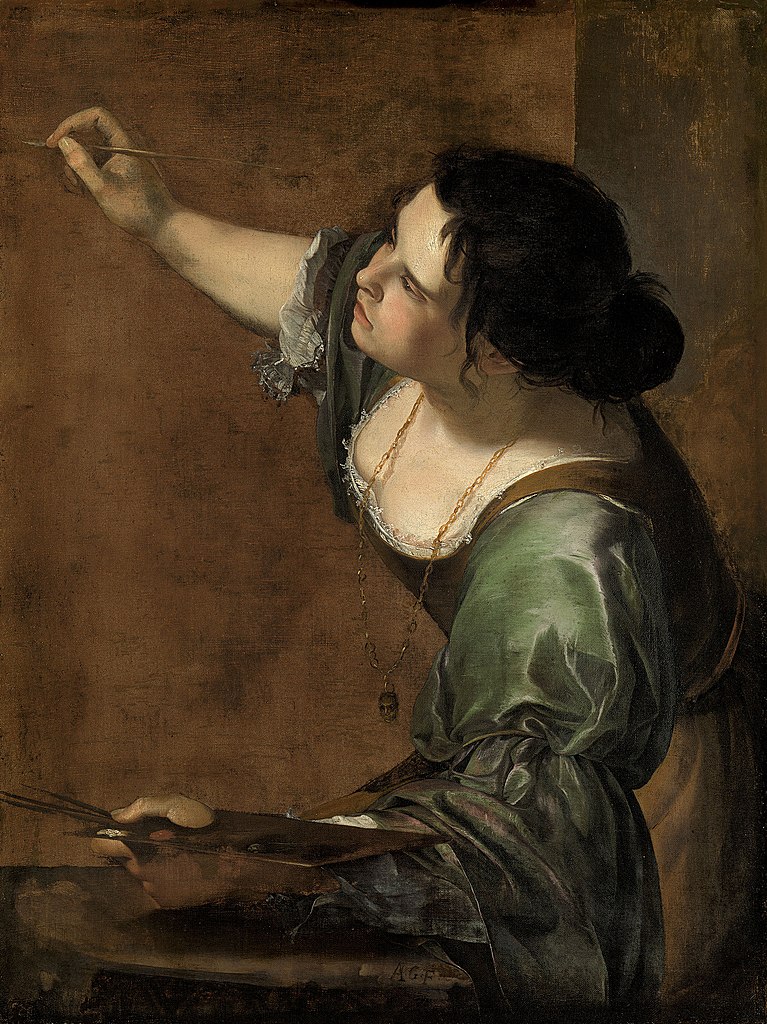
“She was a genius,” says the Guardian. She was a “uniquely gifted artist who should be considered among the all-time greatest painters,” says the BBC. I say, no, she was not. The Italian Baroque painter Artemisia Gentileschi (1593–c.1656) was not a genius, was not uniquely gifted and should definitely not be considered a great painter. But don’t take my word for it — see for yourself. Here is one of her most famous and extravagantly praised paintings:

Self-Portrait as the Allegory of Painting (c. 1640), Artemisia Gentileschi

Given the title of Gentileschi’s self-portrait, you can’t fault her ambition and egocentricity. But you can fault her perspective, her composition, her colouring, her grasp of her own anatomy, and her ability to represent fabric, flesh, and hair. Here for comparison is a self-portrait by a genuinely gifted female artist, the French Élisabeth Vigée-Le Brun (1755–1842):

Self-Portrait in a Straw Hat (1782), Élisabeth Vigée-Le Brun

Vigée-Le Brun represents herself as attractive and enjoying both life and being a woman. Feminists don’t want women to be attractive and happy like that. They want women to be unhappy, angry and militant. That’s one big reason they prefer the untalented Gentileschi to the highly talented Vigée-Le Brun. I don’t think Gentileschi’s Self-Portrait as the Allegory of Painting even rises to the level of bad art. The words that come most naturally to my lips are “bloody awful.” The first time I saw the painting in a book of art history, I wondered whether its inclusion was a joke or mistake. How could any art-historian or critic take that mess seriously?

The siren-song of solipsism

Very easily, it became apparent. And very prudently too. Anyone at the Guardian, BBC or other leftist institution who spoke the truth about Artemisia Gentileschi’s sometimes execrable art would be in serious trouble. If Gentileschi had been a man and painted to the same low standard, she would quite rightly have been forgotten long ago. But she was a woman and a “rape-survivor,” so feminists in the 1970s decided to create a cult around her. By worshipping her, they were really worshipping themselves, because I think some or perhaps most feminists don’t see other women as individuals or even as human beings in their own right. Instead, those feminists see other women as reflections of themselves or as counters in the feminist struggle for power and self-assertion.

But this inability to see others as real applies more generally to leftists and their supposed objects of concern. I was struck by this passage in The Liar (1991), an autobiographical novel by the near-ubiquitous British leftist Stephen Fry: “For Adrian other people did not exist except as bit-players in the film of his life. No-one but he had noted the splendour and agony of existence, no one else was truly or fully alive.” Fry is homosexual and half-Jewish, which may also be significant, but his solipsism is, I’d argue, an important feature of leftism. For leftists, collectivism is really the simplest and surest way to exalt the self. And you can see these aspects of leftism in the cult of Artemisia Gentileschi — and also in Gentileschi herself. Her bad art is now being worshipped in a major exhibition at the National Gallery in London. Here’s how Rhiannon Lucy Cosslett of the Guardian reacted when she overheard some truth-telling at the exhibition:

Artemisia’s features, in the guise of myriad saints and figures from myth and religion, are everywhere. As Laura Cumming wrote, she “seems to live inside every role she depicts”. I delighted in this, but other visitors did not. “Self-obsessed”, said one older man, and I laughed to myself because, really, his remark was just too perfect, too predictable, too tediously sexist for words. The history of women and art has been, in the main part, a history of bodies. Bodies stripped of clothing and imagined and objectified by men. Yet running alongside this parade of breasts and bottoms as conceived by the male gaze is a subversive counterhistory: that of women artists seeing themselves. (The history of art is full of female masters. It’s time they were taken seriously, The Guardian, Rhiannon Lucy Cosslett)

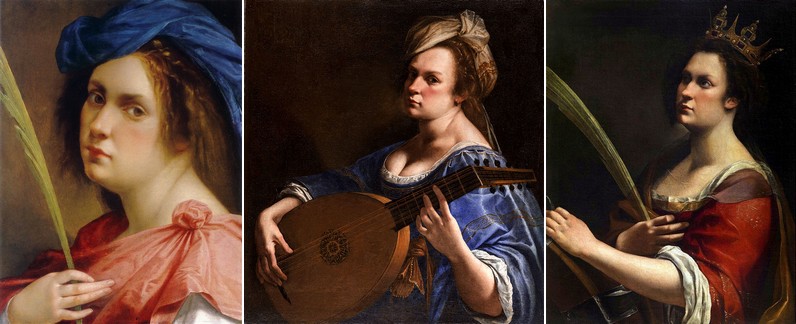
Yes, Gentileschi did see herself. She then put herself down on canvas, over and over again, in awkward, ugly, ill-coloured ways. That is subversive, I suppose. It’s definitely self-obsessed. Rhiannon Lucy Cosslett says the remark by the “older man” is “tediously sexist” because she can’t say that it’s untrue. Gentileschi also sometimes looks self-pitying, as in her Self-Portrait as Martyr, the painting on the left below:

Some of Artemisia’s subversive self-obsession: self-portraits as martyr, lute-player and St Catherine

Cosslett both explains and echoes the self-pity: “Artemisia was a survivor of male violence, just as I am. Tears sprang to my eyes when I looked at the transcript of her torture during her rapist’s trial, and read that she had repeated ‘è vero, è vero, è vero’ (‘it is true, it is true, it is true’).” I’d suggest that Cosslett wept for herself, not for Gentileschi. That is, Cosslett sees Gentileschi as a reflection of herself, not as an individual. That’s why objective standards of good and bad art don’t apply in the cult of Artemisia Gentileschi. She and her art serve to reflect feminists back at themselves.

And her art is probably even more appealing to feminists because, unlike Élisabeth Vigée-Le Brun’s, it is bad art. Leftists hate beauty, truth and goodness, and delight in the destruction of those things. The cult of Artemisia exalts ugliness and insists on untruths: Artemisia was a “genius,” a “uniquely gifted artist … among the all-time greatest painters.”

Chopping off White men’s heads

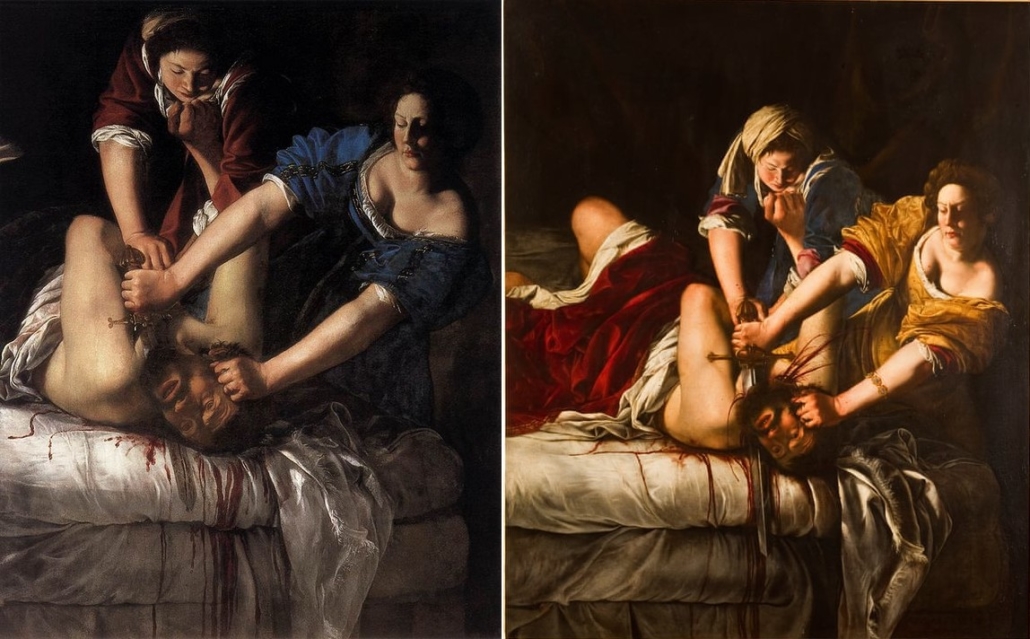
The cult also celebrates the overthrow of White men, because this is Gentileschi’s most famous painting in its two versions:

Judith Beheading Holofernes

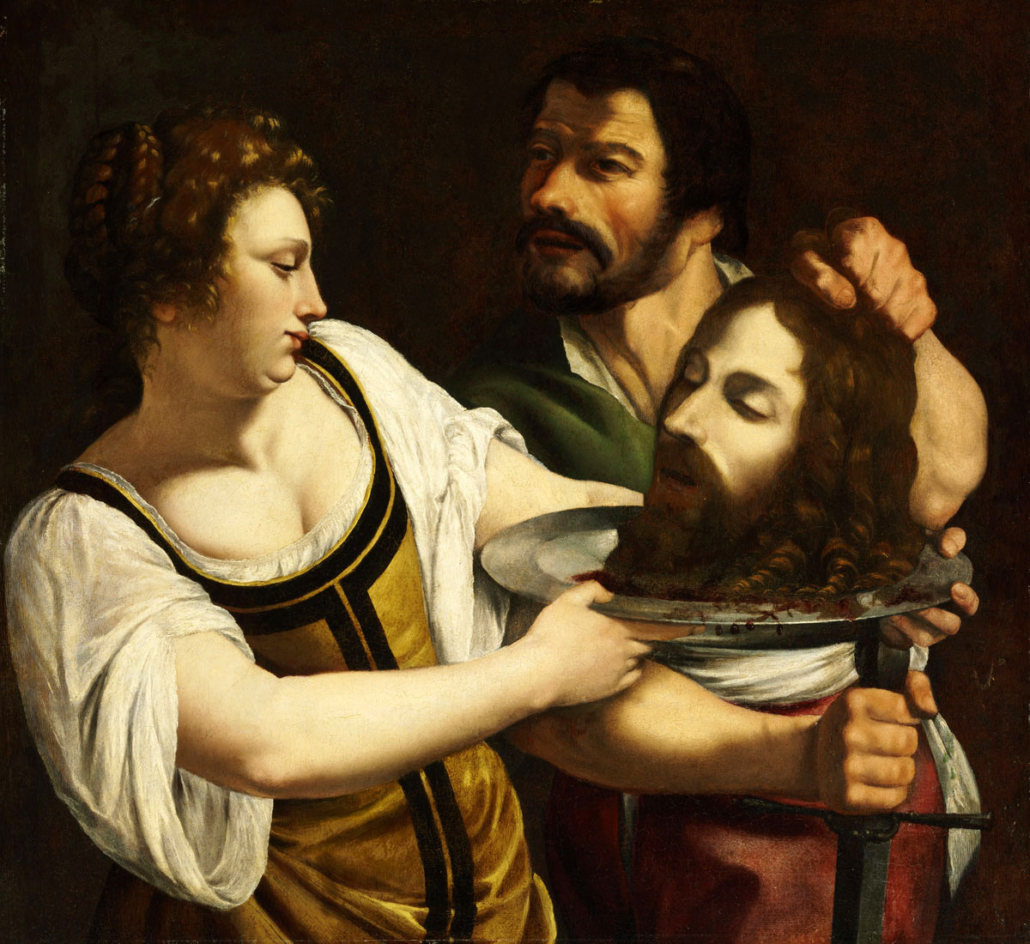
Many painters have represented the ethnocentric Old Testament story of a Jewish heroine killing a gentile to defend her people, but few have done it as badly as Gentileschi did. And here is another of her bad paintings on a similar theme:

Salome with the Head of Saint John the Baptist (c. 1615)

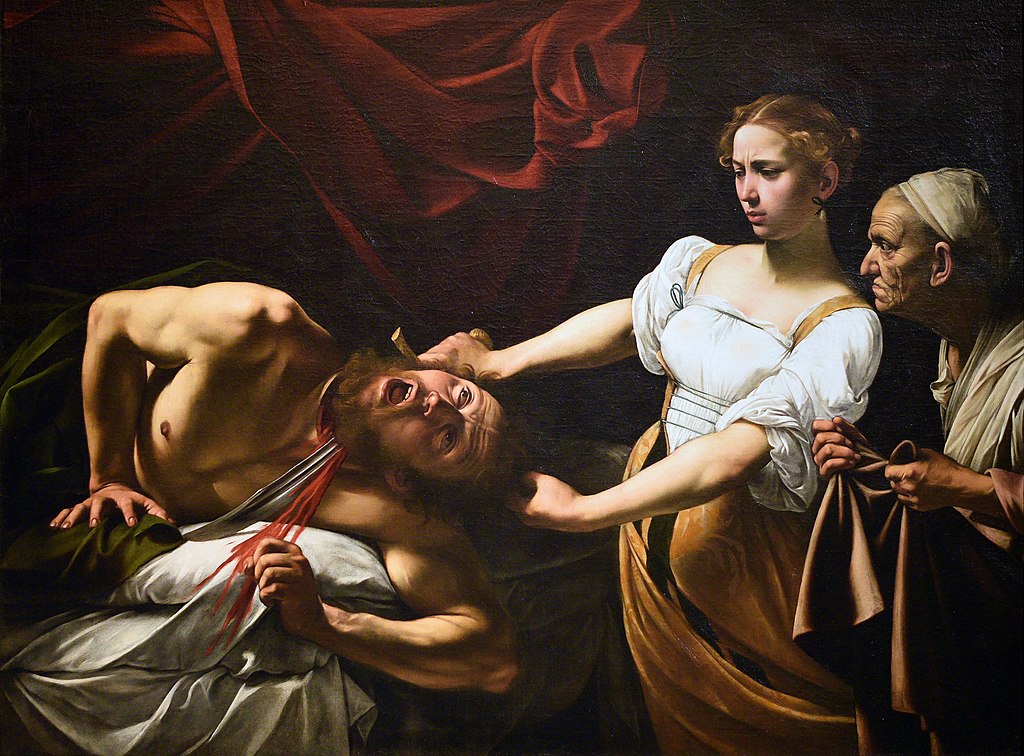
Gentileschi places herself on canvas, dealing death to White men, and feminists can again see themselves reflected in her bad art. If you want to see how a real genius represents Judith’s death-dealing, here is Caravaggio:

Caravaggio’s Judith beheading Holofernes (1599)

Compositionally, that isn’t one of Caravaggio’s best paintings: it isn’t a realistic portrayal of what such a beheading would have looked like (according to the apocryphal Book of Judith, Holofernes was drunk and helpless when Judith cut off his head as her maidservant kept watch at the door of his tent, but painters have understandably chosen more drama and less drunkenness). Gentileschi understood Judith’s task better, which is why she shows the beheading as a collaboration. After all, men are on average far more physically powerful than women, as Gentileschi presumably learned when she was raped by her father’s assistant, Agostino Tassi.

Victimhood valorizes

So yes, she was the victim of a bad crime and yes, the crime was compounded by the torture she endured to prove her accusation against Tassi. But her victimhood does not “valorize” her art (to use an ugly neologism found in this feminist art-criticism on Gentileschi). Her art is still bad and Caravaggio’s is still sublime. I’m not disturbed by Gentileschi’s decapitations. They might be more realistic, but they don’t look real. Caravaggio’s decapitation does look real.

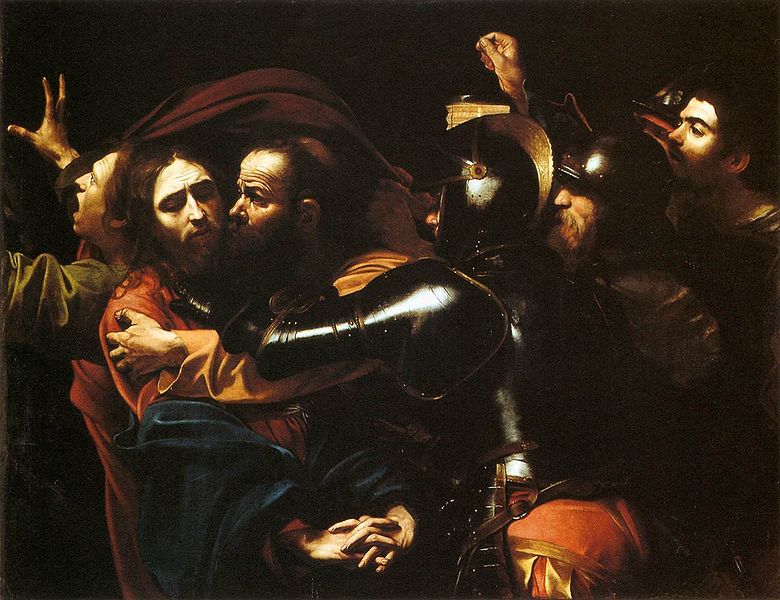
And while Gentileschi painted herself as a martyr and saint, as you can see above, Caravaggio painted himself as a sinner, as you can see below:

Caravaggio’s The Taking of Christ (c. 1602)

The figure on the far right, holding up a lantern to assist the taking of Christ for trial and crucifixion, is probably Caravaggio himself. That is a very simple and effective way to represent a difficult but essential Christian doctrine: that we all bear responsibility for the crucifixion of God’s only-begotten son.

Anatomy out of whack

It’s also significant, I think, that Caravaggio has given a determinedly gentile face to the kiss-bestowing Judas, an archetypal Jewish villain in so much Christian iconography. There’s no evasion of responsibility here: Caravaggio is saying “I did it; you did it; we all did it.” But if Artemisia Gentileschi had attempted the same scene, I think her first impulse would have been to give Christ her own features and thereby play the victim again. She certainly couldn’t have painted to Caravaggio’s sublime standards. He could represent reality; she couldn’t. Even the Guardian and BBC acknowledge Gentileschi’s artistic failings:

Her anatomy is sometimes out of whack, her details occasionally glossed over (or perhaps painted by assistants). … the single light source in [Judith and her Maidservant with the Head of Holofernes (1623-5)] — a candle near Judith’s upper arm — is in the wrong place. It is too far behind Judith, who has her left hand held out catching the light that is clearly behind it, which is not possible. The mistake is compounded by a poorly painted shadow covering much of Judith’s face, which is also not possible. It’s a splodge and a botch. (Artemisia review — overwhelmingly present, The Guardian, 4th October 2020; Artemisia Gentileschi: Will Gompertz reviews her show at the National Gallery, BBC, 3rd October 2020)

Will Gompertz of the BBC then says: “And yet. Who cares?” I care and so should everyone who wants to defend artistic standards. Gentileschi’s failings aren’t minor and incidental, but major and characteristic. It matters that her “anatomy is sometimes out of whack” and that Caravaggio’s isn’t. She aimed for realism like him and didn’t achieve it. And without the example and inspiration of male painters like Caravaggio, she wouldn’t have reached even the low standards that she did. Whether feminists and other leftists like it or not, artistic genius and creativity are largely male things — more specifically, White male gentile things.

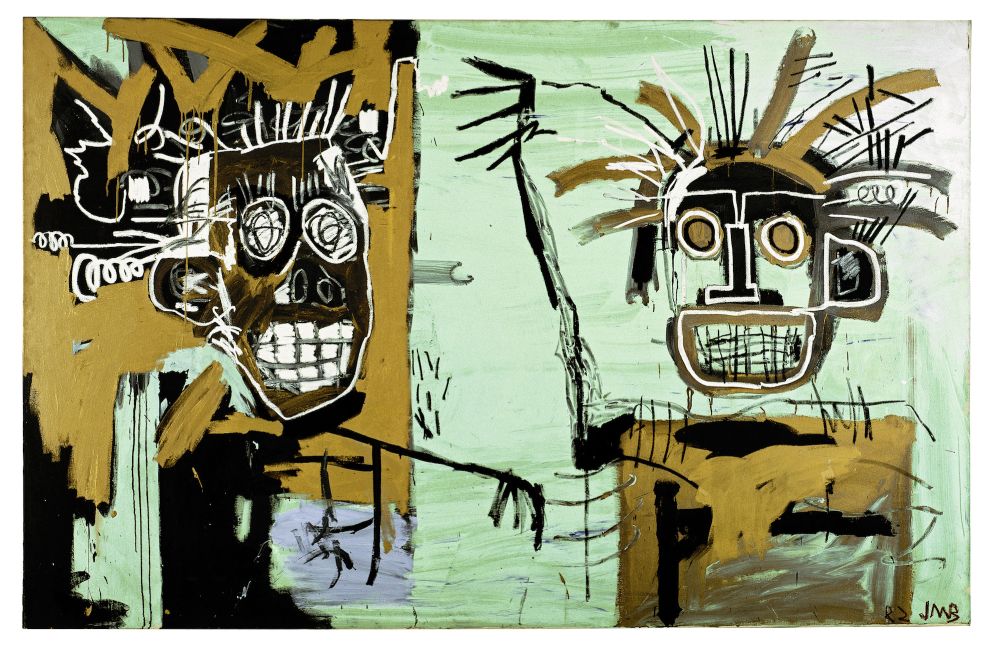
Some risibly bad art by Jean-Michel Basquiat

Feminists and other leftists don’t like it, of course, which is why they have created cults not just for Artemisia Gentileschi, but also for the risibly bad Black artist Jean-Michel Basquiat and the parodically minimalist Jewish artist Mark Rothko (see Brenton Sanderson’s three-part study of Rothko). Unlike them, Gentileschi valued realism, even if she didn’t achieve it. Basquiat and Rothko are part of what Tom Wolfe calls The Painted Word, that is, art that depends for its success not on its own merits, but on the spinning of verbal webs by disproportionately Jewish critics, academics and dealers. But Caravaggio’s realism — his ability to capture reality in paint — was not an isolated act of genius. It is no coincidence that his great art belongs to the same period as the birth of modern science and anatomy. Other White men were looking at the world and trying to understand and represent it in objective ways. Caravaggio was obsessed with light; Gentileschi was obsessed with herself.

The might of the “male gaze”

So are many of the feminists who now celebrate her and her subversive gynocentric reclamation of “breasts and bottoms as conceived by the male gaze,” as the Guardian journalist Rhiannon Lucy Cosslett put it. But if Cosslett wants true subversion, she should consider the fact that female breasts and bottoms were actually created by the male gaze. You could almost say that the human female is a work of art created by the human male, because countless acts of sexual selection down the course of evolution have favoured some types of women and disfavoured others. The sexual selection has worked in the other direction too, shaping male bodies according to female preferences.

But humans are not like Birds of Paradise, with drab, selective females and spectacular, attention-seeking males. The shaping of women by the “male gaze” may have been particularly strong in Europe when women were competing for the attention of skilled hunters in the colder and harsher European environment. The anthropologist Peter Frost argues that this female competition explains the variety of eye- and hair-colours found in Europe, where genes for blue eyes and blond hair appeared under pressure of the male gaze. In prehistoric times, White women were evolving special beauty even as White men were evolving special creativity.

Opposing beauty, pursuing power

In modern times, that White female beauty was celebrated by the art of White male creators. Later still, both the art and the beauty were attacked by leftist ideologies invented or decisively influenced by an alien group called Jews. I agree with a fascinating article at National Vanguard arguing that “Jews themselves are an unattractive and, on average, ugly people” and that “Jews, as a group, oppose beauty.” Indeed, the Talmud advises Jews not to regard physical beauty as important in marriage: “For ‘false is grace and beauty is vain.’ Pay regard to good breeding, for the object of marriage is to have children” (Taanith 26b and 31a).

The cult of Artemisia Gentileschi is a product of those leftist ideologies, celebrating a painter who was mediocre at her rarely achieved best. And just as Gentileschi’s art was not beautiful, nor was Gentileschi herself. She looks masculine and muscular, with high testosterone that may have given her the ambition and drive to promote herself in a way that her art could not do on its own merits. And she had novelty value as a female painter, of course. Cosslett says that a “large part of why Gentileschi captivates is because she triumphed against patriarchy.” But feminists like Cosslett don’t genuinely care about patriarchy or about rape. It wasn’t the Guardian or BBC that exposed the Muslim rape-gangs of Rotherham and numerous other British towns and cities. But it is the Guardian and BBC that support the continued growth in Western nations of Islam, which competes with Orthodox Judaism for the title of the world’s most patriarchal and misogynistic religion.

Instead, feminists like Cosslett care about themselves and about warring on truth, beauty and goodness. The cult of Artemisia Gentileschi is a small but characteristic battle-front in that war. Gentileschi was a bad artist who created ugly art. There are thousands of male artists far worthier of exhibitions at the National Gallery and of praise in the mainstream media. But those male artists don’t receive the attention they deserve. Not while leftism rules the media and inverts reality in its perpetual quest not for truth and beauty, but for power and revenge.

Jews in the Cathedral: A Response to Curtis Yarvin

8388 words

Having read deeply into the Jewish Question for almost 20 years, I’m always fascinated by novel objections to anti-Semitism. This was the case when I was prompted to turn to the writings of Curtis “Mencius Moldbug” Yarvin by a recent Keith Woods video (“Unqualified Reservations on Moldbug”). I think I first heard about Yarvin around 8 years ago, but there never seemed to be a “hook” sufficient for me to want to read his work. It was only with the Woods video, and an interesting video response to the Woods post from the academic YouTuber “The Distributist,” that I learned that Yarvin had at some point discussed the Jewish Question, or at least his personal stance on anti-Semitism. It was finally time for me to bite. For the past few weeks, I’ve been giving serious consideration to Yarvin’s short 2007 essay “Why I am not an anti-Semite,” as well as many of his other essays.

Yarvin, probably the foremost thinker of the “Neoreactionary movement,” is in my opinion a talented and generally thoughtful writer. We seem to share a great interest in the writings of Thomas Carlyle, and while I disagree with what I perceive to be Yarvin’s glossing over of Carlyle’s old-form socialist (in a good sense) tendencies with the implication that they were a kind of youthful phase he imbibed from friends and later outgrew,[1] I think we’d have a mutually enjoyable discussion on the subject of the “Sage of Chelsea.” My aim in this essay, however, is not to explore Yarvin’s writings in general, or to critique or otherwise examine the ideas behind the Neoreactionary movement. Quite frankly, there are many people better qualified and well-read in some of these ideas than I am, or ever will be. Instead, since my work is concerned primarily with the history of anti-Semitism, I want to focus specifically on “Why I am not an anti-Semite,” and to tease out and highlight some of its problems.

I have to confess to hesitating in writing this essay for a few reasons. The first is that the Yarvin piece dates from 2007, rendering it 13 years old at this point. How accurately it can be said to reflect Yarvin’s current ideas about anti-Semitism is therefore less than clear. Since he hasn’t issued any further statement on the matter, however, I am left to assume that it continues to represent his fundamental stance on the issue. My second reason is that Yarvin’s essay is, from my perspective, very short — a little over 1,600 words. As someone who regularly writes pieces around 4,000-8,000 words in length, I get the impression that Yarvin’s essay isn’t as complete or evidenced as it should, or could, be in terms of deserving a lengthy critique. I would certainly regard it as somewhat unfair if I’d simply written down a few thoughts, only for someone to invest several thousand more words in an effort to rubbish them. On this matter I can only say (and this is a compliment) that the relative novelty, even strangeness, of some of Yarvin’s comments, at least when compared with rather tired rebuttals to anti-Semitism from the likes of Jordan Peterson, Slavoj Žižek, and stereotypical Jewish apologists, are in fact deserving of a response, regardless of their brevity. Finally, a large part of my work over the last eight years has involved an attempt to offer an evidence-based apologetics for attitudes and beliefs, both historical and contemporary, that are regarded as anti-Semitic. A key part of this effort has been direct engagement with influential counter-narratives (see my recent long essay on the weaknesses of Middleman Minority Theory), and Yarvin’s renewed and ongoing influence in certain Rightist circles really does necessitate the production of a serious corrective view.[2]

“Why I am not an anti-Semite.”

Before critiquing the relevant arguments, we should begin first with a representative summary, using his own words, of the reasons why Yarvin is “not an anti-Semite.” Yarvin opens by explaining the origins of his essay. One of his over-arching ideas is that of “the Cathedral,” a term he coined to describe the elite network of academics, mainstream journalists, media moguls and capitalist oligarchs who preach the official “faith” of political correctness. Yarvin has often characterised “the Cathedral” as fundamentally Christian, especially Calvinist, in origin. In mid-2007, however, Yarvin was challenged on Twitter by “a fan of Kevin MacDonald” who asked why:

in my classification of American castes and conflicts, and my discussion of the belief system of the ruling Brahmin caste, I neglected Jewish influence. Specifically, as per MacDonald, I neglected the importance of Jewish intellectuals in the transition of the American establishment from 1920s style “super-protestantism” to postwar secularism and multiculturalism.

Yarvin’s essay is therefore an extended response to the Twitter user and, more broadly, to MacDonald and those of like mind.

Admirably, Yarvin opens his essay by laying a few cards on the table. He moves first to a definition of anti-Semitism, initially expressing admiration for Murray Rothbard’s definition of an anti-Semite as “anyone who proposes legal disabilities against Jews,” before adding that “by this definition the creed is basically extinct.” Yarvin then asserts that “anti-Semitic” is instead a useful “adjective for anyone with negative views on Jews as a whole.” Yarvin then notes that there are “many bad reasons not to be an anti-Semite. For example, anti-Semitism is unfashionable. If you want to be fashionable, don’t be an anti-Semite.” In fact, Yarvin goes so far as to say:

Anti-Semitism MacDonald style is probably the most courageous political belief anyone can hold in 2007—at least if you live anywhere west of Gaza City. This does not make it right, but it certainly does not give anyone who believes in “diversity” and “the environment” any right to sneer. I admire conviction, I despise cant. Anti-Semitism was cant in Munich in 1936, or in 1886 for that matter. It is cant in Tehran today. In California in 2007, it can be nothing but conviction.

Yarvin also makes it clear early in his essay that his father is Jewish. He explains, “This does not make me Jewish, but surely it makes me suspect, at least to some anti-Semites. But if this was my best reason for not being anti-Semitic, surely it would tend to confirm rather than refute MacDonald’s theories.” With these preliminaries out of the way, Yarvin proceeds to his reasons for rejecting anti-Semitism.

His first reason is that it isn’t at all obvious that Jews have an influential role in the direction of modern culture and politics. He flatly denies that they are in any way key players within “the Cathedral.” He writes:

Basically, the reason I neglected [Jewish influence] is that I don’t see it. But the point is certainly debatable. … The basic question is whether, as I argue, multiculturalism is best understood as a simple development of mainline Protestantism, or whether, as Anonymous believes, it should be seen as a Jewish-Protestant syncretism.

Yarvin rejects any such argument because it fails “the five tests of belief system classification,” something that he himself invented. Why exactly the rather simple and empirically testable idea that Jews are influential in culture and politics, and especially influential in multiculturalism, should be subjected to such a bespoke process is left unstated. Instead, Yarvin concedes that “many multiculturalists come from a Jewish background,” but counters with the assertion that “multiculturalism does not claim to be Jewish, and it’s pretty hard to get from massacring the Midianites to supporting open borders.” So, cutting out a lot of inconsequential and distracting filler, Yarvin’s first reason for rejecting the idea that Jewish influence has played a role within “the Cathedral” is that multiculturalism does not explicitly advertise itself as a tool of Jewish interests, and that ancient Jewish tales of racial genocides on their own soil don’t correspond well with hostile acts among non-Jews in the present.

Yarvin’s second objection to anti-Semitism is that be believes Jews do not act collectively. He argues that: “It’s not just that [MacDonald] believes in group selection—he believes in group action. I believe in human action. A group is not a person.” This is correct, but it’s not at all clear why such a strong distinction in terms needs to be made. I’m sure that Kevin MacDonald believes in individual human action also. The relevant point here is that a group is a collective of “human persons” who might have, or perceive themselves to have, individual interests “in common,” and who act according to those shared interests. In this sense, actions can be shared and steered by a group. Yarvin does accept that “Germans, Sioux or Irishmen” could:

act collectively in ways that favor Germans, Sioux or Irishmen. But in order for this to work, you need a cohesive belief system that rewards altruism on behalf of the group, and discourages “defecting” actions that would otherwise favor the individual. You need, in other words, an actual movement of ethnic nationalism.

Elaborating the point, Yarvin insists that Judaism, which he places in scare quotes, has this only “in theory.” He explains, “The whole Torah is a story of pure asabiya. The Jews get their asses kicked when they’re divided. They kick ass when they’re together.” In reality, Yarvin argues, Judaism is merely “an evolving system like any other,” and has abandoned this kind of system. Jewish ethnic nationalism is said to be found today only “among Zionists, Hasidim, etc., and certainly not among the Reform and socialist Jews who in the middle of the century became part of the American elite.” So Yarvin’s second reason is therefore that Jews in the American elite do not exhibit ethnic nationalism.

Yarvin’s third reason for rejecting anti-Semitism is that Jewish behaviour in twentieth-century America is less like infiltration and more like assimilation. He argues that Jews did not necessarily compete against the WASP elite, but rather imitated them, mimicked their ideologies, and ultimately grafted themselves onto them:

Basically, the Jews (like my ancestors) who came to the US were people who wanted to get ahead—as individuals. They were done with the ghetto and the shtetl. They wanted money and power. Doesn’t everyone? It was only natural, therefore, that they would be drawn to the social patterns of the most prestigious class in their new country—the mainline “super-Protestants.” Like most converts, they adopted the most fashionable views of the Brahmin elite, which was already well down the road toward secularization and Unitarianism in the modern sense of the word. Indeed, for the earlier-arriving and (much as I hate to admit it, since my ancestors spoke “jargon”) more cultured German Jews, much of this process had already happened in Europe. Reform Judaism is pretty much Protestantism in all but name, as is of course “scientific” Marxist socialism. Whereas the Brahmins had no reason at all to adopt Jewish ways of thought. Nor do I see any way in which they did. The assimilation was entirely in the other direction.

So Yarvin’s third reason for rejecting anti-Semitism is that any Jewish presence in “the Cathedral” is really the accidental result of early twentieth-century status-hungry Jewish migrants copying the attitudes and ambitions of American “super-Protestants.”

Finally, and this was the main focus of the Keith Woods video, Yarvin rejects anti-Semitism because it relies on “an enormous mass of corroborating evidence.” Yarvin rather strangely insists that:

A historian is not a mere collator of facts—he or she is creating an interpretation, much like a trial lawyer. The goal of history is to paint a picture of the past. The test, for any reader, is simply whether you find that picture convincing. Volume of evidence has not much to do with it. [emphasis added]

This last sentence, sure to stun every prosecutor and historian in the West, is the curious hill on which Mr Yarvin decides to die in the cause of rejecting anti-Semitism. Not only does he wish to die on it, but, it would seem, he wishes to do so in flamboyant fashion. Yarvin insists that masses of evidence in support of one’s case are in fact

a contrary indicator, because a lawyer with a weak case often feels the temptation to try to inundate the jury with a vast mass of detail. The strategy is essentially to demand that the reader either agree, or do the work of assembling the same detail into a counter-narrative. The canonical example is Johnnie Cochran’s great gambit, “if the gloves don’t fit, you must acquit.”

For a canonical example this is extremely poor, and the analogy of the trial lawyer is itself awful. For a start, Johnnie Cochran’s defense of O.J. Simpson, and the entire context of the above quote, wasn’t based on “inundating the jury with a vast mass of detail,” but on finding very small weak points in the prosecution case that could be critiqued and exploited ruthlessly —  in this case, whether or not a single pair of gloves fit his client’s hands—hands that were swollen because Simpson stopped taking his arthritis medication. I also think that, rather than being the result of Johnnie Cochran’s often ridiculous defense strategy, O.J. Simpson walked free because the jury was majority Black — a canonical example of group action if there ever was one.

There is simply no methodological comparison to be made, despite the rhetorically attractive style of Yarvin’s presentation. Taken to its logical conclusion, Yarvin’s reasoning would suggest a poor level of evidence produced in support of a history would be a positive indicator of its quality — a theory I urge Mr Yarvin to test by submitting something un-referenced and poorly-backed to any respectable history journal. Alternatively, he can try a new career as a prosecutor while employing the same nonchalant dismissal of detail and see just how successful he can be. For now, however, we need only summarise that Yarvin’s fourth reason for rejecting anti-Semitism is that it boasts too much evidence.

Yarvin’s four reasons for rejecting anti-Semitism are therefore:

Multiculturalism does not explicitly advertise itself as Jewish.
Jews in the American elite do not exhibit ethnic nationalism
.
Jews merely copied the attitudes and ambitions of WASPs.
Anti-Semitism relies on an excess of evidence.

Response to Yarvin

In trying to gain my own understanding of Yarvin’s approach, I felt it necessary first to address his Jewishness. Other than his essay on anti-Semitism, I don’t find much in the way of a Jewish identification in his work. This corresponds well with findings that mixed-ethnicity children of Jewish fathers tend to have a much lower sense of Jewish identity than those with Jewish mothers:

A higher ratio of non-Jewish mothers is linked to a lower ratio of Jewish attachments within mixed-married homes. … Every systematic study of the Jewish community has shown that Jewish mothers provide more intensive and extensive connections to Jews and Judaism than do Jewish fathers in mixed-married households. Whether the measure is cultural, institutional, social, or religious, having a Jewish mother in the household (born or converted) makes the households far more likely to incorporate Jewish activities and values.[3]

Having a lower level of Jewish self-identification, of course, doesn’t translate automatically to having no identification with Jews at all. Yarvin’s assertion that having a Jewish father “does not make me Jewish,” probably needs to be problematised, not because Yarvin is Jewish, but because he is extremely likely to hold simple familial sympathies that lend themselves to a certain level of affection or affinity with Jews and Judaism. His employment of the analogy “If your father is Catholic, are you not allowed to be an anti-Catholic?” is also more than a little disingenuous given the rather obvious skirting of the issue that Jewishness is a matter of ethnicity as much as religion; of blood as much as belief. There’s an entirely different social and psychological texture between telling your Italian Catholic father you don’t believe in Christ and, for example, saying you’ve developed a distaste for Italians. For these reasons, Yarvin is correct in explaining that having a Jewish father “makes me suspect, at least to some anti-Semites.” It certainly makes him suspect to me. To borrow the notorious phrasing of Mel Gibson, Yarvin has a “dog in the fight,” even if it’s a little on the small side. Objecting to anti-Semitism, and offering arguments against it, is likely to bring some form of reward, even if in this case it’s limited purely to the psychological relief of absolving one’s paternal kin of certain charges. This understanding doesn’t help to unravel the specific arguments proposed by Yarvin, but it does assist with comprehending their origin, as well as helping to explain the resistant and strange quality they uniformly demonstrate.

Yarvin’s essay opens, very cleverly in my opinion, by mixing surface-level magnanimity with subtle salvos. For example, hidden beneath the early, somewhat patronising, praise of Kevin MacDonald is a barb left glaringly undeveloped for the rest of the essay. This, of course, is the denunciation of anti-Semitism as “cant in Munich in 1936, or in 1886 for that matter. It is cant in Tehran today.” Why exactly negative views on Jews as a whole should be regarded as cant (insincere, hypocritical, sanctimonious, quasi-fashionable speech) in any of these time periods or locations is left undeveloped. In fact, the essay is striking for its overwhelming neglect of history and the antagonistic advance of Zionism, seeming at times to proceed from the idea that the phenomenon began in 1950s America. There’s a clear implication in Yarvin’s phrasing that anti-Semitism was “easier,” or at least more fashionable in Germany (1886 and 1936), an argument that while true in one sense (it was more culturally pervasive) is misleading in its neglect of certain key interim periods. The Weimar Republic, for example, had a wide range of speech laws at least commensurate with those found in modern Europe, and more extensive than anything found in contemporary America. Anti-Semitic speech was prosecuted very regularly,[4] and many of the leading anti-Semitic ideologues of 1936, including the likes of Julius Streicher, had surely demonstrated “conviction” in their beliefs during their many terms in prison before 1933.[5]

Additionally, there are very few periods in history in which anti-Semitic arguments could be regarded as the product of insincere cant. The overwhelming trend has been that anti-Semitic speech has been a risky anti-elite activity, bringing the possibility of death or mutilation under certain medieval European monarchies[6], and the risk of severe social ostracism and imprisonment in more recent times, even for figures of significant public standing such as Friedrich Nietzsche, Richard Wagner, Henry Ford, and Charles and Anne Morrow Lindbergh, all of whom underwent periods of extended personal angst or troubles over the impact that expounding anti-Jewish ideas could have on their lives.[7]

The question remains as to the tactical benefit of dismissing historical anti-Semitism, or contemporary middle eastern anti-Semitism as “cant.” Quite simply, one of the major problems facing Jewish apologists is the ubiquity and uniformity of anti-Semitism. Common coping strategies invariably involve attempts to artificially break up the historical pattern, either by suggesting that anti-Semitism “mutated” over time like a virus, that it was carried from one culture into another, that it has been more sane in some time periods than others, or, as Yarvin seems to suggest, that it is more of a fad in certain contexts. By opening his essay with a denunciation of “cant,” even glossed over with praise for MacDonald, Yarvin in fact signposts his work, consciously or not, as being related to the tradition of Jewish apologetics.

Yarvin’s first major argument for rejecting anti-Semitism is that he “doesn’t see” the “importance of Jewish intellectuals in the transition of the American establishment from 1920s style “super-protestantism” to postwar secularism and multiculturalism.” Clarifying his point, Yarvin stresses that “multiculturalism does not claim to be Jewish,” as if this is in any way evidence. It in fact only raises a number of questions:

  • “Claims” aside, is there any objective evidence that Jews have a played a special role in promoting pluralism, tolerance, and multiculturalism in Western societies?
  • Since multiculturalism is an idea and cannot itself “claim” to be anything, isn’t the better approach to ask if Jews claim to be multiculturalists?
  • Is there any evidence that Jews played an important role, as Jews, in the transition of American immigration policies between the 1920s and 1960s?

Is Multiculturalism Jewish?

Have Jews played a special role in promoting pluralism, tolerance, and multiculturalism in Western societies? The historical record is clear that the first advocacy of multiculturalism in its modern political form arose in the works of Moses Mendelssohn (1729–1786), the German Jew and proto-Open Borders philosopher who pushed Enlightenment ideas on tolerance to their limit with such questions as: “For how long, for how many millennia, must this distinction between the owners of the land and the stranger continue? Would it not be better for mankind and culture to obliterate this distinction?”[8] Mendelssohn’s primary motivation, in the context of the decline of the absolute monarchies, was to ensure that Jews could preserve their unique identity within the framework of a future multicultural society — a combination he felt would ensure Jewish safety and continuity in Europe. The primary requirement for such a future would be the delegitimisation of the notion of a core, hegemonic culture to which others are expected to assimilate. Mendelssohn was in fact the pioneer of an entire movement (Haskalah) of Jewish intellectuals known as the maskilim, all of whom disseminated the philosophy of tolerant multiculturalism in Enlightenment circles, and who provided the ghetto Jews of Europe with a methodology of superficial assimilation and an ethnically safe Jewish secularism — that of being “European outside, Jewish inside.” Scholar Ephraim Nimni has argued that present-day multiculturalism is inextricably linked to benefits for Jews and represents the accomplishment of Haskalah ideas:

If the Haskalah model was severely undermined by the rigidities of the European nation-state model, a post-Haskalah model is eminently feasible in the era of multiculturalism and multinational states, and consistent with the lifestyle and wishes of secular Jews in contemporary liberal democracies. … Diaspora Jews have a common project with other ethnic and national minorities, and post-Haskalah Jewish communities will find a sense of mission and an imprint of their collective personality. This sense of mission is appealing and mobilising, for it relates to an immediate Jewish interest as well as having a wider application in favour of other minorities … all of which is entirely congruent with the goals and aims of a post-Haskalah Jewry.[9] [emphasis added]

Mendelssohn’s Haskalah ideas, borrowed from, but also contrasted with, the attitude of European atheists, Deists, and liberal Protestant philosophers, especially Rationalists like Bayle and Locke (who, to be fair to Yarvin, were both Calvinists), who believed in a common humanity that could move toward a world of no religion, or of a single religious truth.[10] For Mendelssohn, the notion of a future common humanity was merely territorial — European lands and communities would essentially become home to atomised individuals who were entitled to hold their own beliefs without pressure to assimilate to the values and traditions of a wider culture. In short, Mendelssohn’s multiculturalism would mean little more than the majority giving up its position of political, cultural, and demographic group hegemony as exemplified in the homogenous nation-state.[11] His ideas were also linked to activism for the legislative enforcement of multicultural tolerance and ongoing Jewish immigration. In Austria, for example, Joseph II’s 1781 Edict of Toleration (which Mendelssohn printed and distributed as propaganda) was the result of a literary scene that Mendelssohn had fostered in the cities, as well as the intervention of wealthy Court Jews.[12] Menasseh ben Israel (1604–1657) the Jewish intellectual behind the readmission of Jews to England under Cromwell, was also viewed as a proto-Haskalah figure by Mendelssohn, who looked at ben Israel’s efforts to promote “tolerance” in the Netherlands as a template for action, and who translated ben Israel’s apologetic The Vindication of the Jews into German in 1782. Perhaps the pinnacle of Mendelssohn’s career was his publication of Jerusalem (1783), a work of Utopian multiculturalism that propagandised the separation of Church and State, religious freedom, and the idea that “a man’s racial origin or religious affiliations would play no part in any sphere of life except that of religion.”[13]

As Jacob Katz has noted, deception about the nature of Judaism has been a central element of Jewish promotion of multiculturalism from the time of Mendelssohn. Because of the decline in power of the European monarchies and the rise of democracy, older Jewish privileges (e.g., tax farming and avoiding conscription) were also declining. The early Jewish promotion of multiculturalism was designed in part to enable Jews to acquire equal rights in legislation with the natives of European nation-states, thus providing Jews with opportunities to establish influential relations with new, rising native elites — parliamentary, commercial, and professional — and to obtain a new set of privileges. To use Yarvin’s terminology, Jews fully intended to become an integral part of, if not to lead or dominate, “the Cathedral.” The push for equal “rights,” and its justification, of course, was, as Katz points out, based on the lie that Judaism was “a broad-minded and tolerant religion.”[14]

This was the ruse presented by the “Grand Sanhedrin” of Jewish representatives convened in Paris by Napoleon in 1807, after which Jews were formally acknowledged within legal proclamations for the first time as Frenchmen, and citizens of the French Empire.[15] In a legal sense, and in terms of meaningful precedent, we can pinpoint the date on which Europe became multicultural as March 17 1808, a fact that is tied directly to the history, activism, ideas, and indeed the deceptions, of the Jews. The consequence was the perpetuation of an ethnocentric nation [Jews] within an increasingly atomised culture [that of the Europeans] in which the very notion of citizenship had been fundamentally diluted. From this proto-multiculturalism derives the intense suspicion of anti-Semites in the post-Enlightenment period that Jews had essentially deceived their way to citizenship, and that their assimilation was purely superficial, with the Jews remaining a “nation within a nation.” The fears of the anti-Semites thus reflected not only their antagonism toward Jewish clannishness and the reality of Jewish privilege, but also a growing awareness of the disintegration of their own ethnic and cultural cohesion. Such has been the fundamental dynamic of Western multiculturalism ever since.

Aside from the philosophy of the Rationalists and the activities of Mendelssohn and the maskilim, and the legal watershed of 1808, Western multiculturalism, in a radical demographic sense, is a very recent phenomenon, dating from the period 1945–1965 and accelerating rapidly over the last 30 years. This event, again, is inseparable from the Jewish historical trajectory, since the Holocaust narrative has been ruthlessly employed to destroy the moral foundations of the claims of Europeans to their own lands, to demonise any European employment of the language and ideas of race, to instigate a culture of European guilt and reparations, and to facilitate a perverse deification of the Jews and the revived “values” of Mendelssohn — tolerance, diversity, and pluralism.[16] The Holocaust is the lynchpin of modern education in multiculturalism and human rights, without which it is difficult to imagine anything on the scale we are currently witnessing in the form of mass migration, White marginalisation, and the endless pushing of the frontiers of “tolerance” into new forms of the Different, be they sexual perversions, psychotic identities, or White radical self-abnegation.

In my forthcoming book On the Jews, I put forth the theory that there have been three sustained “Great Reactions” of long duration against the Jews in European society, between which Jewish populations adapted their positions and increased in strength. Anti-Jewish violence during the Crusades, the evolution of the so-called ‘Blood Libel’ and associated folklore regarding Jews, and the earliest expulsions of usurers, were key elements of the “First European Reaction” (1095–1290). Increased involvement of Church and State, and a somewhat sociological turn in the Church’s view of the Jews (e.g., the activities of Martin Luther in Germany and the war on the conversos in Spain) in the late medieval and early modern periods comprised the ‘Second European Reaction” (c.1380–1535). The “Third European Reaction” (c.1870–1950) was relatively short-lived, but was highly focused on the aftermath of Jewish emancipation and the fulfilment of Mendelssohn’s pluralist vision — the economic, social, and political impact of the Jews on European society. What began as opposition to Jewish political “emancipation” developed into a coherent political philosophy and ideology based on several key precepts:

  • Jews are a separate and distinct ethnic group, inherently different in traits and characteristics from Europeans.
  • Jews are incompatible with nationalism because they possess cultural and national aspirations of their own, cannot be integrated, and thus represent a state within a state.
  • The modern state has become subject to an aggressive, speculative, and exploitative capitalism pioneered, and in many cases operated, by Jews.
  • Jewish influence in public life is closely connected with the negative aspects of modernity and European racial decline.
  • The excesses of Jewish influence in public life under democracy required the democratic mobilization of anti-Semitism under anti-Semitic parties, an anti-Semitic press, and the expansion of anti-Semitism in culture.

As was the case in previous Reactions, Jews developed a formidable response. In the West, they strengthened existing ties with friendly European elites and formed their first formal, secular defense committees, from which they agitated for speech laws and other oppressive legislation. In the East they had two primary strategies. In the first, they began one of the largest propaganda hoaxes ever conceived and, under the guise of mass pogroms purportedly instigated by Russian elites, mass migrated to the West, especially the United States, accompanied by waves of media-induced sympathy. In the second, they threw their demographic bulk and intellectual aggression into Communism, forming its vanguard and using its momentum to exact revenge on a Russian elite that they felt had failed to support their interests, and against an East European peasantry they often viewed as little better than animals.[17] In a final strategy, the Jews developed Zionism, with Palestine postulated as a Jewish homeland but instead coming to represent a colonial halfway house, a safe haven from which to operate in tandem with a growing and increasingly powerful Diaspora in the United States, and a nuclear-powered “safe space” to be utilized in the event of a Reaction. These strategies would be so successful that they would prompt historian Yuri Slezkine to describe the twentieth century as “The Jewish Century.”[18]

World War II was comprised of a series of overlapping conflicts, one of which, the Third European Reaction against the Jews, unleashed decades, if not centuries, of suppressed inter-ethnic tensions throughout Europe. Jews were frequently active, and violent, participants during the war, meaning mass casualties were inevitable.[19] The number of deaths on all sides was significant. But honest, full, and unbiased accounts of why this inter-ethnic catastrophe occurred, and the true nature of its extent, remain absent from the mainstream, and extremely rare in scholarship. What instead emerged in the aftermath of the war was a “Holocaust Industry” that initiated an era of “White Guilt” that has, in turn, contributed heavily to the Western cultural paralysis and inertia of the present time.

In the aftermath of the Third Reaction, this paralysis and inertia was furthered by the further entrenchment and adaptation of the Jews within European civilisation. The period since 1945 has witnessed growing Jewish influence in Hollywood, academia, and the press, and the truly extraordinary growth in power of the Jewish defense leagues, most notably New York’s Anti-Defamation League (ADL). Buoyed by the financial support of wealthy Jewish donors from the worlds of international finance and the mass media, the ADL and similar organizations throughout the West have assumed an importance in public life far out of proportion to the size of the population they exclusively serve. Their legacy has been the rapid expansion of speech legislation in White-majority countries, the invention of so-called “hate crime” legislation, the slow creep of mass censorship, and, finally, the ceaseless promotion of the multicultural state.

Multiculturalism can be regarded as the zenith of Jewish adaption in the wake of Third Reaction. Any discussion of a modern-day “Cathedral” of interests that does not take into account the role of Jewish intellectuals and oligarchs in the expansion, promotion, and protection of the multicultural state is simply disingenuous. There is clear and unambiguous evidence that Jews played an important role, as Jews, in the transition of American immigration policies between the 1920s and 1960s, and that Diaspora Jews, generally speaking, continue to describe themselves, and behave, as conspicuous multiculturalists (e.g., see the work of Kevin MacDonald on the United States, and Brenton Sanderson on Australia, as well as my own work on the U.K., Ireland, and the international mass migration scene — here and here).[20] Of further interest is Judith Goldstein’s recently published, and extremely interesting, The Politics of Ethnic Pressure: The American Jewish Committee Fight Against Immigration Restriction, 19061917, in the course of which Goldstein writes that:

The AJC was the most active and important anti-restrictionist lobbying group. … It allied with Italian, German, and Scandinavian groups, but none of them displayed the interest, knowledge, and sophistication on the immigration issue that characterised the AJC effort. … In each of the legislation battles the AJC sought to delay consideration of test bills and to block their passage. … In their anti-restrictionist campaign, Jewish spokesmen glorified the long-time policy of open immigration and the practice of “cosmopolitan nationality.”[21]

That the historical relationship between Jews and multiculturalism, and the concept of “cosmopolitan nationality,” has recently dovetailed with the drive of international finance for mass migration and the liquidity of labor does not detract from the deeply historical and intense Jewish interest in, and involvement with, the multicultural project. Modern multiculturalism assists the cultural survival of non-host populations while suppressing the host via “antiracism” legislation, education, and social propaganda. As Stuart Schoenfeld has pointed out, Jews are prime beneficiaries of both.[22]

Do Jews in the American Elite Exhibit Ethnic Nationalism?

It really does defy belief that anyone could deny the strength of ethnic nationalism and identification among Jews in the American elite. In fact, the argument runs so strongly against common sense and popular knowledge that one can only conclude that the argument is being made entirely in bad faith. Jewish ethnic nationalism, in the form of Zionism, is at the forefront of American elite politics, something more than capably demonstrated in Walt and Mearsheimer’s The Israel Lobby and U.S. Foreign Policy (2007). Zionist politics is supported tactically and financially by a considerable number of very influential Jewish politicians and oligarchs, who in turn represent some of the wealthiest figures in the contemporary American elite.

More than half of the top twenty political donors in America are Jews, and of these at least eight are committed Zionists (Sheldon Adelson, Stephen Schwarzman, Donald Sussman, Jeffrey Yass, Michael Bloomberg, Henry and Marsha Laufer, Josh Bekenstein, Bernard Marcus), with the precise political affiliations of Stephen Mandel, Deborah J. Simon, and James H. Simons unclear (Thomas Steyer would appear to be less inclined towards Zionism and is half-Jewish). Of the nine sitting Jewish Senators in Congress, eight (Dianne Feinstein, Ron Wyden, Chuch Schumer, Ben Cardin, Michael Bennet, Richard Blumenthal, Brian Schatz, and Jacky Rosen) have demonstrated more or less consistent support for Zionism as a political project, as well as legislation strengthening the position of Jews in the United States (e.g. legislation outlawing anti-Semitism). Only Bernie Sanders would appear to have a more ambiguous position on these matters.

The key point here is that these donors and politicians are the driving force of American policy on Israel, and are much more influential than either individual “Calvinist” or “super-Protestant” donors, and certainly much more influential than grassroots relatively less wealthy Christian Zionists who are themselves the puppets of a lucrative propaganda machine. Curtis Yarvin has attempted to explain away the nature of this kind of influence by making the argument that money is not directly linked to power (for a scholarly counter-argument, see here), even stating in a recent podcast “I don’t think [Jeff] Bezos has a lot of power.” With this level of reasoning, tied to Yarvin’s apparent deification of ultra-capitalists, it’s perhaps unsurprising to see a similar denial of reality in the face of obvious Jewish influence and strong Jewish identity in the American elite.

Did Jews want to imitate WASPs, or to topple them?

I agree with Yarvin’s statement that Jewish immigrants to America “wanted to get ahead … They wanted money and power.” I disagree with the emphasis he lays on the individual nature of this drive for money and power. Historically, Jews have placed a very heavy emphasis on economic, political, and social group co-operation. Jews remain notable for high levels of in-group philanthropy, and Jewish defense bodies tend to be extremely well-funded.

Contrary to Yarvin, there is very little evidence that Jews were “drawn to the social patterns of the most prestigious class in their new country—the mainline “super-Protestants.” In many cases, these positions were frankly impossible due to direct clashes of interest. As discussed above, some of the key concerns of the “super-Protestants” in the years of mass Jewish immigration (c.1880–1930) included controlling the demographic make-up of the country via immigration restrictions, and attempting to promote racial hygiene in the form of eugenics. Jews were very strongly opposed to both.

There is little question that Jews were keen to obtain the outward signs of social climbing in America — by, for example, entering certain professions or joining fashionable golf clubs. But underlying many of these economic advances was an outright hostility to the culture, politics, and behavior of the Protestant Brahmin class. In this regard, Yarvin’s definition of “assimilation” needs to be problematised. As I’ve argued elsewhere, and developed further in my forthcoming book, it is highly doubtful whether genuine Jewish group assimilation has ever occurred in any nation at any time. In the United States, Jewish “assimilation” has involved the academic deconstruction of WASP cultural heroes (e.g., T.S. Eliot, Richard Wagner), the pathologization of the WASP family (Freud, the Frankfurt School, and their intellectual followers), and the weaponisation of WASP children during the 1960s “New Left” revolution (perversely caricatured — using a phenotypically WASPish Jewish family —  in Philip Roth’s American Pastoral); the Jewish identifications of the Jewish participants in the New Left are well-documented. With the vanishing of the WASPs as a visible cultural elite, the Jewish cultural elite has distinguished itself not by following old paternalistic WASP cultural patterns, but by moving its gaze onto less privileged White classes and targeting them with the same hostile attitude — the denigration and demonisation of rural Whites and their culture, the ongoing promotion of mass migration, and the pathologisation of White identity in its entirety.

The central problem with Yarvin’s argument is that none of the worst ideas and activities at the forefront of what he calls “the Cathedral” are Calvinist or “super-Protestant” in origin. Feminism, Cultural Marxism, modern consumer credit, international vulture fund capitalism, transgenderism and the concept of fluid sexual identities, Whiteness Studies, cosmopolitan pluralism, and open borders philosophies are simply stunning in the uniformity of their Jewish origins. Yarvin implies that because these ideas cannot be found in the Old Testament (“The Midianities!” he cries) then the fact they’ve been innovated by Jews is meaningless. We are expected to believe that these Jews are just wannabe-WASPs, despite their Jewish upbringing, Jewish spouses, and often explicitly Jewish self-explanations. What Yarvin neglects is that old-form Judaism is merely a template for “getting on in the world” and that Jewishness has been divorced from its exclusive reliance to the finer points of Judaism since at least the era of the maskilim. (This is one of the main reasons for the intense Jewish celebration of Spinoza, who was seen as ushering in a new method of “being Jewish.”) As Robert Amyot and Lee Sigelman have pointed out, “Jewish identity has been transformed from predominantly religious to predominantly ethnic.”[23] What we see today is not an accidental elite. It’s not an elite built on mimicry. It is the culmination of the historical trajectory of the post-ghetto Jew — a hostile elite in power.

One need only look to the example of the old Russian Empire to see how Jews tend to view their relationships with elites, relationships that are built on self-interest more than imitation. For centuries Jews were content to be close partners with Russian nobles in the  economic exploitation of the peasantry. Once the peasants were emancipated, however, and a new paternalistic attitude took hold among the nobles, resulting in the removal of certain Jewish privileges (tax farming and tavern keeping), Jews threw themselves first into attempts at the financial dispossession of their former partners and, when that failed, into the Bolshevik drive for their total elimination as a class.

Does anti-Semitism boast “too much” evidence?

When I first started looking into anti-Semitism and the history of the Jews, I was struck by the way in which anti-Jewish criticisms were often summarily dismissed in mainstream literature as vague and bigoted accusations built on stereotypes. The standard characterisation of anti-Semitic material has often been that it is based on a kind of lazy reasoning (e.g., “anti-Semitism is the socialism of fools”) replete with gross generalisations about “the Jew.” There is certainly some material, normally centuries old, to which these descriptions could arguably be applied.

In more recent periods, however, anti-Semitism has come to rely on evidence and facts, with a certain focus on named individuals and their ideas and actions, as the only possible counterweight to the overwhelming power and influence of opposing forces. With nothing but truth on their side, the anti-Semites have thrown themselves ever harder on the need to offer as much as they can in defense of their arguments. As Hillaire Belloc remarked in his The Jews (1922), when men like German historian Heinrich von Treitschke were silenced for complaining publicly about “the unjust influence of the Jews in the press,” and later had their writings denounced as “the extravagancies of fanatics,” they were ultimately able to frustrate their opponents only “by the quotation of an immense quantity of facts which could not but remain in the mind.” The idea that someone can analyze Jewish power and influence credibly without being well armed with facts and data is ridiculous.

The simple fact remains that writing or speaking about Jews is a very difficult task — not just intellectually in terms of gaining a grasp of the relevant ideas and the vast quantity of literature, but in terms of the extremely negative reception such writings will inevitably meet. In some countries, writing negatively about Jews will lead to imprisonment. In most, it can lead to a loss of livelihood. In all, it will lead to a level of derision, scorn, and dismissal. This is the case regardless of the level of effort and scholarship that might be invested in such a work. I honestly can’t think of a more thankless task, which leads me to the belief that there must be at least some level of fanaticism in all who take up the pen in this way.

I recall my first encounters with the work of Kevin MacDonald, and being impressed with the bibliography and scale of reading involved — much greater than anything I was used to in some of the standard histories I’d read. I was quite stunned then, when I began to read some of the early criticisms of MacDonald’s trilogy, some of which have been regurgitated as recently as the Cofnas intervention in 2018. I’m thinking mainly of the accusation that MacDonald had taken some of his many hundreds of quotations “out of context,” as if taking an objective fact from an author’s book means that we are also bound to adopt or include his or her subjective opinions. Some of the criticisms of MacDonald’s use of texts were so infantile and pedantic that, rather than making me reconsider the utility of MacDonald’s thesis, it drove me to reflect on the absolute necessity of making claims about Jews as “watertight” as possible. Of course, nothing would ever be enough to appease certain elements, but, for the right people, it seemed to me that well-referenced, evidenced-backed work would be the only way of getting past those running intellectual interference. There could simply never be “too much” evidence.

Imagine my surprise, then, on seeing Curtis Yarvin’s claim that anti-Semitism now boasts “too much” evidence. I’ll grant Yarvin this — he is original. His main grievance seems to be that in order to disprove the claims of anti-Semites he’d have to wade through vast amounts of evidence in order to disentangle truth from fiction. His main problem with MacDonald’s work therefore seems to be that he doesn’t want to go through the same two hundred or so texts for each volume in order to offer a different interpretation. Having nothing to respond with, he simply denigrates the need for a response, walks away, and calls that a victory.

Conclusion

All of this, to use Yarvin’s metaphor, is a canonical example of glove waving. Who is really engaged in distraction here? Who is really holding up the trial by asking if the gloves fit, or, rather if they fit “the five tests of belief system classification”? Who is calling for acquittal if these gloves don’t fit? In Moldbug’s world, money doesn’t equal power, Jeff Bezos is a political “average Joe,” and the Jews are just Calvinist WASPs who like bagels. In Moldbug’s world, we live our lives under a “Cathedral” of interests dominated by the ideals of “super-Protestantism.” In Moldbug’s world, anti-Semitism is cant, and our best future lies in the kind of materialistic techno-oligarchy offered by Peter Thiel, the personification of the Republican Party’s surreal combination of stale mercantilism and liberal views on social issues.

I’m glad I don’t live in Moldbug’s world. In my view, if I walk into a Cathedral and find it full of Jews, the chances are that I’ve walked into a synagogue by mistake. And so here we are, locked in together, along with history and a certain uneasy sense of inevitability. How to close the essay? Perhaps with Carlyle:

These days of universal death must be days of universal rebirth, if the ruin is not to be total and final.
       Latter Day Pamphlets, No.1


[1] Yarvin quotes Walt Whitman on the socialist tendencies of Carlyle, adding “You will indeed see Carlyle, especially in his early works—before he has entirely rid himself from his old group of Radical friends, to be exact—take just this tack. Much of it is still found in Chartism (1840).” Carlyle in fact wrote his excellent “Chartism,” a thoroughly socialist anti-establishment work, in his mid-40s, and reiterated some of its ethos in Latter Day Pamphlets around a decade later. It’s quite clear that throughout his life Carlyle had an intense sympathy for the White British working classes, and, unusually for his time, for the Irish as the worst victims of the excesses of imperial mercantile interests.

[2] Yarvin has only been discussed once previously at The Occidental Observer, where he has been discussed, in poor context in my opinion, by Marcus Alethia, as a “brilliant neoreactionary thinker and half-Jew.”

[3] S.B. Fishman, Double or Nothing? Jewish Families and Mixed Marriage (Waltham: Brandeis University Press, 2004), 128.

[4] See, for example, C. Levitt, “The Prosecution of Antisemites by the Courts in the Weimar Republic: Was justice served? Leo Baeck Institute Yearbook, vol. 35. (London: Secker and Warburg, 1990), 151-167.

[5] See R. Bytwerk, Julius Streicher: Nazi Editor of the Notorious Anti-Semitic Newspaper Der Sturmer (New York: Cooper Square Press, 2001), 24. See also the example of Arnold Spencer Leese, an Englishman imprisoned for publishing anti-Semitic pamphlets.

[6] For English examples see J. Gillingham, Anglo-Norman Studies: Proceedings of the Battle Conference, Volume 25 (Woodbridge, 2003), 145. For French examples see, N. Roth, Medieval Jewish Civilization: An Encyclopedia (New York: Routledge, 2003), 605. There are many examples from medieval Germany of anti-Semitic agitators having limbs severed, or being executed. See, for example, Benjamin Ginsberg, The Fatal Embrace: Jews and the State (Chicago: Chicago University Press, 1998), 12.

[7] For Nietzsche and Wagner see R. Holub, Nietzsche’s Jewish Problem: Between anti-Semitism and anti-Judaism (Princeton: Princeton University Press, 2015). For Lindbergh see K. MacDonald’s Preface to The Culture of Critique.

[8] M. Mendelssohn, “Anmerkung zu des Ritters Michaelis Beurtheilung des ersten Teils von Dohm, über die bürgerliche Verbesserung der Juden,” (1783), Moses Mendelssohn gesammelte Schriften, ed. G. B. Mendelssohn (Leipzig, 1843), vol. 3, 367.

[9] E. Nimni, The Challenge of Post-Zionism: Alternatives to Fundamentalist Politics in Israel (New York: Zed Books, 2003), 138.

[10] M. Mendelssohn, Moses Mendelssohn: Writings on Judaism, Christianity, and the Bible (Brandeis University Press, 2011), 53.

[11] Ibid, 40. In Mendelssohn’s words, “It is obviously the duty of the stronger to … stretch out his arms and, like Augustus to cry out “Let us be friends!”

[12] A. D. Low, Jews in the Eyes of the Germans: From the Enlightenment to Imperial Germany (Philadelphia: Ishi, 1979), 17.

[13] J. Katz, Exclusiveness & Tolerance: Jewish-Gentile Relations in Medieval and Modern Times (New York: Schocken, 1975), 179.

[14] Ibid, 186.

[15] E. Benbassa, The Jews of France: A History from Antiquity to the Present (Princeton: Princeton University Press, 1999), 89.

[16] See P. Gottfried, Multiculturalism and the Politics of Guilt: Toward a Secular Theocracy (Columbia: University of Missouri Press, 2002).

[17] See Haim Nahman Bialik’s poem “The City of Slaughter,” a masochistic pogrom fantasy, which describes Ukrainian peasants as “wild ones of the wood, the beasts of the field.”

[18] Y. Slezkine, The Jewish Century (Princeton: Princeton University Press, 2004).

[19] See B. Ginsberg, How the Jews Defeated Hitler: Exploding the Myth of Jewish Passivity in the Face of Nazism (New York: Rowman & Littlefield, 2013).

[20]  See also, Frank, Gelya. “Jews, Multiculturalism, and Boasian Anthropology.” American Anthropologist, New Series, 99, no. 4 (1997): 731-45.

[21] J. Goldstein, The Politics of Ethnic Pressure: The American Jewish Committee Fight Against Immigration Restriction, 1906-1917 (New York: Routledge, 2020).

[22] S. Cohen, National Variations in Jewish Identity: Implications for Jewish Education (New York: SUNY Press, 2012 ), 146.

[23] Amyot, Robert P., and Lee Sigelman. “Jews without Judaism? Assimilation and Jewish Identity in the United States.” Social Science Quarterly 77, no. 1 (1996): 177-89.

The Earl Raab Election(s)

The Census Bureau has just reported that about half of the American population will soon be non-white or non-European. And they will all be American citizens. We have tipped beyond the point where a Nazi-Aryan party will be able to prevail in this country. We [i.e., Jews] have been nourishing the American climate of opposition to bigotry for about half a century. That climate has not yet been perfected, but the heterogeneous [i.e., multiracial] nature of our population tends to make it irreversible, and makes our constitutional constraints against bigotry more practical than ever.
Earl Raab, Jewish Bulletin of Northern California, February 19, 1993

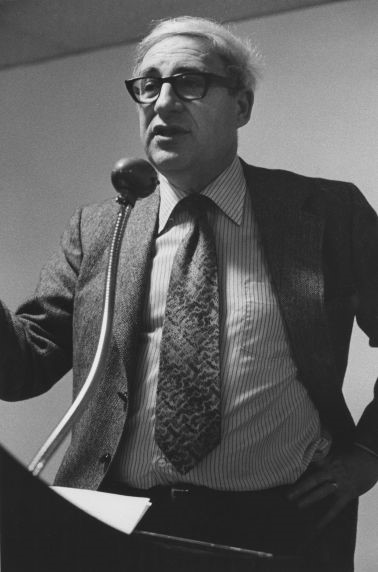
Earl Raab speaking at the 1972 AFT Los Angeles Civil Rights Conference

Note on usage: In this essay the racial designation “White” will be capitalized when used to mean racial Europeans and not capitalized (i.e., “white”) when conforming to common and official usage that includes non-European Caucasians (NECs) such as Middle Easterners and North Africans (MENAs) and semi-European Caucasians such as Ashkenazi Jews in the “white” racial category.

Earl Raab (1919—2015) served 40 years as the director of the Jewish Community Relations Council in San Francisco and was also the director of the Perlmutter Institute for Jewish Advocacy at Brandeis University. By “bigotry” and “Nazi-Aryan” in the above quotation, he means pro-White advocacy and support for White interests, the most existentially important of which are White preservation and independence — the continued existence of the White or European racial group and control of its own existence with its own countries, governments, cultures and economies. Earl Raab and his Jewish readership, the “we” in the above quote who are representative of the dominant and more active elements of the Jewish population, defined their group interests as diametrically opposed to White racial interests, promoting multiracialism, mass non-White immigration and racial intermixture, thereby causing White racial dispossession, subjugation, replacement and destruction. White interests, and especially the existentially important ones of continued racial life and independence through racial separation, are identified with and denounced as Nazism, racism, white supremacy, Fascism, etc. Thus even Donald Trump, whose perceived identification with implicit Whiteness is certainly far below any explicit support for existentially important interests, is frequently described as a racist, white supremacist, Nazi, etc., simply for opposing and obstructing, and so slowing, the progress of the anti-White agenda.

In 2016 the anti-White agenda of Raab, et al. was at the point of achieving Raab’s “irreversible” realization in a Hillary Clinton victory which would have swung the Damoclean sword and politically beheaded the White population, terminating its still remaining vestiges of political control of the country it created. They would do this by the legalization and enfranchisement of an estimated 22 million illegal non-White aliens (and possibly statehood for Puerto Rico and Washington D.C.), so that a party that served, promoted and defended White interests would no longer, in Raab’s words, “be able to prevail.”

But it was Donald Trump — the first major party presidential candidate in generations meaningfully identified with White interests, even if at a very low and implicit level — who won, not Clinton, and Raab’s triumphalism of 1993 suddenly seemed premature. Trump’s victory clearly demonstrated it was still possible for an implicitly pro-White candidate to prevail, and if so, also demonstrated the more remote possibility that a much more explicitly and meaningfully pro-White candidate and party could also still prevail.

So instead of realizing its complete and “irreversible” triumph over White America, the Anti-White Coalition suffered a defeat that shocked and shook it to its core. In response, it mobilized all the assets of its vast power structure to undermine the results of the election and make sure such a thing could never happen again. Before 2016 we could visualize the electoral future as a gradual racial transformation of the electorate to a non-White majority over the course of two or three decades in line with the projected demographic changes, but in the aftermath of Trump’s win it became clear that the Democrats planned to radically accelerate the racial electoral shift in their favor, plans postponed by Clinton’s defeat, but only until the next Democrat victory.

The approaching 2020 election — and if the Democrats lose this election, every election to come until the Democrats do win and impose permanent and “irreversible” non-White political dominance — will be as meaningful and decisive for America as the South African general election of 1994, which transferred political control of South Africa from the White minority to the non-white majority, was for the White population of that country. Every American election until the Democrats win will continue to be a sword of Damocles hanging over the neck of the White population which will finally fall when the Democrats win, striking off the White head (i.e., control or possession) of the country and imposing permanent non-White supremacy and the subjugation of Whites.

To realize the goal of White racial preservation and independence, the continued life of our race, and its control of its own existence, we must separate ourselves from the non-White races. To do this, it is necessary to be in control of the country, in fact very strongly in control, and to exercise that control with a firm and decisive will. To advance the same goal for our race in Europe, Canada and Australia we should so conduct ourselves in the process of separation that our racial kin in other countries will be moved to emulate our example rather than be repelled by it.

If our goal is to preserve as much of our race as we can, and if our goal of separation and independence for racial preservation is the goal consistent with the best interests of our race, then these goals would be best achieved by what Wilmot Robertson labeled the “National Premise,” a grand territorial partition of the country that would “spin off” the non-White racial populations into separate independent countries while keeping the greater part of the territory for a separate and independent all-White country. This separate and independent White country would contain the great majority of the White population (basically all who don’t self-emigrate to non-White areas) as well as the territory where the great majority of Whites reside, obliging less than 25% of them to relocate (the extent of White relocation should be minimized to maximize White support). This separate and independent White country would still be transcontinental and include the national capital and so be the continuation of the United States, and it would keep disturbance and disruption to a minimum (e.g., retirees would continue to receive their Social Security and Medicare benefits). I have previously discussed and described this goal in detail on this site in my essays “The National Premise Revisited” (with maps), my review of The White Nationalist Manifesto by Dr. Greg Johnson,  and in two earlier articles in The Occidental Quarterly: “Visions of the Ethnostate” (vol. 18, no.3, Fall 2018 pp 29–46) and “Separate or Die” (vol. 8, no. 4, Winter 2008–2009 pp 15–38)

The most important measure of any separatist and preservationist proposal is what proportion of our race could it be reasonably expected to save, or is even designed to save. By such a measure the National Premise proposal for a grand or total separation is clearly the only sufficient preservationist solution. Such a solution is incomparably superior to the sundry much smaller-scale secessionist proposals that would have little or no lasting preservationist effect, making them no more than larger and more elaborate variants of White flight.

The National Premise goal can theoretically be achieved by different means, but by far the clearest and most structured path forward, and the one that would be least disruptive of people’s lives in every sense, would be within the existing political and electoral system established and long maintained by earlier generations of our race. This is the system to which the great majority of our people strongly adhere, regard as legitimate, and wish to continue.

We can conceive of this electoral path to White racial liberation and restoration (or instauration per Robertson’s more esoteric Latin term), as having multiple stages, and each stage having several steps (or hurdles). The first stage is the conversion or transformation of one of the two major political parties into a national populist party, and then over successive stages and steps into an implicitly and then explicitly pro-White party. Since the 1960s the Republican party has been the obvious vehicle for this development, but other than the steady migration of White voters to the GOP, no overt steps in a national populist direction were taken until Trump, whose election was the first official and historical step (one could say the first victory) for the national populist and ultimately pro-White movement. A basic outline of this electoral path would be:

Stage 1: The conversion or transformation of the Republican party into a national populist party. In many respects the policies of such a party would naturally tend to coincide with the interests of the majority element of the population, which in America, Europe, Canada and Australia would be Whites, including being restrictive of immigration, but it would seek to unify and integrate all parts of the citizenry and so be inclusive of the non-White elements, perhaps even pandering to them to address their complaints and attract their support. The efforts to restrict illegal immigration could include better border protection and enforcement (e.g., “the wall”), abolishing DACA and denying any form of amnesty for illegal immigrants, enacting mandatory E-Verify to restrict employment opportunities for illegals, denying government benefits and assistance for illegals, and possibly, assuming there is a strong enough popular mandate to provide the will, the forcible deportation of all illegal aliens.

Stage 2: The conversion of the GOP into an implicitly pro-White party. At the implicit level of the process pro-White policies would still be limited but would include greater priority and emphasis placed on combating illegal immigration with an increased determination to employ and enforce all the methods listed in Stage 1. Also at this stage there would no longer be any pandering to non-Whites, appeals to their special interests, or promotion of their inclusion and integration.

Stage 3: The further transformation of the GOP into a more actively, but still implicitly, pro-White party. This stage would include abolishing any programs or policies that overtly benefit or prioritize the interests of non-Whites, including Affirmative Action, “reverse discrimination,” or restrictions on rights of private association and discrimination, essentially repealing the 1964 Civil Rights Act.

Stage 4: The continued conversion of the GOP into an explicitly pro-White party. At this stage of the process active measures would be supported to advance specifically White racial interests, but they would still be more defensive, ameliorative and temporary rather than decisive, complete and final. This would include means to secure White political dominance and efforts to promote various forms and degrees of racial separation.

Stage 5: The completed conversion of the GOP into an explicitly pro-White party. At this level of the process there would be open and determined advocacy for the complete and final, and only fully sufficient, solution to the issue of racial preservation and independence by the National Premise concept of a complete or grand racial separation through a grand partition of the country on racial lines.

The anti-Whites are very much aware of the threat such a development, made evident by Trump’s victory, poses for their previously unchallenged plans. The conversion of one of the major parties into a pro-White party, especially if it has enough White electoral support to win, is their worst political nightmare, and that is why they have mobilized all their power against it, with unprecedented and ferocious intensity, to “nip it in the bud” and abort the further development of a potential nascent pro-White movement. A second Trump victory would take the second step in Stage 1 even if only by consolidating the first step. A Trump defeat would probably set back the development of the GOP into a national populist, and increasingly more pro-White, party until it would be too late to matter.

How fast and far the Republican party can go in the process of its conversion over stages into an ever more pro-White party depends on the extent of its White support, and how fast and far its White support is willing to go. Trump won a very providential Electoral College victory in 2016 with 58% of the “white” vote, including 63% of white men and 53% of white women — the notorious “gender gap” celebrated by the anti-Whites. As the Jews and non-European Caucasians (NECs) commonly included in the “white” classification give most of their vote to the Democratic party (Jews consistently vote over 70% for Democrats) we can estimate that the GOP’s share of the White (European) vote is 2–3% greater than its share of the overall “white” vote, indicating that in 2016 Trump actually won 60–61% of the White vote. In the 2018 mid-term elections about 8 million Trump voters didn’t vote, and this decreased turnout for the GOP allowed the Democrats to take control of the House of Representatives with very adverse consequences, including the expected impeachment attempts.

When Trump began his candidacy in May 2015 he immediately jumped far ahead of his competition, with about 30% support in the polls of the Republican base, by emphasizing his opposition to illegal immigration and amnesty, including DACA, and promising to build a “wall” to stop illegals from crossing the southern border. This was and is a strongly pro-White position, although implicitly so, and beyond what any of his competitors were willing to match. He did not promise to deport the illegals who were already here, which would have been at the very limits of the parameters of acceptable political discourse, but his statements were enough to arouse the full fury of the dominant Anti-White Coalition far beyond anything or anyone since Nixon, and perhaps further than that. But his statements strongly opposing illegal immigration set off alarm bells among the anti-White establishment while also awakening the growing racial disquiet and concerns of a broad mass of Whites. These statements excited unprecedentedly enthusiastic support within the pro-White movement, with some seeming to think he could and would take the conversion process all the way through Stage 2.

Trump’s record on keeping his campaign promises is mixed, but not for lack of effort. He never seems to give up, and when blocked on one path, whether by congressional or judicial opposition, thinks out-of-the-box to find a way around to another path. His constituency is of course a coalition of somewhat disparate groups, although overwhelmingly White and to a large degree qualifying as populist. His most important constituency, in terms of numbers, is probably Evangelical Christians, and he has found it much easier to keep his campaign promises to them and other constituencies not related to racial or immigration issues than those that are related to race or immigration. Still he has tried, and stubbornly persists in trying to find a way. Despite congressional resistance and judicial obstruction. he has found creative ways to put together $18 billion to pay for about 1,000 miles of bollard fencing, the type of barrier preferred by the Border Patrol. As of mid-October, 341 miles of bollard fencing were completed and construction is continuing at a rate of about ten miles per week. About 500 miles is projected to be completed by the end of Trump’s first term. The remaining 500 miles of already funded fencing should be completed a year or so into his second term, assuming he has a second term. Otherwise the money will certainly not be used for further construction but might be used to tear down the fencing that has been built.


To Trump’s credit, on racial issues he has often gone beyond his campaign promises, taking bold action on matters not discussed in the campaign, which should be regarded as surprise bonuses by White advocates. Recently he denounced both “Critical Race Theory” and “The 1619 Project,” two of the leading current expressions of anti-White ideology, and banned the common practice of engaging in compulsory anti-White indoctrination sessions in the Executive branch and by government contractors, to the great discomfiture of professional anti-Whites like Tim Wise. On border enforcement he has pressured Mexico to allow apprehended illegal border crossers to be returned to Mexico to await the adjudication of their cases rather than being released into the U.S. where almost all of them disappear. He has also stopped the long practice of building federal housing projects—overwhelmingly populated by non-Whites—in primarily White suburbs.

To win the coming election without help from a second stroke of Providence or from an unlikely — and for us undesirable — major increase in his share of the non-White vote, and assuming the same voter turnout as in 2016, Trump will probably need to increase his share of the White (European) vote by at least several points to circa 63–65%, which would show in the tabulations as 61–62% of the overall “white” vote. To win the popular vote he would probably need to raise his numbers to at least 63% of the overall “white” vote, which could require as much as 66% of the White (European) vote. Assuming Trump does win, the larger the margin of his victory, and in particular the greater the extent to which his victory is attributable to White support, the stronger will be his mandate, the effects on the GOP and the spirit of his White supporters, creating a sense of confidence that will both enable and encourage bolder pro-White policies.

If Trump wins with a significant increase in White support it would also be another step in the process of transforming the GOP into a White people’s party, as an essential part of that process is decreasing the party’s dependence on non-White votes. Ideally, and ultimately necessarily as the party’s policies become more explicitly and meaningfully pro-White, the future White People’s party will need to be independent of non-White votes for electoral success, meaning it will need to win, based on the current 2020 racial proportions of the electorate, perhaps 80% of the White vote to win the popular vote, although the percentage required to win the electoral college, depending on the distribution of the votes, could theoretically be much less.

The other essential part of the process of converting the GOP into a White People’s party that is successful both electorally and in the actual implementation of pro-White policies is the continuation of a super-majority of White support as the party’s policies become more explicitly and meaningfully pro-White, ultimately to the point of a racial partition of the country to realize the “National Premise.”

This process of the conversion of the GOP into a White People’s party by steps and stages is at stake in the upcoming election. Trump’s election in 2016 was the first real step in the process. There is a common but misguided tendency for White advocates to focus too much on Trump in this election when our focus should really be on the process, the whole process, and nothing but the process. In this process Trump is only the first stepping-stone, or perhaps the first several stepping-stones depending on what happens, but the process is far bigger than him and hopefully will continue after he has left the scene. But that depends on whether he wins this election. Our choice is between a Trump victory that would likely mean the continuation of the process of transforming the GOP into a White People’s party, or a Democrat win that would be the “irreversible” Earl Raab election, essentially equivalent in effect to the 1994 general election in South Africa, reducing the founding White population to a state of racial dispossession and subjugation, and even persecution, leading ultimately to destruction.

Moral Communities and the Summer of George

The Summer of George is a paradigmatic example of a media-induced moral panic. A whole new, well-funded industry involving “racial sensitivity training” has sprung up where White people are systematically browbeaten into racial submission and abject guilt for the accomplishments of their ancestors. Such moral panics are, so far as I know, unique to the West and a key consequence of individualist culture. Try to imagine a moral panic in an African society. Or China. Or an Arab country. Not going to happen (counter-examples welcome).

My view is that the moral communities observed at the origins of Western history and surfacing recurrently in later centuries tapped into a pre-existing tendency among individualists to create such communities as a force for cohesion that does not rely on kinship relations. Particularly important since the seventeenth century have been the egalitarian moral communities based on a hunter-gatherer ethic whose evolutionary origins are discussed in Chapter 3 of Individualism and the Western Liberal Tradition (hereafter Individualism).

Egalitarianism is a notable trait of hunter-gatherer groups around the world. Such groups have mechanisms that prevent despotism and ensure reciprocity, with punishment ranging from physical harm to shunning and ostracism.[1] Christopher Boehm describes hunter-gatherer societies as moral communities in which women have a major role,[2] and the idea that Western cultures, particularly since the seventeenth century, are moral communities based on a hunter-gatherer egalitarian ethic will is a major theme of Individualism  In such societies people are closely scrutinized to note deviations from social norms; violators are shunned, ridiculed, and ostracized. Decisions, including decisions to sanction a person, are by consensus. Adult males treat each other as equals.

Moral communities are pervasive throughout the institutional structures of the West; however, because of their widespread influence, moral communities are particularly noteworthy in the media and the academic world—both areas which have been dominated by a Jewish elite whose gradual rise to power increased greatly after World War II and came to dominate the culture of the West by the 1960s. For example, whereas mainstream social science had been relatively free of morally based ingroup-outgroup thinking prior to World War II, such thinking has had dramatic effects on the social sciences and humanities in later decades, to the point that academic departments and scholarly associations in these areas can be accurately characterized as “tribal moral communities” in the sense of Jonathan Haidt.[3] This is most obviously the case in areas such as social psychology, sociology, and ethnic and gender studies.

The result has been that academic research communities and the media rigorously police research and commentary that conflict with racial egalitarianism or promote the interests of European-derived peoples, and these attitudes have been internalized by a great many White people. Researchers such as Arthur Jensen, Richard Lynn, J. Philippe Rushton, and Ralph Scott who attempt to publish findings on race differences or on public policies related to race find themselves socially ostracized, and they quickly learn that there are steep barriers to publication in mainstream academic journals and no mainstream grant support for their research. Recently Bruce Gilley, a professor at Portland State University, had the audacity to publish an academic article titled “The Case for Colonialism” in which he “suggested that European colonies in the Third World were both beneficial and legitimate, as they generally increased the local standard of living and were often supported by a significant portion of the local population.” The moral (not factual) condemnations quickly followed, and his department is now doing all can to make life miserable for him despite “acknowledg[ing] Gilley’s professionalism: it alleges neither academic misconduct nor personal misconduct on his part but affirms the opposite.” The editor of the journal where the article was published “resigned his position out of fear for his physical safety.”

One wonders how Gilley’s article even got published. When scholarly articles contravening the sacred values of the tribe are submitted to academic journals, reviewers and editors usually become extremely “rigorous”— demanding more experimental controls and other changes in methodology. Such “scientific skepticism” regarding research that one dislikes for deeper reasons was a major theme of The Culture of Critique in discussions of the work of Franz Boas, Richard C. Lewontin, Stephen Jay Gould, and the Frankfurt School, to name a few.[4] 

One result of this academic reign of terror has been that conservatives often self-select to go into other areas that are not so compromised, such as the hard sciences or computing; there is also active discrimination against conservative job candidates and Ph.D. applicants.[5] The system is therefore self-replicating.

Normal levels of wanting to be liked (not to mention pathological altruism) often involve a sense of self-righteousness, which can be translated as a sense of moral superiority that advertises one’s good reputation within a community defined, as prototypical European groups are, not by kinship but by conforming or exceeding the moral standards of the community. As noted above, such expressions of moralistic self-righteousness have a long history in Western societies and are very salient in contemporary political rhetoric.

It’s interesting that moral outrage, especially by males, acts as a cue to mate value in monogamous marriage that is a fundamental marker of Western social structure.[6] Since women want mates who fit into their moral community, men who signal moral outrage compatible with the values of that community are seen as good marriage prospects. One can imagine how this works on campus environments in the contemporary West where moral outrage directed at pretty much the entire Western past is de rigueur. Or in cities like Portland where, on Columbus Day, statues of Teddy Roosevelt and the sainted Abraham Lincoln (because he ordered the executions of 38 Indians after a Dakota uprising) were toppled by morally outraged antifa mobs.

An example of how self-righteous virtue signaling works at the highest levels of government can be seen in the comments of David Goodhart, a liberal journalist on migration:

There has been a huge gap between our ruling elite’s views and those of ordinary people on the street. This was brought home to me when dining at an Oxford college and the eminent person next to me, a very senior civil servant, said: ‘When I was at the Treasury, I argued for the most open door possible to immigration [because] I saw it as my job to maximise global welfare, not national welfare.’ I was even more surprised when the notion was endorsed by another guest, one of the most powerful television executives in the country. He, too, felt global welfare was paramount and that he had a greater obligation to someone in Burundi than to someone in Birmingham. … [The political class] failed to control the inflow … in the interests of existing citizens.[7]

An evolutionist can only marvel at the completely unhinged—pathological—altruism on display here, given that the people making these policies are presumably native White British themselves.

This overweening concern with people of different races living in far off lands at the expense of one’s own people was characteristic of many nineteenth-century English intellectuals, particularly those associated with Exeter Hall, who exhibited what Charles Dickens described as “platform sympathy for the Black and … platform indifference to our own countrymen.”[8] In his novel Bleak House, serialized in 1852–53, Dickens portrayed such sentiments in the character of Mrs. Jellyby, whose “handsome eyes had a curious habit of seeming to look a long way off. As if … they could see nothing nearer than Africa.”[9] Mrs. Jellyby neglected those around her, including her daughter, her thoughts directed instead towards the fictitious African possession of Borrioboola-Gha and her idealistic plans for its development.

It is well-known that massive non-White immigration has had negative effects most of all on the traditional, White working class of Western societies, while wealthier Whites can escape the problems brought about by immigration by moving to other neighborhoods—the phenomenon of White flight.  They also tend to have jobs, such as in journalism, that have not been impacted by immigration, although visas for workers in technical areas are increasingly common. However, contemporary liberal-minded elites throughout the West are indifferent or even dismissive of the negative effects of immigration on the White working class in terms of lowered wages,[10] lessened community cohesion and involvement,[11] and deteriorating public schools. As noted, in Mrs. Jellyby’s case, this included neglecting her own children—also characteristic of contemporary liberals who typically fail to think seriously about the effects of mass non-White migration on the long-term prospects of their own children as a minority in a majority non-White society.

Such expressions of high-mindedness are attempts to fit into a moral community as defined by the media and accepted by their peers. Because the left dominates the moral high ground, expressing empathy for the native Whites, especially the White working class, makes anyone with such ideas into a moral pariah, as would advocating for their interests, with likely negative effects on career prospects. Indeed, expressions of White identity and especially having a sense of White interests have been condemned by establishment media and academic figures as illustrating the lowest form of moral depravity.

Of course, the motives involved in such cases may involve more than empathy for suffering others. While these elite Whites may feel genuine empathy for suffering others in foreign lands to the point of wanting to inundate the West with them, they are also in effect buttressing their status in the morally defined ingroup. They may even be attempting to be “more moral than thou”—competitive virtue signaling—by out-empathizing others in the group. And whether consciously or unconsciously, they may be aware of severe costs if they fail to conform to the norms of their moral community—as well as the benefits of conforming.

The conviction of self-righteousness characteristic of altruistic people need not be rational:

What feels like a conscious life-affirming moral choice—my life will have meaning if I help others—will be greatly influenced by the strength of an unconscious and involuntary mental sensation that tells me that this decision is “correct.” It will be this same feeling that will tell you the “rightness” of giving food to starving children in Somalia, doing every medical test imaginable on a clearly terminal patient … . It helps to see this feeling of knowing as analogous to other bodily sensations over which we have no direct control.[12]

In other words, the sensations of rightness and nobility act as psychological reflexes, and they are so pleasurable that people are inclined to seek them in their own right and without regard to facts or the long-run consequences to themselves.

Talk to an insistent know-it-all who refuses to consider contrary opinions and you get a palpable sense of how the feeling of knowing can create a mental state akin to addiction. … Imagine the profound effect of feeling certain that you have ultimate answers. … Relinquishing such strongly felt personal beliefs would require undoing or lessening major connections with the overwhelmingly seductive pleasure-reward circuitry. Think of such a shift of opinion as producing the same type of physiological changes as withdrawing from drugs, alcohol, or cigarettes.[13]

Feelings of moral righteousness may thus be pleasurable and lead to addiction. “Sanctimony, or a sense of righteous outrage, can feel so intense and delicious that many people actively seek to return to it, again and again.”[14]

The pleasure of knowing, with subjective certainty, that you are right and your opponents are deeply, despicably wrong. Or, that your method of helping others is so purely motivated and correct that all criticism can be dismissed with a shrug, along with any contradicting evidence.[15]

This type of sanctimoniousness is, of course, particularly common among the people labeled “Social Justice Warriors.” These are the people screaming “racist,” “misogynist,” “white supremacist,” etc. at any seeming violation of the norms of the moral communities of the left. And, because of the cultural hegemony of the left, such people can often be seen on social media (and in op-eds in the mainstream media) expressing their moral righteousness—a moral righteousness that fits with or extends the boundaries of the cultural left.

Another aspect of this is competitive altruism or competitive virtue signaling. Given that expressions of moral righteousness are typically communicated in a social setting and are aimed at solidifying or enhancing one’s reputation within a group, there may be competition for ever more extreme expressions of self-righteousness—even among people who are not biologically inclined to be prone to be warm and loving to others. Extreme expressions of moral righteousness are not only addicting, they may also raise one’s status in a social group, just as it’s common for religious people to express “holier than thou” sentiments. Strongly religious people compete to be most virtuous in their local church. On the left, we see vegan fanatics shunning vegans who even talk to people who eat meat or eat in restaurants where meat is served—even family members. I imagine there is a dynamic within antifa groups—the shock troops of the establishment’s views on race and migration—where people who do not condone violence or are unwilling to crack heads themselves are ostracized or at least have much less status.

The result is a “feed forward” process in which the poles of political discourse move ever farther apart, doubtless exacerbated by the contemporary fixation on social media. For example, well-publicized attacks on Confederate statues have quickly morphed into attacks on Thomas Jefferson, George Washington, and Christopher Columbus. Sympathy among liberals for granting amnesty to illegal immigrants has morphed into calls by prominent Democrats to abolish the Immigration and Customs Enforcement Agency (ICE), make border crossing legal, and give them health care, driver’s licenses, voting rights, and ultimately citizenship. Inviting anyone remotely associated with conservative ideas—much less the racialist Right—to give a talk at a college campus has morphed from a tolerated rarity to a context for angry protests, rioting, injuries to conservatives, and damage to property.

I suggest that this competitive virtue signaling is a major cause of the increasing polarization that we see in the United States and throughout the West in the age of social media. A Pew Research Center survey on changes in U.S. political culture from 1994–2017 found that the increasing divide between Republicans and Democrats, especially on immigration and race, was much more due to the median views of Democrats shifting left.[16]

Nevertheless, a theoretically similar phenomenon exists on the right as, for example, when individuals condemn others for being insufficiently militant or ideologically pure. However, because the left dominates the cultural landscape, such competitive virtue signaling has had most of its effects on the left as the median views of liberals shift to the left. Such competitive virtue signaling from both the left and the right is highly characteristic of the social dynamics of social media sites and journalism.

People on the right face the danger of “doxxing,” having their identity and personal information made public. Hosts of shows in the mainstream media may have to cope with losing sponsors and hence their livelihood; e.g., as of March, 2019, Fox News host Tucker Carlson had lost around 30 sponsors, mainly because of his comments on immigration.[17] Or people may fear losing their job as a result of a phone call to their place of employment by a self-described “civil rights” organization such as the Southern Poverty Law Center or the Anti-Defamation League. This may well be why it is the left that has become more extreme in recent decades, whereas far too many on the right attempt to mollify their leftist critics by knuckling under to their moral righteousness.

The cultural domination of the left has meant that certain views are off-limits for all but the most daring. Thus, media sites like Breitbart and The Daily Caller, while definitely to the right of the mainstream media, avoid explicit advocacy of White identity and interests. Such constraints are much less apparent on the left, with the result that the left continues to get more and more extreme in their views. As I write, views on immigration noted above and on abortion (making abortion legal up until or even shortly after birth) that used to be virtually non-existent among Democrats are increasingly being espoused by mainstream Democrat politicians and pundits. And because transgenderism has become a leftist cause, pre-pubertal children are now given hormone blockers, at times with disastrous results:

Prescribed puberty blockers by the Gender Identity Development Service as a teenager, the Manchester resident has been left with a male-sounding voice, body hair, a beard, no breasts, and unsure whether she will ever be able to have children.

A critical consequence of this is racial polarization. White Americans have been shifting toward the Republican Party—the last Democrat president to get a majority of White votes was Lyndon Johnson in 1964. In general, this is an expression of implicit Whiteness, as non-White groups coalesce in the Democratic Party. The point here is that such trends are likely to increase and polarization become more severe.

Civil war is definitely in the air and one can only imagine the violence that would greet the (at this juncture unlikely) re-election of Donald Trump. But, if Joe Biden wins, a great many Americans, seeing that the changes are happening at warp speed and that the Democrats are aiming at a permanent power via importing Democrat-voting non-Whites, packing the Supreme Court, ending the electoral college and two senators per state and the re(as they already have in states like California), will become disillusioned with the system—like the USSR toward the end of the Cold War. Again, civil war is in the air.


[1] Christopher H. Boehm, Hierarchy in the Forest: The Evolution of Egalitarian Behavior (Cambridge: Harvard University Press, 1999).

[2] Ibid., 8.

[3] Jonathan Haidt, “Post-partisan Social Psychology.” Presentation at the meetings of the Society for Personality and Social Psychology, San Antonio, TX, January 27, 2011.

https://vimeo.com/19822295

http://people.stern.nyu.edu/jhaidt/postpartisan.html

[4] Kevin MacDonald, The Culture of Critique: An Evolutionary Analysis of Jewish Involvement in Twentieth-Century Intellectual and Political Movements (Westport, CT: Praeger, 1998; 2nd edition: Bloomington, IN: AuthorHouse, 2002), especially Chs. 2 and 6.

[5] Kevin MacDonald, “Why are Professors Liberals?,” The Occidental Quarterly 10, no. 2 (Summer, 2010): 57–79.

https://www.researchgate.net/publication/321716607_

[6] Mitch Brown et al., “Demonstrate Values: Behavioral Displays of Moral Outrage as a Cue to Long-Term Mate Potential,” unpublished ms, Fairleigh Dickinson University (2020).

[7] David Goodhart, “Why We on the Left Made an Epic Mistake on Immigration,” Daily Mail (March 22, 2013).

http://www.dailymail.co.uk/news/article-2297776/SATURDAY-ESSAY-Why-Left-epic-mistake-immigration.html

[8] Arthur A. Adrian, “Dickens on American Slavery: A Carlylean Slant,” PMLA: Journal of the Modern Languages Association of America 67, no. 4 (June 1952): 315–29, 329.

[9] Charles Dickens, Bleak House, Vol. 3 (London: Bradbury & Evans, 1853), 26.

https://books.google.com/books?id=KlsJAAAAQAAJ

[10] George J. Borjas, “The Analytics of the Wage Effect of Immigration,” Working Paper 14796 (March, 2009), National Bureau of Economic Research.

https://www.nber.org/papers/w14796.pdf

[11] Robert D. Putnam, “E Pluribus Unum: Diversity and Community in the Twenty-first Century,” Scandinavian Political Studies 3 (2007): 137–174; Salter, “The Biosocial Study of Ethnicity”; see also Frank Salter, “Germany’s Jeopardy,” You Tube (January 5, 2016).

[12] Robert A. Burton, “Pathological Certitude,” in Barbara Oakley, Ariel Knafo, Guruprasad Madhavan, and David Sloan Wilson (eds.), Pathological Altruism (New York: Oxford University Press, 2012): 131–37, 135.

[13] Ibid., 136.

[14] David Brin, “Self-addiction and Self-righteousness,” in Barbara Oakley, Ariel Knafo, Guruprasad Madhavan, and David Sloan Wilson (eds.), Pathological Altruism (New York: Oxford University Press, 2012): 77–84, 80.

[15] Ibid., 80.

[16] Pew Research Center, “The Partisan Divide on Political Values Grows Even Wider” (October 5, 2017).

https://www.people-press.org/2017/10/05/the-partisan-divide-on-political-values-grows-even-wider/

[17] Jeremy Barr, “Without Major Sponsors, Tucker Carlson’s Show Leans on Ads for Fox Programming,” The Hollywood Reporter (March 22, 2019).

https://www.hollywoodreporter.com/news/major-sponsors-tucker-carlsons-show-leans-fox-news-house-ads-1196257

The Real Goal of US University Biosecurity: Copy China’s Social Engineering

“We are all inevitably someone’s adversary.” Michel Foucault, Society Must Be Defended, Lectures at the Collège de France series

“War has become a regime of biopower, a form of rule aimed not only at controlling the population but producing and reproducing all aspects of social life. Biopower functions through the proliferation of acceptable freedoms, fosters life or disallows it. It fosters life through the production of knowledge about the (legitimate) self, especially in relation to a given population. This is what is meant by normalization, which refers to the construction of what behavior, and therefore who, is “normal” in the population. The war function and the police function are increasingly indistinguishable.” Michael Hardt and Antonio Negri, Multitude, as discussed in Dominic Corva, “Biopower and the Militarization of the Police Function

“Draconian surveillance measures introduced during the Covid-19 epidemic are handing “unchecked powers” to authoritarian regimes across Asia.  Risk analysts warn that “extreme measures and unchecked powers” brought in to tackle Covid-19 could become permanent features of government across the region, and have an impact on the rights and privacy of millions of people.  Surveillance tools and technology such as fever detection goggles, drones that monitor curfews and lockdown, and apps that track the spread of Covid are already being deployed as part of laws and other measures brought in during the pandemic in countries including [especially] China.  Right to Privacy Index (RPI) has assessed 198 countries on arbitrary and mass surveillance operations. The index found that Asia was the highest-risk region for breaches of privacy. The report also highlights a trend of arrests linked to citizens criticising national Covid response programmes.”   “Drones, fever goggles, arrests: millions in Asia face ‘extreme’ Covid surveillance,” The Guardian (October 1, 2020)

“Living in greater harmony with nature [in order to prevent pandemics] will require changes in human behavior as well as other radical changes that may take decades to achieve: rebuilding the infrastructures of human existence, from cities to homes to workplaces, to water and sewer systems, to recreational and gatherings venues. In such a transformation we will need to prioritize changes in those human behaviors that constitute risks.  Among the most important factors are those associated with human behaviors, e.g., population growth, crowding, human movement, and many others, including behaviors that either perturb the environment or result in new human-created ecologic niches.  These reflect the extraordinary importance of human population growth and movement.”   David M. Morens, Anthony S. Fauci, Office of the Director, National Institute of Allergy & Infectious Diseases, National Institutes of Health, Bethesda, MD, USA., “Emerging Pandemic Diseases: How We Got to Covid-19.”

“While the measures that will be necessary to defeat the coronavirus will seem draconian, even anti-American to some, we believe that there is no alternative.  We acknowledge that the refusal to obey rules one considers unjust is an American tradition.  A refusal to be vaccinated threatens the lives of others.  How can government ensure compliance with protective vaccines?  Vaccine refusers could lose tax credits or be denied nonessential government benefits. Health insurers could levy higher premiums for those who by refusing immunization place themselves and others at risk.  Private businesses could refuse to employ or serve unvaccinated individuals. Schools could refuse to allow unimmunized children to attend classes. Public and commercial transit companies — airlines, trains and buses — could exclude refusers. Public and private auditoriums could require evidence of immunization for entry. A registry of immunization will be needed with names entered after immunization is completed. Adequate immunization may require more than a single vaccination, and the durability of protection by different vaccines may vary and may require periodic booster immunizations. Thus, immunized persons will need to receive expiration date-stamped certification cards, which should be issued to all who are immunized in the country, whether here legally or not.”   Dr. Michael Lederman, Maxwell J. Mehlman and Dr. Stuart Youngner, Case Western Reserve University, “Defeat Covid-19 by requiring vaccination for all. It’s not un-American. It’s patriotic.”

I’ve visited a number of US universities over the past several months and they all have one thing in common: a lockstep, identical policy over the covid phenomenon. I say “phenomenon” because the actual scientific data are conflicting, often wildly so, and all over the map, and its effect, profoundly more psychological than even biological. I say “psychological” because it is confusing, and creates anxiety, uncertainty, and a lack of faith in institutional integrity.  I say “lockstep” because universities now have identical policy—whether classes are in person, temporarily on-line or a mix—which consists of identical elements, even language, disclosures, warnings, and penalties concerning signage, masks, distancing, socializing, sanitizing, notification, testing, reporting, quarantining, tracing, tracking, monitoring, and eventually, the mandate to vaccinate. The entire US higher education complex is marching in lockstep to one voice, one authority, one interpretation, one strategy. It is as if the country’s universities and colleges were subject to a “hostile takeover,” by a corporate raider or by foreign interests; or they were suddenly militarized under the cover of a need for the “biosecurity of militarization,” and the students, locked in isolation in the towers of a medieval complex and corralled and herded in a massive national experiment. It’s not just heartbreaking, but an outrage, to see how our nation’s young adults are being treated. Everyone is afraid. Fear is the new realm—and the great risk of the new campus “biosecurity.”

Students are caught in a difficult and understandable cognitive dilemma among the conflicts and inconsistencies of health information: the irrational, ad hoc and authoritarian nature of university institutional responses, and the almost impossible choices one is left with, concerning how to even function practically on a college campus today.[1]

One major reason that students, such as the undergraduates at the University of Chicago, are expressing frustration with vague, confusing or conflicting signals from their administration, is because university managers really aren’t in charge; they have effectively handed over management of the campus, to an effective syndicate of alphabet agencies made up of the CDC, the WHO, the DHS, DOD, state and city government, and not least the DNC, toward which the university administration has demonstrated strong political allegiance, including to its own senior political alumnae, such as the Obama-Lightfoot-Sanders “triumvirate.”

Or take the University of Wisconsin at Madison. Its Chancellor, a former White House cabinet member and advisor to former presidents Clinton and Obama, led the institution’s “SmartStart” plan to re-open the campus to all students for the Fall 2020 semester. Over the past few weeks, tens of thousands of students, some with spouses, some even with children, packed their belongings and from all over the world, headed off and converged on Madison, to pursue their academic journeys; move in to new dormitories, apartments and houses; set up a home, buy their books, enroll in courses, and a dozen other personal and academic chores. And yet barely two weeks into the Fall semester, the “SmartStart” turned into the “FallStall” as all campus, in-person classes were suddenly cancelled; libraries, labs, and campus facilities closed or restricted, and students confined to their dorms and homes, and otherwise “quarantined.” All because a few students tested “positive” and the university, “out of an abundance of caution” reversed course, shut down all student activity, and followed the politically charged interventions of the state’s Democrat governor.

Universities like Chicago or Wisconsin also steer their policies from their internal legal counsel, and from Trustees, who worry about being sued. The legal “abundance of caution” doctrine largely rules their corporate behavior and creates confusing, often complex, illogical policy and rules. Covid is also big business: millions of dollars in research grants are on the table, so the administrations are also threading that needle. This in some ways re-defines what an “R1” research university is, as the university, and all its members, have now, effectively, become itself the subject of research.

But what is the larger objective here? Where are U.S. universities headed, and why? Think through what the mix of virus protection routines is doing to the mental routines of young adults, to their new assumptions and expectations about social interaction and compliance; and what the confusion, anxiety, frustration and fear caused by constantly changing university ad hoc policy actions, are doing to establish a set of policies and regulations that can be lowered almost on command by the promise of relief.  What does a face mask, social distancing and avoidance, constant sanitizing, cooperation in testing, contact tracing, and “geofencing,” do to one’s psychological outlook; to your core sense of self, and even personality? They are all altered.  What is the new “baseline?” Essentially it’s the Chinese system. Why China? China is the model of mass compliance and top-down state authority, on a mass scale that can be extended globally—a model that allows nearly absolute government control of not only economic sectors, their activities and investment, but of culture.[2] Here is an excerpt from a recent New York Times article, implying throughout that China’s top-down command social model represents an aspiration for the US (“How China Brought Nearly 200 Million Students Back to School: China says the reopening of classrooms proves that its top-down system is superior,” 12 September 2020):

While the Communist Party has adopted many of the same sanitation and distancing procedures used elsewhere, it has rolled them out with a characteristic all-out, command-and-control approach that brooks no dissent. It has mobilized battalions of local officials and party cadres to inspect classrooms, deployed apps and other technology to monitor students and staff, and restricted their movements. It has even told parents to stay away for fear of spreading germs.

China’s leader, Xi Jinping, said in a speech on Tuesday that the country’s progress in fighting the virus, including the opening of schools, had “fully demonstrated the clear superiority of Communist Party leadership and our socialist system.”

China’s top-down, state-led political system allows the party to drive its vast bureaucracy in pursuit of a single target — an approach that would be nearly impossible anywhere else in the world. In the United States, where the pandemic is still raging, discussions about how and when to resume in-person classes have been fraught. An absence of a national strategy has left school districts to craft their own approach. Coronavirus tests can be hard to come by. Parents have expressed misgivings about sending their children back to classrooms. Teachers’ unions have threatened to strike, while college students have flouted rules against gatherings.

In China, where the virus has largely been under control for months, there is no such debate. The party controls the courts and the news media and quashes any perceived threats to its agenda. Local bureaucracies have little choice but to obey the orders of the all-powerful central government. “The Chinese system moves by itself,” said Yong Zhao, a scholar at the University of Kansas who has studied education in China. “The system is run like a military: it just goes for it, no matter what anyone thinks.”

In many ways, China is applying the same heavy-handed model to reopen schools that it has used to bring the virus under control. To stop the epidemic, the authorities imposed harsh lockdowns and deployed invasive technologies to track residents, raising public anger in some places and concerns about the erosion of privacy and civil liberties. With schools, the government’s effort has in some places been met with similar frustrations. Teachers, who are at times doubling as medical workers, checking for fevers and isolating sick students, say they are exhausted by the new protocols. Students have complained that some policies, such as lockdowns on university campuses, are excessive.

In a profound irony, China first copied (appropriated) U.S. economic culture, systems and intellectual property, and now there are political interests in the U.S. that seek to copy China’s social culture, and its systems of control and social engineering. Such a unified mass block severs the “invisible hand” and installs the authoritarian fist, but unlike earlier examples such as the USSR, the system is not geopolitically organized, but rather ordered in social dimensions of absolute unification: a re-engineered American culture is in service to a new master; as a re-shaped block that can fit into and be absorbed by a larger entity. That entity is China, and a “Sino-sphere” hegemony. This fits easily into the ideological contours of anti-Americanism, and an identitarianism that at its core seeks extreme class leveling as the ultimate compensation for, and protection against, perceived privilege, ambition, and independence.[3]

The social transformation ambitions of a new American radical Left, naturally expands outward from the higher education (re-education) complex, and is in fact propagated and reinforced by it, as such a transformation requires a constant intellectual reinforcement and stewardship.  Flowing outward from this ideological production is a gradual acceptance of larger social, cultural and economic displacements by the state, and at that state level, a deeper operational infrastructure of social control and management—otherwise instinctively resisted—is required.  This includes the emerging surveillance and security regime gradually but inexorably growing since 2001, and now consolidated in the new “911” which is the Covid-19 construct. This biosecurity regime is not merely a new passive intrusion into privacy, property and other constitutional rights, but is also an active intervention into the sovereignty of the private, individual body through enforced vaccination.  This turns the physical human organism into “converted” property by the state itself; a collective hive maintained by vaccination, continuous testing, and pharmacological intervention.[4]   In this way of incremental but systematic normalization of extreme, radical social engineering, the entire global population can be transformed from a natural, “wildlife” and segregated diversity of cultural independence and social autonomy model, into an effective agricultural model of population control that can be industrially cultivated, bio-engineered, homogenized, and harvested.  The “crop” of young adults contained within the higher education complex are perhaps the most vital first segment to stabilize and consolidate.

The USA Today opinion piece quoted at the top of this article asserts a radical “forced vaccination” agenda, with extreme penalties for resistance, written by three medical professionals from Case Western Reserve (all Jewish).  It is important to appreciate that such extreme social intervention and engineering is not a natural element of Western culture, but instead must be modeled, formatted and institutionalized in mass-cooperative social regimes where deference to authority is especially pronounced: this is inherent in Asian culture.  The entire Covid biosecurity construct is designed explicitly to lower resistance in Western culture to authority direction, and to condition behavior in personal and group behavior through symbolic routine and ritual which is why the face mask, distancing, quarantine, and group social congregation restrictions are central to the collective acceptance of an “Asian” social control and authority model.  Western cultural traditions must be comprehensively “unscaffolded” across highly traditional routines and expectations such as organized religion.  Complementing this meta-social behavioral conditioning system, is an enforced, legal compulsion regime that is being lobbied (including by the same USA Today authors).

In the radical Left’s Weltanschauung of an over-populated and warming world, absolute cognitive conformity and social homogenization allow for the attempted mastery of the entire ecological system—the ability to control production, consumption, energy, and waste. The “Wuhan virus” isn’t a pathogen; it is a behavioral coding that is activated and programmed with an eye to controlling the future culture—and even the genetic structure—of a society. Like a farmer planting his crops, the crop to be harvested in the future must be seeded, incubated, sprayed, pruned, and harvested in concentrated, controlled production centers. Hence the modern university, and “biosecurity.” There is no more centralized, readied and institutionalized infrastructure to accomplish these goals, than our nation’s colleges and universities; there is no more effective, and efficient way to assemble, control and train millions of Americans, year after year, than through the education complex.[5] Nothing even comes close to such mass institutional collation of millions of subjects. No other mass recruitment method can get that many young people with that much concentration, under that much closed-system control, and with that much regular, reliable induction, than higher education—a higher education turned inside-out and converted in its mission via an easy, immediate and inter-institutionally readied, federal takeover. The CDC is the new Department of Education.  The university is the ideological and public relations target, which the media promotes through agitation and saturation.

America’s university administrations, through their softness in leadership, by their eagerness to please special interests, and from their susceptibility to ideology and financial dependence, are making life for students and their families utterly untenable, if not impossible—and psychologically dangerous. And for the larger country, they are willing to serve as a social engineering center, with thousands of university “camps” all across the country, in every state, major city, county, and town. These centers are already built and ready for conversion, needing only an insidiously natural-seeming change channeled through a biosecurity overlay. This leaves students—and the public—with an increasingly difficult but urgent choice: either submit to and comply with experimental, mass-control biosecurity and the concomitant ideological indoctrination of millions of our young adults; or reject the university’s corruption to better pursue the interests and future of your family and country.

In negotiation, the first thing you learn is how to get up from the table, walk away and say “No.”

This is one of those moments on America’s campuses.


[1] See https://www.dissidentprof.com/8-home/163-covid-19-on-campus-turning-the-university-of-chicago-into-a-re-education-camp. See also Federal judge William Stickman IV’s recent Ruling: It overturns Covidianism’s constitutional violations, but through an actual fact trial, overturns its entire construct. The full U.S. District Court Opinion is linked in this article.

[2] See https://thefederalist.com/2020/10/02/seeking-american-lessons-from-chinas-revolutionary-past/

https://thefederalist.com/2020/10/02/forced-denunciations-and-sensitivity-training-mimic-communist-brainwashing-tactics/

[3] China also has a friend in this ambition for control: Israel. What has been called ‘the only democracy in the Middle East,” wants to become the only authority in the Middle East (brokered with the Sunni Arabs). Israel is also the first developed country to issue a nation-wide “second lockdown” (interestingly on the 9-11 weekend), as it is the leading regional promoter of the Covid program, with top-down, unconstitutional social controls; along with promotion of its pharmaceutical sector,and the vaccination agenda, largely driven by its pharma export interests. Israel’s new lockdown orders are leading to some protests, riots and a level of social anxiety similar to the US. Compare this to Sweden. There have never been any lockdowns or broad social controls including mandatory facemasks.  The Covid response across very different cultural domains and political systems, is instructive as to the larger strategic purpose of certain nations. There are steady-state, culturally consolidated, stable societies like Sweden, and then there are unstable, expansionist theocracies like Israel, where Covid is being used as an explicit tool in furthering active geopolitical goals of regional destabilization and expansion under unified control. Sweden stands in stark contrast as a stable cultural and political society, completely detached from the covid biosecurity regime.

[4] Ohio State University instituted such a testing regime, which includes “surveillance testing”—random testing of asymptomatic students. It’s not clear what this will accomplish, outside of assuring, through test result anomaly, that every student will, stochastically wind up in isolation, monitored and inducted into a re-testing and biometric routine. Yale has also initiated “SalivaDirect“. The Yale program highlights how these testing routines are affecting students. In both cases, testing is mimicking randomized control and clinical trial methods. This is largely due to the culture of university medical practices. Such procedures may notionally reduce bias, but it is also theoretically blinding (in this case, blinding is corrupted by bio-ID collection and tracking) and promotes or justifies an evidence case for standardized, universal intervention, including vaccination. Student testing is in fact a mass control experiment and financial annuity, as it asserts permanent re-testing (the C.D.C. which is providing all official guidance and protocols to universities on campus biosecurity and population testing, states that it will undertake long-term “vaccine development and testing such as basic research, clinical studies, side effects and adverse reactions, vaccines of the future, and the vaccine product approval process”).  These representative programs otherwise suffer from at least two core problems: one is their biodata, storage, transfer, disclosure, tracking and identity parameters have been established under a biosecurity pretext; the other is the fundamental futility of testing and isolation: mathematical modeling in complex unbounded large networks, shows they are ineffective. The asymmetry among the quantitative and qualitative random variables also creates constraints on the specificity and spread design. Exploitation and manipulation are invited. Moreover, any university campus is subject to numerous daily external workers, contractors, shipping companies, visitors from around the world, hospital admits, and even the homeless. If not network inclusive, testing is especially moot. The other risk from biosecurity enforcement, outside of behavioral and personality alteration, is bio-marker baseline disclosure to facilitate vaccination, re-testing, and secondary pharmicon regimes (see, for example Detroit Daily News: “University of Michigan President: I know there is ‘lack of trust’” resulting from the university’s covid testing. The original plan included “a now-scrapped plan to send armed police officers into off-campus student housing neighborhoods to enforce no-party policies”).

[5] See the Harvard-Wuhan controversy: “Harvard University Professor and Two Chinese Nationals Charged in Three Separate China Related Cases.”
University Professor Arrested.”
The Thousand Talents Plan is part of China’s long quest to become the global scientific leader.”
“Spy school: Chinese military officer busted for posing as Boston University student.”
Harvard prof charged with hiding China ties, payments.

China censors Mike Pence during VP debate broadcast as he criticizes Beijing.

Critical Kosher Theory

1. Without deception, the kosher industry would not be as ubiquitous as it is. Reasoning: the vast majority of the revenue feeding this religious enterprise comes mostly from outside Jewish congregations. Over five decades ago rabbis from kosher agencies claimed that they kept their hekhsher (kosher seal) unusually small so as not to offend non-Jewish consumers, and today they claim that they have no control over the size of kosher seals – even though they stipulate the strictest contracts. Our study suggests that a Deceptive Trade Practice is in play among the companies and agencies. We estimate that this enterprise would be entirely different, perhaps 5% or less of its current size, if completely run by religious volunteers from the congregations that observe Kashrus. We discovered that keeping consumers in the dark with little transparency and a lot of obscurity is key to sustaining and growing their business. Arguably, the kosher agencies can stipulate in contractual words a mandatory legibly sized hekhsher (kosher seal) to be displayed on labels with the morally correct addition of the bold text “KOSHER CERTIFIED”. But they don’t.

2. If label transparency was honest, kosher brands might lose business to #NKC products NOT Kosher Certified. Reasoning: Our surveys indicate that more than half of consumers desire no religious intervention in the production of their food or they desire a “higher” transparency indicated on the labeling when this is the case. If this group was “kosher aware” and if companies were legally forced to display large and clear kosher labeling, companies might opt for keeping away from kosher certification to access this greater share of the market. Of course, there are other factors pressuring companies to kosher-certify their goods that we are not privy to, for instance, distribution and supermarket management demands.

3. When dollar signs start entering the religious aspects of Kashrus, it is perverted with greed and corruption, even in “holy” Jerusalem. Reasoning: Israel’s ynetnews reveals a darker side of the kosher certification business occurring in the Jewish State itself. If such criminality can occur among the rabbis and inspectors in Jerusalem, then similar or worse conditions may exist in America where the kosher revenue is largely derived from outsiders of the Jewish congregations. This behavior was further leaked by professionals at the International Food Safety and Quality Network in their forum, and by Jewish journalists themselves at the New York Daily News.

4. Give ‘em an inch, they’ll take a mile. Reasoning: There are plenty of laws protecting the kosher-keeper, and plenty of IRS law that benefits religious organizations, but no laws protecting the consumer from religious groups co-opting secular businesses, instituting their particular rules and laws, and wringing out revenue from companies where consumers have no reason to suspect outside religious involvement. These consumers are unfairly being taken advantage of, and the parties involved in the kosher enterprise have shown no compassion or even tolerance for how they may feel regarding outside religious intervention in their secular livelihood. Further, given that approximately one million observant kosher keepers are actively buying kosher certified products with deceptively obscured transparency of kosher seals, their silence must be an admission that they find no shame in this religion-based fraud.

Looking back into history…

Jewish women rioted en masse in the early 1900s, resulting in national kosher laws across America protecting kosher-keepers. But kosher laws protecting kosher keepers were not good enough. Preferential IRS laws for religious organizations allow kosher agencies more protections by keeping their finances out of public scrutiny. It is one matter to have laws for protection of particular groups. It is another matter entirely to take advantage of people outside the specific religious community, especially where they are forced into becoming unwitting contributors to the financial gain of a religious congregation they do not belong to. This is immoral; it degrades religious freedom for the out-group. Most Americans perceive religious organizations as moral and honest, but here we find a business practice throughout the industrialized world that is tied directly to untouchable religious NGOs that do all within its power to conceal the facts from consumers.

Our very own Federal Trade Commission ignores whistle blowers on the kosher industry. As a result, as generous as the American government has been to accept religious pluralism and to accommodate protection for the kosher industry and kosher keepers, no effort is extended to protect the general consumer who is not a kosher keeper. The insiders of the kosher industry do not seem to have concerns for the out-group, consistently citing marketing data from pro-kosher associations.

5. When food companies contract with the kosher certification industry, there is a veil of silence that shrouds the details that its patrons inquire about. Reasoning: The companies won’t tell us, so we can’t tell you until an insider whistle blower appears on the scene. Our experience in confronting food companies with questions usually results in silence, or incredibly vague responses with little detail. Our educated presumption is that there are non-disclosure or confidentiality agreements contracted by the kosher agencies and food companies keeping the details in the dark.

6. Major efforts are undertaken to suppress “kosher awareness” from the public, but no efforts to curtail Talmudic “separatist” laws like Bishul Akum. Reasoning: Articles from the ADL and Reveal News magazine attempt to scare away inquisitive minds on The Kosher Question, but are they willing to look into OU Kosher’s own article on three post-Torah Kashrus proscriptions that enforce separation and xenopobia? Of course not.

After reading the article linked above by OU Kosher, “Bishul Akum: Playing with Fire,” a serious double standard is exposed with respect to the entire enterprise of kosher certification. Clearly, these religious experts prescribe that strict observers of the Kashrus dietary laws are to be highly exclusionary, to avoid gifts (like a meal “fit to be served at a royal table” or a bottle of wine) from members of outgroups as a measure to limit socialization, new friendships, and closer relationships.  And yet the behavior of this industry is towards imposing its religious rules and dogma onto “others” outside their synagogues with little to no possibility of escape. If this industry was tolerant and fair to other religions and peoples, they would insist with the contracting food companies to produce equivalent products free from kosher certification, thus permitting choice. But they don’t, and so the whole application of these proscriptions within the kosher world is the ultimate hypocrisy.

7. Kosher Supremacy rules over America, and food companies are complicit in depriving #EQUITY to people of diverse faiths and identities. Reasoning: Synonyms of the word ‘Supremacy’ are Authority, Control, Predominance, and Hegemony. The kosher industry enjoys all of these, and more. There are no major churches, religious organizations or advocacy groups working on behalf of consumers and citizens who are against this practice of kosher certification. There is no equity and religious freedom for the vast majority. They are effectively marginalized. You will not find a kosher-certified product “X” and the same branded product “X” without kosher-certification for those consumers who would like to abstain from Jewish intervention.

8. It is easier and more profitable to co-opt existing industry and make it serve ancient particularism of Kashrus law than to build its own industry from scratch. Reasoning: History indicates that the Jewish community had the financial resources to fund an entrepreneurial and niche kosher food industry to serve specialty kosher markets and kosher sections of supermarkets or general stores. But this would have necessitated full funding by the Jewish community. By contracting directly with existing producers, the kosher community built a certification industry on mostly non-Jewish capital and have created a highly profitable enterprise. Of course, we don’t know how profitable it is, because that information is shrouded in secrecy.

9. Mammon rules. As society “progresses”, more secular companies submit and pay to implement ancient kosher law requirements, while few observe “Blue Laws” of old #Christian culture in Western Society that allowed a day for rest and worship. Reasoning: Businesses closed on Sundays in the 1960s and earlier because of local laws that eroded away in time. However, the practice was a religious and moral one serving the culture of the times. Today, all but Chick-Fil-A stores have shed this Sunday closing on economic grounds. But more and more companies are submitting to kosher agencies and their stipulations on ancient dietary laws. Early America was dominated by Christian morals and culture, especially by the early settlers. But this culture has been transformed, and it is clear that either we are living in a purely Judaized culture, or mammon is now running the show. Or both.

10. Ubiquitous kosher certification, as it currently is implemented, is a strategy that abuses the last vestige of moral fiber and good will that bind the American society. Reasoning: Edward Bernays, a Jewish man named as one of the top 100 influential Americans of the twentieth century by Life magazine, a nephew of Sigmund Freud, and an expert on public relations and propaganda, stated: “The conscious and intelligent manipulation of the organized habits and opinions of the masses is an important element in democratic society. Those who manipulate this unseen mechanism of society constitute an invisible government which is the true ruling power of our country.”

Well, one organized habit of Americans nationwide is buying kosher certified products, but 90% may not know it, and people generally don’t like being duped. What little mention there is in American news articles regarding kosher food is entirely positive, with none of the many downsides. One 1954 speech made by a member of the Daughters of the American Revolution (Mrs. Marian Strack) took aim at this business, and the press struck hard against her, silencing honest and balanced debate regarding all aspects of this matter. Our food culture and all the particular interests that this undisclosed kosher revenue feeds have been shaped by figures unseen to the public.

After nearly one century, food manufacturers refuse to produce equitable products free from kosher certification aside from their kosher-certified versions. Access to the national “free” marketplace will eventually be driven by submission to the dogmatic kosher agencies’ will. 

As Ms. Bousquet sums up at the end of her masterpiece, From Kosher to Halal:

The accommodations described as ‘reasonable’ directly oppose the historic secularism model, the only guarantee of equality of treatment for all citizens. This project must rest on clear positions applicable to all issues of religious intrusion into civic and public space. No violations should have been tolerated, and should not be in the future. … We must, quite simply, determine the following: (1) What norms are acceptable for the public sphere (commerce)?, (2) What kind of practices should be relegated entirely to the private sphere? and (3) What norms demonstrably contravene animal welfare? [referring to controversial religious slaughter]. … The last word belongs to consumers.

Allow us to conclude with this brief comment: When the masses discover the schemes, the trust will be lost. But is #CriticalKosherTheory just one facet of a larger group evolutionary strategy? That remains to be answered.

This article originally appeared at the KosChertified? website—the go-to place for information on the kosher racket.

Minority-Worshipping Madness: Our New Monuments will be to Blacks and Jews

As sites like the Occidental Observer, VDARE and American Renaissance constantly describe, minority-worship is “madness-inducing.” Minority-worship inverts reality, morality and logic, insisting that Whites abase themselves and trash their societies in a vain attempt to appease the ever-growing rancour, resentment and envy of their racial enemies.

All-suffering saintliness

Blacks, for example, are invariably the most violent, least intelligent, most destructive, least productive, most narcissistic and least admirable group in any White society unlucky enough to host them. They murder, rape and rob at startlingly high rates and in startlingly unpleasant ways: for three examples among millions, see the Knoxville Horror, the mass gerontophile rapist Delroy Easton Grant, and acid-throwing robbers in London.

Ethnic enrichment in London

And who is to blame for these Black pathologies, according to minority-worship? Whites are, of course. The central dogma of minority-worship is the all-encompassing evil of Whites and the all-suffering saintliness of non-Whites, whose innate genius and gentleness are crushed by racism and White supremacy. It follows, then, that Blacks will flourish when the White jackboot is lifted from their saintly necks, as it was in Haiti after the Haitian Revolution of 1804. Whites were tortured, massacred and expelled, whereupon Haitian Blacks promptly built an advanced Afrocentric utopia that is today the most equal, most peaceful, most technologically advanced and yet most ecologically friendly place on earth. If only Blacks in Britain, America and Europe could cast off their chains and emigrate to Haiti to be “Free at last!” Haiti could topple White tyrannies, of course, but it refuses to use its anti-gravity rays and interstellar space-fleet for anything but peaceful purposes.

Megalomania and malignant narcissism

At least, that’s what Haiti would be like if leftist fantasies about Black genius were true. They aren’t, and the real Haiti is a true monument to the Black capacity for civilization. As even the Guardian admits, it’s a hell-hole of misgovernance, corruption, crime, poverty, disease, superstition and ecological devastation. So is Zimbabwe, another place where saintly Blacks were rescued from evil Whites and allowed to rule themselves. They ended up far worse off, as Blacks always do when leftists liberate them from oppression and injustice. For another example of liberation-into-dystopia, look at the current Black Lives Matter (BLM) hysteria, triggered by media lies about the self-induced death of a thuggish, drug-taking Black criminal called George Floyd. BLM hysteria has sent murder-rates soaring in Black districts all across America. Thousands of young Black men are meeting violent, painful and entirely unnecessary deaths thanks to a movement that claims to place their welfare at the heart of its concerns.

But BLM hysteria isn’t responsible only for physical violence. It’s also behind a vast increase in violence to truth, logic, morality and the English language. For a prime example, take the bloated Anti-Racist Action Plan produced by students at the Royal Academy of Dramatic Arts (RADA) in London. I haven’t read all of it: life is too short and my tolerance for leftist prose is too low. But from what I have read, I conclude that one of two things is true. The Action Plan was written either by very clever undercover satirists or by not-so-clever non-Whites determined to bring Deep Purple’s artistic ideal — “Everything louder than everything else” — from heavy metal to politics. The megalomania, malignant narcissism, self-righteousness, pretension, pseudo-intellectualism, irrationality and authoritarianism of the Action Plan could all induce tinnitus at a hundred yards. Here’s a mercifully brief sample:

It is imperative that RADA becomes actively anti-racist, encouraging a greater intake of BAME Black and Minority-Ethnic students and staff, and ensuring that they have positive experiences at all junctures. … As an anti-racist institution, RADA must ensure that all students and staff entering the building are of one mind in terms of holding anti-racist values. It is important that all staff and students are provided with updated reading lists which include texts about contemporary racial and societal issues. … RADA must ensure that Unconscious Bias Training and all other types of training around race, equality and inclusion is mandatory for all students and staff. (RADA Students’ Anti-Racist Action Plan, 2020)

The world’s greatest actor was a hate-criminal! Laurence Olivier in black-face for Othello (1965)

The students at RADA seem to have been inspired partly by Maoism and the Cultural Revolution, partly by the megalomaniac Daleks of the Dr Who television series and the strident Dalek battle-cries of “You will obey!” and “Exterminate!” The non-White students are crying “You will obey, crackers!” and want to exterminate all crime-think at RADA. Among much else, they are demanding “Removal of all material created by those who supported racist ideologies. Including (but not limited to): busts, paintings, room names, theatre spaces and seats.”

An uncanny sense of déjà vu

Britain has a very rich tradition of drama and acting. It has produced some of the world’s greatest writers, performers, plays and films. Thanks to mass immigration, that tradition is now being attacked by non-Whites who want to lose their envy and sense of inferiority in the act of destruction. But I had an interesting experience after sampling the Anti-Racist Action Plan and its megalomaniac demands that the universe revolve about non-Whites and their concerns. A day later I read an article by the conservative Melanie Phillips in the sensible and moderate Jewish Chronicle and was struck by an uncanny sense of déjà vu:

Of course people need to be taught about the Holocaust. But the greater need by far is to teach them about the Jewish people, their history in both the land of Israel and the diaspora and about Judaism’s unique characteristics and record of survival. (Holocaust education can foster ignorance and hatred, The Jewish Chronicle, 1st October 2020 / 13th Tishrei 5781)

Behold Melanie’s megalomaniac demand that the universe revolve around Jews and their concerns! No wonder I felt déjà vu: the narcissism of the leftist “BAME” students at RADA is echoed by the narcissism of the supposedly conservative Melanie Phillips in the Jewish Chronicle. And the Chronicle was so pleased by her words that it repeated them as the sub-heading below the headline.

Hate-facts will be forbidden

Both Melanie and the Chronicle will be in no doubt about who should control the “teaching” given to “people” about those vitally important Jewish topics. For example, will people be taught that among “Judaism’s unique characteristics” has been its ability to spawn an uncannily large number of nation-wreckers like Leon Trotsky, fraudsters like Bernie Madoff, intellectual charlatans like Sigmund Freud, and sex-criminals like Jeffrey Epstein? No, of course not. Hate-facts like those will be strictly forbidden in the teaching Melanie has in mind, because Jews will oversee what goyim are taught about Jews.

And so there will be no place for the horrific anti-Semitism covered by the Jewish Chronicle in July 2019. A hate-filled extremist mocked a proposed “Holocaust memorial and learning centre” near Parliament and claimed that many gentile opponents of the memorial “are keeping quiet — almost certainly because they fear being accused of antiSemitism.” That is, in itself, absolutely classic anti-Semitism: the claim that Jews use unfair accusations of anti-Semitism to silence opposition and get their own way.

Ugly, intrusive and unfairly imposed

And who was that hate-filled extremist spewing classic anti-Semitism against the Holocaust memorial? It was Melanie Phillips herself. She was right in her criticisms, too: the proposed memorial is ugly, intrusive and being imposed on unwilling gentiles who won’t speak out because “they fear being accused of antisemitism.” Melanie doesn’t disagree with the Jew-worshipping aims of the memorial, of course: she simply thinks that it’s not the right way to do “What’s best for Jews.” Lots of other Jews think that it is. The memorial is, in fact, another example of Jewish megalomania and Jews’ insistence that the universe revolve around them and their concerns. Like Holocaust museums across America, it is designed to send a simple message: “You will obey, goyim!”

And I feel déjà vu again when I read demands for a Museum of Slavery in London: “It is unacceptable that the capital city of a nation that built a global empire and its wealth in large part as a result of its role in the slave trade has no significant museum or monument marking the role that London and Britain played in these historic atrocities.” Like the Holocaust memorial, the proposed Museum of Slavery which will fill the urgent need to browbeat Whites about how evil they were — and are — to saintly minorities.

The poisoning of politics

These parallels between Jewish megalomania and Black megalomania are no coincidence. At least, that’s what Britain’s then Chief Rabbi, Jonathan Sacks, claimed back in 2007. The Jerusalem Post reported his words like this:

Sacks said Britain’s politics had been poisoned by the rise of identity politics, as minorities and aggrieved groups jockeyed first for rights, then for special treatment. The process, he said, began with Jews, before being taken up by blacks, women and gays. He said the effect had been “inexorably divisive.” “A culture of victimhood sets group against group, each claiming that its pain, injury, oppression, humiliation is greater than that of others,” he said. In an interview with the London Times, Sacks said he wanted his book to be “politically incorrect in the highest order.” (Sacks: Multiculturalism threatens democracy, The Jerusalem Post, 20th October 2007)

So Sacks thinks that the poisoning of British politics “began with Jews.” He’s right: Jews did invent the megalomania, self-righteousness and authoritarianism of identity politics. And not just in Britain, but right across the West. Identity politics has what you might call “Sacks Appeal”: it’s a way for minorities to blame all their own failings on Whites while receiving ever more privileges and money from Whites.

Seize power, create dystopia

What’s not to like? Nothing, if you’re a self-righteous ethnocentric anti-White minority. Everything, if you’re White and have foresight. As I pointed out in “Feeding the Dragon,” non-Whites and their Jewish enablers do not believe in equality and justice, but in power and revenge. They want power over Whites in order to take revenge on Whites. When Blacks came to power in Haiti, they tortured and massacred Whites, then created a hellish dystopia. When Jews came to power in the Soviet Union, they tortured and massacred goyim, then created another hellish dystopia. If Blacks and other non-Whites come to power in the West, the same things will happen. Their hatred of Whites and Western civilization is already obvious. And what the obviously Jewish “museum curator” below wants to do to “racist statues” is also what she wants to do to racist Whites:

The unattractive Madeline Odent

A museum curator who sparked outrage after tweeting a guide about vandalising ‘racist’ statues has left her job. Madeline Odent posted messages to her 5,000 followers in the wake of the Black Lives Matter movement outlining how household items could permanently damage monuments.

The furore began in June when the Oxford-educated curator, who comes from a wealthy family in Georgia and is married to banker Pascal Odent, tweeted her comments days after protesters in Bristol toppled a statue of slave trader Edward Colston.

She wrote: ‘From an art perspective, it’s honestly fine to throw paint on memorials of genocidal racists! Paint is pretty easy to clean off. What would be an absolute shame is if people threw certain household items that cause irreversible bronze disease. Of course then the artefact can’t really be on display. … Because, like, if somebody were to throw a ton of tomatoes at a bust of a genocidal racist, nobody would probably notice the chemical reaction until it was too late to save the artefact.’ … (Toppled? Museum curator who sparked outrage after tweeting a guide about vandalising ‘racist’ statues using household items has left her job, The Daily Mail, 26th September 2020)

Looking at that photo of Madeline Odent reminds me of something I’ve written before at the Occidental Observer: “Personal ugliness goes naturally with the urge to destroy beauty, order and harmony, and to overturn the aesthetic and artistic standards whereby one is judged.” And it’s no surprise that Ms Odent comes from “a wealthy family” and is married to a banker. She’s part of the hostile elite that attacks Western civilization from above while non-Whites imported and fostered by the hostile elite attack Western civilization from below.

Above or below, these people have to go. They all have countries of their own and they should return there. Then they’ll be free of White oppression and can create the societies that suit them best. The examples of Haiti and Zimbabwe don’t look promising, it’s true, but that’s not our problem. Instead, our problem is how to end minority-worship, free ourselves of our implacable racial enemies, and return our societies to what best suits us, not what best suits them.