Featured Articles

The “Extraordinary Successful” Aristocratic Individualism of Indo-Europeans – Chapter 2 of Individualism

Editor’s note: This is Part 2 of Prof. Duchesne’s commentary on Individualism and the Western Liberal Tradition.

Part 2 of my detailed examination of Kevin MacDonald’s Individualism and the Western Liberal Tradition: Evolutionary Origins, History, and Prospects For the Future (2019), examines his emphasis in chapter two on the aristocratic individualism of Indo-Europeans. In Part 1 I covered MacDonald’s argument in chapter one that Europe’s founding peoples consisted of three population groups:

  1. Western Hunter-Gatherers (WHGs) who were descendants of Upper Paleolithic peoples who arrived into Europe some 45000 years ago,
  2. Early Farmers (EFs) who migrated from Anatolia into Europe starting 8000 years ago, and
  3. Indo-Europeans (I-Es) who arrived from present-day Ukraine about 4500 years ago.

Using MacDonald’s argument, I emphasized how these three populations came to constitute the ancestral White race from which multiple European ethnic groups descended.

The task MacDonald sets for himself in chapter two is a most difficult one. He sets out to argue that the most important cultural trait of Europeans has been their individualism, that this trait was already palpable in prehistoric times among WHGs and I-Es, that it is possible to offer a biologically based explanation for the emergence of this individualism, and that this individualism was a key component of the “extraordinary success” of Europeans. How can one employ a biological approach to explain individualistic behaviors that seem to defy a basic principle of evolutionary psychology — that members of kin groups, individuals related by blood and extended family ties, are far more inclined to support their own kin, to marry and associate with individuals who are genetically close to them, than to associate with members of outgroups? It is also the case that the concept of “group selection”, to which MacDonald subscribes, says indeed that groups with strong in-group kinship relationships are more likely to be successful than groups in which kinship ties are less extended and individuals have more room to form social relations outside their kin group.

Evolutionary psychologists prefer models that explain group behavior in animals and humans generally. They also prefer to talk about cultural universals — behavioral patterns, psychological traits, and institutions that are common to all human cultures worldwide. When they encounter unusual cultural behaviors, they look to the ways in which different environmental settings may have resulted in genetically unique behaviors, or to the ways in which relatively autonomous cultural contexts may have promoted or inhibited certain common biological tendencies.

MacDonald combines these two approaches to argue that the individualism of Europeans is a genetically based behavior that was naturally selected by the unique environmental pressures of northwest Europe. However, it is only in reference to the egalitarian individualism of northwestern hunter gatherers, which is the subject of chapter three, that MacDonald tries to explain how this egalitarian individualism was genetically selected. He takes it as a given in chapter two that the I-Es were selected for their own type of aristocratic individualism, without linking this individualism to environmental pressures in the Pontic steppes. In Part 3 we will bring up his argument about how Europe’s egalitarian individualism was naturally selected.

Cultural Peculiarities of Indo-Europeans

MacDonald refers often to my book, The Uniqueness of Western Civilization, in his analysis of the culture of Indo-Europeans, while putting a stronger and clearer emphasis on the way kinship was “de-emphasized” within the central institution of the Männerbund, or the warrior brotherhood of the I-Es. These warrior bands, as I also observed in Uniqueness, were organized primarily for warfare, which was the main way aristocrats found a livelihood consistent with their status as warriors, opportunities to accumulate resources and followers, and a chance to attain heroic renown among peers. Membership was open to any aristocratic warrior willing to enter into a contractual agreement with the leader of a warband, with the greatest spoils and influence going to those who exhibited the greatest military talents. In other words, these war bands were open to individuals on the basis of talent, rather than “on the basis of closeness of kinship”.

My emphasis in Uniqueness  was less on the looser kinship ties of I-Es than on the “aristocratic egalitarianism” that characterized the contractual ties between warriors — how the leader, even when he was seen as a king, was “first among equals” rather than a despotic ruler. MacDonald emphasizes both this aristocratic trait and the ways in which I-Es established social relations outside kinship ties.

I-Es were aristocratic in the true sense of the word: men who gained their reputation through the performance of honorable deeds, proud of their freedom and unwilling to act in a subservient manner in front of any ruler. In addition to, or as part of the Männerbund, “guest-host relationships (beyond kinship) where everyone had mutual obligations of hospitality”, and where “outsiders could be incorporated as individuals with rights and protections,” were common among these aristocrats. By the time the Yamnaya migrated into Europe some 4500 years ago, they had developed a highly mobile pastoral economy coupled with the riding of horses and the development of wagons, in the same vein as they initiated a “secondary products revolution” in which animals were used in multiple ways beyond plain farming, for meat, dairy products, leather, transport and riding. This diet, together with the open steppe environment, where multiple peoples competed intensively to support a pastoral economy requiring large expanses of land, encouraged a highly militaristic culture. Indo-Europeans became a most successful expansionary people: Currently 46% of the world’s population speaks an Indo-European language as a first language, which is the highest proportion of any language family.

Egtved Girl wears a well-preserved woollen outfit and a bronze belt plate which symbolises the sun – a well-travelled woman at the dawn of the Celtic Urnfield culture who found herself visiting Denmark.
MacDonald could have clarified for readers unfamiliar with evolutionary theories of marriage and family that when he writes about “an  aristocratic elite not bound by kinship,” or about how ties between aristocrats “transcended the kinship group,” he is not denying the importance of blood ties between extended I-E family members and extended I-E families grouped into clans. He observes that marriages occurred within clans and that punishments and other disputes were decided in terms of kinship customs. The difference is that I-Es developed social ties above their kin relations that “tended to break down strong kinship bonds”.  While the strong kinship cultures of the East were characterized by arranged marriages within the extended family, and political-military ties were heavily infused by kin customary relations, among the Corded Ware culture that grew out of the Yamnaya one finds exogamy or marriage outside the extended family or with females “non-local in origin”, including the practice of monogamy. Exogamous marriages between I-E groupings, including the peoples they dominated, were a key component of their guest-host networks and a means to pull together military alliances and integrate new talent.

Individualism and Ethnocentrism Among Ancient Greeks

But it could be that MacDonald does assume that, in the degree to which Europeans created social ties outside kinship ties, it would have been inconsistent for them to retain kinship affinities and ethnocentric tendencies. He observes that “despite the individualism of the ancient Greeks, they also displayed [in their city-states] a greater tendency toward exclusionary (ethnocentric) tendencies than the Romans or the Germanic groups that came to dominate Europe after the fall of the Western Empire” (48).

The Greeks had a strong sense of belonging to a particular city-state, and this belonging was rooted in a sense of common ethnicity…The polis was thus…exclusionary (serving only citizens, typically defined by blood)…Greek patriotism based on religious beliefs and a sense of blood kinship was in practice very much focused on the individual city, making those interests absolutely supreme, with little consideration for imperial subjects, allies, or fellow Greeks in general (48-49).

I don’t think it should surprise us that despite their individualism the Greeks had a conception of citizenship defined by kinship. I would argue, rather, that it was precisely their individualistic detachment from narrow clannish ties that allowed the Greeks to develop a new, wider and more effective, form of collective ethnic identity at the level of the city state. Citizenship politics was introduced in Greece in the seventh century BC as a challenge to the divisive clan and tribal identities of the past. A citizen in a Greek city-state was an adult male resident individual with a free status, able to vote, hold public office, and own property. Bringing unity of purpose among city residents, a general will to action to communities long divided along class and kinship lines, was the aim behind the identification of all free males as equal members of the city-state.

As I argued in “The Greek-Roman Invention of Civic Identity Versus the Current Demotion of European Ethnicity“:

We should praise the ancient Greeks for being the first historical people to invent the abstract concept of citizenship, a civic identity not dependent on birth, wealth, or tribal kinship, but based on laws common to all citizens. The Greeks were the first Westerners to be politically self-conscious in separating the principles of state organization and political discourse from those of kinship organization, religious affairs, and the interests of kings or particular aristocratic elites. The concept of citizenship transcended any one class but referred equally to all the free members of a city-state. This does not mean the Greeks promoted a concept of civic identity regardless of their lineage and ethnic origin […] The Greeks…retained a strong sense of being a people with shared bloodlines as well as shared culture, language, mythology, ancestors, and traditional texts.

City-states were indispensable to forge a stronger unity among city residents away from the endless squabbling of clannish aristocratic men, for the sake of harmony, the ‘middle’ good order. To this end, the ancient Greeks enforced a set of laws (nomoi) that applied equally to all citizens, de-emphasizing both kinship ties and differences between classes — which brings me to another point I may elaborate in more detain in another post: the aristocratic individualism of I-Es contained a democratizing impulse.

In the creation of city-states, and the subsequent democratization of these polities, particularly in Athens, we see an egalitarian impulse emerging out of the aristocratic war band and the prior aristocratic governments of ancient Greece when a council of aristocratic elders, without input from the lowers classes, was in charge. It is not that the old aristocratic values were devalued; rather, these values trickled downwards to some degree. The defense of the city, and warfare generally, would no longer be reserved for privileged aristocrats but would become the responsibility of hoplite armies manned by free farmers. Heroic excellence in warfare would no longer consist in the individual feats of aristocrats but in the capacity of individual hoplites to fight in unison and never abandon their comrades in arms.

Solon

The democratization of the city-states from Solon (b. 630 BC) to Cleisthenes (b. 570 BC) to Pericles (495–429 BC), the creation of popular assemblies, were associated with the adoption of hoplite warfare, starting in the mid-seventh century, the abolition of debt slavery, the securing of property rights by small landowners, and the creation of an all-embracing legal code. This unity of purpose was taken to its logical conclusion in the ideal city state imagined by the character of Socrates in Plato’s Republic, “Our aim in founding the city was not to give especial happiness to one class, but as far as possible to the city as a whole”.

Individualism and Ethnocentrism Among Romans

The ethnocentrism of the Greeks beyond their city-states should also be recognized. The ancient Greeks came to envision themselves as part of a wider Panhellenic world in which they perceived themselves as ethnically distinct precisely in lieu of their individualistic spirit, which they consciously contrasted to the “slavish” spirit of the Asians. As Lynette Mitchell observes in Panhellenism and the Barbarian in Archaic and Classical Greece (2007), “there was in antiquity a sense of Panhellenism”. Panhellenism was “closely associated with Greek identity”. While this unity was ideological, rather than politically actual, weakened by endless quarrels between city-states, the Greeks contrasted their citizen politics with the despotic government of the Persians.

Europeans, however, would have to wait for the Romans to start witnessing a strong common identity beyond the city.

The same pattern from an aristocratic form of rule towards citizenship politics was replicated in Roman Italy, followed by the creation of an actual, and more encompassing, form of collective identity. MacDonald analyzes very effectively how the aristocratic individualist ethos of Indo-Europeans shaped the course and structure of politics throughout the Roman Republican era in an Appendix to Chapter 2. Even though an individualist ethos prevailed in Rome, we should not be surprised by the observation that, for the early Romans, “family was everything” and that “affection and charity were…restricted within the boundaries of the family.” We should not be surprised either that “there were also wider groupings” shaped by strong kinship ties, and that “cities developed when several of these larger groupings (tribes) came together and established common worship,” and that Roman cities were not “associations of individuals”, which is a modern phenomenon.

We must look for this aristocratic individualist ethos in the “non-despotic government” the Romans created, their republican institutions. This was a government in which aristocratic patrician families contested and shared power in the senate, which would eventually expand to include representative bodies, tribunes, for non-aristocratic plebeians with wealth, towards a separation of powers, between the senate of the patricians and the tribunes of the plebs, along with two consults from each body elected with executive power. The I-E aptitude for openness and social mobility was reflected in the rise of plebeian tribunes and the eventual acceptance of marriage between patricians and plebs. It was also reflected in the gradual incorporation of non-Romans, or Italians, into Roman political institutions. As MacDonald writes,

Instead of completely destroying the elites of conquered peoples, Rome often absorbed them, granting them at first partial, and later full, citizenship. The result was to bind ‘the diverse Italian peoples into a single nation'” (80).

Unlike the Greeks who restricted citizenship to free born city inhabitants, the Romans extended their citizenship across the Italian peninsula, after the Social War (91–88 BC), and across the Empire, when the entire free population of the Empire was granted citizenship in AD 212. MacDonald believes that this openness beyond Rome and beyond Italian ethnicity “resulted in Rome losing its ethnic homogeneity” (84). He cites Tenney Frank’s argument (1916) that Rome’s decline was a product of losing its vital racial identity as Italians become mixed with very heavy doses of “Oriental blood in their veins”. He believes that the Roman I-E strategy of incorporating talent into their groupings worked so long as “the incorporated peoples were closely related to the original founding stock”.

I am not sure if by “closely related” MacDonald means only the Latins; in any case, I see the forging of all Italians “into a single nation” as a very successful group evolutionary strategy in Rome’s expansionary drive against intense competition from multiple cultures and civilizations in the Mediterranean world. Similarly to the Greeks, the Roman-Italians retained a very strong sense of ethnic national identity throughout their history.
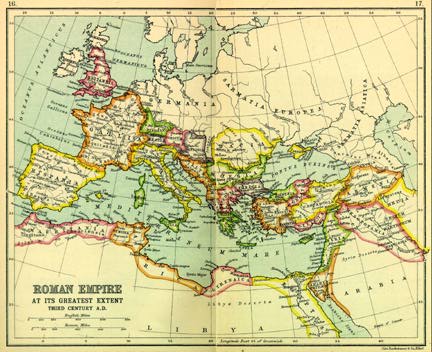
It is important to keep in mind that Italian citizenship came very late in Roman history, some five centuries after Rome began to rise. We should avoid conceding any points to the erroneous and politically motivated claim by multiculturalists that the Roman Empire was a legally sanctioned “multiracial state” after citizenship was granted to free citizens in the Empire. This is another common trope used by cultural Marxists to create an image of the West as a civilization long working towards the creation of a universal race-mixed humanity.  Philippe Nemo, under a chapter titled, “Invention of Universal Law in the Multiethnic Roman State,” want us to think that “the Romans revolutionized our understanding of man and the human person” in promulgating citizenship regardless of ethnicity. But I agree with the Israeli nationalist Azar Gat that ethnicity remained a very important marker for ancient empires generally, no less an important component of their makeup than domination by social elites over a tax-paying peasantry or slave force. “Almost universally they were either overtly or tacitly the empires of a particular people or ethnos.”

It should be added that Romans/Latins were so reluctant to grant citizenship to outsiders that it took a full-scale civil war, the Social War, for them to do so, even though Italians generally had long been fighting on their side helping them create the empire. Gat neglects to mention that all the residents of Italy (except the Etruscans, whose status as an Indo-European people remains uncertain) were members of the European genetic family. Let’s not forget how late in Rome’s history, AD 212, the free population of the empire was given citizenship status, and that the acquisition of citizenship came in graduated levels with promises of further rights with increased assimilation. Right until the end, not all citizens had the same rights, with Romans and Italians generally enjoying a higher status.Moreover, as Gat recognizes, Romanization was largely successful in the Western half of the empire, in Italy, Gaul, and Iberia, all of which were Indo-European in race, whereas the Eastern Empire consisted of an upper Hellenistic crust combined with a mass of Mesopotamian, Egyptian, Judaic, Persian, and Assyrian peoples following their ancient ways, virtually untouched by Roman culture. The process of Romanization and expansion of citizenship was effective only in the Western (Indo-European) half of the Empire, where the inhabitants were White; whereas in the East it had superficial effects, although the Jews who promoted Christianity were “Hellenistic” Jews. This is the conclusion reached in Warwick Ball’s book, Rome in the East (2000). Roman rule in the regions of Syria, Jordan, and northern Iraq was “a story of the East more than of the West.” Similarly, George Mousourakis writes of “a single nation and uniform culture” developing only in the Italian Peninsula as a result of the extension of citizenship, or the Romanization of Italian residents. Perhaps we can also question Tenney Frank’s argument about the heavy presence of Oriental blood in Italy. According to David Noy, free overseas immigrants in Rome — never mind the Italian peninsula at large — might have made up 5% of the population at the height of the empire, which is not to deny Orientalist elements among the enslaved population.

For these reasons, I would hesitate to say that the I-E strategy of openness dissolved the natural ethnocentrism of Italians and Europeans generally. Their aristocratic individualism should be seen as a more efficient and rational ethnocentric strategy re-directed towards a higher level of national and racial unity, without diluting in-group feelings at the family level. It was only at the level of clans and tribes that the Greeks and the Romans diluted in-group kinship tendencies when it came to the conduct of political affairs. In Rome, the Senate worked as a political body mediating the influence of families in politics, not eliminating kinship patron-client relations at the level of families, but minimizing their impact at the level of politics. The Senate was a political institution within which elected members (backed by their extended families and patron-client connections) acted in the name of Rome even as they competed intensively with each other for the spoils of office holding.

It has indeed become clearer to me, after thinking about MacDonald’s contrast between kinship oriented and individualist cultures, why the East was entrapped to despotic forms of government. Rather than viewing this government as a purely ideological choice, it can be argued that the prevalence of despotism in the East was due to the prevalence of kinship ties in the running of governments and the consequent inability of Eastern elites to think about higher forms of identity in the way the Greeks and Romans did. Eastern empires were highly nepotistic, with rulers using the state to expand their kinship networks, favoring relatives while behaving in a predatory way against rival ethnic-tribal groups, without a sense of city-state or national unity, and without the ability to generate loyalty among inhabitants or members belonging to other kinship groups. The historian Jacob Burckhardt once observed about the Muslim caliphates that “despite an occasionally very lively feeling for one’s home region which attaches to localities and customs, there is an utter lack of patriotism, i.e., enthusiasm for the totality of a people or a state (there is not even a word for ‘patriotism’)”. Burckhardt does not say anything about kinship, but it seems reasonable to infer that the strong kinship ties that prevailed in the East made it very difficult to forge a common identity beyond these ties.

What ultimately allowed the Romans to defeat the Semitic Carthaginian empire, thereby securing the continuation of Western civilization, was their ability, in the words of Victor Davis Hanson, to “improve upon the Greek ideal of civic government through its unique idea of nationhood and its attendant corollary of allowing autonomy to its Latin-speaking allies, with both full and partial citizenship to residents of other Italian communities”. This form of civic identity among Italians was the main reason Rome was able, as MacDonald observes, “to command 730,000 infantry and 72,7000 cavalrymen when it entered the First Punic War” and to sustain major defeats in the early stages of the Second Punic War without losing the loyalty of its Italian allies and the ability to marshal huge armies.

We will see in our review of future chapters that what I have said above is not inconsistent with MacDonald’s thesis but relies on his own observations that a fundamental by-product of individualism is the formation of ingroups that are based on reputation and moral norms rather than on kinship. We will see that the same Christian Europe that pushed further the breakdown of kin-based clans, cousin marriage and polygamy, created a powerful moral community across Europe: Christendom. The point I am making now is that we should also see the ancient Greek city-states and the idea of Romanitas (or Romanness) as attempts to forge broader ingroup unities without relying solely on kinship relations. It is no accident that Europe would eventually give birth to the formation of the most powerful nation-states in the world, capable of fighting ferociously with each other while dominating the disorganized, clannish, despotic non-White world.

The Indigenous Europeans Consisted of Three Distinct White Population Movements: Chapter 1 of Individualism and the Western Liberal Tradition

Editor’s note: Prof. Ricardo Duchesne has written a series of articles on my book Individualism and the Western Liberal Tradition, originally posted at Eurocanadian.ca. These essays are not only informative on the contents of the book, but also contain incisive commentary. Well worth reading!

General Remarks

Kevin MacDonald’s Individualism and the Western Liberal Tradition: Evolutionary Origins, History, and Prospects For the Future (2019) is the first book that employs an evolutionary psychological approach to explain the rise of the West — actually, it is the first book that aims to comprehend the dynamics of the entire history of the West from prehistoric to current times to explain as well the decline of the West, the ways in which the “egalitarian individualism” originated by northwest Europeans in hunting and gathering times planted the seeds of the West’s current decision to destroy its genetic heritage through the importation of masses of immigrants.

Difficult as this task may seem, MacDonald performs it extremely well. In a normal academic world in which criticism of immigration was permissible, MacDonald’s book would have been the subject of immediate debate rather than complete silence. The books currently dominating the “rise of the West” tend to downplay any substantial differences between the West and other civilizations. They talk about “surprising similarities” between the major civilizations as late as the 1750s, and argue that the West diverged only with the spread of the Industrial Revolution. Some books go back in time to the family structure of medieval northwest Europe, or to the enforcement of monogamy by the Catholic Church, or to the rise of modern science in the seventeenth century. While MacDonald makes effective use of earlier arguments on Western uniqueness, including my own argument about the importance of the “aristocratic egalitarianism” of prehistoric Indo-Europeans, he believes that the starting point must be “the genetic history of the West”.

For MacDonald, the most unique trait of Europeans is their individualism, a trait manifested in two different forms, in the aristocratic individualism of Indo-European cultures, and in the hunter-gatherer egalitarian individualism of northwestern Europe. There is a genetic basis for these two forms of individualism. To understand their origins it is necessary to document how these two forms were naturally selected within populations living in particular environmental settings, as well as within the novel cultural-environmental settings they created. The egalitarian form of individualism, in MacDonald’s estimation, was the form that eventually came to dominate European culture. While the aristocratic individualism of Indo-Europeans predominated in ancient Greece and Rome, the trend in European history was for the accentuation of egalitarian individualism, with the Church playing a critical role, and then the Puritan revolution with its “moralistic Utopianism” gradually spreading in the United States.

The Jews did not invent this egalitarian individualism. They interpreted this egalitarianism into a call for a plurality of cultures and races inside the West — the “ethnic dissolution of non-Jews” — while protecting Jewish in-group solidarity and ethnocentrism. They insisted that the egalitarian values of Europeans required them to abolish their exclusive and unequal ethnic-based concept of citizenship for the sake of a truly egalitarian multiracial concept  open to the arrival of millions of immigrants.

MacDonald’s emphasis on the “primordial” foundations of the egalitarian individualism of northwest hunter gatherers should not be confused with the standard observation that hunters and gatherers across the world were egalitarian. His focus throughout the book is on kinship systems, whether lines of descent were bilateral or patricentric, whether marriages were exogamous or endogamous, monogamous or polygamous, whether families were nuclear or extended, whether there was individual choice in marriage or arranged marriages, and whether individuals were inclined to establish relations outside their kinship group, with relatively weak ethnocentric tendencies, or whether they were seen as embedded to their kinship group, with relatively strong levels of ethnocentrism. His central argument is that already among northwest European hunter gatherers we can detect relatively weaker collective kinship systems, which gave room for more individual initiative and relationships outside extended families and blood lines, with individuals forming associations outside kinship relationships, as if they were in a state of equality rather than in a state of inequality between ingroups and outgroups.

It is this focus on the individualistic family systems of the West that allows MacDonald to offer a comprehensive explanation of both the rise and the decline of the West.  Most scholars writing about the rise of the West today are concerned to answer why the Industrial Revolution occurred in eighteenth century England/Europe. Some emphasize the unique family structure of northwest Europe, but they trace this family structure to the Middle Ages, and none of them go back to the evolution of genetic dispositions among northwest hunter-gatherers to explain the rise of the West. I am not aware of any scholar who focuses so consistently on the weak ethnocentric tendencies of Europeans to explain both the rise and decline of the West. If meeting the scientific criteria for parsimony is valuable to you, then reading MacDonald’s book will be very illuminating indeed.

What follows is the first of nine or ten commentaries I will be writing about Individualism and the Western Liberal Tradition

Three Foundational Genetic Populations of Europe

Chapter One brings up the latest research on population movements into prehistoric Europe to argue that three distinct populations came to constitute the genetic foundations of this continent:
  1. A “primordial population” arriving in Europe about 45,000 years ago, which he calls “Western hunter-gatherers (WHGs),” and which developed a unique culture of egalitarian individualism in the northwest areas of Europe.
  2. Early Farmers arriving from Anatolia about 8000 years ago, bringing agriculture and having the greatest genetic effect on the WHG population in the southern areas of Europe.
  3. Indo-Europeans migrating from the Pontic-Steppes beginning around 4500 years ago, starting with the Yamnaya peoples and later associated with the Corded Ware culture. The greatest genetic impact of the Yamnaya and Corded Ware peoples was on central Europe and some regions in the north, with less impact in the east and south.

This first chapter, the shortest at 25 pages, may be the most tricky for readers to digest; and I fear that, if not read carefully, it may create the impression that MacDonald is arguing that Europe’s population was formed by non-white genetic groups coming from the outside, “mysterious” Yamnaya peoples coming from “the steppes”, as they were described in the mainstream media, and by farmers from the Near East. Because MacDonald presents this argument in a scholarly and judicious manner, using the geographical and ethnic terminology of the literature, and avoiding descriptions about the “white race” until the last pages, it may lead some readers to infer that only the WHGs in the northwest were white and native to the continent.

Up until about page 13, MacDonald describes (correctly) the EFs as a people from “Anatolia”. He describes the I-Es as an “amalgam of Armenian-like Near Eastern people,” Caucasus hunter-gatherers, Siberian North Eurasians (“related to North American Indians”), and Eastern Hunter-Gatherers. I have no dispute with this terminology, except that it may lend itself to manipulation by the mainstream media — into the notion that only one genetic population, WHGs (in the north) was white. This seems to be the impression of Morris V. de Camp, the reviewer of Individualism and the Liberal Tradition at Counter Currentswhen he writes that “Western Hunter Gatherers are Europe’s indigenous population” while describing the other two populations using the ethnic-geographical terms MacDonald uses, without adding that these two other populations were also white, or undergoing selection for white skin, brown eyes and tallness.

Readers may underestimate the subsequent points MacDonald develops in the closing pages of this chapter where he states with definiteness that the EFs who entered Europe from Anatolia had “white skin and brown eyes” and that they actually eliminated “the dark-skinned WHGs in the south of Europe” (24). While “proto-Indo-European genes for light skin pigmentation were relatively infrequent…compared to contemporary Ukrainians,” there was selection for white skin and other European physical traits as the I-Es “spread north”. He describes the I-Es from the Pontic Steppes that migrated into Europe 4000 years ago as “white-skinned, brown eyed peoples”.

Making  white skin or eye color the defining traits of Western Civilization is not the point. I am in agreement with MacDonald that “individualism” is the best word that defines and allows us to understand the unique trajectory of Europeans. But we must be upfront about the racial identity of Europeans in light of the extremely deceitful way in which the mainstream media and academics are using these recent findings on the population genetics of Europeans to argue that Europe was not the “ancestral home of white people”, but was from the beginning  a continent populated by “diverse immigrants” from external regions.

The current promoters of mass immigration want us to believe that Europe’s original populations were already diverse and that whites were not the original population, even though these findings actually demonstrate that evolution, or genetic differentiation along different racial paths, occurred in different regions of the world, including Europe, after homo sapiens migrated out of Africa some 60 or 50 thousand years ago. The media, and the scientists themselves, are deceitfully speaking about the “mysterious” Yamnaya and the Anatolian farmers as evidence that Europe was a “melting pot” of “immigrants” from “diverse” racial groupings arriving from “Eurasia” and the “Near East”. Indeed, since the WHGs themselves were descendants of African migrants, the media has been contriving headlines and arguments about how Europeans were an amalgam of “Africans,” “Near Eastern migrants,” and “mysterious” Yamnaya people who “shared distant kinship with Native Americans”.

Many reacted with disbelief at the African look of the “first European” Dr. Richard Neave created from fragments of fossils of a 35,000 years old skull found in Europe, with Lawrence Auster calling it an “undisguised fraud“. But why should we expect the first generations of homo sapiens in Europe to have evolved “white” traits not long after they entered this continent? The research that is coming out suggests that today’s races are very young (outside Africa), and did not appear until about 12,000 to 10,000 years ago; and it may be that the European race is the youngest race, the last evolutionary stage of homo sapiens.

The WHGs were not intially European but evolved into Europeans thousands of years after they had inhabited the northwest regions of Europe. From a Darwinian perspective, the question that should matter is when and how the inhabitants of Europe became European. According to Sandra Wilde et. al. “strong selection favoring lighter skin, hair, and eye has been operating in European populations over the last 5000 years“.  In terms of these physical markers, Europeans are a very young race emerging in the course of centuries from a preceding people that were not European. This evolution, of course, was not merely about the evolution of “white” physical traits, though we should not underestimate the importance of these traits. It stands to reason that there were other key traits, including behavioral traits, which did not emerge at once but through time, which means that it is difficult to state with any definiteness when the inhabitants of Europe became “European”.

This argument is implicit in MacDonald’s observation that new evolutionary pressures in the natural environment of Europe, including in the “novel environments” created by farmers and by Indo-European horse riders, selected for different mutations and eventually different traits, including lighter skin and eyes combined with individualist behaviors. He uses the phrase “selection in situ” to refer to how the environment of Europe selected for new mutations among the EFs and I-Es, or for physical and psychological predispositions, making them more pronounced. Genes for lighter skin and eyes likely become more pronounced as I-Es and EFs spread into the northwest. MacDonald writes, “the larger point is that…selection for lighter eye, hair, and skin pigmentation occurred within Europe after the EFs and I-Es migrations”.

We need to think of Europeans as a race that evolved through thousands of years inside Europe, not always gradually, but at an accelerated pace from about 10,000 years ago, in response both to the unique ecology of Europe and to their own unique cultural activities. The upper Paleolithic peoples who first inhabited Europe, coming from Africa via the Near East, were not Europeans but a people closely descended from the homo sapiens who left Africa some 50,000 (or 60,000 years ago), carrying in their genes only a fraction of the African genetic diversity, which set them on a different evolutionary trajectory as they inhabited and reproduced under very different environmental pressures, relatively isolated from other evolving/isolated races.

Anthropologist Alice Roberts: I look at that face and think “I’m actually looking at the face of [my ancestors] from 40,000 years ago.”

The genetic history of Europeans has been totally politicized. The media used the African-like reconstructions of the “first Europeans” to put Africans at the center of European ancestry, with the British anthropologist Dr. Alice Roberts gushing over the reconstruction, and going to Africa to trace her ancestral roots, for a BBC documentary called “The Incredible Journey”, which aired in 2009.

The fact that this early Upper Paleolithic inhabitant of Europe was dark, and that lighter skin, eyes, and hair were later evolutionary acquisitions, supports our side of the debate. The cultural Marxist view that human genetic evolution somehow came to a halt after homo sapiens migrated out of Africa, as Stephen Jay Gould and Richard Lewontin argued, and as the entire establishment today continues to insist, has been falsified.

Population Movements into Europe after Origins of European Race

We don’t know exactly when other racial traits and differences may have evolved in Europe, such as rate of physical maturation, gestation period, details about body built, blood types, resistance and susceptibility to various diseases, and brain size. But we know that Europeans were a race that evolved certain anatomical and behavioral traits by reason of breeding for thousands of years within a geographical area we call Europe. The I-Es were not a “mysterious” people who came from outside Europe but a people native to this continent. The official geographical definition of the “continent of Europe” is consistent with the cultural history of this continent in comprising “European Russia”, the Pontic Steppes located north of the Black and Caspian seas, present day Ukraine, the original homelands of the I-Es.

Other than the EFs who came from Anatolia, who already had genes for white skin, and then evolved into Europeans in Europe, there is strong genetic evidence showing that once a European race emerged out of the three populations MacDonald highlights, Europe did not experience any major genetic mixing from non-European immigrant races.

We learn this from Jean Manco’s Ancestral Journeys: The Peopling of Europe from the First Venturers to the Vikings (2013). This book draws on recent ability of geneticists to trace ancestry and human migrations by studying two types of DNA, mtDNA, which traces direct chains of descent from mother to maternal grandmother, and Y-DNA, which traces descent from father to paternal grandfather. Using this technique it investigates the “peopling” of Europe from the “first Europeans” all the way to the Viking era. Even as Manco plays up politically correct tropes about multiple “migrants” moving into Europe, most of the “invaders” and “migrants” she mentions came from within Europe’s boundaries, and the ones coming from outside barely had any genetic impact, which is why she can’t help saying there is a “high degree of genetic similarity among Europeans”.

Manco shows that the Angles and Saxons who colonized Britain around AD 400-600 came from the Proto-Germanic Corded Ware and Bell-Beaker cultures that had melded during the Nordic Bronze Age (1730-760 BC) in Jutland, or what is present day Denmark. After connecting the Mycenaeans to the Indo-Europeans, she writes that the Classical Greeks “came to think of themselves as European” (177). She refers to Rome as a “melting pot”, but then adds that those contemporaneous Roman authors, in the first centuries AD, who “railed against the level of immigration” for diluting the Roman character, were “rather short-sighted” since the Italian-born, she estimates, made up about 95% of its inhabitants (199). She writes about the “great wandering” of the Germanic peoples who overran the Roman empire, the Goths, Gepids, Vandals, Burgundians, Angles, Saxons, in favor of her ‘migrationist’ thesis, but not only were these movements strictly intra-European affairs, but, as she observes, “we should not expect much, if any, genetic distinction between these peoples. They were of the same stock” (213).

She writes about the Slavic expansion and movements between 300-700 AD in-through what we today consider to be Slavic countries, yet goes on to emphasize “the striking genetic similarity of Slavic speakers…Slavic populations are more similar across national boundaries than non-Slavic nations.” (224). She describes the movements of Bulgars and Magyars in the seventh century AD, two mobile peoples from the Asian side of the steppes, connected to the Turkic-Mongoloid in race. But she then informs us that, while the Bulgars gave their name to Bulgaria, the Bulgarians of today are genetically similar to Slavic speakers, with genes distinctive for Asian Turkic speakers occurring in only 1.5 percent of Bulgarians. While the Magyars gave their Ugric language to Hungary, “modern Hungarians appear genetically much like their Slavic neighbors”, for even though Magyars imposed their rule upon a Slavic population, subsequent migrations from Slavs diluted the Magyar input to Hungary (235-40).

Europeans evolved in the course of time inside Europe and have remained European through almost their entire history until mass immigration came to be promoted in the last three decades. In our examination of chapters 2 and 3 of MacDonald’s book we will go over his crucial argument that Europeans were selected for egalitarian individualism as well as aristocratic elite social ties “where kinship was deemphasized, and individual talents and accomplishment valued”. How important these two behavioral traits were in determining the unique historical trajectory of Europeans?

Free Expression Foundation, Inc. Press Release

June 23, 2020

On June 17, 2020, the Free Expression Foundation, Inc. (“FEF”), filed an amicus curiae brief with the U.S. Ninth Circuit Court of Appeals in support of declaring the Anti-Riot Act of 1968 unconstitutional.  A year ago, in a well- reasoned decision in the case of U.S. v. Rundo, et al., District Court Judge Cormac Carney, influenced by one of FEF’s prior amicus briefs, struck down the Act as an unconstitutionally overbroad regulation of protected speech and assembly.  The government appealed.

Rundo is an important and interesting case, troublesome both factually and legally.  Robert Rundo and three other California residents, members of an organization called the Rise Above Movement, had been invited to provide security at a Pro-Trump rally in Berkeley, California due to expected violence from Antifa extremists.  The legal rally was held, Antifa showed up, attendees of the rally wore red MAGA hats, waived “Don’t Tread on Me Flags,” and shouted “Build the Wall.”  This, of course, got the Antifa worked up and scuffles broke out, between RAM members and Antifa, among others.  A score of people, mostly Antifa and their friends, were detained by Berkeley police.  Rundo was stopped by police but let go.  Everyone went home.  That would have been the end of the story except for the events at Charlottesville, Virginia.

The Charlottesville Unite the Right rally, which was attended by four different California RAM members, triggered a wave of highly negative media coverage with demands that “something be done about White extremist violence.”  After an urgent directive came down from Attorney General Jeff Sessions, the Justice department brushed off the long dormant Anti-Riot Act and launched coast-to-coast prosecutions of supposed sinister conspiracies to cause riots.  And the Joint Terrorism Task Force (“JTTF”) swung into action.  The four California RAM members who had attended the Unite the Right rally, who had returned home and were peacefully going about their lives, were arrested and dragged off to federal court in Charlottesville, Virginia where, despite the stalwart efforts of the Federal Public Defender’s office, they ended up with negotiated plea bargains of three to four years in prison.  They faced up to 10 years.  They remain in prison, where for many days they were kept in solitary confinement and ill-treated.

About the same time the Charlottesville RAM members were arrested, Rundo and the three other California RAM members were also arrested.  In Rundo’s case, about 15 JTTF agents broke into his apartment in the middle of the night, threw him up against a wall, ransacked his apartment including punching through walls, and took him off in handcuffs.  He and the other RAM defendants (one was let out on bail) then languished in prison for nearly ten months, until through the efforts of the California Federal Public Defender’s office and FEF, Judge Cormac Carney struck down the Act as unconstitutional and ordered the defendants released.

During all this belligerent activity by the government based on an unconstitutional statute neither the ACLU nor any other Civil Liberties group lifted a finger to help the alleged “right-wing extremists.”  In fact, these organizations turned a blind eye despite pleas for help.  There is, accordingly, a certain irony that after the latest spate of arson and violence by Antifa types, the following letter was circulated by the American Civil Liberties Union:

Dear Comrades/FPDs/CJA lawyers:

The national ACLU has been following a recent spate of federal prosecutions under the Anti-Riot Act, 18 USC 2101 and 2102.  This statute was enacted in 1968 and infamously used against the Chicago 7, but rarely since then.  But in recent days, US Attorney’s Offices have been charging people, including Black activists and protestors, under the statute.

The ACLU has long been interested in striking down the statute as unconstitutional because it criminalizes protected speech.  We would like to (1) track current prosecutions under the Anti-Riot Act and (2) offer to file amicus briefs or participate as co-counsel for the limited purpose of briefing the First Amendment issues or simply assist behind the scenes in these cases.

If you catch one of these cases, we would love to hear about it.  You can contact me at the email address below.

Cecillia D. Wang

Pronouns: she, her, hers
Deputy Legal Director
Director, Center for Democracy

The point to emphasize in all this is that the RAM young men, most innocent of any crime at all, have been railroaded into years of prison and stress-filled and unfair criminal trials by the profound neglect, distortions, and other failures of the media, the FBI, the Justice Department, and what could be called the Civil Liberties establishment — those organizations that raise millions of dollars pretending to defend Free Speech.  (We should, however, be grateful for judges such as Judge Cormac Carney, who still are watchful guardians of the First Amendment and equal justice before the law.)

FEF, as the only amicus in the RAM cases so far, has now filed four amicus curiae briefs in support of striking down the Anti-Riot Act as unconstitutional and freeing the RAM defendants (in the Virginia case) and exonerating the RAM Defendants (in the California case):  one in the California District Court, two in the Fourth Circuit, and one in the Ninth Circuit.  A true friend of the court, FEF has supported the arguments of the defendants’ counsel not by merely repeating them but by providing several different angles on the manifest defects in the Act, including, for example, by providing extensive research on the Act’s legislative history directed at suppressing legitimate, if robust and unpopular, public dissent.  In particular, FEF has presented an argument nearly unnoticed by any of the other parties that should drive a stake through the heart of this sinister statute: that the Act does not even properly describe a crime. This is so because the Act, originally enacted in 1968, was amended by Congress in 1996 in a way that makes complete gibberish of the statute.  It reads now like a bad Monty Python skit.  So our government has for decades been threatening, and now prosecuting, people for political reasons based on a statute that not only violates First Amendment principles in a host of ways but does not even state a crime.

It bears emphasis that the Anti-Riot Act is not only unconstitutional but unnecessary, as there are many other criminal laws on the books, state and federal, for prosecuting assaults and other bad conduct at group assemblies.  Among the many problems with the Anti-Riot Act is that it gives enormous discretion to the government to pick its prosecutions based on political factors.  And that is exactly what the government has done.

As noted, these RAM prosecutions are interesting and troublesome both factually and legally.  FEF is a fledgling 501c3 non-profit that is trying to make them more interesting – by having the Anti-Riot Act on which they are based stricken all around the country, by an appeal to the Supreme Court if necessary — and less troublesome to those who want to vigorously and fearlessly exercise their First Amendment rights.

FEF needs and will wisely use your financial assistance, which will be tax deductible in accordance with the tax laws.  Here is FEF’s website for donations:  Freeexpressionfoundation.org. You may also send check or money order to FEF, P.O. Box 1479, Upper Marlboro, MD 20773.

For Liberty and the Rule of Law,
Paul Angel, Chairman of FEF
Glen Allen, Esq., Counsel for FEF


A Thousand Points: Reply to Commentators

My latest TOO essay, “A Thousand Points of White”, and the piece by Giles Corey that inspired it (“American Roulette”), have drawn over 200 comments combined—a sign that such matters are of some importance.  This is unsurprising, given the chaos of recent months.  It also provides a good opportunity to respond to some of these many comments, and to make a few observations more generally on the need and value of useful and constructive feedback from readers.

The two essays share several points in common.  Both pieces emphasize the urgency of the White plight and the need for concrete action on behalf of White interests.  Both mention the importance of the Jewish enemy, of the need for armed self-defense, and of the desirability to move out into the public—versus, say, spending all day writing blog posts—in order to effect change.  Both essays argue that, at a national level, the United States is a lost cause, and therefore that action must be taken at a local level.  To this end, something like “White autonomous zones” will be necessary.  The result will be a kind of micro-secession movement.

There are, of course, some differences:  Corey argues that virtually all future scenarios will involve massive violence and bloodshed, whereas I hold out the possibility of relatively civil political change.  Corey calls for a concentration of White nationalists in rural states, whereas I propose local White autonomous declarations in all states and in all social settings: city, suburb, and rural.  We both recognize the need for an economic response, but Corey suggests withholding federal tax payments, whereas I call for local, White-only currencies.  And then there are some minor quibbles:  Corey mentions the concept of “White genocide” but I have argued against such terminology (here); and he declares himself a Christian, whereas I have argued that Christianity is intrinsically anti-White and thus self-defeating for any White nationalist movement.[1]  But we won’t linger on these points.  More urgent matters are at hand.  In the case of a pro-White movement, our points of commonality are more important than our differences.

Reader commentaries, as usual, brought in a variety of perspectives.  And as usual, the more concrete and specific that a given essay is, the more critical the commentary.  Given that my piece was, by design, more specific in its suggestions than Corey’s, it seems that my piece drew the most criticism.  And this is fine with me—preferred, in fact.  Like all serious writers, I encourage and welcome critical feedback; this is how we all sharpen and refine our arguments.  Here, I’d like to respond to as many of the substantive points as I can, and then offer some broader thoughts on the role and nature of reader commentaries at large.

The Good, the Bad, …

A number of remarks were substantive, coherent, and useful; let me begin with these.  (I won’t cite commenters by name—any interested reader can track them down.)

The heart of my proposal was to conduct a highly decentralized effort by encouraging numerous local groups to create independent White-interest groups—perhaps as “White Lives Matter,” perhaps as something more innocuous.  These groups would be (relatively!) low-key and uncontroversial, operating simply as a starting point to get local Whites talking to sympathetic others in their immediate vicinity.  Of course, a public group, openly meeting to talk about White issues, is itself sure to draw negative attention.  But this publicity should be seen as a positive development; it will force the issues of White interest and White well-being into the public eye, and in a way in which Whites will partially control the narrative (unlike today).

Once established, they would work, first, to make their local areas as White as possible by simply choosing local boundaries (neighborhood, city, county) and then discouraging non-white presence: “you are no longer welcome here” is the message to send out.  And by this I mean: not living here, not working here, not attending school here, not making deliveries here, not “passing through”—nothing.  This step alone could well be a long-term effort, taking months or years.  But it would have a huge effect.

Once this was largely attained, the working group could then go on to a second phase, of exerting actual political control, at first by volunteer efforts and later by formal political and legal action.  At that point, we might functionally have a real “White autonomous zone”.  But again, this must be seen as a long-term goal that could take years.

All this would happen against a background of a decaying federal system that will become increasingly unable to exert its will in local events.  At some point, they will huff and puff…and do nothing—rather as is now happening with the Seattle “autonomous zone.”  Future developments will only work to our advantage.

Most commenters seem to endorse the essence of such a plan, and offer useful elaboration.  One says “do not be overtly organized…do not have one leader,” which is in the nature of any form of decentralized resistance.  Others call for “sticker campaigns” or pamphlets, which could be good advertising programs for White interest groups.  One reader suggests we might need background checks on new group members (likely so, if they are unknown to the group), and advises that White groups control their own means of existence and communication, such as by owning their own meeting place and their own web servers.  Others recommend low-tech communications, such as with good old paper and pen (right!), and that we learn to survive economically by withdrawing, as much as possible, from the corrupt, Jewish-driven economic system—which was the sentiment behind my suggestion of ‘Aryan Bucks’ as a local currency.  A key objective, as one reader says, is to get other Whites to start thinking in racial terms—not to be ‘racist’ per se, which is obviously a pejorative, but rather to conceptualize issues in racial terms, even if subconsciously.


Some readers are concerned about appearing too obviously pro-White, and suggest various strategies for disguising this fact.  “Blue Lives Matter” (pro-cop), “covert NGOs,” or otherwise Euro-centric groups may well be pragmatic options, depending on local conditions.  But bear in mind, a main objective is to make White presence felt in society, as an active force; hiding or disguising the Whiteness of the movement undermines this vital point.  Other commenters call for specific pro-White actions, such as homeschooling children, or offering financial aid for young White mothers.  Another reader suggests pressing on weak points in the American Judeocracy, such as the Holocaust story—a matter near and dear to my heart![2]  Yes, by all means, we must do everything to expose the weakness and corruption of the occupying power.  As the same reader says, we need a multi-pronged approach to deal with this particular Hydra.

A few readers, however, want us to go further, and take more assertive action.  My suggested approach is generally fairly mild, nonviolent, and legal.  To me, this has the best chance of drawing support from the maximum number of Whites.  However, and though I can’t quite endorse them, there are obviously harsher options available.  Giles Corey cites the need for active, armed militias, and some readers clearly like this alternative.  One commenter calls for “armed revolution” and the need to “blow these [expletive] commies back to the Stone Age.”  It could come to this, but no need to jump the gun.  Other readers are a bit milder; one suggests “a constant stream of small but unpleasant events” which could encourage non-Whites to move on, and another specifically demands that “Jews…and those who serve the Jews” in media, academia, government, etc. ought to “feel the pain”—hard to argue with these sentiments.

Such harsher actions are in line with my ‘accelerationist’ argument, i.e. that we ought to hasten the inevitable collapse of the irredeemable American system.  Some readers object to my partly (but only partly) tongue-in-cheek suggestions that we promote immigration, affirmative action, riots, and so on.  But seriously:  The system cannot be salvaged; it is under the control of pathological, homicidal, kleptomaniacal fiends, and therefore it, indeed, needs to be brought down.  Increasing multi-racialism will speed its collapse, as will economic chaos, environmental disaster, or extreme political paralysis.  What, exactly, one ought to do to assist collapse is a complex and intricate topic that I cannot examine here.  Simple actions, like voting for polarizing candidates or avoiding tax payments, have a role, but some will want to take a more proactive approach.  One might study, for example, the history of revolutionary actions by, of all people, Jews and radical leftists, who, at various times in history, sought to bring down a hated government.  Radical environmentalists are another source of information.  For example, environmental writer Derrick Jensen wrote a mainstream book entitled Endgame (2006) that is surprisingly explicit; volume two of that work has a few sections on (wink, wink) ‘pacifism’ that describe how a mere handful of motivated and well-prepared individuals can wreak havoc on a nation’s infrastructure, thereby hastening collapse.  Again, though I cannot endorse such actions, curious readers may want to track down that book.

…and the Ugly

On the other hand, I have my share of critics.  Anything like a “White Lives Matter” will “never be permitted to form in 2020 America,” says one; such groups “will be snuffed out immediately.”  My whole approach, according to others, is “a very bad idea,” “childishly naïve,” “not workable,” and is based in a “loss of perspective.”  The proposal is hopeless because Whites have given “no sign that they want to organize.”  My passing suggestions for acceleration of collapse are either “an extraordinarily lame attempt” at humor or “suicidal insanity”; consequently, I am either “not thinking very clearly” or else “a buffoon.”  (I vote for buffoon.)  Indeed, my (very mild) suggestion that individuals book a room somewhere in their neighborhood, advertise it as a meeting-place for a pro-White group, and see who comes, “may be the single worst piece of advice ever published” on TOO!  Well!

The overriding concern of such critics seems to be that “the system”—that is, the feds, the cops, Blacks, antifa, disaffected youth, etc—will rain down on any such WLM group with such speed, viciousness, and brutality that it will make your head spin.  “Hoards of brainwashed young White zombies” will eat your brains; you, your spouse, and everyone in your family will be summarily fired from their jobs; and your lives will otherwise be “destroyed.”  Any pro-White movement will be “easily crushed” by authorities.  “They’ll play Whack-a-Mole with you,” says one reader.  Ouch!

But seriously—what is the motive for such remarks?  First of all, the critics have no basis for claiming that my approach won’t work.  In fact, local, decentralized civil resistance groups have a long history of effectiveness and success.  Has my approach been tried, and failed?  Ten, 20, 30 times?  In various parts of the country?  Until then, we ought not be so certain of failure.  At best, the critics can say that they would not join such a group; fair enough.  But don’t draw general conclusions from your personal reluctance to participate.

Yes, there will be resistance—from local law enforcement and local protesters, but not from “antifa” (whoever the hell “they” are).  Certainly, a single large event, like Charlottesville, can be targeted by a large number of radical leftists.  But that’s precisely why we need numerous, simultaneous, independent, local groups.  Massive decentralization virtually guarantees that neither the feds, nor antifa, nor any large national group will effectively target you.  My critics are overly-cowed by pictures on TV.  Jews and their allies are experts at puffing up their perceived power.  But outside New York and Washington DC, their power on the ground declines dramatically.  The multi-city riots of recent days were conducted mostly by opportunistic Black criminals and random anarchists; it was not a centrally-planned effort, and such people pose virtually no threat to local White groups.

Furthermore, I hate to disparage commenters, but I can’t stop wondering how many leftist/Jewish trolls we attract here at TOO.  Probably a fair number.  We need to keep in mind:  If someone’s “comments” or “suggestions” are virtually identical to what a Jewish or leftist opponent might say, then we need to take them with a huge grain of salt.  Our opponents would like nothing better than that we do nothing—hence, for them, every suggestion for concrete White action is necessarily stupid, unworkable, or doomed to failure.  Right.  Don’t believe it.  Critical comments are welcome, but they should be coherent and constructive.  Mindless opposition serves no purpose, other than to cast suspicion on the commenter.

More pragmatically, what actual risks would White activists face?  Is being fired a real threat?  Perhaps, depending on the person and the circumstances.  But first, I think such threats are generally overblown; a few high-visibility cases get lots of media time, thanks to our Jewish friends, but realistically, this is a small risk for most people.  Secondly, there are large groups of people for whom ‘firing’ is not a threat at all:  retirees, students, stay-at-home moms and dads, the self-employed, the family-employed, those with strong support systems (like unions), and so on.  Not to mention—the already unemployed!  Lots of those around lately.  No doubt there are plenty of folks in a position to attend such a group.


And there were other minor criticisms sent my way.  Activist Whites comprise only “a small, perhaps aging, powerless minority”—and therefore, what, we should just give up?  And is there any data for such a claim?  Regarding my reference to the conventional figure of 6 million American Jews, another critic claims “at least five times that number,” hence 30 million.  Again, data?  And again, does it matter?  Should we therefore surrender?  Then a reader turns the tables on me, asking for data for my claim that any nation of 330 million is ungovernable.  This is actually incidental to my argument, but in short, to respond to the critic, there is a lengthy history—dating back to Plato and Aristotle—of a “size theory of politics.”  This suggests that only small populations can achieve rational and stable governmental forms along with high qualities of living.  Contemporary data suggests that 10 to 20 million is perhaps the most that can be rationally and justly governed.  But this is a topic for another time.

The Judeocratic Election of 2020

If we wonder where our national politicians are, amidst the many signs of governmental breakdown and cultural decay, we need not look very far.  By all indications, things will get much worse after the 2020 election, even if, God help us, Trump wins again.  The implicit or explicit anti-White stance taken by virtually all politicians, left or right, and by virtually all news media (Fox included), is a consequence of the same thing:  Jewish money and Jewish power.  Even more so than in the past—if that’s possible—Jews have thrust themselves into dominant positions in both major parties.  And it can only spell disaster for American Whites.

Regarding political money, we only have to take a look at the major donors to date, for the upcoming election.  The website www.opensecrets.org is one helpful source.  They list the “top individual donors” to date (here) for both “dems/liberals” and “reps/conservatives.”  Click on the table headings for a sorted list.  If we select for the top Republican donors, we get a heavily Jewish list; among the top 12 donors, half (6) are Jews, and another—the top highest donor, Richard Uihlein—has a likely Jewish wife.[3]  Jewish donations amount to at least $49 million of the $132 million (37%) given by the top 12.  If we include Uihlein’s surely philo-Semitic views, the figure comes to $81 million, or 61% of the money, coming from pro-Jewish donors.  Either way, the figures are substantially higher than the typical 25% that conservatives get from Jewish sources.

For their part, the Democrats are an utter basket case.  Sorting the list for their top donors, we find, amazingly, that 11 of the top 12 are Jews:  T. Steyer, D. Sussman, M. Bloomberg, K. Tinklenberg Jurvetson (probable), D. Simon, J. H. Simons, G. Marcus, H. Laufer, G. Soros, J. Bekenstein, and S. Klarman.  Just these 11 Jews have given, to date, some $153 million to Democrats and liberals, vastly outdistancing non-Jewish sources.  At this rate, something like 90% of liberal donations will come from Jews—a record-breaking figure, by far.  No matter who wins in November, Whites lose.

No halfway-intelligent White can take such numbers lying down.  Post-election policies will get dramatically worse for all Whites, particularly if Biden wins, and catastrophically, if Dems take the Senate.  We can expect massive immigration and amnesty, Black and minority handouts, continued debasement of White and European culture and values, and substantial increases in Jewish power nationally.  If you’re not ready to revolt now, just wait six months.

In the face of all this, is it asking too much to form some scattered White interest groups?  And then to declare that enough is enough, and that Jews and other non-Whites are no longer welcome here?  It’s time to be heard.  Make a stand.  Organize, speak out, defend your rights.

Corey ended his piece with an inspiring quotation from Oswald Spengler’s Man and Technics (1931).  In closing, let me build on this.

In his final chapter, Spengler decried the corrupt, machine-driven civilization that was crushing humanity.  We in the West have attained high culture, but ultimately “every high culture is a tragedy.”  Indeed, “the history of mankind as a whole is tragic.”  In this present world, “all things organic are dying in the grip of organization.  An artificial world is permeating and poisoning the natural.”  For Spengler, this artificial poison was “the machine,” but for us, it is our Jewish taskmasters.  Corruption was endemic at the top:  “The tension between work of leadership and work of execution has reached the level of a catastrophe.”  Now, “it is mere human nature to revolt against the role for which the machine”—today, the Jews—“earmarks most of [humanity].”  Thanks to our careless pandering to other nations and ethnicities, “the unassailable privileges of the White races have been thrown away, squandered, betrayed.”  “The innumerable hands of the colored races,” Spengler says, “will shatter the economic organization of the Whites at its foundations.”  “This is no mere crisis,” he adds, “but the beginning of a catastrophe.”

In his conclusion, Spengler is resigned:  “Faced as we are with this destiny, there is only one world-outlook that is worthy of us”—namely, “a short life, full of deeds and glory, rather than a long life without content.”  Naïve and optimistic Whites, believing that all will be well, display a shameful lack of integrity and courage; in the present situation, says Spengler, “optimism is cowardice.”  The book ends with the passage on greatness and honor that Corey cited.

Now is the time for action.  Take a stand.  The sooner we act, the better for us all, and the better for the world at large.


Thomas Dalton, PhD, has authored or edited several books, including a new translation series of Mein Kampf, and the book Debating the Holocaust (4th ed, 2020).  For all his works, see his personal website www.thomasdaltonphd.com

[1] Recently I have written (here):  “Consider this question:  What in God’s name (so to speak) is even remotely pro-White about the Bible?  I’ll tell you:  nothing.  The Old Testament was written by Jews, about Jews, and for Jews.  It is resolutely anti-goyim.  It is nothing more than a war manual for the defense of the Jewish race, along with some moronic theological cover.  The New Testament was also written by and about Jews:  Jesus, Mary, Joseph, 12 Apostles, Paul, ‘Mark,’ ‘Luke,’ ‘Matthew,’ ‘John’—all ethnic Jews.  The chronology of events, furthermore, strongly suggests that Paul invented his demi-god Jesus, primarily, it seems, as a stunt to undermine Roman paganism and to draw in the gullible masses, to persuade them to worship the Jewish God and his “son.”  With its emphasis on the presumed afterlife, Paul’s constructed theology was profoundly anti-life, anti-world, and anti-corporeality.  He never believed in it—that artful liar—nor did any of his fellow Hebrews.  Present-day Jews are laughing up their sleeve over the foolish Christians and their ‘love thy neighbor’ and ‘turn the other cheek’; and of course, they are right there, first in line, ready to exploit that love.

There is no sense, then, in which the Bible is pro-White.  In fact, the New Testament, rightly understood as an anti-Roman manifesto, is profoundly anti-White.  At best, we might say that the Bible is pro-humanity.  But even here, it is cloaked with an insidious Jewish leveling of all peoples, all ‘equal before God’—all except the Jews, who are first among equals.

The bottom line:  Can anyone who worships a long-dead ethnic Jew as his god and personal savior really be alt-right?  Really?”

[2] For those interested, see my books The Holocaust: An Introduction and Debating the Holocaust (4th ed.).

[3] The six Jews are S. Schwarzman, J. Yass, G. Palmer, B. Marcus, P. Singer, and I. Moskowitz.  Uihlein’s wife is the former Elizabeth Hallberg.  Hallberg (or Halberg) is a traditional Jewish-Ashkenazi surname.  Furthermore, they have a daughter, Frederika (‘Freddy’), whose married name is Goldenberg.  Not proof, but highly suspicious.

Latter-Day Flagellants, Christianity, and the Politics of Evil

“Using these whips they beat and whipped their bare skin until their bodies were bruised and swollen and blood rained down, spattering the walls nearby. I have seen, when they whipped themselves, how sometimes those bits of metal penetrated the flesh so deeply that it took more than two attempts to pull them out.”
Heinrich of Herford, (c.1300–1370)

Enoch Powell, delivering perhaps the most notorious speech of 20th century British politics, warned that “In this country in 15 or 20 years’ time the black man will have the whip hand over the white man.” In much the same way as his demographic projections, the remarkable Enoch was more than a little off on timing, even if there is an obvious truth underlying every aspect of his broader prophetic warning. Britain is, like much of the West, now at a demographic tipping point, and the balance of power between the races is on a knife-edge. But does the Black man, at the present moment, really have the whip hand over the White man? Is it even the case in the United States, where the demographic balance is tipped even more heavily against Whites? I think not. Contemporary Black power in the West, in and of itself, is not self-sustaining but is rather dependent on a vast cultural and legal apparatus that Blacks had little or no role in designing. This apparatus is instead the contrivance of three actors: the Jews; politically, financially, and professionally incentivized Whites; and, finally, pathological and self-flagellating Whites. This last group is undoubtedly the most puzzling and catastrophic element of the current crisis. Much more horrifying than Powell’s utterance is the fact that the White man still holds the whip, but chooses to beat himself with it.

When I first saw images of Whites kneeling for Blacks, washing the feet of Blacks, and otherwise lending themselves to the hysteria of Black sainthood, I was confronted with a sequence of mental images from the distant past. History tells us that plagues are fertile ground for irrational self-sacrifice, and coronavirus, with a little help from the late George Floyd, has not disappointed. Joannes Stobaeus, in his Florilegium, noted that when a plague befell the Spartans “they received an oracle that they would be saved if some Spartans would be selected to be killed by the king.” Clement, in his First Letter to the Corinthians, pointed out that, faced with plagues, “many kings and people in charge, have given themselves to death after listening to an oracle, so that they might save their citizens with their own blood.” Diogenes Laertius, in his Vitae philosophorum, reports that an ancient plague in Athens provoked the killing of “two youths, Kratinos and Ktêsibios, and the suffering was relieved.” Hesiod, in his Works and Days, called for the moral cleansing of the land, and explained famine and plagues in his statement that “The whole state often suffers because of a wicked man, Who transgresses the gods and devises reckless deeds.” Thus, in times of plague, the urge to purge oneself of sins.

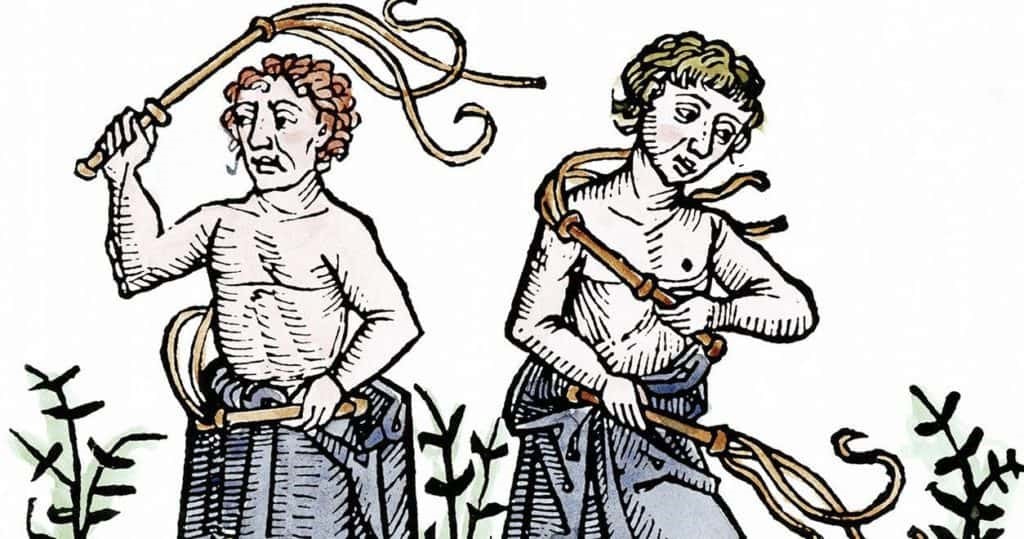
Most interesting among the self-sacrificial acts of the past are, in my opinion, that of the flagellants of the Black Death, derisively and scathingly labelled “the gashers” by the Jewish historian Ben-Zion Dinur. The masochistic flagellants, officially known as “Brethren of the Cross,” or “Brotherhood of the Flagellants,” were radical lay Catholics of both sexes (segregated in processions) who first made a major impact in thirteenth-century Germany during the Black Death. Travelling from town to town, they would hold prayers meetings and processions that would culminate in a massive spectacle where they would whip their flesh until the blood flowed, seeking, through this form of self-sacrifice, to avert a broader national calamity.

Although initially supported by the Church, it soon became clear the flagellants were anti-establishment dissidents in every respect. They rejected the authority of priests and clerics, who were regarded by the flagellants as sunk in sin and therefore intrinsic to the problem. The flagellants rejected the Eucharist, asserting that their blood sacrifice was a more authentic communion with Christ. Finally, they revealed their role as populist social revolutionaries by turning against all established elites, including the very wealthy, the nobility, the city leaders and, most interesting of all, the Jews. In fact, everywhere the flagellants went a violent reaction against the Jews followed. In Frankfurt, in July 1349, the flagellants stormed the Jewish neighborhood themselves, and set it on fire. Occasionally, such as in Mainz, when the Jews heard the flagellants were nearing a town or city, the Jews would launch a pre-emptive assault on Christians, with one chronicler reporting the Jews of Mainz slaughtered 200 Christians before the flagellants finally entered and eliminated the Jewish population. Unsurprisingly, the flagellants were quickly denounced as heretics by the existing elite power structure, and were ruthlessly suppressed to extinction throughout Europe.

In stark contrast to the role of the Brethren of the Cross, our latter-day White flagellants are truly birds of a feather with the elite status quo. Those lauding Blacks and subjecting themselves to humiliating acts of politically correct piety have accepted a form of White self-mortification that is entirely beneficial to our elites, and is without any truly redemptive or socially revolutionary features. The flagellants of the past may have acted in an irrational response to disease, but they transmuted this response into concrete social activism that benefited the broader ethnic group — by attempting to topple or undermine harmful and exploitative relationships at the top of society. Latter-day flagellants feign personal mortification, when in reality they cover themselves in temporary social kudos and self-congratulation. Individually, they harm not a hair on their own heads and spill not a drop of blood, but rather seek to ingratiate themselves into a system of social rewards and even financial benefits. And all the while, the personal fakery of these latter-day flagellants rips bloody shreds from the back of the group as a whole, demoralizing the kin group and energizing its enemies. The latter-day flagellants adopt the pose of self-sacrifice and abasement, throwing their racial kin under the proverbial bus in order to exalt themselves, and themselves alone. They avoid any suggestion of personal sin by professing their “anti-racism,” while flinging judgment and condemnation at those who refuse to bend the knee. The reality is that the latter-day flagellants need these refusers in order to look like “exceptions” in the first place.

The question of what to do about behavior like this has deeply troubled me for more than a decade. Thanks to the work of Kevin MacDonald, we certainly know more about its mechanics and origins than at any time previously. It’s now clear that this isn’t a new problem, even if it appears to be getting worse every year. In my own study of “White Pathology and the 1861 Morant Bay rebellion” for the 2013 special edition of The Occidental Quarterly, I was surprised and horrified at sheer callousness that some Whites could show towards their co-ethnics. The Morant Bay rebellion was a horrifically violent episode, with gruesome, extremely painful murders motivated by hatred of Whites. The town of Bowden was plundered, and the island curate “had his tongue cut out while he was still alive, an attempt is said to have been made to skin him.” Another individual “was ripped open and had his entrails taken out.” Others were “roasted alive” and “had their eyeballs scooped out.” According to The Times of London, the mob then indulged in alcoholic excess, harboring the “drunken dream of negro mastery and white slavery. It was Africa, hitherto dormant, that had broken out in their natures. … They desired the extermination of their emancipators.” In my study of the episode and the reactions it provoked in England, I commented:

To the clear-thinking individual, it was a plainly criminal, and unimaginably brutal series of actions, carried out for malicious reasons against a population targeted for being White. And yet, there was a liberal faction in England convinced not only that it was the Black population that were the true victims, but also that their fellow Whites were reprehensible monsters who deserved the fate which befell them. This pathological response, laden with a misplaced hyper-emotionality, would shake the Empire to its core, sapping its confidence, and bequeathing a legacy which is still felt to this day.

The main warriors on behalf of the Blacks were Christian philanthropists who believed that these races could be raised to standards of education and conduct which would place them alongside Europeans. Members of this group tended to be Non-Conformist, middle-class, and liberal or radical in their politics. Crucially, most had never travelled outside Britain, and had little or no experience with the races they so emphatically and persistently eulogized. The movement was centered around Exeter Hall, a residence in London. The term “Exeter Hall” thus became synonymous with what the brilliant Charles Dickens described as “platform sympathy for the Black and . . . platform indifference to our own countrymen.” Dickens wrote:

The Jamaica insurrection is another hopeful piece of business. That platform sympathy with the Black—or the Native, or the Devil—afar off, and that platform indifference to our own countrymen at enormous odds in the midst of bloodshed and savagery makes me stark wild.

It makes me stark wild too. Isn’t it absolutely terrifying that Dickens’s words on the indifference of these universalist elites to the plight of the working classes of their own people are entirely in keeping with what we see today? These people have the appearance of empathy, but not for anyone that looks like himself. Exeter Hall was largely responsible for the production and dissemination of a range of anti-slavery and pro-Black propaganda which, with its heady emotional characteristics, thrived on those under the influence of the Romantic movement. It was of course highly idealistic:

There was also significant involvement in the movement from the Protestant churches. It was the religious arm of Exeter Hall which was responsible for sending mission upon mission to the colonies with the aim of not only saving souls but of “regenerating whole races,” and it was this religious arm, in conjunction with the mainstream propaganda effort, which popularized the idea of the “noble savage” among the congregations of Britain’s churches.

The idea that Whites, particularly Anglo-Saxons, had a divinely ordained mission to raise up the backward peoples of the earth was driven by Exeter Hall’s most basic article of faith—that all peoples could be raised to the same high level of civilization as themselves. Liberals always have a very strong self-concept as morally superior. Moral posturing is, of course, now front and center in the contemporary West. I concluded my piece on Morant Bay by calling attention to an author who watched Steven Spielberg’s Amistad, recalling Whites “squirming in their seats,” and that afterwards a White couple emerged from the theatre “clinging to each other in a desperate attempt to manage the tragedy that had unfolded before them in graphic and picturesque fashion.” The connection is clear:

What we are thus seeing, in this and myriad other instances, is the emotional abuse and torture of a generation of Whites too ill-informed to generate appropriate intellectual or emotional responses to the fictions they are presented with. The dreamscape of Exeter Hall, in which traitors and murderers become national heroes, is entrenched. It has been absorbed, integrated, and assimilated into the White consciousness, and we, the ideological and psychological descendants of Dickens, are relegated to a much-maligned periphery for daring to suggest that the emperor has no clothes.

Placing the blame for pathological levels of self-abasement solely at the feet of Christianity, however, as some in our circles have done, strikes me as all too easy. Jordan Peterson, simultaneously capable of intellectual sublimities and travesties, is absolutely correct in his observation in 12 Rules for Life:

It is true that the idea of virtuous self-sacrifice is deeply embedded in Western culture (at least insofar as the West has been influenced by Christianity, which is based on the imitation of someone who performed the ultimate act of self-sacrifice). Any claim that the Golden Rule does not mean “sacrifice yourself for others” might therefore appear dubious. But Christ’s archetypal death exists as an example of how to accept finitude, betrayal and tyranny heroically — how to walk with God despite the tragedy of self-conscious knowledge — and not as a directive to victimise ourselves in the service of others. To sacrifice ourselves to God (to the highest good, if you like) does not mean to suffer silently and willingly when some person or organisation demands more from us, consistently, than is offered in return. That means we are supporting tyranny, and allowing ourselves to be treated like slaves. It is not virtuous to be victimised by a bully.

There’s no question, however, that many Christian churches have completely folded into patterns of victimizing themselves, or at least engaging in high-kudos superficial acts of self-abasement, in the service of Blacks and the broader culture of critique. There’s also no question that they view such behavior as highly virtuous. In this regard, I found Cardinal Carlo Vigano’s recent letter to Donald Trump on current events to be extremely timely. It’s obvious from the letter, and from his history of activism against Pope Francis, abortion, and the homosexual network at the Vatican, that Vigano is “to the Right” of Trump in every way, but it’s interesting that he attempts to communicate with Trump in Trump’s own language — employing terms such as “Deep State” to try to communicate something far more profound. Most interesting is Vigano’s denunciation of “adversaries, who often hold strategic positions in in government, in politics, in the economy, and in the media.” These adversaries “serve themselves, do not hold any moral principles, want to demolish the family and the nation, exploit workers to make themselves unduly wealthy, foment internal divisions and wars, and accumulate power and money.” He explains that those who help these adversaries are acting out of “self-interest or fearfulness.” This certainly describes the latter-day flagellants, as does Vigano’s condemnation of those within the Church who are “mercenary infidels who seek to scatter the flock and hand the sheep over to be devoured by ravenous wolves … Just as there is a deep state, there is also a deep church that betrays its duties and forswears its proper commitments before God.” For Vigano, who has previously indicated that the Catholic Church had been infiltrated by a combination of Jews, organized homosexuals, and Freemasons, there is a:

media narrative which seeks not to fight racism and bring social order, but to aggravate dispositions; not to bring justice, but to legitimize violence and crime; not to serve the truth, but to favor one political faction. And it is disconcerting that there are Bishops – such as those whom I recently denounced – who, by their words, prove that they are aligned on the opposing side. They are subservient to the deep state, to globalism, to aligned thought, to the New World Order which they invoke ever more frequently in the name of a universal brotherhood which has nothing Christian about it.

I’m not from a Catholic background, and I’ve been very critical of elements and expressions of Christianity in the past, but even I have to concede, that, objectively speaking, Vigano is on to something. One of the most Christian people I know is absolutely disgusted with White behavior for Black Lives Matter, while the most anti-Christian person I know (a friend of a friend) is also the most virtue-signalling, pro-homosexual, pro-miscegenation cretin I’ve ever encountered. There are no simple answers here, and if one is to denounce the Church as the root and cause of some of our major problems, one might as well denounce everything else in Western modernity that’s been co-opted by our adversaries. It should be clear that there wouldn’t be much left that we couldn’t denounce.

The question of why Whites are allowing themselves to be subjected to this kind of treatment on a mass scale, and in some cases encouraging it, rather requires a clear and unflinching view of the mass perception of White identity politics today. Quite frankly, we have been designated the ultimate evil, and no punishment or humiliation will be enough to satisfy our enemies.

The Politics of Evil

One of the most fascinating series of books I’ve read is Jeffrey Burton Russell’s Cornell-published quadrilogy on the concept of evil in Western culture [Satan: The Early Christian Tradition (1981), Lucifer: The Devil in the Middle Ages (1984), Mephistopheles: The Devil in the Modern World (1986), and The Prince of Darkness: Radical Evil and the Power of Good in History (1988)]. These works aren’t just an outstanding exercise in historical and religious scholarship, but also in their analysis of the development of the concept of evil as a political idea. For Russell, who develops the theme to an unmatched degree, there is great power in being able to label one’s opponent and their ideas as evil. To be labelled as being in league with the Devil—or the modern equivalent—is tantamount to political (and in extreme cases, physical) death. If you doubt such an interpretation, just read Dante’s Inferno, which is as much a summary of medieval Florentine politics and a list of Dante’s personal enemies, as it is a piece of religious poetry.

There really is no question about the fact that White identity politics is post-modernity’s only radical political evil, and Adolf Hitler is its Great Satan, looming over a horde of contemporary minor demons. Like Dante’s Inferno, and his various levels of Hell, our contemporary politics is judged morally on the proximity of one’s ideology to that held by the Great Satan in the lowest Hell. Tucker Carlson may be deemed to toil, for example, in the second or third circle, but you readers, with your race pride and anti-Semitism, well, you are beyond all hope in the ninth circle. Our post-religious culture even has a physical substitute for Hell, in the form of a long-abandoned camp in rural Poland.

In the West, what else comes close to this politico-moral taxonomy that borders on the religious in its dogmatic excess? Nothing. Even Islamic terrorism, one of the few aspects of modern life that isn’t readily assimilable by global capitalism, is always qualified in most media and academic treatments as implying some mediating factors, such as Western imperialism, the alienation of Muslim minorities, or any of a wide range of social and environmental causes that are ultimately the fault of Europeans. For those in charge of the national conversation, Islamic terrorism is something explainable and therefore, in the final examination, non-diabolical. By contrast, arguments for internet censorship targeting White identity websites have been advanced by associating White ethnic activism with conduct that is as low and demonic as pedophilia and the very worst of obscene material, which is probably the only other element of our rotten contemporary culture that continues  (for now) to be viewed as an example of radical evil. Of all political stances, only the assertion of White ethnic interests is deemed by our mainstream as equally irrational and immoral, being based on the alleged “fantasy” of race and the moral crime of wishing to “dominate” or adopt “supremacy” over other groups.

Whites can prostrate themselves in the name of “anti-racism” because by doing so they’re fighting the religious or secular contemporary incarnation of Satan. Historically, it has been extremely dangerous, and often fatal, to be seen as in league with Satan, and alternatively there have been massive incentives to joining crusades against demonic activity. One thinks of the witch craze, the purging of various heretical sects (including the flagellants), and the experiences of the early Protestants. What we are currently seeing culturally, economically, and politically, is an increasing pressure on people to demonstrate whether or not they are on the side of the Devil. Language such as “White silence is violence,” is increasingly asserting that there is no room for Whites to sit on the fence. Whites must declare whether they are good (subservient) or bad (retaining pride), and regardless of the religious beliefs of these Whites, if any, every cue in our culture is making it extremely clear which side will provide them with incentives and which side is laden with social doom. This is very similar to the process that all cultures undergo when there is a dramatic shift against a certain set of beliefs and/or populations.

The point here is that all conventional strategies designed to move White dissident thought from the fringe to the mainstream may be doomed to failure because they neglect the fact we aren’t even on the same spectrum of political possibility, or even within the same psychological framework. We are exiles, declared to be total anathema. To label something evil is to imply it is willfully engaged in the chaotic, unnatural, and sadistic. Evil implies an unregenerate irrationality as well as a complete detachment from morals. It also implies the willful infliction of suffering, and perhaps also a joy in it. Fighting from this position with appeals to things like IQ differences, crime rates, the data on police shootings of Blacks and Whites, or blandishments about the right of all peoples to self-determination, is probably entirely pointless.

Ultimately, the mainstream narrative about White identity politics is based on unreason and outright falsehood. An edifice built so obviously on an emotive disdain for facts and objective reality will be entirely unmoved by rejoinders employing them. Accusations of Leftist hypocrisy are as ubiquitous as they are ineffective, because ultimately people on the Left, or Right for that matter, don’t really care about what is correct or incorrect, or at least don’t care enough to do something meaningful about it. What they do care about is what is “evil,” and if they can look good and get rich fighting it then all the better. What is really required, therefore, is a “fight fire with fire” strategy that embodies emotionality and triggers psychological responses that resonate on a deeper level, beyond consciousness. This necessitates a propaganda designed exclusively to instill feelings of disgust, fear, and hatred for those opposed to White interests. In the final analysis, it must be hammered home that our opponents are not wrong, weak-willed, venal, or corrupt — they are morally, politically, and spiritually evil. They belong in the lowest Hell.

I understand the necessity of framing our arguments in reasonable terms. I understand the value of producing evidence, and presenting facts. But I also understand that these things have limited tactical value. The symbiotic elites of medieval Germany were safely ensconced in their centers of power until the flagellants came to town, with their emotive, violent, grisly, and gloriously fanatical denunciations of evil. Within that environment, riding on the crest of a crisis, the heretics and rebels became the arbiters of truth and the judges of society. Dispute as you will their claim to have banished the Devil, but can you deny they banished, even for a short time, at least some social evils?

Looked at from an angle not dripping with footnotes and statistics, isn’t it clear that our opponents are, in some sense, crawling with “demons”? Aren’t they riddled with the most malevolent of intentions? Don’t they bleat endlessly about eugenic policies of yesteryear while paving the way for “after-birth abortion.” They’re not wrong, my friends, they’re evil.

Our moral superiors: Dressed in White and dripping with blood

Don’t they chastise us for a distant past no-one alive had any role in, while supporting a nation where it’s spectator entertainment to watch bomb blasts tear apart a people who don’t have the luxury of superpower sponsorship, and barely have the infrastructure to survive? They’re not misguided, they’re evil.

Israeli Spectator Sport: Watching the Slaughter in Gaza, 2014

Contemporary politics and “social progress” is awash with evils. The “universal brotherhood” Cardinal Vigano warns us about is typified by blindness to mass rape, the abuse of children, murder on a vomit-inducing scale, corruption, avarice, and the cowardly evasion of responsibility everywhere. The society we live in is sunk in filth so deep that coronavirus isn’t even a fraction of the plague it deserves.

I’ll conclude these reflections with a final comment from the medieval period. In one of the most remarkable texts of the Middle Ages, Pugio Fidei or The Dagger of Faith, the cleric Raymond Martini (1220–1285) began to turn the tide against Jewish financial and political influence in Europe. Employing a team of scholars, including former Jews, he launched an intensive investigation of the Talmud and Midrash, including how they were actually interpreted by contemporary Jews. Unlike earlier anti-Jewish figures like Agobard of Lyon, Martini didn’t waste time with complaints about Jewish slave-trading of Christians or trying to convince elites to “do the right thing.” His argument was simple and devastating: all that Jews presented as positive was negative, all that they presented as Divine was Satanic. Jewish “Light unto the Nations” was “Darkness unto the Nations.” Jewish “truth” was lies. Jewish “freedom” was slavery. Jewish “justice” was injustice. As historian Robert Bonfil comments, “Martini’s book was influential through the end of the Middle Ages and even into the Renaissance.”[1] This period witnessed more expulsions of the Jews than any other in history. They say the greatest trick the Devil ever pulled was convincing people he didn’t exist. Martini would disagree, and insist that by far his cleverest ruse was to pretend he was an angel, while pointing an accusing finger at you.


[1] R. Bonfil, ‘The Devil and the Jews in the Christian Consciousness of the Middle Ages,’ in S. Almog (ed) Antisemitism Through the Ages (New York: Hebrew University of Jerusalem, 1988), 97.

A Thousand Points of White: One Strategy for Achieving White Nationalism

This essay is intended as a response and follow-up to the excellent recent article by Giles Corey, “American Roulette.”  Corey’s piece is passionate, clear, and well-written.  He makes a powerful and inspirational case, in a short space.  My intent here is to build on his ideas and add some needed details.  The chaos of the past few months has given us new opportunities to move forward.  In the spirit of Corey’s piece, I will be concise and blunt; the time for niceties is fast coming to an end.

Herewith is a brief outline of an argument and a strategy for establishing a functional form of White Nationalism.  For sake of clarity, I will express it in a series of numbered paragraphs.  Let’s start with the big picture:

  • The United States is irredeemably corrupt. It cannot be salvaged and it cannot be saved.  The entire political and economic infrastructure is lost.  We have neither a democracy nor an oligarchy, but rather a Judeocracy: rule by Jewish power and Jewish money.  Jews are assisted at all levels by Whites (and others) who act as their willing front-men, and who thus disguise the deeper workings of the system.  Republicans, Democrats, Greens, Libertarians—they’re all the same.  No party has the guts to confront the Jewish power structure.  The media, of course, is also hopelessly corrupted by Jewish influence; witness the battle between CNN, MSNBC, and even Fox News, to see who can display greater fealty to Jewish interests.[1]  Thus we can expect nothing but biased and malicious reporting from any of them.  The American system cannot be reformed; we should not even try.[2]
  • American corruption can work to our advantage. As the US continues on its path of decay and decline, more and more opportunities will emerge for White nationalists.  The American Judeocracy will inevitably destroy itself; it’s only a question of time.  Jewish misanthropy and kleptomania will consume itself and the whole federal infrastructure in the process.  However, the American system will likely not collapse in a sudden, catastrophic paroxysm.  Rather, it will be a slow and steady loss of integrity, of stability, of coherence, and of credibility.  This is what has happened in the latter stages of most all imperial-like political entities in history.  Eventually, the political system and the ruling authorities simply lose the willpower and ability to intervene against rebels or invaders.  We are seeing precursors of this in the Seattle “autonomous zone.”  This works massively to our benefit.
  • White Nationalists should assist the process of decline. The more ethnic diversity, more economic disruption, more political division, and more crime that we experience, the faster will be the process of decline.  As bad as it looks, “Black Lives Matter” is doing us a favor.  Arsonists and looters are doing us a favor.  The moronic liberal elites who defend these low-lifes are too ignorant to realize that such actions are undermining their very system of power.  Recent events are making clear to millions of Whites that a multiracial, Jewish-run America will be a catastrophe in the future.  And they can’t be too happy about it.

So, let’s help the process along:  More Latino and Asian immigration!  More Blacks in corporate America!  More Jews in Washington!  More aid for Israel!  More affirmative action!  More leftist street marches!  Defund the police!  More looting!  More arson!  We can use the liberal Zeitgeist against itself—use its own logic to drive it into the ground.

  • Washington is rapidly losing the moral and political basis for effective action. Trump’s various stupid proclamations and (in)actions and the paralysis in Congress are all good signs.  We are seeing federal dysfunction at all levels: in the response to the coronavirus, in various military conflicts around the globe, and in international relations.  The US is being pushed around by hostile nations, and our allies—even the Jewish-dominated ones in Europe—are increasingly ignoring us.  Again, this is all good news.
  • Whites deserve, and have the right, to self-rule. There is no good reason why Whites anywhere should submit to rule by Jews, Blacks, Hispanics, Asians, or any combination of these.  This is not because such people are “inferior”; rather, every race and every ethnicity has its own values and its own culture, rooted in genetics, and these should not be imposed on unwilling Whites.  Whites have the right to be proud of their values and their cultural achievements, which comprise the highest and greatest achievements in human history.  Let the other races build their own nations and their own cultures, in their own lands.[3]  And let them live with the consequences.
  • White self-governance cannot be achieved at a national level in the US—not for a century, at least. We need to give up on Washington.  The federal system needs to end, and governance rebuilt at the local level.  A nation of 330 million is ungovernable, even of a single ethnicity; a multiracial nation of this size is utterly unsustainable.  Perhaps someday, many decades down the road, a kind of White American coalition or confederation will be possible; but not in our lifetimes.  Again, this is not bad news.
  • Start local, start small. Given that there will not be a federal White nationalist movement or party, we need to look for local or state-level groups advocating White self-rule—or at first, White identity and White self-interest.  Here’s one suggestion:  Start a local “White Lives Matter” group.  What’s good for the goose…  This process can be very small and very simple.  One person can reserve a room in a library, school, or church basement.  One person can reach out to friends, spread the word on social media, or print up flyers to post around town.  Pick a day and time, book a room, advertise—and see who comes.  Even a small turnout is a start.  We ought not forget that, in Germany many years ago, National Socialism began with weekly meetings of just seven or so men (“the same old seven,” lamented Hitler)[4].  If you get seven at first, consider it a victory.
  • “It’s just a club.” At first, any such “WLM” group will likely be a mere discussion group:  politics, news, local developments.  Think of it as a social club:  like-minded Whites getting together, on a regular basis, to discuss issues of common interest.  This alone, as innocuous as it might seem, is a radical step in today’s climate.  The sheer existence of a WLM group will likely draw negative attention; be prepared, stay cool, stay calm, stay rational.  You have a right to your own self-interest.  Use negative publicity to your advantage.  Remember: Anyone who accepts BLM but rejects WLM is an evil “racist.”
  • Become politically active. As the group grows, establish some structure:  take attendance, collect modest annual dues, have officers.  Watch out for spies and moles; they are inevitable, but can be managed.  Once the group is stable, then you are in a position to engage in local politics.  Write op-eds or post things on a local blog.  Make yourselves known; be open, be public.
  • Have definable and clear local objectives, moving toward a White society. It doesn’t matter if you live in a city, suburb, or rural area:  establish a group, meet regularly, and get engaged.  If your area is already mostly or all White, there should be little resistance.  If it is majority-minority, consider moving.  If your area, like mine, is a mostly-White suburb but with encroaching non-whites, put up resistance.  The larger objective is for White self-determination and self-rule, and this starts by making non-whites realize that they are no longer welcome here.  Pick a local geographic region—neighborhood, city, or county—and declare it White.  Don’t hold a vote, don’t look for a majority—just declare it.  This is essentially what a bunch of Seattle hooligans and degenerates recently did; again, that blade cuts both ways.  How outrageous!—a dozen (say) local folks declare their neighborhood or city to be White!  And then they have the nerve to say, publicly, that non-whites are not welcome, and should leave!  Revolutionary!  But that’s what it takes.  No ugliness, no violence, no cross-burnings.  Just a polite and civil statement:  This is now a White area, and non-whites are no longer welcome. Orania in America.
  • Develop a local identity. This will likely mean creating your own distinctive logo or slogan.  Put them on stickers, letterhead, flyers, T-shirts, flags, yard signs.  Spread them around.  You want to see these things on cars, houses, neighborhood kiosks, etc.  Even people who won’t attend a meeting might be sympathetic and put a sign in their window.  Public visibility has a tremendous effect.

Let’s pause here a moment.  By the above simple and elementary acts, Whites everywhere can take concrete steps to reassert their right to self-governance.  Groups need not adhere to any specific ideology, nor align with any particular White movement.  To be counted under the broad heading of “White nationalist,” groups need only endorse something like the follow general precepts:

  • The White race is of inherent value to humanity, and as such deserves protection and defense.
  • Whites have an intrinsic right to self-rule and self-governance.
  • Whites everywhere are under threat due to (a) declining numbers, (b) declining physical, mental, and moral health, and (c) loss of political autonomy and self-government. These threats are various and complex, and require action on several fronts to address.
  • The chief threat to White well-being comes from the global Jewish lobby, which has an inherent interest in seeing a general decline in White prosperity and a loss in White political power. Jews must therefore be confronted and challenged at all levels of society.
  • All humans are, by nature, best suited to live in social and environmental settings from which they evolved—societies that are broadly uni-racial and monocultural. Humans have little or no evolutionary experience living with diverse races or ethnicities, and doing so causes inevitable problems.  Therefore, racial and cultural diversity have profound negative effects on society.
  • The only long-term solution for many present-day problems is to restore human society to its natural and original conditions—uni-racial and monocultural, broadly speaking. This entails political separation and/or expatriation of minority peoples.
  • As a rough provisional goal, White regions of self-governance ought to aim for a minimum of 95% White populations, with all non-White minorities numbering, collectively, less than 5%. Jewish numbers ought to be severely limited, amounting to not more than 0.5% under any circumstances.
  • Only Whites will be fully enfranchised—that is, possess the right to vote, and to hold public office. All others will have minimal civil rights, perhaps on par with a foreign tourist today—basic legal protections, but little more.

Most any sane White person who wishes to live in a stable, secure, and prosperous community ought to accept these points.  Those who do not are likely either (a) paid to oppose them, or (b) brainwashed by our present Judeo-centric culture and academia.  The brainwashed can be educated, but the sell-outs, especially the White ones, are utterly contemptible; they deserve the harshest punishment we can muster.

Additionally, we need not worry excessively about who “counts” as White.  In the vast majority of cases, it is obvious:  those whose ancestry derives from indigenous European peoples and nations.  There are ambiguous cases, such as Ukraine, Belarus, and Russia, that deserve more discussion.  More important, though, is who is not White:  Jews are not White, despite their own frequent proclamations to the contrary.  Arabs or other Middle Easterners are not White.  Hispanics and Latinos are not White.  ‘White’ is not simply a matter of skin color; it is also a question of heritage, of worldview, of culture, and of values.  Don’t be fooled by light skin or blond hair.[5]

This said, we can console ourselves in the fact that America is still a predominantly White nation, and will be so for many years to come.  White Americans currently number about 195 million, in a nation of nearly 330 million.  And even though our numbers are projected to decline slightly in the coming decades, we will still long be the numerically-dominant ethnicity.  Hispanics here could top 100 million by 2050, but that is roughly half of White numbers; Blacks will not number more than 55 million or so, and Asians not more than 45 million.  And we mustn’t forget that American Jews number only some 6 million.  One of our strengths is our numbers, and we must always bear this in mind.  Jews and other non-Whites certainly know it, and they fear it.  Large numbers of active Whites spell doom for them.

Still, based on combined effects, America will be a ‘majority-minority’ nation at least by 2045, and coalitions of non-Whites, led by Jews, could soon exercise even more power than they do at present.  And the trends for the end of this century are even more dire.  This is unacceptable, hence the urgent need for White action on many fronts.

Let’s conclude with a few final points, in our drive for White nationalism.

  • Gradually assume more power, quietly and nonviolently. As local White or WLM movements grow, and as intimidated non-Whites move out, White groups will be able to assume a greater civic role, just by default.  Volunteer groups can provide social services, self-police, and participate in local schools.  White nationalists will then naturally come to gain power in local politics, exercising yet more autonomy.  All the while, the autonomous zones should continue to grow, by declaration.
  • The biggest threat will come from local and state police, and potentially state National Guards. Small, decentralized White autonomous zones generally need not fear the feds.  Yes, we all remember Waco and Ruby Ridge, but those were anomalies of the past.  With a degraded federal justice system, and with (hopefully) dozens of White zones popping up around the country, the feds will be in no position to confront them.  The larger threat, I think, is from local and state authorities.  Fortunately, these groups are now being alienated on a large scale.  As current policemen resign in disgust, less and less qualified people will take their places, resulting in growing inefficiency and incompetence.  Eventually they will be unable to, or chose not to, take action against peaceful civilian groups who only seek self-governance.  Remember, the goal here, at least initially, is to create White autonomous zones which are self-governing and relatively independent from state or federal authorities.  The central tactic is to ‘walk away slowly,’ rather like you might do when confronted by a maniac with a large knife.  Don’t antagonize, don’t threaten—just walk away.
  • Undermine Jewish financial power. Jewish power derives almost exclusively from their vast wealth; 6 million American Jews control some $50 trillion in assets.[6]  But this is denominated in corrupt, inflated, debt-ridden, and intrinsically valueless US dollars.  Therefore, we need to declare the US dollar worthless, and move our financial assets into new, local currencies—perhaps something we might whimsically call ‘Aryan Bucks.’  AB’s could, by law, be held and spent only by Whites.  They would be declared worthless and illegal in the hands of Jews or other non-Whites.  At first, both currencies would have to circulate in parallel, but as quickly as possible, Whites would want to migrate to their own financial system.  The political and economic benefits from this step alone would be enormous.[7]
  • Accelerate growth of autonomous zones. As White zones grow, and as disaffected Whites move into the newly-declared regions, the remaining areas will grow darker in complexion.  This will only accelerate the decline of multiracial America.  Ideally, a positive feedback situation will emerge in which Whites rapidly move into local safe-zones as the other regions collapse.  This makes expansion all the easier.

Numerous local White zones, incidentally—meaning, several in each state or large city—make for a much more practical strategy than, say, picking a few large rural areas.  There aren’t many White Montanans or Californians ready to move to rural Arkansas, but they might be willing to move an hour or two away to a local zone in a familiar area.

  • Be prepared to fight, as a last resort. If we are smart, we can achieve nearly everything we want non-violently.  But sadly, that may not always be the case.  Therefore, as Corey states, we will need to be armed.  At present, something like 35 million White households own at least one gun; presumably, most by the man in the family.  So let’s say we have 35 million armed White males in this country—an awesome force, indeed.  If there is one thing Jews and Blacks fear more than White men, it’s White men with guns.  I wouldn’t hesitate to state that armed White American civilians constitute the most formidable fighting power on Earth.  No one—not even the Jewish-run American military—could defeat them.  If the US military can’t subdue a few thousand low-IQ Muslims in Iraq and Afghanistan, they haven’t a prayer against millions of pissed-off Whites.  This is our ace-up-the-sleeve.  But we need to use it judiciously.

Ideally, White autonomous zones would pop up like mushrooms around the country:  a few in each major city, several in the rural areas of each state.  Under good circumstances, they might grow and join together, combining their collective power.  These “thousand points of White,” as I like to think of them, would pose an insurmountable problem for federal and local authorities, especially if they were peaceful, and especially at the early “club” phase.  Being decentralized, there is no single pressure point for the feds to squeeze; they would have to address multiple, simultaneous local issues at once.  And if there were still on-going riots, or economic chaos, or some new pandemic, …well, the authorities will quickly reach the end of their rope.  And then we win.

Thomas Dalton, PhD, has authored or edited several books, including a new translation series of Mein Kampf, and the book Debating the Holocaust (4th ed, 2020).  For all his works, see his personal website www.thomasdaltonphd.com


[1] Sean Hannity of Fox is particularly pathetic in this regard.  His repeated and unconditional defense of Israeli and Jewish interests is utterly appalling.

[2] Throughout the South, they have signs saying “Pray for America.”  What they should say is “Pray for America’s destruction—and soon.”

[3] Just recently, CNN reported on the nation of Ghana, which is inviting Black Americans to “come home” and resettle there.  An excellent plan, for all concerned!

[4] Mein Kampf, volume one, section 12.11.

[5] Mixed-race individuals are also problematic, but again, they are a small minority.  Roughly speaking, we can say that anyone with three-quarters or more of White heritage counts as White, presuming that they do not adhere to non-White values or culture.

[6] See my article here.

[7] The idea of local currency is well-established in the US.  Wikipedia lists over 100 active local currencies.

The Tale of Bob Mathews

In 1983, The National Alliance—a white activist organization founded and headed by William Pierce—held its annual convention in Washington, D.C.  A young mine worker from the Pacific Northwest by the name of Bob Mathews was scheduled to give a talk at the convention.  Mathews had been an Alliance member for three years and actively recruiting new members for the organization among the farmers and ranchers and working people around where he lived in Washington State.  Dr. Pierce asked Bob to tell the people at the convention how his efforts were going, and about the situation generally in his part of the country.  Bob wrote out his speech on his dining table at home and flew out to D.C. for the conference.1


The Bob Mathews those in attendance saw at the podium was a boyish-looking man thirty years of age.  He was about 5’7” and had a trim muscular build.  He was good-looking with even facial features.  His dark brown hair was short and parted to the side and fell forward onto his forehead.  Those who knew Bob said he had hazel eyes that shone with intensity and purpose.  They saw him as a serious and forceful person.  Even those who disliked his politics liked Bob the man.   In pictures I have seen of him, he reminds me of an army enlisted man home on leave, or the young working-class fathers I see walking past the stores in shopping malls with their wives, their young children in strollers.

An audio tape exists of Bob’s talk. His voice is youthful. There is a tension and fervor in his delivery that gives a sense of immediacy and electricity to the occasion.  Bob talked about ten minutes, not long.  An excerpt from what he had to say that day in the late summer of 1983 gives a sense of his message:

My brothers and sisters, from the mist-shrouded forested valleys and mountains of the Pacific Northwest I bring you a message of solidarity, a call to action, and a demand for adherence to duty as members of a vanguard of an Aryan resurgence and, ultimately, total Aryan victory.  The signs of awakening are sprouting up across the Northwest, and no more than among the two-fisted farmers and ranchers.   The task is not going to be easy.  TV satellite dishes are springing up like poisonous mushrooms across the domain of the tillers of the soil.  The electronic Jew is slithering into the living rooms of even the most remote farms and ranches.  The race-destroying dogs are everywhere.  In Metaline Falls [the town where he lives], we have broken the chains of Jewish thought.  We know not the meaning of the word “mine.”  It is “ours”: our race, the totality of our people.  Ten hearts, one beat!  One hundred hearts, one beat!  Ten thousand hearts, one beat!  We were born to fight and die and to continue the flow of our people.  The future is now!  Stand up like men and drive the enemy to the sea!  Stand up like men and swear a sacred oath upon the green graves of our sires that you will reclaim what our forefathers discovered, explored, conquered, settled, built, and died for!  Stand up like men and reclaim our soil!  Look toward the stars and proclaim our destiny!  In Metaline Falls we have a saying: Defeat, never!  Victory, forever!

Bob’s talk received a standing ovation.  He would be dead in a little over a year.

*  *  *

Robert Jay Mathews was born in Marfa, Texas in 1953 and grew up in Arizona around Phoenix.  From the time he was a teenager, Bob had a fierce racial pride in being a Caucasian.  It wasn’t primarily a matter of prejudice against minorities—harboring antagonistic feelings toward them, resenting them—as is usually attributed to whites who hold strong racial views.  Bob wasn’t so much against anything as he was for something: white people.  He held the conviction that it was white men who had created the greatness that is Western Civilization.  He was convinced that America was in a decline and that whites were being brought down to far less than they once were, and that they had to do something about it.

When still a teenager, Bob joined the ultra-conservative John Birch Society, and he tried to start a survivalist-type group called the Sons of Liberty, but that didn’t get very far.  He also got involved with a tax-protest movement in Arizona.  He wound up getting arrested and put on probation for not paying his taxes.

After high school, Bob didn’t go on to college, much to the disappointment of his parents.  He told them that he didn’t want to go through all the liberal propaganda they shove down your throat in college, and anyway, he wanted to get on with his life.  He wanted to get out of Phoenix, that was for sure.  There were too many laws, too many urban problems, too many minorities, and just too many people in general.

Bob got out a map of North America and started running his finger over it.  His finger came to rest on an isolated village in Washington State, Metaline Falls, the last town before the Canadian border.  Bob loaded up his pickup and drove to Metaline Falls to begin a new life.  Right away, he found a laboring job in a lead and zinc mine.  It wasn’t long before he could afford to buy fifty acres of land and put a mobile home on it.

A writer describes the place Bob went to:

Minorities were virtually absent from the Metaline Falls area, and a white man living there could imagine that he was existing in a country that wasn’t ethnically diverse or full of crowded, complicated cities.  A man could dream of starting over here, of rebuilding his life from scratch.  Mathews loved the landscape the town was set in.  Canada’s Selkirk Mountains rose in the distance.  At dawn, deer walked across the main street of Metaline Falls.  Heavy snow only made the hills and evergreens more beautiful.  God’s country.  It was the kind of climate one would find in northern Europe, where the Aryan people had flourished before their heirs came to America.  In centuries past, those ethnic groups had given rise to Norse and Viking sagas, grand tales of the courage and strength of northern warriors in battle.   They had no fear of death: if they perished heroically, the Valkyries (the handmaidens of Odin, the Supreme Being of Norse mythology) would whisk their souls away to Valhalla, where they’d be enshrined in the great hall of immortality.  A modern-day religion, Odinism, has sprung from these sagas.  Bob Mathews was familiar with it and liked it.  He regarded it the same way he regarded the Northwestern Passage—both could inspire a man to become a hero.2

Bob wanted to start a family, and he met his wife in an unconventional way, through an ad in the nationally circulated Mother Earth News.  His ad read, “Looking for a mature, intelligent woman, 18-25, to share my life and land in Washington.”  One-hundred-thirty women replied.   The letter that most caught Bob’s attention was from a Kansan who had moved to Wyoming after college by the name of Debbie McGarrity.  Debbie wrote Bob that she thought the most important job a woman could do was to raise children.  “You can’t have a good society unless the home is a decent place,” Debbie wrote.  Bob drove to Wyoming to meet Debbie.  She moved to Metaline Falls and they were married in 1976.  Debbie and Bob didn’t have children of their own, but they adopted a son.

Bob had really taken to Dr. Pierce’s book The Turner Diaries.3  He pored over every word in the book and gave it to his friends along with his highest recommendation.  But the thing about Bob was that he wasn’t content to just read the book and agree with what it said.  Bob was a man of action.  He had a fire burning inside him.   He was going to create an Order of his own like the one in the book, and start a revolution like the one he had read about.  Bob meant business.

Right after Bob returned home from his speech at the National Alliance convention, he gathered together eight men in a barracks-like structure he had erected near his mobile home.  “I’ve asked you to come here because I think we share a common goal.”  Earlier, he had talked to them about forming an Order like the one in The Turner Diaries, a group of racial kinsman who would let their deeds do their talking for them.  The goal Bob had in mind was to carve out a part of eastern Washington as a homeland for the white race, purged of Jews and minorities.  They would use The Turner Diaries as a blueprint for getting that done.  “I’m telling you now,” Bob said, “if any of you don’t want to get involved in this, you are free to leave.”

No one left.

“I’m going to ask each of you to take an oath that you will remain true to this cause.  I would like to remind all of you what is at stake here.   It is our children and their economic and racial survival.  Because of that, I would like to place a white child before us as we take this oath.”  A six-week-old daughter of one of the men was placed in the center of the circle as a symbol of a Caucasian future they were about to pledge to create.  She stared up at the figures looming above her in the glow of the candles.

The men clasped hands and recited an oath of loyalty and commitment to their race and to their cause Bob had written:

I, as an Aryan warrior, swear myself to complete secrecy to the Order and total loyalty to my comrades.

Let me bear witness to you, my brothers, that should one of you fall in battle, I will see to the welfare and well-being of your family.

Let me bear witness to you, my brothers, that should one of you be taken prisoner, I will do whatever is necessary to regain your freedom.

Let me bear witness to you, my brothers, that should an enemy agent hurt you, I will chase him to the ends of the earth and remove his head from his body.

And furthermore, let me bear witness to you, my brothers, that if I break this oath, let me be forever cursed upon the lips of our people as a coward and an oath breaker.

My brothers, let us go forth by ones and twos, by scores and by legions, and as true Aryan men with pure hearts and strong minds face the enemies of our faith and our race with courage and determination.

We hereby invoke the blood covenant and declare that we are in a full state of war and will not lay down our weapons until we have driven the enemy into the sea and reclaimed the land which was promised to our fathers of old, and which through our blood becomes the land of our children to be.

The group obtained a trail-clearing contract with the U.S. Forest Service, but that didn’t bring in enough money fast enough.  Bob and two others in the group robbed a porn shop in Spokane, Washington.  One of Bob’s partners slugged one of the clerks.  Their take was $36.

Bob went into a Seattle branch of Citibank, handed the teller a note and walked off with almost $26,000.  A snapshot exists of a smiling Bob Mathews in a long-sleeve flannel shirt holding a Halloween trick-or-treat bag containing the money.

The group captured the courier of an armored car while it was parked in front of a Fred Meyers department store and made off with $43,000.

They hit another armored car, this one parked in front of a Bon Marché food market outlet.  The take in this one was a half-million dollars.

The Order bombed an adult movie theater in downtown Seattle and a Boise, Idaho synagogue.  Neither bomb did much damage.

The group talked about people to assassinate.  Names thrown out included Henry Kissinger, David Rockefeller, and Morris Dees of the Southern Poverty Law Center.  The person they wound up taking out was a Jewish radio call-in host in Denver named Alan Berg.  The killing inspired part of the film Talk Radio.  One of the Order had lived in the Denver area and was very put off by Berg, who went off on monologues about the joys of oral sex, the flaws in Christianity, why whites were afraid of blacks, and how white women fantasize about sleeping with black men.

Bob and several others of the Order drove to Denver.  They ambushed Berg getting out of his car in front of his apartment.  One of the members of the Order, not Bob, started firing from close up.  Bullets hit Berg in the face, neck, and torso.  The garage door behind Berg splintered from the spray of bullets.  When Berg was found lying face up in a pool of blood, the cigarette he had been holding was still lit.  Autopsy reports couldn’t be sure how many shots there were because Berg was twisting at the time he was shot, although it was probably around twelve.  Two slugs struck near Berg’s left eye and exited on the right side of his neck.  Others hit the left side of Berg’s head and exited from his neck and the back of his skull.

The armored-car stick-ups continued.  The biggest one took place on the side of a highway near Ukiah, California, in the northern part of the state.  Bob and 11 others in two pickup trucks forced a Brinks truck to stop and jumped out of their trucks wearing bandannas over their faces.  One of them held up a sign that read “Get Out or Die.”  Bob jumped onto the front bumper of the truck and shouted for the two guards to get out, but they seemed frozen and didn’t move.  One of the robbers blew dime-sized holes in the windshield with an automatic weapon.  That did the trick—the guards opened the door and scrambled out.  

All this was happening with traffic going by on the highway.  People gawked as they went by, and some stopped their cars.  It must have seemed unreal to the passers-by, like a movie.  The group started a chain to unload the bags of money out of the money compartment in back of the armored truck.  They had given themselves five minutes to complete the job, and it was approaching seven minutes.   Somebody could have called the highway patrol.  A traffic jam—they hadn’t thought of that until now—could block their way out.  They had to get out of there!

Bob was inside the truck frantically scooping up money bags and passing them on.  In all the excitement, he didn’t notice that the 9mm pistol he was carrying had fallen out of his pocket.  It turned out to be a fateful error, because the gun was traced to him and the FBI knew whom it was looking for.

Finally, the men jumped in their pickups and sped away, tossing nails out of the back to slow down anyone chasing them.

The Order made a clean getaway (except for the gun left behind), and when they counted up the money they found that the take was a whopping 3.6 million dollars.  They used some of the money for salaries, and most of them quit their regular jobs.  Money went into things like mobile homes and a ski condo.  They purchased 110 acres in Idaho and 106 acres in Missouri to use as paramilitary camps.  Money went for all-terrain vehicles and guns and ammunition.  Two members of the group formed a company called Mountain Man Supply Company with the intention of using it to provide supplies to the Order.

Like the fictional Order in The Turner Diaries, Bob Mathews’ Order counterfeited money.  Along with the dropped pistol, the counterfeiting activity turned out to be Bob’s downfall.  One of the people who passed the money got caught.  In return for the FBI going easy on him, he told them when he was scheduled to meet Bob at a Sheraton Motel in Portland, Oregon.

On the day of the meeting, FBI agents and Portland city SWAT team members converged on the motel.  Bob was in room 24.  The other guests were herded into the motel’s small lounge and told to keep their heads down.  Bob went outside his room to stretch and spotted a man hiding in the bushes and realized what was up and bolted down the stairs past a female agent who fired a shot at him.  The shot missed Bob, and the slug smashed through the window of the lounge where the other guests were crouched down and ricocheted off a stone fireplace.

Bob ran two blocks down the street and got behind a concrete pillar next to an apartment complex.  Bob later reported that it was at this point he decided to stop being the hunted and become the hunter.  A couple of officers chasing him ran up to the pillar and Bob fired, wounding one of them in the shin and foot.  Bob later said that he first had aimed at the officer’s head, but when he saw that he was a white man he lowered his aim.  The other officer blasted a shotgun and the pellets smashed into Bob’s exposed gun hand and searing pain shot up his arm and blood shot from the wound.  Bob escaped, but the hand injury would throb for the remaining weeks he had left to live.

Bob made it to a house on Whidbey Island near Seattle.  There he wrote up a “declaration of war”:

It is now a dark time in the history of our race.  All about us lie the green graves of our sires, yet in a land once ours we have become a people dispossessed.

By the millions, those not of our blood violate our borders and mock our claim to sovereignty.  Yet our people only react with lethargy.

A great sickness has overcome us.  Why do our people do nothing?  What madness is this?  Has the cancer of racial masochism consumed our will to exist?

Our heroes and our culture have been insulted and degraded.  The mongrel hordes sever us from our inheritance.  Yet our people do not care.

Throughout this land our children are being coerced into accepting non-whites as their idols, their companions, and, worst of all, their mates, a course taking us straight to oblivion.  Yet our people do not see.

Not by accident but by design these terrible things have come to pass.  It is self-evident to all who have eyes to see that an evil shadow has fallen across our once fair land.  Evidence abounds that a vile, alien people have taken control of our country.  

All about us the land is dying.  Our cities swarm with dusky hordes. The water is rancid and the air is rank.  Our farms are being seized by usurious leeches and our people are being forced off the land.

They close the factories, the mills, the mines, and ship our jobs overseas.  Yet our people do not awaken.

Do you hear the approaching thunder?  It is that of the awakened Saxon.  War is upon the land.  The tyrant’s blood will flow.

From this day forward, we will no longer submit to the tyranny placed upon us by Tel Aviv and their lackeys in Washington.   Our people are being put into a lobotomized, lethargic state of blind obedience and we will not take part in collective racial suicide.

This is war!

This “declaration of war” was followed by an “open letter to Congress.”

All of you together are not solely responsible for what has happened to America, but each of you, without exception, is partly responsible.  The day will come when each of you will be called to account for that responsibility.

The day will come when your complicity in the betrayal of the 55,000 Americans who were sacrificed in Vietnam will be called to account.

The day will come when your subservience to the anti-American “Israel Lobby” will be called into account.  Your votes to strip American arsenals so that Zionists can hold on to stolen land and your acquiescence in a policy which has turned our Arab friends into enemies—those things are inexcusable.

The day will come when you will pay for betraying your race.  You may say you are against the forced racial busing of school children, that you are against the “reverse discrimination” which takes jobs away from Whites and gives them to Blacks, that you are against the flooding of America with illegal immigrants, because you know these things are unpopular.  But you brought every one of these plagues down on our heads.  You passed the “civil rights” laws which gave us busing in the first place, and then you refused repeatedly to outlaw this monstrous crime against our children.  It was your scramble for Black votes and your cowardice in the face of the controlled news media which allowed our cities to become crime-infested jungles.  You set up the requirements that employers had to meet racial quotas.  And you passed the immigration laws which started the flood of non-White immigrants into America—a flood that is out of control.

We hold you responsible for all these things: for every White child terrorized in a racially-mixed school, for every White person murdered in one of our urban jungles, for every White woman raped by one of the arrogant “equals” roaming our streets, for every White family hungry and desperate because a White worker’s job was given to a Black.  Each day the list grows longer, but the day will come when the score will be settled and you will pay every one of these debts in full.

On November 25th, 1984 Bob wrote a letter to a small weekly newspaper in Newport, Washington that included: “It is logical to assume that my days on this planet are rapidly drawing to a close.  I have no fear, for the reality of life is death.  I have made the ultimate sacrifice to secure the future for my children.”

*   *   *

On December 7th, one hundred FBI agents surrounded the Whidbey Island house.   Bob was alone inside.

They cut off his electricity.

They attempted to negotiate through a bullhorn—”Come out and we won’t harm you.”

His hand mangled and throbbing, Bob opened fire with an automatic weapon.

A standoff lasted through the night and into the next day.  The press converged on the site.

The FBI lofted in tear gas.  Bob must have had a gas mask.  He continued to fire—da-da-da-da-da-da-da-da-da-da-da-da.

“Give up or we’re coming in to get you.”

More automatic weapon fire from Bob.

At 3:00 p.m. on December 8th, a SWAT team stormed into the house. When they got inside, bullets rained down on them through the ceiling from the floor above.  The SWAT team returned fire as they retreated.

After it had gotten dark that evening, a helicopter flew over the house and dropped white phosphorous illumination flares onto the roof.  The house ignited, and flames shot one hundred feet into the air.

Bullets ripped from inside the burning house—Bob was still firing away!   The agents kept down as the slugs whistled through the night air and split the trees above them.

Then everything was still.

The next morning, in the charred ruins of the house they found a body burned beyond recognition.  Dental records determined it to be that of Bob Mathews.


Endnotes

  1. This account is taken from my book, Robert S. Griffin, The Fame of a Dead Man’s Deeds: An Up-Close Portrait of White Nationalist William Pierce (1stBooks Library, 2001).
  2. Stephen Singular, Talked to Death: The Life and Murder of Alan Berg (Beech Tree Books, 1987).
  3. Andrew Macdonald [William Pierce’s pen name], The Turner Diaries (National Vanguard Books, 1978).