Featured Articles

The Puritan Intellectual Tradition in America, Part 2: The Period of Ethnic Defense, 1890-1965

Go to Part 1.

The early part of the twentieth century was the high-water mark of Darwinism in the social sciences. It was common at that time to think that there were important differences between the races in both intelligence and moral qualities. Not only did races differ, they were in competition with each other for supremacy. For example, William Graham Sumner was a social Darwinist; he thought that social class and racial divisions as well as competition were part of the natural order of things. Writing in 1903, he noted that “the two races live more independently of each other now than they did” during the slave era.[1] Whereas later in the century, Jewish intellectuals led the battle against Darwinism in the social sciences, racialist ideas became part of the furniture of intellectual life—commonplace among intellectuals of all stripes, including a significant number of Jewish racial nationalists concerned about the racial purity and political power of the Jewish people. Many of them were Zionists who believed in the importance of Jewish racial purity (a Jewish homeland in Israel would prevent assimilation and intermarriage) and Jewish racial superiority .[2] Read more

The Puritan Intellectual Tradition in America, Part 1: Nineteenth-Century Optimism and Utopian Idealism

This is about a pernicious strand of European thinking that is an important component of the crisis we face today—the Puritan strand of American thought which dominated America until the 1960s counter-cultural revolution. The synopsis is that in the nineteenth century, Puritan-descended intellectuals engaged in utopian, idealistic fantasies, often with moralistic overtones. Then after the Civil War, this type of thinking went into disfavor, replaced by Darwinian thinking which reached its apex in the battle over immigration, ending with the passage of the 1924 law. However, this intellectual shift was eradicated by the Jewish-dominated intellectual movements I discuss in The Culture of Critique.

The culture of the West is complicated—a blend really between very different cultural influences. A basic idea is that Western societies are individualistic—far more individualistic than any other culture area of the world. But within that general framework of individualism, there are important differences.

One important strand derives from Indo-European culture: From the Pontic Steppes of the Ukraine around 4500 years ago. This culture was completely militarized; it was aristocratic and strongly hierarchical. Read more

The White Racial Movement and Gays

Back in 2008, I wrote an essay/review—I called it a review at the time, but it was as much an essay as a review—of the book Gay Artists in Modern American Culture: An Imagined Conspiracy by Michael S. Sherry (The University of North Carolina Press, 2007). The book was informative and personally helpful.  It got me clearer about myself and what I’m up to in my life.

I approached the writing from a white racial angle, so I ran it by the editor of a print journal that dealt with racial matters from a white perspective.   He gave it a cool reception.  The gist of his response was the review was too gay-friendly and wouldn’t play well with his readers.  Perhaps if I were to mute my congeniality toward homosexuals so it wouldn’t be such a turn-off . . .

No thanks.  I wasn’t up to changing the piece at all, even if doing that would have gotten it into print.  It was my truth—reality as I perceived it, in the world and inside me—and anyway, I felt done with the writing and had no more energy to give to it and wanted to move on. Read more

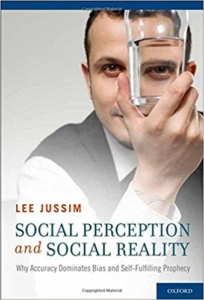
Prof. Lee Jussim’s “Social Perception and Social Reality” and the Leftist Bias of Social Psychology

It’s well known that social psychologists are overwhelmingly liberal in their politics—exactly three people in a crowd of 1000 at a psychology conference raised their hand when Jonathan Haidt asked how many identified as politically conservative. In fact, social psychology is a good example of Haidt’s concept of “tribal moral communities” that infest our political discourse on race, multiculturalism, gender, etc.  People within the (liberal) tribe believe themselves morally (and intellectually) superior to people who don’t think the way they do. And we know that liberal social psychologists are perfectly willing to discriminate on the basis of their political attitudes in hiring decisions, etc.

It is also well known that there is a replication crisis in social psychology. Prof. Lee Jussim’s Social Perception and Social Reality: Why Accuracy Dominates Bias and Self-Fulfilling Prophecy (Oxford University Press, 2014) describes several examples of non-replicable findings which have become hugely influential in the field. My favorite is the study claiming to show 100+ point improvements in IQ scores as the result of expectancy effects, placing these individuals in the top 99.9999999987th percentile. How long can it be before everyone has an IQ of 200 just by having someone in authority tell teachers that their students are “late bloomers”?

Here I have compiled some particularly striking passages (please read the whole thing) from a masterful review  by Thomas Jackson at AmRen. It is essential reading for anyone interested how the leftist politics of academic social psychologists have corrupted understanding of group differences. Read more

Power without Scrutiny: The Jewish Privilege that Poisons Democracy

Who is Ehud Sheleg? What is CFI? Nine out of ten British voters wouldn’t have a clue. Maybe ninety-nine out of a hundred wouldn’t. Their ignorance is very unhealthy, because CFI and Mr. Sheleg have enormous power in Britain. CFI have been controlling policies on immigration and other vital topics ever since 2010, when the so-called Conservative party won a general election against the so-called Labour party.

Two wings, one vulture

Before that, it had been LFI controlling policies on immigration and other vital topics. And what are CFI and LFI? Well, you might call them the two wings of one vulture: CFI stands for Conservative Friends of Israel and LFI stands for Labour Friends of Israel. Although the vast majority of Brits are not even aware that these organizations exist, one group is very aware: the traitorous political elite.

Aspiring Prime Minister Sajid Javid at CFI

You do not get to the top in British politics without getting very close to either CFI or LFI. The Jewish Chronicle has boasted that Conservative Friends of Israel is now “the biggest lobbying group in Westminster.” Under Tony Blair, the biggest lobbying group was Labour Friends of Israel. Ambitious politicians flock to join these organizations and there’s never any need to announce who the chief speaker will be at their annual dinners. As the Guardian pointed out in 2007, Read more

On “Leftist Anti-Semitism”: Past and Present

Leftist Critic of the Jews: William Cobbett (1763-1835)

If I had time, I would make an actual survey of one whole county, and find out how many of the old gentry have lost their estates, and have been supplanted by the Jews, since Pitt began his reign.
William Cobbett, Rural Rides (1826)

I can’t remember a time when the refrain “left-wing anti-Semitism” was more in vogue and yet so woefully misused. A quick Google search for the phrase returns more than four million results, including 65,000 results in which discussion of alleged leftist anti-Semitism forms a substantial element of a book. This curious but prolific fashion has accelerated remarkably in the last five years, with the publication, in relatively quick succession, of a number of texts posturing as ‘definitive’ treatments of the subject. The most notable of these are Stephen Norwood’s Antisemitism and the American Far Left (2013), Philip Mendes’s Jews and the Left: The Rise and Fall of a Political Alliance (2014), William Brustein’s The Socialism of Fools? Leftist Origins of Modern Anti-Semitism (2015), Dave Rich’s The Left’s Jewish Problem: Jeremy Corbyn, Israel and Anti-Semitism, and most recently, Read more

Populist-Socialism: The Economy of the White Ethno-State

Abstract
Little consideration is given to the economic foundations of a White ethno-state. While many in the Alt-Right know conceptually what an ethno-state should be like in the abstract sense of demographics, the minutia of public and economic policy to obtain or maintain such a state is lost. While not exhaustive, the following paper is intended to steer conversations into more concrete terms addressing the economy of a White ethno-state. That is, an anti-materialist economy that serves the nation, versus the nation serving the economy in materialistic capitalism and socialist-communism. A Third Position meshing of populist and socialism is proposed.

The demagogues on the left and right both use the terms populist and socialist to malign their political opponents. Populism has become synonymous with right-wing authoritarianism to the left. The same argument is used by conservatives to associate socialism with communism. Indeed, the populist primacy of the people and the socialist primacy of the class are seen as contradictory ideals. In reality, elements of populism and socialism can be complementary to one another in a dynamic economy. Socialism’s securing the welfare of the people and populism’s emphasis on the common man’s economic growth and interests are not antagonistic to one another, but complimentary.

To many, the concept of socialism is distinctly leftist. Historically, Socialism has been associated with Marxism and “from each according to his ability, to each according to his need.” This Marxist Socialism aims at the elimination of all hierarchy which is natural to man. Communism aimed at the flattening out of wages and elimination of class distinctions altogether. Read more