
“The Book and the Rifle”: Cultural and Racial Policy in Fascist Italy, Part 2
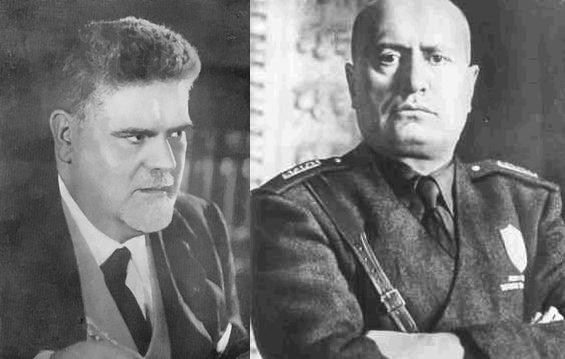
Giovanni Gentile and Benito Mussolini
Intellectual Debate in Fascist Italy
Tarquini emphasizes that culture in Fascist Italy was by no means monolithic, but allowed considerable stylistic variation and intellectual debate so long as these respected core Fascist principles. Indeed, Fascists emphasized that being a Fascist was more about a certain manly mindset than about theoretical abstractions. As Nietzsche did, the Fascists rejected the bourgeois spirit with its satisfaction with mediocrity, its skepticism and compromise, its concern with careers, and its death-fearing selfishness.
Fascism was born out of diverse groups dissatisfied with Italy’s small gains during World War I, frustrated with liberal impotence, and disturbed by the rise of communism. These included military veterans, self-sacrificial arditi soldiers, futurist artists, revolutionary syndicalists, socialistic republicans, and others. Fascism emerged organically as “a militia in the service of the nation,” a political movement, and finally a government, rather than as a preset set of ideas.
The “spirit of the trenches,” the spirit of hierarchy, discipline and community, which had shown its awesome destructive power in wartime would be used by the Fascists to constructively develop the nation in peacetime. Indeed, Fascism developed a “secular liturgy” (p. 43) and “a conception of the nation elevated to a sacred entity” (p. 51). Fascism rejected internationalism, egalitarianism, and materialism, embracing aristocracy, spirituality, and nationalism. Some Fascists even credited their movement with the potential to save Europe from decadence and degeneration.
Fascism was unabashedly communitarian. Economics and culture were to respect community interests. The Fascist doctrine of corporatism reflected “the relevance to the state [statalità] of every economic phenomenon” (p. 157). Fascists similarly argued that writers had “a political, moral, and educational role” and culture had to support “the struggle for civilization” (p. 184). Read more



 This phenomenon has inspired an important essay from


