• MISSION STATEMENT
  • TERMS
  • PRIVACY
The Occidental Observer
  • HOME
  • BLOG
  • SUBSCRIBE TOQ
  • CONTACT USPlease send all letters to the editor, manuscripts, promotional materials, and subscription questions to Editors@TheOccidentalObserver.net.
  • DONATE
  • Search
  • Menu Menu

Caliphate for the UK?

March 12, 2024/16 Comments/in Featured Articles, Islamization/by Mark Gullick

In December of last year, Gaza’s oldest mosque was largely destroyed by Israeli air-strikes. The Omari mosque dating back to the seventh century and named for Umar ibn al-Khattab, Islam’s second caliph, and so is much mourned. It is worth noting in passing that Islam does not separate religion and state as the West does, and so such a strike is against a target as much political as religious.

One act in the tragedy of war is the destruction of venerated architecture. Göring’s Luftwaffe tried desperately to bomb St. Paul’s Cathedral in London during World War II, the bombs falling all around the famous dome but never finding the target. The destruction of St. Paul’s would have adversely affected British morale, but both miraculously survived.

Now, another ancient and respected British institution is under attack; Parliament. Three events in England in the last month may have seemed singular viewed individually, but taken together they could permanently shift the tectonic plates of British government. First, intimidation by pro-Palestinian mobs, along with death threats made to Members of Parliament (MPs), may have altered the outcome of a Parliamentary vote on a ceasefire between Israel and Hamas. A few days later, a local by-election was won by a veteran Islamist White politician who dedicated his win with the opening line of his victory speech; “This is for Gaza!”. Finally, the next week, a leading figure in the Conservative Party said in an unguarded interview moment that he believed that the London Mayor, Muslim Sadiq Khan, was under the control of Islamists in the nation’s capital. Within days, there was one word predominantly on the media’s lips; Islamophobia.

The term “Islamophobia”, which came into being around a century ago and has been, to use a modern term, weaponized by the Islamic lobby, is as potent as the word “racism”, and ultimately just as devoid of meaning. Words, however, do not have to have meaning nowadays, and some are increasingly purely performative, used not as descriptive but as accusatory. Muslims and their cheerleaders use the term to damn perceived opponents and critics, while those who challenge it point out that a “phobia” is an irrational fear, and there is nothing irrational about fearing Islam. As noted, meaning is not a priority in modern political linguistic usage.

The chain of political events that led to the word once again being prominent began at Westminster, when the Speaker of the UK’s House of Commons, Sir Lindsay Hoyle, broke with Parliamentary precedent during a vote over a ceasefire in Gaza. As with any such proceedings, the details are intricate, but essentially the vote was allowed to take place in such an amended way that it would assist the opposition Labour Party and its leader, Sir Keir Starmer, to head off a major rebellion by their front-bench MPs. Equally important were the reasons Hoyle gave for his controversial decision, or rather one of them. He was, said the Speaker, concerned for the safety of MPs leaving the building after the vote. What could have been the threat outside the Mother of all Parliaments? Knife crime? Global warming?

The reason was a mob of pro-Palestinian supporters massed outside the House, who seemed to be looking to re-create the Peasants’ Revolt of 1381, when men of Kent and Essex burnt many of London’s landmarks to the ground.

What happened that evening cannot be under-stated. If the outcome of a British Parliamentary vote can be swayed by the activism of a mob, then all bets are off. The pro-Palestine mobs that have infested London streets every Saturday since October 7 last year have been increasingly brazen as they realize they are not really being policed, and if thus emboldened they are unlikely to slacken, and will go from vocal to violent. In addition, the Gaza vote was extraordinary in that it will have registered little interest in Gaza itself, while it has become the focal point for a seismic shift in British politics taking place over 2,000 miles from Israel and the Palestinian territories.

Just over a week after Sir Lindsay kicked a hornets’ nest with his irregular constitutional decision, attention shifted to a local by-election in a regional seat made empty by the death of the incumbent Labour MP, and which has a good claim to be the dirtiest such ballot ever fought in Britain. Again, the relevance of the outcome to UK politics cannot be over-emphasized.

Rochdale is a northern English town famed during the industrial revolution for its cotton production. More recently, its fortunes have fallen, and it was one of the towns exposed as being home to largely Muslim “grooming gangs” who drugged and raped young White girls with impunity for many years. They were unhampered by the police and only briefly reported by the mainstream media, very late and even then, minimally and reluctantly. Peter McLoughlin’s book Easy Meat charts this industrial-scale rape, often of minors, perpetrated almost exclusively by men of Pakistani origin. He is clear on the political gain of a cover-up: “Thousands and thousands of schoolgirls were sacrificed so that the elite in Britain could make obeisance to their religion of multiculturalism”.

The rape epidemic — which is still going on — was blamed on culture rather than religion, the apologists seemingly failing to notice that, in the case of Islam, the two are inextricably linked.

The Rochdale by-election was dirty and chaotic. Two weeks before the ballot, Labour withdrew support for its candidate, Azhar Ali, over alleged anti-Semitic comments made on social media. For the opposition party not to field a candidate at a by-election in the UK is vanishingly rare. The ruling Conservative Party expected to be trounced anyway in a dress-rehearsal for their likely wipe-out in the General Election later this year, and the up-and coming Reform UK fielded a candidate who had only recently been accepted back into political life after a scandal involving texts sent to a teenage girl. Even an unknown independent candidate, campaigning on issues concerning Rochdale (as you would normally expect from any candidate), finished second above what are usually recognized as the three main parties in Britain. But the clear winner, with more votes than those three parties combined, was veteran maverick George Galloway.

Galloway is a chancer and a rogue, seeking election wherever he believes he can be backed by a Muslim voting bloc, and has now represented four different constituencies in Parliament, a record equaled only by Sir Winston Churchill. The fiery Scot converted to Islam over two decades ago, and has had four wives, each one a Muslima. He is staunchly pro-Islamic and thus pro-Palestinian, which was the centerpiece of his campaign.

Galloway is a superb rhetorician in the Aristotelean sense. “Rhetoric” has now come to mean words alone, but there is far more to it than that, Aristotle defining it as “the faculty of observing in any given case the available means of persuasion”. Rhetoric is a lot more than words, a fact Galloway knows very well indeed. He is a hero to many British Muslims, and infamously met with Saddam Hussein, telling the Butcher of Baghdad that he saluted his “indefatigability”. Galloway regularly laces his speeches with heavily accented Arabic words and phrases.

Galloway is also a consummate campaigner. His team delivered two versions of the party’s campaign leaflets with basically the same text, but featuring a slight amendment depending on the recipient. Muslim households received a leaflet saying that Galloway would fight specifically for Muslims, while kuffar residences received a missive stating that he would fight for the people of Rochdale. Again, the situation in Gaza is shaping and molding politics in the UK, even at grassroots level.

At a hustings in Rochdale (“hustings” are British campaign-trail events, like stump speeches in the US), every question from journalists concerned the conflict in Gaza. At another, Galloway asked Muslim voters what they would say to their maker on Judgment Day when he asked them what they did for Gaza. This is a powerful image for some Muslims, and shows Galloway’s astute understanding of the Islamic faith. At a press conference, he said intriguingly that “the next election will be all about Muslims”. The next election in Britain is the General Election.

Lee Anderson is one of those British politicians known as “enforcers”. This is unofficial, and nothing like the enforcement of the Chief Whip, who ensures voting solidarity among his party’s MPs. But Anderson is a bullish man who does not suffer fools gladly. He was, until recently, the Chairman of the Tory Party and, until even more recently, still in the party. Not anymore. His comments on Sadiq Khan started a media squabble which soon become political, and led to Anderson’s suspension from the Conservative Party on charges of racism and Islamophobia. There is no point in pointing out yet again that Islam is not a race, and so Anderson’s comment could not be racist but, as noted, words don’t mean what they used to mean.

Anderson stated during a TV interview that Khan was controlled by Islamists. This started a furious media squabble about language, an increasingly strong focal point this century with respect to political, or politicized, words and their usage. Every TV hack is suddenly a linguistics expert after a row over the latest contentious Tweet or post, and it often seems as though the media are hosting a semantics seminar rather than confining themselves to mere reportage. Free speech was arguably freer during the reign of Queen Elizabeth —the First, that is — than that of the ailing son of Queen Elizabeth the Second, and politicians in particular are under forensic scrutiny. It is hardly surprising that MPs do not flock enthusiastically to the cause of free speech when their own is the most policed in the country.

Anderson was accused by Khan of both Islamophobia and racism, a double tap for a man often suspected of being a Muslim fifth-columnist and likely to be re-elected to the London Mayorship later this year. Khan has been a great proponent of immigrants coming to London, and this is the clearest example of the deliberate importation of a ready-made voting bloc, as Khan knows perfectly well that the vast majority of immigrants are Muslims, sectarian differences notwithstanding.

For immigration to the UK is not simply a steady procession of arrivals on dinghies on the Kent coast who have to be housed and fed and provided with debit cards and telephones. It is also a part of the political system, and the arrival of ever more Muslims will be as pleasing to Muslim leaders as it is to business owners. Immigrants were (in)famously described as part of an “invasion” by then Tory Home Secretary Suella Braverman, connoting an invading army. That may be hyperbole, but the invaders of which she spoke could also be reservists in an army which is still at the stage of assembly.

A strong element in Britain’s self-deception about Islam since 9/11 is the tired homily telling us that “not all Muslims are terrorists” and “Islamists are just a handful of extremists and don’t represent Islam”. The first statement is literally true but not all Muslims need to be terrorists, and there will be plenty of smiling Muslim families — perhaps running your local shop, if you’re British — who will be quite happy that ISIS are doing the heavy lifting. There will be many DVDs of the Twin Towers in the collections of some Muslim households, right next to the video of Mohammed and Shamima’s wedding. Anything for the ummah, everything for Islam. And perhaps Islam is seeking to unite the British chapter of that ummah, and is eyeing a key caliphate in the new reconquista. This begins with alliance, forced or otherwise.

France is having the same problem as Britain with Muslim influence, and Michel Houellebecq, the French novelist who has been on the wrong side of Islam in the past, has one of his characters in the novel Submission suggest what could be about to happen in the UK (Houellebecq also predicted the current European farmers’ revolt in his novel Serotonin): “It’s true that Christianity and Islam have been at war for a very long time … but I think the time has come for accommodation, for an alliance”.

Islam is used to such alliances, provided the jizya is forthcoming — i.e., the tax occupying Muslims historically levy on their new subjects. The British wouldn’t even notice a new tax, currently being rinsed by the Internal Revenue at the highest rate since the end of World War II. As for Islamic shariah law, a lot of Brits would make a day of it if young offenders who have previously terrorized their neighborhoods were flogged in the town square, or more likely the car-park in today’s Britain. It would not surprise me if Galloway intends to turn Rochdale into a testing-ground for shariah courts, which already exist de facto in Britain.

The day after Galloway’s election, the British Prime Minister — fabulously rich Hindu Rishi Suna — made a speech outside Number 10 Downing Street in which he rehearsed themes that are becoming familiar to watchers of political semiotics. He conflated Islamism with the “far-Right”, an entity which does not exist in any meaningful sense, as I wrote about here at The Occidental Observer.  Sunak called Galloway’s election “beyond horrifying”, and he had a strange take on Anderson’s comments, saying that “the words were wrong”. There is something incantatory about this, as though Anderson were a sorcerer’s apprentice who had uttered the wrong summoning spell. Henry Bolton, the leader of Nigel Farage’s old outfit, the UK Independence Party, described Sunak’s speech as follows: “His words were good, but it wasn’t going anywhere”.

This extraordinary statement shows, as noted, that there is a deep crisis in contemporary English-language usage and it needs bringing to light. We used to have philosophers to do that sort of thing for us.

But it is not all political machination. Islam, metaphysically equipped to play the long game but not averse to hurrying things along a little, knows that violence, or at least rumors of violence, are powerful rhetorical tools too. Richard Tice is the leader of the Reform Party, who are being spoken of as the heirs to conservatism should the Tories expected General Election defeat be even worse than expected. Tice has yet to prove that he differs from the political class, but he has not shied away from severe criticism of the campaigning by representatives of both Islamist parties in Rochdale. He claims severe staff intimidation and threats, polling station harassment, and a sudden spike in postal voting. Simon Danczuk, Reform’s candidate at the Rochdale by-election, is more specific in his allegations here.

Islam has been establishing beachheads in the British political process for years, and they have received an accelerant. As in the European lowlands of Belgium and Holland, local Muslim political power grows in the UK, and towns and cities gradually become micro-caliphates which may one day join hands. The Omari mosque was destroyed by military means. The destruction of British democracy may take time, but not a shot need be fired (although the possibility cannot be discounted).

The dissident Right are often conflicted over the question of Islam. Muslims, it goes without saying, are animated by a hatred of Jewry, and so get a pass from many on the far Right. My enemy’s enemy and all that. But the leading two British parties are heading into a General Election which has just come astonishingly to life, as if envious of the gunfight at the OK Corral which the American Presidential Election looks likely to be. If the UK’s election follows the same lines, Islam is drawing its revolvers first. Prime Minister Rishi Sunak and his opposite number, Labour leader Sir Keir Starmer, are trying desperately to placate two bitterly opposed factions over Gaza. Muslim leaders and imams in Britain know this, perceive weakness in the leadership, and know how to mobilize in synchronicity. Islam is increasingly setting the political agenda because Islam is the political agenda.

Finally, the question every politician asks secretly in that little part of themselves where they think what they really mean. Is it good for the Jews? Anti-Semitic violence is increasing in Britain (although every identitarian group claims the same thing), and the first Jew to die at pro-Palestinian hands in the UK — should that happen — may strike a match to a situation every bit as potentially explosive as the stash of dynamite with which Guy Fawkes attempted to blow up Parliament in 1605. For decades, Jewish influence on British politics had been monopolistic and required no enforcement. With sufficient influence in business and the media, British Jewry felt no need to bring in the Stern Gang. This surety no longer exists, and British-Jewish interests are about to discover that there are different types of power and different ways to exert political influence than just money.

https://www.theoccidentalobserver.net/wp-content/uploads/2018/06/TOO-Full-Logo-660x156-1.png 0 0 Mark Gullick https://www.theoccidentalobserver.net/wp-content/uploads/2018/06/TOO-Full-Logo-660x156-1.png Mark Gullick2024-03-12 12:48:282024-03-12 12:48:28Caliphate for the UK?

Paul Craig Roberts: “What’s Up with Conservatives?”

March 12, 2024/4 Comments/in General/by Kevin MacDonald

Paul Craig Roberts: “What’s Up with Conservatives?”

[It] is depressing that [Gov Noem of South Dakota] is so uninformed that she cannot connect her enthusiasm for halting the inflow of immigrant-invaders with her unbridled support for Jews. Governor Noem stresses that she “called on every governor to follow my lead and send troops to the border, and I offered to personally drive more razor wire down to Texas in the back of my truck.” Yet, she seems unaware that principal among the NGOs recruiting and financing the overrunning of America by “immigrant-invaders” is the Hebrew Immigrant Aid Society, of which the current director of the US Department of Homeland Security, Alejandro Mayorkas, himself a Jew, was a board member. https://www.paulcraigroberts.org/2024/02/18/the-genocide-of-the-west/ and https://www.paulcraigroberts.org/2024/02/06/america-is-undergoing-genocide/
So here we have Governor Noem pimping for Jews as she complains about the immigrant-invaders the Jews are helping to bring into our country.

It is really quite astounding that a governor, a conservative hope, cannot see the contradiction or inconsistency in her positions. What it looks like is that politicians simply grandstand on issues that they don’t bother to understand and, thereby, end up with inconsistent positions.

Of course, it’s not so astounding to readers of this website. And it’s bereft of any analysis of how we got here—in particular, that the activist Jewish community views multicultural, multiethnic immigration as a net positive (with few small bumps mainly as a result of Muslim immigration) because it precludes a homogeneous White society that might come to see Jews as enemies, as happened in Germany in the 1930s. And it’s not just liberal-left Jews who see things this way, but Jewish neocons are totally accepting of the “invite the world, invade the world” ideology.

Neocons have been incredibly influential in the Noem’s party, basically dominating U.S. foreign policy in both parties until Trump’s candidacy resulted in wholesale defection among GOP neocons because of his declared non-interventionist foreign policy and his rhetoric against multiculturalism (e.g., claiming that Brussels isn’t Brussels anymore). Hence Victoria Nuland, who was Dick Cheney’s top foreign  policy advisor as well as having important positions in the Obama and Biden administrations.

A big part of the decline of the U.S. is that politicians of both sexes and both parties overwhelmingly see getting elected as their only real goal, and supporting Jewish causes, especially Israel, is a fundamental sine qua on for election. Hence subservience to the interests of our hostile, Jewish-dominated elite, is the only real option. It’s where the money (particularly from the Republican Jewish Coalition) and media coverage are.

https://www.theoccidentalobserver.net/wp-content/uploads/2018/06/TOO-Full-Logo-660x156-1.png 0 0 Kevin MacDonald https://www.theoccidentalobserver.net/wp-content/uploads/2018/06/TOO-Full-Logo-660x156-1.png Kevin MacDonald2024-03-12 11:56:162024-03-12 11:56:16Paul Craig Roberts: “What’s Up with Conservatives?”

Victoria Nuland Resigns—Not a Moment Too Soon

March 10, 2024/in General/by Kevin MacDonald

Arch-neocon Victoria Nuland, who has been discussed many times on TOO, has resigned as the State Department’s Secretary of the Ukraine War. I have seen very little commentary on her resignation, so an article on ZeroHedge got my attention. Unfortunately, the comments are admittedly speculative, but seem at least reasonable.

While there have been rumors that maybe [Nuland] could be in poor or declining health, McGovern has told Russia’s Sputnik that the notoriously hawkish Nuland was a liability at a moment NATO and Russia are inching closer to direct nuclear-armed confrontation.

From the Sputnik article: “The CIA would have, the NSA would have those conversations as well,” said McGovern, referring to leaked recordings of discussions between Nuland and German Defense Minister Boris Pistorius that appeared to reveal plans for an imminent attack on Russian soil. The leaks generated significant embarrassment for German officials as attention was drawn to Chancellor Olaf Scholz’s support for the Ukraine proxy conflict.
[McGovern:] My best guess here is that the CIA and the Defense Department and the NSA got this message around saying, ‘look, Victoria’s got her own agenda here,’” said the analyst. “‘The president doesn’t really want to strike these ammo depots in Russia or knock down the [Crimean] Bridge. So we got to rein her in, I guess it’s time for her to go to early retirement.’”

“My best guess here is that the CIA and the Defense Department and the NSA got this message around saying, ‘look, Victoria’s got her own agenda here,’” said McGovern.

The former CIA official continued to speculate: “‘The president doesn’t really want to strike these ammo depots in Russia or knock down the [Crimean] Bridge. So we got to rein her in, I guess it’s time for her to go to early retirement.’”

Another theory, though not necessarily contradictory to the above, has been advanced by professor of national security at Bowie State University Dr. Matthew Crosston.

He laid out what “a staunch anti-Putinist Nuland was and how fervently she wanted to continue to utilize Ukraine as a platform in which to continue to weaken and/or slight Russia on the global stage — and perhaps even up the ante in that conflict with her support of sending ballistic missiles into Ukraine.” But she also knows the Ukrainian side is losing.

She may have seen the writing on the wall as Ukraine forces are in retreat, and wanted to bail before potential total defeat:

“She undoubtedly understood that if American support lessons or wanes, Ukraine loses, period,” Crosston pointed out. “Perhaps she did not want to be in the Administration that would be responsible for that outcome.”

But both McGovern and Crosston would agree that with Nuland as Under Secretary of State for Political Affairs (in this capacity she basically ran all of US foreign policy in Europe), ceasefire talks between Kiev and Moscow remained an extremely distant prospect or even an impossibility.

“One thing is certain: as long as Nuland remained in that chair, there was literally no chance such talk could even be theorized. Now it can,” Crosston concluded.

ZeroHedge also includes this video of an interview of Glenn Greenwald. Much of this will be familiar to readers of TOO, but there is a discussion of Adam Schiff as a warmonger endorsed by AIPAC and now the presumed next Senator from California. Schiff was buoyed by billionaires, presumably Jewish or at least rabidly pro-Israel, who donated millions to Republican Steve Garvey (who has no chance to win in a very blue state) in order to prevent a runoff between two Democrat candidates. As expected, no mention of Nuland’s strong Jewish connections — also prominent among neocons generally (see here, p. 32ff).

https://www.theoccidentalobserver.net/wp-content/uploads/2018/06/TOO-Full-Logo-660x156-1.png 0 0 Kevin MacDonald https://www.theoccidentalobserver.net/wp-content/uploads/2018/06/TOO-Full-Logo-660x156-1.png Kevin MacDonald2024-03-10 12:56:062024-03-10 12:56:06Victoria Nuland Resigns—Not a Moment Too Soon

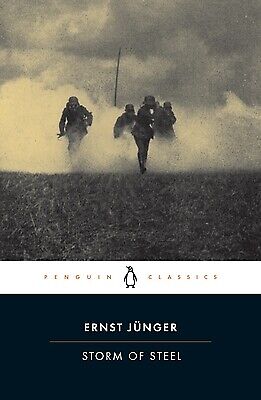
Review of “Storm of Steel” by Ernst Jünger

March 10, 2024/18 Comments/in Featured Articles, Western Civilization, Western Culture/by Bernard M. Smith

When once it is no longer possible to understand how a man gives his life for his country—and the time will come—then all is over with that faith also, and the idea of the Fatherland is dead; and then, perhaps, we shall be envied, as we envy the saints their inward and irresistible strength.
Storm of Steel by Ernst Jünger

The end of the greatness of Western Civilization in one man’s death.

*        *        *

On February 17, 1998, a frail centenarian passed away in Wilflingen, Germany. Born in 1895, Ernst Jünger’s life was far more noteworthy than simply its prodigious length — it was a life that epitomized the gallantry, curiosity, patriotism, intelligence, and culture that made Western Civilization what it became — and from what is has descended. Fused in one man were all the qualities — qualities that are not merely in short supply today but positively lacking. It is not hyperbole to say that an era of sorts and an entire civilization was buried with his remains at Wilflingen Cemetery. We simply do not produce men like him — and have not for a very long time.

To say that Jünger’s life was incredible is selling it short — by a longshot. His life almost perfectly corresponded with the entirety of the twentieth century. The changes he witnessed boggle the mind — from the world he inherited to the world that he left. Born less than twenty-five years after Germany’s unification in 1871, he came into the world during the heady optimism of the German Empire. Successively he would be a participant and witness to: World War I and Germany’s partial dismemberment following its defeat at the hand of the allies; the chaos and political upheavals of the Weimar Republic; the rise of the Third Reich and World War II; the complete destruction and dismemberment of Germany following the war; the eras of West and East Germany; and finally, the reunification of Germany in 1991 following the fall of the Soviet Union. During every phase, from a young man to a very old man, Jünger participated and contributed to Germany. Indeed, he is virtually without parallel in what he means to soul of Germany.

He was a man that lived his entire life wrestling with ideas with a creative mind that seemingly never lost its vigor. An active writer from a young age, his books span multiple generations. He consumed life in an almost inexhaustible way — cogitating over things in a way that was almost superhuman. In that sense, he is close to being the personification of Western Civilization in microcosm. Really, it is that unbelievable.

I could recapitulate his life, but perhaps citing to a then-contemporary obituary to give a flavor for the man is more appropriate. While there were many, I found that The Independent gave as good a voice to the extraordinariness of his life as any other — and I cite it in full because it is worth reading in full:

ERNST JUNGER first beheld Halley’s Comet during its 1910 passage, when he was a boy of 15. In 1987, he made a special journey to Malaysia for a second glimpse. He was one of the very few writers to have seen the comet twice in his lifetime.

All this is described in Zwei Mal Halley (“Halley Twice”, 1988), a book filled with Junger’s characteristic meditations on time and place, on dreams, nature, crystals, stars, mountains, the sea, wild animals and insects, especially butterflies, a passion he shared with Nabokov. Throughout his very considerable body of work, there is an obsession with time, with dates, with temporal coincidences, with the fatidic power of numbers over our birth and death. In a volume of his journals covering the years 1965–70, Siebzig verweht (“Past Seventy”, 1980), he makes this revealing entry at Wilfingen, his home between the Danube and the Black Forest, in sight of the castle of Stauffenberg, on 30 March 1965: “I have now reached the biblical age of three score and ten — a rather strange feeling for a man who, in his youth, had never hoped to see his 30th year. Even after my 23rd birthday in 1918, I would gladly have signed a Faustian pact with the Devil: “Give me just 30 years of life, guaranteed, then let it all be ended.”

A similar expression of his fascinated awe of time and numbers appears in an earlier work, An der Zeitmauer (“At the Wall of Time”, 1959). But one of the most extraordinary examples of this obsession can be found in a journal entry for “‘Monday, 8.8.1988’ — a date with four units. 8 is special (four 8’s, and a fifth one by subtracting the 1 from the 9). Odin rides an 8-legged horse. . . . Dates have often brought me surprises.”

One of his many hobbies was the collection of antique sandglasses, on which he was an authority. He also collected sundial inscriptions. Ernst Junger’s birth at Heidelberg is recorded precisely. It fell on 29 March 1895 on the stroke of noon, under Aries, with Cancer in the ascendant. He was the eldest of seven children, one of whom, his beloved brother Friedrich Georg (who died in 1977), was also a writer, a poet and philosopher.

Junger spent the greater part of his childhood and adolescence in Hanover, where his prosperous parents settled shortly after his birth. They possessed a beautiful villa by a lake, where Ernst made his first entomological investigations. He soon developed a dislike for bourgeois life, and spent a couple of unhappy years in boarding schools, whose reports complain of his dreaminess and lack of interest in the boring curriculum. He was later to write: “I had invented for myself a sort of distancing indifference that allowed me to remain connected to reality only by an invisible thread like a spider’s.”

He spent hours reading unauthorised books, and with his brother lived in an exalted universe of their own. They would go wandering round the countryside, and Ernst struck up happy friendships with tramps and gypsies. He was already the Waldganger (wild man of the woods), the anarchist hero of his 1977 novel Eumeswil. It was the beginning of an unending passion for travel and exotic lands. He took the first big step in 1913 by running away from home to join the Foreign Legion, in which he saw service in Oran and Sidi-Bel-Abbes. After five weeks, his father bought him out. Ernst was to write about this escapade in Kinderspielen (“Children’s Games”, 1936). His father promised that if he passed his Abitur (school-leaving examination) he would be allowed to join an expedition to Mount Kilimanjaro. So Junger swotted away at the Gildermeister Institut, whose grim atmosphere is evoked in Die Steinschleuder (“The Catapult“, 1973), a novel in the great tradition of German school stories.

Junger passed his exam in August 1914 and at once volunteered for the army, in which he fought on the French front with exceptional courage all through the First World War. Wounded four times, he received the highest German military honour, the Order of Merit created by Friedrich II: he outlived all those who also received it. Out of his wartime experiences was born Stahlgewittern (“Storm of Steel”, 1920), which he had to publish at his own expense. This story of the horrors of modern warfare was drawn from his wartime notebooks, often written in the heat of battle on the Western Front. It remains one of the greatest works about the First World War, along with those by Erich Maria Remarque, Henri Barbusse, e.e. cummings, David Jones and Lucien Descaves.

Junger stayed in the army until 1923, when he left and began studying zoology at the University of Leipzig and at Naples. He married Gretha von Jeinsen and his son Ernst was born in 1926. In 1927 they moved to Berlin, where he became a member of the national revolutionary group led by Niekisch (arrested by Hitler in 1937 and kept in a concentration camp until the end of the Second World War). He also got to know Ernst von Salomon, Bertolt Brecht, Ernst Toller and Alfred Kubin, as well as the publisher Rowohlt. He began travelling widely, to Sicily, Rhodes, the Dalmatian coast, Norway, Brazil and the Canaries, and made the acquaintance of Andre Gide in Paris. These travels had a great influence on all his writings, most noticeable in his superb novel Heliopolis (1949) – the most elegantly learned, eloquently written and hauntingly convincing science- fiction story ever written.

Goebbels tried in vain to draw him into the ranks of the Nazi hierarchy in 1931, and he refused to be elected to the German Academy of Letters because it was dominated by national socialist timeservers. In 1932 Junger produced a very significant book, Der Arbeiter (“The Worker”), which is nevertheless one of his least-known works. It was long out of print until Martin Heidegger, himself besmirched with Nazi collaboration, persuaded him to risk letting it be reissued in 1963. It presents the mythical figure of standardised modern man as “The Worker” whose pragmatism and nihilism destroy the old traditional categories of peasant, soldier and priest, foretelling an unprecedented reversal of temporal power in our collapsing cultures where an intellectual and artistic elite has no place.

Related to this theme is a later work, Das Aladdinproblem (1983), in which he asks who will rub the magic lamp of destructive science and dehumanising technology: “With the heavens empty, we live in the Age of Uranium: how can we believe our modern Aladdin’s lamp will not produce some unimaginable monster?” Der Arbeiter is also an important theoretical study of the political history of the Thirties in Germany, and has been considered by critics like Georg Lukacs and Walter Benjamin to have been the ideological matrix of national-socialist ideas. But Junger’s links with national socialism were infinitely complex. He was a serving officer, partisan of the revolutionary right, a sort of conservative anarchist, hostile to the Weimar Republic, yet he refused all honours and promotions.

Unable to bear the rising tide of Hitlerism, he left Berlin for the quiet of the countryside at Kirchhorst, where in February 1939 he began the painful drafting of Auf den Marmorklippen. Its anti-Nazi tone is obvious, but the book was published in September, the month war was declared. On the Marble Cliffs was part of my wartime reading, and I well remember the excitement it caused when the translation was published by John Lehmann just after the war.

With the outbreak of war, Junger was given the rank of captain and took part in the invasion of France, during which he did his utmost to spare civilians and protect public monuments. Posted to Paris, he became a well-known figure in the literary salons of the time like the Thursday reunions of artists and writers at Florence Gould’s. He made good friends of authors like the acid-tongued critic Leautaud and above all Marcel Jouhandeau, whose scholarly ease and wit in writing seemed to Junger exceptional at a time of growing artistic barbarity. Even after their condemnation for collaboration with the Nazis, Junger praised the characters and writings of Chardonne, Celine (whom he did not like), Brasillach and Drieu de la Rochelle, while his admiration for Cocteau, Sasha Guitry and actresses like Arletty was as sincere as that for artists like Braque and Picasso, whose studios he frequented.

His journals of this period are studded with all these famous names. However, he was indirectly implicated in Stauffenberg’s attempt to assassinate Hitler in July 1944, and requested to leave the army and return home to Kirchhorst, where he spent the rest of the war, composing a text on Die Friede (“Peace”). His son Ernst, in prison for opposition to Hitler, was despatched to the Italian front and killed on 29 November in the marble quarries at Carrara by Allied snipers.

After German defeat and capitulation, despite his firm denials of having supported Nazism, Junger encountered the shrill hostility of Marxist and so-called liberal critics who accused him of being its predecessor. They even criticised his scholarly, noble, refined style, calling it frigid, elitist and academic. He writes of his experiments with drugs in Annaherungen (“Approaches”, 1970), influenced by Aldous Huxley’s works on the same subject. He finally settled at Wilfingen in the house of the Master Forester attached to the ancestral home of his executed friend Graf Claus Schenk von Stauffenberg, where in 1959 he founded the literary review Antaios with Mircea Eliade. By 1977, his father, mother, brother and wife had all died. He remarried, taking as his wife Liselotte Lohrer, a professional archivist and literary scholar.

All through the Seventies and Eighties Junger travelled widely. In 1979, he visited Verdun and was awarded the town’s Peace Medal. In 1982 he received a final literary consecration with the award of the City of Frankfurt’s Goethe Prize, which aroused violent protest among his detractors. In 1984, he again made a pilgrimage to Verdun, with Chancellor Helmut Kohl and President Francois Mitterrand to pay homage to the victims of two world wars. In 1992, there was extraordinary confirmation of Junger’s anti-Nazi stance with the discovery of a top-secret document proving that his fate was in the balance just before the Third Reich’s capitulation and during the final days Hitler spent in the Wolfs-Schanze, the very headquarters where he was wounded by the Stauffenberg bomb.

The document is dated December 1944. It is addressed by Dr Freisler, president of the Volksgericht (People’s Court) to Martin Bormann, Hitler’s right-hand man. Freisler informs Bormann that the proceedings to be taken against Captain Junger are to be cancelled. Junger had been indicted on account of his novel On the Marble Cliffs and the “defeatist” opinions he had expressed at his old colleague Commandant Stulpnagel’s HQ in Paris, not long before the latter’s suicide. Freisler reveals that on 20 November 1944 the Fuhrer himself had given the order by telephone from the Wolfs- Schanze that the matter was not to be pursued any further. Freisler ends his letter with “Heil Hitler!”, then adds a postscript: “I am sending you three dossiers on the affair. The Fuhrer wishes to have his orders executed immediately.”

In his Journals, Junger notes that the Gestapo had described him at that period in Paris as “an impenetrable, highly suspect individual”. He comments in a 1992 interview: “It was no surprise to me. After all, it conformed to the pattern of my horoscope. Ever since my schooldays I’ve been accustomed to that kind of unpleasantness.” Ernst Junger’s work is all of a piece — highly literary, beautifully sonorous, excitingly visual, intellectually profound and stimulating. It is the life work of an aristocrat of letters, and one of the best tributes to it has been made by another literary patriarch, Julien Gracq: “The hard, smooth enamelling that seems to armour his prose against the touch of too great a familiarity would seem to us perhaps a little frigid if we did not know, and if we never lost consciousness of the fact while reading, that it has been tempered in an ordeal of fire.”

That is a fitting eulogy for one of the greatest writers of the 20th century.

Ernst Junger, writer: born Heidelberg, Germany 29 March 1895; married 1925 Gretha von Jeinsen (died 1960; two sons deceased), 1962 Liselotte Lohrer; died Wilflingen, Germany 17 February 1998.

Noticeably absent from this obituary is any mention of religion, which is unfortunate. I find great solace that this man, who retained his wits sharply until his death, converted to Roman Catholicism at the ripe age of 101 and died in the bosom and sacraments of the Catholic Church. While there are similar conversion stories of remarkable men who converted after a long lifetime of exhaustive study and moral exploration, his conversion is particularly meaningful to me. While I am no Ernst Jünger, by both blood and conviction, I am northwestern European and a Teutonophile: that the very best modern German man saw fit to do exactly what I did — that is, make an adult conversion to Rome — gladdens me exceedingly. A man such as him — a Western man in the best sense of the term who had lived life to its maximal fullness in every way — decided after seeing virtually everything a man can see and thinking about over in a lifetime came to the conclusion that the ancient faith of Rome was true is inspiring beyond measure. Truly this was a man who drunk deeply of virtually every idea and experienced virtually every political and social movement — all in the great vacillations of the greatest privations intermixed with periods of abundance. From a human perspective, he was someone that saw hope and despair, in both a people and in his heart, wax and wane repeatedly. Such a man knew the scope of life as few ever have — and after surveying all of it, he cast his lot with the Nazarene and the Catholic Church. It is true that we live in an appalling age of nihilism and apostasy in our time, but I am gratified that Rome continues to attract the very best of men even if loses millions more of mediocre and self-centered. It is a testament to the powerful and enduring attraction that is Christ as mediated through the Church He founded — a Church that uniquely fits the soul of the most virtuous men of the West.

Now, the argument from authority is the weakest of all arguments; that said, hostile and indifferent non-Catholics who nonetheless care about the survival of Western Civilization and bemoan the depths of depravity into which we have sunk ought to take something from his conversion. Even if it does not result in a similar conversion, it ought to communicate to every non-Catholic Westerner who cares about the West that Catholicism is not merely a part of our history but a living force that continues to attract men of the highest quality. That means it ought to never be tarnished or mocked even by those men who stand aloof from her.

*        *        *

Jünger, as it clear from above, wrote a great deal — this review only addresses one of his earliest published works: Storm of Steel, which is a first-person account of his experience as a soldier and officer during the First World War. It is a beautiful — if tragic — account of that senseless killing field. It represents the genre of a “soldier’s story” as well as any that I have read, and while it details the horror of the mechanized monster that is modern war, it is neither the glorification of war nor its condemnation. Somewhere in between, Storm of Steel is an account of a man of honor doing his duty without apologizing for it — indeed, if anything, it is the pronouncement of his good fortune to be among the generation that was able to do it. To the modern reader — no doubt a collection of beta men (or, in Nietzsche’s pithier words, “last men”) — such a sentiment after reading the horrors and carnage that Jünger saw and experienced is virtually inexplicable. But then again men of today use words like duty, honor, and fatherland as punchlines — something to be mocked by men who get pedicures. Such is the distance between us and him and the whole of his generation that passed.

The First World War is a confounding — and depressing — topic for me. I have studied it from different angles and perspectives. I have thought about it for seemingly hundreds of hours. I have lamented it and in particular its senselessness. In its essence, WWI was a collective civilizational suicide pact — the destruction of Europe’s finest and the impoverishment of Europe’s future. On the eve of August 1914, European civilization (late-stage Western Civilization) was ascendent around the globe. The war ended that ascent definitively and decisively. What is more, it is virtually impossible to understand why the leaders of Europe decided — in unison — to kill all their best young men and destroy and impoverish their countries simultaneously. The lack of reason or cause, I suppose, bothers me most. Western Civilization was mortally wounded by November 1918 and its self-inflicted wound was utterly meaningless.

But this is not a story of the war’s meaninglessness — it is a story of one of those best men who happened, unbelievably, to survive and tell the tale. Throughout, Jünger speaks for the millions who died — he gives voice to those we lost and what we lost even if we did not lose Jünger. This is a book that communicates the patriotic enthusiasm that swept over Germany, and, by extension, the whole of Europe at the outset of the war. He writes:

We had come from lecture halls, school desks and factory workbenches, and over the brief weeks of training, we had bonded together into one large and enthusiastic group. Grown up in an age of security, we shared a yearning for danger, for the experience of the extraordinary. We were enraptured by war.

The enthusiasm, which he shared with many of his generation, is seemingly out-of-place considering that carnage and hellfire that they would face. Likewise, the enthusiasm did not reflect a belief in the ideological righteousness of the cause beyond the ardent patriotism in the breasts of the men who fought. Consider his view of the enemy, which is infused with a latent sense of chivalry from a bygone era:

Throughout the war, it was always my endeavour to view my opponent without animus, and to form an opinion of him as a man on the basis of the courage he showed. I would always try and seek him out in combat and kill him, and I expected nothing else from him. But never did I entertain mean thoughts of him. When prisoners fell into my hands, later on, I felt responsible for their safety, and would always do everything in my power for them.

We learn early in this book what kind of man this is — and he displays a remarkable consistency throughout in terms of his character.

Jünger’s account is not about military strategy per se although as an officer and leader of men in various battles, the tactics and strategy are always there for consideration. No, this is an account of the primal nature of war — especially the vicious and unforgiving nature of mechanized trench warfare. While this book is not like Guy Sajer’s Forgotten Soldier in that the literary motif of the fog of war is used in the writing itself, there is a distinct chaos that seems never far from the surface in Storm of Steel. But there is something alive — and dare I say beautiful — in the horror of what he describes. It is the continuous paradox of life — man never feels more alive than when he faces death in a real and meaningful way. And death was everywhere in Jünger’s account.

One could almost say that his literary talents created a battlefield aesthetic in which the war was a visual tableau and spectacle — even in its destruction and mangled reality. He paints an intense picture of the trenches, nighttime patrols, and terrifying infantry and storm trooper attacks. Artillery is everywhere and these men lived under constant bombardment. We get a sense of the drip-drip maddening effect of the barrages coupled with the occasional direct hits, which leave multiple men mangled beyond recognition. But we also get a sense of the indomitable esprit de corps of these men; he writes:

Even if ten out of twelve men had fallen, the two survivors would surely meet over a glass on their first evening off, and drink a silent toast to their comrades, and jestingly talk over their shared experiences. There was in these men a quality that both emphasized the savagery of war and transfigured it at the same time: an objective relish for danger, the chevaleresque urge to prevail in battle.

And there is the constant vagaries and senselessness of who dies and how — death is something always lurking and stealing people away in a completely haphazard way. If there is a hidden metaphor in the book as it relates to the meaningless of the war — at least in a geopolitical sense — it is the caprice of who dies and who does not. That said, Jünger does not strike me as intentionally embedding such devices, but it was nonetheless something that struck me repeatedly.

He does not glorify battle per se but there is an unapologetic quality of the writing that conveys the veiled Germanic warrior of an age lost in the mist of time. The suffering and privations — the cold, damp, and hungry conditions — only add laurels of the might and mane of the men who endured and fought. His mode of writing, which builds on a contemporaneous journal that Jünger kept throughout the war, keeps the action moving in an almost herky-jerky fashion that gives us a sense the vicissitudes of soldiers moving hither and thither without always understanding why. Consider this example of his style:

These moments of nocturnal prowling leave an indelible impression. Eyes and ears are tensed to the maximum, the rustling approach of strange feet in the tall grass in an unutterably menacing thing. Your breath comes in shallow bursts; you have to force yourself to stifle any panting or wheezing. There is a little mechanical click as the safety-catch of your pistol is taken off; the sound cuts straight through your nerves. Your teeth are grinding on the fuse-pin of the hand-grenade. The encounter will be short and murderous. You tremble with two contradictory impulses: the heightened awareness of the huntsmen, and the terror of the quarry. You are a world to yourself, saturated with the appalling aura of the savage landscape.

For those who might have seen it, the recent film 1917 uses the cinematic technique of equating the runtime of the film with the sequence of action presented by the film — i.e., the film is a two-hour film that depicts two hours in 1917; it has some similarities to Storm of Steel, not so much in the passage of time or the length of the book, but the work is action-oriented with little dedicated space for philosophical musings other than what is relevant to the action.

Like other war stories, it is a coming-of-age story — innocence and enthusiasm giving way to death and gravitas. The book details Jünger’s progression of increasing responsibilities and dangers. He is eventually trained as a storm trooper who leads offensive raids towards the end of the war. The experience he and his fellows gain always comes at a cost; he writes, “[i]n war you learn your lessons, and they stay learned, but the tuition fees are high.” The book reaches its crescendo during these accounts of the offensive storm trooper raids including the one in which his final injuries were sustained that effectively put him out of the war for good. Both the glorification and vivification that come from war — especially that war — are recounted by him in an evocative way; for example, he writes of his time as a storm trooper:

Trench fighting is the bloodiest, wildest, most brutal of all. … Of all the war’s exciting moments none is so powerful as the meeting of two storm troop leaders between narrow trench walls. There’s no mercy there, no going back, the blood speaks from a shrill cry of recognition that tears itself from one’s breast like a nightmare.

During his service, Jünger was wounded a dozen or so times, each leading to a brief return home or time in the military hospital for recovery. He writes in detail: “[l]eaving out trifles such as ricochets and grazes, I was hit at least fourteen times, these being five bullets, two shell splinters, one shrapnel ball, four hand-grenade splinters and two bullet splinters, which, with entry and exit wounds, left me an even twenty scars.” Despite the comforts, he yearns for the frontlines — he literally cannot wait to return to the hell of the war. Even in his last — and most serious injury — he is anxiously preparing for the winter offensive of 1919 that never came.

Notably, unlike other stories from the losing side, Jünger’s experiences do not lend themselves to cynicism. While Jünger provides a firsthand account of the brutality of trench warfare and the psychological effects it had on the soldiers, there is no sense of complaining in the slightest even when he gives voice to the various temptations that he had to shirk on occasion. The book may be a gripping and unflinching portrayal of the horrors of war, but it is not a demonization of it or his country on account of it. He simply sees himself as a man who did his duty for fatherland and he never exhibits anything remotely like cynicism of the enterprise even if he complains, from time to time, of the mistakes made by generals far off from the tactical reality that he confronted. In that sense, it is a very different book from All Quiet on the Western Front, notwithstanding the many similarities, which exudes a manifested cynicism.

Jünger begins the war and his memoir with the love of his country:

At the sight of the Neckar [River] slopes wreathed with flowering cherry trees, I had a strong sense of having come home. What a beautiful country it was, and eminently worth our blood and our lives. Never before had I felt its charm so clearly. I had good and serious thoughts, and for the first time I sensed that this war was more than just a great adventure.

After all the destruction and carnage, he ends the book with the same love of his country not only intact but somehow strengthened — even as it is tinged with foreboding of what was to come:

Now these [battles]too are over, and already we see once more in the dim light of the future the tumult of the fresh ones. We—by this I mean those youth of this land who are capable of enthusiasm for an ideal—will not shrink from them. We stand in the memory of the dead who are holy to us, and we believe ourselves entrusted with the true and spiritual welfare of our people. We stand for what will be and for what has been. Though force without and barbarity within conglomerate in sombre clouds, yet so long as the blade of a sword will strike a spark in the night may it be said: Germany lives and Germany shall never go under!

We live today among men, at least in the West, who treat their countries with disdain and ignore that they even belong to a people. Where are the men today who might say that Germany — or England — or France — or Spain — or dare I say America — lives? Where are the men who love their fatherlands and love their kin?

*        *        *

Jünger recounts many men he killed during the war. What stands out to me, however, is the one he did not kill:

A bloody scene with no witnesses was about to happen. It was a relief to me, finally, to have the foe in front of me and within reach. I set the mouth of the pistol at the man’s temple — he was too frightened to move — while my other fist grabbed hold of his tunic, feeling medals and badges of rank. An officer; he must have held some command post in these trenches. With a plaintive sound, he reached into his pocket, not to pull out a weapon, but a photograph which he held up to me. I saw him on it, surrounded by numerous family, all standing on a terrace. It was a plea from another world. Later, I thought it was blind chance that I let him go and plunged onward. That one man of all often appeared in my dreams. I hope that meant he got to see his homeland again.

This was a haunting scene. What a waste that war was — what a waste of men such as these. Hidden in this moment in an otherwise unforgiving war is the recognition of the Western sensibility of humanity. True enough it was his duty to kill, but the hope he articulated for the survival of his enemy is rich in meaning and pregnant with the fraternity that exists — or at least once existed — among European men.

When I took the whole of this book in, what struck me more than anything is that a man of twenty-five could write it. Consider too that four of his twenty-five years were not in graduate school but in muddy and bombed-out trenches. Throughout the book are references to themes of Western Civilization, theology, mythology, and philosophy. By no means is this a book that plumbs any of them deeply but the facility of a twenty-five-year-old with all of them demonstrated a greatness in the German psyche that is simply unrecognizable in virtually any men today regardless of age. True enough, Jünger proved to be a gifted writer after the war, but his talents notwithstanding, the civilization that reared him and existed before World War I was astounding.

Why oh why did we allow them all to be killed?

 *        *        *

Saint Martin of Tours, Pray for us.


https://www.theoccidentalobserver.net/wp-content/uploads/2018/06/TOO-Full-Logo-660x156-1.png 0 0 Bernard M. Smith https://www.theoccidentalobserver.net/wp-content/uploads/2018/06/TOO-Full-Logo-660x156-1.png Bernard M. Smith2024-03-10 11:29:132024-03-10 12:07:54Review of “Storm of Steel” by Ernst Jünger

Judge Carney Defends the First Amendment

March 9, 2024/1 Comment/in Featured Articles, General/by Glen Allen, Esq.

Editor’s note: This FEF article on selective prosecution is very important. It is a huge problem for our side and happens repeatedly. The prosecution of the right — even though the same behavior or worse on the left is tolerated — is paradigmatic, but there are many other examples, including the lawfare against Vdare, the deluge of lawsuits against Trump (e.g., inflating property values is common in the real estate industry, and banks can certainly do their own due diligence), and the J6 and Charlottesville defendants. All of these suits have been brought by leftist prosecutors who depend on the courts to uphold their arguments. And people on our side don’t file civil suits related to free speech either because it’s unlikely we could succeed in the courts, no matter how much the facts are on our side (e.g., James Edwards’ lawsuit for defamation against The Detroit Free Press—no libel protection for White advocates). It’s hard to find judges who will apply the rule of law in these situations, but Judge Carmac Carney is doing that. But of course the evil forces of repression are doing their best to overcome that.

Support the cause: donate today at https://freeexpressionfoundation.org/donate/.

JUDGE CARMAC CARNEY DEFENDS THE FIRST AMENDMENT AND THE RULE OF LAW

Written by: FEF Staff

There is an old adage that a judge is a combination of a lawyer and a politician. Hard experience by attorneys representing the Dissident Right in First Amendment cases has shown that this adage often – too often – carries much truth. But there are exceptions. There are judges who wear their robes with honor and interpret and enforce the law impartially and in accordance with basic First Amendment principles. Judge Carmac Carney, federal judge for the Central District of California, is one such judge.

FEF’s supporters may have taken note of Judge Carney’s recent bombshell ruling ordering the release from custody of former Rise Above Movement (RAM) members Robert Rundo and Robert Boman, who were in police custody after being charged under the federal Anti-Riot Act with engaging in violence with hard-left groups at a pro-Trump rally in 2017. Rundo, who had been living abroad since the 2017 Charlottesville Unite the Right rally and was extradited from Romania to face charges last year, has become a fixture in dissident right circles across North America, principally for founding a network of health and fitness societies, called Active Clubs.

Thus far, this highly rare ruling has been covered with unsurprising outrage in the New York Times and CNN, among others, but more interestingly by mainstream conservative sources as well, including the Daily Wire, Hot Air, and the Daily Caller.

From the Daily Wire:

Judge Carney objected to the fact that federal prosecutors charged only right-wing participants, even though left-wing agitators performed identical conduct or worse at the same event—which prosecutors’ own evidence acknowledged.
…
“Antifa and related far-left groups decided they needed to ‘shut this down.’ … They came prepared for violence, bringing weapons including pepper spray, fireworks, knives, and homemade bombs,” Judge Cormac J. Carney of the US District Court for the Central District of California wrote on February 21. “And they used those weapons, as well as their bodies, against Trump supporters and law enforcement.”

As part of Rundo’s and Boman’s defense, Judge Carney was presented with photographs from the pro-Trump event showing that Antifa engaged in violence more egregious than the alleged violence the RAM members were charged with. But no Antifa were ever charged. FEF’s Glen Allen witnessed similar photographs of Antifa violence from the Charlottesville UTR rally presented by prosecutors during the sentencing of an RAM member. The prosecution used these photographs to send the RAM members to prison for two years or more but here again Antifa’s violence was ignored.

More about Judge Carney from the Daily Wire:

“Defendants have established selective prosecution. There is no doubt that the government did not prosecute similarly situated individuals. Antifa and related far-left groups attended the same Trump rallies as Defendants with the expressly stated intent of shutting down, through violence if necessary, protected political speech. At the same Trump rallies that form the basis for Defendants’ prosecution, members of Antifa and related far-left groups engaged in organized violence to stifle protected speech,” he continued.

FEF’s supporters may value a background on the defense of “selective prosecution” and the Anti-Riot Act, the latter a law FEF has particular expertise in, as FEF has filed numerous amicus briefs in Rundo and other cases challenging the Act’s constitutionality.

Traditionally, our criminal justice system has been the purview of state and local governments. This changed in the 1960s as the federalization of crime began to take root. As critics of this growing trend contend, it is rare when federal charges are not duplicative and the criminal activity in question cannot be adequately handled by state authorities operating under state laws. More fundamentally, the Founders, particularly Alexander Hamilton in Federalist Number 17, sought state jurisdiction over public safety specifically to hinder the prospect of central government oppression. As the Founders correctly foresaw, such oppression might come from laws passed or enforced for reasons of politics, inflamed public opinion, and grandstanding Congressmen—and, one might add today, overly ambitious judges and prosecutors.

Thankfully, there are procedural defenses against this increased federalization of criminal prosecutions. Derived from the Equal Protection Clause of the Fourteenth Amendment, selective prosecution, or disparate enforcement of the law, is essentially an allegation of discrimination by prosecutorial authorities. Unlike federal and most state anti-discrimination laws, the defense of selective prosecution allows for claims on the ground of political-opinion discrimination (in addition to discrimination based on the more traditional grounds of race, religion, etc.). Due to the wide discretion prosecutorial authorities enjoy, however, the defense is rarely successful.

The Anti-Riot Act is a prime example of such needless federalization as well as dramatic overreach and over-criminalization in American society. This rarely applied law, enacted in the violent late 1960s, makes it a federal offense to plan or engage in what later becomes a riot, e.g., by travelling across state lines. Enacted, argue some, as a way to deal with then-burgeoning black nationalist and hard-left violence, the long dormant Act has recently been revived by prosecutors, perhaps ironically so, in the Trump-era and used against dissident right-wing individuals and groups. For instance, other members of RAM have previously been charged under this law for communicating about the Charlottesville rally by smart phone messaging apps and travelling in interstate commerce with the “intent to riot” in violation of the Act. In an early iteration of the Rundo indictment, parts of that law, thanks to FEF’s help, were struck down on First Amendment grounds as protected advocacy.

Despite the broad deference accorded prosecutorial discretion, defendants can successfully show selective prosecution by presenting clear evidence that the government’s prosecutorial policy had a discriminatory effect and was motivated by a discriminatory purpose. This is just what Judge Carney, a Bush II appointee, found in the Rundo case.

Unfortunately for Rundo and Boman, the Department of Justice and Ninth Circuit Court of Appeals appear to be doing their best to blunt Judge Carney’s ruling:

But after prosecutors filed an emergency motion to appeal, the Ninth Circuit had one of the right-wingers arrested the next day, February 22. Robert Rundo “is to remain in custody pending resolution of appellant’s motion to stay release pending appeal. No lower court may order his release absent further order of this Court,” the appeals court wrote.

On February 21, Carney again dismissed the charges based on their second argument, of selective prosecution.

Rundo was released from jail, but prosecutors immediately filed an emergency appeal to the Ninth Circuit, asking for Rundo to be arrested and held without bail, and saying they thought he might flee through the southern border if he was not.

On Feb. 23, appeals judges wrote that “Defendant-Appellee Robert Rundo has been arrested” and that lower courts were prohibited from releasing him as the government’s appeal proceeds.

Despite the Ninth Circuit’s rulings, Judge Carney’s decision is a welcome precedent from a law-abiding judge at a time when such rulings seem unfortunately rare. Watch this space to keep apprised of this case as well as FEF’s involvement in it and other similar cases.

https://www.theoccidentalobserver.net/wp-content/uploads/2018/06/TOO-Full-Logo-660x156-1.png 0 0 Glen Allen, Esq. https://www.theoccidentalobserver.net/wp-content/uploads/2018/06/TOO-Full-Logo-660x156-1.png Glen Allen, Esq.2024-03-09 10:14:122024-03-10 08:09:02Judge Carney Defends the First Amendment

The Myth of Low Immigrant Crime

March 8, 2024/1 Comment/in General/by Ann Coulter

The Myth of Low Immigrant Crime

   With the Biden administration hauling in millions of “newcomers” (the latest euphemism for illegal aliens) from booming economies like Venezuela, Senegal and Haiti, we seem to be getting a Kate Steinle every day.

     Among the recent atrocities committed by Our Greatest Strength is the savage murder of 22-year-old nursing student Laken Riley by Jose Antonio Ibarra, a Venezuelan illegal alien released into our country by the Biden administration. The “newcomer” beat Riley so badly that he disfigured her skull.

MEDIA ALERT: Time to roll out the fake studies on low immigrant crime!

The one-man factory producing these studies is Alex Nowrasteh of the libertarian Cato Institute. (Take our country, just don’t raise taxes.) He fudges the data, slaps a false title on his report, and journalists copy his work like they’re Claudine Gay writing a thesis.

Thus, in its story on the murder of Riley, The New York Times cited “studies” showing “no causal connection” between immigrants and crime. Indeed, the Times said, studies “have concluded” that immigrants are less likely to commit crimes than U.S. citizens.

The article links to 1) Nowrasteh’s sham study and 2) a 2017 Times story that cites Nowrasteh’s sham study.

That same day, the Times’ Angelo Fichera ran a “fact check” on Donald Trump’s claim that “the United States is being overrun by the Biden migrant crime. It’s a new form of vicious violation to our country.”

Fichera’s ruling: “This lacks evidence.”

His proof:

“One recently updated analysis by Alex Nowrasteh, the vice president for economic and social policy studies at the libertarian Cato Institute, found that the homicide conviction rate for illegal immigrants in Texas in 2015 was slightly lower than the rate among U.S. citizens.”

(If they’re so law-abiding, why are they fleeing the crime in countries full of people just like them?)

The Nowrasteh “study,” and others that perform the exact same error-ridden analysis, is the heart and soul of the immigrants-commit-less-crime scam. If it’s wrong, liberals have nothing, and you can go back to believing your lying eyes.

Needless to say, his study is not merely off by a homicidal illegal or two. He — and others like him — aren’t even comparing illegal aliens to citizens. They’re comparing illegal aliens to a group that includes both illegal aliens and citizens.

As I pointed out in “Adios, America!” (and apparently will have to keep pointing out for the rest of my life): Texas’ crime data only counts illegal aliens who have already been caught and fingerprinted by the Department of Homeland Security.

That leaves out a lot of illegals. Is the DHS even fingerprinting migrants at the border anymore? If not, then by Nowrasteh’s calculations, illegals’ crime rate in Texas is zero.

How about we only count the murder convictions of citizens who’ve previously been fingerprinted by the Denver police? Why would we do that?

Obviously, a lot of the inmates originally classified as “other/unknown” will later turn out to be illegals. But all these Nowrasteh counts as “citizens.” He had his headline, so why bother updating the data?

According to the more accurate count of illegals in Texas prisons, they commit 30% more murders than U.S. citizens — not to be confused with a “slightly lower” rate than citizens.

Not only that, but the longer inmates are in prison, the more of them will be found to be illegals, whereas the reverse is not true. Consequently, the number of illegal alien murderers continues to grow, while the “other/unknown” — all of whom Nowrasteh calls “citizens” — continues to shrink.

Apart from Nowrasteh’s “study,” the main argument for the peacefulness of illegal aliens relies on “post hoc, ergo propter hoc” reasoning:

The national crime rate declined since 1980, even as illegals poured in. Therefore, illegals cause crime rates to drop.

Cities with lots of illegals have low crime rates. Therefore, illegals are law-abiding.

This is how primitives think. Heard of Rudy Giuliani? Ed Meese? COMPSTAT, California’s three strikes law, the boom in prison construction or the sentencing commission? The cause-and-effect argument about immigration and crime employs the logic of a witch doctor, which may be where this country is headed.

One September day, New York City was 65 degrees, the skies crystal clear, and 3,000 people were murdered. Therefore, cool, clear days cause mass murder.

The media seem to think the criminality of immigrants is a critically important fact, judging by how often they wheel out these nonsense studies. But they don’t have the necessary information. There are no such “studies.”

Why doesn’t the government tell us? The fact that it won’t — and that the media aren’t asking for concrete numbers — tells us more than a million phony studies.

     COPYRIGHT 2024 ANN COULTER

https://www.theoccidentalobserver.net/wp-content/uploads/2018/06/TOO-Full-Logo-660x156-1.png 0 0 Ann Coulter https://www.theoccidentalobserver.net/wp-content/uploads/2018/06/TOO-Full-Logo-660x156-1.png Ann Coulter2024-03-08 10:48:522024-03-08 10:48:52The Myth of Low Immigrant Crime

The Sweet Smell of Head-Chopping… And the Stench of Silence from Libertarians

March 8, 2024/13 Comments/in Featured Articles, Islamization/by Tobias Langdon

Enlightenment enthusiast Kenan Malik is at it again. So are Kenan’s Komrades, the fanatical Furedite freedom-fighters at the libertarian journal Spiked Online. Or rather, Kenan & Komrades aren’t at it again. The problem is not what they’ve done, but what they’ve yet again failed to do. A fascinatingly horrible story about censorship has been in the news. It cries out for condemnation by defenders of free speech, for expert analysis and interpretation by enthusiasts for the Enlightenment. So how have Kenan and his comrades responded to the story? By ignoring it.

The sweet smell of cephalotomy

It’s very easy to understand their silence. Like the murder of Asad Shah, the story explodes all their bullshit and obfuscation about why free speech is dying in the West. Even though the story itself takes place in the East. In Pakistan, to be precise. It’s a good example of how Lewis Carroll (1832–98), the author of Alice in Wonderland, and the Marquis de Sade (1740–1814), the author of 120 Days of Sodom, seem to be collaborating from the afterlife on the script for Pakistani culture. Carroll supplies the absurdity and the Marquis de Sade supplies the atrocity. In this case, fortunately enough, Carroll had the upper hand and the Marquis held himself in check.

An innocent woman in terror of a mainstream Muslim mob: the Arabic script says halwa, meaning “sweet”

So how does the story go? It goes like this: on 25th February, 2024, a young Muslim woman went shopping in Lahore in a pretty new dress. The dress came from a Kuwaiti fashion-house and had Arabic calligraphy on it. Even if you don’t read Arabic, it isn’t hard to see that a single word is repeated there in various colors. The word is حلوۃ, halwa, meaning “sweet” and having no religious significance. Pakistan uses an adapted (and less attractive) form of Arabic script for its own national language of Urdu, so this dress shouldn’t have got the woman in any trouble.

But remember, Lewis Carroll and the Marquis de Sade are writing the script for Pakistan. So here come the actual absurdity and the attempted atrocity. As the woman did her shopping, some men falsely accused her of blasphemy for wearing verses from the Qur’an on her body. The woman fled into a food-shop and huddled there in terror as a mob of hundreds gathered outside. Some of the mob chanted for her death using well-known advice for lovers of the Prophet Muhammad in Pakistan:

!⁧گستاخ رسول کی ایک ہی سزا سر تن سے جدا

Gustakh-e-Rasūl kī ek hī sazā, sar tan se judā!

“For insult to the Prophet, there is only one punishment: cut the head from the body!” (See “sar tan se juda” at Wiktionary)

Fortunately for the woman, her alleged blasphemy didn’t result in actual cephalotomy (Greek kephalos, “head,” + tomos, “cutting”). The police arrived and a brave policewoman called Syeda Shehrbano Naqvi faced down the mob. Naqvi then escorted the woman to safety with her head covered and the dress concealed. Three bearded mullahs later interviewed her at a police-station, examined the dress, and certified that she was entirely innocent of blasphemy. The woman herself issued a terrified apology: “I didn’t have any such intention [of provoking trouble], it happened by mistake. Still I apologise for all that happened, and I’ll make sure it never happens again.”

Patriarchs pronounce: the terrified female fashion-fan is cleared of blasphemy by bearded mullahs

The woman was entirely innocent, remember. But she still felt obliged to apologize to the misogynistic fanatics who threatened to chop her head off. Misogyny was definitely part of what happened. So was patriarchy. Misogynists don’t like seeing women happily shopping in pretty new dresses. Patriarchs do like dictating female behavior. It’s not just libertarians in the West who should have been writing about this story, even though it took place in the East. Western feminists should have been all over it too. This is because the West is importing the East, so misogynistic and intolerant Pakistani culture is now firmly established on Western soil. Misogynistic and intolerant Afghan culture is firmly established too, as we saw when the Afghan “asylum seeker” Abdul Ezedi threw a flesh-eating alkali over a woman and her two young daughters in London in February.

The stench of silence

That was a horrific act of misogyny by a convinced patriarch, but feminists ignored it and wrote no outraged commentaries about its significance for Western women. After all, no White man was involved, so there was no advantage to be gained for leftism in condemning the attack. Similarly, there’s no advantage for leftism or libertarianism in the story about the fashion-phobic mob in Pakistan. Given the enthusiasm of the mob for decapitation and what was written on the woman’s dress, you could say that it was a story about the sweet smell of head-chopping. By ignoring it, Kenan & Komrades have also made it into a story about the stench of silence. After all, the fashion-phobic mob revealed the lunacy of importing Pakistanis and other Muslims into the West. The mob also exploded the lies in articles like this, posted at Spiked by one of Frank Furedi’s fanatical freedom-fighters:

British schools are being turned into political battlegrounds. A militant Muslim identity politics is mounting an ever-stronger challenge to their educational authority. Over the past few weeks alone, the Michaela Community School in north-west London has appeared at the High Court, having been sued for discrimination by a Muslim pupil over its decision to ban prayer rituals. And a few miles away in east London, Barclay Primary School has been under attack from Islamists and a few parents after it told children not to wear clothing or badges displaying some form of ‘political allegiance’ in school — a move interpreted as a clampdown on pro-Palestine symbols.

In both cases, activists’ response to the school’s decisions has been marked by menace. Following Michaela’s decision to ban prayer rituals last spring, bomb threats were made to teachers, the school was vandalised and a brick was thrown through a classroom window. And in response to Barclay Primary’s change to its uniform code, arson and bomb threats were sent both to the school and individual staff. Masked men climbed the school’s fence at night to hang Palestinian flags around its perimeter.

There is a tendency to frame cases like this as part of an age-old conflict between religion and modernity. Between the demands of faith and the demands of public life in secular societies. But it’s a misleading characterisation. The aggressive imposition of Muslim cultural practices on to education has very little to do with Islam and everything to do with decades of multicultural policymaking. That is what we’re seeing right now in the cases of Michaela and Barclay. Not quiet displays of faith, but loud, all-too-visible assertions of Muslim identitarianism. (“How Muslim identity politics colonised education,” Spiked, 28th January 2024)

If you’re like me, your jaw may still be aching from the speed at which it dropped when you read this line: “The aggressive imposition of Muslim cultural practices on to education has very little to do with Islam and everything to do with decades of multicultural policymaking.” What planet is the author on? Planet Trotsky, that’s what. That article was a “Long Read” but it might as well have been called a “Long List of Lies.” It was written by someone called Tim Black, but plugs the same line as Kenan Malik’s many articles on the ever-increasing pathologies created by Muslims in kaffir countries

Black and Malik were once members of a Trotskyist cult called the Revolutionary Communist Party (RCP). They’re still devoted disciples of the RCP’s leader, a Jewish sociologist called Frank Furedi (born 1947) who isn’t remarkable for insight or intellect but is remarkable for his ability to create cognitive clones of himself. Just as Furedi taught them, Kenan and his comrades carry on claiming that Islam and Muslim migration have never been a genuine problem. No, it’s the mistaken policies of the non-Muslim elite towards Muslims that causes all the trouble. If it weren’t for the foul and foolish policy of “multiculturalism,” Muslims would long ago have begun erecting statues of Voltaire and forming reading-clubs to probe the collected works of John Stuart Mill. Their Islamic faith would have remained “a private affair, a matter of conscience and ritual.”

Murderers for Muhammad

That’s the theory, anyway. Alas for libertarians, it falls apart when it’s set against reality. “Multiculturalism” didn’t embolden that Muslim mob chanting for the decapitation of a terrified woman in Lahore in 2024. Nor did it embolden the Muslims who burnt a copy of H.G. Wells’ A Short History of the World in London in 1938. Wells had disrespected the Prophet Muhammad, you see, so Muslims burnt his book for lack of ability to chop his head off. And “multiculturalism” definitely didn’t embolden the Muslim hero-martyr Ilm ud-Deen, who stabbed a Hindu blasphemer to death in 1929, then calmly accepted arrest, imprisonment, and execution. The Hindu had satirized the Prophet in a book called Rangila Rasul or Colorful Prophet, so Ilm Ud-Deen did the decent thing and dispatched him to Hell (“colorful” also implies “promiscuous” or “wanton” in Urdu and Hindi).

Islamic Hero #1: Ilm ud-Deen, who murdered for Muhammad in India (image from the movie Hero Ilmuddin the Martyr)
Islamic Hero #2: Mumtaz Qadri, who murdered for Muhammad in Pakistan (the poster is for a celebration of Qadri in a mainstream Muslim mosque in Maryland, USA)
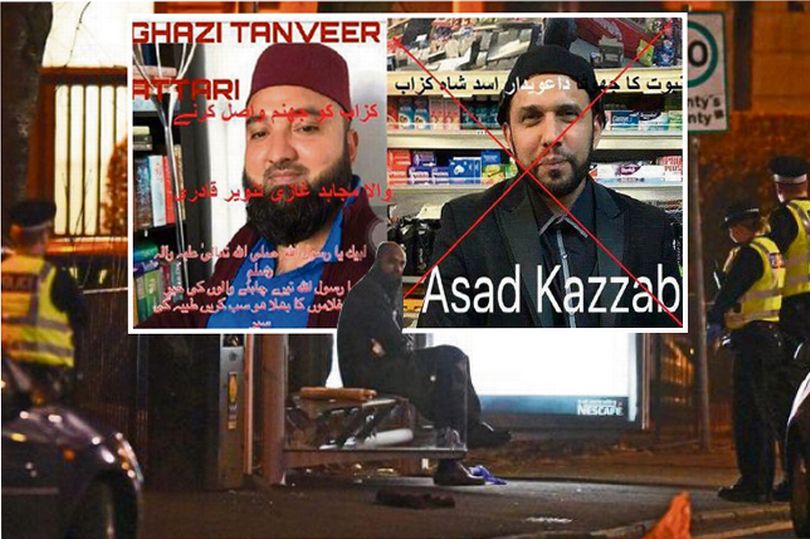
Islamic Hero #3: Tanveer Ahmed, who murdered for Muhammad in Britain (Ahmed is described as ghazi, “hero,” and his victim Asad Shah as kazzab, “liar”)
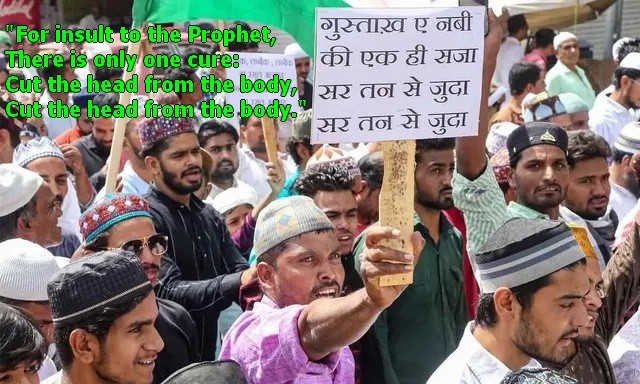
Ilm Ud-Deen’s heroic defence of the Prophet’s honor explains why there are shrines devoted to his memory in modern Pakistan. A movie was released there in 2002 celebrating his love of the Prophet and noble self-sacrifice (you can watch it for free at Youtube). It’s called Ghazi Ilmuddin Shahid, which means Hero Ilmuddin the Martyr. To millions of Pakistanis that’s exactly what he is. He’s a hero for killing the Hindu blasphemer and a martyr for welcoming the execution that followed.

Given the continuing veneration of Ilm ud-Deen in Pakistan, it’s no surprise that in 2011 another devout Muslim followed his golden example and became a ghazi-shahid too. Mumtaz Qadri was a bodyguard for the Pakistani minister Salmaan Taseer. But Taseer tried to help the Christian woman Asia Bibi, who was rotting on death-row after a righteous conviction for blasphemy. Taseer “advocated reform of Pakistan’s controversial blasphemy laws,” so Qadri did the decent thing and machine-gunned him to death, then calmly accepted arrest, imprisonment, and execution. His golden example inspired another yet devout Muslim, this time one living in Britain. After his arrival here from Pakistan, Tanveer Ahmed was horrified to learn that an Ahmadi heretic called Asad Shah was disseminating blasphemous videos from his shop in Glasgow. So Tanveer got in his taxi and drove up from Bradford in 2016 to do the decent thing. He stabbed and stamped Asad Shah to death, then calmly accepted arrest and imprisonment for murder.

Murderous Mumtaz was a “true Muslim”

If Britain still had the death-penalty, he would have accepted execution just as calmly. He didn’t get to be a shahid, a “martyr,” but he’s still a ghazi, a “hero,” to many mainstream Muslims in Britain. For example, Glasgow Central Mosque and the Muslim Council of Scotland refused to take part in an “anti-extremism event” held in memory of Asad Shah. They too thought that Asad Shah was a heretic and deserved all he got. Indeed, only a month before Shah was dispatched to Hell-fire, an imam at Glasgow Central Mosque had expressed his “pain” at the execution of Mumtaz Qadri, the Martyr with a Machine-Gun, called him a “true Muslim,” and pronounced a blessing on him. Kenan Malik’s own newspaper, the Guardian, reported that “One of the largest mosques in Birmingham said special prayers for Qadri, describing him as ‘a martyr’, as did influential preachers in Bradford and Dewsbury’.” Qadri-fans from Pakistan have toured mosques in Britain and praised his heroic defence of the Prophet.

How have Kenan and his comrades responded to this perfectly mainstream Muslim love of violent censorship and hatred of peaceful free speech? Well, to the best of my knowledge, Kenan Malik has never written a word about the murder of Asad Shah or the deep-rooted Pakistani tradition of murder-for-Muhammad that inspired it. The same silence has long been maintained at Spiked, where no senior writer mentioned Asad Shah until 2023, when Spiked’s editor Tom Slater (who isn’t one of Kenan’s original comrades) wrote a detailed article about the murder. But detail didn’t preclude dishonesty. As I described in “Blasphemy and Bullshit,” Slater blamed “liberal cowardice” and “state multiculturalism” for “fuel[ing] Islamic intolerance” and encouraging Muslims “to see themselves as separate and distinct.” Contra Slater’s dishonesty, Tanveer Ahmed came to Britain as an adult with his “Islamic intolerance” fully formed by his upbringing in Pakistan.

“Love Muslim migration, hate free speech”

And Slater doesn’t understand — or pretends not to understand — that “multiculturalism” harmonizes perfectly with mass immigration. Opposing “multiculturalism” and supporting open borders, as Slater and his comrades have always done, is like opposing maggot infestation and supporting open wounds. When the elite of a civilized nation is on the side of the ordinary people in that nation, it does not allow mass immigration from the Third World. That’s why Frank Furedi’s homeland of Hungary is not troubled by rape-gangs, suicide-bombing, murder-for-Muhammad, and other aspects of Islamic enrichment. However, when the elite of a nation is hostile to the ordinary people of that nation, it imposes Third-World immigration on the ordinary people no matter how much they protest. At the same time, the hostile elite privileges the Third-World invaders over the White natives and allows them to pursue their own advantage at all turns.

You can see this elite betrayal in Britain, which has had an official policy of multiculturalism, just as much as in France, which has had an official policy of monoculturalism. In other words, the imposition of Third-World immigration by a hostile elite harmonizes perfectly with the incubation of Third-World pathologies. Kenan Malik and Spiked never point out that the greatest enemies of free speech, like Labour in Britain and the Democrats in America, are simultaneously the greatest supporters of Third-World immigration. Nor do they point out the rarity and fragility of free speech. Across almost all the world throughout almost all of history, tyrants and religious believers have maintained their power by silencing their critics with violence and imprisonment. Given their own political history, Malik and Spiked should need no reminding that it was the freedom-hating Josef Stalin who triumphed over the freedom-loving Leon Trotsky.

Peril-Sensitive Sunglasses

Not that Trotsky was a genuine lover of freedom. He might well have become a worse tyrant than Stalin if he’d won the battle for supremacy. Malik and Spiked aren’t genuine lovers of freedom either. If they were, they wouldn’t have ignored the horrific murder of Asad Shah for so long. When Tom Slater finally broke that shameful silence at Spiked, he complained that Shah’s “name doesn’t mean much to people in Britain today. But it really should.” I fully agree. That’s why I’ve been writing about the murder of Asad Shah ever since it happened: see here, here, here, here, here, here and here. But alas, I’m a crazed far-right extremist and I don’t have the mainstream audience enjoyed by Spiked and by Kenan Malik at the Observer, the Sunday version of the Guardian. If Kenan & Komrades had written regularly and often about Asad Shah, he would now be much better known. But if they’d done that, they would have contradicted their own bullshit about “multiculturalism” rather than migration being to blame for “Muslim identity politics” in the West.

As I’ve said, that theory falls apart when it’s set against reality. That’s why Kenan Malik, for example, has protested loudly about Uyghur Muslims being persecuted by kaffir communists in China even as he’s ignored the murder of Asad Shah in Glasgow and the fashion-phobic mob in Lahore. If Lewis Carroll and the Marquis de Sade are writing the script for Pakistan, then it’s Douglas Adams (1952–2001), author of the Hitchhiker’s Guide to the Galaxy, who’s writing the script for Kenan & Komrades:

Joo Janta 200 Super-Chromatic Peril-Sensitive Sunglasses have been specially designed to help people develop a relaxed attitude to danger. At the first hint of trouble, they turn totally black and thus prevent you from seeing anything that might alarm you. (From Douglas Adams’ The Restaurant at the End of the Universe (1980), chapter 5)

Metaphorically speaking, Kenan & Komrades have been wearing Joo Janta Peril-Sensitive Sunglasses for decades. But the real problem isn’t that they’re blind to the truth about Islam and Third-World migration, it’s that they see the truth and then refuse to be honest about it. That’s why they’ve ignored so many inconvenient stories about Muslim love of Muhammad and hatred of free speech. As I said above, Lewis Carroll had the upper hand on the dress-script, rather than the Marquis de Sade. But the Marquis had the upper hand on this script for lovers of Muhammad:

A mob in Pakistan tortured, killed and then set on fire a Sri Lankan man who was accused of blasphemy over some posters he had allegedly taken down. Priyantha Diyawadana, a Sri Lankan national who worked as general manager of a factory of the industrial engineering company Rajco Industries in Sialkot, Punjab, was set upon by a violent crowd on Friday.

In horrific videos shared across social media, Diyawadana can be seen being thrown on to the floor, where hundreds began tearing his clothes, violently beating him. He was tortured to death and then his body was burned. Dozens in the crowd can also be seen taking selfies with his dead body. The incident began when rumours emerged that Diyawadana, who had been manager of the factory for seven years, had taken down a poster bearing words from the Qur’an. By the morning, a crowd began to gather at the factory gates and by early afternoon they had charged into the factory and seized Diyawadana. (Man tortured and killed in Pakistan over alleged blasphemy, The Guardian, 3rd December 2021)

If Kenan Malik and Spiked were genuinely concerned with defending free speech, they would write about stories like that. There’s no shortage of them from Pakistan and other Muslim countries. But alas, if Kenan & Komrades wrote about horrific stories like that, they would find it much harder to plug bullshit like this:

Discussions about ideas or social practices or public policy should be as unfettered as possible. But when disdain for ideas or policies or practices become transposed into prejudices about people, a red line is crossed. It’s crossed when castigation of Islamism leads to calls for an end to Muslim immigration. (“Blurring the line between criticism and bigotry fuels hatred of Muslims and Jews,” The Observer, 3rd March 2023)

That’s Kenan Malik in the Sunday version of the Guardian. He wants both discussion about ideas and Muslim immigration to “be as unfettered as possible.” But the murder of Asad Shah proves that “Muslim immigration” is very bad for “discussion of ideas.” That’s why Kenan has ignored the murder of Asad Shah. He’s also ignored the fact that ideas do not have to be accompanied by immigration. Here is an image of a Muslim expressing an idea in India:

A Muslim offers some wholesome head-chopping advice in Hindi script (image from OpIndia)

The Hindi script on the placard reads Gustākh-e-nabi ki ek hi sazā, sar tan se judā, sar tan se judā, which means “For insulting the Prophet, there is only one punishment: cut the head from the body, cut the head from the body!” It’s the same wholesome head-chopping advice that I discussed at the beginning of this article (or nearly the same: it uses nabi for “prophet” rather than rasūl).

That’s the magic of writing, you see: it allows ideas to fly across vast stretches of space and time without any accompanying body or brain. The Muslim is in India, I’m in Britain. I’ve seen his “idea” and I reject it. But alas: Muslims who accept the same idea have colonized Britain in ever-growing numbers. Tanveer Ahmed accepts that idea. That’s why he triumphed in his “discussion” with the heretical Asad Shah in Glasgow. Asad wanted to shake hands with his opponent; Tanveer wanted to murder his opponent. It was Tanveer who won the discussion and who strengthened his violent form of Islam at the expense of Asad’s peaceful form of Islam.

Phony friend of free speech

As Kenan Malik never told you, Asad Shah had been granted asylum in Britain precisely because he was at threat of violence in Pakistan. But Pakistan followed him to Britain thanks to Britain’s insane and evil immigration policies. When you import Third-World people, you inevitably import Third-World pathologies with them. But it isn’t just the murderous intolerance of mainstream Pakistani culture that Britain has imported. It’s also the rape-culture of Pakistan. And the horrible genetic diseases caused by the Pakistani tradition of marrying close relatives. How does Kenan Malik respond to all these pathologies? To the best of his ability, he ignores them completely. But he claims that “a red line is crossed” when those who oppose “Islamism” call for “an end to Muslim immigration.” So there you have Malik’s “red line.” Not the murder of Asad Shah, which he ignored, but any call for an end to Muslim immigration.

In other words, Malik isn’t a genuine friend of free speech and isn’t a genuine opponent of identity politics. That’s why he ignores horrific stories about Muslim intolerance and why he uses weasel-words like “Islamism.” I don’t think murderers like Mumtaz Qadri and Tanveer Ahmed are “Islamists.” I think they’re perfectly mainstream Muslims. I think the same of the Muslims at Glasgow Central Mosque who refused to attend the “anti-extremism event” for Asad Shah and who pronounced a blessing on Mumtaz Qadri, the Martyr with a Machine-Gun.

“Love Muhammad, hate free speech”

But I’m a crazed right-wing extremist, so I’m sure that Kenan Malik won’t take my word for it. That’s fine. He can take the word of his own newspaper instead. In 2011 Saeed Shah, the Guardian’s correspondent in Islamabad, reported that “mainstream religious organisations applauded the murder of Salmaan Taseer, the governor of Punjab, earlier this week and his killer was showered with rose petals as he appeared in court.” In 2014, the Guardian was back with an update: “A mosque named in honour of the killer of a politician who called for the reform of Pakistan’s controversial blasphemy laws is proving so popular it is raising funds to double its capacity.”

Is Kenan Malik wearing his Joo Janta Peril-Sensitive Sunglasses when stories like that make their regular appearance in his own newspaper? Do the sunglasses “turn totally black and thus prevent him from seeing anything that might alarm him”? No, that’s not what happens. The problem with Kenan & Komrades isn’t their eye-wear but their dishonesty and refusal to admit the truth. Murder for Muhammad is mainstream in Islamic countries. Thanks to Muslim immigration, murder for Muhammad is becoming mainstream in Britain too. And in France, where cartoonists have been massacred and a schoolteacher beheaded by yet more imported lovers of Muhammad and haters of free speech. Lying leftists are responsible for those murders. But so are lip-sealed libertarians.

https://www.theoccidentalobserver.net/wp-content/uploads/2018/06/TOO-Full-Logo-660x156-1.png 0 0 Tobias Langdon https://www.theoccidentalobserver.net/wp-content/uploads/2018/06/TOO-Full-Logo-660x156-1.png Tobias Langdon2024-03-08 09:06:012024-03-09 01:37:21The Sweet Smell of Head-Chopping… And the Stench of Silence from Libertarians
Page 4 of 512345
Subscribeto RSS Feed

Kevin MacDonald on Mark Collett’s show reviewing Culture of Critique

James Edwards at the Counter-Currents Conference, Atlanta, 2022

Watch TOO Video Picks

video archives

DONATE

DONATE TO TOO

Follow us on Facebook

Keep Up To Date By Email

Subscribe to get our latest posts in your inbox twice a week.

Name

Email


Topics

Authors

Monthly Archives

RECENT TRANSLATIONS

All | Czech | Finnish | French | German | Greek | Italian | Polish | Portuguese | Russian | Spanish | Swedish

Blogroll

  • A2Z Publications
  • American Freedom Party
  • American Mercury
  • American Renaissance
  • Arktos Publishing
  • Candour Magazine
  • Center for Immigration Studies
  • Chronicles
  • Council of European Canadians
  • Counter-Currents
  • Curiales—Dutch nationalist-conservative website
  • Denmark's Freedom Council
  • Diversity Chronicle
  • Folktrove: Digital Library of the Third Way
  • Human Biodiversity Bibliography
  • Instauration Online
  • Institute for Historical Review
  • Mondoweiss
  • National Justice Party
  • Occidental Dissent
  • Pat Buchanan
  • Paul Craig Roberts
  • PRIVACY POLICY
  • Project Nova Europea
  • Radix Journal
  • RAMZPAUL
  • Red Ice
  • Richard Lynn
  • Rivers of Blood
  • Sobran's
  • The European Union Times
  • The Occidental Quarterly Online
  • The Political Cesspool
  • The Raven's Call: A Reactionary Perspective
  • The Right Stuff
  • The Unz Review
  • Third Position Directory
  • VDare
  • Washington Summit Publishers
  • William McKinley Institute
  • XYZ: Australian Nationalist Site
NEW: Individualism and the Western Liberal Tradition

Also available at Barnes & Noble

Culture of Critique

Also available at Barnes & Noble

Separation and Its Discontents
A People That Shall Dwell Alone
© 2025 The Occidental Observer - powered by Enfold WordPress Theme
  • X
  • Dribbble
Scroll to top

By continuing to browse the site, you are legally agreeing to our use of cookies and general site statistics plugins.

CloseLearn more

Cookie and Privacy Settings


How we use cookies

We may request cookies to be set on your device. We use cookies to let us know when you visit our websites, how you interact with us, to enrich your user experience, and to customize your relationship with our website.

Click on the different category headings to find out more. You can also change some of your preferences. Note that blocking some types of cookies may impact your experience on our websites and the services we are able to offer.

Essential Website Cookies

These cookies are strictly necessary to provide you with services available through our website and to use some of its features.

Because these cookies are strictly necessary to deliver the website, refusing them will have impact how our site functions. You always can block or delete cookies by changing your browser settings and force blocking all cookies on this website. But this will always prompt you to accept/refuse cookies when revisiting our site.

We fully respect if you want to refuse cookies but to avoid asking you again and again kindly allow us to store a cookie for that. You are free to opt out any time or opt in for other cookies to get a better experience. If you refuse cookies we will remove all set cookies in our domain.

We provide you with a list of stored cookies on your computer in our domain so you can check what we stored. Due to security reasons we are not able to show or modify cookies from other domains. You can check these in your browser security settings.

Other external services

We also use different external services like Google Webfonts, Google Maps, and external Video providers. Since these providers may collect personal data like your IP address we allow you to block them here. Please be aware that this might heavily reduce the functionality and appearance of our site. Changes will take effect once you reload the page.

Google Webfont Settings:

Google Map Settings:

Google reCaptcha Settings:

Vimeo and Youtube video embeds:

Privacy Policy

You can read about our cookies and privacy settings in detail on our Privacy Policy Page.

Privacy Policy
Accept settingsHide notification only