O “putsch” de Reuss na Alemanha

Suponho que o leitor esteja informado dos estranhos acontecimentos que se passaram na Alemanha, recentemente, quando o príncipe Henrique XIII de Reuss e uma vintena de seus conspiradores foram detidos pela polícia política do regime dominante em Berlim. Toda a mídia do sistema dedicou suas manchetes ao suposto pronunciamento de um conciliábulo de radicais de direita empenhados em subverter a sublime ordem da República Federal da Alemanha, a qual serve de modelo para todas as democracias modernas.

Espanta, mas encanta, a reaparição na história do minúsculo e extinto Principado de Reuss, cuja linhagem foi fundada por Erkenberto, senhor de Weida. O imperador Henrique VI decretara que todos os descendentes varões dessa casa chamar-se-iam Henrique. Até o ano de 1300, esses príncipes, que dominavam Weida, Gera, Schleiz e Plauen, foram conhecidos como “Reussen”, ou seja, “Russos”. Isso se deveu ao matrimônio de Henrique de Plauen com Chwihowska, filha de Brzetislav IV Chwihovsky e da princesa ruríquida Maria. No século XV, passaram a ter assento no Colégio de Príncipes do Sacro Império Romano-Germânico como burgrávios de Mísnia. Algumas gerações depois, a casa de Reuss se dividiu em três ramos e conseguiu sobreviver a Carlos V, a Luís XIV, a Frederico o Grande, a Napoleão, a Metternich e a Bismarck. Até 1918, os príncipes de Reuss foram cabeças de gato [ou cabeças de rato, isto é, chefes menores, mas autônomos, por oposição a “colas de león”, ou seja, rabos de leão, metáfora do ditado espanhol para significar chefes menos autônomos de poderes maiores (n. do trad.)] do II Reich, quando seu pequeno Estado se dissolveu na Revolução de Novembro. Todas essas referências, eu as colhi do Almanaque de Gotha, mais confiável do que as tendenciosas e infectas Wikipédias da vida. Os meus familiares mais antigos e tradicionais me diziam que o melhor guia para o conhecimento das coisas da bonne compagnie [círculos sociais da nobreza], guia infalível mesmo, era o velho almanaque de Justus Perthes, o referido Almanaque de Gotha. Não duvido, eu sou fiel às palavras, tradições e preconceitos de meus antepassados. O pequeno problema é que o Gotha deixou de ser publicado na II Guerra Mundial e meus dados possivelmente estejam desatualizados. Melhor assim.

O caso é que, neste último mês, as redações de periódicos alemães começaram a receber informes da polícia política dando conta de uma operação secreta em curso contra um perigosíssimo núcleo de conspiradores, formado pelo príncipe Henrique e uma vintena de zelotes. Foi dado destaque especial à presença da juíza Birgit Malsack-Winkemann na célula subversiva. Ex-deputada do AfD [Alternative für Deutschland: Alternativa para a Alemanha, partido de direita da Alemanha (n. do trad.)], essa senhora foi representada como uma perigosa terrorista, uma Calamity Jane, una Monja Alférez, uma Bonnie sem Clyde, una Hanna Reitsch, uma espécie de Lara Croft. Apesar de um pouquinho avançada em anos, já quase na melhor idade, as credenciais que lhe confere seu conhecimento das artes marciais e da operação de comandos especiais, além de sua habilidade como franco-atiradora, capacitaram-na para tomar de assalto (sozinha!) o Bundestag, “informa” a mídia escrota do regime alemão. Nunca se viu uma trama tão bem ideada desde aquela do famoso Walter nos tempos de O Grande Lebowski. O plano era genial e só a traição de um delator pôde arruiná-lo: cerca de setenta macróbios alemães iriam tomar o controle de um país com 80 milhões de habitantes.

Claro que as perguntas não tardaram. O chanceler social-democrata Scholz não pode deixar de ser parabenizado por haver salvo a democracia alemã — e toda a Europa — de tão perigosa circunstância, mas algumas questões não foram bem explicadas. A primeira é que um segredo conhecido de todas as redações dos periódicos não é um segredo. Qualquer operação verdadeiramente grave é levada a cabo sob rigoroso sigilo, não é anunciada até no Bild. A polícia política do regime alemão cometeu falha grave ao dar tanta publicidade a uma diligência tão delicada. Por outro lado, um putsch de verdade, como aquele de Kapp (1920) ou Hitler (1923), se organiza com o apoio do exército, ou de parte dele, por questão bem simples: sem o apoio dos militares, qualquer intentona golpista está destinada a fracassar. Quando se tenta derrubar um regime pela força, o que não pode faltar é isso mesmo, ou seja… Força. Não que escasseassem militares na reduzida e seleta tropa do príncipe Henrique, na Agincourt particular do prince Harry de Reuss, mas eram velhos milicos já reformados e sem acesso a nenhum armamento mais pesado do que a barriga deles. Sem dúvida, a democracia europeia corre perigo de subversão violenta, haja vista a recente onda de atentados por carta-bomba aqui na Espanha e os golpes de Estado na Alemanha. Devemos, pois, reforçar os poderes da polícia secreta para vigiar a tresloucada militância da extrema direita. Em lugar de atacar os moinhos de vento do islamismo, o melhor a fazer é combater as odiosas realidades das conspirações soberanistas. Estas, sim, devem estar no centro de nossas preocupações como objeto de nosso mais veemente repúdio.

Curioso, também, é o pensamento do príncipe Henrique: conforme este aristocrata, o Principado de Reuss foi suprimido de forma ilegítima por um golpe de Estado (a Revolução de Novembro de 1918), e a atual Alemanha, além disso, não é Estado soberano, pois segue ocupada por seus vencedores ianques, que mantêm a enorme base de Ramstein (50 mil homens), além de outras em Ansbach, Pirmasens, Husterhohe, Weilimdorf e Wiesbaden. A situação colonial da Alemanha decorre do Tratado de Paris (1947), que impôs as condições draconianas da paz, quando já não havia nenhum Estado alemão independente com o qual negociar. A própria Lei Fundamental de Bonn renegava a soberania nacional e a cedia às potências ocupantes, no caso de existir um regime que não fosse do agrado dos vencedores.

A Alemanha que rechaçou há um século o Diktat de Versalhes assume hoje com íntima e firme convicção sua condição de escrava dos Estados Unidos. Um dos grandes erros de Stalin foi pensar em reconstruir a nação alemã, unida e neutra, depois da Guerra.. Nem os anglo-saxôes nem os seus lacaios, como Adenauer, um antigo separatista renano, estavam dispostos a isso. E continuam não querendo uma Alemanha livre. Nessas condições, o príncipe Henrique exige que se restaure um Estado alemão soberano, que lhe seja devolvido Reuss, e que se estabeleça um processo constituinte na Alemanha, concomitantemente ao estabelecimento de verdadeiro tratado de paz com as grandes potências.

Eis o verdadeiro crime do príncipe Henrique: desejar devolver a independência e a soberania à Alemanha. No momento em que Scholz sacrifica a indústria e o bem-estar dos alemães aos interesses dos Estados Unidos, alguém pode imaginar o impacto que pode ter a pitoresca negação da submissão teutônica aos interesses ianques? Não haverá alemães que agora perguntam por que devem sacrificar seu presente e seu futuro no altar dos objetivos puramente egoístas dos Estados Unidos? Não haverá alemães buscando entender o porquê de a Alemanha se encontrar desarmada, quando sofre guerra comercial de Washington, que lhe ataca com verdadeira sanha? Ainda que não seja mais a nação ganhadora dos prêmios Nobel, decerto haverá ainda alguns crânios dolicocéfalos na Alemanha, sobretudo no Leste, que possam conceber a arriscada ideia de recuperar a independência nacional e pôr abaixo o vergonhoso edifício social-democrata, cujo vigamento tem base nas crateras escavadas pelas bombas dos ocupantes ianques. Eles existem, sim, e parece que são cada vez mais numerosos. Essa é a chave para o entendimento do episódio que a mídia representa como estranho e atentatório, buscando demonizar o inofensivo e excêntrico príncipe Henrique. Trata-se de uma mensagem de advertência que o regime alemão manda para os patriotas e dissidentes mais sérios.

Fonte: El Manifiesto. Autor: Sertorio. Título original: El “putsch” de Reuss en Alemania. Data de publicação: 11 de dezembro de 2022. Versão brasilesa: Chauke Stephan Filho.

Jews Who Deny Jewish Guilt for Soviet Crimes Will Go To Hell

A couple of weeks ago, Jewish conservative Dennis Prager went “death con 3” against Nick Fuentes. Although he didn’t produce a quote or a source, Prager accused Fuentes of claiming that a mere “few hundred thousand” Jews were killed in the Jewish Holocaust rather than the canonical figure of six million. The shamelessly manipulative title of his article says it all: “If Holocaust Deniers Don’t Go to Hell, There  is no God.” It’s as if Dennis Prager has a direct line to the Big Man Upstairs, and is informing the unfortunate Mr. Fuentes of the toasty place waiting for him once he buys his Nazi farm in the sky.

The article was certainly a lazy piece of White shaming. Prager could not spare an insult for Black “death con” coiner Kanye West who last month trumpeted his denialism more noticeably than did Fuentes. Prager basically called Jewish Holocaust denial a sin and a lie. He said it was anti-Semitic. He dredged up quotes from Generals Dwight Eisenhower and George Patton, who witnessed actual Jewish suffering and death at the end of the Second World War. Then after a For Dummies summary of anti-Jewish atrocities and a tragic personal anecdote which may or may not have happened, Prager damns Fuentes’ soul to eternal hellfire.

I wonder if Prager’s editor or his readership realize how pernicious this article is. If someone is going to Hell anyway, how much of a sin would it be to strip him of his rights, or incarcerate him without trial, or even kill him? That would be nothing compared to what God has in store for him. It fact, it would be doing God’s work here on Earth. Was Dennis Prager inciting violence against Nick Fuentes? Was he giving the old wink-wink, nudge-nudge to people who might oppress him? Or was he using the Jewish Holocaust like a carrot and stick to coerce Christians into not annoying the American Jewish elite?

See, goyim? Repeat the words “six million” a bunch of times and ya got it made. And if you don’t, well, not only will we make your life be a living Hell, but after you die, you’ll face the real thing.

Either way, it was gob-smackingly arrogant on Prager’s part to assume the role of supernatural traffic cop, determining who gets to go where until the end of time. Does this mean that a person who thinks a mere half million died will be banished to a deeper circle of Hell than someone who sticks to the still-scandalously low tally of 4.5 million? Note also how Prager is directing traffic away from free inquiry. He’s not encouraging people to examine the data and come to their own conclusions. Instead, he and God are pronouncing the mainstream Jewish Holocaust narrative as gospel. Question it even in good faith, and lose your soul.

Well, since one bad turn deserves another, I think I will relieve Monsignor Prager at the intersection of Heaven and Hell and start directing post-reaper traffic in a wholly new direction: If you’re Jewish and you deny Jewish complicity in the formation and atrocities of the Soviet Union, which wasted over 80 million lives over 70 years, then you are evil, you are going to Hell, and you really shouldn’t be too surprised when people start resenting you for it. It’s that pesky little anti-Semitism thing—which never seems go away, does it?

Here is a brief bullet list of things Jews everywhere should feel guilty for (and unlike the sanctimonious obscurant Prager I will provide sources in case anyone wishes to investigate further):

  • Aleksandr Solzhenitsyn describes many 19th century Russian Jews as energetic organizers of revolution. These Jews were, radical, violent, and unstable people who did not shy away from becoming “detonator[s] for the revolution” in both a literal and figurative sense. Contemporaneous sources claim that anywhere from one quarter to one half of all left-wing radicals in pre-revolutionary Russia were Jews. (Two Hundred Years Together, Aleksandr Solzhenitsyn. Chapter 6, unofficial translation published at www.twohundredyearstogether.wordpress.com)
  • Jews were vastly overrepresented among the Bolsheviks taking part in the October Revolution. Vladimir Lenin himself attested that the presence of so many intelligent and well-connected urban Jews “saved the Revolution at a difficult time.” (The Jewish Century, Yuri Slezkine. Princeton University Press, 2004. p 155 & 224.)
  • Solzhenitsyn describes how the first Soviet secret police, known as the Cheka, was not only disproportionately Jewish but thoroughly dedicated to terror. It routinely meted out the death penalty without trial, and murdered innocents by the thousands. In striving towards its goal of the “physical extermination of all servants of Czarism and capitalism” the Cheka annihilated entire villages. In the Crimea from 1917 to 1921, which became known as the “All-Russian Cemetery,” the Red Army, led by the Jew Leon Trotsky and his Jewish subordinates Ephraim Sklyanksy and Jacov Sverdlov, murdered between 120,000 and 150,000 people. (Two Hundred Years Together, Aleksandr Solzhenitsyn. Chapter 16. Columbus Falco, translator)
  • Solzhenitsyn demonstrates how overpopulated with Jews the early Soviet administrative leadership was. This includes the politburo itself and various executive committees, central committees, and revolutionary congresses. (Two Hundred Years Together, Aleksandr Solzhenitsyn. Chapter 18. Columbus Falco, translator)
  • In 1932 and 1933, Lazar Kaganovich, Stalin’s Jewish yes man, was instrumental in the deportation and incarceration of over 268,000 Cossacks and other villagers in the Northern Caucasus. (The Black Book of Communism, Courtois et al. Harvard University Press, 1999. pp 162-163)
  • In 1932, the Jew Naftali Frenkel oversaw the construction of the White Sea-Baltic Canal, and worked to death around 200,000 gulag slaves. Jews made up the majority of the camp’s chief overseers. (Stalin’s War Against the Jews, Louis Rapoport. The Free Press, 1990. p 44)
  • Jews were overrepresented in the murderous Soviet security apparatus during the Great Terror of the 1930s . 42 of the NVKD’s 111 top officials were Jews, and 12 of the NKVD’s 20 directorates during this time, including the gulag system, were headed by Jews. Over two million people lost their lives during the Great Terror. (The Jewish Century, Yuri Slezkine. Princeton University Press, 2004. p 103 & 254.)
  • “An Israeli student finishes high school without ever hearing the name ‘Genrikh Yagoda,’ the greatest Jewish murderer of the 20th century, the GPU’s deputy commander and the founder and commander of the NKVD. Yagoda diligently implemented Stalin’s collectivization orders and is responsible for the deaths of at least 10 million people. His Jewish deputies established and managed the gulag system.” (“Stalin’s Jews,”, Sever Plocker. YNet News, 2006)
  • From 1925 to 1933, the Jew Filipp Goloshchyokin ran the forced collectivization in Kazakhstan, causing a famine known as the “Goloshchyokin genocide,” which killed between one and two million people. (“The Kazakh Famine of 1930-33 and the Politics of History in the Post-Soviet Space”, Elena Volkava. The Kennan Institute, Undated)

This list is hardly comprehensive, but I’m sure it’s enough to demonstrate that unless Dennis Prager also insists we not deny Jewish complicity in the above, he has no room to lecture anyone on how to get into Heaven or Hell.

The double standard here is that Jews get a free pass on collective guilt while White Christians do not. And yes, gentiles have their fair share of guilt from the early Soviet period. But not only were Jews overrepresented among the worst Soviets, but without them, according to Lenin, the most murderous regime in modern history up to that point would never have existed at all. How could any Jew not feel at least a little bit guilty over that?

One can argue that I take the same For Dummies approach Prager does, and then chide me for not digging deeper for nuance. Perhaps this or that particular Jew was not as guilty as he seems (as is probably the case), or perhaps circumstances were a bit more nebulous than I portray (as reality often is). I happily concede this. On the other hand, when gentiles try to ascertain similar nuance with the Jewish Holocaust—and perhaps wish to revise down that six million figure a smidge, or question some of the dubious scholarship surrounding Auschwitz, or note that Amon Göth might have been maligned just a tad in Schindler’s List—they meet with belligerent resistance from Jews like Prager. And Prager is one of the more moderate ones. So if gentiles are prohibited from investigating the Jewish Holocaust for humanizing nuance, why should any gentile give a whit if Jews try to do the same with the Holodomor and the Gulag Archipelago?

Finally, one can argue that the large number of Jews killed by the Soviets (1.5 million during the Stalin era, according to Louis Rapoport) balances out the Jewish perpetrators of the above crimes. The Jewish people, therefore, should be exonerated. If so, then the much larger number of White gentiles killed by the Nazis during the Second World War must also balance out whatever atrocities the Third Reich committed. Such an argument exonerates White people from their sins just as the Jews exonerate themselves from theirs. This should also force Dennis Prager to stop using the Jewish Holocaust as a weapon to control his political opponents.

He should probably stop doing that regardless, lest one day he realize that the person most likely going to Hell is him.

The Outrageous Statements of Jewish Israeli Homosexual Transhumanist Vegan Yuval Noah Harari

In a recent The Occidental Observer essay titled “Life Without Jews: The Amazing Adventures of Israeli Trans-Pedophile and Tampon-Fetishist Jonathan Yaniv,”  author Tobias Langdon recounts the grotesque and perverted—and typically Israeli Jewish—behavior of this being who had the “attention of millions of people around the world” for just one of his/her vile acts.

Inspired by the topic, here we will examine the outrageous behavior of another Israeli Jew who has attracted the attention of many millions around the world. Yuval Noah Harari is described as an “advisor” to the globalist transhumanist cult of power known as the World Economic Forum, whose Executive Chairman Klaus Schwab has openly stated it is developing “a fusion of our physical, biological and digital identities” for all humankind. Amazingly, Harari’s public statements, many of them made from the main stage at the annual World Economic Forum conference where he has become a favorite keynote speaker, are far more outrageous and outraging than even Schwab’s. Almost half the age of Schwab, Harari at 46 is less likely to be an “advisor” than a spokesman for the sociopathic transhumanist futurology the World Economic Forum is not only envisioning, but increasingly imposing over today’s world through its many partners.

Harari’s popularity and influence is immense. From his About website:

Prof. Yuval Noah Harari is a historian, philosopher, and the bestselling author of Sapiens: A Brief History of Humankind, Homo Deus: A Brief History of Tomorrow, 21 Lessons for the 21st Century, and the series Sapiens: A Graphic History and Unstoppable Us. His books have sold 40 Million copies in 65 languages, and he is considered one of the world’s most influential public intellectuals today.

The World Economic Forum’s bio on Harari further boasts that he has published with the Guardian, Financial Times, the New York Times, the Atlantic, the Economist and Nature magazine. New York Times is of course by the Jewish Sulzberger family, the Economist is still 21% owned by the Rothschilds with Evelyn de Rothschild Chairman for over fifteen years until the late 80s, Nature magazine was co-founded by the early transhumanist Thomas Huxley (grandfather of Aldous Huxley, author of Brave New World), the Guardian “has continued its long-standing tradition of liberal [i.e., radical] politics” (primarily globalist), and the Atlantic is currently majority-owned by the Emerson Collective which promotes non-White immigration, works to “combat the achievement gap among students of color,” and engages in “philanthrocapitalism.” Harari has found suitable outlets for his transhumanist ranting, and/or they have found him.

Harari’s first popular book Sapiens is derived from lectures he gave to his undergraduate world history classes. He began his academic career in the program of the Israeli Defense Forces known as Atuda, which allows high school graduates to defer their mandatory conscription in the IDF to attend university, provided they study topics applicable to the military. Harari published such works as “Strategy and Supply in Fourteenth-Century Western European Invasion Campaigns” in the Journal of Military History, and “The Concept of ‘Decisive Battles’ in World History”, among many others. He was exempted from IDF service due to “an undisclosed health problem” but nothing “catastrophic.”

He lives with his husband on a moshav, an agricultural co-operative, outside Jerusalem. Being gay, he says, helped him to question received opinions. “Nothing should be taken for granted,” he has said, “even if everybody believes it.”

Harari’s husband is also his agent and manager, Itzik Yahav. “He likes to say, ‘You don’t understand—Yuval works for me!’” Yahav declined an invitation to have Harari participate in the World Economic Forum, at Davos, in 2017, because the proposed panels were “not good enough.” A year later, when Harari was offered the main stage, in a slot between Angela Merkel and Emmanuel Macron, Yahav accepted.

At his 2018 addresses at the World Economic Forum, Harari’s outrageous statements found their greatest reach. He participated in four speaking events that year, including two panels titled “Questioning Our Human Future” and “Putting Jobs Out of Work.” It was Harari’s keynote lecture “Will the Future Be Human?” that should concern the rest of humanity most. This is Harari’s opening statement:

We are probably one of the last generations of homo sapiens. Within a century or two, Earth will be dominated by entities that are more different from us than we are different from neanderthals or from chimpanzees. Because in the coming generations, we will learn how to engineer bodies and brains and minds.

Harari speaks with certainty and even excitement about processes for which humanity should have a choice. In his view however, this transhumanist future is inevitable.

  • “This will be decided by the people who own the data. Those that control the data control not just the future of humanity, but the future of life itself.”
  • “We have reached the point where we can hack… human beings and other organisms.”
  • “…the rise of machine learning and AI are giving us the necessary computing power. And at the same time, advances in … brain science are giving us the necessary biological understanding.”
  • “You can really summarize 150 years of biological research since Charles Darwin in three words: Organisms are algorithms.”
  • “When the infotech revolution merges with the biotech revolution, what you get is the ability to hack human beings.”
  • “You will not be able to hide from Amazon, Ali Baba and the Social Police.”
  • “Once we have algorithms that understand me better than I understand myself, they could predict my desires, manipulate my emotions, and even take decisions on my behalf. And if we are not careful, the outcome could be the rise of digital dictatorships.”
  • “If democracy cannot adapt to these new conditions, then humans will come to live under the rule of digital dictatorships. Already at present, we are seeing the formation of more and more sophisticated surveillance regimes throughout the world.”
  • “By hacking organisms, elites may gain the power to re-engineer the future of life itself. … This will be the greatest revolution in biology since the beginning of life four billion years ago.”
  • “Science is replacing evolution by natural selection with evolution by intelligent design. Not the intelligent design of some god above the clouds, but our intelligent design. … These are the new driving forces of evolution.”
  • “If we don’t’ regulate (data), a tiny elite may come to control not just the future of human societies, but the shape of life forms in the future.”
  • “As a historian I can tell you two things about the past: … it wasn’t fun … and it’s not coming back. So nostalgic fantasies are really not a solution.”
  • “We had better call upon our scientists, our philosophers, our lawyers and even our poets—or especially our poets—to turn their attention to this big question: how do you regulate the ownership of data? The future not just of humanity but the future of life itself, may depend on the answer to this question.”

Thus Harari ends his address to the WEF in 2018 with a big question. But there can be little question that the answer of who will regulate the data is those “elites” he appears to warn us about. They are the partners in the WEF, which include the world’s most powerful corporations, the governments of most  current nations of the globe, globalist “think tanks” and Non-Governmental Organizations (NGOs), the world’s military and intelligence agencies, and above all, the most wealthy and powerful Jewish banking family dynasties that top the pyramid of power. These are the “elites” who will own and control the data, and from that, everything else. Harari must know this, since he is their spokesman. Knowing his people will dominate the elite, a digital dictatorship is a future he is looking forward to.

Looking through these key statements, we see that Harari dismisses God more thoroughly than Nietzsche, and replaces Him with the technocratic “elites” which include Harari himself. This is a distinctly Judaic concept. He impresses the inevitability of his technocratic future, and asserts that we cannot return to an unpleasant past to avoid the challenge. He ascribes an omnipotence in the future to those who own the data, and conveys a helplessness among the rest of humanity before this ultimate power over all of life. The god-like “elites” are watching, and there will be no escape.

Harari allows for no glitches in the programs, no side effects from the technologic hacking of humanity, no machine failures, no problems except “digital dictatorships.” Critiques of his books however are more scathing. Canadian Professor of Anthropology Christopher Robert Hallpike stated in a review of Sapiens that:

…one has often had to point out how surprisingly little he seems to have read on quite a number of essential topics. It would be fair to say that whenever his facts are broadly correct they are not new, and whenever he tries to strike out on his own he often gets things wrong, sometimes seriously. … [W]e should not judge Sapiens as a serious contribution to knowledge but as ‘infotainment’, a publishing event to titillate its readers by a wild intellectual ride across the landscape of history, dotted with sensational displays of speculation, and ending with blood-curdling predictions about human destiny.

This past summer,  Current Affairs magazine published “The Dangerous Populist Science of Yuval Noah Harari,” which stated: “The best-selling author is a gifted storyteller and popular speaker. But he sacrifices science for sensationalism, and his work is riddled with errors.”

Last month the German Frankfurter Allgemeine Zeitung called Harari a “brand” created by his partner to sell everything from comic books and children’s stories to videos (a distinctly Jewish approach), and that his fans treat Harari like a “pop star” despite his grim message that humans are obsolete and machines will replace us.

Harari was back as a featured speaker at the World Economic Forum in 2020. He was introduced by the IDF-trained Israeli Jew Orit Gadiesh, who calls herself the “chairman” of Bain Capital (once headed by Mitt Romney), and as I reported in this TOO essay, is on the Board of Trustees of the World Economic Forum. Harari spoke along with the long-time Prime Minister of the Netherlands Mark Rutte, on the topic “How to Survive the 21st Century.” He may have surpassed his 2018 address in outrageous quotes.

  • “…three problems pose existential challenges to our species … nuclear war, ecological collapse and technological disruption.”
  • “…technology may also disrupt human society and the very meaning of human life in numerous ways, ranging from the creation of the global useless class to the rise of data colonialism and of digital dictatorships.”
  • “…automation will eliminate millions upon millions of jobs.”
  • “…the automation revolution … will be a cascade of ever bigger disruptions.”
  • “In the past, humans had to struggle against exploitation. In the 21st century, the really big struggle will be against irrelevance. And it’s much worse to be irrelevant than to be exploited. Those who fail in the struggle against irrelevance will constitute a new useless class. People who are useless, not from the viewpoint of their friends and family of course, but useless from the viewpoint of the economic and political system (sic).  And this useless class will be separated by an ever growing gap from the ever more powerful elite.”
  • “…AI will likely create immense wealth in a few high tech hubs, while other countries will either go bankrupt, or become exploited data colonies.”
  • “…the other major danger we face is the rise of digital dictatorships, which will monitor everybody, all the time.”
  • “We humans should get used to the idea that we are no longer mysterious souls. We are now hackable animals.”
  • “If this power (to hack human beings) falls into the hands of a 21st century Stalin, the result will be the worst totalitarian regime in human history.”
  • “If we allow the emergence of such total surveillance regimes, don’t think that the rich and powerful in places like Davos will be safe.”
  • “…the ability to hack humans might still undermine the very meaning of human freedom.”
  • “…humans will simply not be able to understand the computers’ decisions … [H]umans are likely to lose control over our own lives, and also lose the ability to understand public policy.”
  • “What will be the meaning of human life when most decisions are taken by algorithms?”
  • “If we fail to conceptualize the new hell quickly enough, we might find ourselves entrapped there with no way out.”
  • “…AI and biotechnology will give us god-like abilities to re-engineer life, and even to create completely new life forms.”
  • “Our intelligent design is going to be the new driving force of the evolution of life. In using our new divine powers of creation, we might make mistakes on a cosmic scale. ”
  • “Of course this is not a prophecy. These are just possibilities. Technology is never deterministic.”
  • “To do something effective, we need global cooperation. All the three existential challenges [nuclear war, ecological collapse and technological disruption] that we face are global challenges that demand global solutions.”
  • “If we allow such an arms race to develop in fields like AI and bio-engineering, it doesn’t really matter who wins the arms race. The loser will be humanity.”
  • “In the 21st century, good nationalists must also be globalists.”
  • “If we return there now (the jungle of constant war), our species will probably annihilate itself.”
  • “I very much hope that we can rely on the leaders assembled here, and not on the rats.”

Some of this—even quite a bit of it—may come to be true. We are already seeing increasing gaps between elites and everyone else, surveillance is continually being refined, and already there are powerful forces that seek a dictatorship, digital or otherwise and are eager to rid the public square of traditional freedoms such as free speech. But Harari’s is certainly a dystopian vision that should be resisted at all costs.

The main pattern of Harari’s discourse is fear requiring globalism as a solution. This is the old Hegelian dialectic we have seen many times before, most recently with the Covid pandemic virus as the fear (another invisible menace), and lockdowns and vaccines as the solutions. Harari here admits the possibility of mistakes, but never suggests that his technocratic near future is anything but inevitable. Machines will take over human jobs, and the “useless class” will grow. This is by no means inevitable however, as National Socialist Germany showed with its program of restricting mechanical labor and promoting manual labor in the building of the Autobahn, in order to improve and eventually all but eliminate unemployment. Harari’s techno-future could be heaven, or it could be hell, and even the “rich and powerful” and the “leaders” in Davos could be subject to the hellscape. The closer they are to the peak of the global hierarchy, the more closely they will be watched. That’s how Stalin did it.

Stalin (Dzhugashvili) also had his Jewish “advisors,” and, as the Darling of Davos, Harari will excel among the technocratic elites beside Klaus Schwab, who also was mentored by Jews such as Henry Kissinger and Hermann Kahn, and who also incited fears of global catastrophe. Schwab cites Jewish author Jean-Jacques Servan-Schreiber, who wrote The American Challenge, as a great influence, and Harari cites Jewish author Jared Diamond of Guns, Germs and Steel as his literary influence. As a spokesman for instilling and normalizing the 4th Industrial Revolution that will make humans “hackable animals,” Harari will never become useless like so many of the rest of us. His mad ravings are worshiped among the WEF power elites as revelations straight from the master Machine. But among the rest of us normal humans, Harari must appear a sickly vegan degenerate homosexual  Israeli Jew holding dangerous sociopathic delusions of dystopian grandeur.

Civic Nationalism’s Last Gasp?

The Dying Citizen: How Progressive Elites, Tribalism, and Globalization Are Destroying the Idea of America
Victor Davis Hanson
Basic Books, 2021

Reviewed by Nelson Rosit

Is Victor Davis Hanson Donald Trump with a Ph.D. in classics? There are certain parallels between the author of The Dying Citizen and the forty-fifth president. While Professor Hanson uses the rubric “citizenship,” Mr. Trump uses the acronym MAGA to describe a renewed civic nationalism that might provide enough centripetal force to hold together this multi-ethnic entity called the United States for a while longer.

Hanson (b. 1953), grew up in the San Joaquin Valley and pursued an academic career. He is now a professor emeritus of classics at Fresno State and a senior fellow at the Hoover Institution, a conservative-leaning think tank. Hanson’s latest book is a cogent articulation of the present policy positions of the establishment Right. It can be used to gauge the policy departure from the McCain-Romney Republicanism of the recent past. The important question, however, is: Can “true citizenship”/MAGA/civic nationalism provide any utility for the cause of White America?

VDH realizes that the United States is in crisis. He terms 2020 a revolutionary year, and believes only shock therapy can save the country. His quick assessment of ailments includes growing economic inequality, open borders, the rise of tribalism, the increasing power of a bureaucratic Deep State, and expanding globalism, all of which threaten to undermine American society. Of course, such a diagnosis begs the question: What is the treatment regimen? No nostrum is prescribed.

In his Introduction Hanson makes some common-sense observations: Self-governance is not an easy task, and to have rights people must assume responsibilities. I think the Founders made the point succinctly when they stressed the need for civic virtue to make a representative republic succeed.

Being a classicist, Hanson gives the reader some ancient history. Athens is usually identified as the first democracy. “Consensual government did not appear until about twenty-seven hundred years ago, most prominently in Athens, twenty-five hundred years after the beginning of large urban settlement in the Near East” (6). At least with VDH you do not get theories such as the African origins of Greek civilization as found in Black Athena,[1] or the Iroquois League being the model for American federalism.

The first chapter deals largely with economics, and, from a conventional-Right perspective, Hanson is pretty solid in this area. A strong middle class is essential for political and social stability. Judging from the context of his remarks Hanson includes the more established blue-collar workers in this middle class. The present economic system features stagnant wages and a raising cost of living that squeezes the middle. Massive immigration at home and outsourcing abroad has contributed to economic insecurity, and Hanson believes this has played a role in the decline of marriage. The author notes that most economic experts—men such as Paul Krugman and Larry Summers—state that high-paying production jobs are leaving America, and not coming back. Hanson does not buy that argument, and neither did former president Trump.

De-emphasizing Race

Chapters Two and Three discuss immigration and ethnicity (tribes), and here Hanson shows his respectable conservative stripes. He is against massive immigration, especially when many enter illegally, because it makes assimilation more difficult. Though he knows better, VDH still proclaims American exceptionalism and the magic dirt theory. He admits: “The few unusual countries, ancient and modern, that have tried to unite diverse tribes without imperial coercion have usually fared poorly” (106). The author does not identify those countries that have not “fared poorly,” but in any case, I would remove the modifier ‘usually’ from the above quote. I would also add that the American empire is definitely willing to use coercion to make its multi-ethnic state work. But if one has faith that the United States will be the exception the laws of history then you believe everything will work out in the end. The magic dirt corollary posits that when natives from dysfunctional societies such as Somalia and El Salvador reach the U.S., they will not replicate the cultural characteristics of their homelands, but will instead become model Americans. So far, all the data are against the magic dirt theory.

Due to the author’s belief in assimilation, he differentiates between multiracialism which he approves and multiculturalism which he opposes. A racialist would counter that culture is, in part, a racial construct. Large numbers of migrants who are genetically distant from the majority population make assimilation impossible. But VDH sees tribalism as “reactionary to the core” while clinging to his utopian hopes for these genetically distant migrants: the answer to growing tribalism in the United States is “true citizenship . . . that diminishes the power of ethnic identification and race” (112).

Hanson rightly criticizes the Left for trying to rewrite American history. Yet he indulges in the same practice to support his assimilationist project. He claims: “The United States has always cherished its universally applicable melting-pot ethos of e pluribus unum” (107). Of course, the U.S. has not always had a universalist ethos (e.g., the 1924 immigration restriction law), and the phrase e pluribus unum originally referred to uniting the several former colonies into one nation.

Later in the chapter VDH to “talks the talk” by castigating cultural Marxism and social justice warriors, but he misses the main point. He asks, “So why has twenty-first-century American race and gender victimization supplanted doctrinaire Marxist class oppression in the culture of resistance against established norms?” The reality is that it’s all about destroying White political and cultural hegemony, but Hanson, as a mainstream conservative, can’t accept that. He notes that “Today’s social justice warrior apparently would not wish to empathize with a West Virginia coal miner but prefers instead CNN anchor Don Lemon or billionaire rapper Jay-Z” (115)—implicitly referring to the White working class, but not discussing the obvious racial dynamic of a multi-racial left-liberal elite opposed to the White working class.  In fact, it is racial. Is the man being willfully blind? A little further on Hanson almost stumbles upon the answers his own question, but again the obvious conclusion eludes him. He notes that “old Marxism had once sought to transcend race” (117). Yes, it tried, but it failed to transcend race, and a similar fate will befall the author’s solution of “true citizenship,” because race is an essential human characteristic.

VDH realizes the purpose of the Left’s “assaults on traditional commemoration—from holidays to statues to eponymous street names—is to redefine the past as a way of recalibrating the future” (119)—George Orwell said it best in Nineteen-Eighty-Four: “Who controls the past controls the future: who controls the present controls the past.” But he fails to note these assaults are part of the war on White America The denigration of traditional heroes is, in effect, a psyop against White America.

In keeping with his non-racial civic nationalism Hanson believes “the worst thing about identity politics as currently practiced by the left is that it has stimulated the rise of identity politics on the right” (125). Okay, the Right is always responding to developments on the Left. I would call this a law of political science: The Right is always reactive, though not necessary reactionary. So Edmund Burke, father of modern conservatism, was reacting to the French Revolution, Mussolini was reacting to Lenin, and the January 6th rioters were reacting to the George Floyd riots of 2020. VDH claiming that White self-defense against attacks is worse than the attacks themselves! But race does not really exist, so what is the fuss about? Ignoring all the population genetic studies showing clear genetic clusters corresponding to traditional racial categories, he resorts to simply asserting that “it is difficult to agree upon a definition of what ‘white’ actually is, given that it is not necessarily aligned with superficial appearance” (127). I guess that if it cannot be defined to VDH’s satisfaction, it doesn’t actually exist.

The Deep State

Once Hanson gets away from the issue of race, he begins to make more sense, and in Chapter Four he deals with the Deep State. For decades mainstream political science textbooks have discussed the vast discretionary authority wielded by unelected, upper-level bureaucrats, not to mention the power of the military-industrial complex. However, when the Right began to criticize these entities as the Deep State, it was immediately labeled nothing but a conspiracy theory. Likewise, one can celebrate the growing ethnic diversity of America, but if it is termed “The Great Replacement,” it is a conspiratorial hoax. In his opposition to powerful centralized bureaucracy and other unelected institutions, I detect some libertarian leanings in his attitude toward government. My own view is that government is simply a vehicle; who is behind the wheel is what matters. There’s nothing inherently wrong with centralized government. Government is a vehicle that can take you where you want to go, or it can careen off a cliff.

Trump

Hanson is generally pro Trump in a nuanced way. In 2019 he published The Case for Trump in which he wrote that, although a flawed character, the president had a coherent agenda and had implemented much of it.[2] By 2019 almost everyone on the Dissident Right was very disappointed with Trump, some bitterly so. There were several reasons why Trump failed to meet expectations, and certainly opposition from the Deep State was one. In 2016–17 Trump, the tough guy New York real estate mogul, was a babe in the woods.

As a political novice who ran against both the Democrats and the GOP establishment Trump struggled to find talented and loyal administrators to fill top executive branch positions. His newly appointed National Security Advisor Ret. General Michael Flynn was the victim of a “government ambush” (171). The legitimacy of Trump’s 2016 election was questioned by the Russian Collusion Hoax. Robert Mueller put together “perhaps the most high-powered and experienced team of investigators even assembled by the Department of Justice” (174). After 22 months and 40 million dollars no Russian collusion with members of the Trump campaign was found.

After the failure of the Mueller investigation, impeachment was the next tactic used to hamstring the Trump presidency and render him un-reelectable.  During the Trump administration members of the executive branch exhibited “an unabashed audacity” in resisting the authority of the president. For example, former FBI Director James Comey wrote a book, A Higher Loyalty, which “publicized the deep state’s sanctimonious notion that violating laws and protocols in service of its own purported higher ethical agendas . . . was more than justified” (184).

The Constitution

Hanson shares with American conservatives a reverence for the U.S. Constitution. It is almost a fetish. I certainly hold the Founding Fathers in the highest esteem, but if the Constitution is our salvation, we would not be in the predicament we are in now. The Constitution is open to differing interpretations, and it can be and has been amended. Nevertheless, the document does act as an impediment to radical change from the Left. Hanson sums up the Left’s position: “[W]hy let old white men of a bygone age continue, from their graves, to impose their ossified values on a far more enlightened, ethnically and racial diverse, and knowledgeable twenty-first century nation?” (217).

According to Hanson several parts of the Constitution are vulnerable to being dismantled or circumvented. The Electoral College, an integral component of our federalist system, is one example, and the erosion of the First Amendment through “hate speech” restrictions is another. The technique used in the latter case is “freedom of speech, not reach.” The First Amendment prohibits government interference with free speech, but the Left believes that “the media, publishing, and especially Big Tech . . . have the right—and sometimes the responsibility—to apply codes of conduct and censorship in their own domains” (243). The Left also believes in the legitimacy of applying pressure on media companies to censor speech by government actor, as indicated in the recent revelations on the role of the FBI in getting Twitter and other media companies to censor the Hunter Biden laptop story, and the role of the Biden administration in getting Twitter to censor Covid-related opinions. Abridgment of the Second Amendment is also a concern of the author who believes that “the Founders in some sense saw the Second Amendment as the most important of the Bill of Rights” (251).

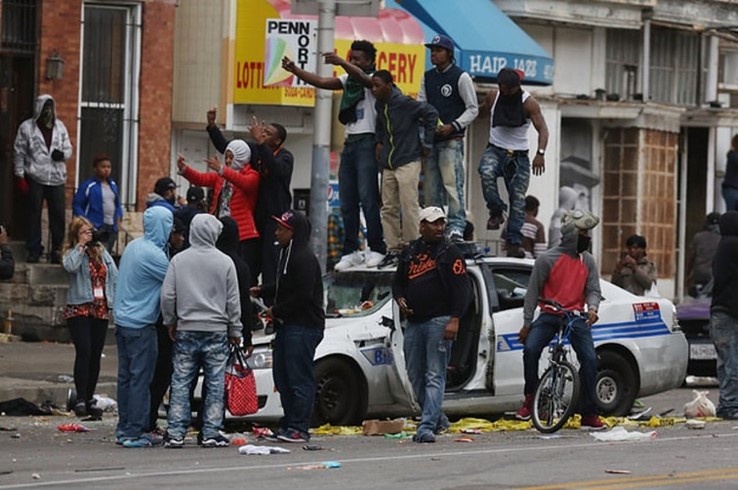
Another legal issue worrying Hanson is what he calls the new nullification, or what could simply be termed selective law enforcement. There are sanctuary cities that “seek to render elements of federal immigration law null and void” (254). Then there is the “de facto nullification” of giving rioters “space” for violent protests involving assaults, looting, and arson. The practice became official policy in April 2015 during the Freddie Gray riots in Baltimore when than mayor Stephanie Rawlings-Blake ordered city police to stand down in the face of mayhem. This approach became widespread in late spring and summer of 2020 during the Floyd riots when virtue-signaling mayors in cities such as Minneapolis, Portland, and Seattle refused to enforce laws protecting lives and property. In the case of Minneapolis, the pronouncements of Mayor Jacob Frey actually helped to incite violence in his city.

Globalism

Chapter Six deals with globalism. Here is, perhaps, one of the big changes that has occurred within the conventional Right since the McCain-Romney days. (Of course, Mitt Romney is still a Republican senator, so obviously the transformation was only partial). Under true citizenship/MAGA, the globalist policies of free trade, open borders, and offshoring have been replaced, at least in theory, with America First. Hanson defines globalism as simply “putting global concerns above national interests” (269). Globalism, championed by Western elites, dilutes VDH’s concept of true citizenship. Globalists are “post-citizens” who wish to transcend the boundaries of race, sex, and nationality. According to the author, organizing international relations around nation states is not ideal, but it “is the least pernicious system compared to the alternatives” (272).

It is not just that globalism has hurt the US with “lost jobs, investments, control over borders, and national cohesiveness,” it has resulted in “eroded indigenous customs and traditions the world over” (281). Hanson continues: “the global creed has destroyed the ancient idea of localism and regionalism as central to the human experience.” Globalists do not value the “unique traditions, ancestries, local histories—and differences” of particular locales (302).

The hubris of the globalists is particularly galling to VDH. They see themselves as the new elite whose education, training, and values entitle them to guide world affairs. Despite their lofty opinions of themselves, the author observes that the globalists of WHO failed completely to contain Covid-19. VDH considers NATO as part of, and perhaps a principal enforcer of, the globalist project. He quotes NATO’s first Secretary-General Lord Hastings Ismay who described the organization’s mission as “to keep the Russians out, the Americans in, and the Germans down” (297). No mention of containing communism. The Great Replacement is one of the results of globalism. Hanson does not use the term, but he relates how Bill Kristol, the Jewish neo-conservative pundit, declared that there was “a need to replace an increasingly pathological American white working class” with immigrants (291).

Epilogue

The book ends with an epilogue obviously written sometime after the main text. Here Hanson again discusses Trump, along with the 2020 election, January 6th, and the Biden administration. Though generally supportive, VDH expresses mixed feelings about the former president who could be “an idealistic populist, a rank cynic, a canny pragmatist, neither, or a combination of the three” (324). Once more, Trump was a bit naive, he “under-appreciated” and at times “seemed oblivious” to the political forces arrayed against him (326). Being a political outsider, he had no cadre of experienced and knowledgeable people to fill key administrative positions. Plus his “mercurial persona” and “often off-putting behavior” made him difficult to work with.

Hanson expresses doubts regarding the legitimacy of the 2020 election. Tens of millions of people voted by mail “with far less audit of signatures, addresses, and deadlines” than in the past. Voting by mail is “fraught with dangers of fraud and a general inability to authenticate voter eligibility and identification” (336).

As for the January 6th capitol protests, Hanson points to an obvious factor that the mainstream media and the political establishment refuse to acknowledge. By justifying the violence during the so-called “racial reckoning” of 2020, the Left created the climate for the assault on the capitol in January 2021. The protesters that day were poorly led, if indeed there was any real leadership at all. Some thought that violence was the way to be heard, that this was the way it is done now, this is how you do it. They did not realize that those rules only applied to the other side. As VDH puts it: “[T]he Left had for months contextualized the mayhem of Antifa and BLM and therefore should not have been surprised when others were emboldened to follow their violent example. The public was left with the general impression that, for political reasons, violence in the streets was being condoned and perpetrators not held to account for their illegal actions” (340).

Conclusion 

So, having considered Hanson’s “true citizenship,” which I have equated with MAGA/civic nationalism, we return to the question posed at the start:  Is this movement an on ramp to explicit White advocacy? Or is it a dead end? As Yogi Berra opined: “It’s tough to make predictions, especially about the future,” but I believe Trumpism will fade and will prove to be the last gasp for civic nationalism.

There are several reasons for this prediction: It will be difficult to have Trumpism without Trump, and his future is uncertain at best. For all his faults Trump is an authentic personality and seemed to have a unique ability to incite the Left. Meanwhile possible successors, such as Ron DeSantis, smack of opportunism. Of course, the Romney wing of the Republican Party never went away and they are working day and night to return to the pre-2016 business-as-usual approach. But the main reason that civic nationalism will fail to deliver is its refusal to face the reality of race and the importance of racial differences in human affairs.

Whatever happens, politics will not return to pre-2016 status quo ante. There are long-term trends, such as political and social polarization, that appear to be accelerating. Political violence, practiced by the Left since the “long hot summers” of the 1960s and more recently taken up by Antifa and BLM, has spread to elements of the political Right and could intensify. Due to selective law enforcement, however, violence, other than in self- defense, is likely to be counterproductive for the Right. Is there a role for the Republican Party to move a White agenda forward? As alluded to above, the neo-conservatives are working hard to regain full control of the party, and they hold the purse strings. But do they have the votes? American political parties are subject to change—a century ago, the Democrats were the White man’s party, and the Republicans, the party of Lincoln, received the Black vote. In any case, voting is without risk or cost and takes very little time or effort so any return on such a small investment is a plus.

In the final analysis electoral politics will only go so far in bringing about fundamental societal change. As Andrew Breitbart wrote: “Politics is downstream from culture.” People need to live the change they want. One encouraging trend sees White Americans moving to areas of the country that they find more politically and socially congenial, hopefully creating supportive networks. Liberal journalist Bill Bishop has termed this The Big Sort.[3] While others call it an ingathering.[4] This is where Hanson’s true citizenship might be most applicable, becoming civically engaged at the local level to build healthy White communities.


[1] Martin Bernal, Black Athena: The Afroasiatic Roots of Classical Civilization, Rutgers University Press, 1987.

[2] Victor Davis Hanson, The Case for Trump Basic Books, 2019.

[3] Bill Bishop, The Big Sort: Why the Clustering of Like-Minded America is Tearing Us Apart, Mariner Books (2009).

[4] See for example: Eric Paulson, “Nine Reasons for an Ingathering,The Occidental Observer (November 3, 2010).

Extremismo judeu: a quinta-coluna

O perigoso extremismo de Israel não tem por fundamento nenhuma figura individual mais influente de sua política, não deriva de nenhuma eminência parda ou vermelha daquela sociedade, como bem escreveu Joshua Leifer no seu artigo intitulado Israel’s New Kingmaker Is a Dangerous Extremist, and He’s Here to Stay, publicado em The New York Times no dia 07NOV2022. Ao contrário de supostas fontes pessoais do ódio, o que existe em Israel como causa principal de seu extremismo é o próprio supremacismo judeu em si mesmo. Esta forma de dominação ramifica-se no corpo político de praticamente todos os países do Ocidente. O governo sujeito a tal controle acabou sendo designado pela redução já bastante conhecida de ZOG, ou seja, Zionist Occupied Government [acrônimo aportuguesado: “Zogue” (n. do trad.)].

A mídia zogue apregoa, ilimitadamente, que os Estados Unidos estariam infestados de terroristas da extrema-direita doméstica. No entanto, faltam evidências para a comprovação dessas afirmações, a não ser que se considere como “evidência” a palhaçada que se passou no circo que foi o “julgamento” daqueles envolvidos nos acontecimentos do 6 de Janeiro [de 2021] por seleta comissão parlamentar. O referido artigo do NYT indica claramente que, na verdade, o país mais coalhado de racistas, etnonacionalistas e terroristas domésticos de extrema-direita é Israel. Eles podem.

A esquerda liberal, buscando tocar o terror psicológico, alardeia, apoplecticamente, que Trump houvera encarnado o espírito de Hitler. Ao contrário disso, porém, e na mesma medida, os fatos vistos a maior distância temporal mostram que nunca houve a menor possibilidade de Trump dar uma de Hitler e agir como um führer. Trump não tem o genoma de um homem forte. Ele é só um vulgar narcisista representando o papel de demagogo que o zogue lhe determinou. O verdadeiro totalitarismo vem do acatamento dos democratas à “autoridade” dos judeus, determinados a destruir a nossa sociedade por suas despóticas políticas “plandêmicas” e seu absolutista marxismo cultural. A intenção deles é superar as limitações da nossa natureza, pelo que seu cajado segue nos tangendo para os horizontes mais distantes e amplos do transumanismo de seus sonhos molhados.

O artigo de The NYT refere que existe amplo acordo entre os judeus quanto à “necessidade” de “remover ou transferir os árabes para fora de Israel”. Em que isso difere do Acordo de Transferência de Haavara, nos anos trintas, que resultou da colaboração entre nazistas e judeus? Sem nenhuma evidência a seu favor, os gasistas do holocausto (perdoem o trocadilho) querem fazer crer que o esforço para expulsar os judeus da Alemanha terá consistido numa política de extermínio dos judeus. Ah! Essa é boa! Isso aí é só um típico caso de projeção (Freud explica). Na verdade, a agenda da expulsão e do extermínio é aquela que o Estado Judeu vem implementando há décadas, impiedosamente, contra os palestinos.

No intento de criar uma Nova Ordem Mundial, obediente ao seu próprio poder unipolar, que dele faria uma espécie de “rei da montanha”, o Ocidente deixou-se enganar pelos Governos sob Ocupação Sionista, que o levaram a se confrontar com outras duas superpotências: a Rússia e a China. Os Estados Unidos são a cidade que os supremacistas judeus estão destruindo, insidiosamente, pela desinformação de que a nossa salvação dependeria da derrota da Rússia. A nossa Nação e as nossas tradições democráticas estão sendo transformadas numa espécie de Palestina do Primeiro Mundo.

Vladimir Putin não é nenhum anjinho, mas muitos de seus compatriotas veem-no como o herói da luta épica contra a dominação ocidental do mundo. Com efeito, a Rússia desafia a hegemonia ocidental, colocando-se à frente do combate em defesa da visão eurasiana dos negócios mundiais. O chefe russo trata de recuperar a soberania dos Estados para nova organização do mundo, mais branda e inclusiva, conforme preconizam alguns dos maiores teóricos geopolíticos da Rússia.

Um deles é, por exemplo, o falecido Lev Gumilev. Respeitadíssimo acadêmico, ele foi o criador de uma notável teoria etnogênica. Esse etnogenista chegou à compreensão das causas que levam os judeus talmúdicos à condição de concitadores da destruição em qualquer lugar onde estiverem.

Outro brilhante intelectual, este bastante mais popular, é o filósofo e geopolítico Alexander Dugin. Ele dedica o seu trabalho à promoção da sociedade tradicionalista em oposição ao projeto globalista do Great Reset. As ideias de Dugin pareceram tão perigosas para os seus inimigos que eles o tentaram matar na explosão de um carro-bomba. Não conseguiram, mas a filha de Dugin (Darya Dugina) estava no carro e morreu no atentado, em 20AGO2022, na cercania de Moscou.

Outra grande figura é Sergey Glazyev, economista mundialmente reconhecido. Ele foi o criador de novo sistema monetário tendo por premissa a segurança, a estabilidade e a satisfação dos povos em condições internacionais de maior paridade. Buscando a multipolaridade como ideal, o grande economista desafia o sistema unipolar atual, dominado pelos bandidos ocidentais reunidos em máfias como a BlackRock e o World Economic Forum (WEF).

Na presente configuração internacional binária, é forçoso que estejamos alinhados com a Rússia, a China e o Sul Global, contra a agenda unipolar e totalitária que a etnocracia judaica tenta impor a todo o mundo. Ao longo de sua história, os judeus têm financiado ambos os contendores da luta política. Não está sendo diferente agora. Eles tentam romper alguns dos elos centrais mais fortes da corrente da resistência multipolar, ou seja, a Rússia e a China. Com o poder financeiro do aríete neoliberal, os sionistas tentam derrubar a muralha da China. Se o conseguem, o gigante amarelo estará sob sua influência. Essa possibilidade é assustadora. Os judeus vem agindo insidiosamente ao longo dos anos para transformar essa possibilidade em realidade. Um comentarista já observou que a China segue sendo envolvida como parte menor nos negócios do Poder Judeu. Ele diz que “Culpar a China sem ter em vista os judeus é o mesmo que ver Robin, mas não o Homem-Morcego”, fazendo uma brincadeira com coisa séria.

Conforme se esperava desde a abertura dos mercados chineses que fizera Kissinger, o país asiático encontra-se agora infestado de bandidos da banca, que esfregam suas mãos, ansiosos para agadanhar a vasta riqueza da China com que podem dominar o mundo. Os chefes chineses deixar-se-ão enganar por essa canalha? A China será a avenida por onde passará a elite de judeus organizada na BlackRock para ter acesso à Yellow BRICS Road? [trocadilho: a autora brinca com a antiga canção de 1973 “Goodbye yellow bricks road”, de Elton John (n. do trad.)]. Ou irá a China se valer da sabedoria taoísta para reconhecer os agentes talmúdicos no seu interior, por cujo disfarce fazem parecer que ali estão com o propósito de realizar o compadecido princípio judaísta do tikum olam?

Muitos não ocidentais tomam por correta a teoria etnogênica de Gumilev, segundo a qual os judeus sempre trazem más notícias para a humanidade. O judeu de menos elevado nível social — com quem os seus irmãos da elite não aceitariam nenhuma causa comum e, se assim ditasse os seus interesses, poderiam até empurrá-lo para debaixo de um ônibus — deve buscar alguma composição com os não judeus nesse que é um embate escatológico. Os judeus mais conscientes precisam, por exemplo, denunciar a difamante ADL [Anti-Defamation League, organização supremacista judaica (n. do trad.)] pela perseguição que move contra Kanye West e outros que se atrevem a rasgar o manto de silêncio sobre a vastidão e a profundeza do Poder Judaico.

Agora que o golpe de Estado tecnocrático da plandemia covidiana aproximou ainda mais o Povo Eleito do controle global, é de suma importância que os cidadãos do mundo, entre os quais podem estar os judeus não sionistas, saibamos da condição etnossocial que leva alguém a fazer o que fez Samuel Bankman-Fried [especulador e bandido “filantrópico” judeu (n. do trad.)]. Sem tal consciência — que a mídia hegemônica judaica ataca com a desinformação e a censura — estaremos todos “Fritos” [aqui, a autora brinca com mais esse trocadilho: Fried, o sobrenome do golpista judeu, em inglês, quer dizer “frito” (n. do trad.)]. Nós necessitamos, imperiosamente, compreender que a civilização e a própria natureza encontram-se sob extremo risco neste momento. O perigo vem das quintas colunas judaicas. Elas continuam a sonhar o velho sonho de dominar o mundo. E, aleivosamente, agem para transformar o seu sonho em realidade.

Fonte: The Occidental Observer. Autora: Esther Watcher. Título original: Exposing fifth-column extremism. Data de publicação: 26 de novembro de 2022. Versão brasilesa: Chauke Stephan Filho.

Life Without Jews: The Amazing Adventures of Israeli Trans-Pedophile and Tampon-Fetishist Jonathan Yaniv

Does Clown World issue secret (and separate) awards for Jewiest Jew and Polymorphousest Pervert? If so, then I think one man may well have been bagging both awards for years: the polymorphous Israeli pervert Jonathan Yaniv (born 1986/7), who came to the fascinated and disgusted attention of millions of people around the world when he sued female beauticians in Canada for refusing to wax his testicles.

Transgender splendor

I’m sorry: that should be “her testicles.” Indeed, it should be “her lesbian testicles.” Yaniv claimed to be transgender and in mainstream modern leftism that claim instantly converted him into a completely authentic woman, despite the male genitalia he still possessed. It also lifted him to the top of the leftist tree. Although leftists say they believe in equality, in fact they operate a strict hierarchy of victimhood that grants victim-groups, like Blacks or gays or women, special privilege and power over villain-groups, like Whites or straights or men. As I pointed out in “Power to the Perverts,” under normal circumstances Black lesbians are as far above straight White men in the leftist hierarchy as a bar-headed goose flying over Mt Everest, at 29,000 feet above sea-level, is above a sea-cucumber grubbing in the slime at the bottom of the Marianas Trench, at 36,000 feet below sea-level. But some straight White male perverts came up with a clever way of subverting the leftist hierarchy and turning leftism against itself. These perverts have a sexual fetish known as autogynephilia, in which they fantasize about being women, wearing women’s clothes, and entering all-female spaces like dressing-rooms and toilets.

“Who is Jessica Yaniv Simpson?” A fascinating question answered at MeowMix.org

But if they’d been honest and told leftists that they were straight White men with a sexual fetish, they would have sunk even lower in the leftist hierarchy. Instead, the perverts cleverly aligned themselves with the sanctified lesbian-and-gay community. They weren’t straight White men with a fetish, not at all. No, they were a persecuted and misunderstood sexual minority – the most persecuted and misunderstood of all. Et voilà! By calling themselves “transgender,” the straight White men were able to leap above Black lesbians in the leftist hierarchy. In Britain, a Black-Jewish lesbian feminist called Linda Bellos (born 1950) didn’t get rapt attention when she pointed out what the straight White male perverts were up to. She didn’t get instant obedience when she said that they shouldn’t be allowed to invade female territory. On the contrary, she was called a bigot and a hater for denying that these straight White men were both fully authentic women and fully authentic lesbians. As I said at the Occidental Observer back in 2019:

[Bellos] isn’t superior to all stale pale males. Some of them are armed with a superpower that allows them to bound above Bellos in the victimhood hierarchy. Astonishingly, they’ve managed to brand Bellos as a hater from whom they need protection. Just let that sink in: some stale pale males have successfully claimed to be the victims of an elderly Black-Jewish lesbian. In 2017 they got Bellos banned from making a speech to a feminist society at Cambridge University, one of England’s biggest cult-centres of minority worship. Even more impressively, they set the police on her the following year: she was “interviewed under caution” after being accused of committing a hate-crime against them. (“Power to the Perverts,” The Occidental Observer, 6th March 2019)

Bellos is a TERF, a Trans-Exclusionary Radical Feminist, and in mainstream leftism that’s a very bad thing to be. The TERF wars are about territory and who can legitimately maintain borders against whom. Whites can’t maintain literal or cultural borders against Blacks, because Whites are lower in the leftist hierarchy than Blacks. And so Blacks can take any White role in acting, but Whites are now banned from taking any Black role. Similarly, women can take on male roles, but men are banned from taking female roles – unless those men claim to be “transgender.” However, by denying that men can become women, lesbian TERFs like Bellos haven’t embraced biological realism. They’re still leftists and they still believe in hierarchy, not in reality. They just want to keep lesbians like themselves higher in the hierarchy than straight men and don’t want to accept such concepts as “the female penis” and “lesbian testicles.” Alas for Bellos, boring lesbians like her aren’t entertaining like exhibitionist trannies, as I pointed out in “Dykes Are Dull.” That’s part of why trannies have been winning the TERF wars.

A persecuted and misunderstood trans-lesbian

But Jonathan Yaniv didn’t win his legal war on the female cosmeticians who refused to wax his “lesbian testicles.” Instead, he was utterly defeated (see the Wikipedia article for “Jessica Yaniv”). After that, you might have expected him to retire instantly and entirely from public life, particularly when you look at what was exposed to a world-wide audience about his polymorphous perversions. From pedophilia to tampon-fetishism, Yaniv could keep a large team of psychiatrists busy for years trying to turn him from a predatory pervert into a productive member of society. But I don’t think the psychiatrists would ever succeed. Yaniv doesn’t seem capable of embarrassment or self-reform. “Shame” isn’t a concept that he recognizes. No matter how badly he misbehaves and no matter how many court-cases he loses, he still sees himself as the victim and fights on against the bigots and haters who refuse to accept that he is a persecuted and misunderstood trans-lesbian with “special needs.” He’s now had “bottom surgery,” lost his lesbian testicles, and is working for a “Gender Studies Masters” at Simon Fraster University (SFU) in Canada. There’s an entire website, MeowMix.org, dedicated to recording his misbehavior, cataloguing his perversions, and predicting his eventual incarceration. Yaniv plows on regardless, a “proud lesbian” in a cruel world.

But amid all the commentary on and condemnation of Yaniv, one central and highly significant fact has generally been overlooked. Yaniv is an Israeli Jew. He looks like a Jew and has what sounds like an Israeli accent. MeowMix.org claims that “Yaniv was raised Jewish,” says that “the whole family emigrated from Israel”, and has documented how his mother, Miriam Yaniv (née Miriam Altman, born 1954), tried to destroy proof of her Jewish ancestry on an “Israeli family history site.” Like his mother, he has a Jewish forename and, like the Israel singer Idan Yaniv (born 1986), he has a Hebrew surname that means “he will prosper.” Yaniv also behaves like a quintessential Jewish stereotype, with a mixture of brazen perversity, unblushing shamelessness, and self-righteous aggression. Indeed, Yaniv seems to provide a paradigmatic example of three of the most important background traits for Jewish activism identified by Kevin MacDonald: intelligence, aggressiveness, and psychological intensity. But the most common claim about Yaniv’s race is that he is “white.” This would normally be called Jewish erasure, because ignorant people are erasing someone’s precious and unique Jewish identity. In Yaniv’s case, other Jews have not been anxious to claim him as one of their own. It’s another example of Jews as Schrödinger’s Tribe, switching between a Jewish identity and a generic White identity according to whatever best suits Jewish interests.

White standards don’t apply

Plainly, it doesn’t suit Jewish interests for Jonathan Yaniv to be identified as a Jew. However, it does suit the interests of truth and science. Most or even all of the commentary on Yaniv loses its salience when he is correctly recognized as a Jew. By White standards, his psychology is indeed warped and his behavior is indeed obnoxious. But White standards don’t apply to him, because he isn’t White. Yaniv’s White critics, like the Canadian feminist Meghan Murphy, have tried to shame or ridicule him as though he were susceptible to genetically mediated techniques of social control developed by Whites amongst themselves. But he isn’t susceptible, because he isn’t White. He’s not simply Jewish but Israeli Jewish, the product of a majority-Jewish culture where White standards don’t apply. For example, why is Yaniv shameless? Well, you can’t embarrass an Israeli.

And why is Yaniv such a polymorphous pervert? That is surely related to the higher rate of psychopathology found among Ashkenazi Jews, as described by the Danish researcher Emil O. W. Kirkegaard in a recent paper called “A theory of Ashkenazi genius: intelligence and mental illness.” Kirkegaard argues that the contributions of Ashkenazim to cognitively demanding fields are even greater than one would expect from their higher average IQ. The extra factor, in his opinion, is the higher rate of Ashkenazi psychopathology, which facilitates their ability to generate new ideas and make unexpected connections. Meanwhile, their higher intelligence mitigates the severity of the symptoms and behavior they exhibit, and allows them to remain productive. It’s an interesting theory, but, as is characteristic of Kirkegaard, it assumes a more positive view of Jewish contributions to intellectual life than I think is warranted by the facts. Marx, Freud and Boas surely count as “Jewish geniuses,” but they have harmed the cause of true science rather than advanced it.

Other Jewish geniuses have been central to the creation and promotion of the translunatic cult, as described by Scott Howard in The Transgender-Industrial Complex (2020). Jonathan Yaniv is not a genius, but he has been diagnosed with “depression, anxiety, and attention-deficit hyperactivity disorder.” And the outsize disruption he has caused, as a single Jewish individual in a gentile society, is a clear example of how the West would be better off without Jews and their genius. We don’t live in a more beautiful and truthful world thanks to Jews. On the contrary, we live in a much uglier and much more mendacious one. In his uniquely repulsive way, the Jewish trans-pedo and tampon-fetishist Jonathan Yaniv is just as much proof of that as the Jewish Marx, Freud and Boas.

The American Political System and White Racial Discourse

In the recent mid-term elections (this is being written in December of 2022), Democrats, apparently with a good amount of success, charged Republicans with being no less than a threat to American democracy.   My goodness—I guess hyperbole goes over big in this text-and-Twitter-depth age.  Whatever its success as a campaign tactic, a great deal has been said and written about democracy these past few months.  For instance, this in The New York Times, which naturally finds that the threats to democracy come from conservatives:

[The] United States today finds itself in a situation with little historical precedent.  American democracy is facing two distinct threats, which together represent the most serious challenge to the country’s governing ideals in decades.

The first threat is acute: a growing movement inside one of the country’s two major parties — the Republican Party — to refuse to accept defeat in an election. . . .

The second threat to democracy is chronic but also growing: The power to set government policy is becoming increasingly disconnected from public opinion.  The run of recent Supreme Court decisions—both sweeping and, according to polls, unpopular—highlight this disconnect. Although the Democratic Party has won the popular vote in seven of the past eight presidential elections, a Supreme Court dominated by Republican appointees seems poised to shape American politics for years if not decades.  And the court is only one of the means through which policy outcomes are becoming less closely tied to the popular will.

“We are far and away the most countermajoritarian democracy in the world,” said Steven Levitsky, a professor of government at Harvard University and a co-author of the book “How Democracies Die,” with Daniel Ziblatt. .  .  . In a recent poll by Quinnipiac University, 69 percent of Democrats and 69 percent of Republicans said that democracy was “in danger of collapse.”1

I’ll use the democracy-under-siege talk so prominent lately as a springboard to a consideration of the America’s political system from the perspective of White racial advocacy.   This writing can be viewed as a follow-up to an article of mine in 2020 called “A Suggestion to American White Advocates: Root Your Arguments in This Country’s Core Political and Cultural Ideals.”2   You might want to check out that article to put this one in better context, although it’s really not necessary; this piece stands on its own.   To give you an organizer for what’s coming up, my basic take is that from the perspective of Whites’ wellbeing, rather than democracy being under threat, democracy is the threat.

To begin, as a matter of fact, we don’t have a democracy in this country.  Our form of government is a republic.  We pledge allegiance to the flag of the United States of America, and to the republic for which it stands.  Our political system is grounded in the Roman republican form more than many realize. President, congress, and senate are all Roman terms.3  Unlike in a democracy—say a Greek democracy, Athens—citizens seldom vote on matters themselves.   Instead, they select individuals to take on that task.  In the Federalist Papers which justified the political system the Founders had created, James Madison underscored this key distinction between a republic and a democracy: “In a democracy the people meet and exercise the government in person; in a republic they assemble and administer it by their representatives and agents.”4

It is important to note that these representatives are not merely doing the electorate’s bidding.   The Founders of the American nation wanted decisions of state guided by the wisdom of those who held positions in government and not by the immediate impulses of the citizenry.  In Madison’s words, “The public views should be refined and enlarged by passing them through the medium of a chosen body of citizens, whose wisdom may best discern the true interests of their country, and whose patriotism and love of justice will be the least likely to sacrifice it to temporary or partial considerations”5

Within our republican political system, there are many departures from simple majority rule.  In the beginning, senators weren’t directly elected but rather chosen by state legislators, and the President still isn’t (the Electoral College).  States with small populations like Wyoming have as many senators as New York and California.   The Supreme Court is appointed.  The President can veto legislation.  Indeed, in the early years of this country, the distinction between a republic and a democracy was an important one.  John Adams declared, “There is no good government but what is republican.”6

And more than simply a republic, America is a constitutional republic.  The federal constitution puts a brake on what can legitimately be a matter of collective determination.  The Constitution sets up a separation of powers and checks and balances that prevent majorities in one branch of government—perhaps dominated by powerful factions (the old term for interest groups)—from wielding control.  The Constitution’s first ten amendments, called the Bill of Rights, spell out protections of individuals from the totality as represented by the federal government.  They give explicit acknowledgment of the view that individual citizens have inalienable rights — the term used in the Declaration of Independence. These are rights possessed by all humans, and they can’t be taken away.  These rights are not up for a vote.

To be sure, our form of government reflects democratic principles and includes democratic practices.  The government does not have arbitrary power over people and operates at their consent.  Citizens have the opportunity to participate in the political process.  There are open and free elections and referenda.  All this is democratic.   But still, while the people are heard and wield power, the republic does not require, in the words of the Federalist Papers, the “unqualified compliance to every sudden breeze of passion of a popular majority.”7

In the last century and as it continues now, democracy has taken on the quality of a religious law worth killing and dying for.  World War II was portrayed as a war for democracy.  In recent decades, the Americans talking loudest and slickest at harnessing power have beaten the drums for a crusade to convert other countries to democracy by blowing them up and exterminating their citizens.  In earlier times, however, that justification for conquest and bloodshed wouldn’t have played, because democracy wasn’t sacred.   Major figures in the first century of this country’s existence were not sanguineous about it:

  • James Madison noted democracies “have ever been spectacles of turbulence and contention; have ever been found incompatible with personal security or the rights of property; and have in general been as short in their lives as they have been violent in their deaths.”8
  • Alexander Hamilton: “The ancient democracies in which the people themselves deliberated never possessed one feature of good government. Their very character was tyranny; their figure deformity. When they assembled, the field of debate presented an ungovernable mob, not only incapable of deliberation, but prepared for every enormity.”9
  • The writer James Fennimore Cooper saw democracies as tending “to press against their proper limits, to convert political equality into economic leveling, to insist that equal opportunity become mediocrity, [and] to invade every personal right and privacy; they set themselves above the law; they substitute mass opinion for justice. 10
  • Highly respected French observer Alexis de Tocqueville as early as the 1830s foresaw democracy was inevitable, but he expressed reservations about that prospect. He worried about a perversion of society “into a sea of anonymous beings, social droplets, deprived of true purpose.”11  He noted that democracy promotes antipathy toward eccentricity or any manifestation of defiant individuality.12  “Democracy,” de Toqueville wrote, “encourages a taste for physical gratification; this taste, if it becomes excessive, soon disposes men to believe that all is matter only; and materialism, in its turn, hurries them on with mad impatience to these same delights; such is the final circle within which democratic nations are driven round.  It were well that they see the danger and hold back.” 13

The American republic was conceived as being comprised of individuals not groups.  The Bill of Rights, for instance, protects individuals not groups.  This is important to keep this in mind in a time preoccupied with group identities.  In our time, the idea of individualism, this mindset, carries a negative connotation, including within White racial discourse, as it is linked to selfishness and lack of concern for others and the common welfare.  However, this wasn’t the case at this country’s beginning.  Back then, it was assumed that individuals would, and should, focus on serving their private wants and needs and it wasn’t assumed that this would run counter to a concern for, and service to, the needs of the whole.  The ideal earlier in our history—let’s say prior to WWII–was that individuals would conduct themselves in a way that the more they served themselves the more they were capable of, and motivated to, serve others.

Republican citizenship was not a matter of always looking out for oneself, nor was it deferring to the common good in every instance.   Rather, it was striking a balance between the private and public dimensions of one’s life.  That balance was central to the concept of a true individualist, and it was the predominant view in the beginning that the American political experiment depended on true individualists to make it work.

Benjamin Rush, a physician and signer of the Declaration of Independence, wrote an essay entitled “Thoughts Upon the Mode of Education Proper in a Republic” that relates to this consideration.”14

While Rush used the word republic or some variant of it seven times in his essay, including in the title, the word “democracy” appears not once.

Also striking about the Rush essay is his stress on liberty, referring to it as “the object and life of all republican governments.”  Time and again, Rush writes about freedom, along with his worry that government tyranny will rob people of it.   At its core, the American republic is a test to see what will result if individual people, free from governmental dictates, are given the opportunity and the charge to make a good life for themselves and theirs and at the same time be good for other people and look out for the political arrangement.  The inherent tension between democracy and personal freedom and self-determination did not escape the Founders.  At heart, democracy is a method of social coercion, a way to direct and limit the actions of individuals, since those who aren’t on the side of the majority have to do things the victors’ way.

Throughout his essay, Rush wrote about virtue, linking it to the preservation of freedom — “without virtue there can be no liberty.”  To Rush, virtue meant the personal traits of self-denial, brotherly kindness, character, honor, and physical discipline.  In the beginning, it was assumed that the welfare of the republic depended on the virtue of its individual citizens.  Virtue referred to such qualities as a strong work ethic, self-sufficiency, love of country, an austere style of living, strict observance of a moral code, and willingness to sacrifice private profit for the public good.15 In his farewell address, George Washington declared virtue to be “a necessary spring of popular government.”16

Rush’s essay emphasized the importance of strong loyalty to state and nation.  About the education of a child: “He must be taught to love his fellow creatures in every part of the world, but he must cherish with a more intense and peculiar affection the citizens of Pennsylvania and the United States.”17 Allegiance to a geographic entity was considered vitally important for the success of the American political experiment.

More to be said, but you get the basic idea.

*   *   *

The big contention in this context is that Whites have fared very nicely under the American constitutional republican arrangement and the ideals and ways inherent in it—personal freedom and responsibility, virtue, and so on.   A republic is particularly suited to White people, and while those involved in setting up the American political system didn’t go to any great length to punch up that fact, I have the sense that they were well aware of it; they knew what they were doing.

Similarly, those currently engaged in pulling the props out from under the Founders and this country’s political heritage — including referring to it as a democracy — know what they are doing.  Unhindered by constitutional restraints—the notion of a “living constitution,” etc.—democracy serves the interests of Whites’ adversaries.   It takes power away from individuals and puts it in the hands of the collective, which is increasingly non-White — or better, those who can control the collective by managing the information and idea flow and throwing money around and making people pay who get in their way.  Democracy politicizes everything:  whatever it is, anything and everything, is put up for a vote and the majority (or again, whoever controls the majority, and in this day and age it is increasingly people surreptitiously and openly hostile to Whites, males in particular) wins the day.  Ironically given how it is pitched as putting the masses in charge of their fate, democracy paves the way for minority control (among the possibilities: resentful, revengeful, and exploitive anti-White ethnic and racial elements; self-anointed media elites: kowtow-to-me gripers and grievers; I’ll-handle-it managers and bureaucrats; paid-off and intimidated politicians; and bullshitters).  Bottom line, a republic serves White interests; a democracy works against them.

With that being the case, what follows for White racial discourse—its content, topics?  These six things come to mind:

  1. Give consideration to the connection between the republican political form and White interests. How does a republican system measure up against authoritarian, democratic, aristocratic, elite-managed, and Big Boss (Trump’s image just popped into my head) arrangements?
  2. Make room for American voices — Thomas Jefferson and James Madison, and (I’m thinking out loud) Emerson and Thoreau and Mark Twain and Edgar Rice Burroughs (the Tarzan author) and Teddy Roosevelt and H.L. Mencken and . . . oh, I don’t know, just somebody besides Julius Evola, you know? American thinkers, Nathaniel Hawthorne, Walt Whitman, Teddy Roosevelt, Ernest Hemingway, somebody.
  3. Ease up on badmouthing individualism; look for its positive aspects, and there are some. And generally, be conscious of the downside of dichotomous, either-or thinking — there’s this thing and that thing and this thing is better than that thing, universalism is better than individualism, etc.  Libertarianism, ugh.  Carl Jung’s concept of enantiodromia comes to mind: the idea of positive development and the achievement of wholeness resulting from the integration of opposites (the example above: citizenship in a republic involving both selfishness and selflessness).
  4. Do a word count in White racial dialogue and debate: how often do the words “freedom,” “liberty,” and “self-determination” appear? How about if it is more often?
  5. Pay more attention to the relationship between what individuals are made of and what goes on collectively? I’m reminded of Madison Grant’s observation over a century ago that Nordics, as he called them — Americans of northern European heritage — were becoming characterized by “base desires, passions, and behaviors, and becoming less dignified and honorable.”18  The Founders had it pegged: virtue, character, personal worth, however you want to talk about it, matters greatly; it’s not just about large forces and systems.
  6. Give more attention to the connection between nationalism—identification with, affinity for, commitment to, a particular country—and White wellbeing. Do Whites tend to do better within the context of strong nation states?  A non-American example, would Whites living today in Hungary be better off if they saw themselves in the first instance as White Hungarians or as White nationalists?  Would White Americans be better off focusing their energies on getting their country back, or would they be better off if they viewed themselves as White nationalists and seceded from the U.S.?  Do current-day American White advocates— representative of, by far, the largest segment in this country, whose ancestors created and developed it — see themselves as part of us in the U.S.?  Or have they internalized the notion from their adversaries that they are them here: fringe, right wing, dissidents?  Looking into American nationalism could surface the need for those who argue for Whites to examine presumptions and ideas that limit them.


  1. David Leonhardt, “‘The Crisis Coming’: The Twin Threats to American Democracy,” The New York Times, September 17, 2022.
  2. Robert S. Griffin, “A Suggestion to American White Advocates: Root Your Arguments in This Country’s Core Political and Cultural Ideals,” The Occidental Observer, online, posted June 13, 2020.
  3. Richard Brookhiser makes this point in his book, Founding Father: Rediscovering George Washington (Free Press, 1996) p.122.
  4. James Madison, “An Objection Drawn from the Extent of Country Answered,” Federalist Paper Number 14, in Alexander Hamilton, James Madison, and John Jay, The Federalist Papers (New American Library, 1961), p. 100.
  5. As quoted in Lance Banning, The Sacred Fire of Liberty: James Madison and the Founding of the Federal Republic (Cornell University Press, 1995) p. 203.
  6. As quoted in Nathan Tarcov, “The Meanings of Democracy.” In Roger Soder, ed., Democracy, Education, and the Schools (Jossey-Bass, 1996) p.25.
  7. Tarcov, p.28.
  8. See Robert Westbrook, “Public Schooling and American Democracy,” in Soder, p. 128.
  9. Ibid.
  10. Russell Kirk, The Conservative Mind, seventh revised edition (Regnery, 1986) p.200.
  11. Kirk, p. 12.
  12. Ibid., 155.
  13. Ibid., p. 211.
  14. Benjamin Rush, “Thoughts Upon the Mode of Education in a Republic,” in Steven Tozer, Paul Violas, and Guy Senese, School and Society: Historical and Contemporary Perspectives, Second Edition (McGraw-Hill, Inc., 1995) pp. 40.
  15. Ibid, p. 24.
  16. George Washington, George Washington’s Farewell Address (Applewood Books, 1999).
  17. Tozer, Violas, and Senese, p. 42.
  18. Grant’s observation comes up in my article, “‘What If?’ Thinking: Imagining Alternative Histories as a Way to Know,” The Occidental Observer, online, posted December 3, 2021.