Mark Leibler: Powerbroker for Australia’s Jewish Plutocracy — PART 2
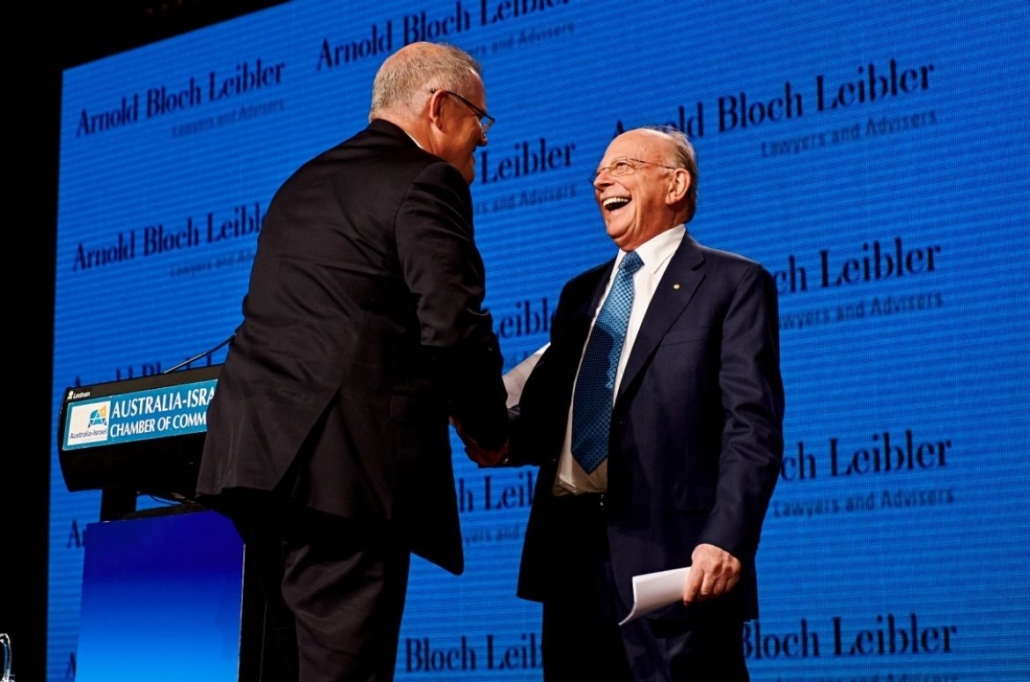 Mark Leibler with Australian Prime Minister Scott Morrison
Lawyer to Australia’s Ethno-Plutocratic Elite
Leibler has been a partner at the law firm Arnold Bloch Leibler (ABL) for almost fifty years. Of the 200 richest people and families in Australia, around one-in-five are clients of ABL. In 2018, thirty-five of Australia’s wealthiest individuals and families were clients of ABL and 19 of these were Jewish. The man topping the rich list, Anthony Pratt, with an estimated fortune of $12.9 billion, is one of them. These clients help make the firm one of Australia’s most profitable. ABL has close connections with several major New York firms — especially those established and run by Jews like Wachtell, Lipton, Rosen & Katz and Skaddan Arps. The lawyers of these New York law firms, which refer many cases to ABL, are said to “feel comfortable dealing with ABL, a firm with origins in the Jewish community that still retains a significant Jewish client base.”[1]
Most of ABL’s wealthy Jewish clientele reside in the wealthy inner suburbs of Melbourne. Sydney has fewer Jewish billionaires than Melbourne, although businessman Sir Frank Lowy and apartment mogul Harry Triguboff ranked in the top 10 of the of the 2018 rich list, and Jewish wealth in Sydney is growing rapidly due to “the business success of South African Jewish migrants, most of whom settled in Sydney and Perth from the 1970s to the 1990s.”[2] A long-time pillar of Melbourne’s Jewish establishment and client of Leibler is Jewish shopping center magnate John Gandel who is Australia’s seventh richest person with a fortune estimated at $6.45 billion in 2018. Gandel has made large donations to Jewish organizations closely linked to Leibler, such as Australia Israel & Jewish Affairs Council (AIJAC) and the United Israel Appeal. Gandel also finances the Anti-Defamation Commission’s propaganda program for schools “Click Against Hate” — an “early intervention” program for schoolchildren from Years 5 to 10. The program is offered free of charge to schools due to this funding.
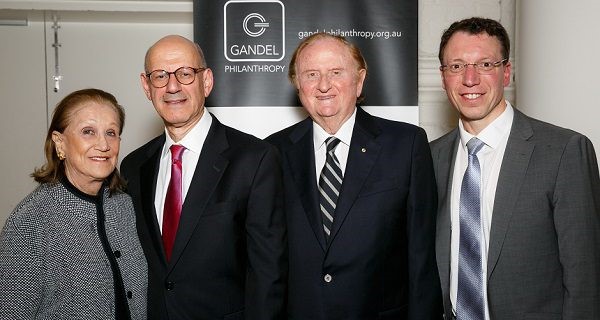 John Gandel (center right) and ADC chairman Dvir Abramovich (far right)
Gandel also funds Taglit-Birthright Israel, a program that provides free ten-day tours of Israel for young Jews who are “currently unaffiliated with the Jewish community and have never visited Israel.” Announcing his financial support, Gandel declared that “My family strongly believes in supporting a range of programs that can foster and enhance Jewish continuity and identity, and help develop the future leaders in our community.” The Zionist Federation of Australia (led by Leibler’s son Jeremy) thanked Gandel and extoled Birthright Israel as “a critically important Israel program” that serves to “engage many young Jewish adults with the powerful connection to Israel, Judaism and other young Jews they meet during and after the program.”[3] Thus, while seeking to increase Jewish ethnocentrism and ethno-nationalism through his funding of Birthright Israel, Gandel simultaneously funds “Click Against Hate,” a program specifically designed to reduce White ethnocentrism and promote the virtues of “diversity” and “multiculturalism” among Australian schoolchildren.
Leibler, Australia’s most prominent tax lawyer, fiercely defends their interests of his Jewish clients like Gandel, and has had the ear of every Australian Treasurer since John Howard had the job in the 1970s. Former Australian Tax Office (ATO) officials who have dealt with Leibler attest to his “reputation as a bully who intimidates junior staffers conducting audits of his clients.” He has a reputation for being “arrogant and a formidable and difficult opponent.”[4] The ATO’s Chief Tax Council, Kevin Fitzpatrick, confirmed Leibler’s reputation as “a person who had influence and as someone who used this perception to bully more junior auditors by threatening to go over their heads to the Commissioner or some other senior official in order to get his way.”[5]
Leibler certainly exemplifies the qualities Kevin MacDonald identified as typical background traits for Jewish activism: hyper-ethnocentrism, intelligence, wealth and psychological aggression.[6] Those who have dealt with Leibler attest that he was “often arrogant, often angry, and that he would regularly swear during arguments with opponents.” Interviewing Leibler for his book, Gawenda could readily see “why some of the politicians he had dealt with, and some in the Jewish community who had opposed him politically, might have felt that Leibler was brash, arrogant, a bully.”[7]
In 1984, when he became president of the Zionist Federation of Australia, the Australian Jewish News described Leibler as “an angry young man.”[8] One anonymous Jewish source noted “a massive vicious streak running through the genes of both [Leibler] brothers.”[9] Isi Leibler’s attacks on opponents, or people he considered opponents, “were legendary for their bluntness and vitriol.”[10] Gawenda notes that while Isi would sometimes be open to reconciliation after he attacked someone (if it was politically expedient), Mark “is a much more uncompromising and dangerous foe.”[11] The Leiblers invariably referred to those Jews who questioned their right to speak for all Australian Jews as “enemies of the Jewish people, or even self-hating Jews.”[12]
In the 1980s, ABL became a locus for Jewish ethnic networking when young Jewish lawyers of the firm were targeted by wealthy Jewish businessmen for lucrative jobs. One was Joe Gersh who was offered a highly-paid job at packaging company run by the late Jewish billionaire Richard Pratt. Pratt had ‘’heard that Gersh was a bright Jewish boy and, according to Gersh, Pratt was then trying to hire every bright young Jewish boy in Australia.” In the end, Gersh opted to stay at the law firm after Leibler told him “things were happening at ABL.”[13] Gersh was quickly made a senior associate, and, at the end of that year, aged 26, a partner. These days Gersh is executive chairman of his investment banking firm Gersh Investment Partners. He is also a director of the Liberal Party think-tank The Sydney Institute, and a long-time friend of former Australian Treasurer Peter Costello. In 2018, Gersh was appointed to the board of the Australian Broadcasting Corporation.
The Powerbroker recounts how Arnold Bloch, the founder of ABL, left the firm in 1981 to go into business with his wealthy Jewish clients Marc Besen and Abe Goldberg. The latter, at one time Australia’s fourth richest man, was a notorious fraudster whose business continued to operate for three years while insolvent. Gawenda recounts how:
In early 1990, Goldberg’s bankers appointed KPMG to look over Goldberg’s books. The auditor discovered that Goldberg’s companies had liabilities of $1.7 billion with assets of $425 million. In other words, Goldberg had been technically bankrupt since the [1987] stock market crash. But before he could be held accountable for the hundreds of millions of dollars he owed the banks and other creditors, he fled to Poland where he renewed his Polish citizenship. At the time Australia did not have an extradition treaty with Poland. Goldberg went back into business in Poland, amassing a significant fortune as a property tycoon before he died there in July 2016, having not paid back a cent of what he owed his creditors in Australia.[14]
In her 1987 book, The New Boy Network, Jewish journalist Ruth Ostrow chronicled the rise to wealth of the post-war Jewish migrants to Australia. Less than thirty years after arriving in the country, some were among the nation’s wealthiest people. Included in her book were Marc Besen, John Gandel, Eddie Kornhauser, Maurice Alter, George Herscu, Abe Goldberg, and the Smorgon, Liberman, Rockman and Werdiger families.[15] All were clients of Arnold Bloch Leibler. Herscu and Goldberg were later exposed as criminals and Herscu ended up in jail. The majority, however, survived the 1987 stock market crash and “went on to accumulate wealth beyond their own imaginings.”[16]
Bottom-of-the-Harbor Tax Avoidance Schemes
These clients expected ABL to provide not just legal services, but to advise them on how to maximize their chances of building successful businesses. A key priority was to structure their business to avoid paying tax. A 1980 Royal Commission uncovered a vast tax avoidance industry among these businessmen. These so-called “bottom-of-the-harbor” schemes “were blatant in their intent — to avoid paying what should have been a legitimate tax bill on company profits.” At its simplest, it involved a series of paper transactions in which a company was stripped of its assets and accumulated profits, leaving no tax payable. These assets were then transferred to a new company that carried on business as before. The original company was then metaphorically dispatched to the bottom of the harbor through a transfer to someone with no assets and no idea of what was actually happening. Often the old company’s records were simply “lost.”[17]
Leibler’s clients used a variety of schemes designed to avoid tax, and an Australian Taxation Office official attested to Leibler’s reputation as a lawyer “deeply involved in the blatant, artificial and contrived schemes.”[18] As mentioned, Leibler also had a reputation for going over the heads of ATO auditors to more senior officials (or threatening to do so) if the result of a tax audit looked unfavorable for one of his clients. Leibler refused to tell Gawenda how many of his clients had been involved in bottom-of-the-harbor schemes, “but there can be little doubt that the number was significant.” These clients needed Leibler’s help, especially when, in the wake of the Royal Commission, the federal government signaled a willingness to pass retrospective legislation to recoup tax that had been avoided by his clients. New laws made it a criminal offence to create a company or trust unable to pay taxes or to assist a company or person to do so. The new law meant those who took up the tax avoidance schemes or promoted them would be criminally liable.
As Treasurer in the Hawke government (1983–91), Paul Keating (Hawke’s successor as Prime Minister in 1991) initially supported a further crackdown on such tax avoidance. In early 1983, the government introduced legislation that gave the Commissioner of Taxation the power to treat a company’s income and capital reserves (i.e., retained undistributed profits) as dividends and, therefore, to tax those reserves. This was an attempt to recoup tax revenue that had been lost through bottom-of-the-harbor schemes. Mark Leibler was incensed by the legislation. He knew that if the legislation passed, some of his wealthiest clients would be liable for many millions of dollars in tax. This would, in turn, seriously reduce a major source of funding for Jewish and Zionist causes.
Leibler initially tried to set up meetings with the then Finance Minister John Dawkins who was spearheading the legislation, but to “Leibler’s frustration and anger” Dawkins refused to see him. The bill passed the House of Representatives in June 1983. As the Opposition opposed the legislation, only one vote — that of the independent Senator Brian Harradine — would determine whether the legislation would pass or fail. While the legislation was being debated in the House of Representatives, Leibler launched an aggressive lobbying campaign to convince Harradine to vote against the legislation when it came to the Senate. Gawenda notes how:
He flew to Canberra to see him. He sent Harradine notes that explained why the legislation was very bad, and might lead to an economic downturn and a significant increase in unemployment. Leibler knew that Harradine was inclined to support the legislation. He was in many ways an old-style Labor man who was not naturally inclined to support wealthy businessmen. … Politically, there was nothing in it for Harradine to vote against the legislation; in fact he was likely to be accused of being on the side of business and the wealthy. He wavered, torn between following his political interest and his understanding, shaped by Leibler’s lobbying, that it was bad legislation.[19]
In the end, Harradine caved in to Leibler’s demands and blocked the legislation. While this was “a major victory for Leibler,” a few years later the High Court of Australia ruled that this legislation was actually unnecessary and that the Commissioner of Taxation already had the power to tax the capital reserves of companies involved in the bottom-of-the-harbor schemes and other forms of tax avoidance. After the ruling, Leibler called the then Commissioner of Taxation, insisting that “urgent remedial action was required” and that it was open to the Commissioner to make a ruling that would, in essence, ignore the High Court decision. The Commissioner of Taxation indicated to Leibler that he wouldn’t act without the support of Treasurer Paul Keating.[20]
Leibler immediately started lobbying Keating. Gawenda notes that it “was relatively easy for a tax lawyer of Leibler’s reputation, who represented so many wealthy clients, to organize meetings with senior politicians on both sides of politics.” The political risks for Keating were substantial if it became known he had met with Leibler to discuss the particular tax assessments of Leibler’s wealthy clients because most Labor MPs supported the High Court ruling. Despite this, as Leibler recorded in his notes from the time, “Keating did respond and very positively. He said quite specifically that he was in agreement with the line I was putting and that he would take the matter up with [tax commissioner] Boucher.”[21] In the end, the Commissioner of Taxation agreed to issue an administrative order whereby “the financial threat” to Leibler’s clients “was significantly diminished.”[22] Leibler was triumphant. To this day, he “nourishes his contacts at the ATO’s senior levels, including with the Commissioner, and his contacts with senior politicians on both sides of politics. The networking and schmoozing never stops; it’s part of his DNA and he has helped to instill it in many lawyers at ABL.”[23]
Cultivating Australia’s Senior Politicians
Mark Leibler has cultivated and sustained close relationships with senior Australian politicians over several decades: from Bill Hayden, when he was foreign minister in the Hawke government in the 1980s, to Prime Ministers John Howard, Paul Keating and Julia Gillard. The walls of his office and study are adorned with “photographs of Leibler with Australian and Israeli prime ministers and foreign ministers and senior cabinet ministers: John Howard, Paul Keating and Malcolm Turnbull, and Israeli Prime Ministers Itzak Shamir, Shimon Peres and Benjamin Netanyahu.”[24]
The perceived imperative of cultivating close relationships with Australia’s senior politicians can be traced back to events that occurred when Mark Leibler first took on leadership roles in Zionist organizations. From the time of Israel’s founding in 1948 through to the election of the Whitlam Labor government in 1972, both major Australian political parties proclaimed bipartisan support for Israel. In 1973, Whitlam declared his government would be more even-handed, which, for Australian Jewry, “meant that Australian government support for Israel could no longer be taken for granted.”[25] Leibler and other Jewish activists were incensed at Whitlam’s stance.
In the lead up to the 1974 election, the Australian Labor Party was concerned wealthy Jewish donors would abandon the party because of Whitlam’s Middle East policies. A meeting was organized between Whitlam and prominent Jewish leaders, including Mark Leibler. Whitlam angered them by refusing to apologize for his public stance. After the event, Whitlam told ALP supporters he felt “ambushed” and accused the Jewish leadership of “trying to blackmail him into supporting Israel.” For Leibler, Whitlam’s intransigence signaled the necessity of establishing “better, more professional connections with leaders of both parties.” Gawenda notes that:
It is now a commonplace accusation that the so-called Jewish Lobby — or Israel Lobby as it is sometimes described — has undue influence on Australian government policies toward the Israel-Palestinian conflict. It has also become common practice to accuse it of being powerful and bullying. Bob Carr, former Labor premier of New South Wales and Foreign Minister in Julia Gillard’s last years as prime minister, is perhaps the most prominent politician to engage in such accusations. Their genesis inside the ALP goes back to that breakfast in Melbourne in 1974.[26]
Leibler led by example and assiduously cultivated relationships with senior Labor Party figures — in particular with Bill Hayden when he was federal leader of the opposition in the early 1980s. Leibler was at the time president of the Victorian State Zionist Council. It was a difficult time to be a Zionist leader. The Israeli invasion of Lebanon had provoked protests around the world. An incursion into southern Lebanon to push the PLO out of the region had turned, under the direction of Ariel Sharon, into a full-scale invasion of the entire country. Hundreds of Palestinian men, women and children had been massacred in the Sabra neighborhood of Beirut and in the nearby Shatila Palestinian refugee camp by the Phalangist militia allied with Israel. A United Nations commission concluded that Israel bore ultimate responsibility for the massacre.
Despite such events, Leibler was (and remains) adamant that no Australian Jewish leader should ever “indulge in any public criticism of Israeli Government policy.” Gawenda notes that “In those days Mark and Isi Leibler saw themselves as policemen of the extent to which members of the Jewish community could be critical of Israel. If anyone crossed the Leibler line, the brothers reacted with the sort of trenchant, even personal, criticism that made enemies of the Jews and non-Jews who found themselves on the receiving end of their often vitriolic attacks.”[27] Leibler has continued to aggressively police “the boundaries of what his fellow Jews could legitimately say about Israel.”[28]
Mark Leibler cultivated Hayden at a time when his brother Isi had already forged close ties with Bob Hawke, then stalking Hayden for the Labor leadership. Given Isi’s close personal relationship with Bob Hawke, his younger brother thought it most expedient to focus his attention on Hayden and, subsequently, Hawke’s logical successor as Prime Minister, Paul Keating. Hayden personally disliked Isi, thinking him “difficult to deal with, prone to angry outbursts, and quick to make threats” and was initially reluctant to speak to his younger brother who had trenchantly criticized him after he had gone to Israel in 1980 and, “despite intense lobbying by Jewish community leaders,” had gone to Ramallah in the West Bank to visit Yasser Arafat.
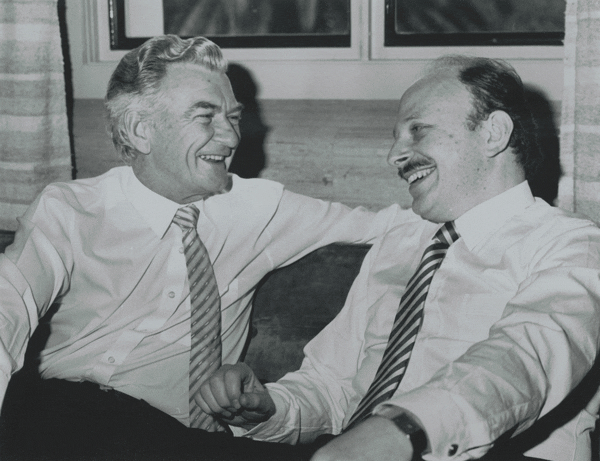
Mark Leibler schmoozing with Bob Hawke in the 1980s
Leibler thought Hayden’s attitude to Israel and Australian Jewry was amenable to change and was, to some degree, a product of his rivalry with Bob Hawke, who, according to former Jewish leaders and Labor politicians, told “whoever would listen that he was a hero to the Jewish community, that the Jews were on his side and wanted him [as opposed to Hayden] to lead the ALP in parliament.”[29] According to Leibler, “Hayden’s difficulties with the Jewish community were due in part to Hayden’s ‘paranoia’ over the relationship between Hawke and the Jews.”
After his initial meeting with Hayden, Leibler assessed that Hayden was “amenable to building a closer relationship between himself and the Jewish community.” In his notes, Leibler stressed the importance of “frequent informal contacts between the Jewish community and Zionist leaders and the top leadership of the ALP.” Leibler’s overtures to Hayden were “the beginning of his successful cultivation of senior government figures of both political persuasions.” His efforts bore tangible fruit when the Hayden was appointed Foreign Minister by Hawke in 1983. Leibler now “had access to the cabinet minister who was in a position to determine Australia’s stance on the conflict between Israel and the Palestinians.”[30]
Overturning the UN Resolution Equating Zionism with Racism
This access became an important strategic asset in Leibler’s campaign to promote the rescinding of the United Nations resolution, passed by the General Assembly in 1975, stating that Zionism was a form of racism. Leibler as ZFA president fervently backed Israeli President Chaim Herzog’s international campaign to annul the UN resolution. The campaign would be led the World Zionist Organization and the Israeli Foreign Ministry, and Leibler would run the Australian campaign through the ZFA. He wrote to politicians, public figures and leading journalists insisting that “the Zionism-equals-racism resolution had contributed to both anti-Zionism and anti-Semitism worldwide,” and asked them to support the resolution’s annulment. Bill Hayden, formerly a critic of the Israeli government, now backed Leibler’s campaign.
In August 1985, the U.S. Congress passed a motion denouncing the UN Resolution stating Zionism was racism. Leibler noted: “It immediately occurred to me that perhaps the principle objective of the Australian campaign should be to bring about a similar result, a resolution of both houses of parliament denouncing resolution 3379 but more than that, calling for its rescission.”[31]
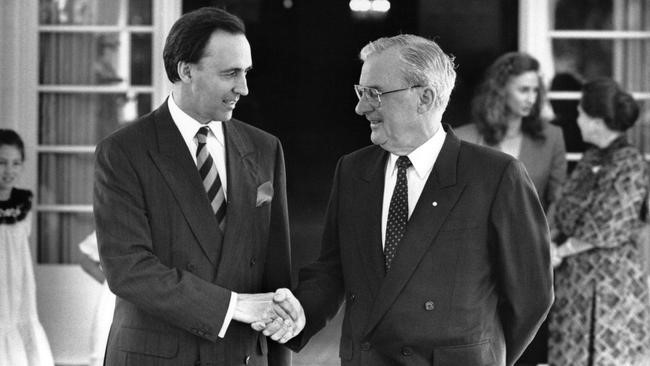 Key Leibler lobbying targets Paul Keating and Bill Hayden
He went to Hayden, not Hawke, with the proposal. Such resolutions were rare in the Australian parliament, and a resolution on a foreign affairs issue had never been passed. Leibler invited Hayden to be keynote speaker at the ZFA’s Biennial Conference in April 1986. Hayden accepted, and told Leibler that he would announce his support for a joint parliamentary resolution in his speech. Having lobbied aggressively to secure cross-party support for the resolution, Leibler then wrote to Hayden “enclosing a draft resolution for him to consider and asked whether he could meet relevant members of Hayden’s staff to discuss the final form of the resolution.”
The resolution (which was basically Leibler’s) that was put to parliament — which went further than the motion passed by the U.S. Congress and called for the UN resolution to be rescinded — was, according to Leibler, “more than satisfactory.”[32] Leibler was present in the House of Representatives when the resolution, carried unanimously in the House and the Senate at the same time, was passed. The Australian resolution was used by the Israel’s president, Chaim Herzog, and Jewish leaders and activists around the world as a model for other jurisdictions. The U.S. Congress subsequently passed a resolution sponsored by Senator Patrick Moynihan identical to the Australian one. The French and European Parliaments later did the same. For Leibler, this showed Australian Jewry “could have influence in international Jewish affairs way beyond its small size.”[33] In December 1991 the United Nations General Assembly revoked the 1975 resolution equating Zionism with racism.
Brenton Sanderson is the author of Battle Lines: Essays on Western Culture, Jewish Influence and Anti-Semitism, available here and here.
[1] Michael Gawenda, The Powerbroker: Mark Leibler, An Australian Jewish Life (Melbourne: Monash University Publishing, 2020), 291.
[2] Ibid., 296.
[3] Unsigned, “Zionist Federation of Australia Welcomes Gandel Philanthropy’s ongoing commitment to Jewish continuity,” Zionist Federation of Australia Official Statement, September 30, 2014. http://www.zfa.com.au/zionist-federation-of-australia-welcomes-gandel-philanthropys-ongoing-commitment-to-jewish-continuity/
[4] Gawenda, The Powerbroker, 4.
[5] Ibid., 239.
[6] Kevin MacDonald, “Background traits for Jewish Activism,” The Occidental Quarterly, Vol. 3 No. 2, 2003, 5-37. https://www.toqonline.com/archives/v3n2/TOQv3n2MacDonald.pdf
[7] Gawenda, The Powerbroker, 168.
[8] Ibid., 345.
[9] Ibid., 169.
[10] Ibid., 170.
[11] Ibid., 169.
[12] Ibid., 173.
[13] Ibid., 88.
[14] Ibid., 70.
[15] Ruth Ostrow, The New Boy Network: Taking Over Corporate Australia (Sydney: William Heinemann, 1987).
[16] Gawenda, The Powerbroker, 93.
[17] Ibid., 94-5.
[18] Ibid., 235.
[19] Ibid., 136.
[20] Ibid., 138.
[21] Ibid., 139.
[22] Ibid., 140.
[23] Ibid., 307.
[24] Ibid., 6-7.
[25] Ibid., 103.
[26] Ibid., 104.
[27] Ibid., 107.
[28] Ibid., 11.
[29] Ibid., 108.
[30] Ibid., 113.
[31] Ibid., 118.
[32] Ibid., 119.
[33] Ibid., 122.









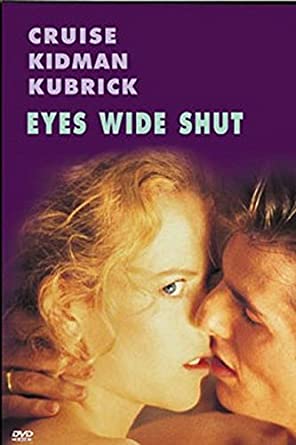 “Eyes Wide Shut,” released in 1999, was the last film of the legendary director Stanley Kubrick. He died of a heart attack six days after he submitted the final cut of the film to the film studio. Kubrick’s other films include “The Killing” (1956), “Paths of Glory” (1957), “Spartacus” (1960), “Lolita” (1962); “Dr. Strangelove or: How I Learned to Stop Worrying and Love the Bomb” (1964), “2001: A Space Odyssey” (1968), “A Clockwork Orange” (1971), “Barry Lyndon” (1975), “The Shining” (1980), and “Full Metal Jacket” (1987). A most impressive list. While I’m sure “Eyes Wide Shut” was a seriously intended expression, and by all accounts Kubrick gave it his best effort, it doesn’t contribute positively to his oeuvre.