• MISSION STATEMENT
  • TERMS
  • PRIVACY
The Occidental Observer
  • HOME
  • BLOG
  • SUBSCRIBE TOQ
  • CONTACT USPlease send all letters to the editor, manuscripts, promotional materials, and subscription questions to Editors@TheOccidentalObserver.net.
  • DONATE
  • Search
  • Menu Menu

Chuck the Cuck: The Shabbos-Goy Charles III Will Be A Worthy Successor to his Mother Elizabeth the Evil

April 11, 2023/48 Comments/in Featured Articles/by Tobias Langdon

This article will be brought to you by the letter “M.” It will feature meteor-malefactors, malign monarchs, and moral masturbation. First up: meteor-malefactors. That’s the term I give to criminals whose serious misdeeds flash through the media like a meteor before disappearing into oblivion. Why does this happen? It’s very simple: because meteor-malefactors reveal the toxic truth rather than reinforcing leftist lies. Let’s look at two of the worst crimes ever committed on British soil. They involved the prolonged suffering and exceptionally brutal murders of schoolchildren. And they were inspired by two forms of hate that leftists pretend to take very, very seriously: misogyny and racism.

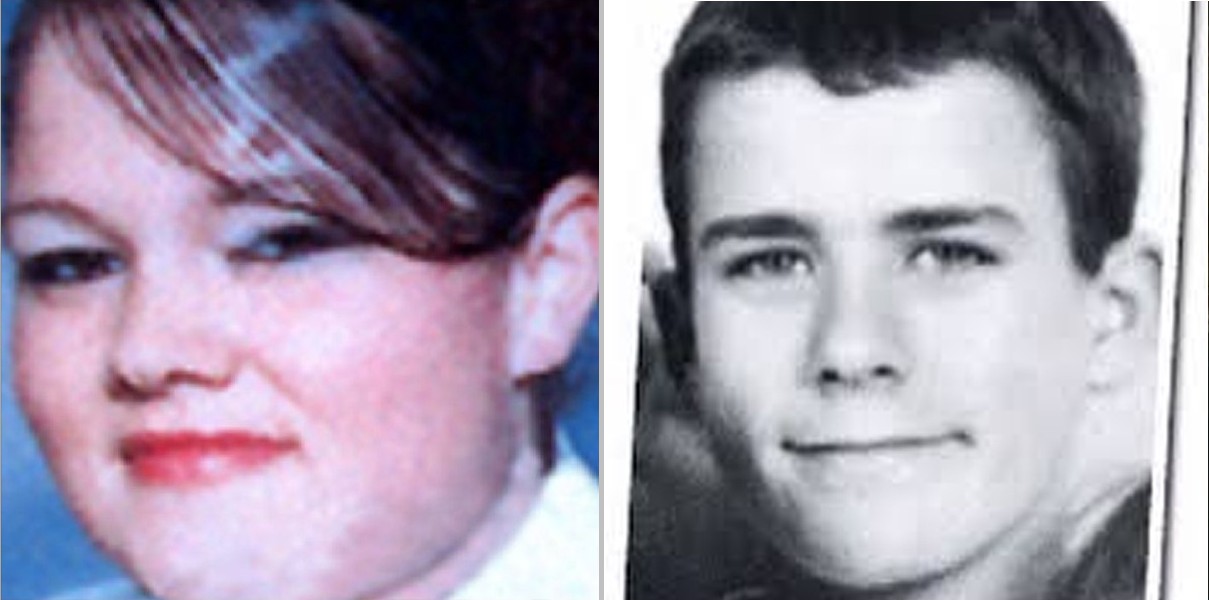
Mary-Ann Leneghan and Kriss Donald, White victims of non-White savagery

But the murders of Mary-Ann Leneghan and Kriss Donald were forgotten long ago by the leftist media. This might seem puzzling, when you consider, for example, that Mary-Ann Leneghan was the victim of a gang of vilely misogynistic men whose crimes were supremely horrible examples of rape-culture and patriarchal barbarism:

[The surviving victim] described how she and Mary-Ann [Leneghan], her friend of 10 years, had been abducted and forced into the boot of a car as they sat in the car park of the Wallingford Arms in Reading, Berkshire on May 6 last year [2005]. She said they were taken to Room 19 of Abbey House Hotel in the city where they were beaten with a metal pole, ordered to strip, forced to perform oral sex, raped, and had boiling sugared water thrown on them.

She said the pair were shown guns and a knife, constantly told they were going to be killed and heard that they would be taken to Prospect Park in Reading. During the first day she hardly flinched as she recounted the graphic details without being hidden by a screen. But today she wept as she told how, as she was raped by a man wearing white jogging bottoms, another man said: “We are ready to go now, let’s leave these bitches now, come on let’s do it.”

She told the jury that she understood this phrase to mean “the final stage, that we were going to die, that they were going to kill us.” She said she, together with Mary-Ann, was taken out of the boot of the car and forced, stumbling and wiping blood from her head, across the park. She said the pair had been ordered to kneel on the ground side by side and were told to put pillow cases over their heads by two men, one wearing a bandana over the lower half of his face and the man with the white jogging bottoms.

With the six defendants just feet away Mary-Ann’s father sat with his hand over the mouth as the girl continued. Asked by prosecutor Richard Latham QC, what happened next she paused for around 30 seconds before looking straight ahead at the jury and saying “she [Mary-Ann Leneghan] was stabbed”. The court was told that the knife-man had been the man with the bandana and asked where on Mary-Ann’s body the man had put the knife she said: “Her upper body, her chest, her breasts, everything. She was asking ‘please not there, please not there’ whatever area she was referring to, and crying and pleading,” she said.

She told how the man with the bandana got angry saying words to the effect of “shut up”. She said that Mary-Ann then fell in a ball on the ground but the stabbing did not stop. “He got more angry because she wouldn’t sit up, he was telling her to sit up because he wanted to slit her throat. … He was stabbing and then she fell,” she said. “They said something about wanting her to die slowly,” she added, before she broke down in tears. … (Friend weeps over Mary-Ann murder, The Daily Mail, 20th January 2006)

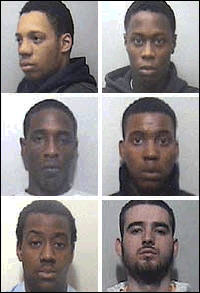
Rapists, torturers, murderers: the energetic enrichers who killed Mary-Ann Leneghan

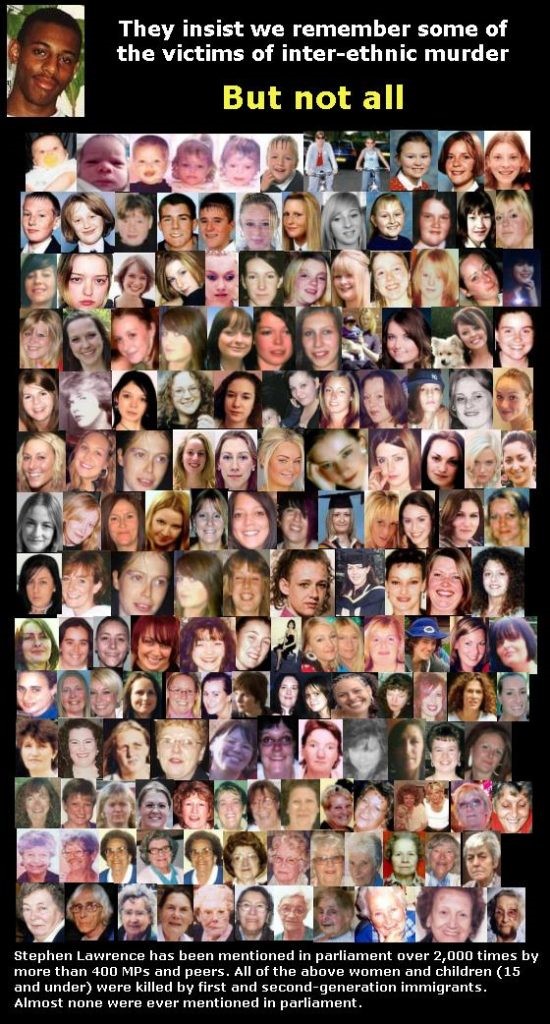
In 1993 an unlucky, mercifully quick and very unusual murder was committed by a gang of “white racists” against an ugly Black schoolboy called Stephen Lawrence. Ever since then, the murder has been endlessly revisited by leftists in articles, editorials, documentaries, dramas, and academic studies. In 2018 the ugly shabbos shiksa Theresa May added Stephen Lawrence Day to Britain’s official calendar. But the far worse murder of Mary-Ann Leneghan — which was prolonged, premeditated and viciously sadistic — was swiftly forgotten by leftists.

Why so? Well, her murder was perfect for the creation of a leftist martyr-cult except for one thing: she and her rapist-murderers were the wrong color. She was White and her rapist-murderers consisted of five Blacks and one Albanian “asylum-seeker.” In other words, unlike the murder of Stephen Lawrence, her murder couldn’t be used to promote the leftist lie that villainous Whites are a constant threat to the lives and well-being of virtuous non-Whites. On the contrary, it revealed the truth: that non-Whites, and Blacks in particular, commit far more and far worse violence against Whites than vice versa, even when those non-Whites are still far fewer in number than Whites. That’s why the Black savages who tortured and killed Mary-Ann Leneghan were meteor-malefactors. Their horrible crimes flashed through the leftist media and then vanished forever.

Singh Something Simple

So did the horrible crimes of the Pakistani Muslim gang that kidnapped, set on fire, and stabbed to death the fifteen-year-old Scottish schoolboy Kriss Donald, who died for no other reason than that he was White. It was another meteor-murder committed by more meteor-malefactors, because it couldn’t be used to promote the leftist lie of White villainy and non-White virtue. But criminals don’t have to commit horrific crimes like those to be sent into oblivion by the left. Let’s move from the sickening to the ridiculous and meet another meteor-malefactor: an ethnic enricher called Jaswant Singh Chail. Luckily for the left, he didn’t succeed in killing the elderly White woman he wanted to kill. If he had succeeded, even the left wouldn’t have been able to send the murder into speedy oblivion. This is because the elderly White woman in question was called Queen Elizabeth II. On Christmas Day 2021, the bumbling and incompetent Chail tried to enter Windsor Castle and kill her with a crossbow. In a video he recorded beforehand, he announced: “I will attempt to assassinate Elizabeth, Queen of the Royal Family. This is revenge for those who have died in the 1919 Jallianwala Bagh massacre. It is also revenge for those who have been killed, humiliated and discriminated on because of their race.”

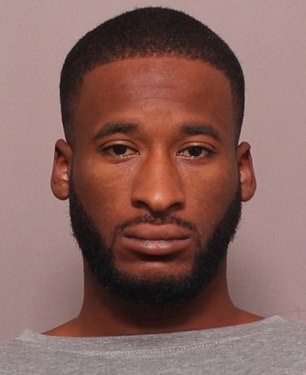
Jaswant Singh Chail, the wannabe anti-racist avenger and assassin of Queen Elizabeth II

If Chail had succeeded in assassinating the Queen, the left might have had to face some uncomfortable questions about the way it incites non-Whites into violence against Whites with constant lying propaganda about “racism.” He didn’t succeed and so the left turned him into a meteor-malefactor. But then so did the cuckservative right, because Chail’s misdeeds also exposed their lies. If he’d been a Muslim, I’m sure that conmen like Mark Steyn and Douglas Murray would have given a lot more publicity to what he tried to do. But Chail is a Sikh, member of a so-called model minority, so he exposed a truth that conmen and cuckservatives don’t want to face: that all non-Whites are bad for the West. Yes, some groups are much worse than others, but none of them should be here and all of them are being used by the left and its Jewish generals in their war on the West.

Waging war on Whites

And in their war on the White working-class. Which brings me to some interesting details in Chail’s farcical attempt on the Queen’s life:

He was spotted by a royal protection officer in a private section of the castle grounds just after 08:10 GMT on 25 December 2021. The officer was at a gate, leading to the monarch’s private apartments. Chail, who was unemployed at the time but had worked for the Co-op supermarket, had climbed into the grounds using a nylon rope ladder, and had already been there for about two hours.

He was wearing a hood and a mask, and was described as “like something out of a vigilante movie”. The officer took out his Taser, and asked him: “Morning, can I help, mate?” Chail replied: “I am here to kill the Queen.” The protection officer immediately told Chail to drop the crossbow, get on his knees, and put his hands on his head. Chail complied and then said again: “I am here to kill the Queen.” (Man admits treason charge over Queen crossbow threat, BBC News, 3rd February 2023)

The royal protection officer used the language of the White working-class, probably because he is a member of the White working-class. Either way, he and his comrades were no doubt very pleased with the cool and professional way he responded to that threat to the monarch whom he had sworn to serve and protect. But if the officer had truly understood the political situation in Britain, he would have realized that his oaths had been rendered null and void by the Queen’s own behavior. After Chail said, “I am here to kill the Queen,” the officer should have said: “Be my guest, mate” and then guided him to his target.

Assassination at the hands of a deranged non-White would have been no more than Elizabeth II deserved for her decades-long betrayal of her people, her nation, and her religion. As I pointed out in my article “Elizabeth the Evil,” she was no great intellect but she played to perfection the role of judas-goat, serving as a figurehead of false continuity and calm as Britain was led into the slaughterhouse by Jews and leftists. She was a malign monarch, betraying her coronation oaths as, decade after decade, violent and destructive non-Whites with alien faiths flooded in to prey on and parasitize her White subjects. Elizabeth II was a traitor, sitting comfortably in luxurious palaces under 24-hour protection as White girls were raped by Muslims in Rotherham and elderly White women were raped by a gerontophile Black in London. But those rapes, horrible as they have been, constitute only a tiny fraction of the violence and misery inflicted on Whites by non-Whites since the coronation of Elizabeth II in 1953.

War on Whites: how non-White savagery is concealed by the Judeo-leftist media

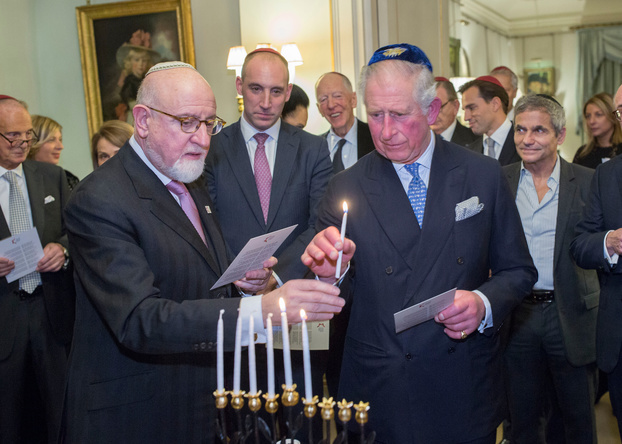
Now Britain is preparing for the coronation of a new monarch and a new traitor. He is officially known as Charles III, but I prefer to call him Chuck the Cuck. Like his mother, he has lived in luxury, decade after decade, and done nothing to defend his White subjects or Christianity against the predation of non-Whites and their alien religions. Indeed, he’s surpassed her in groveling allegiance to the ideology of minority worship created and enforced by Jews. She was a shabbos shiksa and he is a shabbos goy. As Israel Shahak pointed out in his fascinating (and disturbing) book Jewish History, Jewish Religion: The Weight of Three Thousand Years (1994), Jews have traditionally followed a rule of unrelenting hostility and disdain towards gentiles. But that rule is suspended in the case of kings and other powerful figures who might be useful for Jews. And so Chuck the Cuck has been showered with sycophancy by Britain’s Jews, but has been too stupid to understand that it is self-serving, not sincere. He’s also been unable to read the dire warnings of history. It is entirely possible that the Jews who funded Oliver Cromwell were responsible for the execution of Chuck the Cuck’s ancestor Charles I in 1649. It would have been Jewish vengeance for their expulsion from England in 1290 by Edward I, who favored protecting his Christian subjects over pandering to gold-hungry Jews.

Chuck the Cuck is guided by Jews

Jews were certainly responsible for the death of Chuck the Cuck’s relative Tsar Nicholas II, who was slaughtered with his wife and children by the Bolsheviks in 1918. The Bolshevik government was dominated by Jews and the chief executioner of the Romanov family was a Jew called Yakov Yurosky. If Chuck the Cuck lost his power and symbolical importance, he would soon see the genuine Jewish attitude towards goyim. As it is, he basks in Jewish sycophancy and steadfastly follows an anti-White Jewish agenda of minority-worship. Chuck the Cuck isn’t supposed to interfere in politics, but he ignores that rule when he has narcissism to feed and virtue to signal. The present Conservative government has recently begun pretending that it is ready to get tough about the endless flow of mostly young and mostly male migrants illegally crossing the English Channel in small boats. This is how Chuck the Cuck has responded:

King Charles meets former refugees from Sudanese community

The King told former refugees who escaped by boat to Europe from the Darfur genocide: “I’m so glad you’re safe here.” On Wednesday Charles met accountants, NHS consultants and charity workers who have made a new life in the UK. Sudanese activist Amouna Adam invited him to meet her community when the pair met on Holocaust Memorial Day. […] The event, organised by the Holocaust Memorial Day Trust and the human rights organisation Waging Peace, was held at a central London venue used for events by the UK’s Sudanese community. Addressing the men and women who fled the mass killings, the King said: “It’s been a very special visit for me, I can assure you. It’s been such a pleasure to meet you all — I’m so glad you’re safe here.” (King Charles meets former refugees from Sudanese community, BBC News, 15th March 2023)

Chuck the Cuck can be “glad” about Black Sudanese invading Britain because he doesn’t have to pay the costs of their presence. That’s why I hope to see him put on trial one day and face questions about an ordinary White woman who has had to pay the cost of the Sudanese presence:

A savage from Sudan: the energetic enricher Zakarya Etarghi

‘Savage’ rapist Zakarya Etarghi has been given a life sentence with a minimum of 18 years after shattering his victim’s skull and leaving her for dead near a children’s play park. The 24-year-old attacked a woman in her 50s at a public park in Leicester, East Midlands, after a cocaine and alcohol binge.

Today he was jailed at Leicester Crown Court after being convicted of rape and attempted murder on March 7. … Building-site worker Etarghi attacked his ‘vulnerable’ victim and left her with horrific life-changing injuries including a ‘shattered’ skull and bleeding to the brain.

But a member of the public found her with head injuries at the park following what prosecutor William Harbage QC previously told the jury was a ‘brutal’ and ‘appalling’ assault. … Despite the evidence against him, Etarghi, who was born in Sudan, denied the offences — saying someone else must have carried out the attack.

Judge Nicholas Dean QC said his victim was ‘lucky to be alive’ after being ‘attacked in a most brutal way’ when she met Etarghi in the playground — with evidence suggesting a weapon of some kind had been used. … The judge said he had ‘no hesitation’ in concluding Etarghi was a ‘dangerous offender’ who was responsible for ‘controlled and extreme brutality and physical violence of a most callous and horrifying type.’

The court heard a resident found her unconscious and naked from the waist down at around 4.40am after the attack, suffering from multiple injuries. She was rushed to hospital — [and] ‘miraculously’ survived after undergoing life-saving surgery and is still recovering.

Speaking in a victim impact statement, the victim said: ‘If I could describe the last few months, I would say they have been hell. It is like something out of a horror film. It’s like something you see on the news that happens to other people. I no longer feel safe walking to and from my home, especially late at night. I constantly worry something is going to happen.’ (‘Savage’ rapist, 24, who shattered woman’s skull during horrific attack in a children’s play park then left her for dead is jailed for life, The Daily Mail, 25th March 2019)

Thanks to non-White migration, many British Whites have undergone experiences “like something out of a horror film.” Chuck the Cuck has certainly heard about some of those experiences — the rape-gangs in Rotherham and the suicide-bombing in Manchester, for example — but it has made no difference to his minority worship. Indeed, I can see a good parallel between Chuck the Cuck and the Sudanese rapist Zakarya Etarghi. Both of them are obviously dedicated to pursuing their own pleasure at no matter what the cost to others. Etarghi committed rape and Chuck the Cuck commits what I’ll call moral masturbation, that is, the self-pleasuring act of parading one’s virtue and minority-worship in public. When Chuck the Cuck tells low-IQ Sudanese that “I’m so glad you’re safe here,” he doesn’t care about the ordinary Whites who will be harmed by their presence. After all, he wouldn’t be rewarded with leftist acclaim and progressive kudos for defending the interests of Whites. On the contrary, he would be condemned as a racist and bigot for doing that. Defending Whites would take courage that he doesn’t possess and inflict costs that he isn’t prepared to pay.

Crowning the Cuck

Chuck the Cuck will indulge in more moral masturbation during his coronation. It’s already been announced that he will “put refugees and the [ethnically enriched] NHS [National Health Service] at the heart of a diverse Coronation that will bring the nation together in a three-day celebration designed to reflect modern, multi-cultural Britain.” Andrew Joyce has explained how much harm non-Whites do to the NHS, but that makes no difference to Chuck the Cuck. Now there are even reports that the Church of England, no mean moral masturbators themselves, are expressing doubts about the way he wants to involve other religions in the coronation. I doubt that even Chuck the Cuck wants to be crowned by the Chief Rabbi as a chorus of vulnerable asylum-seekers chant “Allahu Akbar!” and wave the severed heads of assorted infidels. But he will want something not far off. Like his mother, he is a dedicated traitor to both the White British and to Christianity, the religion in which he was baptized and that he has sworn to defend.

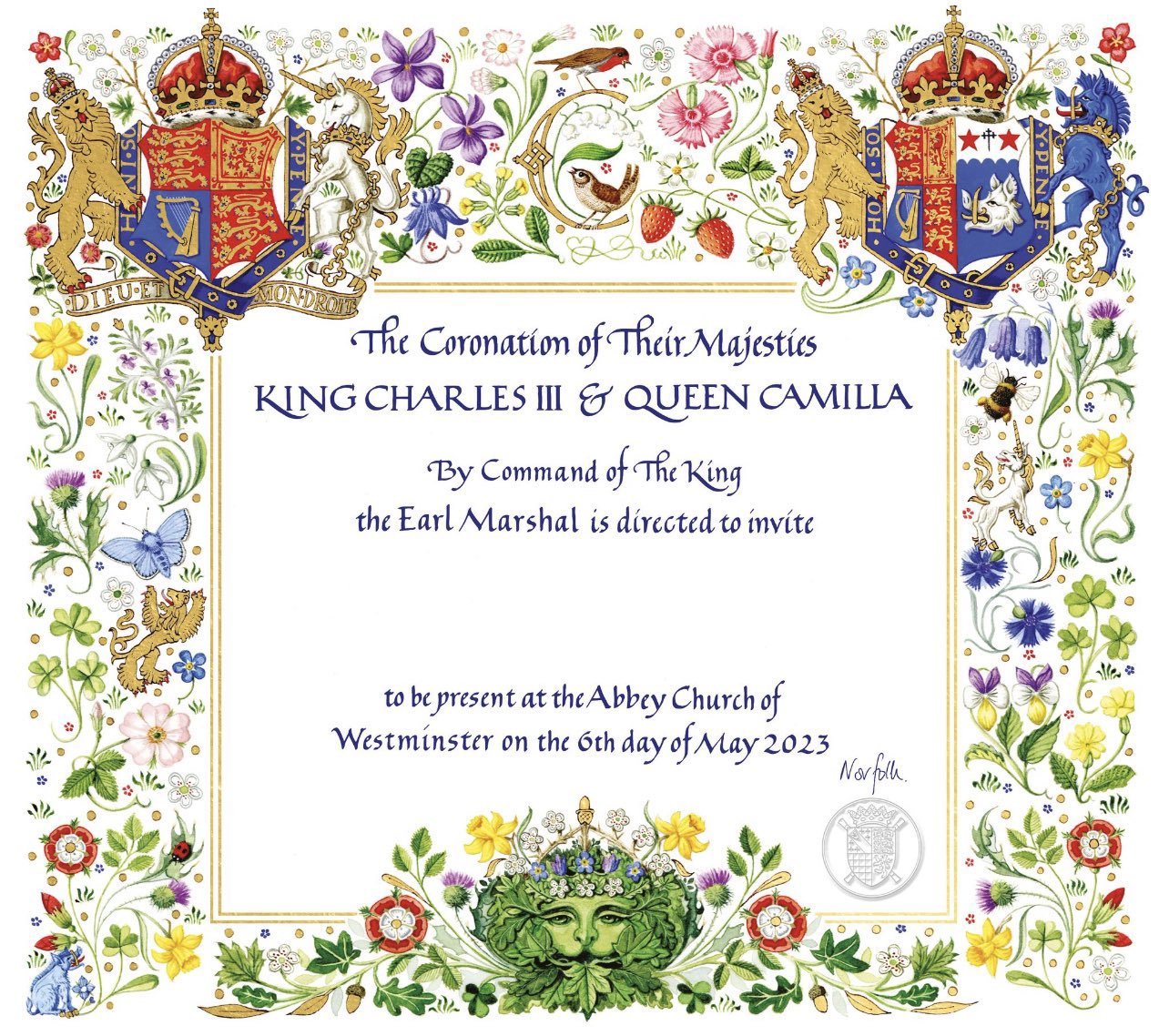
No Christianity, but some grinning paganism: Chuck the Cuck’s coronation invitation with Green Man

And I wonder whether that betrayal of his religion is even worse than it appears. There are no obvious Christian symbols on the invitations he has issued for his coronation. But there is an obvious pagan symbol: the Green Man at the bottom. Is that a hint of where Chuck the Cuck’s real loyalties lie? That is, is Chuck the Cuck not merely a shabbos-goy and traitor, but a literal worshiper of evil? Whether he is or not, one thing is certain. Like the reign of Elizabeth the Evil, the reign of Chuck the Cuck will be pleasing to Satan, not to Jesus Christ.

https://www.theoccidentalobserver.net/wp-content/uploads/2018/06/TOO-Full-Logo-660x156-1.png 0 0 Tobias Langdon https://www.theoccidentalobserver.net/wp-content/uploads/2018/06/TOO-Full-Logo-660x156-1.png Tobias Langdon2023-04-11 08:28:422023-04-12 02:42:49Chuck the Cuck: The Shabbos-Goy Charles III Will Be A Worthy Successor to his Mother Elizabeth the Evil

Jewish Control of U.S. Presidents #2 — Ronald Reagan

April 10, 2023/75 Comments/in Featured Articles/by Karl Haemers

Similar to an addict who must bottom out to a recognition of the full horror and misery of life before turning sincerely to recovery, so we must understand the full depths of Jewish power over us before we can really turn our situation around. In #1 of this series we examined the Jews who gained control over U.S. President Woodrow Wilson, leading to the placement on the Supreme Court of the first Jew, the imposing of the disastrous Federal Reserve system dominated by Jewish bankers, and entry into World War I to the profit and advantage of Jews.

Many other Presidents can be chosen almost at random to continue this examination, but we will look next at Ronald Reagan because it is estimated that around 1980 was the culmination of the rise of Jewish power in America—when they finally achieved dominance over the long-held power of White Anglo-Saxon Protestants (WASPs).

Within the past 60 years, the Jews have risen to elite status in the United States, totally displacing the traditional WASP elite who used to run the country. Their infiltration of the highest offices of every American institution, their extreme over-representation in every profession, their control of the news and entertainment media, their over-representation in the universities, is even more pervasive in America today than in Weimar Germany…

But unlike the WASP elite whom they have displaced, the Jews have become what Professor Kevin MacDonald, in his trilogy of books on Jewish culture, calls a “hostile elite.” The old WASP elite never lost its sense of noblesse oblige toward the ordinary people of America. They were, after all, of the same religion and of the same ethnic origin, and they felt a sense of responsibility for the general welfare of all of their fellow citizens. Our new Jewish elite is different. They feel no identity with ordinary Americans, only contempt, and they concern themselves only with “what is good for the Jews.”

Not only does this new Jewish elite have no empathy for the traditional European majority in America, they actively work to undermine it…

-Benton Bradberry, The Myth of German Villainy, 2012, pp. 434–5

The election of Ronald Reagan in 1980 marked a milestone in this advance of Jewish power, and arguably could be viewed as the transition time. Reagan served as the 40th president during two terms from 1981–1989, with Vice President George H.W. Bush. We will see the role Jews played in Reagan’s trajectory, and Reagan’s receptiveness to Jewish power.

Jewish Media Mafia Origins

Reagan attended Eureka College in Illinois, the state in which he was born. There he acted in school plays. “Upon graduation, he became a radio sports announcer. A screen test in 1937 won him a contract in Hollywood. During the next two decades he appeared in 53 films.” According to Dan Moldea, researcher and author on organized crime, in his The Corruption of Ronald Reagan:

Reagan came to Los Angeles in 1937 to make motion pictures, and, in 1940, MCA bought out his talent agency.  Lew Wasserman became Reagan’s personal agent; he negotiated a million-dollar contract with Warner Brothers on Reagan’s behalf.  In 1946, Wasserman became the president of MCA, and the following year, Reagan, with his film career already in decline, became the president of the Screen Actors Guild.

MCA “was founded in 1924 by Jules Stein, a Chicago ophthalmologist who quickly became friendly with the local underworld,” according to Moldea. He will not state the obvious, that Stein was Jewish, nor that the “underworld” Stein allied with also included Jewish elements. Lew Wasserman who was Reagan’s personal agent and had become president of MCA was also of course Jewish.

Every facet of Reagan’s life, from his careers in acting and politics to his financial successes, were directed by MCA, which, with the help of the Mafia, was the most powerful force in Hollywood from the mid-1940s until the Bronfman family purchased the company in 1995. The Bronfman family was/is also Jewish, as was the Hollywood Mafia as we will see.

It may seem tedious to identify so many of the names in this investigation as Jewish, but that is something Moldea and some other sources we refer to will not do, making it significant obscurantism. Revealing the Jewish identity of those who created and controlled Reagan the president will assist us in a clear identification of the enemy of America and its people, and inform an effective self-defense.

Lew Wasserman’s career in entertainment and organized crime lasted 70 years, starting as an usher at a movie theater in Cleveland in 1933. At the peak of his career as Chairman of MCA in 1973, Variety magazine called him “Hollywood’s ultimate mover and shaker.” Wasserman’s Wikipedia entry references Moldea, and says:

Wasserman was the link between the Mafia, the Hollywood film industry and Reagan, who obtained very lucrative deals as an actor with Wasserman as his agent. By 1947, just after Al Capone died, and still with the help of his alliance with the underworld, Wasserman was instrumental in helping Reagan to become president of the Screen Actors Guild, which kicked-off Reagan’s rise to power. Reagan allowed MCA to work both as a producer as well as an agent, which enabled the Mafia to earn a huge income.

Another Jewish mobster in Hollywood was Sidney Korshak. A Vanity Fair profile on Korshak titled “The Man Who Kept the Secrets” states:

Wasserman’s rise had brought him in contact with the underworlds of both Cleveland and Chicago; MCA’s ascendance in Hollywood in the late 30s was simultaneous with the Chicago Mob’s infiltration, through union control, of the movie business, and with Sidney Korshak’s own move to the Coast. Wasserman was perhaps the most powerful and revered figure in Hollywood, and Sidney Korshak was perhaps his closest friend. … it was Glaser who introduced [Jules] Stein to Korshak. It seems likely that it was Stein who then introduced Wasserman to Korshak.

 Joe Glaser was another Jew of Russian origin involved with MCA and the Hollywood Jewish Mafia. Here is a good summary of the Hollywood/Jewish Organized Crime Syndicate environment at the time:

“Twentieth-century organized crime in America was a primarily Jewish-Italian coalition that shared the sensibilities but lacked the ethnic purity of the true Sicilian Mafia.”

Reagan Groomed for President by Jews

A definitive research work by Dan Moldea titled Dark Victory: Ronald Reagan, MCA and the Mob recounts:

In the late 1940s Hollywood shifted its attention away from the Mafia’s infiltration of the film industry to its infiltration by Communists [i.e., another group of Jews]. Ronald Reagan, a young actor who was represented by Wasserman and MCA, was a star player during the investigations and hearings by the U. S. House Un-American Activities Committee (HUAC), serving as both an informant for the FBI and a friendly witness for the committee.

After his performance in the war against communism … Reagan was rewarded by being elected as President of the Screen Actors Guild (SAG), serving for five consecutive one-year terms. (p. 16)

As SAG President, Reagan allowed a violation of rules that was immensely profitable to MCA:

“In 1952, during his fifth term, Reagan engineered a ‘blanket waiver,’ exempting MCA from SAG rules prohibiting a talent agency from also engaging in film production.” Earlier Moldea writes: “decisions made by SAG while under Reagan’s leadership became ‘the central fact of MCA’s whole rise to power.’” Already in the early 1950s Reagan and MCA were in a mutually beneficial relationship, but

soon after Reagan’s tenure as SAG President ended, he found himself in serious financial trouble. With his film career on the skids, Reagan was saved by MCA with jobs in Las Vegas and on television. …the preferential treatment Reagan received from MCA was a payoff for services rendered while Reagan was President of SAG. (Ibid.)

By 1959 Reagan was reelected to a sixth term as SAG President, this time to oversee a strike of the actors against major studios. Reagan resolved the strike eventually with the assistance of Jewish Mafia attorney Sidney Korshak. Reagan’s own role as President was against SAG rules, since having become a producer with Jewish support, he was disallowed from being President. He refused to recuse himself.

Jews Place a California Governor

Jules Stein was also known to be “active in Republican politics,” and influenced Reagan to shift to the Republican party after the “break up” of MCA. During Reagan’s campaign for California Governor, “Among the guiding forces in the shaping of Reagan’s political philosophy were MCA’s Jules Stein and Taft Schreiber. … [S]everal of Reagan’s campaign financiers (p. 18) were close friends and associates of Sidney Korshak.” (p. 18) Only Schreiber is unconfirmed as Jewish. Reagan won the Governorship in 1966 and again in 1970, with Jewish Hollywood Mafia help. Reagan’s fundraising and campaign management “was arranged and financed by Jules Stein and a group of conservative southern California businessmen.” (p. 252) “Considering all the help Reagan received from Stein and Schreiber, the standing joke in Hollywood was that ‘MCA even had its own Governor.’” It was no joke that Jews had their own Governor in California.

Early in Reagan’s Governorship, “Wasserman had become the most powerful legitimate force in Hollywood.” Reagan paid back the Hollywood Mafia Jews who had placed him in the Governor role:

To help the film industry, Governor Reagan pushed legislation through the California State assembly giving all Hollywood studios, including MCA-Universal and 20th Century-Fox, huge breaks on their film libraries. The tax savings at each studio was estimated to be worth a minimum of $3 million. (p. 266)

Jews such as Stein and Korshak arranged real estate deals for Reagan at values well above market rates, making him a multi-millionaire through what was essentially Jewish money laundering bribery deals. Hollywood Mafia Jews controlled Reagan as far back as 1966 at the beginning of Reagan’s time as role as California governor, by funding and running his campaigns, and bribing him through cutting real estate deals. Reagan reciprocated by passing legislation in the California legislature profiting Jewish Hollywood Mafia moguls.

President Reagan, Actor for Jews

In November 1979, Reagan kicked off his presidential campaign with a speech at the New York Hilton Hotel. Earlier that year, Nevada Senator Paul Laxalt, with extensive Las Vegas Mafia ties, including the Jewish Mafia through the figure of Moe Dalitz, formed the Reagan For President Committee. Laxalt was quoted openly in New York Times Magazine as saying “Moe Dalitz is a friend of mine.” Dalitz and the Jewish Mafia contributed large sums to Reagan’s campaign. Reagan’s platform was to be limited government regulation, low taxes and limits on government spending. Reagan’s main campaign manager was William Casey, corrupt businessman and lawyer who had been lead counsel at the primarily Jewish Bear Stearns investment bank where Jeffrey Epstein also worked, before its bankruptcy. The Jew Alan Greenberg, who recruited and advanced Epstein, was CEO of Bear Stearns at the time of its collapse. Casey went on to be Reagan’s CIA Director. (Moldea, p. 310–11)

In her great chronicle One Nation Under Blackmail, Whitney Webb details Reagan’s CIA Director’s relations with the Jewish Mob:

 [William] Casey and [Roy] Cohn were close friends, and, during the 1980 Reagan campaign, Casey “called Roy almost daily.” … [I]n the immediate aftermath of Reagan’s electoral victory, Cohn … took (Adnan) Khashoggi on as a client. Epstein would follow suit, shortly after his resignation from Bear Stearns. … Casey had been the legal representative of Bear Stearns during Epstein’s time there up until several weeks before Epstein’s abrupt resignation, when Casey became CIA Director. (Webb, ppg. 650–51)

Roy Cohn was of course the Jewish mob attorney in New York City who ran his own child-raping blackmail rings, similar to Epstein. Epstein resigned from Bear Stearns on March 12, 1981, less than a month after Reagan took office. The timing coincided with an insider trading crime at the bank that involved the Jewish mob family the Bronfmans. (Webb, ppg. 18–23)

By August 1980 Reagan gave a campaign speech in Ohio before the Teamsters Union, whose vice-president at the time was Jackie Presser, Jewish, who went on to become the Teamsters’ President in the Reagan years. Through his Jewish father, convicted labor racketeer William, Jackie had close associations with Jewish mobsters Moe Dalitz, Allen Dorfman and Sidney Korshak. (Moldea, p. 315)

Lew Wasserman, the movie mogul who dominated the Los Angeles business scene, worked to restrict funding for Reagan’s competitor, incumbent Jimmy Carter, and was unobtrusively supporting Reagan. (Moldea, pp. 316–17) “Wasserman was also one of the driving forces and chief political patrons of Ronald Reagan, making him a ‘kingmaker’ for several U.S. Presidents during his lifetime,” including Carter. (Moldea, p. 309) Reagan appointed Presser to be his “chief economic advisor” on the transition team, and Presser influenced the selection of other Reagan officials, including Labor, Treasury and others, which would have jurisdiction to (not) investigate Teamster mob connections. (Moldea, p. 317)

Reagan tried to appoint William McCann as ambassador to Ireland, but in the confirmation hearings it became known that McCann had been associated with convicted stock and insurance fraudster Louis Ostrer, who stole funds from the Laborers Union account (Moldea, p. 319). I found no direct evidence Ostrer was Jewish, but his name association with the clearly Jewish Harry Ostrer who conducted the genetic studies that showed Jews are a genetically distinct group, makes it likely.

When MCA founder and Wasserman mentor Jules Stein died on April 29, 1981, President Reagan was one of the seventy-six honorary pallbearers (Moldea, p. 326).

For twenty years including during the two Reagan presidencies, Wasserman’s second in command of MCA was President and Chief Operating Officer Sidney Scheinberg, Jewish. Scheinberg mentored and groomed Jewish movie maker Steven Speilberg, and oversaw the holocaust promotion block-buster Schindler’s List (based on a fictional novel). Also appointed to the MCA board was the Jew Robert Strauss, who was the Chairman of the Democratic National Committee. Later Strauss went on to advise Reagan on the replacement of his controversial Chief of Staff Donald Regan with Republican Senator Howard Baker. Baker later had a close working business relationship with Israeli super-spy Robert Maxwell (Hoch), in the Newstar investment and advisory corporation, investing in privatized assets of the former Soviet Union (Webb, p. 191).

We could provide more evidence from these excellent sources for Jewish power and for Jewish organized crime control over Ronald Reagan in his presidential campaigns, transition teams, and two presidential terms. Let what we have seen already suffice to establish its factual basis.

Reagan’s Gifts to Jews
Next we will examine just some of the many benefits Reagan bestowed upon Jews during his governorship and presidency. Our source will be the Jewish Virtual Library entry on Reagan, which provides a convenient list:

  • California had the second largest Jewish population in the U.S., and served their interests as Governor
  • Resigned in protest from the Lakeside Country Club because it declined to admit a Jew [probably a Jewish mobster]
  • “…strongly supported Israel during the Six-Day War and was the featured speaker at a pro-Israel rally in the Hollywood Bowl in Los Angeles.”
  • Passed a law that banks were authorized to purchase State of Israel bonds
  • Wrote a weekly column in the Jewish Press newspaper, for an audience of mostly Orthodox Jews
  • Jews not yet mentioned but active in both gubernatorial and presidential campaigns and administrations: Theodore Cummings, Albert Speigel (L.A. businessman, head of the Jewish Coalition for Reagan), Max Fisher , Maxwell Rabb , George Klein, Gordon Zacks.
  • “Neo-conservative Jewish intellectuals, such as Eugene V. Rostow, Max Kempelman, Irving Kristol, and Norman Podhoretz were active in the Reagan election campaign and many became influential in the Reagan Administration.” Irving Kristol along with Leo Strauss was a known Communist Trotskyite who gave rise to today’s “Neo-Con” Jews, including his son William.
  • Brooklyn Jews voted strongly for Reagan, an unprecedented split along a “religious” divide.
  • After seeing propaganda footage of the “liberation” of German camps, referenced it in a Yom HaShoah (Holocaust Remembrance Day) speech from the White House in 1981.
  • Israel First policy: support the Israeli military and recognize it as “the only remaining strategic asset in the region on which we can rely,” opposed the PLO and rejected a two-state solution, and provided “strong support for Israel as America’s most reliable ally in the Middle East.”
  • Regarding Israel’s illegal settlement activity in the West Bank and Gaza, Reagan’s consistent position was: “the settlements are not unlawful.”
  • Instructed US delegates to the UN to veto any resolution characterizing Jerusalem as “occupied territory,” and authorized the only veto cast against the UN Security Council resolution condemning the mass shooting of Palestinian worshipers by an Israeli gunman at the Dome of the Rock in 1982, on the grounds that the resolution contained a paragraph declaring Jerusalem occupied territory.
  • In a speech of September 1, 1982, announced the “Reagan Plan” for peace in the Middle East, which denied independent statehood for Palestine, and Jerusalem to remain undivided and its jurisdiction ambiguous.
  • Through negotiations with U.S.S.R. President Gorbachev, conditions in Ethiopia changed to allow Jews there to move to Israel in 1985, in Operation Moses, “with some covert U.S. assistance.”
  • Steady support for Israel was “somewhat marred” by his visit in 1985 to the Bitburg Cemetery in Germany, where SS officers were buried, “who committed the most heinous crimes.” Yet this “caused no lasting damage to the cause of remembrance.”

Regarding the rise of the neocons during Reagan’s presidency:

The fault lines between neoconservatives and paleoconservatives were apparent during the Reagan administration in the battle over the appointment of the head of the National Endowment for the Humanities, eventually won by the neoconservative Bill Bennett. The campaign featured smear tactics and innuendo aimed at M. E. Bradford, an academic literary critic and defender of Southern agrarian culture who was favored by traditional conservatives. After neocons accused him of being a “virulent racist” and an admirer of Hitler, Bradford was eventually rejected as a potential liability to the administration.102

The entry of the neoconservatives into the conservative mainstream did not, therefore, proceed without a struggle. Samuel Francis witnessed much of the early infighting among conservatives, won eventually by the neocons. Francis recounts the “catalog of neoconservative efforts not merely to debate, criticize, and refute the ideas of traditional conservatism but to denounce, vilify, and harm the careers of those Old Right figures and institutions they have targeted.”103

There are countless stories of how neoconservatives have succeeded in entering conservative institutions, forcing out or demoting traditional conservatives, and changing the positions and philosophy of such institutions in neoconservative directions.… Writers like M. E. Bradford, Joseph Sobran, Pat Buchanan, and Russell Kirk, and institutions like Chronicles, the Rockford Institute, the Philadelphia Society, and the Intercollegiate Studies Institute have been among the most respected and distinguished names in American conservatism. The dedication of their neoconservative enemies to driving them out of the movement they have taken over and demonizing them as marginal and dangerous figures has no legitimate basis in reality. It is clear evidence of the ulterior aspirations of those behind neoconservatism to dominate and subvert American conservatism from its original purposes and agenda and turn it to other purposes.… What neoconservatives really dislike about their “allies” among traditional conservatives is simply the fact that the conservatives are conservatives at all—that they support “this notion of a Christian civilization,” as Midge Decter put it, that they oppose mass immigration, that they criticize Martin Luther King and reject the racial dispossession of white Western culture, that they support or approve of Joe McCarthy, that they entertain doubts or strong disagreement over American foreign policy in the Middle East, that they oppose reckless involvement in foreign wars and foreign entanglements, and that, in company with the Founding Fathers of the United States, they reject the concept of a pure democracy and the belief that the United States is or should evolve toward it. (“Neoconservatism as a Jewish Movement;”  inner quote from Sam Francis)

Reaganomics: Trickle Down, Flood Up

The Jewish libertarian leader Murray Rothbard in his essay “The Myths of Reaganomics” states: “I come to bury Reaganomics, not to praise it.” Rothbard’s main critique is that Reaganomics’s stated goals of reducing government spending, reducing taxes, reducing government regulations and balancing the budget all significantly worsened under Reagan. Rothbard’s main agenda however may be to obscure the Jewish role in Reaganomics.

The Chairman of Reagan’s first Council of Economic Advisors was Murray Weidenbaum, Jewish. Martin Feldstein, also Jewish, served on the Council under Weidenbaum until Feldstein went on to the Chairman role from 1982–4. The third among the Chairmen of Reagan’s Council was Beryl Sprinkel. I could not determine if he was Jewish, but he “was heavily influenced by the monetarist ideas of Milton Friedman, who late won the Nobel Prize in Economics.” Friedman was another Jewish Libertarian, who influenced another influential Reagan economic advisor, non-Jew William Niskanen.

The Council lists 64 other people under Members, Special Assistants to the Chairmen, and Senior Staff Economists, not counting the Junior Staff Economists, Staff Economists, Senior Statistician, Statistical Assistants, Research Assistants, Student Assistants, Staff Assistant, Administrative Assistant, Secretary/Staff Support and Title Unknown (85 more). Plenty of the next 64 are Jewish based on name recognition alone, including Feldman, Frankel, Freedman, Hahn, Krugman, Zimmerman and Zycher, and then Greenspan, Kroszner, Milberg, and others. Of note, Larry Summers served among Reagan’s Senior Staff Economists, who went on to serve as the Secretary of the Treasury, Director of the National Economic Council and President of Harvard University.

In opposition to the Jewish Rothbard, non-Jew Niskanan assesses Reaganomics favorably in his Library of Economics and Liberty essay: “The rate of new business formation increased sharply, but the rate of bank failures was the highest since the thirties. Real interest rates increased sharply, but inflation-adjusted prices of common stocks more than doubled.” Business in bank consolidation was good, which included banks laundering Jewish organized crime syndicate money, and Wall Street surged. Niskanen says, “Banks were allowed to invest in a somewhat broader set of assets, and the scope of the antitrust laws was reduced.” Jewish investment banks such as Goldman Sachs expanded their wealth and power due to these Reaganomic measures. This was the era of hostile takeovers of firms via leveraged buyouts, junk bonds and much else. Edmund Connelly: 

I’ll start with Oliver Stone’s 1987 Wall Street, where (half-Jewish) director Stone was at pains to avoid portraying any of the leading characters as Jewish, despite the fact that the 1980s were famous for the rise of Jewish financiers on both sides of legality — Boesky, Milken, et al. The first book to read on this subject is Connie Bruck’s The Predators’ Ball: The Inside Story of Drexel Burnham and the Rise of the Junk Bond Traders. The book is a convincing account of Jewish financial mischief — that it is pervasive and has a massively negative effect on the greater non-Jewish world.

An even better book is James B. Stewart’s Den of Thieves, in which Stewart chronicles the misdeeds of Ivan Boesky, Martin Siegel, Dennis Levine (who wrote his own book, Inside Out: The Dennis Levine Story), and most of all, Michael Milken, the mastermind behind it all. Simply by describing all the Jews involved, Stewart makes it clear that it was a cabal of Jews that pillaged and destroyed some of the most well-known corporations in America at the time by inventing and peddling “junk bonds” as an “advance in capitalism” which enabled hostile takeovers of corporations while typically saddling them with huge debt and enriching themselves. A must-have book. (Intriguingly, the obituary of Stewart’s mother notes that her son James’ “spouse” is one Benjamin Weil, who is Jewish.)

“Reagan supported the large increase in defense spending…” In fact, the Baltimore Sun stated in 2004 that “Reagan presided over the biggest peacetime defense buildup in history,” and that many of the weapons systems developed then were “used in both Persian Gulf wars,” “forced Saddam Hussein’s troops out of Kuwait,” and eventually (under George W. Bush) invaded Iraq to bring down Hussein himself. A list of U.S. wars shows four conducted throughout the eight years of Reagan’s Presidency, including intervention in Lebanon (1982–4), Bombing of Libya (1986), and the Tanker War (1987–8) in which Iranian oil tankers were bombed. The only one of the wars conducted during this time of the Reagan Presidency and the subsequent wars mentioned as using weapons developed during the Reagan years which was not a war on behalf of Israel was the invasion of Grenada (1983). All the others were fought not for U.S. interests and concerns, but for the expansionist, terrorist, apartheid, Zionist supremacist state of Israel. Jewish control of Reagan ensured such a foreign policy in support of Israel and at the expense of U.S. blood and bounty.

Conclusion

Ronald Reagan was literally an actor, spokesman and front man for Jewish power, first as President of the Screen Actors Guild, then as California Governor, and finally as President of the United States for two terms. Throughout this career Reagan’s handlers were mainly Jewish organized crime bosses and their agents, who funded and organized Reagan’s campaigns, handled his financial affairs including lavish real estate deals and lucrative media appointments which rescued Reagan from poverty and made him relatively rich, and directed his policies and programs. In return Reagan manipulated laws and policies that favored first MCA in its expansion of wealth and power, benefited the Jewish organized crime syndicate including deflecting investigations and prosecutions, and later blessed the entire Jewish lobby in America with a flood up economic policy and military support for Israel.

End of story, until we examine another U.S. President controlled by Jews. Who shall it be? Clinton? Nixon? Trump? They might be too obvious. JFK might warrant a closer look, since he too appeared to defy Jewish power—although that topic may have been beaten to death already. Throwing a dart blindfolded at a wall of name slips will likely reveal a President under Jewish control as well as any other method.

https://www.theoccidentalobserver.net/wp-content/uploads/2018/06/TOO-Full-Logo-660x156-1.png 0 0 Karl Haemers https://www.theoccidentalobserver.net/wp-content/uploads/2018/06/TOO-Full-Logo-660x156-1.png Karl Haemers2023-04-10 07:28:562023-04-10 07:29:55Jewish Control of U.S. Presidents #2 — Ronald Reagan

Edwin Black’s “The Transfer Agreement”

April 8, 2023/136 Comments/in Featured Articles/by Spencer J. Quinn

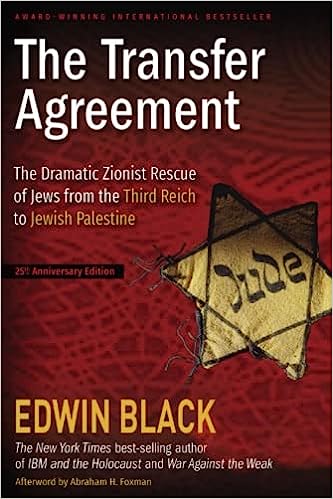
The Transfer Agreement
Edwin Black
Dialog Press, 2009 edition.

When you write a polemic, one meant to justify victory in a war, it would be best to deliver checkmate—that is, irrefutable proof that the correct side had won and that lives had not been sacrificed in vain. Edwin Black’s 1984 volume The Transfer Agreement, which chronicles the secret pact between the Third Reich and Jewish Palestine, is one such polemic. It’s filled with nail-biting drama and larger-than-life characters; it gives us suspense and intrigue, and embodies the agony and ecstasy of Jewish triumphalism on almost every page. As far as histories go, it’s well-paced, extensively researched, and thought-provoking. Ultimately, however, it delivers everything but checkmate.

Indeed, if anything, The Transfer Agreement casts a sympathetic light on the Nazis and reveals how unnecessary, preventable, and essentially Jewish the Second World War really was.

All of this, of course, is unintentional. Black asserts in his Introduction to his 2009 edition that just because Nazis worked with Zionists in the 1930s to establish the commercial, financial, and industrial infrastructure which would become the backbone of Israel does not mean that the Nazis deserve praise or are no longer the despised enemies of humankind. The cognitive dissonance of such a relationship apparently caused Black much anguish and confusion. Yet he persevered to tell this painful yet utterly crucial story of Jewish redemption:

The message of The Transfer Agreement was in fact the chronicle of the anguish of choice—itself the quintessential notion of Zionism’s historical imperative. This book and its documentation posit one question: when will the Jewish people not be compelled to make such choices? Indeed, when will all people similarly confronted be freed from the desperation of such choices?

I know. I gagged too. Dressing up Jewish causes as universal while ignoring or dismissing equally urgent white European causes is a tack Black resorts to often in The Transfer Agreement. For example, in the book’s Introduction, Black lies thusly:

The Zionists were indeed in the company of all mankind—with this exception: The Jews were the only ones with a gun to their heads.

That Black ignores how the disproportionately Jewish Bolsheviks had conquered Russia and contributed to the murder or starvation of millions of Soviet citizens prior to Hitler’s rise to power in 1933, reveals the fundamental dishonesty of The Transfer Agreement. A gun was certainly pointing in the other direction as well.

Such a batter mixed with half-truths can only result in a half-baked product, which makes The Transfer Agreement such a frustrating read. Yet, like Black himself, I persevered. I persevered to reach the inevitable conclusion which Black so unwittingly draws: that without the vituperative neuroticism of a worldwide network of Eastern European Jews, the Second World War would never have happened, and tens of millions would not have died for nothing.

The opening chapters strike one most for the sheer bellicosity of American Jews who immediately found the chancellorship of Adolf Hitler intolerable. Also on display was their awesome power. Rabbi Stephen Wise of the American Jewish Congress (AJC) spoke the loudest and with the greatest scorn, and soon influential Jews across America were debating whether to instigate a comprehensive boycott of Germany. These were no idle threats. Jews controlled many industries, including much of the press, even back then. With enough agitation from the right people, whole cities could rise up in protest against the Third Reich.

If there was any European country back then that could not afford to be boycotted, it was Germany. With millions unemployed and the nation wracked with inflation, Germany was still struggling to pay its war reparations stipulated in the treaty of Versailles. The 800,000 Germans who died of malnutrition at the end of the First World War due to the Allied blockade, as well as the French invasion of the Ruhr in 1923, were still fresh in the minds of many. Things were economically miserable in Germany, and with millions of jobs dependent upon the foreign market, “export was the oxygen, the bread, and the salt of the German workforce. Without it, there would be economic death.”

Black explains further:

Just before the decade closed, on October 24, 1929, Wall Street crashed. America’s economy toppled, and foreign economies fell with it. For Germany, intricately tied to the all the economies of the Allied powers, the fall was brutal. Thousands of businesses failed. Millions were left jobless. Violence over food was commonplace. Germany was taught the painful lesson that economic survival was tied to international trading partners and exports.

So when American Jewish Congress vice-president Joseph Tenenbaum threatened that “[a] bellum judaicum—war against the Jews—means boycott, ruin, disaster, the end of German resources, and the end of all hope for the rehabilitation of Germany.” Hitler, the Nazis, and the suffering German people who elected them knew right away that they were beset by powerful enemies bent upon their utter destruction. Of course, such men were not peculiar to America. Black chronicles how the anti-Nazi boycott movement spread quickly around the world, gaining traction in Europe, the Middle East, and South America. Further, the movement was well-funded and organized with protestors often looking to the AJC in New York for cues.

The alacrity and vehemence with which the Jews reacted to Hitler’s ascension to power were indeed astonishing. With Hitler’s chancellorship not even six-months old, the anti-German boycott had already cost the Third Reich hundreds of millions of Reichsmarks.

One curious aspect of this was Poland. Black does not go into it as much as I would have liked, but he asserts in several places that Polish Jews were indeed behind Polish anti-German truculence throughout the 1930s. The Jews of Vilna were especially vicious, and soon infected the rest of Poland with anti-Nazi fever, which they quite shrewdly framed as national rather than ethnic. The protests quickly grew violent, and in Upper Silesia became “altogether unbearable” according to the German Foreign Ministry. Adding to the insult, the Polish Undersecretary of State told Reich Ambassador Hans Moltke that the Polish government was uninterested in interfering with the boycott.

While Black provides many details surrounding anti-Jewish attacks in Nazi Germany, he offers none on anti-German attacks in Poland, other than that they were “violent.” Things grew further out of hand as Poland, along with Czechoslovakia, began rattling sabers after Hitler, according to Black, threatened to “seize the Versailles-created territorial bridge” (i.e., the Polish Corridor). This led to Poland’s militarization of its western border and serious talks about invading Germany while it was still weak. Thus, the image of Poland being the poor and innocent victim of Nazi aggression gets exploded on the pages of The Transfer Agreement.

We can also thank Edwin Black for writing the following three enlightening sentences:

Polish Jews had successfully enflamed Poland from defensive concern to war hysteria through their violent anti-German boycott and protest movement. German officials were in fact astonished that the historically anti-Semitic Polish people would allow Jewish persecution in Germany to become the pretext for a war. But it was happening.

Why were Jews everywhere so distraught? Hitler barely had time to get his seat warm in the chancellor’s office when Jews were already declaring him an unmitigated catastrophe and were mobilizing with the utmost urgency. Well, according to Black in numerous places, Adolf Hitler had already planned the complete destruction of German Jewry, so the Jews had no choice but to strike back as hard as they could in self-defense. And boycott, along with disruptive protests, picket lines, public humiliations, and libelous editorials were their weapons of choice. “Germany,” Black declares, “would have to be crushed, not merely punished.”

Yet according to the Jewish Encyclopedia, Black’s accusations of Nazi genocidal plans back in 1933 are simply not true.

Did the Nazis always plan to murder the Jews? No. When the Nazis came to power in Germany in 1933, they did not have a plan to murder the Jews of Europe. However, the Nazis were antisemitic. They saw Jews in Germany as a problem. One of the major questions for the Nazis was: How do we get rid of the Jewish population in Germany?

One finds this fairly often in The Transfer Agreement. Black will make some hysterical claim and then footnote it with a source that does not support his hysterical claim. For example, after a brief biography of German banker and early Hitler ally Hjalmar Schacht, Black writes:

It was Schacht who now pledged to his Führer to reestablish Germany’s financial integrity and build a war economy designed for territorial and racial aggression.

Neither of his sources—William Shirer’s The Rise and Fall of the Third Reich (1960) and Schacht’s 1956 autobiography Confessions of “The Old Wizard”—mention anything about “racial aggression” on the pages Black specifies (204–205, 265–266, 284, and 358–359 for the former and 2, 6, and 14 for the latter). Shirer does claim that Schacht was most helpful in “furthering [Germany’s] rearmament for the Second World War”—as if Hitler and the Nazis were plotting Stalingrad and the Battle of Britain way back in 1933. But unlike Black, Shirer does not even offer footnotes. So Black bases his assertion on Shirer’s, which is, it turn, baseless.

Black’s most astonishing faux pas occurs on pages 262–263 in Chapter 28. He writes:

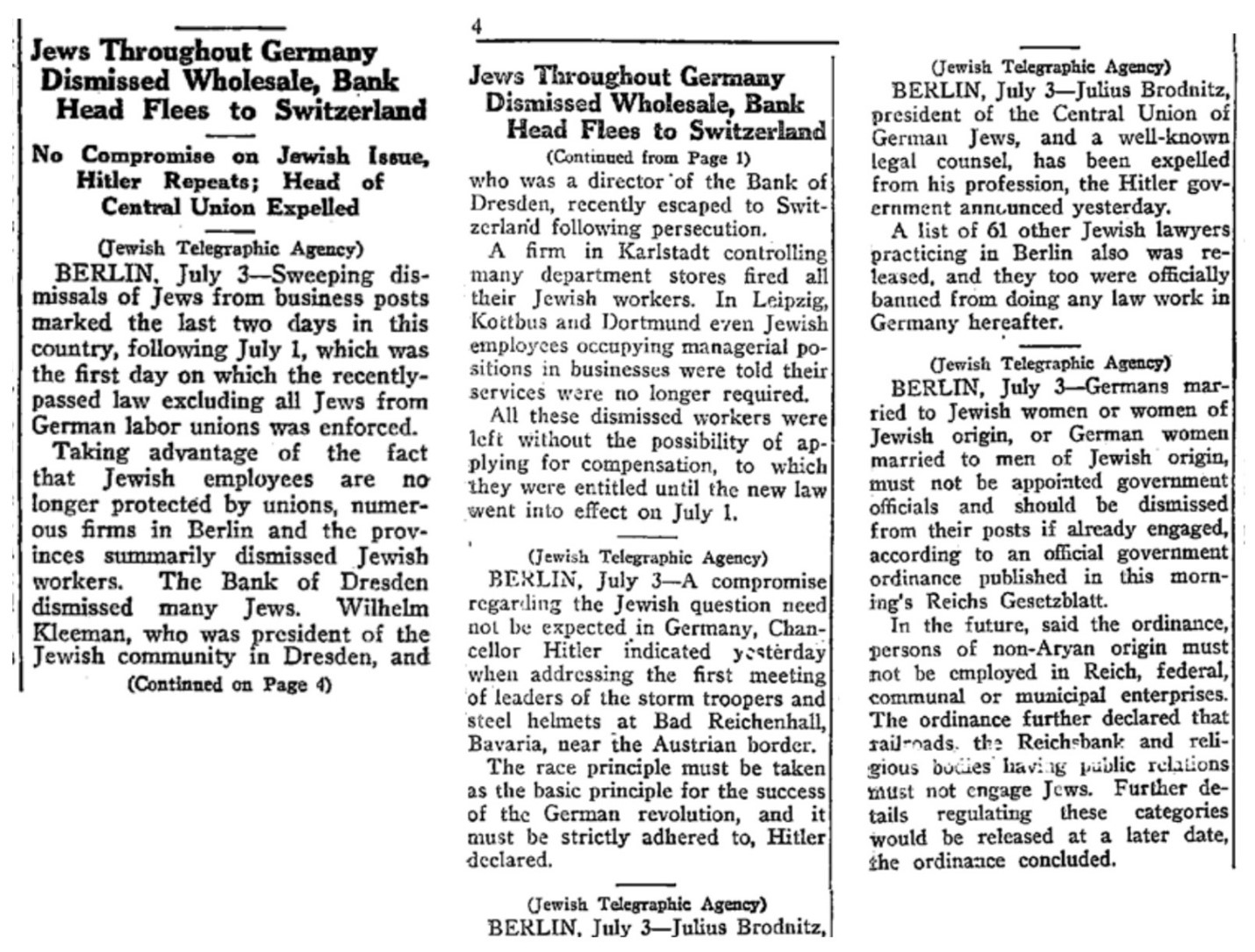
At the height of Germany’s unemployment panic, on July 2 Hitler reassured a nationwide gathering of SA leaders that while the tactics might become more restrained, there was no thought of altering the ultimate goal of National Socialism: the speedy annihilation of Jewish existence.

Black’s lone source for this is an article entitled “Jews Throughout Germany Dismissed Wholesale, Bank Head Flees to Switzerland” from the Jewish Daily Bulletin, July 5, 1933. Here is the link, and below is a reproduction of the article itself. See if you can find anything about the “speedy annihilation” of Jews.

Perhaps this was a simple error, but it survived till the 2009 edition which was published 25 years after the first. And it is a pretty big error to boot.

Black also lacks self-awareness in spots, at times argues against himself—which only makes him look foolish. He glorifies the anti-German boycott often in the Transfer Agreement, and approvingly relays a story in which AJC vice-president W.W. Cohen shouted “No!” at a restaurant when the waiter offered him an imported Bavarian beer. Afterwards, Cohen attended a rally and announced that “any Jew buying one penny’s worth of merchandise made in Germany is a traitor to his people!” A few pages later, after the Germans quite understandably respond in kind against German Jews, Black is suddenly against boycott and wishes to direct our sympathy towards its innocent victims:

But this boycott would be a systematic economic pogrom that would plague every Jewish business and household. No one would be spared. What professional could survive if he could not practice? What store could survive if it could not sell?

This obvious double standard is so appalling that not only should Black not be taken seriously whenever he demonizes Nazis or complains about anti-Semitism, neither should his publisher or editors. Here are three more examples that remove any doubt that Edwin Black is little more than a shameless shill for the Jews.

On page 78, he claims without a source that the Nazis “regarded the Zionists as their enemy personified, and from the outset carried out a terror campaign against them in Germany.” But on page 175, he changes his tune and states how Zionist German Jews actually enjoyed more freedom under the Nazis than did non-Zionist Jews. The Zionist newspaper Juedische Rundschau was allowed relative press freedom; Hebrew was encouraged in all Jewish schools; Zionists were allowed to raise a Star of David flag when ordinary Jews were not allowed to raise the Swastika; and youth groups were permitted to wear Jewish uniforms, “the only non-Nazi uniform allowed in Germany.”

Some enemy. Some terror campaign.

Chapters 18 and 28 also shed harsh light on Black’s blatant hypocrisy. In the former, he congratulates the Jews for going global with their pro-Jewish, anti-Nazi vitriol, and in the latter, he frets over how anti-Jewish and pro-Nazi movement was going . . . wait for it . . . global.

Further, on page 25, Black writes [emphasis mine]:

But when Hitler and his circle saw Germany deadlocked in depression, they did not blame the world depression and the failures of German economic policy. They blamed the Bolshevik, Communist, and Marxist conspiracies, all entangled somehow in the awesome imaginary international Jewish conspiracy.

At this point, Black’s editors, proofreaders, research assistants, or the publisher himself should have taken their clueless author aside and gently reminded him that his entire book is about an international Jewish conspiracy. Just about on every third page you have Jews in one country or continent writing, phoning, or cabling Jews in another country or continent. The big meetings in Prague and Geneva which Black reports on late in his book consist of Jews from all over the place arguing over how best to smother the Third Reich in its cradle. How is this anything other than an international Jewish conspiracy?

How could Edwin Black not see how much of The Transfer Agreement not only justifies some of the worst anti-Jewish stereotypes, but also exonerates the Nazis for understanding the truth about Jews and frankly being so patient with them?

Here is a list of all the things Black records in The Transfer Agreement which point to the Nazi leadership being at least somewhat reasonable—not necessarily innocent, mind you, but reasonable—in the face of international Jewish pressure:

  • Hitler, Hermann Goering, and other high-level Nazis demanded that Nazis not commit acts of violence. (pp. 49, 52)
  • Hitler promised not to boycott German Jews only after world Jewry stop boycotting the Third Reich. (pp. 59–60)
  • The Nazis provided special treatment for German Zionist Jews, as mentioned above. (pp. 174–175)
  • In June 1933, Hitler personally allowed the AJC and other groups to send a multimillion-dollar relief fund to German Jews. (p. 185)
  • After Hitler called off the April 1 anti-Jewish boycott, provincial Nazis continued to boycott Jews despite orders from Berlin not to do so. (p. 219)
  • Hitler bailed out a large Jewish-owned department store chain and then strictly forbade mass arrests and harassment of businessmen and industrialists. (p. 220–221)
  • In order to outlaw atrocities, suppress anti-Jewish acts, and prevent a “second revolution” by fanatical Nazis, Goering ordered mass arrests of dissident Nazi units. (p. 223)
  • Goering promised the death penalty for “atrocity mongers” among the Nazi rank and file. (pp. 224–225)
  • When followers of Der Stürmer publisher Julius Streicher illegally arrested 300 Jewish shopkeepers, the authorities released them immediately. (p. 224)
  • The Nazis actually encouraged Jewish religious, cultural, and athletic activities in the cities. Black writes: “The Nazis delighted in the Jewish subculture and demanded that it thrive. Indeed, every Jewish gathering was approved and attended by Gestapo. For Aryans, an active Jewish subculture provided reinforcement that Jews were an alien people who had no place in Germany.” (p. 373)

Black’s own analysis reveals that the Nazi leadership at least made an effort to crack down on their own radical followers. It seems that a good deal of the atrocity propaganda Black cites from 1933—minus all exaggerations and lies—happened in spite of Adolf Hitler not because of him. Yet none of this means a whit to Black. The Nazi leadership should be condemned as guilty not for what they were doing in 1933 but for what they were going to do ten years later.

This is entirely unreasonable, and it ignores the role the Jews themselves played in so maliciously provoking war with Germany throughout the 1930s. What I wrote about Benjamin Ginsburg’s How the Jews Defeated Hitler­­—another book about 1930s Jewish warmongering—applies also to The Transfer Agreement. And it has everything to do with legerdemain:

How does a magician cause objects to vanish or appear out of nowhere? Through a technique called misdirection, he can draw your attention away from something magical that is about to happen by manipulating your ability to anticipate or remember. In a sense, the magician interferes with your sense of time. Ginsburg and other authors accomplish a similar sleight of hand when discussing Nazi Germany prior to the war. According to their specious logic, because the Nazis committed war crimes during the war, the Nazis must also be considered guilty of the same crimes before the war. Therefore, promoting war against the Nazis during the 1930s is perfectly justified and honorable.

Again, this is not to say that the Nazis were entirely innocent or didn’t say or do horrible things to Jews. They certainly did. They were socialist totalitarians, and so could act with ruthless, top-down efficiency when they wanted to. By virtue of being both eugenic-minded and pro-German in nature, they took a dim view of the subversive Jewish outgroup. Hence the unsubtle hints for Jews to leave; hence the transfer agreement. But did some Nazis do heinous things? Sure. I think it is safe to assume that not all of the reports of murders, beatings, incarcerations, and other outrages were lies or embellishments. Furthermore, Nazi leaders starting with der Führer himself said a few things you just can’t easily unsay.

On page 62, Black describes how Hitler raged in the presence of the Italian ambassador when informed of Mussolini’s disapproval of Nazi anti-Semitism:

“I have the most absolute respect for the personality and the political action of Mussolini. Only in one thing I cannot admit him to be right and that is with regard to the Jewish question in Germany, for he cannot know anything about it.” Hitler continued that he alone was the world’s greatest authority on the Jewish question in Germany, because he alone had examined the issue for “long years from every angle, like no one else.” And, shouted Hitler, he could predict “with absolute certainty” that in five or six hundred years the name of Adolf Hitler would be honored in all lands “as the man who once and for all exterminated the Jewish pest from the world.”

Such a statement is impossible to defend—and yes, I went to the source, and it checks out (John Toland’s 1976 Adolf Hitler, p. 325—although Black mistakenly lists it as page 424). Hitler did say this. Immense moral quandaries aside, if you agree with such a genocidal statement, then you are giving Jews like Stephen Wise all the reason they need to act preemptively against Germay and with extreme prejudice. After all, in a fight, one’s opponent has the right to fight back.

The best way to address this conundrum is to allow Black to lead us to deep water, and then go deeper, where he is unprepared to go. Why were so many Germans, and Nazis in particular, so indignant about the Jewish presence in Germany? Why would Hitler declare such enmity for Jews and not for any other non-Aryan ethnic group in Germany?

Well, given that all the negative stereotypes about Jews back then—usury, alcohol peddling, prostitution, pornography, business tribalism, etc.—can arguably be balanced by their accomplishments in a host of other fields—including medicine, science, and music—the best way to respond would be to point to the Soviet Union and all its unspeakable enormities as a model of Jewish supremacy. Then we can ask why the protagonists of The Transfer Agreement—as well as Black himself—never suggest that perhaps the millions of people already slaughtered or starved by the disproportionately Jewish Soviet leadership by 1933 was the reason the Nazis had such a massive a chip on their shoulder. As Michael Kellogg demonstrated in his 2005 The Russian Roots of Nazism, the Nazis were well aware of the apocalyptic nature of Bolshevism as well as its undeniable link to Jews. They did not want what happened in 1917 Russia to happen in 1933 Germany. And who can blame them?

Hitler said he wanted to exterminate the Jewish pest? Fine. In his 1990 work Stalin’s War Against the Jews, author Louis Rapoport quotes Jewish Politburo member Grigory Zinoviev saying the following in 1917:

We must carry along with us ninety million out of the one hundred million Soviet Russian population. As for the rest, we have nothing to say to them. They must be annihilated.

And you know what? The tragic irony here is that Zinoviev was underselling the destructive power of his own government. Had only 10 million Russians been “annihilated” by the Soviets throughout their 75–year history, it would have been a good thing—compared to what actually happened! That number in fact is much higher.

One last thing, small but poignant. Black describes Congressman Samuel Dickstein as a close friend of Wise. After the dissolution of the Soviet Union, however, it was revealed that Dickstein had been a paid agent for the murderous NKVD. This raises a lot of questions which Black doesn’t care to ask. Further, this knowledge—along with all of the books linked above—came out before the 2009 edition of The Transfer Agreement. Black has no excuse for ignoring such damning evidence against his case.

But what about the transfer agreement itself? Well, here’s where I start saying nice things about Edwin Black. All credit to him for writing an absorbing and well-researched history on this secret pact between Nazis and Zionists. When he is not mendaciously overstating the Nazi menace or eulogizing Jews for trying to destroy Germany, he’s actually quite level-headed and has a reporter’s knack for sticking to only what compels the narrative. His chapter entitled “April First” epitomizes excitement as it depicts, almost like a thriller movie, all the intricate twists and turns of one day in this riveting plot as both Germans and Jews lurch recklessly towards economic war.

On the Jewish side, the struggle boiled down to the belligerent, anti-Gentilic Eastern European Jews (as represented by Stephen Wise, the AJC, and Samuel Untermyer and his World Jewish Economic Federation) versus the more conservative and assimilated Western European Jews (as represented by B’nai B’rith and the American Jewish Committee). Where the former were calling for economic warfare the moment Adolf Hitler became chancellor, the latter were calling for calm and measured diplomatic responses.

Many of the men leading B’nai B’rith and the Committee were German Jews themselves or had friends and family back home. They understood that many of the atrocity reports (known as Greuelpropaganda) coming out of Germany at the time were either lies or gross exaggerations, which was a real sore spot for the Nazi leadership. In some cases, Jews had become victims of violent attack because they were Jews. In other cases, they were victims because they were communist troublemakers who refused to cooperate with Nazi authorities. And when atrocity-mongering reporters like Jacob Leschinsky picked up such stories, they weren’t going to be terribly diligent in making such distinctions.

The German diaspora Jews also understood how serious the Nazis were. If men like Wise, Untermyer, and others kept provoking them, they would retaliate either by making German Jews feel the brunt of the boycott or the brunt of oppression. Many of these Jews were desperate to stop the boycott.

Sadly, the Eastern European Jews won this struggle through will, charisma, and the ability to recruit gullible Christians to their cause. Within months, Jews everywhere were tightening the vise on Germany, hoping to make it crack by winter.

On the opposite side of the coin were the Zionists. Where most Jews saw catastrophe in the Nazis, Zionists saw opportunity. Black is honest enough to admit the ideological similarity between the two, which perhaps is why the Nazis tolerated Zionist Jews most of all. He actually undermines the Jewish supremacist default positions of people like Wise and Untermyer by approvingly quoting common sense from Zionist pioneer Theodore Herzl:

Where [anti-Semitism] does not exist, it is carried by Jews in the course of their migrations. We naturally move to those places where we are not persecuted, and there our presence produces persecution. This is the case in every country.

What we now know as Israel effectively began on March 25, 1933 when German Zionist Federation Kurt Blumenfeld horned his way into an emergency meeting with Goering and other German-Jewish leaders. Goering intended to pressure these Jews into stopping the international Jewish boycott—seemingly operating under the fallacy that they could do this by virtue of being Jews. And according to Black, they really did try.

The Zionists, however, were different. They wanted nothing from the Germans except leave to leave. Goering liked this idea, and promised to play ball as long as the Zionists could do what the other German Jews could not: bring Stephen Wise and Samuel Untermyer to heel. The problem was that in order to entice the 550,000 Jews living in Germany to depart for the undeveloped British-controlled Middle East, each emigre would need to possess the considerable sum of ₤1,000 (now worth £91,566.55 or $114,029) to qualify as refugees according to British law. They would also need to be able to keep a significant percentage of their capital. Two very daunting tasks, but the Zionists were up for the challenge.

This is the struggle Black depicts on the pages of The Transfer Agreement. In it we discover a marvelous array of subplots and subterfuge that, again, could support a decent thriller. Beyond the bitter rivalry among the American Jewish Congress (the largest Jewish activist organization, composed of recent immigrants from Eastern Europe and more prone to radicalism than other Jewish organizations dominated by wealthy Jews from Germany), the American Jewish Committee, and the B’nai B’rith and the obvious Nazi vs. Jew divide, we have German Zionist Federation director Georg Landauer pitted against shady independent businessman Sam Cohen. The former was a true believer and the latter, well, let’s just say he might have been more interested in rescuing German-Jewish capital than German-Jews themselves. He always seemed to stay one step ahead of the Zionists when it came to making deals with the Germans as well. Then you have the loose cannon ideologue Chaim Arlosoroff and his struggles with the “Jewish Hitler” Vladimir Jabotinsky and his Revisionist movement in Palestine. And, as competing alpha-Jews, Wise and Untermyer butted egos quite often.

Everything came to a head at the so-called Political Committee meeting in Prague in August 1933. Here, the world’s most powerful Jews were about to officially declare their anti-German boycott when the Zionists finally revealed the ace up their sleeve: the details of the transfer agreement. In a nutshell, Jewish emigres would leave the majority of their wealth in frozen assets called sperrmarks, which were managed by a Zionist-friendly bank. A collection of Nazi-friendly Zionist businesses (including the one owned by Sam Cohen) would then sell German goods in Palestine and other places, while German exporters would pay themselves with sperrmarks. It was a brilliant scheme, a win-win for the ethnonationalists. It also caused a great deal of kvetching among the Jews in Prague, not least of whom was Stephen Wise—because according to the transfer agreement they could have boycott or Zionism, but not both.

Given that Wise was such a villain throughout this narrative, his getting stymied in the end was satisfying.

To conclude with another chess analogy, there is something known in chess as a helpmate. This is a puzzle which challenges both players to checkmate one side in a certain number of moves. Thus, one player is actually working to checkmate himself. The Transfer Agreement is not quite that bad, but sometimes it does approach helpmate levels of suicide when it comes to Jewish apologetics and the Third Reich. A better analogy would be that Edwin Black is simply a poor player who ultimately captures fewer pieces than his opponent (i.e., the well-read, discerning reader) and ends up in a worse position than when he started. But he still manages to capture pieces. Yes, Nazis said and did things which are difficult if not impossible to defend nearly a century after the fact. So what? The people he champions said and did worse. And Black is not exactly in a hurry to tell us about it.

Often in The Transfer Agreement Black describes the international Jewish struggle against Nazi Germany as economic or propagandistic war. Stephen Wise takes it further in the book’s final chapter when on September 23, 1933, he hinted darkly of real war against Germany. He stated that boycott “is a weapon, but it is not the weapon. . . . The president of the United States and the prime minister of England can do more than a hundred boycotts.”

So war it is.

But this raises an interesting question: if the first casualty of war is always the truth, and the Jews are always at war, then when can we ever rely on Jews to tell the truth?


https://www.theoccidentalobserver.net/wp-content/uploads/2018/06/TOO-Full-Logo-660x156-1.png 0 0 Spencer J. Quinn https://www.theoccidentalobserver.net/wp-content/uploads/2018/06/TOO-Full-Logo-660x156-1.png Spencer J. Quinn2023-04-08 07:25:352023-04-10 08:49:34Edwin Black’s “The Transfer Agreement”

Jewish Involvement in Libertarianism

April 7, 2023/36 Comments/in Featured Articles, Libertarianism/by Hugh Moriarty
  1. Is libertarianism a ‘Jewish intellectual movement’?

In his influential study The Culture of Critique, Kevin MacDonald analyses a number of 20th century intellectual and social movements that were led by Jews and often centred around some charismatic Jewish leader, including Boasian anthropology, Freudian psychoanalysis and Critical Theory. Approaching them from an evolutionary psychology and social identity theory perspective, MacDonald argues that they exemplify ‘group-evolutionary strategies’. In brief, he contends that these movements are stratagems used in Jew-Gentile competition: they function to ‘critique’ and undermine the ethnocentrism of Gentile societies so as to make them more hospitable for Jews and Jewish advancement, and to combat resistance to this advancement (labelled ‘anti-Semitism’). MacDonald never claimed to provide an exhaustive list of such movements, but a question this article will consider is whether libertarianism could be placed among them. Though some other authors have suggested or argued this before[1], I have a different take on things to them, as will be explained in due course.

Why might one suspect this of libertarianism? Libertarianism developed from classical liberalism. Though the founding fathers of classical liberalism were gentiles (with the exception of David Ricardo, who converted to Unitarianism against his family’s wishes), the successor ideology of libertarianism has had many Jews as its major figures. In fact, libertarian economist Steven Horwitz describes the Jewish role in libertarianism as pivotal:

It is not a coincidence that among the leading libertarian thinkers of the 20th century, we have a large number of Jews, starting with Mises, Milton Friedman, Israel Kirzner, and Robert Nozick. And despite the [fact that they] rejected their Judaism, we should not forget Ayn Rand and Murray Rothbard. They are only the tip of the iceberg of the disproportionate number of Jews who have been instrumental in forwarding the ideas of classical liberalism in the last century. It is no exaggeration to say that the modern libertarian movement would not exist were it not for these Jews.[2]

Apparently, libertarian ideas have had a magnetic pull for many Jewish intellectuals; but is libertarianism a ‘Jewish intellectual movement’ in MacDonald’s sense? To answer this we should look to the preface of The Culture of Critique, were he gives four criteria he’s looking for:

1) The movement must be dominated by Jews.

2) There should be evidence that these Jews strongly identify as Jews and believe that they can advance Jewish interests through the movement (though they might deceive themselves about their having this motivation).

3) It should have an influence on gentile society, helping to make the society more hospitable to Jews.

4) It should provoke some response from gentiles, particularly an anti-Semitic response.

Now if Horwitz is right, we can take libertarianism to satisfy the first condition (Walter Block has provided a longer list of prominent Jewish libertarians[3]). Consider next the third criterion—that libertarianism has influenced gentile society and in a way that’s good for the Jews. Though it has had other popular political ideologies and forces to contend with, classical liberalism has certainly been deeply influential in the West, to the extent of being part of the Western identity or self-conception. Moreover, although its successor libertarianism is often regarded as a fringe movement, in the US especially it is promoted by an energetic ecosystem of institutes, political parties, law firms, publishers, journals, magazines and websites. And regarding the Jewish connection, it is often said that Jews have flourished the most in liberal, individualistic countries. Liberal ideas led to Jewish emancipation in Europe, and the US, which perhaps has most approximated to the libertarian ideal, was spoken of as a ‘promised land’ for the Jews. So the influence of (classical) liberal ideas has been ‘good for the Jews’, though perhaps not good enough, with most Jews nevertheless favouring a left-wing, progressive political orientation that campaigns for equality rather than liberty, to the dismay of many Jewish libertarians.[4]

However, it might be argued that liberalism is not good for the Jews at the expense of gentiles, but rather is just good period, that is, for everyone. Jews are not attracted to it for specifically self-interested reasons. Relatedly, it is sometimes said that Jewish overrepresentation in libertarianism is of no special significance since Jews are also overrepresented in the ranks of libertarianism’s arch-enemy, communism. As one writer put it, ‘if Communism and Libertarianism are both great for the Jews, you have to figure that probably just about anything can be construed as good for the Jews.’[5] Mises concurred: ‘these contradictory charges [blaming Jews for both laissez faire capitalism and communism] cancel each other.’[6] Being an urban, intellectual people, Jews will be overrepresented in most intellectual movements.[7]

However, this argument emphasizes the differences between libertarianism and communism while overlooking what they have in common: their shared cosmopolitan or internationalist outlook. Ludwig von Mises described the cosmopolitanism of liberalism as follows:

The ultimate ideal envisioned by liberalism is the perfect cooperation of all mankind, taking place peacefully and without friction. Liberal thinking always has the whole of humanity in view and not just parts. It does not stop at limited groups; it does not end at the border of the village, of the province, of the nation, or of the continent. Its thinking is cosmopolitan and ecumenical: it takes in all men and the whole world. Liberalism is, in this sense, humanism; and the liberal, a citizen of the world, a cosmopolite.[8]

Replace ‘liberalism/liberal’ with ‘communism/communist’ in this passage and it wouldn’t look out of place in any Marxist tract. We could thus suppose that it’s their shared cosmopolitanism, with its de-emphasis on national borders and ethnic or racial identity, that makes both ideologies attractive to a dispersed, diaspora people like the Jews. And we could then suppose that they would be much less enthused about and much less represented in non-cosmopolitan political orientations like conservatism, nationalism, royalism and theocracy (outside the Israeli context).

Next let’s move on to the fourth condition. It is more difficult to see this one being satisfied, since it does not seem that libertarianism, or Jewish involvement in libertarianism, has provoked any defensive, anti-Semitic responses on the part of gentiles, and the issue of Jewish overrepresentation in libertarianism has not even attracted a great deal of notice or comment. But satisfaction of this seems to be just for bonus points, since MacDonald doesn’t treat it as a necessary condition. For instance, in his discussion of Boasian anthropology, he doesn’t show that it provoked an anti-Semitic reaction but just standard scientific criticism. So it seems that the answer to whether libertarianism is a Jewish group-evolutionary strategy comes down to whether the second condition is satisfied: are Jewish promoters of libertarianism motivated by strong Jewish self-identification and the belief that libertarianism advances specifically Jewish interests (perhaps at the expense of Gentile interests)?

Jewish libertarians can indeed be found who explicitly attribute their adherence to libertarianism to Jewish concerns. For instance, the Jewish American legal scholar Randy Barnett has explained how ‘being a contrarian Jew has affected my academic agenda, my scholarly commitments, and the future direction of my work’. His libertarianism, he tells us, stems from a belief that ‘the reason Jews have thrived in the US is because it was fundamentally a republic that puts a primacy on individual rights rather than a democracy that unduly privileges the will of the majority’, and he criticizes progressive Jews for being ‘short-sighted about what is good for the Jews.’[9] However, Barnett is not a major figure and we should turn our attention to the big Jewish libertarian luminaries. Accordingly we will focus on two main intellectual strands, the Ayn Rand strand and the Mises-Rothbard strand. Different answers, I believe, will be obtained for each.

  1. The objectivist strand of libertarianism

As was mentioned, some have previously argued that libertarianism is a ‘Jewish intellectual movement’. Trudie Pert, for instance, argues this in relation to the Mises-Rothbard strand but doesn’t discuss the Ayn Rand or ‘objectivist’ strand. The view taken here, however, is that a much better case can be made for this claim in relation to the objectivist strand.

Ayn Rand was the founder of objectivism, which combines a libertarian, individualistic political philosophy with some other ideas including an ethics of selfishness. Shortly before the publication of her magnum opus Atlas Shrugged, a coterie of admirers began to form around and meet regularly with her, which they jokingly named The Collective. This group formed an institute to promote Rand’s philosophy and was entirely Jewish: as Rothbard, who briefly associated with this group, said, ‘each and every one of them was related to each other, all being part of the one Canadian Jewish family, relatives of either Nathan or Barbara Branden [born Blumenthal and Weidman respectively].’[10] The group believed that Rand was of messianic significance and it has been described as a cult.[11]

In these respects the objectivist movement in its beginnings appeared similar to a paradigmatic MacDonaldian Jewish intellectual movement. But despite the Jewish makeup of The Collective, there is little to suggest that Rand or her group were significantly motivated by Jewish interests. Rand was from a young age introverted and independent. She rarely spoke or wrote about her Jewish identity and showed little interest in it. As with her familial relationships, she didn’t place much importance in it because it was unchosen and therefore not expressive of one’s values: ‘one is simply born into a family. Therefore it’s of no real significance.’[12] Feeling pride (or shame) in one’s family or ethnic background was for Rand irrational and a kind of ‘racism’. It only makes sense to feel pride in one’s own achievements, and anything else is ‘a quest for the unearned.’[13] (Perhaps Rand is looking at this the wrong way. Taking pride in, say, one’s ancestors might not be an attempt to, illogically, claim their achievements as one’s own, but rather to see in their achievements one’s own potentialities; they show to us what we might be capable of.) There is some evidence, however, that later in life Rand developed more of an attachment to her kinsfolk, as she donated to Israel (her first act of giving to a cause) and vehemently defended its right to bring civilization to a ‘primitive’ region. However, she similarly defended European colonialism,[14] so this might have partly stemmed from a universal principle as much as from ethnic loyalty.

Rand was not very interested in leading a movement, and saw her objectivism as a philosophy to be taken up by individuals. The institute associated with The Collective was formed by her main disciple and was called the Nathaniel Branden Institute, and it ended after Branden’s acrimonious break from Rand. It wasn’t until 1985, three years after Rand’s death, that another significant attempt was made to get a movement going, when Collective member Leonard Peikoff, who Rand made heir to her estate, established the Ayn Rand Institute (ARI). Peikoff was more concerned with typical Jewish bugbears, and wrote a book called The Ominous Parallels that attempted to explain the rise of Nazism in Germany with a familiar It-could-happen-here trope.

Next in the line of succession was Yaron Brook, who was appointed by Peikoff as Executive Director in 2000 and who has led the institute since then. Brook is a dual American-Israeli citizen and served in Israeli military intelligence before emigrating to the US at age 26, where he gained an MBA and PhD in finance. Brook got into Rand’s ideas in his teenage years, but before joining the ARI he was reportedly not very well known in objectivist circles. Brook said that he left Israel because of the ‘socialist policy, ridiculous political system, constant external threats.’[15] Nevertheless Israel remained close to his heart, and under his directorship at the ARI, Israel advocacy was ramped up.

The gold-standard for establishing whether Jewish activists are sincere in their principles or are just using them as a gambit to advance Jewish interests is perhaps to find evidence of a double-standard, where those principles are pushed on gentiles but not on Jews. Now objectivists are, generally speaking, in favour of open borders and Brook and his colleagues say that this policy is entailed by objectivist principles. But what do they say about the borders of the Jewish state?

In his regular podcast show, after expressing concern about rising nationalism in Europe after the Brexit referendum, Brook said the following:

Now look … any time I mention immigration, any time I mention nationalism, people bring up Israel. … I don’t have time to cover the Israel example. But Israel is an exception.  You heard it here.  Israel is an exception.  Not a good exception.  Not an exception that is ideal.  But it is an exception.  And, uh, why is Israel an exception? … [that’s something] we will get to on a future show, but not now.”[16]

Objectivists advocate not only for the free movement of people but also of goods and money. Brook’s remarks above might now make us wonder whether these other beliefs would hold firm in relation to the Israel case. Brook denounces EU agricultural tariffs but would he also denounce Israeli agricultural tariffs, which protect struggling Israeli farmers who work difficult, dusty land, from global competition?[17] Would he accept Israel being dependent for its food supply on non-Jews, that is, potential anti-Semites? And would he make an exception for the shekel when it comes to currency controls, which might protect it from manipulations by foreign speculators in certain circumstances?

Brook eventually returns to the same topic in another show, but only when the issue is raised again by a caller.

There’s a bunch of people out there that are calling me a hypocrite … because Israel doesn’t allow open immigration. … It’s built a wall, and Mexicans are invading America so — I mean, that’s ridiculous. It’s ridiculous. Israel is defending itself against a constant military threat from people who wanna wipe it out. They wanna use weapons to kill every Jew in Israel. They say this; they announce it publicly; they do it whenever they have an opportunity. It’s fought multiple wars against armies that have invaded it from these borders, against at least six different Arab-Muslim countries. … [But] Mexicans are coming over the border to get a job … to try to make their lives better lives … how can we be against that? It drives me nuts.[18]

As I’m sure Brook knows, these days there are such things as aeroplanes which can transport people to Israel from countries who are not hostile to it, people who might just want to improve their lives by settling in Israel and contributing to its economy. (Such people might include, for instance, recent non-Jewish African migrants to Israel, who were expelled and resettled in Canada.) How can he be against that? Notice also how Brook raises an altruistic consideration in defence of Mexican immigration, which should carry no weight with an objectivist since they subscribe to an ethics of selfishness. Why should an American objectivist care about a Mexican’s quality of life?

Interestingly, the ARI has a branch in Israel. Though the immigration issue features as a major topic on the U.S. ARI website, this writer, armed with a translator program to translate the Hebrew, could not find any mention of it on the Israeli website, which focuses on more anodyne economic topics about capitalism versus statism.

The Ayn Rand Institute’s Israel advocacy goes well beyond the immigration issue. Under Brook’s and Peikoff’s leadership, the ARI has advanced an agenda barely distinguishable from that of neoconservatism. It has defended the War on Terror, torture, and Israel’s right to ‘exist’ (i.e., expand), and it has called for U.S. military action against Iran. (In fact, Brook has criticized neoconservatism, but his main complaint is that it’s too soft: his line is that the US should dispense with the altruistic nation-building and democracy promotion stuff and just unapologetically pursue its ‘self-interest’ and smash ‘threats to America.’[19]) This agenda, and the hypocrisy implicit in it coming from objectivists, has been meticulously documented by the website ARI Watch. Similar agendas can also be found in other objectivist institutions like The Atlas Society and The Objective Standard, which were founded by people associated with or expelled from the ARI.

Objectivism, then, is led by Jews with a strong sense of Jewish identity and mission. We can therefore conclude with some confidence that the objectivist movement is a Jewish intellectual movement á la MacDonald, though it might not have started out as one. For Brook and his colleagues, objectivism is for thee but not for me. Principles of individualism, liberty and selfishness are selectively applied to accord with Jewish interests. When Israel is considered, suddenly the evaluative frame of reference changes: Israel might violate libertarian and objectivist principles by being statist, socialist, collectivist, having conscription, initiating aggression and so on, but it must be defended because it’s still so much better than what the Arab ‘savages’ (as Rand once called them[20]) have created there. I know of no evidence whatsoever that Brook is still working for Israeli intelligence in some capacity, but it is interesting that his behavior is entirely consistent with this hypothesis.

  1. The Mises-Rothbard strand

Next let’s consider the much more popular Mises-Rothbard strand of libertarianism. Murray Rothbard, the student and follower of Mises, is greatly respected in the libertarian movement, and Walter Block has said he is the closest thing you could find to a guru figure in libertarianism besides Ayn Rand.[21] However, the characters of both were opposite in many respects. In contrast to the austere, intense, authoritarian and haughty Rand, Rothbard was by all accounts affable, gregarious, humorous and down-to-earth. Ideologically he also differed from Rand by advocating the more radical anarcho-capitalist version of libertarianism, which sees no need for government whatsoever, in contrast to objectivism which holds a minimalist theory of the state.

Rothbard rebelled against the communist Jewish milieu he grew up with in New York. But did he retain a strong sense of Jewish identity, or animosity towards gentile culture? In support of this, Pert alleges that Rothbard and Mises were hostile towards Christianity.[22] However, Mises’ attitude to Christianity softened with age,[23] and Pert’s claim is not at all true for Rothbard. Many who knew him personally have said that while being an agnostic he greatly admired the Catholic Church.[24] He had expertise in Church history and theology, loved Baroque Church architecture, and believed that liberalism developed from Christian ideas.[25] Rothbard was also affiliated with the Old Right led by Senator Robert Taft in opposing the ‘welfare-warfare state.’[26] He criticized pillars of Jewish power like the Federal Reserve and fractional reserve banking, and had trouble getting his PhD because of this opposition. Later in his career he tried to form an alliance with paleoconservatives. He even began to sympathize with ethno-nationalist concerns and took seriously Jean Raspail’s anti-immigration novel The Camp of the Saints, though he believed that anarcho-libertarianism could accommodate those concerns.[27]

This leads to the issue of immigration: what was Rothbard’s position on it? Initially Rothbard held the standard libertarian position. As one of his followers expresses it, ‘Libertarians, for the most part, will support immigration. There’s nothing special about the territory of a particular state. If someone is willing to hire or sponsor an immigrant that should be the end of the matter.’[28] In particular, by rejecting the concept of public property as an absurdity, libertarians often consider public property to be up for grabs (though there are exceptions here: Hans-Hermann Hoppe considers it the property of the taxpayers).

However, Rothbard came to change his attitude to immigration from reflecting on the ideal anarcho-capitalist state.[29] In such a society, all land would be privately owned and therefore there would be no automatic right to enter that territory. Someone wanting to hire an immigrant would need to get the agreement of those whose land the immigrant would need to traverse to reach his business and use thereafter. Anti-immigration views will perhaps gain more traction in libertarian circles; though it’s often said that most libertarians are for open borders, three of the most respected libertarians, Rothbard, Rockwell and Hoppe, have come out against the idea.

This libertarian solution to the immigration problem would hardly be appealing to an ethno-nationalist however. The difficulty is that such restrictions would apply to everyone, not just ‘foreigners’. Without public land, nobody would have an automatic right to roam. It would be a paltry kind of freedom that can only be automatically exercised on one’s private plot. One might think that the landowners could agree to grant such rights to ‘compatriots’ and not ‘foreigners’, but this very distinction presupposes the existence of a state and state borders, which anarcho-libertarianism rejects. (Rothbard’s vision of society also shows a lack of appreciation for the value of wild land, valuable for its beauty and ecological importance.)

What the Ayn Rand Institute is to Rand, the Mises Institute, established by Rothbard’s colleague and friend Lew Rockwell, is to Mises and Rothbard. But one does not find the selective application of libertarian principles there to advance Jewish interests. Israel receives no special favors at the Mises Institute,[30] nor at Rockwell’s website LewRockwell.com or at the ideologically similar Ron Paul Institute. Anti-war and anti-interventionist positions prevail at these forums, in contrast with the ARI.

We can thus conclude that while the Ayn Rand strand of libertarianism is a Jewish Intellectual Movement in MacDonald’s sense, the Mises-Rothbard strand is not. However, there are other strands one might consider and this article makes no claim to completeness. Milton Friedman and the Chicago School haven’t been discussed. This school ascended to become part of the Establishment, and Marco de Wit has already persuasively argued that it is a MacDonaldian Jewish Intellectual Movement.[31] Other strands one could investigate include the Washington-based Cato Institute and the Libertarian Party, though I will leave that to other investigators.

Though many libertarians of the Mises-Rothbard stripe are sincere and principled people, in the rest of this article I will argue that, despite their valuable contributions to economic thought and to the defence of peace and freedom, their doctrine comes to grief with its inability to reckon with the Jewish Question.

  1. Libertarianism and tribalism

The increased Jewish involvement in the development of liberalism coincided with a radicalisation of that tradition, for libertarianism is arguably more extreme and individualistic than classical liberalism. This is partly because while classical liberalism is associated with the Harm Principle (HP)—roughly, that force can only be legitimately used against a person to prevent him from harming others, libertarianism is associated with the Non-Aggression Principle (NAP): that force can only be legitimately used against a person to prevent him from using force or threatening to use force against others or their property.[32] And the latter seems more licentious than the former. For instance, laws against blackmail could plausibly be justified by the HP but not by the NAP.[33] (However, matters are complicated here by the fact that libertarians typically stretch the meaning of ‘aggression’, to include things like fraud or walking through someone else’s property.) The more moderate nature of classical liberalism can also be seen in the willingness of classical liberals to make exceptions to their principles. J. S. Mill, for instance, said that an individual may be compelled by government to do certain positive acts to support the community, such as ‘to give evidence in a court of justice; to bear his fair share in the common defence, or in any other joint work necessary to the interest of the society of which he enjoys the protection; and to perform certain acts of individual beneficence, such as saving a fellow-creature’s life, or interposing to protect the defenceless against ill-usage.’[34] These policies cannot be derived from his Harm Principle. Libertarians, on the other hand, pride themselves on their ‘logical consistency’: their unflinchingly accepting the implications of their limited number of principles, no matter how ‘counterintuitive’ they may seem. But what they applaud as logical consistency others see as dogmatism.[35] Libertarian rhetoric sometimes also has a revolutionary flavour, advocating black-market dealing and tax evasion, and taking or occupying public property, though typically rejecting the use of force.

It is not surprising that members of an ethnic minority like the Jews would be attracted to libertarianism, since its radically individualist philosophy undermines the ethnocentrism of the ethnic majority and thus lowers the drawbridge, so to speak, into that society for outsiders. But is this not a double-edged sword? Wouldn’t an individualistic libertarian order prohibit or at least undermine Jewish ethnocentrism just as much as gentile ethnocentrism?

This question was addressed, at least obliquely, in a recent book by Alan Krinsky[36] that argues for the compatibility of traditional Judaism and libertarianism. Judaism is the polar opposite of a system of thought like libertarianism in many ways, for instance it is extremely non-individualistic or ‘collectivist’. It is difficult to think of a statement more at odds with the libertarian spirit then one from a leading Rabbi quoted by Krinsky, which affirms that the Jewish community is ‘not just an assembly of people who work together for their mutual benefit, but a metaphysical entity, an individuality; I might say, a living whole,’ or a ‘juridic metaphysical person.’[37] Nevertheless, Krinsky argues that this strange kind of entity would be accepted in a libertarian society, because it is ultimately a ‘voluntary association’ and in libertarianism everyone has the right to form such associations as they see fit. Libertarianism has nothing against community, he says, so long as it’s not held together by force.[38]

There is a naivety, however, in conceptualizing Judaism, or the Jewish community more generally, as a mere voluntary association, as if to put it on the level of a local board-game or toastmasters club. Society is not just a site of mutually beneficial interactions but is also an arena of competition for power and resources, and Jews compete in this arena as a group (the existence of a vast, integrated and international network of Jewish advocacy and campaigning groups puts this beyond question.) Their commitment to ‘work[ing] together for their mutual benefit’ manifests itself, for instance, in covertly practiced ethnic nepotism and tactics of collusion and exclusion used in the spheres of business, politics and culture, which non-Jews see as discrimination and unfair competition, just as collusion between players in a poker game is regarded as unfair and is prohibited. But such collectivist tactics are allowable in a libertarian order since they don’t involve using force or the threat of force. They are in accordance with the letter, though not with the individualistic spirit, of libertarianism. This can then lead to a collectivist ‘arms race’, where non-Jews band together as a self-defensive response,[39] which would ultimately destabilize a libertarian system. Interestingly, Krinsky expresses some doubts about libertarianism’s sanguine attitude towards voluntary associations, since they could include ‘discriminatory associations’ like ‘sexist and racist groups.’[40] But he seems to lack the introspective powers necessary to realize that his own Judaism might also be such a discriminatory association.

The sanguine attitude of libertarians towards ‘metaphysical entities’ like the Jewish community points to a fatal weakness with their doctrine. Misguided political ideologies usually end up dashed against the rock of human nature, and libertarianism is no different from Marxism in this respect. But whereas Marxism ignored our ‘selfish’ nature, our tendency to be motivated primarily by personal profit, libertarianism ignores our ‘tribal’ nature, our tendency to identify with and collude in groups. Tribalism runs counter to the individualism that is a key part of libertarianism, and an excess of it would destabilize a libertarian society. Libertarians will, no doubt, acknowledge the existence of tribalism, but then why are they so unworried by it?

One reason is that they seem to treat tribalism not as a deep feature of human nature but as more like superstition: an archaic, irrational tendency that man will grow out of in civilized society. We are left to infer this, at any rate, from their nonchalant attitude towards the immigration of very illiberal tribes into liberal countries, which betrays a naïve confidence that they will give up their old ways of thinking and become good liberal individualists in short order. The point is doubtful, however, as there seems to be no inverse relationship between intelligence/educatedness and tribalism. Jews and North East Asians, for instance, are known for their high IQ and high ethnocentrism.

There is also a strong Rousseauian trend in libertarianism that might explain its attitude towards tribalism. Jean-Jacques Rousseau believed that men were naturally good and lived contentedly until society corrupted them. Life in the State of Nature, Rousseau imagined, was not solitary, nasty, brutish and short as Thomas Hobbes believed. It was solitary, yes, but it was also a state of contented independence living off nature’s bounty, comparable perhaps to how orangutans live, the semi-solitary apes. Libertarians, especially anarcho-libertarians, also hold romantic notions about the State of Nature, imagining it as characterised by harmonious interactions.[41] Man then became corrupted, not so much by society as Rousseau believed but by government. Indeed, there is intellectual pressure on those who believe government to be the root of all evil to have a rosy-eyed view of the State of Nature, since the alleged horrors of the State of Nature have been the main justification for government in much of Western political philosophy. Tribalism, then, could be seen by libertarians as part of this corruption, something artificial that is stirred up and reinforced by the state to further its own agenda, and not as something native to man when left alone.

Implicit in the Rousseauian and libertarian view is the idea that sociality and hence tribalism is not natural or instinctive to man. Men lived naturally solitary lives, and then decided and made a rational calculation (indeed, a miscalculation in Rousseau’s view) to live together under a leader and in a hierarchy. Thus man’s sociality is derived from reason rather than instinct.

Serious reflection on human nature will, however, lead to the conclusion that sociality and tribalism are instinctual and ineradicable. Tribalism may be partly based on the rational calculation that it is better to band together with others to survive and compete, but it is also positively reinforced by elemental feelings like love and affection, pride, attachment to one’s own kind, the desire for recognition, approval and connection, as well being negatively reinforced by feelings of loneliness and insecurity. Further, for most people, living for their own private pleasure like a Randian egoist, however heroically, is not sufficient to give their lives meaning. Most people need to identify with something greater than themselves, and the libertarian individualist is in danger of becoming a shallow libertine. There is little reason to think that humans ever had a solitary way of life that they made a rational decision to leave. If we evolved from apes as the evolutionists say then we likely evolved from social apes, so that man has always lived in social and hierarchical groups and has a nature geared to that mode of existence. The chimpanzee is, after all, our closest relative, not the orangutan.

Libertarianism condemns ethnocentrism and downplays its importance in social life, but ethnocentrism is like weaponry: it would perhaps be nice to live in a world without it, but so long as one group refuses to give it up it would be foolish for others to do so. The libertarian individualist is one who by renouncing tribalism has, as Fredrick Nietzsche might say, ‘strayed most dangerously from [his] instincts.’[42]


1] Lote, S. 2011. Libertarianism: Ideals and reality. The Occidental Quarterly 11(1), pp. 45-50. Pert, T. 2011. Austro-libertarianism, Catholicism, and Judaism. The Occidental Quarterly 11(1), pp. 69-86.

[2] Horwitz, S. Libertarianism rejects anti-Semitism. Foundation for Economic Education. https://fee.org/articles/libertarianism-rejects-anti-semitism/

[3] Block, W. 2017. Are All Jews Socialists, Progressives, Communists, Left-Liberals, Bernie and Hillary Supporters, Democrats? No! Lewrockwell.com. https://www.lewrockwell.com/lrc-blog/jews-socialists-progressives-communists-left-liberals-bernie-hillary-supporters-democrats-no/

[4] E.g., Friedman, M. 1972. Capitalism and the Jews. https://www.law.uchicago.edu/recordings/milton-friedman-capitalism-and-jews. Block, W. 2018. Is it permissible to criticize Jews? Lewrockwell.com. https://www.lewrockwell.com/lrc-blog/permissible-criticize-jews/

[5] Lindsay, R. 2015. Jews created libertarianism. https://beyondhighbrow.com/2015/09/30/jews-created-libertarianism/

[6] von Mises, L. 1974[1944]. Omnipotent Government: The Rise of the Total State and Total War. Liberty Fund, p. 209.

[7] Cofnas, N. 2018. Judaism as a group evolutionary strategy: A critical analysis of Kevin MacDonald’s theory. Human Nature, 29, p. 138.

[8] Von Mises, L. 1985. Liberalism in the Classical Tradition. Trans: R. Raico. Foundation for Economic Education, pp. 105-6.

[9] Barnett, R. 2015. The making of a libertarian, contrarian, non-observant, but self-identified Jew. Georgetown Law Faculty Publications and Other Works. 1330.

[10] Rothbard, M. The sociology of the Ayn Rand cult. https://www.lewrockwell.com/1970/01/murray-n-rothbard/understanding-ayn-randianism/.

[11] See Ibid. Also see Block, W. 2000. Libertarianism vs objectivism: A response to Peter Schwartz. Reason Papers 26.

[12] Rand quoted in Branden, B. 1987. The Passion of Ayn Rand. Anchor Books, p. 72. Also see p. 6.

[13] Rand, A. and Branden, N. 1961. The Virtue of Selfishness. Signet.

[14] Burns, J. 2009. The Goddess of the Market: Ayn Rand and the American Right. Oxford University Press, p. 266.

[15] Arfa, O. 2007. ‘You don’t fight a tactic’. Jerusalem Post.

[16] The Yaron Brook Show, episode 62. Brexit: What’s on the horizon?

[17] See Katsman, H. Why Israeli farmers are struggling – and government policies aren’t helping. Stroum Center for Jewish Studies. https://jewishstudies.washington.edu/israel-hebrew/israeli-agriculture-farming-government-policies-tariffs/

[18] The Yaron Brook Show, episode 65. Live from FreedomFest ask me anything.

[19] See Brook, Y. and Epstein, A. 2007. Neoconservative foreign policy: An autopsy. The Objective Standard. The difference between Brook’s approach and the neoconservative one might be smaller than this suggests. Brook either fails to or pretends not to appreciate that the neoconservatives are Straussians who believe in the ‘noble lie’. Was the high-sounding talk of spreading freedom and democracy merely for public consumption? One should not dismiss such possibilities when dealing with neoconservatives.

[20] See video clip, ‘Ayn Rand on Israel and the Middle East.’ https://www.youtube.com/watch?v=2uHSv1asFvU

[21] Libertarianism versus objectivism, p. 45.

[22] Pert, p. 71.

[23] See Hülsmann, J.G. Mises: The Last Knight of Liberalism. Mises Institute, pp. 982-986 & pp. 437-443.

[24] See Rockwell, L (ed). 1995. Murray N. Rothbard: In Memoriam. Mises Institute.

[25] Rothbard in Memoriam, p. 80.

[26] Rothbard in Memoriam. p. 65.

[27] Rothbard, M. N. 1994. Nations by consent: Decomposing the nation-state. Journal of Libertarian Studies, 11, pp. 1-10.

[28] Casey, G. 2012. Libertarian Anarchy: Against the State. Continuum. p. 8.

[29] Rothbard. Nations by consent. pp. 1-10.

[30] See Halbrook, S. P. 1981. The alienation of a homeland: How Palestine became Israel. The Journal of Libertarian Studies, vol. 5, pp. 357-374. Rothbard, M. N. 2016[1978]. ‘Little’ Israel. https://mises.org/library/never-dull-moment/html/c/467.

[31] Marco de Wit. 2021. Did Milton Friedman’s Libertarianism Seek to Advance Jewish Interests? Occidental Observer.

[32] Some libertarians claim that their entire system is based on the NAP, while others believe it is just one of a number of principles informing libertarian thinking (see Zwolinski, M. 2016. The libertarian nonaggression Principle. Social Philosophy and Policy, 32(2), pp. 62-90.

[33] See Casey, p. 47. This does not mean libertarianism condones blackmail (libertarianism is not a complete theory of morality).

[34] Mill, J. S. 2003. On Liberty. Yale University Press. p. 82.

[35] E.g., K. MacDonald. 2011. Introduction to the special issue: libertarianism and white racial nationalism. The Occidental Quarterly, vol. 11(1), p. 12.

[36] Krinsky, A. D. 2020. Running in Good Faith? Observant Judaism and Libertarian Politics. Academic Studies Press.

[37] Joseph B. Soloveitchik, quoted in Krinsky, 2020. p. 155.

[38] It should be noted that libertarians often engage in crude black and white thinking about force. To promote community life and consciousness, for instance, governments have more options at their disposal then using force, such as various sorts of carrot or stick incentives and disincentives, but libertarians often classify such tools as the use of force (e.g., ‘No third road is possible here; one must choose compulsion or liberty’ (Casey, p. 54)).

[39] This process is described by MacDonald in Separation and its Discontents: Toward an Evolutionary Theory of Anti-Semitism (2004).

[40] Krinsky, p. 171.

[41] See Casey, p. 32.

[42] Nietzsche, F. The Antichrist. §14.

https://www.theoccidentalobserver.net/wp-content/uploads/2018/06/TOO-Full-Logo-660x156-1.png 0 0 Hugh Moriarty https://www.theoccidentalobserver.net/wp-content/uploads/2018/06/TOO-Full-Logo-660x156-1.png Hugh Moriarty2023-04-07 07:17:272023-04-08 10:51:58Jewish Involvement in Libertarianism

You’re Being Played, Republicans!

April 6, 2023/40 Comments/in General/by Ann Coulter
You’re Being Played, Republicans!

A few years ago, I posted this riddle on Twitter:

      What’s easier to roll than an Easter egg?

Answer: Donald Trump.

Now, I can add:

What’s easier to roll than Donald Trump?

Answer: Republican voters.

Democrats are playing Republicans like a fiddle. The left’s sole objective is to make Trump the Republicans’ 2024 presidential nominee. He’s already lost three election cycles for the GOP — why not make it four?

A month ago, things were looking bad for the Democrats.

Immediately after Trump announced for president last November, he may as well have gone into the witness protection program. Even Fox News cut away from his announcement speech. He had to have dinner with a noted Hitler enthusiast to get any attention, and, when he spoke at CPAC in February, the room was half-empty.

Looming before them was the threat from Florida: Gov. Ron DeSantis. He was beating Trump in the presidential polls without even announcing. He’d scored victory after victory against Democrats and won his reelection bid — in a purple state! — by 20 points, despite attacks from Trump.

Against DeSantis’ smarts and energy, the Democrats would be running President Senile Dementia and a vice president whose sole credentials are that she is black and a woman.

They had only one hope: Get Trump the nomination. Liberals: HE’S A DANGER TO THE NATION! NEVER HAVE WE FACED SUCH PERIL! Now let’s do everything we can to make sure he gets the nomination.

And that’s why Democrats indicted Trump on absurd charges this week, with the media covering the event like it was the capture of Osama Bin Laden. Today, the party mandarins are sitting around laughing as Republicans trip over themselves to defend Trump.

This was the whole point of my book, “Resistance Is Futile: How the Trump-Hating Left Lost Its Collective Mind.” Instead of attacking Trump for the things he’d actually done, liberals would run off and make wild charges, forcing normal people to say, I don’t like the guy, but he’s not a Russian agent.

The endless stream of preposterous charges against Trump only helped him.

So why not launch another ridiculous accusation to help him get the nomination? That’s exactly what they did in last year’s GOP primaries, supporting Trump’s nut-bar candidates, knowing they would go on to lose the general election. By boosting Trump’s candidates, Democrats managed to pull out a historic midterm victory for Biden.

And now, they’re doing it again, trying to trick Republicans into choosing the worst possible presidential nominee. Guess what? It’s working! New GOP motto: Unable to learn from the third kick of a mule.

In response to Trump’s arraignment on Tuesday, all conservative media swept aside news of out-of-control crime, chaos at the border, fentanyl overdoses and the looming recession. Their No. 1 job became: SAVE TRUMP! A major conservative talk radio host even suggested DeSantis stand down and endorse Trump.

True, everyone at MSNBC is a Trump-hating zealot. But this helps obscure the real objective. Half the Democrats genuinely hate Trump, and the other half are saying, This is fantastic. We’re going to win him the nomination.

Politico reports that Biden’s senior advisers reacted to Trump’s recent surge in the polls with unmitigated joy. “We beat Trump once, they say, and will again.”

They’re absolutely right. After voters reject you once, they almost never change their minds. In all of U.S. history, losing presidential candidates have run again about a dozen times. Only three of those renominations were successful — and only one since 1892. (Nixon was the only one to do it in the past 131 years. Of course, that first election probably was stolen from him, but Nixon graciously conceded, instead of running around making a complete ass of himself.)

Everyone acts as if Trump’s 2016 win was a gigantic, stupendous victory, when in reality he barely squeaked by. Don’t confuse “startling” with “big.”

He was running against the most hated woman in politics.

Moreover, the country had been incessantly told that Hillary had it in the bag. On Election Day, The New York Times put her chances of winning at 85%. Princeton professor Sam Wang — who’d correctly predicted 49 out of 50 states in 2012! — said Clinton was more than 99% likely to be the next president. How many Clinton voters saw those polls and thought, I’ll just say I voted for her and go get my nails done.

Yet and still, out of 139 million votes cast in 2016, Trump won with a mere 80,000 votes across three states. Flip those votes, and Hillary wins.

Trump’s winning was a shock, but it wasn’t an amazing, spectacular victory, indicative of some sort of electoral magic.

And then, of course, Trump went on turn his presidency over to Jared and Ivanka, betray his voters (But he moved the embassy!) and lose the next three election cycles.

Republicans: No matter how angry you are at Democrats for politicizing the law, please remember: Trump. Will. Lose. To. Biden. There is absolutely no scenario in which he wins. The good news is there’s virtually no scenario where Biden wins — unless Trump is his opponent.

     COPYRIGHT 2023 ANN COULTER

https://www.theoccidentalobserver.net/wp-content/uploads/2018/06/TOO-Full-Logo-660x156-1.png 0 0 Ann Coulter https://www.theoccidentalobserver.net/wp-content/uploads/2018/06/TOO-Full-Logo-660x156-1.png Ann Coulter2023-04-06 10:18:372023-04-06 10:23:04You’re Being Played, Republicans!

The Culture War in Ukraine

April 5, 2023/37 Comments/in Featured Articles/by Oliver Williams

The rationale for America’s participation in the proxy war in Ukraine rarely articulates itself with the language of national interests or security concerns. Instead it’s sold as a war over “our values” and the maintenance of a “rules-based liberal international order”. In the words of Joe Biden, “We are engaged anew in a great battle for freedom. A battle between democracy and autocracy. Between liberty and repression.” Rather than a regional territorial dispute, it’s a cosmic struggle for freedom and democracy. But in this grand battle, democracy might not mean what you think.

Ukraine is a deeply corrupt country that has banned rival political parties, shut down television news stations, and passed a law to drastically limit press freedom. The very meaning of democracy has been silently reconceptualised. If once it meant non-fraudulent voting and a free press, now it means something altogether different. Italians voting, democratically, for Giorgia Meloni, was viewed by President Biden as a threat to democracy:

Democracy is at stake… You just saw what’s happened in Italy in that election. You’re seeing what’s happening around the world. And the reason I bother to say that is we can’t be sanguine about what’s happening here either.

Biden expressed a similar view about Poland and Hungary while giving an assessment of then-President Trump’s foreign policy: “You see what’s happened in everything from Belarus to Poland to Hungary, and the rise of totalitarian regimes in the world, and as well, this president embraces all the thugs in the world.” This way of speaking of Poland and Hungary is far from unusual in the English-speaking media.

Democrat Congressman Jamie Raskin summed up what’s being fought for in Ukraine. Accusing Moscow of being “a world center of antifeminist, antigay, anti-trans hatred, as well as the homeland of replacement theory for export” he concluded “In supporting Ukraine, we are opposing these fascist views.” Framed in this way it is unsurprising that the proxy war finds its most rabid adherents among Democrats. Homosexuality is entirely legal in Russia and yet Western liberals will use gay rights, trans rights and feminism to foment a surreal new jingoism that bolsters support for spending billions to fund a proxy war against a nuclear-armed power.  “Nation building” means teaching Afghans about the artistic merit of latrines, “democracy” means trans rights, and “a rules based international order” means America doing whatever it wants.

For Richard Moore, the head of Britain’s MI6 intelligence agency, gay and transgender rights are the dividing line between Russia and the UK. “With the tragedy and destruction unfolding so distressingly in Ukraine”, he tweeted at the start of the war, “we should remember the values and hard won freedoms that distinguish us from Putin, none more than LGBT+ rights”.

In the 1960s political radicals opposed America’s military-industrial complex. Today they donate to it. Judith Butler, the primary originator of radical gender ideology, donated to Kamala Harris’s failed presidential campaign. Harris is now the primary saleswoman for arming Ukraine and escalating the conflict.

A professor of strategic studies at the University of St. Andrews expressed some typical delusions of Western liberals:

Just as the ability to absorb information is better than lunkhead hypermasculinity in a modern army, diversity and societal integration also bring major advantages. As Ukraine has become more diverse and tolerant, its army has benefited. In contrast with Putin’s homophobic military, the Ukrainian armed forces include LGBTQ soldiers who have incorporated “unicorn” insignia into their uniforms. The valor of these soldiers, and the rallying of the Ukrainian people around a vision of a tolerant and diverse society, have led to an overall increase in Ukrainian support for gay rights.

American commentators have painted the conflict in Ukraine as a literal culture war and Putin is happy to reciprocate. In the midst of the conflict he expressed support for Harry Potter author JK Rowling, comparing her “cancellation” over trans issues to the sanctions meted out against Russia by Western nations. In an Address to the Federal Assembly in Moscow, Putin promised to “protect our children from degradation and degeneration” emanating from the West:

Look what they are doing to their own people. It is all about the destruction of the family, of cultural and national identity, perversion and abuse of children… They are forcing the priests to bless same-sex marriages… Reportedly, the Anglican Church is planning to explore the idea of a gender-neutral god. What is there to say? …Millions of people in the West realise that they are being led to a spiritual disaster. Frankly, the elite appear to have gone crazy.

In his sermon on Forgiveness Sunday, Patriarch Kirill of Moscow and all Russia spelt out the nature of the ideological cleavage between NATO and Russia:

In the Donbass there is rejection, a fundamental rejection of the so-called values that are offered today by those who claim world power. Today there is such a test for the loyalty of this government, a kind of pass to that “happy” world, the world of excess consumption, the world of visible “freedom”. Do you know what this test is? The test is very simple and at the same time terrible. … In order to enter the club of those countries, it is necessary to hold a gay pride parade. Not to make a political statement “we are with you”, not to sign any agreements, but to hold a gay parade. And we know how people resist these demands and how this resistance is suppressed by force.

This is, continues Kirill, “a test of loyalty to that very powerful world.” He isn’t wrong. Writing in The Atlantic, Dominic Tierney, a senior fellow at the Foreign Policy Research Institute, wants to fight Russia so that a pride parade can be held in Mariupol:

Russian President Vladimir Putin is the antithesis of everything the left stands for. Not only did he launch an unprovoked attack on a sovereign democratic nation, but he has also disparaged LGBTQ rights, multiculturalism, and immigration, and claimed that “the liberal idea” has “outlived its purpose.” … LGBTQ protesters in Berlin also demanded that Germany step up arms shipments to Ukraine, so that a Pride parade can, one day, be held in the Russian-occupied city of Mariupol.

The LGBT community has become a strange proxy of US power. Kyiv Pride is sponsored by the United States embassy in Ukraine and by the United States Agency for International Development, alongside the Canadian and German governments. In 2021 the Kyiv Pride account tweeted “KyivPride invades eastern Ukraine. The KyivPride: going East project aimed at mobilizing the LGBT+ community in Donbas started in May. In other words, let’s make Donbas queer”.

One typical apparatchik of the American empire in the current year is the “non-binary” lesbian Masha Gessen, who has said of marriage:

Fighting for gay marriage generally involves lying about what we’re going to do with marriage when we get there, because we lie that the institution of marriage is not going to change, and that is a lie. The institution of marriage is going to change, and it should change, and again, I don’t think it should exist.

Russian Foreign Minister Sergei Lavrov has accused the United States of spreading “a cultural revolution” around the world that consisted of political correctness “taken to the extreme”. Opposition to the American war machine is the only sensible response.

https://www.theoccidentalobserver.net/wp-content/uploads/2018/06/TOO-Full-Logo-660x156-1.png 0 0 Oliver Williams https://www.theoccidentalobserver.net/wp-content/uploads/2018/06/TOO-Full-Logo-660x156-1.png Oliver Williams2023-04-05 06:37:242023-04-05 06:37:24The Culture War in Ukraine

Anti-Racism Comes for the Church: The Case of Thomas Achord

April 4, 2023/67 Comments/in Christianity, Featured Articles/by F. Roger Devlin, Ph.D.

A year or two ago, I received a large, unsolicited and apparently self-published book in the mail: Who Is My Neighbor? An Anthology in Natural Relations, edited by Thomas Achord and Darrell Dow. Neither name was familiar to me. Since my available reading time is somewhat constrained, I did no more than leaf through it at first. But I kept it on my shelf because the idea of “an anthology in natural relations” sounded worthwhile. The editors clearly felt that relations in contemporary America had become unnatural (in some sense), and in response they had assembled hundreds of short, simple texts on proper human relations from antiquity to the present day. Their anthology emphasized the Classical and Christian traditions, but included some material from Egypt, China, India, the Jewish tradition and more. There were chapters on God (or the gods), marriage, family and household (including slavery), local and political community, economics, education, literature, and other matters—much of the very stuff of human life.

I was sympathetic to the project. Contemporary man has no idea how unusual his moral notions appear within a broad historical context. This characteristically modern form of ignorance has been called the “provincialism of time,” and one of the purposes of education is overcoming it to some degree. Browsing such an anthology might even have therapeutic value for some of our contemporaries.



But I had mostly forgotten about this book when, browsing a dissident website a couple weeks ago, I came across an appeal to help the family of a man who had lost his livelihood due to thought crime. I made a small donation and searched the internet for further information on the case. This quickly led me to a number of posts about a certain Thomas Achord, an alleged “white supremacist” who had also been dismissed from his employment in November, 2022. That name rang a bell, and a quick check of my bookshelf confirmed that this second cancellee was indeed the co-editor of Who Is My Neighbor?

Until November of last year, Mr. Achord served as the headmaster of a small private school in Louisiana that is part of the Classical Christian Education movement. This is a traditionalist movement which stresses exposing the young to the Bible and other classic texts, in part through the study of Latin (and sometimes Greek). It provides pupils with an understanding that the world did not begin the day they were born, that their own generation is merely one link in a chain spanning centuries. This helps transmit to them a sense of identity and roots, as well as protecting them from faddish thinking. I have been sympathetic to the movement since it first came to my attention in the 1990s.

Late last year, an Englishman and Christian theologian named Alastair Roberts discovered that Achord had maintained a pseudonymous blog between January 2020 and August 2021. As is the way with pseudonymous writings, much of this material was more forthright in language than what Achord had published under his own name, although not inconsistent with it. Roberts criticized some of the pseudonymous posts, but his language was measured and he explicitly disavowed any desire to threaten Achord’s employment.

Roberts’ post was soon spotted by columnist Rod Dreher, however, whose children had attended Achord’s school. In addition to the material uncovered by Roberts, Dreher took exception to a chapter of Who Is My Neighbor? containing texts in support of the common-sense ideas that diversity promotes conflict and erodes social capital, while good fences make good neighbors. Dreher quickly decided such ideas made Achord a “vile racist” (as well as anti-Semite and misogynist) and “doxxed” him to the school, which panicked and promptly fired the father of four. Dreher acknowledges that Achord is quiet, modest, friendly, and talented; his ideas are Dreher’s only justification for getting the man dismissed.

Some circumstances may make this dispute appear surprising. Dreher is perhaps best known as the author of The Benedict Option (2017), a book advocating the formation by like-minded Christians of small face-to-face communities capable of withstanding the onslaught of mass culture and cultivating the virtues among the rising generation. This is similar to the goals pursued by the Classical Christian Education movement, so it is not surprising Dreher enrolled his own children in such a school.

But it also seems to overlap rather largely with the aims of Achord and Dow in editing their Anthology in Natural Relations. In the “Introduction” they write:

The subversion of natural and organic connections (family, nation, etc.) has spiritual implications. The goal is the subversion of Christian nations and the culture produced by Christendom. The way forward means recognizing that the world into which we are born includes families, institutions and nations that are structured hierarchically. Likewise our duties within those structures (i.e., justice) are hierarchical in nature. To live with piety is to accept our place in that structure of reality, favoring the near over the far.

Achord’s “racism” is presumably related to his advocacy of “favoring the near over the far.”

Achord and Dow drop a broad hint as to where the contemporary “subversion of natural and organic connections” such as nation and family is coming from by printing three quotes from the founders of communism on the back of their book:

Even the usual differences within species, like racial differences . . . can and must be done away with historically.—Karl Marx

The nationalities of the peoples associating themselves in accordance with the principle of community will be compelled to mingle with each other as a result of this association and thereby to dissolve themselves.—Friedrich Engels

The aim of socialism is not only to abolish the present division of mankind into small states and end all national isolation; not only to bring the nations closer together, but to merge them—V. I. Lenin

Marx speaks of races, Engels and Lenin of nations and nationalities, but the basic idea is the same: communism represents a form of universalism, a type of thinking which elevates the universal over the particular, extending even to outright hostility toward more particular forms of human association.

Speaking generally, each of us forms the center of a concentric series of spheres of attachment beginning with our immediate family and running through our extended family to our community (if we are still fortunate enough to live in one), and thence to nation, race, and the human species as a whole. Like communism, Christianity has a universal aspect, as illustrated by Christ’s Great Commission to “go and make disciples of all nations.” The parable of the Good Samaritan also makes clear that our rightful sphere of moral concern may include even perfect strangers. But unlike communism, neither Christ nor the Church ever expressed hostility to particular attachments as such, nor advocated abolishing the institutions on which they rest. It is compatible with Christianity to love your own wife more than your neighbor’s wife. The same principal applies to one’s children, and even extended family (for extended family was an important social fact in the ancient Near East where the Bible originated).

But what about race? This, of course, is the locus of disagreement between Dreher and Achord. So we must ask: do the Bible or Christianity view it as illegitimate to feel a greater attachment to one’s own race than to the other races of mankind?

In fact, the Bible does not have a great deal to say about race in the sense commonly intended today, viz., the three-to-seven major continental races of mankind, a sphere of belonging intermediate between the nation and the human species. There is not even any word for “race” in this sense in Biblical Hebrew or Greek. That is not surprising. The known world of Biblical times did not cover the entire terrestrial globe, so appreciation of the racial differentiation of mankind was limited.

What the Bible does refer to—in countless passages—is “nations.” And no Biblical author ever condemns patriotism or devotion to nation: “make disciples of all nations” obviously does not mean “abolish nations.” The same goes, historically, for the Christian church. Within living memory, e.g., Bishop Fulton Sheen used to remind his vast American television audience that one could not be a good Christian without also being a patriot. This was viewed almost as a truism at the time.

Any Christian serious about developing a Biblical view of race or race relations must proceed by careful study of what the Bible says about nations, adjusting it (if and where appropriate) to the broader category of race. What would be the likely result of such a study? Well, if we accept Steve Sailer’s definition of a race as “a very extended family that is inbred to some extent,” it is hard to see how anyone could simultaneously affirm family attachments as natural and good while condemning all racial attachment. Such is the view of “Kinism,” a nationalist- and racialist-compatible tendency within the contemporary church which seems to me consistent with scripture, church tradition and common sense.

Until recently, of course, there was no need of a special word like “Kinist” to refer to those Christians who believe in the legitimacy of particular attachments, because such belief was universal. But “antiracism” has long since invaded the church in force. Christians, like everyone else, grow up surrounded by shrill and sanctimonious denunciations of “racism.” This term, which is never defined, only dates back to the 1930s. It is variously ascribed either to Lenin’s sidekick Leon Trotsky or to Magnus Hirschfeld, a Jewish sexologist and early promoter of transsexualism who was also a strong communist sympathizer. The very least we can say about such men is that their thinking was not inspired by Christianity. Yet millions of white Christians like Rod Dreher assume that the communist-inspired notion of antiracism is not merely compatible with, but an actual requirement of, their faith! In effect, they believe an essential doctrine of Christianity, the “sinfulness of racism,” went unmentioned in the Bible or by any church leader for nineteen hundred years before being revealed to Christendom by some Jewish radical less than a hundred years ago.

Such extreme historical illiteracy is the perfect example of that “provincialism of time” and faddish thinking which, as I noted above, a proper education should help protect us against. And the Achord case seems to indicate that it has now gained a controlling interest in the Classical Christian Education movement. Thomas Achord realizes better than anyone what a tragedy this represents for both the church and our people. On his pseudonymous blog he lamented that those involved in Classical Christian Education

are scared, they’re aware that things are against them as Christians, as Westerners, perhaps they sense that things are against them as whites, but they don’t admit it. My concerns are that . . . they’ll be hoodwinked and guilted into tolerating Diversity, nonwhites [and] Marxism. I want to provide formal help, tools, resources for white-advocates to take back the West for white peoples by recovering a classical education.

But this is already disallowed in today’s church. If you feel any secret loyalty to race or nation, white man, Christian morality demands you be sniffed out, hunted down, professionally destroyed, and see the bread stolen from your children’s mouths.

After all, Christ commanded us to love one another.

*   *   *

You can assist Thomas Achord’s family here [link to: https://www.givesendgo.com/G9HF1]. But hurry: “antifascist” Christians are already pressuring the site to disallow donations to a “white supremacist.”

https://www.theoccidentalobserver.net/wp-content/uploads/2018/06/TOO-Full-Logo-660x156-1.png 0 0 F. Roger Devlin, Ph.D. https://www.theoccidentalobserver.net/wp-content/uploads/2018/06/TOO-Full-Logo-660x156-1.png F. Roger Devlin, Ph.D.2023-04-04 08:04:022023-04-04 08:04:02Anti-Racism Comes for the Church: The Case of Thomas Achord
Page 5 of 6«‹3456›
Subscribeto RSS Feed

Kevin MacDonald on Mark Collett’s show reviewing Culture of Critique

James Edwards at the Counter-Currents Conference, Atlanta, 2022

Watch TOO Video Picks

video archives

DONATE

DONATE TO TOO

Follow us on Facebook

Keep Up To Date By Email

Subscribe to get our latest posts in your inbox twice a week.

Name

Email


Topics

Authors

Monthly Archives

RECENT TRANSLATIONS

All | Czech | Finnish | French | German | Greek | Italian | Polish | Portuguese | Russian | Spanish | Swedish

Blogroll

  • A2Z Publications
  • American Freedom Party
  • American Mercury
  • American Renaissance
  • Arktos Publishing
  • Candour Magazine
  • Center for Immigration Studies
  • Chronicles
  • Council of European Canadians
  • Counter-Currents
  • Curiales—Dutch nationalist-conservative website
  • Denmark's Freedom Council
  • Diversity Chronicle
  • Folktrove: Digital Library of the Third Way
  • Human Biodiversity Bibliography
  • Instauration Online
  • Institute for Historical Review
  • Mondoweiss
  • National Justice Party
  • Occidental Dissent
  • Pat Buchanan
  • Paul Craig Roberts
  • PRIVACY POLICY
  • Project Nova Europea
  • Radix Journal
  • RAMZPAUL
  • Red Ice
  • Richard Lynn
  • Rivers of Blood
  • Sobran's
  • The European Union Times
  • The Occidental Quarterly Online
  • The Political Cesspool
  • The Right Stuff
  • The Unz Review
  • Third Position Directory
  • VDare
  • Washington Summit Publishers
  • William McKinley Institute
  • XYZ: Australian Nationalist Site
NEW: Individualism and the Western Liberal Tradition

Also available at Barnes & Noble

Culture of Critique

Also available at Barnes & Noble

Separation and Its Discontents
A People That Shall Dwell Alone
© 2025 The Occidental Observer - powered by Enfold WordPress Theme
  • X
  • Dribbble
Scroll to top

By continuing to browse the site, you are legally agreeing to our use of cookies and general site statistics plugins.

CloseLearn more

Cookie and Privacy Settings


How we use cookies

We may request cookies to be set on your device. We use cookies to let us know when you visit our websites, how you interact with us, to enrich your user experience, and to customize your relationship with our website.

Click on the different category headings to find out more. You can also change some of your preferences. Note that blocking some types of cookies may impact your experience on our websites and the services we are able to offer.

Essential Website Cookies

These cookies are strictly necessary to provide you with services available through our website and to use some of its features.

Because these cookies are strictly necessary to deliver the website, refusing them will have impact how our site functions. You always can block or delete cookies by changing your browser settings and force blocking all cookies on this website. But this will always prompt you to accept/refuse cookies when revisiting our site.

We fully respect if you want to refuse cookies but to avoid asking you again and again kindly allow us to store a cookie for that. You are free to opt out any time or opt in for other cookies to get a better experience. If you refuse cookies we will remove all set cookies in our domain.

We provide you with a list of stored cookies on your computer in our domain so you can check what we stored. Due to security reasons we are not able to show or modify cookies from other domains. You can check these in your browser security settings.

Other external services

We also use different external services like Google Webfonts, Google Maps, and external Video providers. Since these providers may collect personal data like your IP address we allow you to block them here. Please be aware that this might heavily reduce the functionality and appearance of our site. Changes will take effect once you reload the page.

Google Webfont Settings:

Google Map Settings:

Google reCaptcha Settings:

Vimeo and Youtube video embeds:

Privacy Policy

You can read about our cookies and privacy settings in detail on our Privacy Policy Page.

Privacy Policy
Accept settingsHide notification only