Featured Articles

Facial, Racial, Spatial: How Human Faces and Brains Have Taken Different Routes through Race-Space

Eyes, nose, mouth, chin, cheeks, brows — all of those words are home-grown English. But when you put them together and view them as a whole, they turn French in the word “face.” That doesn’t happen in German, where home-grown Augen, Nase, Mund, Kinn, Wangen, Brauen come together as home-grown Gesicht.

Faces, Races, Spaces

German is less of a hybrid language than English and I’d like to know how that affects the psychology of native speakers. The geometry of the two languages became much more different after the Norman Conquest and that must affect the way that minds move through them. If languages had faces, the German and English languages would look much less alike than the German and English peoples. I mean the real peoples: the white Germans and the White English. I’m a racist, which means I’m also a “facist” (i.e., face-ist). I think race is a biological reality with enormous — indeed, decisive — consequences for culture and civilization. And races are inescapably connected with faces. Evolution in different physical and cultural environments has sculpted faces in different ways just as it’s sculpted every other part of the human body, from the bones to the brain.
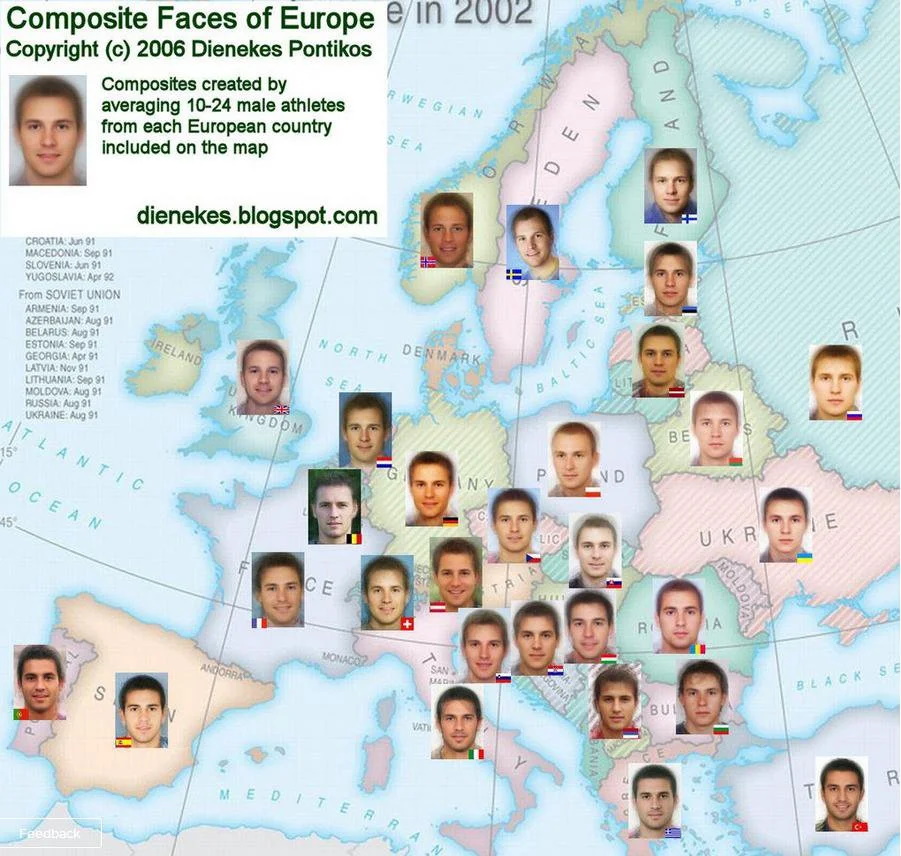
Composite faces of male athletes from different European nations, including Germany and the UK (from Dienekes Anthropology blog)

The outcomes of those different evolutionary paths are just much more obvious in the face, which is, after all, the most obvious part of the human body. That’s why so much of our brains is devoted to reading other people’s faces (and to controlling our own). Our intense interest in faces arises from the important information that they carry. Not that leftists like us to see some of that information. They hate the way we can tell Swedes from Somalis from Samoans at a glance. Sadly for leftists, it’s clear that facial is racial is spatial, because races and their faces have evolved in different places and taken different routes through genetic space. That affects more than the geometry of faces. The color of faces has important information too, both in subtle ways, like the intra-racial differences in the face-colors of men and women studied by the maverick anthropologist Peter Frost, and in gross ways, like the inter-racial differences in the skin-color of Blacks and Whites. When we look at a face we’re looking not just at geometry — the shapes and relative sizes of noses and mouths and eyes — but also at chemistry (which is geometry at a microscopic scale). The color of hair, skin and eyes says something about the chemistry of the body. You could say that a human face is like the cover of a book. It gives you imperfect but important information about the contents of the skull: the geometry and chemistry of the brain, and hence the psychology and cognition of the face’s owner.

The leftist miracle of an unbreakable brain-barrier

That’s why facism is an essential part of racism: the differences between the faces of different races convey real and important biological data. But leftism denies the significance of faces just as it denies the existence of races. Leftists can’t deny that evolution has sculpted faces, but they do deny that evolution has sculpted the brains that lie directly behind those faces. Or rather, they say that the same evolutionary forces that made the faces of Swedes, Somalis and Samoans so different were somehow prevented from working on the brains that lay directly behind those faces. After Homo sapiens evolved in Africa, the skull became an absolute and unbreakable barrier, sealing the brain off from all further evolution as Homo sapiens migrated into environments as different as the tropical, ocean-kissed islands of Tahiti and the icy, oxygen-starved plateau of Tibet. Bodies changed, but brains didn’t. That’s why the Psychic Unity of Mankind is a central axiom of leftism. According to leftists, the brains of all humans, Blacks and Whites, men and women, Finns and Fijians, are capable of exactly the same high intellectual endeavor. We have exactly the same cerebral hardware and we run exactly the same psychological software. Only racism and sexism can explain why Black women have never won Nobel Prizes for Physics or Field Medals in mathematics. Racism and sexism are also shamefully and solely responsible for the myth that White women are more attractive and more feminine than Black women.
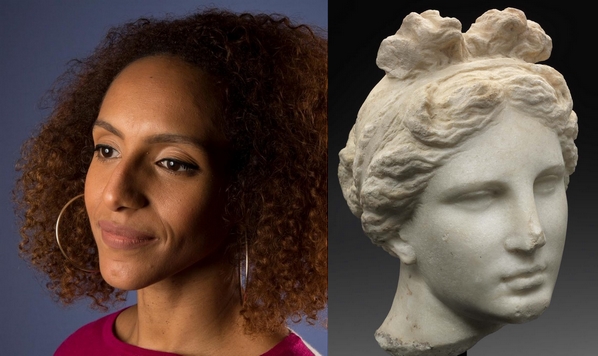
Leftism says that Black-Jewish Afua Hirsch is just as beautiful as all-White Aphrodite

Well, that’s what leftism says, but leftism is a lie. Our faces are different and so are both our brains and our beauties. If we’d evolved to read the geometry of internal organs as easily as the geometry of external faces, we’d be able to distinguish between the brains of Blacks and Whites at a glance. And not just the brains but everything else in the body, from the liver to the lungs. To the dismay of leftists, artificial intelligence (AI) can now do exactly that: it can assign internal organs to different races with very high accuracy. As I described in “Biology is Blasphemy,” leftist scientists have been “shocked, confused, and frankly horrified” to discover that AI can read the reality of race in X-rays and other medical images. As one researcher despairingly concluded: “There is no easy way to remove racial information from images. It is everywhere and it is in everything.”

Ugly, asymmetrical and alien

But why would we want to “remove racial information from images”? Well, I don’t and I hope that you don’t, but lying leftists do, because they want to deny reality in pursuit of what really matters to them: power and the chance to scapegoat non-leftist Whites for the failure and criminality of Blacks. Take this photo of ten vibrant faces that recently appeared in the British media:

The ugly, asymmetrical and alien faces of a violent armed gang in racially and facially enriched Britain — the White-looking criminal is called Ihab Ashaqui

The faces are ugly, asymmetrical and alien (ugliness and asymmetry go together, in fact). If they were the covers of books, then the books would be in the genre of true crime. And they’d be autobiographies, because the faces are those of a violent armed gang who “used guns, knives, hammers and crowbars to terrorise [their victims] before fleeing in a fleet of stolen vehicles.” Leftists would say that the men are completely British and that they’ve been turned into violent criminals by living in a White-supremacist society that refused to nurture their innate intelligence, civility and potential for high achievement. I say: “Face the facts and see the facts in the faces.” And the facts are that both the faces and the brains behind the faces have followed very different evolutionary paths to those of the genuine White British. Nine of the ten men are obviously Black and Blacks haven’t been through the process of genetic pacification, whereby strong and stable states have weeded out genes for crime and violence in their subjects by executing and imprisoning violent and lawless men over many centuries. On the contrary, Blacks have evolved in environments where violence and selfish, impulsive behavior are advantageous.
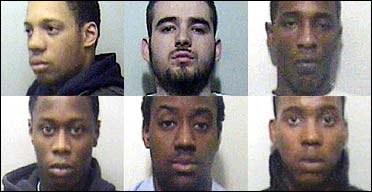
Thames Valley police images of (top row, left to right) Adrian Thomas, Indirit Krasniqi and Jamaile Morally, and (bottom row, left to right) Joshua Morally, Llewellyn Adams and Michael Johnson

An Albanian face in an otherwise Black gang: the torturers, rapists and murderers of White schoolgirl Mary-Ann Leneghan

The one White face in the gang isn’t the product of genetic pacification either. The White-looking thug is called Ihab Ashaqui, which may well be a misspelt Albanian name. Like mountainous Chechnya — which produced the Boston Bombers for America, a head-chopping young art-critic for France, and the most furious fighters of Islamic State — and mountainous Georgia — which produced the Machiavellian mass-murderer Josef Stalin, mountainous Albania has bred men who would rather feud and fight rather than obey laws. And so Albanians behave more like non-British Blacks than British Whites. That may be why Ihab Ashaqui appears in an otherwise Black gang just as Indrit Krasniqi, another Albanian, appeared in the Black gang that raped, tortured and murdered the White schoolgirl Mary-Ann Leneghan in 2005. Unlike the murdered Black and now-sainted schoolboy Stephen Lawrence, she has long been forgotten by the leftist media. After all, her death revealed the truth of how dangerous Blacks are to Whites, whereas the death of Stephen Lawrence can be used to promote the lie that Whites are dangerous to Blacks. Leftism hates truth and loves lies.

Jewish faces in the highest of places

And leftist lies killed Mary-Ann Leneghan, because she spent her short life saturated in pro-Black propaganda designed to persuade her that Blacks were cool and fascinating and perfectly suitable for White girls like her to be friends with. That’s how she ended up raped and tortured for hours, then stabbed to death in a park as she pleaded desperately for her life. By any objective standard, her murder was far worse than the murder of Stephen Lawrence. And it involved misogyny and patriarchy at its most brutal and femicidal. But leftists don’t apply objective standards and they don’t genuinely care about misogyny, patriarchy and femicide. They apply the standard of “What advances the cause of leftism and helps leftists like me gain more power?”
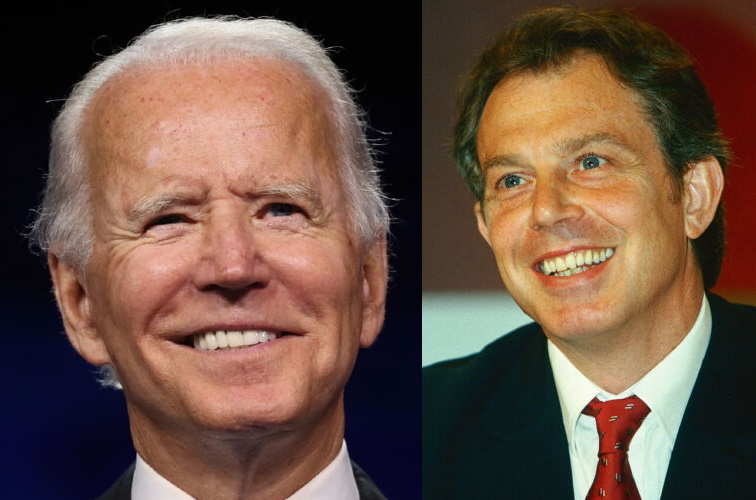
Bland Biden, bland Blair, unthreatening goyish frontmen for a hostile Jewish elite

Jewish faces in the highest of places: How Jews are in charge of the so-called Biden administration
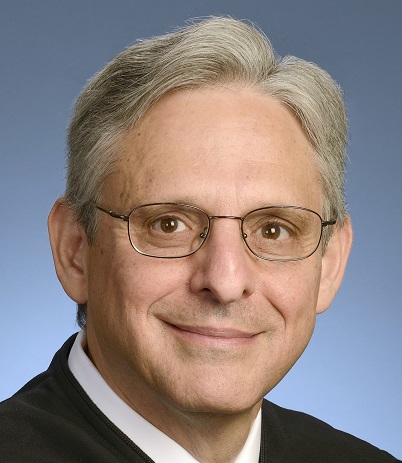
Merrick Garland, chief judge of the U.S. Court of Appeals for the District of Columbia, is a former prosecutor who’s viewed as a moderate.

The sly and sinister Jew Merrick Garland, anti-White American Attorney-General

But it’s because leftists love power that they’re careful about the faces that front their parties. Like the Blair government in Britain, the Biden government in America is disproportionately staffed by Jews, particularly at the highest levels, and follows an anti-White Jewish agenda of open borders and plutocratic enrichment. But in both cases the Jews who ended up running things chose a bland and unthreatening goy to front their election campaign. After all, if the sinister Jew Merrick Garland had been the Democratic candidate for POTUS, even the dumbest goyim might have felt a chill down their spines and understood that voting Democrat was not in their best interests.

Three Jewish faces, three Jewish fraudsters: Bernie Maddoff, Sam Bankman-Fried of FTX, Caroline Ellison of FTX
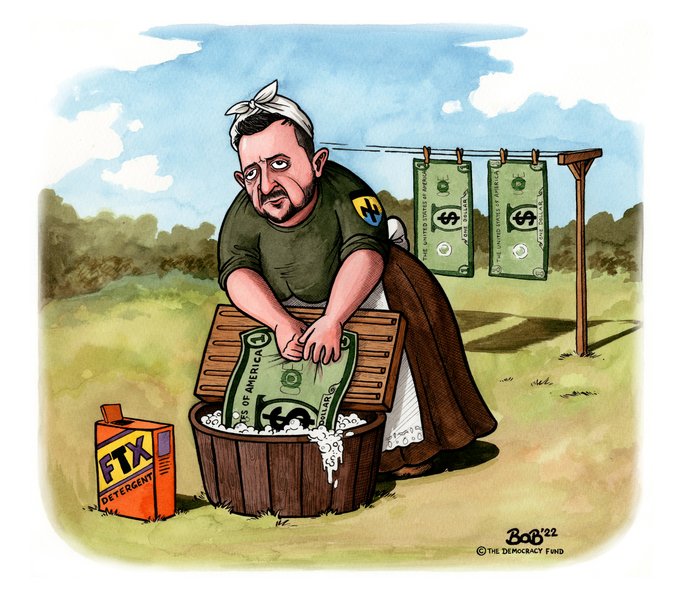
Another Jewish face, another Jewish fraudster: the anti-White, anti-Christian Ukrainian president Volodymyr Zelensky laundering money through FTX

And how do I know that Merrick Garland is sinister? Well, it’s there in his face. If that punim were the cover of a book, the book would be a torture manual or a grimoire of Black Magic. This is me being facist again: the faces of Jews often give me the creeps. And I’m not unique in that. In Western culture there’s a long and shameful history of Jews being represented as or likened to vampires, ghouls and other evil creatures — see Andrew Joyce’s “On Jews and Vampires.”

Cannibals, vampires and Princes of Darkness

At least, leftists and Jews call it a “shameful” history. As both a facist and a racist, I’d call it a healthy and appropriate response to the alien and predatory nature of Jews, which is plainly visible in their faces and body language — and also audible in their voices. In America, the bloodthirsty Jewish neo-con Richard Perle is nicknamed “the Prince of Darkness.” By no coincidence, the Machiavellian Jew Peter Mandelson received the same nickname in Britain (Mandelson was one of the hostile Jewish elite who pulled Blair’s strings). Elsewhere in Britain, the Jewish politician Gerald Kaufman was nicknamed “Hannibal Lecter” (after the cannibal serial-killer created by the writer Thomas Harris). And the Jewish politician Michael Howard, who headed the so-called Conservative party and failed to beat the bland and unthreatening goy Tony Blair at the 2005 election, was nicknamed “Dracula.” One of his own shadow-ministers, Ann Widdecombe, said of Howard that “there is something of the night about him.”

The ugly, evil and truth-hating Jew Jonathan Greenblatt, head of the anti-White ADL

Again, I think this is a healthy and appropriate gentile response to the alien and predatory nature of Jews. But healthy and appropriate racial responses are abhorred and abominated by media and business in the modern leftist West. Kanye West, the Black American musician, has learned that very strongly in recent months, as Andrew Joyce explained at the Occidental Observer in “Jewish Troubles with Uppity Rappers.” West is very intelligent and articulate by Black standards, and he’s very courageous by White standards, because he’s said things that no White of remotely comparable status has dared to say. The ugly and sinister Jew Jonathan Greenblatt, head of the totalitarian Anti-Defamation League (ADL), says that Kanye needs to be crushed because he’s accused Jews of having the power to crush their critics. The ADL is pro-LGBT and anti-BTG — against Beauty, Truth and Goodness. It’s no coincidence that Greenblatt is ugly, evil and a liar. As the great Catholic writer Hilaire Belloc said long ago in The Great Heresies (1938): “[T]here is (as the greatest of the ancient Greeks discovered) a certain indissoluble Trinity of Truth, Beauty and Goodness. You cannot deny or attack one of these three without at the same time denying or attacking both the others.”
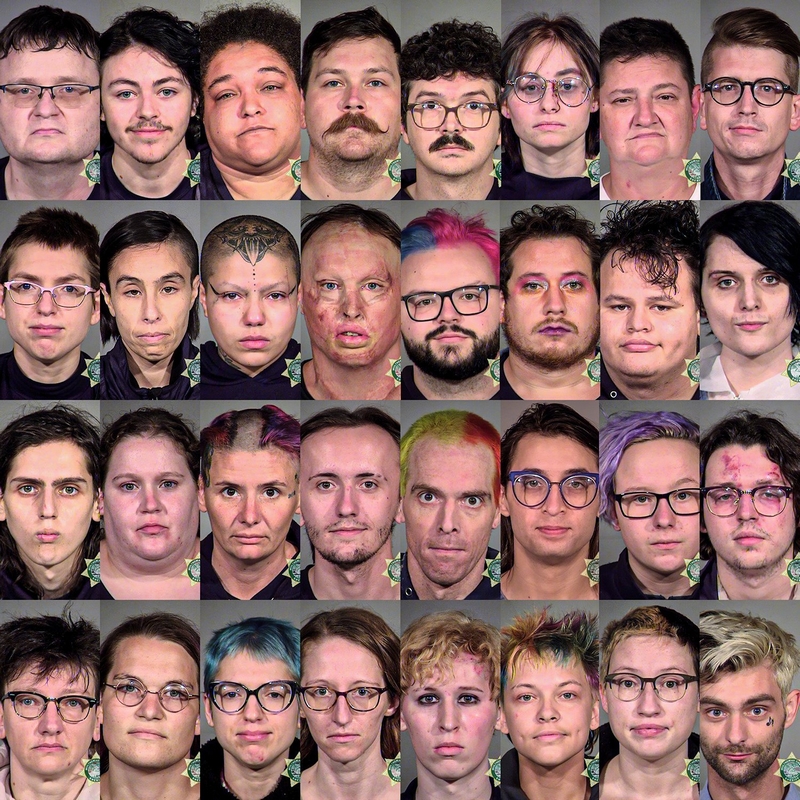
The ugly, evil and truth-hating faces of American antifa

You can see Belloc’s words brought to life in Jonathan Greenblatt and in the ugly, evil and truth-hating faces of American antifa. But the converse of his words also applies: to promote any one of that “indissoluble Trinity” is to promote the two others. It’s also no coincidence that Whites have evolved the brightest and most beautiful faces, created the best art and the least corrupt and criminal societies, and pursued truth so successfully in science and mathematics. Faces are themselves works of art, sculpted down the millennia by the aesthetic choices and preferences of men and women competing for mates.

The specialness of European female beauty

But the anthropologist Peter Frost argues that male choices were particularly important in Europe, where women competed more intensely for fewer men in a much harsher and colder environment than that of tropical Africa. That’s why the color of women’s hair and eyes is most varied in Europe: women benefited by standing out from their rivals in the competition for mates in an individualist mating system in which personal preferences rather than family strategizing was paramount. Indeed, Frost says that “eye colors … have diversified only in Europeans and more so in women than in men. Specifically, the range of eye colors is more evenly distributed among women: they have the less frequent colors more often and the more frequent ones less often.” The eyes are windows to the soul, so it’s said. They’re certainly a window into evolution and the gem-like eyes — sapphires, emeralds and more — of European women are the result of a distinct and uniquely beautiful evolutionary path. But what have Jews, whose faces and brains are the product of a different evolutionary path, done with the beauty of European women? They’ve turned it into the drug and dross of pornography. The vast majority of the alien-faced young men migrating into Europe have undoubtedly seen White women in Jewish pornography and had their rape-culture strengthened and stimulated by it.

Facial (and racial) propaganda from the anti-White, pro-migrant Guardian

Again, leftists don’t care. Their pro-migrant propaganda studiously ignores the predominance of rape-inclined young men and pretends again and again that non-White migrants are helpless women and children. We often see crying women and children in the pro-migrant leftist media. It’s facial propaganda that’s also racial propaganda, exploiting our instinctive sympathy for distressed human faces to promote the invasion of White nations by hostile and dangerous outsiders. Facism is always racism, whether it’s the healthy, truthful facism that helps Whites by recognizing that non-White faces go with non-White brains, or the unhealthy, lying facism that harms Whites by pretending that non-White faces go with brains that are just like ours. No, they’re not like ours and they don’t fit in White societies. The faces of different races belong in different spaces.
The War on Christmas Updated

Originally posted on December 20, 2020.

A dozen years ago I wrote two essays showing that the War on Christmas in recent times has in fact been conducted by Jews out of their historic hatred of Christ, Christians, and European Whites. Recently, I was a guest on Guide to Kulchur, hosted by Frodi Midjord, and we talked about my 2008 essays “Merry Christmas Movies … NOT!” Today I will update those essays.

Jewish columnist Burt Prelutsky bluntly explained my point in his 2004 column “The Jewish Grinch who Stole Christmas,” beginning with “I never thought I’d live to see the day that Christmas would become a dirty word. … Schools are being forced to replace ‘Christmas vacation’ with ‘winter break’ in their printed schedules.” We all know about that, as a whole generation now has become inured to the horrid greeting, “Happy Holidays.”

“How is it, one well might ask, that in a Christian nation this is happening?” asks Prelutsky. In plain English, he spells it out: “I blame my fellow Jews. When it comes to pushing the multicultural, anti-Christian agenda, you find Jewish judges, Jewish journalists, and the American Civil Liberties Union, at the forefront. . . . But the dirty little secret in America is that anti-Semitism is no longer a problem in society — it’s been replaced by a rampant anti- Christianity.” Amen to that, brother.

Next, we turn to Prelutsky’s fellow Jew, Neil Gabler, an expert on Hollywood whose 1988 book title alone tells us all we need to know: An Empire of Their Own: How the Jews Invented Hollywood. Prelutsky didn’t mention Hollywood in his War on Christmas, so I’ll show how Jews are busy there destroying the spirit and intent of that sacred day for Christians. It’s not pretty, either.

This undermining of the Christian meaning of Christmas began early in America, before and during World War II, but it was subtle enough that few goyim noticed, let alone objected. We had, for instance, the huge hit “White Christmas,” written by Irving Berlin, born ביילין ישראל, or “Israel Beilin” for those who don’t read Hebrew.

Mark Steyn (“A Triumph of Miscegenation,” The Spectator, December 17/24, 1994) light-heartedly described how Jews created a gradual division between religious and secular Christmas symbols, making America a society where “Jesus, Mary and Joseph are for home and for church; Santa, Rudolph and Frosty the Snowman — the great secular trinity — are for everybody.” For instance, “Rudolph the Red-nosed Reindeer,” was first a book created by Robert May in 1939 and a decade later inspired his brother-in-law Johnny Marks to write a song about Rudolph. Both men were Jewish.

Also Jewish were Jule Styne and Sammy Cahn, who together wrote the lyrics

Oh, the weather outside is frightful
But the fire is so delightful
And since we’ve no place to go
Let it snow! Let it snow! Let it snow!

Of course this “compromise” to take Christ out of popular culture was a great victory for Jews, for it allowed the hostility many Jews felt toward a Christian majority to find vent without the Gentiles really noticing. Novelist Philip Roth, however, knew exactly what it meant:

The radio was playing ‘Easter Parade’ and I thought, But this is Jewish genius on a par with the Ten Commandments. God gave Moses the Ten Commandments and then He gave to Irving Berlin ‘Easter Parade’ and ‘White Christmas.’ The two holidays that celebrate the divinity of Christ — the divinity that’s the very heart of the Jewish rejection of Christianity — and what does Irving Berlin brilliantly do? He de-Christs them both! Easter he turns into a fashion show and Christmas into a holiday about snow. Gone is the gore and the murder of Christ — down with the crucifix and up with the bonnet! He turns their religion into schlock. But nicely!

Nicely! So nicely the goyim don’t even know what hit ’em. They love it. Everybody loves it. The Jews especially. Jews loathe Jesus.

In the context of the times, however, such songs were not obviously anti-Christian. It was not until Jews achieved cultural hegemony in the late 1960s that the underlying sentiment of hostility toward Christians in America came out into the open, led first and foremost by the just-mentioned Philip Roth, whose 1969 blockbuster novel Portnoy’s Complaint was shockingly candid about the prevalence of Jewish hatred toward Gentiles. Somehow, few Gentiles (Whites) of the time even noticed, so in an important sense the book served as a litmus test for how explicit Jews in America could be about their contempt for goyim. And that contempt turned out to be immense. Still, it took time for this hostility to emerge, then dominate.

Obviously, “Happy Holidays” and “Season’s Greetings” were not always ubiquitous during the month of December, nor were real Christmas songs in any way unwelcome. Quite the contrary. Criticism of Christmas was not easily tolerated. For instance, back in 1952, George S. Kaufman appeared on a popular television show one week before Christmas and was asked what he wanted for the holiday. He replied, “Let’s make this one program on which no one sings ‘Silent Night.'” The response from the audience (largely Gentile, one would presume) was fast and furious: Kaufman was removed from the show and exiled from the TV screen for a year thereafter.

Fast-forward to 1982 and the popular Saturday Night Live Show featured a skit called “Merry Christmas, Dammit!” This skit portrayed the relationship between Donny and Marie Osmond, two non-Jewish sibling pop singers, as incestuous, and the Virgin Mary was described as “that virgin chick” in a jazzed-up version of “Silent Night.” Eddie Murphy — in his popular “Gumby” guise — read a children’s story in which Santa tears out the lungs of one of his elves because the elf asked for a sip of Santa’s hot chocolate. He ends the skit by saying “And to everyone out there — a Merry Christmas! And to my producer, my director, my manager, and my lawyer — Happy Hanukkah, boys!” Obviously, sensibilities had changed by then, and the people calling the shots were Jews.

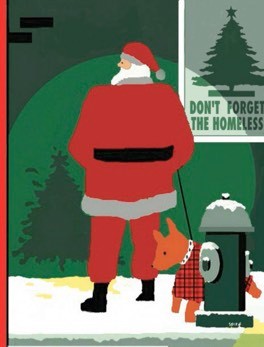
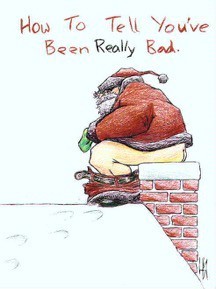
Again, beginning in 1969 and the huge success of Roth’s Portnoy’s Complaint, with its lusty protagonist prone to masturbating into pieces of raw liver, we eventually witness a parade of degraded images of excretory functions paired with Christmas imagery. Thus, we had Jewish illustrator Art Spiegelman trying to get this drawing onto the cover of The New Yorker:

Sadly, the drawing was rejected, but Spiegelman and the art editor of The New Yorker (his wife) were able to use the image as their 1993 Christmas card instead. And The New Yorker did run Spiegelman’s Easter cover picture of the Easter Bunny being crucified, but that’s another story.

Jump ahead four years and Santa urinating is upstaged by South Park’s Mr. Hankey, the Christmas Poo.” In this recurrent theme, Mr. Hankey “emerges from the toilet bowl on Christmas Eve and brings presents to good boys and girls whose diets have been high in fiber. He is especially close to Kyle [a Jewish boy], consoling him during his Christmas-Hanukkah depression and generally appears to help the boys out with something or gives them advice.”

Mr. Hankey was introduced in a 1997 episode that showed the young Kyle brushing his teeth. Mr. Hankey, wearing a Santa hat, jumps out of the toilet bowl and sings a song about Santa and Christmas. The starkest comment in the scene comes when this animated feces writes “Noel” in excrement on the mirror.

Two years later, the more extensive Mr. Hankey version was released as Mr. Hankey’s Christmas Classics. (A parallel CD of the songs includes the delightful “Merry Fucking Christmas”). Here Mr. Hankey besmirches the faces of children singing Christmas songs. He then introduces us to the next scene, “Christmastime in Hell,” where Hitler is shown crying over his Christmas tree. Later, when Jesus and Santa sing a duet, Santa gets miffed that there are far more songs about Jesus than about him, so he leaves the stage. When Jesus implores him to return, Santa speaks the cheery words, “Aw, fuck you, Jesus!”

This episode is a parody of the Charlie Brown Christmas Special in which everyone yells out “Merry Christmas, Charlie Brown!” only after Charlie has realized the true meaning of Christmas — which has Christ at its center. In the South Park version, the characters wish the Jewish boy Kyle a Merry Christmas only after he has taught everyone, through Mr. Hankey the Christmas Poo, that Christmas and Christianity are shit.

I feel compelled here to provide a slightly tangential account of Jewish attitudes toward Christmas, fairly tinged with scatological associations, in order to show that the above representations are not simply generically juvenile creations. To do this, we must scurry over to the Israeli site Haaretz for the skinny – For them, it’s wholly unholy:

Christmas Eve is one of the few occasions when Hasidim refrain from Torah study, do not conduct weddings or go to the mikveh [ritual bath for women]. But they do play chess and work on their bills.

On Christmas Eve, known in Jewish circles as Nitel Night, the klipot (shells) are in total control. The klipot are parasitical evil forces that attach themselves to the forces of good.

According to kabbala (Jewish mysticism), on the night on which “that man” — a Jewish euphemism for Jesus — was born, not even a trace of holiness is present and the klipot exploit every act of holiness for their own purposes.

For this reason, Nitel Night, from nightfall to midnight, is one of the few occasions when Hasidim refrain from Torah study. On this horrific night, they neither conduct weddings nor do they go to the mikveh (ritual bath). An entire folkloric literature has developed around the unusual recreational activities of Nitel Night.

Oh, there’s the usual disclaimer that not all Jews follow this custom, but in three decades of research on Jews I’ve found that it’s simply a truism that Jews have an exceedingly negative view of Jesus, Mary, Christians, and Christmas. No wonder so many spit when passing a church . . . or even spit on Christians themselves in Israel.

But in the Haaretz story, this passage about Kabbalistic toilet paper really stood out:

The Knesset correspondent of the ultra-Orthodox newspaper Hamodia, Zvi Rosen, relates that celebrated Hasidic admorim (sect leaders) would cut a year’s supply of toilet paper for Sabbath use (to avoid tearing toilet paper on Sabbath) on this night. Actually, this disrespectful act has profound kabbalistic significance, because kabbalistic literature extensively discusses Christianity as waste material excreted from the body of the Jewish people.


Honestly, I couldn’t make this stuff up. And get this: One of their commandments recommends that they attempt procreation on Friday night, which is a holy time. “Yet on Nitel Night, which has no holiness, it is customary to refrain from observing the commandment, because of the fear that a Jewish child conceived on Jesus’ birthday could become an apostate.”

Gentiles have no idea what they are dealing with when we talk about Jewish ascendency in the creation and control of Western culture. Often, I too simply shake my head.

When I wrote these essays in 2008, I included plenty of links, but a surprising number of them are now dead, so I’ve had to learn to use the Wayback Machine. Still, some sources are beyond locating now, such as Christmas movie reviews by a Jewish individual named Austin Pearl. My links were rock solid in 2008, so I’m going to continue to use Pearl’s Jewish views because they tie together many of the films discussed here.

Pearl gleefully explained his motive for collecting anti-Christmas films: “It’s my wanting to recognize things that are deliberately anti-Christmas. It’s my wanting to take a big you know what on everyone’s Christmas spirit. . . . Each one of them is so anti-Christmas that I want to share them with the world, thereby forcing everyone to realize how liberating it is to rip off the Christmas mind control device and have some laughs in the process.” There is the scatological reference again — “wanting to take a big you know what on everyone’s Christmas spirit.” Clearly we are seeing a pattern emerge.

Humor such as in South Park is juvenile, but in reality it rests upon a long Jewish tradition of hatred of and disrespect for Christmas. Still, it doesn’t really rise to the level of successful cultural subversion. For that, we need to consider a raft of anti- Christmas films. To put this into its proper context, let’s consider the broader circumstances of the modern era. As Kevin MacDonald demonstrates in The Culture of Critique, “The Judaization of the West means that the peoples who created the culture and traditions of the West have been made to feel deeply ashamed of their own history — surely the prelude to their demise as a culture and as a people.” To being ashamed, we can now add that we Western people — Whites — have been subjected to subliminal conditioning that tries to associate positive Christmas symbols with terrifying experiences, thus subverting the beauty and even worship attached to traditional Christmas images, songs, etc.

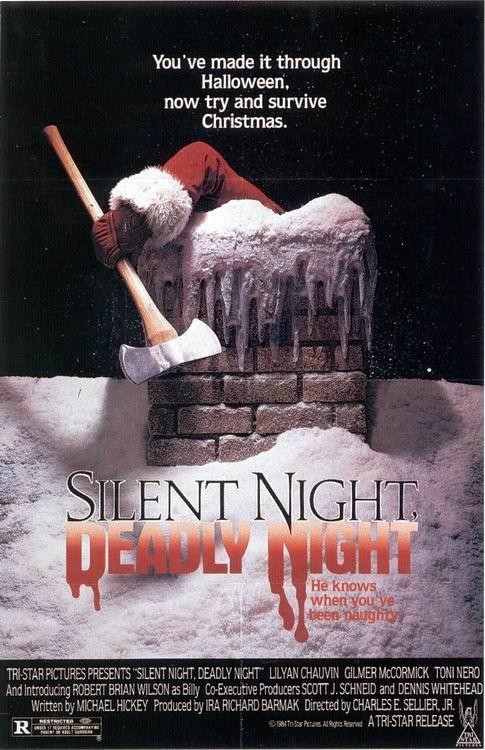
While Hollywood Christmas movies were almost exclusively positive in the past, like Christmas songs, they have been stripped of religious meaning — and then turned into visual horror shows. Perhaps the best example of this is Silent Night, Deadly Night.

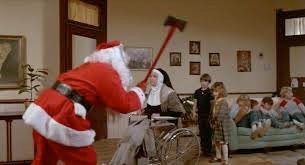
This is a 1984 slasher film that begins with a young boy named Billy witnessing the murder of his parents by a man dressed as Santa Claus. Billy ends up at St. Mary’s Orphanage, where he is beaten by Mother Superior. Later, morphing memories of his punishment at her hands with images of Santa, Billy grows up to become a killer teenage Santa. At work, for example, he strangles a co-worker with Christmas lights and then dispatches the girl with whom the co-worker was having sex.

After a string of other Santa murders, Billy returns to the orphanage, with the police hot in pursuit. Tragically, they shoot and kill Father O’Brien, a deaf priest dressed as Santa. Sneaking into the orphanage, Billy, dressed as Santa, swings his ax at Mother Superior, but a policeman shoots him down. Imparting his central message, Billy assures viewers, “You’re safe now … Santa Claus… is gone.” Not exactly a happy message at Christmastime.

In 1984, such imagery was still able to rile the public. Siskel and Ebert condemned the film, going “so far as to read the film’s production credits on air, saying ‘shame, shame’ after each one.” Angry mothers protested the movie around the nation, and TriStars Pictures, its distributor, quickly ceased advertising the film.

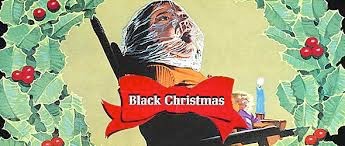
Silent Night, Deadly Night did have antecedents. Black Christmas was a 1974 movie set in a sorority house during Christmas break. A maniac is making calls from within the house, killing the coeds one by one. The movie also takes every opportunity to pair beloved Christmas songs with chilling scenes, a phenomenon that was later repeated in Gremlins, as we will see.

Another, Christmas Evil (1980), features a delusional Santa stand-in who murders three church-goers in front of a church. (He stabbed one man in the eye with a toy.) Later, while wearing a ragged Santa outfit and being chased by an angry mob, our main character drives his van off a bridge, imagining himself to be Santa in his flying sleigh.

Austin Pearl, our Jewish reviewer, approvingly wrote, “Christmas Evil ruins Christmas unlike any other movie.” In particular, this reviewer liked “all the vividly disturbing images of Santa sprinkled throughout the movie.”

It’s no surprise that Pearl also liked the 2003 Billy Bob Thorton film Bad Santa, which was a concerted ethnic effort to trash Christmas. Jewish director Terry Zwigoff made the film under producers Ethan and Joel Coen for the Disney subsidiary Miramax, run by two Jewish brothers, Bob and the notorious Harvey Weinstein. Billy Bob Thornton starred as the bad Santa of the title, going about his life boozing and swearing with abandon. At one point he has anal sex with an overweight woman in a changing room, while elsewhere he goes to a mall drunk and destroys a reindeer display in a drunken rage. Ho ho ho.

Near the end of this dark film, he is shot by a group of policemen but survives. Despite his obvious guilt in numerous crimes, he is pardoned because “the Phoenix police department [thought that] shooting an unarmed Santa Claus in front of children was more fucked up than Rodney King.”

According to Wikipedia, critics generally liked the film, with one describing it as an “evil twin” of “Miracle on 34th Street,” the inspirational Christmas classic. According to reviewers’ consensus on Rotten Tomotoes, it’s “A gloriously rude and gleefully offensive comedy, Bad Santa isn’t for everyone, but grinches will find it uproariously funny.” No wonder Austin Pearl wrote glowingly that “Bad Santa is perhaps the most subversive, offensive Christmas movie ever made — with Thornton as a truly despicable character who, for once, does not receive a total personality transplant by the movie’s end.”

Director Zwigoff intended this film for impressionable teenagers, the vast majority of whom are, one would assume, Christian.

When asked if he thought the film would do well, Zwigoff answered, “I think it might. Every teenager in America is dying to see this film. Though they won’t be able to get in unless they have a very open-minded parent.” Clearly he was aware of the film’s subversive content.

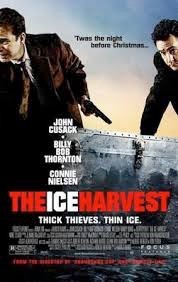
Two years later came another Jewish-directed anti-Christmas movie. The Ice Harvest, Harold Ramis’s “grisly black comedy/film-noir,” sees Billy Bob Thornton return to a mayhem-filled Christmas. One reviewer intoned that The Ice Harvest “is a must-see for fans . . . in the mood to see one of the worst Christmas Eves in the history of cinema.” Roger Ebert (page has been taken down) was also impressed. “I liked the movie for the quirky way it pursues humor through the drifts of greed, lust, booze, betrayal and spectacularly complicated ways to die.” In other words, Hollywood’s version of Merry Christmas stuff.

Gremlins

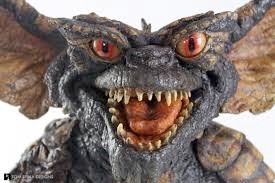
In my personal view, the most unsettling Christmas movie was the original Gremlins (1984). Though directed by Joe Dante, Steven Spielberg’s production company Amblin Entertainment released it. TIME magazine characterized the film as being “developed and ‘presented'” by Spielberg and being one of his “children too.” Stylistically, too, this film is completely Spielbergian, beginning with a typical suburban paradise. Snow is on the ground as local residents prepare for Christmas.

The drama begins when protagonist Billy receives a cute “mogwai” from his inventor father, but the creature spawns siblings that are far from full of holiday cheer. On the contrary, they bring violence, mayhem, and death to this otherwise happy time of year. Their mischief is methodically paired with normally positive symbols of Christmas. For instance, when Billy’s mom is home alone making Christmas cookies and listening to Christmas music, she is attacked by a squad of ghoulish gremlins with murder on their minds. After stabbing one through the heart, she dispatches another with a deft push of the blender switch, turning the previously Christmas-cookie-aroma-filled kitchen into a bloodbath.

More blood is added when a gremlin foolishly hides in the microwave. A few minutes on high power and his head delightfully explodes. Retreating to the living room, the mother is literally attacked by the Christmas tree, which is full of gremlins. This conflation of joyful Christian symbols with diabolical evil is a central device to the whole movie.

Another example comes when the police pass by Billy’s neighbor’s house and are greeted by the neighbor, dressed as Santa Claus, running about helplessly as gremlins eat into his brain. Next, Christmas-caroling gremlins arrive at grouchy old Miss Deagle’s door, only to send her flying out the second-floor window of her house in a malfunctioning motorized chair.

I call this movie “most unsettling” because I remember when it came out, and the trailers and ads were specifically aimed at children — young children, as I recall, 4–8 years old. I also recall many tales of parents angrily leading their shrieking children out of theaters because families had been led to believe this was a fun Christmas movie. Tell me if you think the following is fun.

In two scenes I thought were totally extraneous, protagonists Billy and his girlfriend Kate pass a group of Christmas carolers singing “Silent Night,” when Kate suddenly and soberly states that Christmas is a time when “a lot of people get really depressed. . . . While everybody else is opening up their presents, they’re opening up their wrists. It’s true. The suicide rate is always the highest around the holidays.” When she volunteers that she doesn’t celebrate Christmas, Billy asks, “What, are you Hindu or something?” Historically, the non-Christian group in America with mixed feelings toward Christmas is not Hindus, but Jews. Here the mask is in place but the true message is easily discernible. It is Jews who hate Christmas.

Much later in the movie, after the gremlins have wreaked havoc on Kingston Falls, Kate launches into a startling horror story about Christmas, one that seems completely gratuitous since it is independent of the blood-thirsty gremlin theme. Surveying the rubble left by the marauding gremlins, Kate relates how she now has another reason to hate Christmas. It seems that when she was nine, she and her mother were decorating the tree on Christmas Eve, waiting for her father to come home from the office. They waited, but he never came.

Then, four or five days later, as the temperature dropped, Kate went to make a fire. “And that’s when I noticed the smell.” Thinking it was a dead cat or bird, they called the fire department to clean it out, but instead “they pulled out my father. He was dressed in a Santa Claus suit. He’d been climbing down the chimney on Christmas Eve, his arms loaded with presents. He was going to surprise us. He slipped and broke his neck, died instantly. And that’s how I found out there was no Santa Claus.”

Now that you’ve read my account of Gremlins, go back and watch it again. Note the systematic pairing of Christmas songs with things negative, a Christmas tree with violence, Christmas carols with monsters. And of course, not the slightest hint whatsoever that Christmas has anything to do with a religious holiday celebrating a divinity that Christians traditionally believe to be God.

There’s actually a dizzying array of Christmas films available—over 100 since 2010, including 26 horror films—and too many to review here. Not all Christmas movies are subversive—Hollywood is well aware that there is money in appealing to particular audiences, such as viewers of Hallmark or the Lifetime Movie Network. One such is the popular Elf (2003), by screenwriter David Berenbaum and director Jonathan Favreau, who is half Jewish, with Ed Asner starred as Santa, and James Caan as the elf’s biological father. I invite readers to comment about this film and, because of the glut of films, I’ll need to do that with some other Christmas films as well.


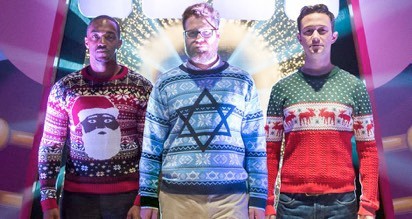
A recent film that looked highly promising as far as my thesis goes is The Night Before (2015) starring Jewish actors Seth Rogen and Joseph Gordon-Levitt, along with Anthony Mackie, who is Black. (This lack of White males fits into my recent photo essay showing how in 2020 Whites males have been almost completely airbrushed out of commercials.) Further, the film is “a successful collaboration between Seth Rogen and Evan Goldberg”; the director is Jonathan Levine.

More to the point, reviewer Ben Kendrick strongly suggests that this movie also shows great disrespect for Christmas. The Night Before is “irreverent,” “nor is it a Christmas movie for all audiences” (such as believing Christians, for example?). The film blends “stoner hijinks and holiday spirit.” It is a “raunchy comedy set against a holiday backdrop,” and, in a key description, Kendrick admits that “It’s a surprisingly subversive tale, playing off Christmas movie tropes in unique (and often hilarious) ways.” Again, I need to ask readers to see how this Jewish-inflected film approaches traditional Christmas.

Other films that caught my eye were Black Christmas (2006), a “Canadian-American slasher film,” Four Christmases (2008), The Christmas Chronicles (2018) and Last Christmas (2019). Comments on them are also welcome.

Santa’s Slay

I put aside all of these films, however, when I hit pay-dirt yesterday with the film Santa’s Slay (2005). I’m going to start with Wikipedia’s description:

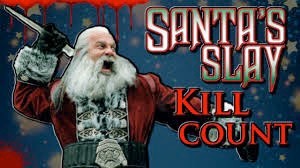
Santa’s Slay is a 2005 Canadian American Christmas slasher comedy film that stars professional wrestler Bill Goldberg as Santa Claus. The film was written and directed by David Steiman, a former assistant to [Jewish] Brett Ratner; Ratner served as a producer….

On Christmas Eve, the Mason family (played by a cast of all Jewish celebrities in bit roles) is bickering about their wealth and material possessions while eating Christmas dinner when Santa Claus (Bill Goldberg, also Jewish) comes down the chimney and kills them all in various graphic displays of Christmas-themed violence, such as drowning the matriarch Virginia (Fran Drescher) in eggnog, using the star atop a Christmas tree as a ninja star and stabbing the patriarch’s hands to the table with silverware and suffocating him by stuffing a leg of turkey in his mouth. Riding on his sleigh driven by his “hell-deer,” the Buffalo-like Beast, Santa arrives at Hell Township and decimates the locals in various holiday-themed ways. In one of his kills, Santa slaughters the occupants of a local strip club, frequented by Pastor Timmons (Dave Thomas), a crooked minister, who manages to survive the massacre.

Yes, this “gift” was dropped right in my lap as I perused Jewish-created anti-Christmas films. You have to watch this selection of scenes to believe it.

Typical goys are celebrating a traditional Christmas scene with carols and a creche. “Santa” on his sleigh comes through, beheading the statue of Joseph. The actual opening, however, begins with a beautiful rendition of “Joy to The World” against a shot of a well-decorated millionaire’s home, and then zooms into the well-appointed dining room of a large “Gentile” family.

James Caan plays the patriarch, and the whole skit is reminiscent of the typical Hollywood ploy of mocking the goyim, as in the old Caddyshack series. Childishly tasteless and gauche, Caan criticizes the dry turkey, mock praying, “Let it be tender and moist,” to which his wife (played by Fran Drescher) retorts, “Yeah, moist, it’s called foreplay.” Then one family member sodomizes his wife under the table. Lots of laughs. Soon, however, we get bulked-up former wrestler Bill Goldberg as a Viking Santa coming down and through the chimney for some Christmas murder.

More goy mocking comes a little later when Mrs. “Talbot” bullies Jewish Mr. Green at his deli, insisting that he use “Merry Christmas” rather than “Happy Holidays.” Immediately after this, the miserly biddy is driven off the road by Goldberg in his sleigh, and she dies in a fiery inferno. Ah, revenge.

Surprisingly, however, the attack on Christians doesn’t go much beyond that. Yes, later two Gentile boys dressed in red and green pajamas ask their parents if they “can open our mother f**king presents now?” When they open the presents, there are explosions and the boys’ heads are blown off, to which goy Grandma slowly replies “F**k.” In the milieu of 2005, this does not rise to the level of high offense, let alone blasphemy. In addition, Jesus Christ is never mentioned, let alone attacked.

I can’t explain why this is. By 2005, Jews held such a lock on American culture that they could pretty much do what they wanted, as we saw in Quentin Tarantino’s 2009 film Inglourious Basterds. Though director Tarantino is not Jewish, Eli Roth is, and as Sergeant Donny “The Bear Jew” Donowitz, he executes Nazis with his baseball bat. Roth famously said that such filmic revenge amounted to “almost a deep sexual satisfaction of wanting to beat Nazis to death, an orgasmic feeling. My character gets to beat Nazis to death. That’s something I could watch all day.” In addition, Lawrence Bender, one of the producers, told Tarantino that “As your producing partner, I thank you, and as a member of the Jewish tribe, I thank you, motherf**ker, because this movie is a f**king Jewish wet dream.”

Screenwriter and director David Steiman, et al. could have accomplished something similar with Santa’s Slay but for some reason they didn’t even come close. Instead, we ended up with a stupidly juvenile and unprofessional film that was a real chore to watch. Given the coarse level our society has fallen to this century, though, it is hardly surprising that untalented reviewers could write that Santa’s Slay was “simultaneously vulgar and wholesome, stupid and satirical, violent and lighthearted.” Or that “overall it is just a fun, brainless movie that has a ton of violence in it.” Another wrote that “Admittedly, the film doesn’t quite keep up the relentless pace the entire time, but it’s mostly one hell of a slay ride, full of cheesy dialogue, colorful characters, and plenty of laughs.”

“Plenty of laughs.” You can do that with Christmas, of course, but try it with a comedy about the Prophet Muhammad … or the Holocaust. You know, make a “brainless movie” with “colorful characters, and plenty of laughs” about Auschwitz or something. But plan to start looking for a new job the next day.

In any case, Santa’s Slay hardly bothered me, unlike the way Gremlins did. Though Santa’s Slay is clearly patterned on Gremlins, beginning with the use of the song “Christmas (Baby, Please Come Home)” at the opening of both films, it’s a different film (perhaps because the filmmakers were untalented).

Throughout Santa’s Slay the mood mimics Gremlins, plus we have the same type of teenage protagonists, along with a quirky inventor in the family.

Beyond that, however, Santa’s Slay doesn’t come close to the subversion of the Christmas spirit the way Gremlins did. What it did, oddly, was begin to subvert Jews themselves, which really surprised me.

Here I’m going to go out on a limb and attempt a reading of Santa’s Slay worthy of Jay Dyer or Mark Brahmin. While I’ve never really understood Michael Hoffman’s “Revelation of the Method,” I sort of get that it means producers of messages deliberately reveal who they are and what they are doing. And in watching Santa’s Slay, I kept asking myself “Are the Jews making this movie revealing themselves as satanic”?

Yes, I know at this point you are going to cry “WHAT?!!!” But consider that when the credits begin to roll, we are treated to the wordplay of seeing the title first as Satan’s Slay then morph into Santa’s Slay. And throughout Goldberg certainly plays a satanic Santa. What really cements this view, however, is the fact that a central part of the story refers to two virgin births: that of Christ and that of Satan, with Santa Claus being the resulting issue.

Finally, though Goldberg’s Santa wreaks massive havoc and leaves a long trail of people quite dead, in the end a (Christian) angel prevails, and the Gentile teenage couple happily escapes, while satanic Santa is again remanded to the control of the angel. Jews had free rein in this film, yet it turned out to empower Christian Whites. Curious.

And with that happy turn of events, I’ll end this discussion by giving readers a heartwarming review of the 2015 Hallmark film, ‘Tis the Season for Love, which I called “a pro-White, pro-natal TV movie.”

Merry Christmas. I look forward to reader comments on modern Christmas films.

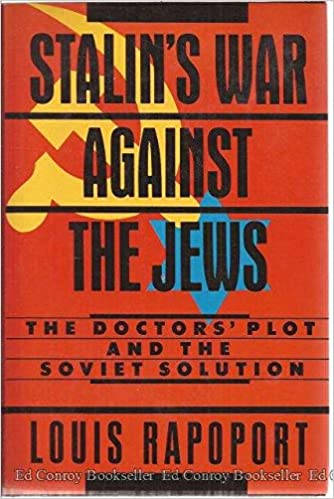
Review: Stalin’s War Against the Jews: The Doctor’s Plot and the Soviet Solution

Stalin’s War Against the Jews: The Doctor’s Plot and the Soviet Solution
Louis Rapoport
Free Press, 1990

A person’s lack of self-awareness can produce a sense of eye-rolling irony. Not a pleasant feeling—sort of like spinning one’s wheels. But such an encounter doesn’t have to be a total loss. A self-unaware person can still teach us things, as long as we don’t let the irony get the better of us.

Louis Rapoport’s 1990 work Stalin’s War Against the Jews gives us such an opportunity by offering an engaging roundup of a vital part of twentieth century history. Although Rapoport presents it as part of the interminable saga of Jewish “lugubria” (if I may coin a term), what he really offers is an eye-opening account of Jewish culpability in the vast blacklist of Soviet atrocity. In mentioning anti-gentile enormities offhandedly and focusing more on the significantly less deadly anti-Jewish crimes of the Soviets, Rapoport reveals his appalling lack of self-awareness. (As do Natan Sharansky, Benjamin Netanyahu, Robert Conquest, and Theodore Draper, who provide glowing blurbs on the book’s back cover.)
Would these reviewers have responded as well to a book entitled Hitler’s War Against White Christians which only mentions Jewish suffering in passing?

Rapoport starts with some useful biographical information about Stalin, whom he correctly vilifies throughout his book. He describes young Joseph Djugashivili as an industrious bully who was always cynical and pragmatic regarding his interactions with Jews. Rapoport covers Stalin’s time as a young radical robbing banks, getting into Lenin’s good graces, and vying with the more urbane and Mephistophelean Leon Trotsky during the early days of the Bolsheviks. Rapoport compares Stalin, being a Georgian, to the Corsican Napoleon and the Austrian Hitler as an ethnic outsider identifying with gentile majorities as a basis for his power and appeal.

Right off the bat, however, he discusses Stalin’s sinister yet unrealized intention in his last years to deport nearly all Soviet Jews to Siberia, Kazakhstan, and Birobidzhan. Yes, I think it is fair to say that Russian Jews dodged a bullet when Stalin died. Despite this, Rapoport makes the dubious claim that “the Jews suffered far more under the ‘anti-racist’ Bolsheviks than they had under the openly anti-Semitic czar Nicholas II.”

Here is where the lack of self-awareness comes in. Everyone suffered more under the Bolsheviks than under the Czar. For gentiles, it wasn’t even close, yet Rapoport never directly acknowledges this. It’s as if for him no one can suffer the way a Jew suffers. Furthermore, he quite astonishingly indicts the Jews for much of this suffering. He admits not only that Jews “laid the foundations of communism and socialism” (for example, Karl Marx, Ferdinand Lassalle, and Eduard Bernstein) and made up Lenin’s “top men” (Lev Kamenev, Grigory Zinoviev, and Jacob Sverdlov) but also that Jews were instrumental in the rise of Bolshevism.

In the three decades before the Revolution of 1917, a growing number of young Jewish revolutionaries flocked to the new religion of communism, seeing it as a means of delivery not only from their own constricted status as Jews, but for all humankind. These were the educated, secular equivalents of those Jews who had followed previous false Messiahs—such as Shabtai Zvi in the seventeenth century, or much earlier pretenders like David Reuveni. The very high proportion of Jews in the forefront of the movement in Russia was, however, also directly linked to the fact that the aristocracy and peasants shared a mutual antipathy toward Jews, considering them Russia’s main source of bedevilment.

It gets better. It turns out that Jews got their hands dirty after the Revolution as well.

Under Lenin, Jews became involved in all aspects of the Revolution, including its dirtiest work. Despite the Communists’ vows to eradicate anti-Semitism, it spread rapidly after the Revolution—partly because of the prominence of so many Jews in the Soviet administration, as well as in the traumatic, inhuman Sovietization drives that followed. Historian Salo Baron has noted that an immensely disproportionate number of Jews joined the new Bolshevik secret police, the Cheka, “perhaps in subconscious retaliation for the many years of suffering at the hands of the Russian police.” And many of those who fell afoul of the Cheka would be shot by Jewish investigators.

And did someone say genocide? Here is a direct quote from Zinoviev in a 1917 conversation with Polish Cheka leader Felix Dzerzhinsky and Jewish Menshevik leader Raphael Abramovich:

We must carry along with us ninety million out of the one hundred million Soviet Russian population. As for the rest, we have nothing to say to them. They must be annihilated.

Moving on to the 1930s, it gets even better.

Thousands of Jewish revolutionaries helped to spearhead the Terror machine with a messianic fervor. One of them, Matvei Berman, had helped to institutionalize slave labor as early as 1922. . .

And then we have the Jewish “Iron Commissar” Lazar Kaganovich:

Kaganovich was also known for his vow against alleged class enemies and saboteurs: “We’ll break their skulls in.” In 1932, when he was in charge of suppressing a strike by Kuban Cossacks during collectivization in the Ukraine, he transferred whole Cossack settlements to Siberia—a mere rehearsal for the transfer of eight entire nationalities in the forties. Khrushchev, who participated in many of these events and whose own hands were not unsullied, termed Kaganovich “unsurpassed in his viciousness.”

I saved the best for last:

Other Jewish Chekists who rose to the top included Aron Soltz, long known as “the consciences of the Party,” and Naftali Frenkel, a Turkish Jew whom Solzhenitsyn would characterize as “the nerve of the Archipelago, which stretched across the nine time zones of the vast country.” It was Frenkel who refined Berman’s use of prisoners as slave laborers. In 1932 Stalin put him in charge of the construction of the White Sea-Baltic Canal, which took the lives of some 200,000 prisoners, and later he worked under [Genrikh] Yagoda, the first and last Jewish head of the Cheka. Most of the chief overseers of the canal were Jews.

While it is nice that Rapoport likens communism to false religions, he fails to consider why the Russian aristocracy and peasantry “shared a mutual antipathy toward Jews.” I understand that tit-for-tat can reach farther back into history than we can fathom, and that the Jews have their side of things. But to assume that this anti-Jewish antipathy sprang out of nowhere or from the black hearts of gentiles is simply dishonest. Honesty would compel Rapoport to discuss uncomfortable topics like usury, alcohol peddling, prostitution, draft evasion, tax evasion, anti-assimilation, russophobia, ideological subversion, terrorism, and the weaponization of the Jewish fund known as the Kahal against gentile economic competitors—which effectively wiped out gentile middle classes in places like Odessa.

Honesty would also compel him to admit that perhaps this anti-Semitism he’s so worried about (which he refers to as a “disease”) was justifiable given the atrocious behavior of so many Soviet Jews. It’s as if he feels anti-Semitism is a worse crime than working 200,000 slaves to death or deporting whole populations to their doom in Siberia.

Not only is Rapoport not entirely honest, his argument doesn’t follow logically. Given that. . .

  1. Jews suffered as Jews under the anti-Semitic Czar, and
  2. Jews rebelled against the anti-Semitic Czar through Bolshevism.

It follows that. . .

  1. Jews suffered more as Jews under Bolshevism than they did under the Czar.

How does this even make sense?

It only makes sense when rewriting C as “Jews—especially urban, educated Jews—benefitted enormously from taking part in the vast Soviet system.”

So then where does this war against the Jews come in? Well, first Rapoport discusses the well-known suppression of all nationalist, religious, and ethnic identity during the early Soviet period. This included abolishing the teaching of Hebrew, instruction in Judaism, and the existence of all Jewish organizations. But if you don’t read Rapoport carefully, you’d think the Jews were the only group being repressed during this time. Ironically, however, Rapoport admits (again, with zero self-awareness) that the Jews themselves were doing most of the repressing.

The Jewish Bolsheviks were the most fanatical advocates of suppressing Jewish parties—no matter how anti-Zionist, such as the Bund. The main Jewish enemy was the “Bourgeois-clerical-Zionist” camp: Judaism, Zionism, the Hebrew language. At one and the same time, the Bolsheviks granted grudging recognition of the Jews as a nationality while taking the rights of nationality away from them. For the sine qua non of the Communist revolution remained the dissolution of all nationalities, and the Jews were at the head of the list.

Next, Rapoport provides a chilling rundown of the Great Terror, with all its plots, paranoia, denunciations, and show trials. This was essentially Stalin’s mid-1930s purge of the Communist Party, which resulted in seven to ten million being killed. Rapoport estimates that “hundreds of thousands” of these victims were Jewish—which makes sense, given that so many Jews were active communists at the time. His chapter on the Great Terror certainly makes for some gripping reading and provides an excellent introduction to this grisly topic. Still, however, he cannot seem to help himself with his lack of awareness. He admits that “[m]any of the prosecution witnesses and agents provocateurs” used against Jews during the Terror were Jews themselves, as were “[s]ome of the main instruments of the Terror.” He names M.I. Gay, A.A. Slutsky, Boris Berman, and others.

Yet on the same page he condemns contemporaneous actions against Zinoviev, Kamenev, and Trotsky as anti-Semitism. Basically, we have bad Jews doing bad things to other bad Jews in a bad system that they themselves had created after doing bad things to not-so-bad gentiles—and all Rapoport can do is point and sputter about anti-Semitism.

We can see where his priorities lie.

Rapoport dutifully chronicles Jewish suffering during the early days of the Second World War, which he paints as Soviet-Nazi collusion. One example is the Soviet silence in the face of German anti-Jewish atrocities in Poland from 1939 to 1941 during the Molotov-Ribbentrop Pact. Another is Babi Yar, where the Soviet press reported that nearly 50,000 Russians or Ukrainians (but not Jews) had been massacred. This all counts as part of Stalin’s war against the Jews, apparently. But Rapoport fails to consider other reasons for Soviet behavior here. In the former case, the Soviets did not want to upset a supposed ally whom they were intending to attack anyway. (See Viktor Suvorov’s The Chief Culprit for more on Stalin’s secret war plans against the Germans.) In the latter case, the Soviet newspapers’ prime goal was to inspire anti-German hatred among the Soviet masses. Calling the Babi Yar victims Jews simply would not have accomplished this as well as calling them Russians or Ukrainians.

The best Rapoport can do to forward his “Stalin’s-war-against-the-Jews” thesis during his Second World War chapter is to bring up the massive eastward deportations Stalin executed in the wake of the German invasion. Sure, hundreds of thousands of Jews suffered during this period—as did all people of all nationalities. I’m sure a good bit of this suffering had been caused by gentile cruelty. But it’s a stretch to call these deportations a “war against the Jews,” especially when they were taken either to protect the Soviet citizenry from the German invasion, or to prevent them from taking part in it, which, after decades of terror and oppression, many Soviet citizens were keen to do.

Up until this point, it is clear that Stalin disliked Jews and was not above treating Jewish Party members as harshly as they had treated their victims throughout the 1920s and 1930s. But he had always been willing to work with them and kept several, such as Kaganovich, as his favorites. This changed after 1948, when Golda Meir, the Israeli Ambassador to the Soviet Union, visited Moscow and was thronged by 50,000 enraptured Soviet Jews. This bold ethnocentric display infuriated Stalin, who from then on marked Soviet Jewry as an unstable element which needed to be dealt with. If there is any point in Rapoport’s narrative where his war-against-the-Jews thesis is strongest, it’s here.

Right away, Stalin began ordering the mass arrest, deportation, and execution of Jews for the flimsiest of reasons, such as merely attending the Meir visit, communicating with various Jewish groups such as the Jewish Anti-Fascist Committee (JAC), being a prominent cultural figure, or simply receiving Zionist brochures in the mail from the Israeli embassy. Perhaps some of these victims had been bad actors during the Great Terror or before, but the vast majority were certainly innocent.

Stalin was growing increasingly paranoid and totalitarian in his old age and the Jews of the Soviet Union were bearing the brunt of it according to Rapoport. His writing assumes tremendous urgency as he depicts the disastrous Crimea Affair—an episode in which prominent Jews, including Vyacheslav Molotov’s Jewish wife Paulina, hoped to convince Stalin to concede the Crimea to the Jews. The famous Doctor’s plot garners its own chapter, as it should, since no event in Russia since the Beilis Trial had exhibited as much controversy surrounding Jews and anti-Semitism as that.

My favorite moment describes how Paul Robeson, the Black American singer and left-wing luminary, visited the Soviet Union in 1949. He repeatedly asked the Soviet authorities to arrange a meeting with an old friend of his, the Jewish poet and former JAC Deputy Chairman Itzik Feffer. Unbeknownst to Robeson, however, Feffer had run afoul of Stalin and had been rotting away in Lubyanka Prison. The Soviets stalled while they fattened Feffer up in his cell before finally allowing him to visit Robeson in his (no doubt bugged) hotel room. While chatting amiably with his old friend, Feffer indicated through gestures his own dire circumstances as well as those of other Jews, such as the actor Solomon Mikhoels, whom Stalin murdered the year before. The two were crying when they parted because they knew they would never see each other again.

Despite knowing that his friend’s fate was sealed, Robeson later performed brilliantly at the Tchaikovsky Hall and then spoke glowingly to the audience about the freedom that writers and artists enjoy in the Soviet Union. Afterwards, the tragic farce continued:

When Robeson went home, he continued to misrepresent the reality of life in the Soviet Union. Apparently Robeson, Howard Fast, and others who knew what was going on felt that “quiet diplomacy” was the best way to help their friends. Robeson made his son vow not to make the story public until after his death, “because he had promised himself that he would never publicly criticize the USSR.” The singer-actor who had become as much a leader for black Americans as actor Mikhoels had become for Soviet Jews was covering up not only the murder of Mikhoels and the arrest and imminent death of his Jewish writer friends, but the clear signs of an anti-Semitic campaign that spelled impending genocide.

A poignant story, and Rapoport tells  it well. But it is undone (again) by his astonishing lack of self-awareness. Several chapters earlier, Rapoport writes how Feffer’s fate could not have happened to a nicer guy.

The JAC’s deputy chairman, poet Itzik Solomonovich Feffer, was a very different kind of Soviet Jew, much more in the tradition of those who had helped shape totalitarian terrorism. Feffer, born in Kiev in 1900 and a Party member from age nineteen, was a devoted communist, a Red Army colonel, and an operative of “the organs.” In his poem, “I am a Jew,” he declared that he drank “happiness from Stalin’s cup” and praised Kaganovich, “Stalin’s friend.” Though Feffer boasted of his rabbinic ancestry, his poems jeered at Judaism, while celebrating the slave-labor society. He immortalized the show trials of “traitors, spies, and assassins. . . .[w]e shoot you down like mad dogs.”. . . . There is no doubt now why Beria chose him as second in command at the JAC—to watch everyone else, and denounce them at the appropriate moment.

The more Rapoport denounces anti-Semitism in the Soviet Union, the more he underscores its rock-solid justifications.

Of course, Stalin cannot be defended. His murderous and possibly genocidal anti-Semitism was only one of his many evil facets. Rapoport does a fine job condemning him through his reporting—a necessary case to make, if somewhat trivial given the millions of deaths already on Stalin’s head by the time he turned on the Jews. Despite its author’s obvious blind spots, Stalin’s War Against the Jews is a well-written and serviceable history of the highs and lows of twentieth century Soviet Jewry—and how interconnected these extremes actually were. Much of this book will be a revelation to those unacquainted with the Jewish Question.

But by conflating Stalin’s personal anti-Jewish animus (as paranoid as it was) with something as broad as anti-Semitism, Rapoport prestidigitously condemns the Russian people when such a charge is unwarranted. No, the Russian people are not to blame here. Stalin’s war against the Jews was his alone. Once he died in 1953, so did much of the violent anti-Jewish repression in the Soviet Union, and his plan to deport them all was permanently shelved. If anything, Rapoport does a better job of painting Soviet Jews as anti-Semitic—or worse—since they had always oppressed their own and by the late 1940s were being forced to lie in the very same bed that they had so enthusiastically made twenty to thirty years prior.

That Louis Rapoport remains oblivious to this irony throughout his book is incomprehensible. He writes in his Preface that one purpose of Stalin’s War Against the Jews was to help readers understand how the “pogrom atmosphere of 1948 to 1953 that culminated in the Doctor’s Plot” had led to the great exodus of Jews from the Soviet Union in the 1970s. Instead, however, he presents all the excellent reasons why the Russians wanted them gone in the first place.

Merry Christmas!

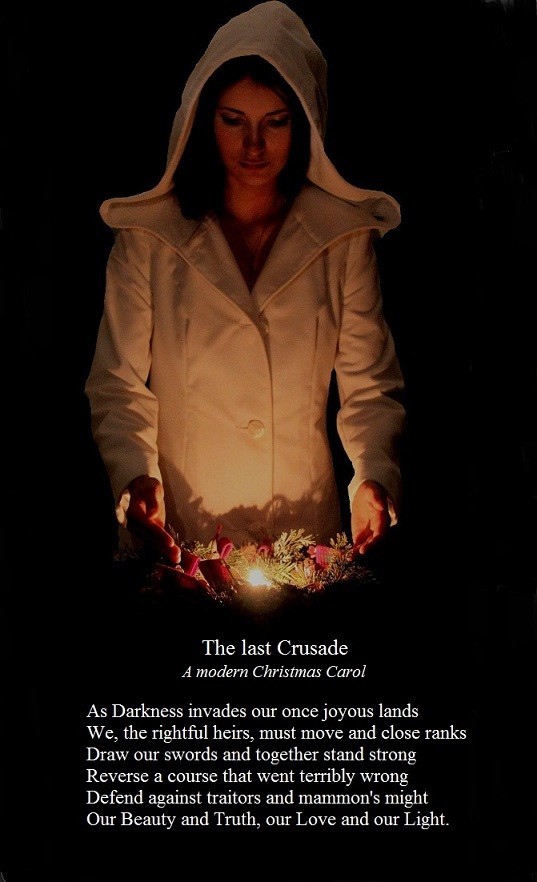
TOO Christmas Carol

Nine White American Voices

In a recent article entitled “The American Political System and White Racial Discourse,” I suggested that White advocacy dialogue and debate

[m]ake room for American voices—Thomas Jefferson and James Madison, and (I’m thinking out loud) Emerson and Thoreau and Mark Twain and Edgar Rice Burroughs (the Tarzan author) and Teddy Roosevelt and H.L. Mencken and . . . oh, I don’t know, just somebody besides Julius Evola, you know? American thinkers, Nathaniel Hawthorne, Walt Whitman, Teddy Roosevelt, Ernest Hemingway, somebody.

In the week since—it’s now December 22nd—I’ve asked myself, “Who are White ‘somebodies’ you think ought to be heard?”   Of course, the possibilities are virtually endless, but I’ve got to start somewhere and nine people come to mind at the moment: philosopher, essayist, and lecturer Ralph Waldo Emerson; novelist and short story writer Ernest Hemingway; Civil War combatant William T. Anderson; film director Sam Peckinpah; poet Emily Dickinson; artist and art educator Robert Henri; U.S. Congresswoman Jeannette Rankin; cartoonist Steve Ditko; and country singer Hank Williams.  In that order, I’ll deal with them here to the extent I can given the space limitations I’m working with.   You can Google and check Amazon and libraries to look into them further if you’d like.

As you read through this material, I invite you to be vigilant to what comes up for you: thoughts, feelings, images, memories, observations, insights, questions, issues, goals, things-that-need-to-be-done.  Get clear about all that, put words to it, and discern what significance, if any, it has for you.

Ralph Waldo Emerson

Ralph Waldo Emerson (1803–1882) was an American essayist and lecturer.  He was a prominent figure in an American form of philosophical idealism called Transcendentalism.  His address to a Harvard audience in 1837, published with the title The American Scholar, has been called America’s “intellectual Declaration of Independence.”  One of Emerson’s major writings is the essay Self-Reliance, which he included in a book published in 1842.   Excerpts from that essay:

  • To believe your own thought, to believe that what is true for you in your private heart is true for all men—that is genius. A man should learn to detect and watch that gleam of light that flashes across his mind from within, more than the luster of bards and sages.
  • There is a time in every man’s education when he arrives at the conviction that envy is ignorance, that imitation is suicide, that he must take himself for better, for worse, as his portion; that though the wide universe is full of good, no kernel of nourishing corn can come to him but through his toil bestowed on that plot of ground which is given to him. A man is relieved and gay when he has put his heart into his work and done his best, but what he has said and done otherwise shall give him no peace.
  • Trust thyself: every heart vibrates to that iron string. Accept the place the divine providence has found for you, the society of your contemporaries, the connection of events. Great men have always done so and confided themselves childlike to the genius of their age, betraying their perception that the absolutely trustworthy was seated in their heart, working through their hands, predominating in all their being.  We are now men and must accept in the highest mind the same transcendent destiny, not minors and invalids in a protected corner, not cowards fleeing before a revolution, but guides, redeemers, and benefactors, obeying the Almighty effort and advancing on Chaos and the Dark.
  • Whoso would be a man must be a nonconformist. He who would gather immortal palms must not be hindered by the name of goodness but must explore if it be goodness. Nothing is at last sacred but the integrity of your own mind.
  • Honor is venerable to us because it is no ephemera. It is always ancient virtue.
  • Live no longer to the expectation of these deceived and deceiving people with whom we converse. Say to them, I have lived with you after appearances hitherto.  Henceforward I am the truth’s.  I must be myself.  I cannot break myself any longer for you.   If you can love me for what I am, we shall be the happier.  I will not hide my tastes or aversions.  If you are noble, I will love you; if you are not, I will not hurt you and myself by hypocritical intentions.  If you are true but not in the same truth with me, cleave to your companions; I will seek my own.  I do this not selfishly but humbly and truly.  It is alike your interest, and mine, and all men’s, however long we have dwelt in lies, to live in truth.  Does this sound harsh today?  You will soon love what is dictated by your nature as well as mine, and if we follow the truth, it will bring us out safe at last.
  • Insist on yourself; never imitate. Your own gift you can present every moment with the cumulative force of a whole life’s cultivation, but of the adopted talent of another you have only an extemporaneous half possession. That which one can do best, none but his Maker can teach him.  Where is the master who could have taught Shakespeare?  Where is the master who could have instructed Franklin, or Washington, or Bacon, or Newton?
  • That which a man is does always by necessity acquire; and what a man acquires is living property, which does not wait upon the beck of rulers, or mobs, or revolutions, or fire, or storm, or bankruptcies, but perpetually renews itself wherever the man breathes. It is only as man puts off all foreign support and stands alone that I see him to be strong and to prevail.  Nothing can bring you peace but yourself.

Ernest Hemingway

In both public and private writings, Ernest Hemingway increasingly reasserted his distaste for politicians, re-emphasized his abiding lack of faith in governmental solutions to social problems, and reaffirmed his personal and artistic independence from political parties and ideologies.

No one would call Hemingway a sophisticated political thinker, but novelist John Dos Passos was wrong to conclude that he had “no consistent political ideas.”  From adolescence to old age, his ideas were remarkably consistent.  They stemmed from main currents of American political thought—principally from the libertarian tradition of Jefferson and Emerson, salted by the philosophical pessimism of Alexander Hamilton and Henry Adams.

Hemingway agreed with Adams that power was poison.  Like Jefferson, he welcomed integration into a small group or family or village and expounded the virtues of as little government as possible.

With the Transcendentalists, Hemingway thought that government could provide no panaceas for social ills.  What was needed was a whole man, uncompartmentalized, unspecialized, a modern Thinking Man—a god to drive the half-gods out of the political arena as the great bullfighter would drive the fake messiahs from the bull ring.

Ideally, the individual man, like the individual family, should be left alone to confront his destiny.  At the root of Hemingway’s support for individual liberty lay a longing for a golden, mythical past in which each man—for him as for Jefferson, the self-sufficient man—lived free, unencumbered, and in harmony with nature.  This ideal closely approximates the one Hemingway’s heroes in his fiction seek but do not find, as the complicated modern restraints impinge and can only be escaped at the moment of death, when the heart that beat to the sway of the Gulf Stream or against the pine-needled floor of the Spanish forest stops.

Bloody Bill and Bloody Sam

A pro-Confederate guerrilla fighter during the Civil War, William T. Anderson unleashed untamed brutality toward Union soldiers and pro-Union partisans that prompted the nickname Bloody Bill.   Film director and screenwriter Sam Peckinpah (1925–1984), whose explicit depiction of feral violence during the 1960s and ’70s evoked controversy, was called Bloody Sam.

“You Federals have just killed six of my soldiers, scalped them, and left them on the prairie,” Bloody Bill declared. Earlier, federal troops had murdered his father and sister and destroyed the family property.  “From this time forward, I ask no quarter and give none.  Every federal soldier on whom I put my finger shall die like a dog.”

On September 27th, 1864, Anderson presided over the slaughter of federal troops in Centralia Missouri.  Most all of the federal soldiers had been stripped naked and lay twisted and crooked in their death agonies, pinned down like bugs by bayonets, eyeless, earless and had dark oozing holes where their mouths had been.  Many lay with heads flattened into mush or smashed open like melons.  There were those with no heads, which had been cut off, stuck on rifle barrels, or placed atop fence posts and tree stumps like jack-o’-lanterns.  If a corpse had a head, it was likely someone else’s.  Here and there were bodies lacking hands and feet or arms and legs.  Worst of all was the naked body of a soldier whose genitals had been sawed off and stuffed into his mouth.  His contorted face testified that this had been done while he was alive.

Bloody Sam’s film Straw Dogs, distributed in 1971, tells the story of an American academic David Sumner on a research grant in Cornwall, England.   Sumner endures the ridicule, harassment, and cruelty of five men from the village who persist in the face of his posture of kindness and reasonableness and his attempts to placate and ingratiate them.  Things escalate to the point that two of the men rape Sumner’s wife and attack the house he is living in.  The half hour climax of the film depicts Sumner slaughtering them all, one by one, the last by ramming his head into a giant animal trap and springing its jaws on his neck.  Said Peckinpah, “David Sumner is a guy who finds out a few nasty secrets about the world and about his situation and about himself.”

Emily Dickinson

If I can stop one heart from breaking,
I shall not live in vain;
If I can ease one life the aching,
Or cool one pain,
Or help one fainting robin
Unto his nest again,
I shall not live in vain.

Robert Henri

Robert Henri (1865–1929)—pronounced Hen-rye, birth name Robert Cozad—was an American painter.  Shortly before his death, the Arts Council of New York chose him as one of the top three living American artists.  Henri was also a popular and influential teacher of art.  Henri’s ideas on art, life, and education were compiled from lecture notes by a student, Margery Ryerson, in a book entitled The Art Spirit, though Henri is listed as the author. Below are excerpts from the book.   Henri is not just talking about someone who creates paintings or sculptures; he is talking about a way to live in the world regardless of one’s vocation.

  • The question of development of the art spirit in all walks of life interests me. I mean by this the development of individual judgment and taste, the love of work for the sake of doing things well, the tendency toward simplicity and order.
  • When the art is alive in any person, whatever his kind of work may be, he becomes an inventive, searching, daring, self-expressive creature. He becomes interesting to other people. He disturbs, upsets, enlightens. He opens ways for a better understanding.  Where those who are not artists are trying to close the book, he opens it.  He shows that there are still more pages to be read and to be written.
  • Artists do not forget the present in looking backward or forward. They are occupied wholly with the fulfillment of their own existence. Because they are engaged in the full play of their own existence, in their own growth, their fruit is bountiful.
  • Artists should study their own individuality to the end of knowing their tastes. They should cultivate the pleasures so discovered and find the most direct means of expressing those pleasures to others and thereby enjoy them over and over again.
  • An artist can’t be honest unless he is wise. To be honest is to be just, and to be just is to realize the relative value of things. The faculties must play hard in order to seize the relative value of things.
  • The best art the world has ever had was left by men who thought less of making great art than of living completely with all their faculties in the enjoyment of full play.
  • Find out what is really important to you. Then sing your song. You will have something to sing about and your whole heart will be in the singing.
  • What is life to you? What reasons and principles have you found? What are your deductions?  What projections have you made?  What excitement, what pleasure, do you get out of it?  I should like to see every encouragement for those who are fighting to open new ways.  I should like to see every living worker helped to do what he believes in the best he can.
  • You have to make your statement of what is essential to you, an innate reality not a surface reality. Choose things seen and use them to make your statement.
  • Reduce everything you see to the utmost simplicity. Let nothing but the things that are of the utmost importance to you have any place.
  • Each individual needs to wake up and discover himself as a human being with needs of his own. He needs to look about, to learn from all sources, to look within, and to invent for himself a vehicle for self-expression.
  • An artist must educate himself. He cannot be educated. He must test things out as they apply to himself. His life is one long investigation of things and his own reactions to them.
  • All art that is worthwhile is a record of intense life. Each artist’s work is a record of his special effort, his search, his findings, in language that best expresses that. The significance of his work can only be understood by careful study: no crack-judgments; looking for the expected won’t do; and we can’t even trust the critics with the best reputations.
  • The real artists are too busy with just being and growing and acting like themselves to worry about the end. The end will be as it is. Their object is intense living, fulfillment.

Jeannette Rankin

Jeannette Rankin (1880–1973) was the first woman elected to the U.S. House of Representatives to represent an at-large district in Montana.   After she was elected, she said, “I may be the first woman member of Congress, but I won’t be the last.”  She was the only member of Congress who voted against declaring war on Japan after the attack on Pearl Harbor.  When asked by incredulous interviewers how she could have done such a thing, she declared that war was a barbaric relic of the past and absurd and immoral, and that there are better ways to resolve international disputes than violence, and that she was not going to send mothers’ sons to be blown to bits in some distant land.  She was mocked and ridiculed and shunned and in the next election voted out of office.

Steve Ditko

Steve Ditko, who died in 2018, is deemed by cartoon insiders to have been one of the supreme stylists in the history of the form.  In the 1960s, Ditko drew Spider-Man, and as time went along, made both character and plot contributions to the Spider-Man series.  In his half-century career, Ditko worked on a number of other characters and series, including The Hulk, Iron Man, and Dr. Strange.

The success of the Spider-Man movies brought new prominence to Ditko’s work among the general public.  Then over eighty, Ditko was barely getting by on social security and a veteran’s pension.  He could have improved his financial stress by selling his original artwork and accepting private commissions to re-create his old work, but he would have none of that.  To Steve Ditko, there was a right way to do things and a wrong way.  It’s one or the other, right or wrong, period.  Things aren’t relative: what is right and true is right and true here, there, in the past, and now, and for you and me and everybody else, no qualifications, no exceptions.  He was determined to do things the right way regardless of the negative consequences that may result.   He refused to do anything that compromised his principles, his honor.

One’s work should reflect the outer edge of one’s current beliefs, insights, and commitments, thought Ditko.  Recreations of his old work would have been going backward.  When the Spider-Man films came out, he pressed for credit as the character’s artist, but he didn’t push for financial gain and made it clear that he had long since abandoned the character and was now engaged with other projects.

Ditko turned down lucrative work starting up the Star Line of children’s books over the issue of whether being heroic is a decision rather than an inherent part of the make-up of a few special individuals that can be revealed but not chosen.  He believed that being a hero isn’t a matter of special grace, something you are born with à la Superman.  Being a hero is something that every one of us can choose to become by the way we conduct our lives.  Even though it will likely take rigorous preparation and diligent hard work and personal fortitude to become a hero, it is nevertheless possible for all of us, in our own way and in our own circumstance, to be heroic.  We can do more than fall at the feet of heroes, insisted Ditko.   We can become heroes ourselves.

Ditko was asked to work on a new series called Dark Dominion.   Depicting the supernatural was a violation of his beliefs and he quickly ended his association with the project.  He also turned down an assignment drawing the Transformer coloring book anthology because the central character for the series was a vampire.  To Ditko, this life is it.  What you see is all there is.  What you do with this life is all there is going to be.  What you accomplish in your private and public existence and its consequences is the only legacy you will ever leave.

A comic book organization scheduled a ceremony to give Ditko an award for a distinguished career in comics, but he refused to attend.  He was honored in absentia, and without his knowledge or approval, someone accepted the award on his behalf.  Thinking Ditko would be pleased, the person who accepted the award sent it to him.  Ditko phoned him and said, “Awards bleed the artist and make us compete against each other.  How dare you accept this on my behalf!”   Ditko sent the award back.

Ditko, very old, and unwell, to the end, sat every day at his drawing board drawing pictures the best he could, in the most honest way he could, and self-published them.  He could have been working for major publishing outlets that had the resources to promote and distribute his creations effectively, but they wouldn’t do it in a way he believed in.  With no mainstream publishing outlet, very few people would get to see his work, but he did it anyway.

Hank Williams

Hear that lonesome whippoorwill
He sounds too blue to fly
The midnight train is whining low
I’m so lonesome I could cry

I’ve never seen a night so long
When time goes crawling by
The moon just went behind the clouds
To hide its face and cry

Did you ever see a robin weep
When leaves begin to die?
Like me, he’s lost the will to live
I’m so lonesome I could cry

The silence of a falling star
Lights up a purple sky
And as I wonder where you are
I’m so lonesome I could cry

The Crusader Armies

The Crusader Armies: 1099-1187 by Steve Tibble: Used - Picture 1 of 1

The Crusader Armies 1099–1187
Steve Tibble
Yale University Press, 2018

The ethnic composition of the Crusader armies changed during the decades after the First Crusade took Jerusalem in 1099. By the 1140s, Turkic Muslim mercenaries served openly in the Latin Kingdom of Jerusalem’s military. The resident Crusader society likewise grew culturally and genetically distinct from its European roots. Crusader men married local Christian women, particularly Armenians for the knights, and otherwise adapted in language, diet, and dress. Successive generations born into such mixed-heritage families felt an ever diminishing connection to Europe. Their menfolk formed the core of the Crusader armies.

Dr. Steve Tibble of the University of London offers a probing study in The Crusader Armies 1099-1187. He cites modern archaeological evidence and sleuths through the historical chronicles to rectify their neglect of the Crusaders’ infantry and their Turcopole light cavalry. Although the heavy cavalry knights were the Crusaders’ most powerful force, their efficacy and very survival depended on the auxiliary services.

Today’s anti-colonial mindset holds that the Crusaders were foreign intruders. They were, but so were all militarily active parties in the region at the time. For centuries, alien rulers had kept the locally established peoples, Armenians excepted, disarmed and subjugated. It was the policy of Byzantines, Arab conquerors, Egyptians, and the Turkic invaders who arrived shortly before the latest interlopers, the Crusaders.

Everything about the Turks made them the drivers of military and social change in the Crusader era. They were nomadic herders from the steppes of central Asia. Expert mounted archers on small, nimble ponies, they were confident warriors who would swarm their enemies while quickly discharging showers of arrows. Droughts on the steppes spurred them to greener pastures. They met and defeated the Byzantines at Manzikert in 1071. Their subsequent migrations proceeded rapidly. They substituted themselves for nearly all the Arab rulers of statelets in Syria and Palestine. They seized Jerusalem from the Egyptians (who returned to Egypt only to be evicted by the Crusaders). And they encountered the First Crusade soon after it had crossed the Bosporus.

Responding to Turkic weapons and tactics transformed the Crusaders’ Western style of warfare. While armor protected the knights from Turkic arrows, weight considerations precluded the armoring of their horses, which Turkic archers sought to wound or kill before or during battle. The Crusaders responded by reinvigorating an institution much slighted in Western medieval warfare, the infantry.

The idea was to have the knights shielded by an infantry cordon of crossbowmen and pikemen. On a “fighting march” or deployed for battle, the crossbowmen’s arrows would fend off enemy archers whose own arrows had less range and penetrating power. The infantry would open to allow the knights their signature charge. Properly executed with intact warhorses, it could overwhelm any adversary. The system began haltingly during the First Crusade and became standard practice in the Latin Kingdom, the principality of Antioch, and the counties of Edessa and Tripoli.
Infantry requires infantrymen. It was in their recruitment that military change became entwined with social change.

Crusader infantrymen had to be part-timers, in complicated contrast to their knightly comrades. The knights, even with their armed dependents, did not form a permanent army so much as a warrior caste whose status they maintained without intermission. They were born for combat, much as birds are born for flight, and saw it as their calling. Infantrymen were less attuned to war. They were recruited from the resident Christian population, both native and immigrant, urban and rural. Most adult men served in some capacity, if only for garrison duty.

Centuries of Muslim rule had left large, varied Christian populations in place. In the Latin Kingdom, roughly the area comprising modern Israel and Dr. Tibble’s focus, they were perhaps fifty percent of residents. They were more prevalent in Antioch and Edessa where Christian Armenians had, with perseverance, retained a martial culture congruent with the Crusaders’ own. Greek and Syrian Christians of various sects predominated in the Latin Kingdom where they commonly spoke Arabic.

The Crusader rulers bolstered their manpower pool by encouraging farming colonists from the West to settle vacant lands. This magnitude and success of this undertaking have only recently come to light. There are 235 known such colonization sites in the Latin Kingdom alone, with less intense colonization elsewhere.

Newcomers and native Christians generally got along well. They often intermarried, to the dismay of Church officials in Rome who regarded Eastern Christians as schismatics or heretics, but with the complicity of local Catholic churchmen who paid little heed to doctrinal niceties. Strong evidence of Western convergence with the East comes from the military where Armenian and Arabic displaced the Crusaders’ medieval French as the usual languages for training and tactical field commands. Some intrepid men of Eastern-Christian heritage achieved knighthood.

Some indigenous and mixed-heritage Christians became Turcopoles, the Crusaders’ light cavalrymen. Named pursuant to a Byzantine precedent, they specialized in reconnaissance and patrolling. They sometimes had knights and infantry accompany them as they sought to detect and engage hostile infiltrators. Most fighting in the Crusader East occurred in such small-unit actions, not the few great battles. Skirmishers par excellence, and the Turcopoles were in the thick of it.

Completing the Crusaders’ manpower resources were Italian seafarers and the warrior-monks of the military religious orders. Italian sailors and merchants provided crucial assistance to capture the Egyptian-held Palestinian ports. Carpenters and engineers from Italian ships built the Crusaders’ siege engines. The military religious orders, principally the Order of the Hospital of St. John (Hospitallers) and the Knights of the Temple (Templars), augmented the Crusader armies in several ways. As the twelfth century progressed, they promoted tactical “best practices” and placed large contingents of their members in the field armies. They funneled wealth and fresh manpower from Europe to the East. By the 1170s, the orders were responsible for most of the great Crusader castles, Kerak notably excepted.

      Military resources available to the Crusaders lagged their enemies’ growing strength. Political changes exacerbated the disparity. Whereas early Crusaders faced feuding Turkic mini-states and an independent Egypt, their successors confronted a united Turkic/Egyptian  superpower whose consolidation its Kurdish ruler, Saladin, had largely completed by 1186. Egyptian revenues enabled Saladin to fund several armies, each larger than any the Crusaders could muster. Finally in 1187, Saladin crushed the Crusaders at Hattin. A truncated Latin Kingdom, bereft of Jerusalem, survived on a narrow strip of the Palestinian coast. With Edessa having fallen generations before, Antioch and Tripoli also continued as diminished survivors. The Crusaders triumphal years were behind them.

The Crusader Armies offers fine style, rigor without academic jargon, and thorough, unobtrusive documentation. Anecdotes illuminating historical nuances grace Dr. Tibble’s presentation. For example, an account of insubordination attests to how seriously Crusaders, unlike contemporaneous Europeans, stressed military discipline. The culpable fighter won grudging acquittal only because his infraction had harmed the enemy. His excuse, that as a Turk he did not understand the spoken command he had disobeyed, seems not to have mattered.

Some readers will object to Dr. Tibble’s dismissal of religion’s role. He claims that the Crusades can be explained as a clash between nomadic and settled societies without reference to religion. To his credit, he often ignores this dictum. Taken to extremes, it accounts for the Turkic invaders well enough but not their Crusading adversaries.

Dr. Tibble’s treatment of Jews, i.e., his failure even to mention them, is mystifying. He discusses in detail the Crusaders’ relations with everyone else. Why not the Jews? He leaves readers clueless.

His foray into White Crusaders’ attitude toward blacks is welcome but not entirely satisfactory. The Egyptian infantry mostly comprised Black Nubians whom the Crusaders often fought and disdained as men and fighters. Even so, Dr. Tibble writes too loosely of medieval Whites’ “casual racism.” The medieval Song of Roland treats Blacks respectfully. Then again, the author(s) of Roland probably had no experience with Blacks.

The biggest disappointment in The Crusader Armies is the absence of reasoned speculation on the self-identification of the mixed-heritage Crusader families. Many knightly families, for example, including the Latin Kingdom’s royal family, were as much Armenian as European. How did they regard themselves? Perhaps this question presupposes a too modern mentality. Medieval men and women, not indoctrinated with self-identity qualms, could experience personal wholeness within their extended families and their people, where the latter understood is as one’s family’s social milieu, not the modern abstract monstrosity called “the nation.”

Whatever self-identification there had been meant little after Hattin when Saladin launched a sweeping ethnic cleansing of the Crusaders’ hinterlands. All apparently Western Christians, but not Christians identifiable as native, were purged by slaughter, enslavement, or forced exile. It was a draconian program. It also made possible some of the Crusaders’ finest moments.

The scope and speed of ethnic cleansing left Crusader castles isolated in enemy territory without hope of relief. Their defenders, as “men trying to make a point,” Dr. Tibble writes, nonetheless fought heroically. The Hospitallers held Belvoir for eighteen months. At Kerak and Montreal, castles of the secular lord Reynald of Chatillon, whom Saladin personally murdered after Hattin, defenders likewise held out, for nearly two years at Montreal.

It was of these defiant Crusaders that Sir Steven Runciman movingly spoke: “Their lives were precarious and they knew it. … [T]hey faced their doom with pride and resolution.” (Creighton Lecture, Athlone Press, London, 1960, not quoted by Tibble).

The pride of the doomed Crusaders haunts me. It was also the pride of the ancient aristocratic warriors whom Ricardo Duchesne posited as the wellspring of Western civilization and its abiding unique qualities. Modern Christian and Jewish moralists, or, arguably more accurately, the Christian ones goaded by their watchful Jewish mentors, tell us that this pride is a sin or, at best, an abnegation of one’s unceasing obligation to self-criticize and remake oneself and one’s society. Very well, I shall sin and abnegate. I shall not revere Abraham Foxman, Martin Luther King, Pope Francis, Nelson Mandela, Nancy Pelosi, and their ilk as my heroes. For solace, I shall take refuge, if only in my imagination, with the great Christian warlords of the Latin East.

Jews Who Deny Jewish Guilt for Soviet Crimes Will Go To Hell

A couple of weeks ago, Jewish conservative Dennis Prager went “death con 3” against Nick Fuentes. Although he didn’t produce a quote or a source, Prager accused Fuentes of claiming that a mere “few hundred thousand” Jews were killed in the Jewish Holocaust rather than the canonical figure of six million. The shamelessly manipulative title of his article says it all: “If Holocaust Deniers Don’t Go to Hell, There  is no God.” It’s as if Dennis Prager has a direct line to the Big Man Upstairs, and is informing the unfortunate Mr. Fuentes of the toasty place waiting for him once he buys his Nazi farm in the sky.

The article was certainly a lazy piece of White shaming. Prager could not spare an insult for Black “death con” coiner Kanye West who last month trumpeted his denialism more noticeably than did Fuentes. Prager basically called Jewish Holocaust denial a sin and a lie. He said it was anti-Semitic. He dredged up quotes from Generals Dwight Eisenhower and George Patton, who witnessed actual Jewish suffering and death at the end of the Second World War. Then after a For Dummies summary of anti-Jewish atrocities and a tragic personal anecdote which may or may not have happened, Prager damns Fuentes’ soul to eternal hellfire.

I wonder if Prager’s editor or his readership realize how pernicious this article is. If someone is going to Hell anyway, how much of a sin would it be to strip him of his rights, or incarcerate him without trial, or even kill him? That would be nothing compared to what God has in store for him. It fact, it would be doing God’s work here on Earth. Was Dennis Prager inciting violence against Nick Fuentes? Was he giving the old wink-wink, nudge-nudge to people who might oppress him? Or was he using the Jewish Holocaust like a carrot and stick to coerce Christians into not annoying the American Jewish elite?

See, goyim? Repeat the words “six million” a bunch of times and ya got it made. And if you don’t, well, not only will we make your life be a living Hell, but after you die, you’ll face the real thing.

Either way, it was gob-smackingly arrogant on Prager’s part to assume the role of supernatural traffic cop, determining who gets to go where until the end of time. Does this mean that a person who thinks a mere half million died will be banished to a deeper circle of Hell than someone who sticks to the still-scandalously low tally of 4.5 million? Note also how Prager is directing traffic away from free inquiry. He’s not encouraging people to examine the data and come to their own conclusions. Instead, he and God are pronouncing the mainstream Jewish Holocaust narrative as gospel. Question it even in good faith, and lose your soul.

Well, since one bad turn deserves another, I think I will relieve Monsignor Prager at the intersection of Heaven and Hell and start directing post-reaper traffic in a wholly new direction: If you’re Jewish and you deny Jewish complicity in the formation and atrocities of the Soviet Union, which wasted over 80 million lives over 70 years, then you are evil, you are going to Hell, and you really shouldn’t be too surprised when people start resenting you for it. It’s that pesky little anti-Semitism thing—which never seems go away, does it?

Here is a brief bullet list of things Jews everywhere should feel guilty for (and unlike the sanctimonious obscurant Prager I will provide sources in case anyone wishes to investigate further):

  • Aleksandr Solzhenitsyn describes many 19th century Russian Jews as energetic organizers of revolution. These Jews were, radical, violent, and unstable people who did not shy away from becoming “detonator[s] for the revolution” in both a literal and figurative sense. Contemporaneous sources claim that anywhere from one quarter to one half of all left-wing radicals in pre-revolutionary Russia were Jews. (Two Hundred Years Together, Aleksandr Solzhenitsyn. Chapter 6, unofficial translation published at www.twohundredyearstogether.wordpress.com)
  • Jews were vastly overrepresented among the Bolsheviks taking part in the October Revolution. Vladimir Lenin himself attested that the presence of so many intelligent and well-connected urban Jews “saved the Revolution at a difficult time.” (The Jewish Century, Yuri Slezkine. Princeton University Press, 2004. p 155 & 224.)
  • Solzhenitsyn describes how the first Soviet secret police, known as the Cheka, was not only disproportionately Jewish but thoroughly dedicated to terror. It routinely meted out the death penalty without trial, and murdered innocents by the thousands. In striving towards its goal of the “physical extermination of all servants of Czarism and capitalism” the Cheka annihilated entire villages. In the Crimea from 1917 to 1921, which became known as the “All-Russian Cemetery,” the Red Army, led by the Jew Leon Trotsky and his Jewish subordinates Ephraim Sklyanksy and Jacov Sverdlov, murdered between 120,000 and 150,000 people. (Two Hundred Years Together, Aleksandr Solzhenitsyn. Chapter 16. Columbus Falco, translator)
  • Solzhenitsyn demonstrates how overpopulated with Jews the early Soviet administrative leadership was. This includes the politburo itself and various executive committees, central committees, and revolutionary congresses. (Two Hundred Years Together, Aleksandr Solzhenitsyn. Chapter 18. Columbus Falco, translator)
  • In 1932 and 1933, Lazar Kaganovich, Stalin’s Jewish yes man, was instrumental in the deportation and incarceration of over 268,000 Cossacks and other villagers in the Northern Caucasus. (The Black Book of Communism, Courtois et al. Harvard University Press, 1999. pp 162-163)
  • In 1932, the Jew Naftali Frenkel oversaw the construction of the White Sea-Baltic Canal, and worked to death around 200,000 gulag slaves. Jews made up the majority of the camp’s chief overseers. (Stalin’s War Against the Jews, Louis Rapoport. The Free Press, 1990. p 44)
  • Jews were overrepresented in the murderous Soviet security apparatus during the Great Terror of the 1930s . 42 of the NVKD’s 111 top officials were Jews, and 12 of the NKVD’s 20 directorates during this time, including the gulag system, were headed by Jews. Over two million people lost their lives during the Great Terror. (The Jewish Century, Yuri Slezkine. Princeton University Press, 2004. p 103 & 254.)
  • “An Israeli student finishes high school without ever hearing the name ‘Genrikh Yagoda,’ the greatest Jewish murderer of the 20th century, the GPU’s deputy commander and the founder and commander of the NKVD. Yagoda diligently implemented Stalin’s collectivization orders and is responsible for the deaths of at least 10 million people. His Jewish deputies established and managed the gulag system.” (“Stalin’s Jews,”, Sever Plocker. YNet News, 2006)
  • From 1925 to 1933, the Jew Filipp Goloshchyokin ran the forced collectivization in Kazakhstan, causing a famine known as the “Goloshchyokin genocide,” which killed between one and two million people. (“The Kazakh Famine of 1930-33 and the Politics of History in the Post-Soviet Space”, Elena Volkava. The Kennan Institute, Undated)

This list is hardly comprehensive, but I’m sure it’s enough to demonstrate that unless Dennis Prager also insists we not deny Jewish complicity in the above, he has no room to lecture anyone on how to get into Heaven or Hell.

The double standard here is that Jews get a free pass on collective guilt while White Christians do not. And yes, gentiles have their fair share of guilt from the early Soviet period. But not only were Jews overrepresented among the worst Soviets, but without them, according to Lenin, the most murderous regime in modern history up to that point would never have existed at all. How could any Jew not feel at least a little bit guilty over that?

One can argue that I take the same For Dummies approach Prager does, and then chide me for not digging deeper for nuance. Perhaps this or that particular Jew was not as guilty as he seems (as is probably the case), or perhaps circumstances were a bit more nebulous than I portray (as reality often is). I happily concede this. On the other hand, when gentiles try to ascertain similar nuance with the Jewish Holocaust—and perhaps wish to revise down that six million figure a smidge, or question some of the dubious scholarship surrounding Auschwitz, or note that Amon Göth might have been maligned just a tad in Schindler’s List—they meet with belligerent resistance from Jews like Prager. And Prager is one of the more moderate ones. So if gentiles are prohibited from investigating the Jewish Holocaust for humanizing nuance, why should any gentile give a whit if Jews try to do the same with the Holodomor and the Gulag Archipelago?

Finally, one can argue that the large number of Jews killed by the Soviets (1.5 million during the Stalin era, according to Louis Rapoport) balances out the Jewish perpetrators of the above crimes. The Jewish people, therefore, should be exonerated. If so, then the much larger number of White gentiles killed by the Nazis during the Second World War must also balance out whatever atrocities the Third Reich committed. Such an argument exonerates White people from their sins just as the Jews exonerate themselves from theirs. This should also force Dennis Prager to stop using the Jewish Holocaust as a weapon to control his political opponents.

He should probably stop doing that regardless, lest one day he realize that the person most likely going to Hell is him.