Featured Articles

Joseph Maistre and the Inevitability of Evil

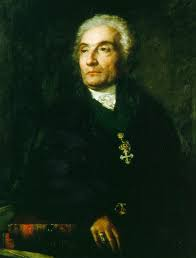
Joseph de Maistre (1753–1821)

Note: Below is my article I originally wrote in French for the French-Breton website of the European Identitarians, Breizh-Info

To each of us his own author, to each of us his own interpretation of the author’s work. For several reasons I chose for our discussion today a Savoyard writer and philosopher Joseph de Maistre. Maistre was a contemporary of Napoleon, although he barely ever mentions Napoleon in his work. He was also a disciple of the Enlightenment, although he was its fiercest opponent. All of us must therefore ask ourselves a question; well, what does Maistre have to do with us and how relevant is he to Europeans living now in the liberal System? I will briefly examine Maistre’s beliefs and also discuss whether he can be useful in understanding the dominant ideas of our time. Can Europeans still use portions of his teachings in the face of coming catastrophes? As to my choice of this author, there is also a personal side to it.  Understanding and interpreting any literary work often depends on the mood and character of the interpreter. Being by nature inclined towards cultural pessimism and being skeptical of the idea of progress, it should come as no surprise that I chose Maistre and his criticism of liberal happy tomorrows.  Moreover, let us also recall that this year marks the bicentenary of his death.

First of all, we must recall that Maistre’s political ideas are closely linked to his ultra-Catholic and Ultramontane beliefs, as well as his unshakeable belief in the iron fist of divine Providence. Being cursed by Original Sin, the human species, from birth onwards, is doomed to eternal Evil, as well as to being a victim of ceaseless suffering. Man cannot escape from Evil even if he is good, even if he considers himself a virtuous man, and even if he boasts of never having done any harm to his fellow man. On the contrary, the more virtuous a man is, the more likely he will be exposed to Evil, which Maistre refers to as “hereditary fault.”:  “On the other hand, it is equally possible that a man tortured for a crime he did not commit really merited punishment for an absolutely unknown crime.” [i]

Consequently, following our gratuitous birth we have irrevocably “fallen into time” —the expression coined by Emile Cioran, a prominent French-Romanian doomsday philosopher whose own work was profoundly inspired by Maistre. As a result of this Fall, all of us, without any exception, are toys of reversibility—that is to say, we are meant to atone not only for the faults and defaults of our distant ancestors, faults which they may have committed without their prior knowledge of it; but we are equally obliged to atone for crimes of those who are harming us now, and even those who had harmed either us or others, thousands and thousands of years before we were born, and whose names we will never know.

Maistre reminds us that “evil has sullied everything, and all of man is nothing but sickness.”[ii] Therefore, any pursuit of earthly happiness falls short—a pathetic endeavor doomed to failure; for he who refuses to suffer is not worthy of being called a human being.

Examples of perpetual Evil abound. Indeed, it suffices to have a quick glance at Europe’s political past. European history has been a long trajectory of conflicts, civil wars, violence and cataclysms. Therefore, a world improvement, or craving for a world ruled by reason, so much praised by the eighteenth-century encyclopedists, can never be attained.

Unhappily, history proves that war is, in a certain sense, the habitual state of mankind, which is to say that human blood must flow without interruption somewhere or other on the globe, and that for every nation, peace is only a respite. [iii]

The cult of Reason, installed by the French revolutionaries as a new secular religion, including their new Goddess of Reason, turned out to be a great historical swindle.  Subsequently, this cult resulted in the escalation of violence between individuals and between nations, as seen during the Bolshevik revolution in Russia a century after the death of Joseph de Maistre. Contrary to Jean-Jacques Rousseau and his ramblings about “the noble savage” and his beliefs in the alleged freedom of man at birth, authority always precedes reason and not the other way around. Man becomes aware of his reason, that is, his capacity to think and to reason, only within his family, his tribe, his clan, and his people, guided by wise men and their sense of tradition. The abstract reason of scientists and savants, as revered by the French revolutionaries of the eighteenth century and their liberal-communist offspring of the twentieth century, and later on their multiculturalist and globalist successors of the twenty-first century, is a giant hoax which, under the veneer of “human rights,” “multiculturalism,” and “tolerance” only augur new massacres. As a good connoisseur of classical languages ​​and modern European languages ​​of his time, during his lengthy dialogues in the course of his long walks along St. Petersburg waterfronts, Joseph Maistre was able to foresee the looming danger of the Jacobin doubletalk which was later launched by Bolsheviks and which is common today amidst the new world superclass based in Brussels and Washington DC.

But there is no such thing as ‘man’ in this world. In my lifetime I have seen Frenchmen, Italians, Russians, etc.; thanks to Montesquieu, I even know that one can be Persian. But as for man, I declare I’ve never in my lifetime met him; if he exists, he is unknown to me. [iv]

In hindsight, this passage may help us better understand the dissolution of the Soviet empire and the emergence of Ukraine and other nations whose national aspirations few knew about earlier. The same was true for the Croats and Slovenes during the dissolution of multicultural Yugoslavia in 1991.  All seems well when the preaching is about man-in-the-abstract; however, once the crisis starts, each of us, even the least nationalist-minded person, knows very well which family, i.e., ingroup he must relate to and in which language he will demonize his now-enemy neighbor. Worse, the ideas of progress and their great optimistic effusions about the best of all possible worlds, as envisaged by the philosophers of the Age of Enlightenment, such as Rousseau, inevitably lead to a new round of revolutions with their processions of massacres and sufferings. The bloody French Revolution, of which Maistre was a prime witness, was only the beginning of the Evil willed by divine Providence. If  Maistre had lived in the twentieth century, his words about the Bolshevik revolution in imperial Russia of 1917 would have sounded even more convincing.

Hence, if each revolution produces Evil, why does God allow it in the first place? Is this a divine attempt to test mankind, or is it a scam originating in a monotheistic religion of the Middle East? Maistre champions monarchical authority and the Inquisition as the sole remedy; in other words, he praises the regimes which until recently have been branded as “muscular regimes.” However, one only needs to think about the wars of religion in sixteenth-century France or the Thirty Years’ War in seventeenth-century central Europe to realize that their violence was not less than that of the Jacobin Revolution condemned by Maistre. Nor does his choice of placing government in the hands of all-knowing papists and Jesuit teachers inspire confidence.

It belongs to prelates, to noblemen, to great officers of the state to be the depositories and guardians of saving truths, to teach peoples what is good and what is bad, what is true and what is false in the moral and spiritual orders. The others have no right to reason about these sorts of things. They have the natural sciences to amuse them.[v]

Should we therefore leave it to Jesuits, to papists, and to the Catholic clergy to reestablish order in Europe and preserve the simulacrum of our small happiness? Out of the question—at least for the minority of free thinkers still remaining. In view of the pro-migration homilies of the actual pope and his high clergy in Europe and in the United States and their multicultural statements in favor of Afro-Asian migrants, there is no longer any need for communist commissars. Maistre himself would be shocked by his own ecumenical logic which has now yielded a worst-case scenario emerging daily when observing papal pronouncements. Two hundred years later, Maistre’s great disciple and admirer, Emile Cioran, also a champion of the Fall into Time, albeit pagan given his vision of the sacred, rightly warned us that we must henceforth expect nothing: neither from men nor from gods. [vi]


Notes:

[i] Joseph de Maistre, St. Petersburg Dialogues (First Dialogue), trans. and edited R.A. Lebrun (Montreal: McGill-Queens University Press, 1993), p.21.

[ii] Ibid., p. 36.

[iii] J. de Maistre, Considerations on France, trans. and edited R. A. Lebrun (Montreal: McGill University Press  1994), p. 23.

[iv] Ibid, Considerations, p.53.

[v] St. Petersburg Dialogues, p. 260.

[vi] E.M. Cioran, The Fall into Time (Chicago: Quadrangle books, 1970). Also T. Sunic, „Emile Cioran and the Culture of Death“ .


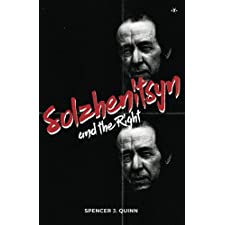
Spencer J. Quinn’s “Solzhenitsyn and the Right”

Solzhenitsyn and the Right
Spencer J. Quinn
Antelope Hill Publishing, 2021

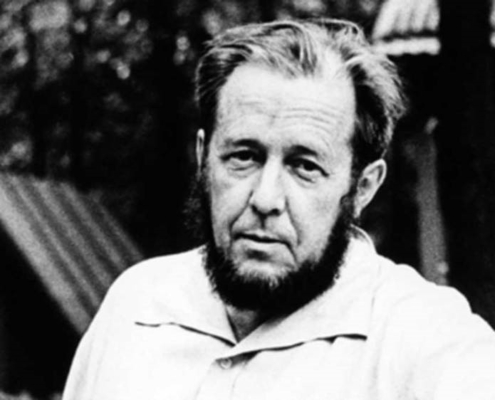
Spencer J. Quinn’s Solzhenitsyn and the Right summarizes a large portion of Aleksandr Solzhenitsyn’s voluminous body of work, but its focus isn’t entirely on Solzhenitsyn. It is replete with parallels between pre- and post-revolutionary Russia/Soviet Union and the present situation in the West.

Fundamentally, Solzhenitsyn was a Russian patriot, and certainly not in a civic nationalist sense:

In his memoirs, he refers to Russians as his people and Russia as his country, and never does the fate of either escape his concern. He identified with the Russian people and so he bled when they bled, cried when they cried, and cheered when they cheered. He also longed for the Russian soil when he was away from it. Religion, tradition, and patriotism bound him to his people, and his people to each other, as in any enduring civilization. … For Solzhenitsyn, nationalism was more about blood than what it says in one’s passport. (3, 5)

Not surprisingly given such attitudes, he was highly critical of the West where he was exiled for almost 15 years, repeatedly “predicting the West’s downfall” because of its individualism, Enlightenment values, and lack of religious fervor. (4) And, as Quinn notes, he is proving to be right as a result of the immigration tsunami that has transformed Western societies into battlegrounds of conflicting and incompatible peoples and cultures, and where the native European-derived peoples are routinely vilified by elites in the media, the university, major corporations, and the political class in the societies they created. Of these, Solzhenitsyn identified the media as the most influential: it “distorts and embellishes its reportage to be as sensationalist as possible in order to ‘miseducate’ public opinion and garner profits and influence.” (17) In particular, the media appeals to and encourages weakness, whether in the food we eat (often resulting in obesity and its attendant diseases like diabetes), how we spend our leisure, how important we regard material wealth, or the value one places on conforming to the media’s moral imperative to admit and care for an unending stream of migrants who will eventually displace the peoples of the West. As always the demise of Western societies is presented as a moral issue, with payment to the descendants of colonial peoples and slaves quite possibly requiring the forfeit “of everything it owns.” (21)

Quinn notes the parallel between Soviet communism and the contemporary West:

While for Solzhenitsyn this Evil took the form of Communist and totalitarian governments which for the most part existed outside the West, today it appears as the equally totalitarian anti-white Left which lurks among us and has laid claim to our universities, our media, our corporations, and nearly all of our other institutions. It is this Left which has imported its shock troops from the Third World, and it is this Left which the West’s ‘conservative’ leadership has continually bowed down to and appeased. (22)

The composition of Western elites matters, and in particular the media elites. Fundamentally, they hate us. And, although Jews, with their long list of (imagined and real) historical grudges, are highly overrepresented in all areas of Western elites, they are by far most overrepresented as owners and creators in the media.

Solzhenitsyn spent eight years in a Gulag and survived assassination attempts by the KGB. Quinn notes that even this sort of Soviet oppression is more extreme than what we see in the West now, there are certainly the beginning signs of similar repression—travel restrictions, bank account and credit card suspensions for dissidents, banning and shadow banning on social media, double standards of justice in which the legal system throws the book at rightists and typically refuses to even investigate or indict leftists—as exemplified by the consequences of the Charlottesville Unite the Right rally and the recent January 6 protest. There is no reason at all to suppose that the West couldn’t end up being at least as oppressive as the USSR. Powerful interests are seeking just that. “If the Far Left ever succeeds in gaining control over a major government (as it did in Russia in 1917), then the Dissident Right can expect oppression similar to what Solzhenitsyn and other figures faced in the Soviet Union.” (11)

Jewish Issues

Pyotr Stolypin, Prime Minister of Russia from 1906–1911, was assassinated in 1911 by a Jewish radical, Mordecai Bogrov, at a time when such radicalism was common among Jews. Jews hated Stolypin because, as Solzhenitsyn described it, “he boosted Russian interests too blatantly and too insistently—the Russianness of the Duma as a representative body, the Russianness of the state.” (26; italics in text) Solzhenitsyn believed Stolypin’s assassination was catastrophic because it unleashed “the first eddies in a swirl of nihilism, war, and death which would soon consume Europe.” (27) Quinn notes that Solzhenitsyn “dared to depict Bogrov in a way resembling Jewish stereotypes” (30)—a lying, two-faced manipulator, physically weak and neurotic but highly intelligent. “There was nothing the Russians could do, other than cede power to the Jews, that would satisfy him” (31). And indeed, he was motivated by his Jewish identity and sense of Jewish interests: “I was fighting for the benefit of the Jewish people.”  (34)

Parallels to the Present

After describing Lenin’s psychopathic personality (e.g., his duplicity and his “enmity toward everything traditional, natural and morally wholesome,” (43) Quinn notes that “the left has not changed much since Lenin’s day, merely exchanging class for race in the twenty-first century. The same bunch that called for the civil rights of non-Whites is now calling for the open oppression of whites. Just as with Lenin, what the Left says it wants and what it truly wants are two different things. … A stroll through Twitter or anti-white Hollywood in the 2020s will show quite clearly that the left’s violent fantasies against their perceived enemies haven’t gone away and aren’t going anywhere.” (44)

The February Revolution which led to the Provisional Government resulted from well-organized, well-funded activists, just as we see today in the wake of George Floyd’s death; “they are also engaging in the kind of violence, ruthless intimidation, and hateful rhetoric that Solzhenitsyn documents in March 1917.” As today, rightists in 1917 trusted the leftists, who were clearly attempting to end the monarchy, to be “acting in good faith when they clearly weren’t.” And as today, the left is full of promises for a utopian future free of strife and oppression if only power is ceded to them. Solzhenitsyn: “Tranquility would only come to Russia when the present government system had been ripped out at the root.” (54; italics in text) Solzhenitsyn comments on the police being intimidated and rendered powerless, and Quinn draws the contemporary parallel: “During America’s riots in the summer of 2020, how many times did the police stand down or kneel to the rioters? How many times did we see the police actively take the side of the rioters, or refuse to protect innocent people from them?” (57) As now, the media was on the side of the rioters, not only presenting fake news, e.g., on police violence against rioters, but also, as Solzhenitsyn notes, intimidating those with power from enforcing the law: “Columns in the liberal newspapers alone made the governors pale and attempt to justify their measures. … They could not kill their own people” (57)—quite unlike the Bolsheviks who had no compunctions about mass murder against their perceived enemies.

As Quinn notes, the main message of March 1917 is that the Bolshevik Revolution did not have to happen, and neither does the current revolution playing out throughout the West. “The Left does not have to win. But for today’s Right to check the Left and achieve victory, it will need leaders who possess the nerves and confidence that the Russian leaders depicted by Solzhenitsyn entirely lacked”—something sorely lacking at this point. (63; emphasis in text) As Solzhenitsyn noted in his play Prisoners,

We clutch at life with convulsive intensity—that’s how we get caught. We want to go on living at any, any price. We accept all the degrading conditions, and this way we save—not ourselves—we save the prosecutor. But he who doesn’t value his life is unconquerable, untouchable. There are such people. (70; italics in text)

At this point, the Right in the West needs such people to win.

We can only imagine how many intelligent, well-meaning Russians were swayed by the liberal-left media, wanting to be seen as a good person, and conforming to whatever mandates the left proposed. They supported the left and looked forward to the utopian, classless future promised by the Bolsheviks. What is clear now is that there are millions of White voters throughout the contemporary West, many of them calling themselves conservatives, who have been eager to embrace today’s promised utopian future of racial harmony and equal outcomes for all races.

Two Hundred Years Together

The longest section of Solzhenitsyn and the Right discusses Solzhenitsyn’s Two Hundred Years Together, placing “much of the blame for the October Revolution, the atrocities of the early Soviet period, and subversive Left-wing behavior in general squarely on the shoulders of the Jews. [Solzhenitsyn] also … exonerates much of Tsarist Russia from the charge of anti-Semitism, which Jewish authors never seem to tire of leveling. … Dissidents on the Right should take advantage of Solzhenitsyn’s fame and cite him as often as possible in the battlefield of ideas—especially when it comes to the Jewish question.” (83, 84)

Jews were heavily overrepresented in Lenin’s inner circle and indeed, in Lenin in Zurich “Solzhenitsyn offers tantalizing evidence that the October Revolution would not have occurred (or would not have been successful) without actions carried out by Jews at its most critical moments.” (47)

Nevertheless, Solzhenitsyn often bent over backwards not to be negative about Jews. Quinn notes that “Solzhenitsyn was no anti-Semite. There are many passages in this work that demonstrate a desire to show justice, even tenderness, toward Jews. It cannot be denied that he had great respect for them” (84)—a trait, as Quinn notes, that is entirely lacking in vast majority of Jewish writers commenting on the behavior of White gentiles toward Jews. And commenting on Jewish characters in his play Republic of Labor, Solzhenitsyn noted in Two Hundred Years Together that he had fictionalized them somewhat because the truth “would be inevitably considered anti-Jewish incitement (as if that trio of Jews was not inflaming it in real life, caring little about consequences).” (78)

Departing from Solzhenitsyn, Quinn eschews any perspective that flinches from dealing honestly with Jews. White nations are in the process of being subjugated and the great majority of Jews, including many wealthy, politically involved Jews and Jews with prominent positions in the media, support this revolution. Of course, this does not mean that White advocates should be dishonest, only that they should not flinch from the truth. So despite what Solzhenitsyn would have advocated, “the value and importance of Two Hundred Years Together cannot be overstated.” (86) What follows then are three chapters listing the “misdeeds” (87) of the Jews.

Solzhenitsyn notes that Jews began to be represented among revolutionaries in the 1870s after originally being underrepresented. The reason for this was that leftist revolutionaries often viewed Jews as exploiters—a perspective that disappeared from revolutionary rhetoric after Jews became prominent among them. This is an important point that is missing from typical accounts by Jewish historians. From Separation and Its Discontents (Ch. 2, pp. 41–42):

Emancipation often accentuated the importance of resource competition as a source of anti-Semitism. Lindemann (1991, 17) notes that Jews in pre-emancipation Russia “were viewed by the authorities and by much of the rest of population as a foreign, separate, exploitative, and distressingly prolific nation.” The official Russian view was that emancipation had resulted in Jews economically dominating and exploiting the Slavic peasants (Judge 1992, 9, 11). The following passage, from an article published in 1893 by M. Pierre Botkine, the Secretary of the Russian Legation in Washington, was also emphasized by Goldwin Smith (1894, 248) in his anti-Jewish writing. It combines the issue of economic domination with the loyalty issue … :

The Hebrew, as we know him in Russia, is “the eternal Jew.” Without a country of his own, and as a rule, without any desire to become identified with the country he for the time inherits, he remains, as for hundreds of years he has been, morally unchangeable and without a faculty for adapting himself to sympathy with the people of the race which surrounds him. He is not homogeneous with us in Russia; he does not feel or desire solidarity with us. In Russia he remains a guest only—a guest from long ago, and not an integral part of the community. When these guests without affinity became too many in Russia, when in several localities their numbers were found injurious to the welfare and the prosperity of our own people as a whole, when they had grown into many wide-spreading ramifications of influence and power, and abused their opportunities as traders with or lenders of money to the poor—when, in a word, they became dangerous and prejudicial to our people—is there anything revolting or surprising in the fact that our government found it necessary to restrict their activity? . . . Is it just that those who have never had to confront such a situation should blame us for those measures?

            Our peasantry has only recently been organized in their existing social relations, and is not yet well educated, or well trained in the exercise of social rights or obligations under their present system. . . . If we take into consideration the character of the Slavonian folk, it is easy to understand why our meek, ignorant, and easy-going peasantry fell under the control of the Jews, who, as a class, are far better educated and more thrifty, and have the aptitude for commerce and for money making which distinguishes their race everywhere—and who readily perceived and soon abused their superiority in those particulars, after the emancipation of the serfs had deprived them individually of the safeguards the old system of things had afforded them. This Jewish influence was everywhere oppressive, and now and then became an unbearable yoke. The peasants in some localities, having lost all patience, were guilty of violent excesses, mobbed the Jews, and destroyed their property. (Botkine 1893, 613–614)

Solzhenitsyn presents numerous Jewish writers who basically say the same thing: that diaspora Jews do not identify with the country they reside in. Israeli author A. B. Yoshua: “The Galut [diaspora] is an immoral creature. He uses all the benefits of his host country but at the same time he does not identify with it.” (129) As has often been the case, Zionists had a much more realistic perspective on Jews, and often regarded Jews as a separate ethnicity and acknowledged that anti-Semitism was a natural reaction to Jews as foreigners. A statement published by the Zionist Federation of Germany after the National Socialists came to power stated “Zionism has no illusions about the difficulty of the Jewish condition, which consists above all in an abnormal occupational pattern and in the fault of an intellectual and moral posture not rooted in one’s own tradition” (SAID, Ch 5, 161).

Continuing SAID (Ch. 2, 42–43) on Jews as oppressors in nineteenth-century Russia:

In 1881 a government document decried the failure of its twenty-year-long campaign to fuse the Russian and Jewish populations and perceived the problem to be “the exploitation [by the Jews] of the indigenous population and mostly of the poorer classes” (in Frankel 1981, 64). This was the view of official American government observers as well (see Goldstein 1990, 36, 290), and it was also apparent in the Jewish revolutionary socialist Hayim Zhitlowski (1972, 129): “Whenever I turned my eyes to ordinary, day-to-day Jewish life, I saw only one thing, that which the antisemites were agitating about: the injurious effect of Jewish merchantry on Russian peasantry. No matter how I felt, from a socialist point of view, I had to pass a death sentence not only on individual Jews but on the entire Jewish existence of individual Jews” (italics in text).[i]

Gentile revolutionaries were also prone to anti-Semitic pronouncements. In 1869 the Russian anarchist Mikhail Bakunin stated of the Jews that “their history, since well before the Christian era, has imprinted on them a trait essentially mercantile and bourgeois, which means, taken as a nation, they are par excellence the exploiters of the work of others, and they have a horror and a natural fear of the masses of the people, whom, moreover, they hate, openly or secretly” (in Rather 1990, 178). The revolutionary party Narodnaia Volia took a tolerant view toward the 1881 pogroms and issued the following statement to the Ukrainian people:

The people in the Ukraine suffer worst of all from the Jews. Who takes the land, the woods, the taverns from out of your hands? The Jews. From whom does the muzhik [peasant], often with tears in his eyes, have to beg permission to get to his own field, his own plot of land?—the Jews. Wherever you look, wherever you go—the Jews are everywhere. The Jew curses you, cheats you, drinks your blood. . . . But as soon as the muzhiki rise up to free themselves from their enemies as they did in Elizavetgrad, Kiev, Smela, the tsar at once comes to the rescue of the Jews: the soldiers from Russia are called in and the blood of the muzhik, Christian blood, flows. . . . You have begun to rebel against the Jews. You have done well. Soon the revolt will be taken up across all of Russia against the tsar, the pany [landowners], the Jews. (In Frankel 1981, 98)[ii]

Importantly, the previous footnote concludes: “In later years, Jews assumed a much larger role in the revolutionary movement in Russia. This resulted in a very different interpretation of the 1881 pogroms. Writing in 1905 during another period of pogroms, the Jewish socialist theorist Shimen Dubnov attributed the 1881 pogroms to “imaginary economic factors,” while the recent pogroms had been the result of “revenge for the revolutionary activity of the Jews” (in Frankel 1981, 136). Workers and peasants were active participants in the 1905 pogroms as well.” In other words, what had originally been a movement dominated by non-Jews had been transformed in a manner congruent with Jewish interests. Solzhenitsyn notes that by the 1880s and 1890s Jews became disproportionately involved in revolution—between a quarter and a third of revolutionaries were Jews and Jews constituted 37 percent of political prisoners despite being only 5 percent of the population.

Like 1960s Jewish radicals (The Culture of Critique, Ch. 3), Russian-Jewish radicals of the late nineteenth century tended to come from wealthy families and were not estranged from their families, both of which were often the case with non-Jewish radicals.

One thing that may surprise many, given the representations of Jews in the popular media and the occupational and social class profile of Jews in the West, is how violent these Jewish revolutionaries were. Solzhenitsyn notes that the 1903 pogrom in Gomel, Belarus was started when “armed and organized gangs of Jews had instigated the pogrom against Russians. … All the casualties were Russian.” But when the troops arrived, they protected the wealthy Jewish parts of the city, “and to show their appreciation, the Jews fired guns and threw stones at them.” (89) These Jews were angry because of the Kishinev pogrom which had happened 6 months previously. Nevertheless, when many Jews showed how violent and sadistic they could be after the Bolsheviks came to power, there was widespread surprise. As I noted in a review of Yuri Slezkine’s The Jewish Century:

Many of the commentators on Jewish Bolsheviks noted the ‘transformation’ of Jews: In the words of another Jewish commentator, G. A. Landau, ‘cruelty, sadism, and violence had seemed alien to a nation so far removed from physical activity.’ And another Jewish commentator, Ia. A Bromberg, noted that: the formerly oppressed lover of liberty had turned into a tyrant of “unheard-of-despotic arbitrariness”…. The convinced and unconditional opponent of the death penalty not just for political crimes but for the most heinous offenses, who could not, as it were, watch a chicken being killed, has been transformed outwardly into a leather-clad person with a revolver and, in fact, lost all human likeness (Slezkine, 183–184).

This psychological “transformation” of Russian Jews was probably not all that surprising to the Russians themselves, given [Maxim] Gorky’s finding that Russians prior to the Revolution saw Jews as possessed of “cruel egoism” and that they were concerned about becoming slaves of the Jews.

Quinn notes that all of the blameworthy aspects of Jewish behavior in Gomel have been whitewashed by Jewish historians, and that Jewish accounts of the Kishinev pogrom routinely ignore Jewish behavior as implicated. Moreover, as Andrew Joyce has documented, Jewish accounts at the time played up various hoaxes of Jewish victimization (“Babies were literally torn to pieces by the frenzied and bloodthirsty mob,” as a New York Times article claimed).

And it’s no surprise that Jews became the primary theorists of revolution—they “tirelessly propounded anarchism, socialism, and other disruptive ideologies.” (91) It’s also fascinating that a pro-Jewish party and the Jewish press supported the Duma’s refusal to lift restrictions on Jews, likely as a strategic move to retain Jewish ardor in the revolutionary efforts. As Quinn notes, “we should never take the Left, especially the Jewish left at its word. Any progressive agenda is merely a smokescreen for destroying traditional gentile power structures and replacing them with totalitarianism.” (93; italics in text) And regarding the press, it’s no surprise that, as Solzhenitsyn notes, it “was dominated by left-wing or radical Jews who occupied key positions” (94) And it’s hard not to relate to the lament of a Russian newspaper editor in 1905 who noted that “The Jews have bet heavily on the card of revolution” and that Russians “who think seriously have understood that in such movements the press represents a force and that this force is not in their hands, but in that of their adversaries.” (94) In all of this, Solzhenitsyn bends over backwards to present Jewish actions favorably, but, as Quinn notes, “struggles with his evenhandedness [and] his efforts get more strained as the book goes on.” (105)

So it’s no surprise that Jews were overrepresented in the October Revolution or subsequent governments—6 of 12 of the conspirators and, according to mass murderer Lazar Kaganovich, “the vast majority of the presidium at the table were Jews,” as well as at least half of Lenin’s first Soviet Politburo. (103)

Not that other peoples weren’t involved. While Russians remained a minority in the power structure, other groups­—Poles, Latvians, Georgians also played a role, and the Russians who did participate were basically psychopaths. As I noted in the Preface to the 2002 edition of The Culture of Critique (p. 32):

It is interesting that many of the non-Jewish Bolsheviks were members of non-Russian ethnic groups or, as noted in CofC, were married to Jewish women. It was a common perception during the early stages of the Soviet Union that the government was dominated by “a small knot of foreigners” (Szajkowski 1977, 55). Stalin, Beria, and Ordzhonikidze were Georgians; Dzerzhinsky, the ruthless head of the Checka (Secret Police) during the 1920s, was a Pole with strong pro-Jewish attitudes. The original Cheka was made up largely of non-Russians, and the Russians in the Cheka tended to be sadistic psychopaths and criminals (Werth 1999, 62; Wolin & Slusser 1957, 6)—people who are unlikely to have any allegiance to or identification with their people.

Quinn notes that Solzhenitsyn accepts “for the sake of argument” that Bolshevik Jews were renegade Jews (Otshchepentsy), but then wonders why these same Jews hesitate to apply this argument to Russian Bolsheviks. The above indicates that the Russian Bolsheviks tended not to identify with their people—marrying into a group that was widely despised by Russians and counting among them “sadistic psychopaths and criminals.” On the other hand, there is a great deal of evidence that in general Jewish communists retained a strong sense of Jewish identity. This is a critical question because a standard Jewish rationale for Jewish involvement in communism was that these revolutionaries were not really Jews—that they had become entirely removed from any Jewish identity. From The Culture of Critique (Ch. 3):

Several factors favor our supposing that Jewish identification occurred in a substantial percentage of ethnic Jews [in the USSR]: (1) People were classified as Jews depending on their ethnic background at least partly because of residual anti-Semitism; this would tend to impose a Jewish identity on these individuals and make it difficult to assume an exclusive identity as a member of a larger, more inclusive political group. (2) Many Jewish Bolsheviks, such as those in Evsektsiya [an explicitly Jewish section of the Communist Party] and the JAC [Jewish Anti-fascist Committee), aggressively sought to establish a secular Jewish subculture. (3) Very few Jews on the left envisioned a postrevolutionary society without a continuation of Judaism as a group; indeed, the predominant ideology among Jewish leftists was that postrevolutionary society would end anti-Semitism because it would end class conflict and the peculiar Jewish occupational profile. (4) The behavior of American communists shows that Jewish identity and the primacy of Jewish interests over communist interests were commonplace among individuals who were ethnically Jewish communists. … (5) The existence of Jewish crypsis in other times and places combined with the possibility that self-deception, identificatory flexibility, and identificatory ambivalence are important components of Judaism as a group evolutionary strategy (see Separation and Its Discontents, Ch. 8). …

Consider the case of Polina Zhemchuzhina, the wife of Vyacheslav Mikhailovich Molotov (Premier of the USSR during the 1930s) and a prominent revolutionary who joined the Communist Party in 1918. (Among other accomplishments, she was a member of the Party Central Committee.) When Golda Meir visited the Soviet Union in 1948, Zhemchuzhina repeatedly uttered the phrase “Ich bin a Yiddishe tochter” (I am a daughter of the Jewish people) when Meir asked how she spoke Yiddish so well (Rubenstein 1996, 262). “She parted from the [Israeli delegation] with tears in her eyes, saying ‘I wish all will go well for you there and then it will be good for all the Jews’ ” (Rubenstein 1996, 262). Vaksberg (1994, 192) describes her as “an iron Stalinist, but her fanaticism did not keep her from being a “good Jewish daughter.”

Consider also the case of Ilya Ehrenburg, the prominent Soviet journalist and anti-fascist propagandist for the Soviet Union whose life is described in a book whose title, Tangled Loyalties (Rubenstein 1996), illustrates the complexities of Jewish identity in the Soviet Union. Ehrenburg was a loyal Stalinist, supporting the Soviet line on Zionism and refusing to condemn Soviet anti-Jewish actions (Rubenstein 1996). Nevertheless, Ehrenburg held Zionist views, maintained Jewish associational patterns, believed in the uniqueness of the Jewish people, and was deeply concerned about anti-Semitism and the Holocaust. Ehrenburg was an organizing member of the JAC, which advocated Jewish cultural revival and greater contact with Jews abroad. A writer friend described him as “first of all a Jew. . . . Ehrenburg had rejected his origins with all his being, disguised himself in the West, smoking Dutch tobacco and making his travel plans at Cook’s. . . . But he did not erase the Jew” (p. 204). “Ehrenburg never denied his Jewish origins and near the end of his life often repeated the defiant conviction that he would consider himself a Jew ‘as long as there was a single anti-Semite left on earth’ ” (Rubenstein 1996, 13). In a famous article, he cited a statement that “blood exists in two forms; the blood that flows inside the veins and the blood that flows out of the veins. . . . Why do I say, ‘We Jews?’ Because of blood” (p. 259). Indeed, his intense loyalty to Stalin’s regime and his silence about Soviet brutalities involving the murder of millions of its citizens during the 1930s may have been motivated largely by his view that the Soviet Union was a bulwark against fascism (pp. 143–145). “No transgression angered him more than anti-Semitism” (p. 313).

A powerful residual Jewish identity in a prominent Bolshevik can also be seen in the following comment on the reaction of ethnic Jews to the emergence of Israel:

It seemed that all Jews, regardless of age, profession, or social status, felt responsible for the distant little state that had become a symbol of national revival. Even the Soviet Jews who had seemed irrevocably assimilated were now under the spell of the Middle Eastern miracle. Yekaterina Davidovna (Golda Gorbman) was a fanatic Bolshevik and internationalist and wife of Marshal Kliment Voroshilov, and in her youth she had been excommunicated as an unbeliever; but now she struck her relatives dumb by saying, “Now at last we have our motherland, too.” (Kostyrchenko 1995, 102)

Solzhenitsyn, despite wanting to share blame for the October Revolution and the atrocities that followed, states that “Jews were the driving force behind the October Revolution.” (106) The horror of the early Soviet regime is almost impossible to comprehend. Solzhenitsyn describes the early days of the Russian Civil War not as a war, but as the “liquidation of a former adversary” (108). It was routine to execute their victims without trial, the only “evidence” needed being the social class membership of the victims.

Solzhenitsyn, commenting on the change in attitude among Soviet Jews after Jews became targets of Soviet oppression after World War II:

The Soviet government was as unjust and cruel [after the Revolution] as it was to be in 1937 and 1950. But in the Twenties the bloodlust did not raise alarm or resistance in the wider Jewish population since its force was aimed not at Jewry. (115)

Further, “Solzhenitsyn mordantly points out how convenient it was for his critics to profess outrage over these crimes [i.e., the hundreds of thousands of deaths involved in the construction of the Belomor Canal between Lake Onega and the White Sea] only decades after they had been committed. At the time, however, nearly all Jewish voices were silent; and most remain till this day—except when they want to heap more scorn on Solzhenitsyn as an anti-Semite.” (122)

Similarly, criticism of the USSR among Jews in the United States did not become widespread until there were signs that Jews were being persecuted in the USSR. Indeed, the origins of the neoconservative movement (a Jewish intellectual and political movement) can be traced to the 1950s. For example, Sydney Hook was “deeply concerned about the emergence of anti-Semitism in the USSR.”

Until the Moscow Trials of the 1930s he was blind to the violence and oppression in the USSR. During a visit to the USSR in 1929, “I was completely oblivious at the time to the systematic repressions that were then going on against noncommunist elements and altogether ignorant of the liquidation of the so-called kulaks that had already begun that summer. I was not even curious enough to probe and pry, possibly for fear of what I would discover.” During the 1930s, when the Communist Party exercised a dominant cultural influence in the United States, “the fear of fascism helped to blur our vision and blunt our hearing to the reports that kept trickling out of the Soviet Union.” Even the Moscow Trials were dismissed by large sectors of liberal opinion. It was the time of the Popular Front, where the fundamental principle was the defense of the Soviet Union. Liberal journals like the New Republic did not support inquiries into the trials, citing New York Times reporter Walter Duranty as an authority who believed in the truth of the confessions. (“Neoconservatism as a Jewish Movement,” p. 36)

Solzhenitsyn portrays the 1930s as the height of Jewish power in the USSR: “Despite offering the caveat that Jews never constituted all of these powerful organizations, Solzhenitsyn goes on for pages detailing the Jewish dominance of Soviet economics, diplomacy, culture, and politics during the 1930s. … And this was occurring while Stalin was supposedly purging Jews from the Party” (119, 120)

Ethnic networking was pervasive, including in the Gulag and in the construction of the Belomor Canal noted above. Quinn on the Gulag: “They were known to recruit other Jews for privileged positions among the medical staff, even if those they recruited had no medical training” (120) Solzhenitsyn again goes into voluminous detail, naming Jews so privileged, and then noting “Is it really reasonable to suppose that Jews were digging soil with their shovels and racing with their hand-barrows and dying under those barrows from exhaustion and emaciation?” He also notes one non-Jew with the name Bernstein who received privileged treatment because he was thought to be a Jew: “Jews took him for one of their own and never failed to help him when he needed it.” Which reminds me that a well-known article by media critic William Cash provided anecdotal evidence that individuals disguised themselves as Jews in their attempst to become accepted in the movie industry. (SAID, Ch. 2, note 40, p. 84)

Quinn discusses the negative Jewish reception to his work. Even before Two Hundred Years Together, Solzhenitsyn stated, “Even at the height of the battle at the [USSR’s] Secretariat of the Writers’ Union I was not inveighed against with such bile, such personal, passionate hate, as I was now by America’s pseudo-educated elite.” (147) Regarding the reception of Two Hundred Years Together, Quinn notes that Jewish writers have “said little about the vast suffering of Russians during the Soviet period or cared to refute Solzhenitsyn’s linking of high-level Jews … to the suffering.” (130)

No surprise there. Nothing has changed. The Jewish unwillingness to see the enormity of Jewish behavior during the Soviet period and really for the entire gamut of Western history continues into the present. Quinn makes the obvious conclusion: “As whites slowly become minorities in their homelands, Solzhenitsyn’s calls for hope and reconciliation sound more and more like the stuff of fantasy. … How much longer can we afford to hope?” (131) Indeed.

And I agree with Quinn that “white identity is the only solution to Jewish conquest.” (134) In the Russian case, Solzhenitsyn shows that even a rather tepid sense of Russian ethnocentrism was enough to make many Jews leave Russia in the later decades of the Soviet regime. Quinn concludes: “If it can be done there, it can be done anywhere.” (134, emphasis in original) Nevertheless, only the rise of Vladimir Putin, who tamed the Jewish oligarchs who had basically inherited the Soviet economy after the fall of the USSR, prevented the Jews from once again dominating Russia—a source of much of the hatred toward Russia that we see today, especially from neoconservatives.

Besides an upsurge in White identity—which does seem to be happening, we therefore need strong leadership at the political level, and that is sorely lacking. The courage that has been in evidence in so much of the history of the West and enabled its many accomplishments is in short supply. And, as Solzhenitsyn noted in his much-maligned Harvard address of 1978, “Must one point out that from ancient times a decline in courage has been considered the first symptom of the end?” (21)

Spencer J. Quinn’s Solzhenitsyn and the Right is essential reading, and certainly not only for those already well read on White identity and White interests. It will also be a red pill for many who continue to be under the spell of the current culture of Western suicide.


                [i]. The following report from British Vice-Consul L. Wagstaff sums up the public perception of the social and economic causes of anti-Semitism leading to the pogroms of 1881 in Russia and reflects many of the themes of this section and the previous section:

It is chiefly as brokers or middlemen that the Jews are so prominent. Seldom a business transaction of any kind takes place without their intervention, and from both sides they receive compensation. To enumerate some of their other occupations, constantly denounced by the public: they are the principal dealers in spirits; keepers of “vodka” (drinking) shops and houses of ill-fame; receivers of stolen goods; illegal pawnbrokers and usurers. A branch they also succeed in is as government contractors. With their knowledge of handling money, they collude with unscrupulous officials in defrauding the State to vast amounts annually. In fact, the malpractices of some of the Jewish community have a bad influence on those whom they come in contact with. It must, however, be said that there are many well educated, highly respectable Jews in Russia, but they form a small minority. . . . They thoroughly condemn the occupations of their lower brethren. . . . They themselves acknowledge the abuses practised by some of their own members, and suggest remedial measures to allay the irritation existing among the working classes.

Another thing the Jews are accused of is that there exists among them a system of boycotting; they use their religion for business purposes. . . . For instance, in Bessarabia, the produce of a vineyard is drawn for by lot, and falls, say to Jacob Levy; the other Jews of the district cannot compete with Levy, who buys the wine at his own price. In the leasing by action of government and provincial lands, it is invariably a Jew who outbids the others and afterwards re-lets plots to the peasantry at exorbitant prices. . . .

Their fame as usurers is well known. Given a Jewish recruit with a few roubles’ capital, it can be worked out, mathematically, what time it will take him to become the money-lender of his company or regiment, from the drummer to the colonel. Take the case of a peasant: if he once gets into the hands of this class, he is irretrievably lost. The proprietor, in his turn, from a small loan gradually mortgages and eventually loses his estate. A great deal of landed property in south Russia has of late years passed into the hands of the Israelites but principally into the hands of intelligent and sober peasants.

From first to last, the Jew has his hand in everything. He advances the seed for sowing, which is generally returned in kind—quarters for bushels. As harvest time comes around, money is required to gather in the crops. This is sometimes advanced on hard conditions; but the peasant has no choice; there is no one to lend him money, and it is better to secure something than to lose all. Very often the Jew buys the whole crop as it stands in the field on his own terms. It is thus seen that they themselves do not raise agricultural products, but they reap the benefits of others’ labour, and steadily become rich, while proprietors are gradually getting ruined. In their relation to Russia they are compared to parasites that have settled on a plant not vigorous enough to throw them off, and which is being sapped of its vitality.

The vice-consul also noted that peasants often say when they see the property of a Jew, “That is my blood.” The complaints of the pogromists also included charges that Russian girls in service at Jewish households were sexually exploited.

                [ii]. Other pronouncements from revolutionaries during the period stated that “one should not hit the Jew because he is a Jew and prays to his own God . . . but because he plunders the people, sucks the blood of the workingman”; and, “The Jew owns the bars and taverns, rents land from the landowners and then leases it out to the peasant at two or three times the rate, he buys wheat on the field, goes in for money lending and charges percentages so high that people call them simply ‘Yiddish’ rates” (in Frankel 1981, 100). A Jewish socialist, Pavel Borisovich Akselrod, analyzed the situation by writing that “however great the poverty and deprivation suffered by the Jewish masses . . . the fact remains that, taken overall, some half of them function as a nonproductive element, sitting astride the neck of the lower classes in Russia” (in Frankel 1981, 105). These comments agree with the assessment of the British Vice-Consul quoted in note 21. …

What’s to be Learned from Jon Gruden Getting Kicked Out of the Game

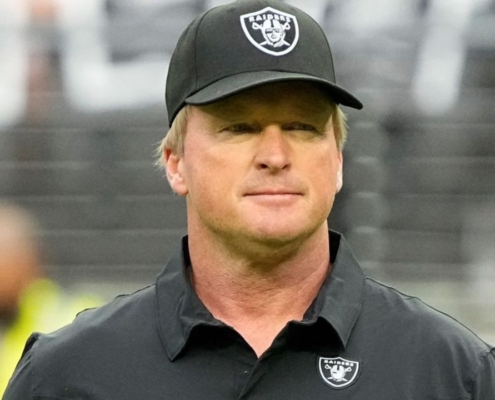
At this writing in mid-October, 2021, Jon Gruden, the coach of the National Football League’s Los Vegas Raiders, has been forced to resign from his coaching position and undoubtedly has been cancelled for life after it was found he used offensive language in personal emails to former Washington Football Team president Bruce Allen back in 2011.  While the word is that there were other objectionable emails, the examples cited in media reports have been from the Allen emails: Gruden referred disparagingly to the capability (“dumberiss”) and lips (“size of michellin tires”) of the Black president of the players union; called the league commissioner a “faggot” and “clueless anti-football pussy”; criticized efforts to encourage teams to draft “queers”; and panned the hiring of woman game officials.

Back in 2008, I wrote an article called “When They Attack” offering advice to White racial advocates and activists who come under fire, as they invariably will if their identities become known.1 Race hasn’t surfaced in the Gruden matter, at least explicitly, but it informs what went down in his case.   Look at the picture of Gruden at the top of this article.  Is he White enough for you?  If you don’t follow sports, take my word for it, nobody epitomized (he’s past tense now) the rough-tough, no bullshit, anti-white wine, alpha male more than Jon Gruden.  If you were a resentful Black, feminist, gay, or loyal NPR listener, wouldn’t you like to punch Gruden right in the nose?

This writing uses the Gruden incident as the occasion to take another run at the “when they attack” topic.   It seems worth the effort in a time when the woke crusaders are doing Joseph Stalin, Chairman Mao, and the East German Stasi proud.  Two topics here: what the Gruden episode says about the game—the current cultural/political reality—today’s zealots have managed to put on the field; and the big lesson to be learned from that.

The Game on the Field

The generalization: the rules are stacked against you.

There is a tough participation requirement. You can’t play in the game if someone—including and especially someone who would take delight if you fell into a manhole—can make the case that you are a racist, sexist, or homophobe.  If you are declared one of those, you get spit on and tossed.

There’s no difference between talk and action.  Gruden said some bad words.  But what has he actually done against Blacks, gays, and women?   He mentored Mike Tomlin, the current Black Pittsburgh Steelers head coach.  I’ve not heard anything about him mistreating the current Raiders gay player, Carl Nassib.  What’s he done to women?   I’d like to see a list of his discriminatory, hurtful actions, but then again, I’m not in charge of this game.

Subjectivity doesn’t compute. When Gruden used the terms “faggot” and “pussy,” he didn’t mean the same thing by them as they mean to Pete Buttigieg.   His “dumberiss” and “michellin tires” locker room talk about union leader Smith didn’t mean the same thing as it would have if the women on “The View” had said it.   When he came down on pressuring owners to draft “queers” and hire woman referees and umpires, he was—yes indelicately, this is a hard-assed football coach, not Justin Bieber—affirming the merit system in sports.  But that doesn’t count for anything in this game.

No distinction between public and private expression.  Gruden was talking to a friend (Allen) in what he assumed was confidence.  At what point in America did we start snooping into people’s personal communications?   That isn’t up for consideration in this game.

It doesn’t matter when a violation occurred.  Gruden’s offenses were a decade ago.  The world was different a decade ago, yet Gruden’s transgressions are treated as if they happened last Tuesday.

Denials don’t fly.  Gruden said he isn’t a racist. “I don’t have a racist bone in my body.  I have proven that my entire life.”  Is it within the realm of possibility that he isn’t lying?  In this game, no.

Apologies don’t cut it.  The first words out of Gruden’s mouth were, “I’m sorry.”  Always a losing strategy.  In this game, saying you are sorry is an admission of guilt and justifies beating you with a stick.

Don’t look for supporters.  Before he quickly retracted it, Tony Dungy—an ex-player and coach and current commentator on televised games and, ironically, Black—said Gruden is a good person and deserves another chance.

We heard Jon Gruden say he addressed this.  He gave his side of it.  He said that it wasn’t racial, that he was making a comment about DeMaurice Smith [the players union president], and he basically attacked his character.  I will accept that and just say that it was an immature way to do it.  It wasn’t the right way to do it.  But it was ten years ago.  And I’m not going to chalk everything up to racism.  I think we accept his apology, move forward, and move on with his team.2

Tony quickly realized that if he didn’t back off, Black or not, he’ll get a taste of what Gruden got.   He wouldn’t be kicked out of the game altogether, but he’d be relegated to the end of the bench.

Piling on is permissible.  People are coming out of the woodwork to kick Gruden when he is down: for his grating personality, his less than stellar game commentary when he worked for ESPN, for a slight he committed against somebody at some time or another, for looking like Chucky from the movies—anything, everything.  It’s as if he’s never done a good thing is his life.  A player he coached twenty years ago: “Man, this dude is a fraud.  Y’all don’t seem to understand he’s selling you on something and you’re buying it.  He’s been doing that for years.  Talking behind people’s backs, that was one of his traits in Tampa.”3

Invariant consequences.  Gruden was fired from his job and cancelled for life.  Does that punishment fit this crime?  Might a reprimand, fine, suspension, or even forgiveness be in order in this instance?  Nah.

The Lesson to be Learned

The big lesson to be learned from the Gruden episode: cover your backside.

I have a seventeen-year-old daughter who lives with her mother in another state from where I live.  This week, I got a notice from the administration of her high school.

Our school is participating in the [state] Healthy Youth Survey during fall 2021. The Healthy Youth Survey includes questions related to physical activity and diet, unintentional and intentional injury, substance use, sexual behaviors, abuse, risk and protective factors, and access to school-based services.  Participation in the survey is voluntary and the students’ answers are anonymous.

In an email, I advised her against completing the survey.

Never trust anything to be remain private.   There are too many examples of where such trust was misplaced.  This rule also applies to sharing any intimacy verbally.   Someone will say something like, “It’s OK, you can tell me” and then share it with others.  I’ve seen it happen.

When you are sitting alone in your room with your phone or laptop texting a friend or posting something on Instagram, you feel private.  You aren’t.  You are communicating with the world.  In this time of electronic communication and social media, especially within the current “woke” orthodoxy, never express anything you wouldn’t be happy to have as a headline in the newspaper.  That means in a text, email, Tweet, Zoom call, on Facebook or Instagram, a TikTok post or video, anything.  This also applies to anything you write in any context, including in school papers.  This week, a prominent National Football League coach was forced to resign for some language people found objectionable in emails he assumed were private.  When I was working at the university, I learned it had my emails going back fifteen years.  Fortunately, I’ve followed the advice I’m giving you here.

My advice to you reading this is to think long and hard before making your identity known to the Big Brothers, inquisitors, and church ladies (remember Dana Carvey?) who are around in droves these years.  I’ve personally gone public with my racial ideas, but I’m not advising others to follow my example.  For one thing, I was a tenured full professor before I made my views known and as a practical matter it was highly unlikely that I would wind up out on the street.  Plus, for whatever reason, I have less need than most others for social approval and inclusion.  But that’s not to say I didn’t pay heavy dues for coming down on the side of White people.  I’m reminded of the lyrics from the song, “The Boxer”:

In the clearing stands a boxer
And a fighter by his trade
And he carries the reminders
Of ev’ry glove that laid him down

Many of the writers for this publication do so anonymously, and that’s absolutely fine with me.  I would caution my daughter against, say, attending a Charlottesville-type rally.  If I wouldn’t tell my daughter to do it, I’m not going to tell your daughter—or you—to do it.  Some White racial advocates—who keep themselves safe behind false identities—are telling college students to start right-wing and White racial organizations on campus.  In today’s university, that is setting yourself up for demonization and pariah status and shutting down your graduate school and job prospects.  That isn’t right, but that is what is, and we all have to live in reality, the game that’s on the field.  While laudable, even courageous, standing up for White people where people can see you is a very dangerous undertaking.  Check out the fates of the visible alt-right spokesmen not so long ago.  The metaphor for waging the cultural and racial battle that makes the most sense to me in today’s reality isn’t storming the beaches of Normandy, it’s guerrilla warfare.


Endnotes

  1. Robert S. Griffin, “When They Attack,” 4pp, 2008. In the writings section of my web site.  http://www.robertsgriffin.com
  2. “Tony Dungy Getting Criticized for What He Said About Jon Gruden, The Spun by Sports Illustrated.

https://thespun.com/more/top-stories/tony-dungy-getting-criticized-jon-gruden

  1. First Take on Twitter: .@keyshawn.

The Problem with Leftism

Everyone complains about the Left, but no one does anything about it.  Or so it would seem.  Part of the problem, I suspect, is that many in the public have mistaken notions about what “the Left” is and how it operates, and thus they more or less mindlessly support it, or oppose it, as the case may be.  Hence it is high time for a hard look at this nefarious political entity, in order to devise better and more appropriate responses to it.

Let’s start with conventional views.  A constant theme of right-wing and conservative commentators is that the Left dominates America today.  This holds true across nearly the entire spectrum of conservatism, from the dissident- and alt-Right to conventional Republicans, to Pat Buchanan, to Fox News, to the Wall Street Journal, to the pro-Trump crowd.  In fact, it’s about the only thing they all agree on.  The primary concern seems to focus on media and on politics, the latter via the Democrats and the Biden regime.  Many would include academia, Hollywood, and the public schools as well.  Furthermore, this is universally seen on the Right as a disaster—and it is a disaster, but for reasons other than they presume—as well as something that poses a fundamental threat to America, to the “American way of life,” and to our very health and well-being.  The Left, apparently, is the root of all evil.

But what exactly is “the Left,” and why are they so evil?  This is rarely explained, likely because it is a relatively complicated matter that requires more than the usual 10 seconds of thinking.  Given the importance of the topic and the seriousness of the threat, however, we need to dive a bit more deeply into it.

To anticipate my main conclusion:  I think “the Left” is largely misnamed and misconceived—it is a kind of diversionary concept invented to distract from the real power-brokers and the real conflicts at hand.  “The Left” is actually a kind of fake Left, portrayed as opposing “the Right,” which is in reality a fake Right.  The net effect is to create a false antagonism and to encourage the unthinking masses to pick sides, even as they ultimately support the same side in the end.  Unsurprisingly, the Jewish Lobby plays a large role here, as I will show.

Real Leftism

I think many would be surprised to hear that real leftism is not what is commonly portrayed, and that it is actually (gasp!) not so bad.  At the risk of being pedantic, let’s look at standard definitions of both “Left” and “liberal,” since these seem to nominally be at the heart of the problem.  As I like to say, we need to know what we are talking about, if we hope to make any progress on these vital issues.  Here, then, is a typical definition of “Left”:

Left n, cap  a: those professing views usually characterized by desire to reform or overthrow the established political order, and usually advocating change in the name of the greater freedom or well-being of the common man.  b: a radical (as distinct from conservative) position.

Thus stated, this is relatively benign.  Anyone unhappy with an existing political administration will of necessity seek to reform or replace it, and thus we can all agree with this.  However, it is surprising to see the Left defined as striving for increased freedom for the average individual, when today it is more common to decry the “liberty-loathing left.”  It is true that those in power are working to diminish or restrict peoples’ freedoms—but this doesn’t make them leftists.  In fact it makes them anti-leftists, at least on this definition.  More problematically, we can have no doubt that “the Right” in anything like current forms, including neo-con and Judeo-Trumpian conservatism, would certainly (and in some cases did) institute their own forms of liberty restriction; hence ‘liberty-loathing’ is no hallmark of “the Left.”

As to the “radical” aspect, I would argue that this is largely in the eye of the beholder.  To be a radical in this sense is simply to press for far-reaching and qualitative change, as opposed to “tinkering around the edges,” which can be considered a conservative approach.  Clearly one can be a “radical right-winger” as much as one can be a “radical leftist,” and so part (b) does not offer much illumination.

What about “liberal,” or more generally, “liberalism”?  Here’s what we might find:

liberalism n:  a political philosophy based on belief in progress, the essential goodness of man, and the autonomy of the individual, and standing for the protection of political and civil liberties.

Again, we find woefully little to object to here.  I think we all are in favor of “progress,” even though we may have different ideas about what exactly that means.  What about “the essential goodness of man”?  That’s a strange phrase.  It is almost a religious idea, almost like saying we are all “children of God” or something.  But that’s nonsense.  I guess we can agree that most people, most of the time, are good; but still, there are bad, malevolent, and detestable people out there whom I would never declare to be “essentially good.”  That phrase might have been better stated as a general optimism about human nature, perhaps.  And I can agree to this.  I am generally optimistic about humanity; it is primarily aberrant conditions that cause the worst in people to come out.  In a mass technological society, “people” can seem incredibly dull, ignorant, and short-sighted, but this is more a consequence of social structure than anything else.  Much more needs to be said on this, but I defer that to another time.

“Autonomy of the individual” and “protecting civil liberties” are again, perhaps, a surprise.  But they should not be.  Liberalism, like liberal, derives from the Latin liber (free).  A liberal is, literally, a free thinker; a key part of the definition of ‘liberal’ is the idea of “one who is open-minded.”  Who among us does not claim to be open-minded?  Hence a true liberal is a free-thinking, autonomous, civil libertarian.  But doesn’t that describe the vast majority of “the Right”?  What are we to make of this?

We are beginning to see the nature of the problem.  Many of us, based on these definitions, would be forced to call ourselves “leftists” and “liberals.”  And yet, many would never do this, even on pain of death.  Somehow, politics has either become detached from reality, or it has altered the basic meaning of words so much that we, collectively, and quite literally, do not know what we are talking about.  Or perhaps a bit of both.

If nothing else, all this suggests that the stereotypical right-left distinction has become almost meaningless, likely as part of a deliberate strategy of obfuscation.  Clearly a more precise analysis is called for.

The Structure of the Fake American Left

The Left as commonly portrayed—the fake Left—is in reality a two-tiered system, composed of a small number of ideological leaders and propagators, and a large mass of people who generally self-identify as “Democrats” or “liberals.”  In America today, ‘Democrat’ and ‘Left’ are virtually coextensive; nearly all Democrats are leftists, and nearly all leftists are Democrats.  The terms are almost interchangeable.  But here, I will focus on ‘Left’ and ‘leftism’ since that terminology has a broader international meaning than the American-only party of Democrats.

More revealing is who these people are.  The elite leftists today are almost exclusively either Jews (of political, corporate, or academic stripe) or Gentiles, mostly White, working for and on behalf of Jews.  (Whether these Gentile lackeys are aware of their subservient status or not, and whether they care, are good questions that I can’t address here.)  In other words, the elite Left are either Jews or people beholden to Jews.  Either way, Jewish interests and Jewish issues predominate.

We know this because, firstly, so many of the Democratic elite are themselves Jews (Bernie Sanders, Chuck Schumer, Adam Schiff, George Soros, Jerry Nadler, Dianne Feinstein, Michael Bloomberg, Tom Steyer, Janet Yellen, Tony Blinken, Rochelle Walensky…) or have Jewish family members (Joe Biden, Kamala Harris, Nancy Pelosi, Donald Trump, Hillary Clinton, the Cuomo family).  The pervasive Jewish presence in the Democratic Party is a fact never mentioned in the MSM, and rarely discussed even by their strongest right-wing opponents.[1]  This should tell us something.

Secondly, we know that a large majority of Democratic campaign money comes from Jewish sources.  Over the past few decades, reported percentages of Democratic totals range from “about half,”[2] to 50%,[3] to “as much as 60%,”[4] to “over 60%,”[5] to as much as 2/3,[6] to “70% of large contributions,”[7] to 80-90%.[8]  A recent study, “The Jewish Vote 2020,” cites a number of relevant statistics, including these:

  • In the 2016 cycle, all of the top seven biggest donors overall were Jews (p. 11).
  • The top 10 donors in 2016 gave $406 million, of which $357 million—an amazing 88%—was from Jews (p. 14).
  • Of the top 50 donors in 2016, 20 (40%) were Jews (p. 14).
  • And it reconfirms that, today, Jews comprise roughly 50% of “big individual donors” to Democrats, and 25% of the same for Republicans (p. 11).

Late in 2020, in the run-up to the presidential election, it was reported that 15 of the top 25 donors (for both parties combined), or 60%, were Jews.  Top Democratic donors were Steyer ($54 million), Don Sussman ($22 million), James Simons ($21 million), Michael Bloomberg ($19 million), Deborah Simon ($12 million), Henry Laufer ($12 million), Josh Bekenstein ($11 million), Stephen Mandel ($9 million), Soros ($8 million—although he funnels many other donations through various nonprofits), and Steve Ballmer ($8 million).  These days, anything less than $10 million barely warrants mention.

So much for politics.  What about leftist media?  We know the main culprits:  CNN, MSNBC, the New York Times, and the Washington Post.  Unsurprisingly, Jews fill top spots at all these organizations or their parent companies.  CNN’s president is Jeff Zucker, and is owned by Warner Media, with Jason Kilar as CEO.  MSNBC is owned by NBC Universal, with CEO Jeff Shell, and top execs Robert Greenblatt, Bonnie Hammer, Noah Oppenheim, and Ron Meyer.  The NYT has been Jewish-owned and -operated since 1896; the current owner and publisher is Arthur Sulzberger.  The Washington Post has been Jewish-owned and -operated since 1933, with the possible exception of current owner Jeff Bezos (status unknown), who acquired it from the Jewish Graham family in 2013 (“at the suggestion of his friend, Don Graham”).[9]  We could include various other media entities, such as NPR Radio; elsewhere (note 10) I have shown that its on-air staff is over half Jewish.

In support of political and media Jews are the leftist “Big Tech” Jews, who include the likes of Mark Zuckerberg and Sheryl Sandberg (Facebook), Larry Page and Sergei Brin (Google), Larry Ellison and Safra Catz (Oracle), Susan Wojcicki (YouTube), Steve Ballmer, Andy Jassy (Amazon), Marc Benioff, and Michael Dell (Dell computers).  Thus, between money, power, media, and technology, the leftist elite—Jews and their sycophants—have a near monopoly on discourse in America and much of the West.

What about the base of the fake Left?  This is a large group of individuals, mostly White, who have been deluded as to the true nature of that ideology.  We can get a rough idea of numbers by considering the fact that Biden received about 80 million votes, of which some 72% were Whites; thus, there are about 55 million Whites who presumably identify with or favor the leftist Democrats.  To this number we can add the 15 million Blacks and 10 million Latinos who also voted for Biden.  The leftist base is thus about 80 million people.  This is a large number, though not overwhelming in a nation of 330 million.

By contrast, Trump earned about 50 million White votes; another 50 million or so Whites did not vote.  Hence, in rough terms, the (fake) Left has a grip on only about one-third of Whites; two-thirds elude their grasp.  This is a good sign—perhaps the best news among a raft of bad omens.  Something like 100 million Whites are either opposed, or potentially opposed, to leftist ideology.  There is much to build on here.

In sum, the nominal Left is a fake Left, adhering to virtually nothing of the meaning of a true leftism.  Rather, it is influenced and run, directly and indirectly, by wealthy and influential Jews.  This fake Left is a Jewish Left, ideologically speaking, and it operates largely by and for Jewish interests.  Likewise with liberalism, which today is a fake liberalism: an ideology that is fully aligned with Jewish interests.  In fact, the marriage of convenience between Jews and liberalism has long been known.  Consider this revealing passage:

Throughout the nineteenth century and later, the fate of the Jews would be linked inextricably with that of liberalism itself.  Their loyalty to liberalism would be intense and abiding, nurtured on gratitude for rights received and determination to establish a permanent place for the Jews in the modern European world.  Liberals, although scarcely ecstatic over persistent Jewish religious and social particularism, would reciprocate with toleration and increasing measures of equality before the law.  Both parties, but especially the Jews, would be acutely aware that Jewish emancipation stood or fell with the fortunes of liberalism.[10]

For well over a century, a majority of Jews have allied themselves with liberalism and leftism solely because it served their interests—the welfare of native populations be damned.  In a sense, they hijacked an otherwise virtuous ideology and perverted it to their own benefit.

The Real Right

Now that we have done some preliminary analysis of the Left, let’s turn to the Right.  In a popular sense, the Right has some stereotypical characterizations.  We know the catchphrases: “Guns, God, and country”; “Don’t tread on me”; “Liberty or death”; and various takes on the notion of freedom.  Again, these are constant themes across the conservative spectrum.

But how do these conventional ideas match up with the formal notion of “the Right”?  Earlier I cited standard definitions of ‘Left’ and ‘liberal,’ and to be fair, I need to do the same for their nominal counterparts, ‘Right’ and ‘conservatism’.  Here they are:

Right n, cap  (1) individuals favoring traditional attitudes and practices, and sometimes advocating the forced establishment of an authoritarian political order.  (2) a group or party that favors conservative, traditional, or sometimes authoritarian attitudes and policies.

conservatism n:  a political philosophy based on tradition and social stability, stressing established institutions, and preferring gradual development to abrupt change.

As before, there are some surprises—mostly in what is not here.  On the one hand, we find an emphasis on tradition and stability, gradual change (“reform”), and potentially anti-democratic policy, if this is how we may interpret ‘forced authoritarianism’ in this context.  On the other, we notice what is missing:  God, religion, rights, liberty, freedom.  Nothing on “small government.”  Even terms like ‘nation’ and ‘country’ are absent.  What are we to make of this?

It would seem that, as with the Left, that the Right has also been distorted from its formal and definitional meaning into a kind of caricature.  The current obsession with religion, freedom, patriotism, and formal democracy have been introduced by those who would like to divert people away from the true ruling entities in the US—Jewish money and power, Judeophilic lackeys, the ultra-rich, and a techno-industrial system that is spinning out of control—in order to confuse and distract the masses.

A true Right, composed of true conservatives, would do the following:

  • They would be less concerned about formal, representative democracy and more about the integrity of society, human welfare, and long-term sustainability of their own people. If this demands the use of “undemocratic” policies, so be it.
  • They would actively oppose any corrupt and malevolent minority from attacking the basis of society and from seeking to exploit it for their personal gain.
  • They would strive for social homogeneity, both racially and ethnically, knowing that multicultural and multiracial societies are inevitably prone to conflict, disruption, instability, and ultimately decay.
  • They would oppose an advancing high-tech society, knowing that potent and uncontrollable technologies not only empower our social overlords but also destroy traditional society, damage human health, and promote the destruction of the natural world upon which all real stability is grounded.
  • They would support the disintegration of large, unstable political systems like modern America and encourage the devolution and decentralization of political power; large complex societies have, of necessity, more laws, more constraints, and less freedom. They are also more easily manipulated by unscrupulous minorities.

Incidentally, one troubling fact of the January 6 “insurrection” is that most of the people there were pro-America and pro-democracy (or so it is claimed).  But true conservatives would not hold these views.  True conservatives realize that “America,” in both practice and theory, is anti-conservative and unsustainable.  America needs to be replaced with something else—something new, something different, something that will protect and defend the social well-being of the American majority and the ecological basis for it.[11]  Sadly, very few of the “insurrectionists” seem to have had any conception of the Judeocracy that rules over them and which dictates much of what Trump does and says; this strongly suggests that they severely misread the real basis of American power politics.  Most of those people, I would suggest, are members of the “fake Right”—a manipulated and distorted ideology that serves the purposes of the ruling Jewish elite.

The True Problems with “the Left”

Returning to the main theme, the fake Left is a heavily Jewish enterprise.  But most people, Left and Right, don’t know this or don’t acknowledge it, and they therefore don’t object to that fact.  When those on the Right object to the Left, it is usually to more concrete (but secondary) issues.  We can make a short list:  leftists are for “big government”; they support “open borders”; they want to take our guns; they stifle our freedom of speech (or freedom generally); they are authoritarian; they conduct “cancel culture”; they demonize Whites; they are anti-Christian; they tyrannize the public, as via their over-hyped Covid panic; they “tax and spend.”   Maybe even “they hate America” (if we listen to Tucker Carlson).  Doubtless we could add more, but I think this covers the main concerns for most on the Right.

I cannot argue with these points; I think all of them are basically true.  But there are deeper factors at work that help to explain this collective phenomenon, which is why we need to press a bit harder to really understand the process at work here.

When I consider the many objectionable features of what is called the Left, I compile a different sort of list.  For what it’s worth, I find it to have the following negative qualities:

A desire to impose their beliefs and values on others.  This is the “controlling,” “authoritarian,” and “liberty-loathing” aspect.  Leftist liberals seem to have an inordinate need to compel others to follow their belief-system.  They are the antithesis of “live and let live.”  They have little or no tolerance for dissenting views, especially those that threaten their own positions.  They know that rational dissent will severely undermine their credibility, and so they suppress it.[12]

They are blind to the realities of race, biology, and genetics.  For the Left, most all of human nature is a “social construction”—something pliable and malleable, something that can be defined and redefined almost at will.  Humans are merely a plastic biology; the many races are rather like different colors of Playdough, all equally moldable into new shapes and forms.  This results in an over-inclusive and naïve egalitarianism.

But this is not reality.  The fact is that there are profound and unalterable differences between human beings, both between and within races.  These are manifest in physical, mental, emotional, psychological, and cultural ways.  They are rooted in genetics, and cannot be wished away.  But leftists have deeply imbibed the fallacy of human equality.  Many are also functional relativists who cannot bear to make value distinctions.  (I should note here the difference between the leftist elite, who espouse views that they don’t really believe, and the naïve leftist masses, who generally do seem to believe them.)  As a result, leftists say incredibly stupid things and make incredibly stupid policy proposals.

No concept of a noble humanity.  When one swallows the myth of human equality, one condemns the human race to a miserable mediocrity.  If all are equal, then none are better, and in fact no one can be better.  Equality denies the existence of superior individuals, who are the very ones that drive society forward.  When such superior individuals do appear—as they inevitably do—they are suppressed, censored, attacked, perhaps jailed, perhaps killed.  Superior individuals put the lie to the myth of equality, which is one reason why they are so dangerous to the Left.  Because leftists have repudiated the whole concept of a noble humanity, they represent a profound threat to human well-being.  They effectively destroy the future of our race.

A pathology of pity.  Leftists are pity-mongers in the extreme.  They wallow in pity.  They praise pity.  And they sell pity.[13]  Great individuals and great societies do not wallow in pity.  They accept pain, hardship, and loss, and then they move on.  They give a fair respect to all of humanity, but they don’t elevate the lesser or the weak.  They don’t allow the lesser to dominate or even to consume inordinate time or resources.  The lesser of one’s own race are cared for, quietly, and the lesser of other races are excluded.  Such an approach can seem harsh, but such is life.

Dangerous and possibly fatal naiveté.  By accepting false but comforting myths, by failing to address the real threats to society, by adopting a de facto philo-Semitism, and by wallowing in an over-socialized and misdirected form of pity, leftists dodge the hard reality of the modern world.  In doing so, they doom society to inevitable suffering and decay.  Life is hard, evolution can be brutal, and choices are painful.  Leftists, though, prefer the easy way out; they seek to avoid all conflict and confrontation, and are happy to surrender control of their lives to, for example, a Jewish elite who would like nothing more than to use them, exploit them, and utterly crush them in the end.

Only by addressing these deeper failings of the Left can we get to the root of the problem.

Where Is the Opposition?

As I mentioned above, all sectors of the Right oppose leftism, but most are half-hearted—or worse.  Let’s take a specific example.  Perhaps the most visible and vocal critic of the Left is Tucker Carlson of Fox News.  In my essay Dissecting Tucker Carlson, I have critiqued his modus operandi, but here I want to emphasize his deeper alignment with the Left.

Let’s compare Carlson’s worldview to that of the typical leftist.  (A) The leftist, being a naïve egalitarian, is an anti-racist.  He believes deeply in human equality.  He is pro-democracy (at least verbally) and he supports “America.”  He is materialistic; he strives for a thriving economy, economic growth, and material prosperity.  Most importantly, he is philosemitic; he supports Israel, defends Jewish interests, promotes Jewish ideology, and gives free reign to Jewish voices.  The leftist never ‘outs’ Jews, never really criticizes Israel, never seeks to limit Jewish dominance in government, finance, media, or academia, and never calls to restrict their activities.  In this way, the leftist maintains his status and material well-being.

(B) Tucker Carlson, being a naïve egalitarian, is an anti-racist.  He believes deeply in human equality.  He is pro-democracy (at least verbally) and he supports “America.”  He is materialistic; he strives for a thriving economy, economic growth, and material prosperity.  Most importantly, he is philosemitic; he supports Israel, defends Jewish interests, promotes Jewish ideology, and gives free reign to Jewish voices.  Carlson never ‘outs’ Jews, never really criticizes Israel, never seeks to limit Jewish dominance in government, finance, media, or academia, and never calls to restrict their activities.  In this way, Carlson maintains his status and material well-being.

I trust that we can see the similarities here.[14]  And yet Carlson is supposedly an exemplary member of “the Right.”  Sadly, he is not alone; the above description applies to a large majority of the nominal Right.  This is precisely why the alleged Right is a fake Right, and why so many populist conservatives are fake conservatives.

If Carlson and others were true right-wingers, and true conservatives, they would display the characteristics I cited above.  They would be openly and explicitly anti-minority, anti-egalitarian, explicitly “racist” (or “racialist”), anti-Semitic, pro-environment, anti-technology (and not just anti-Big Tech), and perhaps even anti-democratic.  They might be anti-capitalist, knowing the disruption caused by unrestrained free-market capitalism.  God forbid, they might even be a little socialist!  They would be not so much patriotic—which implies a kind of naïve acceptance of the ruling class and the existing political order—but rather truly nationalist, in the sense of defending the interests one’s own race and ethnicity, which is, after all, the true basis of a “nation.”[15]

Where, then, are the true conservatives?  Where lies the true Right?  It is almost impossible to find, even in the big wide world of the Internet.  Thank God for organizations like The Occidental Observer, The Unz Review, and National Vanguard, who are willing to call a spade a spade.  Thank God for individuals like Kevin MacDonald and Andrew Anglin, William White Williams and David Duke, who are willing to speak openly and intelligently about the Jewish Question.  Thank God for the small circle of leading Holocaust revisionists, who work relentlessly to undermine the keystone of Jewish mendacity.[16]  Without such individuals, we would be lost.  With them, we have hope.

The Way Forward

In sum, the popular Left-Right divide in American politics is a fake dichotomy, constructed by and serving the interests of a Jewish elite and their well-paid Gentile lackeys.  When people focus all their attention and energy on this contrived distinction, they are distracted from, and thus overlook, the true and deeper causes of social crisis in this country.  The fake Right and the fake Left both serve their Jewish masters.  Only by moving beyond this superficial divide can we get to the root of things.

There are positive aspects of both real leftism and real conservatism.  We should indeed be open-minded, free-thinking, non-dogmatic, and progress-oriented.  We should indeed defend individual autonomy, and political and civil liberty, while promoting the better instincts of humanity.  At the same time, we should be truly nationalist:  that is, defending the integrity and well-being of White Americans.  We should work toward a relatively homogenous, monocultural, mono-ethnic nation, which is the only type of nation proven to be stable and sustainable.  We should be ardent environmentalists, preserving wild nature, expanding wilderness, and protecting indigenous species; without this, we cannot hope for a flourishing society.  We should put sharp limits on free-marketeers, finance capitalists, and financial speculators; if this means moving toward a limited socialism, so be it.

Above all, we should end the constant clamor over the bogus Left-Right confrontation, and focus on what really matters:  subverting the dominant Judeocracy, creating a manageable and ethnically-uniform nation (or nations), and getting down to the hard work of restoring a sane society.  I fear that we haven’t much time to spare.

Thomas Dalton, PhD, has authored or edited several books and articles on politics, history, and religion, with a special focus on National Socialism in Germany.  His works include a new translation series of Mein Kampf, and the books Eternal Strangers (2020), The Jewish Hand in the World Wars (2019), and Debating the Holocaust (4th ed, 2020).  Most recently he has edited a new edition of Rosenberg’s classic work Myth of the 20th Century and a new book of political cartoons, Pan-Judah!.  All these works are available at www.clemensandblair.com.  For all his writings, see his personal website www.thomasdaltonphd.com.


[1] It will be a cold day in hell before Tucker Carlson or Sean Hannity ever speak explicitly about the Jews on the Left.

[2] Jewish Power, by J. J. Goldberg (1996), p. 277.

[3] Jerusalem Post (27 Sep 2016).

[4] Washington Post (13 Mar 2003), p. A1.

[5] Jewish Power in America, by B. Feingold (2008), p. 4.

[6] Jewish Telegraphic Agency (7 Jun 2011).

[7] The Hill (30 Mar 2004), p. 1.

[8] Passionate Attachment, by Ball and Ball (1992), p. 218.

[9] This fact alone is damning; I know of no instance in which Jews have sold a major media company to a non-Jew.  And the fact that Bezos turned over operations of Amazon to another Jew, Andy Jassy, is a further indication.

[10] The Jews in Weimar Germany, by Don Niewyk (1980), p. 1.

[11] More needs to be said on this, which I will address in a subsequent essay.

[12] Again, the Left has no monopoly on this issue.  The Right can be just as imposing.

[13] One need only watch any episode of popular television shows, especially so-called reality TV.  Shows like “American Idol” or “Dancing with the Stars” or “America’s Got Talent” are endless parades of sob stories.  Crying contestants are de rigueur.

[14] There are, of course, differences:  Carlson is anti-immigration, pro-Christian, Covid-skeptical, and withering in his critique of the Biden regime.  But the similarities are more significant and more consequential than the differences.

[15] ‘Nation’ comes from Latin natus or natio, that is, those who are “born together,” or of similar birth.

[16] Among whom I would include Germar Rudolf, Carlo Mattogno, and Jürgen Graf.  Any discussion of Holocaust revisionism that does not mention these men is not worth its salt.

Don’t Call it the Holocaust

“You ARE Zaphod Beeblebrox?”
“Yeah,” said Zaphod, “but don’t shout it out or they’ll all want one.”
“THE Zaphod Beeblebrox?”
“No, just A Zaphod Beeblebrox, didn’t you hear I come in six packs?”
—Douglas Adams, The Hitchhiker’s Guide to the Galaxy

In many ways, language is everything when it comes to demographic warfare. The group that can control what other groups are allowed to say has the upper hand because controlling what a person says ultimately leads to controlling what a person thinks. And once you can do that, you can quite easily coerce entire classes and races of people into doing your bidding. The Soviets understood this well, and it was one reason why they were able to manage their oppression of a vast populace for many years.

Whites, as an oppressed class in our current demographic struggles, should be well aware by now of the language restrictions which have been placed on them. For example, referring to blacks as “Negroes” or Asians as “Orientals” is considered not just out of date, but offensive. Calling a black person a “nigger” is practically grounds for murder these days. But what way of referring to Whites is analogous to this? Nothing, really. Recently, a Jew named Donald Moss announced from his perch within the American Psychoanalytic Association that whiteness is a parasitic condition to which there is no cure. Can’t get too much more defamatory than that. And did Dr. Moss get in any trouble for offending White people? Of course not. After all, the Nation of Islam has been calling White people blue-eyed devils for years and getting away with it.

As a result of this pervasive abuse, I believe it is time for Whites to go on the offensive on the language front in the great demographic war. This means that we should produce a list of terms that we should never allow anyone, including other Whites, to say in our presence. Racial insults, of course, should top this list. Under no circumstances should we allow anyone to use the terms “redneck,” “cracker” or other racial epithets in a derogatory way. These should be met with a barrage of accusations of racism, followed by charges of hypocrisy and whatever else the circumstances call for. Basically, this should mark the permanent end of the conversation with those who think they can defame White people and get away with it.

But these are obvious cases. Less obvious is the derogatory term “Nazi” which I discuss in my 2019 Counter-Currents article “The Other N-Word.” I think, however, the most potent weapon at our disposal is the one which can turn the tables on the most potent weapon of our enemies—that is, the insidious demographic weapon known as “The Holocaust.” Not the historical event, mind you, but the demographic weapon which was designed to weaken the morale and spirit of an entire people through guilt, propaganda, and lawfare. The aggressive application of language which I outline below can work regardless if one believes the anti-Jewish atrocities of the 1940s happened or didn’t happen, or were exaggerated or not. This is about controlling language, not arguing history.

Any time a racially conscious White has a serious discussion with a Jew—or, really, anyone on the Left—they need to interrupt their interlocutor as soon as “the Holocaust” is mentioned. There are several ways to approach this. One could take the snarky Jonathan Bowden tack and ask not-so-innocently which holocaust they’re referring to. From Western Civilization Strikes Back, pages 97–98:

The deputy chairman of the party that I was in was asked about the Shoah on a Channel Four program. And he said, “Well, which ‘Shoah’ are you referring to? Are you talking about the communist holocausts, many of which were inspired by Jewish ideas?”

Silence. A very radical statement for a contemporary BNP leader. Silence. Silence.

A clever rhetorical twist, that.

I would prefer, however, to keep things on the up-and-up. When they say “the Holocaust,” we know that they are referring to the Jewish Holocaust—which is what it should be called—and it would be best if we didn’t pretend not to know this unless one has a talent for witty repartee and can handle oneself in these kinds of conversations. So in response to any reference to “the Holocaust,” a racially aware White person should resist the urge to make a Douglas Adams reference and instead politely inform their interlocuter that such a term is racist and evinces an offensive form of ethnic chauvinism.

Why? (They will invariably find the accusation shocking and in all innocence inquire “Why?”). Because by employing the definite article “the” and the capital “H,” the term’s user implies that there is only one holocaust. All other holocausts are, to borrow an expression from Jean-Marie Le Pen, a “just a detail in history.” For example, the Bengal Famine. I’m sure any Jewish person using the term “the Holocaust” would be interested to discover how Winston Churchill requisitioned grain from India during the Second World War, and thereby caused the starvation of up to three million Indians in the Bengal province of British India in 1943. That’s a holocaust. Referring to what happened to the Jewish diaspora in Europe from 1941 to 1945 as “the” holocaust is an insult to all the people who died in the Bengal Famine and every other holocaust before and since.

And if the person hasn’t scurried away or shrieked “anti-Semite!” by this point, then one can bring up the atrocities of the early Soviet period, such as the terror famines, the Great Terror, and the Gulag Archipelago. That’s between 17 and 18 million lives disposed of, according Robert Conquest’s Harvest of Sorrow and The Great Terror. Throw in all the victims of the gulag up to 1939, and you have millions more. These were all holocausts, no? In fact, the point could be made that the Soviets were the ones who committed “the Holocaust” since they killed far more people than the Nazis did and with less reason. This last part is crucial. Whatever atrocities the Nazis committed, they at least had the excuse of being at war and forced to deal with a hostile population of Jews prone to sabotage and guerilla warfare. In fact, by 1944 they were at war with three superpowers on at least as many fronts. The Soviets had no such excuse since they drenched their countryside in blood in the years between the Russian Civil War and the Second World War—in other words, peacetime.

And if by luck or persistence the conversation continues, then one can bring up the names of all the Jews who contributed to “the Holocaust”—this one and only Holocaust—upon millions of innocent Russians, Ukrainians, and others prior to when most Jews even knew what a concentration camp was. Readers of this site probably don’t need an itemization of such a list. Aleksandr Solzhenitsyn’s Two Hundred Years Together is a great source. But there are many others.

At this point, there can be no more conversation. We have flipped the script, so to speak. We have trumped the Jewish victim card with an even higher one of our own. We have overwhelmed their most powerful weapon with an even greater one of our own. All because of our control of language. All because we don’t let them or anyone else get away with calling the anti-Jewish atrocities of the 1940s “the Holocaust.” All because we make explicit what Jews have for so long kept implicit with their use the definite article and that dreaded capital “H”—that Jews believe that Jewish lives are worth more than non-Jewish lives. Once we expose this, they have no defense to charges of racism which will naturally follow.

Of course, nothing is this simple in life, and nothing will change in our favor overnight. But if enough Whites were to take this relatively easy tack in the public sphere—and not just on social media, televised news, or on CSPAN, but in everyday discussions with family, friends, and colleagues—then the Jews and their allies will be forced onto the defensive for a change. They will face a rare reversal in the demographic wars. And after that, who knows what could happen?

The Tyranny of Translunacy: How Higher Status in Leftism Decides Who Can Invade Whose Territory

Here’s an interesting sentence in Latin: Utinam populus romanus unam cervicem haberet! But what does it mean? Since the nineteenth century, fewer and fewer British prime ministers have been able to answer that question. Boris Johnson bucked the trend. He has a degree in classics from Oxford and could tell you instantly that it means: “Would that the Roman people had a single neck!”

Serve the cervix

He could also tell you that those were the headchop-hungry words of the tyrant Caligula (12–41 AD), according to the historian Seneca, and that cervicem is the accusative singular of the feminine Latin noun cervix, meaning “neck.” Johnson could give you all the other forms of that word in Latin, from the dative singular to the genitive plural. But alas, his grasp of the word in modern English has deserted him. It’s now a medical term meaning “the neck of the womb.” But when Johnson was asked at the Conservative Party Conference to affirm that only women have a cervix, he evaded the question: “What I think about this is [that] biology is very important. But we have a system now in our country for many, many years in which people can change gender. We help them to do that and what I absolutely passionately believe, and I fought for this for a long time, is everybody should be treated with dignity and respect.”

By piffling and prevaricating like that, Johnson blew his chance to put clear blue water between the Conservatives and their supposed ideological opponents in the Labour party. In the previous week the Labour leader, Keir Starmer, had been asked whether it was transphobic to think, as one of his female MPs does, that “only women have a cervix.” The swamp-creature Starmer claimed it was indeed transphobic. That simple statement of biological fact was “something that shouldn’t be said,” he told his interviewer. “It is not right.” Why so? According to Starmer, it’s because transgender people are among the “most marginalised and abused communities.” If you don’t follow his logic, that’s unsurprising: there is no logic there. The alleged “marginalization” of transgender people doesn’t give them the right to replace biological reality with translunatic fantasies.

Labour loves translunacy

In fact, this absurd controversy about who has a cervix is proof that transgender people are the opposite of “marginalized.” Their lunatic ideas are accepted by mainstream leftists right across politics, academia and the media. The Labour party bows before transgender lunacy and the supposedly right-wing leader of the Conservative party refuses to repudiate it. But let’s be clear about what is going on in the cervix controversy. When Starmer made his absurd statements, he wasn’t worried about the sensitivities of “trans-men,” or cervix-possessing women who claim to be men. Trans-men are a relatively quiet and unaggressive group.

No, Starmer was worried about “trans-women,” the variously perverted and mentally disturbed men who claim to be women. As Steve Sailer has often pointed out, trans-women are both loud and aggressive. They’ve driven the transgender agenda, which now includes the drugging and mutilation of confused or misguided children. Biologically male translunatics are the ones that Starmer is scared of. If he had spoken the truth and said that only women have a cervix, it would immediately follow that those without a cervix cannot be women. Translunatics and their supporters would promptly have driven him out of the Labour leadership.

Emotion versus intellect

But who is Boris Johnson scared of? In the past, he’s repeatedly defied political correctness and mocked leftist pieties on race and sex. And he didn’t merely buck the political trends in his choice of a classics degree: he also appointed the very intelligent and scientifically minded Dominic Cummings as his Chief of Staff. Cummings and his allies believe that “Government has to be totally transformed. It is full of arts graduates. It should be full of mathematicians.” Johnson wanted Cummings to reform government bureaucracy and reverse its ever-growing leftism. And maybe Cummings could have done it if Johnson hadn’t also wanted to share government with his blonde girlfriend Carrie Symonds, who has a degree in “art history and theatre studies.”

In intellect and grasp of scientific reality, Symonds was no match for Cummings on the question of how best to run government, just as the Jewish pseudo-scientist Stephen Jay Gould was no match for genuine scientists like Charles Murray or Arthur Jensen on the question of how best to explain the differing average IQs of Blacks and Whites. But intellect and grasp-of-reality don’t determine power-struggles in the corrupt modern West. Will-to-power and alignment with Jewish interests are much more important.

Testosteronized Tory: the emotional but formidable Carrie Johnson, proud possessor of a degree in art history and theatre studies

That’s why Carrie Symonds defeated Cummings and Gould defeated Murray et al. Cummings left government and Carrie married Boris Johnson. As his wife, she attended the recent Conservative conference and made a sycophantic speech at an “LGBT+ Conservatives reception,” where she revealed that “her husband was ‘completely committed’ to LGBT+ rights” and that she herself had been “moved to tears” by the story of an LGBT+ victim of hate-crime. Carrie obviously has female emotionality, but she doesn’t have a typically female face. Instead, her face is broad and masculine, suggesting that she has higher-than-average levels of testosterone and lots of will-power and aggression. Perhaps that’s why Boris Johnson so often looks like a rabbit caught in the headlights when he’s photographed with her (see the photo above).

Porn-positive pedo-pushing Jews

I think that a sensible man would have taken one look at Carrie’s man-jaw and decided to keep well clear. Johnson was not sensible and has allowed Carrie far too much influence over both himself and the government. That’s why, I suggest, he failed to support biological reality when asked about who has a cervix. He’s scared of his intellectually vacuous but psychologically formidable wife, who supports translunacy, and so he didn’t clearly state that only women have a cervix. This cowardice would be laughable if it weren’t so tragic. Translunacy doesn’t simply make politicians lie or equivocate about biological reality: it is also responsible for genuine medical horrors, like the use of “puberty-blocking drugs” on confused and mentally ill children and the surgical mutilation of such children. All this is done because Western elites have refused to confront and contradict the small but aggressive and determined group of “trans-women.”

Porn-positive pedo-pushing Jewish academic Gayle Rubin

And why have Western elites refused to do that? I’d suggest that it’s because the elites are following a Jewish agenda. As Kenneth Vinther described in his excellent article “Oppression by Orgasm” at Counter Currents, not just translunacy but all forms of sexual subversion in the West are heavily Jewish in origin, inspiration and promotion. For example, the most important academics in the translunatic cult are the Jewish lesbians Judith Butler and Gayle Rubin. And these Jewish academics have wider ambitions still. As the goy writer Robert McCain has asked: “If her celebration of sadomasochism did not suffice to make Professor Rubin notorious, what about her defense of pedophilia and child pornography in her 1984 essay, ‘Thinking Sex: Notes for a Radical Theory of the Politics of Sexuality’?” But Rubin and Butler aren’t “notorious” among leftists: on the contrary, they’re celebrated as brave pioneers of the struggle for equality. What is that brave struggle truly about? Vox Day suggests that “Pedophilia is the end game of Equality. It always was.” Leftists want to dissolve all barriers: not just those between men and women, but also those between adults and children.

Labour’s betrayal of the working-class

And that’s how we’ve arrived at the absurdity of the Labour leader Keir Starmer stating that “it is not right” to say only women have a cervix. As Labour leader, Starmer supposedly represents the working-class, who overwhelmingly accept biological reality and reject translunacy. It’s clear, then, that Starmer doesn’t represent the working-class. But the Labour party hasn’t done that for decades. Labour’s former deputy leader, Roy Hattersley, has openly boasted in the Guardian that: “For most of my 33 years in Westminster, I was able to resist [my constituents’] demands about the great issues of national policy — otherwise, my first decade would have been spent opposing all [Third-World] immigration and my last calling for withdrawal from the European Union.” Like Hattersley, Keir Starmer has a Jewish wife; and like Hattersley, Starmer believes that Somalis, Pakistanis and Jamaicans can be “just as British” as Whites whose ancestors have lived in Britain for millennia.

An ideal James Bond in leftist eyes: the obese Black actress Gabourney Sidibe

Indeed, it’s a central doctrine of leftism that Western identity should be unconditionally open to non-Whites, who become full and authentic citizens of Western nations simply by migrating there. On the other hand, not all leftists presently accept translunacy. For example, TERFS, or trans-exclusionary radical feminists, reject the doctrine that female identity is unconditionally open to males, who become full and authentic women simply by saying that they are women. But trans-critical leftists don’t realize that non-White migration into the West was the model for migration by men into womanhood. By denying the biological basis of Western identity in the 1950s and ’60s, leftists prepared the way for the translunatic cult in the 21st century. For leftists, men can become women just as, on the movie or TV screen, Blacks can occupy White roles or women can occupy male roles. For example, on British television, a Black actress has recently played the completely White Anne Boleyn, one of the queens of Henry VIII, and the White actress Jodie Whittaker has played the formerly male role of Dr Who. Leftists also strongly support the casting of a Black in the iconic White role of James Bond — their ideal James Bond would presumably be an obese Black actress like Gabourney Sidibe.

Blacks have higher status than Whites

But it is now completely unacceptable for White actors to play non-White roles of any kind. All White roles are open to non-Whites, but no non-White role is open to any White. And when the White American woman Rachel Dolezal tried to pass as Black, she was mocked and condemned, not praised for further demonstrating the “non-existence” of race. So why do leftists believe that some borders should be dissolved while other borders should be maintained? Why can Blacks play Whites, but Whites not play Blacks? As I said in “Borders for Us, Not for You,” I think it’s a matter of status and will-to-power. When a group has high status in leftism, it can assume the identity of any group with low status. But a group with low status can’t assume the identity of a group with high status. Biological men have lower status than biological women in leftism, but “transwomen,” although biologically male, have cleverly aligned themselves with homosexuals, who have higher status than biological women.

The Jewish “trans-lesbian” Jonathan Yaniv at work in a female toilet

And that’s why, for example, the Israeli-Jewish pervert Jonathan Yaniv, who is biologically male, can claim to be a “lesbian” and indulge his paedophilia and menstruation-fetishism without any criticism from the mainstream left. Similarly, non-Whites have higher status than Whites in leftism, therefore non-Whites can migrate freely into the West and take any White role in acting. But Whites cannot take Black roles and Whites like Rachel Dolezal cannot be permitted to pass themselves off as a Black. And I find it very interesting that some Jews are trying to add Jews to the list of groups whom it is forbidden for Whites to represent on stage and screen:

Enough, already! Is it time to stop the ‘Jewface’ casting?

It’s the debate that’s growing ever more heated: should non-Jewish actors play Jewish parts? Now outspoken comedian Sarah Silverman has waded in to decry what she has labelled “Jewface”. The American star was speaking after Kathryn Hahn was reported to have been cast as Joan Rivers in The Comeback Girl, an upcoming drama based on the life of the Jewish comedy icon.

Ms Hahn is not Jewish, but did play a rabbi in the comedy drama series Transparent and is married to Jewish actor Ethan Sandler. “One could argue, for instance, that a gentile playing Joan Rivers correctly would be doing what is actually called ‘Jewface,’” Ms Silverman said on her podcast last week.

Though the comedian said she had “zero problems” with Ms Hahn’s involvement in the project and stressed she was a “brilliant” actress, she pointed to an apparent double standard, with Jewish characters often portrayed by non-Jews despite a growing focus on representation in the industry.

“The pattern in film is just undeniable, and the pattern is if the Jewish female character is courageous or deserves love, she is never played by a Jew. Ever!” she said. She pointed to a number of films and TV shows from recent years which have featured non-Jewish actresses in Jewish parts, including the 2018 courtroom drama On The Basis Of Sex starring Felicity Jones as the late Supreme Court Justice Ruth Bader Ginsburg.

Ms Silverman also cited The Marvellous Mrs Maisel featuring Rachel Brosnahan as a Jewish comedian and the 2017 film Disobedience with Rachel McAdams as Esti Kuperman, a Charedi woman who renews her same-sex relationship with her childhood best friend, Ronit Krushka, who is played by British Jewish star Rachel Weisz.

The issue of Jewish representation has sparked debate in recent years, with actresses Maureen Lipman and Miriam Margolyes joining a group of artists in 2019 in signing a letter condemning a musical for casting non-Jews to play Jews. (Enough, already! Is it time to stop the ‘Jewface’ casting?, The Jewish Chronicle, 8th October 2021)

“Jewface,” of course, applies only in one direction: it goes without saying that all White roles should remain open to Jewish actors and actresses. But what is going on in the nascent campaign against “Jewface”? Well, I’ve suggested previously that Jews can be described as “Schrödinger’s Tribe.” In quantum physics, Schrödinger’s cat is simultaneously alive-and-dead until the universe decides one way or another. In Western politics and culture, Jews are simultaneously a minority and not-a-minority, switching between the two identities according to whether they want to claim victimhood or make a Western organization seem more “White” than it actually is.

I further suggest that, in the past, Jew-dominated Hollywood and other media were happy to cast White actors in Jewish roles because this contributed to Jewish crypsis, or the camouflaging of Jews as Whites. The Jewish writer David Cole has also pointed out, in the case of Ruth Bader Ginsburg, that true-to-life casting would sometimes be very hard on the eyes of cinema-goers. The real Ginsburg was remarkably ugly, so Hollywood decided it was better she be portrayed by the attractive shiksa Felicity Jones.

“Jewface” in action: the ugly Ruth Bader Ginsburg is portrayed by the attractive Felicity Jones

But it’s apparent that some Jews are now rejecting these considerations of Jewish crypsis and shiksa beauty. They want to join what Steve Sailer calls the “Flight from White” and to openly assert the higher status of Jews. If Jews have higher status than Whites, then Jewish roles must be closed to Whites, while White roles remain open to Jews. And what do I think about this anti-“Jewface” campaign? I fully support it. I’d like to see it made more and more obvious that Whites are being assigned the lowest possible status in Western nations.

That way, more Whites will wake up to what has already happened and to what is being planned for the future. The tyrannical fantasies of Caligula were never realized. The Roman people didn’t have una cervix, a “single neck” that he could sever at a stroke. But the tyrannical fantasies of the modern left are being realized even as I type. By insisting that non-Whites are valuable citizens of Western nations and denying that only women have a cervix, leftists deny biological reality and prepare the way for even worse assaults on truth, beauty and goodness. If Whites are despised and being dispossessed while they are still the majority, what will happen in those fast-approaching days when they become a minority? More Whites need to ask – and answer – that question. And then they will join the fight to reclaim the West.

Jones vs. KMac: Spirit or Material? Toward a Synthesis

By now, healthy numbers of informed people are generally aware of the work of our editor Kevin MacDonald and traditional Catholic thinker E. Michael Jones. Much of their influence comes from the fact that both have devoted major portions of their careers to writing about what is absolutely the most pressing issue of our age: The Jewish Question.

What has long fascinated me is the fact that both writers have considered Jews and their collective behavior in quite contrasting ways — yet in my estimation, they are both right. How can that be? Thus, for a decade or so, I’ve attempted in my own mind to reconcile KM and EMJ. Better yet, I’d love to attempt a synthesis of the two approaches to understanding Jews. Given that the present essay marks my 100th contribution to The Occidental Observer, I’d say that a conversation about the attempt to reconcile KM and EMJ is worthy of the occasion.

In my estimation, the contrasting foundations of these two men’s analyses mirror the larger Western conflict we’ve all seen for five hundred-plus years with the struggle between our inherited Christian past, with belief in faith, souls, spirits, and—most of all—God, vs. rationalism, humanism, and materialism—in other words, a strongly scientific worldview. Obviously, Catholic traditionalist E. Michael Jones falls into the former group, while Kevin MacDonald, an academic evolutionary psychologist, falls into the latter. When views from these two competing and conflicting worldviews consider a wide range of topics, they barely ever share common ground, but with KM’s and EMJ’s approaches, they share so much that they are almost complementary in some respects. How can this be? What, then, is the nature of Jews? Why are they so unique among humans? What can they teach us about humanity in general — if not the greater meaning of existence itself?

My consideration of these questions is biographical in that I’ve grappled with these competing worldviews for most of my life and have actually wavered between them over the decades. To my own surprise, I’d now say that Jones’ Christian approach is the more conclusive narrative in that Christianity — as with religion in general — posits a beginning, a middle and an end, which even to many of us post-Christians is a familiar story encompassing “In the beginning,” Adam and Eve, the life of Christ, the struggles between Good and Evil, everlasting souls, heaven and hell, angels, and always an omnipotent, all-loving God.

In an exchange among KM, EMJ and their hostess, Jones explained some aspects of this religious view:

Man is a composite being made up of body and soul (if that word sounds tendentious to the sociobiologists, they can substitute “mind” in its place). He has both a brain and a mind. These two entities are related but distinct. Human beings, unlike angels, can’t have minds unless they have brains, which function according to the laws of chemistry, biology, electricity, etc. and are a direct product of our DNA. Our thoughts, however, are a function of our minds, and, although we can affect our minds by manipulating the chemistry of our brains through alcohol and drugs, the logic of our thoughts is independent of the functioning of our brains.

In contrast, MacDonald grounds his trilogy on Jews in a post-Christian world, one is which God is dead and therefore plays no role in the universe, where scientific laws impartially govern eternity, among which are those laws in evidence with respect to Darwinian evolution. Sadly (for me personally) this modern view of scientific materialism allows for no obvious purpose in existence beyond mere survival. And while survival is nice, it’s still does not provide a convincing reason to struggle and survive. In this sense, The West in general has been demoralized for the past few hundred years, depending on the pace and degree of an acceptance of the atheism — implicitly or explicitly — that has appeared alongside the rise of science.

In short, should you warm to either KM or EMJ, it will likely come down to the worldview you tend to accept already — the general Christian one of historical Europe or the modern scientific view. Personally, I can’t imagine many people changing their worldviews from one to the other simply based on a careful reading of Jones vs. KMac, but that has in fact been happening to me. I’m not back to a belief in God yet, but due to the facts surrounding the Jewish Question, I’m inching my way away from the Existential belief that our presence here on this Earth is meaningless, for it appears indisputable that Jewish existence has some sort of meaning, and, if their existence has meaning, so should ours.

Having just argued tentatively in favor of the religious or supernatural, I will allow that KM likely has the advantage in this debate in that the modern West and its institutions have largely abandoned a spiritual, Christian approach and accepted “science,” which can be as seemingly solid as physics and math or as malleable as the social sciences have been across time. As a rule of thumb, “educated” Westerners have shed Christianity and a belief in God, while “the unintelligent, hicks and charlatans” still embrace them. Witness today’s knee-jerk reaction to the Catholic Church’s repression of Galileo or the respective fates of Clarence Darrow and William Jennings Bryan in the 1925 “Scopes Monkey Trial,” such that Darrow is still respected to this day while Bryan is knowingly mocked.

Without question, the largest institutions of The West such as academia and the media, but also the government that rules over us, are functionally anti-Christian and pro-science. Few would argue otherwise. (Let’s leave out the Covid debate for now.) So it is within these structures of support that MacDonald has advanced his career. His project on Jews in the 1990s admits as much in the opening words of the 1994 book that began the trilogy: “The project attempts to develop an understanding of Judaism based on modern social and biological sciences. … The fundamental paradigm derives from evolutionary biology, but there will also be a major role for the theory and data derived from several areas of psychology, including especially the social psychology of group behavior.” (vii)

Though it’s been many years since I read the trilogy, I still have a strong impression that A People That Shall Dwell Alone (1994) and Separation and Its Discontents (1998) hew more closely to what appears to be MacDonald’s mid-to-late career dedication to impartial scientific inquiry. In contrast, by the time of the more famous Culture of Critique: An Evolutionary Analysis of Jewish Involvement in Twentieth-Century Intellectual and Political Movements, (also 1998; hereafter usually CofC) there is the impression that this scientist-author, as a member of the group being “critiqued” and therefore harmed, has experienced a number of “Aha!” moments and realized that his earlier efforts at impartial research were insufficient when encountering a hostile group that undermines the very power of impartial science in the service of, well, a “group evolutionary strategy.” This does not imply that MacDonald did not think that the theory and data in CofC would not hold up to the same standards of scientific rigor as the other books in the trilogy. However, from 1998 onward, I would say, MacDonald has become a partisan—and for many good reasons. (In fact, here he writes as much: “As a result of reading about various Jewish intellectual and political movements, I came to see Jews as advocating policies that are opposed to the interests of European peoples. It was this cognitive awareness based on a great deal of reading and thinking that led me to my current beliefs.”)

Careful readers of the trilogy will spot this shift, I believe, with the first two books relying more heavily on evolutionary theory straining to be as evidence-based as possible, whereas CofC moves on to “the Boasian school of anthropology, psychoanalysis, leftist political ideology and behavior, the Frankfurt School of Social Research, and the New York intellectuals.” What is critical, KM points out, is that these venues and ideologies were promoted for their “scientific rigor” for decades, when in fact, as MacDonald discovered, they were perversions of real science employed in the course of anti-White ethnic warfare, with Freudian psychoanalysis being a prime case in point.

Perhaps more than any other thinker in the English-speaking world, MacDonald has exposed this form of ethnic warfare and really captured the critical conversations about race, Jews and Whites in the first two decades of the 21st century, despite robust efforts by Jewish-led interests to stifle this knowledge.

To be sure, KMac’s account could be right — and probably is. Over the millennia, Jews have evolved adaptive behavior that ensures their survival and puts them on top. But honestly, it’s really just too … “uncanny,” which is why EMJ’s Christian approach has, against my desire, it seems, pulled me toward belief in a spiritual battle rather than a merely biological and social one. Let’s consider Jones’ account.

I first ran across the writings of Dr. Jones through his journal Culture Wars, and I actually stopped buying it after a number of issues because the editing and format were often so atrocious that I could not take it seriously. I returned to it, however, because Jones’ writing on Jews was so blasphemous — meaning so good, touching always on our current culture in ways that were highly instructive. Only Kevin MacDonald, many of us TOQ/TOO writers and a tiny handful of others were doing something similar. And Lord knows the mainstream press and academia wouldn’t touch an approach like Jones’ (though any number of Jewish academics were in fact writing similar things in books that were rather obscure, in part because far fewer people read books this century).

I’m pretty good about keeping up with these topics and am happy to say that both MacDonald and Jones, despite opposition, have been getting great exposure for some twenty years. No doubt this is due in part to their successful use of non-written forms of discourse, such as YouTube, other podcasts, speeches, interviews, etc. And for some years, all their works were available on Amazon but of course those days are long gone as the regime methodically cracks down on White activists (and Jones).

Punishing Heretics

Not surprisingly, both of these modern heretics have paid a steep price for fearlessly addressing the JQ. For instance, beginning in 2006, this attack began against MacDonald:

The Southern Poverty Law Center has initiated a campaign against me. The controversy started in September, 2006 when someone not connected with CSULB emailed all the full-time people in the Psychology Department — except me — alerting them to a comment about me at the SPLC website.  Heidi Beirich of the SPLC came to Long Beach from November 12–15, 2006 to interview faculty and administrators about me. During the 2006–2007 and 2007–2008 academic years there was also a great deal of discussion and debate about my work and associations on faculty email lists. Eventually several departments issued statements dissociating themselves from my work and, in some cases, condemning my work.

The result was a hostile working environment for the next eight years (until he retired) where “[c]old shoulders, forced smiles and hostile stares became a reality. Going into my office to teach my classes and attend committee meetings became an ordeal.” Fortunately, MacDonald mounted a robust defense, arguing that “The SPLC is paying me attention because it wants to suppress my academic work.” Further, he argued that the two authors of the SPLC created a report that was “a compendium of ethical lapses.” Unlike others, he survived this attack on his career.

It’s been far from smooth sailing since, however. The ADL currently has 88 entries on MacDonald, and one way or another, MacDonald’s family and neighbors have heard nefarious stories about the retired professor, leading to discomfort and ostracism that most people never experience. And, of course, The Occidental Quarterly (an academic journal) and the online Occidental Observer, both of which MacDonald edits, have been de-platformed by PayPal and credit card processors.

E. Michael Jones has also endured his fair share of opprobrium as well, beginning with the almost surreal story of his first teaching appointment:

In the fall of 1980, E. Michael Jones was an assistant professor of American Literature at St. Mary’s College. After receiving his Ph.D. from Temple University in 1979, Jones had moved his wife and two children to South Bend, Indiana to begin what he thought was going to be a career in academic life. But God had other plans. One year into the six years of his tenure track position, Jones got fired because of his position on abortion. Getting fired for being against abortion at what called itself a Catholic college was something his professors at Temple found difficult to understand. Taking his cue from their incomprehension, Jones decided to abandon academe and start a magazine instead. Initially known as Fidelity and now as Culture Wars, that magazine set out to explore the disarray in the Catholic Church that led to his firing.

What Jones eventually found was that America’s kulturkampf, which long had a Protestant-Catholic dimension as well as a glaring racial one, found itself with a rapidly growing Catholic-Jewish battle as well. Increasingly after the year 2000, Jones wrote about this conflict in Culture Wars, culminating in collecting these essays into a truly magisterial book in 2008 titled The Jewish Revolutionary Spirit and Its Impact on World History (JRS). No reader of Jones’ writing in that tome can be surprised that Jones has been met with Jewish opposition. Jones, of course, seems entirely right about his arguments and observations, but many Jews don’t necessarily want the world to read such truths about them.

In particular, the SPLC has been aggressive in chasing Dr. Jones. And in 2008 they realized what initially appeared to be one of their greatest successes. As Jones relates:

I was in the middle of a tune when I got the call. On Monday nights I play Irish music at a pub in South Bend. On Monday, February 11, I was planning an early departure on Tuesday morning to speak at the Catholic University School of Architecture, as part of a lecture series on Building Catholic Communities….

Tim Ehlen was now on the phone explaining that the entire lecture series was cancelled by the Dean of the School of Architecture and Planning at Catholic University of America in Washington, D.C.   The Architecture department was the host for this lecture series.  I was scheduled to speak in less than 48 hours. … Just as Dr. Carlson was beginning his presentation, an email was sent from the Southern Poverty Law Center to Ehlen …

“These are not the Latin Mass traditionalists,” Mr. Potok continued, referring to me and John Sharpe of IHS press. “These are the people who reject Vatican II reforms. They are out of [actor Mel Gibson’s father] Hutton Gibson’s world, in saying that the Jews are destroying the world.”

When confronted with the usual SPLC shtick, Dean Ott panicked and canceled the entire lecture series.  Six months of effort on the part of Ehlen to put this series together were all over.  I would be less than candid if I were to say that cancellations come as a surprise to me. The SPLC, the group which pressured CUA to cancel, employs people whose job it is to find out when I speak and get me canceled.

Another cancellation came some years later when Jones had bags packed for an appearance at a Traditionalist Catholic conference in Gardone, in northern Italy. As before, a telephone call relayed the information that yet another Jones speech would be canceled, “thus aborting an opportunity to discuss the thesis of The Jewish Revolutionary Spirit in the Traditionalist circles who had gone out of their way to avoid the issue.”

Of course, Jones understood all along what was happening because of his writing and speaking on Jews: “There were certain opinions which were left better unsaid.” Sage advice, no doubt, but based on literally thousands of instances, when that choice arises, Jones is sure to utter them anyway, which is why I titled a 2018 TOO essay on Jones: “Too Reflexively Ornery”:  E. Michael Jones and Culture Wars. In fact, a decade ago I labeled Jones as a “Catholic iconoclast” and noted how Culture Wars had run cover stories such as “Judaizing: Then and Now,” “Shylock Comes to Notre Dame,” and “Too Many Yarmulkes: Abortion and the Ethnic Double Standard.” This Philadelphia boy knows how to shock.

Reviews

Next, we come to the issue of how the works of MacDonald and Jones have been accepted, beginning appropriately in academia, since both men earned Ph.D.s and taught at universities. While there have been extensive scholarly reviews of MacDonald’s books, neither MacDonald nor I are aware of any instance of these highly relevant books being used in any classroom in American universities, which speaks volumes about the intellectual poverty of today’s humanities and social sciences, as well as the censorship applied to much dissident thought. (MacDonald keeps a superb website cataloging these reviews and so much more; one can follow the links for weeks on end.)

The same can be said for Jones’ books on Jews, particularly The Jewish Revolutionary Spirit. In my own field of American cultural history, Jones’ work far exceeds in explanatory power what has been happening in America for a century and a half over the depressing pablum that now dominates the humanities everywhere. Yet we know of no instance of The Jewish Revolutionary Spirit being used in the classroom.

Fear not, however, for both MacDonald and Jones are quite adept at using the Internet to propagate their knowledge and arguments, which is likely why MacDonald emerged as the de facto intellectual leader of the Dissident or Alt-Right and Jones has become increasingly popular among younger White males. I invite readers to consider writing (or creating videos) about the Internet presence of both men.

Fate of Their Books

Some of Jones’ books are still available on Amazon, such as Degenerate Moderns, Libido Dominandi and The Slaughter of the Cities, though not JRS (old or new edition) or Logos Rising. (Oddly, Barren Metal, which appeared between JRS and Logos Rising, is available.)

In MacDonald’s case, the first book in the Jewish trilogy, A People That Shall Dwell Alone, is available at Amazon, as well as an earlier book, but not the second book in the trilogy, Separation and Its Discontents. Of course, CofC and Cultural Insurrections, the two most important books in his oeuvre, are unavailable. In contrast, Barnes and Noble sells both A People That Shall Dwell Alone and Separation and Its Discontents, and most importantly CofC (but not Cultural Insurrections). We find another split in sales where Amazon does sell Individualism and the Western Liberal Tradition: Evolutionary Origins, History, and Prospects for the Future (2019) (which, as you might expect, takes a social science perspective on the history of the Catholic Church and its influence), but Barnes and Noble does not. Go figure. In any case, searching for each book on both sites can take some extra steps, so, again, just buy them via links on KMAC’s site.

God and Spirit

As indicated above, I’ve found myself involuntarily drifting toward a suspicion that it’s actually Jones and his belief in traditional Catholicism who is setting us further along the track than Kevin MacDonald. I say this with full knowledge of the fact that Jones resolutely disavows a belief in race, the importance of DNA and related matters. Of course, Jones is dead wrong about this, but weighed against the mass of superb scholarship Jones has done over thirty years, I intellectually ding him only about 3% for his odd claims dismissing race. Perhaps this intellectual chasm between the two men is all the more reason to achieve a synthesis of MacDonald and Jones.

Another relevant point is that over the last two decades I’ve found myself accepting a belief in the existence of Satan and Evil, and undeniably, from the perspectives of Whites and other non-Jews, Jews are inextricably associated with Satan, though I’ll leave it to others to argue whether they are, in some sense, actually Satan or more along the lines of being under the spell of that malicious being.

MacDonald can never go that route because science rejects believe in God, spiritualism, the supernatural realm, etc. For his part, Jones accepts the linkage of Jews and Satan but does this properly through the most basic of Christian doctrines—one of the Gospels. St. John writes in the Book of the Revelation (2.9, 3.9) that “those who call themselves Jews” are really liars and members of the “synagogue of Satan” (JRS, 15).

On page 32 Jones again quotes St. John by writing “The Devil is your father, and you prefer to do what your father wants. He was a murderer from the start and was never grounded in the truth; there is no truth in him at all.” I will not begin to try to unpack all of that here, but in the Introduction to JRS and here in Chapter One, titled “The Synagogue of Satan,” Jones makes a case that St. John was revealing that at the foot of the cross, when many Jews rejected Christ as the Messiah, a transformation in the term “Jew” was introduced, and no longer has “a clear racial meaning.” Further, “When the Jews rejected Christ, they rejected Logos, and when they rejected Logos … they became revolutionaries” (p. 15). The following thousand-plus pages is a story of their revolutionary actions, which can be seen as “the history of the Jews and the attacks on the Universal Christian Church by heretics linked to Jews or heavily influenced by Jews” (p. 20). On that count, Jones succeeds hands down in making his case.

(It is interesting to note that on the following page Jones approvingly cites Kevin MacDonald’s observation that movements are led by the few — which Jones indeed shows in his discussion of The Enlightenment, the birth of modern England, the Russian Revolution, the Civil Rights movement and the rise of the American Empire. That neither Jones’s insights nor those of MacDonald are recognized at all in education in the entire Anglo-sphere is, then, an unspeakable crime and we can thank both scholars for doing their best to right this wrong.)

I know I have given far more attention to the writing of Jones than to MacDonald, but that is because I am de facto in MacDonald’s camp, writing as I do for The Occidental Quarterly and The Occidental Observer, where I explicitly support MacDonald’s work and implicitly follow it at all times as well. With Jones, however, it takes a bit more effort. MacDonald writes with unbroken clarity in a social science style, so his own prose speaks for itself. In contrast, Jones is more of a storyteller whose constant goal is to reveal “the unwritten grammar” of events both old and new. The only other scholar I’ve seen succeed in this so successfully in the cultural sphere is the late Jewish professor Stephen Whitfield (American Space, Jewish Time, 1988), though Whitfield covers only a fraction of the story Jones does. The style is fun but can take a little getting used to.

Jones uses other metaphors for exposing “the unwritten grammar” of reality. For instance, in Chapter 71 of Barren Metal, “Andrew Jackson and the Monster Bank,” Jones argues that “Jackson’s repeated use of the word ‘monster’ is the key which unlocks the door to understanding.” This passage highlights both the beauty and the utility of Jones’ writing, in this instance in a critique of usury:

What [author] Meyer failed to mention is that usury is, as Ezra Pound would have put it, contra naturam, and, by its very nature monstrous. Far from being a mysterious lapse into incoherence, Jackson’s repeated use of the word ‘monster’ is the key which unlocks the door to understanding his stake in this fight. A monster is something unnatural. Usury is monstrous because it is contra naturam. The bank war of the 1830s arose because neither Andrew Jackson nor his opponent Nicholas Biddle could articulate the real issue which had plagued the American System from its inception in the mind of Alexander Hamilton, namely, usury.

I suspect our editor Kevin MacDonald will not be overly persuaded by my foray into religion, but these unhappy, desperate times push me to desperate thoughts. By all rational, material measurements, the White race has been defeated by Jewry. Point to even one area in which Whites hold a credible counter to Jewish power. There are none. Except — and this is where desperation comes in — a turn to the possible existence of God, and the Christian God at that. Remember, if I can be convinced that Satan is alive and well, I can well consider that Satan’s opponent, God, also exists. It’s a start.

And I’m not the only one thinking this way. Much to my utter surprise, none other than enfant terrible Andrew Anglin has headed in much the same direction, to the extent that he, too, is turning to E. Michael Jones. In a blog on September 24, 2021, he posted this lecture by Jones:

Commenting on this video, Anglin wrote:

When I read about the way homosexuals have infiltrated the Catholic Church, my resolve in the belief that there is only one true faith is strengthened, as it makes perfect sense to me that in this time of ultimate, total, global satanic Jewish evil, that the Catholic Church would be under such aggressive assault by the Devil….

I will admit, however, that a big part of this is the fact that I really believe that E. Michael Jones is the only relevant living Christian intellectual. However, if that is the case, then why? Surely, God will offer us a guide in this time of darkness? I’m only seeing one guide, who actually seems like an adult.

I am personally cursed to see clearly what is happening in the material world. But I am not any clearer than you on what is happening in the spiritual world. So I am left in as much of a conundrum in trying to figure out what the true nature of religion is as anyone else.

Like Jones, Anglin believes that the Catholic Church “is a top target of Satan.” And any regular reader of The Daily Stormer knows that Anglin sees Jews at the center of all of this. Anglin and Jones are strange bedfellows indeed, but if Jesus could forgive a former prostitute and welcome her among his most intimate followers, Jones and the rest of us might also accept Anglin in a similar way.

Isn’t there an inescapable feeling that we are at a crossroads of history? MacDonald emphasizes that if Whites cannot adopt a counter strategy to the current Jewish group evolutionary one, our prospects are doubtful. Anglin, too, has admitted that The West has lost to the Jews and now is the time merely to survive. Jones, however, offers hope. In the closing of JRS, he writes:

The final collapse of Jewish resistance to Logos will take place when they have reached the pinnacle of worldly power. At no time in the past 2000 years have Jews had more power than now. …

The conversion of the Jews did not seem imminent. The Jews had never been more powerful; the Church, the antagonist of the synagogue of Satan for 2000 years, had never been weaker. But appearances can deceive. Benedict XVI, the author of Dominus Iesus, had said, even before becoming pope, that he looked forward to the conversion of the Jews. Reversal was in the air. (1073–77)

Perhaps we can only pray that this is so.

Conclusion

As stated above, both MacDonald and Jones, based  particularly on their books CofC and JRS, appear to be right with respect to the JQ. One cannot, for instance, read the writings of MacDonald and conclude, “No, he is wrong.” On scientific terms, he has nailed it. With Jones’ writing on Jews, it is not as easy to declare outright that “This is true” because it revolves around religion, and belief is a chief characteristic of religion. It is simply not susceptible to scientific proof. Still, when a reader gets to the end of JRS, the overwhelming response has to be, “Dr. Jones has made his case about the revolutionary (and destructive) nature of Jews.”

This is such an important point to grasp. Take, for instance, last year’s George Floyd incident, BLM violence, and what has since flowed from them. Back in the ‘60s and ‘70s it was pretty much common knowledge that Jews were using Blacks as a battering ram against White society, yet by my estimation, about 90% of the writing on Blacks and American society since last year either states or implies that it is Black agency and power themselves that are responsible for this. Of course, that is preposterous. Blacks don’t have any power. Jews are responsible, and KM and EMJ have written brilliantly on this in an historical context. KM did so in his essay “Jews, Blacks, and Race,” which appeared in Cultural Insurrections, while Jones did so extensively in JRS (specifically chapters 14, 16, 17, 19, 20, 22, 26 and 29). This should be common knowledge still but is not.

Again, I must stress how critical it is to openly talk about Jews and the JQ, precisely as KM and EMJ have done. As Jones wrote in Culture Wars in the December 2020 issue, Chinese philosopher Sun Tzu told us, “If you know the enemy and know yourself, you need not fear the result of a hundred battles. If you know yourself but not the enemy, for every victory gained you will also suffer a defeat. If you know neither the enemy nor yourself, you will succumb in every battle.” That is why Jones ceaselessly names the enemy: “If you want to succeed in the culture wars, you must identify the enemy.”

Elsewhere (Part 1 & Part 2; also here) I’ve cited TOO writer Andrew Joyce on both naming the Jew and describing their destructive (and often revolutionary) behavior. Just recently he contributed a new TOO essay in which he reviewed a new Arktos book by New Zealander Kerry Bolton, a book which gets to the heart of both MacDonald’s and Jones’s cases. Not mincing words, Joyce writes that “a very Jewish cast of characters were responsible for developing, spreading, and implementing many of the most destructive ideas of the twentieth and twenty-first centuries. At the heart of these ideas is the desire to fracture the host society/mass culture.” Joyce quotes Bolton for a specific argument:

The focus of this Neo-Freudianism is on the individual detached from society. It is therefore a means of deconstructing and fracturing the social organism, which is why the Marxian theorists who created the Frankfurt Institute in 1923 found Freudianism to be such a useful ingredient in creating a new revolutionary synthesis. The organic bonds of family, state, faith, and ethos, disparaged as ‘primary ties’ in need of cutting, were portrayed as injurious to the individual well-being and as repressing the individual’s path to self-actualisation.

Bolton, Joyce notes, shows that “The primary weapon employed by all factions is the Freudo-Marxism Synthesis, which touted social engineering as a ‘therapy’ but possessed social control as its aim. This synthesis and its early promotion were of course Jewish in origin, and Bolton makes sure to hammer this point home.” Fortunately for us, Bolton is as tenacious as Joyce and “repeatedly stresses that many of these figures are Jews, and that the Frankfurt School, its funders, and many other peripheral associations involved in early Cultural Marxism were ‘largely Jewish.’” This corresponds completely with the scope of the writing of MacDonald and Jones, both of whom are referenced in Joyce’s essay. I’m completely astonished at this late date that so many otherwise intelligent people either fail to see this or opt not to mention it.

In any case, for years, a tiny minority of us Whites have labored mightily to inform fellow Whites (and fellow Christians) of the threats posed by our enemy. We have done what we can but it appears not to suffice. Perhaps, then, E. Michael Jones has it right in the video above when he says to change the question from “What can we do?” to “What can God do?” Maybe so. In our desperate hour, maybe that’s all we can do. I’m running out of other ideas.