“At the same time, fifty Jewish families own 80% of all wealth. Where do you see the Ukrainian oligarch? I don’t know any. They are all Jews. Their wealth betrays their own bragging rights: Rolls-Royces, planes, castles, hotels, casinos owned in Monte Carlo. Aircraft and yachts under foreign flags. And, of course, they don’t pay taxes. And plants and factories were bought by them not at a real price, but stolen from the entire Ukrainian people.”
Serhiy Ratushniak, Former Mayor of Uzhhorod
With Russia now slowly escalating its ‘special military operation’ against Ukraine on the eve of its first anniversary, I find myself drawn once again to the complex but stark phenomenon of extreme Jewish corruption in the latter nation. While it’s become commonplace to note Volodymyr Zelensky’s Jewishness, and perhaps also that of Volodymyr Groysman, the first Prime Minister to serve under Zelensky, I have yet to read a detailed discussion of the major Jewish players in the ongoing saga of Ukrainian oligarchy and its political affiliates. If anything, the present conflict is a huge distraction from the fact that, for decades, the biggest threat to Ukraine hasn’t been Russia, but financiers and speculators operating with impunity within Ukraine’s borders to exploit ethnic Ukrainians and plunder their resources.
Speaking in general terms, of course, Ukraine is an extremely corrupt country, with the culture of fraud and graft stemming in large part from the Soviet legacy and saturating all levels of society. Crooks of all ethnic backgrounds are ubiquitous in the nation. Bribery is systematic, where it’s accepted as a basic fact of life by ordinary citizens and extends even to such mundane tasks as vehicle inspection. As well as infesting politics, bribery and other forms of corruption remain endemic in the police force, higher education, health care, and the justice system, with the result that Ukraine ranks alongside some of the worst African nations in Transparency International’s assessment of corruption perception. According to 2015 data, politically connected businesses accounting for less than 1 per cent of companies in Ukraine owned more than 25 per cent of all assets and accessed over 20 per cent of debt financing. In the capital-intensive mining, energy and transport sectors, politically connected businesses accounted for over 40 per cent of turnover and 50 per cent of assets.
Far from being the beacon of freedom presented to us now by the mass media, Ukraine is a nation bankrupt in social trust and well-accustomed to the yoke of exploitation. There has been little internal outcry over the massive trafficking of its women for sex, both inside and outside the country, with coastal cities such as Odessa becoming sex tourism hubs for the worst of the Turkish and Israeli middle classes. Ukraine now has the highest adult HIV prevalence outside Africa, with sexual contact outpacing injection drug use as the primary form of transmission since 2008. The National Institute on Drug Abuse points out that substance abuse in Ukraine has been at epidemic proportions for the last 15 years.
Ukraine is on multiple levels a deeply flawed and troubled state, and like any bloody carcass it has attracted its share of hyenas. I believe, however, that Jewish corruption in Ukraine, despite Jews only comprising around 0.5% of the Ukrainian population, is of a character significant enough to merit special attention. In the following essay I want to explore some of the key players and their interconnections, as well as to offer some thoughts on the reasons why anti-Jewish attitudes have not taken hold in Ukraine, and why they are unlikely to do so in the future.
How ‘Anti-Corruption’ Is Zelensky?
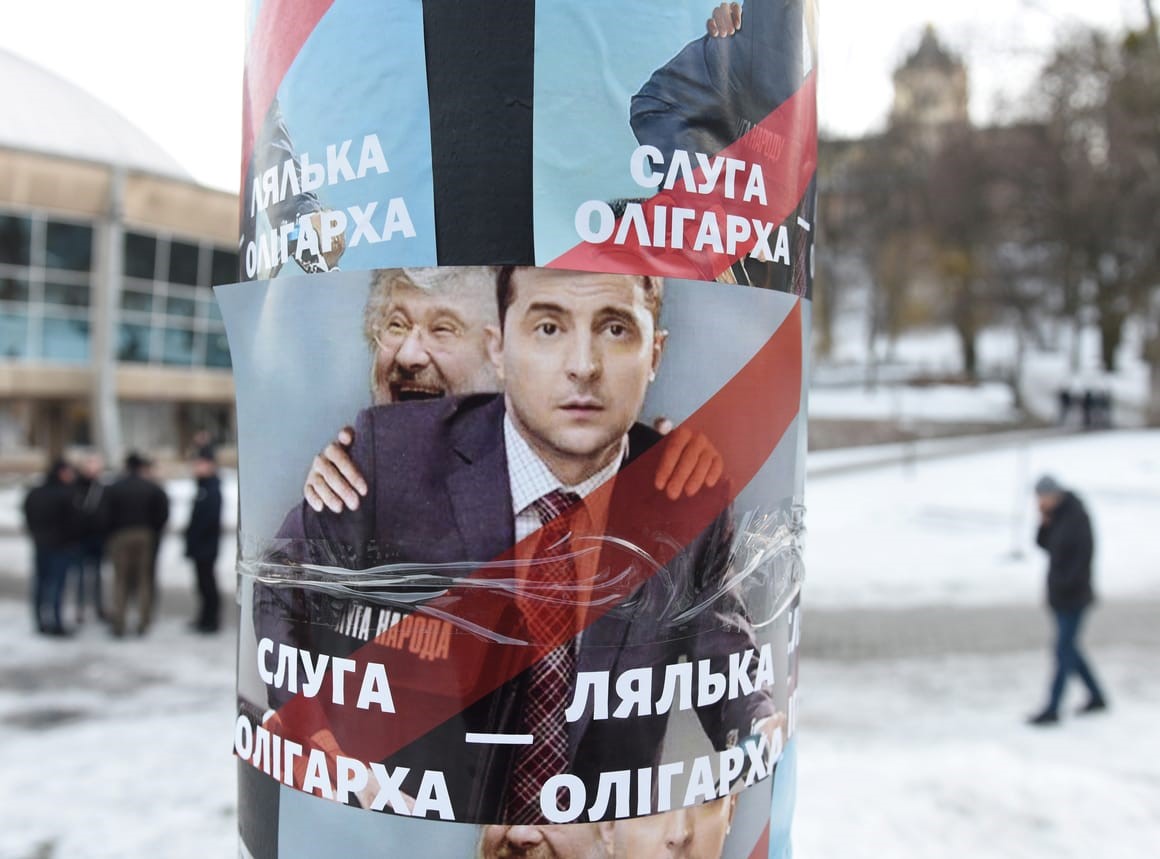
Now overshadowed by his reinvention as a kind of Second Coming of Winston Churchill, Zelensky’s first great transformation was that of a close associate of the worst of Ukraine’s oligarchs (Ihor Kolomoisky, discussed below) into an “anti-corruption” populist. Zelensky’s relationship with Kolomoisky goes back to around 2012, when Zelensky and the Jewish brothers Serhiy and Boris Shefir, began making content for Kolomoisky’s TV stations through their production production company, Kvartal 95. As is now well-known, Zelensky’s political ascent began after his starring role in the political satire ‘Servant of the People,’ which began airing on Kolomoisky’s 1+1 network in 2015. The 1+1 channel had been founded by another Jew, Alexander Rodnyansky. Servant of the People starred Zelensky as a school teacher whose anti-corruption rant in class is filmed by a student, goes viral, and wins him the presidency. Zelensky turned to real-world politics, capitalized on widespread public anger at corruption, and ended up winning the Presidency with ease just three-and-a-half years after the show’s launch.
Zelensky is entirely a media creation, a blank canvas upon which anything can be projected. Before the war, the German Council on Foreign Relations pointed out that “Zelensky has so far been very vague about his policies and vision for the future. So it has been extremely difficult to tell what he stands for or fact-check his largely policy-free statements in the way the experts have for other candidates. He rarely mentions facts.”
Zelensky’s 2019 campaign was dogged by doubts over his authenticity given his close association with Kolomoisky. Britain’s Royal Institute of International Affairs astutely observed that, even if Zelensky was earnest in his claims to oppose the corrupt, “he cannot govern without systema [the oligarchic structure] and will bow to its interests.” In the heat of the campaign, an ally of incumbent Petro Poroshenko (rumored to have a Jewish father), journalist Volodymyr Ariev (who also claims Jewish ancestry), published a chart on Facebook purporting to show that Zelensky and his television production partners were beneficiaries of a web of offshore firms, which they had set up beginning in 2012, that received $41M in funds from Kolomoisky’s Privatbank. Many of these allegations were proven correct after the leaking of the Pandora Papers, millions of files from 14 offshore service providers, to the International Consortium of Investigative Journalists.
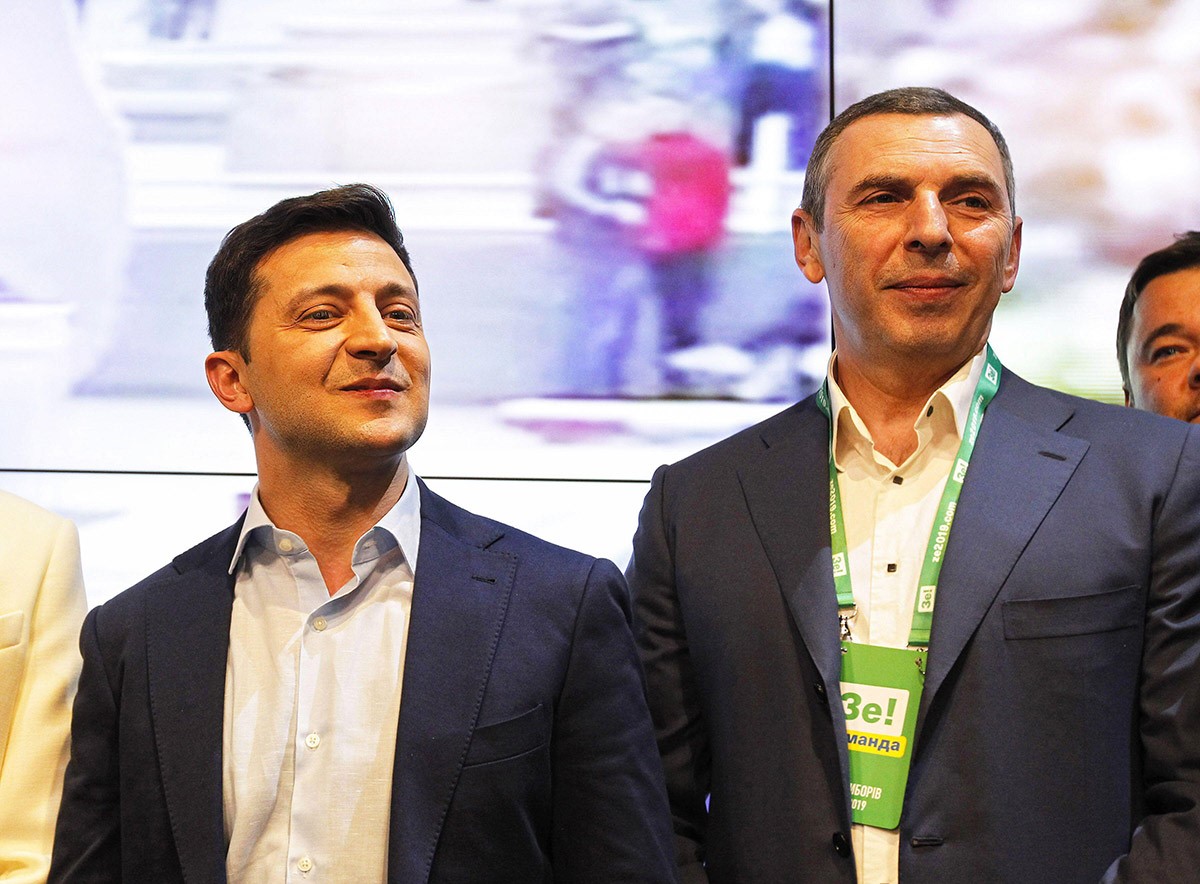
The documents show that Zelensky and his Jewish partners in Kvartal 95 set up a network of offshore firms dating back to at least 2012, the same year the company began making regular content for Ihor Kolomoisky. The offshores, which filtered Kolomoisky’s money through the British Virgin Islands (BVI), Belize, and Cyprus in order to avoid paying tax in Ukraine, were also used by Zelensky associates to purchase and own three prime properties in the center of London. The documents also show that just before he was elected, Zelensky gifted his stake in a key offshore company, the British Virgin Islands-registered Maltex Multicapital Corp., to Serhiy Shefir — soon to be his top presidential aide. And in spite of “giving up his shares,” the documents show that an arrangement was soon made that would allow the offshore to keep paying dividends to a company that now belongs to Zelensky’s wife.
Zelensky and Serhiy Shefir
Besides providing financial support during Ukraine’s 2019 election, Kolomoisky supplied Zelensky with cars, and the bulletproof Mercedes Zelensky used on the campaign trail was owned by Kolomoisky associate Timur Mindich — who is on the board of trustees of the Jewish Community of Dnipropetrovsk, a body of which Kolomoisky was president. Although Zelensky continued to deny that his relationship to Kolomoisky was anything but professional, the Kyiv Post reported in April 2019 that Zelensky traveled a total of 11 times to Geneva and an additional two times to Tel-Aviv, during precise periods when Kolomoisky was in these locations. Zelensky’s travel companions during these trips included Jewish oligarch and close Kolomoisky associate Gennadiy (Zvi Hirsch) Bogolyubov, and the brothers Hryhoriy and Ihor Surkis both whom have been accused of serious corruption. They are among the wealthiest people in Ukraine and are Jewish through their mother Rima Gorinshtein. The very Jewish character of these trips should come as no surprise given that, where possible, Zelensky likes to surround himself with Jewish aides. In the aftermath of the outbreak of war, for example, it emerged that he sought advice on public relations from two Likud-backing Israelis, Srulik Einhorn and Jonatan Urich.
Zelensky hasn’t exactly turned on the hand that fed him, and his rise coincided with the downfall of several of Kolomoisky’s opponents. After Zelensky became President, Kolomoisky’s nemesis at Ukraine’s central bank, Valeria Gontareva, was subjected to a sustained campaign of intimidation. Criminal proceedings were brought against her for alleged abuse of office during her time at the central bank, her Kiev flat was raided by the police, a car belonging to her daughter-in-law, also called Valeria Gontareva, was torched, and her house outside the Ukrainian capital was set ablaze and destroyed. Under Zelensky, Ukraine’s parliament passed a measure that prevented Kolomoisky from having to pay higher taxes on his mining operations, and prior to the start of the war with Russia all indications pointed to the renewed influence of interest groups opposed to reform. First, in March 2020, was the dismissal of the government of prime minister Oleksiy Honcharuk (who didn’t help his case by attending a concert headlined by an anti-Jewish heavy metal band), followed, a day later, by the removal from office of the reformist prosecutor-general, Ruslan Ryaboshapka. Then, in April, came the Constitutional Court’s blocking of judicial reforms, and a ruling by the same court, in October, that effectively paralyzed the work of the National Agency for Corruption Prevention. In July 2020 Zelensky forced the resignation of Yakov Smolii as National Bank of Ukraine (NBU) governor. After leaving his position, Smolii referred to “systematic political pressure” on the bank, and did not rule out a coincidence of interest between the President’s Office and Kolomoisky. He said that the President’s Office wanted to replace the NBU’s leadership with people it could control. Smolii’s resignation came shortly after Ukraine had received the first tranche of a new $5 billion IMF stand-by arrangement. A key condition for continued IMF support was the independence of the NBU, and the IMF had made it clear that it held Smolii and his team in high regard.
Seeking international assistance in the aftermath of Russia’s “special military operation,” Zelensky has done much to give the appearance of fighting corruption while actually doing very little. Western media and politicians in the last few weeks have lavished praise on Zelensky for a series of raids and dismissals tackling corruption in the country, but few charges have been brought and the raids have been perfectly timed with EU accession talks and attempts to obtain European financial and military assistance. Political commentator Yuriy Vishnevskyi pointed out the uselessness of the raid against Kolomoisky, stressing that “detectives knew perfectly well that they would most likely not find anything there, since Kolomoisky was not an official at [government bodies suspected of tax evasion]. It is doubtful that he compiled documents at home that would prove his involvement in criminal schemes.” Rumors that Zelensky has stripped Kolomoisky of his Ukrainian citizenship, along with the Ukrainian citizenship of Jewish oligarchs Hennadiy Korban and Vadim Rabinovich, have prompted counter-rumors that this is nothing more than a clever sleight of hand designed to free these figures from already weak anti-oligarch laws passed in 2022.
Ihor Kolomoisky – Supreme Parasite
Kolomoisky, who also holds Israeli and Cypriot citizenship, is probably one of the worst thieves to ever walk the earth, and there has been no greater parasite feeding on Ukrainians. Once named by the Center for Corruption and Organized Crime Research (OCCRP) as being in the top four most corrupt individuals on the planet, Kolomoisky used his ownership of PrivatBank to defraud customers of around $5.5 billion in deposits, which amounted to 40% of all private deposits in Ukraine. Although now banned from entering the United States, where he has numerous assets, Kolomoisky has never been arrested in Ukraine and Zelensky shows no indications of ever bringing him to justice. Regarded as criminal by almost anyone with a brain, Kolomoisky is a hero of the international Jewish community. In 2008 Kolomsoisky was elected President of the United Jewish Community of Ukraine, and in 2010 he was elected president of the European Jewish Council.
In keeping with centuries of the same historical pattern, large-scale Jewish financial crime perpetrated by small numbers of key actors continues to benefit the general Jewish population. Jews internationally have benefited for years from Kolomoisky’s plundering of the Ukrainian people. In March 2021 it emerged that two Miami-based Jews, Mordechai Korf, 48, and Uri Laber, 49, were acting as Kolomoisky’s middlemen in the United States. As well as laundering his money in various assets, the pair donated more than $11 million to nearly 70 yeshivas and religious charities (Jewish Educational Media, Colel Chabad, among others) in Brooklyn and across the state of New York. Kolomoisky is also a listed donor for Yad Vashem. Both Korf and Laber also held shares in PrivatBank, and are reported by The Forward as having pumped “about $25 million into Jewish nonprofits between 2006 and 2018.” Kolomoisky is of course the patron of “Menorah,” the largest Jewish center in the world. Entirely appropriate given its existence is owed to international robber barons, the center is home to travel agencies and banks. The official website says that the building is something “every Dnipro resident can be proud of,” to which I can only reply that I’d hope so given that, willingly or not, some of the savings and deposits of every Dnipro resident went into its construction.
Menorah – Largest Jewish Community Center in the World
One of the best examples of how Kolomoisky conducts business is his ownership of Dnipro Airport. In 2009 Kolomoisky bought 99.45% of shares in the airport through his company Galtera. Under the terms of the investment agreement, Galtera was to invest UAH 882.1 million in the development of the airport, and had to hand over the runway, radio beacon system, and land plots to the state. By 2015, Galtera had invested only UAH 142,145, and failed to turn over any real estate to the government. A sequence of litigations began, but with Ukraine’s justice system fully in thrall to the oligarchy, no resolution was ever reached. Kolomoisky, meanwhile, made flying from the airport so expensive (one commentator explained that even short flights carried fees that would elsewhere take one to space) that the citizens of Dnipro overwhelmingly opted to drive three hours to Kharkiv rather than pay the airport’s extortionate and inflated prices. On the bright side, they have an absolutely gargantuan Jewish center they can be proud of.
Jewish Invisibility in Ukraine
The lack of outcry over Ukrainian money going into Jewish pockets might seem surprising to Western observers but is perfectly explainable. There have certainly been no shortage of Jews acting parasitically in Ukraine. In addition to Kolomoisky and others named above, Hennadiy Kernes, Pavel Fuks, Andriy Yermak (now Head of the Office of the President of Ukraine), Hennadiy Korban, Vadim Rabinovich, Alexander Feldman, and Victor Pinchuk have engaged in fraud, corruption, and the amassing of vast amounts of wealth and power at the expense of the Ukrainian people. In Ukraine, however, pronounced examples of corruption and oligarchy are also found among other ethnic minority groups like Muslim Tatars (e.g. Rinat Akhmetov) and among ethnic Ukrainians themselves. The country is so corrupt that even clear examples of ethnic cohesion, such as the overlapping Jewish circles of Zelensky and Kolomoisky, fade into a broader picture of socio-political decay.
Discussion of the particularities of Jewish corruption in Ukraine became more difficult in September 2021 when Zelensky signed a new law defining the concept of anti-Semitism and establishing punishment for transgressions including imprisonment up to five years. The new laws mean that outbursts such as that by Vasily Vovk and Nadiya Savchenko will become a thing of the past. Vovk, a retired general who held a senior reserve rank with the Security Service of Ukraine wrote in a 2017 Facebook post that Jews “aren’t Ukrainians and I will destroy you along with Rabinovich. I’m telling you one more time — go to hell, zhidi [kikes], the Ukrainian people have had it to here with you. Ukraine must be governed by Ukrainians.” In the same year, Savchenko, a fighter jet pilot who was elected to parliament in 2014 while she was still being held as a prisoner of Russia, said during an interview “I have nothing against Jews. I do not like ‘kikes.’” She later said Jews possess “80 percent of the power in Ukraine when they only account for 2 percent of the population.”
Investigations into Jewish criminality are also being hampered by accusations of anti-Semitism, as witnessed in the May 2020 case involving Mykhailo Bank, a senior police official in the Ivano-Frankivsk region of Ukraine. As part of an investigation into “transnational and ethnic organized groups and criminal organizations,” Bank wrote to Yakov Zalischiker, the head of the Jewish community in the city of Kolomyia, demanding the names of all Jewish community members as well as those of foreign Jewish students staying in the city. Reading between the lines, one assumes that Bank had good reason to believe that these “transnational and ethnic organized groups and criminal organizations” were Jewish. Unfortunately for Bank, he was singled out by Eduard Dolinsky, Ukraine’s incarnation of the ADL’s Jonathan Greenblatt, who portrayed the demand as implying an impending Holocaust. “This is called stigmatization,” complained Dolinsky. “They [the National Police] did not send such a letter to the Greek Catholics or the Orthodox to compile lists in connection with the fight against organized crime. They turned to the Jews. This shows deep xenophobia.” The case was further amplified by the involvement of Jewish politician Igor Fris, who personally lobbied Zelensky about the matter. The head of the Department of Strategic Investigations of the National Police of Ukraine, Andriy Rubel, and the head of the National Police, Ihor Klymenko, were both forced into groveling apologies. Within weeks Bank was spontaneously “discovered” to have been involved in corruption and was quickly fired.
Finally, since Kolomoisky was one of the main funders of Ukrainian ultra-nationalist groups like Right Sector, was linked with the Svoboda party, and was involved with the Azov Battalion, Ukrainian ultra-nationalism has a strangely non-ethnic quality; or rather, it is concerned more with defining itself as being against Russia than in pushing for any kind of “Ukraine for Ukrainians” platform. As such, Ukrainian ultra-nationalism has become a kind of aggressive civic nationalism, harmless to Jews and other minorities but incendiary enough to play a part in provoking the massive conflict currently absorbing the attention of the world.
What kind of Ukraine will emerge from the ruins remains to be seen. What seems certain is that luxury homes in Florida, London, Geneva, and Tel Aviv will long continue to host those who’ve fattened themselves on Ukrainian money, and who continue to hoard their stolen profits while tens of thousands of body bags continue their somber transit to the graveyards of Kiev and Moscow.
https://www.theoccidentalobserver.net/wp-content/uploads/2018/06/TOO-Full-Logo-660x156-1.png00Andrew Joyce, Ph.D.https://www.theoccidentalobserver.net/wp-content/uploads/2018/06/TOO-Full-Logo-660x156-1.pngAndrew Joyce, Ph.D.2025-11-27 06:22:152025-11-27 13:24:12Jewish Corruption in Ukraine
The first and only time I met Alex Linder in person was at a Shakespeare’s Pizza in Columbia, Missouri more than 20 years ago. The rest of the encounters took place over email, or under the original red, blue and yellow banner of the Vanguard News Network.
The Madison Avenue-ready motto: “No Jews. Just Right.”
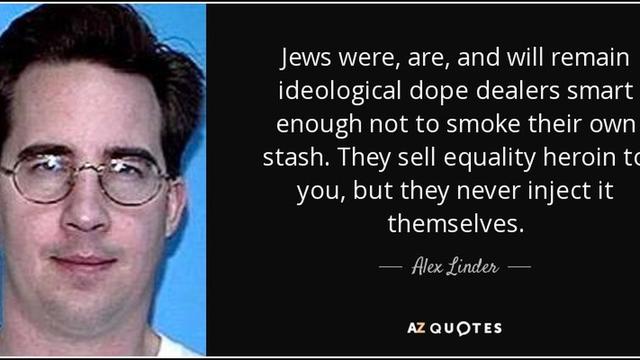
Linder, who died in June, 2025 at age 59, was the site’s editor. It was one of the most explosive white advocacy publications to ever to flash pixels. VNN, as it was also known, combined crude epithets, clever neologisms (“Amerikwa” combined America and Kwa Zulu, the autonomous zone for Zulus in South Africa), Yiddish endings (itz coming), the brilliant “spintro”, a pithy paragraph-like piece of writing that preceded a link, original writings, and links to other pro-white sources.
It was enough to earn Linder a visit from the FBI. Also, a place in the Internet archives of the Library of Congress.
At Shakespeare’s, I wondered if the table was bugged (and he may have wondered if I were wearing a wire), but within a few minutes, I gathered he was serious. He handed me some CD’s of material he’d burned, and it was the first time I’d ever heard another human being use the term “pro-white” out loud.
It was jarring, even for someone like me, who was in the early stages of exploring white advocacy. I don’t know what to make of the fact that of all the white advocates out there, he was the first one I met in person.
I held to his resumé to persuade myself he wasn’t completely nuts: graduate of academically strong Pomona College, a researcher for Evans & Novak (one of my parents’ favorite shows), and some kind of work for The American Spectator, though I never saw a byline. His interest in D.C. politics and journalism matched mine.
The white-hot intensity of Linder’s thinking and writing prevented anything resembling a normal life, or even a “normal” life of white advocacy. He clashed with just about everyone. He lobbed insults at Sam Francis, Jared Taylor and Peter Brimelow, among others — men who themselves suffered repercussions for white advocacy, but whose failure to “Name the Jew” to his satisfaction earned his scorn.
Of Pat Buchanan he said: “When you talk about Hitler, you’re looking up, not down.” He associated with a man who committed a shooting at a synagogue that resulted in the death of three people, none of whom were Jewish.
How this advanced the cause of white advocacy is anyone’s guess.
Jesus Christ was “jeeboo”, as in, “if you believe in jeeboo, white man, you’ll believe in anything,and that’ll get you dead.” Not an exact quote — I’m going for the spirit.
On VDare, Brimelow called him “a white radical agent provocateur… savagely witty but scabrously incorrect … and “whatever else you can say about Linder, he can write.”
One wonders what Linder would have said about Nick Fuentes.
“No Way Out But Through the Jew” he would write, over and over, a phrase that could of course be interpreted as “a critical mass of whites must understand Jews and their motivations, and work to decrease their influence, if we are to survive”, instead of mass killing, which is surely how the ADL would interpret it.
Of course, Israel acts as if there is “No Way Out But Through the Palestinian”, and few seem bothered — or, if they do, Israel is proceeding apace nevertheless. Nor does Baruch Goldstein’s massacre of worshippers at a mosque seem to cause personal embarrassment or discomfort to Jews.
Note for the record that Linder never killed anyone, nor was he ever convicted of anything but disorderly conduct. He struggled with a police officer at a protest.
A favorite crudely-lettered sign: “Civil Rights is Jewish Tyranny in Blackface.” He held it up, wearing a tweed jacket and scholarly glasses.
Some energy forms, like the fire in a fireplace, can be contained. Linder, by contrast, was like some kind of molten liquid that would burn through the jar into which it was poured, through the table, and through the floor below.
Two views: an obsessed mind whose asynchronous endorsements of racial violence, open hostility to Christianity and inability to coordinate with even the staunchest of white activists doomed him to unmentionable status.
Or: a sharp mind whose understanding of the Jewish threat was communicated in blunt language, and who understood how humor can help to get a point across.
His entire life was dedicated to sounding this one alarm.
In the course of one e-mail conversation, he acknowledged: “I know this is rough stuff. But keep your eyes open, follow current events, and see if I’m not right.”
Linder thought it was funny that whites were scared to even think certain thoughts or speak certain words, while our racial opponents not only didn’t fear thinking or writing about acting against us. They actually did it.
His constant bashing of Christianity added to Linder’s prickle. He was gleefully doing this until his death, the Twitter record shows. But that was all just pure Linder: crashing the party to choquer les foules, and watching the terrified looks on everyone’s faces.
He once mused on what kind of men would lead us out of our mess. He predicted that it would not be a southern man. Rather, it would be someone brash from the New York area or maybe the Midwest.
When Trump won the first time, this thought crossed my mind.
Parallels between Linder and Trump are difficult to ignore. Both men cause even their strongest supporters to cringe on occasion. Recklessness comes standard. Actually taking action and getting things done is a virtue.
They even shared a penchant for nicknames. “Appeaser Annie,” Linder would call Ann Coulter, among other nicknames that sound Trumpian.
Linder’s ideal was the German man. He dismissed “WASPs and Irishmen” as tipsy backslapping dealmakers and bribe-takers too cowardly to simply pick up the sword and start swinging.
He predicted the “manosphere” observation that women are generally unfit for politics, noting “women’s socio-biological function and concern is birthing and binding families, and in that regard harmoniousness is the very definition of success. But politics is about big groups of people dividing and fighting” (“On Women and Their Proper Relation to White Nationalism,” loaded 7/10/2003, VNN.) [1] A list of Linder’s writings may be found at: https://www.alexlinder.com/writings.html.
In “For Conservatives Ignorant of the Jewish Question”, Linder wrote the subhead: They aren’t liberals, they aren’t conservatives, they’re Jews. Miss that and you miss everything.”
There is, by my observation of platforms like X, an increasing understanding of this.
In reading about all the Jewish figures to emerge from the Jeffrey Epstein e-mails, I had to laugh. There’s Lawrence Summers right alongside Noam Chomsky right alongside Ehud Barak. There’s no “conservative” or “liberal” there. They’re all just Jews, the end. They network for wealth, prestige and powe
r, regardless of whether they’re calling themselves liberal, conservative or radical.
Miss that and you miss everything.
I just got done watching a New York Times podcast interview between Ross Douthat, their house conservative, and Yoram Hazony, the Israeli leader of the “National Conservative” movement. Over the course of an hour, Hazony was asked about the rise of “antisemitism” on the American right and the “threat” posed by figures like Nick Fuentes and Tucker Carlson. Hazony never engaged with the substance of anything Fuentes or Carlson ever said. He told Douthat that true nationalism has nothing to do with race.
“Semitically correct”, Linder would have snorted. “Nationalism made safe for Jews.”
His business card read, “Cultural Chemotherapy. P.C. is a Disease. Get Cured”.
In many ways, Linder tracked the mindset of an old-school, cigar-chomping newspaper editor:
If you’re going to write, say what you mean and mean what you say. Don’t waste our time.
Don’t lard it up with useless corporate-speak. Don’t spin out pointless and boring
articles that serve no purpose. Get right to the point.
Have a little fun while you’re at it. “With a high, hard Viking laugh”, he’d say.
He protested on VNN that while “scary and dangerous racist” was his label, he actually spoke for the good guys. “We’re the ones protecting a little white girl
in a pinafore dress playing happily on the sidewalk. The Jews are the bad guys, not us.” Or something like that.
Linder observed that “Jews dictate to us. We should be dictating to them.”
Sounds like a healthy mindset for a white man to me.
Today, when I read a New York Times piece by “Binyamin Appelbaum” promoting Pennsylvania governor Josh Shapiro, I’m reminded of Linder. When I read about Bari Weiss posing as a “dangerous thinker”, I think of Linder. When I see a headline reading “Israel is at War With Itself,” I think of Linder. Another New York Times headline for him: “Adam Sandler is the Light We Need. Yes, Adam Sandler.” Author: one Joanna Novak.
Cue Linder, over and over.
Linder was especially amused by the spectacle of the tough-guy conservative writer who turned into a stammering coward on the topic of Jews. Tough everywhere except where it most counts, he would write.
I know of no white advocacy writer who dropped as many memorable one-liners.
“Racism is just conservatism with descended testicles.”
“Nothing was ever improved by adding Mexicans to it.”
“There’s nothing wrong with Indians. They just belong in India.”
“Jew set up, Jew knock down.”
For all the missteps, I do believe Linder was motivated by an acute sense of justice. It drove him crazy that Jews could get away with the injustices they did and never get called out for it, and instead be hailed as the world’s ultimate victims. And on top of that, paint anyone who so much as hinted at this as the worst imaginable evil in our society.
He resented the fact that white suffering was denied and ignored.
Linder had quirks. For some reason, he was a big fan of the Black football coach Tony Dungy. He once he tossed out a word of admiration for Jewish men by declaring that when actual threats begin to mount and surround them, Jewish males will get together and “act like men.” Yes, Linder said that.
The implication was that white men do not currently “act like men.”
I didn’t know anything about Linder’s personal life. I’m sure your average SPLC investigator could tell you more than I could. I just didn’t find myself interested in gossipy items.
I didn’t know much about his health struggles, either. Just that Crohn’s disease was mentioned, and later, that he’d died of cancer.
But for whatever else you can say about Linder, his sheer brashness made a mark on white advocacy.
As we parted that night so many years ago, I expressed concerns about his future prospects and personal safety.
Outside the pizza place, he turned back toward me and swung open his trenchcoat. “If they want me, here I am. Come and get me.”
He then disappeared into the cold Missouri night.
Christopher Donovan has contributed many pieces to The Occidental Observer and The Occidental Quarterly.
https://www.theoccidentalobserver.net/wp-content/uploads/2018/06/TOO-Full-Logo-660x156-1.png00Christopher Donovanhttps://www.theoccidentalobserver.net/wp-content/uploads/2018/06/TOO-Full-Logo-660x156-1.pngChristopher Donovan2025-11-26 07:29:542025-11-26 10:32:56White Radical Agent Provocateur: An Alex Linder Remembrance
Free Solo, instead, is largely about the intensity of knowing a person like [Alex] Honnold, of having someone so unusual in your life, and the ways in which he bewitches, excites, and frightens the people around him simply by doing his job.
My fear of heights has increased with age — I do not recall it being an issue when I was younger. While I have no fear of commercial air travel, I have developed an intense fear of heights — even modest ones. It struck me a few years ago when I hiked Crowders Mountain near Charlotte, North Carolina with my family. I took the “easy” path of seemingly hundreds of trail rock steps to the 1,600-foot summit, which offers incredible views of the surrounding area. Upon reaching it, I took one look around and decided that the view itself was too much: I began to have something more than anxiety but less than a full-blown panic attack. I almost immediately (and embarrassedly) tucked tail and made haste to descend the mountain. There are even more embarrassing episodes of my fear of heights that I will not belabor here (like my anxiety on Ferris Wheels) but the nub of my fear appears to be when the place of height lacks adequate (at least to me) safety measures. In any event, I am certainly — and markedly — afraid of heights now.
Understanding my fear of heights is important in understanding my reaction to the 2018 documentary Free Solo. Free Solo is not just a documentary about rock climbing in its most extreme form — it is an incredible journey in the psychological portrait of an obsessive type of Western man. The film follows professional rock climber Alex Honnold as he prepares to free solo El Capitan in Yosemite National Park. Free solo rock climbing is a form of climbing where the climber ascends without the use of ropes or protective gear, relying solely on their climbing shoes and chalk for grip. This style of climbing emphasizes the climber’s skill and mental fortitude, as any fall can result in serious injury or death. While extreme sports have become a fad of sorts in the last forty years — mostly individual sports that simultaneously push adrenaline and limits beyond measure — free solo rock climbing is perhaps the most extreme of them all.
El Capitan — or the El Cap — is a vertical rock formation in Yosemite National Park, on the north side of Yosemite Valley, near its western end. The granite monolith is about 3,000 feet from base to summit along its tallest face and is a world-celebrated location for big wall climbing. To see it — to see its almost flawless granite verticality — it is be stunned that anyone could climb even with the most prophylactic safety equipment let alone climb with none. Just looking at it gave me chills — it is that impressive. Alex Honnold was the first man ever to free solo this mountain — and this first was captured by Free Solo. It is never lost on the viewer (or at least this one) that this was easily a film that could have never seen the theaters had Honnold slipped to his death on camera. Watching him scale the face of El Cap is itself a marvel that he did not.
Three things stand about the work as a documentary. First, it is visually stunning. Any nature footage of Yosemite is bound to impress, and everything there seems almost prehistoric and larger than life. It is creation in its purest and most unadulterated form. The film captures this beauty and grandeur as well as any nature documentary has. The film zeroes in on Honnald’s climbing — and moves in, as it were, to the crevices, cracks, and depressions on the face of the mountain. Instead of the smooth appearance that El Cap has from a thousand feet away, it is a highly textured labyrinth of creases that the film highlights. Second, the film is a study into the mind of an extreme athlete — Honnold is a very unusual psychological specimen. The film does its best, albeit in very brief interludes, to offer some insight into the mind of a free soloist. Third, the documentary is drama-filled with ethical dilemmas and emotional strain. The people who assist and accompany Honnold on this journey — from his film crew to his fellow rock climbers who train with him; from his girlfriend to his mother — are struck by the problem of helping Honnold do something that is so incredibly dangerous on its face. That the filmmakers, who are Honnold’s longtime friends, might be filming contemporaneously his death is never lost on them. That his climbing companions may be training with him for the same is similarly difficult for them to process.
It is a mesmeric film — one that I was late, by seven years, seeing when it was first released. A close friend — someone who shares a similar personality, at least in some ways, to Alex Honnold — recommended the movie to me. Unlike me, this friend is someone who shares an affinity for extreme adventures. In a just a little bit different life, he could have been someone like Alex Honnold.
Alex Hannold at Yosemite
* * * *
Free Solo was a documentary that was acclaimed by virtually everyone who saw it. It won the Academy Award for best documentary in 2018 — and, based upon my research, every major publication — of every conceivable stripe — seemingly had something (universally positive) to say about it. In an age in which heroes are a dead letter and in which religion is a tacky anachronism, Free Solo strikes a chord for a type of man who is alive in doing something extreme. No, really extreme. It is a perfect statement of secular religion, or, at least, a type of secular religion. Embodied within it is a type of secular holiness that bears a relation, albeit for different reasons, for the hard things done by men in ages past. Man, in the age without God, seeks his Zen in highly idiosyncratic ways but it is to be found, or so he thinks, if that way is authentic and radically his own. I cannot recall a character who exemplifies Zen in the secular sense more than Alex Honnold. To demonstrate how powerful this image is, I, as a man who is deeply committed to the most retrograde and traditional form of Catholicism, found myself mesmerized by him. I too am a creature of my age.
But enough has been written — more in fact — about the mind of the extreme athlete in Alex Honnold. While he is, to say the very least, an intriguing and mystifying human being, most of what has been written about his documentary would be, to the extent he cared, agreeable to him. There is something else that fascinated me about him — something I think he would find it much less fascinating but just as compelling to me. That is, Honnold as the archetype of the Western man — the European man. Let me unpack that: Honnold appears to have generic modern liberal sensibilities. He is a vegetarian and an environmentalist. His foundation is based upon environmental micro-investments for impoverished Third World communities. He grew up in California. He ostensibly is irreligious and shacks up with his girlfriend in his home (a van). Other than his habit for undertaking this extreme activity, he strikes me very much as a man with conventional California liberal beliefs and views. While I would not describe him as a “hippie,” he is seemingly comfortable in their midst and aping their worldview (when he is not thinking about rock climbing, which is evidently not very often). To say that he would disdain what I am going to write it is to put it mildly, yet it was what struck me after taking in the whole of who — and what — this man is.
Let me offer politically incorrect assumptions on several counts and digress for a moment from free soloing. To situate my comments and observation, something must be said of race. First, races exist — not as social constructs, but as durable biological categories. Moreover, various races differ on average in myriad ways. The traditional understanding of race, which is just another word for the biological term “sub-species,” historically subdivided people into five categories: Caucasian (White); Mongoloid (Asian); Negroid (Sub-Saharan African); Australoid (Aborigine); and Amerindian. If race were not such a dirty word, I am sure that greater precision in definitional terms would have developed. Obviously, race is not so rigid that its categories are impermeable, and the borders between groups give way to zones of racial and geographical clines but the general proposition holds that racial groups differ from one another in meaningful ways. While “race” is an objectionable word among Western elites, “population groups” is a more anodyne way of saying the same thing among contemporaries. The meaningful differences between groups are something that can be registered internally but rarely spoken of in so-called polite company. So, that East Asians, for example, generally have a higher intelligence (as measured by a range of intellectual assessments) is noticed but seldom mentioned. That Sub-Saharan Africans surpass other groups in a variety of athletic feats (mostly those that rely upon fast twitch muscles) is similarly noticed.
We are not allowed to mention racial differences, in part, because of the implications of these differences — especially in modern, pluralistic societies like those common in the post-Christian Western world. It is not deemed an acceptable thing to say, for example, that the primary reason that African Americans do not obtain proportional admission (without substantial assistance) as a group to America’s elite universities is because they are, on average, less intelligent than the average intelligence of the competitor groups in Whites (which is just shorthand for European) and East Asians. Likewise, it is similarly verboten to say that the reason why African Americans disproportionately populate American prisons (and therefore disproportionately engage in anti-social criminal activity) is that they generally have a greater average tendency towards anti-social behavior, or, put differently, have lesser levels, on average, of self-control. Explanations for social phenomenon such as these are considered outside of acceptable discourse, and, as such, other explanations for different outcomes among racial or population groups must be considered. If one understands this, it makes perfect sense why, in an era in which racial discrimination is heavily penalized socially and legally, that a concept like “systemic racism” is used to capture an alleged mythical explanation for different racial outcomes — one that has no basis — as opposed to the more obvious one that racial or genetic distinctions largely account for different outcomes.
It is understandable to me why some have deemed race beyond acceptable discourse. There is something unseemly about it — something that offends good manners. If we accept that which we see in front of us — that is, racial differences obviously exist — we sense that there is an unfairness to it because race is, after all, an immutable characteristic that seemingly divests people of agency. The determinism of race has an ugly side. It seems plausible to me that many might accept the reality of race but deny its legitimacy of inclusion in public discourse because to do so would allow the public to use race as a shorthand for intelligence, work ethics, or criminality. Exceptions to average outcomes of course exist, of course; perhaps the thinking is that to allow a greater room for race to be included in public discourse is to allow unfair racial discrimination to flourish and create a self-fulfilling cycle of divergent racial outcomes.
The objections to taking race seriously come from more than Western liberal elites: they also come from the minority of committed Christians in Western societies. Christianity, as the great universalizing force in world history, rejects tribal or racial identity as particularly instructive, let alone destiny-making, in determining whether any man can be saved. To admit racial differences is to call into question, at least superficially, whether that maxim is true in the main. If all men are essentially equal in dignity before God and Church, which is what Christianity posits, then can groups of men meaningfully differ in racial attributes that make effecting that dignity real? I have struggled with that question for many years now as a committed Catholic — my mind and soul want the essential dignity of all men to mean that all groups are of equal abilities and attributes. Parenthetically, beyond religion, is not the American ideal of meritocracy predicated on such an assumption? But, upon years of reflection upon it, there is nothing particularly offensive about racial group differences and the Christian premise of essential dignity of all men. To a finer point on it, Christians readily acknowledge that differences of ability, temperament, and intelligence exist among individual men. Indeed, it is obvious as the day is long. I may be smarter, more athletic, and more peaceful than some but there are many who are better than me in every one of those regards. These differences do not call into question the essential dignity of all men — they co-exist. I do not feel inferior when I am around someone who is my better in some or all regards because I am essentially the equal of any man.
That different families, kinship communities, and nations should have similar group-level differences likewise should not call into question the essential dignity of men. That races, as the outer ring of population distinctions, also have differences as a result likewise should not be offensive. But more to the point, a reconciliation must be cognizable because I believe that Christianity is true and the faith as it is will never contradict natural truths. If race — and racial differences — are true as a matter of nature (and the powerful cocktail of geography, genetics, and time that make racial differences plausible), then racial differences and Christianity must be reconcilable.
For my own part, my intellectual and spiritual reconciliation of race and religion comes with certain moral demands: first, Christianity requires for the group as much as the individual that we exercise a profound humility. All have fallen and therefore no man or no collection of men bound by kinship is permitted to glory in themselves — only in God. That means even if we acknowledge differences, the relative hierarchy of men in view of those differences, whatever they may be, is irrelevant to their dignity as men. East Asians, for example, are not better versions of human beings because they are, on average, smarter than the rest of the world. It is difficult for me to claim that denying, for example, this reality (East Asian intelligence) is itself a virtue. Second, Christians are duty-bound to treat both kin and stranger (which is another way to say those from within and without of our racial group) with the same human dignity. The missionary impulse to convert all nations, given to the Apostles by our Lord, carries with an implicit conviction that all nations are worthy to be saved. Race then may be real, but it never warrants, at least for the Christian, a belief in essential superiority or inferiority of one group versus another on the plane of human dignity. But nor does it require, in service of the notion of essential human dignity, that we deny the existence of differences that exist among individual men or groups of men. They exist and make up what we might term the hard landscape of human existence in this world.
Race then is not a social construct — it is a principle derived from biology and nature. Men tend not to use it as a social concept or organizing principle. Race becomes relevant, at least to me, as a proxy for civilization. If civilization is the outer limit of human social organization and race is the outer limit of group differences, it makes sense, and is indeed borne out, that different races make different civilizations. European civilization is different from East Asian civilization and so on. Obviously, religion plays an outsized influence on civilization but so do racial attributes. The West looks like it does — the people within it have the assumptions and customs that they do — because, in large part, it was created by a particular racial group (Whites) who themselves had collective abilities and temperaments that fit the civilization they created. The same is true for every other civilization.
I am a White (read: European) American who is comfortable in Western Civilization. One of the demeaning characteristics of the elitist crusade against race is that Whites like me are — ironically — told that our particular race and our particular civilization (Western) is uniquely depraved (which violates the seeming social canon that race does not exist as a category and, in any event, should never be used as a cudgel against people born into that non-existent category). I became racially-conscious later in life (at about the same time I discovered my fear of heights) because of the official racial bias and bile that poured forth from elitist circles upon me and my own. To distill this further, when I had the full complement of children that God would give me, I found the racial bias and animus against them far more offensive than it had ever been against me. If my racial consciousness is offensive, and I am sure it is, the people to be blamed are the militant “anti-racists” in positions of power that showered upon me and my own that we are somehow qualitatively worse human beings for being born White. I did not believe that was true for other races; I will not believe it about my own either.
If my racial consciousness was initiated through what was essentially a negation of the official elitist hostility towards Whites, my evolution has been a more nuanced view based upon the positives of belonging to this group and civilization. To put it differently, I may have started this path in protest of racism shown towards me, but I have ended it with an affinity towards my own. To be sure, this is not a matter of racial superiority (indeed, my religion will not countenance it), but it is a recognition that my people — that is, Whites — are reasonable in wanting the perpetuation of their civilization, which can only come if Whites perpetuate themselves as a group. Under conventional conversational mores, it is perfectly acceptable for an African-American to indicate his or her preference for a Black spouse or their children’s marriage to a Black man or woman; to swap out, however “White” for Black in that sentiment is to, evidently, ride with the Klan. In that sense, I have a strong preference that my White children marry others from my racial group. While Catholicism trumps race in terms of marriage for my children, race is something too in the way that I think about it. Perhaps nothing more offensive could be said by a White man today — the truth is that I care little for the opinion of the people who it would offend. I see now, in a way that I did not see before, that Whites add something special to the world that is worthy of perpetuation. And if I can indulge the thought a bit more, Whites are, as a group, an unusually empathetic group of people — a caring race — which is why, or so it seems to me, God chose them to be the main missionary engine of His Holy Church. There is a double irony there. Whites are depicted by Western elites and race hustlers as uniquely evil as a group — the truth is something far different. To be clear, Whites are not a “new” chosen people and other races have different gifts too that I do not deny. But my view is that my people — my extended kin in the form of Whites — have co-created a wonderful civilization that is laudable. It is something that I can say that I am proud of without any form of customary “White Guilt”. Indeed, I refuse that now.
So native Europeans — both in Europe and in the vast European diaspora — have much to be proud of in the accomplishments of their people and the civilization that they created. They have been on the forefront of virtually every civilizational advance — and what is more, they exported those advances. The Chinese, in particular, match Europeans in many regards in their civilizational greatness but as is well known, they famously built a wall around their civilization instead of sharing it. In any event, from virtually every field of human accomplishment, Europeans have done incredible things for which is more than acceptable to both take cognizance of — and be proud of — as a member of that group and civilization. The world, as it is, organizes itself in a model given to it by Europeans — in arts, sciences, technology, culture, and economics given to it also by Europeans. And the question remains, why did the world tilt in such a distinctively European way? While that is a complex question, it does strike me that there is something uniquely curious in Europeans — something restless and adventurous among them. In every endeavor of human searching, Europeans have been among the forefront of discovery. Why is that? Prof. Ricardo Duchesne’s Faustian Man.
In his own unique way, Alex Honnold is an exemplar of this intrepid racial type found among a class of Europeans who fueled Western Civilization’s greatness. To look at him is not to see any particular attribute of greatness — he is seemingly an ordinary man. But his inner drive is Herculean — it is positively Faustian. His desire for excellence is otherworldly. And what makes him so unique is there is almost no hint of vanity or gain — he undertakes this incredible effort only to satiate his innate inner need to do it. Europe has produced men like this in seemingly every generation, and they are the great men of their ages. They did it not for fame — not for money — not for acclaim but because their nature made them reach for something beyond them and focus upon it with a monomaniacal obtuseness that is incredible to behold. In Honnold, I saw Alexander the Great. I saw Julius Caeser. I saw Constantine. I saw Saint Augustine. I saw Charlemagne. I saw Richard the Lionhearted. I saw Jean Parisot de Valette. I saw Columbus. I saw Hernan Cortez. I saw Pizzaro. I saw Oliver Cromwell. I saw Jacques Cathelineau. I saw Napolean. I saw Ernest Shackleton. I could go on, but I won’t. There is fearlessness and restlessness in the greatest of my people that manifests itself in magnitude for nothing other than the greatness of the challenge and the iron will to see it through. And to those who would say that Christianity crimps Western man’s greatness, behold how many of our best men were devoted Christians. Christianity, notwithstanding whatever Frederich Nietzsche said, does not create men without chests. We have had many Christian European men much greater than Nietzsche to ever count.
All the greatest mountaineers were European men — simply because, as Oswald Spengler realized, the urge to explore, to reach the highest, to do what no man has done before, is strictly a White male attribute.
Even though Alex Honnold, in his breezy California liberalism would balk at the comparison and the point, he is nonetheless prisoner to a legacy that runs through his blood. He is a man who would rather die than compromise. He is a man who seeks something impossible because it is impossible. That Christianity lost my people in the main means that it lost people of singular greatness like Alex Honnold. I may see things more clearly, and I think I do, but I will never touch the greatness of a man like him in this life. And it has little to do with rock climbing but everything to do with the spirit of a warrior willing to sacrifice — willing to not count the cost of the battle before fighting. Alex Honnold is great not because he free soloed El Cap, as incredible as that was, but because he both wanted to do it and was willing to suffer the privations that accompanied it until it was accomplished, or he died. And while he would disown me publicly for my racial acclaim, I am proud that he is of my own kind.
Oh, that the Church might gain men like him again and my civilization and people might rise again. That we may once more put that distinctive European proclivity towards greatness once again at the service of Holy Mother Church. When this greatness is married to grace — when this otherworldly resolve is fixed towards God — the world becomes a European project for Christ. Oh, that might it be again.
Saint Boniface, Pray for Us.
https://www.theoccidentalobserver.net/wp-content/uploads/2018/06/TOO-Full-Logo-660x156-1.png00Bernard M. Smithhttps://www.theoccidentalobserver.net/wp-content/uploads/2018/06/TOO-Full-Logo-660x156-1.pngBernard M. Smith2025-11-25 08:19:142025-11-26 07:01:54Alex Honnold, Free-Soloing, and a Christian View on Race
The new guy is just as bad, but smoother, silkier. He is mild mannered and polite and smiles more and praises the Latin Mass while restricting it’s use.
Total silence about the takeover of the Catholic Church in China by the Communist Party. There was a shameful deal done with the Communists to allow them to choose bishops. They have naturally taken full advantage of this and are forcing communist priests ón the laity. The anti-Communist trad Catholics beg for help from the Vatican and the first American pope turns a deaf ear. The very old Cardinal Zen is allowed to speak out, but the Pope himself clearly favours the communists.
Leo XIV has criticised deporting foreigners and utters the familiar sickly sweet injunctions to help the poor refugees, even as the refugees attack women and damage churches. As Trad Catholics are quick to point out, the Vatican City has high walls around it and prison terms for entering illegally. The US Church was happy to accept billions fron Biden to facilitate immigration but no Nigerians need apply for asylum in the Vatican. Prevost could fit tens of thousands in there, if he wanted to.
It would take a book to tell the story of every rapist and degenerate protected by Francis. Pope Leo continues the style. Let us examine a representative trio. Father Rupnik got expelled from the priesthood for assembling a harem of nuns and using spiritual jargon and the various accroutements of religion to seduce them. Not technically a rapist, but definitely a cad. Pope Francis reinstated him as priest and it seems that Chicago Leo sees no problem with his continued presence.
Cupich is Archbishop of Chicago and notorious for his pro-abortion, pro-LGBTQ attitude. He wanted to give a “lifetime achievement award” to Illinois Senator Dick Durbin, a leftist Democrat. Pope Leo has promoted him to the Pontifical Commission for the Vatican City State.
The king of this trio of rogues is good old King Charles III, brother of Epstein pal Prince Andrew. Charles was friendly for many years with the evil Jimmy Saville, a man who boasted of being catholic. The Royals even gave him a knighthood. What does Pope Prevost do? Give the King some special award. It is sold as a move to convert the English. It is just another example of Prevost’s poor choice of company.
Charles should be careful associating with degenerate Prevost. The most patriotic people in the whole UK are of course the Ulster Prods. They are a million strong, lots of them are Army and they very well informed and critical of the British deep state. Their oath of loyalty to the king is specifically conditional on the king upholding the religion. They dislike the Royal Family intensely. — “A nest of vipers” said one Orangeman. They are renaming streets and digging up trees that the once popular prince planted. They know already that Charles is a degenerate and here he is associating with an equally degenerate Pope?
The Orange Order issued a public letter to the king, urging him to reflect on his coronation oath. Ian Paisley Jr. has called for the king to abdicate. Next summer, if Charles is still on the throne, perhaps the Orangemen will place four figures on top of their towering bonfires. Charles, Andrew, Jimmy and Jeffrey. And all the King’s policemen and all the King’s spies will be too scared to take them down again.
Infiltration in the Church is not new or surprising. A thousand writers will tell you the Protocols are forged, but few dispute the Illuminati documents, from a century earlier. They tell a similar story of a vast evil conspiracy and boast that they had many priests enrolled and they controlled seminaries in Bavaria. This was two hundred years ago, and they have been busy since. Bella Dodd was involved in training a thousand communists in the US to infiltrate the priesthood in the 1930s.
There is a rule for what to do if an evil Pope gets elected.
Pope Nicholas II published a Bull, In Nomine Domini, April 13, 1059:
3. Wherefore, if the perversity of depraved, and iniquitous men, so prevail, that a pure, sincere and free election cannot be held in the City, the Cardinal Bishops with the religious Clerics, and the Catholic laity, even though few, obtain the right of power (ius potestatis) to elect the Pontiff of the Apostolic See, where it might be fitting.
It’s an old rule, and no doubt some will argue that it has been superceded by newer rules. But there seems to be no specific mention of it being repealed, so that means it is still in force.
Either way it doesn’t matter. Rules are wonderful but their application depends ón power. You can no doubt think of many cases where perfectly good and valid rules, widely accepted by all, are broken with smirking impunity by Somebody in Authority. If you draw their attention to it, it is quite common that they will jeer at you and boast of their immunity. Prison officers are notorious for this, but it is increasingly common everywhere.
Even if this law has been officially superceded, we can reinstate it. It is difficult to do but simple to describe. All we have to do is assemble a huge disciplined crowd. 200,000 would do it. Fill St Peter’s Square with people chanting insults about Prevost and urging him to flee.
It’s unlikely the Swiss Guards would open fire. It’s slightly more likely that the masonic Italian state would attack the protest but that is not very likely. A quarter of a million people for 24 hours in St Peter’s Square would do it.
A reasonable definition of a Trad catholic is someone who is aware of masonic and Jewish infiltration of the Church and is not happy with it. At least one tenth of nominal Catholics are Trad. There are enough Trads living in Rome to make the numbers. There are millions more in the rest of Italy and in France and Germany. A little further and we have millions more Trads in Spain and Poland. If one out of every hundred of Europe’s trad catholics decide to make a pilgrimage to Rome, it will all be over for Prevost.
The fake Pope will flee. There are a handful of honest priests. They will appoint Mel Gibson as pope with a mission to clean out the church.
There is a man from New Jersey working on making this happen, Brother Bugnolo (www.fromrome.info). He says he has mailed out about 3500 letters of legal notice to the Clergy of the Diocese of Rome and the suburbican Dioceses, and received confirmation of receipt. He has explained in Italian the legal problems with the Conclave, and has informed them of their rights. He has asked them to speak to one another and put the College of Cardinals on notice, as is their right and responsibility. I don’t know if this Brother Bugnolo guy is legit. Perhaps he will just steal any donations. But the concept he is promoting is reasonable.
He has even priced the organising of the mass assembly of the faithful: Including advertising, posters and permits it amounts to about $250,000.
“As of November 1, 2025, about $25,100 has been raised for this project. Expenses for posters in the City of Rome alone, printing costs & municipal fees for placement, is about $27,500. And so we are just at the beginning of the fund raising. Since posters should be placed in all the cities around Rome inside the suburbican Dioceses, and together that probably would raise this costs for posters and municipal fees to maybe $40,000 to $50,000.”
Br Bugnolo has interesting research on Pope Bob. Prevost is not really his valid surname. Riggitano and Alioto were the surnames his grandfather used to get into America. Riggitano is potentially a Jewish surname. Alioto is potentially a Mafia name. What a coincidence.
Certain businessmen invested millions to overthrow the Tsar of Russia. For less than a million of your US dollars, there is a realistic chance to chase Pope Prevost out of Rome, elect Mel Gibson by acclamation and switch the entire one billion Catholic flock to a remigration platform.
Arrivederci a Roma!
https://www.theoccidentalobserver.net/wp-content/uploads/2018/06/TOO-Full-Logo-660x156-1.png00Ganainmhttps://www.theoccidentalobserver.net/wp-content/uploads/2018/06/TOO-Full-Logo-660x156-1.pngGanainm2025-11-25 07:24:092025-11-25 07:24:09Is the new Pope a Catholic?
The execution of Julius and Ethel Rosenberg in 1953 marked one of the most charged moments of the early Cold War. The couple had been arrested in 1950 and convicted in 1951 for conspiring to pass United States atomic secrets to the Soviet Union. Their deaths in the electric chair were the first peacetime executions for espionage in American history. To many on the political Left, the case came to symbolize hysteria, scapegoating, and the excesses of McCarthy era justice.
Yet in a move that still startles observers, the Anti-Defamation League did not rally to their defense. Instead, the ADL helped legitimize the prosecution, worked against public sympathy for the Rosenbergs, and framed Communist defenses of them as a cynical abuse of antisemitism.
The organization’s choices were not random. They emerged from a broader effort by mainstream Jewish institutions to gradually break from Soviet-style Communist politics and reposition themselves as loyal partners of the American national security state. Over time, this repositioning dovetailed with a growing emphasis on Zionism and support for the new state of Israel. The Rosenberg case became one of the early stages where this transformation played out in full public view.
During the Second Red Scare, the ADL faced an atmosphere thick with suspicion. By 1948, surveys conducted by the American Jewish Committee revealed that 21 percent of Americans believed “most Jews are Communists,” and more than half associated Jews with atomic spying. In this climate, the ADL’s leaders resolved that defending the Rosenbergs would threaten Jewish security. Instead, the ADL issued a clear statement in 1952, declaring that global Communist support for the Rosenbergs was “a vivid example of the technique of falsely charging anti-Semitism to hide conspiracy.” They went further by directing Jewish organizations not to “support any meetings or attempts to develop pro-Rosenberg sympathy.” In New York, Rabbi George Fox joined the ADL in blocking a supportive meeting for the Rosenbergs at Temple Judea Hall.
While some might have called for clemency or justice, the ADL actively supported purging suspected Jewish Communists from its ranks, cooperated with the House Un-American Activities Committee, and supported the execution. Judge Irving Kaufman, who sentenced the Rosenbergs to death, was himself a member of the ADL’s Civil Rights committee.
The ADL, along with other organizations like the American Jewish Committee (AJC), released a joint statement rejecting claims by the National Committee to Secure Justice in the Rosenberg Case that antisemitism motivated the trial. They characterized these claims as efforts to “inject the false issue of anti-Semitism.”
The crackdown was felt throughout the community. Lucy Dawidowicz, an ardent Zionist and critic of Communism, observed that Jewish Communists viewed the ADL as “reactionary, fascist-collaborating oligarchs and conspiratorial enemies both of democracy and their own oppressed people.” The urgency grew as the American Jewish Left became associated with the radical fringe. Between 1940 and 1952, about 25 percent of Communist Party members were Jewish, though Jews composed only about three percent of the U.S. population. Of the 124 people questioned by Joe McCarthy’s Senate Committee on Homeland Security and Government Affairs in 1952, 79 were Jews.
Amid rising paranoia, Jewish advocacy organizations began sharing files with anti-Communist leaders like Roy Cohn and Senator McCarthy, “sharing their files on politically suspect organizations inside and outside the Jewish community,” as detailed by Stuart Svonkin in Jews Against Prejudice.
Within the ADL’s own oral history, director Benjamin Epstein described efforts to win editorial backing from Hearst-owned newspapers by securing their endorsement of U.S. aid to Israel as Jewish organizations shifted toward Zionist advocacy. When the Rosenberg defense committee insisted that antisemitism played a role in the Rosenberg trial, groups like the ADL and AJC dismissed such assertions. The AJC itself went the extra mile by infiltrating pro-Rosenberg meetings, reporting supporters to the FBI, and testifying before HUAC. Additionally, the AJC published “The Rosenberg Case: Fact and Fiction,” which was distributed globally with the U.S. State Department backing to counter the international campaign for clemency.
The ADL’s approach was partially shaped by fear, admitted decades later by Arnold Forster, the group’s civil rights director. Forster confessed in his memoir that support for the execution was motivated “more by fear than principle,” while Emmaia Gelman contended that the ADL sought to signal “Jews were not dissenters against the state.” Mainstream Jewish organizations endeavored to create a firewall between their own liberal stances and Communist views, pursuing new alliances in an attempt to blend in with broader American respectability.
This strategic flexibility was evident in other contexts as well. While the ADL refused to defend Julius and Ethel Rosenberg, it vigorously supported Anna Rosenberg, who has no relation to the Rosenbergs but was accused of Communist ties after her nomination as Assistant Secretary of Defense. ADL Director Benjamin Epstein warned that attacks on Anna Rosenberg were designed to keep Jews out of public office and framed her as “a latter-day [Albert] Dreyfus.” In effect, the ADL protected Jews who were towing the bipartisan line–a course of action that aligned with American Jewry’s transition toward Zionism in that epoch.
Of note, several Jewish figures such as Rabbi Abraham Cronbach and Albert Einstein defended the Rosenbergs, but their efforts were marginalized thanks to the Zionist vibe shift underway. Rabbi and the AJC’s executive S. Andhil Fineberg of the AJC boasted that only Cronbach and Einstein stood apart from the organizational consensus.
The flexible strategy that the ADL and its fellow Jewish organization employed during the McCarthy era endures to the present day. With Donald Trump’s rise, the ADL pivoted nimbly to both denounce and embrace him, depending on which posture best served Jewish and Zionist interests. ADL CEO Jonathan Greenblatt fiercely criticized Trump’s remarks after Charlottesville, condemned his anti-immigrant statements, and tied his rhetoric to rising antisemitism.
Yet, when Trump’s actions favored Zionist geopolitical aims, the ADL became a vocal supporter. The group praised the Trump administration’s embassy move to Jerusalem, endorsed his executive order on campus antisemitism, celebrated the Abraham Accords, and lauded Trump’s crackdown on pro-Palestinian activism. The ADL even hired a lobbying firm linked to Trump.
The ADL’s defense of the Rosenberg executions illuminates not only a moment of political expediency but a sustained pattern of strategic flexibility. Ultimately, Jewish power moves not according to fixed ideological lines but according to shifting interests, temporarily blending in with the broader American community, pivoting between respectability and radical advocacy as circumstances demand. This long-term strategy, born in the crucible of the Cold War, continues to drive Jewish institutions’ political behavior to this day.
Taken as a whole, Jewish organizations are best understood not through rigid ideological frameworks but as political actors guided above all by a single pragmatic calculus: Does this advance Jewish interests?“
https://www.theoccidentalobserver.net/wp-content/uploads/2018/06/TOO-Full-Logo-660x156-1.png00Jose Ninohttps://www.theoccidentalobserver.net/wp-content/uploads/2018/06/TOO-Full-Logo-660x156-1.pngJose Nino2025-11-24 08:24:312025-11-24 08:24:31Inside the ADL Strategy During the Red Scare: Flexible Strategizing Rather than Rigid Dogma
Ask not what you can do for your country. Ask what your country did to you.
-“Dogma” by KMFDMby KMFDM
Support for Donald Trump as President properly arises out of a sense of pragmatism and an understanding of how close the Democrats and the left are to consolidating power beyond the point of no return. Those of a more reactionary, populist perspective never regarded him as ideologically perfect. Overt Zionist tendencies, even marrying his daughter, Ivanka, to the wealthy, powerful Jewish Kushner family, his scandalous history with women, and other flaws always rendered support for Trump’s presidency as a grudging compromise, necessary to prevent Hillary Clinton and Kamala Harris from being elected President of The United States. This compromise is even more trying for those who rightly regard American hegemony, waning though it may be, with trepidation and even revulsion. On that matter, Trump’s popularity has drawn heavily from crass American chauvinism. This explains the unusually bright blue suit and red tie he wore throughout his campaign and still wears quite often even now. Such unusual attire is constantly worn precisely because it is so reminiscent of the American flag. It also explains why Lee Greenwood’s horrible song “God Bless the U.S.A.” is constantly played during all of his appearances, from campaign rallies and speeches as well as various speeches and presentations as president. Despite how awful the song is, it remains quite popular, particularly among large contingents of the opposition to the Democrats and the left—and Trump’s core constituency most specifically. The song remains so popular in large part because it has become a sort of anthem to what is more or less a populist, right-of-center movement in America that has enjoyed some measure of political success in electing Trump and moving the GOP away from establishment, corporate conservatism to some small degree. This rather unpleasant consideration requires a critical examination of both the history and lyrical content of this anthem often referred to as “Proud to Be an American,” but is in fact titled “God Bless the U.S.A.”
The song was written and recorded in 1984, and was featured in a documentary on President Reagan in conjunction with his historic landslide electoral campaign that year. Interestingly, both Lee Greenwood and the song are classified in the country music genre, even though the song sounds nothing like country music in a typical sense, as is the case with much of what passes as country music over the past several decades. This song had remained somewhat obscure, until the Iraqi invasion of Kuwait in 1990 and the American military response in Operation Desert Storm in January to February of 1991. General Norman Schwarzkopf is reported to have played the song at his headquarters in Saudi Arabia. Notably, it achieved much greater popularity in the wake of the 9/11 terrorist attacks and indeed was used to galvanize support for military actions not just in Afghanistan but, quite significantly, the invasion of Iraq and the subsequent occupation and effort to install “democracy” in that country. Stated another way, it was used as propaganda to garner support for what are derisively referred to as the “forever wars” which have wasted trillions in treasure and needlessly squandered the blood of American and allied soldiers. These forever wars also include acts of American aggression against Syria and Lybia, as military conflict with Iran has been on the bubble for decades. Since 2016, the song has been embraced by Donald Trump in all three of his presidential campaigns, but was arguably most prominent in his comeback presidential campaign in 2024.
Notably, the song has been adopted by the Department of Defense (now the Department of War) since 9/11. It is invariably played at veterans’ functions as well as official functions for various entities in the armed forces. The Internet is awash with various accounts of the song’s prominence in military life. Indeed, the song is often played at the conclusion of basic training, the completion of which marks a recruit’s graduation as a full-fledged service member. By selecting this song, the United States military psychologically conditions those who serve in its ranks, linking both the song and its lyrical content with the positive emotional experiences associated with these and other events associated with military service.
The first two stanzas are perhaps the most remarkable. They read as follows:
If tomorrow all the things were gone
I worked for all my life
And I had to start again
With just my children and my wife
I thank my lucky stars
To be living here today
‘Cause the flag still stands for freedom
And they can’t take that away
Salient words indeed: the opening explicitly envisages losing everything except family. Ironically enough, or perhaps not so ironic given who and what the ruling class in this country is, such grim prospects are not entirely uncommon in a country that has oscillated between economic malaise and economic disaster over the past 25 years. Indeed, this country has now experienced three—THREE!—“once-in-a-lifetime” economic disasters since the turn of the millennium: 9/11, compounded by the Enron and Worldcom securities fraud scandals; the Great Recession of 2008, and the slow-burn economic disaster that has unfolded with insane Covid policy that destroyed between one-fourth and one-third of all small businesses. This prolonged economic disaster that has unfolded for over half a decade has been compounded with unprecedented inflationary spending and the inflation that inevitably results, further exacerbated by hundreds of billions wasted on the proxy war in Ukraine.
It is interesting indeed that the song references having a wife and family, a fortuitous circumstance that disaffected men have increasingly been left without, starting with Generation X and only getting progressively worse with each successive generation. The song presupposes what used to be a norm in American life decades past, but is increasingly less the case. Each successive generation is less likely to have marriage and children, just as more end up in divorce. More Americans, particularly young men, are also subject to so-called single motherhood, the boyfriends who come and go, or a second marriage replete with half and step siblings and a second husband who exemplifies all the various stereotypes about evil step-parents. The song is also peculiar in presupposing that women typically stay with men during such hardship; this is usually not the case.
While the stanza presupposes a baseline norm that is less and less common, both this and following stanzas are also notable for their propensity to inculcate a spirit of total sacrifice for those who find the song endearing or moving. The song explicitly contemplates losing (almost) everything and being unquestionably grateful and loyal to the United States regardless. This is not necessarily something ignoble, provided that the society in question honors the social contract that is supposed to exist between individuals and that society. If a person loses everything through no fault of his country, these values of loyalty and honorable are deeply admirable. However, it has become increasingly apparent that both the American government and American society have not honored this social contract. Indeed, many real-life situations in which persons, including combat veterans, lose everything has not only become somewhat common, but is part and parcel of various sociological and societal problems that can be directly traced to United States foreign and domestic policy. Many of these problems also arise naturally and inevitably from various dysfunctional, subversive, and harmful elements in what passes as American “culture.” Is it then still noble for people to stand by a nation and its society that has harmed so many tens of million through a wide range of disastrous policies, or is this the sort of thing for gullible suckers? Consider that more discerning individuals stop asking “what you can do for your country” and instead “ask what your country did to you.”
To assert “I’d defend Her still today” is to defend the utterly indefensible.
It is in this particular context of the prospect of losing almost everything that the song affirms—in the refrain chorus—love for this country because of the “freedom” its citizens supposedly enjoy: “And I’m proud to be an American / Where at least I know I’m free.” The song then admonishes—in non sequitur fashion—that the singer “won’t forget the men who died / Who gave that right to me.”
A picturesque image of the streets of Singapore. The social order achieved through less “freedom” allows citizens and travelers to enjoy a higher sense of freedom.
Both of these assertions, so core to garden-variety American jingoism, require close examination and scrutiny. Consider that “freedom” is a highly overrated value, and that, somewhat paradoxically, a higher sense of freedom is often achieved through less freedom. This paradox is exhibited in many different instances, but it is perhaps best demonstrated by comparing some of the more appalling settings in modern America with more authoritarian polities. Modern-day Singapore is an excellent example that is both demonstrative and less controversial than certain other historical predecessors. In “State Power: A Most Effective Means to Achieve Important Ends,” a street corner in Singapore is juxtaposed with the infamous intersection of Allegheny and Kensington in Philadelphia. That infamous den of drug abuse, crime, and violence is hardly an outlier, as confirmed by a brief survey of many American cities, from Baltimore to St Louis, from Jackson Mississippi to less affluent areas in Los Angeles. Those of a race realist perspective correctly point the finger at racial differences, namely intractable deficiencies in intellect that have stubbornly defied all attempts at remediation as well as a veritable “racial commitment to crime” that together define a critical mass of the black population as well as mestizos to some lesser extent. But this is not the only factor behind the spread of American squalor and disenfranchisement. Whites in particular have been victimized by the proliferation of illicit and destructive drug abuse, most notably the opiod and methamphetamine epidemics. This is compounded, seemingly in exponential fashion, by the downward mobility of a critical mass of Americans, notably white Americans. As was reported this week, the average age of buying a home in this country is now forty, as this hallmark of the American middle class has become only more elusive for each successive generation.
Down and out at the infamous intersection of Allegheny and Kensington.
Critically, these and other social ills which are destroying lives and destroying whatever semblance of society exists in this country are properly attributed, to a very large degree, to American notions of “freedom.” In the context of multiple drug abuse epidemics that plague American society, restrictions imposed by the Constitution as well as a passive, grudging acceptance or at least tolerance of these vices beget a permissiveness of drug cartels and the drug trade. Conversely, these evils could be quickly dispatched through authoritarian measures, with a merciless, iron hand and a hardened heart with more than a mere propensity for cruelty and bloodlust in the service of the public good. This is proven by Singapore itself, which sanctions many drug offenses with the death penalty, and invokes the sanction of caning in less serious instances.1 However much some may condemn Mao Zedong as mass murderer in other instances, his unwavering brutality ended the opium epidemic almost instantly and saved China from a national vice that had been consuming the Chinese people for over a century. Mao’s policy was very simple. Any individual apprehended in the trade side was promptly tried and executed, starting with drug runners, many of whom were minors.2 These and other low-level players would implicate their superiors before execution, and on up the chain it went until the drug kingpins themselves were apprehended and liquidated. Authorities dealt with addicts with a carrot-and-stick approach, offering them an opportunity for rehabilitation, but with the clear understanding that truly punitive measures, including imprisonment, forced labor, and even execution await if the “carrot” does not work. An obvious disclaimer seems obligatory: executing young children for drug running simply goes too far. Such excesses notwithstanding, the ruthless initiative of the Chinese communists proves that unwavering brutality with iron resolve and swift carriage can solve problems like the opium crisis or the opiod and methamphetamine epidemics very, very quickly.
These notions of freedom are harmful in other ways. As Oswald Mosley articulates, freedom of the press is really nothing more than carte blanche license for moneyed interests to acquire and consolidate mass media concerns, to propagate civilization-destroying lies and filth. American permissiveness has also led to the proliferation of myriad other vices that destroy lives, from pornography to the burgeoning sports gambling industry, and so much more besides. As set forth above, that same ethos has also allowed high finance and moneyed interests to wreak incalculable harm on society, from a wide-ranging number of securities fraud scandals to the 2008 economic collapse. That same anarchic ethos has granted entities like BlackRock free rein to horde real estate and other commodities individuals need to have any quality of life.
Conversely, various practical considerations, as demonstrated in cancel culture, effectively deter ordinary citizens from any utterance that defies received orthodoxy on any number of important social issues. Even attempts at maintaining relative anonymity often fail. Those who condone the current regime of onerous civil rights laws, most notably Title VII, incredulously speak of a “workplace free of political contest,” but these laws have in fact promulgated both a set of government agencies and a human resources hive mind that permits certain, favored expressions while sanctioning others with loss of employment and livelihood. As set forth in “Power, Naïveté, and Cynicism: Reconceptualizing the First Amendment,” the Equal Employment Opportunity Commission has effectively sanctioned and deterred a wide range of expressive activity both in the workplace and outside of it. In one example, postal workers were prohibited from wearing garments (namely t-shirts) featuring the Gadsden flag, after a black employee complained it created a hostile working environment. That management eventually prohibited such attire did not prevent the EEOC from allowing a complaint to proceed in court. These and other considerations reveal that such blather about “freedom” is largely a chimera. Even worse, the body of so-called civil rights laws prevent Americans from hiring whom they please, living among whom they please, and have effectively gutted and eviscerated any association of freedom that was once enjoyed.
A comparison chart originally featured in “Power, Naïveté, and Cynicism: Reconceptualizing the First Amendment,” listing utterances and expressions that are tolerated and condoned in the workplace, and those that are not. Utterances outside of the workplace on social media are not immune, as they can be found to justify a hostile working environment claim and because employers routinely reconnoiter postings of job applicants and even employees. But at least we know we are free, right, Lee Greenwood?
The oft-repeated assertion about sacrifice of those who served giving Greenwood and his patrons “that right” also requires close scrutiny. At the outset, it must be noted that whatever that right Greenwood and his fans are referring to remains remarkably undefined.3 But these and similar sentiments suggest, at some level, that absent American interventionism and war-mongering over the past 110 years, Americans would enjoy none of the supposed liberties set forth in the Constitution and the Bill of Rights most particularly. As stated in “Democracy as Pretext for American Hegemony,” this country “has never faced any real foreign threat since The War of 1812.” Despite Woodrow Wilson’s abject lies about “making the world safe for democracy,” Imperial Germany had neither designs nor the capacity (most especially maritime capacity) to threaten American hegemony in the Western hemisphere. Detractors will often cite the infamous Zimmermann telegram, but even conceding its authenticity, the telegram contained a conditional statement that was only invoked in the event the United States declared war on Germany. This was in the context of the United States lending aid and support to Great Britain, even though Germany otherwise would have had no quarrel with the United States but for its overt interventionism and provocations.
The same principle applies in relation to The Third Reich in World War II. Whereas the United States did—wrongly—declare war on Imperial Germany in World War I, Hitler of course declared war on the United States in the immediate aftermath of Pearl Harbor.4 This of course was a strategic blunder that essentially doomed Germany, pitting her and her heroic feldgrau columns of the deutsche Wehrmacht against a third peer power—all while bogged down at the outskirts of Moscow in the wake of a historically severe Russian winter and sizeable casualties since unleashing Barbarossa. By declaring war on the United States before pacifying either the United Kingdom or the Soviet Union, Hitler foolishly did precisely what his enemies, namely Churchill, Roosevelt, and Stalin wanted him to do.
Although a key reason to denounce the Führer for “very different reasons” than implored by conventional wisdom, this strategic blunder was nonetheless made in the context of significant provocations by the Roosevelt administration. This includes lend lease to not just the United Kingdom but Stalin’s Soviet Union as well, providing destroyers to the United Kingdom just as the War in the Atlantic was on the precipice of winning the war for Germany, and even attacking German U-Boots without provocation.5
The decision to declare war on the United States is not to be condemned under the abject lie that Germany did not have legitimate grievances, but rather that she simply did not have the material wherewithal to prosecute such a war successfully. As stated in “Denouncing Hitler for Very Different Reasons:”
If Germany and her war machine were a truly omnipotent force, as invincible as imaginary space invaders from Mars or some other fantastical distant planet, Germany would have been absolutely and utterly justified in declaring war on the United States. But even as the Wehrmacht was the very paragon of military discipline and one of the greatest fighting forces in the annals of military history, the Wehrmacht, although a most lethal instrument indeed, was not so omnipotent.
These and other considerations thus belie the cliched assertion that American servicemen died to “give that right”—whatever that means—to those who lap up such sentimental schmalz. If the United States had not stuck its ugly and utterly ruinous, civilization-destroying snout where it did not belong, Americans would in any case still enjoy “freedom”—whatever that is supposed to mean. This consideration is bolstered by the great fortune regrettably bestowed on this nation, as stated in this apocryphal quote falsely attributed to Otto von Bismarck:
The Americans are a very lucky people. They’re bordered to the north and south by weak neighbors, and to the east and west by fish.
In fairness to Greenwood, it must be conceded this song was written and recorded in 1984, during the height of The Cold War. This consideration tempers to some degree the assertion stated above that the United States has not faced a credible threat since 1812. Every year the Soviet government affirmed a mission statement to make communism the one and only form of government throughout the world. Even then, it is dubious whether the Soviet Union ever had the material capacity to invade the United States. Some have posited a polar route invasion strategy, in which the Red Army invades up through the Arctic circle down through Canada before pressing on to American soil outright. It is highly dubious whether this could ever have been executed successfully. Beyond that, the specter of assured mutual destruction vis-à-vis the United States’ nuclear arsenal deterred any such thing even if the Soviets did possess the material capacity to execute such a massive undertaking.
As stipulated in “Democracy As Pretext for American Hegemony,” the Red Army did have designs to push through Western Europe, with a vision of Red Army soldiers washing their boots in the English Channel. This of course was also envisioned in World War II, and was only prevented by the harrowing sacrifice and superhuman feats of the vaunted deutsche Wehrmacht in the face of truly impossible odds. Simply stated, the threat of Bolshevism and the Soviet Union’s status as the other superpower was indeed a threat to world peace and a threat to American national security to some notable degree. But this precarious circumstance is properly attributed to America’s own doing: namely by propping Stalin up against Hitler. And in any case having two oceans to the east and west as well as a nuclear arsenal rendered a scenario of invasion as envisioned in Red Dawn highly improbable if not impossible.
As stated earlier, “God Bless the U.S.A.” was instrumental in rallying support for American military action in the wake of 9/11. While limited action in Afghanistan was justified6, and really should have been done after the attack on the USS Cole the year before, these forever wars have been a disaster of incalculable proportions for American society as well as Europe and the world. No one can say with any degree of precision how much of a role this song played in deluding traditional America to support these catastrophic mistakes. Would neo-conservative elements have been able to persuade large segments of the American population to support these destructive wars if the song either did not exist or was not allowed to be used for these propaganda purposes? They probably would have still been able to throw this country in almost 20 years of protracted, indefinite conflict squandering trillions and squandering so many lives while ruining countless others even without this song. This song was nonetheless instrumental in these propaganda efforts. The song did play a substantial if not pivotal role in deluding otherwise idealistic, mostly well-intentioned men to enlist in wars this country had no justification in waging, as it similarly induced friends and family to support both these wars and a decision to fight in them. How many of those men lost their lives, or suffered horrible injuries, or had to witness comrades die or suffer such injuries on account of the jingoistic schmalz this song ginned up in the masses?
In relation to such hard, difficult questions, it is noteworthy that this song has been used to exploit those who favor it in other ways as well. Indeed, Greenwood partnered with President Trump to peddle a line of bibles that are incredulously marketed to this song. For $64.99 (up five dollars since first introduced), those so inclined can buy an official “God Bless the USA” bible, which features an inscription in hand-written style of the lyrics, as well as The Declaration of Independence, the Bill of Rights, the Constitution, and the Pledge of Allegiance as inserts, with brightly colored graphics associated with the United States flag and other American iconography. Whatever one thinks of either Christianity or such crass American chauvinism, these bibles are more than just more notable exemplars of American vulgarity and a crude money grab. Joining the scripture to American jingoism is theologically unsound, to put it mildly. There was indeed a backlash. The publisher even had to forego use of the “New International Version,” as was originally intended, and print these bibles in the “trusted King James version,” not out of any preference for that version, but because the copyright owners of the New International Version balked. It is of note that several of the videos found on Lee Greenwood’s YouTube channel peddling these and other, more expensive editions of the “God Bless the U.S.A.” line of bibles have the comments sections turned off.
The song is objectionable for other reasons as well. What reason would any person have in being proud to be an American in the first place? Consider the song’s reference to the U.S. Cities Detroit, Houston, New York, and Los Angeles, and further consider what these and other cities represent in actuality.
The subject of Detroit should require no introduction. Many decades ago, Detroit was a beautiful city, renowned throughout the world as a showcase of modern, art deco architecture that had come to prominence during the turn of the 20th Century. In the wake of the post-war order, Motor City has been utterly devastated. A large causal factor was the great migration of blacks from the South. Many of a race realist perspective cite this as the primary and even lone causal factor, but outsourcing of manufacturing by corporations, most particularly American automobile manufacturers, gutted the economic engines in not just Detroit but places like Flint just a few hours north, as well as other cities like Gary, Indiana, which has gained infamy rivaling that of Detroit for its urban decay and ruin. This consideration reveals that the causation for such urban decay and devastation consists of multiple factors, including not just the mad delusion of multiracialism but pernicious economic policy embraced by corporations that gutted the manufacturing base of the American economy. Detroit has made some negligible progress since 2008, but the city is still a blight. Many architectural marvels still lie in ruin with others lying in various states of disrepair. Other grand structures have been razed altogether, with nothing built in their place. Detroit is arguably the world’s premier avatar for urban decay, with several photography books documenting the fallen state of what once was called “The Paris of the Midwest.”
The cover of one photography book documenting the Fall of Detroit. A veritable cottage industry has arisen producing photography, videos, and other content about urban decay and ruin. Detroit is one of the most prominent examples of urban ruin and decay in America and the world.
New York City is often touted as the greatest city in the world. Those who have lived and live there still may have reason to disagree. This is true now and it was certainly true when the song was released in 1984, when The Big Apple had been through two decades of infamous urban decay and an unremitting crime spree. Escape from New York was released in theatres just three years before, just as the infamous Bernard Goetz subway shooting happened the same year as this song’s release.
New York City is of course the seat of the financial industry, which, as described above, is largely responsible for the oscillation between economic malaise and economic catastrophe that has plagued American life for a quarter of a century. Many large banks were more than just complicit in the Enron and Worldcom securities fraud scandals. Those outrages were of course eclipsed by the criminal malfeasance underlying the so-called Great Recession of 2008, properly described as a depression. In this way, the economic fallout from the 2008 financial crisis was just another series of outrages and crimes that high finance has not answered for; a true reckoning would look something like the proper response to drug cartels mentioned above. New York is of course the seat of other insidious but powerful interests, notably BlackRock but also many others. Given these and other considerations condemning the famous city, consider as an alternative this line from “She Said Destroy” by Death in June: “She said destroy in black New York.”
New York is to Sodom as Los Angeles is to Gomorrah. Hollywood and above all the pornography industry are, as everyone knows, seated there. This is juxtaposed with neighborhoods of the black and mestizo undertow. Rodney King, gang wars, the Los Angeles Riots of 1992 are as equally associated with Los Angeles as Disneyland, Rodeo Drive, and the cliché of the small-town cheerleader or beauty queen contestant trekking there to seek dreams of fame and fortune only to be chewed up and spit out by the lechers of the Harvey Weinstein sort. Others allow themselves to be procured by the pornography industry that has existed there for decades, with many dying of drug overdose, suicide, and the like, while others lead lives of ruin and regret. Then there is of course the Orenthal Simpson trial, which should have convinced a critical mass of white Americans that the multiracial experiment can never work.
Houston may be the most benign of the four, but what does Houston really offer other than suburban sprawl characterized by endless strip malls and tract housing? It is both unfortunate and an indictment of mainstream American conservatism that the issues of suburban sprawl and urban planning are issues typically championed by the left. Two prominent YouTube channels, “Not Just Bikes” and “City Nerd” have produced sensible and informative content on these issues, but they are both staunchly leftist in the very worst ways on all other matters. Fortunately, the faculties of reason, discernment. and discrimination allow critical viewers to adopt and embrace those contentions and observations that have merit, while discarding the rest. The car-centric planning characteristic of Houston is indeed a blight that has rendered much of America a hellscape. Endless plots of asphalt for sprawling parking lots and ever-growing highways, coupled with the ubiquity of the same iteration of chain stores often contribute to a disorienting effect in any given setting in the United States where a bystander would not have a reason to know where he is at all if were to suddenly find himself at any given place after being blind-folded. Houston, as an avatar of this American blight, is hardly a reason to be proud to be an American. Precisely the opposite.
These and other considerations beg the question why anyone would ever be proud to be an American. For well over a century, the United States and what it passes off as “culture” has been an absolute bane to European civilization and posterity. As has been stated so many times before, what is palmed off as “culture” is in fact a malignant tumor of Unkultur, characterized by all the worst auspices of modernity. McDonalds and Coca-Cola, Kentucky Fried Chicken, Burger King, and Taco Bell are the culinary banners of American cultural imperialism at its worst. This is of course compounded by the proliferation of subversive and harmful music much worse than even the kitschy schmalz of Lee Greenwood. Madonna, Katy Perry, Rihanna, Snoop Dogg (real name Calvin Coldoazor Broadus). Cardi B and now Sabrina Carpenter are unavoidable icons of American “culture” and society.
Those born in America who have sought to emigrate to Europe or have done so successfully know what an embarrassment this country can be in other ways. The sheer force of will necessary to overcome the handicap of being a product of the American education system just to obtain proficiency let alone mastery in a foreign language is an indictment by itself. Anyone who is a product of this nation’s farcical education system and who has sought to overcome such liabilities knows that same force of will is required to obtain even a semblance, a mere glimmer, of a classical education. An expatriate with more enlightened sensibilities can always spot a group of loud, obnoxious American tourists from some distance. The manner of dress of typical Americans is another indictment against Americans collectively, replete with some stupid baseball cap, sneakers, and a t-shirt signifying support for this or that sportsball team. Despite all the insistence to the contrary, it really sucks to be an American. Indeed, the only source of pride as an American derives from concerted efforts to overcome the myriad liabilities and handicaps that arise from being born here in the first place.
Such considerations are compounded by how awful the song is by any measure of good taste. The ham-fisted way the song evokes sentimentality about pride in “being an American” is nothing less than abject schmaltz. The song is also remarkable in how poorly written it really is. A cursory review of the words reveals the song to be yet another instance of the American national character as an emblem of celebrated, even deliberate ignorance. Consider just a couple of grammatical faux pas. The first two lines of the song’s famous refrain read, as stated before, as follows: “And I’m proud to be an American / Where at least I know I’m free.” Being an American is not a place, so the subordinate conjunction “where” is wrong. For this sentence to be correct, it would have to read something like “And I am proud to be in America, where. . .,” but just because someone is in America does not make him an American. “Proud to be born in America” would be in agreement with the subordinate conjunction “where,” but may not sound as good to the ear. The best solution would be to change the subordinate conjunction of the second line to something like “because at least I know I’m free.” The phrase “Cause there ain’t no doubt I love this land” also exemplifies the sort of bad grammar that is often featured in American Unkultur not just as an affectation, but one the plebian masses lap up with particular zeal, like so many pigs at the trough before the slaughter. The folksy schtick of such lines could not be more hokey, and indeed often sound like parody mocking those it caters to.
The song may be less repugnant to the ear than far greater offenses to one’s auditory senses than say Katy Perry’s “California Girls,”7 but not by much. The instrumental fill with electric guitar that joins the verse “I love this land” and “God Bless the USA” consists of three chords, and is strangely reminiscent of the comically basic piano fill from the improvised rendition aptly described as “No More Catholics!” from the Trainspotting sequel.
Sick Boy cautions Renton that he cannot play piano beyond just two chords, but that was enough to rile up the loyalist crowd (whom Renton and Sick Boy had systematically robbed just before being compelled to go on stage). It is also surprising that the canned-sounding drum roll at the song’s climax inspires anyone, let alone tens of millions. Compare such uninspired percussion with this war-time rendition of Preußens Gloria, even as it was recorded with very limited fidelity.
These and other attributes of “God Bless the U.S.A.” are further testament to how culturally and even morally bankrupt American society really is. This is brought in even sharper relief with a firm, unwavering look at a figure such as Lee Greenwood and his peddling of cheap tchotchkes, t-shirts, and hats on his website, to say nothing of his printed-in-China bibles sold for between $64.99 to $99.99. As all meaning is derived from difference, this becomes even more apparent when one considers how this song has become a de facto anthem of the United States military. To think the world’s lone superpower, listing like a slowly sinking ship as it may be, embraces this song or silly, even stupid songs like “Yankee Doodle Dandee” should be a source of national embarrassment. But it is of course seen as such by precious few. Compare and contrast with the truly great marching songs of the seemingly vanquished German military tradition, including Der Königgrätzer Marsch, Preußens Gloria, or even “Alte Kameraden.” “Erika” has been rendered infamous, but the song about a girl named Erika truly instills an ideal for living and, if necessary, fighting and dying for. And who could forget “Westerwaldlied?”
Alas, those with the greatest fighting prowess, better, truly elegant uniforms, and superior traditions in martial music let alone a righteous, but tragically forlorn crusade against International Jewry, Soviet Bolshevism, and the evils of democracy and the modern world do not always prevail.
Unfortunately, as destructive and distasteful as this noxious tune is, it strikes at the heart of many tens of millions of Americans who, despite being deceived and misled into such mad delirium, are more or less well intentioned and without whom there would be no meaningful opposition to the Democrat party and Cultural Marxism at all. This characterization as “more or less well intentioned” of course requires many caveats and qualifications, so much so that some may contest the veracity of the assertion outright. Zionism and more particularly so-called Christian Zionism is far too prevalent in much of the mainstream conservative constituency. Far too much of the conservative base is all too ready to lick Martin Luther King’s taint even still, replete with unironic, genuine assertions such as “The Democrats are the real racists” or even that fascism, national socialism, and other right-wing authoritarian movements both in history and modernity are somehow “left-wing.” This remains true despite “black fatigue” seemingly reaching critical mass with incidents like the murder of Austin Metcalf by a black youth that the black community rewarded with a million dollars in donations, outrage over prolonged, even generational dependence on S.N.A.P benefits, generational Section 8 housing, and other “gib-me-dats,” and other grievances against the black undertow collectively. These and many other caveats notwithstanding, many—although by no means all—of those who favor this auditory affliction nonetheless have good instincts in relation to certain matters such as border policy and third-world immigration, as they also generally have a good sense that both this country and the Western world are on a very bad trajectory.
A small selection of really bad, “boomer-con” memes. Not all of those opposed to the Democrats are that well-intentioned or have such good instincts.
It is in view of such good intentions and generally good instincts that the song and its propensity to propagate American jingoism should be condemned. As explicated above, this song played some role in deluding mostly well-meaning Americans into the forever wars, just as at least some are duped into buying kitschy “God Bless the USA Bibles”—made in China for a couple bucks, but sold at a handsome profit for $59.99, now $64.99. As an aside, it should be noted this is just the baseline edition, with limited edition versions going for $99.99, and premium edition signed copies by Donald Trump himself commanding a cool one thousand. The web store on godblesstheusabible.com also offers an assortment of apparel in the way of t-shirts, sweatshirts, and baseball caps, as well as various trinkets that range from keychains, a patriotic ping pong ball set, and even a crude mini-sculpture depicting the moment Trump rose after the assassination attempt in Butler, Pa, exclaiming “fight, fight, fight.”
This sort of crass exploitation, what might be more charitably described as monetization, should not be terribly surprising. It fits right in with a number of other distasteful offerings Trump has made over the years. A cursory review of Lee Greenwood as a person is also informative and unsettling. The man, supposedly a good Christian man peddling two-dollar bibles made in China for $65-100, has been divorced FOUR times, and is currently married to Kimberly Payne Greenwood, a woman 25 years younger and former Miss Tennessee beauty pageant winner. Because he was able to avoid the draft legally, it would be unfair and perhaps libelous to call him a draft dodger, but in his youth, when there was a real opportunity to “stand by” those who fought and all too often died for our “right” to “freedom,” he failed to do so.8
In this way, this song and its inseparable association with the Trump campaign, the Trump Administration, and its constituency portend the perils of Realpolitik in endorsing such a flawed, imperfect opposition to the Democrat party. As awful as this song is, as much as it has helped delude millions of Americans from seeing how this very government and country have harmed their interests and their very persons in very real ways, both the popularity of this song and the sentiments it conveys seem thoroughly intractable, at least for the foreseeable future. One hopes such adherence does not lead to similar disasters as the forever wars, but missteps and flaws in the Trump Presidency give more than enough reason for caution. In the meantime, those of more discriminating taste will simply have to plug their ears, mute the television or computer or mobile device when the song is played, or simply just grin and bear it.
Other articles and essays by Richard Parker are available at his publication, The Raven’s Call: A Reactionary Perspective, found at theravenscall.substack.com. Please consider subscribing on a free or paid basis, and to like and share as warranted. Readers can also find him on twitter, under the handle @astheravencalls.
Japan, China, Nordkorea, Bosnien, Sudan, Jugoslawien, Afghanistan.Alle diese Länder haben etwas gemeinsam, was ist es, he? Diese Länder sind in den vergangenen 60 Jahren von Amerikanischen Truppen bo…
Read full story
This author referred to this song as such in two essaysrecently.
As was made famous in the 1994 incident with Michael Fay, Singapore has the unique punishment of caning in its criminal justice system. Caning may sound quaint, reminiscent of stern nuns at Catholic schools or Dominatrixes who indulge sordid BDSM fetishes. It is in fact a very brutal, violent method of punishment. Caning strokes rip chunks of flesh out of the prisoner’s ass, often disfiguring and scarring the tissue. The punitive sanction is incredibly painful. Despite being denounced as both cruel and even as torture, it is a remarkably effective deterrent and should be endorsed as a punishment for offenses such as graffiti and low-level drug offenses.
Some accounts indicate the condemed could be as young as seven years old. This obviosly goes too far and is unnecessary, but it nonethless remains the case that Mao’s unfathomable brutality solved China’s Opium Crisis, saved lives in the net balance, and helped lift China out of unimaginable poverty and squalor.
\In the song’s refrain (printed above), Greenwood denotes his pride as an American because “at least I know I’m free. The stanza then continues “And I won’t forget the men who died / Who gave that right to me.” “That right” clearly relates back to this state of being “free,” which could not be more vague or non-descript.
As most readers are doubtlessly aware, Germany’s declaration of war, while timed immediately after the surprise attack and coordinated as part of the Axis alliance, does not mention Pearl Harbor. It does however mention lend-lease, attacking German U-Boots without provocation, as further expounded on in the next footnote.
The USS Greer, after rushing from Iceland to protect a convoy under wolfpack attack, depth charged German submarines and was in turn torpedoed. 11 sailors died and 22 were injured. Sadly, it was not sunk. This prompted Roosevelt’s “shoot on sight” order, divulged on September 1941 in his weekly “fireside chat” radio programs. That order dictated that American naval and air forces would attack German submarines first, even in the absence of any provocation or attack. This order was announced even though there would be no reason for U-boats to attack US destroyers—in self-defense—if the United States was not sending them as escorts to protect British and Commonwealth merchant vessels that were legitimate targets in a de jure warzone. This in turn led to the USS Reuben James incident, in which an American destroyer, the USS Reuben James, was sunk by Erich Topp in command of U-552 while escorting convoy HX-156. The destroyer was not flying the American ensign and was dropping depth charges on other German submarines, key facts often omitted in American propaganda. In relation to the USS Greer, it is also remarkable that there is “no positive evidence, the navy told the president, that [the German U-Boot knew the nationality of the ship at which it was firing.”
See footnote two.
Once again, misspelling of girls in the title “California Gurls” will not be countenanced.
Greenwood received a hardship deferment having been a father at 17.
https://www.theoccidentalobserver.net/wp-content/uploads/2018/06/TOO-Full-Logo-660x156-1.png00Richard Parkerhttps://www.theoccidentalobserver.net/wp-content/uploads/2018/06/TOO-Full-Logo-660x156-1.pngRichard Parker2025-11-23 10:18:442025-11-23 12:22:34Repudiating Lee Greenwood’s “God Bless the USA:” Chauvinism, Dystopia, and Social Ruin
A film edit is sometimes known as a “bridge”, a term usually used for audio rather than visual content, and it may be that the BBC’s recent creative editing of a speech by Donald Trump is a bridge too far. The two versions of Trump’s now-infamous speech on January 6, 2020 —- both the original and the BBC’s re-imagining on the current affairs program Panorama —- are doubtless familiar to the reader, but can be seen here. The splice joins two of Trump’s statements from the same speech which were originally separated by 54 minutes, and turns Trump’s call for peaceful protest at the Capitol into an apparent call to arms. An endearing trait of Trump’s is giving praise to anyone who has done a good job, even if that person has is an obvious enemy of his. Of the doctored audio, he said: “I don’t know how they did that. Somebody did an amazing job”.
Once this sleight-of-hand was discovered by a Daily Telegraph journalist, there was a degree of collision between excrement and air-extractor. Trump threatened to sue the BBC for $1billion failing a full retraction and apology. The Corporation lost its Director, Tim Davie, and its CEO, Debra Turniss, who quit within days. The number of viewers who had cancelled their TV licenses over the last decade was 2.4 million, but suddenly started to climb exponentially. Inside 10 Downing Street, the Prime Minister slowly began to realize that, if the scandal couldn’t bring him down personally, then in media terms (the only ones that matter to the political class), it could harm or even remove his main propaganda megaphone. Predictably, he threw the “state broadcaster” under the bus in public, and was reportedly “very angry”, but that’s all political theatrics. Saving the BBC will now be a political priority, although whether it will be possible is another matter. All in all, a bad day at the office for Auntie, as the BBC used to be affectionately known.
In the world of the British media, this is a big scandal. It’s bigger than the photographic hoax that led to Piers Morgan getting fired from The Daily Mirror for publishing fake pictures of British troops abusing Iraqi civilians. It’s bigger than the previous BBC scandal concerning pedophilia among its celebrities, with Huw Edwards, one of its star presenters, found guilty of possessing indecent images. It’s bigger than Bashir and Diana. But the affair someone will inevitably dub “Editgate” or “Splicegate” is a complex web woven from politics, media (old and new), and the nature of truth.
What of the political aspect? In the normal run of things, it is politicians who make diplomatic blunders, such as that of Anthony Eden invading Suez in 1957 when Eisenhower had effectively told him to do no such thing. It isn’t usually public corporations that imperil the entente cordiale. Also, what one would have assumed is taught in Diplomacy 101 is: If you have made one diplomatic howler, don’t make another. But Starmer likes to think outside the box.
A few hours after the BBC story broke, MI6 suspended intelligence-sharing between Britain and America concerning drug-running in the Caribbean, where the USS Ford has just dropped anchor (or whatever it is aircraft-carriers do). Trump has already video-gamed a few alleged Venezuelan narcos out of the water, and is looking to do the same thing in and around the Islands should anyone step out of line. The President seems to have this odd objection to tens of thousands of Americans being killed by smuggled Fentanyl. Starmer is a lawyer, and the very worst kind of a bad breed, a human-rights lawyer. He believes that blowing criminals out of the water is legally problematic, to use a favorite leftist term. One of Starmer’s aides notes that the PM “doesn’t understand politics”. He certainly doesn’t understand Realpolitik.
Starmer isn’t even a freshman when it comes to flouting diplomatic protocols. During the US Election, Labour sent a gaggle of 100 staffers to the US to campaign for Kamala Harris. If that doesn’t count as election interference, then that term has elastic boundaries. Most of Starmer’s cabinet openly insulted Trump in 2016, as have most of the British left since, and a PM in political trouble anyway will not be looking forward to choosing sides, which is what he’s going to have to do. If Starmer backs the BBC, he puts even more strain on a creaking “special relationship”. Side with Trump, and he enrages the liberal left, which is not difficult. Even New Statesman magazine, about as left-wing as it gets without changing its name to Pravda, has turned against Starmer, and that could be his et tu, Brute? moment. But how did the rest of the British deep state respond to this Transatlantic tussle?
A perfect example is Ed Davey, leader of the Liberal Democrat Party and a man for whom there is absolutely no excuse. His ideological wagon-circling in defense of the BBC, both in the House of Commons and on the intellectual bouncy-castle of social media, was shot through with amateur dramatics. Davey stood up in the House as though he were a Dickensian Whig trying to save a young girl from the gallows. He talked about Trump “coming for” the BBC, which is “our light on the hill”. “We are a nation under attack”, he wailed. Davey wrote to Prime Minister Starmer (at least, Prime Minister at the time of writing) complaining about Trump’s “attack” and “assault” on our beloved BBC. Of course Davey loves the BBC. His progressive worldview is echoed by them. They are on his side.
Other apparatchiks are clucking that Trump’s lawsuit is one more case of his aggressive, imperialistic authoritarianism. This is exemplified by a cartoon in Britain’s left-wing Guardian newspaper in which the BBC is portrayed as some poor creature in the desert being remorselessly hunted down by voracious predators. Another female Labour politician said Trump was only suing because he was interested in making a buck. I think that line of argument may fold under questioning.
Speaking of folding under questioning, what of the BBC’s defense against an accusation of defamation? Here are the three pre-legal defenses the BBC offered up in its watery “apology” after its admission that it doctored the recording:
It would not air the program “in that format” again.
This did not harm Trump, as he went on to win the election.
The whole incident is not worth compensation.
Basically, they are saying the following to Donald Trump: We won’t make the same mistake twice (at least, we won’t get caught doing it next time), it wasn’t election interference since you won, and we’re not paying, so get over it. Trump did not get over it. The apology was about as convincing as those synthesized voices you hear at railway stations apologizing for a cancelled train. You don’t exactly feel a moral urgency there in the shape of remorse. Trump wanted an apology and he got an internal memo.
So, Trump set a deadline, like the bad guys in the movies. It wasn’t high noon though, but the following Friday. Friday came and went, the deadline passed, and from the BBC no further answer was forthcoming. So Trump said, okay, I’m suing. Not for $1billion, though, he said, to the relief of BBC chiefs. No, for up to $5billion. It’s tempting to wonder if this upper figure was arrived at deliberately, as the BBC’s annual revenue is the equivalent to $5.5billion. While the BBC got their trembling accountants working round the clock to see what this meant — can Trump bankrupt us? Can he buy us? — the other main priority must surely have been to steady the ship. Again, the BBC don’t play by the rules.
One would imagine the “Beeb” would be eagle-eyed for any potential repeats of their misbehavior. You can be sure they won’t make the same mistake a second time, and they haven’t. They’ve made it a second and a third time. To be accurate, they had already made the same mistake that has hauled them up in court over Panorama with regard to another program. A few days after the 2024 Panorama story broke, a second program was unearthed from 2022, Newsnight, which used the same doctored soundtrack as Panorama. But here’s the twist: it wasn’t spliced in the same place. The overall false impression that Trump was calling for insurrection was still there, but the recording had been tweaked. It was like two mixes of the same single; the BBC edited their edit. This speaks of a project, something ongoing, of meetings and collusions between producers to try and refine the deception, to improve the product between Newsnight and Panorama. There really is a lot of smoke coming out of this gun.
And then there is Rupert Lowe, the ex-Reform MP who has formed his own political party. He had just told the House of Commons that he believed there should be a referendum on introducing the death penalty for domestic and foreign criminals who had committed serious enough crimes. (It’s one of the certainties in British politics that if there were a referendum on the restoration of the death penalty, the result would be an overwhelming ‘yes’. It’s been like that since the death penalty for murder was abolished in 1965). Lowe was quoted by the BBC (no tape-doctoring this time) as having called for the death penalty for “asylum seekers”, a wholly untrue accusation. Lying is pathological with the BBC, their mouths are full of truth decay. And what of team Trump?
Trump intends to sue in Florida, where he has residency, so the BBC might get some nice footage. They might also have more chance of a favorable result, as Floridian courts are known for their tendency to favor freedom of speech. Given that the edit occurred and has been admitted to, however, the BBC’s motives will be center-stage. I’m no lawyer, but I heard a Fox news contributor who was a lawyer talking about “actual malice” and “reckless disregard”. At least one of those legal definitions seems to me as though it has to do with motive and intention. One of Trump’s legal team, Alejandro Brito, told GB News that “the BBC tried to bring down the President, and accused them of ‘institutional bias’”. The court already knows what the BBC did; they will be judging why they did it.
The BBC have said that they “didn’t intend to mislead people”. Given that they have admitted the deception, this seems absurd. What is the point of a deliberate deception if not to mislead? The BBC is not a self-contained production studio, however, and much of its material is out-sourced, so the onus may be on the prosecution to prove that this was not a procedural error for which the parent company was not culpable. But someone signed off on it, de facto, and I doubt it was some intern who is responsible because they mistakenly pressed the wrong edit button. This didn’t stop Starmer in the House defending the BBC’s actions by saying that “mistakes do get made”. “Mistakes”.
The BBC’s problem is also timing. They released the edited tape not as part of some mid-term appraisal of Trump’s governance, but on the eve of one of the most crucial American elections in history (although it should be noted that the Newsnight precursor to Panorama did come out around the mid-terms during the Biden administration). To play Pollyanna and say, well, Trump won anyway, so we didn’t exactly do much harm, is to misunderstand basic legal principles. It doesn’t matter whether the defendant actually caused any harm, but whether harm was intended. It’s the relationship between between actus reus, the guilty act, and mens rea, the guilty mind. As noted, I am not a lawyer, but I got the A-level and even I can remember the principle of res ipsa loquitur; the facts speak for themselves.
One big winner out of all this is Nigel Farage. Reform’s leader, whose party is currently leading the polls by a country mile, has long advocated for the abolition of the BBC, or at least the removal of its state funding. Addressing a Reform conference, he told of a conversation he had with Trump just after the story broke. The President asked the man widely tipped to be the next Prime Minister: “Is this how you treat your greatest ally?” Trump has already shown the UK that they won’t get a pass on tariffs should they be required, and both the President and his VP have been vocal on the UK’s free speech problem, as well as their ruinous immigration policy, if policy it can be called. In Britain, Big Brother is watching you. But, across the Atlantic, someone is watching Big Brother.
Perhaps the Cold War is not over or, rather, it will resume with new combatants: the US and the UK. “The special relationship is dead”, said former Home Secretary Suella Braverman, and she has been prescient in the past. Is the UK about to feel like a little boy, suddenly abandoned when his big brother leaves home to join the army or go to university? How will the relationship that reached peak special when Thatcher danced with Reagan fare? Nigel Farage has been the de facto British Ambassador to the US since before the firing of the last official one, Sir Peter Mandelson. This is the third time Mandelson has been required to leave a Labour party in office. There is a piece on his wretched career here, but a word of warning. It’s a link to a BBC piece, so be advised. This time round, despite Starmer having personally endorsed Mandelson’s role as Foreign Secretary, it turns out his background check had failed to notice ties to Jeffrey Epstein. For readers outside the UK, you may have little idea of just how corrupt the British government is. But the special relationship would be far better off under a Farage premiership — Trump counts him as a personal friend — and Reform would be very happy to operate without the BBC.
The BBC is excellent when it comes to deceiving the public it was set up to “inform, educate, and entertain”, in the words of its founder, Lord Reith, in 1922. But information and education were shown the door some time ago, and the current scandal is the most entertaining BBC output in years. As for the notorious “BBC bias”, I was pleased to see a weblog called Biased BBC still running, as I was reading it a quarter of a century ago and it does exactly what it says on the label; it forensically examines each and every instance of political bias by the “state broadcaster”. And, boy, does it have some archives. One recent instance of deception was actually practiced on the Corporation itself, when it opened its much-trumpeted BBC Verify, an “independent and impartial” fact-checking service to keep the public from the devil of misinformation. They really ought to have verified the CV or resumé of the girl who got the job, Marianna Spring, as she was rather economical with the truth concerning her journalistic career to date. But it is deception of another kind which is of a deeper, more philosophical interest.
The outgoing CEO of the BBC, Debra Turniss, made an extraordinary claim to camera just after she had cleared her desk. “There is no bias”, she said, “at the BBC”. This is more than just a lie, it represents an entire epistemology, a version not of truth but of how truth is constructed. Surely she must have known she was lying. Mastering cognitive dissonance is an entry-level requirement for the political and media class, so saying one thing and knowing another to be true is schoolgirl stuff. I’m not so sure. People of Ms. Turniss’ ideological stripe at the BBC — and they all are — believe so totally in their moral rectitude that they cannot consider that they might be doing something wrong (and that includes lying) whatever that something is. This meme makes the point effectively.
Their thought process runs something like this; if the object of the edit was to discredit President Trump, which is a priori an outcome to be desired for the betterment of the world in general, then we were right to do it. It doesn’t matter that we tinkered with reality, because if reality is incorrectly ordered then reality must be tinkered with. We are here to fix it. A BBC executive would not understand the difference between David Hume’s “is” and “ought”. This is what happens when you mix morality with epistemology. Their moral code is absolutely clear: they do not believe they are in the right. They know they are. In their own hermetically sealed epistemology, the BBC — and all its minions — know that they are right in the same way we know that the triangle contains the same amount of internal degrees whether it’s in London, Paris, or Rome.
BBC impartiality is like the Loch Ness Monster; everyone has heard about it, a few claim to have seen it, but it does not exist. The BBC are not there to report on world events, they see themselves as existent in order to tell you what those events mean. Journalist Peter Hitchens puts it succinctly; “The BBC operate a slick operation for their own worldview”. Well, the operation may not be so slick if the BBC has to brass up $5 billion.
As a character in an old British sitcom might have said, “who’s going to pay for it all, that’s what I’d like to know?” Any punitive payment made by the BBC to Trump will, of course, come from the weal they hold from the TV license fee — currently £174.50 a year — and predictable voices have already been raised. It is tiresome to read people who should know better describe the license fee as a “tax”. It is not, it is a fee. One is compulsory, the other elective. If you don’t want to pay the “TV tax”, don’t have a television. But the license fee will have to go up to pay for any award to Donald Trump that breaks that bank at the BBC. As soon as the news broke, some little pointy-head at the BBC did his sums and estimated that the $1 billion being talked about as Trump’s (then) reparation would put £30 on every TV license in Britain. You have to applaud the BBC; they will even try to persuade people to blame a rise in the license fee on Trump.nd what of the BBC itself? It won’t last in the shark-infested waters of the free market because it’s never had to try. It’s already had its monopoly on sport taken away by Sky and its grip on drama loosened by Netflix. The BBC’s Royal Charter is under review, and Nigel Farage certainly won’t be recommending it be signed. If Trump does break the BBC, it can’t file for bankruptcy, it’s not that sort of limited company. What will happen is that the government will “step in” and save its main propaganda tool, and it will do it with what it usually terms “government money”, in reality the tax weal. All that means is that if someone cancels their TV license out of disgust with the BBC, they will still help to pay for saving it via income tax.
But, whoever throws them a life-jacket, and whatever the outcome, the BBC will be a tarnished brand in the eyes of the people who pay its wages, the viewing public. Surely this is the hill the license fee dies on. And the man who will have bayoneted it didn’t even choose to fight.
The BBC, along with the British political class as a whole, simply don’t get Trump and they never have: The patriotism, the attacks on big government, the criticism of other countries, the dismissal of climate change, the apparent desire to stop illegal immigration, and the pro-White stance (although that is something whose name Trump doesn’t seem to be able to speak). It’s totally alien to the mindset of the British. But, as far as the BBC are concerned, those baseball caps with MAGA emblazoned on the front may as well read FAFO.
If the BBC does go down, at least there will be something worth watching on television.
https://www.theoccidentalobserver.net/wp-content/uploads/2018/06/TOO-Full-Logo-660x156-1.png00Mark Gullickhttps://www.theoccidentalobserver.net/wp-content/uploads/2018/06/TOO-Full-Logo-660x156-1.pngMark Gullick2025-11-22 07:30:062025-11-22 07:30:06The BBC: A Bridge Too Far?
We may request cookies to be set on your device. We use cookies to let us know when you visit our websites, how you interact with us, to enrich your user experience, and to customize your relationship with our website.
Click on the different category headings to find out more. You can also change some of your preferences. Note that blocking some types of cookies may impact your experience on our websites and the services we are able to offer.
Essential Website Cookies
These cookies are strictly necessary to provide you with services available through our website and to use some of its features.
Because these cookies are strictly necessary to deliver the website, refusing them will have impact how our site functions. You always can block or delete cookies by changing your browser settings and force blocking all cookies on this website. But this will always prompt you to accept/refuse cookies when revisiting our site.
We fully respect if you want to refuse cookies but to avoid asking you again and again kindly allow us to store a cookie for that. You are free to opt out any time or opt in for other cookies to get a better experience. If you refuse cookies we will remove all set cookies in our domain.
We provide you with a list of stored cookies on your computer in our domain so you can check what we stored. Due to security reasons we are not able to show or modify cookies from other domains. You can check these in your browser security settings.
Other external services
We also use different external services like Google Webfonts, Google Maps, and external Video providers. Since these providers may collect personal data like your IP address we allow you to block them here. Please be aware that this might heavily reduce the functionality and appearance of our site. Changes will take effect once you reload the page.
Google Webfont Settings:
Google Map Settings:
Google reCaptcha Settings:
Vimeo and Youtube video embeds:
Privacy Policy
You can read about our cookies and privacy settings in detail on our Privacy Policy Page.