The Way Life Should Be? Vol. XV: A Tale of Two Senators, Or How the Establishment Really Works
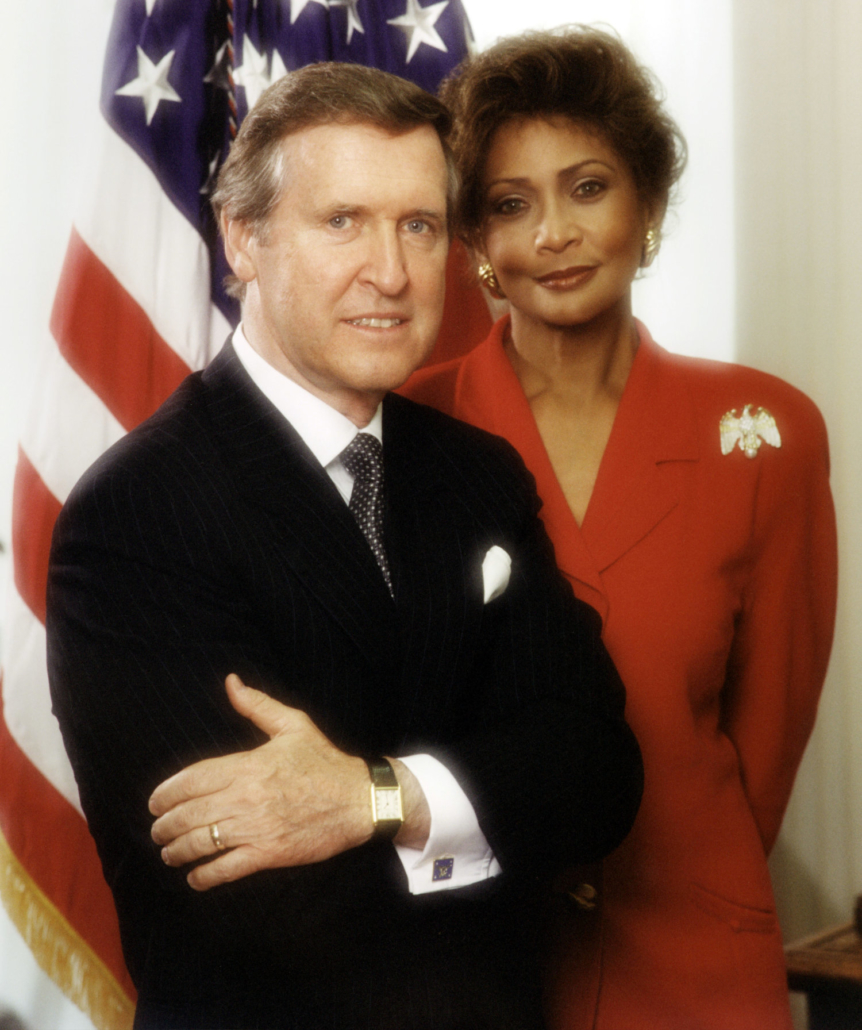
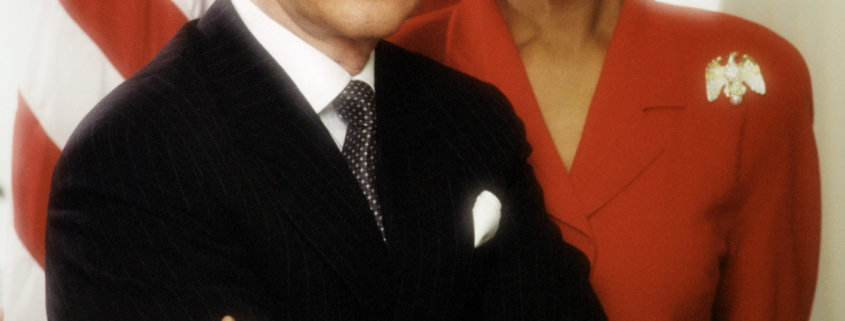
Secretary of Defense William S. Cohen and Janet Langhart Cohen.
Perhaps no two figures better epitomize the kosher sandwich in action than former Maine Senators George J. Mitchell and William S. Cohen, Gentile and Jew, Democrat and Republican, equal and complementary slices of kosher bread in the neo-liberal order. They are, as we shall see, really quite perfect avatars.
George Mitchell
Following his stint in the US Senate from 1980 through the end of his term on January 3rd, 1995, Mitchell was asked by Michael Eisner to join Disney’s Board of Directors; he also joined Verner, Liipfert, Bernhard, McPherson, and Hand (where Elliott Abrams—yes, that Elliott Abrams—worked before joining the Reagan administration), a law firm and lobbyist organization that in September 2002 merged with Piper Rudnick LLP, which would itself soon be part of the merger that would form DLA Piper. Mitchell is currently a partner and Chairman Emeritus of DLA Piper’s Board, and has been on or is presently on the Boards of Staples, Unum, Unilever, Starwood Hotels (owned by Marriott), Xerox, FedEx, and others; Mitchell was also on the Board of the American Security Project, which is not as innocuous as the name sounds. The American Security Project takes a very antagonistic stance toward Russia and works to advance interventionism in order to combat climate change. They also use climate change as a bogeyman for causing “ethnic conflict” in and mass migration from sub-Saharan Africa. The implications are obvious, and with people like John Kerry on the Board and former “luminaries” including Susan Rice, this is unsurprising. As one example, the same UNICEF that declares the West must open itself up to an indefinite number of “migrants” receives well north of $100 million annually from the United States government[1] and also has a multi-million-dollar partnership with DLA Piper.
Curiously, however, despite the supposedly carbon-driven mass migrations from the Equatorial world, Mitchell’s Bipartisan Policy Center, of which he is co-founder and co-chair, receives a substantial amount of funding from companies like Chevron and ExxonMobil.[2] It also receives funding from FedEx, which is surely a coincidence.
In 2004, Mitchell defended the Board’s ouster of Roy Disney and, as one might expect, was rewarded as Chairman of Disney from March 2004-December 31st, 2006. Roy Disney and Stanley Gold were vocal in their criticisms of Mitchell as former CEO Michael Eisner’s puppet. “Giving the company’s chairmanship to former US Senator George Mitchell, Eisner’s lap dog, is a fig leaf covering Eisner’s continuing control of the company,” wrote one observer. Additionally, as Gold wrote in his letter of resignation from the Board:
Senator Mitchell was appointed Presiding Director, despite having been recently employed as a Company consultant and notwithstanding that the law firm of which he was chairman received in excess of $1 million for legal services on behalf of the Company in fiscal 2001.
No conflict of interest there. It gets better, as Wesley B. Truitt reports in his book The Corporation:
After retirement, [George Mitchell] became a partner in a prominent Washington, DC law firm and accepted Michael Eisner’s invitation to join Disney’s board of directors and those of eight other companies. As a nonemployee director at Disney, he was paid $45,000 annually, plus $1,000 per meeting he attended. Disney also hired him as a $50,000-per-year consultant, and he became a consultant to six of the other companies on whose boards he served. Two of those firms, Federal Express (FedEx) and Staples, for which he was both director and consultant, also employed his law firm, as did Disney. This is all pre-2002. In that year, with corporate governance reforms occurring, Disney dropped Mitchell’s law firm, having paid it $2.6 million in fees over the previous seven years, and required Mitchell to give up all other board seats except three. He kept FedEx, Staples, and Starwood Hotels. He continued to take consulting fees, amounting to $175,000 annually from FedEx and Staples. His consulting fees from Disney had brought him $300,000 over seven years. In March 2005, Disney’s board of directors, following a search in which only one outsider was interviewed (in Eisner’s presence), announced their choice of Robert Iger, then president of Disney and Eisner’s handpicked insider choice, to succeed him as CEO later that year.[3]
In 1998, Verner, Liipfert et al. received $1 million in compensation from Starwood Hotels for their lobbying efforts; that number was $430,000 in 1999, $380,000 in 2000, $380,000 in 2001, and $300,000 in 2002, when they merged with Piper Rudnick. Starwood retained Piper Rudnick, and then what became DLA Piper after the merger, into 2016, at which point Starwood was acquired by Marriott.
As the ultimate Shabbos goy, Mitchell earned high praise from ADL Director Abe Foxman while serving as Special Envoy for Middle East Peace under Barack Obama. As if he could be any more of a living cliché, Mitchell is also in the Bilderberg Group.
Earlier this year, in documents unsealed on August 9th by federal prosecutors in New York at the U.S. Attorney’s Office for the Southern District of New York, Mitchell was among those named by Virginia Roberts Giuffre in a lawsuit against Jeffrey Epstein and Ghislaine Maxwell as one of the men she was forced to have sex with while she was allegedly being trafficked for sexual acts as an underage girl by the duo. Mitchell denies the accusation; however a sworn affidavit by a former Epstein employee, Juan Alessi, affirms Giuffre’s claim. Mitchell was absolutely an associate of Epstein’s—Mitchell called Epstein a “friend and supporter” in a 2003 New York Magazine profile and Epstein referred to Mitchell as “the world’s greatest negotiator.” Giuffre named Mitchell in a 2015 defamation suit against Ghislaine Maxwell and again in a sworn deposition in 2016, saying she was instructed to give him a “sexual massage” while he was visiting Epstein in Palm Beach. From these documents, we learn:
American liberal icon, President Obama’s Middle East peace envoy Senator George Mitchell, frequently visited Epstein’s New York residence. Mr. Mitchell…was very close to Jeffrey, Virginia recalled. “He is very clean-cut. You wouldn’t think of him being part of Jeffrey’s crew.”
Though Mitchell cited work commitments as the reason and not the atrocious optics of an accused sex abuser’s affiliation with a fund for those abused by the clergy, he resigned in May from the oversight committee of the Philadelphia archdiocese’s Independent Reconciliation and Reparations Program (IRRP), a fund handled by administrators Kenneth Feinberg and Camille Biros. Feinberg made at least $3.3 million representing British Petroleum after their massive spill, and, per Judicial Watch:
Uncovered U.S. Treasury Department documents…reveal President Obama’s “Special Master for TARP Executive Compensation” Kenneth Feinberg received a $120,830 annual salary to establish executive compensation levels at companies bailed out by the federal government. These documents contradict multiple press reports that Feinberg would not be compensated for this work for the Treasury Department.
Feinberg makes his living deciding on what, if any, financial compensation victims of tragedies like 9/11 are entitled to. There’s really not much else to say about that—a Jewish lawyer profiting wildly from tragedy and financial improprieties says it all, really.
William Cohen
William Cohen and George Mitchell were concurrent Maine Senators for all of Mitchell’s time in office. Cohen was a Senator from 1979 through the end of his term on January 3rd, 1997. Cohen and his wife Janet Langhart have made a tidy profit from advertising their interracial marriage, first with the 2006 memoir Love in Black and White, and next with Langhart’s one-act play Anne and Emmett, which—I kid you not—debuted at the US Holocaust Museum and is about “an imagined conversation between Anne Frank and Emmett Till.”
After serving as the Secretary of Defense during Bill Clinton’s second term, Cohen founded the Cohen Group, a lobbyist organization and “business advisory firm providing corporate leadership with strategic advice and assistance in business development, regulatory affairs, deal sourcing, and capital raising activities,” of which Cohen remains Chairman and CEO. The Cohen Group has lobbied on behalf of special interests such as VR military training technology company Raydon, commercial satellite operator SES Americom, and technology-defense contractor Alion Science & Technology, and has facilitated donations to both Maine Senators Susan Collins and Angus King; a number of their employees and associates have donated to current presidential hopeful Pete Buttigieg. Tellingly, Cohen rebuked Donald Trump during Trump’s 2016 campaign and endorsed Hillary Clinton for president. In the 2016 election cycle, affiliates of the Cohen Group’s largest donation recipient was Hillary Clinton, although Republicans Susan Collins, John McCain, and Jeb Bush were also among the top donation recipients. This speaks volumes about the truly bipartisan nature of not just the Cohen Group, but of the DC Beltway—and the entire Establishment for that matter: they’re all pretty much on the same page.[4] Also consider that Cohen was John McCain’s Best Man in his second marriage, and the picture increasingly comes into focus. For further illustrative purposes, however, let’s look at some of the top donation recipients from the Cohen Group in other election cycles:
· 2014: Susan Collins, Cory Booker, Mitch McConnell, John McCain, Joe Kennedy III
· 2012: Susan Collins, Barack Obama, Mitt Romney, Joe Kennedy III, Tim Ryan
· 2008: Hillary Clinton, Barack Obama, Susan Collins, Mitch McConnell, Ted Stevens
· 2004: John Kerry, Joe Lieberman, Howard Dean, Arlen Specter, John Edwards
You get the idea. What many do not know, however, is that Cohen’s former chief of staff and top political strategist Bob Tyrer (who by the way is now co-president of the Cohen Group) was tasked with running Susan Collins’s campaign for Senate in 1996 as Cohen’s hand-picked replacement—a position she enjoys to this day. The substantial and consistent donations to Collins especially make much more sense in this light. As you’ll recall from the previous piece, DLA Piper is also a major campaign donor to Collins, as are companies like FedEx. You can see how the pieces are starting to fit.
Cohen is also on the Advisory Board of the Partnership for a Secure America, which, like Mitchell’s American Security Project, considers “climate change” to be a “threat multiplier.” Other organizations of which Cohen is currently or has been involved with include Viacom, CBS, the Council on Foreign Relations, AIG, MIC Industries, the Brookings Institution, the Atlantic Partnership, Thayer Capital, and the Trilateral Commission.
The Sandwich
The most obvious connection between Cohen and Mitchell, aside from the fact that they were concurrent Senators from Maine for a decade-and-a-half and clearly worked closely together is their co-authored book on the Iran-Contra affair published in 1988. Not-so-obvious would be the other aspects of their working relationship. Presently, DLA Piper has established, “a strategic alliance with The Cohen Group, a business consulting firm, to help clients identify and achieve global business and strategic opportunities.”
The first identifiable financial ties are from 2003, when the Cohen Group’s lobbying services were retained by Piper Rudnick for $250,000; in 2004 that number rose slightly to $280,000, but in 2005, when a three-way merger created DLA Piper, the Cohen Group’s compensation fell to $80,000. The working relationship persisted, however, with the Cohen Group’s compensation for their lobbying efforts on behalf of DLA Piper totaling $110,000 in 2006 and $140,000 in 2007. Though DLA Piper is listing as having retained the Cohen Group in 2008, I could not find the amount, at which point the financial record of the Cohen Group’s explicit lobbying endeavors on behalf of DLA Piper appears to vanish. As indicated above, however, this did not end the Cohen-DLA Piper working relationship, but rather precipitated what would grow into a major partnership.
Cohen was a featured speaker at DLA Piper’s annual Global Real Estate Summit in Chicago this year and Ambassador Nick Burns serves as Senior Advisor to DLA Piper through the firm’s exclusive relationship with the Cohen Group, where he is a Senior Counselor. DLA Piper and the Cohen Group have collaborated on “independent reports” designed to influence policy—for which they were financially compensated—and a litany of other projects both domestically and globally. One such project may potentially have involved a coup attempt in Turkey. A large percentage of the Cohen Group’s leading figures are ex-diplomats and military figures; there is a curious paucity of “traditional” business or legal acumen at the top. Oh, and by the way:
We know, from sworn testimony given by FBI whistleblower Sibel Edmonds, that former Undersecretary of State Marc Grossman committed treason when he divulged classified information to Turkish operatives in the summer months of 2001, included in that information was the fact that Brewster Jennings & Associates and Valerie Plame were CIA…Marc Grossman’s former boss at the State Department, Richard Armitage…The ATC helps facilitate billions in defense contracts between the Turkish government and FBI Director James Comey’s friends at Lockheed Martin, where Comey used to be VP and Senior Counsel. Lockheed Martin’s Board of Directors also includes Joseph Ralston and James Loy who work with Grossman at the Cohen Group.[5],[6]
There are deep ties not just between the Cohen Group and DLA Piper, but between the Council on Foreign Relations (CFR) and both the Cohen Group and DLA Piper, as Laurence Shoup relates:
The Cohen Group was founded by former Defense Secretary and CFR director William S. Cohen when he left the Clinton administration in early 2001. The objectives of the firm are: “helping multinational clients explore opportunities overseas as well as solve problems that may develop. The Cohen Group has the unique ability to provide our clients with truly comprehensive tools for understanding and shaping their business, political, legal, regulatory, and media environments.” The Cohen Group has a strategic alliance with the international law firm DLA Piper, one of the largest law firms in the world. Both the Cohen Group and DLA Piper have multiple connections to the CFR. Besides Cohen himself, Marc Grossman, a vice chair at the Cohen Group, is a Council member, and former ambassador and undersecretary of state Nicholas Burns is both a CFR member and a senior counselor at Cohen. Former Senator George J. Mitchell, DLA Piper’s former chairman, was a Council director, and former U.S. senator and CFR member Tom Daschle is a policy adviser at this law firm.
But why does it matter that Mitchell, Cohen, and their associates have these connections to the CFR? There are hundreds of these think tanks that recycle the same old “bureaucratic tape-worms,” to borrow Tucker Carlson’s phrase, in between governmental appointments. As Shoup explains in his excellent book Wall Street’s Think Tank: The Council on Foreign Relations and the Empire of Neoliberal Geopolitics, 1976-2014:
The CFR’s own leaders, in their own publication, [state] that U.S. foreign policy in the twentieth century was made by a “professional class” (their term for a ruling capitalist class) of only “several hundred” people, augmented by a number of “experts” beginning in the 1960s. Almost all of these people were members of the CFR, which actively promoted a foreign policy suitable to the U.S. capitalist class…The Council is the most important U.S. and global center of “deep politics” and the “deep state” that rules behind the scenes, a way that the 1 percent conducts their unrelenting class war against the 99 percent. Despite pretensions to “democracy” and endless attempts at instructing the world, U.S. “democracy” is, in reality, largely a fraud, a hollowed-out shell, devoid of any substantive content. The fact is that the U.S. government—led behind the scenes by the CFR—is largely run in an anti-democratic fashion by and for the interests of a financialized capitalist class, their corporations, and the wealthy families that control and benefit from these corporations. No matter who is elected, people from the Council propose, debate, develop consensus, and implement the nation’s key strategic policies. The deep state, in the form of the CFR, operates behind the scenes, making and enforcing important decisions outside of those publicly sanctioned by law and society. A focus on the Council on Foreign Relations is a key way to understand concretely the central sector of the ensemble of power relations in the United States and its informal global empire.
The Cohen Group and DLA Piper each feature both current and former members within or affiliated with the CFR, as well as other major geo-political players; these connections are anything but incidental. Major DLA Piper alumni include: A.B. Krongard, former Executive Director of the CIA; Mel Martinez, former Senator, member of the Bipartisan Policy Center, and JP Morgan Chase’s Chairman of the Southeast US and Latin America; and Harry Cummings McPherson, Jr., who served as counsel and special counsel to Lyndon B. Johnson from 1965 to 1969 and was Johnson’s chief speechwriter from 1966 to 1969. Additionally, DLA Piper represents over 150 Israeli companies and investors. From the firm’s website:
The firm has also assisted over 75+ of its foreign clients who require legal assistance in Israel…Our Israel Country Group delivers all the benefits of a global elite law firm through a team of lawyers dedicated to the Israel market. Our broad knowledge and access to local advice has led to us becoming a key address for advising Israeli clients as they do business across the globe. Recent involvement has included advising on M&A transactions in Japan, Norway, Spain and South Africa; HR matters in Brazil, Singapore and Italy; real estate deals in the US, Germany and the UK; IP and tax in Turkey, Dubai, Australia and Czech Republic; fund formation in Poland and the US; commercial and mining advice in Africa; and litigation advice in the UK, Africa and the US.
Don’t forget that George Mitchell of DLA Piper was an associate of Jeffrey Epstein. Recall also the “changing role” of the NSA following 9/11 and the fact that the NSA gave Israel access to all US citizens’ communications data. This all dovetails rather nicely, as, returning to Shoup:
William J. Clinton was himself a CFR member before he became president…Of Clinton’s three secretaries of the treasury, the first, Lloyd M. Bentsen, was not a CFR member (my note: or a Jew, but definitely a Shabbos goy), but Robert E. Rubin and Lawrence H. Summers were (my note: both Jewish), with Rubin later becoming a director and co-chair of the Council. All three of Clinton’s choices for Secretary of Defense, Les Aspin, William J. Perry, and William S. Cohen, were CFR members, and Aspin and Cohen were directors. Cohen was a director when Clinton called on him to serve in the government…George W. Bush was never a member of the CFR, but…his vice president, Richard B. Cheney, was a longtime member and was a two-time director between 1987 and 1995. Both of Bush’s secretaries of state, Colin L. Powell and Condoleezza Rice, had long been members of the Council when they were appointed, and Powell became a CFR director in 2006…George W. Bush had two secretaries of defense, Donald H. Rumsfeld and Robert M. Gates. Rumsfeld was a CFR member during the 1970s but later dropped out of the organization. Gates has been a continuous Council member since 1985. Bush’s appointees to head the CIA, Porter J. Goss and Michael V. Hayden, were CFR members prior to entering office, as were both of his appointees to head up the World Bank, Paul Wolfowitz and Robert Zoellick, who had also been a Council director. Three of the four men Bush appointed to be UN ambassador, John D. Negroponte, John R. Bolton, and Zalmay Khalilzad, were CFR members prior to their appointments…Susan E. Rice, who also served as Obama’s first UN representative, has been active in the organization for years…Obama’s second secretary of state, John Forbes Kerry, became a CFR member in the early 1990s. He married his second wife, the near billionaire Teresa Heinz (who inherited the Heinz food fortune), in 1995, the same year she was elected to Council membership.
I would be remiss if I did not also mention that Janet Napolitano, who made a brief appearance in Volume IX, is also a member of the CFR, but in light of all of these other revelations, that does seem a bit incidental, doesn’t it?
Reposted from The Anatomically Correct Banana.
[1] “‘Migrating is not a choice,’ according to Henrietta Fore, executive director of the United Nations Children’s Fund (UNICEF), speaking to reporters last week on the sidelines of the G7 ministerial summit in Paris. Fore insisted: ‘Migrants do not want to leave their country, but they are forced to do so because of the economic situation or the violence that reigns there.’…‘Those of us who live in more developed countries must do whatever we can to allow them to get here and integrate.’… UNICEF is funded by governments and private donations. Due to relentless lobbying on Capitol Hill by UNICEF USA supporters, the United States has ‘traditionally provided more unrestricted funding to UNICEF than any other government.’ The U.S. remains UNICEF’s top funder with $132.5 million in 2019, just as it was in 2016, 2017, and 2018 with similar contributions. What remains to be determined is why the Trump administration continues to write a blank check to [them].” https://cis.org/Rush/UNICEF-Chief-Developed-World-Must-Welcome-All-Migrants-Because-Migration-Not-Choice
[2] Would you like to know more? https://ethics.harvard.edu/blog/bipartisan-lobbying-center
[3] P. 209.
[4] Consider the 636 business organizations that signed their approval of a prospective “Immigration Reform” bill in 2014 that enjoyed bipartisan support, and which would have provided for DREAMER amnesty and the re-orientation of immigration toward “economic necessity”: https://www.uschamber.com/letter/multi-industry-letter-immigration-reform
[5] http://illinoispaytoplay.com/tag/the-cohen-group/
[6] Lockheed Martin is a major donor to both Maine Senators Susan Collins and Angus King, and House Representative Chellie Pingree—Republican, Independent, and Democrat. Yup.