
Why is Europe Rejecting Nationalism?
Based on the outcome of the Brexit referendum and Donald Trump’s victory in 2016, many began to hope that a wave of right wing populism would sweep across the West. This, unfortunately, has not been the case. Instead, 2016 and 2017 have showed, for now at least, that Europe will consider but ultimately reject nationalism. I’d have to reluctantly agree with a Washington Post article, “A specter is haunting Europe — the specter of nationalism. For now, though, it’s mostly just that: a specter. It hasn’t been able to move beyond its phantasmological form and actually take power outside of Hungary and Poland.”
It is all too true that nationalism in Europe remains only an apparition which tantalizes us with every election only to dissipate with the victory of yet another internationalist shill for global special interests. Nationalism was rejected in Austria, the Netherlands, and of course in France. In the UK, nationalism was “accepted” in the form of the Brexit referendum, but Theresa May’s government is certainly not an authentic British nationalism.
Across the European continent, nationalist candidates have been routinely losing national elections. Austria’s Norbert Hofer of the Freedom Party failed to win the Austrian Presidency in a painfully close election, The Netherlands’s Geert Wilders of the Party for Freedom styled himself as the European Donald Trump and had an equally dazzling coif of hair, but got only 13% in the Dutch election, and France’s fiery Marine Le Pen of the National Front ultimately lost in a landslide to an ex-Goldman Sachs executive. Read more
Review: The Strange Death of Europe: Immigration, Identity, Islam by Douglas Murray
The Strange Death of Europe: Immigration, Identity, Islam
Douglas Murray
Bloomsbury Continuum, 2017
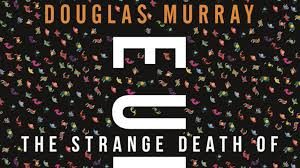
I finished reading Douglas Murray’s The Strange Death of Europe just 24 hours before a Libyan Muslim detonated an explosive device at the exit of an arena in Manchester, sending arrows of shrapnel into dozens of concert-goers and confirming, in an instant, every one of Murray’s arguments. Timely, erudite, and needed, The Strange Death of Europe is the story of European cultural and racial ‘assisted suicide,’ with a focus on the effects of ongoing mass immigration from Africa, the Indian sub-continent, and the Middle East. This is a book that, in terms of its central arguments and pool of facts, will say nothing new to those on the Alt Right. In this movement we live our lives with the burden of truly painful knowledge. We know that our current course will lead only to dispossession and destruction. Everything about the contemporary world suggests that we are a generation born either to witness the end of our great race, or to orchestrate its most stunning and earth-shattering rebirth. This book offers nothing in terms of assisting the latter, but in terms of its contribution to an understanding of the former, its unique strength may be said to lie in the concise, compelling, and clear-headed manner in which it advances the thesis that multiculturalism is a death sentence on Europe. Murray’s book is a forceful refutation of the lie that we are ‘progressing’ to a better European future, taking the theme of impending European death to a mass audience, particularly in Britain where the book climbed to number three in both the Sunday Times and UK Amazon bestseller lists, and sold out in numerous branches of the country’s largest high street book merchant. Despite ubiquitous socio-political conditioning, there is clearly a hunger for dissenting speech.
Murray opens with the stark statement: “Europe is committing suicide,” soon refined into the more nuanced argument that Europe’s political leaders, together with a complicit media, are in the process of taking their populations down the road of ethnic and cultural annihilation. The apparent acquiescence of European populations in this diabolical journey is ascribed by Murray to a number of factors. Europe has lost faith in its beliefs, traditions and legitimacy. It is in the midst of an “existential tiredness.” At the heart of this loss of direction and sense of self is the imposition of a cult of guilt — a cult that has grown weed-like from the fertile soil of Holocaust and slavery narratives advanced by the enemies of our people. Murray remarks that “More than any other continent or culture in the world today, Europe is now deeply weighed down with guilt for its past.” Read more
Manchester Malady: Traitors Lie, Children Die
“Diversity is indeed a strength, not a threat.” That’s a line from the Queen’s Christmas message in 2004. “I love the diversity of London — I just feel comfortable.” That’s a line from the former immigration minister Barbara Roche in 2011. “Our priority as a government must always be to keep people safe.” That’s a line from the British Home Secretary Amber Rudd in 2017.
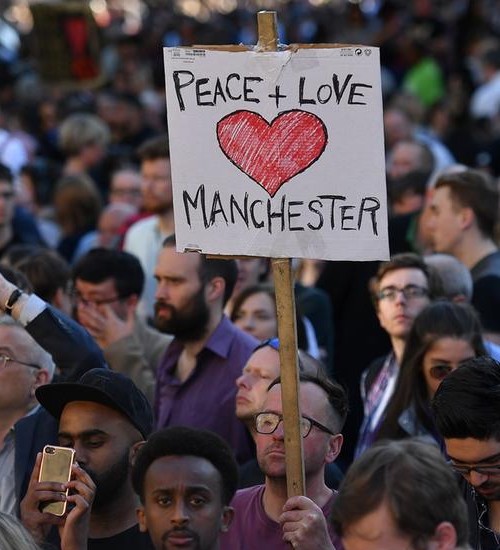
Liberal fantasy: “Peace + Love Manchester”
Racial and religious enrichment
All three women are suicide-mommas promoting an insane and deadly liberalism. All of them bear some responsibility for the suicide-bombing in Manchester on 22nd May 2017. But give Barbara Roche her due: unlike the other two, she was speaking the truth. She does indeed love an atomized society, because it fulfils her deepest political ambition: “to combat anti-semitism and xenophobia in general.” Roche is Jewish and feels paranoid in a homogeneous White society. That’s why she worked so hard to open Britain’s borders to the Third World under the traitorous Tony Blair.
And if the glorious project of racial and religious enrichment goes wrong, Barbara can always seek refuge in Israel, where her Jewish identity gives her an automatic right of citizenship. But let’s suppose that Salman Abedi, the British citizen responsible for the Manchester vibrancy, had wanted to take a short holiday in Israel to soak up some sun and enjoy some of that famous Israeli courtesy and charm.
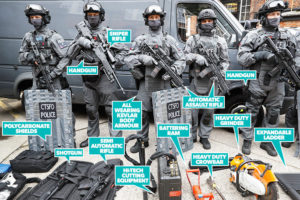
Unpleasant reality: Robo-cops to combat vibrancy
Would he have been granted a tourist visa? No, not a chance. He was on terrorist watch-lists maintained by both British and American intelligence, so we can be absolutely certain that Israel would have refused him entry. Israel would also have refused his Libyan parents entry if they’d tried to claim asylum as refugees when they escaped the Gaddafi regime. Israel’s government really does make it a “priority” “to keep people safe.” Read more
The Golden Globalists: MacShane and Macron vs Marine Le Pen
Slugs are remarkably resilient creatures. If a snail falls from height onto a hard surface, it might well crack its shell and perish. A slug falling the same distance will absorb the impact in its springy flesh and slither away unharmed, eye-stalks jauntily re-extended.
A Fraudster Bounces Back
Did Denis “The Slug” MacShane draw inspiration from his molluscan namesake? I like to think so. Metaphorically speaking, this veteran socialist, a former Minister for Europe and policy advisor to Labour Friends of Israel, fell from a great height in 2013, when he was jailed for fraud amid much gloating by his unsavoury fascist and anti-Semitic opponents. Decent folk will rejoice to learn that Denis has absorbed the impact and slithered away unharmed — and unimpoverished. This is currently his resumé at the Euro-lobbyists Avisa:
DENIS MACSHANE Senior Advisor
Nationality: British
Dr Denis MacShane is Britain’s former Minister of Europe and served on the Council of Europe and NATO Parliamentary Assembly, representing the UK as a Member of Parliament. …
Denis knows many of the key EU ministers in national government and parliaments as well as most senior people in Brussels[.] Denis has one of the best address books for key European political, media, policy and official deciders. He counts several European Commissioners and key MEPs from multiple countries and parties as personal friends, and is one of the few senior policy experts in the UK to speak up for the European Parliament.
He still writes regularly for European and US media outlets including the Financial Times, Le Monde, Libération, Die Welt, the Globalist and Slate. In addition to his native English, Denis speaks French and German. Areas of expertise: Brexit; External Relations; Security and Defence (Dr Denis MacShane at Avisa)
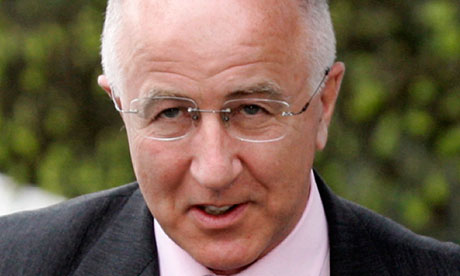
Hither and Slither: Denis “The Slug” MacShane
The resumé tactfully omits his conviction for fraud and the name of the constituency he served as an MP. It was Rotherham, of course. And it’s now infamous around the world for the sexual abuse that took place there. Hundreds of White working-class girls were being raped, prostituted and beaten by brutal misogynists who regarded them as nothing but objects for their own pleasure and profit. This was a horrifying example of Patriarchal Oppression, so what a stroke of luck for the girls that they had a Labour MP and a Labour council to defend their interests. Rotherham was overflowing with feminists, anti-rape activists and child-welfare workers. Read more
The KosChertified? App is Here!

Go to Koschertified.com to upload the app.
Many in our movement are often heard complaining on podcasts and in the comments sections of too much talk, but no action. Sure, it would be both practical and effective if our politicians represented our interests and took action on our behalf, but that’s a pipe dream! Also, it is certainly unreasonable to expect most patriots and White nationalists to find their way to UC-Berkeley every time an Alt-Right or conservative speaker gets silenced. And do we all possess the same courage as that recently displayed by “Stickman” wading into a seething throng of antifa?
Actually, some of the most common demonstrations of power by our adversaries has been in their dominating critical industries, creating monopolies, and doing it all with the host majority blinded to its very existence or protecting themselves constitutionally through our freedom of religion. Some of their power plays have been accomplished by means of boycotting (e.g. in their methods of acquiring newspapers or sending others to bankruptcy with diminished advertising revenue; or in their political and economic opposition to Germany in 1933). In fact, just look how aggressively the BDS movement is being counter-attacked. They understand the power of the boycott, and in their world only they are permitted access to use it.
So why am I bringing this up, you may ask? Just the other day my girlfriend discovered a new app to help her in her grocery shopping: KosChertified? It was less than $2, strikingly different than most, and as she knows well the direction my politics leans, she decided to share it with me. I searched through its contents and couldn’t believe my eyes! You would have thought it was written by an investigative reporter from Red Ice! But it wasn’t. Here in my palm laid the 21st-century tool that delivers both an expose’ of the little-known kosher-certification industry, its controversial conflicts of interests (especially with our interests), and a database of food products that haven’t been certified kosher! Now here was something we could use ourselves, I thought. Looking at the app’s website, www.koschertified.com, one finds that “over one million food products have been certified kosher!” (Note: This app is only for the United States.) Clearly this kosher sector of the food industry falls into that discussion on power above — where most ordinary people are simply oblivious to their total domination. In fact, glancing through the app’s convenient grocery list application one finds numerous food categories that have a real scarcity of non-certified products — and some are empty, like sports drinks and horseradish! So what does this portend for our grocery shopping future? Perhaps the possibility of having absolutely no choice — fifteen aisles of products all having been blessed by one of the many rabbinical agencies that oversee every detail of the food we buy! And I’m sure this will be a free service, so that they can “be the light unto our nations.” Read more
Opiates: “Death on the Prescription Plan”

Like Harold Covington, I have a soft spot for Jewish writer James Howard Kunstler. For starters, his style amuses me, especially in his weekly (now twice weekly) blog Clusterfuck Nation. This blog plays a useful role beyond that, however, in that he consistently zeroes in on the damage his own tribe is doing to the United States (and the world). He can sum this up cleverly, bitingly, and accurately, yet of course he never names the Jew, even after he’s gone through half a dozen uninterrupted Jewish names.
His April 28th column is no exception. Consider the opening three paragraphs:
While the news waves groan with stories about “America’s Opioid Epidemic” you may discern that there is little effort to actually understand what’s behind it, namely, the fact that life in the United States has become unspeakably depressing, empty, and purposeless for a large class of citizens. I mean unspeakably literally. If you want evidence of our inability to construct a coherent story about what’s happening in this country, there it is.
I live in a corner of Flyover Red America where you can easily read these conditions on the landscape — the vacant Main Streets, especially after dark, the houses uncared for and decrepitating year by year, the derelict farms with barns falling down, harvesters rusting in the rain, and pastures overgrown with sumacs, the parasitical national chain stores like tumors at the edge of every town.
You can read it in the bodies of the people in the new town square, i.e. the supermarket: people prematurely old, fattened and sickened by bad food made to look and taste irresistible to con those sunk in despair, a deadly consolation for lives otherwise filled by empty hours, trash television, addictive computer games, and their own family melodramas concocted to give some narrative meaning to lives otherwise bereft of event or effort.
Kunstler lives in Greenwich, New York, a tiny village northeast of Saratoga Springs. He uses this setting for his surprisingly sympathetic World Made By Hand novels (four of them), where narrator Robert Earle is a carpenter in a post-oil world in which inhabitants of the United States are reduced to living like their ancestors did in the middle of the 1800s. I say sympathetic in that Kunstler creates a Gentile world, one which rings true to me, peopled by generally decent and caring folk. I salute Kunstler both for his ability to imagine a world so unlike the one in which he grew up (New York City) but more so for his willingness to actually like these White Christians. We all know many Jews have completely opposite views and feelings. Read more

Also available at Barnes & Noble

Also available at Barnes & Noble

