Featured Articles

White Replacement Isn’t a Conspiracy Theory

Tucker Carlson’s recent monologue on demographic replacement has sent leftists into a frenzy. It’s not that they categorically deny the fact that Whites are being demographically replaced, they just think it’s “racist” for Whites to talk about it.

The few influential people (like Tucker) who draw attention to “conspiracy theories” (like White replacement) are made the poster children for the radical left’s justification of right-wing censorship. The last thing anti-Whites want is 200 million White people not only asking themselves why they’re being replaced, but why it’s in their best interest. To save face, leftists just eliminate the discussion by virtually eliminating the influence of anyone who brings the subject up (e.g. the ADL immediately calls for FOX to fire Tucker for “spreading poison”). In other words, they don’t want to talk about it, and they definitely don’t want Whites to talk about it. This alone should be cause for concern. In a free society, all things should be up for discussion, especially a group’s existence.

On the rare occasion that leftists decide to talk about things like White replacement, it’s usually accompanied by a barrage of anti-White slurs and childish analogies that depict Whites as angry racists. Such can be observed in a recent Salon article titled: Tucker Carlson’s immigration bait-and-switch betrays his desperation: No one denies that immigration brings change, Tucker — just that it’s racist to be angry about it:

Fox News host Tucker Carlson is really determined to sell his audience on what is — and this cannot be stressed enough — a literal neo-Nazi conspiracy theory. Neo-Nazis and other white nationalist groups have long pushed the idea that a shadowy cabal of Jews is secretly conspiring to “remake” America and “steal” it from its rightful owners, white Christians. They are supposedly doing this by “importing” non-white people — who neo-Nazis believe to be mentally inferior and therefore easily controlled by the shadowy Jewish conspiracy — into the U.S.

Carlson’s only spin is replacing the word “Jews” with “Democrats,” but other than that, he’s lifting “replacement theory” wholesale from the neo-Nazi dregs of the internet and now is repackaging this ridiculous conspiracy theory as if it were an inarguable fact, much to the delight of White nationalists. And because Carlson’s main modus operandi is trolling, he’s relishing the negative attention he gets by hyping a racist conspiracy theory and he’s using his audience’s love of liberal-triggering to encourage them to mindlessly burrow deeper into the worldview of unapologetic fascists.

Carlson is a moral monster. It’s likely he has been this way since his high school “Dan White Society” days. Sadly, he is a monster that must be dealt with, despite the unfortunate risk of troll-feeding. It’s not just because Carlson has an audience that regularly tops 3 million viewers, though that alone is terrifying. It’s that he is a smart man whose strategy for selling this conspiracy theory is sinister and clever. To fight back, it’s crucial that progressives don’t fall into the trap he is setting.

Needless to say, there’s no argument here that rebuts the demographic realities resulting from immigration. Just moral posturing. What the left does best when they don’t really want to deal with reality.

It’s not only “racist” for a White man to be “angry” about his race being demographically replaced, but it also makes him a “moral monster” who promotes “a literal neo-Nazi conspiracy theory” if he mentions it to his audience? How does that make sense on any level? Is it racist for Blacks to get angry about gentrification, or when Mexicans take over Black neighborhoods?

On one hand the leftist says, “European colonialism is genocidal,” even when they politely leave after building infrastructure that the natives could only dream of. But on the other hand they in effect are saying, “non-White immigrants replacing White people is a good thing”—never mind why it’s good, much less good for Whites. How can any rational person take that argument seriously? Furthermore, how can any rational person attempt to present that argument in the very same article in which they are chastising someone for allegedly using “bait-and-switch” tactics?:

Basically, Carlson is pulling off two bait-and-switch routines. First, he falsely conflates any cultural change with his ridiculous “replacement” conspiracy theory. Second, he tries to paint the debate as one over whether change is real — something that literally no one contests — so as to avoid talking about the real issue, which is how it’s nuclear-level racist to react to cultural change like it’s some kind of existential threat. In reality, it’s just what happens if you’re lucky to live long enough to experience it.

Did I just read that right? Is she really saying that it’s nuclear-level racist to think that replacing a White population with a non-White population is an “existential threat” to Whites? Cultural change just happens. It’s inexplicable, and our media and political elites have had nothing to do with it. Nobody’s interests are at stake. Deal with it. It’s always good. Like when millions were massacred in the Soviet Union after the cultural change when the Bolsheviks took over. Or Cambodia. Or Rwanda. Even the nuclear-level racist ADL, as quoted by uber-racist Carlson, thinks that a one-state solution would be a disastrous cultural change for Jews. Actually, I wonder if she would even have a job if she said that about any group other than White people, excluding Christians.

There’s no way anyone could be so callous as to refer to what’s happening as just “cultural change.” This cultural change was brought about by ethnic activists who feared and loathed the traditional White majority of America, and it is kept in place by our new, post-1965 elite. Ms. Marcotte should give us a clear picture of how she sees the future when Whites are a relatively powerless minority in America. I’m sure she would see it as nothing but harmonious multiculturalism. But what if it isn’t? What if lethal ethnic conflict comes to the fore, as it has so often in the past. What majority group in their right mind would want to take that risk?

Nevertheless, I’ll give Ms. Marcotte the benefit of the doubt and assume that she is ignorant and not inherently evil (a courtesy she didn’t grant Tucker). Maybe she had a bad day and got confused with what she actually meant to say. Or maybe the editor called in sick. Either way, as a thankless gesture, I decided to post an edited version of the previous quoted paragraph:

Basically, Marcotte is pulling off two bait-and-switch routines. First, she falsely conflates White replacement with her ridiculous “cultural change” conspiracy theory. Second, she tries to paint the debate over whether demographic replacement is real — something literally no one contests — so as to avoid talking about the real issue, which is how it’s nuclear-level stupid to react to becoming a minority like it’s not an existential threat. In reality, only total idiots would consider themselves lucky to live through demographic replacement.

There, that’s better.

But in all seriousness, she acknowledges that immigration changes the face of society, but in the same way that “generational shifts” result in skinny jeans and TikTok. Again, it’s important to understand exactly what this woman is saying: she is saying that White replacement is comparable to “changing fashions and evolving social norms.” She even attempts to cleverly justify it by comparing White people’s demographic decline to the bad hair products of the 80s:

Here’s the thing, though: Lieu didn’t give any game away. Liberals have never denied that immigration changes society. Of course it does, along with generational shifts, changing fashions, and evolving social norms. When I was young, people wore low-rise jeans and MTV still played music videos. Now it’s skinny jeans (though apparently not for long) and TikTok. Change is inevitable, and generally good, as anyone who has a memory of hair-destroying styling products in the bad old days can contest.

What makes “replacement” a conspiracy theory, however, is that it invents this elaborate fantasy ascribing change not to the normal churn of human society, but to a sinister and hidden conspiracy of Jews and Democrats who are secretly inflicting change to pull off some grand scheme.

She says the reason “White replacement” is a conspiracy theory is because Whites point the finger at “Jews and Democrats” as the those responsible for massive non-White immigration into the United States. What she doesn’t say is that Republicans wanting cheap labor—Jews and non-Jews—bear a healthy portion of the blame.  But yes, Jews and Democrats have been the prime movers—Jews heavily involved since early in the twentieth century, and Democrats totally on board now that they have basically jettisoned their White working-class base and are dreaming of permanent hegemony due to their non-White voting base.

What would make “White replacement” a conspiracy theory would be if it wasn’t an observable phenomenon. If it’s such a positive transition, why can’t we have an honest discussion about it without name-calling, moral posturing, and censorship? If this “normal churn of human society” is so wonderful, why are so many Whites unhappy and complaining about it? Are they just too stupid to know what’s best for them? But to make that argument, Marcotte would have to explain exactly why it’s just wonderful for Whites.

The data are conclusive: White demographic replacement isn’t a conspiracy theory, it’s a statistical fact. The fact is that it’s stupid for Whites like Marcotte to believe that the share of the population like them just magically decreased by 30 percentage points in less than 50 years and that it is “nuclear-level racist” to think it may not turn out well. Particularly in a era when tens-of-thousands of non-Whites are marching for the southern border at any given time on Biden’s promise of mass amnesty, and legal immigration continues at an all-time high.

Immigration is 100% causative, meaning that it happens for a reason. There are two primary elements that define a nation: ethnicity and borders. Borders are designed to keep people from other nations out, or at least they used to be. Protocols are in place as to who gets to immigrate into the United States (all countries have an immigration policy). It’s not just some random act of human migration called “cultural change” (unless that’s the new liberal term for legal and illegal immigration”) that determines who gets to come here and who doesn’t. Up until 1965, the National Origins Formula prevented immigration from changing the ethnic composition of an America determined to retain its Northern and Western European character.

Historically speaking, immigration has always been a politically divisive topic in the United States. It goes without saying that if America was 90% White, Democrats would never win a presidential election in the current political climate. Just as it’s safe to say that Republicans will never win a presidential election when Whites become a minority. It’s as simple as that. Just because the writers of Salon pretend it isn’t happening doesn’t mean it isn’t.

The weird thing about this line of liberal “logic” is that they would never apply it to any other group besides White people. Do African nations have a moral imperative to import enough non-Africans so that they are a minority? For that matter, they wouldn’t apply it to animals or plants either. These people would sacrifice their lives to save a tree or an endangered insect. But for some reason they won’t do it for White people. Why is that? Well, for starters, anti-White hostility has been dramatically increasing in recent years, to the point that Critical Race Theory, which blames White people for everything bad about society, is now the more-or-less official position of the establishment: media, academia, politics, Big Tech, and Wall St. — with “Jews and Democrats” leading the charge. This singling out White people as a group for all social evil borders on dehumanization, the third of the 8 stages of genocide, according to the US State Department. Ironically, the eighth and final stage is denial (e.g. “it’s not White genocide, it’s cultural change due to a normal churn of human society”).

More importantly, Carlson is propping up this fake debate so that he can smuggle in his real argument, which is that change is bad.

Carlson’s whole gambit depends on the presumption that change is a terrible thing. But that belief is both delusional and, on the subject of immigration, racist.

But it’s only a “fake debate” insofar as liberals and the left don’t even try to tell us why ethnic replacement is a good thing for the people being replaced. They opt instead to write slanderous articles filled with anti-White slurs and buzzwords without addressing the real concerns of those who are talking about White replacement. They don’t want the Tuckers of the world telling you that demographic change could be very bad for the people in the process of becoming a minority. Left-wingers ultimately want Whites jumping up-and-down with joy for their impending demographic doom. It’s just “cultural change.”

One can’t help but notice why liberals (or Ms. Marcotte) never offer an explanation as to why Whites should be so happy about their replacement. And even when they do, it’s always the same narrative: if you’re White and not happy about being a minority in your own country, it’s just because you’re an angry racist who can’t accept change. We’ll see what happens when the children of White liberals can’t get into a top university because all standardized tests have been thrown out and equity demands that non-Whites be admitted according to their percentage of the population (or more). And we’ll see what happens when liberal White suburbanites have to deal with poor non-Whites being dropped into their neighborhoods as local jurisdictions lose power over zoning.

If White replacement is a good thing for Whites, and they should be happy about it, wouldn’t it make more sense to offer an explanation of how it’s going to be beneficial?: if you’re White you’re going to be demographically replaced in the United States, but don’t be scared, it’s just cultural change and it’s going to be good for White people. And here’s why: you’re taxes are going to go down, you’re communities will be safer with less crime, your children are going to get a better education, healthcare is going to be more affordable, there will be less social unrest, no more BLM/antifa riots, there are going to be more jobs, there will be fewer suicides and opioid overdoses and so much more. Not to mention, your children and grandchildren will absolutely love being a minority. Just ask the Blacks!

Could anyone really believe this? Until “Jews and Democrats” are willing to have an honest debate on the causes and effects of the rapid demographic change ongoing in the United States, White replacement needs to be called what it is: placing Whites in a position where they will be vulnerable to the ethnic hatreds and historical grudges of others — and, quite possibly, violent (rather than creeping demographic) genocide least on the scale of what happened in the USSR. The hatreds among ethnic partisans and the mindless idealism of liberals like Marcotte are already in place.

Mark Steyn Lies As Naturally As He Breathes: A Master-Class in Mendacity on behalf of Zionism and the ADL

Mark Steyn is a highly intelligent man and an excellent, erudite writer. I admire (and envy) his ability to write so much so fast and so entertainingly. Unfortunately, Steyn is also a liar and fraud. And I can prove that very easily.

Mark Steyn, the porky-purveying Pied Piper of Zionism (“porky pie” is Cockney rhyming slang for “lie”)

Here goes. As Kevin MacDonald set out in two recent articles at the Occidental Observer, the Fox broadcaster Tucker Carlson has recently tangled with the rabidly anti-White, ruthlessly pro-Zionist liars and censors at the Anti-Defamation League (ADL). And Carlson doesn’t seem to have come off worse. The dispute began after he correctly said that the Democratic Party in America wants to import a new Democrat-voting electorate of non-Whites and “dilute the political power of current registered voters.”

Steyn knows whereof he speaks

The repulsive Jonathan Greenblatt, Inquisitor-General of the ADL, immediately condemned Carlson for supporting “replacement theory,” a “white supremacist tenet” that “is antisemitic, racist and toxic.” He said: “Tucker must go.” But Carlson didn’t go. Instead, he struck back at the ADL, pointing out that the organization opposes population-replacement in firmly Jewish Israel even as it supports population-replacement in ever-less White America. Mark Steyn discussed the dispute in an article imposingly titled “The Perversion of Public Discourse.” When Steyn talks about perverted discourse, you should listen, because he knows whereof he speaks. Indeed, he can’t avoid knowing about perverted discourse, because he practises it so often himself.

Jonathan Greenblatt, Inquisitor-General of the ADL

Steyn’s priority is to serve Jewish interests, not the truth. He doesn’t want his goyish fans to recognize the truth about Carlson’s dispute with the ADL, because the ADL’s attack on Carlson was a blatant example of anti-White activism by a strongly ethnocentric Jewish organization. Accordingly, Steyn assumed his well-practised role as the Pied Piper of Zionism and began piping a seductive tune of falsehoods. He wanted to pretend, first, that Jonathan Greenblatt is a typical leftist, rather than a typical ethnocentric Jew; and second, that the ADL is corrupt in typically leftist fashion, rather than typically Zionist fashion.

Big bad goyim corrupting Jewish rubes

As I’m sure Steyn himself won’t need telling, two trusty weapons in the armoury of the perverted discourser are suppressio veri and suggestio falsi. In the first, you mislead by suppressing what is true; in the second, you mislead by suggesting what is false. Steyn used both in his article. Here he is skilfully wielding suggestio falsi: “Jonathan Greenblatt, the Obama hack who now runs the Anti-Defamation League, demanded that Fox fire Tucker.” Steyn is falsely suggesting, first, that Greenblatt is an essentially minor figure corrupted through his association with the big bad goy Barack Obama; and second, that Greenblatt has in his turn corrupted the formerly pure ADL.

In reality, Obama was a minor figure corrupted by Jews who shared Greenblatt’s ethnocentrism, as you can see in this very interesting mainstream article from 2008 about the “Chicago circle” of Jews who “nurtured [Obama] all the way to the top”:

Writer Toni Morrison famously dubbed Bill Clinton “the first black president” – a title he fervently embraced. Abner Mikva, the Chicago Democratic Party stalwart and former Clinton White House counsel, offers a variation on that theme. “If Clinton was our first black president, then Barack Obama is our first Jewish president,” says Mikva, who was among the first to spot the potential of the skinny young law school graduate with the odd name.

“I use a Yiddish expression, yiddishe neshuma, to describe him,” explains Mikva. “It means a Jewish soul. It’s an expression my mother used. It means a sensitive, sympathetic personality, someone who understands where you are coming from.” …

Abner Mikva: The Mensch who managed Obama

Obama’s circle of Jewish patrons and advisers widened further in 1992 when he became involved in a voter registration drive that brought him into contact with Bettylu Saltzman, a liberal activist (and daughter of the late Philip Klutznick, a former commerce secretary and shopping mall developer). Saltzman says she knew from the moment she met Obama that he would someday be president. … “As Jews got to know him, they recognized a kindred spirit, not someone who came down from Mars,” Mikva said. Rabbi Arnold Wolf, of KAM Isaiah Israel synagogue across the street from Obama’s Chicago home, was another early backer. Like Mikva, he sees what he called Obama’s “Jewish side.” … (Barack Obama: The first Jewish president? Chicago circle nurtured him all the way to the top, The Chicago Tribune, 12th December 2008)

Mikva was also one of the powerful Jews—others include Sean Wilentz, Elizabeth Holtzman, Ted Weiss, Geoff Stone, and Larry Summers—who greased the rather undistinguished (i.e., very few publications from an elite academic) Elena Kagan’s path to the Supreme Court—a classic case of how Jewish ethnic networking operates.

Barack Obama, like Tony Blair in Britain, was a narcissistic shabbos-goy of mediocre intellect who worked assiduously for the Jews who funded his rise to power and ensured him friendly coverage in the media. It is not honest of Mark Steyn to call Jonathan Greenblatt an “Obama hack” or to say that “Greenblatt is a humbug” for opposing population-replacement in Israel while supporting it in America. By using the weak and inaccurate term “humbug” rather than the strong and accurate term “hypocrite,” Steyn is trying to suggest that Greenblatt isn’t sincere about protecting Israel’s Jews from replacement. But he is sincere – very sincere. Greenblatt applies a typical Jewish double-standard. Or rather, he applies a single standard of “What’s best for Jews?” Mass immigration into Israel would harm Jewish interests, therefore Greenblatt opposes it. Mass immigration into America harms White interests, therefore he supports it.

The ADL’s mission is a mystery

But Steyn was even less honest later in his article. Lachlan Murdoch of Fox had stood by Carlson but assured Greenblatt that “Fox Corporation shares your values and abhors anti-semitism, white supremacy and racism of any kind” and therefore continued to “support your mission.” Steyn commented thus:

As for “supporting your mission”, I have no idea what the ADL’s “mission” is these days: They’re either rubes or just the usual American “activist” grifter racket. But at any rate they had no difficulty giving a genuine Jew-hater, Ilhan Omar, the full hagiographic tongue-bath in an ADL book of “inspiring stories”. If you’re interested in committing immigration fraud, Ms Omar’s story is certainly inspiring – because it doesn’t get more all-in than being willing to marry your brother.” (The Perversion of Public Discourse, 13th April 2021)

There you have it: the highly intelligent and astute Mark Steyn claims: “I have no idea what the ADL’s ‘mission’ is these days.” He’s lying, because he knows perfectly well that the ADL’s “mission” remains what it has always been: to promote Jewish interests and harm White and Christian interests. It’s not as though the ADL has ever made any secret of its support for everything that harms Whites and undermines America’s status as a White Christian nation. Steyn is dishonest to use the term “rubes” of the ruthless, effective and very wealthy ADL. He’s also dishonest to suggest that the ADL might be a “usual American ‘activist’ grifter racket.” In fact, it’s a specifically Jewish “‘activist’ grifter racket.”

Muslims don’t threaten Jewish power

And note Steyn’s use of the phrase “these days.” In the past, he knew what the ADL’s mission was; today, oy, who can say? Again, he’s dishonestly suggesting that the ADL has strayed sadly from its original pure path, corrupted by powerful non-Jewish folk like Barack Obama. This simply isn’t true: the ADL was corrupt right from its inception in 1913, when it used undeniably dishonest and anti-Black means to defend a probably guilty Jew called Leo Frank, who had been accused of raping and murdering a 13-year-old shiksa called Mary Phagan (for further discussion, see Ron Unz’s excellent “American Pravda: the ADL in American Society”).

And what of the ADL’s support for the Somali Muslim Ilhan Omar? Steyn knows very well that the ADL supports Omar because she is anti-White and anti-Christian. She appeared in that “ADL book of ‘inspiring stories’” as a celebration of everything that is bad for traditional America and the Christian Whites who built it. The ADL doesn’t see unintelligent, incompetent and criminally inclined Somali Muslims as a threat to Jewish power, but as an excellent way to further atomize formerly cohesive White nations. Indeed, Muslim misbehaviour strengthens Jewish power by justifying an ever-stronger security and surveillance state. That’s why the Jewish immigration minister Barbara Roche enriched Britain with 200,000 Somalis and counting: “Since most were untrained and would be dependent on welfare, the Home Office could have refused them entry. But they were granted ‘exceptional leave to remain [by Roche]’.”

No, Greenblatt will never abandon Zionism

Steyn is well aware of ethnocentric, anti-White Jews like Roche and their often-repeated claim that “Jews and Muslims are natural allies.” As I’ve said, Steyn serves Jewish interests rather than the truth, so he deliberately lies about why the ADL supports non-Whites like Omar Ilhan. However, Steyn saved his best dishonesty till the end of his article, when he produced this positively pyrotechnic porky:

I wouldn’t be surprised to see the likes of Greenblatt abandon Zionism as a practical matter in the years ahead. His contemptible predecessor certainly had no difficulty abandoning the remnants of Europe’s Jewish community, as I wrote a few years back in “Hath Not a Jew, Eyes?” – after Abe Foxman blamed the Continent’s new Jew-hate on “neo-Nazis” and “neo-Fascists”. … As Laura Rosen Cohen writes of this contemptible nothing of a man: ‘Shame on you, Abraham Foxman. Shame on you. These Jews are a danger to the Jewish people… It’s so cozy to be a professional Jew, fighting the ghosts of WW2 over and over and never facing the real threats to the Jewish people.’ (The Perversion of Public Discourse, 13th April 2021)

Steyn knows very well that “the likes of Greenblatt” will never abandon Zionism, because Zionism is absolutely central to their identity as strongly ethnocentric Jews. Steyn and the similarly dishonest Laura Rosen Cohen also know that Abe Foxman was not a “contemptible nothing of a man,” but a very powerful Jewish activist with a perfectly coherent and well-applied anti-White agenda—the same agenda as Greenblatt. Foxman sought to blame Muslim “Jew-hate” on Whites not because he was mistakenly fighting old battles, but because he was (and is) anti-White and anti-Christian. Foxman and other Zionists don’t fear incompetent and unintelligent Muslims. Rather, they fear the competent and intelligent Whites who have, down the centuries, so often recognized Jewish misbehaviour and expelled Jews from their territory.

That’s why the hostile Jewish elite and its treasonous gentile collaborators have imposed Muslim immigration on unwilling White nations. By atomizing the West, they seek to reduce the chances of a collective White response to Jewish misbehaviour. That’s also why members of the hostile Jewish elite have so often announced that “Muslims and Jews are natural allies.” Against whom? Against bigoted White Christians, of course. Mark Steyn collaborates with that anti-White campaign. After all, who is he addressing in dishonest articles like “The Perversion of Public Discourse”? His large audience of far-too-trusting goyim, that’s who. He’s piping a seductive tune of Greenblatt as an “Obama hack,” Foxman as a “contemptible nothing,” and the ADL as a formerly decent organization corrupted by gentile leftism.

Liar, liar, pants on fire

He doesn’t want his goyish readers to recognize the truth about Carlson’s dispute with the ADL. The truth is that the ADL is a strongly ethnocentric Jewish organization that hates Whites and seeks to suppress any expression of support for White interests. And Steyn is happy to lie and lead his readers away from the truth about the ADL. In effect, he’s defending Greenblatt and Foxman even as he pretends to criticize them.

I conclude, therefore, that Steyn is a liar and his metaphorical pants are most definitely on fire. If he happens to read this article and wants to disagree, I invite him to take on a simple bet. Let’s give “the likes” of “Greenblatt” five years to “abandon Zionism as a practical matter.” If they don’t do so, Steyn’s forfeit will be to re-publish at his website Larry Auster’s excellent and incisive critiques of his dishonesty and trickery. If, on the other hand, the likes of Greenblatt do indeed abandon Zionism, my forfeit will be to do whatever Steyn thinks suitably chastening for a contemptible nothing of an anti-Semite like me. But I’m sure Steyn will decline the bet. He knows the truth as well as I do.

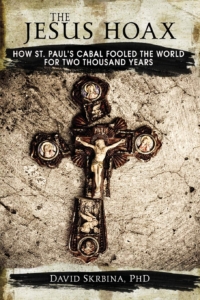
Review of David Skrbina’s The Jesus Hoax: How St. Paul’s Cabal Fooled the World for Two Thousand Years

The Jesus Hoax: How St. Paul’s Cabal Fooled the World for Two Thousand Year
David Skrbina
Creative Fire Press, 2019

David Skrbina is a professional philosopher who was a senior lecturer at the University of Michigan from 2003–2018. In addition to the book under review, he has written and edited a number of books, including The Metaphysics of Technology (Routledge, 2014), Panpsychism in the West (MIT Press, 2017), and the anthology Confronting Technology (Creative Fire Press, 2020).

The Jesus Hoax attempts to convince the reader that there is no rational basis for Christianity and that the motivation for its main originator, St. Paul, was antagonism toward the Roman Empire. Within this framework, Paul was a Jewish nationalist whose goal was to recruit non-Jews to oppose the Roman imperium: “Since the biblical Jesus story is false, it was evidently constructed by Paul and his fellow Jews in order to sway the gullible Gentile masses to their side and away from Rome” (43). Indeed, Skrbina claims that Paul may have been a Zealot, i.e., a member of a Jewish sect dedicated to violent resistance against the Romans, concluding “it seems clear that he was an ardent Jewish nationalist opposed to Roman rule, as was the case with most elite Jews of the time” (37).

Skrbina argues that there is no convincing evidence for the truth of the Jesus story, either within the canonical New Testament or from non-Christian sources. The earliest reference from a non-Christian source is a paragraph from the Jewish writer Josephus dated to 93 recounting the basic story, that Jesus was crucified “upon the accusation of the principal men among us”—i.e., the elite Jews of the period. Here Skrbina raises a general issue: the earliest source for the passage from Josephus is from the Christian apologist Eusebius in the fourth century, and the oldest sources for the gospels themselves are dated much later than they were supposedly written (70–95), leaving open the possibility of redactions and interpolations. For example, the oldest copy of the complete Gospel of Matthew, which, as noted below, contains the most inflammatory anti-Jewish passage of all, dates from the mid-fourth century, well after Constantine had legalized Christianity in the Empire and anti-Jewish attitudes were rife among intellectuals like Eusebius and the Church fathers such as St. John Chrysostom.”[1] The extent of redaction and interpolation remains unknown and presents obvious problems of interpretation.

The first Romans to comment on Christianity were Tacitus and Pliny (~115), both of whom disliked Christianity. As Skrbina notes, “the Romans were generally tolerant of other religions, and thus we must conclude that there was something uniquely problematic about this group” (60).

And Skrbina is well aware that an analysis of the entire early Christian movement must be aware of Jewish issues, quoting Nietzsche: “The first thing to be remembered, if we do not wish to lose the scent here, is that we are among Jews” (34). He is quite accurate in his assessment of Jewish ethnocentrism: Jews “saw themselves as special, different, ‘select,’ and thus they put these ideas into the mouth of their God. Certainly, no one would deny a people pride in themselves. But these extreme statements go far beyond normal bounds. They indicate a kind of self-absorption, a self-glorification, perhaps a narcissism, perhaps a conceit. To be chosen by the creator of the universe, and to be granted the right to rule, ruthlessly, over all other nations, bespeaks a kind of megalomania that is unprecedented in history” (63).

Not surprisingly, such a people have often been hated by others, and Skrbina recounts the many examples of anti-Jewish attitudes and actions in the ancient world: “where the Jews settled amongst other peoples, they seem to have made enemies” (65), noting particularly the recurrent theme—a theme that continued long past the ancient world—of Jews allying themselves with ruling elites against the native population. I was particularly struck by a passage Skrbina quotes from recent scholarship referring to advice given in 134 BC to King Antiochus VII, the Greek ruler of the Seleucid Empire, to exterminate the Jews: “for they alone among all the peoples refused all relations with other races, and saw everyone as their enemy; their forebears, impious and cursed by the gods, had been driven out of Egypt. The counselors [cited] the Jews’ hatred of all mankind, sanctioned by their very laws, which forbade them to share their table with a Gentile or give any sign of benevolence.”[2]

Skrbina concludes that there is a “deeply-embedded misanthropic streak” in Jews that continues into the contemporary era, quoting the famous passage from Rabbi Yosef who, in 2010 stated, “Goyim were born only to serve us. Without that, they have no place in the world—only to serve the people of Israel. They will work, they will plow, they will reap. We will sit like an effendi [a man of high social standing] and eat” (Jerusalem Post, October 18, 2010). Skrbina: “There is something about Jewish culture that inspires disgust and hatred” (79).

Based on the extensive citations to the Old Testament, Skrbina concludes that the Gospels, commonly dated well after Paul’s writing, were also likely written by Jews. Skrbina notes that the latest-dated gospel, John, is addressed to “intra-Jewish squabbling” (41) over the issue of Jesus being the Messiah—obviously a view rejected by Orthodox Jews. In other words, John identifies as a Jew but as a Jew battling the Orthodox Jewish establishment. Importantly, John contains anti-Jewish passages that would echo down the centuries: Jews “sought to kill Jesus,” and the gospel represents Jesus as saying, “You [Jews] are of your father the devil… He was a murderer from the beginning, and has nothing to do with the truth, because there is no truth in him. When he lies, he speaks according to his own nature, for he is a liar and the father of lies” (John 8:44) (41). Many contemporary scholars accept the view that anti-Jewish statements in the Gospels are intramural disputes about whether Jews or Christians were the chosen people of God.

Of course, there are many other anti-Jewish statements:

  • John 5:18: For this reason the Jews were seeking all the more to kill [Jesus], because he was not only breaking the sabbath, but was also calling God his own Father, thereby making himself equal to God.
  • John 7:1: After these things Jesus walked in Galilee: for he would not walk in Jewry, because the Jews sought to kill him.
  • John 7:12–13: And there was considerable complaining about him among the crowds. While some were saying, “He is a good man,” others were saying, “No, he is deceiving the crowd.” Yet no one would speak openly about him for fear of the Jews.
  • John 8:37: I know that you are descendants of Abraham; yet you look for an opportunity to kill me, because there is no place in you for my word.

And the most influential of all:

  • Matthew 27:25–26: When Pilate saw that he could prevail nothing, but thatrather a tumult was made, he took water, and washed his hands before the multitude, saying, I am innocent of the blood of this just person: see ye to it. Then answered all the people, and said, His blood be on us, and on our children.

Such sentiments are not only found in the Gospels. St. Paul: 

  • 1Thess 2:14–15: For ye, brethren, became followers of the churches of God which in Judaea are in Christ Jesus: for ye also have suffered like things of your own countrymen, even as they haveof the Jews: Who both killed the Lord Jesus, and their own prophets, and have persecuted us; and they please not God, and are contrary to all men.

Skrbina, discussing the Gospel of Mark, notes that Paul et al. had two enemies, the Romans and non-believing Jews like the Pharisees who “wanted to kill Jesus” (95). Mark therefore blamed both, and Skrbina concludes that “Mark’s anger against his fellow Jews … got the better of him; for centuries afterward, Christians would blame the Jews for killing Christ, not realizing that the whole tale was a Jewish construction in the first place” (95).

Later in Matthew and Luke, “the anti-Jewish rhetoric heats up a bit; the Jews are called ‘a brood of vipers’ (Mat 3:7, 12:34, 23:33) and ‘lovers of money’ (Lu 16:14). And there are repetitions of the message of revolution, including armed confrontation (“I have not come to bring peace, but a sword” [Mat. 10:34]) and it depicts that the coming confrontation would split families.

Skrbina’s reconstruction of the trajectory of Christianity is presented as tentative (“I’ll not claim certainty here” [81]). For example, he imagines a soliloquy by Jewish patriot Paul asking, “What message could our ‘Jesus’ take to the masses,” answering “we need them to be pro-Jewish, not make them Jews–no, that would never work. We need something new, a ‘third way’ between Judaism and paganism. Maybe for a start, we could get them to worship our God Jehovah, and not that absurd Roman pantheon” (84; emphasis in text). And the whole point was to encourage revolt: “Throughout [Paul’s] letters we find numerous references to enslavement, revolution, insurrection, war, the importance of the disempowered masses, and so on. In the early Galatians we read of the need for Jesus to ‘deliver us from the present evil age’ ([Galatians] 1:4)” (90). Skrbina considers the following passage, from 1Corinthians 1:4 “decisive” (92): 

For consider your call, brethren, not many of you were wise according to worldly standards, not many were powerful, not many were of noble birth; but God chose what is foolish to shame the wise, God chose what is weak in the world to shame the strong. God chose what is low and despised in the world, even things that are not, to bring to nothing things that are. (Skrbina’s emphasis)

Militancy increases in Luke and Matthew, both dated to 85. Matthew (10:34): “Do not think that I have come to bring peace on earth. I have not come to bring peace, but a sword.”

If one agrees with Skrbina on all this, then he suggests that you “go to your local church leaders and confront them with the evidence (or lack thereof). Their response will confirm everything you need to know. Then, make it clear to them that you have been swindled” (112). And: “Christians need to own up the fact that they have been swindled, and then see if anything can be salvaged of their religion. Keep the social club, do charity work, help the poor—just dump the bogus metaphysics” (116). 

Discussion

Since I am not a believer and since I am quite cognizant of Jewish efforts to manipulate the beliefs and attitudes of non-Jews—the thesis, after all, of The Culture of Critique—I am quite open to Skrbina’s interpretation. However, there are a few things that bother me. 

Liars? In Skrbina’s view, the entire project was based on lies, lies made possible by Jewish contempt for non-Jews. In a section titled “Paul, Liar Supreme,” we find “The Gentiles were always treated by the Jews with contempt. … They could be manipulated, harassed, assaulted, beaten, even killed if it served Jewish interests” (99). The gospel writers were also likely liars: “Even in ancient times, people were not idiots. How could Mark accept without any apparent evidence or confirmation, such fantastic tales? And accept them so completely that he would write them down as factual truth, as real and actual events? And then how could the same thing happen three more times, to three different individuals?” (106). And Paul is even more unlikely to have actually believed what he was writing because he was so close to the events he wrote about, and because he was a “clever man. How could he possibly have fallen so completely for a bogus Jewish messiah that he would dedicate his life to spreading the story?” (106).

This is presented as an issue of cleverness, and it is certainly true that there is a small but consistent negative correlation between intelligence and religiosity.[3]  But the weakness of the association—explaining around four percent of the variance—indicates that there are plenty of intelligent people who are quite religious. This would have been even more likely in the ancient world—a context in which religion was taken very seriously, where miraculous events were taken for granted by many, and where there wasn’t already a long history of philosophical skepticism about religion, as there is in the contemporary West. Or consider the medieval period in the West that produced highly intelligent believers, such as St. Thomas Aquinas or William of Occam. Or the ultra-religious but very intelligent Puritans who settled New England and quickly founded Harvard University and the other elite Ivy League universities. We live in an age where science has become the height of respectability—hence the attempts to manipulate what can pass as scientific to serve other interests and have a dramatic impact on contemporary culture. However, the cultural context has been much different in the past, and I suspect that correlations between intelligence and religiosity would have been approximately zero in many historical periods.

Another issue related to lying is martyrdom. The proposal that Paul and the gospel writers were liars must deal with the issue of “Who would die for a lie? … as Jews, they were all, already, under persecution from the Romans. As extremist, fanatical Jews they were willing to do anything and suffer any punishment, in order to help ‘Israel’” (110). It’s certainly true that Jews died and were enslaved in droves when the Romans put down the Jewish uprisings, and this was presumably on the minds of the putative gospel writers (the first Roman-Jewish war was in 70), so the extreme altruism of martyrdom for the benefit of the group seems possible, particularly among Jews—there is a long tradition of Jewish martyrdom that continues to be an important aspect of Jewish identity. However, stories of martyrdom in both the Christian and Jewish traditions may well be at least exaggerated if not entirely apocryphal (e.g., here) because of their usefulness in creating a strong sense of ingroup identity.

Again, there are the questions of who wrote the New Testament and when was it written, including possible redactions and interpolations. I am not at all a scholar on the New Testament, but I note that a recent scholar, Robert Price, dates the first collection of St. Paul’s letters from Marcion in the second century, with the authorship of some letters highly contested, and a strong possibility of interpolations by later collectors:

The question of authorship would have little bearing here one way or the other. In this process, interpolations were made and then gradually permeated the text tradition of each letter until final canonization of the Pastoral edition (and concurrent burning of its rivals) put a stop to all that. … But the first collector of the Pauline Epistles had been Marcion. No one else we know of would be a good candidate, certainly not the essentially fictive Luke, Timothy, and Onesimus. And Marcion, as Burkitt and Bauer show, fills the bill perfectly. Of the epistles themselves, he is probably the original author of Laodiceans (the Vorlage [i.e., original version] of Ephesians) and perhaps of Galatians, too. Like Muhammad in the Koran, he would have read his own struggles back into the careers of his biblical predecessors.

But there are other scholars who continue to uphold the view that the New Testament is a reliable account, or at least reliable enough (see, e.g., Craig L. Blomberg, The Historical Reliability of the New Testament: Countering the Challenges to Evangelical Christian Beliefs). I am certainly not in any position to evaluate what continues to be a very contentious area which has been covered in minute deal for at least 200 years, often by highly motivated scholars. At this late stage of scholarship, it seems unlikely that a consensus will ever be reached, especially because a great deal of the scholarship may well be motivated by a desire to defend deeply held religious beliefs—or dispute them; e.g., Blomberg describes himself as “a Christian believer of an evangelical persuasion” (xxv), which doesn’t mean that he is incorrect, but indicates that he would be motivated to defend his beliefs.

Given all this complexity I take that path of humility in trying to assess these issues, resulting in my being an agnostic about the historicity of the New Testament, whether whoever wrote it were liars, and what their real agendas were. I am persuaded that there is no consensus on what was actually written in the first century, and I accept the possibility that the writings that survive as the canonical writings of Christianity may well include later redactions and interpolations that reflect very different perceptions and interests from those of the putative first-century writers.

The Anti-Jewish Statements in the New Testament. I noted above that there are quite a few anti-Jewish passages in the New Testament, including from St. Paul himself. Skrbina claims that “The scattered anti-Jewish statements in all the Gospels—especially John—more reflect an internal Jewish battle over ideology than an external, Gentile attack” (107–108). This is a common scholarly view, but if you are trying to recruit Gentiles to your movement to serve Jewish interests, would you really want to litter your writing with anti-Jewish statements? In fact, these statements, particularly the claim that Jews committed deicide, have been used by Christians against Jews throughout the succeeding centuries, most notably “His blood be on us, and on our children.” Although the major outbreaks of anti-Semitism have always involved far more than Christian religious beliefs—they have typically occurred during periods of resource competition of various sorts (MacDonald, 1998)—I have no doubt that Christian beliefs about Jews fed into and exacerbated anti-Jewish attitudes, especially in the past when vast sections of the European population were deeply religious—e.g., during the Middle Ages when religious beliefs motivated the Crusades and long, arduous pilgrimages to sites where miracles were said to have occurred. It was a period when, e.g., Notre Dame de Paris, the symbol of traditional France, was adorned with anti-Jewish imagery.

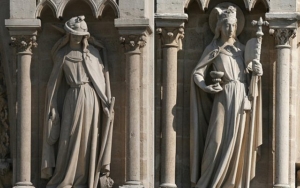
Ecclesia (right) and Synagoga, illustrating Jewish blindness in rejecting Christianity

Indeed, Jewish perceptions of the anti-Jewish nature of Christian theology have resulted in Jewish activism to essentially rewrite or reinterpret the New Testament in their interests. Antonius J. Patrick summarizes this strand of Jewish activism in his review of Vicomte Léon de Poncins’ Judaism and the Vatican: An Attempt at Spiritual Subversion:

The pronouncements on non-Christian religions and the declaration Nostra aetate passed in the Fourth Session of the Council (1965) accomplished almost all that the Modernists had hoped for. In effect, these pronouncements repudiated nearly two thousand years of Catholic teaching on the Jews. Ever since, the Church has continually bowed to Jewish pressure in regard to its liturgy, the naming of saints, and in the political realm—its most infamous decision in the latter being the recognition of the state of Israel in 1994.

Poncins, who closely covered the Vatican II proceedings, wrote of the declaration:

. . . a number of Jewish organizations and personalities are behind the reforms which were proposed at the Council with a view to modifying the Church’s attitude and time-honored teaching about Judaism: Jules Isaac, Label Katz, President of the B’nai B’rith, Nahum Goldman, President of the World Jewish Congress, etc. . . . These reforms are very important because they suggest that for two thousand years the Church had been mistaken and that she must make amends and completely reconsider her attitude to the Jews.

The leading figure in the years prior to the Council was the virulent anti-Catholic writer Jules Isaac, and he played an active role during the Counsel. “Isaac,” Poncins describes, “turned the Council to advantage, having found there considerable support among progressive bishops. In fact, he became the principal theorist and promoter of the campaign being waged against the traditional teaching of the Church.”

Isaac had long before begun his hostile campaign to overturn Catholic teaching on the Jews with his two most important books on the subject: Jésus et Israel (1946) and Genèse de l’Antisémitisme (1948). Poncins accurately summarizes the main thrust of these works:

In these books Jules Isaac fiercely censures Christian teaching, which he says has been the source of modern anti-Semitism, and preaches, though it would be more correct to say he demands, the ‘purification’ and ‘amendment’ of doctrines two thousand years old.

Moreover, whatever the beliefs and motives of St. Paul and the Gospel writers, the Church had essentially become an anti-Jewish movement by the fourth century when Catholicism became the official religion of the Roman Empire:

The proposal here is that in this period of enhanced group conflict, anti-Jewish leaders such as [St. John] Chrysostom [who retains a chapel named after him at St. Peter’s basilica in Rome] attempted to convey a very negative view of Jews. Jews were to be conceptualized not as harmless practitioners of exotic, entertaining religious practices, or as magicians, fortune tellers, or healers [as had been the case previously], but as the very embodiment of evil. The entire thrust of the legislation that emerged during this period was to erect walls of separation between Jews and gentiles, to solidify the gentile group, and to make all gentiles aware of who the “enemy” was. Whereas these walls had been established and maintained previously only by Jews, in this new period of intergroup conflict the gentiles were raising walls between themselves and Jews….

The interpretation proposed here is that group conflict between Jews and gentiles entered a new stage in the 4th century. It is of considerable interest that it was during this period that accusations of Jewish greed, wealth, love of luxury and of the pleasures of the table became common (Simon 1986, 213). Such accusations did not occur during earlier periods, when anti-Jewish writings concentrated instead on Jewish separatism. These new charges suggest that Jews had increasingly developed a reputation as wealthy, and they in turn suggest that anti-Semitism had entered a new phase in the ancient world, one centered around resource competition and concerns regarding Jewish economic success, domination of gentiles [especially enslaving gentiles], and relative reproductive success. …

Jews were increasingly entering the imperial and municipal service in the 4th century until being excluded from these occupations in the 5th century—an aspect of the wide range of economic, social, and legal prohibitions on Jews dating from this period [particularly prohibitions on Jews owning Christian slaves—itself an indication of the superior wealth of Jews]. These factors, in combination with traditional gentile hostility to Judaism (because of its separatist practices and perceptions of Jewish misanthropy and perhaps of Jewish wealth), set the stage for a major anti-Semitic movement. The proposal here is that this anti-Semitic movement crystallized in the Christian Church. (Separation and Its Discontents, Ch. 3, 96, 98, 99)

It is quite possible that the anti-Jewish statements in the New Testament are interpolations made much later by anti-Jewish writers motivated by resource competition and Jews enslaving Christians. If so, the liars were not Paul and the Gospel writers, but Christians concerned about Jews in the third and fourth centuries. J. G. Gager suggests that the extant literature from the early Church was deliberately selected to emphasize anti-Jewish themes and exclude other voices, much as the priestly redaction of the Pentateuch retained from earlier writings only what was compatible with Judaism as a diaspora ideology (J. G. Gager, The Origins of Anti-Semitism: Attitudes toward Judaism in Pagan and Christian Antiquity (Oxford, 1983), 7; N. deLange, “The origins of anti-Semitism: Ancient evidence and modern interpretation,” In Anti-Semitism in Times of Crisis, S. L. Gilman & S. T. Katz (NYU Press, 1991, 30–31). It’s quite conceivable that, rather than reflecting real intra-Jewish squabbles in the first century, as suggested by Skrbina, these early works were deliberately embellished in order to emphasize anti-Jewish themes in the originals—or they were completely fabricated—at a time when these writers had become strongly anti-Jewish for reasons that would not have been salient in the first century. In any case, this possibility is highly compatible with the view that there was a qualitative shift toward the conscious construction of a fundamentally anti-Jewish version of history during the formative period of the Catholic Church.

Consequences of the Lies. Skrbina ends by claiming that Paul’s lies were successful: “It took a few hundred years, but when enough people fell for the hoax, it helped to bring down the Roman Empire” (122). And he describes the lies as a “mortal threat”: “eventually drawing in 2 billion people, becoming an enemy of truth and reason, and causing deaths of millions of human beings via inquisitions, witch burnings, crusades, and other religious atrocities” (101).

I have never seen a scholarly argument that the institutionalization of the Catholic Church contributed importantly to the fall of the Empire. The Eastern Empire, although losing substantial territory to the Muslims, was only overthrown in 1453 after centuries of battling them. However, it’s certainly a reasonable idea given that Christian religious ideology was the polar opposite of thoroughly militarized Indo-European culture upon which Rome was built. Ancient Greco-Roman culture was fundamentally aristocratic and based on ideas of natural inequality and natural hierarchy. Thus, Plato’s “just society” as depicted in The Republic was to be ruled by philosophers because they were truly rational, and he assumes there are natural differences in the capacity for rationality—a modern would phrase it in terms of the behavior genetics of IQ and personality. Aristotle believed that some people were slaves “by nature” (Larry Siedentop, Inventing the Individual: The Origins of Western Liberalism (Cambridge, MA: Harvard University Press, 2014), 52), i.e., that the hierarchy between masters and slaves was natural. Reflecting themes common in Indo-European culture emphasized by Ricardo Duchesne (The Uniqueness of Western Civilization), the ancients prized fame and glory (positive esteem from others) resulting from genuine virtue and military and political accomplishments—but not labor, because laborers were often slaves and the rightful booty of conquest.

So the Christian ethic of prizing meekness, humility, and labor was quite a change. Within Christian ideology the individual replaced the ancient Indo-European family as the seat of moral legitimacy. Christian ideology was intended for all humans, resulting in a sense of moral egalitarianism, at least within the Christian community, rather than seeing society as based on natural hierarchy. Individual souls were seen as having moral agency and equal value in the eyes of God—a theology that has had very negative effects in the contemporary world.

However, universalism and the Christian virtues of meekness and humility are not the only story and indeed, as Skrbina notes, the sword also makes an appearance in the New Testament. In the Middle Ages Christianity was Germanized (James Russell, The Germanization of Early Medieval Christianity, Oxford, 1996), making it much more compatible with an aristocratic warrior ethnic. And in the medieval period and beyond, Christianity facilitated Western individualism and essentially ushered in the modern age of science, technological progress, and territorial expansion (Joseph Henrich, The Weirdest People in the World, 2020; MacDonald, Individualism and the Western Liberal Tradition, 2019).

As a direct result, Christians who had a firm conviction about their beliefs eventually conquered the world and have been responsible for essentially all of the scientific and technological progress that created the modern world. Indeed, in his The WEIRDest People in the World, Joseph Henrich argues that the medieval Church invented Western individualism by insisting on monogamous marriage and by “demolishing” extended kinship relations, presented by Henrich as an attempt to understand, as phrased in his subtitle, How the West Became Psychologically Peculiar and Particularly Prosperous (Harvard, 2020). I have quite a few objections to his approach (see here), but he is certainly correct that the Church was influential in opposing the power of extended kinship groups and preventing concubinage and polygyny among elites, thereby facilitating a relatively egalitarian marriage regime. Essentially Henrich ignores the ethnic basis of Western individualism that reaches back into pre-historic Western Europe and is certainly reflected in the classical Western civilizations of Greece and Rome. Henrich also ignores genetic influences on IQ and personality. But I agree with a much weaker version—that the Church facilitated Western individualism and so helped give rise to the modern world (Chapter 5 of Individualism and the Western Liberal Tradition, 2019).

So it’s not entirely a story of “causing deaths of millions of human beings via inquisitions, witch burnings, crusades, and other religious atrocities.” But the sad reality is that contemporary Christianity, or at least the vast majority of it, is utterly opposed to the interests of the people who have historically made it their religion. For example, Prof. Andrew Fraser has interpreted fundamental Christian texts in a manner consistent with an ethnic form of Christianity (e.g., “Global Jesus versus National Jesus”, and in The Sword of Christ (2020; this book seems to have been banned by Amazon), Giles Corey attempts to rescue an ethnically viable Christianity from the ruins of contemporary, leftist-dominated Christian theology. As I note in my preface:

Religious thinking is by its nature unbounded—it is infinitely malleable [so that, for example, redactions and interpolations on the New Testament could easily have been adapted to create a fundamentally new theology]. It is a dangerous sword that can be used to further legitimate interests of believers, or it can become a lethal weapon whereby believers adopt attitudes that are obviously maladaptive. One need only think of religiously based suicide cults, such as People’s Temple (Jonestown), Solar Temple and Heaven’s Gate. Mainstream Christianity from traditional Catholicism to mainstream Protestantism was fundamentally adaptive in terms of creating a healthy family life. It was compatible with a culture characterized by extraordinary scientific and technological creativity, [territorial expansion], and standards of living that have been much envied by the rest of the world. …

Corey is well aware that contemporary Christianity has been massively corrupted. Mainline Protestant and Catholic Churches have become little more than appendages for the various social justice movements of the left, avidly promoting the colonization of the West by other races and cultures, even as religious fervor and attendance dwindle and Christianity itself becomes ever more irrelevant to the national dialogue. [Guillaume Durocher notes that only 6–12 percent of the French population are practicing Catholics, indicating that Catholicism cannot be blamed for France’s current malaise.] On the other hand, [American] Evangelicals, a group that remains vigorously Christian, have been massively duped by the theology of Christian Zionism, their main focus being to promote Israel. [In general, they have rejected an explicit White identity or a sense of White interests.]

Until the twentieth century, Christianity served the West well. One need only think of the long history of Christians battling to prevent Muslims from establishing a caliphate throughout the West—Charles Martel at the Battle of Tours, the Spanish Reconquista, the defeat of the Turks at the gates of Vienna. The era of Western expansion was accomplished by Christian explorers and colonists. Until quite recently, the flourishing of science, technology, and art occurred entirely within a Christian context.

Corey advocates a revitalization of Medieval Germanic Christianity based on, in the words of Samuel Francis, “social hierarchy, loyalty to tribe and place (blood and soil), world-acceptance rather than world-rejection, and an ethic that values heroism and military sacrifice.”  This medieval Christianity preserved the aristocratic, fundamentally Indo-European culture of the Germanic tribes. This was an adaptive Christianity, a Christianity that was compatible with Western expansion, to the point that by the end of the nineteenth century, the West dominated the planet. Christianity per se is certainly not the problem.

The decline of adaptive Christianity coincides with the post-Enlightenment rise of the Jews throughout the West as an anti-Christian elite, and Corey has a great deal of very interesting material on traditional Christian views of Judaism. Traditional Christian theology viewed the Church as having superseded the Old Testament and that, by rejecting the Church, the Jews had not only rejected God, they were responsible for murdering Christ. …

In fact, intellectual movements of the left—disseminated throughout the educational system and by the elite media—have exploited the Western liberal tradition. The intellectuals who came to dominate American intellectual discourse and the media were quite aware of the need to appeal to Western proclivities toward individualism, egalitarianism, and moral universalism by essentially creating a moral community that appealed to these traits but also served their interests. A theme of The Culture of Critique is that moral indictments of their opponents have been prominent in the writings of the activist intellectuals reviewed there, including political radicals and those opposing biological perspectives on individual and group differences in IQ. A sense of moral superiority was also prevalent in the psychoanalytic movement, and the Frankfurt School developed the view that social science was to be judged by moral criteria.

The triumph of the cultural left to the point of substantial consensus in the West has created a moral community where people who do not subscribe to their beliefs are seen as not only intellectually deficient but as morally evil. Moral communities rather than kinship are the social glue of Western societies. Westerners, being individualists and relatively unconcerned about the prospects of their kin beyond their immediate family, willingly punish other Whites who oppose their moral community, even at cost to themselves (altruistic punishment). Their main concern is to have a good reputation in their moral community which is now defined by the media and the educational system—a moral community that was created by hostile elites out of fear and loathing of the traditional White American majority (see Culture of Critique, Ch. 7).

Finally, Skrbina asks, “Can it really be beneficial to accept a myth as truth? Can one really live a happy, successful, and meaningful life dedicated to a false story or a lie?” (16). I think that the answer is that yes it can. As an evolutionist, my working hypothesis is that when it comes to the realm of ideas, evolution does not aim for truth but rather for success in continuing one’s family and increasing the prospects of one’s tribe. Certainly the religious beliefs of other groups, say Muslims, Jews, or Mormons, may well be false and based on inventions. But the people believing in these lies have often done very well in evolutionary terms and are continuing to do so. Ashkenazi Jewish eugenics proceeded for centuries in a religious context, resulting in a highly intelligent elite able to wield vast influence throughout the West. Islam expanded over hundreds of years, controlling vast territories, with leaders rewarded by large harems and many descendants; Islam is now rapidly expanding in Europe and has higher fertility than native Europeans. It’s well known that seriously religious, fundamentalist Christians in the West have more children on average than non-Christian Europeans, which is certainly adaptive. But they are also more likely to swear fealty to the interests of Israel and in general they are entirely resistant to being informed about the negative effects of multiculturalism or about Jewish cultural influence (whose effects they despise) or even Jewish traditional hostility toward Christianity.

And it can scarcely be doubted that Catholicism and mainline Protestantism have been completely corrupted and actively subverted so that millions of White Americans have been swept up by the multiculturalism and replacement-level immigration as moral imperatives. Jewish activism has certainly been part of this, but traditional Christian universalism and moral egalitarianism are also part of the equation. One might say that Christianity, despite periods when it was highly adaptive, carried the seeds of its own destruction—a chink in its armor that made it relatively easy to subvert once the culture of the West had been subverted by our new hostile elite.

So, in my view, it’s a complex story, and one that is far from finished.


[1] Kevin MacDonald, Separation and Its Discontents: Toward an Evolutionary Theory of Anti-Semitism (AuthorHouse, 2003; originally published: Praeger, 1998), Ch. 3.

[2] Quoted in Emilio Gabba, “The Growth of Anti-Judaism or the Greek Attitude toward the Jews.” In W. D. Davies & Louis Finkelstein (Eds.), The Cambridge History of Judaism. Vol. 2: The Hellenistic Age (Cambridge University Press, 1989), 614–656, 645).

[3] Miron Zuckerman, et al., “The Negative Intelligence–Religiosity Relation: New and Confirming Evidence,” Personality and Social Psychology Bulletin 46, no. 6(2020): 856–868.


The Presidential Commission on the Supreme Court of the United States: Bring in the Shakher-Makhers

In order to mandate progress in the name of law, especially in the name of constitutional law, it is necessary to deceive. Where the law is backward, it must be made to seem progressive. Where the law is uncertain or permissive, it must be made to seem definite and mandatory. Where arguments are limited and honestly debatable, they must be made to seem comprehensive and inescapable. Where opponents refuse to yield, their positions must be distorted or they themselves must be belittled and insulted.   Prudence is the opposite of ideological moralism.  It is what the decay inherent in liberal idealism consumes.  Robert F. Nagel, The Implosion of American Federalism, and Unrestrained: Judicial Excess and the Mind of the American Lawyer

A culture that is at once moralistic, self-righteous, alienated and in a minority will constantly be tempted to break the rules of political discourse—indeed to conduct its struggles in ways that preclude the use of the word “discourse” —and to gain its ends by deception or outright falsehood.  Robert Bork, The Tempting of America: The Political Seduction of the Law

In the early 1990’s when I worked in the Former Soviet Union for a large multi-national corporation looking at doing “deals” in the suddenly open communist country—a massive advanced industrial empire that was quickly destabilized by the economic theory of “shock therapy” which was advanced by Columbia University advisor Jeffrey Sachs and University of Chicago Nobel economist Milton Friedman—we were often told by native Russians to “watch out for the shakher-makhers.”  This old slang, heard in Russian, German, and often in Yiddish on the streets of New York, means “wheeler-dealer.”  It implies an underhanded street hustler; a “conman”  and in early twentieth-century America, implied gangster affiliation—especially the country’s largest criminal enterprises composed of Jewish immigrants or second generation inductees into organized crime.

As the disastrous Russian privatization program—notionally advertised as a means of distributing shares in state-owned enterprises to the larger public—spun rapidly out of control, it became clear who was actually getting all the stock and control of the old Soviet industrial corporations: a small, tightly knit group of “shakher-makhers,” almost all Jewish.  In the end some went to prison, or fled, after the incompetent Boris Yeltsin was replaced by the cool hand of Vladimir Putin; others made off to Switzerland, and a few more ingratiated themselves with the new leader (and still do).

Fast forward to 2021 and it is not hard to discern a consistency in this general observation made over many decades, if not centuries, by the competing gangs, law enforcement, or the victims of their criminal operations.  As I discussed in the Summer 2020 issue of The Occidental Quarterly, this current cultural phenomenon, a “Neo-Bolshevism,” finds a consistent traction in our nation’s law schools. In that article, titled, “The New Bolshevism in the Legal Profession: The Effect of Activist Law Faculty on Standards of Jurisprudence, Professional Conduct, and University Pedagogy,” I noted:

There is an especially visible commonality in the current U.S. political economy that is defined by an ethno-religious and state special interest that is advanced largely through the re-casting and re-purposing of law. The modern university law school sits in its organizational center, acting as an asserted professional authority on legal interpretation; as an activism network node; and as an ideological pedagogic institution among students in captive degree programs.

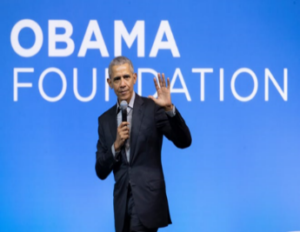
The recently announced White House “Presidential Commission on the Supreme Court of the United States,” exhibits many of these features, and in a very visible manner.  While the Commission is a putative presidential authority, it should be clear that the current U.S. president is merely a proxy for the agenda of a special interest syndication, led in several important ways by the former president, Barack Obama, and the members of his Foundation.

The Obama Foundation: “The seemingly independent factions are in actuality part of a larger ‘family’ or ‘gang’ of wealthy and radical individuals and organizations. With former President Barack H. Obama’s Foundation at the top, they operate similar to an organized crime family—on the periphery of civil society.”

As a graduate of Harvard Law School and in the capacity of a “professor” at the University of Chicago Law School where he taught a course on “race and law,” Obama turned to his old colleagues—including some of his former White House advisors—to head up the Commission, whose ostensible purpose is to provide “window dressing” and a gloss of objective analysis before a final push is made to add at least four new liberal justices to the SCOTUS bench, and establish an effective permanent Left majority on a court effectively converted into a legislative body.  From TOQ:

I refer to a dominant, highly organized, efficient and resource-rich political party coalesced around Israeli interests. Those interests include strictly economic ones (including organized crime); religious and ethnic enthusiasms, and geopolitical ambitions (the pan-Israel construct).  Although criticism of Israel—such as John Mearsheimer and Stephen Walt discuss in The Israel Lobby and U.S. Foreign Policy—can be seen in a simple mono-directional manner (i.e., aid and finance flowing from the U.S. to Israel), Israel also serves as an “incubator” for U.S. domestic security policy, law enforcement, and related State projects.  Israel is effectively America’s “third political party.”

Indeed, as Israeli activist Ilana Daniel states:

“We are being used as a model for the rest of the world.  Many of us are calling this a new holocaust in our own country.  You could not have created a bigger betrayal.  This has nothing to do with a virus.  It leaves behind the arguments of right and left, pro and anti, even religious designations, and asks of us: what are the most basic common denominators we share?”  (Ilana Rachel Daniel, Israeli political activist on Israel’s current state authoritarian Covid policy and the “purity test”).

The especially poignant irony in her case is that Israel is held out as the only “democracy” in the Middle East—generally politically progressive, socially tolerant, governed by parliamentary system, and with a modern free press and purported strong ties to the US, UK, Germany and France.  Yet its extremism in biosecurity is highly authoritarian and has survived a broad legal challenge brought by protestors in Israel’s Knesset and courts and by a determined radical legal activist syndicate of legal and other professionals.  Its higher education system, coupled—like the US—to industrial and defense interests, is highly active in bio-security research, legal policy, and molecular engineering, while its notorious Mossad intelligence agency is, like the US DHS complex, turned inward on its own citizens. It is indeed a “model” for US special interests that make up its “intelligentsia.”

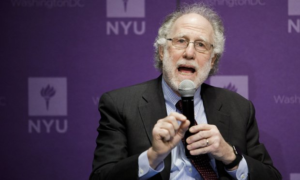
Who needs the Constitution?  How to bypass voters and get the entire Covid policy panoply pushed into non-objective law without public deliberation, or the hard work of constitutional amendment: Hire the шахер-махер: the Obama SCOTUS Court Packing “Commission,” led by NYU Law’s Bob Bauer, above.  Who is packing whom?

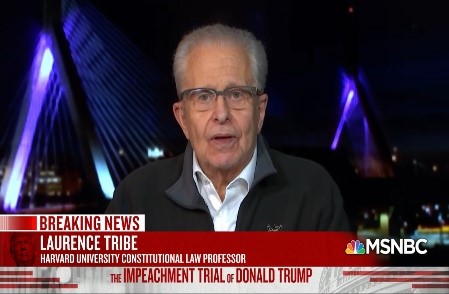
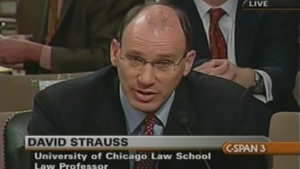
The lead member of the Commission is former Obama White House advisor and radical NYU Law professor Bob Bauer, accompanied by his former professor, Harvard’s notorious Laurence Tribe who believes there is an “invisible constitution” that means whatever you want it to, followed by Chicago Law’s David Strauss, an old colleague of Obama and a loyalist who wrote “The Living Constitution,” which is among a set of academic works arguing for a coercive moral activism from the courts. All three are close personal friends and loyal, ideological allies of the former president and his current political operations.

Laurence Tribe

A Balanced Commission?

There are some on the left who assert that, because the Commission includes some law professors who are considered moderate or generally conservative, such as UChicago Law’s well-regarded and youthful constitutional scholar William Baude, that it will either result in an effective “hung jury” concerning what explicit or implied recommendations it may or may not make, or that it will not be forceful enough to convincingly ratify the Administration’s (and the Obama Foundation’s) court-packing agenda that Progressives are seeking (as one writer notes, “Congressional advocates of court-packing are moving ahead as though the Commission doesn’t exist. They have introduced legislation to add four justices, just enough to give the court a majority of Democratic appointees instead of Republican ones”).  For others, a few moderate commission members make it seem fair and balanced, so that no particular faction could dominate it.  But this rests on a more fundamental flawed assumption: that there is a public mandate for such a “commission” in the first place. In fact, it is an invention of the Left, and merely another political tool that seeks to make—like prior unconstitutional state voting law changes that had such dramatic effects on the 2020 election—the extra-legal appear as if it were perfectly legal, normal and even welcome. In this case, it is accomplished by using traditional institutional processes and forms (like commissions, committees and other symbolism) to mask what is in reality a very different, radical, and even legally violative content.

David Strauss

It is important to appreciate that such commissions are highly susceptible to manipulation by their external sponsors (the Clinton and Obama Foundations), and especially, that once formed, the commission leader (in this case former Obama appointee and radical NYU Law professor Robert Bauer), along with his senior and ideologically aligned colleagues, have significant powers as far as what the final report will include, what is omitted, and how the narrative is presented and “spun”  (the 911 and Warren Commissions are examples). The fully left-progressive Yale Law has more commission members than any other single law school, followed by predominantly left-progressive Harvard and Chicago, and the commission includes former Clinton speech writer and head of the far-left NYU Brennan Center, Michael Waldman).

“Never Trump” commission member, Harvard Law’s Laurence H. Tribe is an especially revered icon among the Left (he even sued President Trump) and is worshiped by all his many former students working as law professors.  Indeed, as former Dean of Stanford Law, Kathleen Sullivan gushes in her fawning law review article on Tribe: “[He] is the greatest living intradisciplinary scholar of constitutional law—and perhaps simply the greatest such scholar ever.”  Tribe carries enormous weight in the Commission hierarchy (not unlike the sociology of a primate group).  He was also a mentor to Barack Obama at Harvard Law, and, during Obama’s tenure as editor-in-chief of the Harvard Law Review, he published a paper that argues how relativity theory in physics can be used to explain a “relativity” in law, meaning law is fungible, elastic, a morally relative topology, and ultimately unsettled (which some critics in academia have called a “crackpot theory”).

Moreover, the three senior members of the Commission who are especially close to Obama, also have significant “academy” power over the younger members such as Baude and legal historian Alison LaCroix, who are also still managing their careers and are dependent on continued favor and acceptance from their law school colleagues (almost all far Left or progressive) and in reality have limited independence.  Their “home” law schools are also institutionally influential, and in Chicago, Harvard and NYU’s case, all are aligned politically with the current left-progressive agenda of the Democratic Party. They may “protest” but it will be done politely, theoretically, academically, and be at best merely a mild “dissenting” view that is used to sell a fair and balanced political act, as the underlying court packing plan is politically contentious.

The Commission also includes David F. Levi, whose father, Edward Levi, was the former Dean of UChicago Law, and past president of the University of Chicago (and namesake of the main administrative building “Levi Hall”).  David’s brother, John Levi, is credited with hiring Barack Obama for his law internship in Chicago, and for also hiring Michelle Obama, providing the opportunity for them to meet, and eventually marry.  One big happy family (and the Levis, all from a family of rabbis).

The Commission is in fact, a very tightly affiliated, private team, led by senior members from the law schools of Harvard, Yale and Chicago, with a traditional hierarchy of “lieutenants” just below them—and importantly, from the same university institutions, which reinforces consensus or obedience. All of these senior members are ideologically aligned and active in political commentary and public relations, including the Dean of Yale Law, Heather Gerkins, liberal Dean of NYU Law Trevor Morrison, and NYU Law’s Rick Pildes who specializes in election law, the eradication of the electoral college, the modification of state voting rules, and is a source of regular left-progressive opinion including as a regular commentator on CNN and an op-ed writer for the New York Times.  Pildes is a political authoritarian and a clever arguer. In his most recent New York Times article, titled “How to Keep Extremists Out of Power,” he argues that voting laws should be modified so that political moderates—he considers Trump supporters to be extreme—would be favored. Yale Law Dean Gerkins is just as radical. She promotes a government construct she calls “nationalist federalism” that is a coy way of acknowledging state and local government, but increasing the consolidation of power in Congress, with effective hegemony over state government (which is what H.R.1—the “For the People Act,” proposes; it’s no surprise that Michael Waldman’s Brennan Center is all for it). Gerkins’ Yale Law colleague, Jack Balkin, previously on the faculty of law at Tel Aviv University, and a well-known Marxist constitutional “deconstruction” activist is also on the Commission. Belkin advances what he refers to as a “memetic, ideology and transcendence” construct of jurisprudence, and he is known for his concepts of “ideological drift,” “nested oppositions,” and legal semiotics.

In all these cases, their radicalized “neo-Bolshevist” and critical legal studies or “CLS” views, are precisely those that would be pursued in a new “packed” Supreme Court. This is why they are on the Commission: it is ideologically unified and institutionally concentrated in the so-called legal reconstruction advocated by Yale’s notorious Bruce Ackerman, and professionally incestuous in numerous shared relationships in employment, politics and government assignments, including in judicial clerkships.

The commission does have some limited constitutional diversity, but they are institutionally isolated, far less in favor, or even recognition, by the Commission sponsors, and are the proverbial “potted plant” as far as actual group power and influence.  Moreover, this is a very traditional East-Coast “elite” law school project of establishment liberals: there are no commission members from the Universities of Wyoming, South Dakota, Texas, Florida, Montana, Iowa, or any solid “red” states. It is far from even symbolically representative of America: This is effectively a private law trust acting as a private commission carrying out a private agenda for private interests.

But even if the Commission were to produce a “balanced” report, or create the impression of bi-partisan judgment, it is, like all such commissions, merely “window dressing” and a public relations gesture of impression management.  All warfare (or lawfare) involves deception, and in the case of Washington, D.C. culture, a document that provides deniability, or points to consideration and a symbol of participative democracy.  The actual make-up of the Commission, however, and its clear mandate from its sponsors (not the public) tells the purpose, motivations, and larger political intent of the group to which it belongs.  If, as some on the Left have criticized, the Commission “will go nowhere,” that is largely what it is supposed to do: it is merely political “chum” or bait to consolidate critics and advocates alike. What matters in the end is what Congress, the White House and the Roberts Court itself does (and what American citizen critics do).  As NYU political science professor Ana Harvey smartly researched with convincing statistical analysis, “The U.S. Supreme Court does not appear to decide constitutional cases independently of elected branch preferences.  They are extraordinarily deferential to those preferences, in particular the preferences of majorities of the House of Representatives.  It is even more evident when we control for selection bias in the Court’s docket.”  That dynamic, combined with removal of the Senate filibuster, and overwhelming external financial and other pressure, is what the actual court packing political weaponry consists of.

As I wrote in TOQ:

[This is part] of a complex political network that is intellectually centered in elite law schools that codifies activism and provides a pipeline of ideologues into the government apparatus. It is almost entirely made up of pro-Israel radicals (Henry Kissinger, Laurence Tribe, Louis Kaplow, Cass Sunstein, Bruce Ackerman, Alan Dershowitz, Eric Posner, and others) who provide a “senior authority” symbolism that is reinforced with dozens of second- and third-tier ideological colleagues, including those in foreign and military policy, and financial institutional and media influence roles.  Such ideology is channeled into policy that is then “sold” through the Congressional apparatus and with careful appointee maneuvering in senior advisor and administrative roles in State, the White House, the Pentagon and the intelligence, security and law enforcement agencies. The model rests largely on an elitist intellectual identity which is necessary in order to anchor relatively complex conceptual and linguistic framing that can then flow through an elitist social network.  While this picture has been described before, it rarely puts its finger on the more sensitive, if difficult ethno-religious and cultural content that is the inherent basis of the instincts, motivations, interests and ideology that initiate, manage and distribute the necessary intellectual content through the institutional architecture that converts it operationally. The central operational coding consists of a “Neo-Bolshevism” that projects a social justice philosophy, but is at its core a fascistic, authoritarian ethno-religious [obsession] that manifests in systematic institutional social predation, including most recently, the roll-out of long-incubated plans that seek to dismantle several traditional Western cultural traditions and replace them with a de facto theocracy centered in…key social controls that isolate and de-socialize public interaction while increasing public economic dependence and cognitive infantilism.

The new Presidential Commission is precisely of this character. It is a clear expression of organized ideology that resides consistently throughout America’s university law schools that are functioning, in this case, as unconstitutional, extra-legal political operating arms of special interests. The individuals with the most power have a history of acting as “hired guns” of the DNC party agenda, with consistently little if any regard for the rule of law, the U.S. Constitution, and especially, the hard work of bi-partisan compromise and separated governance that upholds the founding political philosophy of the United States, a philosophy perhaps most centrally in John Locke’s “Two Treatises of Government.”

V.S. Solovyev is a graduate of the University of Chicago.

Confronting the Judeocracy: The Six Stages of Enlightenment

Anyone who has spent even a short time battling against the Judeocracy has surely experienced the frustration of attempting to persuade a trusted friend or colleague of the gravity of the situation—only to fail.  This is undoubtedly one of the most discouraging and troubling aspects of those who take up the mission for truth and justice.  We repeatedly encounter intelligent and well-read individuals who, we believe, surely must share our sense of concern and outrage.  If they do not, it can only be from lack of knowledge; therefore, a short chat or a targeted reading or two, we think, will do the trick.  The facts are indisputable, and hence it is merely a matter of information.  Once our friends have the requisite facts, they will surely—surely—see things our way.  And yet, time after time, they do not.

Why is this?  What are they thinking?  What is their logic?  How is it that they can fail to be fully convinced of the severity of the Jewish Question?  Or even just be sympathetic to our stance?  Why is it that they occasionally even become outright hostile—not to them, but to us?  How can they be in denial of what is, from a rational and objective standpoint, surely one of the major problems facing civilized humanity?  Undoubtedly this could be the topic of a book-length treatment, and I can only outline a few basic ideas here.  But I think there is some merit in examining the basic categories of response and denial by those confronted, perhaps for the first time in a serious manner, with the Jewish Question and with the many problems of living under de facto Jewish rule.

At its most basic level, the situation is one in which the relative novice is confronted with a difficult, troubling, and potentially catastrophic scenario: profound social corruption by wealthy and powerful Jews.  (I stress the ‘relative’ here; everyone, even the functionally illiterate, has heard something negative about the Jews, likely many negative things.)  It is a ‘bad news’ story of the highest magnitude.  And the last thing many people want in their lives these days is another bad news story.  God knows we’ve had enough troubles in recent years:  political upheaval, riots in the streets, a global pandemic, economic gyrations, unrestrained immigration, environmental decline, opioid crises, surging crime, falling lifespans.  Who needs yet one more disaster heaped upon their plates?  The Jews?  Really?  Are you serious?  And I suppose the Holocaust never happened!  (Hint:  it didn’t—not in the way described.)  What are you, some kind of Nazi?  A White supremacist?  On and on.

Despite all this, many of us persevere.  We realize that public education is one of our primary weapons in the Great Struggle, and we are bound and determined to press ahead and inform as many as possible of the nature of the problem.  Therefore, it is of some use to understand more precisely how people typically respond to our overtures, in order to be more effective in our communication.  After all, we are pursuing a noble cause, and we sincerely want people to be well-informed and, ideally, to join us in our mission.  Apart from our opponents, we genuinely want people to like and appreciate us.  You don’t get very far coming off like a fanatic or a jerk.  I’m quite confident that virtually none of us relish making enemies for the sake of making enemies.  We have no driving urge to be antagonistic or rabble-rousing.  Generally speaking, what we have are facts, experiences, and informed opinions on the Jews; these, combined with a general sense of concern for social welfare, justice, and the state of the world, incline us to undertake unusual, unpopular, but highly valuable actions to educate others, and to articulate possible solutions.  It is the prototypical ‘thankless task,’ and yet we do it all the same.

That said, it is helpful to have a model of how people react to the Jewish Question.  The approach I will outline here derives from another famous model describing how people react to a different crisis situation: death.  In the 1950s and 60s, Swiss (later, American) psychiatrist Elisabeth Kübler-Ross developed a well-known scheme that came to be known as “the five stages of grief.”  When confronted with imminent death, she said, people typically progress through five relatively distinct mental phases:  denial, anger, bargaining, depression, and acceptance.  Denial:  “No, this isn’t true, it can’t be happening.  There must be some mistake.”  Anger:  “How could this happen to me?  It’s just not fair!  Someone is to blame.  God, how could you let this happen!”  Bargaining:  “Please, God, get me through this and I promise to do x, y, z.  Or, doc, you have to help me; I’ll do whatever it takes.”  Depression:  “There’s no use, nothing will work.  I’m doomed.  What’s the use of even trying?”  And finally, Acceptance:  “Everyone dies, and I guess my time is up.  So be it.  Time to meet my Maker.”  This schema was first described in her initial book, On Death and Dying (1969).

I’ll not debate the merits or demerits of Kübler-Ross’ theory here.  Some have found it helpful, and others dismiss it as largely irrelevant or at least unsubstantiated.  Still, based only on common sense, I think we can see that there is some insight here, and that many people—perhaps some we have known personally—indeed experience such stages in varying degrees.  Obviously not everyone passes through all five stages, and not necessarily in the prescribed order, but nonetheless, these stages do describe some essential aspects of human response to the looming tragedy of one’s own demise.

Inspired by this model, let me then propose something analogous:  The Six Stages of Enlightenment on the Jewish Question.  I claim no real scientific grounding here, and I have done no exhaustive surveys or interviews.  This is based simply on my own personal experience, over several years, of confronting people—students, family, friends, strangers—on the dangers of the Judeocracy.  My six stages are as follows:

1. Denial
2. Irrelevance
3.  Impotence
4.  Misplaced Anger
5.  Acceptance
6.  Righteous Anger and Action

As with Kübler-Ross’s theory, I do not claim that all people experience all of these stages, nor that they necessarily progress through them in order.  But I do think that many people, when confronted with the data, do experience some or most of these stages.  Let me briefly describe each in turn, and then outline some of the relevant facts that make the case for enlightenment.

DENIAL.  Upon first hearing a serious claim that Jews have outsized and detrimental influence in society, or dominate the ranks of the wealthy, or run the media, or control politics, the usual initial response is denial:  “No they don’t.  That’s ridiculous.  There are no more Jews in power than anyone else.  That’s just an anti-Semitic canard.”  This, even from highly-educated people.  Fortunately, this is an empirical question; an overwhelming Jewish presence can be easily proven, given the relevant data.  Below I offer a concise version of this argument.

IRRELEVANCE.  Once it is shown that Jews are massively over-represented in key sectors of society, the standard reply is that this fact does not matter.  “Ok, there are lots of Jews in media, finance, and politics, but this doesn’t really matter.  People are just people.  There are good ones and there are bad ones.  If Jews hold lots of influential positions, that only means that they worked hard and succeeded.  And anyway, they’re just doing their jobs.  If they didn’t do them, someone else would.”

This seems like a common-sense view, but to make such a claim is to hold an extremely naïve and ill-informed view of the world.  It’s true that most decent people, and especially most Whites, tend to view others as individuals; there are likely evolutionary reasons for this, which I won’t elaborate here, but see Kevin MacDonald’s book Individualism and the Western Liberal Tradition for a good recent account.  If we judge everyone as basically well-intentioned individuals, then of course, it doesn’t really matter if Jews or any other minority dominates society.  If Jews are disproportionate, then it can only mean that they are that much smarter or industrious than others, and thus they deserve their standing. (Nathan Cofnas is doing his best to make this thesis academically respectable—refuted in several places, most recently by Andrew Joyce).  And if some Jews commit crimes or other unethical actions, we have to judge and punish them individually, on a case-by-case basis.  Or so they say.

The Jewish critic must then respond to this stance with a demonstration that it does matter, that Jewish over-representation has a long-standing and deep-rooted grounding in anti-White and even anti-human actions, and that it is remarkably detrimental to social and human well-being.  This is a longer and more difficult argument to make, but it can be done; again, I outline this case below.

IMPOTENCE.  Once we have shown the deleterious effect of Jewish dominance, the next reply is typically something like this:  “Ok, if Jews have so much power and influence, then you can’t possibly win.  They are just too strong.  So why fight them?  It can only hurt yourself and your family.  Better to just ignore the whole situation and live your life as best you can.”

Certainly this is a pragmatic view, and many otherwise well-intentioned critics adopt this line.  But ultimately it means surrender:  a moral capitulation to a malevolent ruling power.  To yield to evil is itself a great evil.  It is to condemn one’s own future, and that of your children and grandchildren, to a life of increasing brutality and coarseness, of deprivation and suffering, of conflict and war.  No truly concerned person can accept this.  We must confront the situation head-on.  To fight against evil, even in the face of likely defeat, is noble; it actually makes life worth living.  Even if victory is a long way off—and ultimate victory for our side is inevitable, once we understand the history—it is still a fight worth pursuing.  Living in a Judeocracy means that every major aspect of society is affected.  If you have any concerns or causes in this world that you think are worth fighting for—the environment, social justice, education, human rights, health, democracy—then you need to engage in the fight against Jewish rule because it has a negative impact on virtually every other social issue.  To paraphrase Spengler, impotence is cowardice.

MISPLACED ANGER.  At this point, your friend is likely to start getting irritated—with you.  As a typical semi-thoughtful but uncritical television viewer, he has likely absorbed and internalized the conventional pro-Jewish mantra:  Jews are a beleaguered and innocent people who have been unjustly attacked over the centuries, most notably during the Holocaust, and thus we owe them vast amends.  Furthermore, being a typically decent person, he thinks that anyone attacking Jews, or any minorities, is a morally-deficient racist or neo-Nazi—and now, this is you!  For God’s sake, everybody hates a racist!  Even Tucker Carlson hates racists!—as he informs us every night, in his unthinking, dim-witted, and duplicitous manner.  Since you clearly hate Jews, you are now officially a ‘hater.’  And everyone hates a hater—don’t they?

Sensing that he has lost the argument, your friend then launches into either subtle or overt ad hominem attacks against you.  Rational discussion is out the window, and emotion rules the day.  You are now simply a ‘bad person’; no further need to debate with you.  Having demonstrated your incivility and cruel-heartedness, you are either pitied or detested.  Critically, the focus has shifted to you; Jews are suddenly nowhere in sight, even though this was the sole issue at hand.  They are suddenly off the hook.  How convenient; the Jews themselves couldn’t have scripted a better outcome.

Sadly, many people remain stuck in this mode for a long time, perhaps for their entire lives.  They never address the real issue, but continue only to think negatively of you and you alone.  This is a relatively good outcome for them; the social problem is not a multitude of wealthy, powerful, and ethnocentric Jews, but little ol’ you, and perhaps a few of your like-minded hater friends.  It’s much easier, and much less threatening, to deal with you and your “ilk,” rather than a potent, dispersed, malevolent force like world Jewry.

Sometimes, though, and often in surprising ways, there is a shift in attitude.  Your friend becomes curious.  He investigates, he reads, he asks questions.  Slowly, slowly, he comes around to your side.  “You know, I’ve been thinking, and I think you’re on to something.  Those Jews are everywhere, once you learn how to spot them.  No one criticizes them.  No one questions the Holocaust.  No one is even willing to simply name the Jews.  They get away with everything…”  Thus we arrive, with luck, at ACCEPTANCE.  Yes, Jews in fact dominate key sectors of society.  Yes, Jews in fact are the major wire-pullers in politics and business.  Yes, Jews couldn’t care less about human well-being, and they would just as soon cause mass suffering and even death, if it profited them in any way.  The denialism has been overcome.

Once at this phase, it is only a short step to the final stage: RIGHTEOUS ANGER—now against the real enemy—and corresponding ACTION.  Anyone with a conscience, with a sense of moral outrage, and with a larger sense of justice, will be utterly appalled at the situation.  They will now become activist, speaking out, writing, informing others.  They will develop the moral backbone to confront Jewish power and its proxies directly.  Being truly knowledgeable and well-informed, they will make a formidable opponent.  The movement will have taken one more small step forward.  And victory will be one day closer.

Constructing the Case

Given that nearly everyone begins at some level of the ‘denial’ stage, it is worthwhile to offer some specific facts that can help build the case against it.  The goal, again, is to show that Jews are massively disproportionate amongst the wealthy and powerful in society.  This is the core truth from which all the rest proceeds.  Fortunately, as I said, this is an entirely empirical matter.  Basic research will reveal the truth.  Of course, the names vary from nation to nation, and they change constantly over time.  A specific case must be made at a given point in time, and in a specific nation of interest.  Since I am an American, and the data here is extensive, let me briefly review the case in the present-day USA.  Even a cursory overview demonstrates the failure of denial.

We can separately examine four sectors of American society:  politics, academia, finance, and media.  In politics, we have a strong Jewish presence in all three branches of government–Congress, the White House, and the Supreme Court.  Regarding the latter, we currently have 2 Jews among the 9 justices:  Elena Kagan and Stephen Breyer.  Until the recent death of Ruth Bader-Ginsburg, the figure was 3 of 9, and if President Obama had had his way late in his final term, it would have been an astonishing 4 of 9, with Merrick Garland.  (We can be sure that any future Biden nominee will be Jewish.)

The current US Congress has 38 Jews among its combined 535 members, with 10 in the Senate and 28 in the House.  This constitutes around 7% of the Congressional total, versus an American Jewish population of some 6 million, or just under 2% of the nation.  Hence Jews are over-represented in Congress by a factor of 3.5, and in the Senate by a factor of 5.  The record high for Jewish representation, incidentally, occurred in the aftermath of the 2008 federal election, when fully 48 Jews held seats in Congress (15 Senate, 33 House).

The Biden administration, like that of Trump, Obama, Bush, and Clinton, has an extensive Jewish presence.  Start with the families of Biden and Kamala Harris.  Remarkably, all three of Biden’s adult children married Jews:  daughter Ashley married Howard Krein, son Hunter married “filmmaker” Melissa Cohen, and now-deceased son Beau married Hallie Olivere.  Correspondingly, three of Biden’s six grandchildren are half-Jews.  Biracial VP Kamala Harris married a Jewish lawyer, Doug Emhoff, back in 2014; thankfully, they have no children.

Biden’s sympathies to the Jews extend, of course, to his highest-level administrative positions.  Of 25 cabinet or cabinet-level positions, eight (32%) are held by Jews:  Tony Blinken, Alejandro Mayorkas, Janet Yellen, Merrick Garland (yes, that Merrick Garland), Ron Klain, Avril Haines (half), Isabel Guzman (half), and Eric Lander.  Other high-ranking Biden Jews include John Kerry (half), Rochelle Walensky of the CDC, Jeff Zients, Wendy Sherman, Gary Gensler of the SEC, David Cohen, “Rachel” Levine, Anne Neuberger, Andy Slavitt, Victoria Nuland, and Roberta Jacobson.  And this is not to mention Judeophilic Gentiles like Jake Sullivan, or Gentiles with Jewish spouses, like Samantha Power.  Below I offer some thoughts about why, exactly, this situation came to be.

What about academia?  Here is one remarkable indication:  It was recently noted that of the eight Ivy League schools—Harvard, Yale, Princeton, Columbia, Penn, Brown, Cornell, and Dartmouth—fully seven have Jewish presidents.  In other words, 88% of these elite schools are run by Jews.  We can be sure that this Jewish orientation then extends down into provosts and deans who are disproportionately Jewish, into faculty members who are disproportionately Jewish, and into the very curriculum itself, which undoubtedly caters to liberal-left Jewish interests.

Then consider university faculty more broadly.  In an article published in 2006, Schuster and Finkelstein found that “25% of research university faculty are Jewish, compared to 10% of all faculty.”[1]  An older study by Steinberg[2] found that 17.2 percent of faculty at “high ranking” universities were Jewish.  By a different assessment, Harriett Zuckerman[3] examined just the “elite” scientific and research faculty.  She found the following, by major discipline:

Law                 36% Jewish
Sociology         34% Jewish
Economics       28% Jewish
Physics            26% Jewish
Poli Sci             24% Jewish

What about students?  Experience shows that when Jews constitute more than just a few percent of the student body, they begin to dominate campus life.  As it happens, there are nine major American universities with over 20% Jewish undergrads (in descending order: Brandeis, Tulane, CUNY-Brooklyn, Binghamton, Queens College, George Washington University, Columbia, Boston University, and Washington University-St. Louis).  And there are another 23 major schools with more than 10% Jews (Maryland, American University, Brown, University of Miami, Rutgers, University of Florida, Cornell, Penn, Syracuse, Michigan, New York University, Northwestern, University of Hartford, Wisconsin, Yale, Indiana, UC-Santa Barbara, Duke, University at Albany, Harvard, Cal State-Northridge, Florida State, and USC).  Hence we have 32 major American universities, representing the intellectual elite of the nation, with a hugely disproportionate Jewish presence, top to bottom.  Again, this in a nation of scarcely 2% Jews.

Consider, next, the realm of finance and wealth.  When we run down the list of wealthiest Americans, we find a striking fact:  around half of them are Jews.  Among the top ten, we find five Jews:  Mark Zuckerberg, Larry Page, Sergey Brin, Larry Ellison, and Michael Bloomberg.  Of the top 50 richest men, at least 27 are Jews, including Steve Ballmer, Michael Dell, Carl Icahn, David Newhouse, Micki Arison, and Stephen Ross.[4]  The combined wealth of these 27 individuals comes to roughly $635 billion.  Note: If Jews were proportionately represented among the top 50, there would be one individual; instead, there are 27.

More broadly, we can infer that this “50% rule” holds throughout much of the wealth hierarchy.  In support, we may cite Benjamin Ginsberg, who wrote, “Today, though barely 2% of the [American] nation’s population is Jewish, close to half its billionaires are Jews.”[5]  At present, there are something like 615 American billionaires, which implies around 300 Jewish billionaires.

Or perhaps the figures are even worse than we suspect.  A recent study of the most malicious “vulture” capitalists showed a heavy preponderance of Jewish names, far more than half.  And one ranking from a few years ago of the richest hedge fund managers in the US listed 32 individuals by name; of these, at least 24 (75%) are Jews.  It seems that the more we look, the worse it gets.

Even more impressively, consider total private wealth.  In 2018, the total assets of all private households in the US hit $100 trillion for the first time ever.  The 50% rule suggests that the 6 million or so American Jews own or control, in total, some $50 trillion.  This works out to an average of $8 million for every Jewish man, woman, and child—a truly astonishing figure.

So much for Jewish wealth.  More importantly, these various sectors are deeply interconnected.  Jewish wealth is directly related to Jewish political influence.  Take, for example, Joe Biden’s top political donors.  It turns out, unsurprisingly, that the vast majority of Biden’s political donations came from Jewish billionaires.  As Andrew Joyce writes, “of [his] top 22 donors, at least 18 are Jews,” followed by the list of names.  This is perhaps extreme but not surprising, given that Jews overall provide at least 50% of Democratic political funding, and at least 25% of Republican funds.  These are truly disturbing numbers for anyone who cares about political corruption.  Note that there are literally hundreds of lobby groups, all donating to their favored candidates.  And yet one lobby—the Jewish Lobby—provides 25 to 50%, or more, of major candidate funding.  Imagine if, say, half of your income came from one person, and the other half came from a mix of 200 other individuals; who would you listen to?  The answer is obvious.

Finally, take the media.  Hollywood, as we all know, has long been a Jewish domain—reaching back to its origins in the 1910s and 1920s.  It was constructed by the likes of Carl Laemmle (Universal Pictures), Adolph Zukor, Jesse Lasky, Daniel and Charles Frohman, and Samuel Goldwyn (Paramount), William Fox (Fox Films, later 20th Century Fox), and the four “Warner” Brothers—in reality, the Wonskolaser clan:  Jack, Harry, Albert, and Sam.  They were soon followed by Marcus Loew (MGM), William Paley (CBS), and Harry and Jack Cohn (Columbia), establishing nearly complete Jewish control over the film business.

Today the situation is little changed—and is neither disputed nor even controversial.  A notable story published in the LA Times in 2008 openly proclaimed that “Jews totally run Hollywood”.[6]  It investigated every major studio and found nothing but Jewish bosses.  Today the names have changed, but not the ethnicities.  A recent survey of major executives or owners reveals the following:

20th Century Studios  (S. Asbell)
Paramount  (S. Redstone)
Disney Studies  (A. Bergman, A. Horn)
Warner Bros Studios  (T. Emmerich, A. Sarnoff, R. Kavanaugh)
MGM  (M. De Luca)
Sony Pictures  (T. Rothman, S. Panitch, J. Greenstein)
Lionsgate  (M. Rachesky, J. Feltheimer)
Relativity Media  (D. Robbins)
Millennium Media  (A. Lerner)
The Chernin Group  (P. Chernin)
Amblin Partners  (S. Spielberg)
Participant  (J. Skoll, D. Linde)
Sister  (S. Snider, E. Murdoch)
Spyglass  (G. Barber)
Glickmania  (J. Glickman)

As before, all of these individuals are Jews.[7]  With such dominance, we should scarcely be surprised to find pro-Jewish themes repeatedly appear in film:  from the Holocaust and the ‘evil Nazis,’ to the Arab and Muslim ‘terrorists,’ to the ignorant and corrupt Whites, to support for various socially and ethically degrading behavior such as casual sex, homosexuality, interracial couples and families, recreational drug use, crude materialism, and rampant multiculturalism.  All these themes serve Jewish interests.

The overall media situation is even more telling.  The five largest media conglomerates in the US are:  1) Disney, 2) Warner Media, 3) NBC Universal, 4) Viacom CBS, and 5) Fox Corporation.  A look at their owners, largest shareholders, and top officers is revealing:

  • DisneyRobert Iger, executive chairman; Alan Horn, Chair, Disney Studios; Alan Braverman, exec VP; Peter Rice, chair, Content; Dana Walden, chair, ABC; Lowell Singer, senior VP.
  • WarnerJason Kilar, CEO; David Levy, Pres, Turner Broadcasting; Jeff Zucker, Pres, CNN; Ann Sarnoff, CEO, Warner Pictures; Michael Lynton, chair, Warner Music (Parent company:  AT&TJohn Stankey, CEO).
  • NBC Universal:  Jeff Shell, CEO; Robert Greenblatt, Chair, NBC Entertainment; Bonnie Hammer, Chair, Cable Entertainment; Noah Oppenheim, president, NBC News; Mark Lazarus, Chair, Sports; Ron Meyer, Vice Chair, NBCUniversal  (Parent company:  ComcastBrian Roberts, CEO).
  • Viacom CBS:  An unusual situation:  Viacom is a “public” company but voting stock is 100% owned by Shari Redstone and the heirs of Sumner Redstone.  Leading individuals include David Nevins, CCO; Susan Zirinsky, president, CBS News; David Stapf, president, CBS TV.
  • Fox Corporation:  Similar to Viacom, a public company but 39% of voting stock is owned by Rupert Murdoch and Lachlan Murdoch.

All of these individuals are Jewish, with the possible exception of the Murdochs—although it seems certain that they are at least part-Jewish.[8]  And given the difficulty in ascertaining ethnicity, Jewish influence is certainly greater than shown here.  Hence the above is undoubtedly a conservative estimate.  It furthermore says nothing about the many Jewish underlings who implement day-to-day decisions.  Once again, it’s difficult to convey the degree of dominance here.  These five corporations produce the vast majority of all media consumed in the US, which includes all of the major news outlets and most of the major Hollywood studios.  In fact, Jewish leadership or ownership at the top translates all throughout the organization, to middle-managers, staffers, reporters, television personalities, and editors.  It has a very concrete effect on how the media is produced, what is presented, and what is not presented.  It affects who we see, and who we don’t see.

And it’s not only the so-called liberal media outlets.  The conservative venues also are dominated by Jewish interests—typically, via right-wing or neo-conservative Jews.  Fox News, and its parent corporation Fox, owned and operated by the Murdoch family, is every bit as pro-Jewish and pro-Israel as the liberal outlets.  Fox News anchors disagree vehemently with just about every liberal position, and yet, remarkably, they are fully on-board with all Jewish issues.  They struggle to outdo their peers at CNN and MSNBC in their obeisance to Jewish and Israeli interests.[9]  This, again, is no coincidence.  It is evidence of Jewish domination of American media, across the political spectrum and across all venues.

In addition to the above, various other media are also well-represented by American Jews.  Among newspapers, the New York Times has been Jewish-owned and -managed since Adolph Ochs bought the paper in 1896; the current owner, publisher, and chairman is Arthur G. Sulzberger.  US News and World Report is owned by Mort Zuckerman.  Time magazine is owned by Warner Media, and its current chief editor is Edward Felsenthal.  Advance Publications is a mini media conglomerate entirely owned and operated by the Jewish Newhouse family; it manages a wide array of venues including Conde Nast (Vogue, The New Yorker, GQ, Glamour, Architectural Digest, Vanity Fair, Pitchfork, Wired, and Bon Appetit), Discovery Channel, Lycos, and Redditt.  And in broadcast media, we have National Public Radio (NPR), which has long been a Jewish preserve; its on-air staff is unquestionably more than half Jewish.[10]

I think we can put to rest all thoughts of denialism here.

Is Jewish Dominance Irrelevant?

If we then proceed to stage two, Irrelevance, we must counter the view that Jewish dominance is inconsequential.  Again, from the naïve standpoint, Jews predominating in government, academia, finance, and media seems not to matter.  These Jews are largely invisible as Jews, and their Jewishness is rarely displayed explicitly.  As before, the influence is generally manifest in myriad subtle ways—in which voices and views are presented (and which not presented), which individuals are allowed to speak (and which not allowed), which values are projected as good and positive, which causes are worthy of attention, and so on.

The central issues here are (a) that Jews tend to work collectively, in their own best interests, and (b) that they tend to have little regard for all non-Jews, and they tend to hold particular contempt for White Europeans, who have, historically speaking, proven to be their most formidable opponents.  Jews work tribally, as a pack; they assist each other in attacking and undermining all perceived enemies.  Jews in finance and academic Jews can count on media Jews to give them positive coverage and to downplay or bury any negative stories.  Media Jews will slander an enemy even as finance Jews put the squeeze to that person’s employer.  It can be very effective when multiple actors in a trillion-dollar cabal are arrayed against you.

On occasion, these dominant Jews will indeed fight with each other, as when conservative right-wing Jews spar with their liberal leftwing brethren—such as the recent rift between the rightwing Murdoch Jews and the left-wing ADL Jews, especially Jonathan Greenblatt, over comments by Tucker Carlson.  But this is only an internal dispute about the best way to promote Jewish interests, nothing more.  Much of current political confrontation is mere show; Democratic-Republican squabbles are meaningless when both sides are backed by wealthy Jews.  And Jews across the political spectrum love to use Gentile lackeys like Anderson Cooper, Chris Cuomo, Chris Hayes, Sean Hannity, and yes, Tucker Carlson, to cover for them.  This again serves to obscure the real power structure.

But the fact that powerful Jews work with each other, against all others, is a well-established historical fact that has been well-attested, over the centuries, by some of the West’s most brilliant thinkers.  This topic literally requires a book-length treatment—see my book Eternal Strangers: Critical Views of Jews and Judaism through the Ages (2020), which is the first to fully document the historical record.  It dates back over 2,000 years, at least to remarks by Hecateus of Abdera and Theophrastus circa 300 BC, proceeding to the likes of Cicero, Seneca, Tacitus, Porphyry, Thomas Aquinas, Martin Luther, Voltaire, Rousseau, Fichte, Kant, Hegel, Schopenhauer, Bakunin, Nietzsche, Mark Twain, H. G. Wells, Heidegger, and chess genius (and half-Jew) Bobby Fischer, among many others.  It is an impressive list.

The criticisms are uniformly blunt and damning.  Jews are “misanthropic and hostile to foreigners,” “the very vilest of mankind,” “look upon all other men as their enemies,” “an accursed race,” “the basest of peoples.”  They are profoundly and deeply different—in a bad way—from the rest of humanity.  Medieval theologians condemned the Jews for their usury and their abuse of Christians and Christianity.  Luther called them “a heavy burden, a plague, a pestilence, a sheer misfortune,” adding that “we are at fault in not slaying them.”  For Voltaire, they “display an irreconcilable hatred against all nations”; for Rousseau, the Jewish race was “always a foreigner amongst other men.”  German philosopher Johann Herder called them “a widely diffused republic of cunning usurers.”  Kant saw them as “a nation of deceivers.”  Schopenhauer was especially blunt:  “scum of humanity—but great master of lies.”  Heidegger captured the situation well in just three words: “planetary master criminals”.[11]

This 2,000-year history of hatred and contempt for the rest of humanity is played out in the present day, though with much stealth and deception.  Jews often work in the background, hidden, out of the limelight; they are, as Hitler said, the “wire-pullers” (Drahtzieher) of contemporary society, using money and power to steer events in their favor.  History tells us that Jews will stoop to anything—the most heinous, the most egregious, the most unethical—to promote their ends.  Even war: there is an equally long and damning history of Jewish involvement in wars, from the Jewish-Roman wars in the first and second centuries to the present-day “war on terror”.[12]  This is not speculation; all these facts are well-attested and well-documented.  We need only do a basic bit of reading, from reputable sources.

The bottom line, of course, is that Jewish over-representation in major sectors of society does matter—it matters very much.  Arguably it is the root cause of virtually all our present-day social problems, all of which have been created or exacerbated by powerful Jews.  We can scarcely imagine what life could be like without their manipulating and malevolent presence.

This brief account of pernicious Jewish influence should help lay to rest the “irrelevance” stage.  But impotence need not be the consequence.  Accept the reality, and turn your anger onto the real targets.  And then act.  Bear in mind:  Every Jewish victory in past centuries has been ephemeral, and has instead been transformed into concrete action against the Hebrews—isolation, ghettoization, incarceration, expulsion, or worse.  And so it will be this time.  Either the Jews themselves will recognize that they are on the brink and voluntarily retreat to their “homeland” in Palestine, or else native peoples around the world will, once again, take action.

The path to enlightenment is hard.  And yet it must be pursued, if humanity is to flourish and prosper.

Thomas Dalton, PhD, has authored or edited several books and articles on politics, history, and religion, with a special focus on National Socialism in Germany.  His works include a new translation series of Mein Kampf, and the books Eternal Strangers (2020), The Jewish Hand in the World Wars (2019), and Debating the Holocaust (4th ed, 2020), all available at www.clemensandblair.com.  For all his writings, see his personal website www.thomasdaltonphd.com.


[1] J. Schuster and M. Finkelstein, The American Faculty (2006), p. 66.

[2] S. Steinberg, The Academic Melting Pot (1974), p. 103.

[3] H. Zuckerman, Scientific Elite (1977).

[4] Bloomberg Billionaires Index (2018).

[5] The Fatal Embrace (1993), p. 1.

[6] “How Jewish is Hollywood?” (19 Dec 2008).

[7] Until recently, we could have included the Weinstein Company (aka Lantern Entertainment), but the sex scandal surrounding Harvey Weinstein drove the corporation into bankruptcy in early 2018.

[8] Rupert’s mother, Elisabeth Joy Greene, appears to have been Jewish.  See here, here, and here.  We could also cite Rupert Murdoch’s award from the heavily-Jewish group ADL in 2010, and his son James’ $1 million donation to the same group in 2017.  If the Murdochs are not Jewish, they are in very good graces with them.

[9] Sean Hannity is particularly egregious in this respect.

[10] Current and recent individuals include, at a minimum:  N. Adams, H. Berkes, M. Block, D. Brooks, A. Cheuse, A. Codrescu, K. Coleman, O. Eisenberg, D. Elliott, D. Estrin, S. Fatsis, P. Fessler, C. Flintoff, D. Folkenflik, R. Garfield, T. Gjelten, B. Gladstone, I. Glass, T. Goldman, J. Goldstein, J. Goldstein, R. Goldstein, D. Greene, N. Greenfieldboyce, T. Gross, M. Hirsh, S. Inskeep, I. Jaffe, A. Kahn, C. Kahn, M. Kaste, A. Katz, M. Keleman, D. Kestenbaum, N. King, B. Klein, T. Koppel, A. Kuhn, B. Littlefield, N. King, N. Pearl, P. Sagal, M. Schaub, A. Shapiro, J. Shapiro, W. Shortz, R. Siegel, A. Silverman, S. Simon, A. Spiegel, S. Stamberg, R. Stein, L. Sydell, D. Temple-Raston, N. Totenberg, G. Warner, D. Welna, L. Wertheimer, D. Wessel, E. Westervelt, B. Wolf, and D. Zwerdling.

[11] For an enlightening list of some 50 such quotations, see the website of Clemens and Blair, LLC publishing (here).

[12] See my book The Jewish Hand in the World Wars (2019).

Lance Welton on Jewish ethnocentrism: Fairness, Paranoia, and Self-Deception

Lance Welton’s article on VDARE is a nice summary of research on Jewish ethnocentrism and its consequences: “Did the ADL Think It Could Get Away with  Hypocrisy on Replacement in U.S. vs. Israel? Answer: It Probably Didn’t Think At All.” As noted below, some of his presentation touches on my Individualism and the Western Liberal Tradition as well as my books on Judaism.

Welton:

“Fairness,” as I noted in my article on blacks, is “impartial and just treatment or behavior without favoritism or discrimination.” This is a high-order value which demands that you put aside nepotism, ethnocentrism, and even personal gain, in favor of this abstract goal. So, on this basis, would we expect Jews to be as high in “fairness” as Whites?

No. Firstly, there is abundant evidence that Jews are more ethnocentric than whites; meaning they cooperate strongly with their own people and are hostile to other peoples. Jews have been stereotyped as being highly ethnocentric throughout their history, as Kevin MacDonald showed in his 1994 book A People That Shall Dwell Alone [Chap 8, 228ff]. There is overwhelming evidence that racial stereotypes, like all stereotypes, tend to be true; that’s why they develop [Social Perception and Social RealityBy Lee Jussim, 2012].

This goes very deep. Jewish babies react with far greater horror to strangers of a different ethnic group than do German babies [Security of Infant-Mother, -Father, and -Metapelet Attachments Among Kibbutz-Reared Israeli Children, by Abraham Sagi et al., Monographs of the Society for Research in Child Development, 1985].

Data from the University of Wisconsin’s MIDUS survey of middle-aged Americans demonstrated that among Whites there is a positive correlation between how religious you are and how group-oriented you are. However, the same study found that Jews are the most ethnocentric—group-oriented religious group—even though they were the least religious group of those surveyed. When factors such as intelligence (which tends to make people less ethnocentric) and religiousness level were controlled for, Jews were still way more ethnocentric than the gentile White groups. (This is discussed in Religiosity as a Predictor of In-Group Favoritism Within and Between Religious Groups, by Curtis Dunkel & Edward Dutton, Personality and Individual Differences, 2016).

If you take into account the number of Jews in a population compared to the number of Whites, then the extent to which Jews “marry out” is far lower. Jews are about 49 times less likely to marry someone of a different faith than Protestants are, for example. [See Andrew Joyce’s “The Cofnas Problem.“]. The most obvious explanation for this, in the context of the other research: ethnocentrism. Jews seem to be evolved to be higher in ethnocentrism [see “A Genetic Perspective on Individualism/Collectivism,” A People That Shall Dwell Alone, Ch. 8: p. 236ff], something that would be heightened by their small gene pool; with people tending to be more ethnocentric when the gene pool is small [Natural History of Ashkenazi Intelligence, By Gregory Cochran et al., Journal of Biosocial Science, 2006]. This higher ethnocentrism would make them less able to suppress ethnocentric instincts in favor of creating fairness than are gentile Whites.

Fairness is one of the traits that is higher in Western societies based on individualism versus the kinship-based societies of the rest of the world. Joseph Henrich and colleagues reviewed research showing differences between subjects from Western, Educated, Industrialized, Rich, Democratic (WEIRD) nations and subjects in a wide range of other cultures, finding important differences in fairness and moral reasoning. This is reviewed in Individualism and the Western Liberal Tradition: 

In non-Western societies based on extended kinship, morality is defined in terms of whether an action satisfies obligations within the family or kinship group, whereas in individualist societies, morality is thought of as satisfying abstract notions of justice such as Immanuel Kant’s Categorical Imperative: Act according to the maxim that you could wish all other rational people to follow, as if it were a universal law. … The differences between individualist and collectivist cultures—whether in fairness and altruistic punishment, moral reasoning, cognition, or perception—are all “of a piece;” they all fit into a consistent pattern in which Westerners detach themselves from social, cognitive, and perceptual contexts, whereas non-Westerners see the world in a deeply embedded manner. This pattern is highly consistent with Western peoples being more prone to scientific reasoning (p. 110).

On the other hand, collectivist cultures—my view is that Judaism is a paradigmatic collectivist culture—see the world from the standpoint of group interests, so that even scientific reasoning in the social sciences is performed through the lens of group interests. Hence, The Culture of Critique.

The Western, Educated, Industrialized, Rich, Democratic (WEIRD) people discussed in Chapter 3 developed scientific and scholarly associations in the post-medieval West which assume groups are permeable and highly subject to defection—that there is a marketplace of ideas in which individuals may defect from current scientific views when they believe that the data support alternate perspectives. On the other hand, collectivist cultures create group-oriented intellectual movements based on dogmatic assertions, fealty to group leaders, ethnic networking, and expulsion of dissenters [i.e., the thesis of The Culture of Critique]. …

Moreover, … WEIRD people tend more toward analytical reasoning (detaching objects from context, attending to characteristics of the object and developing rules for explaining and predicting phenomena) as opposed to holistic reasoning (attending to relationships between objects and surrounding field). Westerners tend to categorize objects on the basis of rules that are independent of function and hence more abstract whereas non-Westerners are more likely to categorize on the basis of function and contextual relationship. Science is fundamentally concerned with creating abstract rules independent of context and developing explanations and predictions of phenomena in the empirical world. Such traits, which can be seen even in the ancient Greco-Roman world of antiquity, clearly predispose to scientific thinking. …

For collectivists, moral reasoning involves taking account of the social context, which is fundamentally centered on fitting into and strengthening a kinship group. For individualists, the social world involves a greater need to interact with strangers and to consider their reputation for respecting impersonal rules. …

Individuals are evaluated as individuals on traits—e.g., honesty, intelligence, military talent, and the logic and usefulness of their arguments—in abstraction from their (relatively weak) kinship connections. Moral situations are evaluated in terms of abstract concepts of justice that apply to all individuals rather than being vitally concerned with social obligations to particular people enmeshed in a particular extended kinship network. When confronting the natural world, individualists more easily abstract from social context and personal experience, seeking out and applying universally applicable laws of nature.

Back to Welton:

In addition, there is evidence that Jews are perfectly happy for a situation to be unfair. One study compared religious groups in the US—Baptists, Catholics, Methodists, Jews, and Atheists/Agnostics—and asked people what they thought was most important to live a “good life.” Jews, in contrast to all the other groups, highlighted “extra money” [“For Tomorrow We Die”? Testing the Accuracy of Stereotypes about Atheists and Agnostics, by Edward Dutton & Curtis Dunkel, Mankind Quarterly, 2019]. They see it as important to be richer than other people in a way that the whites do not, which implies that they are less concerned about a possibly unfair situation as long as they benefit. And, being more intelligent than gentile Whites on average (as Richard Lynn has shown in his book The Chosen People) they will better be able to rationalize achieving such an advantage, as intelligent people are typically better at finding ways of rationalizing their biases [Why smart people aren’t better at transcending their biased views, by Tauriq Mousa, The Big Think, June 13, 2012].

Finally, Jews are less mentally stable than Whites. Ashkenazi Jews have significantly elevated levels of bipolar disorder and schizophrenia, both of which can make people paranoid [Genome-Wide Association Study of Schizophrenia in Ashkenazi Jews, by Fernando Goes et al., American Journal of Medical Genetics, 2015]. When people are paranoid, they are less interested in what is “fair”—they are interested simply in surviving and doing so may involve being very “unfair.” People with paranoid personalities tend to be hypocritical and self-seeking [Understanding Paranoia, by Martin Kantor, 2004, p.71].

Because Jews are better at finding ways of rationalizing away their bias and hypocrisy, they may well not believe that they are being “unfair” at all [a kind of self-deception one expects to find among highly ethnocentric people—Ch. 8 of Separation and Its Discontents  and elaborated by Andrew Joyce here]. In this sense, it can be said that intelligent yet paranoid people do not “know themselves”—meaning that they live in a fantasy world in which there is nothing wrong with them; only with others.

This personality type will see the world as packed full of hostile persecutors who want to destroy them, meaning that an obviously Mostly Peaceful protest at the Capitol becomes an “insurrection” in which people could have been killed.

This personality type will also engage in “paranoid projection,” whereby they purport to find an aspect of themselves they dislike in others, causing them to despise these people. “I hate them” becomes “They hate me,” based on finding some minor evidence of this. Hence the Leftist obsession with how “hateful” their opponents are [8 Key Traits of Paranoid Thinkersby Shahram Heshmat, Psychology TodayFebruary 24, 2016].

It’s interesting in this regard that paranoia about the surrounding world is a very central aspect of Jewish culture—analyzed as what behavior geneticists label genotype-environment correlation (e.g., paranoid parents with genetic predispositions to paranoia would socialize their children (who share their genes for paranoia) in a manner that would reinforce a worldview that the outside world is dangerous). From A People That Shall Dwell Alone, Ch. 7:

A permanent sense of imminent threat appears to be common among Jews. Writing on the clinical profile of Jewish families, Herz and Rosen (1982) note that for Jewish families a “sense of persecution (or its imminence) is part of a cultural heritage and is usually assumed with pride. Suffering is even a form of sharing with one’s fellow-Jews. It binds Jews with their heritage—with the suffering of Jews throughout history.” Zborowski and Herzog (1952, 153) note that the homes of wealthy Jews in traditional Eastern European shtetl communities sometimes had secret passages for use in times of anti-Semitic pogroms, and that their existence was “part of the imagery of the children who played around them, just as the half-effaced memory was part of every Jew’s mental equipment.”

This evolved response to external threat is often manipulated by Jewish authorities attempting to inculcate a stronger sense of group identification. Hartung (1992) provides anecdotal data on the emphasis on Jewish suffering and its exaggeration as aspects of modern synagogue service. Such practices have a long history. Roth (1978, 62) notes that Jewish “martyrologists” maintained lists of Jewish martyrs for commemoration during synagogue services during the Middle Ages, and Jordan (1989, 20) refers to the “forbidding martyrocentric self-image” during this period.

Woocher (1986) shows that Jewish survival in a threatening world is a theme of Judaism as a civil religion in contemporary America. Within this world view, the gentile world is viewed as fundamentally hostile, with Jewish life always on the verge of ceasing to exist entirely. “Like many other generations of Jews who have felt similarly, the leaders of the polity who fear that the end may be near have transformed this concern into a survivalist weapon” (Woocher 1986, 73). Woocher (1986) notes that there has been a major effort since the 1960s to have American Jews visit Israel in an effort to strengthen Jewish identification, with a prominent aspect of the visit being a trip to a border outpost “where the ongoing threat to Israel’s security is palpable” (p. 150).

Or, as Elliott Abrams (Faith or Fear, 190) wrote, “the American Jewish community clings to what is at bottom a dark vision of America, as a land permeated with anti-Semitism and always on the verge of anti-Semitic outbursts.”

Hence the Jewish motivation for diversifying America, the theme of Chapter 7 of The Culture of Critique (corroborated by Otis Graham (Unguarded Gates [2004]: 80), who notes that the Jewish lobby on immigration “was aimed not just at open doors for Jews, but also for a diversification of the immigration stream sufficient to eliminate the majority status of western Europeans so that a fascist regime in America would be more unlikely.” The motivating role of fear and insecurity on the part of the activist Jewish community thus differed from other groups and individuals promoting an end to the national origins provisions of the 1924 and 1952 laws.

Writing in the 1970s, Isaacs (1974: 14ff) describes the pervasive insecurity of American Jews and their hypersensitivity to anything that might be deemed anti-Semitic. Interviewing “noted public men” on the subject of anti-Semitism in the early 1970s, Isaacs asked, “Do you think it could happen here?” “Never was it necessary to define ‘it.’ In almost every case, the reply was approximately the same: ‘If you know history at all, you have to presume not that it could happen, but that it probably will,’ or ‘It’s not a matter of if; it’s a matter of when.’ ” (p. 15).

Writing long after the passage of the 1965 law, prominent Jewish social scientist and ethnic activist Earl Raab remarked very positively on the success of American immigration policy in altering the ethnic composition of the United States. Writing for a Jewish publication, Raab noted that the Jewish community had taken a leadership role in changing the northwestern European bias of American immigration policy (Raab, 1993a, 17), and he also maintained that one factor inhibiting anti-Semitism in the contemporary United States is that “an increasing ethnic heterogeneity, as a result of immigration, has made it even more difficult for a political party or mass movement of bigotry to develop” (Raab, 1995b, 91). (Culture of Critique, Ch. 7).

Welton concludes:

The self-centeredness and implicit unfairness of the ADL operatives’ fantasy world means they indeed might very well not have thought at all about what to any outside observer appears to be the utter hypocrisy of their position on the Great Replacement [via immigration] in the U.S. as opposed to Israel.

For such people, objective truth is “defamation”—but their “defamation” of others is objective truth.

Any objective observer would indeed have to agree that the ADL is utterly hypocritical in its stance toward immigration in Israel versus the United States. But activist Jews like Jonathan Greenblatt may not even be aware of it due to their powerful tendencies toward ethnocentrism and its corollary of self-deception. And now these people are firmly ensconced in the hostile elite that is running the United States. A dire situation indeed for the traditional White population of America.

Review of Andre Øvredal’s “Mortal” (2020)

Mortal is a 2020 English-language Norwegian film based on Norse mythology co-written and directed by André Øvredal (interviewed here). It begins with a strange traveler stumbling out of the wood under a dark gray clouded sky as the early evening sets in the land of the midnight sun. He can’t travel as a man among the ruins, unnoticed and unmolested. A marginal in the modern world, it isn’t long before he crosses the path of a degenerate youth of the type dragging down Scandinavia. For the stranger, he’s just a dumb punk who can’t handle the request of “leave me alone.” The wiggers yell at him from their auto, and the stranger warns, “If you touch me, you will burn.” It only takes a second. . .

There’s a fire rising from within him but there’s no control. It’s unclear whether our protagonist is harnessing this power from some unseen inner core or it’s simply an uninhibited force using him as it’s instrument. The only known catalyst for the onset of these strange powers seems to be his raw unchecked emotions. The pain overtakes him. His chest heaves. His skin burns, cracking and peeling…

The scene shifts to Christine, a sweet-faced, yet seemingly hapless therapist who works for the state. Hired recently, she’s already failed at the starting line and lost a client to suicide. We’re introduced to her through the condolences of her supervisor. “No one’s blaming you. Not the parents, no one. . . . Unfortunately, these things happen. Therapy doesn’t always help.”

Blaming herself, Christine cries to her friend. State-sponsored therapists are the last line of defense against suicides. They have the essential authority when measures have to be taken to institutionalize potential suicides before they self-harm. This is often against the will of their patients. She blames herself, insisting that all of the signals were there, but she simply didn’t want to believe it. One could surmise that she feels the guilt of someone who didn’t prevent a tragedy because they didn’t want to be bothered.

She takes an incoming call. Her services are now required by the police. After regaining her composure, she makes her way toward a small Norwegian town at the foot of a misty hilltop covered in coniferous trees. A dark primal green still rules this land, never out of sight. Her counterpart in law enforcement greets her in the lobby. Henrik is an old veteran of the force with a hard-featured Aryan face and two perennially calm ice blue eyes that betray the kind of deep thoughtfulness that comes with decades of life experience predicting the actions and outcomes of mankind’s most aberrant and abominable.

He informs her they have in custody one Eric Bergland, the Norwegian-American backpacker looking for distant relations who’d gone missing three years ago after a fire at a farm in Årdal that left five dead. He’s not been seen or heard from since then, and he’s wanted for questioning. The Crime Unit is on its way, and time is of the essence to get Bergland to speak about the freshly roasted corpse he left on the roadside, the corpse of one young legend-in-his-own-mind who had an entire lifetime of perpetual adolescence ahead of him.

Nervously she approaches Bergland and begins an interview with the passable English she possesses. She’s unsure whether or not he’s even competent for the conversation. Slowly he begins to explain. To Christine’s surprise he wasn’t even sure if everyone had died in the blaze at the farmhouse he was initially sought for. As he comes to the realization of the amount of death he’s caused, a tear runs down his face. The scruffy backpacker seems overtaken by anxiety as the young therapist watches the water bubble from the glass of water routinely given to those being questioned. Reaching a hand forward, palm down, he begins to raise droplets of the liquid to his hand, defying gravity. The room is suddenly supercharged with electrical energy whose static causes strands of his interlocutor’s blonde hair to stand on end.

Øvredal’s Norway is a primal land of low magic—an archaic elementalism that Eric does not understand. He heats up from the inside like a dynamo. With the breadth of his powers now becoming apparent, the cavalry swoops in. The United States has sent its most highly over-esteemed Third-World Janissary as the representative of Uncle Sam on earth.

The casting in Øvredal’s films is free of affirmative action hires. Those few lesser-thans who make their appearance serve as characters who are typically contemptible and at best pathetically naïve. There are no Black Vikings hiding behind a megalith—traditional horror film rules still apply. Here the role of America’s hired muscle is an Indian woman with a British accent — someone alien to a wayward American. Though she acts with the authority of the US government none among us would call her a fellow American.

The dusky-hued face of life, liberty and the pursuit of global hegemony.

 The character of Christine, though having only just met the man, fulfills her natural feminine role by pacifying the rage and anxiety in this lost soul. The strength of her character isn’t in the way she reacts to danger or the dialogue she has in this supporting role. It’s in the power to bring out growth in a man and maintain a shelter in the storm. A feminine role that complements the masculine rather than challenges it. This portrayal of the natural aesthetic polarity of the sexes is refreshing when one considers the overabundance of obligatory “battle broads” that Tinsel Town’s trash heap has been shelling out.

Throughout his other films, the special effects seep into the environment and seamlessly flow through their interactions with other characters and their surroundings. It is a characteristic of the Norwegian filmmaker to never portray a character with utter disbelief. Surprise? Yes. Terror? Often. But none in his plots elicit hysterical denial. They believe what they see. They don’t understand it, but they fear it.

Eventually Eric has no choice but to run to the only human offering him comfort in the years that have passed since he entered the forest.

Now seeking help, the little group pulls up to a river dock to cross the waterway. “I love ferries. It’s like taking a break from the real world for a few minutes,” Christine states matter-of-factly to Eric. It’s not a dreamy or romantic tone, but a statement of principle.

They learn shortly that the noose is tightening. Eric is having visions that put him in a passive state with a serene dreamy look on his face. He’s seeing things beyond our world and time. Different worlds. . . and a great tree. The most beautiful tree that fills the horizon. Yggdrasil? Christine wonders if he’s a messiah of some kind.

One of many depictions of Yggdrasil, the Tree of Life in Norse Mythology

Hardanger Bridge is the busiest bridge in all of Norway. It lies between Bergen and Oslo, the country’s largest cities. A confrontation during rush hour there means the whole world is watching. It isn’t just the traffic that will grind to a halt that concerns them—everyone will see the videos they share on social media. This, above all is what the government creep of alphabet soup agencies is trying to avoid. He cannot be allowed to manifest his powers in a major city.

But there’s no denying it now. The U.S. sent their ‘girl Friday’ with a license to kill. The condescending Third Worlder knows the national security risk. But the state is always weaker than religion. She makes the phone call, regardless. “Imagine in a few days when people realize what he represents … or what he doesn’t represent. Imagine Christians, Muslims—everyone who believes in a god. Suddenly a god-like human proves they are all wrong. He doesn’t represent any of them. What happens then?” She ends by concluding that a final solution has been determined. “I’ll make sure it happens.” We don’t need to hear her orders to know what she’s planning next.

They try to stop him at the center of the bridge. A Norwegian hasn’t earned himself this much attention from the police services since Breivik. The sky goes black as his passions seize him. Eric is cornered. This time the full spectrum of the titanic abilities he wields is on display. There’s no denying it now.

By now the origins of his god-like destruction are obvious. Taken again under the wing of the state, they study the confused young superbeing. An ethereal call draws Eric into the orbit of the farmhouse inhabited by his ancestors, the source of whatever the polar force that has possessed him is radiating from. Gaining passage to the subterranean causeway deep within a cold dark earth, he searches among the cellar roots to find that which is most sacred and long forgotten by many. The spiritual origins of this great Northern people.

Mortal has a serious and respectable tone. It would appear to be an attempt to rescue Norse mythology from Hollywood depictions such as the popcorn-funded hipster kitsch of JJ Abrams’ latest abortions or the ominous tenor of Ari Aster’s Midsommar (2019) – a fascinating film in its own right but secular in its aesthetics. This director has proven himself as one to watch out for as he fluctuates between larger budget studio films and his more personal projects when the profits from the former are used to bring his intimate creations to life.