Featured Articles

Roche Trap: A Tribalist Lets Slip the Truth

A Spectre is haunting the Unz Review — the spectre of a highly ethnocentric Jewish commenter called Tyrion 2. He possesses all of Kevin MacDonald’s “background traits for Jewish activism,” from ethnocentrism and intelligence to aggressiveness and psychological intensity. With shameless disregard for facts and logic, he assails any criticism of Jews at the Unz Review, arguing aggressively and incessantly that no Jew anywhere has ever done or said anything harmful to non-Jewish interests.

Trap for a Tribalist

As you might expect, Tyrion 2 has been busy on re-prints of my own articles at the Unz Review. For example, he denies that the Jewish immigration minister Barbara Roche had any true responsibility for the massive increase in Third-World immigration under Tony Blair’s New Labour government. Here is his defence of Roche: “She was a junior minister in a government (naturally) dominated by Gentiles and only holding the relevant brief for 2 years. As to her motivations in upholding the party line of Gentiles Blair, Brown and Prescott, I don’t know (upholding the party line as a junior minister? keeping her job?).”

Anyone who reads my article “Roche Motel Revisited: The Comfort of an Atomized Society” will learn how far Tyrion 2’s assertions are from the truth. However, I thought that he wouldn’t bother attacking the re-print of my article “Liberals vs. Mother Nature” at the Unz Review. After all, the article is about India, Freddie Mercury and AIDS, not about the Jewish corruption of Western politics. I was wrong. Tyrion 2 seized on one small reference to Jews in the article – and entered a Roche trap:

Yes, both Jews and Parsis have been overachievers and yes, as you point out, Parsis were not as singled out for dislike as Jews [were] but Parsis lived in super diverse India and Jews lived in much more homogenous [sic] Europe. (Comment of 8th December 2018 on the re-print of “Liberals vs. Mother Nature” at the Unz Review)

Diversity is Good for Jews

Tyrion 2 is making the classic Jewish argument that racially and religiously mixed societies are safer for Jews than homogeneous ones. According to him, in “super diverse India” (in fact, not-so diverse Gujarat), Parsis didn’t stand out and so didn’t suffer persecution and expulsions as Jews did in “much more homogenous Europe.” And guess what? Tyrion 2 is thinking exactly like Barbara Roche:

Friday rush hour. Euston station [in London]. Who’s here? Who isn’t. A kaleidoscope of skin colours. The world in one terminus. Barbara Roche can see it over the rim of her cup of Americano coffee. “I love the diversity of London,” she tells me. “I just feel comfortable.” (Hideously Diverse Britain: The immigration ‘conspiracy’, The Guardian, 2nd March 2011)

Roche wasn’t acting on her own when she became immigration minister and opened Britain’s borders to Somalis and other low-IQ, high-criminality Third-Worlders. She was collaborating with other Jews to make Britain a more “comfortable” place for Jews. And since she left office, she has continued to campaign for open borders and for more anti-White bureaucracy:

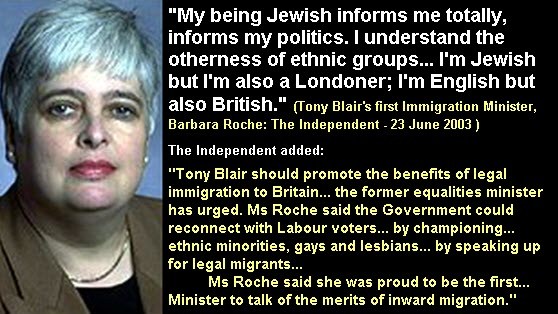
Tony Blair should promote the benefits of legal immigration to Britain, and “not back off” from plans to create a super equalities commission, Barbara Roche, the former equalities minister, has urged. … The child of a Polish-Russian Ashkenazi father and a Sephardic Spanish-Portuguese mother, Ms Roche has reason for her feelings on immigration. “My being Jewish informs me totally, informs my politics. I understand the otherness of ethnic groups. The Americans are ahead of us on things like multiple identity. I’m Jewish but I’m also a Londoner; I’m English but also British.” (Roche urges Labour to promote the benefits of legal migration, The Independent, 24th June 2003)

Migration maniac Barbara Roche

In fact, Barbara Roche is neither English nor British. How could she be, when “being Jewish informs [her] totally”? For her and for other powerful Jews in the West, a term like “British” or “French” or “American” is merely geographic. That’s why she was so eager to flood Britain with low-IQ Third-Worlders, re-shaping its demographics in a way that, while inflicting huge harm and expense on native British Whites, allowed her to “feel comfortable” while sipping “her cup of Americano coffee” at Euston station. Read more
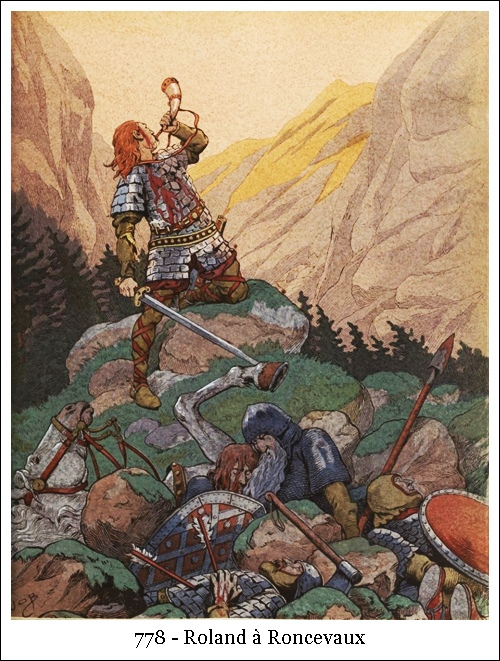
“The Mightier Our Blows, the Greater Our Emperor’s Love”: The Crusader Ideology of Germanized Christianity in the Song of Roland

There is a mysterious quality to the first literature of any ancient nation. The earliest recorded poems are those produced right at the edge between the forceful spontaneity of barbarism and the dead letter of civilization. They almost invariably reflect a primordial and manly mindset very different from that of our own time. They express the psychology and values of conquering peoples, heeding closely to the law of life, by which nations prosper or die. So it is with the Iliad of ancient Greece,the Beowulf of the Anglo-Saxons, and the Song of Roland of the French.

The Song of Roland is the French national epic and the first great piece of French literature, emerging in the eleventh century, on the back of the First Crusade to retake the Holy Land from the Muslims. The poem’s author is even more mysterious than Homer, for we do not even know his name. The Song is a vivid and powerful expression of the values of medieval European chivalry and indeed of the centuries-long clash of civilizations between Christianity and Islam, dating back to the Muslim conquests of Roman Christian Levant and North Africa.

In contrast with later criticisms of Christianity as embodying a universalist “slave-morality,” in the Song we find Christian values perfectly fused, and perhaps subordinated to, the essentially Germanic warrior ethos of the French knightly aristocracy in the form of a novel crusader ideology. The Song presents a perfect case-study of what James C. Russell called the “Germanization of early medieval Christianity” or what William Pierce called “Aryanized” Christianity.[1] The heroes of the poem are obsessed with honor, family, nation, religion, and service to the emperor. I shall present the historical Charlemagne and the values of the Song of Roland. These can help us understand both the emergence and defense of European identity in past centuries. Read more

Quo Vadis Vatican? Jewish involvement in the radical changes of the Second Vatican Council

Add New

Here’s to our murder-less mystery story, where its religious-ecclesiastical background calls for careful threading, though no issues of faith or belief are involved. I am referring to the Second Vatican Council, (1961–1964), some of its deliberations, the shadowy maneuvers that brought them about, and the implications and consequences for the brethren and the world at large. The Council implemented profound changes, of which many faithful are probably not fully aware, and from which the Catholic Church has perhaps not yet recovered.

But first some background. The late 1950s were a time of critical ideological tension. In Italy, Communist governments, provincial and local, ran and administered large swaths of the country. There was a chance that in the next political elections the Communists could win the majority.

Understandably, America was concerned and had disturbing contingency plans should the enemy win. In this, I think, they misunderstood Italy’s collective psychology. For one, many had already perceived the utopian nature of Marxist egalitarianism and sensed that a Communist state would resemble a convent or a prison. But they also knew that, if the Italian Communists won, they would quickly convert the convent into a brothel and the prison into a discotheque. That is, a change in name but not in substance.

Still, Pope Pius XII, who died in 1958, came from a noble family with a long history of service to the Church. Now policy and the political winds called for a Pope with a different background, a “populist” we would say today — one whose humble origins would implicitly raise favor among the discontent, hope in the disenfranchised and sympathy in the downtrodden.

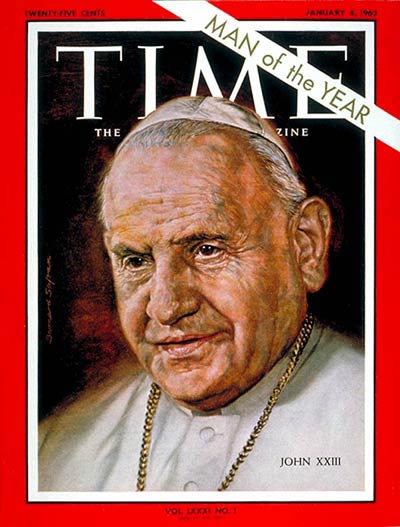
Pope John XXIII filled the bill, for he was the fourth among thirteen children in a family of sharecroppers. And soon he acquired the byname of “good.” From then on, the masses knew him as “the Good Pope.”

Logic is never a friend of mass psychology, for ‘good’ is a relative term. Good compared to whom? In fact, according to a meaningful section of past and current Catholic thinkers, John XXIII was a disaster. Read more

Enrique Krauze, Mexico’s Most Prominent Public Intellectual, Hates Trump (and White, Protestant America)

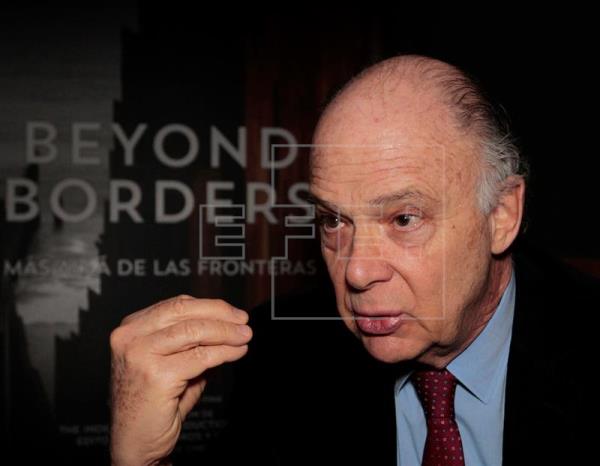
Enrique Krause. The background is for his documentary “Beyond Borders” (in Spanish).

 This piece is an update of my very brief TOO note of 2016, “Enrique Krauze.” Krauze is a Jewish-Mexican historian, essayist, editor, and public intellectual; he can be read in all the most elite places, even dispensing his wisdom in the pinnacle of the journalist profession, the New York Times. In the October, 9, 2017 article “How  Mexico Deals with Trump” of The New Yorker, the American biographer Jon Lee Anderson describes Krauze as “arguably the country’s [Mexico] most prominent public intellectual.”

Krauze hates Donald Trump. Of course, by now, even Trump’s biggest boosters—the Alt Right and talking heads like Ann Coulter and Tucker Carlson—have given up supporting Trump. But that’s because he has not followed up on his promises, particularly with regard to immigration: the wall, birthright citizenship, lowering legal immigration, deporting illegals, and not providing welfare benefits to immigrants. For Krauze, the hate is much deeper. His reasons for hating Trump are much more akin to the reasons so many American Jews hate Trump.  Put simply, Krauze hates Trump not for what he hasn’t done, but for what they see as a President Trump portending some kind of Hitlerian revolution in the West.

According to the Líderes Mexicanos magazine, Leo Zuckermann (another Mexican Jew) is one of the 300 leaders of Mexico. This April Zuckermann interviewed Krauze to talk about the latter’s 2018 book, El Pueblo Soy Yo, whose central theme is populism. I will translate from Spanish to English a passage from the television interview in which Krauze responds to a leading question by Zuckermann. Krauze says that, with the election of Trump, the United States

has degraded Western history. And the country is in a situation of political, historical and moral conflict of enormous [emphasis in Krauze’s voice] proportions and still of unknown prognosis. And there is, without a doubt, a battle between a prospective tyrant, who is Donald Trump, with very clear [emphasis in Krauze’s voice] fascist tendencies—… his racism, his nativism, his hatred, not to mention his personal pathology: megalomaniac, narcissistic in short (we would spend all night talking about this) that also dominates a Congress that wants to be dominated [!!!], against a judicial power that is defending itself, the press, the media, the radio and television channels. 

… the polarization is terrible, and there are thirty-something percent of Americans who, whatever happens with Trump, would approve of him even if he killed people on Fifth Avenue, as he said [emphasis in Krauze’s voice]; nothing would happen.

Zuckermann agreed and referred to an intellectual he had admired so much, Samuel Huntington, especially for his book Political Order in Changing Societies (although not for his later books, such as Who Are We? The Challenges to America’s National Identity). Krauze responded:

I knew him [Huntington]. I even had a controversy with him, and this essay that I published in The New Republic is an essay against him [emphasis in Krauze’s voice] because he is Trump’s prophet. He is the man who says in 2003, in his latest book, “the United States is in danger.” But is the United States in danger? No. It is the White, Protestant United States—the United States that Huntington saw himself in the mirror—that is in danger. And why? Because of the Latin American and, in particular, the presence of Mexicans.

Krauze continues sarcastically, rephrasing Zuckermann’s comment, that White Americans

were losing their soul. That’s why I included [Huntington] there [in my book], along with a variety of my texts against Trump, including, of course, the text of my criticism of [then president] Peña Nieto for having invited Trump to Mexico: that was a historical error.

In other words, Krauze thinks that White Protestants in the U.S.  have some kind of moral obligation to accept as many Mexicans and others as want to go there—the same position held by his co-ethnics in the U.S.  Read more

Barons of Bullshit: A Trip Around the Runnymede Gasbag Community

Linguistics is the scientific study of language, but it hasn’t actually attracted many good scientists. It hasn’t attracted many good writers either. In fact, I would say that the world’s most famous linguist is also one of the world’s worst writers. The Jewish linguist and radical campaigner Noam Chomsky (born 1928) is a gasbag whose books are painful to read. His prose is pompous, pretentious and prolix. And I would connect that to his politics.

In general, I would say that left-wingers write more badly than right-wingers. Often much more badly, as this prize-winning extract shows:

The move from a structuralist account in which capital is understood to structure social relations in relatively homologous ways to a view of hegemony in which power relations are subject to repetition, convergence, and rearticulation brought the question of temporality into the thinking of structure, and marked a shift from a form of Althusserian theory that takes structural totalities as theoretical objects to one in which the insights into the contingent possibility of structure inaugurate a renewed conception of hegemony as bound up with the contingent sites and strategies of the rearticulation of power.

That extract isn’t a joke or a parody. Instead, it’s the entirely serious academic prose that won the feminist scholar Judith Butler first prize in a Bad Writing Contest back in 1998. Butler is a gasbag and a bullshitter. She’s also Jewish like Noam Chomsky. Is that significant? I think it is. Although mainstream linguistics, like mainstream biology, insists on the Psychic Unity of Mankind, I think that mainstream linguistics is wrong. The way we talk and write is influenced by our genetics, not just by our culture and environment. Jews have a higher average verbal intelligence, which allows them to read, write and talk faster and longer than non-Jews.

Bigger and better

That fluency allows Jews to be bigger gasbags and better bullshitters. Chomsky and Butler are bad scholars but prolific writers and speakers. The part-Jewish Christopher Hitchens boasted in his autobiography that “On average I produce at least a thousand words of printable copy every day, and sometimes more. I have never missed a deadline.” I argued in “Gasbags Are Not Great” that the quantity of Hitchens’ “copy” was not matched by its quality. Like Chomsky’s, his prose is pompous, pretentious and prolix. Like Chomsky’s, I find his books painful to read. But Jewish and part-Jewish writers can be prolific without being painful. The part-Jewish Mark Steyn seems to write even more than Hitchens did, but his prose is pleasing to read, not painful.

I’d say that this is because Steyn is right-wing and not a gasbag. But I’ve argued in “Wicked Muslims, Innocent Jews” that he can be a bullshitter. For example, his claim that Jews are suffering first and worst from Muslim immigration into Europe is entirely untrue. It’s a dishonest attempt to conceal the central Jewish role in opening Europe’s borders to the Third World. Mark Steyn, Rod Liddle and other right-wing philo-Semites also constantly rail against the bogus concept of “Islamophobia.” But they don’t discuss where the term came from and who supports the Muslim groups that exploit it. The Muslim lobby-group Tell MAMA (Measuring Anti-Muslim Attacks) uses “Islamophobia” to demand ever-harsher laws against free speech and ever-stronger repression of native White resistance to Muslim crime and misbehaviour.

Mentoring Tell MAMA

But which rich and powerful lobby-group mentors and advises Tell MAMA and has seen its former chief executive become co-chair of Tell MAMA? Why, it’s the Community Security Trust, the Jewish group that also hates free speech and wants to crush native White resistance. Dr Richard Stone, Jewish high priest in the Stephen Lawrence cult, has written that “British Jews and Muslims are natural allies.” Against whom? Against the White and historically Christian majority, of course. While Jews supply the verbal intelligence and legal expertise, Muslims are supposed to play the role of non-White victims in a campaign to undermine and dispossess the White majority.

A bullshitting report on a bogus concept

But Mark Steyn and Rod Liddle don’t write about the central Jewish role in the Islamophobia industry. As I said in “A Singularly Semitic Scandal,” they’re being typhlistic and turning a blind eye to essential but inconvenient facts (typhlism is from the Greek typhlos, “blind”). Who actually introduced the term “Islamophobia” to British politics? It was the Runnymede Trust, which supplies “Intelligence for a Multi-ethnic Britain” and which proudly boasted in 2017: “This report is being published on the 20th anniversary of our initial report Islamophobia: A Challenge for Us All, which first brought the term to public and policy prominence, in Britain and indeed beyond.” Read more

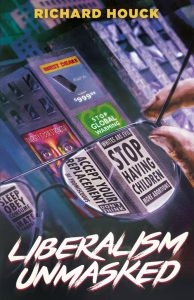
Andrew Joyce Reviews Richard Houck’s Liberalism Unmasked

Liberalism Unmasked
Richard Houck
Arktos, 2018
Available at Arktos and Amazon (all 5-star reviews)

One of my favorite old Irish ballads is ‘The Wind That Shakes the Barley,” written by the nineteenth-century poet Robert Dwyer Joyce. The song (sung magnificently here by Dolores Keane) revolves around a young Wexford rebel who sacrifices his relationship with his beloved, and then engages in violence associated with the 1798 rebellion against British rule. The barley of the title, and chorus, is a reference to the fact the rebels often carried barley or oats in their pockets as provisions while on the move. When these guerrilla fighters were captured by the yeomanry, they were often summarily shot and quickly buried in mass graves. In these graves, the oats and barley germinated, resulting, post-rebellion, in pockets of “croppy-holes,” or random barley growing. The pockets of barley, emerging anew every Spring, nourished later generations of roving guerrilla fighters, and came to symbolize the regenerative and unconquerable nature of Irish resistance to British rule. While the politics behind the imagery may be divisive, I find the deeper Romanticism of the symbolism to be utterly compelling. Every movement of resistance, of any political hue, must cultivate a sense of self-renewal and regeneration.

Our own movement is no different. In 2015 I had the great fortunate to attend and address a sizable meeting of Nationalists, both in Baltimore and Washington D.C. On both occasions I was struck by the number of young people “of quality” in attendance. And on both of those nights, in the quiet moments, the song of Robert Dwyer Joyce came forcefully to mind. Here was the “barley” of our own movement, coming into its own in order to take up the mantle and take us forward. Here was the living proof of the unconquerable nature of our ideas, and a new generation to carry them forth. And, recently, the lyrics of Joyce came to mind once again, this time on reading the work of a young intellectual, and precocious writing talent, in the form of Richard Houck and his Liberalism Unmasked.

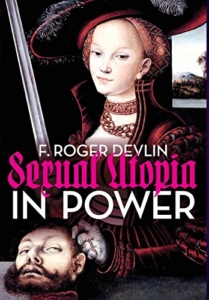
Several months ago, Richard contacted me via social media. He struck me immediately as an enthusiastic and earnest young activist, still in college and eager to get into the fight. When he told me he was writing a book, I have to confess to taking this with a pinch of salt, or as a variation on the theme that “everyone has a book in them.” As time went on, however, his sporadic communications impressed upon me that Richard was an incredibly serious individual — serious beyond his years and serious in his ambitions. When Liberalism Unmasked finally arrived from Arktos, I wasn’t quite sure what to expect other than that I was prepared for a tour de force. And I was not disappointed. Read more

TOQlive: F. Roger Devlin joins James Edwards and Kevin MacDonald

The second monthly TOQlive will be on Sunday, December 2 at 8PM Eastern time (click here to access). As always, it will be a live show, with the last half hour devoted to answering audience questions and comments. Our guest will be F. Roger Devlin who is well known to readers of TOQ and TOO, particularly for his writing on gender issues (click here for his 17 articles on TOO). His book, Sexual Utopia in Power is a classic deconstruction of the sexual revolution that began in the 1960s: He “explores today’s sexual dystopia, with its loose morals and confused sexual roles; its soaring rates of divorce, celibacy, and childlessness; and the increasingly arbitrary and punitive attempts to regulate and police it. Devlin shows that the breakdown of monogamy results in promiscuity for the few, loneliness for the majority, and unhappiness for all.”

His most recent article for TOO is a masterful review of Stephen Baskerville’s The New Politics of Sex which expands on the themes of Sexual Utopia in Power. As he notes, we are now at the point of the criminalizing masculinity:

The sexual revolution did not usher in prolonged anarchy; it replaced a voluntary system of self-control according to principles equally applicable to all with the bureaucratically enforced “empowerment” of one sex at the expense of the other. Thanks to recent headlines, it is finally beginning to dawn on even the dimmest conservatives that the sexual revolution has not “liberated male sexuality,” but subjected men to an arbitrary and hostile regime from which none of them is safe.

There is nothing “ironic” about the cheek-by-jowl existence of a casual sex scene and a bureaucracy dedicated to punishing the men who participate in it: the former acts as a necessary feeder for the latter. The proof is that no feminist has ever encouraged young women behave in ways which would prevent their getting hurt in the first place. Feminists find the hook-up scene far too useful to shut down.

Should be a great discussion.