
Lance Welton on Jewish ethnocentrism: Fairness, Paranoia, and Self-Deception
Lance Welton’s article on VDARE is a nice summary of research on Jewish ethnocentrism and its consequences: “Did the ADL Think It Could Get Away with Hypocrisy on Replacement in U.S. vs. Israel? Answer: It Probably Didn’t Think At All.” As noted below, some of his presentation touches on my Individualism and the Western Liberal Tradition as well as my books on Judaism.
Welton:
“Fairness,” as I noted in my article on blacks, is “impartial and just treatment or behavior without favoritism or discrimination.” This is a high-order value which demands that you put aside nepotism, ethnocentrism, and even personal gain, in favor of this abstract goal. So, on this basis, would we expect Jews to be as high in “fairness” as Whites?
No. Firstly, there is abundant evidence that Jews are more ethnocentric than whites; meaning they cooperate strongly with their own people and are hostile to other peoples. Jews have been stereotyped as being highly ethnocentric throughout their history, as Kevin MacDonald showed in his 1994 book A People That Shall Dwell Alone [Chap 8, 228ff]. There is overwhelming evidence that racial stereotypes, like all stereotypes, tend to be true; that’s why they develop [Social Perception and Social Reality, By Lee Jussim, 2012].
This goes very deep. Jewish babies react with far greater horror to strangers of a different ethnic group than do German babies [Security of Infant-Mother, -Father, and -Metapelet Attachments Among Kibbutz-Reared Israeli Children, by Abraham Sagi et al., Monographs of the Society for Research in Child Development, 1985].
Data from the University of Wisconsin’s MIDUS survey of middle-aged Americans demonstrated that among Whites there is a positive correlation between how religious you are and how group-oriented you are. However, the same study found that Jews are the most ethnocentric—group-oriented religious group—even though they were the least religious group of those surveyed. When factors such as intelligence (which tends to make people less ethnocentric) and religiousness level were controlled for, Jews were still way more ethnocentric than the gentile White groups. (This is discussed in Religiosity as a Predictor of In-Group Favoritism Within and Between Religious Groups, by Curtis Dunkel & Edward Dutton, Personality and Individual Differences, 2016).
If you take into account the number of Jews in a population compared to the number of Whites, then the extent to which Jews “marry out” is far lower. Jews are about 49 times less likely to marry someone of a different faith than Protestants are, for example. [See Andrew Joyce’s “The Cofnas Problem.“]. The most obvious explanation for this, in the context of the other research: ethnocentrism. Jews seem to be evolved to be higher in ethnocentrism [see “A Genetic Perspective on Individualism/Collectivism,” A People That Shall Dwell Alone, Ch. 8: p. 236ff], something that would be heightened by their small gene pool; with people tending to be more ethnocentric when the gene pool is small [Natural History of Ashkenazi Intelligence, By Gregory Cochran et al., Journal of Biosocial Science, 2006]. This higher ethnocentrism would make them less able to suppress ethnocentric instincts in favor of creating fairness than are gentile Whites.
Fairness is one of the traits that is higher in Western societies based on individualism versus the kinship-based societies of the rest of the world. Joseph Henrich and colleagues reviewed research showing differences between subjects from Western, Educated, Industrialized, Rich, Democratic (WEIRD) nations and subjects in a wide range of other cultures, finding important differences in fairness and moral reasoning. This is reviewed in Individualism and the Western Liberal Tradition:
In non-Western societies based on extended kinship, morality is defined in terms of whether an action satisfies obligations within the family or kinship group, whereas in individualist societies, morality is thought of as satisfying abstract notions of justice such as Immanuel Kant’s Categorical Imperative: Act according to the maxim that you could wish all other rational people to follow, as if it were a universal law. … The differences between individualist and collectivist cultures—whether in fairness and altruistic punishment, moral reasoning, cognition, or perception—are all “of a piece;” they all fit into a consistent pattern in which Westerners detach themselves from social, cognitive, and perceptual contexts, whereas non-Westerners see the world in a deeply embedded manner. This pattern is highly consistent with Western peoples being more prone to scientific reasoning (p. 110).
On the other hand, collectivist cultures—my view is that Judaism is a paradigmatic collectivist culture—see the world from the standpoint of group interests, so that even scientific reasoning in the social sciences is performed through the lens of group interests. Hence, The Culture of Critique.
The Western, Educated, Industrialized, Rich, Democratic (WEIRD) people discussed in Chapter 3 developed scientific and scholarly associations in the post-medieval West which assume groups are permeable and highly subject to defection—that there is a marketplace of ideas in which individuals may defect from current scientific views when they believe that the data support alternate perspectives. On the other hand, collectivist cultures create group-oriented intellectual movements based on dogmatic assertions, fealty to group leaders, ethnic networking, and expulsion of dissenters [i.e., the thesis of The Culture of Critique]. …
Moreover, … WEIRD people tend more toward analytical reasoning (detaching objects from context, attending to characteristics of the object and developing rules for explaining and predicting phenomena) as opposed to holistic reasoning (attending to relationships between objects and surrounding field). Westerners tend to categorize objects on the basis of rules that are independent of function and hence more abstract whereas non-Westerners are more likely to categorize on the basis of function and contextual relationship. Science is fundamentally concerned with creating abstract rules independent of context and developing explanations and predictions of phenomena in the empirical world. Such traits, which can be seen even in the ancient Greco-Roman world of antiquity, clearly predispose to scientific thinking. …
For collectivists, moral reasoning involves taking account of the social context, which is fundamentally centered on fitting into and strengthening a kinship group. For individualists, the social world involves a greater need to interact with strangers and to consider their reputation for respecting impersonal rules. …
Individuals are evaluated as individuals on traits—e.g., honesty, intelligence, military talent, and the logic and usefulness of their arguments—in abstraction from their (relatively weak) kinship connections. Moral situations are evaluated in terms of abstract concepts of justice that apply to all individuals rather than being vitally concerned with social obligations to particular people enmeshed in a particular extended kinship network. When confronting the natural world, individualists more easily abstract from social context and personal experience, seeking out and applying universally applicable laws of nature.
Back to Welton:
In addition, there is evidence that Jews are perfectly happy for a situation to be unfair. One study compared religious groups in the US—Baptists, Catholics, Methodists, Jews, and Atheists/Agnostics—and asked people what they thought was most important to live a “good life.” Jews, in contrast to all the other groups, highlighted “extra money” [“For Tomorrow We Die”? Testing the Accuracy of Stereotypes about Atheists and Agnostics, by Edward Dutton & Curtis Dunkel, Mankind Quarterly, 2019]. They see it as important to be richer than other people in a way that the whites do not, which implies that they are less concerned about a possibly unfair situation as long as they benefit. And, being more intelligent than gentile Whites on average (as Richard Lynn has shown in his book The Chosen People) they will better be able to rationalize achieving such an advantage, as intelligent people are typically better at finding ways of rationalizing their biases [Why smart people aren’t better at transcending their biased views, by Tauriq Mousa, The Big Think, June 13, 2012].
Finally, Jews are less mentally stable than Whites. Ashkenazi Jews have significantly elevated levels of bipolar disorder and schizophrenia, both of which can make people paranoid [Genome-Wide Association Study of Schizophrenia in Ashkenazi Jews, by Fernando Goes et al., American Journal of Medical Genetics, 2015]. When people are paranoid, they are less interested in what is “fair”—they are interested simply in surviving and doing so may involve being very “unfair.” People with paranoid personalities tend to be hypocritical and self-seeking [Understanding Paranoia, by Martin Kantor, 2004, p.71].
Because Jews are better at finding ways of rationalizing away their bias and hypocrisy, they may well not believe that they are being “unfair” at all [a kind of self-deception one expects to find among highly ethnocentric people—Ch. 8 of Separation and Its Discontents and elaborated by Andrew Joyce here]. In this sense, it can be said that intelligent yet paranoid people do not “know themselves”—meaning that they live in a fantasy world in which there is nothing wrong with them; only with others.
This personality type will see the world as packed full of hostile persecutors who want to destroy them, meaning that an obviously Mostly Peaceful protest at the Capitol becomes an “insurrection” in which people could have been killed.
This personality type will also engage in “paranoid projection,” whereby they purport to find an aspect of themselves they dislike in others, causing them to despise these people. “I hate them” becomes “They hate me,” based on finding some minor evidence of this. Hence the Leftist obsession with how “hateful” their opponents are [8 Key Traits of Paranoid Thinkers, by Shahram Heshmat, Psychology Today. February 24, 2016].
It’s interesting in this regard that paranoia about the surrounding world is a very central aspect of Jewish culture—analyzed as what behavior geneticists label genotype-environment correlation (e.g., paranoid parents with genetic predispositions to paranoia would socialize their children (who share their genes for paranoia) in a manner that would reinforce a worldview that the outside world is dangerous). From A People That Shall Dwell Alone, Ch. 7:
A permanent sense of imminent threat appears to be common among Jews. Writing on the clinical profile of Jewish families, Herz and Rosen (1982) note that for Jewish families a “sense of persecution (or its imminence) is part of a cultural heritage and is usually assumed with pride. Suffering is even a form of sharing with one’s fellow-Jews. It binds Jews with their heritage—with the suffering of Jews throughout history.” Zborowski and Herzog (1952, 153) note that the homes of wealthy Jews in traditional Eastern European shtetl communities sometimes had secret passages for use in times of anti-Semitic pogroms, and that their existence was “part of the imagery of the children who played around them, just as the half-effaced memory was part of every Jew’s mental equipment.”
This evolved response to external threat is often manipulated by Jewish authorities attempting to inculcate a stronger sense of group identification. Hartung (1992) provides anecdotal data on the emphasis on Jewish suffering and its exaggeration as aspects of modern synagogue service. Such practices have a long history. Roth (1978, 62) notes that Jewish “martyrologists” maintained lists of Jewish martyrs for commemoration during synagogue services during the Middle Ages, and Jordan (1989, 20) refers to the “forbidding martyrocentric self-image” during this period.
Woocher (1986) shows that Jewish survival in a threatening world is a theme of Judaism as a civil religion in contemporary America. Within this world view, the gentile world is viewed as fundamentally hostile, with Jewish life always on the verge of ceasing to exist entirely. “Like many other generations of Jews who have felt similarly, the leaders of the polity who fear that the end may be near have transformed this concern into a survivalist weapon” (Woocher 1986, 73). Woocher (1986) notes that there has been a major effort since the 1960s to have American Jews visit Israel in an effort to strengthen Jewish identification, with a prominent aspect of the visit being a trip to a border outpost “where the ongoing threat to Israel’s security is palpable” (p. 150).
Or, as Elliott Abrams (Faith or Fear, 190) wrote, “the American Jewish community clings to what is at bottom a dark vision of America, as a land permeated with anti-Semitism and always on the verge of anti-Semitic outbursts.”
Hence the Jewish motivation for diversifying America, the theme of Chapter 7 of The Culture of Critique (corroborated by Otis Graham (Unguarded Gates [2004]: 80), who notes that the Jewish lobby on immigration “was aimed not just at open doors for Jews, but also for a diversification of the immigration stream sufficient to eliminate the majority status of western Europeans so that a fascist regime in America would be more unlikely.” The motivating role of fear and insecurity on the part of the activist Jewish community thus differed from other groups and individuals promoting an end to the national origins provisions of the 1924 and 1952 laws.
Writing in the 1970s, Isaacs (1974: 14ff) describes the pervasive insecurity of American Jews and their hypersensitivity to anything that might be deemed anti-Semitic. Interviewing “noted public men” on the subject of anti-Semitism in the early 1970s, Isaacs asked, “Do you think it could happen here?” “Never was it necessary to define ‘it.’ In almost every case, the reply was approximately the same: ‘If you know history at all, you have to presume not that it could happen, but that it probably will,’ or ‘It’s not a matter of if; it’s a matter of when.’ ” (p. 15).
Writing long after the passage of the 1965 law, prominent Jewish social scientist and ethnic activist Earl Raab remarked very positively on the success of American immigration policy in altering the ethnic composition of the United States. Writing for a Jewish publication, Raab noted that the Jewish community had taken a leadership role in changing the northwestern European bias of American immigration policy (Raab, 1993a, 17), and he also maintained that one factor inhibiting anti-Semitism in the contemporary United States is that “an increasing ethnic heterogeneity, as a result of immigration, has made it even more difficult for a political party or mass movement of bigotry to develop” (Raab, 1995b, 91). (Culture of Critique, Ch. 7).
Welton concludes:
The self-centeredness and implicit unfairness of the ADL operatives’ fantasy world means they indeed might very well not have thought at all about what to any outside observer appears to be the utter hypocrisy of their position on the Great Replacement [via immigration] in the U.S. as opposed to Israel.
For such people, objective truth is “defamation”—but their “defamation” of others is objective truth.
Any objective observer would indeed have to agree that the ADL is utterly hypocritical in its stance toward immigration in Israel versus the United States. But activist Jews like Jonathan Greenblatt may not even be aware of it due to their powerful tendencies toward ethnocentrism and its corollary of self-deception. And now these people are firmly ensconced in the hostile elite that is running the United States. A dire situation indeed for the traditional White population of America.
Review of Andre Øvredal’s “Mortal” (2020)

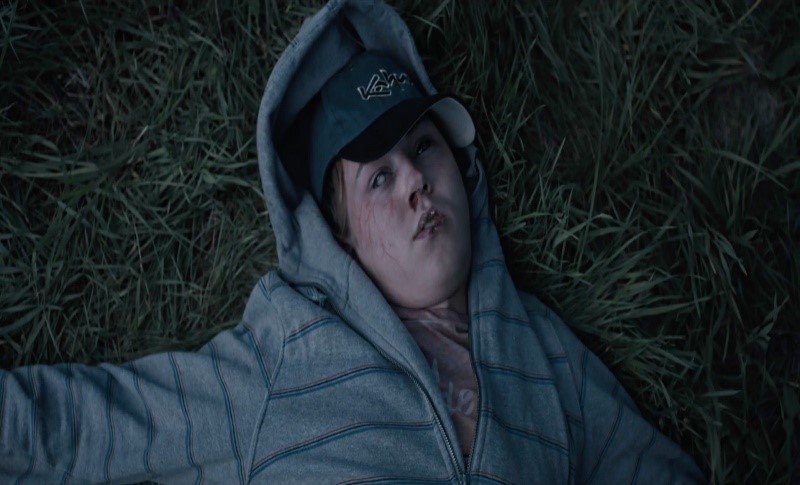
Mortal is a 2020 English-language Norwegian film based on Norse mythology co-written and directed by André Øvredal (interviewed here). It begins with a strange traveler stumbling out of the wood under a dark gray clouded sky as the early evening sets in the land of the midnight sun. He can’t travel as a man among the ruins, unnoticed and unmolested. A marginal in the modern world, it isn’t long before he crosses the path of a degenerate youth of the type dragging down Scandinavia. For the stranger, he’s just a dumb punk who can’t handle the request of “leave me alone.” The wiggers yell at him from their auto, and the stranger warns, “If you touch me, you will burn.” It only takes a second. . .
There’s a fire rising from within him but there’s no control. It’s unclear whether our protagonist is harnessing this power from some unseen inner core or it’s simply an uninhibited force using him as it’s instrument. The only known catalyst for the onset of these strange powers seems to be his raw unchecked emotions. The pain overtakes him. His chest heaves. His skin burns, cracking and peeling…
The scene shifts to Christine, a sweet-faced, yet seemingly hapless therapist who works for the state. Hired recently, she’s already failed at the starting line and lost a client to suicide. We’re introduced to her through the condolences of her supervisor. “No one’s blaming you. Not the parents, no one. . . . Unfortunately, these things happen. Therapy doesn’t always help.”
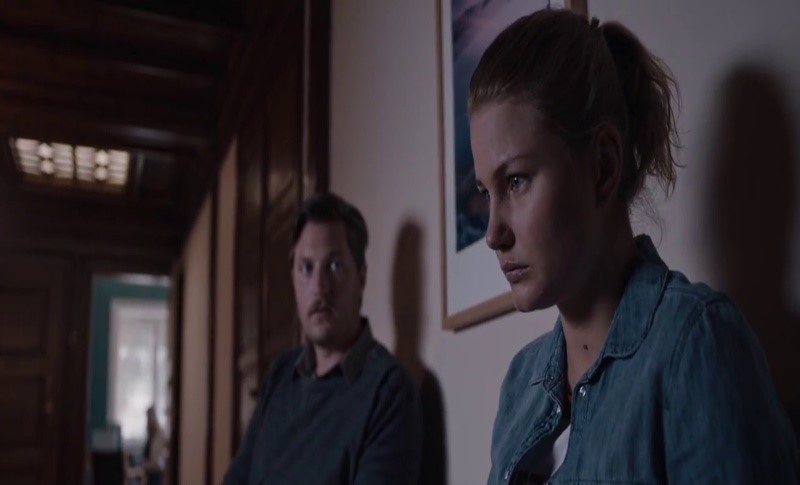
Blaming herself, Christine cries to her friend. State-sponsored therapists are the last line of defense against suicides. They have the essential authority when measures have to be taken to institutionalize potential suicides before they self-harm. This is often against the will of their patients. She blames herself, insisting that all of the signals were there, but she simply didn’t want to believe it. One could surmise that she feels the guilt of someone who didn’t prevent a tragedy because they didn’t want to be bothered.
She takes an incoming call. Her services are now required by the police. After regaining her composure, she makes her way toward a small Norwegian town at the foot of a misty hilltop covered in coniferous trees. A dark primal green still rules this land, never out of sight. Her counterpart in law enforcement greets her in the lobby. Henrik is an old veteran of the force with a hard-featured Aryan face and two perennially calm ice blue eyes that betray the kind of deep thoughtfulness that comes with decades of life experience predicting the actions and outcomes of mankind’s most aberrant and abominable.
He informs her they have in custody one Eric Bergland, the Norwegian-American backpacker looking for distant relations who’d gone missing three years ago after a fire at a farm in Årdal that left five dead. He’s not been seen or heard from since then, and he’s wanted for questioning. The Crime Unit is on its way, and time is of the essence to get Bergland to speak about the freshly roasted corpse he left on the roadside, the corpse of one young legend-in-his-own-mind who had an entire lifetime of perpetual adolescence ahead of him.
Nervously she approaches Bergland and begins an interview with the passable English she possesses. She’s unsure whether or not he’s even competent for the conversation. Slowly he begins to explain. To Christine’s surprise he wasn’t even sure if everyone had died in the blaze at the farmhouse he was initially sought for. As he comes to the realization of the amount of death he’s caused, a tear runs down his face. The scruffy backpacker seems overtaken by anxiety as the young therapist watches the water bubble from the glass of water routinely given to those being questioned. Reaching a hand forward, palm down, he begins to raise droplets of the liquid to his hand, defying gravity. The room is suddenly supercharged with electrical energy whose static causes strands of his interlocutor’s blonde hair to stand on end.
Øvredal’s Norway is a primal land of low magic—an archaic elementalism that Eric does not understand. He heats up from the inside like a dynamo. With the breadth of his powers now becoming apparent, the cavalry swoops in. The United States has sent its most highly over-esteemed Third-World Janissary as the representative of Uncle Sam on earth.
The casting in Øvredal’s films is free of affirmative action hires. Those few lesser-thans who make their appearance serve as characters who are typically contemptible and at best pathetically naïve. There are no Black Vikings hiding behind a megalith—traditional horror film rules still apply. Here the role of America’s hired muscle is an Indian woman with a British accent — someone alien to a wayward American. Though she acts with the authority of the US government none among us would call her a fellow American.

The dusky-hued face of life, liberty and the pursuit of global hegemony.
The character of Christine, though having only just met the man, fulfills her natural feminine role by pacifying the rage and anxiety in this lost soul. The strength of her character isn’t in the way she reacts to danger or the dialogue she has in this supporting role. It’s in the power to bring out growth in a man and maintain a shelter in the storm. A feminine role that complements the masculine rather than challenges it. This portrayal of the natural aesthetic polarity of the sexes is refreshing when one considers the overabundance of obligatory “battle broads” that Tinsel Town’s trash heap has been shelling out.
Throughout his other films, the special effects seep into the environment and seamlessly flow through their interactions with other characters and their surroundings. It is a characteristic of the Norwegian filmmaker to never portray a character with utter disbelief. Surprise? Yes. Terror? Often. But none in his plots elicit hysterical denial. They believe what they see. They don’t understand it, but they fear it.
Eventually Eric has no choice but to run to the only human offering him comfort in the years that have passed since he entered the forest.
Now seeking help, the little group pulls up to a river dock to cross the waterway. “I love ferries. It’s like taking a break from the real world for a few minutes,” Christine states matter-of-factly to Eric. It’s not a dreamy or romantic tone, but a statement of principle.
They learn shortly that the noose is tightening. Eric is having visions that put him in a passive state with a serene dreamy look on his face. He’s seeing things beyond our world and time. Different worlds. . . and a great tree. The most beautiful tree that fills the horizon. Yggdrasil? Christine wonders if he’s a messiah of some kind.

One of many depictions of Yggdrasil, the Tree of Life in Norse Mythology
Hardanger Bridge is the busiest bridge in all of Norway. It lies between Bergen and Oslo, the country’s largest cities. A confrontation during rush hour there means the whole world is watching. It isn’t just the traffic that will grind to a halt that concerns them—everyone will see the videos they share on social media. This, above all is what the government creep of alphabet soup agencies is trying to avoid. He cannot be allowed to manifest his powers in a major city.
But there’s no denying it now. The U.S. sent their ‘girl Friday’ with a license to kill. The condescending Third Worlder knows the national security risk. But the state is always weaker than religion. She makes the phone call, regardless. “Imagine in a few days when people realize what he represents … or what he doesn’t represent. Imagine Christians, Muslims—everyone who believes in a god. Suddenly a god-like human proves they are all wrong. He doesn’t represent any of them. What happens then?” She ends by concluding that a final solution has been determined. “I’ll make sure it happens.” We don’t need to hear her orders to know what she’s planning next. 
They try to stop him at the center of the bridge. A Norwegian hasn’t earned himself this much attention from the police services since Breivik. The sky goes black as his passions seize him. Eric is cornered. This time the full spectrum of the titanic abilities he wields is on display. There’s no denying it now.
By now the origins of his god-like destruction are obvious. Taken again under the wing of the state, they study the confused young superbeing. An ethereal call draws Eric into the orbit of the farmhouse inhabited by his ancestors, the source of whatever the polar force that has possessed him is radiating from. Gaining passage to the subterranean causeway deep within a cold dark earth, he searches among the cellar roots to find that which is most sacred and long forgotten by many. The spiritual origins of this great Northern people.

Mortal has a serious and respectable tone. It would appear to be an attempt to rescue Norse mythology from Hollywood depictions such as the popcorn-funded hipster kitsch of JJ Abrams’ latest abortions or the ominous tenor of Ari Aster’s Midsommar (2019) – a fascinating film in its own right but secular in its aesthetics. This director has proven himself as one to watch out for as he fluctuates between larger budget studio films and his more personal projects when the profits from the former are used to bring his intimate creations to life.
Blacks Bless the Benighted West: The Sacred Central Principle of Modern Western Politics and Culture
Two views on non-Whites are permitted in the modern West. The first view is leftist and rules the media, academia, law, education, government bureaucracy, big business, sports and all leftist parties. It states: “Non-Whites are a limitless blessing and whites are cruelly oppressing them.” The second view is cuckservative and states: “Non-Whites are a limitless blessing and whites no longer oppress them as cruelly as they once did.”
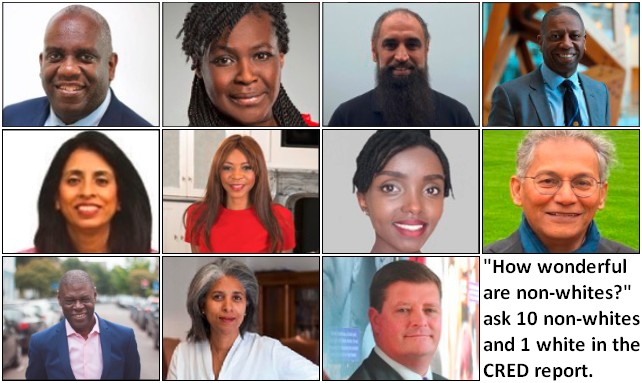
Whitey in the Woodpile: The eleven members of the Commission on Race and Ethnic Disparities
It was the second, cuckservative view that was laid out for the people of Brave New Britain in the recently published report by the Commission on Race and Ethnic Disparities (CRED). But the cuckservative conclusions of CRED were no surprise. After all, Britain has a cuckservative government and it appointed the commissioners who wrote the report. The part-Jewish, part-Turkish prime minister Boris Johnson and his fellow Friends of Israel knew what they wanted and the commissioners have duly supplied it: “We no longer see a Britain where the system is deliberately rigged against ethnic minorities. … The Commission believes that if [our] recommendations are implemented, it will give a further burst of momentum to the story of our country’s progress to a successful multicultural community — a beacon to the rest of Europe and the world.”
Shred the CRED
Yes, the report claims that Britain, with its rape-gangs, suicide-bombers and acid-throwers, will serve as a beacon to European nations like Hungary and Poland, which don’t have rape-gangs, suicide-bombers or acid-throwers because they haven’t been enriched by non-White immigration. But just as predictable as the fatuities of the report has been the response of Britain’s cuckservatives and leftists. Cuckservatives have warmly welcomed the report and leftists have loudly condemned it. The report was variously described in the Guardian as “disturbing,” “nonsensical,” “deeply cynical,” “egregious,” “poisonously patronising,” “historically illiterate,” “insulting to our intelligence,” and, of course, “divisive.”
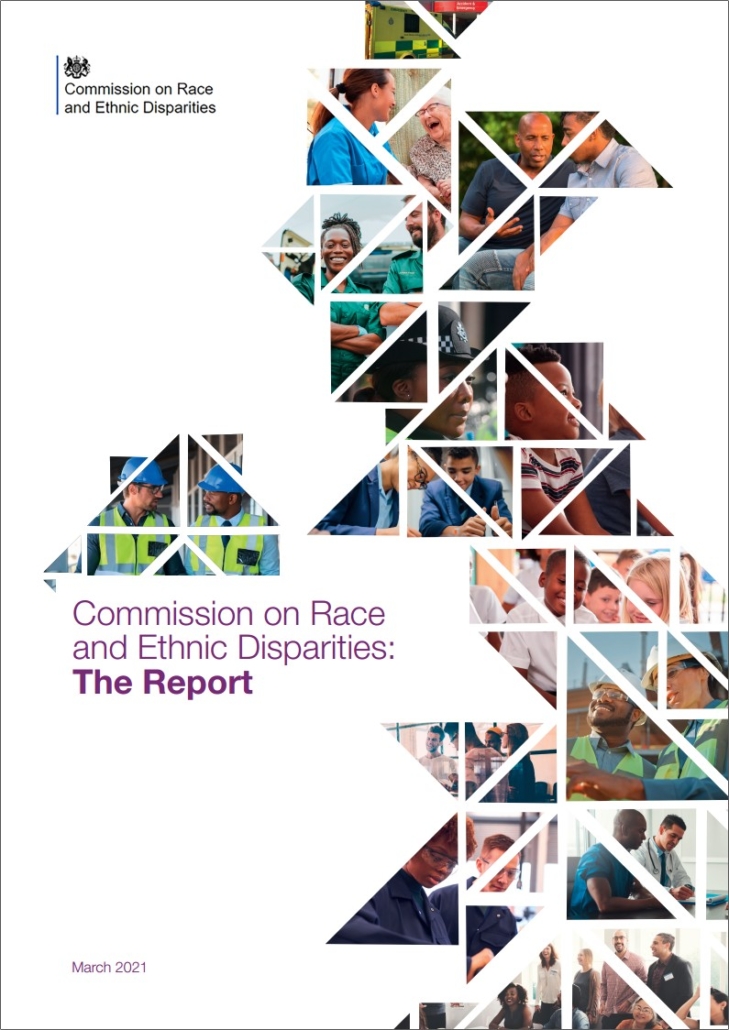
All smiles and happy collaboration: typically leftist propaganda on a typically cuckservative report
For leftists, it is always “divisive” when someone disagrees with them. But BoJo & Co. were careful to avoid one potential complaint from the left: they followed a strict leftist rule by ensuring that the Commissioners were almost all non-White. And so it was that the Commission on Race and Ethnic Disparities was itself a glaring — and entirely unaddressed — example of a “Race and Ethnic Disparity.” In a country that is still about 80% White, the Commissioners had to be 90% non-White because it is non-Whites who decide how wonderful non-Whites are and how much of a blessing mass immigration has been. The White majority doesn’t get a vote on that.
“Heroic” murderers, rapists and pimps
And never has had a vote. After all, if Whites had been allowed to vote on whether Britain should allow mass immigration by non-Whites, they would overwhelmingly have voted “No.” And don’t take just my word for it: the treasonous leftist politician Roy Hattersley, a former deputy leader of the Labour party, proudly announced in 2013 that he had refused to support “what a clear majority of my constituents, and most of the country, undoubtedly wanted [in 1964] — the repatriation of all Commonwealth immigrants.” The CRED report did not discuss this sensible White resistance to non-White immigration, except in so far as White resistance cast a literally “heroic” light on non-Whites. On page 7 of the report, we meet one of the giants of contemporary literature:
[Black] Poet and activist Linton Kwesi Johnson describes the early mass Black presence in the UK as having 2 phases or eras. The first was the 1950s Windrush arrival from the Caribbean, this he called the ‘heroic’ period, when literally doors were closed in the faces of the new Black settlers who heroically battled in the face of adversity. [Note clumsy prose and punctuation.] The children of those settlers … who came of age in the 1970s and 1980s he calls the ‘rebel’ generation, this featured running battles with police and a breakdown in community relations, which continues to have a negative legacy. [More clumsy prose.] The spirit of rebellion continued last summer during the Black Lives Matter (BLM) protests. This was a revolt that engulfed the world. We have to acknowledge the spirit of BLM was the original trigger for our report. (Report by Commission on Race and Ethnic Disparities, March 2021)
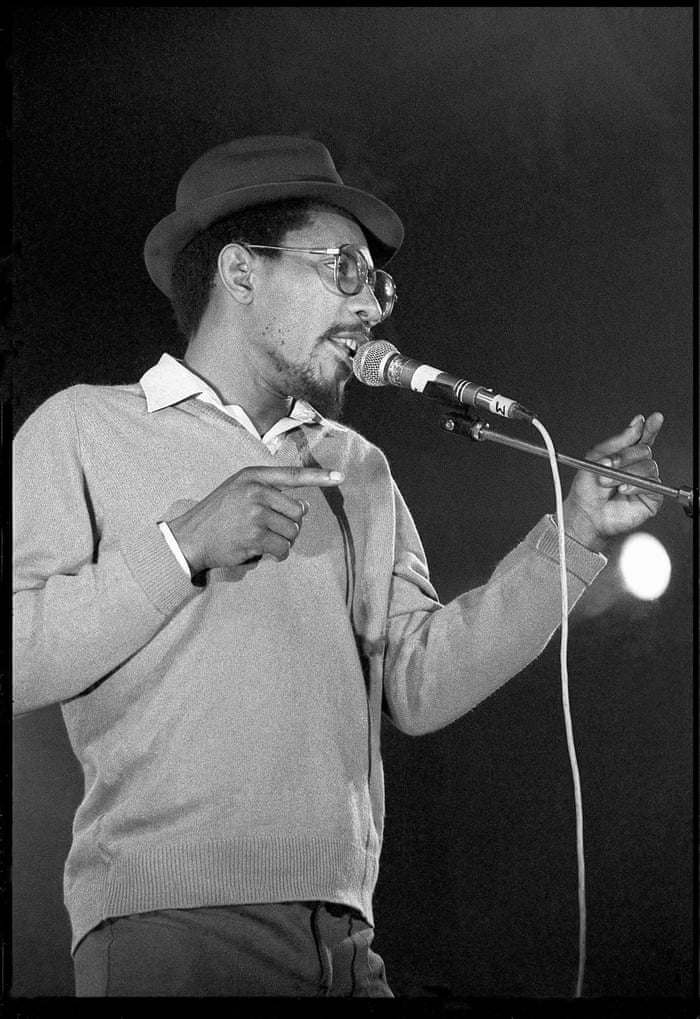 The talentless and unintelligent Linton Kwesi Johnson
“Poet and activist” Linton Kwesi Johnson (born 1952 in Jamaica) didn’t mention that the “Black settlers” also “heroically battled” to raise the abysmally low rates of murder, rape, robbery, pimping and anti-social noise in stale, pale 1950s and ’60s Britain. Or that they battled on behalf of the predatory Jewish landlord Peter Rachman (1919–62), who would install violent and noisy Blacks to drive White tenants out of houses he wanted to buy or convert into flats. But Johnson’s omissions aren’t surprising. Here is a sample of the patois poetry that has won him acclaim and honours for decades:
Inglan is a Bitch
W’en mi jus’ come to Landan toun
Mi use to work pan di andahgroun
But workin’ pan di andahgroun
Yu don’t get fi know your way around.Inglan is a bitch
Dere’s no escapin it
Inglan is a bitch
Dere’s no runnin’ whey fram it.Mi get a lickle jab in a bih ’otell
An’ awftah a while, mi woz doin’ quite well
Dem staat mi aaf as a dish-washah
But w’en mi tek a stack, mi noh tun clack-watchah.Inglan is a bitch
Dere’s no escapin it
Inglan is a bitch
No baddah try fi hide fram it. (Inglan is a Bitch)
Linton Kwesi Johnson is, of course, a leftist and will not agree with the report’s findings. But talentless and unintelligent Blacks like him had to appear before the Commission because negrolatry is an essential part of minority worship in general. Blacks are the most harmful, obnoxious, unintelligent, unattractive and unproductive of all minorities. In other words, they are the group that least resembles Whites, which is precisely why the hostile Jewish elite selected Blacks for transformation into the archetypal saintly victims of White oppression. As Kevin MacDonald has documented, the National Association for the Advancement of Colored People (NAACP) in America was run and funded not by Blacks, but by Jews. In Britain, the Jewish lawyer Anthony Lester (1936–2020) proudly described how he brought the American model of minority worship to Britain:
In Search of Something Better: Anthony Lester recalls the creation of the Commission for Racial Equality
In 1964, on my return from witnessing the “Long Hot Summer” of civil rights action in the American South, I helped found CARD (the Campaign Against Racial Discrimination). We campaigned for effective legislation to combat racism in Britain. The first measure — the Race Relations Act 1965 — was hopelessly narrow and lacked teeth, so we fought for something better. When CARD was taken over by militant extremists, in December 1967, Jim Rose [another Jewish lawyer] and I founded the Runnymede Trust to combat racial prejudice and promote policies for overcoming racial discrimination and disadvantage. Labour’s second measure, the Race Relations Act 1968, was broader in scope but still lacked teeth. So again we campaigned for something better. (Catalyst magazine, 20th November 2006)
 Anthony Lester, Baron of Bullshit
By “better,” Lester meant “better for invading non-Whites, worse for native Whites.” He was praised in his Guardian obituary as “the author of the groundbreaking legislation on racial and gender equality introduced in Britain by Harold Wilson’s Labour government in the 1970s.” Alas, the obituary also noted “a sad coda to his career,” arising “from a complaint by the author and charity worker Jasvinder Sanghera, who waived her right to anonymity to assert that in 2006 she had been subjected to sexual harassment by Lester and … offered a peerage in exchange for sexual favours.”
No mention of Muslim rape-gangs
Lester, who became a Baron in 1993, strenuously denied the accusations, but it was yet another example of how Jews have been vastly over-represented among those accused of sexual predation in recent years. This “Race and Ethnic Disparity” was definitely not examined in the CRED report, which also declined to examine any other kind of “Disparity” about those who commit crime and those who are its victims. For example, the report did not investigate the statistical anomalies whereby non-Whites murder and rape Whites at higher absolute rates than vice versa. And so the hard-working Muslim rape-gangs of Rotherham and many other British towns and cities were not mentioned in the report. In fact, the word “rape” appears only in a footnote on page 146. There was no discussion, therefore, of that remarkable representative of the heroic Black settlement of Britain, the mass gerontophile rapist Delroy Easton Grant, who may have sexually assaulted hundreds of elderly White women after his arrival here from Jamaica.
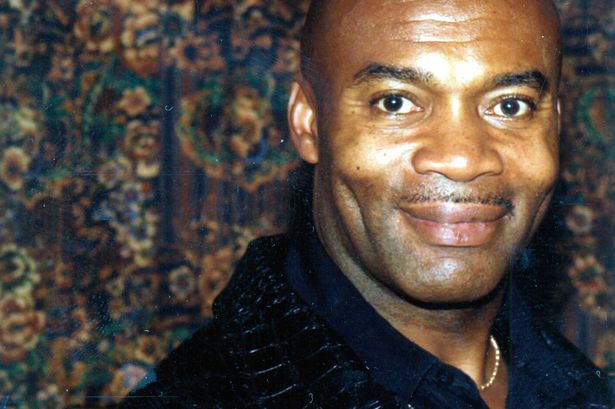
Heroic Black rapist Delroy Easton Grant
Grant certainly caused the premature death of some of those women, but he wasn’t a deliberate murderer like the Black rapist Leroy Campbell, who raped and murdered a White nurse, Lisa Skidmore, after previously serving a so-called “life-sentence” for rape and other offences. The judge who gave him a second (and perhaps genuine) life-sentence said this: “Miss Skidmore had to suffer the pain and terror of being raped by someone in her own home before she died. This was a sustained incident lasting over two hours. There was a significant degree of planning that went into the commission of these grotesque offences. Your actions on that day have had a most dramatic effect on a number of people.”
Meteor malefactors
But the Black genius for vicious crime is by no means confined to rape and murder. For example, three enterprising young Blacks were jailed in 2018 for a “‘shocking’ spree of brutal robberies … across London” in which they had sprayed “acid and alkali” into the faces of their victims. The three young Blacks did not express remorse for their crimes, probably because they didn’t feel any. Black psychopathy and its probable genetic roots were something else that the CRED report did not discuss.
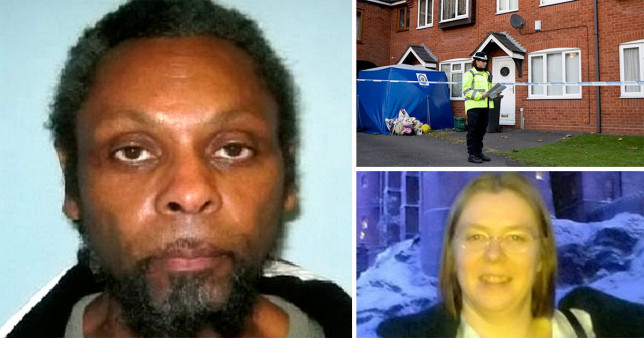
Heroic Black rapist-murderer Leroy Campbell
But that’s unsurprising. High-achieving Blacks like Delroy Grant, Leroy Campbell and the acid-throwers of London are not celebrated in Brave New Britain. They are what you might call meteor malefactors, whose misdeeds flash across the headlines and then vanish forever. But Black criminals have been having “a most dramatic effect” on the White majority ever since Blacks began arriving here in the 1950s against the clearly expressed opposition of the White majority. The CRED report did not discuss this prolonged Black predation on Whites or undertake the admittedly herculean task of estimating how many Whites have been murdered, raped, beaten and otherwise harmed by Blacks during the heroic Black settlement and subsequent Black rebellions.

A cuckservative and her controllers: Priti Patel with convicted Jewish fraudster Sir Gerald Ronson and
Jewish Board of Deputies leader Marie van der Zyl
But the Commission wasn’t set up by the cuckservative government to investigate the harm done to Whites by Blacks. As I pointed out at the beginning, both leftists and cuckservatives are agreed on the sacred central principle of politics and culture: that Blacks Bless the Benighted West. Leftists and cuckservatives merely disagree about whether Whites are as evil and oppressive towards non-Whites as they used to be. Cuckservatives don’t think Whites are, but Whites are still forbidden to have any say on how wonderful Blacks in particular are.
That’s why the Commission itself was headed by a Black, Dr Tony Sewell, who thereby gave the whole proceedings that essential glow of Numinous Negritude. At least, he did so in cuckservative and libertarian eyes. To leftists, however, Sewell is a “coconut” (brown on the outside, white on the inside), “race traitor” and “house negro” working for Whitey. How dare Sewell suggest that Britain was not “institutionally racist” and that minorities could achieve success by their own efforts despite White racism?
Crushing the left, ending the racism racket
The Marxist libertarian Brendan O’Neill hastened to the defence of Sewell and other non-Whites behind the report, condemning the “identitarian bigots” who were accusing Sewell and others of betraying their own kind. O’Neill threw up his hands in horror at “the racial conformism outrageously demanded by sections of the left” and spoke darkly of “the rise of a kind of woke racism.” In other words, he was firing the most powerful weapon in the cuckservative and libtard armoury: the deadly and devastating argument that leftists are the real racists. Well, people like O’Neill think it’s a devastating argument. Of course, they’ve been using it for decades and it’s never had the slightest effect, but they remain eternally optimistic that with just one or two more repetitions it will crush the left and end the “racism racket.”
It won’t, of course. Nor will this cuckservative report by the Commission on Race and Ethnic Disparities. One big reason for that was noted by Commissioners themselves: “We recognise that building a confident, successful multi-ethnic society is a huge and difficult endeavour.” In fact, it’s an impossible endeavour, but even if it were merely “huge and difficult,” one glaring question would remain unaddressed. Why did Britain need to become a “multi-ethnic society”? What was lacking in the land of Shakespeare, Newton, Milton, Darwin, Watt, Hume and many other giants of art, science and philosophy before it became “multi-ethnic”? What overwhelming advantages has Britain gained by importing huge numbers of illiberal tribalists with low average IQs from corrupt, violent and intellectually void countries like Pakistan, Jamaica and Somalia?
No action by cuckservatives
No advantages whatsoever, that I can see. But I and many others can plainly see the huge disadvantages of mass immigration from the Third World. They include suicide bombing, rape-gangs, honour killings, female genital mutilation, inbreeding, exotic diseases, censorship, political corruption and the massive transfer of White taxes to subsidize unproductive but fast-breeding non-Whites. And thanks to imported non-White pathologies — and the hard work of Jewish activists like Anthony Lester — ever-harshening laws have been passed to restrict the free speech and free association of British Whites, even as an immoral and voyeuristic surveillance state pries ever more closely into their private lives.
The Report by the Commission on Race and Ethnic Disparities is not going to mitigate any of those pathologies, let alone end them. As I pointed out at the beginning, the leftist view of race relations — “Blacks are Saints, Whites are Demons” — rules the media, academia, law, education, government bureaucracy, big business, sports and all leftist parties. This cuckservative government isn’t going to make any attempt to change that. For example, Tamara Finkelstein, a high-flying Jewish bureaucrat who is the “Joint Senior Sponsor of the Civil Service Jewish Network,” has supported Black Lives Matter (BLM) on an official government Twitter account and issued the stirring call to “fight racism.” Have she and similar promoters of “far-left identity politics” been reprimanded in any way? Not in the slightest. After all, Tamara is the sister of the high-flying Conservative peer Daniel Finkelstein and her commitment to “anti-racism” is almost certainly the same as his.
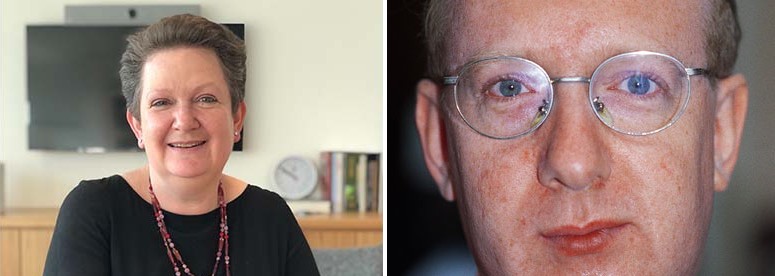
Like sister, like brother: the anti-White Jews Tamara and Daniel Finkelstein
And it was the so-called Conservative prime minister Theresa May who added “Stephen Lawrence Day” to Britain’s religious calendar. The day honours Britain’s new patron saint, a Black teenager who died after being stabbed twice by a gang of “white racists” in 1993. It was a very rare and unusual crime, because Blacks are overwhelmingly murdered by other Blacks, not by Whites. Blacks also murder Whites much more often than the reverse. But none of that matters to the martyr cult of St Stephen Lawrence, which endlessly repeats the lie that Whites are an ominous and ever-present threat to non-Whites and their welfare.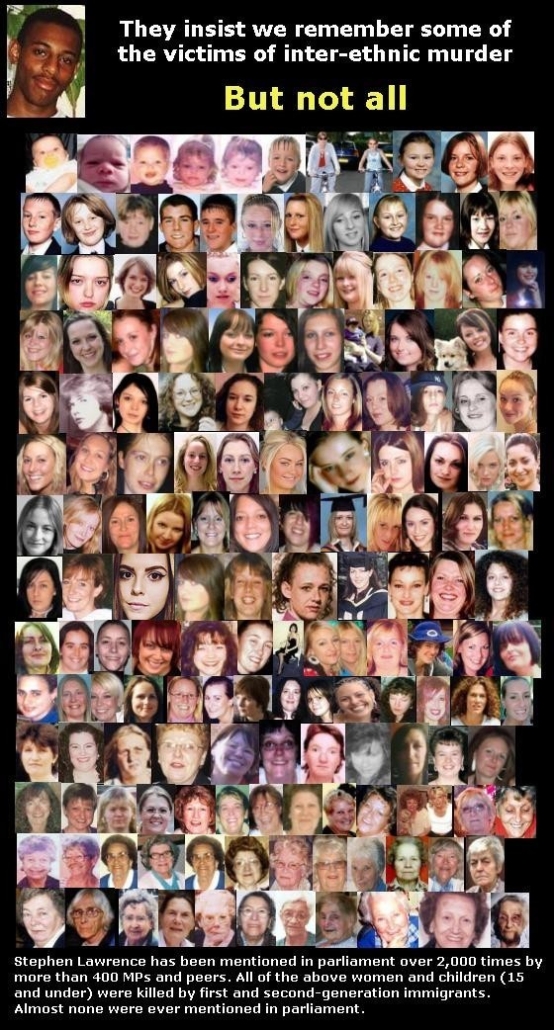
Martyr vs Meteor Murders: Stephen Lawrence is eternally remembered as the
far more numerous White victims of non-Whites are forgotten
Will the so-called Conservative prime minister Boris Johnson remove Stephen Lawrence Day from the calendar? Of course not. Nor will Johnson or any other cuckservative criticize the Stephen Lawrence Research Centre, which is working to further demonize Whites and sanctify non-Whites at De Montfort University in the ancient British city of Leicester:
The Stephen Lawrence Research Centre aims to drive forward conversations that will shape and influence how we think about race and social justice. It intends to honour the enduring legacy of Stephen Lawrence’s life and his family’s ongoing pursuit of justice by asking new questions, debating critical issues, raising awareness, and advocating to bring about positive change. …
National Stephen Lawrence Day 22 April
The 22 April 2018 marked the 25th anniversary of the senseless murder of Stephen Lawrence, a young man who had a bright future ahead of him.
At the memorial service to celebrate his life, the former Prime Minister, Theresa May, announced the annual national commemoration of Stephen Lawrence Day which is to be held each year on 22 April.
Schools and their communities are invited to use the memory of Stephen’s life and legacy as an opportunity to empower young people in their care to live their best life. Find out how to get involved. …
Stephen Lawrence Research Centre news and events
An evening with Baroness Doreen Lawrence: Bringing Legacy to Leicester
Ahead of Stephen Lawrence Day, 22 April, Baroness Lawrence will be joined by [the Trotskyist race-baiter] Imran Khan QC [Queen’s Counsel], educators, students and community leaders for a discussion on how Stephen’s legacy is inspiring a change for good across the nation. (Propaganda and mendacity issued by the Stephen Lawrence Research Centre)
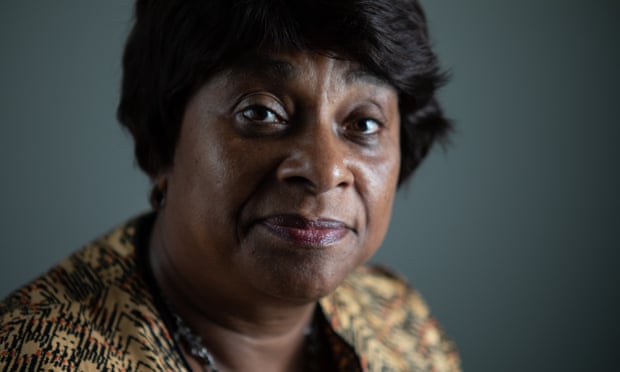
Martyr’s mother: Black Baroness Doreen Lawrence
Baroness Doreen Lawrence is the martyr’s mother, an utterly undistinguished and intellectually void Jamaican woman who has been lavishly honoured and celebrated by Brave New Britain, and is treated as the fount of all wisdom on matters of race and racism. The Guardian was delighted to report that Baroness Lawrence, who was ennobled by the treasonous shabbos-goy Tony Blair, has joined the “Shred the CRED” campaign. She has condemned the recent report for “giving racists the green light.” That’s how she expresses her gratitude for cuckservative pandering and Theresa May’s creation of Stephen Lawrence Day.
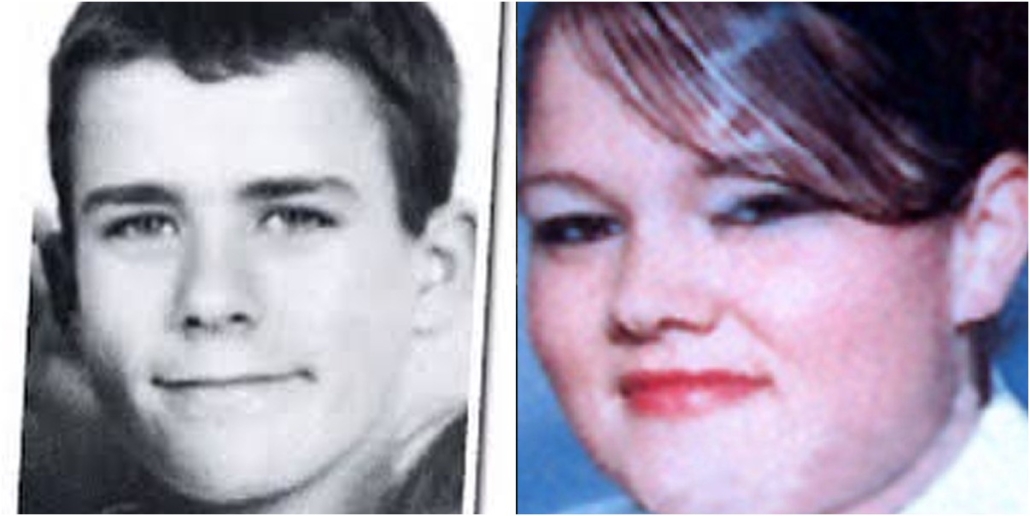
Kriss Donald and Mary-Ann Leneghan, long-forgotten White victims of horrific racist murders
In complete contrast to the saintly Doreen Lawrence, White mothers who have lost children to racially motivated murder, often in far worse ways, are never honoured or celebrated in Brave New Britain, and are never consulted on matters of race and racism. There is no “Kriss Donald Research Centre” to honour the White Scottish teenager who was kidnapped, repeatedly stabbed, and incinerated by Pakistani Muslims in 2004. And there is no “Mary-Ann Leneghan Research Centre” to honour the White English teenager who was raped, tortured and repeatedly stabbed by five Blacks and an Albanian Muslim “asylum-seeker” in 2005.
Britain is a Land of Lies
Kriss Donald and Mary-Ann Leneghan were the victims of meteor murder. The horrible details of their prolonged and agonizing deaths flashed through the British media and then vanished forever, because no mainstream institution in Brave New Britain is interested in the truth about mass immigration from the Third World. Blacks and other non-Whites are not a blessing to Britain. They are a curse imported against the will of the White majority by the hostile Jewish elite and its treasonous gentile collaborators. The overwhelmingly non-White Commission on Race and Ethnic Disparities could never admit this. It has no more interest in the truth about non-Whites than the cuckservative government who appointed it.
Like all other Western nations, Britain is a Land of Lies where liars rule, minority-worship is mandatory throughout public life, and non-Whites impose huge and growing costs on the White majority. And what should we do in the face of the lies, ugliness and evil currently rampant in the West? I think Vox Day’s advice is good. We should devote ourselves ever more firmly to what the great Catholic writer Hilaire Belloc called the “indissoluble Trinity of Truth, Beauty and Goodness.”
Tucker Carlson Doubles Down on Replacement, Explicitly Mentions White Replacement, and Targets the ADL’s Hypocrisy(!)
In a previous article I noted that Tucker Carlson’s comments on ‘replacement’ in the context of immigration had unleashed a torrent of hatred from the ADL and the liberal media. When the ADL goes after public figures, the usual response is groveling apology in a typically futile effort to prevent getting ostracized or fired. After all, the ADL’s Jonathan Greenblatt had tweeted that Carlson’s comments were “anti-Semitic, racist, and toxic.” Accusations of racism—and especially anti-Semitism—are pretty much a death sentence for anyone so accused.
So I was gratified that Carlson didn’t back down. Indeed, he doubled down, with a 20-minute opening monologue elaborating on exactly why the Democrat Party is completely wedded to importing a new electorate and has been doing so for decades. He also mentioned that Whites (and Blacks) are being replaced as voters, that the entire project is immoral, and he called out the hypocrisy of the ADL. As he notes, it’s not about compassion as usually advertised, but about power. And anyone with any brains knows it.
To date, Carlson’s monologue is the most powerful and most explicit statement in the mainstream media that Whites—as Whites—have an interest in immigration. Indeed, a vital interest. In making his argument, he discussed states like California and Virginia that have become reliably Democrat because of immigration, and he mentions Vermont that is now blue because of disenchanted New Yorkers who brought their politics with them when they moved there. He says the same thing is happening to Montana and Idaho as yoga instructors, Google vice-presidents, and assorted rich White folks leave California for greener pastures. It will happen to your state. And the result will be permanent hegemony of the left because the imported electorate are reliable clients of the Democrat Party. ‘Client’ is the right word (from the Latin for ‘dependent’) because these people come to the U.S. for better pay and all the free stuff — medical care, welfare if they have children, and the promise of eventual citizenship and the right to bring in their relatives. This description applies at least to the Mexicans, Central Americans, and Africans who have flooded our shores (that IQ thing again). They remain toward the bottom of the socioeconomic ladder and dependent on the government. Hence reliably Democrat. California went from being the envy of the world to having poverty levels on par with Mississippi. Without explicitly mentioning Whites, he notes that the middle class is leaving in droves, resulting in the cost of a U-Haul being five times higher for people leaving the state as for entering. He portrays the middle class as one of the victim groups of the Great Replacement as America is transformed into a society with a hostile, ultra-wealthy elite who are politically supported by a dependent mass of Democrat voters.
Tucker also doubled down on his voter-replacement logic, but this time he was explicit about White people’s vote being replaced, noting that Whites went from 90 percent of Californians to 30 percent since 1960, which means that how White people vote matters much less than it used to. It’s shocking to hear someone in the mainstream media claim that Whites and their vital interests are victims of the immigration tsunami. One can easily imagine a situation where, even if White Californians woke up (far too many are still drinking the Kool-Aid), they couldn’t win a statewide election. And that’s the whole point. Permanent hegemony.
But because the interests of Whites are definitely not supposed to be paramount, he emphasized that Blacks in California have also been losing political clout rapidly, with very large declines in cities like Los Angeles and San Francisco. In my previous article, I noted that the voter replacement argument doesn’t apply so much to Blacks because the people replacing them have pretty much the same politics. But I stand corrected. Identity politics has changed everything. Black Californian politicos like Maxine Waters, Willy Brown, and Kamala Harris may well become a thing of the past. Harris was replaced by Alex Padilla, a Latino, after being elevated to the vice-presidency, a result that was not warmly greeted by the Black political establishment.
California progressives had pushed [Gov. Gavin] Newsom to appoint Representative Barbara Lee [who is Black] or another like-minded Democrat. Mr. Newsom was also under pressure to appoint a Black woman to take the place of Ms. Harris, the only Black woman in the Senate. Representative Karen Bass and Ms. Lee were at the top of that list. … The Congressional Hispanic Caucus strongly backed Mr. Padilla. The L.G.B.T.Q. community and Equality California lobbied for Robert Garcia, the mayor of Long Beach. Black Women United, a co-founder of Black Lives Matter, and a range of Black elected officials pushed for Ms. Bass or Ms. Lee.
As Blacks become less of a demographic force, they will also become less of a political force. There will be less official sympathy for Black issues like BLM, reparations, dealing with criminals, and centering on Black grievance in the educational system.
Tucker also did some dog-whistling on Jewish involvement by mentioning Michelle Goldberg’s NYTimes op-ed, “We can replace them,” which celebrates replacing the White electorate by doing a screen shot of Goldberg’s statement: “The potential is there; Georgia is less than 53 percent non-Hispanic White.” He didn’t mention Goldberg’s ethnicity, but anyone who knows anything about the media knows she is a strongly identified Jew writing for a Jewish-owned publication that is the crown jewel of the elite liberal-left media. As Tucker noted, Goldberg is “a New York Times columnist, not some QAnon blogger.”
The left pretends that demographic replacement is an obsession on the right, but in fact, it’s an obsession on the left. “It’s the central idea of the modern Democratic Party.” So true. And so refreshing to hear it in the mainstream media.
As always, the left pretends that their plan to replace the White population is a moral imperative. In 2019 then-Senator Harris condemned Trump’s plan to deport illegals on the basis that Trump was trying to “remake the demographics of the country”; she tweeted that such actions are “deeply reprehensible and an affront to our values.” Of course, the left would never think of remaking the demographics of the country!
What’s immoral—and obviously so— is the left’s scheme to remake the electorate in opposition to the legitimate interests of the traditional White majority. Tucker confronted the issue head-on, turning the tables on the leftist moralizers by framing their actions as “cheating.” This is an important message for Whites to hear. What is happening to the White population of America is profoundly immoral. It’s an important message because we Whites are uniquely prone to framing our actions in moral terms. As often discussed here, a major weakness of uniquely individualist culture characteristic of the West is that individualists are highly prone to forming moral communities rather than kinship-based communities typical of the rest of the world. It’s a very exploitable weakness, and our hostile elites have taken full advantage by defining the legitimate interests of Whites as immoral, as Greenblatt and Harris do. Moral communities are fine as long as they serve the community’s interests, and in the long history of the West, they have indeed been a strength. But the problem now is that the people who define the moral communities of the West since World War II are the hostile elite who have shaped academic and media culture, i.e., strongly identified Jews and Jewish-owned mainstream media like the New York Times. So now a substantial proportion of Whites think it’s a moral imperative to replace the White population. No other culture anywhere at any time has ever felt a moral imperative to replace its founding population.
However, the best part about Tucker’s monologue was that he confronted the ADL directly by highlighting their lack of principle. Confronting any powerful Jewish organization is virtually unheard of in American media and political culture where groveling, apologies, and firing are the norm. And he chose a particularly glaring weakness in Jewish rationalizations of the adversarial culture they have championed in the U.S.: Jewish hypocrisy in claiming the moral high ground in America by insisting that any opposition to immigration is racist and hence immoral, while legitimizing Israel’s ethnocentric immigration policy because it threatens the legitimate interests of its Jewish population. In fact, these activist Jews are consummate ethnic nationalists—exactly what they condemn in White Americans. White Americans deserve just what the ADL and the rest of the activist Jewish community want for Jews, a safe homeland that remains theirs.
Granted, Carlson didn’t mention that the ADL was leading the charge against him, but anyone paying the least bit of attention to this episode knows damn well that the ADL is leading the campaign against him. Carlson quoted from the ADL website:
With historically high birth rates among Palestinians, and a possible influx of Palestinian refugees and their descendants now living around the world, Jews would quickly be a minority in a bi-national state, thus ending any semblance of equal representation and protections. In this situation, the Jewish population would be politically—and potentially physically—vulnerable. It is unreasonable and unrealistic to expect the Jewish population to expect the state of Israel to voluntarily subvert its own sovereign existence and national identity and become a vulnerable minority in what was once its own territory.
This is another recurrent theme on TOO—that the traditional White majority will become a hated and oppressed minority (58 articles) because of the immigration of non-Whites in a culture dominated by an elite with a long history of hatred toward the White majority of the U.S. We already see a multitude of examples of hatred toward Whites emanating from the elite media, liberal-left politicians, and just ordinary non-Whites (like this one from James Edwards on Twitter), and hate crimes against Whites are ignored or quickly buried. Why would anyone think this will stop if and when Whites become a minority? It will increase. But the ADL thinks that Jews, who have been and continue to be the leading force enacting a multicultural United States, beginning with their influence in passing the 1965 immigration law, should retain sovereignty in Israel because ceding sovereignty would be dangerous for Jews. This is massively hypocritical, as Tucker implies, and he invited Greenblatt on his show to explain why the same principles that he champions for Israel should not exist in the United States. I rather doubt that will happen.
In fact, Greenblatt repeated his attacks on Carlson in a letter to Fox News, demanding that he be fired while never mentioning that Carlson had broached the hypocrisy of the ADL. Pretty clearly he wants to avoid the issue like the plague. Fox News CEO Lachlan Murdoch responded with a typical mainstream media mantra: “Fox Corporation shares your values and abhors anti-semitism, white supremacy and racism of any kind.” But he rejected the argument that Carlson had endorsed “anti-semitism, white supremacy and racism,” retreating to Carlson’s original voting rights argument. Always a safe move to refuse to avoid issues that vitally affect White America by presenting them in non-racial terms.
In his letter to Murdoch, Greenblatt claimed that Carlson “did not accidentally echo these talking points; he knowingly escalated this well-worn racist rhetoric. … At a time of intense polarization, this kind of rhetoric galvanizes extremists and lights the fire of violence.”
Intense polarization indeed. That’s what happens when there is a powerful attempt to dispossess the founding population of the country. Ultimately the polarization is a result of Jewish activism which has been a necessary condition for the immigration and multiculturalism that is tearing the country apart.
Greenblatt thinks that Tucker’s message will galvanize “extremists.” Let’s hope that it does indeed galvanize the White population. In any case, it’s important for Carlson to not let this issue drop. It was courageous of him to broach the issue, but it needs to be repeated, just as the messages of the left on race and multiculturalism are continually repeated on TV, movies, print media, and throughout the educational system.
The message of White replacement is powerful. As I noted in Chapter 8 of Individualism and the Western Liberal Tradition:
Individualists are less naturally ethnocentric, and the left has created a culture that encourages Whites to inhibit expressions of ethnocentrism while encouraging non-Whites to be ethnocentric. Because the media is dominated by the left and because even the conservative media is terrified of appearing to advocate White interests, explicit messages that would encourage Whites to become angry and fearful about their future as a minority are rare [and when they occur, they are subjected to vicious attacks, as has happened to Carlson]. Indeed, the media rarely, if ever, mentions that Whites are well on their way to becoming a minority. And this for good reason: Whites in the United States and in Canada who are given explicit demographic projections of a time when Whites are no longer a majority tend to feel angry and fearful. They are also more likely to identify as Whites and have sympathy for other Whites.[1]
In other words, while I have emphasized the ability of the higher brain centers to inhibit ethnocentrism, explicit messages indicating that one’s racial group is threatened are able to trigger ethnocentrism. This is especially important because many Whites live far from the areas of their countries undergoing the demographic shifts. Their day-to-day life of living in an essentially White environment hasn’t changed while the population centers of New York, California, Toronto, and Vancouver have changed beyond all recognition from what they were 50 years ago. An obvious inference to be made is that pro-White activists should appeal to Whites’ higher brain centers with explicit messages emphasizing these transformations.
White replacement is our most powerful message. Let’s hope Tucker continues to repeat it. We certainly will.
[1] H. Robert Outten, Michael T. Schmitt, and Daniel A. Miller, “Feeling threatened about the future: Whites’ emotional reactions to anticipated ethnic demographic changes,” Personality and Social Psychology Bulletin 38 (2011): 14–25.
Matthew Bracken’s Three “Enemies” Novels
This is a dead serious warning to our overwhelmingly White audience. All readers have seen the absurd claims about “domestic terrorists” — meaning White men — surrounding the Jan. 6 Capitol “insurrection.” Since then, all manner of outlandish claims have been made about the imminent threat tens of millions of White Americans represent to our beautiful, vibrant, multicultural “democracy.”
In short, this review serves as a warning to “majority Americans” (Whites) that all institutions in today’s United States, up to and including the Federal Government, are arrayed against not just the interests of Whites, but against the continued existence of Whites. Such a thought is hard to accept for many Americans, but the unraveling of American history since 1965 inexorably shows this to be true.
I appreciate that “ordinary” Americans — that is, White Christians as viewed prior to 1965 — could be skeptical of my claims that “their” institutions (which allegedly bestow upon them endless “White privilege”) have been turned and now serve The Dark Side, but it’s quite true. Of course, thanks to the broadcast career of the late Rush Limbaugh and four years of Trump rule, many Whites have woken up to the fact that the American media is overwhelmingly opposed to majority Americans, but it goes much further, I’m afraid.
Education, from elementary through university graduate school, is rabidly anti-White. The judiciary is strongly anti-White as well, as action against Charlottesville protesters and many other cases demonstrates. And the churches? Forget it. What about the police and especially the military? Well, we’ve seen for the last year how the police have been gutted, though whether they are even implicitly pro-White is open to much debate. And finally, the military. Though the process has been in motion for years, Joe Biden’s regime has rapidly ramped up the dispossession of the traditional American military, with this graphic announcement of who the new preferred defenders of the realm are:

28th United States Secretary of Defense
Yes, all of these institutions have turned on White Americans and it will only get worse, as daily news stories show:
The Associated Press WASHINGTON — President Joe Biden on Tuesday [March 29, 2021] nominated a racially diverse and overwhelmingly female group to federal and other judgeships, including three Black women for the U.S. courts of appeals, one pathway to the Supreme Court.

Matthew Bracken
What I intend to do today, then, is to share with readers a review of novels that fictionally take us through an experience where the anti-White government does not just want to dispossess Whites; it literally hunts and kills formerly valued members of the American population. These are stories of rogue government agents with a license to kill Whites, of affirmative action hires lording it over disempowered White men, and technology such as armed drones — overwhelmingly the product of White male minds and hands — now turned lethally on the White man himself. By reading these novels, you can then more easily imagine these events literally taking place. I want this to be the first step in realizing and accepting that you—all of you, but especially White males, who are descended from eons of Europeans, are now the intended target.
The author of these three novels is former Navy SEAL Matthew Bracken, born in 1957, who modestly describes himself as an “old frogman, boat builder, sailor, novelist.” Revisiting his novels, which were written from 2003–2009, I am amazed at the prescience of this former sailor, as his imagined scenarios could be ripped from the very headlines of today’s news. Thus, it is no surprise that since writing his “Enemies” trilogy, Bracken has been a frequent popular guest and a host of The Alex Jones Show; he also made numerous videos on YouTube, including this recent one. Bracken’s voice matters.
You can visit Bracken’s well-stocked website here for tens of hours of written excerpts and more. For now, let’s focus on the first and third
novels in Bracken’s Enemies series.
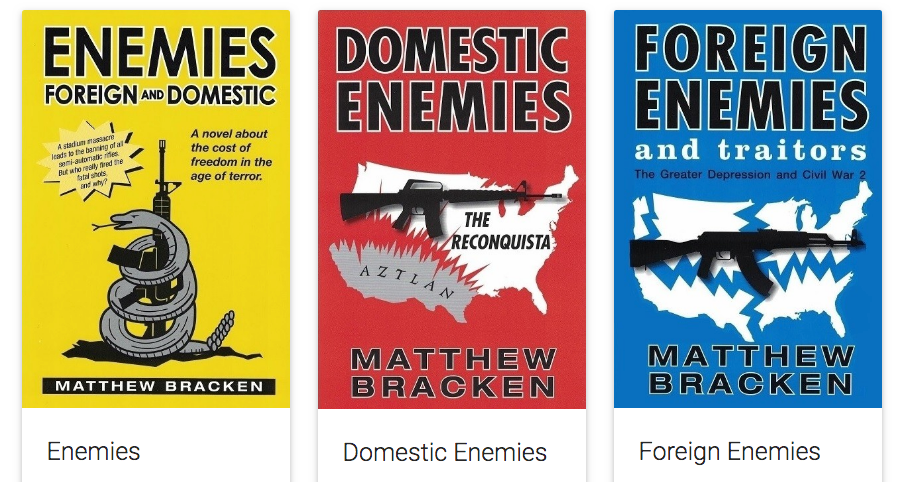
Novel 1
Appearing in 2003, two years after the 9/11 Terror attacks, Bracken’s first novel Enemies Foreign and Domestic introduces a vile government false-flag crime, a genre of conspiracy theory that has thrived since 9/11 (or the Oklahoma City Bombing of 1995 … or the Kennedy assassinations, etc. — take your pick). From the prologue onward, the prose is gripping, and Bracken has easily earned himself a place alongside action thriller writers such as Tom Clancy, Dale Brown or Stephen Coonts.
Of the many benefits of Bracken’s site, one of my favorites is his generosity with huge excerpts. (You can find the whole books online for free if you work at it; for others, you can go to Amazon or your local library.) These excerpts make it easy to copy and paste and are an excellent introduction to his writing. This is a good example illustrating his style, from the opening page of Enemies Foreign and Domestic:
The home team was set to receive the kickoff of their season opener. The 80,000 football fans packing the stadium were on their feet looking down at the two teams lined up on the verdant green field. … The crowd noise reached a sustained roar as they watched the kicker trot toward the teed-up football, they saw the two teams rush at each other, and they followed the flight of the ball high into the air.
In the midst of this jubilant bedlam, in the center of the western end zone upper deck, a forty-year-old architect from Annapolis was struck by something on the left temple. He immediately collapsed forward, spurting blood over his friends and several other fans as he fell across the seats below. His shocking injury occurred while the football was still arcing through the air and down the field, so at first the louder screaming of the fans surrounding his crumpled bleeding body went unnoticed by the rest of the crowd around them.
Every two seconds a similar scene was repeated with horrifying variations across the western upper deck stands, as one fan after another was dealt a sudden bloody wound to the face, head, neck, shoulder, arm or chest. A few victims were killed outright, and some were only slightly grazed, but many received searingly painful wounds which caused them to shriek and jerk and fling blood in all directions. Every two seconds another tableau of unexpected violent trauma was created, sending out radiating bands of fear as the shouted word spread from mouth to ear among the trapped thousands: sniper! The waves of horror emanating from each new victim spread and merged and multiplied until the entire western end zone upper deck section became engulfed in seething animal panic.
Noticing the commotion, the stadium video director focused on the activity and showed it on the fifty-foot-tall screens at the stadium, offering all 80,000 fans a view of a woman vainly trying to stanch the flow of blood from her dying husband’s face.
Police marksmen in Black scanned the stands for signs of the shooter, further alerting fans to an unfolding tragedy. The result was that mob psychology took over and hordes of screaming people rushed in unison toward the exit tunnels. Hundreds of bodies pushed against those unlucky enough to be seated by the safety railings.
The rails bent outward as the human avalanche gathered momentum, and then they buckled and victims began to tumble over. The falling victims were still holding tightly onto those above, pulling them over as well, and the solid cascade began. Dozens and then hundreds of linked victims fell past the VIP sky boxes, thudding down on the unfortunate fans packed into the lower stands ninety feet below.
In a surprisingly short time, a police helicopter had located the sniper in a building under construction a thousand yards from the stadium. Finding the shooter, a SWAT sniper aboard the helicopter put a single bullet though the murderer’s brain, killing him instantly. He was quickly identified as a White male military veteran, often homeless, and in possession of “white supremacist hate literature.” As it turned out, the White man was a patsy set up to take the blame for the massacre, while two government employees embedded in a federal agency had perpetrated the attack in order to give the government an excuse to limit the right of Americans to bear arms. This set off a powerful reaction among American patriots who wanted to rein in a wayward government. A revolution almost resulted.
Again, this appeared in book form eighteen years ago. Now factor in all the events since then, especially the last year. No wonder a character in the book says, “I just don’t know what’s happening in this country any more. I feel like a war’s coming.”
Enemies 1 features Brad, who is clearly Bracken’s alter ego, and his romantic interest, Ranya Bardiwell, a Christian Lebanese American raised in the home of a gun-shop owner who is early on slaughtered in cold blood by the same forces who killed so many at the football stadium. Ranya then becomes a sworn enemy of this murderous state.
Having grown up around guns her whole life, Ranya is both proficient in their use and knowledgeable about all facets of shooting. She puts this knowledge to use the night she returns home to the burned gun store and house, and discovers that her father’s murderers were federal agents, as proved by the spent cartridges she finds on the ground. “Ten millimeter with these marks on the brass and the dent on the top means the ‘FBI Special Edition’ MP-5. A night scope on top, and a sound suppressor. I’m guessing subsonic loads, for no sonic crack. It was the feds all the way.”
This discovery not only gives Ranya a motive for bloody revenge, it also elicits discussions about what government forces are willing to do to American citizens, which is the key message I am imparting in this essay.
Bracken spends the next few hundred pages spinning more drama, but the essential political issues have been covered. In the end, Brad, Ranya, and others kidnap one of the crooked agents, but another agent, Bob Bullard, escapes detection and is able to silence his hostage colleague. Unfortunately, Brad is also shot during the operation, and Ranya flees the region.
The action has played itself out in Bracken’s Enemies Foreign and Domestic, but it leaves one with the feeling that loose ends remain. Bullard, for example, is alive and well, a development that is of great importance in the next two Bracken novels. Further, as terrible as the events of Enemies are, the subsequent novels are far more horrific, more loaded with dystopian images of an America that Bracken fears is coming to pass.
Novel 2
I’ll be brief in my treatment of Bracken’s second Enemies novel, Enemies Domestic: The Reconquista. The action takes place in an American Southwest now ceded to those of Mexican ethnicity. In this novel, Bracken is not subtle about his views on the political correctness of modern America, inserting, stark examples portraying lesbians, for instance, as abhorrent. We learn that the new main male character Alex, an FBI agent, had his life destroyed when his wife Karin left him for a highly masculine female lover, Gretchen Bosch.
Karin works for the IRS, as does her new lover Gretchen, and when all three were attending the Federal Law Enforcement Officers annual picnic, the hulking Gretchen had attacked Alex with an aluminum baseball bat, causing Alex to protect himself by restraining her. For this, he has been charged with assault, a fact Karin and a feminist judge use against him in the child custody proceedings over son Brian. The female judge thunders at the defense lawyer,
Silence! I’ve heard enough. More than enough! The irrational homophobic attitude of your client is very well known to this court. He’s lucky he wasn’t charged with hate crimes after that picnic incident! If Special Agent Garabanda can’t deal with the fact that his ex-wife is dating a woman, that does not speak well to his stability nor to his socialization, not to mention his fitness to share in the raising of their son.
Bracken continues to mock the views of the “socially progressives” when, for instance, Alex objects to his wife dressing their five-year-old son in pink, and the wife responds that it is “orchid.” Continuing, she scolds, “We just think you’ve already done enough damage to Brian’s psyche, that’s all. You’ve tried your best to turn him into a little macho man, always playing with toy guns and wearing camouflage. Well, we’re breaking your chain of patriarchy. We’re not going to inflict another heterosexist creep like you on the world!”
As in all three novels, the action here is engrossing and is generally impossible to separate from actual news in the headlines of the last two decades. And now that Bracken has discussed his fictional Southwest, he will turn to the American South for his third novel, the subtitle of which is “Civil War 2,” which turns out to be appropriate for both the novel and today’s America.
Novel 3
Enemies and Traitors: The Greater Depression and Civil War Civil War 2 reintroduces Vietnam-era Green Beret Phil Carson, a character from the original novel. He is sailing through the Gulf of Mexico alone in his boat but a horrible hurricane has devasted the Gulf coast. Politically, the United States is a shambles, with the Southwest ceded to Mexicans, the Northeast and Great Lakes “a socialist nightmare,” and the South broken into parts under the control of a mulatto generalissimo and states absolutely devastated by massive earthquakes. Only the Northwest region remains free. And the White House is occupied by one Jamal Tambor, a thinly disguised stand-in for former President Barack Obama.
Carson aims for the free Northwest, but it’s a long slog. Soon enough, he ends up in a refugee camp in Mississippi, where a surviving surgeon recounts the last year:
We lost more than half of the medical staff, most of my colleagues, including a lot of old friends, and including my only son and most of his family. I can take you to see the mass graves! . . . Cameroon fever, bird flu, cholera, dysentery, beriberi . . . you name it, we fought it. We even lost thousands to pellagra. Pellagra!. . . It brings the four Ds: diarrhea, dermatitis, dementia and death — just from a lack of niacin, because of a shitty starvation diet with no protein. We were right back to square one, we went back a century in medicine . . .
North of them, what remains of the federal government is intent on bringing the states of Kentucky and Tennessee back under federal control, but White troops will not brutalize fellow Whites enough to accomplish this. Instead, the “true enforcers” are “contract battalions” recruited from “Nigeria, Pakistan, Bolivia, Kazakhstan, Turkey, Albania and a dozen other nations.” Carson learns all too well what this entails when he begins his trek into Tennessee.
Traveling alone on foot, Carson is no match for the power of even this reduced federal force plus foreign mercenaries. Set up this way, the plot allows Bracken to present a reverse picture of what Americans are more accustomed to seeing: Advanced American technology used to subdue Brown adversaries in places like Iraq, Afghanistan, and Libya. Now that same technology is turned on White American men, women and children.
Most prominent among these weapons are drones, which are employed against American civilians with terrifying results. Naturally, one of the missions on which drones (“unmanned aerial vehicles,” or UAVs for short) are used is surveillance. “In the areas slated for complete evacuation, the holdouts could be located by the UAVs and targeted for special action as needed, county by county.”
Bob Bullard is in charge of these tools and he has no qualms about employing them liberally. In one early scene, Bullard asks to see a video of a successful termination of an armed curfew violator. “In the first video clip, the infrared image of a man was clearly seen flitting in and out of the brush along a tree line. The man, hotter than his surroundings, was seen as a White figure walking against a dark background of trees and bushes.” He was quickly painted by invisible laser energy, then blown to bits by a one-pound charge attached to a rocket launched unseen and unheard from above. After the white-hot explosion, “the man was gone, replaced by scattered white hotspots on the ground.”
Bracken personalizes this targeted assassination by showing the dead man as a White father who has now left his only remaining child an orphan. Son Zack is experiencing the trials of Job himself. His father had been a survivalist who had seen the economic troubles coming and prepared for them. Unfortunately, tragedy was to be the family’s close friend. Deeply religious, they had expected God to protect them, but the floods and quakes and attendant flu had first taken twins Becky and Annie. “Becky had died first and Annie a day later, both drowning in their own lung fluids.
Zack and his family had prayed continuously, to no effect.” Then his younger brother Sammy slashed himself while chopping wood, but even the family’s most potent antibiotics had not saved him. His mother had a stock of pills for her depression, but when they ran out, the woes of the world overwhelmed her and, either deliberately or by accident, she and baby Sarah had fallen from a railroad bridge and drowned in the swift waters below.
One evening his father had slipped out of the house late, after which Zack heard a single bang — then waited in vain for his father to return. He didn’t find his father — what was left of him — until the middle of the next day. . . . His father had been blown to pieces, his powerful body shattered. Even his shotgun had been blasted into a bent piece of junk. Zack hid in the woods near the human fragments of his father, shaking, crying, and wondering what to do next. He also found pieces of rocket casing and what was probably part of a rocket tailfin knifed into a tree near the body. His father had been the one killed by the drone attack described above.
Tennessee is where the federal government, aided by non-White foreign mercenaries, is fighting the local White population. Carson eventually joins a band of White former soldiers and together they attempt to restore their liberty and freedom. Doug is a young fellow rebel, and Carson asks him, “So how did you wind up fighting a guerrilla war in Tennessee?”
Doug smiled wistfully. “It’s a long story. To start with, I was drafted. I was going to the University of Maryland, majoring in communications, but I had to drop out after my junior year because I couldn’t afford the tuition. Unfortunately I’m just a Category 7 — a healthy heterosexual Christian White male. That’s the bottom, the baseline. My tuition was tripled with no warning, so that was that. They pulled my student loan and I couldn’t get any kind of extension, so I was back at home living with my mom.”
Bracken is right about such a White male’s place in current American society.
Bracken is also astute regarding the way Blacks are manipulated by hidden powers to do the bidding of the Washington regime, predicting unexpectedly the antics of Black Lives Matter half a decade later. Doug describes his recollection of how his version happened:
It was shock therapy. Especially when the Poor People’s Party marched through Baltimore. There were already about a million of them camping out in Washington on the National Mall before the convention. When they took off walking to Philly, it was like a dam bursting. That was on Labor Day. Mile after mile of people with flags, signs, drums, musical bands on trucks — everything you can imagine. Police cars were escorting them, leading them up I-95. They closed the northbound lanes of 95 for something like twenty miles, for the whole time it took them to walk to Philly. …
Naturally, our own locals got into the spirit and joined the march. They took whatever they wanted from any stores along the way, and the police just watched. There was nothing they could do anyway, or it would have caused the biggest riot in history. It was legalized looting, that’s all it was. Legalized looting, all over Baltimore. “Redistributing the wealth,” they called it. We stayed locked in our house and watched it all on television. It would have been suicide to go out and see it in person.
Yes, Bracken champions the view that Black city dwellers are either one step away from being barbarians or actually at that stage, and in Civil War 2 we find mostly negative descriptions of Blacks and their behavior. The bulk of the discussions revolving around Blacks concerns their actions after massive earthquakes have turned Memphis into a living hell, narrated by Doug, the White rebel heard from above:
There was rioting and looting in St. Louis and Nashville, but the video coming out of Memphis was the worst. Video shot from helicopters. It was like the end of the world down there. It seemed like half of that city was unreinforced masonry — brick — and most of it went down. Even regular wood-frame houses were shaken to pieces. All kinds of natural gas lines go through there; it’s like a big energy corridor from the Gulf to the Northeast. Well, at least it was. The gas pipelines broke in a million places, and a lot of Memphis burned to the ground. Then it was the chemical plants. They had all kinds of chemical plants and fuel farms along the Mississippi, and the ones that didn’t burn spilled. It was a mess! And smack in the middle of all of that, a million people. No electricity, no drinking water, no gas stations or supermarkets open, roads blocked, bridges down. … You couldn’t imagine such a place.
It got worse. Another massive quake hit and destroyed even more of the city, and Doug just barely survived. Unfortunately, he was captured by a gang of roving Blacks:
You can’t even imagine how freaking scary it was. Thousands of birds were going insane, screaming and flying in every direction, just flying straight into things and breaking their necks. Lightning was striking all around us. The sky was kind of a sickly yellow from the chemical fires that were still burning over on the Mississippi River, and there was a new sulfur smell just to remind you that hell was opening up. You could smell it: the sulfur was so strong it burned your nose. It was apocalyptic, super-natural, anything you can think of like that — times ten. …
At this point, Bracken envisions savage behavior on the part of many Black citizens of Memphis. Starving, they have turned to cannibalism, and Doug is on the menu. “There were legs and arms hacked down to the bones,” Doug observes, “and a fire pit, with the big iron grill over it. There were even decapitated heads, set in a row. I was lying on my side, and I looked over and saw a severed head that almost seemed like it was looking back at me.” Doug continues, noting that “The cooking grill was a wrought-iron gate, propped up on angle iron legs that were driven into the dirt. There was a square hole in the cement, where they had built their fire. Now I could understand what they had been talking about. That’s why they had been pinching and squeezing me.” Such food even has a name in the novel: “long pig.”
The cannibals are Black, smoke a lot of marijuana, and get drunk. Further, the leader of the cannibals is fiendish looking, as described by Doug: “We were nose to nose. He looked like the devil himself, his eyes glowing yellow in the firelight.” When the leader addresses his intended meal, he says, “White boy, I’m gonna untie you, and then you gonna get all naked and give me them Army clothes,” so we know Bracken is quite aware of racial differences.
In all three of these novels, Bracken imagines that Whites have the gumption to stand up to the trials they face, but is he right about that? It seems like the bulk of Whites — even in this current year — refuse to face reality. I mean, do Whites read what Paul Kersey writes about crimes against Whites? If they do, does it mean anything to them?
Take, for instance, Kersey’s recent discussion about United Airlines intending to replace new White male pilots with women and non-Whites. Without a doubt, Kersey is right to conclude, “Nothing else to say. Every segment of American society is anti-White, to the detriment of the society White people uniquely created…. America, as presently constituted in its extreme anti-Whiteness, is irredeemable.”
Paul Craig Roberts, who probably qualifies (with great justification) as a grumpy old White man, has also forcefully pointed out the same thing. “It is the White liberals in the Democrat Party and their presstitute propaganda machine— New York Times, CNN, NPR, Twitter, Facebook, YouTube, and the rest of the presstitute whores — that comprise the new Nazi movement. The only difference is that this time the target is White gentiles.”
Roberts continues: “The demonization of American White people is a hard undeniable fact. They have been discriminated against for decades because of racial quotas in university admissions, hiring, and promotion. But now discrimination against Whites has become persecution, and it is more scary….”
Can today’s Whites survive?, Roberts asks. “They cannot. And they sit there, insouciant, sucking their thumbs, sheep ready for slaughter.” Reread this sentence three times, then reflect on it seriously.
Another time, Roberts concluded, “White Gentile Americans Are Today’s Untermensch.” Is he wrong? Over a decade ago, Bracken was making these arguments in his three Enemies novels. But Bracken had faith that enough Whites still had the spirit and strength to stand up for themselves and the country their White ancestors had created. I wish I could be as certain. Perhaps by reading one or more of Bracken’s novels, more Whites will finally realize the mortal situation we all face. Then the time will come to either whimper and die — or finally stand up and fight.
And with those words, I have prepared the way for my next review of novels: those of the late Harold A. Covington, whose five Northwest Novels were for a time the center of great discussion about The War on Whites and how Whites might fight back.

Also available at Barnes & Noble

Also available at Barnes & Noble

